

- Market Size (2026)
- USD 2.7 Bn
- Forecast (2036)
- USD 5.4 Bn
- CAGR (2026 to 2036)
- 7.2%
How big is magnetic separation mining market size?
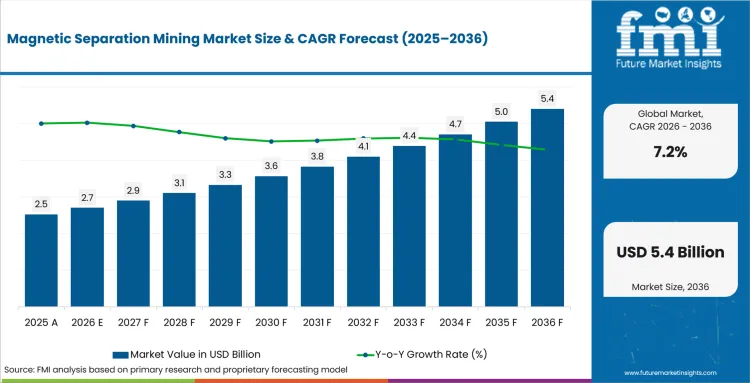
USD 2.7 billion in 2026 and USD 5.4 billion by 2036 at a 7.2% CAGR.
Sales of magnetic separation mining are estimated to rise at 7.2% CAGR through 2036, increasing valuation from USD 2.7 billion in 2026 to USD 5.4 billion by 2036. Mineral processors deploy magnetic separation systems to extract target minerals and strip away magnetic impurities from raw ore. Metso introduced scalable separation units capable of handling between 70 and more than 2,000 tonnes per hour during October 2025. This broad capacity range allows engineering teams to transition smoothly from early pilot testing to full-scale commercial plant operations. Combining integrated processing equipment with standardized controls actively reduces operational friction across complex separation circuits.
Site-tested recovery evidence and prompt local service responses heavily influence equipment selection among operators in Australia and Canada. Mining groups in Brazil and Chile mining groups prioritize steady feed stability and consistent concentrate grades to maximize output across high-volume ore programs. Ongoing equipment wear and abrasive slurry handling make guaranteed technical support a critical factor for final procurement approval. Metso established 24-hour, 7-day service coverage at its Karratha maintenance facility in March 2025. Continuous local assistance ensures prompt corrective repairs for extensive mining operations across Western Australia. Dedicated regional service networks help plant managers safeguard equipment availability through proactive maintenance schedules and immediate emergency interventions.
Key Takeaways for the Magnetic Separation Mining Market
- Demand for magnetic separation mining receives support from declining ore grades and greater beneficiation requirements.
- Direct sales are predicted to garner 47.0% share of distribution channel in 2026. Site testing and equipment sizing strengthen commissioning support.
- Mining companies are estimated to lead end user with 44.0% share in 2026. Direct responsibility covers recovery performance and concentrate quality.
- Feed variability and inadequate liberation form principal barriers during scale-up. Abrasive slurry service also raises maintenance exposure across magnetic drums and high-intensity systems.
- Competition focusses on Metso Corporation, Eriez Manufacturing Co., SLon Magnetic Separation Co., Ltd., and STEINERT GmbH. Mineral Technologies, Multotec, Bunting, and GTEK Magnet complete named competition.
Analyst Perspective
“Magnetic separation investment gains commercial support depending on repeatable recovery and concentrate-grade evidence. Mine teams examine ore variability and liberation performance during equipment review. Wear life and service response guide final approval. Stronger conversion follows site trials connecting laboratory results with stable plant throughput.”
Nikhil Kaitwade, Principal Analyst for Industrial Automation at Future Market Insights
How is Magnetic Separation Mining Market segmented?
The magnetic separation mining industry is segmented by product type, application, end user, distribution channel, technology, and region.
The magnetic separation mining sector is segmented by product type, application, end user, distribution channel, technology, and region. Product type coverage includes wet magnetic separators, dry magnetic separators, magnetic drums, magnetic pulleys, and overband magnetic separators. Application coverage addresses iron ore processing, coal processing, rare earth mineral processing, industrial mineral processing, and recycling and slag processing. End-user coverage spans mining companies, mineral processing plants, metal recycling companies, industrial mineral producers, and research and government organizations. Distribution channel coverage includes direct sales, authorized distributors, engineering procurement and construction companies, online B2B platforms, and aftermarket suppliers. Technology coverage includes permanent magnetic technology, electromagnetic technology, high-intensity magnetic separation, low-intensity magnetic separation, and hybrid magnetic separation. Regional coverage includes North America and Latin America together with Western Europe. Eastern Europe and East Asia extend analysis across established mining industries. South Asia and Pacific with Middle East and Africa complete geographic assessment.
What keeps wet magnetic separators central to product type selection?
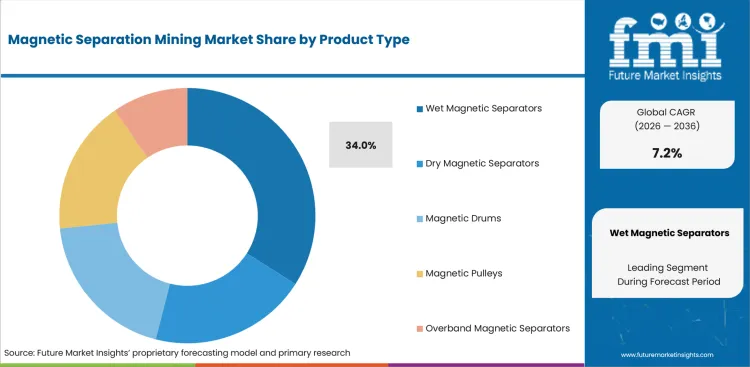
Wet magnetic separators handle fine magnetic particles suspended in water across iron ore and industrial mineral circuits. Slurry contact improves particle presentation across drum surfaces during repeated cleaning stages. Metso reported wet LIMS treatment from a few micrometres to below 6 to 8 millimetres in October 2025. Size coverage supports fine-particle recovery across grinding circuits using controlled pulp density and magnetic field intensity.
- Based on product type, wet magnetic separators are set to represent 34.0% share in 2026 as it reflects established use across fine magnetite recovery and contaminant removal. Buyer assessment covers recovery stability and drum loading as wash-water control shapes maintenance access during continuous plant operation.
- Dry magnetic separators serve crushed ore and low-moisture feeds lacking slurry preparation requirements. Equipment selection reflects feed size and dust control as belt presentation influences magnetic susceptibility during early beneficiation.
Why does iron ore processing lead application demand?
Iron ore processing uses magnetic separation across magnetite concentration and impurity removal. Circuit performance connects crushing and grinding with classification. Separation output then moves through dewatering and concentrate handling. Metso reported equipment for a 30-million-tonne magnetite concentrator at Tonkolili in December 2025. Project scale illustrates direct equipment demand created by large beneficiation programs requiring stable recovery and concentrate output.
- By application, iron ore processing is likely to account for 38.0% share in 2026 owing to established magnetite recovery routes and concentrate-grade requirements. Plant teams compare mass pull and recovery as energy use and pellet suitability complete circuit review.
- Coal processing and rare earth mineral processing use magnetic systems for impurity control and weakly magnetic mineral recovery. Application expansion rests on mineral-specific test work proving separation response across actual feed variability.
What supports mining companies across end user demand?
Mining companies control ore characterization and capital approval. Operating targets and plant maintenance stay under direct oversight. Direct ownership of recovery outcomes encourages supplier review across test work and site service. Vale reported 83.6 million tonnes of iron ore production during 2Q 2025 in its July 2025 release. High production volumes create recurring pressure for stable beneficiation performance across changing feed sources and plant campaigns.
- In 2026, mining companies are expected to hold 44.0% share since being influenced by direct responsibility for ore recovery and plant availability. Internal engineering teams examine scale-up evidence and spare-part access as wear life and operator training guide supplier selection.
- Mineral processing plants focus on stable feed treatment across contracted or multi-source ore streams. Commercial confidence improves based on documented acceptance criteria connecting concentrate quality with throughput and service intervals.
Why does direct sales lead distribution channel demand?
Direct sales promote detailed test work and flowsheet design. Equipment sizing then informs installation and commissioning. Complex ore behavior requires direct technical exchange between mine teams and separator specialists. Metso reported plant availability above 95.0% at Kaunis Iron in January 2025. Close service coordination supported maintenance planning and stable performance across magnetic separation and connected processing equipment. Direct supply relationships also support sorting equipment integration across pre-concentration and material-cleaning stages.
- Direct sales are projected to secure 47.0% share in 2026, influenced by application engineering and site-specific performance commitments. Customers examine test protocols and commissioning duties as acceptance measures guide spare-part coverage and service response.
- Authorized distributors and engineering procurement & construction (EPC) companies extend access across regional projects and replacement needs. Channel value rises due to local inventory and installation coordination as original equipment specialists provide technical escalation.
How does permanent magnetic technology shape technology selection?
Permanent magnetic technology provides continuous magnetic force without energized coils during separation. SLon reported a separator processing up to 2,500 tonnes per hour in August 2025 during a new-equipment presentation. High-capacity design lowers unit count across selected circuits and supports concentrated maintenance planning.
- Permanent magnetic technology is estimated to garner 36.0% share of technology in 2026, backed by low auxiliary power requirements and continuous field availability. Buyer review covers field stability and drum geometry as material temperature and particle loading shape replacement planning.
- Electromagnetic technology and high intensity magnetic separation address weakly magnetic minerals requiring adjustable field conditions. Adoption rests on recovery gains exceeding added power and cooling as control and maintenance requirements complete economic review.
What are drivers, restraints, and opportunities in Magnetic Separation Mining Market?
Ore beneficiation requirements support equipment demand and feed uncertainty slows plant approval. Integrated test work and staged separation create expansion potential across lower-grade resources.
- Driver: Declining ore quality increases demand for separation circuits improving concentrate grade and recovery. Mine operators seek lower downstream load through earlier removal of non-magnetic material.
- Restraint: Variable feed mineralogy weakens repeatability across laboratory testing and plant operation. Inadequate liberation also reduces recovery despite greater magnetic field intensity or longer residence time.
- Opportunity: Providers may combine ore characterization with pilot work and staged magnetic separation. Sensor control improves decisions across equipment sizing and operating adjustment.
Large concentrator projects require dependable beneficiation equipment across growing ore volumes. Metso reported a planned output of 12.6 million tonnes of high-grade iron ore concentrate annually for an Oman plant in June 2025. Scale creates demand for coordinated grinding and separation capacity. Thickening and dewatering need alignment within one operating plan. Magnetic separation suppliers gain stronger order prospects led by evidence linking recovery improvements with stable concentrate production.
Feed variability restricts transfer from laboratory performance into operating plants. Scientific Reports evaluated 613 iron ore samples in September 2024, finding lower-recovery cases more exposed to liberation and unmeasured ore factors. Plant teams therefore require representative sampling across ore domains and operating ranges. Approval weakens if pilot data omit particle size and mineral texture. Slurry conditions or field-intensity changes also need inclusion.
Circular ore recovery creates equipment openings across tailings retreatment and secondary mineral streams. Vale reported 26 million tonnes of ore from circular sources during 2025 in its April 2026 annual-report release. Magnetic separation may support recovery from stockpiles and tailings. Slag and mixed mineral residues require suitable characterization. Equipment providers serving metal recycling programs may also apply magnetic removal across ferrous recovery and contaminant control.
How are country CAGRs aligned in Magnetic Separation Mining Market?
| Country or Market | CAGR |
|---|---|
| Australia | 8.9% |
| Chile | 8.4% |
| USA | 7.9% |
| Brazil | 6.7% |
| Canada | 6.3% |
| South Africa | 6.0% |
| Kazakhstan | 5.2% |
Source: Future Market Insights analysis, 2026.
How do country-level CAGRs compare in Magnetic Separation Mining Market?
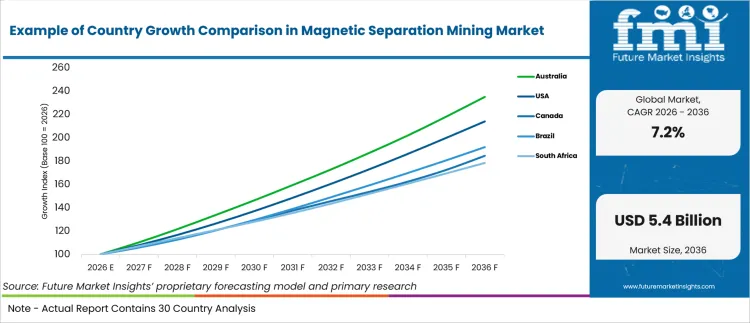
Country comparison shows a gradual step-down across profiled markets. Australia occupies first position, followed by Chile and United States. Brazil and Canada form a middle-lower band across disclosed forecasts. South Africa and Kazakhstan complete comparison under slower equipment-conversion conditions. A 3.7 percentage-point spread separates Australia from Kazakhstan. National rates reflect different mine pipelines and ore characteristics. Service access and capital timing influence country positions.
- Australia is anticipated to lead profiled markets due to extensive iron ore operations and established processing-service capacity.
- Chile is likely to follow Australia depending on magnetite output and continued concentrator development across northern mining regions.
- The United States is expected to form third position led by taconite processing and renewed direct-reduction feed investment.
- Brazil and Canada are projected to occupy adjoining positions supported by large iron ore production systems.
- South Africa and Kazakhstan are estimated to complete disclosed comparison under distinct operating and investment cycles.
Similar CAGRs are likely to conceal different entry requirements across mineralogy and project scale. Local service and plant acceptance alter commercial entry.
Country-wise Analysis
- Magnetic separation mining demand in Australia is forecast to expand at 8.9% CAGR between 2026 and 2036, driven by large iron ore volumes and established beneficiation operations. Pilbara projects favor equipment backed by nearby service and wear support. Repeatable concentrate performance strengthens plant approval. Office of the Chief Economist reported 902 million tonnes of Australian iron ore exports during 2024 in its March 2025 publication, sustaining extensive processing requirements across major producing regions.
- CAP reported more than 15 million tonnes of iron ore shipments during 2024 in its March 2025 integrated reporting cycle. Chilean operators require separation circuits suited to magnetite and pellet feed. Changing ore characteristics influence Atacama and Coquimbo operations. Sector in Chile is estimated to rise at 8.4% CAGR during the assessment period, aided by active iron ore production and concentrator renewal.
- Minnesota taconite operations provide an established base for magnetic concentration and pellet-feed preparation. Industry in United States is projected to record 7.9% CAGR from 2026 to 2036, reflecting plant modernization and direct-reduction feed requirements. Minnesota Department of Revenue reported 28.5 million tons of taconite production during 2025 in its March 2026 data release, supporting continued demand for grinding and magnetic separation capacity.
- Magnetic separation mining sales in Brazil are anticipated to scale at 6.7% CAGR by 2036, underpinned by extensive iron ore operations and concentrate expansion. Vale reported 336 million tonnes of iron ore output during 2025 in its January 2026 production release. Large operating volumes sustain recovery control and equipment availability requirements. Feed-specific circuit adjustment supports stable concentrate output.
- Natural Resources Canada reported 70 million tonnes of iron ore concentrate and pellet production during 2024 on its page modified in October 2025. Canadian mines require equipment suited to Labrador Trough ores and remote locations. Demanding service conditions influence supplier selection. Sector in Canada is predicted to progress at 6.3% CAGR during the study period, led by concentrate output and modernization across established plants.
- South African equipment demand reflects iron ore production cycles and mineral mix. Concentrator investment timing guides equipment conversion. Sector in South Africa is expected to raech 6.0% CAGR between 2026 and 2036, guided by plant optimization and recovery requirements. Statistics South Africa reported a 1.9% year-on-year decline in iron ore production during January 2026 in its March 2026 release, reinforcing supplier focus on efficiency and operating stability.
- Magnetic separation mining market in Kazakhstan is likely to grow at 5.2% CAGR during the forecast period due to measured equipment conversion across developing mineral projects. Bureau of National Statistics of Kazakhstan reported 9.4% expansion in mining and quarrying during 2025 through its January 2026 release. Project progress relies on ore-specific pilot results and logistics access.
Who are notable companies in Magnetic Separation Mining Market?
Metso Corporation, Eriez Manufacturing Co., SLon Magnetic Separation Co., Ltd., STEINERT GmbH, Mineral Technologies, Multotec, Bunting, GTEK Magnet, Yantai Jinyuan Mining Machinery Co., Ltd., and LONGi Magnet Co., Ltd. are notable companies in magnetic separation mining.
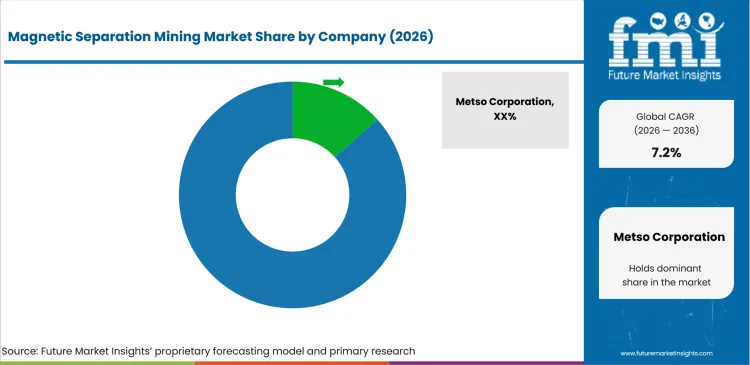
Competition in the market centers on separation recovery and concentrate grade. Throughput and service access influence supplier review. Integrated suppliers combine test work with connected processing equipment and field service. Magnetic-separation specialists emphasize drum design and high-gradient systems. Regional suppliers compete through delivery timing and local installation. Buyer review covers pilot evidence and process guarantees. Wear life and commissioning responsibility guide final selection.
- Metso Corporation and Multotec compete depending on integrated mineral-processing knowledge and plant-service reach. Mining teams assess flowsheet design and equipment compatibility across complete beneficiation programs.
- Eriez Manufacturing Co. and SLon Magnetic Separation Co., Ltd. compete based on specialist magnetic-separation portfolios. Customer evaluation focuses on mineral response and field intensity through application-specific test work.
- Bunting and LONGi Magnet Co., Ltd. address permanent-magnet and material-handling requirements across mining and industrial processing.
- GTEK Magnet and Yantai Jinyuan Mining Machinery Co., Ltd. serve project and replacement demand across regional processing operations. Commercial selection reflects delivery schedules and technical communication.
Competitive Benchmarking: Magnetic Separation Mining Market
| Company | Separation Portfolio | Mineral Processing Knowledge | Project Capability | Service Reach |
|---|---|---|---|---|
| Metso Corporation | High | High | High | Global |
| Eriez Manufacturing Co. | High | High | High | Global |
| SLon Magnetic Separation Co., Ltd. | High | High | High | International |
| STEINERT GmbH | High | High | High | Global |
| Mineral Technologies | Medium | High | High | Global |
| Multotec | Medium | High | High | International |
| Bunting | Medium | Medium | Medium | Global |
| GTEK Magnet | Medium | Medium | Medium | International |
| Yantai Jinyuan Mining Machinery Co., Ltd. | Medium | Medium | Medium | Selected regional programs |
| LONGi Magnet Co., Ltd. | High | Medium | High | International |
Source: Future Market Insights competitive analysis, 2026.
Key Developments in Magnetic Separation Mining Market
- In July 2025, SLon applied wet low-intensity and high-gradient magnetic equipment across a Zimbabwe cesium separation plant. Full-process application expanded magnetic separation into a complex rare-metal route previously dominated by flotation.
- In January 2026, SLon reported an ultra-large VPHGMS installation for a 600-tonne-per-hour ilmenite tailings recovery project in Sichuan. Modular electromagnetic construction supports transport and installation. Simplified maintenance benefits large-capacity tailings retreatment plants.
- In February 2026, Metso and Loesche introduced dry vertical-roller grinding for mineral-processing flowsheets. A base exceeding 2,400 industrial references supports mineral liberation improvements feeding downstream magnetic separation and other beneficiation stages.
Magnetic Separation Mining Market Report Scope
| Coverage field | Report scope |
|---|---|
| Market breakdown | Magnetic separation mining market breakdown includes product type, application, end user, distribution channel, technology, and region. |
| Quantitative Units | Revenue in USD billion in 2026 and CAGR in %. |
| Market Definition | Magnetic separation mining includes wet and dry separators, drums, pulleys, overbands, high-intensity systems, controls, parts, and related services used during mining and mineral processing. Coverage includes equipment recovering magnetic minerals or removing magnetic contaminants. Generic magnets lacking mining or mineral-processing use are excluded. |
| Regions Covered | North America, Latin America, Western Europe, Eastern Europe, East Asia, South Asia and Pacific, Middle East and Africa. |
| Countries Covered | Australia, Chile, USA, Brazil, Canada, South Africa, Kazakhstan, and more than 25 additional countries complete full report coverage. |
| Key Companies Profiled | Metso Corporation, Eriez Manufacturing Co., SLon Magnetic Separation Co., Ltd., STEINERT GmbH, Mineral Technologies, Multotec, Bunting, GTEK Magnet, Yantai Jinyuan Mining Machinery Co., Ltd., and LONGi Magnet Co., Ltd. |
| Forecast Period | 2026 to 2036 |
| Approach | Hybrid bottom-up and top-down methodology uses segment shares and country CAGRs. Company activity, mining output, equipment demand, and buyer adoption support final market reconciliation. |
Source: Future Market Insights scope analysis, 2026.
Magnetic Separation Mining Market - Research Methodology
| Method | Approach |
|---|---|
| Primary Research | FMI analysts gathered input from manufacturers, service providers, technology developers, distributors, end users, procurement teams, and subject-matter experts. Interviews examined purchasing decisions, product or service evaluation, adoption barriers, approval requirements, pricing considerations, and expectations for technical or commercial support. Respondents were also asked what evidence is required before a trial, pilot, or initial order develops into regular purchasing. |
| Desk Research | Desk research covered government statistics, regulatory publications, trade data, industry associations, technical literature, standards, company filings, product information, and official corporate announcements. Sources were reviewed for relevance, publication date, geographic coverage, and consistency with the defined market scope. Claims relating to performance, applications, approvals, capacity, investment, and commercial activity were retained only when supported by credible public evidence. |
| Market Sizing and Forecasting | The market model combined the baseline value with historical performance, segment structure, pricing and volume indicators, adoption levels, company participation, and country-level demand conditions. Forecast assumptions considered economic activity, investment trends, regulatory developments, technology adoption, purchasing cycles, supply availability, and barriers to wider market use. Segment and regional estimates were reconciled before the final market total was calculated. |
| Data Validation | Estimates were checked against multiple independent indicators, including public data, company activity, trade patterns, industry developments, and findings from primary interviews. Validation also tested whether products, services, applications, and company revenues fell within the defined market boundaries. Adjacent categories, unsupported claims, overlapping revenues, and activities without direct market relevance were excluded to reduce double counting and maintain consistency across segments and countries. |
Source: Future Market Insights analysis, 2026.
Magnetic Separation Mining Market by Segments
Magnetic Separation Mining Market segmented by Product Type:
- Wet Magnetic Separators
- Dry Magnetic Separators
- Magnetic Drums
- Magnetic Pulleys
- Overband Magnetic Separators
Magnetic Separation Mining Market segmented by Application:
- Iron Ore Processing
- Coal Processing
- Rare Earth Mineral Processing
- Industrial Mineral Processing
- Recycling & Slag Processing
Magnetic Separation Mining Market segmented by End User:
- Mining Companies
- Mineral Processing Plants
- Metal Recycling Companies
- Industrial Mineral Producers
- Research & Government Organizations
Magnetic Separation Mining Market segmented by Distribution Channel:
- Direct Sales
- Authorized Distributors
- Engineering Procurement & Construction (EPC) Companies
- Online B2B Platforms
- Aftermarket Suppliers
Magnetic Separation Mining Market segmented by Technology:
- Permanent Magnetic Technology
- Electromagnetic Technology
- High Intensity Magnetic Separation
- Low Intensity Magnetic Separation
- Hybrid Magnetic Separation
Magnetic Separation Mining Market segmented by Region:
- North America
- United States
- Canada
- Latin America
- Brazil
- Mexico
- Argentina
- Chile
- Western Europe
- Germany
- France
- United Kingdom
- Italy
- Spain
- Benelux
- Nordics
- Eastern Europe
- Poland
- Czech Republic
- Romania
- Hungary
- East Asia
- China
- Japan
- South Korea
- South Asia and Pacific
- India
- ASEAN
- Australia and New Zealand
- Middle East and Africa
- GCC Countries
- South Africa
- Türkiye
- Israel
Research Sources and Bibliography
- Bureau of National Statistics of the Agency for Strategic Planning and Reforms of the Republic of Kazakhstan. (2026, January 16). Main indicators of industry performance (January-December 2025).
- CAP S.A. (2025, March 21). Integrated report 2024.
- Department of Industry, Science and Resources. (2025, March). Resources and energy quarterly: March 2025.
- Metso Corporation. (2025, January 31). Kaunis Iron exceeds 95% availability with a close partnership with Metso.
- Metso Corporation. (2025, March 21). Metso's largest service center globally completes first year of operations in Karratha, Australia.
- Metso Corporation. (2025, June 17). Metso awarded a major process equipment order to an iron ore concentrator plant in Oman.
- Metso Corporation. (2025, October). Low intensity magnetic separators (LIMS).
- Metso Corporation. (2025, October). Magnetic separation plant units.
- Metso Corporation. (2025, December 22). Metso to deliver mineral processing equipment for the Tonkolili iron ore project in Sierra Leone.
- Metso Corporation. (2026, February 25). Setting the benchmark in sustainable comminution: Metso and Loesche introduce transformative dry grinding technology.
- Minnesota Department of Revenue. (2026, March 17). 2025 taconite production tonnage by product type.
- Natural Resources Canada. (2025, October 7). Iron ore facts.
- SLon Magnetic Separation Co., Ltd. (2025, July 11). Breaking news! SLon has achieved cesium separation technology breakthrough globally.
- SLon Magnetic Separation Co., Ltd. (2025, August 21). SLon's new magnetic separation equipment outlines a green future for the mining industry.
- SLon Magnetic Separation Co., Ltd. (2026, January 23). Ultra-large SLon-5000 VPHGMS have been applied to the beneficiation of ilmenite in Anning, Sichuan.
- Statistics South Africa. (2026, March 12). Mining: Production and sales, January 2026.
- Tahami, M., Mohammadi, M.-R., Schaffie, M., & Ranjbar, M. (2024, September 29). Integration of experimental study and neural network modeling for estimating iron recovery in Davis tube tests. Scientific Reports, 14, 22578.
- Vale. (2025, July 22). Check out the production and sales results for 2Q25.
- Vale. (2026, January 27). Check out the production and sales results for 4Q25.
- Vale. (2026, April 15). Vale releases 2025 annual report highlighting progress in safety, sustainability, and value creation.
This bibliography coverage is provided for reader reference and is not exhaustive. The full report coverage contains a complete reference register and detailed source reconciliation.
This Report Answers
- How do product type, application, end user, distribution channel, and technology influence demand?
- What criteria guide mining teams evaluating magnetic separation equipment prior to plant use?
- Why do country CAGRs differ across profiled markets?
- What companies compete through separation performance, process knowledge, and service support?
- How are forecasts validated through bottom-up and top-down analysis using independent indicators?
- What evidence supports mine-site review prior to full-scale equipment installation?
- Why do liberation and wear life influence supplier selection?
- How does weak pilot design limit return across commissioning and operating adjustment?
- How do service records influence approval across engineering and maintenance teams?
- What company capabilities improve long-term confidence and repeat equipment purchases?
Frequently Asked Questions
How big is the Magnetic Separation Mining Market in 2026?
The magnetic separation mining market is valued at USD 2.7 billion in 2026 and is forecast to reach USD 5.4 billion by 2036. Growth is supported by declining ore grades that increase beneficiation requirements and sustain recurring demand for wet and dry separation systems across iron ore, rare earth mineral, and industrial mineral processing circuits.
What is the CAGR of the Magnetic Separation Mining Market from 2026 to 2036?
The magnetic separation mining market grows at a CAGR of 7.2% between 2026 and 2036, supported by mine operators adopting integrated magnetic separation systems once pilot recovery evidence and concentrate grade performance are validated within funded plant construction or scheduled equipment modernization programs across established processing operations.
Which product type leads the Magnetic Separation Mining Market?
Wet magnetic separators account for 34.0% of the magnetic separation mining market by product type in 2026, driven by their established role in fine magnetite recovery and contaminant removal across slurry-based iron ore and industrial mineral circuits where controlled pulp density and drum loading determine concentrate grade and plant availability.
How much will the Magnetic Separation Mining Market add between 2026 and 2036?
The magnetic separation mining market is set to add USD 2.7 billion between 2026 and 2036, growing from USD 2.7 billion to USD 5.4 billion as wet and dry separation systems, high-intensity equipment, and integrated service programs enter funded beneficiation projects across a widening base of iron ore, rare earth, and circular ore recovery operations.
Who are the leading companies in the Magnetic Separation Mining Market?
Notable companies competing in the magnetic separation mining market include Metso Corporation, Eriez Manufacturing Co., SLon Magnetic Separation Co., Ltd., STEINERT GmbH, Mineral Technologies, Multotec, Bunting, GTEK Magnet, Yantai Jinyuan Mining Machinery Co., Ltd., and LONGi Magnet Co., Ltd., differentiating through separation recovery performance, mineral processing knowledge, project execution capability, and the geographic reach of their plant service networks.
Preview the report firsthand - request a free sample
Get SampleGet the brochure for pricing and purchase details.
Get PDFTable of Content
- Key Takeaways
- Market Size and CAGR
- Top Growth Driver
- Fastest Growing Segment
- Leading Region
- Key Companies
- Emerging Opportunities
- Executive Summary
- Global Market Outlook
- Demand-side Trends
- Supply-side Trends
- Technology Roadmap Analysis
- Analysis and Recommendations
- Analyst Perspective (What is happening? Why now? What should investors know?)
- Key Questions Answered
- How large is the market?
- What is the CAGR?
- What are key trends?
- Which region dominates?
- Who are the leaders?
- Market Overview
- Market Coverage / Taxonomy
- Market Definition / Scope / Limitations
- Research Methodology
- Chapter Orientation
- Analytical Lens and Working Hypotheses
- Market Structure, Signals, and Trend Drivers
- Benchmarking and Cross-market Comparability
- Market Sizing, Forecasting, and Opportunity Mapping
- Research Design and Evidence Framework
- Desk Research Programme (Secondary Evidence)
- Expert Input and Fieldwork (Primary Evidence)
- Tooling, Models, and Reference Databases
- Data Engineering and Model Build
- Quality Assurance and Audit Trail
- Market Background
- Market Dynamics (Drivers, Restraints, Opportunity, Trends)
- Scenario Forecast (Optimistic, Likely, Conservative)
- Impact Analysis
- AI Impact
- Sustainability Impact
- Regulatory Impact
- Technology Impact
- Consumer / Buyer Analysis
- Purchase Drivers
- Adoption Barriers
- Buyer Journey
- Opportunity Map Analysis
- Product Life Cycle Analysis
- Supply Chain Analysis
- Investment Feasibility Matrix
- Value Chain Analysis
- PESTLE and Porter's Analysis
- Regulatory Landscape
- Regional Parent Market Outlook
- Production and Consumption Statistics
- Import and Export Statistics
- Global Market Analysis and Forecast, 2021 to 2036
- Historical Market Size Value (USD Billion) Analysis, 2021 to 2025
- Current and Future Market Size Value (USD Billion) Projections, 2026 to 2036
- Y-o-Y Growth Trend Analysis
- Absolute $ Opportunity Analysis
- Global Market Pricing Analysis, 2021 to 2036
- Global Market Analysis and Forecast, By Product Type, 2021 to 2036
- Introduction / Key Findings
- Historical Market Size Value (USD Billion) Analysis By Product Type, 2021 to 2025
- Current and Future Market Size Value (USD Billion) Analysis and Forecast By Product Type, 2026 to 2036
- Wet Magnetic Separators
- Low Intensity Magnetic Separators
- High Intensity Magnetic Separators
- Dry Magnetic Separators
- Drum Magnetic Separators
- Roll Magnetic Separators
- Magnetic Drums
- Permanent Magnetic Drums
- Electromagnetic Drums
- Magnetic Pulleys
- Head Pulley Magnets
- Cross Belt Pulleys
- Overband Magnetic Separators
- Permanent Overband Magnets
- Electromagnetic Overband Magnets
- Wet Magnetic Separators
- Y-o-Y Growth Trend Analysis By Product Type, 2021 to 2025
- Absolute $ Opportunity Analysis By Product Type, 2026 to 2036
- Global Market Analysis and Forecast, By Application, 2021 to 2036
- Introduction / Key Findings
- Historical Market Size Value (USD Billion) Analysis By Application, 2021 to 2025
- Current and Future Market Size Value (USD Billion) Analysis and Forecast By Application, 2026 to 2036
- Iron Ore Processing
- Magnetite Beneficiation
- Hematite Upgrading
- Coal Processing
- Coal Cleaning
- Mineral Recovery
- Rare Earth Mineral Processing
- Monazite Processing
- Bastnaesite Processing
- Industrial Mineral Processing
- Silica Processing
- Feldspar Processing
- Recycling & Slag Processing
- Metal Scrap Recovery
- Steel Slag Processing
- Iron Ore Processing
- Y-o-Y Growth Trend Analysis By Application, 2021 to 2025
- Absolute $ Opportunity Analysis By Application, 2026 to 2036
- Global Market Analysis and Forecast, By End User, 2021 to 2036
- Introduction / Key Findings
- Historical Market Size Value (USD Billion) Analysis By End User, 2021 to 2025
- Current and Future Market Size Value (USD Billion) Analysis and Forecast By End User, 2026 to 2036
- Mining Companies
- Iron Ore Mining Companies
- Multi-Metal Mining Companies
- Mineral Processing Plants
- Beneficiation Plants
- Ore Concentration Facilities
- Metal Recycling Companies
- Ferrous Metal Recyclers
- Non-Ferrous Metal Recyclers
- Industrial Mineral Producers
- Ceramic Mineral Producers
- Glass Mineral Producers
- Research & Government Organizations
- Geological Institutes
- Mining Research Centers
- Mining Companies
- Y-o-Y Growth Trend Analysis By End User, 2021 to 2025
- Absolute $ Opportunity Analysis By End User, 2026 to 2036
- Global Market Analysis and Forecast, By Distribution Channel, 2021 to 2036
- Introduction / Key Findings
- Historical Market Size Value (USD Billion) Analysis By Distribution Channel, 2021 to 2025
- Current and Future Market Size Value (USD Billion) Analysis and Forecast By Distribution Channel, 2026 to 2036
- Direct Sales
- OEM Contracts
- Project-Based Supply
- Authorized Distributors
- Regional Equipment Dealers
- National Distributors
- Engineering Procurement & Construction (EPC) Companies
- Turnkey Mining Projects
- Process Plant Contractors
- Online B2B Platforms
- Industrial Equipment Marketplaces
- E-Procurement Platforms
- Aftermarket Suppliers
- Spare Parts Suppliers
- Service Providers
- Direct Sales
- Y-o-Y Growth Trend Analysis By Distribution Channel, 2021 to 2025
- Absolute $ Opportunity Analysis By Distribution Channel, 2026 to 2036
- Global Market Analysis and Forecast, By Technology, 2021 to 2036
- Introduction / Key Findings
- Historical Market Size Value (USD Billion) Analysis By Technology, 2021 to 2025
- Current and Future Market Size Value (USD Billion) Analysis and Forecast By Technology, 2026 to 2036
- Permanent Magnetic Technology
- Neodymium Magnets
- Ferrite Magnets
- Electromagnetic Technology
- High Gradient Electromagnets
- Pulsed Electromagnets
- High Intensity Magnetic Separation
- Induced Roll Separation
- Crossbelt High Intensity Separation
- Low Intensity Magnetic Separation
- Drum Magnetic Separation
- Wet Drum Separation
- Hybrid Magnetic Separation
- Magnetic-Gravitational Systems
- Multi-Stage Magnetic Systems
- Permanent Magnetic Technology
- Y-o-Y Growth Trend Analysis By Technology, 2021 to 2025
- Absolute $ Opportunity Analysis By Technology, 2026 to 2036
- Global Market Analysis and Forecast, By Region, 2021 to 2036
- Introduction
- Historical Market Size Value (USD Billion) Analysis By Region, 2021 to 2025
- Current Market Size Value (USD Billion) Analysis and Forecast By Region, 2026 to 2036
- North America
- Latin America
- Western Europe
- Eastern Europe
- East Asia
- South Asia and Pacific
- Middle East & Africa
- Market Attractiveness Analysis By Region
- North America Market Analysis and Forecast, By Country, 2021 to 2036
- Historical Market Size Value (USD Billion) Trend Analysis By Market Taxonomy, 2021 to 2025
- Market Size Value (USD Billion) Forecast By Market Taxonomy, 2026 to 2036
- By Country
- USA
- Canada
- By Product Type
- By Application
- By End User
- By Distribution Channel
- By Technology
- By Country
- Market Attractiveness Analysis
- By Country
- By Product Type
- By Application
- By End User
- By Distribution Channel
- By Technology
- Key Takeaways
- Latin America Market Analysis and Forecast, By Country
- Historical Market Size Value (USD Billion) Trend Analysis By Market Taxonomy, 2021 to 2025
- Market Size Value (USD Billion) Forecast By Market Taxonomy, 2026 to 2036
- By Country
- Brazil
- Mexico
- Chile
- Rest of Latin America
- By Product Type
- By Application
- By End User
- By Distribution Channel
- By Technology
- By Country
- Market Attractiveness Analysis
- By Country
- By Product Type
- By Application
- By End User
- By Distribution Channel
- By Technology
- Key Takeaways
- Western Europe Market Analysis and Forecast, By Country
- Historical Market Size Value (USD Billion) Trend Analysis By Market Taxonomy, 2021 to 2025
- Market Size Value (USD Billion) Forecast By Market Taxonomy, 2026 to 2036
- By Country
- Germany
- UK
- Italy
- Spain
- France
- Nordic
- BENELUX
- Rest of Western Europe
- By Product Type
- By Application
- By End User
- By Distribution Channel
- By Technology
- By Country
- Market Attractiveness Analysis
- By Country
- By Product Type
- By Application
- By End User
- By Distribution Channel
- By Technology
- Key Takeaways
- Eastern Europe Market Analysis and Forecast, By Country
- Historical Market Size Value (USD Billion) Trend Analysis By Market Taxonomy, 2021 to 2025
- Market Size Value (USD Billion) Forecast By Market Taxonomy, 2026 to 2036
- By Country
- Russia
- Poland
- Hungary
- Balkan & Baltic
- Rest of Eastern Europe
- By Product Type
- By Application
- By End User
- By Distribution Channel
- By Technology
- By Country
- Market Attractiveness Analysis
- By Country
- By Product Type
- By Application
- By End User
- By Distribution Channel
- By Technology
- Key Takeaways
- East Asia Market Analysis and Forecast, By Country
- Historical Market Size Value (USD Billion) Trend Analysis By Market Taxonomy, 2021 to 2025
- Market Size Value (USD Billion) Forecast By Market Taxonomy, 2026 to 2036
- By Country
- China
- Japan
- South Korea
- By Product Type
- By Application
- By End User
- By Distribution Channel
- By Technology
- By Country
- Market Attractiveness Analysis
- By Country
- By Product Type
- By Application
- By End User
- By Distribution Channel
- By Technology
- Key Takeaways
- South Asia and Pacific Market Analysis and Forecast, By Country
- Historical Market Size Value (USD Billion) Trend Analysis By Market Taxonomy, 2021 to 2025
- Market Size Value (USD Billion) Forecast By Market Taxonomy, 2026 to 2036
- By Country
- India
- ASEAN
- Australia & New Zealand
- Rest of South Asia and Pacific
- By Product Type
- By Application
- By End User
- By Distribution Channel
- By Technology
- By Country
- Market Attractiveness Analysis
- By Country
- By Product Type
- By Application
- By End User
- By Distribution Channel
- By Technology
- Key Takeaways
- Middle East & Africa Market Analysis and Forecast, By Country
- Historical Market Size Value (USD Billion) Trend Analysis By Market Taxonomy, 2021 to 2025
- Market Size Value (USD Billion) Forecast By Market Taxonomy, 2026 to 2036
- By Country
- Kingdom of Saudi Arabia
- Other GCC Countries
- Türkiye
- South Africa
- Other African Union
- Rest of Middle East & Africa
- By Product Type
- By Application
- By End User
- By Distribution Channel
- By Technology
- By Country
- Market Attractiveness Analysis
- By Country
- By Product Type
- By Application
- By End User
- By Distribution Channel
- By Technology
- Key Takeaways
- Key Countries Market Analysis
- USA
- Pricing Analysis
- Market Share Analysis, 2025
- By Product Type
- By Application
- By End User
- By Distribution Channel
- By Technology
- Canada
- Pricing Analysis
- Market Share Analysis, 2025
- By Product Type
- By Application
- By End User
- By Distribution Channel
- By Technology
- Mexico
- Pricing Analysis
- Market Share Analysis, 2025
- By Product Type
- By Application
- By End User
- By Distribution Channel
- By Technology
- Brazil
- Pricing Analysis
- Market Share Analysis, 2025
- By Product Type
- By Application
- By End User
- By Distribution Channel
- By Technology
- Chile
- Pricing Analysis
- Market Share Analysis, 2025
- By Product Type
- By Application
- By End User
- By Distribution Channel
- By Technology
- Germany
- Pricing Analysis
- Market Share Analysis, 2025
- By Product Type
- By Application
- By End User
- By Distribution Channel
- By Technology
- UK
- Pricing Analysis
- Market Share Analysis, 2025
- By Product Type
- By Application
- By End User
- By Distribution Channel
- By Technology
- Italy
- Pricing Analysis
- Market Share Analysis, 2025
- By Product Type
- By Application
- By End User
- By Distribution Channel
- By Technology
- Spain
- Pricing Analysis
- Market Share Analysis, 2025
- By Product Type
- By Application
- By End User
- By Distribution Channel
- By Technology
- France
- Pricing Analysis
- Market Share Analysis, 2025
- By Product Type
- By Application
- By End User
- By Distribution Channel
- By Technology
- India
- Pricing Analysis
- Market Share Analysis, 2025
- By Product Type
- By Application
- By End User
- By Distribution Channel
- By Technology
- ASEAN
- Pricing Analysis
- Market Share Analysis, 2025
- By Product Type
- By Application
- By End User
- By Distribution Channel
- By Technology
- Australia & New Zealand
- Pricing Analysis
- Market Share Analysis, 2025
- By Product Type
- By Application
- By End User
- By Distribution Channel
- By Technology
- China
- Pricing Analysis
- Market Share Analysis, 2025
- By Product Type
- By Application
- By End User
- By Distribution Channel
- By Technology
- Japan
- Pricing Analysis
- Market Share Analysis, 2025
- By Product Type
- By Application
- By End User
- By Distribution Channel
- By Technology
- South Korea
- Pricing Analysis
- Market Share Analysis, 2025
- By Product Type
- By Application
- By End User
- By Distribution Channel
- By Technology
- Russia
- Pricing Analysis
- Market Share Analysis, 2025
- By Product Type
- By Application
- By End User
- By Distribution Channel
- By Technology
- Poland
- Pricing Analysis
- Market Share Analysis, 2025
- By Product Type
- By Application
- By End User
- By Distribution Channel
- By Technology
- Hungary
- Pricing Analysis
- Market Share Analysis, 2025
- By Product Type
- By Application
- By End User
- By Distribution Channel
- By Technology
- Kingdom of Saudi Arabia
- Pricing Analysis
- Market Share Analysis, 2025
- By Product Type
- By Application
- By End User
- By Distribution Channel
- By Technology
- Türkiye
- Pricing Analysis
- Market Share Analysis, 2025
- By Product Type
- By Application
- By End User
- By Distribution Channel
- By Technology
- South Africa
- Pricing Analysis
- Market Share Analysis, 2025
- By Product Type
- By Application
- By End User
- By Distribution Channel
- By Technology
- USA
- Market Structure Analysis
- Competition Dashboard
- Competition Benchmarking
- Market Share Analysis of Top Players
- By Regional
- By Product Type
- By Application
- By End User
- By Distribution Channel
- By Technology
- Emerging Startups
- Innovation Benchmarking
- Competition Analysis
- Competition Deep Dive
- Metso Corporation
- Overview
- Product Portfolio
- Profitability by Market Segments
- Sales Footprint
- Strategy Overview
- Marketing Strategy
- Product Strategy
- Channel Strategy
- Eriez Manufacturing Co.
- SLon Magnetic Separator Ltd.
- STEINERT GmbH
- Mineral Technologies
- Multotec
- Bunting Magnetics
- GTEK Magnet
- Yantai Jinyuan Mining Machinery
- LONGi Magnet Co., Ltd.
- Metso Corporation
- Case Studies
- Success Stories
- Recent Developments
- Competition Deep Dive
- Assumptions & Acronyms Used


