

- Market Size (2026)
- USD 338.0 Mn
- Forecast (2036)
- USD 550.6 Mn
- CAGR (2026 to 2036)
- 5.0%
How big is Men's Tinted Moisturizers Market in 2026?
USD 338.0 Million in 2026 and USD 550.6 Million by 2036 at a 5.0% CAGR.
Spending on men’s tinted moisturizers is estimated at USD 321.9 Million in 2025 and USD 338.0 Million in 2026, as per FMI. Revenue is projected to reach USD 550.6 Million by 2036 at a 5.0% CAGR, opening USD 212.6 Million of new sales for facial-care suppliers. Shiseido’s April 2026 Skin Matte Serum announcement targets sebum, shine and visible pores, illustrating the wider men’s skincare demand for an improved appearance through a light daily-care step [1].
Tinted moisturizers can enter that routine when the colour effect feels unobtrusive and the finish suits the wearer. The first hurdle is finding a believable shade; the second is keeping the product comfortable enough for daily use. Shade demonstrations and modest coverage can lower trial anxiety, while consistent availability helps turn a successful first match into repeat purchase. Heavy cosmetic language can make that initial step harder for a skincare buyer.
Analysts at FMI see texture and trusted distribution as the most practical ways to build the category. Beiersdorf’s 2025 annual report describes continued work on men’s skincare, while Shiseido announced a new SHISEIDO MEN Ultimune in June 2025 [2] [3]. These are broader skincare developments, but they show the competitive standard for formulation and brand support. Tinted products will need to add visible tone correction without sacrificing the sensory qualities buyers already expect.
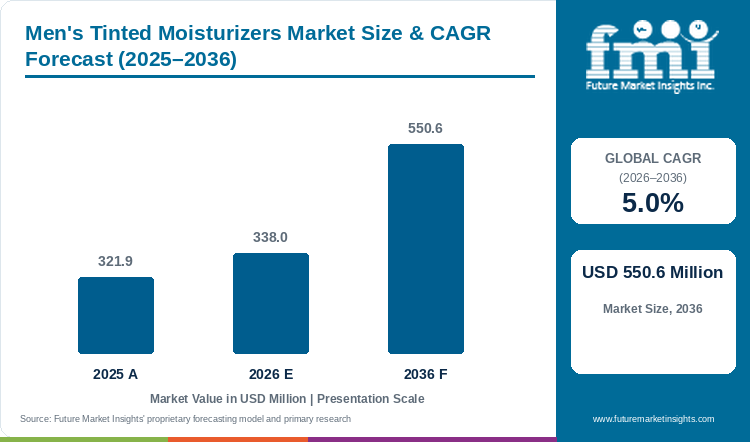
Key Takeaways
- Demand is supported by men seeking hydration and low-visibility tone correction in one familiar daily-care step rather than a separate makeup routine.
- Core / classic lines lead Product Type with 38.0% of 2026 revenue because they address everyday hydration and tone evening with the lowest routine complexity.
- Conventional products lead Nature with 51.0% of 2026 revenue because formulators can balance pigments, humectants, sensory modifiers and skin-care actives across broad retail price points.
- Liquid & serum products lead Format with 28.0% of 2026 revenue because spreadability and thin-film application support a lighter feel and more controllable coverage.
- The principal friction is credibility at first use: a mismatched tone, visible residue or greasy finish can shift a skin-care purchase into an unwanted cosmetic experience.
- Profiled companies are Edgewell Personal Care, Procter & Gamble, Church & Dwight, Beiersdorf, Shiseido, Henkel, L'Oreal, Kenvue, Wahl and Unilever.
Analyst Perspective
“Revenue will accrue fastest where complexion correction feels like ordinary skin care. The conversion threshold is a product that looks undetectable, feels non-greasy and can be repurchased through a familiar channel without requiring makeup expertise”,
- Rahul Pandita, Principal Consultant, FMI
How is the men's tinted moisturizers market segmented?
The market is segmented by Product Type, Nature, Format, Price Positioning and Sales Channel.
Product Type comprises Core / classic lines, Targeted treatment lines, Sensitive & gentle lines, Premium & clinical lines and Kits & sets. Nature comprises Conventional, Vegan & cruelty-free, Natural & organic, Dermocosmetic / clinical and Fragrance-free & sensitive. Format includes Liquid & serum, Cream & balm, Stick & solid, Spray & mist, Sheet & patch and Powder. Price Positioning covers Mass, Masstige, Premium and Professional. Sales Channel includes E-commerce & DTC, Specialty beauty retail, Pharmacies & drugstores, Supermarkets & hypermarkets and Salons & spas.
Why do Core / classic lines anchor the Product Type category?
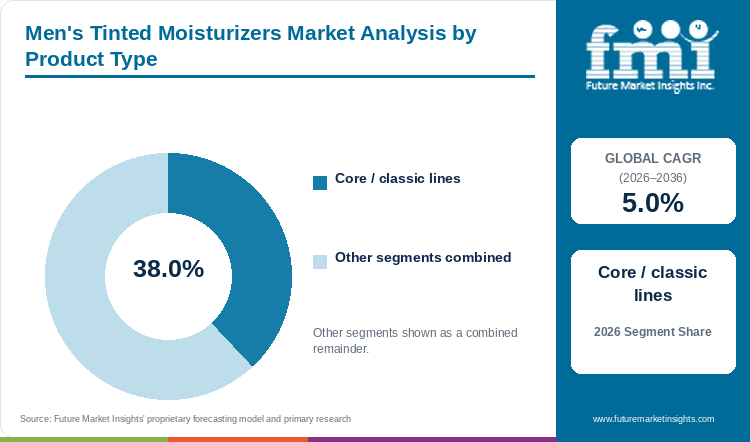
Core / classic lines hold 38.0% of 2026 revenue.
Core / classic lines win the largest revenue position because they solve the category's most repeatable job: moisturize the face and improve visible tone without asking the user to adopt a high-skill complexion routine. They also give brands room to offer neutral coverage and familiar daily-care claims before adding treatment-led or clinical propositions. That makes replenishment easier and reduces the risk that a first-time buyer views the item as occasional color cosmetics.
- Core / classic lines hold 38.0% of 2026 revenue as the proposition stays close to daily facial moisturization while adding a low-coverage complexion benefit.
What keeps Conventional products central to the Nature category?
Conventional products hold 51.0% of 2026 revenue.
Conventional formulations retain the broadest commercial flexibility. Suppliers can combine established humectants and emollients with colorants, sebum-control materials and sensorial modifiers without relying on a narrower natural or clinical positioning. That matters in a hybrid category because the buyer judges both skin comfort and visual performance at once. Broad ingredient flexibility also supports mass and masstige price architecture while allowing brands to adjust finish for climate, skin type and channel requirements.
- Conventional products hold 51.0% of 2026 revenue as they give formulators the widest room to balance shade and finish across multiple price tiers.
Why does Liquid & serum lead the Format category?
Liquid & serum holds 28.0% of 2026 revenue.
Liquid & serum formats reduce the handling friction associated with heavier complexion products. Thin textures spread quickly over facial hair margins and can be layered in small amounts. That supports an adjustable result instead of a fixed level of coverage. The format also fits the serum language already familiar in modern skin care, which helps tinted products communicate treatment and hydration before color. For suppliers, the commercial task is to preserve pigment evenness while keeping rub-off and shine controlled.
- Liquid & serum holds 28.0% of 2026 revenue owing to the fact that controllable spread and light film formation align with demand for an unobtrusive complexion result.
How does Mass pricing support the Price Positioning category?
Mass holds 37.0% of 2026 revenue.
Mass positioning lowers the cost of trial in a category where many users are still testing how much tint they want. It also places hybrid products beside familiar moisturizers and grooming items rather than forcing a specialist beauty-store visit. The main trade-off is shade breadth and education. A mass offer must be easy to understand at shelf and online while still delivering an acceptable result across different complexions. Broad distribution can create repeat purchase only after that first-use test is passed.
- Mass holds 37.0% of 2026 revenue as accessible entry price reduces the financial risk of trying a hybrid skin-care and complexion product.
Why does E-commerce & DTC lead the Sales Channel category?
E-commerce & DTC holds 32.0% of 2026 revenue.
E-commerce helps resolve information gaps before a buyer commits. Product pages can explain coverage level, finish and application while reviews can reduce uncertainty about shade behavior. Digital channels also provide privacy for first-time exploration and support replenishment after the buyer finds a workable result. The limitation is physical shade testing. Suppliers therefore need clear visual guidance and forgiving formulations so online discovery does not create a higher return or abandonment risk.
- E-commerce & DTC holds 32.0% of 2026 revenue because digital education, comparison and replenishment reduce discovery friction for an unfamiliar hybrid category.
What are the drivers, restraints and opportunities in the men's tinted moisturizers market?
Demand is driven by the convergence of men’s facial care and discreet complexion correction, while shade and sensory credibility restrain conversion and adaptive multi-benefit formulas create room for expansion.
- Driver: Men can obtain hydration and visible tone improvement in one skin-care-led step, which lowers the behavioral barrier to complexion products.
- Restraint: Shade mismatch, visible residue or greasy feel can undermine trust at first use and delay repeat purchasing.
- Opportunity: Sheer adaptive tint paired with oil control, blemish compatibility or sun-care benefits can make the product more useful across daily routines.
The strongest driver is a useful combination of skincare and appearance benefits. Shiseido’s April 2026 Skin Matte Serum announcement focuses on sebum and shine [1], while L’Oreal’s current Men Expert tinted moisturizer emphasizes a light, non-greasy feel [5]. For tinted products, the colour effect must arrive through a texture the buyer will tolerate every day. A formula that looks suitable but feels heavy is less likely to become a repeat purchase.
The main restraint occurs at the trial-to-repeat stage. A user may accept the concept but reject the product if the color sits visibly on facial hair, oxidizes poorly or amplifies shine.
The opportunity is to make tint more adaptive and useful rather than heavier. Suppliers therefore need market-specific claim discipline as they add benefits. Companies with men’s skin-care platforms and strong digital education are best placed to test these combinations because they can explain the product in skin-care language before asking users to accept visible complexion correction.
Which country CAGRs are profiled in the men's tinted moisturizers market?
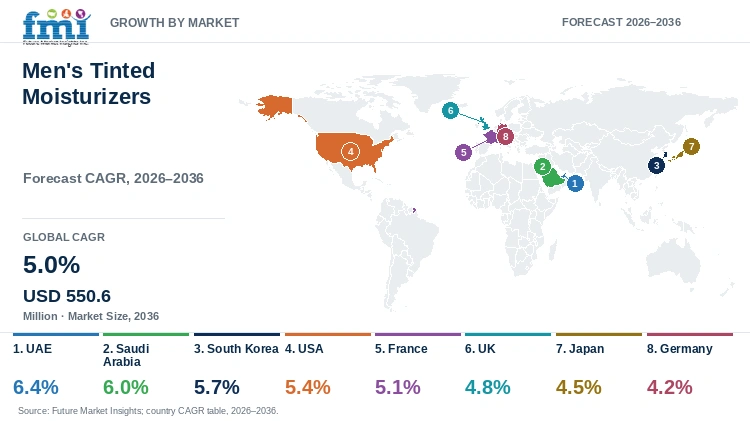
The following country CAGRs cover 2026 to 2036.
| Country | CAGR |
|---|---|
| UAE | 6.4% |
| Saudi Arabia | 6.0% |
| South Korea | 5.7% |
| USA | 5.4% |
| France | 5.1% |
| UK | 4.8% |
| Japan | 4.5% |
| Germany | 4.2% |
How do country-level CAGRs compare in the men's tinted moisturizers market?
The profiled growth rates separate into three practical bands. UAE and Saudi Arabia form the fastest pair above 6%. South Korea and USA follow in the mid-5% range, while France sits just above 5%. UK, Japan and Germany form the slower band below 5%. The spread from UAE at 6.4% to Germany at 4.2% is 2.2 percentage points. These rates describe pace, not absolute market size, so they should not be used as a proxy for revenue ranking.
- UAE: Active beauty trade and imported assortment support entry through capable local distribution partners [9].
- Saudi Arabia: Cosmetic notification requirements make importer and manufacturer responsibility part of route-to-market execution.
- South Korea: Strong cosmetics export infrastructure sits alongside formal review rules for functional claims such as whitening and UV protection.
- USA: MoCRA registration and listing duties increase the documentation burden for responsible persons while preserving a large multichannel beauty environment.
- France: A major cosmetics export base supports supplier depth, while EU notification rules allow one CPNP notification to cover national markets within the bloc.
- UK: Great Britain requires its own cosmetic notification process and a UK-established Responsible Person, creating a separate launch workflow from the EU.
- Japan: Drugstore sales kept expanding in 2025, but active claims can move products toward the quasi-drug pathway and additional approval requirements.
- Germany: Drugstores dominate beauty purchasing, which increases the importance of accessible pricing and clear shelf communication even as online sales grow quickly.
Country rates should be read with the regulatory and channel evidence that sits behind them. A faster CAGR does not remove product-registration costs, and a slower CAGR does not imply a weak beauty economy. The country coverage is USA, Germany, France, UK, Saudi Arabia, UAE, Japan and South Korea.
Country-wise Analysis
- The UAE’s imported beauty assortment creates room for men’s complexion care, with a 6.4% CAGR forecast through 2036, the fastest profiled rate. FEBEA reported growth in French cosmetics exports to the UAE in 2025 [9]. Suppliers can enter through that established beauty trade, but a tinted moisturizer still needs clear shade communication. Local partners and useful demonstrations can reduce the uncertainty of buying a subtle colour product online.
- Saudi Arabia’s cosmetic notification process makes distributor readiness part of the launch plan, supporting a 6.0% CAGR through 2036. SFDA updated its cosmetic-product notification guidance in March 2025 [10]. Brands should settle the product’s claims and documentation before expanding assortment. A light finish and an understandable shade range can then support repeat purchase, provided the importer keeps the successful shades consistently available.
- South Korea’s formulation and export base supports experimentation in men’s complexion care, and sales are forecast at a 5.7% CAGR through 2036. MFDS reported in May 2026 that the cosmetics trade surplus exceeded USD 10 billion in 2025 [11]. Suppliers can draw on that wider capability while keeping tone-correction claims clear. The product must still feel like a usable daily moisturizer if it is to retain a skincare buyer.
- US brands face a documentation task alongside the consumer education task, with a 5.4% CAGR forecast through 2036. FDA’s September 2026 guidance explains facility registration and product-listing duties under MoCRA [12]. Those requirements do not constitute product approval. Suppliers that handle them consistently can focus retail communication on the shade, finish and application steps that determine whether a first-time buyer will try the formula.
- France’s cosmetics production base supports a 5.1% CAGR outlook through 2036. FEBEA recorded EUR 22.4 billion in French cosmetics exports in 2025, with makeup and facial care the largest combined category [9]. That capability gives suppliers formulation and distribution options. Men’s tinted moisturizers still need to distinguish their sheer finish from more visible makeup, using demonstrations that make the everyday skincare benefit easy to assess.
- Great Britain requires its own route for cosmetic notification, while the UK market is forecast to grow at a 4.8% CAGR through 2036. OPSS’s July 2025 cosmetics guidance sets out the role of the Responsible Person and notification before sale [13]. Coordinating those requirements with EU launches can reduce delays. Suppliers can then concentrate on shade education and reliable replenishment for buyers who have found a workable match.
- Japan’s men’s skincare launches show a clear concern with finish and shine, supporting a 4.5% CAGR through 2036. Shiseido’s April 2026 Skin Matte Serum announcement targets sebum and visible pores and includes department stores and official online channels [1]. Tinted moisturizers can address an adjacent appearance need through the same routine. Suppliers should make the extra colour effect subtle and show how it wears on the intended skin tone.
- Drugstores shape Germany’s beauty purchase, with a 4.2% CAGR forecast through 2036. IKW’s 2025-2026 annual report puts drugstores at 53% of beauty-care purchases [4]. A tinted moisturizer therefore needs a message that works quickly on shelf as well as online. Accessible shade descriptions, a light sensory feel and consistent stock can support repeat sales better than positioning that makes the product seem difficult to use.
Who are the notable companies in the men's tinted moisturizers market?
Edgewell Personal Care, Procter & Gamble, Church & Dwight, Beiersdorf, Shiseido, Henkel, L'Oreal, Kenvue, Wahl and Unilever are the notable companies profiled in this market.
Competition is uneven because the profiled companies enter the category from different starting points. Shiseido and L'Oreal have direct public evidence for men-specific complexion or tone-on facial products. Beiersdorf has a substantial NIVEA MEN facial-care platform, although a direct in-scope tinted moisturizer was not verified in the reviewed public material. Edgewell Personal Care, Procter & Gamble and Unilever bring established men's grooming or skin-care channels. Church & Dwight, Henkel, Kenvue and Wahl offer adjacent facial-care or grooming capabilities. Public evidence does not verify an in-scope men's tinted moisturizer for every participant, so capability ratings remain unscored where a direct basis is absent.
- Documented men's complexion and facial-care platforms: Shiseido, L'Oreal and Beiersdorf. Shiseido and L'Oreal have direct men-specific tone or tint evidence, while Beiersdorf has a broad NIVEA MEN skin-care base.
- Men's grooming and skin-care adjacencies: Edgewell Personal Care, Procter & Gamble and Unilever. Their roles are supported by men's grooming or skin-care portfolios, but direct tinted-moisturizer evidence varies.
- Broader facial-care and grooming participants: Church & Dwight, Henkel, Kenvue and Wahl. Their documented capabilities are adjacent to the defined market, so unsupported tint capability is left unscored rather than inferred.
Competitive Benchmarking: Men's Tinted Moisturizers Market
| Company | Male-Focused Skin / Grooming | Tint / Complexion Capability | Digital-to-Retail Access | Geographic Reach |
|---|---|---|---|---|
| Edgewell Personal Care | High | Unscored | Medium | More than 50 markets including USA, Germany, Japan and UK [14] [15] |
| Procter & Gamble | High | Unscored | High | Broad global consumer channels through Gillette, Old Spice and skin-care brands [16] [17] |
| Church & Dwight | Unscored | Unscored | Medium | USA plus international consumer channels including HERO [18] |
| Beiersdorf | High | Unscored | High | International NIVEA skincare distribution [2] [19] |
| Shiseido | High | High | High | Japan-led men’s skincare activity with international SHISEIDO distribution [3] [1] |
| Henkel | Unscored | Unscored | Medium | North America and other Henkel consumer markets [20] |
| L'Oreal | High | High | High | L’Oreal Paris men’s facial-care distribution, including the current French tinted-gel offer [5] |
| Kenvue | Unscored | Unscored | High | North America, Europe, Middle East and wider global consumer-health channels [6] |
| Wahl | High | Unscored | Medium | North America and selected international grooming channels [21] |
| Unilever | High | Unscored | High | North America, Europe and wider Dove Men+Care markets [22] |
Scoring basis: Male-Focused Skin / Grooming measures documented products or brand platforms designed specifically for men. Tint / Complexion Capability measures verified men-specific tone correction or complexion coverage in the defined product space. Digital-to-Retail Access measures evidence of both online availability and established consumer retail reach. High indicates broad or deep documented capability, while Medium indicates a narrower or more indirect capability. Low would require a documented limitation. Unavailable public information is left Unscored rather than treated as weakness.
Key Developments in the Men's Tinted Moisturizers Market
- In June 2025, Shiseido announced a new SHISEIDO MEN Ultimune [3]. The launch reinforces the men’s facial-care platform alongside which complexion products compete. A tinted moisturizer needs to meet that skincare standard while adding a shade effect the wearer finds natural.
- In January 2026, Beiersdorf launched NIVEA Creme Natural Touch in Germany [23]. The vegan, natural-origin formula extends a familiar moisturizing format. For tinted-moisturizer suppliers, it illustrates how a recognizable skincare proposition can make formulation changes easier to introduce.
- In April 2026, Shiseido announced SHISEIDO MEN Skin Matte Serum for a June launch in Japan. The product targets male sebum and shine with sebum-absorbing powder and a non-sticky matte finish. It is adjacent to tint rather than a tinted moisturizer, but it highlights the finish-control technologies that can improve acceptance of complexion hybrids. [1]
Key Players in the Men's Tinted Moisturizers Market
Documented Men's Complexion and Facial-Care Platforms
- Shiseido
- L'Oreal
- Beiersdorf
Men's Grooming and Skin-Care Adjacencies
- Edgewell Personal Care
- Procter & Gamble
- Unilever
Broader Facial-Care and Grooming Participants
- Church & Dwight
- Henkel
- Kenvue
- Wahl
Men's Tinted Moisturizers Market - Report Scope
| Coverage field | Report scope |
|---|---|
| Market breakdown | Product Type; Nature; Format; Price Positioning; Sales Channel |
| Quantitative Units | USD Million |
| Market Definition | Revenue comprises consumer sales of moisturizer products positioned for men that also provide visible tint, tone correction or low-coverage complexion evening, including BB or tone-on day moisturizers and in-scope kits. Exclusions include untinted moisturizers, standalone foundation or concealer without a primary moisturizing proposition, untinted sun care, grooming hardware, downstream service revenue and adjacent substitutes. |
| Regions Covered | North America, Latin America, Western Europe, Eastern Europe, East Asia, South Asia and Pacific, Middle East and Africa |
| Countries Covered | USA, Germany, France, UK, Saudi Arabia, UAE, Japan, South Korea |
| Key Companies Profiled | Edgewell Personal Care, Procter & Gamble, Church & Dwight, Beiersdorf, Shiseido, Henkel, L'Oreal, Kenvue, Wahl, Unilever |
| Forecast Period | 2026 to 2036 |
| Approach | Primary and secondary research with market triangulation. |
Men's Tinted Moisturizers Market - Research Methodology
| Method | Approach |
|---|---|
| Primary Research | FMI analysts gathered input from manufacturers, service providers, technology developers, distributors, end users, procurement teams and subject-matter experts. Interviews examined purchasing decisions, product or service evaluation, adoption barriers, approval requirements, pricing considerations and expectations for technical or commercial support. Respondents were also asked what evidence is required before a trial, pilot, or initial order develops into regular purchasing. |
| Desk Research | Desk research covered government statistics, regulatory publications, trade data, industry associations, technical literature, standards, company filings, product information and official corporate announcements. Sources were reviewed for relevance, publication date, geographic coverage and consistency with the defined market scope. Claims relating to performance, applications, approvals, capacity, investment and commercial activity were retained only when supported by credible public evidence. |
| Market Sizing and Forecasting | The market model combined the baseline value with historical performance, segment structure, pricing and volume indicators, adoption levels, company participation and country-level demand conditions. Forecast assumptions considered economic activity, investment trends, regulatory developments, technology adoption, purchasing cycles, supply availability and barriers to wider market use. Segment and regional estimates were reconciled before the final market total was calculated. |
| Data Validation | Estimates were checked against multiple independent indicators, including public data, company activity, trade patterns, industry developments and findings from primary interviews. Validation also tested whether products, services, applications and company revenues fell within the defined market boundaries. Adjacent categories, unsupported claims, overlapping revenues and activities without direct market relevance were excluded to reduce double counting and maintain consistency across segments and countries. |
Men's Tinted Moisturizers Market by Segments
Men's Tinted Moisturizers Market segmented by Product Type:
- Core / classic lines
- Targeted treatment lines
- Sensitive & gentle lines
- Premium & clinical lines
- Kits & sets
Men's Tinted Moisturizers Market segmented by Nature:
- Conventional
- Vegan & cruelty-free
- Natural & organic
- Dermocosmetic / clinical
- Fragrance-free & sensitive
Men's Tinted Moisturizers Market segmented by Format:
- Liquid & serum
- Cream & balm
- Stick & solid
- Spray & mist
- Sheet & patch
- Powder
Men's Tinted Moisturizers Market segmented by Price Positioning:
- Mass
- Masstige
- Premium
- Professional
Men's Tinted Moisturizers Market segmented by Sales Channel:
- E-commerce & DTC
- Specialty beauty retail
- Pharmacies & drugstores
- Supermarkets & hypermarkets
- Salons & spas
Men's Tinted Moisturizers Market by Region:
- North America
- United States
- Canada
- Latin America
- Brazil
- Mexico
- Argentina
- Chile
- Western Europe
- Germany
- France
- United Kingdom
- Italy
- Spain
- Benelux
- Nordics
- Eastern Europe
- Poland
- Czech Republic
- Romania
- Hungary
- East Asia
- China
- Japan
- South Korea
- South Asia and Pacific
- India
- ASEAN
- Australia and New Zealand
- Middle East and Africa
- GCC Countries
- South Africa
- Türkiye
- Israel
Research Sources and Bibliography
- [1] Shiseido Company, Limited (2026, April 21). SHISEIDO MEN Skin Matte Serum Debuts for Men’s Sebum and Shine Concerns.
- [2] Beiersdorf AG (2026, March 3). Research and Development - Beiersdorf Annual Report 2025.
- [3] Shiseido Company, Limited (2025, June 20). SHISEIDO MEN New Ultimune Debuts.
- [4] German Cosmetic, Toiletry, Perfumery and Detergent Association (IKW) (n.d.). Economic Development - Annual Report 2025/2026. Current page, accessed 6 October 2026.
- [5] L'Oreal Paris (n.d.). Men Expert Gel Hydratant Bonne Mine Hydra Energetic. Current page, accessed 6 October 2026.
- [6] Kenvue Inc. (2025, March 31). Neutrogena and John Cena Team Up for the Ultimate Disappearing Act in New Ultra Sheer Mineral Sunscreen Campaign.
- [7] Pharmaceuticals and Medical Devices Agency (n.d.). Frequently Asked Questions: Regulation of Cosmetics in Japan. Current page, accessed 6 October 2026.
- [8] Ministry of Food and Drug Safety (n.d.). Cosmetics: Functional Cosmetics. Current page, accessed 6 October 2026.
- [9] Fédération des Entreprises de la Beauté (FEBEA) (2026, February 6). Coup de frein sur les exportations de cosmétiques français en 2025.
- [10] Saudi Food and Drug Authority (2025, March 11 update). Guidance and Requirements of Cosmetic Product Notification.
- [11] Ministry of Food and Drug Safety (2026, May 22). 2025 Cosmetics Trade Surplus Exceeds USD 10 Billion for the First Time.
- [12] U.S. Food and Drug Administration (2026, September 9). Registration & Listing of Cosmetic Product Facilities and Products.
- [13] Office for Product Safety and Standards (2025, July 10). Consumer products: cosmetics.
- [14] Edgewell Personal Care (n.d.). Our Brands. Current page, accessed 6 October 2026.
- [15] Edgewell Personal Care (2026, July 9). Edgewell Personal Care Company to Webcast a Discussion of Third Quarter Fiscal Year 2026 Results on August 5, 2026.
- [16] Procter & Gamble (n.d.). Brands: Skin and Personal Care. Current page, accessed 6 October 2026.
- [17] Procter & Gamble (n.d.). Superiority Across Product, Package, Brand Communication, Retail Execution and Value. Current page, accessed 6 October 2026.
- [18] Church & Dwight Co., Inc. (2026, May 1). Church & Dwight Reports Q1 2026 Results.
- [19] Beiersdorf AG (n.d.). NIVEA: Skin Care for everyone. Current page, accessed 6 October 2026.
- [20] Henkel AG & Co. KGaA (2025, February 10). DIAL Healthy Hydration Body Wash Recognized as 2025 Product of the Year USA Award Winner.
- [21] Wahl Clipper Corporation (n.d.). Beard & Hair Care. Current page, accessed 6 October 2026.
- [22] Unilever PLC (2025, April 24). Q1 2025 Trading Statement - Webcast Transcript.
- [23] Beiersdorf (2026, January 5). NIVEA Creme Natural Touch launches in Germany.
- [24] European Commission (n.d.). Cosmetic Product Notification Portal. Current page, accessed 6 October 2026.
- [25] Saudi Food and Drug Authority (n.d.). List of Notification of Marketing for Cosmetic Products (Listed Products). Current page, accessed 6 October 2026.
This bibliography is provided for reader reference and is not exhaustive. The full report contains the complete reference list and detailed citations.
This Report Answers
- How large is the men's tinted moisturizers market in 2026 and what is the forecast value for 2036?
- Which consumer and operating pressures support demand for men's tinted moisturizers?
- Why do Core / classic lines hold the leading Product Type position?
- Why do Conventional products hold the leading Nature position?
- How do the profiled country growth rates differ across the men's tinted moisturizers market?
- Which profiled companies supply relevant men’s skin-care, complexion or grooming categories?
- What limits adoption, repeat purchase or supplier switching in this market?
- What should buyers evaluate before purchasing or listing a men’s tinted moisturizer?
Frequently Asked Questions
How big is the men's tinted moisturizers market in 2026, and what is forecast for 2036?
The market is valued at USD 338.0 Million in 2026 and is forecast to reach USD 550.6 Million by 2036. The expansion reflects broader use of hybrid facial products that combine routine hydration with discreet tone correction.
What is the CAGR for the men's tinted moisturizers market from 2026 to 2036?
The market is forecast to grow at a 5.0% CAGR from 2026 to 2036. Realized revenue will depend on how well suppliers solve shade, finish and channel-education barriers during first use.
Which Product Type segment leads the men's tinted moisturizers market?
Core / classic lines lead Product Type with 38.0% of 2026 revenue. Their position reflects a simple everyday proposition that stays close to facial moisturization while adding light complexion correction.
Which Nature segment leads the men's tinted moisturizers market?
Conventional products lead Nature with 51.0% of 2026 revenue. Their formulation flexibility supports a wide range of textures, finishes and price points across mass and premium channels.
Which profiled countries have the highest growth rates in the men's tinted moisturizers market?
UAE has the highest profiled CAGR at 6.4%, followed by Saudi Arabia at 6.0% from 2026 to 2036. These rates show pace rather than absolute market size, and both markets require strong local regulatory execution.
Which companies are active in the men's tinted moisturizers market?
Profiled companies are Edgewell Personal Care, Procter & Gamble, Church & Dwight, Beiersdorf, Shiseido, Henkel, L'Oreal, Kenvue, Wahl and Unilever. Public evidence verifies direct in-scope tint or tone-on capability for some participants, while others are documented through adjacent men’s skin-care or grooming roles.
Preview the report firsthand - request a free sample
Get SampleGet the brochure for pricing and purchase details.
Get PDFTable of Content
- Key Takeaways
- Market Size and CAGR
- Top Growth Driver
- Fastest Growing Segment
- Leading Region
- Key Companies
- Emerging Opportunities
- Executive Summary
- Global Market Outlook
- Demand-side Trends
- Supply-side Trends
- Technology Roadmap Analysis
- Analysis and Recommendations
- Analyst Perspective (What is happening? Why now? What should investors know?)
- Key Questions Answered
- How large is the market?
- What is the CAGR?
- What are key trends?
- Which region dominates?
- Who are the leaders?
- Market Overview
- Market Coverage / Taxonomy
- Market Definition / Scope / Limitations
- Research Methodology
- Chapter Orientation
- Analytical Lens and Working Hypotheses
- Market Structure, Signals, and Trend Drivers
- Benchmarking and Cross-market Comparability
- Market Sizing, Forecasting, and Opportunity Mapping
- Research Design and Evidence Framework
- Desk Research Programme (Secondary Evidence)
- Expert Input and Fieldwork (Primary Evidence)
- Tooling, Models, and Reference Databases
- Data Engineering and Model Build
- Quality Assurance and Audit Trail
- Market Background
- Market Dynamics (Drivers, Restraints, Opportunity, Trends)
- Scenario Forecast (Optimistic, Likely, Conservative)
- Impact Analysis
- AI Impact
- Sustainability Impact
- Regulatory Impact
- Technology Impact
- Consumer / Buyer Analysis
- Purchase Drivers
- Adoption Barriers
- Buyer Journey
- Opportunity Map Analysis
- Product Life Cycle Analysis
- Supply Chain Analysis
- Investment Feasibility Matrix
- Value Chain Analysis
- PESTLE and Porter's Analysis
- Regulatory Landscape
- Regional Parent Market Outlook
- Production and Consumption Statistics
- Import and Export Statistics
- Global Market Analysis and Forecast, 2021 to 2036
- Historical Market Size Value (USD Million) Analysis, 2021 to 2025
- Current and Future Market Size Value (USD Million) Projections, 2026 to 2036
- Y-o-Y Growth Trend Analysis
- Absolute $ Opportunity Analysis
- Global Market Pricing Analysis, 2021 to 2036
- Global Market Analysis and Forecast, By Product Type, 2021 to 2036
- Introduction / Key Findings
- Historical Market Size Value (USD Million) Analysis By Product Type, 2021 to 2025
- Current and Future Market Size Value (USD Million) Analysis and Forecast By Product Type, 2026 to 2036
- Core / classic lines
- Targeted treatment lines
- Sensitive & gentle lines
- Premium & clinical lines
- Kits & sets
- Y-o-Y Growth Trend Analysis By Product Type, 2021 to 2025
- Absolute $ Opportunity Analysis By Product Type, 2026 to 2036
- Global Market Analysis and Forecast, By Nature, 2021 to 2036
- Introduction / Key Findings
- Historical Market Size Value (USD Million) Analysis By Nature, 2021 to 2025
- Current and Future Market Size Value (USD Million) Analysis and Forecast By Nature, 2026 to 2036
- Conventional
- Vegan & cruelty-free
- Natural & organic
- Dermocosmetic / clinical
- Fragrance-free & sensitive
- Y-o-Y Growth Trend Analysis By Nature, 2021 to 2025
- Absolute $ Opportunity Analysis By Nature, 2026 to 2036
- Global Market Analysis and Forecast, By Format, 2021 to 2036
- Introduction / Key Findings
- Historical Market Size Value (USD Million) Analysis By Format, 2021 to 2025
- Current and Future Market Size Value (USD Million) Analysis and Forecast By Format, 2026 to 2036
- Liquid & serum
- Cream & balm
- Stick & solid
- Spray & mist
- Sheet & patch
- Powder
- Y-o-Y Growth Trend Analysis By Format, 2021 to 2025
- Absolute $ Opportunity Analysis By Format, 2026 to 2036
- Global Market Analysis and Forecast, By Price Positioning, 2021 to 2036
- Introduction / Key Findings
- Historical Market Size Value (USD Million) Analysis By Price Positioning, 2021 to 2025
- Current and Future Market Size Value (USD Million) Analysis and Forecast By Price Positioning, 2026 to 2036
- Mass
- Masstige
- Premium
- Professional
- Y-o-Y Growth Trend Analysis By Price Positioning, 2021 to 2025
- Absolute $ Opportunity Analysis By Price Positioning, 2026 to 2036
- Global Market Analysis and Forecast, By Sales Channel, 2021 to 2036
- Introduction / Key Findings
- Historical Market Size Value (USD Million) Analysis By Sales Channel, 2021 to 2025
- Current and Future Market Size Value (USD Million) Analysis and Forecast By Sales Channel, 2026 to 2036
- E-commerce & DTC
- Specialty beauty retail
- Pharmacies & drugstores
- Supermarkets & hypermarkets
- Salons & spas
- Y-o-Y Growth Trend Analysis By Sales Channel, 2021 to 2025
- Absolute $ Opportunity Analysis By Sales Channel, 2026 to 2036
- Global Market Analysis and Forecast, By Region, 2021 to 2036
- Introduction
- Historical Market Size Value (USD Million) Analysis By Region, 2021 to 2025
- Current Market Size Value (USD Million) Analysis and Forecast By Region, 2026 to 2036
- North America
- Latin America
- Western Europe
- Eastern Europe
- East Asia
- South Asia and Pacific
- Middle East and Africa
- Market Attractiveness Analysis By Region
- North America Market Analysis and Forecast, By Country, 2021 to 2036
- Historical Market Size Value (USD Million) Trend Analysis By Market Taxonomy, 2021 to 2025
- Market Size Value (USD Million) Forecast By Market Taxonomy, 2026 to 2036
- By Country
- United States
- Canada
- By Product Type
- By Nature
- By Format
- By Price Positioning
- By Sales Channel
- By Country
- Market Attractiveness Analysis
- By Country
- By Product Type
- By Nature
- By Format
- By Price Positioning
- By Sales Channel
- Key Takeaways
- Latin America Market Analysis and Forecast, By Country
- Historical Market Size Value (USD Million) Trend Analysis By Market Taxonomy, 2021 to 2025
- Market Size Value (USD Million) Forecast By Market Taxonomy, 2026 to 2036
- By Country
- Brazil
- Mexico
- Argentina
- Chile
- By Product Type
- By Nature
- By Format
- By Price Positioning
- By Sales Channel
- By Country
- Market Attractiveness Analysis
- By Country
- By Product Type
- By Nature
- By Format
- By Price Positioning
- By Sales Channel
- Key Takeaways
- Western Europe Market Analysis and Forecast, By Country
- Historical Market Size Value (USD Million) Trend Analysis By Market Taxonomy, 2021 to 2025
- Market Size Value (USD Million) Forecast By Market Taxonomy, 2026 to 2036
- By Country
- Germany
- France
- United Kingdom
- Italy
- Spain
- Benelux
- Nordics
- By Product Type
- By Nature
- By Format
- By Price Positioning
- By Sales Channel
- By Country
- Market Attractiveness Analysis
- By Country
- By Product Type
- By Nature
- By Format
- By Price Positioning
- By Sales Channel
- Key Takeaways
- Eastern Europe Market Analysis and Forecast, By Country
- Historical Market Size Value (USD Million) Trend Analysis By Market Taxonomy, 2021 to 2025
- Market Size Value (USD Million) Forecast By Market Taxonomy, 2026 to 2036
- By Country
- Poland
- Czech Republic
- Romania
- Hungary
- By Product Type
- By Nature
- By Format
- By Price Positioning
- By Sales Channel
- By Country
- Market Attractiveness Analysis
- By Country
- By Product Type
- By Nature
- By Format
- By Price Positioning
- By Sales Channel
- Key Takeaways
- East Asia Market Analysis and Forecast, By Country
- Historical Market Size Value (USD Million) Trend Analysis By Market Taxonomy, 2021 to 2025
- Market Size Value (USD Million) Forecast By Market Taxonomy, 2026 to 2036
- By Country
- China
- Japan
- South Korea
- By Product Type
- By Nature
- By Format
- By Price Positioning
- By Sales Channel
- By Country
- Market Attractiveness Analysis
- By Country
- By Product Type
- By Nature
- By Format
- By Price Positioning
- By Sales Channel
- Key Takeaways
- South Asia and Pacific Market Analysis and Forecast, By Country
- Historical Market Size Value (USD Million) Trend Analysis By Market Taxonomy, 2021 to 2025
- Market Size Value (USD Million) Forecast By Market Taxonomy, 2026 to 2036
- By Country
- India
- ASEAN
- Australia and New Zealand
- By Product Type
- By Nature
- By Format
- By Price Positioning
- By Sales Channel
- By Country
- Market Attractiveness Analysis
- By Country
- By Product Type
- By Nature
- By Format
- By Price Positioning
- By Sales Channel
- Key Takeaways
- Middle East and Africa Market Analysis and Forecast, By Country
- Historical Market Size Value (USD Million) Trend Analysis By Market Taxonomy, 2021 to 2025
- Market Size Value (USD Million) Forecast By Market Taxonomy, 2026 to 2036
- By Country
- GCC Countries
- South Africa
- Türkiye
- Israel
- By Product Type
- By Nature
- By Format
- By Price Positioning
- By Sales Channel
- By Country
- Market Attractiveness Analysis
- By Country
- By Product Type
- By Nature
- By Format
- By Price Positioning
- By Sales Channel
- Key Takeaways
- Key Countries Market Analysis
- United States
- Pricing Analysis
- Market Share Analysis, 2025
- By Product Type
- By Nature
- By Format
- By Price Positioning
- By Sales Channel
- Canada
- Pricing Analysis
- Market Share Analysis, 2025
- By Product Type
- By Nature
- By Format
- By Price Positioning
- By Sales Channel
- Mexico
- Pricing Analysis
- Market Share Analysis, 2025
- By Product Type
- By Nature
- By Format
- By Price Positioning
- By Sales Channel
- Brazil
- Pricing Analysis
- Market Share Analysis, 2025
- By Product Type
- By Nature
- By Format
- By Price Positioning
- By Sales Channel
- Chile
- Pricing Analysis
- Market Share Analysis, 2025
- By Product Type
- By Nature
- By Format
- By Price Positioning
- By Sales Channel
- Germany
- Pricing Analysis
- Market Share Analysis, 2025
- By Product Type
- By Nature
- By Format
- By Price Positioning
- By Sales Channel
- United Kingdom
- Pricing Analysis
- Market Share Analysis, 2025
- By Product Type
- By Nature
- By Format
- By Price Positioning
- By Sales Channel
- Italy
- Pricing Analysis
- Market Share Analysis, 2025
- By Product Type
- By Nature
- By Format
- By Price Positioning
- By Sales Channel
- Spain
- Pricing Analysis
- Market Share Analysis, 2025
- By Product Type
- By Nature
- By Format
- By Price Positioning
- By Sales Channel
- France
- Pricing Analysis
- Market Share Analysis, 2025
- By Product Type
- By Nature
- By Format
- By Price Positioning
- By Sales Channel
- India
- Pricing Analysis
- Market Share Analysis, 2025
- By Product Type
- By Nature
- By Format
- By Price Positioning
- By Sales Channel
- ASEAN
- Pricing Analysis
- Market Share Analysis, 2025
- By Product Type
- By Nature
- By Format
- By Price Positioning
- By Sales Channel
- Australia and New Zealand
- Pricing Analysis
- Market Share Analysis, 2025
- By Product Type
- By Nature
- By Format
- By Price Positioning
- By Sales Channel
- China
- Pricing Analysis
- Market Share Analysis, 2025
- By Product Type
- By Nature
- By Format
- By Price Positioning
- By Sales Channel
- Japan
- Pricing Analysis
- Market Share Analysis, 2025
- By Product Type
- By Nature
- By Format
- By Price Positioning
- By Sales Channel
- South Korea
- Pricing Analysis
- Market Share Analysis, 2025
- By Product Type
- By Nature
- By Format
- By Price Positioning
- By Sales Channel
- Poland
- Pricing Analysis
- Market Share Analysis, 2025
- By Product Type
- By Nature
- By Format
- By Price Positioning
- By Sales Channel
- Hungary
- Pricing Analysis
- Market Share Analysis, 2025
- By Product Type
- By Nature
- By Format
- By Price Positioning
- By Sales Channel
- Türkiye
- Pricing Analysis
- Market Share Analysis, 2025
- By Product Type
- By Nature
- By Format
- By Price Positioning
- By Sales Channel
- South Africa
- Pricing Analysis
- Market Share Analysis, 2025
- By Product Type
- By Nature
- By Format
- By Price Positioning
- By Sales Channel
- UAE
- Pricing Analysis
- Market Share Analysis, 2025
- By Product Type
- By Nature
- By Format
- By Price Positioning
- By Sales Channel
- Saudi Arabia
- Pricing Analysis
- Market Share Analysis, 2025
- By Product Type
- By Nature
- By Format
- By Price Positioning
- By Sales Channel
- United States
- Market Structure Analysis
- Competition Dashboard
- Competition Benchmarking
- Market Share Analysis of Top Players
- By Regional
- By Product Type
- By Nature
- By Format
- By Price Positioning
- By Sales Channel
- Emerging Startups
- Innovation Benchmarking
- Competition Analysis
- Competition Deep Dive
- Edgewell Personal Care
- Overview
- Product Portfolio
- Profitability by Market Segments
- Sales Footprint
- Strategy Overview
- Marketing Strategy
- Product Strategy
- Channel Strategy
- Procter & Gamble
- Church & Dwight
- Beiersdorf
- Shiseido
- Henkel
- L'Oreal
- Kenvue
- Wahl
- Unilever
- Edgewell Personal Care
- Case Studies
- Success Stories
- Recent Developments
- Competition Deep Dive
- Assumptions & Acronyms Used


