

- Market Size (2026)
- USD 228.0 Mn
- Forecast (2036)
- USD 378.5 Mn
- CAGR (2026 to 2036)
- 5.2%
How big is Men's Beard Dyes Market in 2026?
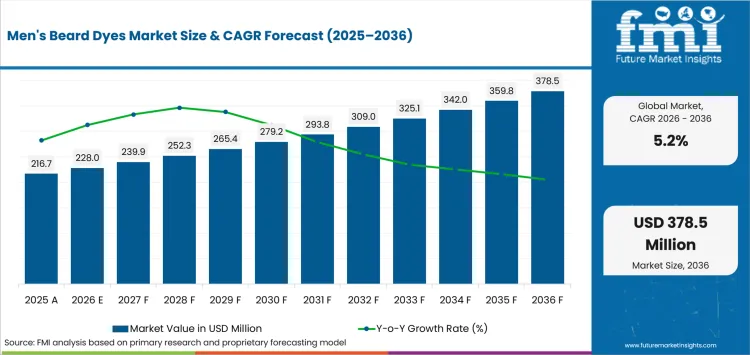
USD 228.0 million in 2026 and USD 378.5 million by 2036 at a 5.2% CAGR.
Sales of men's beard dyes are projected to push valuation to USD 378.5 million by 2036, rising from USD 228.0 million in 2026 at a 5.2% CAGR. Demand continues to be supported by routine grooming habits as gray coverage becomes a recurring part of facial-hair maintenance for many consumers. L'Oréal reported in April 2025 that Garnier Good and Color Sensation contributed to hair-colour category growth. The expansion of shade options and user-friendly at-home formats can encourage trial purchases and increase the likelihood of repeat use.
Distribution channels play an important role in determining how efficiently recurring demand translates into sales. The USA Census Bureau reported in August 2026 that e-commerce accounted for 17.1% of USA retail sales during the second quarter. Established online purchasing habits make replenishment easier for consumers who regularly buy the same shade and product. Gulf markets present a different route to growth, where product registration requirements and market-entry approvals can influence how quickly repeat purchasing shifts to digital channels.
Key Takeaways
- Repeat gray coverage supports demand as facial-hair regrowth makes color correction a recurring maintenance purchase for established home users.
- Based on product type, beard oils are projected to account for 36.0% in 2026 due to conditioning needs after repeated beard coloring.
- By nature, conventional products are estimated to hold 53.0% in 2026 owing to familiar color chemistry and broad retail recognition.
- In 2026, cream & balm is expected to lead format with 26.0% share because thicker textures improve placement control on facial hair.
- Sensitization risk can delay trial because facial application places dye close to exposed skin and makes warnings commercially important.
- Key players in the men's beard dyes market include L'Oréal S.A., Shiseido Company, Limited, Procter & Gamble Co., Wahl Clipper Corporation, Unilever PLC, Beiersdorf AG, Edgewell Personal Care Company, and Henkel AG & Co. KGaA.
Analyst Perspective
"Men's beard dyes earn repeat revenue when shade matching stays predictable and applicators keep color away from exposed facial skin. Commercial evaluation should compare warning clarity and regrowth coverage alongside refill access because visible gray returns create the next purchase."
- Rahul Pandita, Principal Consultant, Future Market Insights
How is the men's beard dyes market segmented?
The men's beard dyes market covers product type, nature, format, price positioning, sales channel and region.
Product type covers beard oils, beard balms, beard washes and kits & sets. Nature covers conventional, vegan & cruelty-free, natural & organic, dermocosmetic / clinical and fragrance-free & sensitive. Format covers cream & balm, liquid & serum, stick & solid, spray & mist, sheet & patch and powder. Price positioning covers mass, masstige, premium and professional. Sales channels cover e-commerce & DTC, specialty beauty retail, pharmacies & drugstores, supermarkets & hypermarkets and salons & spas.
What makes beard oils central to the product type category?
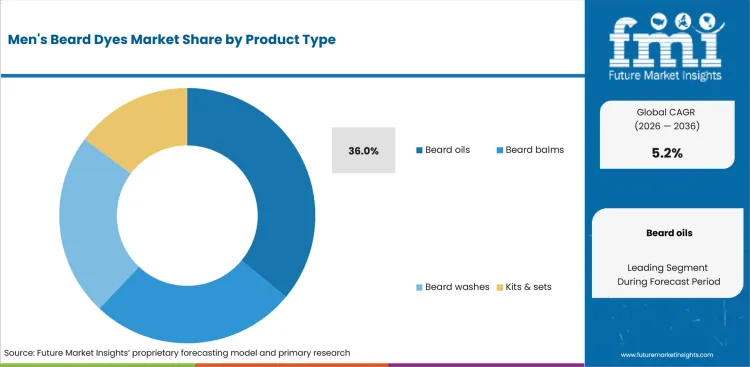
Beard oils fit the post-color stage because repeated dyeing can leave coarse facial hair needing separate conditioning. The adjacent beard oil category gives grooming brands a familiar attachment route without changing shade selection. Visible regrowth can trigger another color cycle before the conditioning product is exhausted or replaced.
- By product type, beard oils are forecast to represent 36.0% in 2026 driven by routine conditioning after beard-color application.
- Edgewell's November 2025 Form 10-K states that Cremo offers a complete line of beard, hair and skin care products. The filing confirms a route for beard-maintenance products around color use within recurring grooming routines.
Why does conventional lead the nature category?
Conventional color systems retain familiar shade logic across permanent and semi-permanent use, which supports repeat selection after a user establishes a suitable result. The FDA stated in September 2025 that some coal-tar hair dyes can cause sensitization and linked PPD prominently with allergic reactions. Natural cosmetic color alternatives compete most directly when ingredient preferences justify moving away from familiar chemistry.
- The conventional segment is likely to capture 53.0% share in 2026 attributable to familiar chemistry and broad retail recognition.
- Clear warnings and patch-test directions protect repeat use by making sensitization precautions visible before a user applies the same familiar shade again.
How does cream & balm support the format category?
Facial placement favors textures that stay within beard edges and reduce running toward cheeks during development. This need overlaps with professional hair care practice because application control matters around hairlines and visible skin. Cream and balm vehicles provide enough body for moustache lines without turning coloring into a high-mess routine.
- Cream & balm is set to lead the format category with 26.0% share in 2026 due to controlled placement on facial hair.
- Henkel reported in August 2025 that it continued rolling out Schwarzkopf Creme Supreme into additional markets. Its integrated bonding-care proposition shows how color performance and post-color hair condition increasingly share one format decision.
What drives e-commerce & DTC in the sales channel category?
Known shades are easy to replenish online because repeat users need less discovery support than they did at first purchase. Unilever announced in June 2025 that it would acquire Dr. Squatch, a men's personal-care brand with retail and direct-to-consumer distribution. The broader men's grooming products category shows why digital merchandising must explain routine order and product purpose before another facial-care step enters the basket.
- E-commerce & DTC is projected to hold 29.0% share in 2026 owing to easy replenishment after users establish a reliable shade.
- Detailed shade guidance and complete directions reduce reorder hesitation once users trust the formula and prefer private home replenishment.
What are the drivers, restraints and opportunities in the men's beard dyes market?
Repeat grooming routines raise repurchase potential, although sensitization can delay trial and low-mess application leaves room for better home-use formats.
- Driver: Established beard-care routines give color products recurring touchpoints as facial hair regrows and visible gray returns.
- Restraint: Sensitization risk raises the cost of weak warnings because repeat exposure can trigger reactions after earlier uneventful use.
- Opportunity: Controlled applicators and clearer shade guidance can reduce mess during home use and improve confidence before replenishment.
Beard color is easier to repurchase inside an established facial-hair routine because regrowth gives users a visible reason to refresh the same shade. Edgewell reported in February 2026 that Cremo organic sales rose 27% year over year, confirming current commercial activity around men's grooming routines. The adjacent beard grooming products category gives color brands natural attachment points in cleansing and conditioning without requiring a separate shopping mission.
Facial exposure makes weak safety communication more costly as hair dye contacts skin repeatedly during touch-ups. MFDS advised in August 2025 that users should perform a skin test before every hair-dye application because reactions can differ by ingredients. Related hair care products therefore need clear warnings and ingredient disclosure to limit avoidable trial loss among users who already know their shade.
Low-mess application gives brands a practical route to users who accept gray coverage but dislike mixing and cleanup near the face. L'Oréal reported in June 2025 that Colorsonic had launched in the United States and France after engineering automated mixing for home hair color. Hair gloss products and post-shave care already compete on easy routines, giving beard-dye brands a route to reduce first-use hesitation with controlled applicators and clear shade guidance.
Which country CAGRs are profiled in the men's beard dyes market?
| Country | CAGR |
|---|---|
| UAE | 6.6% |
| Saudi Arabia | 6.3% |
| South Korea | 5.9% |
| USA | 5.6% |
| Germany | 5.3% |
How do country-level CAGRs compare in the men's beard dyes market?
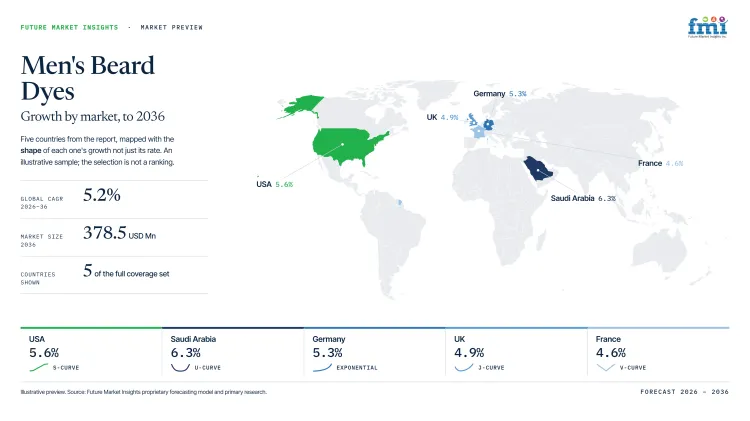
The five profiled countries span 5.3% to 6.6% CAGR, leaving a 1.3 percentage-point range shaped by launch conditions. UAE and Saudi Arabia form the upper Gulf group because registration and digital retail interact closely. South Korea follows under functional-cosmetics controls while USA and Germany track nearer the global 5.2% pace.
- UAE leads because Dubai registration directly governs cross-border digital assortment expansion and retailer onboarding decisions.
- Saudi Arabia follows as SFDA notification readiness determines importer access to pharmacy and marketplace listings.
- South Korea places launch timing behind functional-cosmetics documentation and tightly controlled hair-dye ingredient records for importers.
- USA pairs deep self-service retail reach with recurring federal safety communication around home hair-color use.
- Germany pairs mature drugstore access with ingredient-record discipline shaped by federal research on contact sensitization.
The full report provides country-level CAGR analysis across North America, Latin America, Europe, East Asia, South Asia, Oceania and the Middle East and Africa.
Country-wise Analysis
- At Dubai’s consumer-product entry points, beard-color launches benefit from extensive digital visibility, although registration dossiers remain a requirement for pharmacy and marketplace participation. Men's beard dyes sales in the UAE are forecast to expand at 6.6% CAGR through 2036, supported by rising mobile-commerce adoption and repeat online ordering. Dubai Municipality reported in October 2025 that more than 90% of UAE imports enter through Dubai and roughly 40,000 consumer-product shipments are processed annually. These conditions favor brands that maintain complete Montaji documentation and consistent digital artwork, whereas registration deficiencies can slow assortment expansion even when consumer demand is already established.
- In Saudi Arabia, cosmetics suppliers assemble product and compliance data for digital review before pharmacy chains and online marketplaces approve new grooming listings. SFDA reported in December 2025 that its digital-regulation program would expand into cosmetics through image-analysis and ingredient-compliance tools for regulated personal-care products. Demand for men's beard dyes is projected to grow at 6.3% CAGR through 2036, driven by broader e-commerce access and rising repeat-purchase behavior. Brands with complete product records gain a smoother path into major retail accounts, while incomplete notification files may postpone listings and disrupt planned marketing activity during distributor evaluations.
- South Korea's beard-color market operates within a functional-cosmetics framework in which non-temporary hair dyes require formula documentation as part of commercial planning for both imported and domestic products. Demand for men's beard dyes is forecast to rise at 5.9% CAGR through 2036, attributable to the country's sophisticated beauty-retail ecosystem and strong replenishment culture. MFDS amended cosmetic safety standards in December 2025 to tighten several hair-dye ingredient controls and reinforce regulatory discipline across color-cosmetics categories. Consequently, late-stage ingredient changes can increase compliance costs and affect launch schedules, though established urban beauty channels continue to support rapid product discovery and consumer uptake.
- In the United States, mass retailers and large digital marketplaces make it easy for consumers to replenish familiar beard-color shades without salon assistance through recurring home-use routines. FDA reported in February 2026 that more than 14,000 cosmetic product facilities were registered and updated Cosmetics Direct for biennial renewals. Men's beard dyes sales in the USA are forecast to advance at 5.6% CAGR through 2036, reflecting the scale and reach of national retail distribution. Market participation increasingly rewards companies that maintain strong registration and adverse-event reporting practices, whereas weak compliance records can erode consumer confidence before broad distribution translates into long-term repeat purchases.
- Once German shoppers settle on a shade, dense drugstore and online networks make men's grooming replenishment convenient across established national chains and regional retail catchments. Men's beard dyes demand in Germany is estimated to expand at 5.3% CAGR through 2036 as mature beauty retail supports repeat home-color purchasing. Germany's BfR closed a research project in April 2025 that applied its AIM assay to a hair-dye product while examining chemical-specific immune responses. Sensitization concerns increase the cost of unclear ingredient claims for brands competing across German drugstore and online assortments. Consistent ingredient files and warning language therefore matter across large drugstore and online assortments during recurring home-color replenishment cycles.
Who are the notable companies in the men's beard dyes market?
L'Oréal S.A., Shiseido Company, Limited, Procter & Gamble Co., Wahl Clipper Corporation, Unilever PLC, Beiersdorf AG, Edgewell Personal Care Company, Henkel AG & Co. KGaA.
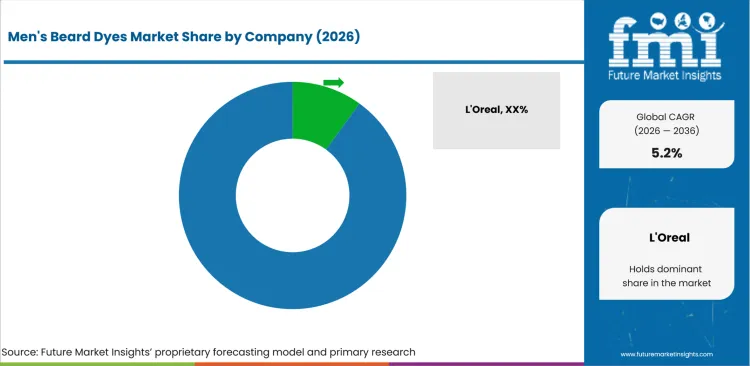
Competition spans global hair-color groups and men's-grooming owners that control different pieces of the repeat routine. The adjacent men's beard care field raises entry barriers through brand trust and channel access, while direct beard-color depth varies materially across the eight-company register. Adjacent men's skincare products also compete for routine ownership around facial comfort and repeat care.
- L'Oréal S.A. and Henkel AG & Co. KGaA bring the deepest documented hair-color formulation and international commercialization records.
- Procter & Gamble Co., Wahl Clipper Corporation, Unilever PLC and Edgewell Personal Care Company compete from established men's grooming touchpoints.
- Shiseido Company, Limited and Beiersdorf AG contribute facial-care and premium beauty reach that can support adjacent men's grooming routines.
Competitive Benchmarking: Men's Beard Dyes Market
| Company | Color & Application Depth | Facial-Grooming Breadth | Route-to-Market Reach | Geographic Reach |
|---|---|---|---|---|
| L'Oréal S.A. | High | Medium | High | Global |
| Shiseido Company, Limited | Low | Medium | High | Asia-led global |
| Procter & Gamble Co. | Low | High | High | Global |
| Wahl Clipper Corporation | Low | Medium | Medium | North America, Europe and selected international markets |
| Unilever PLC | Low | High | High | Global |
| Beiersdorf AG | Low | Medium | High | Global |
| Edgewell Personal Care Company | Low | High | High | North America, Europe and selected international markets |
| Henkel AG & Co. KGaA | High | Low | High | Global |
Scoring basis: High color and application depth requires multiple color platforms while Medium requires one color route and Low reflects one adjacent grooming route. High facial-grooming breadth requires several beard or facial-care categories while Medium covers one or two and Low records one adjacent grooming route. High route-to-market reach requires several channel classes across regions while Medium reflects multichannel coverage and Low identifies one narrower route.
Key Developments in the Men's Beard Dyes Market
- In October 2025, Beiersdorf extended the NIVEA MEN and Real Madrid partnership through 2030 and announced a global limited edition across more than 40 countries.
- In July 2025, Shiseido launched three renewed SHISEIDO MEN Ultimune products across department stores and online channels in Japan.
- In March 2025, Henkel centralized its hair cosmetics business at Hamburg's House of Hair whose test salons support care and color development plus styling work.
Key Players in the Men's Beard Dyes Market
Global Beauty and Grooming Platforms
- L'Oréal S.A.
- Shiseido Company, Limited
- Procter & Gamble Co.
Men's Grooming and Personal-Care Platforms
- Wahl Clipper Corporation
- Unilever PLC
- Beiersdorf AG
Consumer Grooming and Hair Platforms
- Edgewell Personal Care Company
- Henkel AG & Co. KGaA
Men's Beard Dyes Market - Report Scope
| Coverage field | Report scope |
|---|---|
| Market breakdown | By product type, nature, format, price positioning, sales channel and region. |
| Quantitative Units | USD million. |
| Market Definition | Commercial facial-hair color and associated beard-maintenance products used within repeat men's beard-color routines. |
| Regions Covered | North America, Latin America, Western Europe, Eastern Europe, East Asia, South Asia and Pacific and Middle East and Africa. |
| Countries Covered | UAE, Saudi Arabia, South Korea, USA, Germany, and 20+ countries included in the full report. |
| Key Companies Profiled | L'Oréal S.A., Shiseido Company, Limited, Procter & Gamble Co., Wahl Clipper Corporation, Unilever PLC, Beiersdorf AG, Edgewell Personal Care Company, Henkel AG & Co. KGaA. |
| Forecast Period | 2026 to 2036. |
| Approach | Primary and secondary research with market triangulation. |
Men's Beard Dyes Market - Research Methodology
| Method | Approach |
|---|---|
| Primary Research | FMI analysts gathered input from manufacturers, service providers, technology developers, distributors, end users, procurement teams, and subject-matter experts. Interviews examined purchasing decisions, product or service evaluation, adoption barriers, approval requirements, pricing considerations, and expectations for technical or commercial support. Respondents were also asked what evidence is required before a trial, pilot, or initial order develops into regular purchasing. |
| Desk Research | Desk research covered government statistics, regulatory publications, trade data, industry associations, technical literature, standards, company filings, product information, and official corporate announcements. Sources were reviewed for relevance, publication date, geographic coverage, and consistency with the defined market scope. Claims relating to performance, applications, approvals, capacity, investment, and commercial activity were retained only when supported by credible public evidence. |
| Market Sizing and Forecasting | The market model combined the baseline value with historical performance, segment structure, pricing and volume indicators, adoption levels, company participation, and country-level demand conditions. Forecast assumptions considered economic activity, investment trends, regulatory developments, technology adoption, purchasing cycles, supply availability, and barriers to wider market use. Segment and regional estimates were reconciled before the final market total was calculated. |
| Data Validation | Estimates were checked against multiple independent indicators, including public data, company activity, trade patterns, industry developments, and findings from primary interviews. Validation also tested whether products, services, applications, and company revenues fell within the defined market boundaries. Adjacent categories, unsupported claims, overlapping revenues, and activities without direct market relevance were excluded to reduce double counting and maintain consistency across segments and countries. |
Men's Beard Dyes Market by Segments
Men's Beard Dyes Market segmented by Product Type:
- Beard oils
- Beard balms
- Beard washes
- Kits & sets
Men's Beard Dyes Market segmented by Nature:
- Conventional
- Vegan & cruelty-free
- Natural & organic
- Dermocosmetic / clinical
- Fragrance-free & sensitive
Men's Beard Dyes Market segmented by Format:
- Cream & balm
- Liquid & serum
- Stick & solid
- Spray & mist
- Sheet & patch
- Powder
Men's Beard Dyes Market segmented by Price Positioning:
- Mass
- Masstige
- Premium
- Professional
Men's Beard Dyes Market segmented by Sales Channel:
- E-commerce & DTC
- Specialty beauty retail
- Pharmacies & drugstores
- Supermarkets & hypermarkets
- Salons & spas
Men's Beard Dyes Market by Region:
- North America
- United States
- Canada
- Latin America
- Brazil
- Mexico
- Argentina
- Chile
- Rest of Latin America
- Western Europe
- Germany
- France
- United Kingdom
- Italy
- Spain
- Benelux
- Nordics
- Rest of Western Europe
- Eastern Europe
- Poland
- Czech Republic
- Romania
- Hungary
- Rest of Eastern Europe
- East Asia
- China
- Japan
- South Korea
- South Asia and Pacific
- India
- ASEAN
- Australia and New Zealand
- Rest of South Asia and Pacific
- Middle East and Africa
- GCC Countries
- South Africa
- Türkiye
- Israel
- Rest of Middle East and Africa
Research Sources and Bibliography
- L'Oréal. (2025, April 17). First quarter 2025 sales.
- USA Census Bureau. (2026, August 18). Quarterly retail e-commerce sales.
- USA Securities and Exchange Commission. (2025, November 17). Edgewell Personal Care Company Form 10-K for fiscal 2025.
- USA Food and Drug Administration. (2025, September 25). Hair dyes.
- Henkel AG & Co. KGaA. (2025, August 7). Henkel with sales growth acceleration in the first half of the year and good margin and earnings increase.
- Unilever PLC. (2025, June 23). Unilever to acquire men's personal care brand Dr. Squatch.
- Edgewell Personal Care Company. (2026, February 9). Edgewell Personal Care announces first quarter fiscal 2026 results.
- Ministry of Food and Drug Safety. (2025, August 11). [컨슈머 뉴스레터] 헷갈리기 쉬운 염모제 상식.
- L'Oréal. (2025, June 12). L'Oréal named Europe's most innovative company.
- Dubai Municipality. (2025, October 27). Product safety at Beautyworld Middle East 2025.
- Saudi Food and Drug Authority. (2025, December 14). SFDA leads digital transformation in drug and cosmetic safety regulation.
- Ministry of Food and Drug Safety. (2025, December 16). 「기능성화장품 심사에 관한 규정」 일부개정고시.
- USA Food and Drug Administration. (2026, February 11). FDA updates web portal and informational materials to help cosmetic facilities prepare for biennial registration renewal.
- Bundesinstitut für Risikobewertung. (2025, April). Hautanreicherung von Nickel-spezifischen T-Zell-Klonotypen bei allergischer Kontaktdermatitis.
- Henkel AG & Co. KGaA. (2025, October 14). How product ideas are developed in the House of Hair and tested in the test salons.
- Beiersdorf AG. (2025, October 2). A winning team continues: NIVEA MEN and Real Madrid extend global partnership through 2030.
- Shiseido Company, Limited. (2025, June 20). 解き放て、本来のチカラ。 SHISEIDO MEN 新アルティミューン誕生。
- L'Oréal. (2025, June 30). L'Oréal signs an agreement to acquire Color Wow, one of the world's fastest growing and most innovative professional haircare brands.
- USA Securities and Exchange Commission. (2025, August). The Procter & Gamble Company Form 10-K for fiscal 2025.
- Wahl Clipper Corporation. (2026, May 8). Wahl® Launches TrimNinja™: The Always-Sharp Trimmer Built to Last.
- Beiersdorf AG. (2025, July 17). Beiersdorf implements EcoBeautyScore for NIVEA and Eucerin.
- USA Securities and Exchange Commission. (2026, May 6). Edgewell Personal Care Company Form 10-Q for quarter ended March 31, 2026.
- Henkel AG & Co. KGaA. (2026, July 7). Henkel successfully closes acquisition of premium hair care brand OLAPLEX.
- Shiseido Company, Limited. (2026, April 21). 男性特有の皮脂・テカリ悩みに着目。SHISEIDO MENから、速攻「スキンマットセラム」誕生.
- Unilever PLC. (2025, October 23). Broad-based growth, on track for full year outlook.
- L'Oréal. (2026, March 18). Consumer Products.
This bibliography is provided for reader reference and is not exhaustive. The full report contains the complete reference list and detailed citations.
This Report Answers
- How large is the men's beard dyes market in 2026 and 2036?
- Which product type holds the largest share in 2026?
- Why do conventional products lead the nature category?
- How do cream & balm formats improve facial application?
- Why does e-commerce & DTC support repeat shade replenishment?
- Which operating frictions slow trial or repeat use across countries?
- How do the five profiled country CAGRs compare?
- Which eight companies form the competitive register?
- Which recent company actions are changing hair-color and men's grooming competition?
Frequently Asked Questions
How big is the men's beard dyes market in 2026?
The men's beard dyes market is valued at USD 228.0 million in 2026 and is projected to reach USD 378.5 million by 2036. Growth is supported by recurring gray coverage as established facial-hair routines turn visible regrowth into another planned home-color purchase.
What is the CAGR of the men's beard dyes market from 2026 to 2036?
The men's beard dyes market is projected to grow at a CAGR of 5.2% between 2026 and 2036. Expansion is supported by repeat home coloring and easier digital replenishment after users establish a suitable shade.
Which product type leads the men's beard dyes market?
The beard oils segment is expected to hold 36.0% of product type in the men's beard dyes market in 2026, driven by post-color conditioning needs. Routine use extends purchasing beyond the coloring session without requiring users to change an established shade.
Which nature segment leads the men's beard dyes market?
The conventional segment is expected to hold 53.0% of nature in the men's beard dyes market in 2026, attributable to familiar color chemistry. Broad retail recognition supports repeat selection once users establish a predictable shade result and can repurchase the same familiar formulation.
Which countries are projected to record the highest growth in the men's beard dyes market?
UAE is projected to grow at 6.6% CAGR in the men's beard dyes market, followed by Saudi Arabia at 6.3% and South Korea at 5.9% through 2036. Digital retail access supports growth, while local cosmetic-registration rules determine launch timing.
Which companies are active in the men's beard dyes market?
Key companies operating in the market include L'Oréal S.A., Shiseido Company, Limited, Procter & Gamble Co., Wahl Clipper Corporation, Unilever PLC, Beiersdorf AG, Edgewell Personal Care Company, and Henkel AG & Co. KGaA. Their positions differ across hair color, grooming routines and distribution reach.
Preview the report firsthand - request a free sample
Get SampleGet the brochure for pricing and purchase details.
Get PDFTable of Content
- Key Takeaways
- Market Size and CAGR
- Top Growth Driver
- Fastest Growing Segment
- Leading Region
- Key Companies
- Emerging Opportunities
- Executive Summary
- Global Market Outlook
- Demand-side Trends
- Supply-side Trends
- Technology Roadmap Analysis
- Analysis and Recommendations
- Analyst Perspective (What is happening? Why now? What should investors know?)
- Key Questions Answered
- How large is the market?
- What is the CAGR?
- What are key trends?
- Which region dominates?
- Who are the leaders?
- Market Overview
- Market Coverage / Taxonomy
- Market Definition / Scope / Limitations
- Research Methodology
- Chapter Orientation
- Analytical Lens and Working Hypotheses
- Market Structure, Signals, and Trend Drivers
- Benchmarking and Cross-market Comparability
- Market Sizing, Forecasting, and Opportunity Mapping
- Research Design and Evidence Framework
- Desk Research Programme (Secondary Evidence)
- Expert Input and Fieldwork (Primary Evidence)
- Tooling, Models, and Reference Databases
- Data Engineering and Model Build
- Quality Assurance and Audit Trail
- Market Background
- Market Dynamics (Drivers, Restraints, Opportunity, Trends)
- Scenario Forecast (Optimistic, Likely, Conservative)
- Impact Analysis
- AI Impact
- Sustainability Impact
- Regulatory Impact
- Technology Impact
- Consumer / Buyer Analysis
- Purchase Drivers
- Adoption Barriers
- Buyer Journey
- Opportunity Map Analysis
- Product Life Cycle Analysis
- Supply Chain Analysis
- Investment Feasibility Matrix
- Value Chain Analysis
- PESTLE and Porter's Analysis
- Regulatory Landscape
- Regional Parent Market Outlook
- Production and Consumption Statistics
- Import and Export Statistics
- Global Market Analysis and Forecast, 2021 to 2036
- Historical Market Size Value (USD Million) Analysis, 2021 to 2025
- Current and Future Market Size Value (USD Million) Projections, 2026 to 2036
- Y-o-Y Growth Trend Analysis
- Absolute $ Opportunity Analysis
- Global Market Pricing Analysis, 2021 to 2036
- Global Market Analysis and Forecast, By Product Type, 2021 to 2036
- Introduction / Key Findings
- Historical Market Size Value (USD Million) Analysis By Product Type, 2021 to 2025
- Current and Future Market Size Value (USD Million) Analysis and Forecast By Product Type, 2026 to 2036
- Beard oils
- Beard balms
- Beard washes
- Kits & sets
- Beard oils
- Y-o-Y Growth Trend Analysis By Product Type, 2021 to 2025
- Absolute $ Opportunity Analysis By Product Type, 2026 to 2036
- Global Market Analysis and Forecast, By Nature, 2021 to 2036
- Introduction / Key Findings
- Historical Market Size Value (USD Million) Analysis By Nature, 2021 to 2025
- Current and Future Market Size Value (USD Million) Analysis and Forecast By Nature, 2026 to 2036
- Conventional
- Vegan & cruelty-free
- Natural & organic
- Dermocosmetic / clinical
- Fragrance-free & sensitive
- Conventional
- Y-o-Y Growth Trend Analysis By Nature, 2021 to 2025
- Absolute $ Opportunity Analysis By Nature, 2026 to 2036
- Global Market Analysis and Forecast, By Format, 2021 to 2036
- Introduction / Key Findings
- Historical Market Size Value (USD Million) Analysis By Format, 2021 to 2025
- Current and Future Market Size Value (USD Million) Analysis and Forecast By Format, 2026 to 2036
- Cream & balm
- Liquid & serum
- Stick & solid
- Spray & mist
- Sheet & patch
- Powder
- Cream & balm
- Y-o-Y Growth Trend Analysis By Format, 2021 to 2025
- Absolute $ Opportunity Analysis By Format, 2026 to 2036
- Global Market Analysis and Forecast, By Price Positioning, 2021 to 2036
- Introduction / Key Findings
- Historical Market Size Value (USD Million) Analysis By Price Positioning, 2021 to 2025
- Current and Future Market Size Value (USD Million) Analysis and Forecast By Price Positioning, 2026 to 2036
- Mass
- Masstige
- Premium
- Professional
- Mass
- Y-o-Y Growth Trend Analysis By Price Positioning, 2021 to 2025
- Absolute $ Opportunity Analysis By Price Positioning, 2026 to 2036
- Global Market Analysis and Forecast, By Sales Channel, 2021 to 2036
- Introduction / Key Findings
- Historical Market Size Value (USD Million) Analysis By Sales Channel, 2021 to 2025
- Current and Future Market Size Value (USD Million) Analysis and Forecast By Sales Channel, 2026 to 2036
- E-commerce & DTC
- Specialty beauty retail
- Pharmacies & drugstores
- Supermarkets & hypermarkets
- Salons & spas
- E-commerce & DTC
- Y-o-Y Growth Trend Analysis By Sales Channel, 2021 to 2025
- Absolute $ Opportunity Analysis By Sales Channel, 2026 to 2036
- Global Market Analysis and Forecast, By Region, 2021 to 2036
- Introduction
- Historical Market Size Value (USD Million) Analysis By Region, 2021 to 2025
- Current Market Size Value (USD Million) Analysis and Forecast By Region, 2026 to 2036
- North America
- Latin America
- Western Europe
- Eastern Europe
- East Asia
- South Asia and Pacific
- Middle East & Africa
- Market Attractiveness Analysis By Region
- North America Market Analysis and Forecast, By Country, 2021 to 2036
- Historical Market Size Value (USD Million) Trend Analysis By Market Taxonomy, 2021 to 2025
- Market Size Value (USD Million) Forecast By Market Taxonomy, 2026 to 2036
- By Country
- USA
- Canada
- By Product Type
- By Nature
- By Format
- By Price Positioning
- By Sales Channel
- By Country
- Market Attractiveness Analysis
- By Country
- By Product Type
- By Nature
- By Format
- By Price Positioning
- By Sales Channel
- Key Takeaways
- Latin America Market Analysis and Forecast, By Country
- Historical Market Size Value (USD Million) Trend Analysis By Market Taxonomy, 2021 to 2025
- Market Size Value (USD Million) Forecast By Market Taxonomy, 2026 to 2036
- By Country
- Brazil
- Mexico
- Chile
- Rest of Latin America
- By Product Type
- By Nature
- By Format
- By Price Positioning
- By Sales Channel
- By Country
- Market Attractiveness Analysis
- By Country
- By Product Type
- By Nature
- By Format
- By Price Positioning
- By Sales Channel
- Key Takeaways
- Western Europe Market Analysis and Forecast, By Country
- Historical Market Size Value (USD Million) Trend Analysis By Market Taxonomy, 2021 to 2025
- Market Size Value (USD Million) Forecast By Market Taxonomy, 2026 to 2036
- By Country
- Germany
- UK
- Italy
- Spain
- France
- Nordic
- BENELUX
- Rest of Western Europe
- By Product Type
- By Nature
- By Format
- By Price Positioning
- By Sales Channel
- By Country
- Market Attractiveness Analysis
- By Country
- By Product Type
- By Nature
- By Format
- By Price Positioning
- By Sales Channel
- Key Takeaways
- Eastern Europe Market Analysis and Forecast, By Country
- Historical Market Size Value (USD Million) Trend Analysis By Market Taxonomy, 2021 to 2025
- Market Size Value (USD Million) Forecast By Market Taxonomy, 2026 to 2036
- By Country
- Russia
- Poland
- Hungary
- Balkan & Baltic
- Rest of Eastern Europe
- By Product Type
- By Nature
- By Format
- By Price Positioning
- By Sales Channel
- By Country
- Market Attractiveness Analysis
- By Country
- By Product Type
- By Nature
- By Format
- By Price Positioning
- By Sales Channel
- Key Takeaways
- East Asia Market Analysis and Forecast, By Country
- Historical Market Size Value (USD Million) Trend Analysis By Market Taxonomy, 2021 to 2025
- Market Size Value (USD Million) Forecast By Market Taxonomy, 2026 to 2036
- By Country
- China
- Japan
- South Korea
- By Product Type
- By Nature
- By Format
- By Price Positioning
- By Sales Channel
- By Country
- Market Attractiveness Analysis
- By Country
- By Product Type
- By Nature
- By Format
- By Price Positioning
- By Sales Channel
- Key Takeaways
- South Asia and Pacific Market Analysis and Forecast, By Country
- Historical Market Size Value (USD Million) Trend Analysis By Market Taxonomy, 2021 to 2025
- Market Size Value (USD Million) Forecast By Market Taxonomy, 2026 to 2036
- By Country
- India
- ASEAN
- Australia & New Zealand
- Rest of South Asia and Pacific
- By Product Type
- By Nature
- By Format
- By Price Positioning
- By Sales Channel
- By Country
- Market Attractiveness Analysis
- By Country
- By Product Type
- By Nature
- By Format
- By Price Positioning
- By Sales Channel
- Key Takeaways
- Middle East & Africa Market Analysis and Forecast, By Country
- Historical Market Size Value (USD Million) Trend Analysis By Market Taxonomy, 2021 to 2025
- Market Size Value (USD Million) Forecast By Market Taxonomy, 2026 to 2036
- By Country
- Kingdom of Saudi Arabia
- Other GCC Countries
- Türkiye
- South Africa
- Other African Union
- Rest of Middle East & Africa
- By Product Type
- By Nature
- By Format
- By Price Positioning
- By Sales Channel
- By Country
- Market Attractiveness Analysis
- By Country
- By Product Type
- By Nature
- By Format
- By Price Positioning
- By Sales Channel
- Key Takeaways
- Key Countries Market Analysis
- USA
- Pricing Analysis
- Market Share Analysis, 2025
- By Product Type
- By Nature
- By Format
- By Price Positioning
- By Sales Channel
- Canada
- Pricing Analysis
- Market Share Analysis, 2025
- By Product Type
- By Nature
- By Format
- By Price Positioning
- By Sales Channel
- Mexico
- Pricing Analysis
- Market Share Analysis, 2025
- By Product Type
- By Nature
- By Format
- By Price Positioning
- By Sales Channel
- Brazil
- Pricing Analysis
- Market Share Analysis, 2025
- By Product Type
- By Nature
- By Format
- By Price Positioning
- By Sales Channel
- Chile
- Pricing Analysis
- Market Share Analysis, 2025
- By Product Type
- By Nature
- By Format
- By Price Positioning
- By Sales Channel
- Germany
- Pricing Analysis
- Market Share Analysis, 2025
- By Product Type
- By Nature
- By Format
- By Price Positioning
- By Sales Channel
- UK
- Pricing Analysis
- Market Share Analysis, 2025
- By Product Type
- By Nature
- By Format
- By Price Positioning
- By Sales Channel
- Italy
- Pricing Analysis
- Market Share Analysis, 2025
- By Product Type
- By Nature
- By Format
- By Price Positioning
- By Sales Channel
- Spain
- Pricing Analysis
- Market Share Analysis, 2025
- By Product Type
- By Nature
- By Format
- By Price Positioning
- By Sales Channel
- France
- Pricing Analysis
- Market Share Analysis, 2025
- By Product Type
- By Nature
- By Format
- By Price Positioning
- By Sales Channel
- India
- Pricing Analysis
- Market Share Analysis, 2025
- By Product Type
- By Nature
- By Format
- By Price Positioning
- By Sales Channel
- ASEAN
- Pricing Analysis
- Market Share Analysis, 2025
- By Product Type
- By Nature
- By Format
- By Price Positioning
- By Sales Channel
- Australia & New Zealand
- Pricing Analysis
- Market Share Analysis, 2025
- By Product Type
- By Nature
- By Format
- By Price Positioning
- By Sales Channel
- China
- Pricing Analysis
- Market Share Analysis, 2025
- By Product Type
- By Nature
- By Format
- By Price Positioning
- By Sales Channel
- Japan
- Pricing Analysis
- Market Share Analysis, 2025
- By Product Type
- By Nature
- By Format
- By Price Positioning
- By Sales Channel
- South Korea
- Pricing Analysis
- Market Share Analysis, 2025
- By Product Type
- By Nature
- By Format
- By Price Positioning
- By Sales Channel
- Russia
- Pricing Analysis
- Market Share Analysis, 2025
- By Product Type
- By Nature
- By Format
- By Price Positioning
- By Sales Channel
- Poland
- Pricing Analysis
- Market Share Analysis, 2025
- By Product Type
- By Nature
- By Format
- By Price Positioning
- By Sales Channel
- Hungary
- Pricing Analysis
- Market Share Analysis, 2025
- By Product Type
- By Nature
- By Format
- By Price Positioning
- By Sales Channel
- Kingdom of Saudi Arabia
- Pricing Analysis
- Market Share Analysis, 2025
- By Product Type
- By Nature
- By Format
- By Price Positioning
- By Sales Channel
- Türkiye
- Pricing Analysis
- Market Share Analysis, 2025
- By Product Type
- By Nature
- By Format
- By Price Positioning
- By Sales Channel
- South Africa
- Pricing Analysis
- Market Share Analysis, 2025
- By Product Type
- By Nature
- By Format
- By Price Positioning
- By Sales Channel
- USA
- Market Structure Analysis
- Competition Dashboard
- Competition Benchmarking
- Market Share Analysis of Top Players
- By Regional
- By Product Type
- By Nature
- By Format
- By Price Positioning
- By Sales Channel
- Emerging Startups
- Innovation Benchmarking
- Competition Analysis
- Competition Deep Dive
- L'Oreal
- Overview
- Product Portfolio
- Profitability by Market Segments
- Sales Footprint
- Strategy Overview
- Marketing Strategy
- Product Strategy
- Channel Strategy
- Shiseido
- Procter & Gamble
- Church & Dwight
- Wahl
- Unilever
- Beiersdorf
- Edgewell Personal Care
- Kenvue
- Henkel
- L'Oreal
- Case Studies
- Success Stories
- Recent Developments
- Competition Deep Dive
- Assumptions & Acronyms Used


