
- Market Size (2026)
- USD 6.9 Bn
- Forecast (2036)
- USD 11.7 Bn
- CAGR (2026 to 2036)
- 5.4%
How big is the Metal Carboxylates Market in 2026?
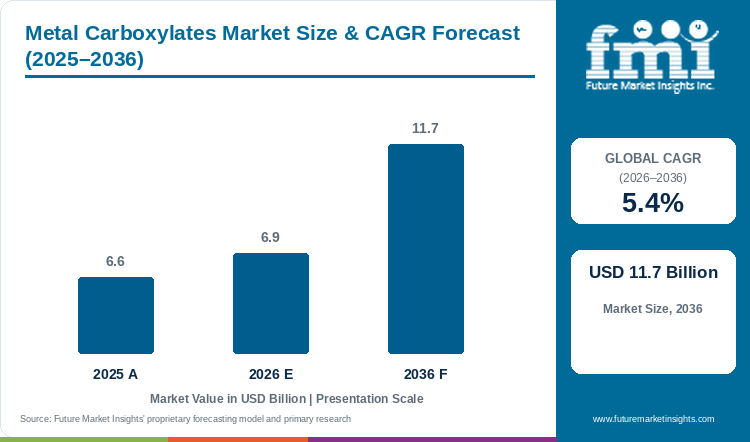
The Metal Carboxylates Market is projected to reach USD 11.7 billion by 2036, growing at a 5.4% CAGR from 2026 to 2036. The market reaches USD 6.9 billion in 2026. The market was valued at USD 6.6 billion in 2025. Cobalt supply is the nearest pressure on prices. The Democratic Republic of Congo replaced its February 2025 export ban with quotas in October 2025. The quotas allow up to 96,600 tons of contained cobalt a year in 2026 and 2027 [2]. On 29 June 2026 Bloomberg reported that the regulator ARECOMS had ordered producers to hand back unused first-half 2026 quota [9].
Demand for the metal salts follows the products they go into. Borchers describes its metal carboxylates as enhancers of oxidative and through drying in paints, coatings and printing inks [3]. Umicore adds catalysts for polyurethane, unsaturated polyester resins and polybutadiene rubber [5]. On 27 October 2026 Sherwin-Williams said that its Performance Coatings Group grew net sales 8.8% to USD 1.9 billion in the third quarter [17]. Buyers of coating resins and the driers that cure them face firm prices with slow volume.
Key Market Trends & Insights
- Cobalt access is now set by quota. After the February 2025 export ban, the Democratic Republic of Congo allowed 18,125 tons of contained cobalt for the rest of 2025. It allows up to 96,600 tons a year in 2026 and 2027, including 9,600 tons for national strategic reserves [2]. On 29 June 2026 it ordered producers to give up unused first-half quota [9].
- Cobalt-free driers are reaching product catalogues. DIC authors described a manganese neodecanoate drier with an amine ligand, DICNATE MV130A, in a paper published on 15 October 2024 [7]. Borchers markets its cobalt-free Borchi OXY-Coat for alkyd paints [4].
- Suppliers are positioning branched neodecanoates against 2-ethylhexanoates. On 6 July 2026 Shepherd Chemical published an article presenting copper neodecanoate as an alternative to copper octoate. The article describes 2-ethylhexanoic acid, the acid behind octoates, as classified as a reproductive and developmental toxin [13].
Regional Highlights
- North America: the United States imported about 14,000 tons of cobalt in 2025. Net import reliance on cobalt was 79%, and about five companies produced cobalt chemicals in the country [2].
- Europe: the German paint and printing ink industry sold 2.8% less volume in 2025, at 1.4 million tons [18]. The VdL forecast a further 2% decline for 2026 [18]. EU hazard classification of cobalt salts is the main regulatory factor for formulators [1].
- Asia Pacific: Asian Paints reported on 29 October 2026 that its decorative business in India grew volume 6.4% in the quarter to 30 September 2026 [19]. The China National Coatings Industry Association put China's 2025 coatings output at 34.602 million tons [20].
Metal Carboxylates Market Size and Forecast
Table 1: Metal Carboxylates Market Size and Forecast
| Market size and forecast | Value |
|---|---|
| Market size in 2025 | USD 6.6 billion |
| Market size in 2026 | USD 6.9 billion |
| Projected market size by 2036 | USD 11.7 billion |
| CAGR from 2026 to 2036 | 5.4% |
Source: Future Market Insights analysis of the metal carboxylates market, 2026.
Analyst Perspective
“The market is being pulled in two directions. Cobalt grades remain widely sold, yet cobalt is the metal with the tightest supply and the sharpest regulatory scrutiny. Suppliers that can offer a cobalt grade, a manganese or other substitute grade and a non-drier line such as catalysts or adhesion promoters will hold customers through either outcome. Buyers should write metal-price pass-through into contracts and qualify a second grade now, while supply is still available on normal terms.”
- Nikhil Kaitwade, Principal Consultant, FMI
How is the Metal Carboxylates Market segmented?
- By metal: Cobalt Carboxylates, Zinc Carboxylates, Calcium Carboxylates, Manganese Carboxylates, Zirconium Carboxylates and Other Metal Carboxylates
- By end-use: Polymerisation Catalysts, Lubricant Additives, Driers, Plastic Stabilizers, Polyester Accelerators and Fuel Additives
- By region: North America, Europe and Asia Pacific
Why do Cobalt Carboxylates lead by Metal in the Metal Carboxylates Market in 2026?
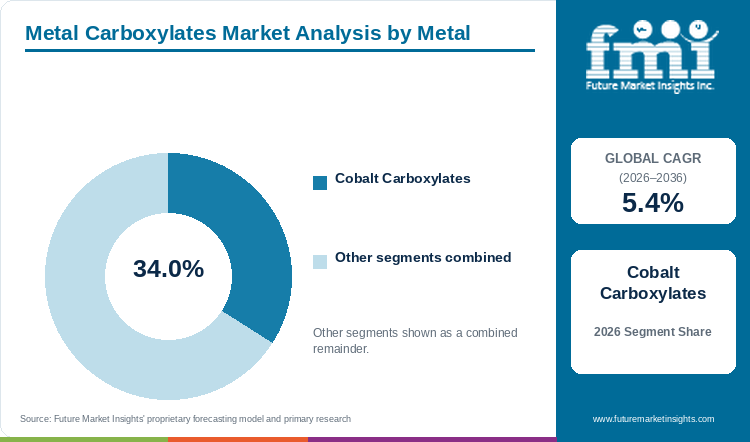
Cobalt Carboxylates account for 34.0% of the Metal Carboxylates Market by metal in 2026. Cobalt is the most active surface drier, and the same salts cure unsaturated polyester resins. Organometal lists a cobalt neodecanoate and a manganese 2-ethylhexanoate, each described as a single top drier for paints and coatings [10][11]. Venator describes its NUODEX Cobalt 6 as a cobalt-based primary drier and accelerator that works with calcium, strontium and zirconium driers [16]. Dosage and breadth explain why this group carries the largest share. Borchers lists ten metal carboxylate driers, four of them cobalt, plus calcium, cerium, zinc and zirconium grades [3]. Formulators can pair a primary grade with companion grades from the same range. Alkyd paint and ink formulators in waterborne coatings also need dedicated grades. Borchers sells a 10% cobalt Hydro-Cure IV for water-based paint systems and a 12% cobalt Hex-Cem for solvent-based systems [3]. Hazard classification puts pressure on this lead. The Cobalt Institute's March 2026 table lists cobalt bis(2-ethylhexanoate) under Repr. 1B, while the neodecanoate and stearate entries carry STOT RE 1 [1]. This explains the push toward cobalt-free manganese grades such as DIC's [7] and Organometal's [11].
Table 2: Metal, 2026 Share
| Leading Share | 2026 market share |
|---|---|
| Cobalt Carboxylates | 34.0% |
| All Other Segments Combined Share | 66.0% |
Source: Future Market Insights analysis of the metal carboxylates market, 2026.
Why do Polymerisation Catalysts lead by End-use in the Metal Carboxylates Market in 2026?
Polymerisation Catalysts account for 34.0% of the Metal Carboxylates Market by end-use in 2026. The segment covers polyurethane, rubber and petrochemical catalysts. Unsaturated polyester cure is counted under Polyester Accelerators. The lead comes from range. Umicore lists metal carboxylate catalysts for polyurethane, unsaturated polyester resins, polybutadiene rubber and petrochemical processes [5]. It also lists potassium-based products that trimerise isocyanate in rigid polyisocyanurate foam [5]. Borchers lists a 15% potassium Hex-Cem as a primary catalyst for rigid urethane foams [3]. Shepherd Chemical names petrochemicals, specialty polymers and unsaturated polyester resins as catalyst categories [15]. Polyester cure is the adjacent outlet for the same metals. Shepherd says its cobalt carboxylates activate the free radical polymerisation of unsaturated polyester resins. It describes the cure as a redox reaction usually started by cobalt-based catalysts together with peroxides [14]. Venator's page for NUODEX Cobalt 6 lists the same cure use and notes that potassium and copper can lift performance in polyester systems [16]. The US Geological Survey names copper, iron and manganese as a combination that can cure unsaturated polyester resins in place of cobalt [2]. Catalyst buyers therefore have a defined substitution path if cobalt cost stays high.
Table 3: End-use, 2026 Share
| Leading Share | 2026 market share |
|---|---|
| Polymerisation Catalysts | 34.0% |
| All Other Segments Combined Share | 66.0% |
Source: Future Market Insights analysis of the metal carboxylates market, 2026.
What are the key drivers, restraints and opportunities?
Driver
Coatings and ink volumes. Driers are consumed wherever oxidatively drying resins are used, so paint and ink output sets the base. Sherwin-Williams reported consolidated net sales of USD 6.9 billion for the third quarter of 2026, up 7.9%. Paint Stores Group sales rose 4.7% on price and low single-digit volume [17]. Asian Paints reported domestic coatings value growth of 16.4% in the quarter ended 30 September 2026. Volume grew 6.8% [19]. Growth in these two markets supports drier sales while German volumes fall.
Use beyond paint. Umicore lists catalysts for polyurethane, unsaturated polyester resins and polybutadiene rubber. It also lists solid cobalt carboxylates as rubber adhesion promoters, mainly for tires, and zinc compounds and additives for lubricants, including antioxidants, extreme-pressure and anti-wear additives [5]. Shepherd Chemical names catalysts, lubricant additives, paint and coating driers, ink formulations and hydrogen sulphide scavenging systems as uses for copper carboxylates [13]. Several outlets reduce exposure to any one industry.
Restraint
Cobalt supply and price. The Democratic Republic of Congo supplied about 230,000 tons of the 310,000 tons of world mined cobalt in 2025. The quota system caps exports at up to 96,600 tons a year in 2026 and 2027 [2]. The Fastmarkets report of September 2025 put the base quota at 87,000 tons a year [8]. That is about 7,250 tons a month, roughly half of 2024 monthly export volumes. US spot cathode averaged about USD 21 a pound in 2025, against USD 16.77 in 2024 [2]. Buyers of cobalt grades should expect that cost to feed through. That pushes formulators toward lower dosage or substitution. The London Metal Exchange cash price averaged about USD 15 a pound in 2025, against USD 11.84 in 2024 [2].
Hazard classification and substitution. DIC's authors state that cobalt 2-ethylhexanoate is labelled Reprotoxic Category 1B by the European Chemicals Agency, with the classification taking effect in November 2023 [7]. The Cobalt Institute's March 2026 table also lists cobalt di(acetate) as Carc. 1B and Repr. 1B. It states that this applies only to pure substances under EU CLP [1]. The US Geological Survey lists cerium, iron, lead, manganese or vanadium as possible substitutes for cobalt in paints [2]. Each substitute needs reformulation and testing, which slows adoption.
Opportunity
Cobalt-free and lower-hazard chemistries. Borchers describes its Borchi OXY-Coat as a cobalt-free drying additive for alkyd paints across hot or cold, dry or humid conditions [4]. DIC's DICNATE MV130A combines manganese neodecanoate with an amine-based ligand and uses VOC-free esters as the solvent [7]. Shepherd Chemical sells copper neodecanoate, an 8 wt% copper green liquid, and presents it as free of the regulatory concerns it links to 2-ethylhexanoic acid [13]. Producers that qualify these grades early can charge more for the formulation work behind them.
Lubricant and additive outlets. Umicore lists additives for lubricants that include antioxidants, extreme-pressure additives and corrosion or anti-wear additives, and zinc compounds for personal care [5]. PMC Group lists calcium, lithium, magnesium and zinc stearates among its product groups [12]. Buyers of lubricant additives can compare how metal-based chemistry is sold into that market.
Metal Carboxylates Market by Country (2026 to 2036)
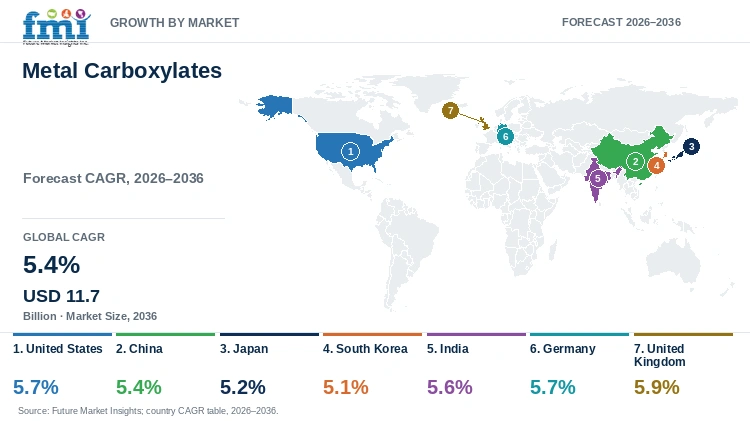
Table 4: Metal Carboxylates Market Country Growth Forecast
| Country | CAGR, 2026 to 2036 |
|---|---|
| United States | 5.7% |
| China | 5.4% |
| Japan | 5.2% |
| South Korea | 5.1% |
| India | 5.6% |
| Germany | 5.7% |
| United Kingdom | 5.9% |
Source: Future Market Insights analysis of the metal carboxylates market, 2026.
United States
Chemical uses are a large part of US cobalt demand. The US Geological Survey puts 25% of cobalt consumed in 2025 into chemical applications, 51% into superalloys and 9% into cemented carbides [2]. It also counts about five companies that produced cobalt chemicals domestically [2]. Net import reliance was 79%, and imports for consumption rose to 14,000 tons in 2025 from 10,800 tons in 2024 [2].
Uncertainty over Congo's export ban likely contributed to that jump in imports and industry stocks during 2025, according to the same report [2]. Import sources for cobalt metal, oxide and salts in 2021 to 2024 were Norway at 26%, Finland at 16%, Canada at 14% and Japan at 14% [2]. Shepherd Chemical, with its US office in Cincinnati, lists cobalt octoate grades at 12% for unsaturated polyester resins [14][15].
Paint demand is firm on price, not volume. Sherwin-Williams said on 27 October 2026 that Paint Stores Group net sales were USD 4.0 billion, up 4.7%. Protective and marine sales grew at a double-digit rate [17]. The company expects muted demand into 2027 [17]. US decorative coatings buyers are therefore watching drier cost, not looking for extra volume.
China
China was the leading producer of refined cobalt and the leading consumer in 2025, mostly for lithium-ion batteries, according to the US Geological Survey [2]. Battery makers and chemical producers draw on the same refined cobalt, so Congo's quotas feed through to Chinese cobalt chemical makers as well.
The China National Coatings Industry Association reported 2025 coatings output of 34.602 million tons, down 7.1%. Main business revenue fell 3.9% to CNY 388.2 billion, and total profit rose 11.5% [20]. Output fell while profit rose.
Coatings exports rose 22.0% to 407,700 tons in 2025, worth USD 1.2 billion [20]. Exported coatings carry the destination's chemical rules. Chinese paint makers that ship to Europe therefore have reason to qualify cobalt-free driers alongside conventional grades [1][4].
Japan
DIC Corporation, a Japanese company, develops cobalt-free driers. A paper credited to Hiroaki Nakano of DIC in Ichihara, Chiba, was published on 15 October 2024. It describes DICNATE MV130A as a manganese neodecanoate drier with an amine ligand and VOC-free esters as solvent [7].
The paper reports that the drier speeds drying of alkyd coatings, though it gives no quantitative test data [7]. Buyers should therefore run their own cure and colour tests before moving a Japanese-made cobalt-free grade into a production resin.
Japan also supplies cobalt materials abroad. It accounted for 14% of US imports of cobalt metal, oxide and salts in 2021 to 2024 [2]. Japanese suppliers sit on both sides of the substitution question. They ship cobalt materials and also develop cobalt-free alternatives, so they are worth including in a second-source list.
South Korea
Korean coatings demand leans on transport equipment. In a note published on 25 June 2026, Shinhan Investment Securities analyst Lee Jin-myung expected KCC's coatings business to keep producing stable profits. The portfolio is high value-added and centred on automotive and marine applications [21].
The same note expects marine coatings demand to keep growing with the shipbuilding boom and eco-friendly vessels [21]. It sees limited effect from the construction slowdown [21].
South Korea does not appear as a separate line in the US Geological Survey's 2025 table of cobalt mine production [2]. Korean formulators buying cobalt grades face the same Congo quota pricing as buyers elsewhere [2][9]. Fastmarkets data reported on 30 June 2026 put benchmark prices more than 160% above their level before the restrictions [9]. Supply contracts with a quarterly metal surcharge may suit both sides better than annual flat prices.
India
Asian Paints reported on 29 October 2026 that domestic coatings value grew 16.4% in the quarter ended 30 September 2026. Volume grew 6.8%, and industrial coatings value grew 31.8% [19].
The company described sharp raw material inflation and material availability constraints from geopolitical disruptions. It said it was taking a further round of staggered price increases in decorative paint [19]. Cost pass-through of this kind is how a rise in drier prices reaches the shelf. It leaves little room for suppliers to absorb cobalt cost increases.
On the same date Asian Paints said it had commissioned Phase 1 of its vinyl acetate ethylene plant at Dahej as part of backward integration [19]. Larger paint makers integrating upstream are likely to press additive suppliers, including driers, for cost transparency and local supply. That favours suppliers able to document metal content and origin batch by batch.
Germany
The German paint and printing ink industry is shrinking in volume. The VdL reported on 12 February 2026 that 2025 sales volume fell 2.8% to 1.4 million tons. Revenue fell about 1.2% to EUR 5.8 billion [18]. Building paint volume fell 3.5% and powder coatings about 5% [18].
For 2026 the VdL forecasts a 2% volume decline, flat industrial coatings and a 3% fall in building paints. Recovery in building paints is possible only from 2027 [18]. Exports rose about 1% to EUR 3.7 billion in 2025 [18].
VdL managing director Martin Kanert said early successes in chemicals law were visible under the Omnibus packages. He added that bureaucracy reduction often stalls in the detail [18]. For drier buyers the practical task is to track EU labelling for each cobalt salt, which the Cobalt Institute table lists substance by substance [1].
United Kingdom
The United Kingdom applies its own hazard classification list. HSE states that EU harmonised classifications in force on 31 December 2020 were carried over into Great Britain as GB mandatory classification and labelling. HSE and ministers can propose new or revised entries [22].
The Cobalt Institute's March 2026 table of cobalt substances applies only to EU territory [1]. A UK buyer of cobalt carboxylate driers must therefore check the GB list and the supplier's safety data sheet for each grade, not assume the EU entry applies.
UK formulators can draw on suppliers with European operations. Borchers has offices in North America, Europe and Asia [4]. Shepherd Chemical has an operation in Mirecourt, France [15], and Organometal runs its metal carboxylate plants outside Athens [10]. A buyer qualifying a second grade has more than one regional source. Each supplier should state its GB classification position in writing.
Who are the notable companies in the Metal Carboxylates Market?
Notable companies in the Metal Carboxylates Market include Umicore, Borchers, Shepherd Chemical Company, Venator, Organometal, PMC Group and DIC Corporation.
Metal choice and chemistry separate the suppliers more than scale does. Umicore says it works with around 20 elements, including cobalt, nickel, manganese and zinc [5]. It offers octoates, neodecanoates, naphthenates, resinates and stearates [5]. Borchers sells ten driers across six metals [3]. Organometal concentrates on driers, with cobalt, manganese and zirconium grades [10][11]. PMC Group lists seven stearate product groups, from aluminium to zinc [12].
Cobalt pressure has turned that choice into a commercial argument. Borchers markets cobalt-free Borchi OXY-Coat for alkyd paints [4]. DIC's authors describe a manganese neodecanoate drier [7]. Shepherd Chemical argues that copper neodecanoate avoids the concerns it attaches to 2-ethylhexanoic acid [13]. Umicore sells cobalt carboxylates as rubber adhesion promoters [5]. It reported on 30 April 2026 exceptional profitability in its Cobalt & Specialty Materials unit [6].
Breadth beyond paint is the second dividing line. Shepherd Chemical lists catalyst categories for petrochemicals, specialty polymers and unsaturated polyester resins [15]. Venator's NUODEX Cobalt 6 is described for both coating driers and polyester cure [16]. Umicore covers polyurethane, rubber and lubricant additives [5]. Suppliers with these outlets can move volume between markets when one weakens.
Key Developments in the Metal Carboxylates Market
- On 30 June 2026, MiningMX reported, citing Bloomberg of 29 June, that the regulator ARECOMS had ordered Congolese cobalt producers to give up unused first-half 2026 export quota. The quota is to be reallocated to its strategic allowance [9].
- On 6 July 2026, Shepherd Chemical published an article presenting copper neodecanoate, an 8 wt% copper liquid, as an alternative to copper octoate and copper naphthenate [13].
- On 30 April 2026, Umicore reported an outstanding first quarter for its Specialty Materials Business Group, driven by exceptional profitability in Cobalt & Specialty Materials [6].
- On 16 October 2025, the Democratic Republic of Congo replaced its cobalt export ban with quotas. The quotas were 18,125 tons for the rest of 2025 and up to 96,600 tons a year in 2026 and 2027 [2][8].
Key Players in the Metal Carboxylates Market
- Umicore
- Borchers (Milliken)
- Shepherd Chemical Company
- Venator
- Organometal
- PMC Group, Inc.
- DIC Corporation
Metal Carboxylates Market Report Scope
Table 5: Metal Carboxylates Market Report Scope
| Coverage field | Report scope |
|---|---|
| Market definition | Metal salts of carboxylic acids such as octoates, neodecanoates, naphthenates and stearates, sold as driers, catalysts, lubricant additives, plastic stabilizers, polyester accelerators and fuel additives, measured by value of sales |
| Metal | Cobalt Carboxylates, Zinc Carboxylates, Calcium Carboxylates, Manganese Carboxylates, Zirconium Carboxylates, Other Metal Carboxylates |
| End-use | Polymerisation Catalysts, Lubricant Additives, Driers, Plastic Stabilizers, Polyester Accelerators, Fuel Additives |
| Regions and profiled countries | North America, Europe, Asia Pacific, United States, China, Japan, South Korea, India, Germany, United Kingdom |
| Companies covered | Umicore, Borchers (Milliken), Shepherd Chemical Company, Venator, Organometal, PMC Group, Inc., DIC Corporation |
| Forecast period | 2026 to 2036, with 2025 as the historical base year |
| Quantitative Units | USD billion |
Source: Future Market Insights analysis of the metal carboxylates market, 2026.
Metal Carboxylates Market by Segments
Metal Carboxylates Market segmented by Metal:
- Cobalt Carboxylates
- Zinc Carboxylates
- Calcium Carboxylates
- Manganese Carboxylates
- Zirconium Carboxylates
- Other Metal Carboxylates
Metal Carboxylates Market segmented by End-use:
- Polymerisation Catalysts
- Lubricant Additives
- Driers
- Plastic Stabilizers
- Polyester Accelerators
- Fuel Additives
Metal Carboxylates Market by Region
- North America
- Europe
- Asia Pacific
- United States
- China
- Japan
- South Korea
- India
- Germany
- United Kingdom
Research Sources and Bibliography
- [1] Cobalt Institute. (2026, March). Classification of Cobalt substances under EU CLP (EU Regulation No. 1272/2008). https://www.cobaltinstitute.org/wp-content/uploads/2026/03/EU_CLP_classification_table_March_2026.pdf
- [2] U.S. Geological Survey. (2026, February). Cobalt, Mineral Commodity Summaries 2026. https://pubs.usgs.gov/periodicals/mcs2026/mcs2026-cobalt.pdf
- [3] Borchers. (n.d.). Driers. https://borchers.com/driers/
- [4] Borchers. (2026, November 2). Borchers, a Milliken brand: home page and news. https://borchers.com
- [5] Umicore. (n.d.). Metal carboxylates. https://csm.umicore.com/en/metal-carboxylates-organics/chemistries/metal-carboxylates/
- [6] Umicore. (2026, April 30). Strong start of the year sets Umicore up for solid 2026 performance. https://www.umicore.com/en/media/newsroom/strong-start-of-the-year-sets-umicore-up-for-solid-2026-performance/
- [7] European Coatings. (2024, October 15). A new high-performance alternative to cobalt driers (DIC Corporation). https://www.european-coatings.com/articles/2024/high-performance-alternative-to-cobalt-driers
- [8] Fastmarkets. (2025, September 22). Cobalt export quotas: DRC sets limits to rebalance global supply. https://www.fastmarkets.com/insights/drc-cobalt-export-quotas-2025/
- [9] MiningMX. (2026, June 30). Congo to claw back unused cobalt quotas. https://miningmx.com/news/base-metals/2026-06-30-congo-to-claw-back-unused-cobalt-quotas/
- [10] Safic-Alcan. (n.d.). ORGANO CO NEO, provided by Organometal. https://www.safic-alcan.com/en-fr/product-catalog/coatings-inks-construction/organometal/organo-co-neo/
- [11] Safic-Alcan. (n.d.). ORGANO MN 10 HF, provided by Organometal. https://www.safic-alcan.com/en-fr/product-catalog/coatings-inks-construction/organometal/organo-mn-10-hf/
- [12] PMC Group. (n.d.). Our products. https://pmc-group.com/our-products/
- [13] Shepherd Chemical Company. (2026, July 6). Copper Neodecanoate: A Safer, Versatile Alternative to Traditional Copper Carboxylates. https://www.shepchem.com/news/copper-neodecanoate-a-safer-versatile-alternative-to-traditional-copper-carboxylates/
- [14] Shepherd Chemical Company. (n.d.). Unsaturated Polyester Resin Catalysts. https://www.shepchem.com/industries/catalysts/unsaturated-polyester-resins/
- [15] Shepherd Chemical Company. (n.d.). Home page. https://www.shepchem.com/
- [16] Safic-Alcan. (n.d.). NUODEX Cobalt 6, provided by Venator. https://www.safic-alcan.com/en-lu/product-catalog/coatings-inks-construction/venator/nuodex-cobalt-6/
- [17] The Sherwin-Williams Company. (2026, October 27). Third quarter 2026 financial results (Form 8-K, earnings release). https://www.sec.gov/Archives/edgar/data/0000089800/000008980026000054/shwearningsrelease3q2026.htm
- [18] CHEManager. (2026, February 12). Farbenbranche malt weiter grau (VdL annual press conference). https://chemanager-online.com/de/news/farbenbranche-malt-weiter-grau
- [19] Asian Paints Limited. (2026, October 29). Press release: Q2 and H1 FY27 financial performance. https://www.asianpaints.com/content/dam/asianpaints/website/secondary-navigation/press-releases/2026-2027/Asian-Paints-Press-Release-Q2-and-H1-FY27.pdf
- [20] SunSirs. (2026, March 9). China's total paint production reaches 34.602 million tonnes in 2025 (China National Coatings Industry Association briefing). https://www.sunsirs.com/uk/detail_news-31112.html
- [21] Edaily. (2026, June 25). Stock reports: KCC, Shinhan Investment Securities. https://en.edaily.co.kr/news/eda202606255060/
- [22] Health and Safety Executive. (2026, May 20). GB CLP regulation. https://www.hse.gov.uk/chemical-classification/legal/clp-regulation.htm
Table of Content
Table of Content
- Key Takeaways
- Market Size and CAGR
- Top Growth Driver
- Fastest Growing Segment
- Leading Region
- Key Companies
- Emerging Opportunities
- Executive Summary
- Global Market Outlook
- Demand-side Trends
- Supply-side Trends
- Technology Roadmap Analysis
- Analysis and Recommendations
- Analyst Perspective (What is happening? Why now? What should investors know?)
- Key Questions Answered
- How large is the market?
- What is the CAGR?
- What are key trends?
- Which region dominates?
- Who are the leaders?
Read More...
- Market Overview
- Market Coverage / Taxonomy
- Market Definition / Scope / Limitations
- Research Methodology
- Chapter Orientation
- Analytical Lens and Working Hypotheses
- Market Structure, Signals, and Trend Drivers
- Benchmarking and Cross-market Comparability
- Market Sizing, Forecasting, and Opportunity Mapping
- Research Design and Evidence Framework
- Desk Research Programme (Secondary Evidence)
- Expert Input and Fieldwork (Primary Evidence)
- Tooling, Models, and Reference Databases
- Data Engineering and Model Build
- Quality Assurance and Audit Trail
- Market Background
- Market Dynamics (Drivers, Restraints, Opportunity, Trends)
- Scenario Forecast (Optimistic, Likely, Conservative)
- Impact Analysis
- AI Impact
- Sustainability Impact
- Regulatory Impact
- Technology Impact
- Consumer / Buyer Analysis
- Purchase Drivers
- Adoption Barriers
- Buyer Journey
- Opportunity Map Analysis
- Product Life Cycle Analysis
- Supply Chain Analysis
- Investment Feasibility Matrix
- Value Chain Analysis
- PESTLE and Porter's Analysis
- Regulatory Landscape
- Regional Parent Market Outlook
- Production and Consumption Statistics
- Import and Export Statistics
- Global Market Analysis and Forecast, 2021 to 2036
- Historical Market Size Value (USD Billion) Analysis, 2021 to 2025
- Current and Future Market Size Value (USD Billion) Projections, 2026 to 2036
- Y-o-Y Growth Trend Analysis
- Absolute $ Opportunity Analysis
- Global Market Pricing Analysis, 2021 to 2036
- Global Market Analysis and Forecast, By Metal, 2021 to 2036
- Introduction / Key Findings
- Historical Market Size Value (USD Billion) Analysis By Metal, 2021 to 2025
- Current and Future Market Size Value (USD Billion) Analysis and Forecast By Metal, 2026 to 2036
- Cobalt Carboxylates
- Zinc Carboxylates
- Calcium Carboxylates
- Manganese Carboxylates
- Zirconium Carboxylates
- Other Metal Carboxylates
- Y-o-Y Growth Trend Analysis By Metal, 2021 to 2025
- Absolute $ Opportunity Analysis By Metal, 2026 to 2036
- Global Market Analysis and Forecast, By End-use, 2021 to 2036
- Introduction / Key Findings
- Historical Market Size Value (USD Billion) Analysis By End-use, 2021 to 2025
- Current and Future Market Size Value (USD Billion) Analysis and Forecast By End-use, 2026 to 2036
- Polymerisation Catalysts
- Lubricant Additives
- Driers
- Plastic Stabilizers
- Polyester Accelerators
- Fuel Additives
- Y-o-Y Growth Trend Analysis By End-use, 2021 to 2025
- Absolute $ Opportunity Analysis By End-use, 2026 to 2036
- Global Market Analysis and Forecast, By Region, 2021 to 2036
- Introduction
- Historical Market Size Value (USD Billion) Analysis By Region, 2021 to 2025
- Current Market Size Value (USD Billion) Analysis and Forecast By Region, 2026 to 2036
- North America
- Europe
- Asia Pacific
- Market Attractiveness Analysis By Region
- North America Market Analysis and Forecast, By Country, 2021 to 2036
- Historical Market Size Value (USD Billion) Trend Analysis By Market Taxonomy, 2021 to 2025
- Market Size Value (USD Billion) Forecast By Market Taxonomy, 2026 to 2036
- By Country
- By Metal
- By End-use
- Market Attractiveness Analysis
- By Country
- By Metal
- By End-use
- Key Takeaways
- Europe Market Analysis and Forecast, By Country
- Historical Market Size Value (USD Billion) Trend Analysis By Market Taxonomy, 2021 to 2025
- Market Size Value (USD Billion) Forecast By Market Taxonomy, 2026 to 2036
- By Country
- By Metal
- By End-use
- Market Attractiveness Analysis
- By Country
- By Metal
- By End-use
- Key Takeaways
- Asia Pacific Market Analysis and Forecast, By Country
- Historical Market Size Value (USD Billion) Trend Analysis By Market Taxonomy, 2021 to 2025
- Market Size Value (USD Billion) Forecast By Market Taxonomy, 2026 to 2036
- By Country
- United States
- China
- Japan
- South Korea
- India
- Germany
- United Kingdom
- By Metal
- By End-use
- By Country
- Market Attractiveness Analysis
- By Country
- By Metal
- By End-use
- Key Takeaways
- Key Countries Market Analysis
- United States
- Pricing Analysis
- Market Share Analysis, 2025
- By Metal
- By End-use
- Germany
- Pricing Analysis
- Market Share Analysis, 2025
- By Metal
- By End-use
- United Kingdom
- Pricing Analysis
- Market Share Analysis, 2025
- By Metal
- By End-use
- India
- Pricing Analysis
- Market Share Analysis, 2025
- By Metal
- By End-use
- China
- Pricing Analysis
- Market Share Analysis, 2025
- By Metal
- By End-use
- Japan
- Pricing Analysis
- Market Share Analysis, 2025
- By Metal
- By End-use
- South Korea
- Pricing Analysis
- Market Share Analysis, 2025
- By Metal
- By End-use
- United States
- Market Structure Analysis
- Competition Dashboard
- Competition Benchmarking
- Market Share Analysis of Top Players
- By Regional
- By Metal
- By End-use
- Emerging Startups
- Innovation Benchmarking
- Competition Analysis
- Competition Deep Dive
- Umicore
- Overview
- Product Portfolio
- Profitability by Market Segments
- Sales Footprint
- Strategy Overview
- Marketing Strategy
- Product Strategy
- Channel Strategy
- Borchers (Milliken)
- Shepherd Chemical Company
- Venator
- Organometal
- PMC Group, Inc.
- DIC Corporation
- Umicore
- Case Studies
- Success Stories
- Recent Developments
- Competition Deep Dive
- Assumptions & Acronyms Used
List of Tables
- Table 1: Global Market Value (USD Billion) Forecast by Region, 2021 to 2036
- Table 2: Global Market Value (USD Billion) Forecast by Metal, 2021 to 2036
- Table 3: Global Market Value (USD Billion) Forecast by End-use, 2021 to 2036
- Table 4: North America Market Value (USD Billion) Forecast by Country, 2021 to 2036
- Table 5: North America Market Value (USD Billion) Forecast by Metal, 2021 to 2036
- Table 6: North America Market Value (USD Billion) Forecast by End-use, 2021 to 2036
- Table 7: Europe Market Value (USD Billion) Forecast by Country, 2021 to 2036
- Table 8: Europe Market Value (USD Billion) Forecast by Metal, 2021 to 2036
- Table 9: Europe Market Value (USD Billion) Forecast by End-use, 2021 to 2036
- Table 10: Asia Pacific Market Value (USD Billion) Forecast by Country, 2021 to 2036
- Table 11: Asia Pacific Market Value (USD Billion) Forecast by Metal, 2021 to 2036
- Table 12: Asia Pacific Market Value (USD Billion) Forecast by End-use, 2021 to 2036
List of Figures
- Figure 1: Global Market Pricing Analysis
- Figure 2: Global Market Value (USD Billion) Forecast 2021-2036
- Figure 3: Global Market Value Share and BPS Analysis by Metal, 2026 and 2036
- Figure 4: Global Market Y-o-Y Growth Comparison by Metal, 2026-2036
- Figure 5: Global Market Attractiveness Analysis by Metal
- Figure 6: Global Market Value Share and BPS Analysis by End-use, 2026 and 2036
- Figure 7: Global Market Y-o-Y Growth Comparison by End-use, 2026-2036
- Figure 8: Global Market Attractiveness Analysis by End-use
- Figure 9: Global Market Value (USD Billion) Share and BPS Analysis by Region, 2026 and 2036
- Figure 10: Global Market Y-o-Y Growth Comparison by Region, 2026-2036
- Figure 11: Global Market Attractiveness Analysis by Region
- Figure 12: North America Market Incremental Dollar Opportunity, 2026-2036
- Figure 13: Europe Market Incremental Dollar Opportunity, 2026-2036
- Figure 14: Asia Pacific Market Incremental Dollar Opportunity, 2026-2036
- Figure 15: North America Market Value Share and BPS Analysis by Country, 2026 and 2036
- Figure 16: North America Market Value Share and BPS Analysis by Metal, 2026 and 2036
- Figure 17: North America Market Y-o-Y Growth Comparison by Metal, 2026-2036
- Figure 18: North America Market Attractiveness Analysis by Metal
- Figure 19: North America Market Value Share and BPS Analysis by End-use, 2026 and 2036
- Figure 20: North America Market Y-o-Y Growth Comparison by End-use, 2026-2036
- Figure 21: North America Market Attractiveness Analysis by End-use
- Figure 22: Europe Market Value Share and BPS Analysis by Country, 2026 and 2036
- Figure 23: Europe Market Value Share and BPS Analysis by Metal, 2026 and 2036
- Figure 24: Europe Market Y-o-Y Growth Comparison by Metal, 2026-2036
- Figure 25: Europe Market Attractiveness Analysis by Metal
- Figure 26: Europe Market Value Share and BPS Analysis by End-use, 2026 and 2036
- Figure 27: Europe Market Y-o-Y Growth Comparison by End-use, 2026-2036
- Figure 28: Europe Market Attractiveness Analysis by End-use
- Figure 29: Asia Pacific Market Value Share and BPS Analysis by Country, 2026 and 2036
- Figure 30: Asia Pacific Market Value Share and BPS Analysis by Metal, 2026 and 2036
- Figure 31: Asia Pacific Market Y-o-Y Growth Comparison by Metal, 2026-2036
- Figure 32: Asia Pacific Market Attractiveness Analysis by Metal
- Figure 33: Asia Pacific Market Value Share and BPS Analysis by End-use, 2026 and 2036
- Figure 34: Asia Pacific Market Y-o-Y Growth Comparison by End-use, 2026-2036
- Figure 35: Asia Pacific Market Attractiveness Analysis by End-use
- Figure 36: Global Market - Tier Structure Analysis
- Figure 37: Global Market - Company Share Analysis
Frequently Asked Questions
How big is the metal carboxylates market in 2026?
The Metal Carboxylates Market reaches USD 6.9 billion in 2026, up from USD 6.6 billion in 2025. It is projected to reach USD 11.7 billion by 2036, a 5.4% CAGR from 2026 to 2036.
Which technology and end-use lead the metal carboxylates market?
Cobalt Carboxylates lead by metal with 34.0% and Polymerisation Catalysts lead by end-use with 34.0% in 2026. Organometal and Venator describe cobalt and manganese grades as single top or primary driers [10][11][16]. Umicore lists catalysts for polyurethane, unsaturated polyester resins and polybutadiene rubber [5].
Which other segments matter?
By metal, Zinc Carboxylates hold 20.0%, Calcium Carboxylates 15.0%, Manganese Carboxylates 12.0%, Zirconium Carboxylates 10.0% and Other Metal Carboxylates 9.0%. By end-use, Lubricant Additives hold 20.0%, Driers 15.0%, Plastic Stabilizers 12.0%, Polyester Accelerators 10.0% and Fuel Additives 9.0%. Umicore lists lubricant additives and rubber adhesion promoters among its uses [5], and PMC Group lists seven stearate product groups [12].
Which profiled country is forecast to grow fastest?
The United Kingdom has the highest forecast CAGR of the seven profiled countries at 5.9% from 2026 to 2036. The United States and Germany follow at 5.7% each, and India is at 5.6%. UK buyers have to check the GB mandatory classification list for each cobalt grade. HSE carried over only the EU classifications in force on 31 December 2020 [22].
How do cobalt supply controls and hazard rules affect pricing?
The Democratic Republic of Congo allows up to 96,600 tons of contained cobalt a year in 2026 and 2027 under its quota system [2]. On 29 June 2026 Bloomberg reported that ARECOMS had ordered producers to give up unused first-half quota [9]. Fastmarkets data put cobalt prices more than 160% above pre-restriction levels [9]. The Cobalt Institute's March 2026 table lists cobalt bis(2-ethylhexanoate) under Repr. 1B, and the neodecanoate entry under STOT RE 1 [1].
What should a buyer check when qualifying a metal carboxylate?
Check the metal, its percentage in the product and the acid it is bound to. 2-ethylhexanoate and neodecanoate grades are treated differently under hazard labelling [1][13]. Borchers lists 10% and 12% cobalt grades for different systems [3], and Shepherd Chemical lists a 12% cobalt octoate for polyester cure [14]. Then confirm the solvent system and whether the supplier offers a cobalt-free alternative [4][7].
Preview the report firsthand - request a free sample
Get SampleGet the brochure for pricing and purchase details.
Get PDF
