

- Market Size (2026)
- USD 748.5 Mn
- Forecast (2036)
- USD 1405.0 Mn
- CAGR (2026 to 2036)
- 6.5%
How big is Metal Printing Binders Market in 2026?
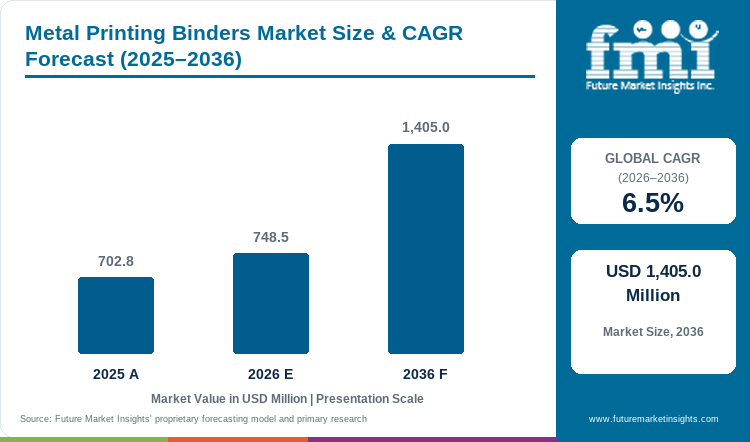
USD 748.5 million in 2026 and USD 1,405.0 million by 2036, expanding at a 6.5% CAGR.
Sales of metal printing binders are estimated to rise at 6.5% CAGR through 2036. Valuation rises from USD 702.8 million in 2025 to USD 748.5 million in 2026 and reaches USD 1,405.0 million by 2036. Every approved production build uses binder or bound feedstock as a required material input. In May 2025, NIST updated its binder-jetting page and confirmed that binder joins powder during printing. Approved 3D printing materials must match the selected binder and furnace settings throughout production. Plant teams test binder behavior with powder and furnace conditions before releasing regular production.
Local test systems determine how quickly a successful trial becomes a recurring binder order. In October 2025, Fraunhofer IFAM linked metal binder jetting with series production and final heat treatment. German plants use that research base to structure print and furnace approval work. In May 2025, NEDO began funding metal 3D printing systems with quality checks and standards in Japan. Neither program reports binder revenue or measures direct binder sales within the supported work. Local test access helps explain why industrial 3D printing reaches routine production at different speeds across countries.
Key Takeaways
- Approved production builds consume binder or bound feedstock, so released production volume raises recurring material demand.
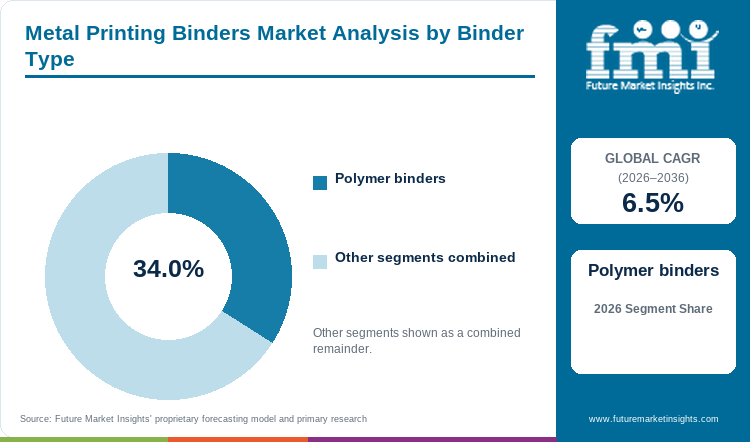
- Polymer binders are projected to hold 34.0% of binder type revenue in 2026, attributable to adjustable flow and controlled binder removal.
- Stainless steel is estimated to hold 32.0% of metal powder revenue in 2026, influenced by familiar grades and established furnace settings.
- Binder jetting is expected to hold 39.0% of process revenue in 2026, driven by binder use across every printed layer.
- Changing a binder source requires printing and debinding checks before sintering confirms residue levels and final part dimensions.
- Key participants include Desktop Metal, Markforged, HP, ExOne Global Holdings, Forward AM, Höganäs, Sandvik Additive Manufacturing, GKN Additive, MIMplus Technologies, and Nanoe.
Analyst Perspective
"Repeat production creates the clearest commercial opening for binder suppliers once plants approve stable powder and furnace combinations. Wider adoption depends on consistent printing and binder removal with reliable sintering results before procurement teams commit to recurring material orders."
- Nikhil Kaitwade, Principal Consultant, Future Market Insights
How is the metal printing binders market segmented?
Metal Printing Binders Market is segmented by Binder Type, Metal Powder, Process, End Use, Sales Channel, and Region. Forecast period from 2026 to 2036.
The metal printing binders market is segmented by binder type, metal powder, process, end use, sales channel, and region. Binder type includes polymer, wax-based, water-soluble, catalytic debinding, and hybrid systems. Metal powder includes stainless steel, tool steel, titanium, copper alloys, and nickel alloys. Process includes binder jetting, metal FFF, MIM feedstock printing, paste extrusion, and cold-bound printing. End use identifies the main binder applications across industrial programs. Sales channel identifies the principal routes used to purchase approved binder materials.
How do polymer binders shape demand within the binder type category?
Polymer binders hold green parts together during handling and burn out during furnace processing. Polymer systems also form bound feedstock for metal filaments used in material extrusion. In May 2025, Stratasys bought key Forward AM assets and operations. The deal preserved a specialist materials unit, but the metal filament line entered portfolio review.
- Polymer binders are likely to capture 34.0% of binder type revenue in 2026, supported by tunable flow and controlled binder removal.
- Plant teams test green strength and residue before approving binders for routine furnace cycles.
Why does stainless steel hold the metal powder position?
Stainless steel gives users familiar grades and established furnace settings for production approval. Metal powder supply can reduce early qualification work for commonly used stainless grades. NIST includes stainless steel in additive research that supports production-focused process development. Particle shape and binder loading affect powder packing, so material supply must remain consistent across qualified lots. Stable powder lots help plants control final part density and dimensions through sintering.
- Stainless steel is forecast to represent 32.0% of metal powder revenue in 2026, reinforced by familiar grades and established furnace settings.
- Plants need stable powder and binder packing before extending an approved process to less familiar alloys.
What supports binder jetting within the process category?
Binder jetting places liquid binder across every printed powder layer during the build. In October 2025, Fraunhofer IFAM linked sinter-based methods with series production. Large build areas can be printed at production-oriented speeds once layer settings remain stable. Plant teams control binder volume and green-part handling before furnace processing begins. Consistent layer quality reduces rework during binder removal and final sintering.
- Binder jetting is set to lead the process category with 39.0% share in 2026, tied to binder use in every printed layer.
- Series production makes binder supply part of routine machine planning across each approved powder and furnace route.
How does industrial tooling shape end-use demand?
Industrial tooling users need short runs and complex internal shapes without creating a full production tool. In April 2026, HP added WC-Co to Metal Jet work for tooling applications. Automotive 3D printing supports jigs and fixtures that require fast design changes across plant operations. Plants verify final part density and dimensions after sintering before approving repeat tooling production.
- Industrial tooling is estimated to hold 29.0% of end-use revenue in 2026, influenced by short-run demand and custom part requirements.
- Tooling programs give plants a clear shop-floor use during early process approval. Approved tooling routes can provide a base for later regulated applications.
Why do printer OEMs lead the sales channel category?
Printer OEMs control settings that directly affect binder placement and final part shrinkage. In April 2026, HP linked Metal Jet material work with contained powder handling for the S100. One platform provider can test more of the process chain within a controlled system. Independent formulators offer wider binder choice but must prove performance across several printer and furnace setups.
- Printer OEMs are set to lead the sales channel with 35.0% share in 2026, enabled by approved settings and single-system support.
- OEM channels turn an approved material setting into a defined supply route for routine production.
What are the drivers, restraints and opportunities in the Metal Printing Binders Market?
Serial production raises material consumption while full-chain qualification slows supplier changes and alloy programs expand addressable use.
- Driver: Serial metal printing converts approved binders and bound feedstocks into recurring production inputs.
- Restraint: Supplier changes are constrained by repeated printing and debinding checks before sintering confirms each approved process route.
- Opportunity: New alloy programs create a route for low-residue binder grades supported by local process data.
Series production ties binder demand to the number of machine builds released for routine manufacturing. In June 2026, Fraunhofer IFAM published a metal binder jetting project focused on serial production. The project checks powder traits and print settings through binder removal and sintering approval. Engineers measure part dimensions and build-to-build consistency before a process enters routine manufacturing. Every released build uses binder or bound feedstock as a planned production input. 3D printing metal programs need scheduled material supply once approved machines move beyond initial trials. Plant teams rely on stable lots and clear storage rules to preserve approved process settings. Higher machine use raises recurring binder and feedstock orders as more released builds enter normal production.
Supplier switching remains constrained by repeated checks across printing, debinding and sintering within each approved process. In May 2025, NIST updated its binder-jetting page and identified binder as part of the powder-fusion process. A chemistry change can alter green-part handling and final furnace results during qualification. Plants run fresh process checks whenever they change an approved binder source. Powder injection molding gives engineers useful furnace knowledge for related sinter-based production routes. Printed routes need separate settings because layer formation and binder removal behave differently. Long approval cycles raise switching costs and increase the value of local test data. Clear lot records help plants compare a candidate binder with the approved production route.
New alloy programs give formulators a route to develop binder grades for additional powder families. In April 2026, HP announced Metal Jet work on copper and M247LC nickel superalloy. The same program included WC-Co tooling material for additional qualification work. Each powder family changes wetting behavior and furnace response during process qualification. Binder developers need print and residue data before supporting a new powder family. Titanium powder programs create another qualification route for aerospace and medical uses. Local trials let engineers test powder and binder behavior against a supported furnace setting. Low-residue binder options can serve powders that operate within different thermal limits. Regular orders follow trials that confirm stable density and part dimensions across repeated builds.
Which country CAGRs are profiled in the Metal Printing Binders Market?
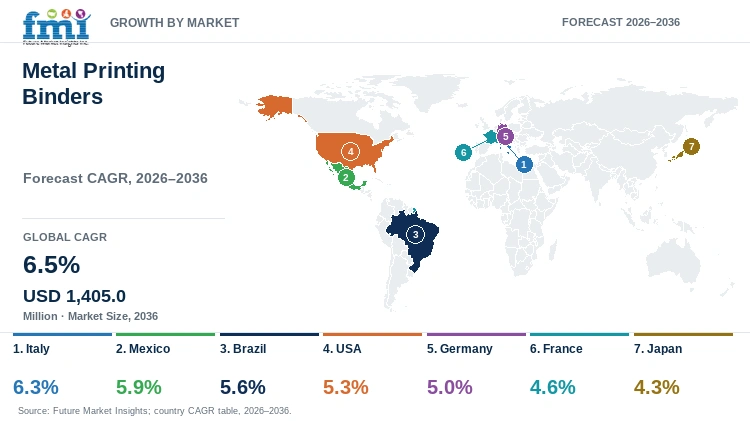
| Country | CAGR |
|---|---|
| Italy | 6.3% |
| Mexico | 5.9% |
| Brazil | 5.6% |
| USA | 5.3% |
| Germany | 5.0% |
| France | 4.6% |
| Japan | 4.3% |
How do country-level CAGRs compare in the Metal Printing Binders Market?
The seven profiled country CAGRs range from 4.3% to 6.3% across the 2026 to 2036 forecast period. Italy and Mexico sit near the upper end of that range. France and Japan record the lower profiled rates within this group.
- Italy uses public materials laboratories to test metal alloys and production routes before wider industrial adoption.
- Mexico's national metrology program supports stable measurement systems for automotive and aerospace metal printing qualification.
- Brazil's national qualification center gives manufacturers local laboratory access for critical metal parts produced through additive manufacturing.
- US measurement research gives plants a common technical basis for binder-jetting process checks and production approval.
- Germany's applied research network supports binder removal and sintering tests across full sinter-based production chains.
- France combines public factory funding with additive manufacturing projects that require traceable process approval for industrial use.
- Japan's national programs connect metal powder quality with certification work and production standards for factory-scale additive manufacturing.
The full report provides country-level CAGR analysis across North America, Latin America, Western Europe, Eastern Europe, East Asia, South Asia and Pacific, and the Middle East and Africa.
Country-wise Analysis
- Public laboratories give Italian manufacturers access to metal alloy tests and additive research. Metal printing binder demand in Italy is projected to grow at 6.3% CAGR through 2036, supported by public materials testing. In January 2026, ENEA updated its MAIA site for advanced materials research and metal alloy printing. The program supports material development and defect checks before engineers release trial parts. Smaller users can still lack debinding equipment or enough furnace capacity for limited trial batches. Service partners can share furnace access and keep process support closer to those users. Printer OEMs can pair those trials with stable material records and approved settings. Those services give qualified trials a clearer route toward recurring binder purchases and regular production.
- Automotive and aerospace plants in Mexico require stable measurements before approving demanding metal printing processes. Mexico is estimated to post 5.9% CAGR through 2036, influenced by national measurement work for industrial qualification. In April 2026, CENAM issued its 2026-2030 plan for national metrology development. The plan names 3D printing for automotive and aerospace use and calls for more stable production systems. Imported materials can extend lead times for smaller firms during qualification work. Local stock reduces that delay and keeps trial programs moving through scheduled process checks. National measurement support gives plant engineers a consistent basis for approval decisions. These conditions protect active production while plants test binder and powder combinations for demanding parts.
- Brazil is expanding national test support for critical metal parts produced through additive manufacturing. Metal printing binder sales are forecast to expand at 5.6% CAGR through 2036, enabled by stronger local qualification support. In October 2025, CTI Renato Archer and Fundação CERTI opened a qualification center with MCTI and FINEP support. The center provides laboratory services for metal parts made through 3D printing. Local projects still need furnace access and specialist help before qualification can finish. Regional material stock can shorten lead times for trial programs near production sites. Furnace partners can keep process checks closer to the plants running those trials. These services reduce delays between successful tests and recurring binder use without removing required qualification steps.
- US plants use measurement controls to test binder behavior with powder during production approval. Metal printing binder sales in the USA are forecast to expand at 5.3% CAGR through 2036, reinforced by national measurement research. In May 2025, NIST updated its binder-jetting page and confirmed that binder joins powder during printing. NIST gives US plants a common technical basis for process checks during qualification. Smaller sites can lack furnace capacity or suitable tools for testing a new binder source. Aerospace 3D printing materials also require strict records for high-risk part programs. Clear lot data helps engineers compare trial results with approved production conditions. Local testing and stock can reduce rework and shorten both approval effort and material lead times.
- German plants use applied research that covers the full sinter-based production chain for metal printing. Germany is estimated to post 5.0% CAGR through 2036, shaped by research on series production and furnace processing. In October 2025, Fraunhofer IFAM linked metal binder jetting with other sinter-based manufacturing methods. The research addressed series production and final heat treatment for printed parts. Binder or powder changes require fresh shrinkage checks before plants release a revised process. Clear process windows help engineers compare candidate materials with approved furnace conditions. Local test support can reduce travel and sample delays during qualification work. Faster local reviews protect active production and help approved trials move into planned material supply.
- France funds factory projects that include additive manufacturing systems and related process approval work. Metal printing binder demand is predicted to advance at 4.6% CAGR through 2036, supported by public factory programs. In June 2026, the Ministry for Industry announced 31 France 2030 robotics and intelligent-machine projects. The program names 3D printing as one supported technology area for factory deployment. High-risk applications require traceable material records before plants change an approved production route. Binder providers support reviews with lot behavior data and final part measurements. Local engineering assistance can shorten approval work for new material combinations. Each approved change must remain tied to its intended use and verified furnace settings.
- Japan is developing metal 3D printing systems with formal quality checks for industrial production. Metal printing binder demand is estimated to grow at 4.3% CAGR through 2036, linked to national quality programs. In May 2025, NEDO launched a metal 3D printing program covering forming and powder systems. The same program addresses design and standards through certification work intended to shorten industrial lead times. Binder providers face substantial record requirements during production approval and safety review. Local engineering partners keep test support near plants and reduce service delays during qualification work. Strict safety checks can lengthen the route from successful trials to routine production. Stable process data and material records help approved programs advance without weakening required safety controls.
Who are the notable companies in the Metal Printing Binders Market?
Desktop Metal, Markforged, HP, ExOne Global Holdings, Forward AM, Höganäs, Sandvik Additive Manufacturing, GKN Additive, MIMplus Technologies, and Nanoe are active within the defined metal printing binders supply boundary.
Competition spans printer control and material supply together with sinter-based process support. Printer platforms manage machine settings and approval data for their own material routes. Powder and feedstock specialists broaden alloy choices across several approved printing systems. 3D printing technologies use different material paths, so procurement teams compare binder compatibility and furnace support before approving supply.
- Desktop Metal, Markforged, HP, and ExOne Global Holdings provide printer platforms that connect material choice with machine settings and print control.
- Forward AM, Höganäs, Sandvik Additive Manufacturing, and Nanoe supply metal powders or bound feedstocks for several sinter-based printing routes.
- GKN Additive and MIMplus Technologies support powder handling, binder removal, furnace processing, and part approval across sinter-based production programs.
Competitive Benchmarking: Metal Printing Binders Market
| Company | Binder / Feedstock Integration | Debinding / Sintering Support | Alloy / Powder Breadth | Geographic Reach |
|---|---|---|---|---|
| Desktop Metal | High | High | High | North America and installed global base |
| Markforged | High | High | Medium | North America, Europe and Asia-Pacific |
| HP | High | Medium | Medium | North America, Europe and selected Asia-Pacific markets |
| ExOne Global Holdings | High | High | High | North America, Europe and Asia |
| Forward AM | High | High | Medium | Europe, North America and partner markets |
| Höganäs | Low | Medium | High | Europe, North America and Asia |
| Sandvik Additive Manufacturing | Low | Low | High | Europe, North America and Asia |
| GKN Additive | Medium | High | High | Europe, North America and Asia |
| MIMplus Technologies | High | High | High | Europe with international project reach |
| Nanoe | High | Medium | Medium | Europe with distributor-supported export reach |
A High score requires broad public evidence for the stated benchmarking test. A Medium score requires valid public evidence for a narrower role or test. A Low score marks a limited role supported by public evidence for that test. Geographic reach lists supported regions and does not change the assigned score.
Key Developments in the Metal Printing Binders Market
- In May 2026, Sandvik agreed to sell its Additive Manufacturing unit to Mimir. The unit supplies metal powders used in 3D printing and metal injection molding.
- In April 2026, HP added copper and M247LC nickel superalloy to its Metal Jet program. The same program added WC-Co tooling material for additional application development. HP announced contained powder handling with Volkmann for that Metal Jet platform.
- In April 2025, Nano Dimension completed its Markforged acquisition and moved the company into its corporate group. The acquisition brought Markforged's metal and composite systems into that group.
Key Players in the Metal Printing Binders Market
Integrated printing and material platforms
- Desktop Metal
- Markforged
- HP
- ExOne Global Holdings
Powder and feedstock specialists
- Forward AM
- Höganäs
- Sandvik Additive Manufacturing
- Nanoe
Industrialization and sintering partners
- GKN Additive
- MIMplus Technologies
Metal Printing Binders Market - Report Scope
| Coverage field | Report scope |
|---|---|
| Market breakdown | By binder type, metal powder, process, end use, sales channel, and region. |
| Quantitative Units | USD million. |
| Market Definition | Standalone binding agents and bound-metal feedstocks used in metal printing are included. Powder-only sales, printers, software, generic services, and finished parts are excluded. |
| Regions Covered | North America, Latin America, Western Europe, Eastern Europe, East Asia, South Asia and Pacific, and Middle East and Africa. |
| Countries Covered | USA, Germany, Japan, Brazil, France, Italy, Mexico, and 20+ countries included in the full report. |
| Key Companies Profiled | Desktop Metal, Markforged, HP, ExOne Global Holdings, Forward AM, Höganäs, Sandvik Additive Manufacturing, GKN Additive, MIMplus Technologies, and Nanoe. |
| Forecast Period | 2026 to 2036. |
| Approach | Primary and secondary research with market triangulation. |
Metal Printing Binders Market - Research Methodology
| Method | Approach |
|---|---|
| Primary Research | FMI analysts gathered input from manufacturers, service providers, technology developers, distributors, end users, procurement teams, and subject-matter experts. Interviews examined purchasing decisions, product or service evaluation, adoption barriers, approval requirements, pricing considerations, and expectations for technical or commercial support. Respondents were also asked what evidence is required before a trial, pilot, or initial order develops into regular purchasing. |
| Desk Research | Desk research covered government statistics, regulatory publications, trade data, industry associations, technical literature, standards, company filings, product information, and official corporate announcements. Sources were reviewed for relevance, publication date, geographic coverage, and consistency with the defined market scope. Claims relating to performance, applications, approvals, capacity, investment, and commercial activity were retained only when supported by credible public evidence. |
| Market Sizing and Forecasting | The market model combined the baseline value with historical performance, segment structure, pricing and volume indicators, adoption levels, company participation, and country-level demand conditions. Forecast assumptions considered economic activity, investment trends, regulatory developments, technology adoption, purchasing cycles, supply availability, and barriers to wider market use. Segment and regional estimates were reconciled before the final market total was calculated. |
| Data Validation | Estimates were checked against multiple independent indicators, including public data, company activity, trade patterns, industry developments, and findings from primary interviews. Validation also tested whether products, services, applications, and company revenues fell within the defined market boundaries. Adjacent categories, unsupported claims, overlapping revenues, and activities without direct market relevance were excluded to reduce double counting and maintain consistency across segments and countries. |
Metal Printing Binders Market by Segments
Metal Printing Binders Market segmented by Binder Type:
- Polymer binders
- Wax-based binders
- Water-soluble binders
- Catalytic debinding binders
- Hybrid binder systems
Metal Printing Binders Market segmented by Metal Powder:
- Stainless steel
- Tool steel
- Titanium
- Copper alloys
- Nickel alloys
Metal Printing Binders Market segmented by Process:
- Binder jetting
- Metal FFF
- MIM feedstock printing
- Paste extrusion
- Cold-bound printing
Metal Printing Binders Market segmented by End Use:
- Industrial tooling
- Aerospace parts
- Medical implants
- Automotive components
- R&D/prototyping
Metal Printing Binders Market segmented by Sales Channel:
- Printer OEMs
- Feedstock suppliers
- Powder/binder formulators
- Service bureaus
Metal Printing Binders Market by Region:
- North America
- United States
- Canada
- Latin America
- Brazil
- Mexico
- Argentina
- Chile
- Western Europe
- Germany
- France
- United Kingdom
- Italy
- Spain
- Benelux
- Nordics
- Eastern Europe
- Poland
- Czech Republic
- Romania
- Hungary
- East Asia
- China
- Japan
- South Korea
- South Asia and Pacific
- India
- ASEAN
- Australia and New Zealand
- Middle East and Africa
- GCC Countries
- South Africa
- Türkiye
- Israel
Research Sources and Bibliography
- National Institute of Standards and Technology. (2025, May 16). Binder jetting.
- Fraunhofer Institute for Manufacturing Technology and Advanced Materials IFAM. (2025, October 8). 6th Workshop on Sinter-based Additive Manufacturing 2025.
- Fraunhofer Additive Manufacturing Alliance. (2026, June 16). Metal binder jetting for serial production.
- New Energy and Industrial Technology Development Organization. (2025, May 9). Development and demonstration of advanced metal additive manufacturing system technology begins.
- Centro de Tecnologia da Informação Renato Archer. (2025, October 29). CTI Renato Archer and Fundação CERTI create a center for qualification of parts made with additive manufacturing.
- French Ministry for Industry. (2026, June 18). France 2030: 31 new projects to accelerate French excellence in robotics, drones, and additive manufacturing.
- ENEA. (2026, January 29). MAIA - Advanced Materials Open Infrastructure.
- Diario Oficial de la Federación and Centro Nacional de Metrología. (2026, April 24). Institutional Program of the National Metrology Center 2026-2030.
- HP Inc. (2026, April 14). HP marks a decade of additive manufacturing innovation at RAPID + TCT.
- Sandvik AB. (2026, May 29). Sandvik to divest the business unit Additive Manufacturing.
- Nano Dimension Ltd. (2025, April 25). Nano Dimension announces closing of Markforged acquisition.
- Nano Dimension Ltd. (2025, July 28). Nano Dimension statement regarding Desktop Metal bankruptcy and strategic decision not to acquire assets.
- Nano Dimension Ltd. (2026, August 6). Nano Dimension reports financial results for the second quarter 2026.
- ExOne Global Holdings. (2025, October 23). ExOne Global Holdings unifies ExOne and voxeljet.
- Forward AM. (2025, May 16). Forward AM joins Stratasys: A new chapter begins.
- Höganäs AB. (2025, March 6). Höganäs and Porite Taiwan announce partnership for near-zero sponge iron powder.
- GKN Powder Metallurgy. (2025, February). Advancing binder jet printing for automotive applications.
- MIMplus Technologies. (2025, July 28). MIMplus wins the VR-INNOVATION Award 2025.
- ENEA. (2026). Materials and devices at the frontier for energy applications, Project 1.4, 2025-2027 implementation plan.
This bibliography gives readers a reference list and is not exhaustive. The full report contains the complete source list and detailed citations.
This Report Answers
- How large is the metal printing binders market in 2026 and 2036?
- Why does serial production increase recurring demand for metal printing binders?
- Which binder type leads metal printing binder revenue during 2026?
- Which metal powder category leads binder-related revenue within the market during 2026?
- Why does binder jetting lead process revenue for metal binders in 2026?
- How does full-chain process approval slow switching between binder suppliers?
- How do growth rates differ across the seven profiled countries?
- Which companies supply printer platforms, feedstocks, powders, or sintering support services?
- What must materials teams verify before releasing binders for regular production?
Frequently Asked Questions
How big is the metal printing binders market in 2026?
The metal printing binders market is valued at USD 748.5 million in 2026. It is projected to reach USD 1,405.0 million by 2036 as approved production programs use more binder or bound feedstock.
What is the CAGR of the metal printing binders market from 2026 to 2036?
The metal printing binders market is projected to grow at 6.5% CAGR from 2026 to 2036. Approved printer and furnace settings turn each production build into another planned binder or bound-feedstock purchase.
Which binder type leads the metal printing binders market in 2026?
The polymer binders segment is projected to hold 34.0% of binder type revenue in 2026. Formulators can adjust flow and manage binder removal in several bound-metal printing routes.
Which process segment leads the metal printing binders market in 2026?
The binder jetting segment is expected to hold 39.0% of process revenue in 2026. Each printed layer needs binder, so every production build uses fresh binder material.
Which metal powder category leads the metal printing binders market in 2026?
The stainless steel segment is estimated to hold 32.0% of metal powder revenue in 2026. Known grades and furnace settings reduce early test work during process approval.
Which countries record the highest profiled growth in the metal printing binders market?
Italy is projected at 6.3% CAGR through 2036, compared with 5.9% for Mexico and 5.6% for Brazil. Public factory and measurement programs support different local testing and approval paths across the three countries.
Which companies are active in the metal printing binders market?
Active companies include Desktop Metal, Markforged, HP, ExOne Global Holdings, Forward AM, Höganäs, Sandvik Additive Manufacturing, GKN Additive, MIMplus Technologies, and Nanoe. These firms differ in printer control, bound feedstocks, metal powder supply, binder removal, and sintering support.
Preview the report firsthand - request a free sample
Get SampleGet the brochure for pricing and purchase details.
Get PDFTable of Content
- Key Takeaways
- Market Size and CAGR
- Top Growth Driver
- Fastest Growing Segment
- Leading Region
- Key Companies
- Emerging Opportunities
- Executive Summary
- Global Market Outlook
- Demand-side Trends
- Supply-side Trends
- Technology Roadmap Analysis
- Analysis and Recommendations
- Analyst Perspective (What is happening? Why now? What should investors know?)
- Key Questions Answered
- How large is the market?
- What is the CAGR?
- What are key trends?
- Which region dominates?
- Who are the leaders?
- Market Overview
- Market Coverage / Taxonomy
- Market Definition / Scope / Limitations
- Research Methodology
- Chapter Orientation
- Analytical Lens and Working Hypotheses
- Market Structure, Signals, and Trend Drivers
- Benchmarking and Cross-market Comparability
- Market Sizing, Forecasting, and Opportunity Mapping
- Research Design and Evidence Framework
- Desk Research Programme (Secondary Evidence)
- Expert Input and Fieldwork (Primary Evidence)
- Tooling, Models, and Reference Databases
- Data Engineering and Model Build
- Quality Assurance and Audit Trail
- Market Background
- Market Dynamics (Drivers, Restraints, Opportunity, Trends)
- Scenario Forecast (Optimistic, Likely, Conservative)
- Impact Analysis
- AI Impact
- Sustainability Impact
- Regulatory Impact
- Technology Impact
- Consumer / Buyer Analysis
- Purchase Drivers
- Adoption Barriers
- Buyer Journey
- Opportunity Map Analysis
- Product Life Cycle Analysis
- Supply Chain Analysis
- Investment Feasibility Matrix
- Value Chain Analysis
- PESTLE and Porter's Analysis
- Regulatory Landscape
- Regional Parent Market Outlook
- Production and Consumption Statistics
- Import and Export Statistics
- Global Market Analysis and Forecast, 2021 to 2036
- Historical Market Size Value (USD Million) Analysis, 2021 to 2025
- Current and Future Market Size Value (USD Million) Projections, 2026 to 2036
- Y-o-Y Growth Trend Analysis
- Absolute $ Opportunity Analysis
- Global Market Pricing Analysis, 2021 to 2036
- Global Market Analysis and Forecast, By Binder Type, 2021 to 2036
- Introduction / Key Findings
- Historical Market Size Value (USD Million) Analysis By Binder Type, 2021 to 2025
- Current and Future Market Size Value (USD Million) Analysis and Forecast By Binder Type, 2026 to 2036
- Polymer binders
- Wax-based binders
- Water-soluble binders
- Catalytic debinding binders
- Hybrid binder systems
- Y-o-Y Growth Trend Analysis By Binder Type, 2021 to 2025
- Absolute $ Opportunity Analysis By Binder Type, 2026 to 2036
- Global Market Analysis and Forecast, By Metal Powder, 2021 to 2036
- Introduction / Key Findings
- Historical Market Size Value (USD Million) Analysis By Metal Powder, 2021 to 2025
- Current and Future Market Size Value (USD Million) Analysis and Forecast By Metal Powder, 2026 to 2036
- Stainless steel
- Tool steel
- Titanium
- Copper alloys
- Nickel alloys
- Y-o-Y Growth Trend Analysis By Metal Powder, 2021 to 2025
- Absolute $ Opportunity Analysis By Metal Powder, 2026 to 2036
- Global Market Analysis and Forecast, By Process, 2021 to 2036
- Introduction / Key Findings
- Historical Market Size Value (USD Million) Analysis By Process, 2021 to 2025
- Current and Future Market Size Value (USD Million) Analysis and Forecast By Process, 2026 to 2036
- Binder jetting
- Metal FFF
- MIM feedstock printing
- Paste extrusion
- Cold-bound printing
- Y-o-Y Growth Trend Analysis By Process, 2021 to 2025
- Absolute $ Opportunity Analysis By Process, 2026 to 2036
- Global Market Analysis and Forecast, By End Use, 2021 to 2036
- Introduction / Key Findings
- Historical Market Size Value (USD Million) Analysis By End Use, 2021 to 2025
- Current and Future Market Size Value (USD Million) Analysis and Forecast By End Use, 2026 to 2036
- Industrial tooling
- Aerospace parts
- Medical implants
- Automotive components
- R&D/prototyping
- Y-o-Y Growth Trend Analysis By End Use, 2021 to 2025
- Absolute $ Opportunity Analysis By End Use, 2026 to 2036
- Global Market Analysis and Forecast, By Sales Channel, 2021 to 2036
- Introduction / Key Findings
- Historical Market Size Value (USD Million) Analysis By Sales Channel, 2021 to 2025
- Current and Future Market Size Value (USD Million) Analysis and Forecast By Sales Channel, 2026 to 2036
- Printer OEMs
- Feedstock suppliers
- Powder/binder formulators
- Service bureaus
- Y-o-Y Growth Trend Analysis By Sales Channel, 2021 to 2025
- Absolute $ Opportunity Analysis By Sales Channel, 2026 to 2036
- Global Market Analysis and Forecast, By Region, 2021 to 2036
- Introduction
- Historical Market Size Value (USD Million) Analysis By Region, 2021 to 2025
- Current Market Size Value (USD Million) Analysis and Forecast By Region, 2026 to 2036
- North America
- Latin America
- Western Europe
- Eastern Europe
- East Asia
- South Asia and Pacific
- Middle East and Africa
- Market Attractiveness Analysis By Region
- North America Market Analysis and Forecast, By Country, 2021 to 2036
- Historical Market Size Value (USD Million) Trend Analysis By Market Taxonomy, 2021 to 2025
- Market Size Value (USD Million) Forecast By Market Taxonomy, 2026 to 2036
- By Country
- United States
- Canada
- By Binder Type
- By Metal Powder
- By Process
- By End Use
- By Sales Channel
- By Country
- Market Attractiveness Analysis
- By Country
- By Binder Type
- By Metal Powder
- By Process
- By End Use
- By Sales Channel
- Key Takeaways
- Latin America Market Analysis and Forecast, By Country
- Historical Market Size Value (USD Million) Trend Analysis By Market Taxonomy, 2021 to 2025
- Market Size Value (USD Million) Forecast By Market Taxonomy, 2026 to 2036
- By Country
- Brazil
- Mexico
- Argentina
- Chile
- By Binder Type
- By Metal Powder
- By Process
- By End Use
- By Sales Channel
- By Country
- Market Attractiveness Analysis
- By Country
- By Binder Type
- By Metal Powder
- By Process
- By End Use
- By Sales Channel
- Key Takeaways
- Western Europe Market Analysis and Forecast, By Country
- Historical Market Size Value (USD Million) Trend Analysis By Market Taxonomy, 2021 to 2025
- Market Size Value (USD Million) Forecast By Market Taxonomy, 2026 to 2036
- By Country
- Germany
- France
- United Kingdom
- Italy
- Spain
- Benelux
- Nordics
- By Binder Type
- By Metal Powder
- By Process
- By End Use
- By Sales Channel
- By Country
- Market Attractiveness Analysis
- By Country
- By Binder Type
- By Metal Powder
- By Process
- By End Use
- By Sales Channel
- Key Takeaways
- Eastern Europe Market Analysis and Forecast, By Country
- Historical Market Size Value (USD Million) Trend Analysis By Market Taxonomy, 2021 to 2025
- Market Size Value (USD Million) Forecast By Market Taxonomy, 2026 to 2036
- By Country
- Poland
- Czech Republic
- Romania
- Hungary
- By Binder Type
- By Metal Powder
- By Process
- By End Use
- By Sales Channel
- By Country
- Market Attractiveness Analysis
- By Country
- By Binder Type
- By Metal Powder
- By Process
- By End Use
- By Sales Channel
- Key Takeaways
- East Asia Market Analysis and Forecast, By Country
- Historical Market Size Value (USD Million) Trend Analysis By Market Taxonomy, 2021 to 2025
- Market Size Value (USD Million) Forecast By Market Taxonomy, 2026 to 2036
- By Country
- China
- Japan
- South Korea
- By Binder Type
- By Metal Powder
- By Process
- By End Use
- By Sales Channel
- By Country
- Market Attractiveness Analysis
- By Country
- By Binder Type
- By Metal Powder
- By Process
- By End Use
- By Sales Channel
- Key Takeaways
- South Asia and Pacific Market Analysis and Forecast, By Country
- Historical Market Size Value (USD Million) Trend Analysis By Market Taxonomy, 2021 to 2025
- Market Size Value (USD Million) Forecast By Market Taxonomy, 2026 to 2036
- By Country
- India
- ASEAN
- Australia and New Zealand
- By Binder Type
- By Metal Powder
- By Process
- By End Use
- By Sales Channel
- By Country
- Market Attractiveness Analysis
- By Country
- By Binder Type
- By Metal Powder
- By Process
- By End Use
- By Sales Channel
- Key Takeaways
- Middle East and Africa Market Analysis and Forecast, By Country
- Historical Market Size Value (USD Million) Trend Analysis By Market Taxonomy, 2021 to 2025
- Market Size Value (USD Million) Forecast By Market Taxonomy, 2026 to 2036
- By Country
- GCC Countries
- South Africa
- Türkiye
- Israel
- By Binder Type
- By Metal Powder
- By Process
- By End Use
- By Sales Channel
- By Country
- Market Attractiveness Analysis
- By Country
- By Binder Type
- By Metal Powder
- By Process
- By End Use
- By Sales Channel
- Key Takeaways
- Key Countries Market Analysis
- United States
- Pricing Analysis
- Market Share Analysis, 2025
- By Binder Type
- By Metal Powder
- By Process
- By End Use
- By Sales Channel
- Canada
- Pricing Analysis
- Market Share Analysis, 2025
- By Binder Type
- By Metal Powder
- By Process
- By End Use
- By Sales Channel
- Mexico
- Pricing Analysis
- Market Share Analysis, 2025
- By Binder Type
- By Metal Powder
- By Process
- By End Use
- By Sales Channel
- Brazil
- Pricing Analysis
- Market Share Analysis, 2025
- By Binder Type
- By Metal Powder
- By Process
- By End Use
- By Sales Channel
- Chile
- Pricing Analysis
- Market Share Analysis, 2025
- By Binder Type
- By Metal Powder
- By Process
- By End Use
- By Sales Channel
- Germany
- Pricing Analysis
- Market Share Analysis, 2025
- By Binder Type
- By Metal Powder
- By Process
- By End Use
- By Sales Channel
- United Kingdom
- Pricing Analysis
- Market Share Analysis, 2025
- By Binder Type
- By Metal Powder
- By Process
- By End Use
- By Sales Channel
- Italy
- Pricing Analysis
- Market Share Analysis, 2025
- By Binder Type
- By Metal Powder
- By Process
- By End Use
- By Sales Channel
- Spain
- Pricing Analysis
- Market Share Analysis, 2025
- By Binder Type
- By Metal Powder
- By Process
- By End Use
- By Sales Channel
- France
- Pricing Analysis
- Market Share Analysis, 2025
- By Binder Type
- By Metal Powder
- By Process
- By End Use
- By Sales Channel
- India
- Pricing Analysis
- Market Share Analysis, 2025
- By Binder Type
- By Metal Powder
- By Process
- By End Use
- By Sales Channel
- ASEAN
- Pricing Analysis
- Market Share Analysis, 2025
- By Binder Type
- By Metal Powder
- By Process
- By End Use
- By Sales Channel
- Australia and New Zealand
- Pricing Analysis
- Market Share Analysis, 2025
- By Binder Type
- By Metal Powder
- By Process
- By End Use
- By Sales Channel
- China
- Pricing Analysis
- Market Share Analysis, 2025
- By Binder Type
- By Metal Powder
- By Process
- By End Use
- By Sales Channel
- Japan
- Pricing Analysis
- Market Share Analysis, 2025
- By Binder Type
- By Metal Powder
- By Process
- By End Use
- By Sales Channel
- South Korea
- Pricing Analysis
- Market Share Analysis, 2025
- By Binder Type
- By Metal Powder
- By Process
- By End Use
- By Sales Channel
- Poland
- Pricing Analysis
- Market Share Analysis, 2025
- By Binder Type
- By Metal Powder
- By Process
- By End Use
- By Sales Channel
- Hungary
- Pricing Analysis
- Market Share Analysis, 2025
- By Binder Type
- By Metal Powder
- By Process
- By End Use
- By Sales Channel
- Türkiye
- Pricing Analysis
- Market Share Analysis, 2025
- By Binder Type
- By Metal Powder
- By Process
- By End Use
- By Sales Channel
- South Africa
- Pricing Analysis
- Market Share Analysis, 2025
- By Binder Type
- By Metal Powder
- By Process
- By End Use
- By Sales Channel
- United States
- Market Structure Analysis
- Competition Dashboard
- Competition Benchmarking
- Market Share Analysis of Top Players
- By Regional
- By Binder Type
- By Metal Powder
- By Process
- By End Use
- By Sales Channel
- Emerging Startups
- Innovation Benchmarking
- Competition Analysis
- Competition Deep Dive
- Desktop Metal
- Overview
- Product Portfolio
- Profitability by Market Segments
- Sales Footprint
- Strategy Overview
- Marketing Strategy
- Product Strategy
- Channel Strategy
- Markforged
- HP
- ExOne Global Holdings
- Forward AM
- Höganäs
- Sandvik Additive Manufacturing
- GKN Additive
- MIMplus Technologies
- Nanoe
- Desktop Metal
- Case Studies
- Success Stories
- Recent Developments
- Competition Deep Dive
- Assumptions & Acronyms Used


