

- Market Size (2026)
- USD 530.9 Mn
- Forecast (2036)
- USD 959.8 Mn
- CAGR (2026 to 2036)
- 6.1%
How big is Ceramic Printing Binders Market in 2026?
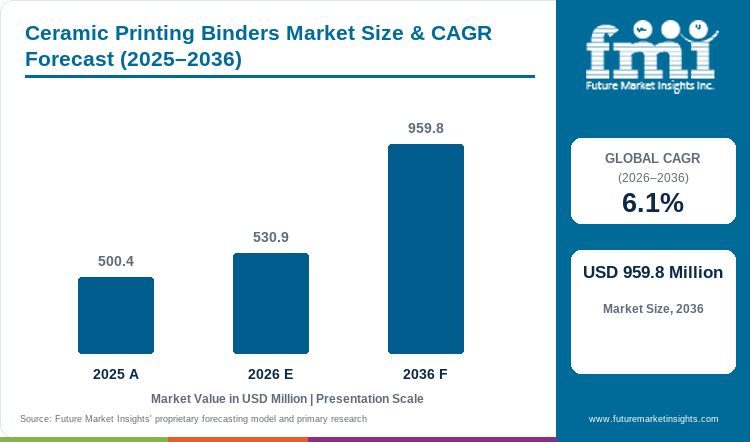
USD 530.9 million in 2026 and USD 959.8 million by 2036, expanding at 6.1% CAGR.
Sales of ceramic printing binders are estimated to rise at 6.1% CAGR through 2036. Valuation rises from USD 500.4 million in 2025 to USD 530.9 million in 2026 and reaches USD 959.8 million by 2036. In November 2025 ISO published ISO/ASTM 52940:2025 to standardize ceramic slurry checks used in vat photopolymerization. The standard covers solids content and flow behavior during feedstock preparation. It also defines checks for particle size and mixture stability before printing. Production teams use these measures to compare material lots before binder removal and firing. Consistent feedstock reduces failed qualification runs and makes repeat purchasing easier after a process receives approval.
The USA is projected to grow at 5.2% CAGR through 2036 while Japan is forecast at 4.2%. NIST updated its ceramic additive manufacturing program in May 2025 to identify barriers affecting wider production use. The program identifies part performance and cost as barriers during qualification. It also lists certification as a barrier before wider production use. US programs measure parts and test process routes as output moves beyond research-scale work. Japanese programs often combine machine development with material development inside the same project. That joint approach supports detailed application testing but can extend the path toward recurring binder purchases.
Key Takeaways
- Qualified ceramic production is raising binder demand as stable slurry behavior and controlled firing help printed parts retain planned dimensions.
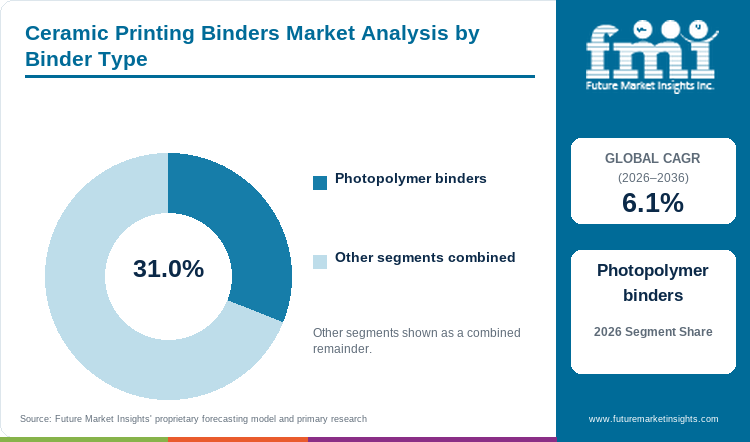
- Photopolymer binders are estimated to hold 31.0% of binder type revenue in 2026, supported by controlled light curing and green-part strength.
- Alumina is forecast to represent 35.0% of ceramic type demand in 2026, reinforced by familiar firing methods and broad technical use.
- Vat photopolymerization is expected to hold 34.0% of process revenue in 2026, linked to fine layer control and improved surface quality.
- Debinding and sintering can reveal hidden cracks or shrinkage that raise qualification costs even after printing succeeds.
- Active companies include Lithoz, Tethon 3D, Admatec Additive Solutions B.V., Formlabs, KYOCERA Fineceramics Europe GmbH, Sinto, XJet 3D, and ExOne Global Holdings.
Analyst Perspective
"The commercial case improves when binder suppliers prove consistent slurry behavior across printing and firing for repeat production. Adoption depends on stable material lots and technical support that reduce failed qualification work across the approved process."
- Nikhil Kaitwade, Principal Consultant, Future Market Insights
How is the ceramic printing binders market segmented?
Ceramic Printing Binders Market is segmented by Binder Type, Ceramic Type, Process, End Use, Sales Channel, and Region.
The market is segmented by binder type, ceramic type, process, end use, sales channel, and region. Binder type includes photopolymer, aqueous, polymer burnout, gelcasting, and hybrid ceramic binders. Ceramic type covers alumina, zirconia, silicon carbide, silica, and technical ceramic blends. Process includes vat photopolymerization, binder jetting, material extrusion, robocasting, and inkjet ceramic printing. End use covers dental - medical ceramics, industrial components, electronics substrates, aerospace ceramics, and R&D - prototyping. Sales channel covers printer OEMs, ceramic feedstock suppliers, material distributors, and service bureaus.
What makes photopolymer binders central to the binder type category?
Light-cured binders turn powder-filled liquid into a firm green part during layer formation. Engineers use ceramic 3D printing for thin walls and small channels that require detailed surfaces. High powder loads can block light and make the slurry harder to spread evenly. Material qualification checks shelf life and cure response before reviewing burn-out residue and fired dimensions.
- Photopolymer binders are estimated to hold 31.0% of binder type revenue in 2026, enabled by tunable curing and reliable green-part strength.
- ISO published ISO/ASTM 52940:2025 in November 2025 to standardize ceramic slurry checks for content and flow plus particle stability.
Why does alumina influence selection within the ceramic type category?
Alumina gives production teams a familiar base for comparing fired density and dimensional shrinkage during qualification. Industrial ceramic use provides established powder handling and kiln methods for binder trials. Users also check electrical performance and wear against the final application requirements. Successful qualification depends on even powder distribution and clean binder removal before firing. These established practices support more recurring trials than less common ceramic compositions.
- Alumina is forecast to represent 35.0% of ceramic type demand in 2026, supported by familiar firing practice and broad technical use.
- Fraunhofer IKTS demonstrates vat-printed alumina honeycomb parts and keeps this process active within German ceramic research.
How does vat photopolymerization shape the process category?
Vat photopolymerization cures thin layers of powder-filled resin or slurry with controlled light exposure. The process produces detailed shapes and smooth surfaces in printed ceramic parts. Powder settling or changing flow can reduce layer control during a build. Process qualification checks solids content and light response before cleaning begins. The same review covers binder removal and firing for each qualified material.
- Vat photopolymerization is likely to capture 34.0% of process revenue in 2026, influenced by fine layer control and surface definition.
- ISO published ISO/ASTM 52940:2025 in November 2025 to standardize ceramic slurry checks used in vat photopolymerization.
What supports dental - medical ceramics within the end use category?
Dental and medical programs need custom ceramic shapes that retain their form throughout firing. Material approval checks dimensional change and sterilization requirements for dental printing materials intended for clinical use. Qualification also examines residue risks that could affect finished ceramic components. Small parts and complex shapes favor printing methods with precise feature control. Stable lot records and clear firing guides support recurring orders after a material route passes approval.
- Dental - medical ceramics are forecast to represent 30.0% of end use demand in 2026, linked to custom clinical shapes requiring precise production.
- Lithoz reported in September 2025 that CADdent produced patient-specific ATZ ceramic earmolds in series using LCM printing.
What drives printer OEMs within the sales channel category?
Printer OEMs connect binders with machine settings and firing guides for each qualified production workflow. Customers source qualified 3D printing materials through equipment suppliers that already understand the printer settings. These suppliers can coordinate light exposure and cleaning steps with the required kiln settings. Open platforms give users broader choices when they qualify custom ceramic powders. OEM channels reduce setup work as successful material trials move toward steady production.
- Printer OEMs are projected to hold 37.0% of sales channel revenue in 2026, reinforced by bundled testing and application support.
- ExOne and voxeljet launched a shared service network in November 2025 with more than 45 trained technicians across eight countries.
What are the drivers, restraints and opportunities in the Ceramic Printing Binders Market?
Qualified production raises repeat binder demand, thermal processing slows approval, and open formulations give specialists a route into custom ceramic workflows.
- Driver: Production users purchase more binder when qualified recipes deliver stable flow and green strength while preserving fired dimensions.
- Restraint: Debinding and sintering can expose defects after printing and increase the cost of material qualification.
- Opportunity: Open formulations support custom powders and local application work that closed printer-qualified material systems cannot cover.
Qualification turns material trials into recurring consumable demand
Production teams purchase more binder once an approved recipe performs consistently across several material lots. Each batch must maintain steady flow and cure response while protecting green strength and final fired dimensions. In November 2025 ISO published shared slurry checks that standardize common feedstock terms used during print setup. Those checks support early comparison across binder jetting systems and vat photopolymerization processes. The standard does not prove final part performance, so users still test binder removal and firing during qualification. Stable lot records reduce failed trials and help teams compare incoming batches with the last approved material. Recurring orders become easier when approved settings continue producing consistent results through printing and firing.
Thermal processing can expose defects after a successful print
Binder removal can damage a part even when the printed shape appears acceptable before firing. Heat drives gas through the green body and can crack or distort parts during the thermal cycle. In May 2025 NIST updated its ceramic additive manufacturing program and identified several barriers to broader production. Part performance and cost remain qualification concerns while certification adds another approval requirement. Failed firing consumes kiln capacity and staff time, so users test the full heat cycle before accepting routine formulations. Long furnace cycles slow changes to high-purity alumina and other powder mixes. Limited furnace access can extend qualification across several material recipes and increase the cost of formulation changes.
Open material development gives specialists a custom formulation route
Open printers let laboratories match binders with local ceramic powders and firing requirements. This flexibility helps laboratories use selected powders that do not fit closed material kits. In February 2025 Tethon 3D acquired TA&T to add ceramic material expertise for printer development and application support. Smaller specialists combine additive manufacturing materials with testing services and pilot lots for custom programs. Every trial still requires stable flow and clean binder removal before firing. Application support can move custom recipes from laboratory testing into regular part production. Specialists can charge for recipe tuning as customers prepare recurring material orders. Open routes allow users to test solids loading and burnout requirements beyond standard OEM material kits.
Which country CAGRs are profiled in the Ceramic Printing Binders Market?
| Country | CAGR |
|---|---|
| Poland | 6.2% |
| Mexico | 5.9% |
| Brazil | 5.5% |
| USA | 5.2% |
| Germany | 4.9% |
| France | 4.5% |
| Japan | 4.2% |
How do country-level CAGRs compare in the Ceramic Printing Binders Market?
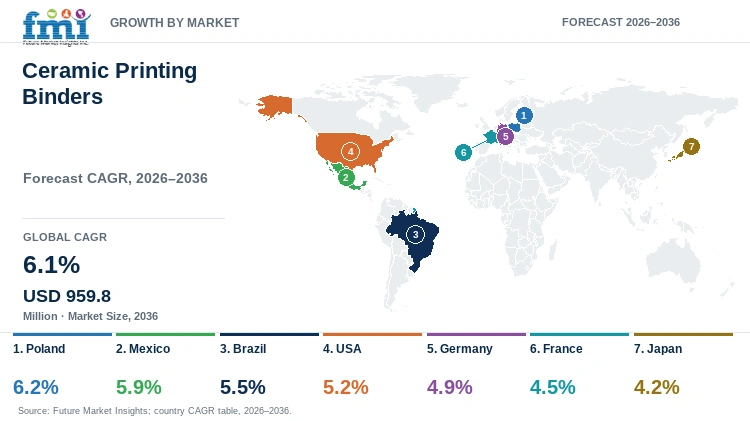
Poland is projected to record the highest profiled CAGR at 6.2% through 2036, followed by Mexico at 5.9% and Brazil at 5.5%. The USA is projected at 5.2%, while Germany is estimated at 4.9% and France at 4.5%. Japan is forecast at 4.2% during the same assessment period, placing it below the other profiled countries. These rates compare forecast growth across all seven countries in the profile. Local testing capacity and kiln access influence how successful trials become recurring material orders.
- Poland's research network gives material developers shared ceramic expertise for testing powder lots and curing behavior before industrial scale-up.
- CIDESI combines ceramic-powder processing with flow testing and compounding to give Mexican manufacturers a defined route for feedstock preparation work.
- Brazil's shared ceramic printing service supports industrial and medical application trials through public equipment that includes printing and firing capabilities.
- US ceramic additive programs span aerospace and energy applications alongside electronics and medical work which creates several routes for binder qualification.
- Germany's established technical ceramics base gives users familiar powder handling and kiln practices for evaluating new binder formulations.
- French ceramic centers emphasize software and post-print processing so users can plan qualification beyond the printing stage.
- Japanese ceramic programs connect printer development with demanding turbine-core applications and create a clear route for coordinated process testing.
Similar country CAGRs can produce different order patterns because testing capacity and kiln access vary across national programs. Local process support also affects how quickly successful trials become recurring material purchases. The full report compares North America and Latin America with Western Europe and Eastern Europe. It also covers East Asia and South Asia and Pacific alongside the Middle East and Africa.
Country-wise Analysis
- Polish research groups are moving ceramic printing from laboratory studies toward industrial production. Poland is projected to grow at 6.2% CAGR through 2036, supported by DLP research moving closer to plant use. In July 2026 Łukasiewicz researchers described DLP printing of YAG:Ce ceramic material for Polish industry. Their work aims to transfer controlled ceramic printing methods from laboratory work into industrial settings. Binder suppliers must manage powder-lot changes and cure response across different production sites. Pilot material lots and flow testing can connect research recipes with stable green-part production. Tight firing control and local process expertise reduce additional trials during scale-up and help manufacturers move toward recurring production with less rework.
- Public test centers let Mexican manufacturers qualify materials before investing in dedicated production equipment. Mexico is estimated to post 5.9% CAGR through 2036, enabled by shared facilities that lower early qualification costs. In December 2025 the federal gazette published CIDESI's 2025-2030 program, which lists 3D printing and light-cured resin work for industry. The same program covers ceramic-powder processing together with flow testing and compounding for feedstock preparation. Access to proven feedstocks and skilled technical staff remains an important constraint during qualification. Trained distributors and small trial lots can reduce process risk before manufacturers commit to production equipment. Spanish-language process guides help plants retain working recipes while kiln access determines regular production timing.
- Brazilian industrial users can access public ceramic printing and firing services for early material qualification. Brazil is projected to grow at 5.5% CAGR through 2036, with shared technical services supporting initial process trials. In August 2026 CTI Renato Archer updated its national ceramic 3D printing service. The service covers industrial and dental work alongside aerospace and electronics applications that need shared equipment. Shared printing and firing equipment also supports medical programs that require controlled material testing. Imported specialty feedstocks and uneven firing expertise can slow wider commercial use during qualification. Small trial lots and clear kiln guidance reduce failed-test costs, but limited kiln access can still delay regular production.
- US ceramic programs use additive manufacturing across aerospace and energy applications alongside electronics and medical work. USA ceramic binder demand is forecast to rise at 5.2% CAGR through 2036, driven by aerospace programs that require tight process control. In December 2025 NASA updated a ceramic rocket-part project for components exposed to high heat and demanding build conditions. Aerospace 3D printing requires steady binder flow since some defects remain hidden until firing. Material suppliers use lot records and burn-out guides to control each qualification batch. Limited local kiln access can delay commercial trials when teams test unfamiliar material recipes. Careful process records help research programs become recurring orders while protecting the planned fired shape.
- German manufacturers test ceramic binders within established technical ceramic process chains that already use strict dimensional limits. Germany is estimated to post 4.9% CAGR through 2036, reinforced by local process knowledge and institute support. Fraunhofer IKTS demonstrates vat-printed alumina parts and develops binders for powder-bed ceramic printing. The main qualification hurdle is preserving the planned shape through binder removal and firing. Users need test data that connects slurry behavior with fired dimensions for each material lot. Local process expertise can reduce approval work for plants already familiar with technical ceramics. Kiln scheduling and final size checks can delay a successful print from entering routine production.
- French users work with public ceramic centers that support laboratory tests and pilot production runs. France is estimated to post 4.5% CAGR through 2036, influenced by public centers that provide local process support. In February 2025 CTTC held an industry session on ceramic 3D printing that covered production software and post-print processing. Zirconia dental ceramics require close control of slurry behavior and cleaning during qualification. Binder removal and firing also require careful handling because poor process control can damage final parts. Feedstock providers support plant trials with flow testing and clear firing limits. Local kiln access influences how quickly approved recipes move into routine plant production.
- Japanese ceramic programs often combine machine design with material development during new projects. Japan is estimated to post 4.2% CAGR through 2036, shaped by joint machine and material development. In September 2025 Sinto and Noritake demonstrated a ceramic casting core for gas turbines. The project combined CERAMAKER printing with Noritake material expertise inside one coordinated test route. Full production approval depends on stable fired parts from every qualified process. Material specialists support paste setup and the complete firing path during application testing. Long test cycles favor programs that align machine settings with material behavior and can move joint development toward recurring orders.
Who are the notable companies in the Ceramic Printing Binders Market?
Lithoz, Tethon 3D, Admatec Additive Solutions B.V., Formlabs, KYOCERA Fineceramics Europe GmbH, Sinto, XJet 3D, and ExOne Global Holdings are active within the defined ceramic printing binders supply boundary.
Competition depends on how much of the ceramic printing workflow each firm can support during qualification. Integrated printer-material companies reduce testing work by linking feedstock choices with machine settings and firing guidance. Open material specialists focus on custom mixes for ceramic powders selected by individual users. Technical ceramic groups contribute kiln knowledge and application expertise for demanding end-use requirements. Every supplier must prove consistent fired parts across the qualified route before a broad portfolio can support qualification decisions.
- Lithoz, Admatec Additive Solutions B.V., Sinto, and XJet 3D provide printer and material systems with process help.
- Tethon 3D and Formlabs provide open ceramic resin routes with material testing support for users.
- KYOCERA Fineceramics Europe GmbH and ExOne Global Holdings provide technical ceramic parts and powder-based binder-jet routes.
Competitive Benchmarking: Ceramic Printing Binders Market
| Company | Feedstock Integration | Post-Processing Support | Process Openness | Geographic Reach |
|---|---|---|---|---|
| Lithoz | High | High | Medium | Europe, North America, Asia |
| Tethon 3D | High | Medium | High | North America, international |
| Admatec Additive Solutions B.V. | High | High | High | Europe, international |
| Formlabs | High | High | Medium | North America, Europe, Asia |
| KYOCERA Fineceramics Europe GmbH | Medium | High | Low | Europe, global reach |
| Sinto | High | High | Medium | Asia, Europe, international |
| XJet 3D | High | High | Low | Europe, North America, Asia |
| ExOne Global Holdings | Medium | Medium | High | Europe, Americas, Asia |
High feedstock integration requires public proof that binder-bearing ceramic material connects with a printer platform. Medium integration marks a narrower or partner-based link, while Low indicates limited public proof. High post-processing support requires documented help with binder removal and firing across the qualified workflow. Medium support covers partial assistance, while Low marks little public evidence for post-print help. High process openness covers several powder or binder routes across more than one hardware path. Medium openness covers a narrower route, while Low identifies a more closed material path. Geographic reach lists active regions without changing capability scores, and every rating remains tied to recorded public evidence.
Key Developments in the Ceramic Printing Binders Market
- In November 2025 XJet 3D launched the compact Carmel Pro printer for metal and ceramic NanoParticle Jetting. The November 2025 announcement also stated that wider printer availability was planned for 2026.
- In October 2025 ExOne Global Holdings brought ExOne and voxeljet under one holding group. The October 2025 move combined binder-jet systems with service and application support under one group.
- In January 2025 Lithoz announced the first US CeraFab Multi 2M30 installation at Embry-Riddle for aerospace and lunar research.
Key Players in the Ceramic Printing Binders Market
Integrated ceramic printing platforms
- Lithoz
- Admatec Additive Solutions B.V.
- Sinto
- XJet 3D
Ceramic resin and formulation specialists
- Tethon 3D
- Formlabs
Industrial ceramic and binder-jet providers
- KYOCERA Fineceramics Europe GmbH
- ExOne Global Holdings
Ceramic Printing Binders Market - Report Scope
| Coverage field | Report scope |
|---|---|
| Market breakdown | By binder type, ceramic type, process, end use, sales channel and region. |
| Quantitative Units | USD million. |
| Market Definition | Binder systems and binder-bearing feedstocks used to shape ceramic powders by additive manufacturing before debinding, sintering, infiltration, or related thermal processing are included. |
| Regions Covered | North America, Latin America, Western Europe, Eastern Europe, East Asia, South Asia and Pacific, and Middle East and Africa. |
| Countries Covered | Poland, Mexico, Brazil, USA, Germany, France, Japan, and 20+ countries included in the full report. |
| Key Companies Profiled | Lithoz, Tethon 3D, Admatec Additive Solutions B.V., Formlabs, KYOCERA Fineceramics Europe GmbH, Sinto, XJet 3D, ExOne Global Holdings. |
| Forecast Period | 2026 to 2036. |
| Approach | Primary and secondary research with market triangulation. |
Ceramic Printing Binders Market - Research Methodology
| Method | Approach |
|---|---|
| Primary Research | FMI analysts gathered input from manufacturers, service providers, technology developers, distributors, end users, procurement teams, and subject-matter experts. Interviews examined purchasing decisions, product or service evaluation, adoption barriers, approval requirements, pricing considerations, and expectations for technical or commercial support. Respondents were also asked what evidence is required before a trial, pilot, or initial order develops into regular purchasing. |
| Desk Research | Desk research covered government statistics, regulatory publications, trade data, industry associations, technical literature, standards, company filings, product information, and official corporate announcements. Sources were reviewed for relevance, publication date, geographic coverage, and consistency with the defined market scope. Claims relating to performance, applications, approvals, capacity, investment, and commercial activity were retained only when supported by credible public evidence. |
| Market Sizing and Forecasting | The market model combined the baseline value with historical performance, segment structure, pricing and volume indicators, adoption levels, company participation, and country-level demand conditions. Forecast assumptions considered economic activity, investment trends, regulatory developments, technology adoption, purchasing cycles, supply availability, and barriers to wider market use. Segment and regional estimates were reconciled before the final market total was calculated. |
| Data Validation | Estimates were checked against multiple independent indicators, including public data, company activity, trade patterns, industry developments, and findings from primary interviews. Validation also tested whether products, services, applications, and company revenues fell within the defined market boundaries. Adjacent categories, unsupported claims, overlapping revenues, and activities without direct market relevance were excluded to reduce double counting and maintain consistency across segments and countries. |
Ceramic Printing Binders Market by Segments
Ceramic Printing Binders Market segmented by Binder Type:
- Photopolymer binders
- Aqueous binders
- Polymer burnout binders
- Gelcasting binders
- Hybrid ceramic binders
Ceramic Printing Binders Market segmented by Ceramic Type:
- Alumina
- Zirconia
- Silicon carbide
- Silica
- Technical ceramic blends
Ceramic Printing Binders Market segmented by Process:
- Vat photo-polymerization
- Binder jetting
- Material extrusion
- Robocasting
- Inkjet ceramic printing
Ceramic Printing Binders Market segmented by End Use:
- Dental - medical ceramics
- Industrial components
- Electronics substrates
- Aerospace ceramics
- R&D - prototyping
Ceramic Printing Binders Market segmented by Sales Channel:
- Printer OEMs
- Ceramic feedstock suppliers
- Material distributors
- Service bureaus
Ceramic Printing Binders Market by Region:
- North America
- United States
- Canada
- Latin America
- Brazil
- Mexico
- Chile
- Rest of Latin America
- Western Europe
- Germany
- United Kingdom
- Italy
- Spain
- France
- Nordics
- Benelux
- Rest of Western Europe
- Eastern Europe
- Russia
- Poland
- Hungary
- Balkan and Baltic States
- Rest of Eastern Europe
- East Asia
- China
- Japan
- South Korea
- South Asia and Pacific
- India
- ASEAN
- Australia and New Zealand
- Rest of South Asia and Pacific
- Middle East and Africa
- Kingdom of Saudi Arabia
- Other GCC Countries
- Türkiye
- South Africa
- Other African Union Countries
- Rest of Middle East and Africa
Research Sources and Bibliography
- International Organization for Standardization. (2025, November 6). ISO/ASTM 52940:2025: Additive manufacturing of ceramics - Feedstock materials - Characterization of ceramic slurry in vat photopolymerization.
- National Institute of Standards and Technology. (2025, May 16). Additive manufacturing of ceramics.
- Fraunhofer Institute for Ceramic Technologies and Systems IKTS. (2026). Additive processes for ceramic components.
- Lithoz GmbH. (2025, September 24). Lithoz LCM printers make additive serial production of fully customized ceramic earmolds for hearing aids a reality.
- ExOne Global Holdings. (2025, November 13). ExOne and voxeljet launch unified global aftermarket support network.
- Tethon 3D. (2025, February 20). Tethon 3D acquires TA&T to advance ceramic additive manufacturing.
- National Aeronautics and Space Administration. (2025, December 18). Additively manufactured ceramic rocket engine components.
- Sintokogio, Ltd. (2025, September). Noritake and Sinto develop a precision-casting core using the CERAMAKER ceramic 3D printer.
- CTI Renato Archer. (2026, August 6). 3D printing and sintering service for ceramic materials.
- Centre de Transfert de Technologies Céramiques. (2025, February 13). The latest advancements in ceramic additive manufacturing.
- Diario Oficial de la Federación & CIDESI. (2025, December 31). Institutional Program of the Center for Engineering and Industrial Development 2025-2030.
- Łukasiewicz Research Network - Institute of Microelectronics and Photonics. (2026, July 6). Ceramics of the future: Designing intelligent materials for Polish industry.
- XJet 3D. (2025, November 3). XJet expands access to high-value metal and ceramic additive manufacturing with Carmel Pro compact multi-material printer launch.
- ExOne Global Holdings. (2025, October 23). ExOne Global Holdings unifies ExOne and voxeljet.
- Lithoz GmbH. (2025, January 28). Embry-Riddle Aeronautical University installs first Lithoz CeraFab Multi in the USA for advanced lunar exploration systems.
- XJet 3D. (2026, August 18). XJet appoints ZEN Global as sales partner and representative in Japan.
- Lithoz GmbH. (2026, June 9). How LCM enabled a monolithic ceramic gyroid with five times the power-to-weight ratio of conventional solid oxide fuel cells.
- Lithoz GmbH. (2026, July 21). Lithoz ceramic material revenue up 40% year over year, fueled by MedTech and LCM contract manufacturers.
- XJet 3D. (2026, March 9). Ter Hoek expands into technical ceramic manufacturing with XJet Carmel 1400C 3D printing solution.
- 3DCeram Sinto. (2026, February 9). Automated post-processing for ceramic 3D printing: Auto Cerakleaner.
- Lithoz GmbH. (2026, June 10). Ceramic additive manufacturing enables 500 mm dual-channel for high-speed PEALD and ALE in the same chamber.
- Tethon 3D. (2026, March 25). Tethon 3D acquires Fortify IP to target RF and defense applications.
- Admatec Additive Solutions B.V. (2025, June). Successful restart for Admatec and Formatec.
- Formlabs. (2026, January 22). Scaling high-performance ceramics manufacturing at Sinto Advanced Ceramics.
- KYOCERA Fineceramics Europe GmbH. (2025, July 8). Kyocera establishes 3D printing of SiSiC components at the location Selb, Germany.
- XJet 3D. (2026, March 2). Nivalon Medical produces a patient-specific, motion-preserving, metal-free spinal implant using advanced ceramic 3D printing.
- ExOne Global Holdings. (2026, January 13). VX7000 enters customer production for large-format binder jet 3D printing.
This bibliography is provided for reader reference and is not exhaustive. The full report contains the complete reference list and detailed citations.
This Report Answers
- What is the 2026 ceramic printing binders value and 2036 forecast?
- Why do qualified ceramic workflows create more recurring binder demand?
- Which binder type holds the largest estimated share during 2026?
- Which ceramic type accounts for the largest estimated 2026 share?
- Which printing process holds the largest estimated share during 2026?
- How do country CAGRs differ across Poland, Mexico, Brazil, USA, Germany, France, and Japan?
- How do debinding and sintering change the economics of ceramic binder qualification?
- Which companies supply integrated platforms, ceramic resins, technical ceramics, or binder-jet production routes?
- What should material teams check before ceramic binder production approval?
Frequently Asked Questions
How big is the ceramic printing binders market in 2026?
The market is valued at USD 530.9 million in 2026 and is projected to reach USD 959.8 million by 2036. Approved workflows increase binder purchases by proving stable slurry flow and adequate green-part strength. Production teams also check binder removal and firing across approved ceramic processes before placing recurring orders. These checks support larger material purchases once the same recipe performs consistently across later lots.
What is the CAGR of the ceramic printing binders market from 2026 to 2036?
The market is projected to grow at 6.1% CAGR from 2026 to 2036. Growth depends on users moving beyond print trials and testing binder behavior through the complete heat cycle. Consistent lot control helps production teams approve trial recipes for recurring use across later batches. The same records help later material lots follow the approved production process with fewer repeat checks.
Which binder type leads the ceramic printing binders category during 2026?
Photopolymer binders are estimated to hold 31.0% of binder type revenue in 2026, supported by controlled light curing and green strength. Material approval checks viscosity and shelf life before production teams review burn-out residue and fired dimensions. Consistent lot records help users compare later material batches with the approved binder process.
Which ceramic type holds the largest estimated share in the ceramic printing binders market?
Alumina is forecast to represent 35.0% of ceramic type demand in 2026, reinforced by familiar firing methods and broad technical use. Material approval checks powder spread and shrinkage before confirming final density against the required production range. Familiar kiln methods and lot records help users plan these checks across recurring production runs.
Which process holds the largest estimated share in the ceramic printing binders market?
Vat photopolymerization is likely to capture 34.0% of process revenue in 2026, influenced by fine layer control and surface quality. Production requires stable slurry behavior through each build and clear cleaning procedures afterward. Users also need planned binder removal and firing steps for every approved material. Consistent settings help production teams compare each new lot with the qualified process.
Which countries record the highest profiled growth in the ceramic printing binders market?
Poland is projected to grow at 6.2% CAGR through 2036, followed by Mexico at 5.9% and Brazil at 5.5%. Local testing access and feedstock supply influence how quickly trials become recurring orders. Firing expertise and service capacity also differ across the three countries during qualification. Test equipment and kiln access remain important factors in each national approval process.
Which companies are active in the ceramic printing binders market?
Active companies include Lithoz, Tethon 3D, Admatec Additive Solutions B.V., Formlabs, KYOCERA Fineceramics Europe GmbH, Sinto, XJet 3D, and ExOne Global Holdings. Integrated providers connect machines with tested materials and guide users through qualification across printing and firing. Open-material specialists offer formulation flexibility for custom ceramic powders that fall outside closed material kits. Technical ceramic groups contribute firing knowledge and established industrial production routes for demanding end uses.
What limits return on investment in the ceramic printing binders market?
Rejected builds and long kiln cycles can erase savings from lower binder prices during material qualification. Material teams check powder loading and viscosity alongside cure response and burn-out residue before approving recipes. Production reviews also examine kiln bottlenecks and shrinkage across qualified recipes to protect throughput. Stable feedstock behavior reduces rejected parts and preserves kiln capacity during recurring production. Return on investment improves when material changes require fewer repeat qualification cycles across later batches.
Preview the report firsthand - request a free sample
Get SampleGet the brochure for pricing and purchase details.
Get PDFTable of Content
- Key Takeaways
- Market Size and CAGR
- Top Growth Driver
- Fastest Growing Segment
- Leading Region
- Key Companies
- Emerging Opportunities
- Executive Summary
- Global Market Outlook
- Demand-side Trends
- Supply-side Trends
- Technology Roadmap Analysis
- Analysis and Recommendations
- Analyst Perspective (What is happening? Why now? What should investors know?)
- Key Questions Answered
- How large is the market?
- What is the CAGR?
- What are key trends?
- Which region dominates?
- Who are the leaders?
- Market Overview
- Market Coverage / Taxonomy
- Market Definition / Scope / Limitations
- Research Methodology
- Chapter Orientation
- Analytical Lens and Working Hypotheses
- Market Structure, Signals, and Trend Drivers
- Benchmarking and Cross-market Comparability
- Market Sizing, Forecasting, and Opportunity Mapping
- Research Design and Evidence Framework
- Desk Research Programme (Secondary Evidence)
- Expert Input and Fieldwork (Primary Evidence)
- Tooling, Models, and Reference Databases
- Data Engineering and Model Build
- Quality Assurance and Audit Trail
- Market Background
- Market Dynamics (Drivers, Restraints, Opportunity, Trends)
- Scenario Forecast (Optimistic, Likely, Conservative)
- Impact Analysis
- AI Impact
- Sustainability Impact
- Regulatory Impact
- Technology Impact
- Consumer / Buyer Analysis
- Purchase Drivers
- Adoption Barriers
- Buyer Journey
- Opportunity Map Analysis
- Product Life Cycle Analysis
- Supply Chain Analysis
- Investment Feasibility Matrix
- Value Chain Analysis
- PESTLE and Porter's Analysis
- Regulatory Landscape
- Regional Parent Market Outlook
- Production and Consumption Statistics
- Import and Export Statistics
- Global Market Analysis and Forecast, 2021 to 2036
- Historical Market Size Value (USD Million) Analysis, 2021 to 2025
- Current and Future Market Size Value (USD Million) Projections, 2026 to 2036
- Y-o-Y Growth Trend Analysis
- Absolute $ Opportunity Analysis
- Global Market Pricing Analysis, 2021 to 2036
- Global Market Analysis and Forecast, By Binder Type, 2021 to 2036
- Introduction / Key Findings
- Historical Market Size Value (USD Million) Analysis By Binder Type, 2021 to 2025
- Current and Future Market Size Value (USD Million) Analysis and Forecast By Binder Type, 2026 to 2036
- Photopolymer binders
- Aqueous binders
- Polymer burnout binders
- Gelcasting binders
- Hybrid ceramic binders
- Y-o-Y Growth Trend Analysis By Binder Type, 2021 to 2025
- Absolute $ Opportunity Analysis By Binder Type, 2026 to 2036
- Global Market Analysis and Forecast, By Ceramic Type, 2021 to 2036
- Introduction / Key Findings
- Historical Market Size Value (USD Million) Analysis By Ceramic Type, 2021 to 2025
- Current and Future Market Size Value (USD Million) Analysis and Forecast By Ceramic Type, 2026 to 2036
- Alumina
- Zirconia
- Silicon carbide
- Silica
- Technical ceramic blends
- Y-o-Y Growth Trend Analysis By Ceramic Type, 2021 to 2025
- Absolute $ Opportunity Analysis By Ceramic Type, 2026 to 2036
- Global Market Analysis and Forecast, By Process, 2021 to 2036
- Introduction / Key Findings
- Historical Market Size Value (USD Million) Analysis By Process, 2021 to 2025
- Current and Future Market Size Value (USD Million) Analysis and Forecast By Process, 2026 to 2036
- Vat photo-polymerization
- Binder jetting
- Material extrusion
- Robocasting
- Inkjet ceramic printing
- Y-o-Y Growth Trend Analysis By Process, 2021 to 2025
- Absolute $ Opportunity Analysis By Process, 2026 to 2036
- Global Market Analysis and Forecast, By End Use, 2021 to 2036
- Introduction / Key Findings
- Historical Market Size Value (USD Million) Analysis By End Use, 2021 to 2025
- Current and Future Market Size Value (USD Million) Analysis and Forecast By End Use, 2026 to 2036
- Dental - medical ceramics
- Industrial components
- Electronics substrates
- Aerospace ceramics
- R&D - prototyping
- Y-o-Y Growth Trend Analysis By End Use, 2021 to 2025
- Absolute $ Opportunity Analysis By End Use, 2026 to 2036
- Global Market Analysis and Forecast, By Sales Channel, 2021 to 2036
- Introduction / Key Findings
- Historical Market Size Value (USD Million) Analysis By Sales Channel, 2021 to 2025
- Current and Future Market Size Value (USD Million) Analysis and Forecast By Sales Channel, 2026 to 2036
- Printer OEMs
- Ceramic feedstock suppliers
- Material distributors
- Service bureaus
- Y-o-Y Growth Trend Analysis By Sales Channel, 2021 to 2025
- Absolute $ Opportunity Analysis By Sales Channel, 2026 to 2036
- Global Market Analysis and Forecast, By Region, 2021 to 2036
- Introduction
- Historical Market Size Value (USD Million) Analysis By Region, 2021 to 2025
- Current Market Size Value (USD Million) Analysis and Forecast By Region, 2026 to 2036
- North America
- Latin America
- Western Europe
- Eastern Europe
- East Asia
- South Asia and Pacific
- Middle East and Africa
- Market Attractiveness Analysis By Region
- North America Market Analysis and Forecast, By Country, 2021 to 2036
- Historical Market Size Value (USD Million) Trend Analysis By Market Taxonomy, 2021 to 2025
- Market Size Value (USD Million) Forecast By Market Taxonomy, 2026 to 2036
- By Country
- United States
- Canada
- By Binder Type
- By Ceramic Type
- By Process
- By End Use
- By Sales Channel
- By Country
- Market Attractiveness Analysis
- By Country
- By Binder Type
- By Ceramic Type
- By Process
- By End Use
- By Sales Channel
- Key Takeaways
- Latin America Market Analysis and Forecast, By Country
- Historical Market Size Value (USD Million) Trend Analysis By Market Taxonomy, 2021 to 2025
- Market Size Value (USD Million) Forecast By Market Taxonomy, 2026 to 2036
- By Country
- Brazil
- Mexico
- Chile
- Rest of Latin America
- By Binder Type
- By Ceramic Type
- By Process
- By End Use
- By Sales Channel
- By Country
- Market Attractiveness Analysis
- By Country
- By Binder Type
- By Ceramic Type
- By Process
- By End Use
- By Sales Channel
- Key Takeaways
- Western Europe Market Analysis and Forecast, By Country
- Historical Market Size Value (USD Million) Trend Analysis By Market Taxonomy, 2021 to 2025
- Market Size Value (USD Million) Forecast By Market Taxonomy, 2026 to 2036
- By Country
- Germany
- United Kingdom
- Italy
- Spain
- France
- Nordics
- Benelux
- Rest of Western Europe
- By Binder Type
- By Ceramic Type
- By Process
- By End Use
- By Sales Channel
- By Country
- Market Attractiveness Analysis
- By Country
- By Binder Type
- By Ceramic Type
- By Process
- By End Use
- By Sales Channel
- Key Takeaways
- Eastern Europe Market Analysis and Forecast, By Country
- Historical Market Size Value (USD Million) Trend Analysis By Market Taxonomy, 2021 to 2025
- Market Size Value (USD Million) Forecast By Market Taxonomy, 2026 to 2036
- By Country
- Russia
- Poland
- Hungary
- Balkan and Baltic States
- Rest of Eastern Europe
- By Binder Type
- By Ceramic Type
- By Process
- By End Use
- By Sales Channel
- By Country
- Market Attractiveness Analysis
- By Country
- By Binder Type
- By Ceramic Type
- By Process
- By End Use
- By Sales Channel
- Key Takeaways
- East Asia Market Analysis and Forecast, By Country
- Historical Market Size Value (USD Million) Trend Analysis By Market Taxonomy, 2021 to 2025
- Market Size Value (USD Million) Forecast By Market Taxonomy, 2026 to 2036
- By Country
- China
- Japan
- South Korea
- By Binder Type
- By Ceramic Type
- By Process
- By End Use
- By Sales Channel
- By Country
- Market Attractiveness Analysis
- By Country
- By Binder Type
- By Ceramic Type
- By Process
- By End Use
- By Sales Channel
- Key Takeaways
- South Asia and Pacific Market Analysis and Forecast, By Country
- Historical Market Size Value (USD Million) Trend Analysis By Market Taxonomy, 2021 to 2025
- Market Size Value (USD Million) Forecast By Market Taxonomy, 2026 to 2036
- By Country
- India
- ASEAN
- Australia and New Zealand
- Rest of South Asia and Pacific
- By Binder Type
- By Ceramic Type
- By Process
- By End Use
- By Sales Channel
- By Country
- Market Attractiveness Analysis
- By Country
- By Binder Type
- By Ceramic Type
- By Process
- By End Use
- By Sales Channel
- Key Takeaways
- Middle East and Africa Market Analysis and Forecast, By Country
- Historical Market Size Value (USD Million) Trend Analysis By Market Taxonomy, 2021 to 2025
- Market Size Value (USD Million) Forecast By Market Taxonomy, 2026 to 2036
- By Country
- Kingdom of Saudi Arabia
- Other GCC Countries
- Türkiye
- South Africa
- Other African Union Countries
- Rest of Middle East and Africa
- By Binder Type
- By Ceramic Type
- By Process
- By End Use
- By Sales Channel
- By Country
- Market Attractiveness Analysis
- By Country
- By Binder Type
- By Ceramic Type
- By Process
- By End Use
- By Sales Channel
- Key Takeaways
- Key Countries Market Analysis
- United States
- Pricing Analysis
- Market Share Analysis, 2025
- By Binder Type
- By Ceramic Type
- By Process
- By End Use
- By Sales Channel
- Canada
- Pricing Analysis
- Market Share Analysis, 2025
- By Binder Type
- By Ceramic Type
- By Process
- By End Use
- By Sales Channel
- Mexico
- Pricing Analysis
- Market Share Analysis, 2025
- By Binder Type
- By Ceramic Type
- By Process
- By End Use
- By Sales Channel
- Brazil
- Pricing Analysis
- Market Share Analysis, 2025
- By Binder Type
- By Ceramic Type
- By Process
- By End Use
- By Sales Channel
- Chile
- Pricing Analysis
- Market Share Analysis, 2025
- By Binder Type
- By Ceramic Type
- By Process
- By End Use
- By Sales Channel
- Germany
- Pricing Analysis
- Market Share Analysis, 2025
- By Binder Type
- By Ceramic Type
- By Process
- By End Use
- By Sales Channel
- United Kingdom
- Pricing Analysis
- Market Share Analysis, 2025
- By Binder Type
- By Ceramic Type
- By Process
- By End Use
- By Sales Channel
- Italy
- Pricing Analysis
- Market Share Analysis, 2025
- By Binder Type
- By Ceramic Type
- By Process
- By End Use
- By Sales Channel
- Spain
- Pricing Analysis
- Market Share Analysis, 2025
- By Binder Type
- By Ceramic Type
- By Process
- By End Use
- By Sales Channel
- France
- Pricing Analysis
- Market Share Analysis, 2025
- By Binder Type
- By Ceramic Type
- By Process
- By End Use
- By Sales Channel
- India
- Pricing Analysis
- Market Share Analysis, 2025
- By Binder Type
- By Ceramic Type
- By Process
- By End Use
- By Sales Channel
- ASEAN
- Pricing Analysis
- Market Share Analysis, 2025
- By Binder Type
- By Ceramic Type
- By Process
- By End Use
- By Sales Channel
- Australia and New Zealand
- Pricing Analysis
- Market Share Analysis, 2025
- By Binder Type
- By Ceramic Type
- By Process
- By End Use
- By Sales Channel
- China
- Pricing Analysis
- Market Share Analysis, 2025
- By Binder Type
- By Ceramic Type
- By Process
- By End Use
- By Sales Channel
- Japan
- Pricing Analysis
- Market Share Analysis, 2025
- By Binder Type
- By Ceramic Type
- By Process
- By End Use
- By Sales Channel
- South Korea
- Pricing Analysis
- Market Share Analysis, 2025
- By Binder Type
- By Ceramic Type
- By Process
- By End Use
- By Sales Channel
- Russia
- Pricing Analysis
- Market Share Analysis, 2025
- By Binder Type
- By Ceramic Type
- By Process
- By End Use
- By Sales Channel
- Poland
- Pricing Analysis
- Market Share Analysis, 2025
- By Binder Type
- By Ceramic Type
- By Process
- By End Use
- By Sales Channel
- Hungary
- Pricing Analysis
- Market Share Analysis, 2025
- By Binder Type
- By Ceramic Type
- By Process
- By End Use
- By Sales Channel
- Kingdom of Saudi Arabia
- Pricing Analysis
- Market Share Analysis, 2025
- By Binder Type
- By Ceramic Type
- By Process
- By End Use
- By Sales Channel
- Türkiye
- Pricing Analysis
- Market Share Analysis, 2025
- By Binder Type
- By Ceramic Type
- By Process
- By End Use
- By Sales Channel
- South Africa
- Pricing Analysis
- Market Share Analysis, 2025
- By Binder Type
- By Ceramic Type
- By Process
- By End Use
- By Sales Channel
- United States
- Market Structure Analysis
- Competition Dashboard
- Competition Benchmarking
- Market Share Analysis of Top Players
- By Regional
- By Binder Type
- By Ceramic Type
- By Process
- By End Use
- By Sales Channel
- Emerging Startups
- Innovation Benchmarking
- Competition Analysis
- Competition Deep Dive
- Lithoz
- Overview
- Product Portfolio
- Profitability by Market Segments
- Sales Footprint
- Strategy Overview
- Marketing Strategy
- Product Strategy
- Channel Strategy
- Tethon 3D
- Admatec Additive Solutions B.V.
- Formlabs
- KYOCERA Fineceramics Europe GmbH
- Sinto
- XJet 3D
- ExOne Global Holdings
- Lithoz
- Case Studies
- Success Stories
- Recent Developments
- Competition Deep Dive
- Assumptions & Acronyms Used


