

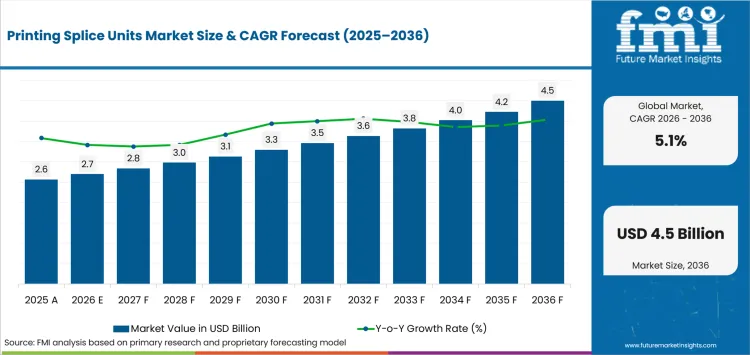
- Market Size (2026)
- USD 2.7 Bn
- Forecast (2036)
- USD 4.5 Bn
- CAGR (2026 to 2036)
- 5.1%
How big is Printing Splice Units Market in 2026?
USD 2.7 billion in 2026 and USD 4.5 billion by 2036 at a 5.1% CAGR.
Demand for printing splice units is projected to grow at 5.1% CAGR from 2026 to 2036. Market value is forecast to rise from USD 2.7 billion in 2026 to USD 4.5 billion by 2036. Web-fed plants justify the investment by recovering production time lost during repeated reel changes. Martin Automatic's February 2026 case study states that Zumbiel makes six to eight reel changes during an eight-hour shift. Its automatic splicer recovers 25 to 30 productive minutes per shift compared with manual changes.
Many printing plants operate with limited budgets and older presses that need custom work before a splice unit can be installed. Intergraf's June 2025 activity report counted about 110,000 European printing companies and found 95% employed fewer than 20 people. Smaller plants need clear uptime gains and nearby service before accepting production interruptions during installation.
Key Takeaways
- Frequent reel changes remove saleable press time and strengthen demand for automatic splice units.
- By unit type, automatic splice units are estimated to hold 31.0% in 2026 owing to non-stop reel transfer.
- Paper is set to lead web material with 30.0% share in 2026 due to frequent reel changes.
- Flexographic printing is set to lead printing process with 31.0% share in 2026 due to costly reel stops.
- Older press-room layouts and control systems can lengthen installation and testing before operators accept stable non-stop splicing.
- Key players in the printing splice units market include Martin Automatic, Butler Automatic, KAMPF GmbH, BOBST, Windmöller & Hölscher, Koenig & Bauer, BW Papersystems, Rotoflex, a Mark Andy brand, MPS Printing, and Grafotronic.
Analyst Perspective
"Printing splice units justify capital when recovered press time exceeds integration and operator-preparation costs. Strong offers hold web tension at production speed without turning installation into a longer source of downtime."
- Nandini Roy Choudhury, Principal Consultant, Future Market Insights
How is the printing splice units market segmented?
The printing splice units market is segmented by unit type, web material, printing process, web width, sales channel and region.
Unit type: automatic splice units, manual splice tables, flying splice units, tape splice units and web accumulator splice units. Web material includes paper, film, labelstock, foil laminates and nonwoven webs. Printing process includes flexographic printing, gravure printing, offset web printing, digital web printing and converting lines. Web width includes below 500 mm, 500-1,000 mm, 1,000-1,800 mm and above 1,800 mm. Sales channel includes press OEMs, converting line OEMs, aftermarket retrofit and direct automation suppliers. Region follows Report Scope taxonomy.
Why does flexographic printing lead demand within the printing process category?
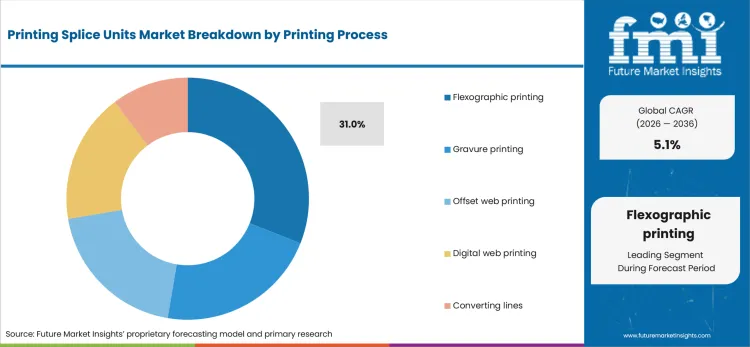
Flexographic presses lose saleable production time during reel stops because packaging runs depend on continuous web movement.
- In 2026, flexographic printing is expected to lead printing process with 31.0% share because every reel stop removes production time from roll-fed packaging lines.
- Al Jawad Flexi reported a running W&H NOVOFLEX II press in August 2026 after expanding its flexible-packaging press capacity. Modern flexographic printing lines automate more of the press sequence, so reel changes must work smoothly with the rest of the line.
Why do automatic splice units lead demand within the unit type category?
Automatic splice units prevent planned reel-change stops while operators prepare incoming rolls under stable web tension.
- Based on unit type, automatic splice units are projected to account for 31.0% in 2026 due to non-stop reel transfer.
- Desmedt Labels installed a Martin Automatic butt splicer on a digital hybrid press in March 2026. Desmedt calculated about 750 extra production hours annually from the press-and-splicer combination, showing why automatic splicing can improve utilization on short-run printing machines.
Why does paper lead demand within the web material category?
Paper reels place different loads on the handling system because carton grades vary in weight and stiffness during transfer, which can disturb downstream cutting accuracy.
- Paper is projected to hold 30.0% share in 2026 owing to repeated reel changes in high-volume carton and commercial printing operations.
- Superior Lithographics invested in another BW Papersystems SheetRunner in November 2025 for heavier-caliper folding-carton stock. Its high-speed splicer reduces handling delays on paper packaging lines where heavy board stock can limit output.
Why does the 500-1,000 mm range lead demand within the web width category?
Mid-web equipment in the 500-1,000 mm range handles useful volumes without the heavier rolls used on wider packaging lines.
- The 500-1,000 mm segment is likely to capture 35.0% share in 2026 attributable to common mid-web label and packaging formats.
- MPS introduced EF Packaging for Labelexpo Europe 2025 with enhanced mid-web capability and automated control. The platform gives splice-unit makers another route into mid-web lines where digital label printing runs beside conventional web handling.
Why do press OEMs lead demand within the sales channel category?
Press OEMs define web-handling requirements before the line layout is fixed and test splice controls during installation.
- Press OEMs are set to lead the sales channel with 41.0% share in 2026 due to early specification of web handling and controls.
- Koenig & Bauer demonstrated EasyTronic CI Flexo in April 2026 with automatic web feed through the press path. The demonstration shows why web handling is easier to plan during digital packaging printing projects than after a press is already installed.
What are the drivers, restraints and opportunities in the Printing Splice Units Market?
Repeated reel changes raise the value of non-stop splicing, while retrofit engineering can slow approval and connected press controls expand the value of integrated automation.
- Driver: Frequent reel changes make manual stops more costly and improve the payback case for automatic web transfer.
- Restraint: Older press rooms may need custom web paths and control work before a splice system can run reliably at production speed.
- Opportunity: Splice controls are easier to integrate where digital and flexographic presses already automate register setup and other web functions.
Frequent Reel Changes Raise the Cost of Manual Stops
Label converters gain capacity by removing repeated reel-change stops without replacing the press itself. In June 2026, Martin Automatic documented six MBS non-stop unwind splicers installed on Nordvalls flexo and finishing lines. Nordvalls linked the equipment to non-stop production, higher output per shift and lower substrate waste. Those gains make automatic splicing easier to justify on printed labels lines with frequent roll changes.
Existing Press Layouts Increase Retrofit Work
Existing press rooms can turn a splice purchase into a larger engineering project because the web path must fit fixed walls and floor levels. Martin Automatic reported in March 2026 that Römer Etikett routed the web above head height on a bridge beside a Mark Andy P5. Tight layouts increase design and setup work before operators can confirm stable production on the finished line.
Press Automation Raises the Need for Control Integration
New presses automate more setup and quality checks along the web path, which makes control compatibility more important during splice-unit selection. BOBST launched FLEXJET in September 2025 as an inline module for DIGITAL MASTER label platforms. The same control requirement applies to high-speed gravure printing and other web-fed lines where the splice unit must exchange status signals with the press.
Which country CAGRs are profiled in the Printing Splice Units Market?
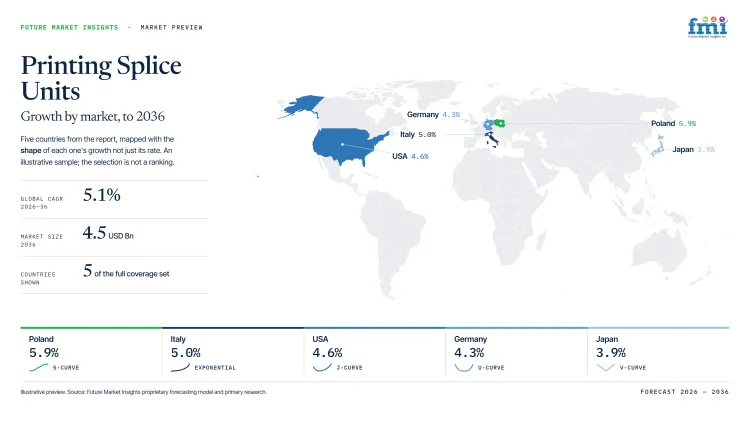
| Country | CAGR |
|---|---|
| Poland | 5.9% |
| Mexico | 5.6% |
| Brazil | 5.3% |
| Italy | 5.0% |
| USA | 4.6% |
| Germany | 4.3% |
| Japan | 3.9% |
How do country-level CAGRs compare in the Printing Splice Units Market?
The seven country forecasts fall into three bands within a 2.0 percentage-point spread. Poland and Mexico are above 5.5% while Brazil and Italy cluster near 5.0% during the forecast period. The USA and Germany follow below them, with Japan at 3.9% through 2036 at the lower end.
- Poland is expected to witness steady expansion, supported by ongoing industrial expansion and equipment modernization across manufacturing facilities.
- Mexico’s export-oriented production base continues to generate demand as manufacturers invest in capacity and operational efficiency.
- Brazil benefits from a combination of industrial growth and replacement spending, creating opportunities across both new and existing installations.
- Italy draws strength from a diverse manufacturing sector that values productivity gains and process upgrades.
- The USA relies heavily on its large installed base, with demand increasingly linked to replacement cycles and efficiency improvements.
- Germany’s advanced industrial landscape places greater emphasis on reliability and engineering precision.
- Japan remains the most mature market in the comparison, where growth is driven more by incremental upgrades than large-scale new adoption.
Country-wise Analysis
- Polish converters serve brands and European customers from a print base where equipment investment has strengthened. Demand for printing splice units in Poland is forecast to rise at 5.9% CAGR through 2036 as capacity upgrades give plants more chances to add automated reel handling. The Polish Economic Institute's November 2025 data show printing and reproduction investment increased 33.1% among non-financial enterprises employing 50 or more people. Poland's Central European location also gives folding carton packaging converters access to regional equipment service. Mixed press ages make one-size-fits-all retrofit packages difficult for plants with different line layouts.
- Mexican label and packaging plants buy automation during press upgrades that handle shorter runs and more varied substrates. INEGI's August 2025 release recorded a 3.8% year-over-year fall in physical output for printing and allied industries during June. Sales of printing splice units in Mexico is projected to grow at 5.6% CAGR during the assessment period as plants replace or upgrade web-fed equipment. Mexico's converting base also supports flexographic printing plates and mid-web equipment, giving installers a familiar service environment. Uneven output makes payback harder to prove, which increases the value of local commissioning and Spanish-language service.
- Brazilian printers face uneven monthly output and operate web-fed lines from several equipment generations. Sales of printing splice units in Brazil are forecast to expand at 5.3% CAGR by 2036 as plants seek more output from existing roll-fed lines. In January 2026, IBGE reported an 18.3% increase in printing and reproduction of recorded media from October to November 2025. Brazil's flexible plastic packaging sector gives splice manufacturers a practical customer base for roll-fed automation. Service coverage varies by region, so local parts stock and remote diagnostics can reduce downtime during repairs.
- Italian converters run packaging and commercial work where equipment decisions must fit each plant's production mix. Istat's February 2026 release recorded a 2.9% year-over-year fall in wood, paper and printing output during December 2025. Printing splice units industry in Italy is predicted to advance at 5.0% CAGR through 2036 as plants seek to recover press time without replacing complete lines. Italy has experienced converting engineers, but softer factory output makes capital approval more selective. Older and newer presses often share the same plant, which raises engineering costs and favors vendors that can quantify recovered press time before installation.
- US plants judge splice automation by how much output an existing line can recover because mature presses often run beside newer digital equipment. PRINTING United Alliance's August 2025 study covered nearly 200 companies and found many firms postponing capital investment during flat or declining performance. Printing splice units industry in the USA is anticipated to increase at 4.6% CAGR over the forecast period as plants seek more output from established web-fed presses. Domestic service networks can shorten installation and repair delays on existing equipment during retrofit projects. Capital approval is easier when proposals show the minutes recovered and waste reduced on the actual line.
- German converters treat automatic splicing as an engineering project that must fit a specific press room and operating routine. Adoption of printing splice units in Germany is estimated to expand at 4.3% CAGR through 2036 as machinery investment supports retrofit demand. VDMA documented above-average real order growth for printing and paper technology in Germany during January through March 2025. Germany's machinery base gives converters access to press builders and local service teams for detailed integration work. Existing layouts can restrict accumulator placement and web routing, so early layout planning and operator training reduce installation risk.
- Japanese plants require proven machine interfaces and local technical support before changing a production-critical web path. Full-year 2025 figures from the Japan Printing Machinery Association show printing-machinery exports increased 5.2% from the prior year. Demand for printing splice units in Japan is forecast to rise at 3.9% CAGR over the assessment period as plants replace equipment selectively instead of adding capacity quickly. Japan's machinery base gives plants direct access to technical evaluation and local replacement-part support. Detailed acceptance testing takes time, so suppliers need structured trials and local support that prove splice quality on the customer's actual line.
Who are the notable companies in the Printing Splice Units Market?
Martin Automatic, Butler Automatic, KAMPF GmbH, BOBST, Windmöller & Hölscher, Koenig & Bauer, BW Papersystems, Rotoflex, a Mark Andy brand, MPS Printing, and Grafotronic are notable companies serving this market.
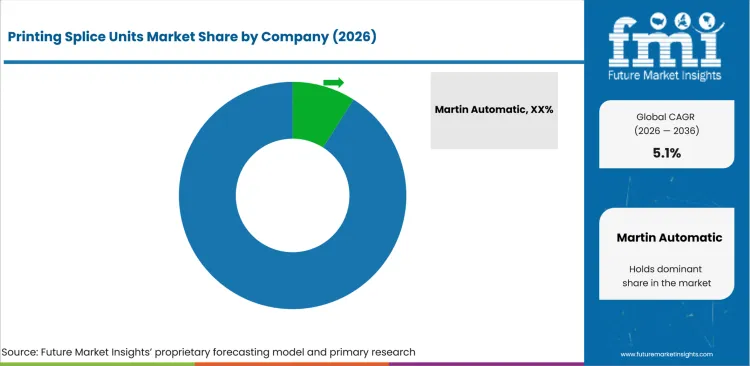
Competition includes splice manufacturers, press OEMs and converting-equipment specialists that control different parts of the web path. Each company must prove reliable transfer at production speed without long installation stoppages.
- Martin Automatic and Butler Automatic specialize in stand-alone splicing, while BW Papersystems supplies integrated web-handling equipment.
- Koenig & Bauer and MPS Printing supply press automation, while BOBST and Windmöller & Hölscher supply web-fed packaging platforms.
- KAMPF GmbH and Grafotronic supply converting equipment alongside Rotoflex as Mark Andy's finishing brand for web-fed production.
Competitive Benchmarking: Printing Splice Units Market
| Company | Automatic Web Transfer | Line Integration Depth | Service / Retrofit Support | Geographic Reach |
|---|---|---|---|---|
| Martin Automatic | High | High | High | North America, Europe and international installations |
| Butler Automatic | High | Medium | High | North America and Europe |
| KAMPF GmbH | Medium | High | High | Europe, North America and international converting markets |
| BOBST | Medium | High | High | Global |
| Windmöller & Hölscher | Medium | High | High | Global |
| Koenig & Bauer | Low | High | High | Global |
| BW Papersystems | High | High | High | Americas, Europe, Middle East, Africa and Asia |
| Rotoflex, a Mark Andy brand | Medium | High | High | North America with international Mark Andy channels |
| MPS Printing | Low | High | High | Europe with international label and packaging installations |
| Grafotronic | Medium | High | High | Europe with international label-finishing installations |
Scoring basis: Automatic web transfer scores High for documented non-stop splicing, Medium for transfer controls and Low without a splice action. Line integration scores High for coordinated functions, Medium for one primary interface and Low without control coordination. Service support scores High for multi-market commissioning, Medium for narrower coverage and Low for limited field-service evidence.
Key Developments in the Printing Splice Units Market
- In April 2025, KAMPF GmbH merged its two North American operations into Kampf Machinery North America Inc.
- In June 2026, BW Papersystems relocated its Brazil operations to Vargem Grande Paulista for closer customer access and industrial support.
- In June 2026, Koenig & Bauer reported numerous contract signings at Expográfica as Latin American customers invested in automation.
Key Players in the Printing Splice Units Market
Automatic Splicing and Web-Handling Specialists
- Martin Automatic
- Butler Automatic
- BW Papersystems
Printing and Integrated Press Platforms
- BOBST
- Windmöller & Hölscher
- Koenig & Bauer
- MPS Printing
Converting and Finishing Automation
- KAMPF GmbH
- Rotoflex, a Mark Andy brand
- Grafotronic
Printing Splice Units Market - Report Scope
| Coverage field | Report scope |
|---|---|
| Market breakdown | By unit type, web material, printing process, web width, sales channel and region. |
| Quantitative Units | USD billion. |
| Market Definition | Revenue from manual and automated splice units used to join roll-fed webs in printing and converting lines. Included revenue covers the splice mechanism plus integrated unwind, accumulator, tension-control and standard control packages sold with the unit. Complete press revenue, stand-alone finishing machinery without a splice function, separately sold consumables and downstream printed products are excluded. |
| Regions Covered | North America, Latin America, Western Europe, Eastern Europe, East Asia, South Asia and Pacific, and Middle East and Africa. |
| Countries Covered | Poland, Mexico, Brazil, Italy, USA, Germany, Japan, and more than twenty-five additional countries in the full report. |
| Key Companies Profiled | Martin Automatic, Butler Automatic, KAMPF GmbH, BOBST, Windmöller & Hölscher, Koenig & Bauer, BW Papersystems, Rotoflex, a Mark Andy brand, MPS Printing, Grafotronic. |
| Forecast Period | 2026 to 2036. |
| Approach | Primary and secondary research with market triangulation. |
Printing Splice Units Market - Research Methodology
| Method | Approach |
|---|---|
| Primary Research | FMI analysts gathered input from manufacturers, service providers, technology developers, distributors, end users, procurement teams, and subject-matter experts. Interviews examined purchasing decisions, product or service evaluation, adoption barriers, approval requirements, pricing considerations, and expectations for technical or commercial support. Respondents were also asked what evidence is required before a trial, pilot, or initial order develops into regular purchasing. |
| Desk Research | Desk research covered government statistics, regulatory publications, trade data, industry associations, technical literature, standards, company filings, product information, and official corporate announcements. Sources were reviewed for relevance, publication date, geographic coverage, and consistency with the defined market scope. Claims relating to performance, applications, approvals, capacity, investment, and commercial activity were retained only when supported by credible public evidence. |
| Market Sizing and Forecasting | The market model combined the baseline value with historical performance, segment structure, pricing and volume indicators, adoption levels, company participation, and country-level demand conditions. Forecast assumptions considered economic activity, investment trends, regulatory developments, technology adoption, purchasing cycles, supply availability, and barriers to wider market use. Segment and regional estimates were reconciled before the final market total was calculated. |
| Data Validation | Estimates were checked against multiple independent indicators, including public data, company activity, trade patterns, industry developments, and findings from primary interviews. Validation also tested whether products, services, applications, and company revenues fell within the defined market boundaries. Adjacent categories, unsupported claims, overlapping revenues, and activities without direct market relevance were excluded to reduce double counting and maintain consistency across segments and countries. |
Printing Splice Units Market by Segments
Printing Splice Units Market segmented by Unit Type:
- Automatic splice units
- Manual splice tables
- Flying splice units
- Tape splice units
- Web accumulator splice units
Printing Splice Units Market segmented by Web Material:
- Paper
- Film
- Labelstock
- Foil laminates
- Nonwoven webs
Printing Splice Units Market segmented by Printing Process:
- Flexographic printing
- Gravure printing
- Offset web printing
- Digital web printing
- Converting lines
Printing Splice Units Market segmented by Web Width:
- Below 500 mm
- 500-1,000 mm
- 1,000-1,800 mm
- Above 1,800 mm
Printing Splice Units Market segmented by Sales Channel:
- Press OEMs
- Converting line OEMs
- Aftermarket retrofit
- Direct automation suppliers
Printing Splice Units Market by Region:
- North America
- United States
- Canada
- Latin America
- Brazil
- Mexico
- Chile
- Rest of Latin America
- Western Europe
- Germany
- United Kingdom
- Italy
- Spain
- France
- Nordics
- Benelux
- Rest of Western Europe
- Eastern Europe
- Russia
- Poland
- Hungary
- Balkan and Baltic States
- Rest of Eastern Europe
- East Asia
- China
- Japan
- South Korea
- South Asia and Pacific
- India
- ASEAN
- Australia and New Zealand
- Rest of South Asia and Pacific
- Middle East and Africa
- Kingdom of Saudi Arabia
- Other GCC Countries
- Türkiye
- South Africa
- Other African Union Countries
- Rest of Middle East and Africa
Research Sources and Bibliography
- Martin Automatic. (2026, February 5). Martin Automatic integrates seamlessly with HP at Zumbiel
- Intergraf. (2025, June). Intergraf Activity Report 2024-2025
- Martin Automatic. (2026, March 10). Desmedt scores another first!
- BW Papersystems. (2025, November 3). Superior Lithographics Invests in BW Papersystems’ SheetRunner to Advance Carton Production Capabilities
- Windmöller & Hölscher. (2026, August 11). Al Jawad Flexi Invests in Next-Gen Packaging Solutions by Windmöller & Hölscher
- MPS Printing. (2025, September). Where Performance Grows: MPS Unveils EF Packaging and Performance Ecosystem
- Koenig & Bauer. (2026, April 29). Koenig & Bauer Introduces New CI Flexo Demo Press at Technology Days 2026
- Martin Automatic. (2026, June 9). Nordvalls invests in Martin Automatic technology
- Martin Automatic. (2026, March 19). Römer Etikett installs Martin Automatic technology
- BOBST. (2025, September 17). BOBST extends application flexibility and market reach at Labelexpo Europe 2025
- Polish Economic Institute. (2025, November 7). Economic Weekly 44/2025, November 7, 2025
- Instituto Nacional de Estadística y Geografía. (2025, August 18). Encuesta Mensual de la Industria Manufacturera (EMIM): Indicadores del sector manufacturero
- Instituto Brasileiro de Geografia e Estatística. (2026, January 8). Produção industrial mostra variação nula em novembro
- Istat. (2026, February 11). Produzione industriale - Dicembre 2025
- PRINTING United Alliance. (2025, August). State of the Industry Report 2025: Executive Summary
- VDMA. (2025, May 27). Deutschland: Auftragseingang nach Fachzweigen
- Japan Printing Machinery Association. (2026). 印刷、製版、製本、紙工機械 生産輸出入統計(2025年)
- KAMPF GmbH. (2025, April 1). Kampf GmbH Announces Merger of Atlas Converting North America Inc. and Kampf Machinery Corporation
- BW Papersystems. (2026, June 21). BWP has relocated our Brazil operations to a new facility. We've Grown. And We're Closer to You Than Ever.
- Koenig & Bauer. (2026, June 1). Koenig & Bauer at Expográfica: Investment Boom Driven by End-to-end Solutions
- BOBST. (2025, February 17). Autoadesivi Cipriani renews BOBST partnership with MASTER M5 flexo press
- BW Papersystems. (2026, March 8). BW Papersystems marks 50th ServoPro Rotary Die Cutter installation
- BOBST. (2025, July 10). TOMEX installs BOBST DIGITAL MASTER 340 All-in-One label press
- BOBST. (2025, November 20). Vitrapack accelerates productivity and sustainability with new BOBST EXPERT CI flexo press
- BW Papersystems. (2025, September 9). BW Papersystems introduces the SpeedLiner X at Labelexpo Europe 2025
- Koenig & Bauer. (2026, April 28). Koenig & Bauer Celmacch Expands Portfolio with New Prima Series
- Martin Automatic. (2025, November 3). Martin showcases collaborative automation
- Butler Automatic. (2025, April 27). ISO 9001:2015 Certificate of Registration
- KAMPF GmbH. (2026, June 9). Successful ConSlitter Operation at SCHEYER
- BOBST. (2025, October 2). MCC strengthens EMEA operations with strategic investment in two BOBST MASTER M6 inline flexo presses
- Windmöller & Hölscher. (2026, June 23). Unleashing the Beast: W&H ALPHAFLEX Emerges in India
- Koenig & Bauer. (2026, February 11). Clear Film Printing Garners 50 Percent Additional Productivity With New Eight-Color Koenig & Bauer XD Pro Mod 127 Flexographic Press
- BW Papersystems. (2026, September 3). Flash4 Partners with BW Papersystems to Advance High-Speed RFID and Smart Label Manufacturing
- Mark Andy. (2025, May 22). Mark Andy and Canflexographics Deepen Canadian Commitment with Rotoflex Partnership
- MPS Printing. (2025, November 21). MPS Printing announces restart and sets course for a future of renewed stability, innovation, and strengthened partnerships
- Grafotronic. (2025, February 3). Another successful collaboration with Domino
- Butler Automatic. (n.d.). Butler Automatic - About Us Retrieved September 11, 2026.
- Koenig & Bauer. (2026, March 26). Non-financial Group report 2025 - Koenig & Bauer - Annual Report
- Martin Automatic. (n.d.). Contact | Martin Automatic, Inc. Retrieved September 11, 2026.
This bibliography is provided for reader reference and is not exhaustive. The full report contains the complete reference list and detailed citations.
This Report Answers
- How large is the printing splice units market through 2036?
- What makes non-stop reel changes economically attractive?
- Why do automatic splice units lead unit type in 2026?
- How does paper affect splice and reel handling?
- Why does flexographic printing lead printing process in 2026?
- How do the seven country CAGRs compare?
- What delays splice-unit installation on existing printing lines?
- Which companies compete through splicing and press automation?
Frequently Asked Questions
How big is the printing splice units market in 2026?
The printing splice units market is valued at USD 2.7 billion in 2026 and is projected to reach USD 4.5 billion by 2036. Non-stop reel changes recover press time otherwise lost during repeated manual roll changes in production.
What is the CAGR of the printing splice units market from 2026 to 2036?
The printing splice units market is projected to grow at a CAGR of 5.1% between 2026 and 2036. Plants replacing or upgrading web-fed equipment can justify splice units more easily when each reel change would otherwise stop production.
Which unit type leads the printing splice units market?
The automatic splice units segment is expected to hold 31.0% of the printing splice units market in 2026, driven by continuous reel transfer. Automatic transfer reduces planned press stops during frequent roll changes on web-fed production lines.
Which web material leads the printing splice units market?
The paper segment is expected to hold 30.0% of the printing splice units market by web material in 2026, attributable to frequent reel changes. Controlled reel transfer protects downstream print and cutting quality on high-speed paper production lines.
Which countries are projected to record the country growth comparison in the printing splice units market?
Poland is projected to grow at 5.9% CAGR followed by Mexico at 5.6% and Brazil at 5.3% through 2036. The seven forecasts differ because press-replacement cycles and the cost of adapting splice equipment vary by country.
Which companies are active in the printing splice units market?
Key companies operating in the market include Martin Automatic, Butler Automatic, KAMPF GmbH, BOBST, Windmöller & Hölscher, Koenig & Bauer, BW Papersystems, Rotoflex, a Mark Andy brand, MPS Printing, and Grafotronic. They compete by reducing reel-change downtime or by integrating splice controls with the press, supported by line-specific installation and service.
Preview the report firsthand - request a free sample
Get SampleGet the brochure for pricing and purchase details.
Get PDFTable of Content
- Key Takeaways
- Market Size and CAGR
- Top Growth Driver
- Fastest Growing Segment
- Leading Region
- Key Companies
- Emerging Opportunities
- Executive Summary
- Global Market Outlook
- Demand-side Trends
- Supply-side Trends
- Technology Roadmap Analysis
- Analysis and Recommendations
- Analyst Perspective (What is happening? Why now? What should investors know?)
- Key Questions Answered
- How large is the market?
- What is the CAGR?
- What are key trends?
- Which region dominates?
- Who are the leaders?
- Market Overview
- Market Coverage / Taxonomy
- Market Definition / Scope / Limitations
- Research Methodology
- Chapter Orientation
- Analytical Lens and Working Hypotheses
- Market Structure, Signals, and Trend Drivers
- Benchmarking and Cross-market Comparability
- Market Sizing, Forecasting, and Opportunity Mapping
- Research Design and Evidence Framework
- Desk Research Programme (Secondary Evidence)
- Expert Input and Fieldwork (Primary Evidence)
- Tooling, Models, and Reference Databases
- Data Engineering and Model Build
- Quality Assurance and Audit Trail
- Market Background
- Market Dynamics (Drivers, Restraints, Opportunity, Trends)
- Scenario Forecast (Optimistic, Likely, Conservative)
- Impact Analysis
- AI Impact
- Sustainability Impact
- Regulatory Impact
- Technology Impact
- Consumer / Buyer Analysis
- Purchase Drivers
- Adoption Barriers
- Buyer Journey
- Opportunity Map Analysis
- Product Life Cycle Analysis
- Supply Chain Analysis
- Investment Feasibility Matrix
- Value Chain Analysis
- PESTLE and Porter's Analysis
- Regulatory Landscape
- Regional Parent Market Outlook
- Production and Consumption Statistics
- Import and Export Statistics
- Global Market Analysis and Forecast, 2021 to 2036
- Historical Market Size Value (USD Billion) Analysis, 2021 to 2025
- Current and Future Market Size Value (USD Billion) Projections, 2026 to 2036
- Y-o-Y Growth Trend Analysis
- Absolute $ Opportunity Analysis
- Global Market Pricing Analysis, 2021 to 2036
- Global Market Analysis and Forecast, By Value (USD Billion) Type, 2021 to 2036
- Introduction / Key Findings
- Historical Market Size Value (USD Billion) Analysis By Value (USD Billion) Type, 2021 to 2025
- Current and Future Market Size Value (USD Billion) Analysis and Forecast By Value (USD Billion) Type, 2026 to 2036
- Automatic splice units
- Manual splice tables
- Flying splice units
- Tape splice units
- Web accumulator splice units
- Automatic splice units
- Y-o-Y Growth Trend Analysis By Value (USD Billion) Type, 2021 to 2025
- Absolute $ Opportunity Analysis By Value (USD Billion) Type, 2026 to 2036
- Global Market Analysis and Forecast, By Web Material, 2021 to 2036
- Introduction / Key Findings
- Historical Market Size Value (USD Billion) Analysis By Web Material, 2021 to 2025
- Current and Future Market Size Value (USD Billion) Analysis and Forecast By Web Material, 2026 to 2036
- Paper
- Film
- Labelstock
- Foil laminates
- Nonwoven webs
- Paper
- Y-o-Y Growth Trend Analysis By Web Material, 2021 to 2025
- Absolute $ Opportunity Analysis By Web Material, 2026 to 2036
- Global Market Analysis and Forecast, By Printing Process, 2021 to 2036
- Introduction / Key Findings
- Historical Market Size Value (USD Billion) Analysis By Printing Process, 2021 to 2025
- Current and Future Market Size Value (USD Billion) Analysis and Forecast By Printing Process, 2026 to 2036
- Flexographic printing
- Gravure printing
- Offset web printing
- Digital web printing
- Converting lines
- Flexographic printing
- Y-o-Y Growth Trend Analysis By Printing Process, 2021 to 2025
- Absolute $ Opportunity Analysis By Printing Process, 2026 to 2036
- Global Market Analysis and Forecast, By Web Width, 2021 to 2036
- Introduction / Key Findings
- Historical Market Size Value (USD Billion) Analysis By Web Width, 2021 to 2025
- Current and Future Market Size Value (USD Billion) Analysis and Forecast By Web Width, 2026 to 2036
- 500-1,000 mm
- Below 500 mm
- 1,000-1,800 mm
- Above 1,800 mm
- 500-1,000 mm
- Y-o-Y Growth Trend Analysis By Web Width, 2021 to 2025
- Absolute $ Opportunity Analysis By Web Width, 2026 to 2036
- Global Market Analysis and Forecast, By Sales Channel, 2021 to 2036
- Introduction / Key Findings
- Historical Market Size Value (USD Billion) Analysis By Sales Channel, 2021 to 2025
- Current and Future Market Size Value (USD Billion) Analysis and Forecast By Sales Channel, 2026 to 2036
- Press OEMs
- Converting line OEMs
- Aftermarket retrofit
- Direct automation suppliers
- Press OEMs
- Y-o-Y Growth Trend Analysis By Sales Channel, 2021 to 2025
- Absolute $ Opportunity Analysis By Sales Channel, 2026 to 2036
- Global Market Analysis and Forecast, By Region, 2021 to 2036
- Introduction
- Historical Market Size Value (USD Billion) Analysis By Region, 2021 to 2025
- Current Market Size Value (USD Billion) Analysis and Forecast By Region, 2026 to 2036
- North America
- Latin America
- Western Europe
- Eastern Europe
- East Asia
- South Asia and Pacific
- Middle East & Africa
- Market Attractiveness Analysis By Region
- North America Market Analysis and Forecast, By Country, 2021 to 2036
- Historical Market Size Value (USD Billion) Trend Analysis By Market Taxonomy, 2021 to 2025
- Market Size Value (USD Billion) Forecast By Market Taxonomy, 2026 to 2036
- By Country
- USA
- Canada
- By Value (USD Billion) Type
- By Web Material
- By Printing Process
- By Web Width
- By Sales Channel
- By Country
- Market Attractiveness Analysis
- By Country
- By Value (USD Billion) Type
- By Web Material
- By Printing Process
- By Web Width
- By Sales Channel
- Key Takeaways
- Latin America Market Analysis and Forecast, By Country
- Historical Market Size Value (USD Billion) Trend Analysis By Market Taxonomy, 2021 to 2025
- Market Size Value (USD Billion) Forecast By Market Taxonomy, 2026 to 2036
- By Country
- Brazil
- Mexico
- Chile
- Rest of Latin America
- By Value (USD Billion) Type
- By Web Material
- By Printing Process
- By Web Width
- By Sales Channel
- By Country
- Market Attractiveness Analysis
- By Country
- By Value (USD Billion) Type
- By Web Material
- By Printing Process
- By Web Width
- By Sales Channel
- Key Takeaways
- Western Europe Market Analysis and Forecast, By Country
- Historical Market Size Value (USD Billion) Trend Analysis By Market Taxonomy, 2021 to 2025
- Market Size Value (USD Billion) Forecast By Market Taxonomy, 2026 to 2036
- By Country
- Germany
- UK
- Italy
- Spain
- France
- Nordic
- BENELUX
- Rest of Western Europe
- By Value (USD Billion) Type
- By Web Material
- By Printing Process
- By Web Width
- By Sales Channel
- By Country
- Market Attractiveness Analysis
- By Country
- By Value (USD Billion) Type
- By Web Material
- By Printing Process
- By Web Width
- By Sales Channel
- Key Takeaways
- Eastern Europe Market Analysis and Forecast, By Country
- Historical Market Size Value (USD Billion) Trend Analysis By Market Taxonomy, 2021 to 2025
- Market Size Value (USD Billion) Forecast By Market Taxonomy, 2026 to 2036
- By Country
- Russia
- Poland
- Hungary
- Balkan & Baltic
- Rest of Eastern Europe
- By Value (USD Billion) Type
- By Web Material
- By Printing Process
- By Web Width
- By Sales Channel
- By Country
- Market Attractiveness Analysis
- By Country
- By Value (USD Billion) Type
- By Web Material
- By Printing Process
- By Web Width
- By Sales Channel
- Key Takeaways
- East Asia Market Analysis and Forecast, By Country
- Historical Market Size Value (USD Billion) Trend Analysis By Market Taxonomy, 2021 to 2025
- Market Size Value (USD Billion) Forecast By Market Taxonomy, 2026 to 2036
- By Country
- China
- Japan
- South Korea
- By Value (USD Billion) Type
- By Web Material
- By Printing Process
- By Web Width
- By Sales Channel
- By Country
- Market Attractiveness Analysis
- By Country
- By Value (USD Billion) Type
- By Web Material
- By Printing Process
- By Web Width
- By Sales Channel
- Key Takeaways
- South Asia and Pacific Market Analysis and Forecast, By Country
- Historical Market Size Value (USD Billion) Trend Analysis By Market Taxonomy, 2021 to 2025
- Market Size Value (USD Billion) Forecast By Market Taxonomy, 2026 to 2036
- By Country
- India
- ASEAN
- Australia & New Zealand
- Rest of South Asia and Pacific
- By Value (USD Billion) Type
- By Web Material
- By Printing Process
- By Web Width
- By Sales Channel
- By Country
- Market Attractiveness Analysis
- By Country
- By Value (USD Billion) Type
- By Web Material
- By Printing Process
- By Web Width
- By Sales Channel
- Key Takeaways
- Middle East & Africa Market Analysis and Forecast, By Country
- Historical Market Size Value (USD Billion) Trend Analysis By Market Taxonomy, 2021 to 2025
- Market Size Value (USD Billion) Forecast By Market Taxonomy, 2026 to 2036
- By Country
- Kingdom of Saudi Arabia
- Other GCC Countries
- Türkiye
- South Africa
- Other African Union
- Rest of Middle East & Africa
- By Value (USD Billion) Type
- By Web Material
- By Printing Process
- By Web Width
- By Sales Channel
- By Country
- Market Attractiveness Analysis
- By Country
- By Value (USD Billion) Type
- By Web Material
- By Printing Process
- By Web Width
- By Sales Channel
- Key Takeaways
- Key Countries Market Analysis
- USA
- Pricing Analysis
- Market Share Analysis, 2025
- By Value (USD Billion) Type
- By Web Material
- By Printing Process
- By Web Width
- By Sales Channel
- Canada
- Pricing Analysis
- Market Share Analysis, 2025
- By Value (USD Billion) Type
- By Web Material
- By Printing Process
- By Web Width
- By Sales Channel
- Mexico
- Pricing Analysis
- Market Share Analysis, 2025
- By Value (USD Billion) Type
- By Web Material
- By Printing Process
- By Web Width
- By Sales Channel
- Brazil
- Pricing Analysis
- Market Share Analysis, 2025
- By Value (USD Billion) Type
- By Web Material
- By Printing Process
- By Web Width
- By Sales Channel
- Chile
- Pricing Analysis
- Market Share Analysis, 2025
- By Value (USD Billion) Type
- By Web Material
- By Printing Process
- By Web Width
- By Sales Channel
- Germany
- Pricing Analysis
- Market Share Analysis, 2025
- By Value (USD Billion) Type
- By Web Material
- By Printing Process
- By Web Width
- By Sales Channel
- UK
- Pricing Analysis
- Market Share Analysis, 2025
- By Value (USD Billion) Type
- By Web Material
- By Printing Process
- By Web Width
- By Sales Channel
- Italy
- Pricing Analysis
- Market Share Analysis, 2025
- By Value (USD Billion) Type
- By Web Material
- By Printing Process
- By Web Width
- By Sales Channel
- Spain
- Pricing Analysis
- Market Share Analysis, 2025
- By Value (USD Billion) Type
- By Web Material
- By Printing Process
- By Web Width
- By Sales Channel
- France
- Pricing Analysis
- Market Share Analysis, 2025
- By Value (USD Billion) Type
- By Web Material
- By Printing Process
- By Web Width
- By Sales Channel
- India
- Pricing Analysis
- Market Share Analysis, 2025
- By Value (USD Billion) Type
- By Web Material
- By Printing Process
- By Web Width
- By Sales Channel
- ASEAN
- Pricing Analysis
- Market Share Analysis, 2025
- By Value (USD Billion) Type
- By Web Material
- By Printing Process
- By Web Width
- By Sales Channel
- Australia & New Zealand
- Pricing Analysis
- Market Share Analysis, 2025
- By Value (USD Billion) Type
- By Web Material
- By Printing Process
- By Web Width
- By Sales Channel
- China
- Pricing Analysis
- Market Share Analysis, 2025
- By Value (USD Billion) Type
- By Web Material
- By Printing Process
- By Web Width
- By Sales Channel
- Japan
- Pricing Analysis
- Market Share Analysis, 2025
- By Value (USD Billion) Type
- By Web Material
- By Printing Process
- By Web Width
- By Sales Channel
- South Korea
- Pricing Analysis
- Market Share Analysis, 2025
- By Value (USD Billion) Type
- By Web Material
- By Printing Process
- By Web Width
- By Sales Channel
- Russia
- Pricing Analysis
- Market Share Analysis, 2025
- By Value (USD Billion) Type
- By Web Material
- By Printing Process
- By Web Width
- By Sales Channel
- Poland
- Pricing Analysis
- Market Share Analysis, 2025
- By Value (USD Billion) Type
- By Web Material
- By Printing Process
- By Web Width
- By Sales Channel
- Hungary
- Pricing Analysis
- Market Share Analysis, 2025
- By Value (USD Billion) Type
- By Web Material
- By Printing Process
- By Web Width
- By Sales Channel
- Kingdom of Saudi Arabia
- Pricing Analysis
- Market Share Analysis, 2025
- By Value (USD Billion) Type
- By Web Material
- By Printing Process
- By Web Width
- By Sales Channel
- Türkiye
- Pricing Analysis
- Market Share Analysis, 2025
- By Value (USD Billion) Type
- By Web Material
- By Printing Process
- By Web Width
- By Sales Channel
- South Africa
- Pricing Analysis
- Market Share Analysis, 2025
- By Value (USD Billion) Type
- By Web Material
- By Printing Process
- By Web Width
- By Sales Channel
- USA
- Market Structure Analysis
- Competition Dashboard
- Competition Benchmarking
- Market Share Analysis of Top Players
- By Regional
- By Value (USD Billion) Type
- By Web Material
- By Printing Process
- By Web Width
- By Sales Channel
- Emerging Startups
- Innovation Benchmarking
- Competition Analysis
- Competition Deep Dive
- Martin Automatic
- Overview
- Product Portfolio
- Profitability by Market Segments
- Sales Footprint
- Strategy Overview
- Marketing Strategy
- Product Strategy
- Channel Strategy
- Butler Automatic
- Kampf Schneid- und Wickeltechnik
- Bobst
- Windmöller & Hölscher
- Koenig & Bauer
- BW Papersystems
- Rotoflex
- MPS Systems
- Grafotronic
- Martin Automatic
- Case Studies
- Success Stories
- Recent Developments
- Competition Deep Dive
- Assumptions & Acronyms Used


