

- Market Size (2026)
- USD 2380.6 Mn
- Forecast (2036)
- USD 4861.0 Mn
- CAGR (2026 to 2036)
- 7.4%
How big is the mobile compressor skids market in 2026?
USD 2380.6 million in 2026 and USD 4861.0 million by 2036 at a 7.4% CAGR.
The mobile compressor skids market was valued at USD 2,216.6 million in 2025. It is expected to grow from USD 2,380.6 million in 2026 to USD 4,861.0 million in 2036 at a CAGR of 7.4%. Demand is expected to be driven by gas gathering bottlenecks and field pressure decline across active production basins. Reciprocating skids are forecast to represent 47.0% share in 2026. Gas engine driven units are expected to secure 51.0% share in 2026 with broad fit across remote pads.
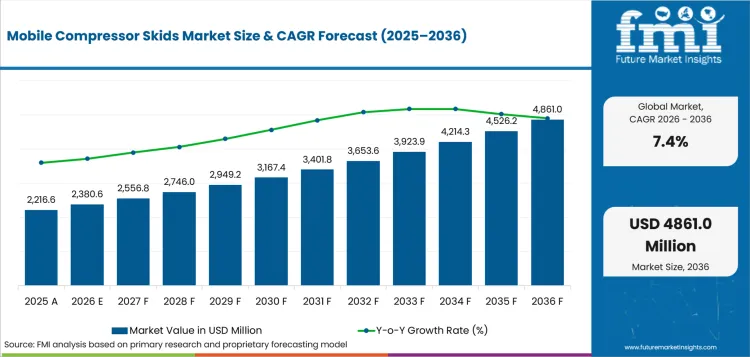
| Metric | Value |
|---|---|
| 2026 Market Size | USD 2380.6 million |
| 2036 Market Size | USD 4861.0 million |
| Forecast CAGR | 7.4% from 2026 to 2036 |
| Leading Compressor Type | Reciprocating Skids |
| Reciprocating Skids Share in 2026 | 47.0% |
| Leading Power Source | Gas Engine Driven |
| Gas Engine Driven Share in 2026 | 51.0% |
| Fastest-growing Country | China |
| China CAGR | 8.3% by 2036 |
Summary of the Mobile Compressor Skids Market
| Market Signal | Commercial Impact |
|---|---|
| Demand and Growth Drivers | Mobile compressor skid demand is increasing as upstream operators seek flexible gas gathering and wellhead compression solutions.
|
| Product and Segment View | Reciprocating skids, gas engine-driven units, and rental fleets lead the market.
|
| Geography and Growth Outlook | China, India, and the United States are expected to remain the major growth markets.
|
| Competitive Landscape | Competition is focused on compression capability, equipment availability, and field service support.
|
| Analyst Perspective | Mobile compressor skids are increasingly viewed as productivity and operational flexibility assets.
— Nikhil Kaitwade, Principal Analyst, Future Market Insights |
Field compression is moving toward movable packages that can follow production changes before permanent station spending is justified. EIA reported in March 2026 that USA marketed gas production averaged 118.5 Bcf/d in 2025. API listed the sixth edition of API 618 in May 2024 for reciprocating compressors in petroleum and gas services. Operators also compare screw compressor packages against reciprocating skids for lower pressure duties and vapor recovery work.
The mobile compressor skids market is expected to expand through 2036 with demand from gas gathering and wellhead compression. Vapor recovery applications add selective demand. Buyers are using rental fleets and service-bundled packages to avoid fixed equipment exposure on short field cycles.
What supports mobile compressor skid demand?
Which factors support expansion in the mobile compressor skids market?
Rental horsepower and gas gathering demand support value creation across field production systems and midstream networks.
- Market value is supported by field-ready packages that recover gas from wells with changing suction pressure.
- Supplier pricing reflects compressor frame selection and controls integration before enclosure design affects final package cost.
- Revenue improves with rental fleets that combine equipment availability and field service response in one contract.
- Buyer trust rises with suppliers that document compressor standards and maintenance routines for active oilfield sites.
Why is the mobile compressor skids market growing?
Mature producing wells need field compression after reservoir pressure falls below gathering system requirements.
Mobile compression is expected to drive demand, as it provides a cost-effective interim solution before investment in a permanent compression station can be justified. EIA reported in March 2026 that USA marketed gas production reached 118.5 Bcf/d in 2025. This scale gives operators a clear reason to recover losses from low-pressure wells. Suppliers with compressor rental contracts can reduce stranded asset risk for field teams that expect pad conditions to change.
Gas market volatility strengthens the case for timed service decisions over long capital commitments. Operators can deploy mobile skids after flow tests and move them once production profiles change. This supports booster compressor demand across gathering corridors that need temporary pressure support before larger network upgrades.
How is the mobile compressor skids market segmented?
The mobile compressor skids market is segmented by compressor type, power source, application, pressure range, and sales model.
- Reciprocating skids are projected to account for 47.0% share in 2026 with field gas pressures varying across producing pads.
- Gas engine driven units are expected to represent 51.0% share in 2026 due to broad use on remote sites that lack stable grid power.
- Gas gathering is forecast to hold 35.0% share in 2026 as midstream operators manage uneven flows across collection systems.
- Medium pressure units are anticipated to secure 46.0% share in 2026 driven by fit across pad-level and line boosting duties.
- Rental fleet is estimated to account for 44.0% share in 2026 as operators limit ownership risk during field changes.
Which compressor type category holds a notable share in the mobile compressor skids market?
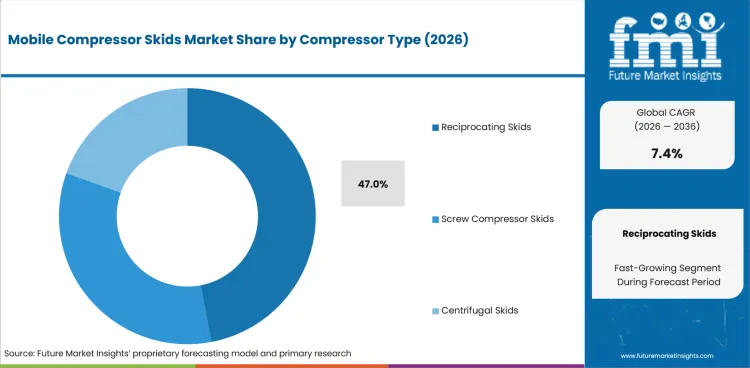
- Reciprocating skids are projected to account for 47.0% of the market in 2026, due to their ability to handle changing suction pressures and variable gas compositions across producing pads.
- Screw compressor skids gain use in lower pressure service that needs compact packages and easier maintenance routines.
How does the power source segment perform in the mobile compressor skids market?
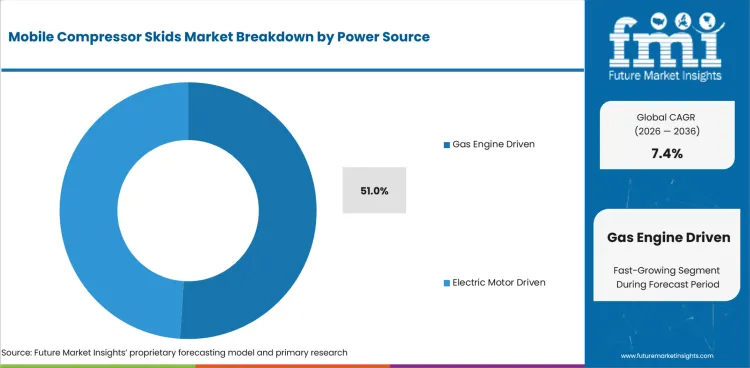
- Gas engine driven units are expected to represent 51.0% of the market in 2026, owing to their extensive deployment in remote fields with limited grid access and readily available field gas.
- Electric motor driven packages gain attention in basins that can use grid power and lower onsite emissions plans.
What drives demand across the application segment in the mobile compressor skids market?
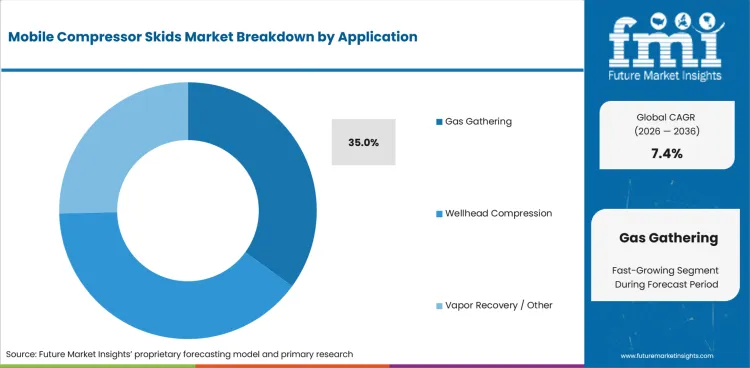
- Gas gathering is forecast to hold 35.0% of the market in 2026, as dispersed wells require temporary pressure support before investment in permanent gathering infrastructure is justified.
- Vapor recovery applications create orders for compact skids that capture tank battery gas with limited civil work.
Which pressure range shows a prominent position in the mobile compressor skids market?
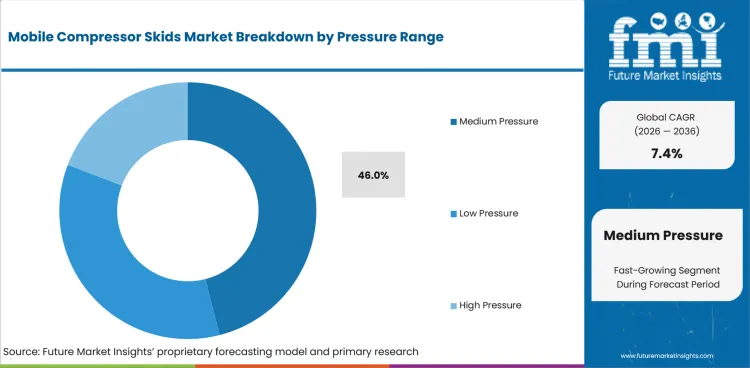
- Medium-pressure skids, anticipated to secure 46.0% of the market in 2026, maintain a prominent position through their suitability for pad-level compression and gathering line support applications.
- High pressure units require tighter material selection and stronger documentation for pipeline boosting duty.
How are buyers selecting across sales model options in the mobile compressor skids market?
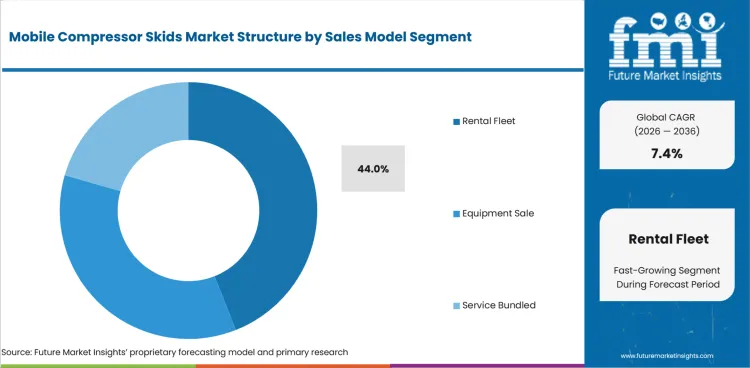
- Rental fleet offerings is estimated to account for 44.0% of the market in 2026, as buyers prioritize operational flexibility, uptime guarantees, and technical support during uncertain field life cycles.
- Equipment sale remains relevant for operators with repeat well programs and stable long-term compression needs.
What are the driver, restraints, and opportunities in the mobile compressor skids market?
Field pressure decline and associated gas capture support growth while service coverage limits broader deployment speed.
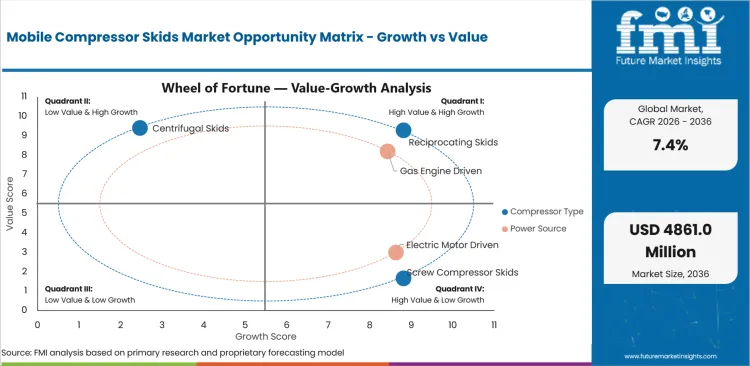
- Driver: Pressure-decline recovery raises skid demand as mature wells need compression before permanent station economics are clear.
- Restraint: Skilled technician availability constrains uptime in remote locations with changing gas conditions.
- Opportunity: Standardized modular packaging can shorten engineering cycles and improve fleet redeployment across basins.
Field Pressure Decline and Mobile Horsepower
Field pressure decline is expected to support skid deployment after wellhead flow weakens. Enerflex states that its reciprocating compression packages range from 20 HP to 10000 HP. This package range lets buyers match horsepower to maturing wells and gathering support without committing to a permanent station.
Associated Gas Capture and Gathering Bottlenecks
Associated gas capture is expected to increase the value of movable compression in liquids-rich basins. EIA reported in March 2026 that Appalachia, Permian and Haynesville supplied 67% of USA marketed gas output in 2025. Field teams also compare flare gas recovery systems for tank battery work that would otherwise lose gas value.
Service Coverage and Uptime Discipline
Uptime remains the practical restraint. A skid creates value only while it runs. Archrock describes contract compression as service covering installation and operation with maintenance and equipment management. This lifts attention on air compressor control systems that help operators watch package condition and service intervals.
Which countries are growing fastest in the mobile compressor skids market?
China 8.3% CAGR, India 8.1% CAGR, United States 7.8% CAGR, South Korea 7.2% CAGR, Germany 6.4% CAGR, United Kingdom 6.1% CAGR, France 5.9% CAGR, and Japan 5.8% CAGR through 2036.
.webp "Top Country Growth Comparison Mobile Compressor Skids Market Cagr (2026 2036)")
| Country | CAGR |
|---|---|
| China | 8.3% |
| India | 8.1% |
| United States | 7.8% |
| South Korea | 7.2% |
| Germany | 6.4% |
| United Kingdom | 6.1% |
| France | 5.9% |
| Japan | 5.8% |
Source: Future Market Insights, 2026.
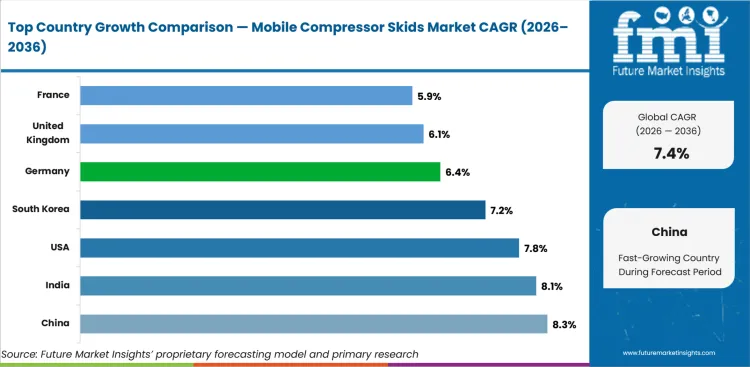
How do country-level CAGRs compare in the mobile compressor skids market?
China and India show the most visible growth outlook while Japan records a more measured expansion profile among profiled markets.
- China is expected to register an 8.3% CAGR by 2036, driven by shale gas development and coalbed methane programs that continue to generate new compression requirements.
- India is projected to grow at an 8.1% CAGR through 2036, as gas grid expansion and city gas distribution (CGD) buildouts increase demand for supporting compression equipment.
- The United States is forecast to expand at a 7.8% CAGR through 2036, with sustained activity across shale basins supporting rental and mobile horsepower needs.
- South Korea is anticipated to advance at a 7.2% CAGR by 2036, supported by LNG‑linked industrial corridors requiring flexible rotating equipment solutions.
- Germany is projected to post a 6.4% CAGR through 2036, as gas storage facilities and LNG infrastructure keep packaged and mobile compression relevant.
- The United Kingdom is expected to record a 6.1% CAGR by 2036, with North Sea servicing and maintenance activity sustaining demand for mobile compressor packages.
- France is forecast to grow at a 5.9% CAGR through 2036, driven by LNG terminal operations and selective biomethane injection projects.
- Japan is projected to register a 5.8% CAGR by 2036, as coastal LNG infrastructure and industrial gas corridors continue to support service‑oriented demand.
How fast is the mobile compressor skids market growing in China?
An 8.3% CAGR through 2036 reflects Sichuan and Xinjiang shale gas corridors and demand for field-ready compression support.
Country Market Snapshot Table
| Parameter | Value |
|---|---|
| Market Size in 2025 (Value) | USD 387.8 million |
| Market Size in 2026 (Value) | USD 420.0 million |
| Market Forecast in 2036 (Value) | USD 932.3 million |
| CAGR (2026 to 2036) | 8.3% |
| Years Considered | 2021 to 2036 |
| Base Year | 2025 |
| Forecast Period | 2026 to 2036 |
| Units Considered | Value (USD million) |
| Leading Sub-Region | Sichuan and Xinjiang shale gas corridors |
China Mobile Compressor Skids Market Outlook
- China demand is influenced by domestic gas production and coalbed methane programs across inland basins. Mobile skids give operators a practical way to support variable flows before fixed stations are justified.
- Local packagers and international compressor suppliers compete on rotating equipment depth and service coverage. Buyers value packages that can be moved across shale gas and gathering corridors without long engineering cycles.
Key Growth Drivers
- Shale gas activity supports mobile compression trials. National Bureau of Statistics reported that China produced 21.5 billion cubic meters of natural gas in May 2025.
- Coalbed methane and inland gathering corridors create demand for relocatable horsepower. SCIO reported in April 2025 that Shanxi produced 13.43 billion cubic meters of coalbed methane in 2024.
- Domestic turbomachinery manufacturing gives buyers more local sourcing options for compressor packages and service support.
- Pipeline and LNG infrastructure programs give compressor suppliers more project touchpoints across inland and coastal gas corridors.
Key Restraints
- Remote basin conditions can raise service costs by extending spare-part and technician travel to inland shale fields.
- Project approval timing can slow package deployment. New gas infrastructure still depends on regional permitting and grid coordination.
- Imported compressor frames can face cost pressure under local-content requirements and faster domestic service expectations.
What makes China unique
China has a distinct profile through shale gas and coalbed methane basins that create domestic demand for movable compression packages.
Key Companies
- Shaanxi Blower Group
- CIMC Enric
- Atlas Copco China
- Siemens Energy
- Howden
Sales & Marketing Channels
- Direct OEM sales
- Rental fleet operators
- Oilfield service distributors
- Midstream EPC contractors
- Field service technicians
- Aftermarket parts networks
Country Segment Breakdown Table
| Segment | Sub-Segments |
|---|---|
| By Compressor Type | Reciprocating Skids · Screw Compressor Skids · Centrifugal Skids · Hybrid / Other |
| By Power Source | Gas Engine Driven · Electric Motor Driven · Diesel Driven |
| By Application | Wellhead Compression · Gas Gathering · Pipeline Boosting · Vapor Recovery / Other |
| By Pressure Range | Low Pressure · Medium Pressure · High Pressure |
| By Sales Model | Rental Fleet · Equipment Sale · Service Bundled |
| Key Sub-Regions Covered, Field Service Corridors | Sichuan · Chongqing · Xinjiang · Shaanxi · Inner Mongolia · Guangdong |
Frequently Asked Questions
How fast is China mobile compressor skids market growing?
China is forecast to expand at 8.3% from 2026 to 2036 with demand shaped by Sichuan and Xinjiang shale gas corridors.
Who competes in China mobile compressor skids market?
The section lists Shaanxi Blower Group and CIMC Enric as relevant suppliers with local support.
What is driving adoption in China mobile compressor skids market?
Gas infrastructure needs and service-backed packages support adoption.
What supports mobile compressor skids market growth in India?
An 8.1% CAGR through 2036 reflects Gujarat and eastern pipeline corridors and demand for field-ready compression support.
Country Market Snapshot Table
| Parameter | Value |
|---|---|
| Market Size in 2025 (Value) | USD 175.8 million |
| Market Size in 2026 (Value) | USD 190.0 million |
| Market Forecast in 2036 (Value) | USD 414.0 million |
| CAGR (2026 to 2036) | 8.1% |
| Years Considered | 2021 to 2036 |
| Base Year | 2025 |
| Forecast Period | 2026 to 2036 |
| Units Considered | Value (USD million) |
| Leading Sub-Region | Gujarat and eastern pipeline corridors |
India Mobile Compressor Skids Market Outlook
- Industry in India is supported by gas grid expansion and city gas distribution buildout. Upstream and midstream buyers need packaged compression that can serve dispersed fields and developing pipeline corridors.
- Local packagers have an advantage in service response and project support. Imported compressor frames remain relevant for operators that need proven reciprocating technology and documentation depth.
Key Growth Drivers
- Gas network expansion supports mobile compressor placement. PNGRB listed India natural gas pipeline authorization at 33.2 thousand km in March 2026.
- City gas distribution raises support equipment needs. PIB stated in February 2025 that 307 geographical areas were authorized for CGD networks.
- Domestic packagers improve service access for gas compression buyers across western and eastern corridors.
- Upstream and midstream users can use rental packages before committing to permanent station spending.
Key Restraints
- Pipeline right-of-way delays can slow new compression placement despite broad network authorization.
- Field service depth remains uneven across remote corridors. This can raise downtime risk for rental packages outside main industrial states.
- Capital discipline can limit equipment purchases during phased deployment before permanent station spending.
What makes India unique
India has a distinct profile through gas grid expansion and domestic packagers that give buyers a local service route.
Key Companies
- Kirloskar Pneumatic
- Atlas Copco India
- NEUMAN & ESSER India
- Burckhardt Compression India
- Ariel Corporation
Sales & Marketing Channels
- Direct OEM sales
- Rental fleet operators
- Oilfield service distributors
- Midstream EPC contractors
- Field service technicians
- Aftermarket parts networks
Country Segment Breakdown Table
| Segment | Sub-Segments |
|---|---|
| By Compressor Type | Reciprocating Skids · Screw Compressor Skids · Centrifugal Skids · Hybrid / Other |
| By Power Source | Gas Engine Driven · Electric Motor Driven · Diesel Driven |
| By Application | Wellhead Compression · Gas Gathering · Pipeline Boosting · Vapor Recovery / Other |
| By Pressure Range | Low Pressure · Medium Pressure · High Pressure |
| By Sales Model | Rental Fleet · Equipment Sale · Service Bundled |
| Key Sub-Regions Covered, Field Service Corridors | Gujarat · Assam · Rajasthan · Maharashtra · Andhra Pradesh · West Bengal |
Frequently Asked Questions
How fast is India mobile compressor skids market growing?
India is projected to expand at 8.1% from 2026 to 2036 with demand shaped by Gujarat and eastern pipeline corridors.
Who competes in India mobile compressor skids market?
The section lists Kirloskar Pneumatic and Atlas Copco India as relevant suppliers with local support.
What is driving adoption in India mobile compressor skids market?
Gas grid expansion and local service availability support adoption.
How is the United States performing in the mobile compressor skids market?
A 7.8% CAGR through 2036 reflects Permian and Appalachia production corridors and demand for field-ready compression support.
Country Market Snapshot Table
| Parameter | Value |
|---|---|
| Market Size in 2025 (Value) | USD 603.0 million |
| Market Size in 2026 (Value) | USD 650.0 million |
| Market Forecast in 2036 (Value) | USD 1377.5 million |
| CAGR (2026 to 2036) | 7.8% |
| Years Considered | 2021 to 2036 |
| Base Year | 2025 |
| Forecast Period | 2026 to 2036 |
| Units Considered | Value (USD million) |
| Leading Sub-Region | Permian and Appalachia production corridors |
United States Mobile Compressor Skids Market Outlook
- United States outlook is shaped by shale basins and contract compression models. Operators in the Permian, Appalachia and Haynesville use mobile packages to handle pressure changes and gathering constraints.
- Rental companies compete through basin coverage and field technician access. Equipment suppliers also gain by pairing compressor frames with controls and service-ready packages.
Key Growth Drivers
- Shale basin output supports mobile compression demand. EIA reported USA marketed natural gas production at 118.5 Bcf/d in 2025.
- Permian associated gas creates repeat field compression needs. EIA stated that Permian marketed gas production rose by 11% in 2025.
- Contract compression companies give operators a way to combine equipment availability with field maintenance.
- EPA methane rules make gas capture and vapor recovery more relevant for field operators managing emissions exposure.
Key Restraints
- Technician availability can restrict uptime across large basin fleets that need regular service coverage.
- Gas price swings can delay rental commitments. Henry Hub prices rose 60% in 2025 after weaker 2024 pricing.
- Permitting and emissions compliance can extend deployment timelines for vapor recovery and gathering packages.
What makes United States unique
The United States has a distinct profile through contract compression fleets and shale basins that create repeat demand for movable horsepower.
Key Companies
- Ariel Corporation
- Archrock
- Enerflex
- Caterpillar
- Atlas Copco Gas and Process
Sales & Marketing Channels
- Direct OEM sales
- Rental fleet operators
- Oilfield service distributors
- Midstream EPC contractors
- Field service technicians
- Aftermarket parts networks
Country Segment Breakdown Table
| Segment | Sub-Segments |
|---|---|
| By Compressor Type | Reciprocating Skids · Screw Compressor Skids · Centrifugal Skids · Hybrid / Other |
| By Power Source | Gas Engine Driven · Electric Motor Driven · Diesel Driven |
| By Application | Wellhead Compression · Gas Gathering · Pipeline Boosting · Vapor Recovery / Other |
| By Pressure Range | Low Pressure · Medium Pressure · High Pressure |
| By Sales Model | Rental Fleet · Equipment Sale · Service Bundled |
| Key Sub-Regions Covered, Field Service Corridors | Permian · Appalachia · Haynesville · Eagle Ford · Bakken · Gulf Coast |
Frequently Asked Questions
How fast is United States mobile compressor skids market growing?
United States is estimated to expand at 7.8% from 2026 to 2036 with demand shaped by Permian and Appalachia production corridors.
Who competes in United States mobile compressor skids market?
The section lists Ariel Corporation and Archrock as relevant suppliers with local support.
What is driving adoption in United States mobile compressor skids market?
Shale basin operations and rental fleet coverage support adoption.
What is shaping mobile compressor skids demand in South Korea?
A 7.2% CAGR through 2036 reflects Ulsan and LNG-related industrial corridors and demand for field-ready compression support.
Country Market Snapshot Table
| Parameter | Value |
|---|---|
| Market Size in 2025 (Value) | USD 65.3 million |
| Market Size in 2026 (Value) | USD 70.0 million |
| Market Forecast in 2036 (Value) | USD 140.3 million |
| CAGR (2026 to 2036) | 7.2% |
| Years Considered | 2021 to 2036 |
| Base Year | 2025 |
| Forecast Period | 2026 to 2036 |
| Units Considered | Value (USD million) |
| Leading Sub-Region | Ulsan and LNG-related industrial corridors |
South Korea Mobile Compressor Skids Market Outlook
- South Korea demand is centered on LNG receiving terminals and industrial gas corridors. Mobile skids remain selective in upstream markets with limited domestic gas production.
- Buyers focus on equipment reliability and integration with existing terminal systems. Local turbomachinery firms and global service companies can support packaged compression for industrial duty.
Key Growth Drivers
- Terminal infrastructure supports selective compression projects. KOGAS reported a 5346 km nationwide pipeline network as of December 2025.
- Industrial gas demand provides a service base. IEA reported that Korea natural gas demand increased by 1.5% year over year in H1 2025.
- Local rotating equipment suppliers can support industrial compressor packages and maintenance near coastal clusters.
- LNG supply agreements reinforce long-term terminal utilization and service planning for gas-handling equipment.
Key Restraints
- Limited upstream production narrows broad oilfield rental demand and keeps mobile skid use selective.
- Terminal integration can lengthen procurement after safety reviews and site interfaces are cleared before installation.
- Imported compressor packages face cost exposure under exchange-rate shifts and shipping lead-time pressure.
What makes South Korea unique
South Korea has a distinct profile through LNG terminal infrastructure that creates selective demand for reliable packaged compression support.
Key Companies
- Hanwha Power
- Siemens Energy Korea
- Atlas Copco Korea
- Baker Hughes Korea
- Howden Korea
Sales & Marketing Channels
- Direct OEM sales
- Rental fleet operators
- Oilfield service distributors
- Midstream EPC contractors
- Field service technicians
- Aftermarket parts networks
Country Segment Breakdown Table
| Segment | Sub-Segments |
|---|---|
| By Compressor Type | Reciprocating Skids · Screw Compressor Skids · Centrifugal Skids · Hybrid / Other |
| By Power Source | Gas Engine Driven · Electric Motor Driven · Diesel Driven |
| By Application | Wellhead Compression · Gas Gathering · Pipeline Boosting · Vapor Recovery / Other |
| By Pressure Range | Low Pressure · Medium Pressure · High Pressure |
| By Sales Model | Rental Fleet · Equipment Sale · Service Bundled |
| Key Sub-Regions Covered, Field Service Corridors | Ulsan · Busan · Incheon · Gyeonggi · Jeonnam · Daegu |
Frequently Asked Questions
How fast is South Korea mobile compressor skids market growing?
South Korea is forecast to expand at 7.2% from 2026 to 2036 with demand shaped by Ulsan and LNG-related industrial corridors.
Who competes in South Korea mobile compressor skids market?
The section lists Hanwha Power and Siemens Energy Korea as relevant suppliers with local support.
What is driving adoption in South Korea mobile compressor skids market?
LNG terminal work and industrial gas corridors shape adoption.
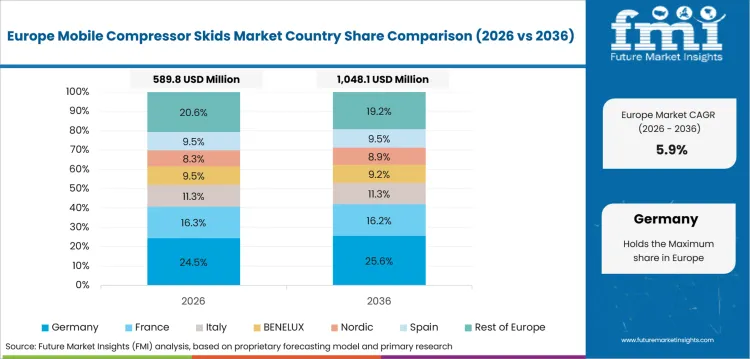
How is the mobile compressor skids market forecast developing in Germany?
A 6.4% CAGR through 2036 reflects Northwest gas storage and LNG corridors with demand for field-ready compression support.
Country Market Snapshot Table
| Parameter | Value |
|---|---|
| Market Size in 2025 (Value) | USD 98.7 million |
| Market Size in 2026 (Value) | USD 105.0 million |
| Market Forecast in 2036 (Value) | USD 195.3 million |
| CAGR (2026 to 2036) | 6.4% |
| Years Considered | 2021 to 2036 |
| Base Year | 2025 |
| Forecast Period | 2026 to 2036 |
| Units Considered | Value (USD million) |
| Leading Sub-Region | Northwest gas storage and LNG corridors |
Germany Mobile Compressor Skids Market Outlook
- Germany demand is shaped by storage assets and LNG import infrastructure. Mobile skids are used selectively in a market with established fixed systems and careful project approvals.
- Supplier selection favors documented equipment and service response near industrial regions. Local compressor companies have an advantage through engineering support and installed-base relationships.
Key Growth Drivers
- Gas security planning supports terminal-related compression. Bundesnetzagentur reported that German gas consumption was 844 TWh in 2025.
- LNG terminal orders support packaged compressor suppliers. Burckhardt Compression reported a Brunsbuttel LNG terminal compressor order in November 2024.
- Local compressor engineering gives buyers access to documented packages and field service expertise.
- Storage and industrial gas networks create selective demand for temporary compression during maintenance periods.
Key Restraints
- Strict engineering and approval requirements can slow deployment of temporary compression packages.
- Gas demand caution can limit discretionary equipment spending. Bundesnetzagentur reported that household and commercial gas use fell in 2025.
- Imported equipment can face service delays if spare parts and technicians are not available near storage or LNG sites.
What makes Germany unique
Germany has a distinct profile through storage assets and strict engineering expectations that shape packaged compression selection.
Key Companies
- Burckhardt Compression
- Siemens Energy
- NEUMAN & ESSER
- Atlas Copco Gas and Process
- Howden
Sales & Marketing Channels
- Direct OEM sales
- Rental fleet operators
- Oilfield service distributors
- Midstream EPC contractors
- Field service technicians
- Aftermarket parts networks
Country Segment Breakdown Table
| Segment | Sub-Segments |
|---|---|
| By Compressor Type | Reciprocating Skids · Screw Compressor Skids · Centrifugal Skids · Hybrid / Other |
| By Power Source | Gas Engine Driven · Electric Motor Driven · Diesel Driven |
| By Application | Wellhead Compression · Gas Gathering · Pipeline Boosting · Vapor Recovery / Other |
| By Pressure Range | Low Pressure · Medium Pressure · High Pressure |
| By Sales Model | Rental Fleet · Equipment Sale · Service Bundled |
| Key Sub-Regions Covered, Field Service Corridors | Lower Saxony · North Rhine-Westphalia · Schleswig-Holstein · Bavaria · Hamburg |
Frequently Asked Questions
How fast is Germany mobile compressor skids market growing?
Germany is projected to expand at 6.4% from 2026 to 2036 with demand shaped by Northwest gas storage and LNG corridors.
Who competes in Germany mobile compressor skids market?
The section lists Burckhardt Compression and Siemens Energy as relevant suppliers with local support.
What is driving adoption in Germany mobile compressor skids market?
Storage assets and LNG import infrastructure shape adoption.
What is the mobile compressor skids market outlook in the United Kingdom?
A 6.1% CAGR through 2036 reflects North Sea and terminal service corridors with demand for field-ready compression support.
Country Market Snapshot Table
| Parameter | Value |
|---|---|
| Market Size in 2025 (Value) | USD 89.5 million |
| Market Size in 2026 (Value) | USD 95.0 million |
| Market Forecast in 2036 (Value) | USD 171.7 million |
| CAGR (2026 to 2036) | 6.1% |
| Years Considered | 2021 to 2036 |
| Base Year | 2025 |
| Forecast Period | 2026 to 2036 |
| Units Considered | Value (USD million) |
| Leading Sub-Region | North Sea and terminal service corridors |
United Kingdom Mobile Compressor Skids Market Outlook
- United Kingdom demand is shaped by North Sea field support and terminal service corridors. Mobile units remain useful for temporary compression during maintenance and late-life field activity.
- Service presence around Aberdeen and energy hubs matters for uptime. Suppliers with rental capacity and offshore-related documentation can support operators better than equipment-only sellers.
Key Growth Drivers
- North Sea activity supports service demand. NSTA reported 15 billion barrels of oil equivalent in UK reserves and resources at end 2024.
- Emissions management raises service requirements. NSTA stated in September 2025 that offshore production emissions were down by one third since 2018.
- Aberdeen and terminal service corridors give suppliers a regional base for field response and spare parts.
- Late-life field work can require movable compression before permanent infrastructure is rationalized.
Key Restraints
- Late-life North Sea economics can limit spending on mobile equipment during uncertain field-life planning.
- Offshore documentation can slow package qualification under safety evidence and service record requirements.
- Weather and logistics can raise field service costs for equipment deployed near offshore-related terminals.
What makes United Kingdom unique
The United Kingdom has a distinct profile through North Sea service corridors that support late-life field compression and terminal maintenance.
Key Companies
- Howden
- Siemens Energy
- Atlas Copco Gas and Process
- Baker Hughes
- Enerflex
Sales & Marketing Channels
- Direct OEM sales
- Rental fleet operators
- Oilfield service distributors
- Midstream EPC contractors
- Field service technicians
- Aftermarket parts networks
Country Segment Breakdown Table
| Segment | Sub-Segments |
|---|---|
| By Compressor Type | Reciprocating Skids · Screw Compressor Skids · Centrifugal Skids · Hybrid / Other |
| By Power Source | Gas Engine Driven · Electric Motor Driven · Diesel Driven |
| By Application | Wellhead Compression · Gas Gathering · Pipeline Boosting · Vapor Recovery / Other |
| By Pressure Range | Low Pressure · Medium Pressure · High Pressure |
| By Sales Model | Rental Fleet · Equipment Sale · Service Bundled |
| Key Sub-Regions Covered, Field Service Corridors | Aberdeen · Teesside · Humberside · Shetland · Norfolk · Merseyside |
Frequently Asked Questions
How fast is United Kingdom mobile compressor skids market growing?
United Kingdom is anticipated to expand at 6.1% from 2026 to 2036 with demand shaped by North Sea and terminal service corridors.
Who competes in United Kingdom mobile compressor skids market?
The section lists Howden and Siemens Energy as relevant suppliers with local support.
What is driving adoption in United Kingdom mobile compressor skids market?
North Sea service work and terminal maintenance shape adoption.
How does France compare in the mobile compressor skids market?
A 5.9% CAGR through 2036 reflects LNG terminal and biomethane injection corridors with demand for field-ready compression support.
Country Market Snapshot Table
| Parameter | Value |
|---|---|
| Market Size in 2025 (Value) | USD 70.8 million |
| Market Size in 2026 (Value) | USD 75.0 million |
| Market Forecast in 2036 (Value) | USD 133.1 million |
| CAGR (2026 to 2036) | 5.9% |
| Years Considered | 2021 to 2036 |
| Base Year | 2025 |
| Forecast Period | 2026 to 2036 |
| Units Considered | Value (USD million) |
| Leading Sub-Region | LNG terminal and biomethane injection corridors |
France Mobile Compressor Skids Market Outlook
- France demand is supported by LNG terminals and biomethane injection corridors. Mobile skids are used in selective projects that need temporary pressure support and gas handling flexibility.
- French buyers favor suppliers with engineering credentials and service access near terminal assets. Cryogenic and gas equipment specialists remain relevant for compression-adjacent packages.
Key Growth Drivers
- Gas network balancing supports selective compressor use. NaTran reported that French gas consumption declined by 3% in 2025.
- Biomethane injection adds pressure management needs. NaTran reported biomethane production rose 17% in 2025.
- LNG terminal corridors create service demand for gas handling and backup compression packages.
- Local engineering groups can support packaged systems near industrial and terminal clusters.
Key Restraints
- Lower gas consumption can restrain broad compression spending during deferred non-essential network upgrades.
- Project-based demand can keep fleet utilization uneven outside LNG terminal and biomethane corridors.
- Specialist service availability can restrict deployment speed in regions outside major industrial clusters.
What makes France unique
France has a distinct profile through LNG terminals and biomethane networks that create selective project-based demand.
Key Companies
- Cryostar
- Air Liquide Engineering & Construction
- Atlas Copco France
- Howden
- Siemens Energy
Sales & Marketing Channels
- Direct OEM sales
- Rental fleet operators
- Oilfield service distributors
- Midstream EPC contractors
- Field service technicians
- Aftermarket parts networks
Country Segment Breakdown Table
| Segment | Sub-Segments |
|---|---|
| By Compressor Type | Reciprocating Skids · Screw Compressor Skids · Centrifugal Skids · Hybrid / Other |
| By Power Source | Gas Engine Driven · Electric Motor Driven · Diesel Driven |
| By Application | Wellhead Compression · Gas Gathering · Pipeline Boosting · Vapor Recovery / Other |
| By Pressure Range | Low Pressure · Medium Pressure · High Pressure |
| By Sales Model | Rental Fleet · Equipment Sale · Service Bundled |
| Key Sub-Regions Covered, Field Service Corridors | Dunkerque · Fos-sur-Mer · Montoir-de-Bretagne · Paris Basin · Lyon · Marseille |
Frequently Asked Questions
How fast is France mobile compressor skids market growing?
France is estimated to expand at 5.9% from 2026 to 2036 with demand shaped by LNG terminal and biomethane injection corridors.
Who competes in France mobile compressor skids market?
The section lists Cryostar and Air Liquide Engineering & Construction as relevant suppliers with local support.
What is driving adoption in France mobile compressor skids market?
LNG terminals and biomethane corridors support selective adoption.
What is shaping the mobile compressor skids market in Japan?
A 5.8% CAGR through 2036 reflects LNG terminal and industrial coastal corridors with demand for field-ready compression support.
Country Market Snapshot Table
| Parameter | Value |
|---|---|
| Market Size in 2025 (Value) | USD 85.1 million |
| Market Size in 2026 (Value) | USD 90.0 million |
| Market Forecast in 2036 (Value) | USD 158.2 million |
| CAGR (2026 to 2036) | 5.8% |
| Years Considered | 2021 to 2036 |
| Base Year | 2025 |
| Forecast Period | 2026 to 2036 |
| Units Considered | Value (USD million) |
| Leading Sub-Region | LNG terminal and industrial coastal corridors |
Japan Mobile Compressor Skids Market Outlook
- Japan demand is concentrated around LNG terminals and coastal industrial corridors. Mobile skids serve selective maintenance and backup gas-handling needs in place of broad upstream deployment.
- Local rotating equipment companies compete with global suppliers on documentation and service access. Buyers prioritize reliability to protect terminal and industrial gas flows.
Key Growth Drivers
- LNG infrastructure supports compression service needs. IEA reported that Japan natural gas consumption decreased by 1.7% year over year in H1 2025.
- Terminal and coastal industrial corridors create demand for reliable packaged support. Japan remained dependent on imported gas for nearly all supply.
- Local compressor manufacturers bring rotating equipment experience for documented gas-handling packages.
- Maintenance and backup applications can support mobile skid use around coastal industrial assets.
Key Restraints
- Limited upstream production narrows field compression demand compared with shale-led markets.
- Nuclear restart and renewable output can reduce gas-fired power demand. IEA projected Japan gas demand to decline in 2025.
- High reliability requirements can extend supplier qualification for mobile or temporary compression packages.
What makes Japan unique
Japan has a distinct profile through LNG import infrastructure and coastal industry that drive selective compression support needs.
Key Companies
- Mitsubishi Heavy Industries Compressor
- IHI Rotating Machinery Engineering
- Ebara Elliott Energy
- Atlas Copco Japan
- Siemens Energy Japan
Sales & Marketing Channels
- Direct OEM sales
- Rental fleet operators
- Oilfield service distributors
- Midstream EPC contractors
- Field service technicians
- Aftermarket parts networks
Country Segment Breakdown Table
| Segment | Sub-Segments |
|---|---|
| By Compressor Type | Reciprocating Skids · Screw Compressor Skids · Centrifugal Skids · Hybrid / Other |
| By Power Source | Gas Engine Driven · Electric Motor Driven · Diesel Driven |
| By Application | Wellhead Compression · Gas Gathering · Pipeline Boosting · Vapor Recovery / Other |
| By Pressure Range | Low Pressure · Medium Pressure · High Pressure |
| By Sales Model | Rental Fleet · Equipment Sale · Service Bundled |
| Key Sub-Regions Covered, Field Service Corridors | Tokyo Bay · Osaka Bay · Nagoya · Chiba · Yokohama · Kitakyushu |
Frequently Asked Questions
How fast is Japan mobile compressor skids market growing?
Japan is forecast to expand at 5.8% from 2026 to 2036 with demand shaped by LNG terminal and industrial coastal corridors.
Who competes in Japan mobile compressor skids market?
The section lists Mitsubishi Heavy Industries Compressor and IHI Rotating Machinery Engineering as relevant suppliers with local support.
What is driving adoption in Japan mobile compressor skids market?
LNG import infrastructure and coastal industry shape selective adoption.
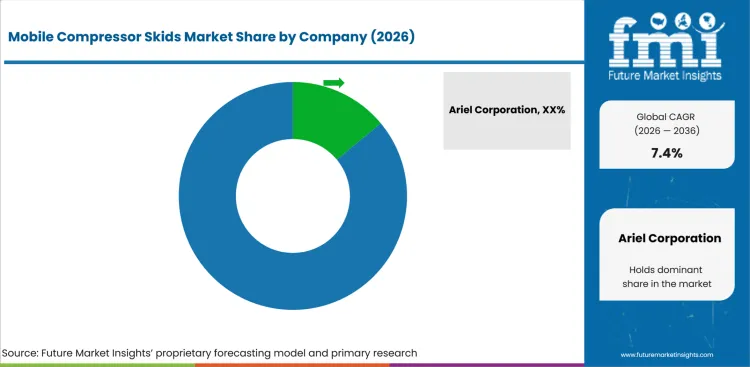
Who are the leading companies in the mobile compressor skids market?
Ariel Corporation and Enerflex are profiled with Archrock and Siemens Energy as prominent suppliers.
- Compressor manufacturers compete on frame reliability and documentation depth for oilfield gas service.
- Rental providers compete on basin coverage and field technician availability during production changes.
- Packaged equipment suppliers compete on controls integration and delivery speed for modular skids.
- Regional service partners compete on spare parts access and response time near active fields.
Compressor manufacturers and rental fleet operators compete by combining package reliability with service coverage. Ariel Corporation and Enerflex focus on reciprocating compressor depth and field package experience. Companies such as Archrock are more inclined toward contract compression fleets that help operators avoid equipment ownership during uncertain field cycles.
Service planning also depends on fluids and consumables that keep packaged compressors available during remote operation. Buyers therefore treat compressor oil planning as part of fleet readiness instead of a back-office purchase. Field packages also need valves, fittings and connectors that can tolerate relocation and pressure changes. This makes oil and gas fittings relevant to skid reliability across gathering duty.
Service providers are gaining importance for mobile units that need inspection and maintenance close to producing basins. This supports oil and gas field services for buyers that manage compressors across multiple pads. Operators are adding remote monitoring to reduce avoidable site visits and shorten downtime windows. This supports digital oilfield solutions that connect skid performance data with field maintenance planning.
How do top mobile compressor skids companies compare?
Ariel and Enerflex score well on reciprocating depth while Archrock is stronger in rental service coverage.
| Company | Relevance to Market Title | Compressor Portfolio | Rental or Service Reach | Oilfield Fit | Geographic Footprint |
|---|---|---|---|---|---|
| Ariel Corporation | High | Reciprocating gas compressors | Partner-led service | High | Global |
| Enerflex | High | Compression packages | Field service and rentals | High | Americas and global |
| Archrock | High | Contract compression fleet | Very high | High | United States |
| Atlas Copco Gas and Process | High | Packaged compression depth | Regional service | Moderate to high | Global |
| Siemens Energy | High | Turbocompressor systems | Project service | High | Global |
| Baker Hughes | High | Gas compression trains | Project and service reach | High | Global |
| Burckhardt Compression | Moderate to high | Reciprocating compressors | Project support | Moderate | Europe and global |
| NEUMAN & ESSER | Moderate to high | Reciprocating systems | Regional service | Moderate | Europe and India |
Source: Future Market Insights competitive analysis, 2026.
Who are the key players in the mobile compressor skids market?
Ariel Corporation, Enerflex and Archrock are listed with Atlas Copco Gas and Process and Siemens Energy among other suppliers.
Key global companies leading the mobile compressor skids market include:
- Ariel Corporation
- Enerflex
- Archrock
- Atlas Copco Gas and Process
- Siemens Energy
- Baker Hughes
- Burckhardt Compression
- NEUMAN & ESSER
- Howden
- Caterpillar
- Kirloskar Pneumatic
- Shaanxi Blower Group
Key Developments in Mobile Compressor Skids Market
- In April 2026, Loyal Equipments secured a ₹6.54 crore order from Burckhardt Compression India for compressor skid packages.
- In August 2025, Enerflex made a sour gas compression package available with a 1,250 HP Waukesha engine and Ariel JGK/4 two-stage compressor.
Key Players in the Mobile Compressor Skids Market
Compressor Manufacturers
- Ariel Corporation
- Enerflex
- Atlas Copco Gas and Process
- Siemens Energy
- Baker Hughes
- Burckhardt Compression
- NEUMAN & ESSER
- Howden
- Mitsubishi Heavy Industries Compressor
- IHI Rotating Machinery Engineering
Rental and Service Providers
- Archrock
- Enerflex
- Baker Hughes
- Atlas Copco Gas and Process
- Howden
Regional Packagers and Suppliers
- Kirloskar Pneumatic
- Shaanxi Blower Group
- CIMC Enric
- Hanwha Power
- Cryostar
- Air Liquide Engineering & Construction
Mobile Compressor Skids Market - Scope & Definition
| Attribute | Detail |
|---|---|
| Market Definition | Skid-mounted compressor packages used to compress natural gas and associated gas at field sites. |
| Functions Covered | Wellhead compression, gas gathering, pipeline boosting, vapor recovery and temporary field pressure support. |
| Applications Covered | Upstream production, midstream gathering, tank battery vapor recovery and pipeline support. |
| End-Use Industries | Oil and gas production, midstream infrastructure, LNG terminals and industrial gas handling. |
| Grades Covered | Reciprocating, screw, centrifugal and hybrid compressor skid formats. |
| Inclusions | Movable compressor skids, rental units, packaged equipment sales, service-bundled compression, controls and field support. |
| Exclusions | Stationary refinery compressors, workshop air compressors, refrigeration compressors, LNG ship fuel compressors and non-oilfield industrial skid systems. |
Mobile Compressor Skids Market - Research Methodology
| Method | Description |
|---|---|
| Primary Research | FMI analysts reviewed input from compressor packagers, rental operators, oilfield service firms and midstream procurement teams. |
| Desk Research | Desk research covered energy agency data, API standards, oilfield equipment classifications and official company disclosures. |
| Market Sizing & Forecasting | The model combined estimated skid shipments, rental horsepower, package pricing, country application mix and field service evidence. |
| Forecast Basis | Forecasts were checked against natural gas production trends, country infrastructure evidence and company portfolio validation. |
Mobile Compressor Skids Market - Report Scope
| Report Attribute | Details |
|---|---|
| Forecast period | 2026 to 2036 |
| Historical period | 2021 to 2025 |
| Quantitative unit | Value in USD million and CAGR from 2026 to 2036 |
| By compressor type | Reciprocating skids, screw compressor skids, centrifugal skids, hybrid / other |
| By power source | Gas engine driven, electric motor driven, diesel driven |
| By application | Wellhead compression, gas gathering, pipeline boosting, vapor recovery / other |
| By pressure range | Low pressure, medium pressure, high pressure |
| By sales model | Rental fleet, equipment sale, service bundled |
| Regions covered | North America, Latin America, Western Europe, Eastern Europe, East Asia, South Asia and Pacific, Middle East and Africa |
| Countries covered | China, India, United States, South Korea, Germany, United Kingdom, France, Japan |
| Key companies profiled | Ariel Corporation, Enerflex, Archrock, Atlas Copco Gas and Process, Siemens Energy, Baker Hughes, Burckhardt Compression, NEUMAN & ESSER, Howden, Kirloskar Pneumatic |
| Approach | Supply-side triangulation with company portfolio review, energy statistics, and field service evidence |
Source: Future Market Insights, 2026.
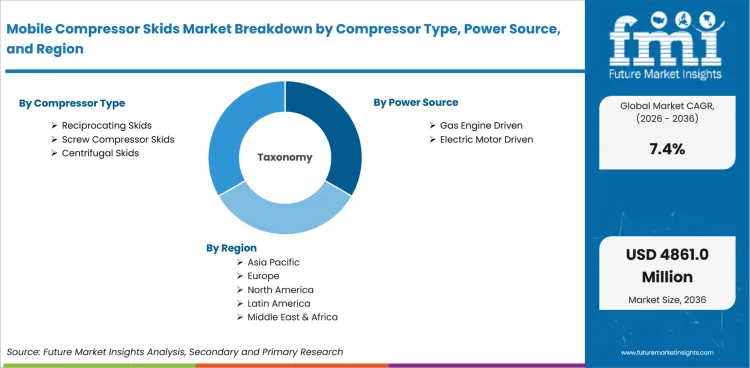
Mobile Compressor Skids Breakdown by Compressor Type, Power Source, Application, Pressure Range, Sales Model, and Region
Mobile Compressor Skids Segmented by Compressor Type
- Reciprocating Skids
- Screw Compressor Skids
- Centrifugal Skids
- Hybrid / Other
Mobile Compressor Skids Segmented by Power Source
- Gas Engine Driven
- Electric Motor Driven
- Diesel Driven
Mobile Compressor Skids Segmented by Application
- Wellhead Compression
- Gas Gathering
- Pipeline Boosting
- Vapor Recovery / Other
Mobile Compressor Skids Segmented by Pressure Range
- Low Pressure
- Medium Pressure
- High Pressure
Mobile Compressor Skids Segmented by Sales Model
- Rental Fleet
- Equipment Sale
- Service Bundled
Mobile Compressor Skids by Region
- North America
- Latin America
- Western Europe
- Eastern Europe
- East Asia
- South Asia and Pacific
- Middle East and Africa
Research Sources and Bibliography
- American Petroleum Institute. (2025, April 30). Refining standards catalog 2025.
- Archrock. (2024, July 22). Archrock to acquire Total Operations and Production Services LLC.
- Archrock. (2024, August 30). Archrock completes acquisition of Total Operations and Production Services LLC.
- Baker Hughes. (2025, January 30). Baker Hughes secures gas technology order for third expansion phase of Aramco’s Jafurah gas field.
- Bundesnetzagentur. (2026, January 12). Bundesnetzagentur publishes gas supply figures for 2025.
- Burckhardt Compression. (2024, November 26). Burckhardt Compression wins major order for LNG terminal in Brunsbuttel, Germany.
- Loyal Equipments Limited. April 1, 2026. Loyal Equipments Limited secures ₹6.54 crore order for compressor skid packages. Regulatory disclosure cited by ScanX.
- Enerflex Ltd. August 18, 2025. Sour gas compression package available with full-service support and fast deployment. Enerflex.
- International Energy Agency. (2025, October). Gas 2025.
- Korea Gas Corporation. (2026, January). Company profile and nationwide gas pipeline network.
- Kirloskar Pneumatic. (2026, June). Reciprocating gas compressor packages.
- NaTran. (2026, January 28). 2025 overview: In 2025, French gas consumption declined by 3%.
- National Bureau of Statistics of China. (2025, June 17). Energy production in May 2025.
- State Council Information Office of the People’s Republic of China. (2025, April 21). China's coal hub Shanxi sees record coalbed methane output in 2024.
- North Sea Transition Authority. (2025, September 2). Emissions down by a third since 2018.
- North Sea Transition Authority. (2025, October 17). Reserves and resources as at end 2024.
- Petroleum and Natural Gas Regulatory Board. (2026, March 23). Data bank: Natural gas pipeline network in India.
- Press Information Bureau, Government of India. (2025, February 3). Steps by government for door-to-door gas supply through piped natural gas.
- USA Energy Information Administration. (2026, March 13). USA natural gas production reached a new record in 2025.
- USA Environmental Protection Agency. (2024, November 12). EPA finalizes rule to reduce wasteful methane emissions.
- NEUMAN & ESSER. (2026, June). Oil and gas compressor solutions.
- Ariel Corporation. (2026, June). Energy natural gas compressor portfolio.
This bibliography is provided for reader reference and is not exhaustive. The full report contains the complete reference list and detailed citations.
This Report Answers
- The report explains how the mobile compressor skids market is forecast to grow from 2026 to 2036.
- The report identifies which compressor type and power source hold notable shares across application and sales model choices.
- The report compares country-level CAGR outlooks and explains the operating reasons behind each market profile.
- The report reviews verified companies with regional presence and practical relevance to compressor skid demand.
- The report outlines how buyers evaluate rental coverage and skid documentation with controls and field service response.
- The report summarizes competitive positioning across manufacturers, rental providers and regional packagers.
Frequently Asked Questions
How large is the Mobile Compressor Skids Market expected to be in the near term?
The market is expanding as operators rely on movable compression to manage changing field pressures and gas gathering constraints.
What is the long term outlook for the Mobile Compressor Skids Market?
The outlook remains positive as mobile compression continues to serve as an interim solution before permanent station investments.
How fast is the Mobile Compressor Skids Market expected to grow?
Growth is driven by mature well pressure decline and flexible compression needs across gas basins.
What is the main driver of mobile compressor skid demand?
Demand is driven by gas gathering bottlenecks and the need to recover production from low pressure wells.
Which compressor type dominates the market?
Reciprocating compressor skids dominate due to their ability to handle variable suction pressures and gas compositions.
Which power source is most widely preferred?
Gas engine driven units are preferred because they operate reliably on remote pads without grid power access.
Which application generates the highest demand?
Gas gathering leads demand as operators manage uneven flows from dispersed wells before fixed infrastructure is installed.
Which pressure range is most commonly used?
Medium pressure skids are most common as they suit wellhead boosting and gathering line support.
Which sales model is most important in this market?
Rental fleets dominate as operators prioritize flexibility, uptime guarantees, and reduced ownership risk.
Which regions show strong adoption of mobile compressor skids?
Asia Pacific, North America, and Europe show strong adoption through shale gas activity, LNG infrastructure, and gathering networks.
Which countries are key markets for mobile compressor skids?
China, India, the United States, South Korea, Germany, the United Kingdom, France, and Japan are some key markets.
Preview the report firsthand - request a free sample
Get SampleGet the brochure for pricing and purchase details.
Get PDFTable of Content
- Key Takeaways
- Market Size and CAGR
- Top Growth Driver
- Fastest Growing Segment
- Leading Region
- Key Companies
- Emerging Opportunities
- Executive Summary
- Global Market Outlook
- Demand-side Trends
- Supply-side Trends
- Technology Roadmap Analysis
- Analysis and Recommendations
- Analyst Perspective (What is happening? Why now? What should investors know?)
- Key Questions Answered
- How large is the market?
- What is the CAGR?
- What are key trends?
- Which region dominates?
- Who are the leaders?
- Market Overview
- Market Coverage / Taxonomy
- Market Definition / Scope / Limitations
- Research Methodology
- Chapter Orientation
- Analytical Lens and Working Hypotheses
- Market Structure, Signals, and Trend Drivers
- Benchmarking and Cross-market Comparability
- Market Sizing, Forecasting, and Opportunity Mapping
- Research Design and Evidence Framework
- Desk Research Programme (Secondary Evidence)
- Expert Input and Fieldwork (Primary Evidence)
- Tooling, Models, and Reference Databases
- Data Engineering and Model Build
- Quality Assurance and Audit Trail
- Market Background
- Market Dynamics (Drivers, Restraints, Opportunity, Trends)
- Scenario Forecast (Optimistic, Likely, Conservative)
- Impact Analysis
- AI Impact
- Sustainability Impact
- Regulatory Impact
- Technology Impact
- Consumer / Buyer Analysis
- Purchase Drivers
- Adoption Barriers
- Buyer Journey
- Opportunity Map Analysis
- Product Life Cycle Analysis
- Supply Chain Analysis
- Investment Feasibility Matrix
- Value Chain Analysis
- PESTLE and Porter's Analysis
- Regulatory Landscape
- Regional Parent Market Outlook
- Production and Consumption Statistics
- Import and Export Statistics
- Global Market Analysis and Forecast, 2021 to 2036
- Historical Market Size Value (USD Million) & Volume (Unit) Analysis, 2021 to 2025
- Current and Future Market Size Value (USD Million) & Volume (Unit) Projections, 2026 to 2036
- Y-o-Y Growth Trend Analysis
- Absolute $ Opportunity Analysis
- Global Market Pricing Analysis, 2021 to 2036
- Global Market Analysis and Forecast, By Compressor Type, 2021 to 2036
- Introduction / Key Findings
- Historical Market Size Value (USD Million) & Volume (Unit) Analysis By Compressor Type, 2021 to 2025
- Current and Future Market Size Value (USD Million) & Volume (Unit) Analysis and Forecast By Compressor Type, 2026 to 2036
- Reciprocating Skids
- Screw Compressor Skids
- Centrifugal Skids
- Reciprocating Skids
- Y-o-Y Growth Trend Analysis By Compressor Type, 2021 to 2025
- Absolute $ Opportunity Analysis By Compressor Type, 2026 to 2036
- Global Market Analysis and Forecast, By Power Source, 2021 to 2036
- Introduction / Key Findings
- Historical Market Size Value (USD Million) & Volume (Unit) Analysis By Power Source, 2021 to 2025
- Current and Future Market Size Value (USD Million) & Volume (Unit) Analysis and Forecast By Power Source, 2026 to 2036
- Gas Engine Driven
- Electric Motor Driven
- Gas Engine Driven
- Y-o-Y Growth Trend Analysis By Power Source, 2021 to 2025
- Absolute $ Opportunity Analysis By Power Source, 2026 to 2036
- Global Market Analysis and Forecast, By Application, 2021 to 2036
- Introduction / Key Findings
- Historical Market Size Value (USD Million) & Volume (Unit) Analysis By Application, 2021 to 2025
- Current and Future Market Size Value (USD Million) & Volume (Unit) Analysis and Forecast By Application, 2026 to 2036
- Gas Gathering
- Wellhead Compression
- Vapor Recovery / Other
- Gas Gathering
- Y-o-Y Growth Trend Analysis By Application, 2021 to 2025
- Absolute $ Opportunity Analysis By Application, 2026 to 2036
- Global Market Analysis and Forecast, By Pressure Range, 2021 to 2036
- Introduction / Key Findings
- Historical Market Size Value (USD Million) & Volume (Unit) Analysis By Pressure Range, 2021 to 2025
- Current and Future Market Size Value (USD Million) & Volume (Unit) Analysis and Forecast By Pressure Range, 2026 to 2036
- Medium Pressure
- Low Pressure
- High Pressure
- Medium Pressure
- Y-o-Y Growth Trend Analysis By Pressure Range, 2021 to 2025
- Absolute $ Opportunity Analysis By Pressure Range, 2026 to 2036
- Global Market Analysis and Forecast, By Sales Model, 2021 to 2036
- Introduction / Key Findings
- Historical Market Size Value (USD Million) & Volume (Unit) Analysis By Sales Model, 2021 to 2025
- Current and Future Market Size Value (USD Million) & Volume (Unit) Analysis and Forecast By Sales Model, 2026 to 2036
- Rental Fleet
- Equipment Sale
- Service Bundled
- Rental Fleet
- Y-o-Y Growth Trend Analysis By Sales Model, 2021 to 2025
- Absolute $ Opportunity Analysis By Sales Model, 2026 to 2036
- Global Market Analysis and Forecast, By Region, 2021 to 2036
- Introduction
- Historical Market Size Value (USD Million) & Volume (Unit) Analysis By Region, 2021 to 2025
- Current Market Size Value (USD Million) & Volume (Unit) Analysis and Forecast By Region, 2026 to 2036
- North America
- Latin America
- Western Europe
- Eastern Europe
- East Asia
- South Asia and Pacific
- Middle East & Africa
- Market Attractiveness Analysis By Region
- North America Market Analysis and Forecast, By Country, 2021 to 2036
- Historical Market Size Value (USD Million) & Volume (Unit) Trend Analysis By Market Taxonomy, 2021 to 2025
- Market Size Value (USD Million) & Volume (Unit) Forecast By Market Taxonomy, 2026 to 2036
- By Country
- USA
- Canada
- Mexico
- By Compressor Type
- By Power Source
- By Application
- By Pressure Range
- By Sales Model
- By Country
- Market Attractiveness Analysis
- By Country
- By Compressor Type
- By Power Source
- By Application
- By Pressure Range
- By Sales Model
- Key Takeaways
- Latin America Market Analysis and Forecast, By Country
- Historical Market Size Value (USD Million) & Volume (Unit) Trend Analysis By Market Taxonomy, 2021 to 2025
- Market Size Value (USD Million) & Volume (Unit) Forecast By Market Taxonomy, 2026 to 2036
- By Country
- Brazil
- Chile
- Rest of Latin America
- By Compressor Type
- By Power Source
- By Application
- By Pressure Range
- By Sales Model
- By Country
- Market Attractiveness Analysis
- By Country
- By Compressor Type
- By Power Source
- By Application
- By Pressure Range
- By Sales Model
- Key Takeaways
- Western Europe Market Analysis and Forecast, By Country
- Historical Market Size Value (USD Million) & Volume (Unit) Trend Analysis By Market Taxonomy, 2021 to 2025
- Market Size Value (USD Million) & Volume (Unit) Forecast By Market Taxonomy, 2026 to 2036
- By Country
- Germany
- UK
- Italy
- Spain
- France
- Nordic
- BENELUX
- Rest of Western Europe
- By Compressor Type
- By Power Source
- By Application
- By Pressure Range
- By Sales Model
- By Country
- Market Attractiveness Analysis
- By Country
- By Compressor Type
- By Power Source
- By Application
- By Pressure Range
- By Sales Model
- Key Takeaways
- Eastern Europe Market Analysis and Forecast, By Country
- Historical Market Size Value (USD Million) & Volume (Unit) Trend Analysis By Market Taxonomy, 2021 to 2025
- Market Size Value (USD Million) & Volume (Unit) Forecast By Market Taxonomy, 2026 to 2036
- By Country
- Russia
- Poland
- Hungary
- Balkan & Baltic
- Rest of Eastern Europe
- By Compressor Type
- By Power Source
- By Application
- By Pressure Range
- By Sales Model
- By Country
- Market Attractiveness Analysis
- By Country
- By Compressor Type
- By Power Source
- By Application
- By Pressure Range
- By Sales Model
- Key Takeaways
- East Asia Market Analysis and Forecast, By Country
- Historical Market Size Value (USD Million) & Volume (Unit) Trend Analysis By Market Taxonomy, 2021 to 2025
- Market Size Value (USD Million) & Volume (Unit) Forecast By Market Taxonomy, 2026 to 2036
- By Country
- China
- Japan
- South Korea
- By Compressor Type
- By Power Source
- By Application
- By Pressure Range
- By Sales Model
- By Country
- Market Attractiveness Analysis
- By Country
- By Compressor Type
- By Power Source
- By Application
- By Pressure Range
- By Sales Model
- Key Takeaways
- South Asia and Pacific Market Analysis and Forecast, By Country
- Historical Market Size Value (USD Million) & Volume (Unit) Trend Analysis By Market Taxonomy, 2021 to 2025
- Market Size Value (USD Million) & Volume (Unit) Forecast By Market Taxonomy, 2026 to 2036
- By Country
- India
- ASEAN
- Australia & New Zealand
- Rest of South Asia and Pacific
- By Compressor Type
- By Power Source
- By Application
- By Pressure Range
- By Sales Model
- By Country
- Market Attractiveness Analysis
- By Country
- By Compressor Type
- By Power Source
- By Application
- By Pressure Range
- By Sales Model
- Key Takeaways
- Middle East & Africa Market Analysis and Forecast, By Country
- Historical Market Size Value (USD Million) & Volume (Unit) Trend Analysis By Market Taxonomy, 2021 to 2025
- Market Size Value (USD Million) & Volume (Unit) Forecast By Market Taxonomy, 2026 to 2036
- By Country
- Kingdom of Saudi Arabia
- Other GCC Countries
- Türkiye
- South Africa
- Other African Union
- Rest of Middle East & Africa
- By Compressor Type
- By Power Source
- By Application
- By Pressure Range
- By Sales Model
- By Country
- Market Attractiveness Analysis
- By Country
- By Compressor Type
- By Power Source
- By Application
- By Pressure Range
- By Sales Model
- Key Takeaways
- Key Countries Market Analysis
- USA
- Pricing Analysis
- Market Share Analysis, 2025
- By Compressor Type
- By Power Source
- By Application
- By Pressure Range
- By Sales Model
- Canada
- Pricing Analysis
- Market Share Analysis, 2025
- By Compressor Type
- By Power Source
- By Application
- By Pressure Range
- By Sales Model
- Mexico
- Pricing Analysis
- Market Share Analysis, 2025
- By Compressor Type
- By Power Source
- By Application
- By Pressure Range
- By Sales Model
- Brazil
- Pricing Analysis
- Market Share Analysis, 2025
- By Compressor Type
- By Power Source
- By Application
- By Pressure Range
- By Sales Model
- Chile
- Pricing Analysis
- Market Share Analysis, 2025
- By Compressor Type
- By Power Source
- By Application
- By Pressure Range
- By Sales Model
- Germany
- Pricing Analysis
- Market Share Analysis, 2025
- By Compressor Type
- By Power Source
- By Application
- By Pressure Range
- By Sales Model
- UK
- Pricing Analysis
- Market Share Analysis, 2025
- By Compressor Type
- By Power Source
- By Application
- By Pressure Range
- By Sales Model
- Italy
- Pricing Analysis
- Market Share Analysis, 2025
- By Compressor Type
- By Power Source
- By Application
- By Pressure Range
- By Sales Model
- Spain
- Pricing Analysis
- Market Share Analysis, 2025
- By Compressor Type
- By Power Source
- By Application
- By Pressure Range
- By Sales Model
- France
- Pricing Analysis
- Market Share Analysis, 2025
- By Compressor Type
- By Power Source
- By Application
- By Pressure Range
- By Sales Model
- India
- Pricing Analysis
- Market Share Analysis, 2025
- By Compressor Type
- By Power Source
- By Application
- By Pressure Range
- By Sales Model
- ASEAN
- Pricing Analysis
- Market Share Analysis, 2025
- By Compressor Type
- By Power Source
- By Application
- By Pressure Range
- By Sales Model
- Australia & New Zealand
- Pricing Analysis
- Market Share Analysis, 2025
- By Compressor Type
- By Power Source
- By Application
- By Pressure Range
- By Sales Model
- China
- Pricing Analysis
- Market Share Analysis, 2025
- By Compressor Type
- By Power Source
- By Application
- By Pressure Range
- By Sales Model
- Japan
- Pricing Analysis
- Market Share Analysis, 2025
- By Compressor Type
- By Power Source
- By Application
- By Pressure Range
- By Sales Model
- South Korea
- Pricing Analysis
- Market Share Analysis, 2025
- By Compressor Type
- By Power Source
- By Application
- By Pressure Range
- By Sales Model
- Russia
- Pricing Analysis
- Market Share Analysis, 2025
- By Compressor Type
- By Power Source
- By Application
- By Pressure Range
- By Sales Model
- Poland
- Pricing Analysis
- Market Share Analysis, 2025
- By Compressor Type
- By Power Source
- By Application
- By Pressure Range
- By Sales Model
- Hungary
- Pricing Analysis
- Market Share Analysis, 2025
- By Compressor Type
- By Power Source
- By Application
- By Pressure Range
- By Sales Model
- Kingdom of Saudi Arabia
- Pricing Analysis
- Market Share Analysis, 2025
- By Compressor Type
- By Power Source
- By Application
- By Pressure Range
- By Sales Model
- Türkiye
- Pricing Analysis
- Market Share Analysis, 2025
- By Compressor Type
- By Power Source
- By Application
- By Pressure Range
- By Sales Model
- South Africa
- Pricing Analysis
- Market Share Analysis, 2025
- By Compressor Type
- By Power Source
- By Application
- By Pressure Range
- By Sales Model
- USA
- Market Structure Analysis
- Competition Dashboard
- Competition Benchmarking
- Market Share Analysis of Top Players
- By Regional
- By Compressor Type
- By Power Source
- By Application
- By Pressure Range
- By Sales Model
- Emerging Startups
- Innovation Benchmarking
- Competition Analysis
- Competition Deep Dive
- Ariel Corporation
- Overview
- Product Portfolio
- Profitability by Market Segments (Product/Region/Sales Channel)
- Sales Footprint
- Strategy Overview
- Marketing Strategy
- Product Strategy
- Channel Strategy
- Enerflex
- Archrock
- Atlas Copco Gas and Process
- Siemens Energy
- Baker Hughes
- Burckhardt Compression
- NEUMAN & ESSER
- Ariel Corporation
- Case Studies
- Success Stories
- Recent Developments
- Competition Deep Dive
- Assumptions & Acronyms Used


