

- Market Size (2026)
- USD 3.8 Bn
- Forecast (2036)
- USD 11.8 Bn
- CAGR (2026 to 2036)
- 12.0%
How big is Mobile Game Engine Market size?
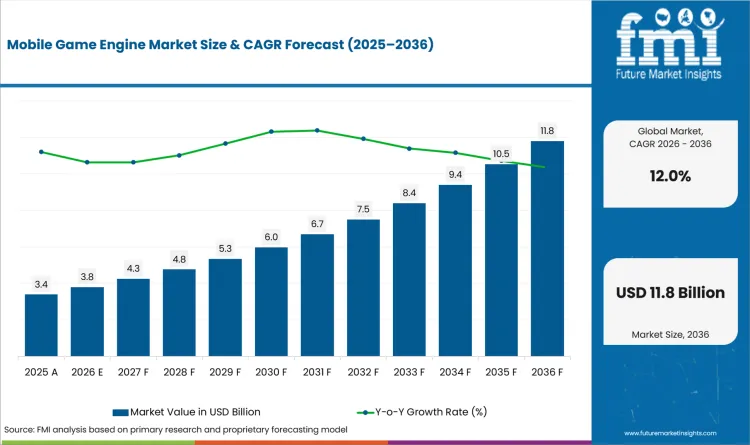
USD 3.8 billion in 2026 and USD 11.8 billion by 2036 at a 12.0% CAGR.
Demand for mobile game engine is projected to expand at 12.0% CAGR between 2026 and 2036, increasing valuation from USD 3.8 billion in 2026 to USD 11.8 billion by 2036. Game development teams merge software testing and store deployment seamlessly through dedicated mobile game engines. Unity Technologies revealed during January 2026 for Black Drive Studio having operated with just 10 employees and accumulated over 5 million Google Play downloads across their mobile portfolio. Such notable engine-supported production capabilities allowed the small studio to manage multiple Android titles successfully without requiring isolated technical pipelines.
Long-term support windows and carefully controlled release migrations stand out as the primary technical preferences for development studios throughout the United States and Germany. Software creators across South Korea and Brazil prioritize prompt mobile build efficiency with highly responsive local distribution tools. Apple confirmed in January 2026 noting developers to have released more than 500 updates for active Apple Arcade titles throughout 2025. These continuous content updates directly amplify the industry-wide need for rock-solid engine builds and ongoing platform compatibility.
Key Takeaways for the Mobile Game Engine Market
- Demand receives support from extensive mobile-game development activity and cross-platform production requirements.
- Mobile gaming is estimated to secure 41.0% share of application in 2026, led by frequent content updates and multi-device publishing needs.
- Android is likely to lead platform with 39.0% share in 2026, shaped by varied device specifications and recurring operating-system changes.
- Engine fees and policy changes restrict buyer confidence across long development cycles. Low-end device performance and migration expense create added review steps during engine replacement.
- Competition includes Unity Technologies, Epic Games, Cocos, GameMaker, CRI Middleware, Open 3D Foundation, Buildbox, Defold Foundation, Godot Engine, and Solar2D. Providers differentiate based on mobile performance and documentation quality.
Analyst Perspective
“Mobile game engine selection begins with technical proof instead of editor familiarity. Development teams examine build stability and licensing exposure across a complete release cycle. Sustained adoption follows engines supporting platform changes without costly production disruption.”
- Sudip saha, Principal Analyst at Future Market Insights
How is Mobile Game Engine Market segmented?
The mobile game engine sector is segmented by product type, application, end user, distribution channel, platform, and region.
The mobile game engine industry is segmented by product type, application, end user, distribution channel, platform, and region. Product type covers 2D game engines and 3D game engines with cross-platform game engines. Cloud-based game engines and open-source game engines complete product coverage. Application includes mobile gaming and AR & VR mobile games. Educational games and casino & card games extend use-case coverage. Hyper-casual games complete application assessment. End user covers game development studios and independent developers. Enterprise developers and educational institutions support specialized programs. Media & entertainment companies complete end-user coverage. Distribution channel includes direct licensing and digital distribution. Cloud marketplace and channel partners extend commercial access. Open-source distribution completes channel coverage. Platform includes Android and iOS with cross-platform deployment. Web-based mobile gaming and other mobile platforms complete platform assessment. Regional analysis covers North America and Europe with East Asia. South Asia and Pacific joins Latin America with Middle East and Africa. Adjacent boundaries include extended reality software and serious game applications.
Why do 2D game engines lead product type demand?
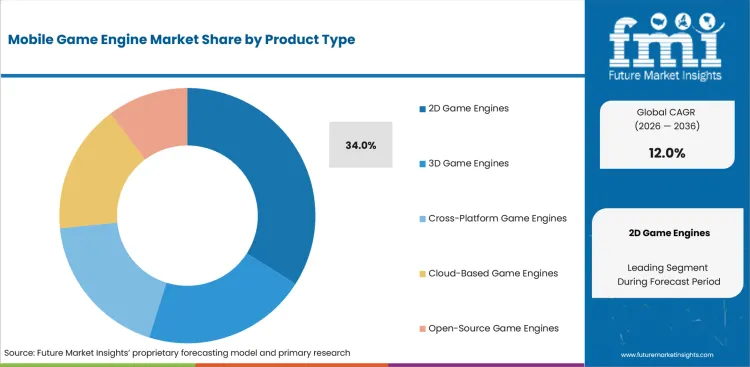
2D game engines support shorter production cycles across puzzle and casual titles. Smaller teams often favor focused toolsets requiring limited specialist resources. Unity’s March 2026 report found 52.0% of surveyed developers prioritizing smaller-scale projects for risk reduction. Compact project scopes strengthen demand for editors supporting rapid iteration and controlled asset complexity.
- Based on product type, 2D game engines are estimated to represent 34.0% share in 2026 due to accessible workflows for sprite-based mobile production. Lower art-pipeline complexity permits teams to test mechanics without committing extensive technical resources.
- 3D game engines support projects requiring advanced rendering and detailed environments across varied mobile devices. Cross-platform game engines combine shared code with platform-specific tuning during coordinated release programs.
How does mobile gaming guide application demand?
Mobile gaming links engine selection directly with player acquisition and release maintenance. Storefront updates require stable packaging and repeatable performance checks. Google’s June 2025 release stated Play Games Services connected developers with more than 2 billion monthly active players. Audience scale supports engine investment across achievements and retention features built into mobile titles.
- In 2026, mobile gaming is projected to hold 41.0% share since it reflects frequent release cycles across Android and iOS stores. Engine value rises through dependable builds and integrated testing across varied device profiles.
- AR & VR mobile games and educational games require specialized interaction systems with device sensors. Casino & card games and hyper-casual games emphasize excessive iteration as mobile augmented reality tools extend spatial interaction options.
What keeps game development studios ahead across end user demand?
Game development studios coordinate programmers and artists across shared production pipelines. Central engine standards reduce asset conflicts and release inconsistency. Unity’s March 2025 report found 45.0% of respondents viewing efficiency tools as a primary success strategy. Studio demand favors engines supporting coordinated workflows and dependable project administration.
- By end user, game development studios are anticipated to capture 38.0% share in 2026 owing to repeated engine use across several projects. Centralized build systems connect technical standards with publisher milestones and quality reviews.
- Independent developers value lower entry costs and direct documentation access across focused projects. Enterprise developers and educational institutions assess security as media & entertainment companies examine compatibility across interactive content programs.
Why does direct licensing support distribution channel selection?
Direct licensing provides development organizations with negotiated software access and technical assistance. Contract review clarifies seat pricing and service obligations across project teams. Unity’s September 2024 announcement set an 8.0% Unity Pro subscription increase effective January 2025. Pricing changes reinforce demand for clear license terms across multi-year game programs.
- Direct licensing is likely to secure 37.0% share in 2026, guided by negotiated support terms and enterprise account management. Buyers assess renewal rules with version access during budget approval.
- Digital distribution and cloud marketplace improve software access for smaller development teams. Channel partners provide local assistance as open-source distribution serves developers seeking source access and community-maintained extensions.
What supports android across platform demand?
Android production requires testing across diverse hardware and memory configurations. Native-code compatibility adds workload during operating-system transitions. A May 2025 notice from Android Developers Blog set 16 KB page-size support for new applications and updates targeting Android 15 from November 2025. Engine vendors need maintained build chains limiting compatibility failures during store submission.
- Platform modeling forecasts android to account for 39.0% share in 2026, influenced by extensive device variation and global store access. Buyers favor engines providing profiling tools and maintained Android export pipelines.
- iOS and cross-platform deployment support-controlled hardware environments with unified production plans. Web-based mobile gaming and other mobile Platforms require selective support as connected game console workflows influence shared assets.
What are drivers, restraints, and opportunities in Mobile Game Engine Market?
Mobile-first player activity supports engine demand across studios and independent teams. Licensing changes and platform requirements slow approval across established projects.
- Driver: Large mobile-game audiences sustain demand for engines supporting repeatable production across Android and iOS. Cross-platform workflows reduce duplicated development work across release programs.
- Restraint: Engine fees and policy revisions create uncertainty across multi-year budgets. Low-end device limitations increase testing effort and delay release approval.
- Opportunity: Providers may serve smaller teams through predictable pricing and lightweight runtimes. Detailed documentation and transparent platform plans improve adoption across focused game genres.
Mobile play connects engine usage with sustained content production. Entertainment Software Association’s October 2025 global report found 55.0% of players using mobile devices. Mobile usage supports investment in editors and deployment systems designed for frequent store releases. Commercial conversion requires dependable performance across target device ranges.
Workforce disruption restricts project continuity and tool migration capacity. Game Developers Conference’s 2025 survey recorded layoffs among 11.0% of participating developers during a prior year. Reduced staffing increases reliance on familiar engines and limits resources available for retraining. Application crowdtesting service support may reduce selected device-testing workloads without replacing internal release ownership.
Genre-focused engines gain space through simpler production and controlled operating costs. Google’s September 2025 platform update placed more than 200,000 titles across its mobile and PC catalog. Catalog depth creates demand for tools serving varied production scales and specialized mechanics. Providers need measurable build efficiency and maintained export support to convert developer interest.
How are country CAGRs aligned in Mobile Game Engine Market?
| Country or Market | CAGR |
|---|---|
| South Korea | 14.1% |
| UK | 12.9% |
| USA | 11.7% |
| Japan | 11.0% |
| Brazil | 10.4% |
| Germany | 10.0% |
| Canada | 8.7% |
Source: Future Market Insights analysis, 2026.
How do country-level CAGRs compare in Mobile Game Engine Market?
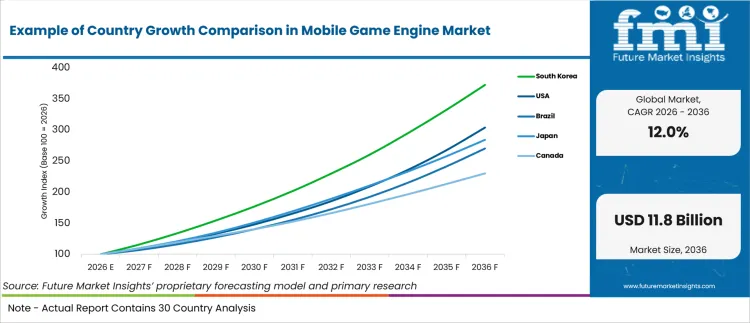
The country comparison shows a gradual step-down in growth across the markets covered. South Korea and the United Kingdom occupy the upper end of the range, followed by the United States and Japan as a closely grouped second tier. Brazil and Germany form the next growth band. Canada records the lower rate within the comparison. The 5.4 percentage-point spread shows that all seven markets share a favorable growth outlook, although their relative positions indicate different levels of market momentum. Country rates represent individual national forecasts, so market size and commercial conditions may differ from CAGR positions.
- South Korea and the United Kingdom lead the comparison and establish the upper growth cluster among the markets shown.
- The United States and Japan follow at a limited distance, indicating that both markets retain considerable development momentum.
- Brazil and Germany form the subsequent growth band and maintain a relatively small gap from the middle tier.
- Canada records the slowest growth among the listed markets, yet its forecast remains favorable within the wider market context.
- The pattern resembles a gradual downward slope instead of a sharp separation between high-growth and low-growth markets.
Markets carrying similar CAGRs are expected to present different entry conditions depending on mobile-platform adoption and developer-support availability. The full report provides country-level analysis across North America, Europe, East Asia, South Asia and Pacific, Latin America, and the Middle East and Africa.
Country-wise Analysis
- Adoption in South Korea is projected to expand at 14.1% CAGR from 2026 to 2036, guided by rapid mobile-service adoption and demanding local release standards. Ministry of Culture, Sports and Tourism’s April 2025 notice set 100,000 domestic users as one domestic-agent criterion across a three-month average. Local compliance preparation encourages engines offering maintained user records and dependable support processes. Publisher confidence improves through clear platform updates and controlled deployment evidence.
- Department for Culture, Media and Sport’s July 2025 evaluation associated UK Games Fund activity with around 430 additional full-time-equivalent jobs. Added development capacity expands team interest across commercial and open-source engines. Provider approval favors training support and predictable licensing for early-stage studios. Public program support places United Kingdom as expected to scale at 12.9% CAGR by 2036, reflecting prototype completion and reusable game assets.
- Extensive player reach supports United States as set to grow at 11.7% CAGR between 2026 and 2036, reinforced by major publisher participation. Entertainment Software Association’s June 2025 study counted 205.1 million American video-game players. Large player access supports engine demand across mobile genres and live-content programs. Supplier review emphasizes credible crash testing and responsive platform maintenance across varied studio sizes.
- Japan External Trade Organization’s February 2025 announcement identified 10 Japanese game-industry companies for its GDC pavilion. International showcases expose studios and middleware providers to cross-platform production partnerships. Engine adoption favors exact documentation and dependable local assistance across gaming console and mobile projects. International publishing exposure supports Japan as anticipated to rise at 11.0% CAGR during the study period, aided by established production practices.
- Expanding studio interaction influences Brazil as projected to increase at 10.4% CAGR during the forecast period, backed by regional publishing activity. Gamescom latam’s May 2026 event report recorded more than 700 studios. Dense studio participation creates opportunities for affordable engines and local training partnerships. Provider selection emphasizes lightweight Android performance and clear subscription terms for smaller development teams.
- German Games Industry Association’s April 2026 update counted 956 game companies. Company depth supports engine licenses and specialized middleware across varied production scales. Supplier evaluation favors lifecycle support and documented compatibility across European release requirements. Structured technical review places Germany as forecasted to progress at 10.0% CAGR through 2036, helped by organized project funding.
- Established studio networks place Canada as likely to rise at 8.7% CAGR during the assessment period, aided by international publishing links. Entertainment Software Association of Canada’s January 2025 report identified 821 video-game companies operating nationally. Studio concentration sustains engine demand across independent teams and major publishers. Commercial success reflects skills availability and stable support across dispersed production locations.
Who are notable companies in Mobile Game Engine Market?
Unity Technologies, Epic Games, Cocos, GameMaker, CRI Middleware, Open 3D Foundation, Buildbox, Defold Foundation, Godot Engine, and Solar2D are notable providers shaping mobile game engine competition.
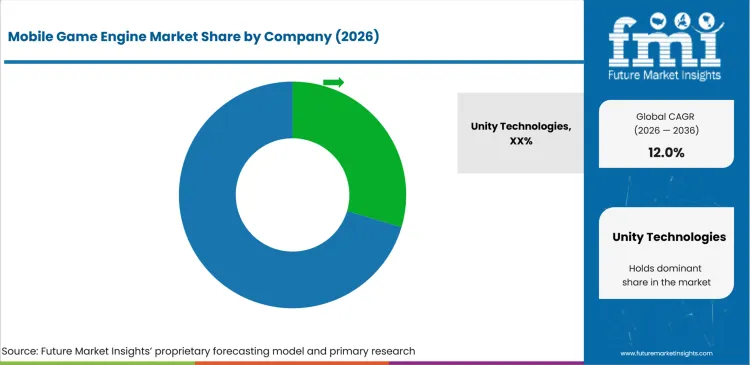
Large engine providers compete through extensive editors and deployment support. Focused providers serve 2D production and source-access requirements with lower operating complexity. Buyer comparison centers on mobile build stability and platform-update timing. Migration expense protects incumbent positions across established projects. Service quality affects renewal confidence across multi-project studio programs.
- Unity Technologies and Epic Games cover extensive production workflows across several platforms. Cocos supports mobile-focused development across 2D and 3D projects.
- GameMaker and Buildbox address visual workflows suited to smaller teams and focused genres. CRI Middleware supplies specialized audio and video technology supporting game production.
- Open 3D Foundation oversees Open 3D Engine based on an open-source development model. Community participation and source-code access support its appeal across collaborative game-development projects.
- Defold Foundation and Godot Engine offer source-access options with active contributor communities. Solar2D supports Lua-based mobile development across lightweight projects.
Competitive Benchmarking: Mobile Game Engine Market
| Company | Mobile Workflow Depth | Cross-Platform Coverage | Source Access | Support Reach |
|---|---|---|---|---|
| Unity Technologies | High | High | Limited | Global |
| Epic Games | High | High | Limited | Global |
| Cocos | Medium | High | High | Multi-country |
| GameMaker | Medium | Medium | Limited | Multi-country |
| CRI Middleware | Focused | Medium | Limited | Regional |
| Open 3D Foundation | Medium | Medium | High | International community |
| Buildbox | Selective | Medium | Limited | Specialist |
| Defold Foundation | Selective | Medium | High | International community |
Source: Future Market Insights competitive analysis, 2026.
Key Developments in Mobile Game Engine Market
- In March 2025, Godot Engine released Godot 4.4 with embedded game windows and reduced stutter. Release information connected editor improvements with quicker testing across mobile game projects.
- In April 2025, Unity Technologies released Unity 6000.1.0f1 with Android SDK 36 support. Release information connected updated Android compatibility with lower migration work across new mobile builds.
- In June 2025, Epic Games released Unreal Engine 5.6 with a 60 frames-per-second target for modern mobile devices. Company information connected performance upgrades with higher-fidelity mobile production under controlled device optimization.
Mobile Game Engine Market Report Scope
| Coverage Field | Report Scope |
|---|---|
| Market Breakdown | Mobile game engine market breakdown includes Product Type, Application, End User, Distribution Channel, Platform, and Region. |
| Quantitative Units | Revenue in Billion adn CAGR in %. |
| Market Definition | Mobile game engines combine editors and rendering systems with physics and scripting for Android and iOS production. Analytics and monetization tools support game development. Deployment functions convert projects into store-ready builds. Generic creation software without mobile-game production support is excluded. |
| Regions Covered | North America, Europe, East Asia, South Asia and Pacific, Latin America, Middle East and Africa. |
| Countries Covered | South Korea, UK, USA, Japan, Brazil, Germany, Canada, and additional countries covered in full analysis. |
| Key Companies Profiled | Unity Technologies, Epic Games, Cocos, GameMaker, CRI Middleware, Open 3D Foundation, Buildbox, Defold Foundation, Godot Engine, and Solar2D. |
| Forecast Period | 2026 to 2036 |
| Approach | Hybrid bottom-up and top-down methodology uses segment shares and country CAGRs. Company activity and buyer adoption support final market reconciliation. |
Source: Future Market Insights analysis, 2026.
Mobile Game Engine Market - Research Methodology
| Method | Approach |
|---|---|
| Primary Research | FMI analysts gathered input from manufacturers, service providers, technology developers, distributors, end users, procurement teams, and subject-matter experts. Interviews examined purchasing decisions, product or service evaluation, adoption barriers, approval requirements, pricing considerations, and expectations for technical or commercial support. Respondents were also asked what evidence is required before a trial, pilot, or initial order develops into regular purchasing. |
| Desk Research | Desk research covered government statistics, regulatory publications, trade data, industry associations, technical literature, standards, company filings, product information, and official corporate announcements. Sources were reviewed for relevance, publication date, geographic coverage, and consistency with the defined market scope. Claims relating to performance, applications, approvals, capacity, investment, and commercial activity were retained only when supported by credible public evidence. |
| Market Sizing and Forecasting | The market model combined the baseline value with historical performance, segment structure, pricing and volume indicators, adoption levels, company participation, and country-level demand conditions. Forecast assumptions considered economic activity, investment trends, regulatory developments, technology adoption, purchasing cycles, supply availability, and barriers to wider market use. Segment and regional estimates were reconciled before the final market total was calculated. |
| Data Validation | Estimates were checked against multiple independent indicators, including public data, company activity, trade patterns, industry developments, and findings from primary interviews. Validation also tested whether products, services, applications, and company revenues fell within the defined market boundaries. Adjacent categories, unsupported claims, overlapping revenues, and activities without direct market relevance were excluded to reduce double counting and maintain consistency across segments and countries. |
Source: Future Market Insights analysis, 2026.
Mobile Game Engine Market by Segments
Mobile Game Engine Market segmented by Product Type:
- 2D Game Engines
- 3D Game Engines
- Cross-Platform Game Engines
- Cloud-Based Game Engines
- Open-Source Game Engines
Mobile Game Engine Market segmented by Application:
- Mobile Gaming
- AR & VR Mobile Games
- Educational Games
- Casino & Card Games
- Hyper-Casual Games
Mobile Game Engine Market segmented by End User:
- Game Development Studios
- Independent Developers
- Enterprise Developers
- Educational Institutions
- Media & Entertainment Companies
Mobile Game Engine Market segmented by Distribution Channel:
- Direct Licensing
- Digital Distribution
- Cloud Marketplace
- Channel Partners
- Open-Source Distribution
Mobile Game Engine Market segmented by Platform:
- Android
- iOS
- Cross-Platform Deployment
- Web-Based Mobile Gaming
- Other Mobile Platforms
Mobile Game Engine Market segmented by Region:
- North America
- United States
- Canada
- Latin America
- Brazil
- Mexico
- Argentina
- Chile
- Western Europe
- Germany
- France
- United Kingdom
- Italy
- Spain
- Benelux
- Nordics
- Eastern Europe
- Poland
- Czech Republic
- Romania
- Hungary
- East Asia
- China
- Japan
- South Korea
- South Asia and Pacific
- India
- ASEAN
- Australia and New Zealand
- Middle East and Africa
- GCC Countries
- South Africa
- Türkiye
- Israel
Research Sources and Bibliography
- Apple. (2026, January 12). 2025 marked a record-breaking year for Apple services.
- Android Developers Blog. (2025, May 8). Prepare your apps for Google Play’s 16 KB page size compatibility requirement.
- Department for Culture, Media and Sport. (2025, July 18). Evaluation of the UK Games Fund.
- Entertainment Software Association. (2025, June 3). Annual ESA study reveals video games’ universal appeal across generations.
- Entertainment Software Association. (2025, October 8). Global report: Video games transcend entertainment, affect positive change in players’ lives.
- Entertainment Software Association of Canada. (2025, January 27). Canada’s Video Game Industry 2024.
- Epic Games. (2025, June 3). All the big news and announcements from the State of Unreal 2025.
- Game Developers Conference. (2025). GDC 2025 State of the Game Industry: Devs weigh in on layoffs, AI, and more.
- Gamescom latam. (2026, May 3). Gamescom latam 2026 wraps up with record-breaking results.
- German Games Industry Association. (2026, April 23). More companies, fewer employees: Germany’s games industry is recovering only slowly.
- Godot Engine. (2025, March 3). Godot 4.4, a unified experience.
- Google. (2025, June 30). Get ready for the next generation of gameplay powered by Play Games Services.
- Google. (2025, September 23). New ways Google Play is built entirely around you.
- Japan External Trade Organization. (2025, February 28). JETRO to host 10 Japanese game industry companies at GDC 2025 Japan Pavilion.
- Ministry of Culture, Sports and Tourism. (2025, April 24). Advance legislation notice of criteria to determine foreign game companies to designate domestic agent.
- Open 3D Engine. (2026, May 27). Release notes for Open 3D Engine.
- Unity Technologies. (2024, September 12). A message to our community: Unity is canceling the Runtime Fee.
- Unity Technologies. (2025, March 17). Learn how devs are adapting to face change in the new 2025 Unity Gaming Report.
- Unity Technologies. (2025, April 23). Unity 6000.1.0f1.
- Unity Technologies. (2026, January 5). Grow with Unity: How Unity helped fuel Black Drive Studio’s growth.
- Unity Technologies. (2026, March 9). 2026 Unity Game Development Report: How studios are building a sustainable future.
This bibliography is provided for reader reference and is not exhaustive. The full report contains the complete reference list and detailed citations.
This Report Answers
- How do segments influence demand across product type and application with end-user coverage?
- What criteria guide studios evaluating mobile game engines prior to project adoption?
- Why do country CAGRs differ across profiled countries for mobile game engine demand?
- What companies compete through mobile build performance and platform support?
- How are forecasts validated through bottom-up and top-down analysis using independent indicators?
- What evidence supports studio review prior to multi-project engine deployment?
- Why do licensing terms and platform changes influence software selection?
- How do low-end device constraints limit returns across testing and optimization work?
- How do build records influence approval across development and publishing teams?
- What provider capabilities improve long-term confidence and recurring engine use?
Frequently Asked Questions
How big is the Mobile Game Engine Market in 2026?
The mobile game engine market is valued at USD 3.8 billion in 2026 and is forecast to reach USD 11.8 billion by 2036. Growth is supported by expanding mobile-game production activity that sustains demand for engines handling cross-platform development, testing, and store deployment across Android and iOS titles.
What is the CAGR of the Mobile Game Engine Market from 2026 to 2036?
The mobile game engine market grows at a CAGR of 12.0% between 2026 and 2036, supported by sustained mobile-first player activity that drives studios toward engines offering repeatable production, cross-platform workflows, and dependable build stability across frequent release cycles on Android and iOS storefronts.
Which application leads the Mobile Game Engine Market?
Mobile gaming leads the mobile game engine market with a 41.0% application share in 2026, driven by frequent content updates and multi-device publishing needs that require dependable builds and integrated testing across varied device profiles throughout Android and iOS store release cycles.
How much will the Mobile Game Engine Market add between 2026 and 2036?
The mobile game engine market is set to add USD 8.0 billion between 2026 and 2036, growing from USD 3.8 billion to USD 11.8 billion as mobile-first player activity and cross-platform production requirements expand engine adoption across studios, independent developers, and enterprise development teams worldwide.
Who are the leading companies in the Mobile Game Engine Market?
Ten companies lead the mobile game engine market in 2026, including Unity Technologies, Epic Games, Cocos, GameMaker, CRI Middleware, Open 3D Foundation, Buildbox, Defold Foundation, Godot Engine, and Solar2D, competing through mobile build stability, cross-platform coverage, documentation quality, and source-access options across global development workflows.
Preview the report firsthand - request a free sample
Get SampleGet the brochure for pricing and purchase details.
Get PDFTable of Content
- Key Takeaways
- Market Size and CAGR
- Top Growth Driver
- Fastest Growing Segment
- Leading Region
- Key Companies
- Emerging Opportunities
- Executive Summary
- Global Market Outlook
- Demand-side Trends
- Supply-side Trends
- Technology Roadmap Analysis
- Analysis and Recommendations
- Analyst Perspective (What is happening? Why now? What should investors know?)
- Key Questions Answered
- How large is the market?
- What is the CAGR?
- What are key trends?
- Which region dominates?
- Who are the leaders?
- Market Overview
- Market Coverage / Taxonomy
- Market Definition / Scope / Limitations
- Research Methodology
- Chapter Orientation
- Analytical Lens and Working Hypotheses
- Market Structure, Signals, and Trend Drivers
- Benchmarking and Cross-market Comparability
- Market Sizing, Forecasting, and Opportunity Mapping
- Research Design and Evidence Framework
- Desk Research Programme (Secondary Evidence)
- Expert Input and Fieldwork (Primary Evidence)
- Tooling, Models, and Reference Databases
- Data Engineering and Model Build
- Quality Assurance and Audit Trail
- Market Background
- Market Dynamics (Drivers, Restraints, Opportunity, Trends)
- Scenario Forecast (Optimistic, Likely, Conservative)
- Impact Analysis
- AI Impact
- Sustainability Impact
- Regulatory Impact
- Technology Impact
- Consumer / Buyer Analysis
- Purchase Drivers
- Adoption Barriers
- Buyer Journey
- Opportunity Map Analysis
- Product Life Cycle Analysis
- Supply Chain Analysis
- Investment Feasibility Matrix
- Value Chain Analysis
- PESTLE and Porter's Analysis
- Regulatory Landscape
- Regional Parent Market Outlook
- Production and Consumption Statistics
- Import and Export Statistics
- Global Market Analysis and Forecast, 2021 to 2036
- Historical Market Size Value (USD Billion) Analysis, 2021 to 2025
- Current and Future Market Size Value (USD Billion) Projections, 2026 to 2036
- Y-o-Y Growth Trend Analysis
- Absolute $ Opportunity Analysis
- Global Market Pricing Analysis, 2021 to 2036
- Global Market Analysis and Forecast, By Product Type, 2021 to 2036
- Introduction / Key Findings
- Historical Market Size Value (USD Billion) Analysis By Product Type, 2021 to 2025
- Current and Future Market Size Value (USD Billion) Analysis and Forecast By Product Type, 2026 to 2036
- 2D Game Engines
- Casual Game Engines
- Puzzle Game Engines
- 3D Game Engines
- Real-Time 3D Engines
- High-Fidelity 3D Engines
- Cross-Platform Game Engines
- iOS & Android Engines
- Multi-Device Engines
- Cloud-Based Game Engines
- Browser-Based Engines
- Cloud Development Platforms
- Open-Source Game Engines
- Community-Supported Engines
- Customizable Engines
- 2D Game Engines
- Y-o-Y Growth Trend Analysis By Product Type, 2021 to 2025
- Absolute $ Opportunity Analysis By Product Type, 2026 to 2036
- Global Market Analysis and Forecast, By Application, 2021 to 2036
- Introduction / Key Findings
- Historical Market Size Value (USD Billion) Analysis By Application, 2021 to 2025
- Current and Future Market Size Value (USD Billion) Analysis and Forecast By Application, 2026 to 2036
- Mobile Gaming
- Action Games
- Adventure Games
- AR & VR Mobile Games
- AR Gaming
- VR Mobile Experiences
- Educational Games
- E-Learning Games
- Training Simulations
- Casino & Card Games
- Online Casino Games
- Card & Board Games
- Hyper-Casual Games
- Arcade Games
- One-Touch Games
- Mobile Gaming
- Y-o-Y Growth Trend Analysis By Application, 2021 to 2025
- Absolute $ Opportunity Analysis By Application, 2026 to 2036
- Global Market Analysis and Forecast, By End User, 2021 to 2036
- Introduction / Key Findings
- Historical Market Size Value (USD Billion) Analysis By End User, 2021 to 2025
- Current and Future Market Size Value (USD Billion) Analysis and Forecast By End User, 2026 to 2036
- Game Development Studios
- Independent Studios
- Large Game Publishers
- Independent Developers
- Freelance Developers
- Solo Developers
- Enterprise Developers
- Brand Experience Developers
- Corporate Training Developers
- Educational Institutions
- Universities
- Game Development Academies
- Media & Entertainment Companies
- Digital Media Firms
- Content Production Companies
- Game Development Studios
- Y-o-Y Growth Trend Analysis By End User, 2021 to 2025
- Absolute $ Opportunity Analysis By End User, 2026 to 2036
- Global Market Analysis and Forecast, By Distribution Channel, 2021 to 2036
- Introduction / Key Findings
- Historical Market Size Value (USD Billion) Analysis By Distribution Channel, 2021 to 2025
- Current and Future Market Size Value (USD Billion) Analysis and Forecast By Distribution Channel, 2026 to 2036
- Direct Licensing
- Enterprise Licensing
- Developer Licensing
- Digital Distribution
- Official Websites
- Digital Download Platforms
- Cloud Marketplace
- Cloud Service Marketplaces
- SaaS Platforms
- Channel Partners
- Authorized Resellers
- System Integrators
- Open-Source Distribution
- Git Repositories
- Developer Communities
- Direct Licensing
- Y-o-Y Growth Trend Analysis By Distribution Channel, 2021 to 2025
- Absolute $ Opportunity Analysis By Distribution Channel, 2026 to 2036
- Global Market Analysis and Forecast, By Platform, 2021 to 2036
- Introduction / Key Findings
- Historical Market Size Value (USD Billion) Analysis By Platform, 2021 to 2025
- Current and Future Market Size Value (USD Billion) Analysis and Forecast By Platform, 2026 to 2036
- Android
- Google Play Games
- Third-Party Android Stores
- iOS
- App Store Games
- Apple Arcade Development
- Cross-Platform Deployment
- Android & iOS
- Multi-OS Publishing
- Web-Based Mobile Gaming
- HTML5 Games
- Progressive Web Apps
- Other Mobile Platforms
- HarmonyOS
- Other Proprietary Platforms
- Android
- Y-o-Y Growth Trend Analysis By Platform, 2021 to 2025
- Absolute $ Opportunity Analysis By Platform, 2026 to 2036
- Global Market Analysis and Forecast, By Region, 2021 to 2036
- Introduction
- Historical Market Size Value (USD Billion) Analysis By Region, 2021 to 2025
- Current Market Size Value (USD Billion) Analysis and Forecast By Region, 2026 to 2036
- North America
- Latin America
- Western Europe
- Eastern Europe
- East Asia
- South Asia and Pacific
- Middle East & Africa
- Market Attractiveness Analysis By Region
- North America Market Analysis and Forecast, By Country, 2021 to 2036
- Historical Market Size Value (USD Billion) Trend Analysis By Market Taxonomy, 2021 to 2025
- Market Size Value (USD Billion) Forecast By Market Taxonomy, 2026 to 2036
- By Country
- USA
- Canada
- By Product Type
- By Application
- By End User
- By Distribution Channel
- By Platform
- By Country
- Market Attractiveness Analysis
- By Country
- By Product Type
- By Application
- By End User
- By Distribution Channel
- By Platform
- Key Takeaways
- Latin America Market Analysis and Forecast, By Country
- Historical Market Size Value (USD Billion) Trend Analysis By Market Taxonomy, 2021 to 2025
- Market Size Value (USD Billion) Forecast By Market Taxonomy, 2026 to 2036
- By Country
- Brazil
- Mexico
- Chile
- Rest of Latin America
- By Product Type
- By Application
- By End User
- By Distribution Channel
- By Platform
- By Country
- Market Attractiveness Analysis
- By Country
- By Product Type
- By Application
- By End User
- By Distribution Channel
- By Platform
- Key Takeaways
- Western Europe Market Analysis and Forecast, By Country
- Historical Market Size Value (USD Billion) Trend Analysis By Market Taxonomy, 2021 to 2025
- Market Size Value (USD Billion) Forecast By Market Taxonomy, 2026 to 2036
- By Country
- Germany
- UK
- Italy
- Spain
- France
- Nordic
- BENELUX
- Rest of Western Europe
- By Product Type
- By Application
- By End User
- By Distribution Channel
- By Platform
- By Country
- Market Attractiveness Analysis
- By Country
- By Product Type
- By Application
- By End User
- By Distribution Channel
- By Platform
- Key Takeaways
- Eastern Europe Market Analysis and Forecast, By Country
- Historical Market Size Value (USD Billion) Trend Analysis By Market Taxonomy, 2021 to 2025
- Market Size Value (USD Billion) Forecast By Market Taxonomy, 2026 to 2036
- By Country
- Russia
- Poland
- Hungary
- Balkan & Baltic
- Rest of Eastern Europe
- By Product Type
- By Application
- By End User
- By Distribution Channel
- By Platform
- By Country
- Market Attractiveness Analysis
- By Country
- By Product Type
- By Application
- By End User
- By Distribution Channel
- By Platform
- Key Takeaways
- East Asia Market Analysis and Forecast, By Country
- Historical Market Size Value (USD Billion) Trend Analysis By Market Taxonomy, 2021 to 2025
- Market Size Value (USD Billion) Forecast By Market Taxonomy, 2026 to 2036
- By Country
- China
- Japan
- South Korea
- By Product Type
- By Application
- By End User
- By Distribution Channel
- By Platform
- By Country
- Market Attractiveness Analysis
- By Country
- By Product Type
- By Application
- By End User
- By Distribution Channel
- By Platform
- Key Takeaways
- South Asia and Pacific Market Analysis and Forecast, By Country
- Historical Market Size Value (USD Billion) Trend Analysis By Market Taxonomy, 2021 to 2025
- Market Size Value (USD Billion) Forecast By Market Taxonomy, 2026 to 2036
- By Country
- India
- ASEAN
- Australia & New Zealand
- Rest of South Asia and Pacific
- By Product Type
- By Application
- By End User
- By Distribution Channel
- By Platform
- By Country
- Market Attractiveness Analysis
- By Country
- By Product Type
- By Application
- By End User
- By Distribution Channel
- By Platform
- Key Takeaways
- Middle East & Africa Market Analysis and Forecast, By Country
- Historical Market Size Value (USD Billion) Trend Analysis By Market Taxonomy, 2021 to 2025
- Market Size Value (USD Billion) Forecast By Market Taxonomy, 2026 to 2036
- By Country
- Kingdom of Saudi Arabia
- Other GCC Countries
- Türkiye
- South Africa
- Other African Union
- Rest of Middle East & Africa
- By Product Type
- By Application
- By End User
- By Distribution Channel
- By Platform
- By Country
- Market Attractiveness Analysis
- By Country
- By Product Type
- By Application
- By End User
- By Distribution Channel
- By Platform
- Key Takeaways
- Key Countries Market Analysis
- USA
- Pricing Analysis
- Market Share Analysis, 2025
- By Product Type
- By Application
- By End User
- By Distribution Channel
- By Platform
- Canada
- Pricing Analysis
- Market Share Analysis, 2025
- By Product Type
- By Application
- By End User
- By Distribution Channel
- By Platform
- Mexico
- Pricing Analysis
- Market Share Analysis, 2025
- By Product Type
- By Application
- By End User
- By Distribution Channel
- By Platform
- Brazil
- Pricing Analysis
- Market Share Analysis, 2025
- By Product Type
- By Application
- By End User
- By Distribution Channel
- By Platform
- Chile
- Pricing Analysis
- Market Share Analysis, 2025
- By Product Type
- By Application
- By End User
- By Distribution Channel
- By Platform
- Germany
- Pricing Analysis
- Market Share Analysis, 2025
- By Product Type
- By Application
- By End User
- By Distribution Channel
- By Platform
- UK
- Pricing Analysis
- Market Share Analysis, 2025
- By Product Type
- By Application
- By End User
- By Distribution Channel
- By Platform
- Italy
- Pricing Analysis
- Market Share Analysis, 2025
- By Product Type
- By Application
- By End User
- By Distribution Channel
- By Platform
- Spain
- Pricing Analysis
- Market Share Analysis, 2025
- By Product Type
- By Application
- By End User
- By Distribution Channel
- By Platform
- France
- Pricing Analysis
- Market Share Analysis, 2025
- By Product Type
- By Application
- By End User
- By Distribution Channel
- By Platform
- India
- Pricing Analysis
- Market Share Analysis, 2025
- By Product Type
- By Application
- By End User
- By Distribution Channel
- By Platform
- ASEAN
- Pricing Analysis
- Market Share Analysis, 2025
- By Product Type
- By Application
- By End User
- By Distribution Channel
- By Platform
- Australia & New Zealand
- Pricing Analysis
- Market Share Analysis, 2025
- By Product Type
- By Application
- By End User
- By Distribution Channel
- By Platform
- China
- Pricing Analysis
- Market Share Analysis, 2025
- By Product Type
- By Application
- By End User
- By Distribution Channel
- By Platform
- Japan
- Pricing Analysis
- Market Share Analysis, 2025
- By Product Type
- By Application
- By End User
- By Distribution Channel
- By Platform
- South Korea
- Pricing Analysis
- Market Share Analysis, 2025
- By Product Type
- By Application
- By End User
- By Distribution Channel
- By Platform
- Russia
- Pricing Analysis
- Market Share Analysis, 2025
- By Product Type
- By Application
- By End User
- By Distribution Channel
- By Platform
- Poland
- Pricing Analysis
- Market Share Analysis, 2025
- By Product Type
- By Application
- By End User
- By Distribution Channel
- By Platform
- Hungary
- Pricing Analysis
- Market Share Analysis, 2025
- By Product Type
- By Application
- By End User
- By Distribution Channel
- By Platform
- Kingdom of Saudi Arabia
- Pricing Analysis
- Market Share Analysis, 2025
- By Product Type
- By Application
- By End User
- By Distribution Channel
- By Platform
- Türkiye
- Pricing Analysis
- Market Share Analysis, 2025
- By Product Type
- By Application
- By End User
- By Distribution Channel
- By Platform
- South Africa
- Pricing Analysis
- Market Share Analysis, 2025
- By Product Type
- By Application
- By End User
- By Distribution Channel
- By Platform
- USA
- Market Structure Analysis
- Competition Dashboard
- Competition Benchmarking
- Market Share Analysis of Top Players
- By Regional
- By Product Type
- By Application
- By End User
- By Distribution Channel
- By Platform
- Emerging Startups
- Innovation Benchmarking
- Competition Analysis
- Competition Deep Dive
- Unity Technologies
- Overview
- Product Portfolio
- Profitability by Market Segments
- Sales Footprint
- Strategy Overview
- Marketing Strategy
- Product Strategy
- Channel Strategy
- Epic Games (Unreal Engine)
- Cocos
- GameMaker
- CRI Middleware
- Amazon Lumberyard / Open 3D Engine
- Buildbox
- Defold Foundation
- Godot Engine
- Solar2D
- Others
- Unity Technologies
- Case Studies
- Success Stories
- Recent Developments
- Competition Deep Dive
- Assumptions & Acronyms Used


