

- Market Size (2026)
- USD 1120.6 Mn
- Forecast (2036)
- USD 2580.8 Mn
- CAGR (2026 to 2036)
- 8.7%
Molded-Fiber Coatings Market Size, Market Forecast and Outlook By FMI
USD 1,120.6 million in 2026 and USD 2,580.8 million by 2036 at an 8.7% CAGR.
The molded-fiber coatings industry value is forecast to grow from USD 1,030.9 million in 2025 to USD 2,580.8 million by 2036 at 8.7% CAGR as foodservice buyers and produce packers qualify fiber formats that need grease holdout, moisture control, and heat sealability. Direct to Molders is forecast to represent 61.0% share in 2026 because coating trials must match forming tools, drying conditions, and tray geometry. Recycled Fiber is expected to secure 52.0% share in 2026, led by molder interest in lower-cost feedstock with stronger circular packaging claims.
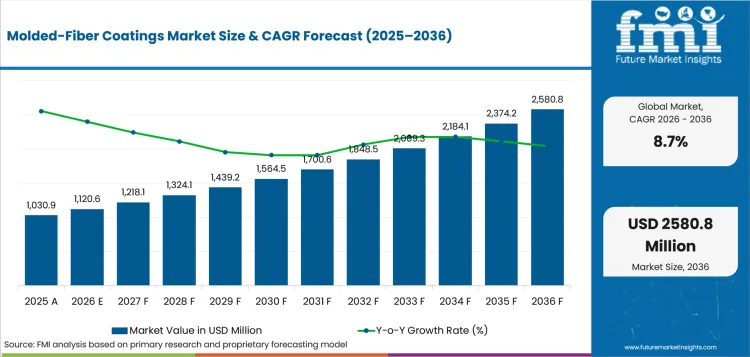
Molded-Fiber Coatings Market Overview: Size and Forecast
- 2025 Market Size: USD 1,030.9 million
- 2026 Market Size: USD 1,120.6 million
- 2036 Market Size: USD 2,580.8 million
- Forecast CAGR: 8.7% from 2026 to 2036
- Leading Sales Channel: Direct to Molders
- Direct to Molders Share in 2026: 61.0%
- Leading Fiber Feedstock: Recycled Fiber
- Recycled Fiber Share in 2026: 52.0%
- Fastest-growing Country: China
- China CAGR: 9.8% by 2036
Summary of the Molded-Fiber Coatings Market
The molded-fiber coatings market is expected to witness steady growth through 2036, driven by foodservice, produce, and retail packaging buyers seeking coated fiber formats that can replace selected plastic-lined packs. Market expansion is further supported by stronger packaging waste rules and rising buyer interest in recyclable fiber packaging.
- Demand and Growth Drivers
- Foodservice buyers are shifting toward coated fiber bowls, trays, and cup carriers designed for hot and oily meals.
- Retailers are giving more attention to packages with clear recyclability evidence and lower plastic content.
- Coating suppliers are extending barrier portfolios through water-based, bio-based, and dispersion systems.
- Product and Segment View
- Direct to molders is projected to hold 61.0% share in 2026, influenced by line trials and coating adjustment needs.
- Recycled fiber is forecast to represent 52.0% share in 2026, led by cost control and circular packaging claims.
- Water-based barrier coatings are expected to secure 46.0% share in 2026, supported by repulpability and lower-plastic positioning.
- Geography and Competitive Outlook
- China is projected to record 9.8% CAGR by 2036, backed by parcel packaging and food delivery scale.
- India is expected to expand at 9.5% CAGR by 2036 through plastic packaging compliance and foodservice conversion.
- Solenis and Michelman compete through water-based barrier coatings and customer trial support.
- BASF, Kemira, Siegwerk, Sappi, and Stora Enso focus on fiber-based packaging materials and functional coating systems.
- Analyst Opinion
- Nandini Roy Choudhury, Principal Consultant for Packaging at FMI, observes, “Molded-fiber coatings are now more than a sustainability add-on. Foodservice buyers and retailers want fiber packages that can hold oil, resist moisture, seal correctly, and pass recycling review. Suppliers treating coating performance as part of molding-line design should gain stronger customer approval.”
Policy pressure and packaging performance are the main value signals for molded-fiber coatings as retailers review coated trays, bowls, clamshells, and cup carriers. UNEP stated in 2025 that 19 million to 23 million tonnes of plastic waste leak into aquatic ecosystems each year. OECD reported in October 2024 that comprehensive policies across the plastics lifecycle could reduce plastic leakage by 96% by 2040. Solenis and HEIDELBERG announced in September 2024 a collaboration to develop print-applied barrier coatings for paper packaging. Suppliers with recyclable coating evidence and molder-level trial support can secure foodservice and produce packaging approvals more easily.
Which factors support expansion in the molded-fiber coatings market?
Finished coating revenue and converter qualification programs support market value across foodservice and fiber packaging channels.
- Market value is supported by coating systems sold before finished molded fiber packs reach foodservice and retail buyers.
- Supplier pricing reflects barrier chemistry and food-contact review before coating weight affects final pack economics.
- Revenue improves as molders convert trays, bowls, and clamshells into coated formats with measurable grease resistance.
- Retail trust rises as pack testing makes recycling compatibility and food-contact performance easier to compare.
Why is the molded-fiber coatings market growing?
Molded fiber producers need oil and moisture barriers with clearer recycling compatibility and lower plastic exposure.
Foodservice buyers are driving the first wave of coating trials as they need fiber packs that survive hot meals, oily foods, sauces, and delivery handling. GOV.UK reported in July 2025 that the United Kingdom recycled 64.1% of packaging waste in 2024 under methodology 1, while paper and cardboard recorded the highest material recycling rate at 74.3%. This recycling context gives fiber-based packaging a stronger buyer argument only when coatings do not reduce recovery value. Suppliers that document barrier performance and repulpability in the same approval cycle have a clearer sales case.
How is the molded-fiber coatings market segmented?
The molded-fiber coatings industry is segmented by coating type, function, end use, fiber feedstock, and sales channel.
- Water-based barrier coatings are projected to secure 46.0% share in 2026, led by buyers seeking grease and moisture holdout without plastic lamination.
- Oil & grease resistance is anticipated to hold 39.0% share in 2026 since fried foods and sauced meals create visible staining risk for uncoated fiber.
- Foodservice packaging is expected to capture 44.0% share in 2026 due to takeaway trays, molded bowls, clamshells, and cup carriers requiring barrier protection.
- Recycled fiber is forecast to represent 52.0% share in 2026, guided by feedstock economics and circular packaging positioning.
- Direct to molders is projected to account for 61.0% share in 2026, reflected by trial work involving coating solids, drying time, and tray geometry.
Why do water-based barrier coatings dominate the molded-fiber coatings market?
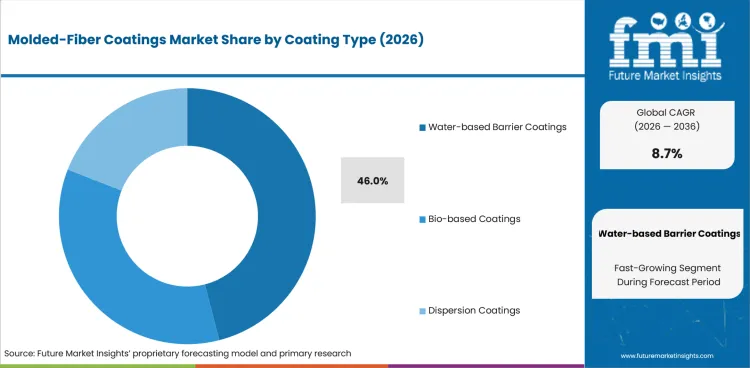
- Water-based barrier coatings are projected to account for 46.0% share in 2026, influenced by demand for grease and moisture control without PE extrusion.
- Bio-based coatings gain use as renewable material claims support premium foodservice and biodegradable packaging programs.
Which function leads the molded-fiber coatings market?
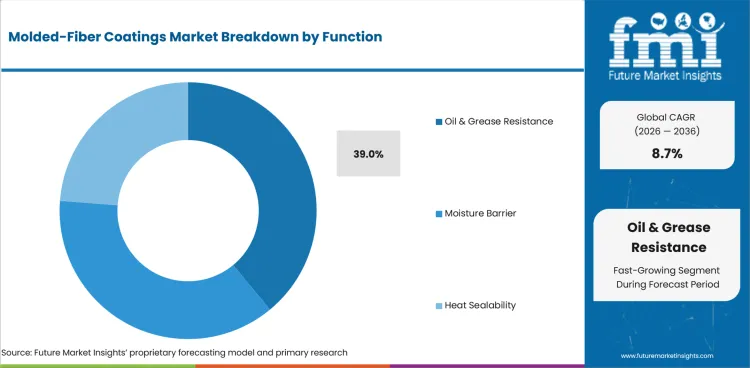
- Oil & grease resistance is anticipated to hold 39.0% share in 2026 through hot-food and fried-food packs that expose untreated fiber to leakage.
- Moisture barrier coatings gain importance as produce trays and chilled food formats face condensation during storage and display.
Which end use leads the molded-fiber coatings market?
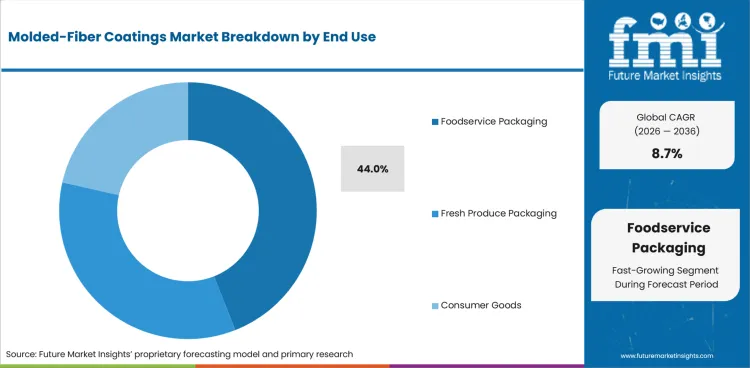
- Foodservice packaging is expected to represent 44.0% share in 2026, reflected by quick-service restaurants testing coated bowls and trays.
- Fresh produce packaging gains value as coated pulp trays reduce staining and softening during refrigerated movement.
Which fiber feedstock leads the molded-fiber coatings market?
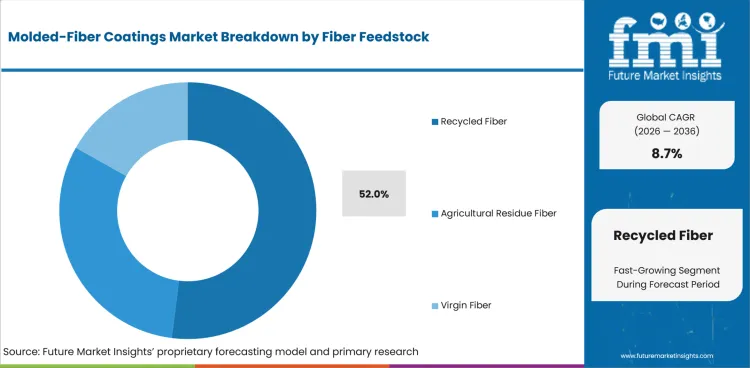
- Recycled fiber is forecast to account for 52.0% share in 2026, led by lower input cost and stronger circular packaging positioning.
- Agricultural residue fiber creates added trial where bagasse and similar materials support plastic-free foodservice claims.
Which sales channel leads the molded-fiber coatings market?
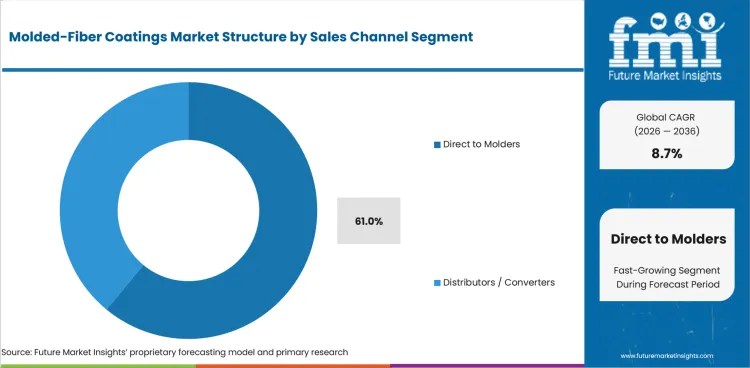
- Direct to molders is projected to represent 61.0% share in 2026, shaped by the need to tune coating, molding, drying, and nesting conditions together.
- Distributors and converters remain important for smaller buyers, although large foodservice programs usually require direct technical support.
What are the driver, restraints, and opportunities in the molded-fiber coatings market?
Plastic-reduction demand and coated fiber performance support growth while line-speed limits restrict wider conversion.
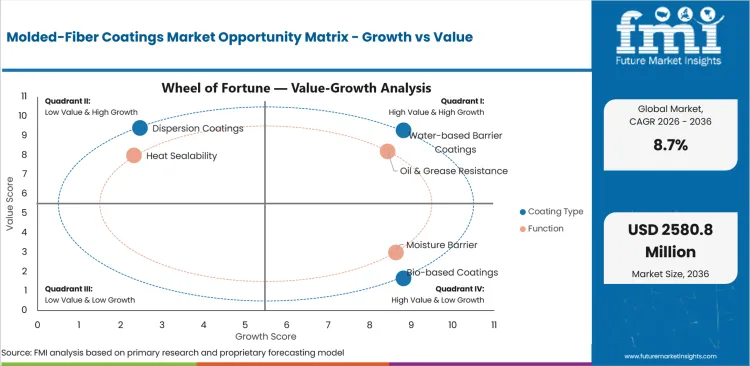
- Driver: Foodservice brands are moving toward coated molded fiber formats that reduce plastic lining in takeaway packaging.
- Restraint: Coating systems can slow production when drying time or surface defects disrupt molding-line economics.
- Opportunity: Verified recyclable and compostable coating systems can create stronger access to premium foodservice tenders.
Molded-Fiber Coatings Market Demand Outlook
Demand outlook is moving toward coated fiber formats that can prove grease resistance, moisture control, and recovery compatibility before broader foodservice rollout. FDA stated in January 2025 that 35 food contact notifications related to PFAS-containing grease-proofers were no longer effective. This makes PFAS-free coating documentation more important for molded fiber bowls, trays, clamshells, and cup carriers. Buyers are expected to favor suppliers that can show food-contact readiness and barrier performance without relying on fluorinated grease-proofing chemistry.
Consumer Segmentation and Purchase Behavior Analysis
Foodservice chains, produce packers, and retail private-label teams form the main buyer pool for molded-fiber coatings. GOV.UK lists paper, board, or fibre-based composite recycling targets of 75% in 2025, 77% in 2026, and 79% in 2027. These targets make procurement teams more careful when selecting coated fiber formats that must remain compatible with paper recovery systems. Repeat purchasing will depend on coating consistency, pack appearance, leakage control, and recycling evidence that lowers approval risk.
Voice of Customer and Decision-driver Analysis
Purchase decisions for molded-fiber coatings are shaped by barrier performance, trial support, coating cost, and end-of-life proof. CalRecycle stated in May 2026 that California’s packaging rules require 100% of covered single-use packaging and plastic foodservice ware to be recyclable or compostable by 2032. This gives customers a clearer reason to compare coated molded fiber against plastic-lined and composite formats. Suppliers that support pilot trials, drying adjustments, and recyclability records should gain stronger acceptance with foodservice and retail buyers.
Which countries are growing fastest in the molded-fiber coatings market?
China 9.8% CAGR, India 9.5% CAGR, South Korea 8.9% CAGR, United States 8.4% CAGR, France 8.3% CAGR, United Kingdom 8.1% CAGR, Germany 8.0% CAGR, and Japan 7.6% CAGR through 2036.
.webp "Top Country Growth Comparison Molded Fiber Coatings Market Cagr (2026 2036)")
| Country | CAGR |
|---|---|
| China | 9.8% |
| India | 9.5% |
| South Korea | 8.9% |
| United States | 8.4% |
| France | 8.3% |
| United Kingdom | 8.1% |
| Germany | 8.0% |
| Japan | 7.6% |
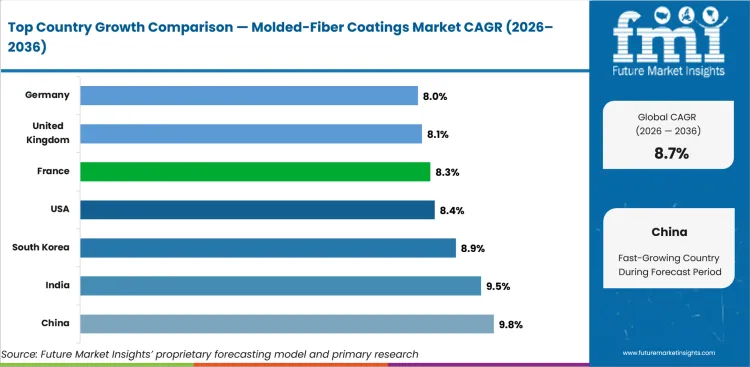
Source: Future Market Insights, 2026.
How do country-level CAGRs compare in the molded-fiber coatings market?
China leads country growth while Japan records the most cautious expansion outlook among profiled markets.
- China is forecast to record 9.8% CAGR by 2036 as parcel packaging and food delivery support faster coated fiber conversion.
- India is expected to expand at 9.5% CAGR from 2026 to 2036 due to plastic packaging compliance and foodservice trials.
- South Korea is projected to grow at 8.9% CAGR through 2036 as organized foodservice procurement supports approved coated fiber formats.
- United States is estimated to rise at 8.4% CAGR by 2036 with PFAS-free food-contact packaging and state packaging rules.
- France is expected to advance at 8.3% CAGR over the forecast period as plastic reduction policy supports produce and takeaway packaging trials.
- United Kingdom is forecast to grow at 8.1% CAGR through 2036 as EPR fee signals influence pack material selection.
- Germany is projected to post 8.0% CAGR by 2036 as recycling proof and technical documentation shape buyer approval.
- Japan is expected to advance at 7.6% CAGR by 2036 as quality-led convenience retail trials require longer validation.
How fast is the molded-fiber coatings market growing in China?
A 9.8% CAGR through 2036 reflects parcel packaging scale and food delivery conversion across coastal packaging corridors.
Country Market Snapshot Table
| Parameter | Value |
|---|---|
| Market Size in 2025 (Value) | USD 175.2 million |
| Market Size in 2026 (Value) | USD 192.4 million |
| Market Forecast in 2036 (Value) | USD 490.0 million |
| CAGR (2026 to 2036) | 9.8% |
| Years Considered | 2021 to 2036 |
| Base Year | 2025 |
| Forecast Period | 2026 to 2036 |
| Units Considered | Value (USD million) |
| Leading Sub-Region | Yangtze River Delta and coastal packaging corridors |
China Molded-Fiber Coatings Market Outlook
China molded-fiber coating demand is influenced by parcel packaging scale, delivery meals, and local converter capacity. Coating suppliers can benefit when water-based and bio-based systems match high-throughput molding lines.
Local packaging producers are expected to prioritize coating consistency, drying efficiency, and practical technical service. Buyers with large parcel and delivery volumes should favor coating systems that reduce plastic use without slowing plant output.
Key Growth Drivers
- Parcel packaging scale gives molded fiber inserts and protective formats a larger trial setting. China handled over 175 billion parcels in 2024 with a 21.5% increase from the prior year.
- Green-transition capability supports recycled-material learning for packaging suppliers. A Chinese circular-material enterprise consumed more than 30 billion plastic bottles every year through polyester-yarn recovery, according to a January 2025 State Council address.
- Food delivery platforms need coated bowls and trays that can handle oil, sauce, and delivery-time moisture without leakage.
- Local coating partnerships help suppliers adapt water-based and bio-based systems to domestic converter economics.
Key Restraints
- Price-sensitive foodservice buyers can delay premium coating adoption when uncoated fiber remains available.
- Converter fragmentation can make coating performance inconsistent across provinces and plant types.
- Packaging compliance pressure can slow supplier approval because China’s revised express delivery rules contain 15 articles and clarify responsibilities for green packaging research, reduced secondary packaging, and material recycling.
What makes China unique
China is unique due to parcel scale and fast localization of coating chemistry across molded fiber and paper packaging converters.
Key Companies
- BASF China
- Solenis China
- Michelman China
- Stora Enso China
- Local molded fiber converters
- Regional packaging coating distributors
- Food delivery packaging suppliers
Sales & Marketing Channels
- Direct sales to molded fiber factories
- E-commerce and parcel packaging buyers
- Food delivery platform procurement
- Provincial converter networks
- Multinational brand-owner trials
- Packaging distributor channels
Country Segment Breakdown Table
| Segment | Sub-Segments |
|---|---|
| By Coating Type | Water-based Barrier Coatings · Bio-based Coatings · Dispersion Coatings · Other |
| By Function | Oil & Grease Resistance · Moisture Barrier · Heat Sealability · Printability / Other |
| By End Use | Foodservice Packaging · Fresh Produce Packaging · Consumer Goods · Industrial / Other |
| By Fiber Feedstock | Virgin Fiber · Recycled Fiber · Agricultural Residue Fiber |
| By Sales Channel | Direct to Molders · Distributors / Converters |
| Key Sub-Regions Covered, Coastal Packaging Clusters | Shanghai · Zhejiang · Jiangsu · Guangdong · Shandong · Sichuan |
Frequently Asked Questions
How fast is China molded-fiber coatings market growing?
Sales in China are ready to scale at 9.8% CAGR from 2026 to 2036, guided by parcel and food delivery packaging demand.
Who leads China molded-fiber coatings market?
BASF, Solenis, Michelman, Stora Enso, and local coating distributors compete based on barrier technology and converter access.
What is driving adoption in China molded-fiber coatings market?
Parcel scale and food delivery packaging are moving buyers toward coated molded fiber formats.
What is driving molded-fiber coatings growth in India?
A 9.5% CAGR through 2036 is supported by plastic packaging compliance and foodservice conversion.
Country Market Snapshot Table
| Parameter | Value |
|---|---|
| Market Size in 2025 (Value) | USD 62.0 million |
| Market Size in 2026 (Value) | USD 67.9 million |
| Market Forecast in 2036 (Value) | USD 168.3 million |
| CAGR (2026 to 2036) | 9.5% |
| Years Considered | 2021 to 2036 |
| Base Year | 2025 |
| Forecast Period | 2026 to 2036 |
| Units Considered | Value (USD million) |
| Leading Sub-Region | Western and southern foodservice packaging corridors |
India Molded-Fiber Coatings Market Outlook
India molded-fiber coating demand is shaped by food delivery, quick-service restaurants, institutional catering, and export-oriented bagasse packaging. Coatings are needed as molded fiber products move from dry snacks into wet curries, oily meals, and hot takeaway use.
The market is cost-sensitive, so suppliers must prove that coatings improve pack acceptance and reduce leakage complaints. Distributor support and practical line guidance should matter for regional molders.
Key Growth Drivers
- Plastic packaging compliance pushes brand owners to review lower-plastic foodservice formats. India reported 60,128 registered producers, importers, and brand owners under the EPR portal in 2026.
- Recycling infrastructure scale supports packaging compliance programs. India reported 3,012 registered plastic waste processors under its EPR framework.
- Food delivery chains need molded bowls and lids that resist sauces, oils, and longer delivery handling.
- Export-oriented bagasse producers need coatings that meet overseas buyer standards for food contact and barrier reliability.
Key Restraints
- Small molders often lack coating controls and drying discipline needed for consistent barrier performance.
- Low-cost uncoated tableware keeps price pressure high in local foodservice channels.
- Documentation pressure remains high as around 207 lakh tonnes of plastic packaging waste have been recycled after EPR guidelines came into force.
What makes India unique
India is unique because molded fiber and bagasse capacity is broad, but coating quality decides access to higher-value foodservice and export demand.
Key Companies
- Michelman India
- BASF India
- Solenis India
Sales & Marketing Channels
- Direct sales to bagasse and molded fiber producers
- Regional packaging distributors
- Food delivery packaging suppliers
- Export tableware buyer audits
- Quick-service restaurant procurement
- Institutional catering suppliers
Country Segment Breakdown Table
| Segment | Sub-Segments |
|---|---|
| By Coating Type | Water-based Barrier Coatings · Bio-based Coatings · Dispersion Coatings · Other |
| By Function | Oil & Grease Resistance · Moisture Barrier · Heat Sealability · Printability / Other |
| By End Use | Foodservice Packaging · Fresh Produce Packaging · Consumer Goods · Industrial / Other |
| By Fiber Feedstock | Virgin Fiber · Recycled Fiber · Agricultural Residue Fiber |
| By Sales Channel | Direct to Molders · Distributors / Converters |
| Key Sub-Regions Covered, Foodservice and Export Packaging Corridors | Maharashtra · Gujarat · Karnataka · Tamil Nadu · Telangana · Delhi NCR |
Frequently Asked Questions
How fast is India molded-fiber coatings market growing?
Demand in India is ready to rise at 9.5% CAGR from 2026 to 2036 with foodservice and EPR-led packaging conversion.
Who leads India molded-fiber coatings market?
Michelman, BASF, Solenis, and regional bagasse packaging suppliers compete through coating support and customer trials.
What is driving adoption in India molded-fiber coatings market?
Food delivery needs and plastic packaging compliance are moving molders toward coated fiber formats.
How is the molded-fiber coatings market performing in South Korea?
An 8.9% CAGR through 2036 reflects organized recycling expectations and centralized foodservice procurement.
Country Market Snapshot Table
| Parameter | Value |
|---|---|
| Market Size in 2025 (Value) | USD 40.7 million |
| Market Size in 2026 (Value) | USD 44.3 million |
| Market Forecast in 2036 (Value) | USD 103.9 million |
| CAGR (2026 to 2036) | 8.9% |
| Years Considered | 2021 to 2036 |
| Base Year | 2025 |
| Forecast Period | 2026 to 2036 |
| Units Considered | Value (USD million) |
| Leading Sub-Region | Seoul Capital Area foodservice networks |
South Korea Molded-Fiber Coatings Market Outlook
South Korea demand is expected to build around cafe chains, delivery food platforms, and organized packaging recovery systems. Buyers require clean pack finish, reliable lid fit, and leakage resistance before wider rollouts.
Centralized procurement can help approved coated fiber formats scale quickly. The main challenge is matching premium appearance and cost expectations against plastic-lined formats.
Key Growth Drivers
- Plastic circularity policy supports coating systems that reduce plastic use. South Korea set a 2030 target of 1 million tonnes source reduction in plastic waste.
- Recycled-material policy strengthens packaging review. South Korea aims to increase recycled PET bottle content from 10% to 30% by 2030.
- Seoul-area cafe chains need coated beverage carriers and trays for takeaway channels.
- Food delivery platforms create demand for moisture-resistant molded bowls and lids.
Key Restraints
- Franchise buyers may reject coated fiber if lid fit or surface finish differs across batches.
- Imported specialty coatings can face pricing pressure when local buyers compare them against plastic-lined packs.
- Excessive packaging controls can limit oversized packs as South Korea references product-to-package volume limits of 50% or less for certain delivery packaging controls.
What makes South Korea unique
South Korea is unique because centralized foodservice procurement can scale approved coated fiber formats quickly after technical approval.
Key Companies
- BASF Korea
- Solenis Korea
- Michelman Asia-Pacific suppliers
Sales & Marketing Channels
- Franchise chain procurement
- Food delivery platform packaging reviews
- Converter and distributor networks
- Cafe and bakery supplier catalogs
- Retail sustainability teams
- Packaging testing partners
Country Segment Breakdown Table
| Segment | Sub-Segments |
|---|---|
| By Coating Type | Water-based Barrier Coatings · Bio-based Coatings · Dispersion Coatings · Other |
| By Function | Oil & Grease Resistance · Moisture Barrier · Heat Sealability · Printability / Other |
| By End Use | Foodservice Packaging · Fresh Produce Packaging · Consumer Goods · Industrial / Other |
| By Fiber Feedstock | Virgin Fiber · Recycled Fiber · Agricultural Residue Fiber |
| By Sales Channel | Direct to Molders · Distributors / Converters |
| Key Sub-Regions Covered, Foodservice Packaging Clusters | Seoul · Incheon · Gyeonggi · Busan · Daegu · Daejeon |
Frequently Asked Questions
How fast is South Korea molded-fiber coatings market growing?
Sales in South Korea are expected to increase at 8.9% CAGR from 2026 to 2036 through organized foodservice packaging trials.
Who leads South Korea molded-fiber coatings market?
BASF Korea, Solenis Korea, local converters, and packaging distributors compete based on coating performance and buyer access.
What is driving adoption in South Korea molded-fiber coatings market?
Food delivery platforms and cafe chains are moving buyers toward coated molded fiber formats.
What is the molded-fiber coatings market outlook in the United States?
An 8.4% CAGR through 2036 is supported by PFAS-free food-contact packaging and state-level packaging rules.
Country Market Snapshot Table
| Parameter | Value |
|---|---|
| Market Size in 2025 (Value) | USD 235.6 million |
| Market Size in 2026 (Value) | USD 255.4 million |
| Market Forecast in 2036 (Value) | USD 572.2 million |
| CAGR (2026 to 2036) | 8.4% |
| Years Considered | 2021 to 2036 |
| Base Year | 2025 |
| Forecast Period | 2026 to 2036 |
| Units Considered | Value (USD million) |
| Leading Sub-Region | West Coast and national foodservice networks |
United States Molded-Fiber Coatings Market Outlook
United States molded-fiber coating demand is shaped by foodservice testing, retailer sustainability reviews, and PFAS-free packaging requirements. Large customers often require lab-to-line validation before national conversion.
State packaging policy is creating stronger interest in recyclable and compostable foodservice ware. Suppliers with food-contact support and molder trial capacity should gain better approval speed.
Key Growth Drivers
- California packaging rules create a strong substitution signal. CalRecycle states that by 2032, 100% of covered single-use packaging and plastic foodservice ware must be recyclable or compostable.
- Foodservice material reduction is becoming measurable. California’s SB 54 targets a 25% reduction in covered single-use plastic packaging and foodservice ware.
- Quick-service restaurant chains are testing coated bowls and trays in states with stronger packaging scrutiny.
- Retail produce buyers need molded trays that resist condensation during refrigerated distribution.
Key Restraints
- Multi-state rules create different compliance screens for the same foodservice package.
- National chains require long trial periods before replacing incumbent plastic or coated paper formats.
- Grease-barrier documentation pressure increased after FDA determined that 35 PFAS-related food contact notifications were no longer effective in 2025.
What makes the United States unique
United States is unique due to state-driven packaging requirements and large chain-level qualification programs.
Key Companies
- Solenis LLC
- Michelman Inc.
- BASF Corporation
- Kemira North America
- Siegwerk USA
Sales & Marketing Channels
- Direct enterprise sales to molded fiber producers
- Converter and packaging distributor networks
- Quick-service restaurant specification teams
- Retailer sustainability procurement programs
- Food-contact and recyclability testing partners
- Packaging compliance consultants
Country Segment Breakdown Table
| Segment | Sub-Segments |
|---|---|
| By Coating Type | Water-based Barrier Coatings · Bio-based Coatings · Dispersion Coatings · Other |
| By Function | Oil & Grease Resistance · Moisture Barrier · Heat Sealability · Printability / Other |
| By End Use | Foodservice Packaging · Fresh Produce Packaging · Consumer Goods · Industrial / Other |
| By Fiber Feedstock | Virgin Fiber · Recycled Fiber · Agricultural Residue Fiber |
| By Sales Channel | Direct to Molders · Distributors / Converters |
| Key Sub-Regions Covered, Foodservice and Retail Packaging Networks | California · Pacific Northwest · Midwest · Northeast · Texas · Southeast |
Frequently Asked Questions
How fast is United States molded-fiber coatings market growing?
Sector in the United States is anticipated to grow at 8.4% CAGR from 2026 to 2036 reflecting PFAS-free and recyclable packaging demand.
Who leads United States molded-fiber coatings market?
Solenis, Michelman, BASF, Kemira, and Siegwerk compete based on food-contact coating technology and molder support.
What is driving adoption in United States molded-fiber coatings market?
PFAS-free grease resistance and state packaging rules are moving demand toward coated molded fiber.
How is the molded-fiber coatings market performing in France?
An 8.3% CAGR through 2036 reflects plastic reduction policy and produce packaging conversion.
Country Market Snapshot Table
| Parameter | Value |
|---|---|
| Market Size in 2025 (Value) | USD 73.2 million |
| Market Size in 2026 (Value) | USD 79.3 million |
| Market Forecast in 2036 (Value) | USD 176.0 million |
| CAGR (2026 to 2036) | 8.3% |
| Years Considered | 2021 to 2036 |
| Base Year | 2025 |
| Forecast Period | 2026 to 2036 |
| Units Considered | Value (USD million) |
| Leading Sub-Region | Paris and western fresh produce packaging corridors |
France Molded-Fiber Coatings Market Outlook
France demand is supported by plastic-reduction policy and retailer work on produce and takeaway packaging. Coated molded fiber gains where reuse is impractical and food hygiene favors single-use formats.
The market is selective because reduction and reuse rules can compete with simple material substitution. Suppliers must show that coating chemistry supports food-contact use and recycling expectations.
Key Growth Drivers
- France’s national 3R framework set a 20% reduction target for single-use plastic packaging by the end of 2025.
- The framework also aims for 100% recycling of single-use plastic packaging by 1 January 2025, supporting coated fiber alternatives with recovery evidence.
- Fresh produce packers are testing molded trays that protect shelf presentation while reducing plastic tray exposure.
- Bakery and prepared-food channels need grease-resistant fiber formats for urban takeaway sales.
Key Restraints
- Reuse policy can reduce single-use pack demand in institutional and dine-in settings.
- Buyers need proof that coating chemistry aligns with French packaging and food-contact expectations.
- Environmental claim controls remain strict because France’s November 2025 AGEC FAQ states that recycled-content claims must use exact values and cannot use ranges such as 30% to 80% recycled material.
What makes France unique
France is unique due to reduction and reuse goals that make coated fiber opportunities more application-specific than simple plastic replacement.
Key Companies
- Solenis France
- BASF France
- Siegwerk France
- Sappi Europe
- Stora Enso France
Sales & Marketing Channels
- Retailer private-label packaging teams
- Foodservice procurement groups
- Fresh produce packing houses
- Converter and distributor sales
- Sustainability compliance advisers
- Packaging trial laboratories
Country Segment Breakdown Table
| Segment | Sub-Segments |
|---|---|
| By Coating Type | Water-based Barrier Coatings · Bio-based Coatings · Dispersion Coatings · Other |
| By Function | Oil & Grease Resistance · Moisture Barrier · Heat Sealability · Printability / Other |
| By End Use | Foodservice Packaging · Fresh Produce Packaging · Consumer Goods · Industrial / Other |
| By Fiber Feedstock | Virgin Fiber · Recycled Fiber · Agricultural Residue Fiber |
| By Sales Channel | Direct to Molders · Distributors / Converters |
| Key Sub-Regions Covered, Retail and Produce Packaging Areas | Paris · Lyon · Lille · Marseille · Nantes · Bordeaux |
Frequently Asked Questions
How fast is France molded-fiber coatings market growing?
Industry in France is projected to increase at 8.3% CAGR from 2026 to 2036 through plastic-reduction packaging programs.
Who leads France molded-fiber coatings market?
Solenis, BASF, Siegwerk, Sappi, Stora Enso, and local converters compete through barrier and fiber packaging capabilities.
What is driving adoption in France molded-fiber coatings market?
Plastic reduction targets and produce packaging trials are moving buyers toward coated molded fiber.
What is the molded-fiber coatings market forecast for the United Kingdom?
An 8.1% CAGR through 2036 reflects EPR fee pressure and foodservice packaging classification needs.
Country Market Snapshot Table
| Parameter | Value |
|---|---|
| Market Size in 2025 (Value) | USD 67.0 million |
| Market Size in 2026 (Value) | USD 72.5 million |
| Market Forecast in 2036 (Value) | USD 158.0 million |
| CAGR (2026 to 2036) | 8.1% |
| Years Considered | 2021 to 2036 |
| Base Year | 2025 |
| Forecast Period | 2026 to 2036 |
| Units Considered | Value (USD million) |
| Leading Sub-Region | London and national grocery packaging corridors |
United Kingdom Molded-Fiber Coatings Market Outlook
United Kingdom demand is shaped by EPR base fees, recyclability assessment, and foodservice packaging classification. Buyers are reviewing whether coated fiber packs are treated closer to paper and board or fiber-based composite material.
Foodservice groups want oil resistance, but procurement teams also ask whether the final pack can be collected and processed. Suppliers with clear recyclability evidence can move faster through approval.
Key Growth Drivers
- EPR fee signals make material classification important. GOV.UK listed 2025 base fees of £196 per tonne for paper and card.
- Composite classification creates a sharper cost comparison. GOV.UK listed 2025 base fees of £461 per tonne for fibre-based composite material.
- London and major city takeaway chains are testing lower-plastic bowl and tray formats.
- Grocery buyers are reviewing fresh produce packs to reduce plastic trays and film.
Key Restraints
- Coated fiber can lose its price case if buyers fear higher composite packaging fees.
- Local recycling acceptance varies across councils and creates buyer uncertainty.
- Recyclability classification raises coating-design pressure because GOV.UK states that fibre-based composite packaging is classified that way only when plastic layers are more than 5% by mass.
What makes the United Kingdom unique
United Kingdom is unique because packaging fee classification can influence coating choice as much as barrier performance.
Key Companies
- Solenis UK
- BASF UK
- Siegwerk UK
- Sappi Europe
- Stora Enso UK
- Foodservice packaging distributors
- Grocery packaging converters
Sales & Marketing Channels
- Foodservice distributor catalogs
- Grocery private-label packaging tenders
- Converter technical sales teams
- Sustainability consultant-led pack reviews
- Regional packaging wholesalers
- Retail compliance teams
Country Segment Breakdown Table
| Segment | Sub-Segments |
|---|---|
| By Coating Type | Water-based Barrier Coatings · Bio-based Coatings · Dispersion Coatings · Other |
| By Function | Oil & Grease Resistance · Moisture Barrier · Heat Sealability · Printability / Other |
| By End Use | Foodservice Packaging · Fresh Produce Packaging · Consumer Goods · Industrial / Other |
| By Fiber Feedstock | Virgin Fiber · Recycled Fiber · Agricultural Residue Fiber |
| By Sales Channel | Direct to Molders · Distributors / Converters |
| Key Sub-Regions Covered, Grocery and Foodservice Packaging Clusters | London · Manchester · Birmingham · Leeds · Glasgow · Bristol |
Frequently Asked Questions
How fast is United Kingdom molded-fiber coatings market growing?
Demand in the United Kingdom is ready to rise at 8.1% CAGR from 2026 to 2036 with EPR and recyclability-led pack selection.
Who leads United Kingdom molded-fiber coatings market?
Solenis, BASF, Siegwerk, Sappi, Stora Enso, and converter networks compete through barrier evidence and customer trials.
What is driving adoption in United Kingdom molded-fiber coatings market?
EPR fee signals and foodservice plastic substitution are moving buyers toward coated molded fiber.
How is the molded-fiber coatings market performing in Germany?
An 8.0% CAGR through 2036 reflects recycling proof and technical packaging qualification.
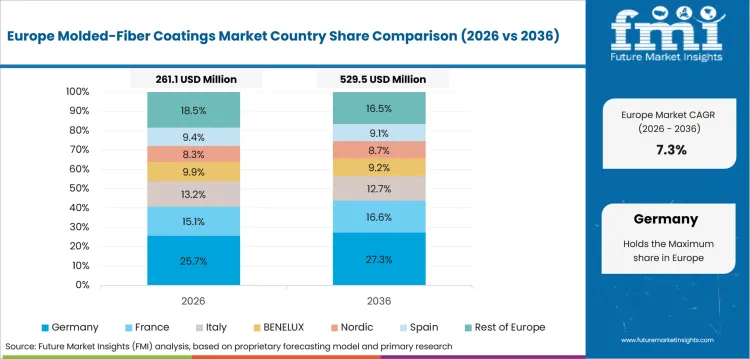
Country Market Snapshot Table
| Parameter | Value |
|---|---|
| Market Size in 2025 (Value) | USD 95.4 million |
| Market Size in 2026 (Value) | USD 103.0 million |
| Market Forecast in 2036 (Value) | USD 222.4 million |
| CAGR (2026 to 2036) | 8.0% |
| Years Considered | 2021 to 2036 |
| Base Year | 2025 |
| Forecast Period | 2026 to 2036 |
| Units Considered | Value (USD million) |
| Leading Sub-Region | North Rhine-Westphalia and Bavaria packaging corridors |
Germany Molded-Fiber Coatings Market Outlook
Germany molded-fiber coating demand is shaped by technical buyer scrutiny, recycling culture, and packaging documentation. Buyers usually require recognized test evidence before scaling new barrier chemistries.
Supplier selection is documentation-led. BASF, Siegwerk, Sappi, and Stora Enso have relevant European coating or fiber packaging capabilities that support molded fiber qualification.
Key Growth Drivers
- German recycling systems create a strong test environment. UBA stated in January 2026 that around 5.5 million tonnes of packaging waste collected by dual systems were recycled in 2024.
- Packaging recycling performance supports fiber recovery claims. UBA reported a 70% recycling rate for plastic packaging in 2024 within dual-system recycling discussion.
- Bakery and convenience food buyers need grease control for short-life takeaway formats.
- German machinery and print networks support coating trials linked to forming and finishing steps.
Key Restraints
- Buyers often require evidence from recognized recycling protocols before scale approval.
- Higher labor and energy costs make coating drying time a stronger production concern.
- Technical scrutiny remains high because UBA stated in January 2026 that only 5 of 8 packaging recycling targets were met in 2024, while beverage cartons, glass packaging, and composite packaging missed their targets.
What makes Germany unique
Germany is unique because technical proof and recyclability evidence often decide supplier entry before price negotiation begins.
Key Companies
- BASF SE
- Siegwerk Druckfarben AG & Co. KGaA
- Sappi Europe
- Stora Enso Germany
- Solenis Germany
- Kemira Germany
- Packaging testing laboratories
Sales & Marketing Channels
- Direct technical sales to molders
- Paper mill and coating line partnerships
- Packaging converter tenders
- Foodservice brand qualification programs
- Laboratory certification and recycling test routes
- Specialty distributor networks
Country Segment Breakdown Table
| Segment | Sub-Segments |
|---|---|
| By Coating Type | Water-based Barrier Coatings · Bio-based Coatings · Dispersion Coatings · Other |
| By Function | Oil & Grease Resistance · Moisture Barrier · Heat Sealability · Printability / Other |
| By End Use | Foodservice Packaging · Fresh Produce Packaging · Consumer Goods · Industrial / Other |
| By Fiber Feedstock | Virgin Fiber · Recycled Fiber · Agricultural Residue Fiber |
| By Sales Channel | Direct to Molders · Distributors / Converters |
| Key Sub-Regions Covered, Technical Packaging Corridors | North Rhine-Westphalia · Bavaria · Baden-Württemberg · Hesse · Lower Saxony · Hamburg |
Frequently Asked Questions
How fast is Germany molded-fiber coatings market growing?
Industry in Germany is expected to rise at 8.0% CAGR from 2026 to 2036 through recycling-led packaging qualification.
Who leads Germany molded-fiber coatings market?
BASF, Siegwerk, Sappi, Stora Enso, Solenis, and Kemira compete through barrier resin, coating, and fiber packaging portfolios.
What is driving adoption in Germany molded-fiber coatings market?
Recycling proof and foodservice documentation requirements are moving buyers toward coated molded fiber formats.
What is the molded-fiber coatings market forecast for Japan?
A 7.6% CAGR through 2036 reflects quality-led packaging trials and convenience retail discipline.
Country Market Snapshot Table
| Parameter | Value |
|---|---|
| Market Size in 2025 (Value) | USD 52.6 million |
| Market Size in 2026 (Value) | USD 56.6 million |
| Market Forecast in 2036 (Value) | USD 117.7 million |
| CAGR (2026 to 2036) | 7.6% |
| Years Considered | 2021 to 2036 |
| Base Year | 2025 |
| Forecast Period | 2026 to 2036 |
| Units Considered | Value (USD million) |
| Leading Sub-Region | Tokyo and convenience retail corridors |
Japan Molded-Fiber Coatings Market Outlook
Japan demand is expected to build through convenience retail, bento packaging, and prepared-food formats that need clean presentation and reliable sealing. Coated molded fiber must meet strict quality expectations before wider use.
Japanese buyers often require stable coating appearance, predictable handling, and food-contact confidence. Bio-based coatings can gain interest when they meet the same performance standards as water-based systems.
Key Growth Drivers
- Japan’s foodtech policy material stated in 2025 that food tech was designated as one of 17 national strategic fields, supporting packaging innovation around prepared foods.
- Japan’s environment plan stated in 2025 that greenhouse gas emissions should be reduced by 60% in FY2035 and 73% in FY2040 from FY2013 levels.
- Convenience food channels need molded fiber trays that resist moisture during chilled display.
- Trading houses and converters can organize supplier screening for imported coating technologies.
Key Restraints
- Tight visual quality requirements make surface defects and staining harder to accept.
- Domestic buyers may run long validation cycles before changing food-contact packs.
- Sustainability-linked buyer scrutiny is rising as Japan’s 2025 environment plan also submitted those FY2035 and FY2040 targets as its national climate contribution.
What makes Japan unique
Japan is unique because coating acceptance depends on appearance control and user experience as much as sustainability claims.
Key Companies
- BASF Japan
- Solenis Japan
- Michelman Asia-Pacific suppliers
- Sappi Japan-facing channels
- Stora Enso Japan-facing channels
- Domestic packaging converters
- Trading company sourcing networks
Sales & Marketing Channels
- Trading company sourcing networks
- Convenience store packaging teams
- Foodservice converter channels
- Imported specialty coating distributors
- Brand-owner sustainability departments
- Packaging testing partners
Country Segment Breakdown Table
| Segment | Sub-Segments |
|---|---|
| By Coating Type | Water-based Barrier Coatings · Bio-based Coatings · Dispersion Coatings · Other |
| By Function | Oil & Grease Resistance · Moisture Barrier · Heat Sealability · Printability / Other |
| By End Use | Foodservice Packaging · Fresh Produce Packaging · Consumer Goods · Industrial / Other |
| By Fiber Feedstock | Virgin Fiber · Recycled Fiber · Agricultural Residue Fiber |
| By Sales Channel | Direct to Molders · Distributors / Converters |
| Key Sub-Regions Covered, Convenience Retail Corridors | Tokyo · Osaka · Nagoya · Fukuoka · Yokohama · Sapporo |
Frequently Asked Questions
How fast is Japan molded-fiber coatings market growing?
Sector in Japan is projected at 7.6% CAGR from 2026 to 2036 as convenience retail tests coated fiber packaging.
Who leads Japan molded-fiber coatings market?
BASF Japan, Solenis Japan, Michelman suppliers, trading houses, and domestic converters compete through validation-led coating access.
What is driving adoption in Japan molded-fiber coatings market?
Convenience retail packaging and chilled food presentation are supporting coated molded fiber trials.
Who are the leading companies in the molded-fiber coatings market?
Solenis, BASF, Michelman, Kemira, and Siegwerk.
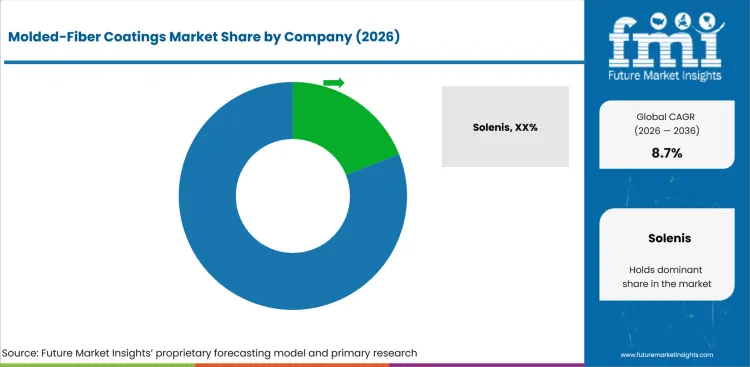
- Established coating companies hold an advantage through food-contact chemistry and molder-level technical support.
- Fiber packaging suppliers gain relevance by providing recyclable paper and board formats that shape buyer expectations.
- Specialist coating developers gain access when they prove PFAS-free grease resistance and repulpability together.
- Retail-ready evidence supports trial through clear recyclability testing, coating performance data, and application guidance.
Coating suppliers in the market compete by combining formulation depth with converter execution. Solenis and HEIDELBERG gained stronger visibility after their September 2024 collaboration on print-applied barrier coatings for paper packaging. Michelman strengthened its position in November 2025 by introducing Michem Coat 9250 for recyclable hot beverage cups. BASF and UPM added another fiber-based packaging signal in May 2026 through recyclable packaging work using Joncryl HPB technology.
Manufacturing support has become a competitive separator as coated fiber moves beyond laboratory tests into molding lines. Suppliers must help customers manage coating weight, drying time, nesting marks, and sealing behavior. Sappi’s January 2026 heat-sealable paper portfolio and Siegwerk’s August 2024 functional paper coating work show how fiber packaging suppliers are expanding beyond basic barrier claims. Customers are expected to favor companies that can support real packaging qualification rather than stand-alone material promotion.
Smaller and regional players can win through faster customization and local converter access. China and India create scale opportunities where price and line speed decide adoption. Germany, France, the United Kingdom, and the United States create more documentation-heavy conditions because recyclability and food-contact proof influence buyer approval. Companies with practical trial support and conservative sustainability claims should gain more durable listing decisions.
How do top molded-fiber coatings companies compare?
Solenis and Michelman score strongest on molder support while BASF leads in barrier resin depth.
| Company | Relevance to Market Title | Barrier Chemistry Depth | Molded Fiber Trial Support | Recycling Evidence Strength | Channel Reach | Geographic Footprint |
|---|---|---|---|---|---|---|
| Solenis | Very High | Very Strong | Very Strong | Strong | Very Strong | Global |
| BASF | Very High | Very Strong | Strong | Strong | Very Strong | Global |
| Michelman | Very High | Strong | Very Strong | Very Strong | Strong | Global |
| Kemira | High | Strong | Moderate | Strong | Strong | Europe and North America |
| Siegwerk | High | Strong | Moderate | Strong | Strong | Global |
| Sappi | Moderate to High | Moderate | Moderate | Very Strong | Strong | Europe and Americas |
| Stora Enso | Moderate to High | Moderate | Moderate | Very Strong | Strong | Europe and Asia |
Source: Future Market Insights competitive analysis, 2026.
Who are the key players in the molded-fiber coatings market?
Solenis, BASF and Michelman are listed with Kemira and Siegwerk among other suppliers.
Key global companies leading the molded-fiber coatings market include:
- Solenis
- BASF
- Michelman
- Kemira
- Siegwerk
- Sappi
- Stora Enso
- UPM Specialty Materials
- Regional molded fiber converters
- Packaging coating distributors
Key Developments in Molded-Fiber Coatings Market
- In September 2024, Solenis and HEIDELBERG collaborated to develop print-applied barrier coatings for paper packaging.
- In November 2025, Michelman introduced Michem Coat 9250 for recyclable hot beverage cups and paper-based foodservice structures.
- In May 2026, UPM and BASF announced collaboration on recyclable fiber-based packaging using UPM papers and BASF Joncryl HPB barrier technology.
Key Players in the Molded-Fiber Coatings Market
Barrier Coating Formulators
- Solenis
- BASF
- Michelman
- Kemira
- Siegwerk
Fiber Packaging Specialists
- Sappi
- Stora Enso
- UPM Specialty Materials
- Regional paper and board producers
Regional Converter and Channel Companies
- Molded fiber producers
- Foodservice packaging converters
- Packaging coating distributors
- Recyclability testing partners
- Retail packaging specification teams
Molded-Fiber Coatings Market - Report Scope
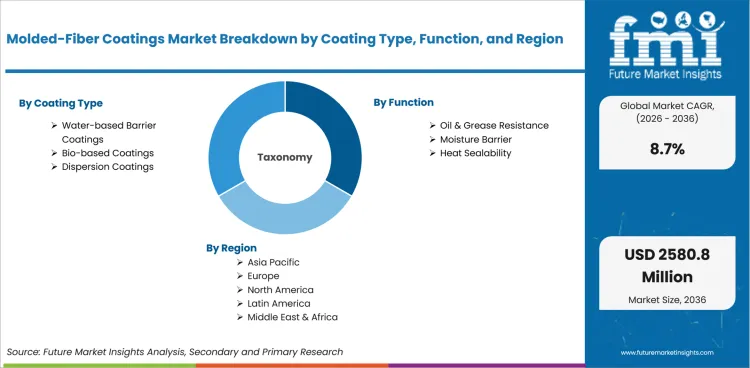
| Parameter | Details |
|---|---|
| Forecast period | 2026 to 2036 |
| Historical period | 2021 to 2025 |
| Quantitative unit | Revenue in USD million |
| By coating type | Water-based barrier coatings, bio-based coatings, dispersion coatings, other |
| By function | Oil & grease resistance, moisture barrier, heat sealability, printability / other |
| By end use | Foodservice packaging, fresh produce packaging, consumer goods, industrial / other |
| By fiber feedstock | Virgin fiber, recycled fiber, agricultural residue fiber |
| By sales channel | Direct to molders, distributors / converters |
| Regions covered | North America, Latin America, Europe, East Asia, South Asia and Pacific, Middle East and Africa |
| Countries covered | China, India, South Korea, United States, France, United Kingdom, Germany, Japan |
| Key companies profiled | Solenis, BASF, Michelman, Kemira, Siegwerk, Sappi, Stora Enso |
| Approach | Hybrid bottom-up and top-down methodology using coating value, molded fiber output, application mix, country policy signals, and supplier portfolio validation |
Source: Future Market Insights, 2026.
Molded-Fiber Coatings Market - Scope & Definition
| Attribute | Detail |
|---|---|
| Market Definition | Barrier coatings, dispersion coatings, and bio-based surface treatments applied to molded fiber packaging for grease resistance, moisture protection, heat sealing, and printability |
| Functions Covered | Oil resistance, grease resistance, moisture barrier, heat sealability, printability, fiber surface protection |
| Applications Covered | Molded fiber trays, bowls, clamshells, cup carriers, produce trays, inserts, and industrial protective formats |
| End-Use Industries | Foodservice packaging, fresh produce packaging, consumer goods packaging, industrial packaging |
| Grades Covered | Water-based barrier systems, bio-based coating systems, dispersion coatings, and specialty functional coatings |
| Inclusions | All commercially traded molded-fiber coating systems across coating type, function, end use, fiber feedstock, sales channel, and selected countries |
| Exclusions | Uncoated molded fiber products, rigid plastic containers, paperboard coatings outside molded fiber use, machinery revenue, finished retail packaging margins, and unrelated protective packaging formats |
Molded-Fiber Coatings Market - Research Methodology
| Method | Description |
|---|---|
| Primary Research | FMI analyst interviews with molded fiber producers, coating formulators, foodservice packaging buyers, converters, distributors, and sustainability teams across key markets |
| Desk Research | Review of regulatory data from packaging authorities, environmental agencies, company releases, recyclability frameworks, and technical literature related to fiber packaging coatings |
| Market Sizing & Forecasting | Hybrid bottom-up and top-down approach using coating value, molded fiber output, application mix, country policy signals, and supplier portfolio validation |
| Data Validation | Cross-verification using packaging rules, food-contact requirements, recycling evidence, supplier developments, converter qualification patterns, and country-level adoption checks |
Molded-Fiber Coatings Market Breakdown by Coating Type, Function, End Use, Fiber Feedstock, Sales Channel, and Region
Molded-Fiber Coatings Market Segmented by Coating Type
- Water-based Barrier Coatings
- Bio-based Coatings
- Dispersion Coatings
- Other
Molded-Fiber Coatings Market Segmented by Function
- Oil & Grease Resistance
- Moisture Barrier
- Heat Sealability
- Printability / Other
Molded-Fiber Coatings Market Segmented by End Use
- Foodservice Packaging
- Fresh Produce Packaging
- Consumer Goods
- Industrial / Other
Molded-Fiber Coatings Market Segmented by Fiber Feedstock
- Virgin Fiber
- Recycled Fiber
- Agricultural Residue Fiber
Molded-Fiber Coatings Market Segmented by Sales Channel
- Direct to Molders
- Distributors / Converters
Molded-Fiber Coatings Market by Region
- North America
- Latin America
- Europe
- East Asia
- South Asia and Pacific
- Middle East and Africa
Research Sources and Bibliography
- BASF. (2026, May 4). UPM and BASF accelerate the transition to recyclable, fiber-based packaging.
- California Department of Resources Recycling and Recovery. (2026, May 1). California approves new plastic and packaging rules that put consumers first.
- California Department of Resources Recycling and Recovery. (2026). SB 54: Plastic Pollution Prevention and Packaging Producer Responsibility Act.
- Department for Environment, Food & Rural Affairs. (2024, December 23). Recyclability assessment methodology: Stages of recyclability and definitions. GOV.UK.
- Department for Environment, Food & Rural Affairs. (2025, June 30). Extended Producer Responsibility for Packaging: 2025 base fees. GOV.UK.
- Department for Environment, Food & Rural Affairs. (2025, July 23). UK statistics on waste. GOV.UK.
- Department for Environment, Food & Rural Affairs. (2025). Extended producer responsibility for packaging: Recycling obligations and waste disposal fees. GOV.UK.
- Department for Environment, Food & Rural Affairs. (2025). Packaging data: What to collect for extended producer responsibility. GOV.UK.
- European Commission. (2025). Packaging and Packaging Waste Regulation.
- Food and Drug Administration. (2025, January 3). FDA determines authorization of 35 food contact notifications related to PFAS are no longer effective.
- German Environment Agency. (2026, January 27). Facts against myths: Packaging waste recycling in Germany is working.
- Michelman. (2025, November 6). Michelman introduces Michem Coat 9250: Next-generation recyclable cup coating for hot beverages.
- Ministry for the Ecological Transition. (2025, November). Frequently asked questions: Decree No. 2022-748 of April 29, 2022, relating to consumer information on the environmental qualities and characteristics of waste-generating products.
- Ministry of Ecology, Sustainable Development and Energy. (2025). Reduction, reuse and recycling potential by 2025: Plastic packaging in France.
- Ministry of Economy, Trade and Industry. (2025). KANSAI × FOODTEC. Government of Japan.
- Ministry of Environment, Republic of Korea. (2025). Toward a sustainable, plastic-free circular economy.
- Ministry of Environment, Republic of Korea. (2025). Recycled feedstock targets for packaging materials.
- Ministry of the Environment, Japan. (2025). Annual report on the environment, the sound material-cycle society and biodiversity in Japan 2025.
- Organisation for Economic Co-operation and Development. (2024, October 2). Global action across the plastics lifecycle could nearly eliminate plastic leakage by 2040.
- Press Information Bureau. (2026, March 23). Plastic waste management. Government of India.
- Sappi. (2026, January 15). Sappi introduces the market’s widest portfolio of heat-sealable papers for recyclable packaging.
- Siegwerk. (2024, August 15). Siegwerk to present new functional paper coatings at Specialty Papers Europe 2024.
- Solenis. (2024, September 17). Solenis and HEIDELBERG collaborate to develop print-applied, eco-friendly barrier coatings for paper packaging.
- State Council Information Office of the People’s Republic of China. (2025, June 5). China accelerates express delivery green packaging amid e-commerce boom.
- The State Council of the People’s Republic of China. (2025, January 22). Address by Vice Premier Ding Xuexiang at World Economic Forum Annual Meeting 2025.
- The State Council of the People’s Republic of China. (2025, April 18). China unveils new regulations on express delivery sector.
- United Nations Environment Programme. (2025, July 1). Plastic pollution.
This bibliography is provided for reader reference and is not exhaustive. The full report contains the complete reference list and detailed citations.
This Report Answers
- Market size estimates for 2026 and forecasts through 2036 for the molded-fiber coatings market.
- Insights across more than 30 regional and country-level markets.
- Analysis of demand drivers, coating performance needs, buyer adoption patterns, and purchasing behavior.
- Evaluation of key coating types and sales channels, including direct supply to molders and distributor routes.
- Assessment of packaging waste rules, recyclability requirements, and PFAS-free coating impacts on market development.
- Identification of growth opportunities across coating types, functions, end uses, fiber feedstocks, and sales channels.
- Evaluation of supply chain dynamics, product innovation trends, and converter qualification structures.
- Country-level growth analysis covering China, India, South Korea, United States, France, United Kingdom, Germany, and Japan.
- Assessment of the competitive landscape, including leading molded-fiber coating suppliers and fiber packaging participants.
- Analysis of customer preferences, barrier performance expectations, and emerging growth opportunities.
- Regional outlooks across North America, Europe, East Asia, and South Asia and Pacific.
- Delivery of market data, forecasts, and supporting analysis in PDF and Excel formats.
Frequently Asked Questions
What is the growth prospect for molded-fiber coatings?
Demand for molded-fiber coatings is expected to rise at a considerable pace as foodservice and retail packaging buyers shift toward coated fiber formats.
Which companies are expected to shape the molded-fiber coatings market?
Solenis, BASF, Michelman, Kemira, Siegwerk, Sappi, and Stora Enso are expected to shape market competition through barrier coating technologies and fiber packaging portfolios.
Why are leading coating companies investing in molded-fiber coatings?
Leading coating companies are investing in molded-fiber coatings to support plastic reduction, food-contact performance, and recyclable packaging programs.
Why are direct-to-molder channels important in the molded-fiber coatings market?
Direct-to-molder channels support coating trials where drying time, application weight, tray geometry, and barrier performance must be adjusted together.
Which coating formats are gaining attention in molded-fiber coatings?
Water-based barrier coatings and bio-based coatings are gaining attention as buyers seek grease resistance and lower-plastic packaging claims.
How do regulations influence molded-fiber coating launches?
Regulations influence coating launches through PFAS restrictions, recyclability requirements, food-contact review, and packaging waste policies.
Why is recyclability important for molded-fiber coatings?
Recyclability is important because buyers need coated fiber packs that can deliver barrier performance without lowering fiber recovery value.
What role does foodservice packaging play in molded-fiber coating adoption?
Foodservice packaging drives adoption because trays, bowls, clamshells, and cup carriers need resistance to oils, sauces, heat, and delivery handling.
How do coating suppliers support molded fiber producers?
Coating suppliers support molded fiber producers through formulation guidance, pilot trials, drying adjustments, barrier testing, and recycling evidence.
Preview the report firsthand - request a free sample
Get SampleGet the brochure for pricing and purchase details.
Get PDFTable of Content
- Executive Summary
- Global Market Outlook
- Demand-side Trends
- Supply-side Trends
- Technology Roadmap Analysis
- Analysis and Recommendations
- Market Overview
- Market Coverage / Taxonomy
- Market Definition / Scope / Limitations
- Research Methodology
- Research Design
- Primary Research
- Desk Research
- Market Sizing and Forecasting
- Data Validation
- Global Market Analysis 2021 to 2025 and Forecast, 2026 to 2036
- Historical Market Size Value (USD Million) Analysis, 2021 to 2025
- Current and Future Market Size Value (USD Million) Projections, 2026 to 2036
- Y-o-Y Growth Trend Analysis
- Absolute $ Opportunity Analysis
- Global Market Pricing Analysis 2021 to 2025 and Forecast 2026 to 2036
- Global Market Analysis 2021 to 2025 and Forecast 2026 to 2036, By Coating Type
- Introduction / Key Findings
- Historical Market Size Value (USD Million) Analysis By Coating Type, 2021 to 2025
- Current and Future Market Size Value (USD Million) Analysis By Coating Type, 2026 to 2036
- Global Market Analysis 2021 to 2025 and Forecast 2026 to 2036, By Function
- Introduction / Key Findings
- Historical Market Size Value (USD Million) Analysis By Function, 2021 to 2025
- Current and Future Market Size Value (USD Million) Analysis By Function, 2026 to 2036
- Global Market Analysis 2021 to 2025 and Forecast 2026 to 2036, By End Use
- Introduction / Key Findings
- Historical Market Size Value (USD Million) Analysis By End Use, 2021 to 2025
- Current and Future Market Size Value (USD Million) Analysis By End Use, 2026 to 2036
- Global Market Analysis 2021 to 2025 and Forecast 2026 to 2036, By Fiber Feedstock
- Introduction / Key Findings
- Historical Market Size Value (USD Million) Analysis By Fiber Feedstock, 2021 to 2025
- Current and Future Market Size Value (USD Million) Analysis By Fiber Feedstock, 2026 to 2036
- Global Market Analysis 2021 to 2025 and Forecast 2026 to 2036, By Sales Channel
- Introduction / Key Findings
- Historical Market Size Value (USD Million) Analysis By Sales Channel, 2021 to 2025
- Current and Future Market Size Value (USD Million) Analysis By Sales Channel, 2026 to 2036
- Global Market Analysis 2021 to 2025 and Forecast 2026 to 2036, By Region
- Introduction / Key Findings
- Historical Market Size Value (USD Million) Analysis By Region, 2021 to 2025
- Current and Future Market Size Value (USD Million) Analysis By Region, 2026 to 2036
- North America Market Analysis 2021 to 2025 and Forecast 2026 to 2036
- Pricing Analysis
- Market Share Analysis, 2025
- By Country
- By Coating Type
- By Function
- By End Use
- By Fiber Feedstock
- By Sales Channel
- Country-level Analysis
- United States
- Canada
- Latin America Market Analysis 2021 to 2025 and Forecast 2026 to 2036
- Pricing Analysis
- Market Share Analysis, 2025
- By Country
- By Coating Type
- By Function
- By End Use
- By Fiber Feedstock
- By Sales Channel
- Country-level Analysis
- Brazil
- Mexico
- Rest of Latin America
- Western Europe Market Analysis 2021 to 2025 and Forecast 2026 to 2036
- Pricing Analysis
- Market Share Analysis, 2025
- By Country
- By Coating Type
- By Function
- By End Use
- By Fiber Feedstock
- By Sales Channel
- Country-level Analysis
- Germany
- France
- United Kingdom
- Italy
- Spain
- BENELUX
- Nordics
- Rest of Western Europe
- Eastern Europe Market Analysis 2021 to 2025 and Forecast 2026 to 2036
- Pricing Analysis
- Market Share Analysis, 2025
- By Country
- By Coating Type
- By Function
- By End Use
- By Fiber Feedstock
- By Sales Channel
- Country-level Analysis
- Russia
- Poland
- Rest of Eastern Europe
- East Asia Market Analysis 2021 to 2025 and Forecast 2026 to 2036
- Pricing Analysis
- Market Share Analysis, 2025
- By Country
- By Coating Type
- By Function
- By End Use
- By Fiber Feedstock
- By Sales Channel
- Country-level Analysis
- China
- Japan
- South Korea
- South Asia and Pacific Market Analysis 2021 to 2025 and Forecast 2026 to 2036
- Pricing Analysis
- Market Share Analysis, 2025
- By Country
- By Coating Type
- By Function
- By End Use
- By Fiber Feedstock
- By Sales Channel
- Country-level Analysis
- India
- ASEAN
- Australia & New Zealand
- Rest of South Asia and Pacific
- Middle East & Africa Market Analysis 2021 to 2025 and Forecast 2026 to 2036
- Pricing Analysis
- Market Share Analysis, 2025
- By Country
- By Coating Type
- By Function
- By End Use
- By Fiber Feedstock
- By Sales Channel
- Country-level Analysis
- GCC Countries
- South Africa
- Turkey
- Rest of Middle East & Africa
- Market Structure Analysis
- Competition Dashboard
- Competition Benchmarking
- Market Share Analysis of Top Players
- By Region
- By Coating Type
- By Function
- By End Use
- By Fiber Feedstock
- By Sales Channel
- Emerging Startups
- Innovation Benchmarking
- Competition Analysis
- Competition Deep Dive
- Company Profiles
- Case Studies
- Success Stories
- Recent Developments
- Assumptions & Acronyms Used
- List of Tables: Molded-Fiber Coatings Market
- List of Figures: Molded-Fiber Coatings Market


