

- Market Size (2026)
- USD 21.8 Mn
- Forecast (2036)
- USD 55.5 Mn
- CAGR (2026 to 2036)
- 9.8%
How big is Kafirin Barrier Coatings Market in 2026?
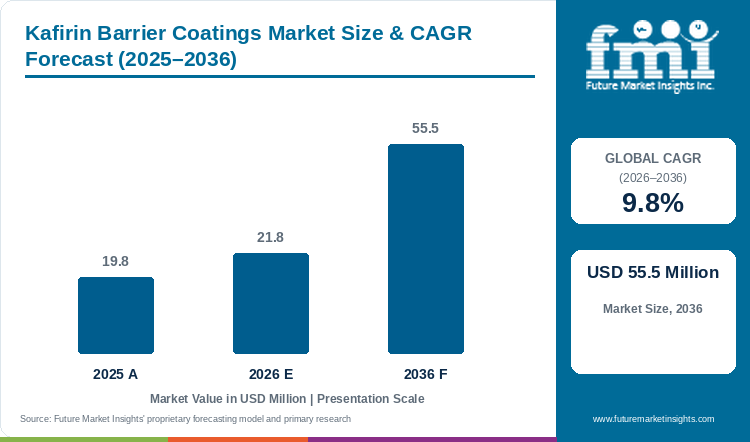
Worldwide kafirin barrier coatings sales stood at USD 19.8 million during 2025, are estimated to reach USD 21.8 million in 2026, and are projected to hit USD 55.5 million by 2036 on an anticipated 9.8% CAGR.
Extracting hydrophobic alpha-kafirin and gamma-kafirin storage proteins from sorghum endosperm yields disulfide-bridged biopolymer networks that resist water vapor permeation and grease wicking far more effectively than corn zein or wheat gluten in humid cold chains. Within this extraction architecture, White Tan-Plant Sorghum Distillers Dried Grains (DDGS) is estimated to command 58.6% of 2026 feedstock demand alongside edible films and coatings converting lines because anthocyanin-free grain co-products prevent dark tannin staining on bleached foodservice board. In January 2026, USDA NASS crop statisticians corroborated this feedstock expansion by documenting that 2025 U.S. grain sorghum production climbed 27% year-on-year to 437 million bushels across 6.02 million harvested acres [1]. Moving past USD 19.8 million recorded in 2025, worldwide kafirin barrier coatings turnover is projected to reach USD 21.8 million for 2026 and is anticipated to attain a 2036 valuation of USD 55.5 million under an expected 9.8% CAGR that brings USD 33.7 million in new orders.
Key Market Trends & Insights
- By sorghum extraction feedstock: White Tan-Plant Sorghum Distillers Dried Grains (DDGS) (58.6% projected share in 2026) dominates procurement because bioethanol dry-grind mills concentrate protein above 30% dry weight without condensed tannin discoloration.
- By prolamin fraction type: Alpha-Kafirin & Gamma-Kafirin Disulfide-Crosslinked Blends (52.4% estimated in 2026) lead formulation orders since cysteine-rich gamma-kafirin shells lock hydrophobic alpha-kafirin cores against high-humidity swelling.
- By coating application process: Aqueous Ethanol Roll-to-Roll Rod & Curtain Coating (49.0% anticipated in 2026) anchors converting operations by matching existing paperboard dryer speeds using 70% aqueous ethanol solvent recovery.
- By coated packaging substrate: Molded Fiber & Kraft Paperboard Trays (54.8% forecast in 2026) form the largest substrate outlet as quick-service chains phase out polyethylene and fluorochemical tray liners.
- By end-use food sector: High-Moisture Chilled Meat & Bakery Paperboard (43.5% expected in 2026) drives food-sector consumption by preventing purge soak-through and lipid oxidation across refrigerated display cases.
- By coat weight specification: 2.5 - 3.5 gsm Standard Confectionery Grade (57.2% predicted in 2026) leads coat weight specifications by closing surface fiber pores without causing brittle film cracking on fold scores.
Regional Highlights
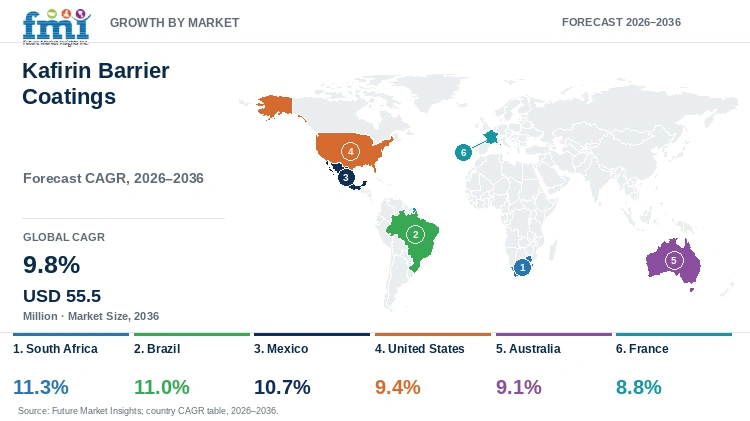
- Top national expansion pace: South Africa is projected to lead major sorghum-processing nations with an expected 11.3% compound annual growth trajectory from 2026 to 2036 on commercial CSIR kafirin licensing and subtropical fruit export coatings.
- Latin American dry-grind momentum: Brazilian revenue is projected to climb 11.0% per year while Mexican shipments are expected to gain 10.7% annually through 2036 as second-crop sorghum bioethanol distilleries monetize high-protein DDGS side streams.
- Established grain and packaging hubs: Converter orders in the United States are forecast to grow 9.4% yearly while Australian turnover is predicted to rise 9.1% and French mills are slated for 8.8% growth under strict food-contact dossier reviews.
Market Size & Forecast
Table 1: Market Size and Forecast for the Kafirin Barrier Coatings Market (USD million and CAGR percentage), 2025 to 2036
| Metric | Value |
|---|---|
| 2025 Market Size | USD 19.8 million |
| Estimated Market Size in 2026 | USD 21.8 million |
| Projected Market Size by 2036 | USD 55.5 million |
| CAGR, 2026 to 2036 | 9.8% |
| Added Revenue, 2026 to 2036 | USD 33.7 million |
Divergent regional grain bioethanol economics and single-use plastic bans determine how packaging mills qualify sorghum prolamin dispersions between 2026 and 2036. During August 2026, Directorate-General for Environment officials brought Regulation (EU) 2025/40 on packaging and packaging waste into direct enforcement, prohibiting food-contact packaging containing per- and polyfluoroalkyl substances above strict parts-per-billion thresholds [2]. Consequently, European and North American tray converters are substituting synthetic fluorochemical sizing with bio-derived prolamin formulations paired with cornstarch packaging substrates to preserve municipal paper repulpability. Meanwhile, Latin American and Southern African extractors capitalize on low-cost dry-grind sorghum mash to supply export fruit packhouses with edible oxygen-barrier dips.
Sorghum DDGS Valorization and Prolamin Extraction Sizing
Table 2: Feedstock Valorization and Prolamin Resin Output Indicators for the Kafirin Barrier Coatings Market (USD million, metric tons, and USD per kg), mixed historical and forecast years from 2025 to 2036
| Metric | 2025 | 2026 | 2036 |
|---|---|---|---|
| Market size (USD million) | 19.8 | 21.8 | 55.5 |
| Refined kafirin coating solids output (metric tons) | 1,180 to 1,310 | 1,310 to 1,450 | 3,650 to 4,050 |
| Valorized sorghum DDGS & bran input (metric tons) | 9,800 to 10,900 | 10,900 to 12,100 | 29,200 to 32,400 |
| Average realized prolamin resin price (USD per kg) | 15.10 to 16.80 | 15.00 to 16.60 | 13.70 to 15.20 |
Operational note: Extraction mass-balance ranges assume 11% to 13% recoverable prolamin yield from white tan-plant sorghum DDGS using food-grade aqueous ethanol-metabisulfite extraction and membrane ultrafiltration.
Integrating prolamin extraction loops directly into grain ethanol dry-grind plants lowers raw material costs by utilizing warm wet cake prior to rotary drum drying. Excessive drum-drying heat above 90 degrees Celsius induces premature disulfide bridging inside raw distillers grains, which cuts subsequent aqueous-ethanol extractability by up to 35%. In January 2026, USDA Economic Research Service feed analysts documented in the monthly Feed Outlook that higher 2025/26 U.S. sorghum harvests expanded domestic feed and industrial grain supply for value-added biorefining [3]. Millers that fractionate tan-plant sorghum protein alongside food coating ingredients secure stable supply contracts with paperboard converters.
Coated Substrate Coverage & Converter Facility Sizing
Table 3: Coated Area and Converter Procurement Indicators for the Kafirin Barrier Coatings Market (million square meters and USD), mixed historical and forecast years from 2025 to 2036
| Metric | 2025 | 2026 | 2036 |
|---|---|---|---|
| Global coated substrate area (million sq. meters) | 380 to 425 | 420 to 470 | 1,150 to 1,290 |
| Average dry coat weight applied (grams per sq. meter) | 2.8 to 3.4 | 2.8 to 3.3 | 2.6 to 3.1 |
| Annual spend per qualified converting line (USD thousand) | 145 to 170 | 155 to 180 | 290 to 340 |
| Kit grease-resistance performance rating | Kit 9 to 11 | Kit 10 to 12 | Kit 11 to 12 |
Table 4: Segment Revenue and Operational Benchmark Traceability for the Kafirin Barrier Coatings Market (USD million and percentages), 2026
| Metric | Value | Basis |
|---|---|---|
| Market size, 2026 | USD 21.8 million | Report value |
| White tan-plant sorghum DDGS feedstock revenue, 2026 | USD 12.8 million | 58.6% feedstock share |
| Molded fiber & kraft paperboard trays revenue, 2026 | USD 11.9 million | 54.8% substrate share |
| 2.5 - 3.5 gsm standard confectionery grade revenue, 2026 | USD 12.5 million | 57.2% coat-weight share |
Replacing synthetic fluorochemicals and extruded polyethylene liners on molded pulp clam-shells requires a uniform prolamin film that bridges surface cellulose voids without soaking into the sheet core. Applying a base pre-coat of modified starch followed by a 2.5 to 3.5 gsm kafirin topcoat reduces prolamin consumption by 40% while achieving Kit Level 11 grease resistance. Consequently, molded fiber and folding carton plants can run kafirin dispersions on standard rod and air-knife coaters without retrofitting extrusion laminators.
Analyst Perspective
"Disulfide-crosslinked kafirin dispersions give molded fiber and kraft paperboard converters an industrial-compostable grease and water-vapor barrier that outperforms corn zein in humid cold chains. Scaling commercial adoption still requires low-temperature DDGS desolventizing at sorghum bioethanol mills to prevent protein denaturation before extraction."
- Nandini Roy Choudhury, Principal Consultant, Future Market Insights.
How is the kafirin barrier coatings market segmented?
The kafirin barrier coatings market is segmented by sorghum extraction feedstock, prolamin fraction type, coating application process, coated packaging substrate, end-use food sector, coat weight specification, and region. In 2026, White Tan-Plant Sorghum Distillers Dried Grains (DDGS) is projected to lead at 58.6%, Alpha-Kafirin & Gamma-Kafirin Disulfide-Crosslinked Blends at 52.4%, Aqueous Ethanol Roll-to-Roll Rod & Curtain Coating at 49.0%, Molded Fiber & Kraft Paperboard Trays at 54.8%, High-Moisture Chilled Meat & Bakery Paperboard at 43.5%, and 2.5 - 3.5 gsm Standard Confectionery Grade at 57.2%.
By sorghum extraction feedstock: White Tan-Plant Sorghum Distillers Dried Grains (DDGS), Red Sorghum Bran & Endosperm Meal, and Brewers Spent Sorghum Mash.
By prolamin fraction type: Alpha-Kafirin & Gamma-Kafirin Disulfide-Crosslinked Blends, Total Unfractionated Kafirin Ethanol Extract, and Tannin-Complexed High-Antioxidant Kafirin.
By coating application process: Aqueous Ethanol Roll-to-Roll Rod & Curtain Coating, Electrospun Nanofiber Mat Lamination, and Post-Harvest Fruit & Nut Immersion Dipping.
By coated packaging substrate: Molded Fiber & Kraft Paperboard Trays, Compostable PLA / Cellophane Flexible Films, Direct Edible Nut, Pear & Avocado Surfaces, and Single-Serve Dissolvable Condiment Sachets.
By end-use food sector: High-Moisture Chilled Meat & Bakery Paperboard, Rancidity-Prone Tree Nuts & Dry Snacks, and Fresh Export Subtropical Produce.
By coat weight specification: 2.5 - 3.5 gsm Standard Confectionery Grade, <2.5 gsm Ultra-Thin Economy Grade, and >3.5 gsm Heavy-Seal Gusset Grade.
Why Does White Tan-Plant Sorghum Distillers Dried Grains (DDGS) Lead Sorghum Extraction Feedstock?
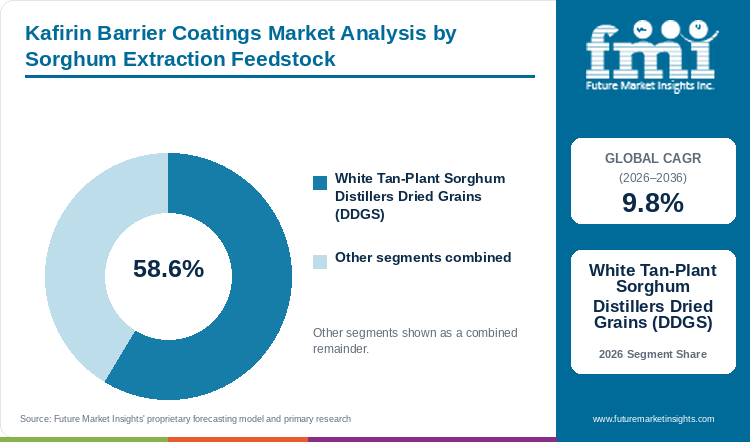
White Tan-Plant Sorghum Distillers Dried Grains (DDGS) is projected to hold 58.6% of sorghum extraction feedstock in 2026, supported by polyphenol-free ethanol mill coproducts.
Table 5: Sorghum Extraction Feedstock Share for the Kafirin Barrier Coatings Market (percentage share), 2026
| Sorghum Extraction Feedstock | Share (2026) |
|---|---|
| White Tan-Plant Sorghum Distillers Dried Grains (DDGS) | 58.6% |
| Red Sorghum Bran & Endosperm Meal | 24.8% |
| Brewers Spent Sorghum Mash | 16.6%* |
| Total | 100.0% |
*Note: Combined share of remaining sorghum extraction feedstock categories totaling 100.0% of 2026 market demand.
Table 6: Sorghum Extraction Feedstock Leadership and Market Growth for the Kafirin Barrier Coatings Market (segment and CAGR percentage), 2026 to 2036
| Metric | Value |
|---|---|
| Global CAGR (2026 to 2036) | 9.8% |
| Leading Segment | White Tan-Plant Sorghum Distillers Dried Grains (DDGS) |
Yeast fermentation inside dry-grind sorghum ethanol plants consumes endosperm starch and triples the residual protein concentration in distillers grains, making White Tan-Plant Sorghum Distillers Dried Grains (DDGS) the most economical extraction input. When extractors use red or high-tannin sorghum varieties, co-extracted anthocyanins impart a reddish-brown tint that disqualifies the coating from white bakery cartons and clear biodegradable packaging films. White tan-plant hybrids bred without pigmented testa layers yield water-clear to pale-straw prolamin dispersions without costly activated-carbon decolorization steps. Furthermore, sourcing centrifuge wet cake directly from ethanol mills avoids the high-temperature drum drying that denatures extractable protein fractions.
- Concentrating prolamin protein three-fold during starch fermentation is projected to enable White Tan-Plant Sorghum Distillers Dried Grains (DDGS) to capture 58.6% of 2026 feedstock demand.
- In November 2025, Cargill Incorporated reported USD 69 million in operational sustainability capital investments alongside 2.5 million North American regenerative agriculture acres and a 20.9% Scope 1 and 2 emissions reduction in its 2025 Impact Report [4].
How Do Alpha-Kafirin & Gamma-Kafirin Disulfide-Crosslinked Blends Dominate Prolamin Fraction Demand?
Alpha-Kafirin & Gamma-Kafirin Disulfide-Crosslinked Blends are expected to capture 52.4% of prolamin fraction type in 2026, reflecting cysteine-bridged moisture vapor resistance.
Combining hydrophobic alpha-kafirin core polypeptides with cysteine-rich gamma-kafirin outer fractions creates a self-assembling micellar network bound by covalent disulfide bridges. Total unfractionated extracts contain variable lipid and low-molecular-weight impurities that plasticize the dried film and raise water vapor transmission rates under refrigerated condensation. Formulators that calibrate the alpha-to-gamma ratio alongside bio plasticizer additives such as glycerol and lactic acid esters achieve elongation-at-break ratings suited for deep-drawn tray corners. Whereas tannin-complexed kafirin is restricted to dark kraft or agricultural mulch substrates, disulfide-crosslinked blends remain optically clear and odor-free for sensitive dairy and confectionery wraps.
- Covalent cysteine crosslinking is expected to give Alpha-Kafirin & Gamma-Kafirin Disulfide-Crosslinked Blends 52.4% of 2026 prolamin fraction revenue.
- In February 2026, peer-reviewed research in Applied Sciences quantified total sorghum prolamin content at 5.5 to 7.0 grams per 100 grams of dry matter, confirming that predominant hydrophobic alpha-kafirin (4.2 to 5.0 g/100 g DM) and cysteine-rich gamma-kafirin fractions govern disulfide protein network stability [5].
What Keeps Aqueous Ethanol Roll-to-Roll Rod & Curtain Coating Ahead in Application Processes?
Aqueous Ethanol Roll-to-Roll Rod & Curtain Coating is anticipated to secure 49.0% of coating application process in 2026, driven by high-speed web drying.
Paperboard mills and flexible film laminators favor Aqueous Ethanol Roll-to-Roll Rod & Curtain Coating because 65% to 75% warm ethanol-water mixtures dissolve kafirin completely and flash off rapidly inside standard flotation dryers. Electrospun nanofiber mat lamination offers ultra-low pore diameters but operates at fractionally slower web speeds that limit adoption to specialty medical and active-packaging patches. By running Mayer rod or slot-die curtain heads inline on biofilm coated paperboard lines, converters deposit defect-free 3 gsm barrier layers at 150 to 300 meters per minute. Closed-loop condenser units recover over 92% of evaporated ethanol vapor for immediate recirculation into the protein dissolution tanks.
- High-speed web compatibility and closed-loop ethanol recovery are anticipated to place Aqueous Ethanol Roll-to-Roll Rod & Curtain Coating at 49.0% of 2026 process turnover.
- In February 2025, Roquette Frères launched its ReadiLYCOAT plant-based water-soluble polymer film coatings platform engineered to accelerate coating process times and eliminate organic solvent emissions [6].
Why Do Molded Fiber & Kraft Paperboard Trays Anchor Coated Packaging Substrate Consumption?
Molded Fiber & Kraft Paperboard Trays are forecast to represent 54.8% of coated packaging substrate in 2026, owing to foodservice fluorochemical phase-outs.
Statutory prohibitions on perfluorinated greaseproofing agents across North America and the European Union force thermoformed pulp and kraft tray producers to adopt bio-based topcoats, lifting Molded Fiber & Kraft Paperboard Trays to over half of substrate volume. Unlined bagasse and wood-pulp trays rapidly absorb hot cooking oils and meat purge unless sealed with a continuous hydrophobic polymer film. Spraying or curtain-coating kafirin onto thermoformed pulp clamshells seals surface capillary channels while allowing finished coated trays to disintegrate fully in EN 13432 industrial composting cycles. In addition to this, paper recovery mills accept kafirin-coated kraft board without the screen-blinding rejects caused by polyethylene film laminates.
- Molded Fiber & Kraft Paperboard Trays are forecast to account for 54.8% of 2026 substrate sales as foodservice operators eliminate fluorinated grease barriers.
- In May 2026, Archer Daniels Midland Company documented 4.6 million regenerative agriculture acres alongside an 89.8% landfill waste diversion rate in its 2025 Corporate Sustainability Report [7].
What Drives High-Moisture Chilled Meat & Bakery Paperboard to Lead End-Use Food Sectors?
High-Moisture Chilled Meat & Bakery Paperboard is estimated to command 43.5% of end-use food sector in 2026, reinforced by purge-resistant barrier integrity.
Chilled meat cuts and butter-rich pastries subject paperboard trays to simultaneous free-water condensation and liquid fat wicking, positioning High-Moisture Chilled Meat & Bakery Paperboard as the foremost end-use sector. Conventional zein or starch coatings swell and lose grease resistance when relative humidity inside supermarket display cases exceeds 80%. Because kafirin contains a higher proportion of non-polar leucine and alanine residues than corn zein, kafirin-coated meat and pastry trays maintain structural stiffness across 7-to-10-day chilled shelf lives. Meanwhile, tree-nut and subtropical fruit packers represent growing secondary outlets that utilize kafirin dips to retard lipid rancidity and respiration weight loss.
- Superior non-polar amino acid hydrophobicity is estimated to give High-Moisture Chilled Meat & Bakery Paperboard 43.5% of 2026 end-use food sector demand.
- During August 2026, USDA NASS crop statisticians forecasted 2026 U.S. grain sorghum production at 296.44 million bushels across 5.355 million harvested acres at an average yield of 55.4 bushels per acre [8].
Why Does 2.5 - 3.5 gsm Standard Confectionery Grade Lead Coat Weight Specifications?
2.5 - 3.5 gsm Standard Confectionery Grade is predicted to account for 57.2% of coat weight specification in 2026, linked to pinhole-free lipid protection.
Converters standardize on 2.5 - 3.5 gsm Standard Confectionery Grade because coat weights below 2.5 gsm leave microscopic cellulose fibers exposed on uncalendered paperboard and cause localized grease spotting. Conversely, heavy-seal gusset applications above 3.5 gsm increase prolamin resin cost per square meter by 45% and require plasticizer loading that can cause roll blocking during warm warehouse storage. Depositing a 3.0 gsm kafirin layer over a clay or starch pre-coat achieves zero turpentine penetration in standard 1,800-second TAPPI T-454 tests without cracking along 180-degree carton crease lines.
- Balancing pinhole closure against crease flexibility is predicted to give 2.5 - 3.5 gsm Standard Confectionery Grade 57.2% of 2026 coat weight demand.
- In October 2025, Roquette Frères introduced its chemical-free AMYSTA L 123 thermally soluble pea starch to deliver low-viscosity film formation and clean-label dispersibility alongside plant-protein barrier topcoats [9].
What are the drivers, restraints, and opportunities in the kafirin barrier coatings market?
Regulatory bans on PFAS greaseproofing chemistries and abundant dry-grind sorghum DDGS supply are projected to accelerate kafirin barrier coating adoption through 2036, whereas aqueous-ethanol solvent recovery capital costs restrain smaller converting plants.
- Driver:Statutory phase-outs of fluorinated paperboard treatments and single-use plastic linings compel food packaging converters to qualify plant-prolamin barrier dispersions.
- Restraint:Explosion-proof drying ovens and ethanol vapor recovery condensers required for solvent-borne prolamin casting create capital hurdles for small paperboard coaters.
- Opportunity:Formulating surfactant-stabilized aqueous kafirin dispersions and ultrasonic-assisted deep-eutectic extraction lowers mill energy use and opens standard water-based coating lines.
Growth Analysis and Future Potential: Qualitative Demand Catalysts
Mandatory fluorochemical prohibitions across European and North American foodservice supply chains are converting prolamin coatings from academic pilot projects into commercial mill procurement. When quick-service restaurant brands eliminate polyethylene film laminates to comply with municipal repulpability scorecards, uncoated fiber trays suffer immediate oil bleed-through. In June 2026, European Union legal notices published formal implementation guidance C(2026) 3702 for Regulation (EU) 2025/40, confirming harmonized recyclability and food-contact substance restrictions taking effect across all member states in August 2026 [10]. Pairing sorghum prolamin topcoats with compostable foodservice packaging substrates enables tray manufacturers to pass both EN 13432 biodegradation and Aticelca 501 paper-recovery audits.
Risk Assessment of the Kafirin Barrier Coatings Market: Operational and Formulation Friction
High hydrophobic amino-acid content makes native kafirin insoluble in pure water, forcing coaters to dissolve the resin in 65% to 75% warm aqueous ethanol or glacial acetic acid. Operating heated organic-solvent coating heads on wide paperboard machines requires ATEX-certified explosion-proof ventilation and solvent-recovery condensers that add USD 1.5 million to USD 3.0 million in line retrofit expense. During June 2026, FAO commodity economists noted in the semi-annual Food Outlook that regional grain and energy price volatility continues to pressure agricultural processing margins [11]. Consequently, independent carton converters running standard bio-based barrier coatings often hesitate to qualify ethanol-borne prolamin systems without multi-year brand offtake guarantees.
Commercial Opportunity Analysis: Formulation Differentiation and Value-Add Formats
Developing solvent-free aqueous kafirin latex dispersions and co-acervated prolamin-polysaccharide emulsions allows formulators to drop directly into existing water-based blade and curtain coaters. Precipitating alpha-kafirin and gamma-kafirin nanoparticles into an alkaline casein or pectin carrier eliminates volatile organic compound emissions at the converting plant. In April 2026, Roquette Frères obtained International Sustainability and Carbon Certification (ISCC) PLUS mass-balance credentials for native starch and BIOSUCCINIUM bio-succinic acid at its Cassano Spinola site in Italy [12]. Suppliers that deliver ready-to-coat aqueous prolamin emulsions for food packaging film and molded pulp lines capture superior gross margins over raw protein meal.
Kafirin Barrier Coatings Market by Country (2026 to 2036)
South African prolamin biorefineries and subtropical fruit packhouses are projected to set the global pace with an expected 11.3% yearly growth rate across the forecast decade, outpacing anticipated Brazilian (11.0%) and Mexican (10.7%) sorghum-processing corridors. Meanwhile, North American and Western European demand is forecast to expand at 9.4% in the United States and 9.1% in Australia alongside a predicted 8.8% in France as PFAS-free food packaging deadlines take hold.
Table 7: Country CAGR and Primary Growth Levers for the Kafirin Barrier Coatings Market (CAGR percentage and operational drivers), 2026 to 2036
| Country | CAGR (2026 to 2036) | Primary Growth Lever |
|---|---|---|
| South Africa | 11.3% | CSIR kafirin extraction IP commercialization and citrus/avocado export shelf-life coatings |
| Brazil | 11.0% | Rapidly expanding second-crop sorghum bioethanol DDGS streams and meat export tray converting |
| Mexico | 10.7% | Large domestic sorghum harvest and cross-border horticultural export packaging upgrades |
| United States | 9.4% | 437-million-bushel sorghum crop valorization and state-level PFAS bans in foodservice fiberware |
| Australia | 9.1% | White tan-plant sorghum breeding leadership and Asia-Pacific chilled beef tray demand |
| France | 8.8% | AGEC Law single-use plastic produce bans and tannin-free white sorghum cooperative supply |
Source: Future Market Insights analysis
United States Kafirin Barrier Coatings Market Outlook (2026 to 2036)
Unlike export fruit packhouse markets that rely on unrefined red sorghum extracts, the United States stands apart globally through its vast dry-grind grain ethanol infrastructure across Kansas and Texas processing identity-preserved white sorghum. During September 2026, ERS feed analysts reported in the monthly Feed Outlook that expanded High Plains acreage and favorable summer yields anchored ample 2026/27 U.S. sorghum supply for domestic ethanol and industrial processors [13]. Consequently, U.S. kafirin barrier coatings revenue is projected to expand at a 9.4% compound annual rate between 2026 and 2036 as state-level PFAS bans in food packaging take effect across twelve states. However, competition from lower-cost soy protein and corn zein coatings in dry-food cartons forces U.S. formulators to target high-humidity meat trays.
Key takeaway: In the United States, High Plains sorghum ethanol DDGS valorization and state PFAS prohibitions are expected to drive a 9.4% annual expansion on molded fiber and meat trays.
Australia Kafirin Barrier Coatings Market Outlook (2026 to 2036)
Australia differs structurally from Northern Hemisphere grain markets because selective breeding of white tan-plant sorghum hybrids across Queensland and northern New South Wales provides biorefiners a non-genetically modified grain stream free of polyphenolic staining. In July 2026, FAS Canberra analysts reported in their Grain and Feed Update that late-autumn rains across northern New South Wales and southern Queensland replenished cropping soils while El Niño required careful 2026/27 sorghum management [14]. Backed by national phase-outs of single-use plastics and PFAS-treated foodservice ware, Australian kafirin coating demand is predicted to expand by 9.1% per year through 2036. Even so, high domestic solvent-recovery electricity tariffs and long freight distances between eastern grain mills and southern carton plants compel converters to favor concentrated dispersion masterbatches.
Key takeaway: In Australia, tan-plant white sorghum breeding across Queensland and national PFAS packaging phase-outs are predicted to support a 9.1% yearly growth pace through 2036.
France Kafirin Barrier Coatings Market Outlook (2026 to 2036)
Whereas American and Brazilian processors extract prolamins from fuel-ethanol distillers grains, France is uniquely shaped by strict statutory prohibitions on plastic produce wrapping under the AGEC law and dedicated food-grade European sorghum cooperatives. French growers in Occitanie and Nouvelle-Aquitaine cultivate exclusively tannin-free hybrid sorghum varieties that yield light-colored protein extracts suited for premium patisserie and cheese paperboards. During May 2026, World Markets and Trade grain analysts at USDA FAS highlighted steady European coarse-grain utilization across French and Western European starch and protein mills [15]. French kafirin barrier coating turnover is foreseen to advance at an 8.8% CAGR to 2036, although rigorous ANSES food-contact migration audits and high small-batch ethanol extraction costs slow initial converter qualification.
Key takeaway: In France, tannin-free regional sorghum cultivation and AGEC plastic-free produce rules are slated to underpin an 8.8% yearly gain in specialty paperboard coatings.
Brazil Kafirin Barrier Coatings Market Outlook (2026 to 2036)
Brazil diverges from legacy grain-milling markets due to explosive investment in flex-mill corn-and-sorghum bioethanol distilleries across Mato Grosso and Goiás that generate vast second-crop (safrinha) distillers dried grains. In July 2025, USDA FAS Brasilia agricultural attachés reported that Brazil ranks as the world's third-largest sorghum producer with output reaching 5.0 million metric tons in 2025/26 [16]. Co-locating industrial prolamin extraction units beside these newly commissioned Cerrado ethanol distilleries is forecast to lift Brazilian kafirin barrier coating demand by 11.0% each year from 2026 to 2036. Nonetheless, variable drum-drying temperatures across newly commissioned ethanol distilleries can denature prolamin fractions, requiring extractors to install dedicated wet-cake fractionation centrifuges for poultry and tropical fruit packaging buyers.
Key takeaway: In Brazil, surging Cerrado sorghum bioethanol DDGS output and beef-and-poultry export tray demand are forecast to fuel an 11.0% annual expansion pace through 2036.
South Africa Kafirin Barrier Coatings Market Outlook (2026 to 2036)
What distinguishes South Africa from every other national market is its sovereign ownership of foundational kafirin extraction and crosslinking intellectual property developed by the Council for Scientific and Industrial Research (CSIR) and the University of Pretoria. Citrus and avocado exporters alongside macadamia packhouses across Limpopo and Mpumalanga increasingly dip harvested produce in aqueous-ethanol kafirin emulsions to suppress moisture loss and rancidity during 28-day maritime transit to Europe. During July 2026, FAS Pretoria specialists confirmed a record 18 million metric ton 2025/26 summer grain crop and ample carry-over stocks for domestic processors [17]. Consequently, South African kafirin coating revenue is anticipated to lead major national markets at an 11.3% CAGR through 2036 despite municipal power-grid intermittency at local extraction mills.
Key takeaway: In South Africa, domestic CSIR prolamin patents and maritime shelf-life coatings for export citrus and macadamias are projected to deliver a top 11.3% yearly growth rate.
Mexico Kafirin Barrier Coatings Market Outlook (2026 to 2036)
Mexico operates a structurally distinct market where large domestic sorghum harvests across Tamaulipas and the Bajío corridor intersect directly with packhouses supplying U.S. fresh-produce retail corridors. During June 2026, FAS Mexico City analysts reported that higher domestic sorghum output is expected to reduce 2026/27 sorghum import reliance [18]. Export avocado and berry packers alongside commercial bakeries adopting PFAS-free molded fiber trays and edible cuticle dips are expected to lift Mexican kafirin barrier coating sales at a 10.7% compound yearly pace over the decade to 2036. However, heavy reliance on imported food-grade ethanol solvents and specialty crosslinking plasticizers exposes Mexican coating formulators to peso exchange-rate fluctuations during seasonal packing peaks.
Key takeaway: In Mexico, strong Jalisco and Tamaulipas sorghum harvests alongside U.S.-bound avocado and berry export standards are anticipated to sustain a 10.7% yearly growth clip.
Full report country CAGRs cover: North America; Latin America; Western Europe; Eastern Europe; East Asia; South Asia and Pacific; Middle East and Africa.
Who are the notable companies in the kafirin barrier coatings market?
Cargill, Incorporated, Archer Daniels Midland Company (ADM), Ingredion Incorporated, CSIR Biosciences, Roquette Frères, Mantrose-Haeuser Co., Inc. (RPM International), Tate & Lyle PLC, and Kerry Group plc are the notable companies in the kafirin barrier coatings market.
Commercial supply across the sorghum prolamin coatings value chain links upstream dry-grind grain processors with specialty plant-protein fractionators and downstream edible-glaze formulators. Integrated agricultural processors including Cargill Incorporated and Archer Daniels Midland Company (ADM) alongside Ingredion Incorporated control bulk white-sorghum milling and bioethanol DDGS streams that feed industrial protein extraction. Plant-polymer specialists such as Roquette Frères and Tate & Lyle PLC together with Kerry Group plc engineer plasticized protein-polysaccharide dispersions for roll-to-roll paperboard coaters. Meanwhile, CSIR Biosciences licenses foundational aqueous-ethanol kafirin extraction and crosslinking patents while Mantrose-Haeuser Co. (RPM International) formulates turnkey confectionery and roasted-nut barrier glazes.
- Integrated Grain Milling & Sorghum Valorization Leaders: Cargill Incorporated and Archer Daniels Midland Company (ADM) alongside Ingredion Incorporated supply de-branded white sorghum meal and low-temperature DDGS protein concentrates.
- Plant Protein Fractionation & Bio-Polymer Specialists: Roquette Frères and Tate & Lyle PLC together with Kerry Group plc blend prolamin fractions with modified starches and polyols for high-speed curtain coating.
- Prolamin Barrier Coating Formulators & IP Licensors: CSIR Biosciences and Mantrose-Haeuser Co. (RPM International) commercialize patented kafirin extraction processes and food-grade nut and fruit shelf-life glazes.
Competitive Benchmarking: Kafirin Barrier Coatings Market
Table 8: Competitive Benchmarking for the Kafirin Barrier Coatings Market (qualitative capability ratings), 2026
| Company | Feedstock Integration | Prolamin Purity & Crosslinking | Coater Application Reach | Geographic Footprint |
|---|---|---|---|---|
| Cargill, Incorporated | High | Medium | High | High |
| Archer Daniels Midland Company (ADM) | High | Medium | High | High |
| Ingredion Incorporated | High | High | High | High |
| CSIR Biosciences | Medium | High | Medium | Medium |
| Roquette Frères | Medium | High | High | High |
| Mantrose-Haeuser Co., Inc. (RPM International) | Medium | High | High | Medium |
| Tate & Lyle PLC | Medium | Medium | High | High |
| Kerry Group plc | Medium | High | Medium | High |
Scoring basis: Feedstock Integration is rated High for companies operating captive grain dry-grind or wet-milling plants and Medium for formulators purchasing refined protein meals. Prolamin Purity & Crosslinking is High where documented patents or commercial lines isolate decolorized alpha/gamma-kafirin fractions with controlled disulfide bridging. Coater Application Reach evaluates turnkey compatibility with industrial paperboard rod/curtain coaters and post-harvest fruit dipping lines across multiple regions.
Key Developments in the Kafirin Barrier Coatings Market
- In June 2026, Roquette Frères launched its NEOSORB AG S50 and L20 plant-based multifunctional sorbitol-mannitol polyol range designed to humectify and stabilize bio-based agricultural and protective film formulations [19].
- In February 2026, Roquette Frères expanded its NUTRALYS portfolio with the launch of NUTRALYS Pea 850F clean-tasting plant protein isolate offering high emulsion capacity and neutral sensory performance [20].
- In November 2025, Cargill Incorporated expanded identity-preserved white sorghum valorization and bio-industrial co-product fractionation across its North American grain milling network to supply low-color packaging biopolymers.
Key Players in the Kafirin Barrier Coatings Market
Integrated Grain Milling & Sorghum Valorization Leaders
- Cargill, Incorporated
- Archer Daniels Midland Company (ADM)
- Ingredion Incorporated
Plant Protein Fractionation & Bio-Polymer Specialists
- Roquette Frères
- Tate & Lyle PLC
- Kerry Group plc
Prolamin Barrier Coating Formulators & IP Licensors
- CSIR Biosciences
- Mantrose-Haeuser Co., Inc. (RPM International)
Kafirin Barrier Coatings Market - Report Scope
Table 9: Report Scope for the Kafirin Barrier Coatings Market (coverage fields and definitions), 2026 to 2036
| Coverage field | Report scope |
|---|---|
| Market breakdown | Sorghum Extraction Feedstock; Prolamin Fraction Type; Coating Application Process; Coated Packaging Substrate; End-Use Food Sector; Coat Weight Specification; Region |
| Quantitative Units | USD Million |
| Market Definition | Includes B2B supplier revenue from extracted sorghum prolamin (kafirin) resins, disulfide-crosslinked kafirin dispersions, and formulated kafirin barrier coating compounds applied to paperboard, molded fiber, flexible bio-films, and direct edible food surfaces. Category Scope Note: Excludes bulk commodity sorghum grain traded for livestock feed, unextracted fuel-grade DDGS, corn zein or wheat gluten coatings containing zero sorghum prolamin, and downstream converted carton or tray sales. |
| Regions Covered | North America; Latin America; Western Europe; Eastern Europe; East Asia; South Asia and Pacific; Middle East and Africa |
| Countries Covered | United States, Australia, France, Brazil, South Africa, Mexico, and additional countries in the full report |
| Key Companies Covered | Cargill, Incorporated, Archer Daniels Midland Company (ADM), Ingredion Incorporated, CSIR Biosciences, Roquette Frères, Mantrose-Haeuser Co., Inc. (RPM International), Tate & Lyle PLC, Kerry Group plc |
| Forecast Period | 2026 to 2036 |
| Approach | Primary and secondary research with rigorous market triangulation. |
Kafirin Barrier Coatings Market - Research Methodology
Table 10: Research Methodology for the Kafirin Barrier Coatings Market (research methods and approach), 2026 edition
| Method | Approach |
|---|---|
| Primary Research | Primary interviews were conducted with sorghum dry-grind bioethanol mill managers, prolamin extraction chemists, paperboard curtain-coating engineers, molded-pulp tray converters, and post-harvest produce packhouse directors to validate extraction yields, coat weights, and qualification hurdles. |
| Secondary Research | Secondary research included USDA NASS and FAS grain production bulletins, European Commission PPWR regulatory texts, CSIR prolamin patent filings, peer-reviewed cereal-chemistry literature, and corporate sustainability and product disclosures from leading grain and bio-coating suppliers. |
| Market Sizing and Forecasting | Market sizing and forecasting from 2026 to 2036 combined bottom-up prolamin resin tonnage and realized price-per-kilogram modeling with top-down substitution rates across PFAS-free foodservice paperboard and edible nut/fruit coatings. |
| Data Triangulation and Validation | Estimates were cross-checked against national sorghum DDGS output, commercial paperboard coating line speeds, and food-contact regulatory compliance schedules to prevent double counting with corn zein or unmodified starch sizing. |
| Country Forecasting Model | Country CAGRs (ranging from 8.8% in France to 11.3% in South Africa around the 9.8% global baseline) are calibrated using national white-sorghum and DDGS feedstock growth, statutory PFAS-free packaging deadlines, and subtropical produce export volumes. |
| Operational Benchmark Traceability | Physical and operational indicators in Tables 2, 3, and 4 (prolamin extraction yield, coated substrate square-meter coverage, gsm coat weight, and Kit grease ratings) are traced to USDA grain processing balances, TAPPI T-454/Cobb test standards, and industrial rod/curtain coater operating parameters. |
Kafirin Barrier Coatings Market by Segments
Kafirin Barrier Coatings Market segmented by Sorghum Extraction Feedstock:
- White Tan-Plant Sorghum Distillers Dried Grains (DDGS)
- Red Sorghum Bran & Endosperm Meal
- Brewers Spent Sorghum Mash
Kafirin Barrier Coatings Market segmented by Prolamin Fraction Type:
- Alpha-Kafirin & Gamma-Kafirin Disulfide-Crosslinked Blends
- Total Unfractionated Kafirin Ethanol Extract
- Tannin-Complexed High-Antioxidant Kafirin
Kafirin Barrier Coatings Market segmented by Coating Application Process:
- Aqueous Ethanol Roll-to-Roll Rod & Curtain Coating
- Electrospun Nanofiber Mat Lamination
- Post-Harvest Fruit & Nut Immersion Dipping
Kafirin Barrier Coatings Market segmented by Coated Packaging Substrate:
- Molded Fiber & Kraft Paperboard Trays
- Compostable PLA / Cellophane Flexible Films
- Direct Edible Nut, Pear & Avocado Surfaces
- Single-Serve Dissolvable Condiment Sachets
Kafirin Barrier Coatings Market segmented by End-Use Food Sector:
- High-Moisture Chilled Meat & Bakery Paperboard
- Rancidity-Prone Tree Nuts & Dry Snacks
- Fresh Export Subtropical Produce
Kafirin Barrier Coatings Market segmented by Coat Weight Specification:
- 2.5 - 3.5 gsm Standard Confectionery Grade
- <2.5 gsm Ultra-Thin Economy Grade
- >3.5 gsm Heavy-Seal Gusset Grade
Kafirin Barrier Coatings Market by Region
- North America
- United States
- Canada
- Latin America
- Brazil
- Mexico
- Argentina
- Chile
- Western Europe
- Germany
- France
- United Kingdom
- Italy
- Spain
- Benelux
- Nordics
- Eastern Europe
- Poland
- Czech Republic
- Romania
- Hungary
- East Asia
- China
- Japan
- South Korea
- South Asia and Pacific
- India
- ASEAN
- Australia and New Zealand
- Middle East and Africa
- GCC Countries
- South Africa
- Türkiye
- Israel
Research Sources and Bibliography
- [1] U.S. Department of Agriculture, National Agricultural Statistics Service (NASS). (2026, January 12). Crop Production 2025 Summary (January 2026). USDA National Agricultural Statistics Service.
- [2] European Commission, Directorate-General for Environment. (2026, August 11). New EU packaging rules start to apply, including restrictions on PFAS in food-contact packaging. European Commission.
- [3] Bond, J. K., Ramsey, S., & Huang, J. (2026, January 14). Feed Outlook: January 2026. U.S. Department of Agriculture, Economic Research Service (FDS-26A).
- [4] Cargill, Incorporated. (2025, November 04). 2025 Impact Report. Cargill Sustainability.
- [5] Przybylska-Balcerek, A., Frankowski, J., & Stuper-Szablewska, K. (2026, February 01). Analysis of Kafirin Content in Sorghum Sprouts Cultivated in a Temperate Climate. Applied Sciences, 16(3), 1485 (MDPI).
- [6] Roquette Frères. (2025, February 11). Innovative and High-Performance Coatings Platform. Roquette Press Releases.
- [7] Archer Daniels Midland Company (ADM). (2026, May 14). 2025 Corporate Sustainability Report. Archer Daniels Midland Company.
- [8] U.S. Department of Agriculture, National Agricultural Statistics Service (NASS). (2026, August 12). Crop Production (August 2026). USDA National Agricultural Statistics Service.
- [9] Roquette Frères. (2025, October 31). AMYSTA ™ L 123, the New Label-Friendly Soluble Pea Starch. Roquette Press Releases.
- [10] European Commission. (2026, June 05). Commission Notice Guidance document for Regulation (EU) 2025/40 on packaging and packaging waste. EUR-Lex Official Journal of the European Union (C/2026/3702 final).
- [11] Food and Agriculture Organization of the United Nations (FAO). (2026, June 18). FAO Food Outlook: Global food commodity market trends face rising geopolitical and weather risks. Food and Agriculture Organization of the United Nations.
- [12] Roquette Frères. (2026, April 30). ISCC PLUS Certification Achieved for Three Sustainable Products. Roquette Corporate Sustainability News.
- [13] Ramsey, S., Huang, J., & Bond, J. K. (2026, September 15). Feed Outlook: September 2026. U.S. Department of Agriculture, Economic Research Service (FDS-26i).
- [14] U.S. Department of Agriculture, Foreign Agricultural Service (FAS). (2026, July 24). Australia: Grain and Feed Update. USDA Foreign Agricultural Service (GAIN Report AS2026-0016).
- [15] U.S. Department of Agriculture, Foreign Agricultural Service (FAS). (2026, May 02). Grain: World Markets and Trade. USDA Foreign Agricultural Service.
- [16] U.S. Department of Agriculture, Foreign Agricultural Service (FAS). (2025, July 10). Brazil: Cultivating Growth- The State of Sorghum Production in Brazil. USDA Foreign Agricultural Service (GAIN Report BR2025-0022).
- [17] U.S. Department of Agriculture, Foreign Agricultural Service (FAS). (2026, July 22). South Africa: Grain and Feed Update. USDA Foreign Agricultural Service (GAIN Report SF2026-0024).
- [18] U.S. Department of Agriculture, Foreign Agricultural Service (FAS). (2026, June 23). Mexico: Grain and Feed Update. USDA Foreign Agricultural Service (GAIN Report MX2026-0032).
- [19] Roquette Frères. (2026, June 25). Roquette Launches NEOSORB® AG. Roquette Press Releases.
- [20] Roquette Frères. (2026, February 23). Launch of Breakthrough Clean-Tasting Pea Protein Isolate. Roquette Press Releases.
- [21] Ingredion Incorporated. (2026, June 05). Ingredion's 2025 Sustainability report: Turning progress into shared value. Ingredion Corporate Sustainability.
This bibliography is provided for reader reference and is not exhaustive. The full report contains the complete reference list and detailed citations.
This Report Answers
- How large is the kafirin barrier coatings market in 2026 and what is forecast for 2036?
- Which PFAS-free packaging rules and sorghum DDGS valorization economics drive demand?
- Why does White Tan-Plant Sorghum Distillers Dried Grains (DDGS) lead extraction feedstocks?
- How do disulfide-crosslinked alpha-kafirin and gamma-kafirin blends outperform corn zein?
- Why do growth trajectories differ across South Africa, Brazil, Mexico, the United States, Australia, and France?
- Which grain processors and bio-coating formulators supply kafirin dispersions today?
- What technical hurdles in aqueous-ethanol solvent recovery restrain small converters?
- What coat-weight and pre-coating parameters should paperboard buyers evaluate before procurement?
Frequently Asked Questions
How big is the kafirin barrier coatings market in 2026, and what is forecast for 2036?
Worldwide kafirin barrier coatings sales are projected to reach USD 21.8 million for 2026 off a USD 19.8 million baseline in 2025 and are anticipated to hit USD 55.5 million by 2036 as foodservice tray and confectionery converters replace fluorinated grease barriers with sorghum prolamin dispersions.
What is the CAGR for the kafirin barrier coatings market from 2026 to 2036?
Future Market Insights projects a 9.8% compound annual growth rate between 2026 and 2036, generating USD 33.7 million in added revenue as dry-grind sorghum ethanol mills monetize protein-rich distillers grains.
Which sorghum extraction feedstock segment leads the kafirin barrier coatings market?
White Tan-Plant Sorghum Distillers Dried Grains (DDGS) is projected to hold 58.6% of 2026 feedstock demand because yeast fermentation triples residual protein concentration while polyphenol-free white hybrids prevent dark staining on bleached paperboard.
Which prolamin fraction type accounts for the largest share in 2026?
Alpha-Kafirin & Gamma-Kafirin Disulfide-Crosslinked Blends are expected to capture 52.4% of 2026 prolamin fraction sales since cysteine-rich gamma-kafirin chains crosslink around hydrophobic alpha-kafirin cores to block moisture vapor and grease.
Which country registers the fastest growth in the kafirin barrier coatings market?
As per FMI, South Africa is anticipated to lead major sorghum-processing nations with an 11.3% CAGR from 2026 to 2036, supported by commercial CSIR prolamin extraction patents and maritime shelf-life coatings on exported citrus and avocados.
Who are the notable companies in the kafirin barrier coatings market?
Active suppliers include Cargill, Incorporated, Archer Daniels Midland Company (ADM), Ingredion Incorporated, CSIR Biosciences, Roquette Frères, Mantrose-Haeuser Co., Inc. (RPM International), Tate & Lyle PLC, and Kerry Group plc, spanning sorghum dry-grind valorization and turnkey barrier glazes.
Preview the report firsthand - request a free sample
Get SampleGet the brochure for pricing and purchase details.
Get PDFTable of Content
- Key Takeaways
- Market Size and CAGR
- Top Growth Driver
- Fastest Growing Segment
- Leading Region
- Key Companies
- Emerging Opportunities
- Executive Summary
- Global Market Outlook
- Demand-side Trends
- Supply-side Trends
- Technology Roadmap Analysis
- Analysis and Recommendations
- Analyst Perspective (What is happening? Why now? What should investors know?)
- Key Questions Answered
- How large is the market?
- What is the CAGR?
- What are key trends?
- Which region dominates?
- Who are the leaders?
- Market Overview
- Market Coverage / Taxonomy
- Market Definition / Scope / Limitations
- Research Methodology
- Chapter Orientation
- Analytical Lens and Working Hypotheses
- Market Structure, Signals, and Trend Drivers
- Benchmarking and Cross-market Comparability
- Market Sizing, Forecasting, and Opportunity Mapping
- Research Design and Evidence Framework
- Desk Research Programme (Secondary Evidence)
- Expert Input and Fieldwork (Primary Evidence)
- Tooling, Models, and Reference Databases
- Data Engineering and Model Build
- Quality Assurance and Audit Trail
- Market Background
- Market Dynamics (Drivers, Restraints, Opportunity, Trends)
- Scenario Forecast (Optimistic, Likely, Conservative)
- Impact Analysis
- AI Impact
- Sustainability Impact
- Regulatory Impact
- Technology Impact
- Consumer / Buyer Analysis
- Purchase Drivers
- Adoption Barriers
- Buyer Journey
- Opportunity Map Analysis
- Product Life Cycle Analysis
- Supply Chain Analysis
- Investment Feasibility Matrix
- Value Chain Analysis
- PESTLE and Porter's Analysis
- Regulatory Landscape
- Regional Parent Market Outlook
- Production and Consumption Statistics
- Import and Export Statistics
- Global Market Analysis and Forecast, 2021 to 2036
- Historical Market Size Value (USD Million) Analysis, 2021 to 2025
- Current and Future Market Size Value (USD Million) Projections, 2026 to 2036
- Y-o-Y Growth Trend Analysis
- Absolute $ Opportunity Analysis
- Global Market Pricing Analysis, 2021 to 2036
- Global Market Analysis and Forecast, By Sorghum Extraction Feedstock, 2021 to 2036
- Introduction / Key Findings
- Historical Market Size Value (USD Million) Analysis By Sorghum Extraction Feedstock, 2021 to 2025
- Current and Future Market Size Value (USD Million) Analysis and Forecast By Sorghum Extraction Feedstock, 2026 to 2036
- White Tan-Plant Sorghum Distillers Dried Grains (DDGS)
- Red Sorghum Bran & Endosperm Meal
- Brewers Spent Sorghum Mash
- Y-o-Y Growth Trend Analysis By Sorghum Extraction Feedstock, 2021 to 2025
- Absolute $ Opportunity Analysis By Sorghum Extraction Feedstock, 2026 to 2036
- Global Market Analysis and Forecast, By Prolamin Fraction Type, 2021 to 2036
- Introduction / Key Findings
- Historical Market Size Value (USD Million) Analysis By Prolamin Fraction Type, 2021 to 2025
- Current and Future Market Size Value (USD Million) Analysis and Forecast By Prolamin Fraction Type, 2026 to 2036
- Alpha-Kafirin & Gamma-Kafirin Disulfide-Crosslinked Blends
- Total Unfractionated Kafirin Ethanol Extract
- Tannin-Complexed High-Antioxidant Kafirin
- Y-o-Y Growth Trend Analysis By Prolamin Fraction Type, 2021 to 2025
- Absolute $ Opportunity Analysis By Prolamin Fraction Type, 2026 to 2036
- Global Market Analysis and Forecast, By Coating Application Process, 2021 to 2036
- Introduction / Key Findings
- Historical Market Size Value (USD Million) Analysis By Coating Application Process, 2021 to 2025
- Current and Future Market Size Value (USD Million) Analysis and Forecast By Coating Application Process, 2026 to 2036
- Aqueous Ethanol Roll-to-Roll Rod & Curtain Coating
- Electrospun Nanofiber Mat Lamination
- Post-Harvest Fruit & Nut Immersion Dipping
- Y-o-Y Growth Trend Analysis By Coating Application Process, 2021 to 2025
- Absolute $ Opportunity Analysis By Coating Application Process, 2026 to 2036
- Global Market Analysis and Forecast, By Coated Packaging Substrate, 2021 to 2036
- Introduction / Key Findings
- Historical Market Size Value (USD Million) Analysis By Coated Packaging Substrate, 2021 to 2025
- Current and Future Market Size Value (USD Million) Analysis and Forecast By Coated Packaging Substrate, 2026 to 2036
- Molded Fiber & Kraft Paperboard Trays
- Compostable PLA / Cellophane Flexible Films
- Direct Edible Nut, Pear & Avocado Surfaces
- Single-Serve Dissolvable Condiment Sachets
- Y-o-Y Growth Trend Analysis By Coated Packaging Substrate, 2021 to 2025
- Absolute $ Opportunity Analysis By Coated Packaging Substrate, 2026 to 2036
- Global Market Analysis and Forecast, By End-Use Food Sector, 2021 to 2036
- Introduction / Key Findings
- Historical Market Size Value (USD Million) Analysis By End-Use Food Sector, 2021 to 2025
- Current and Future Market Size Value (USD Million) Analysis and Forecast By End-Use Food Sector, 2026 to 2036
- High-Moisture Chilled Meat & Bakery Paperboard
- Rancidity-Prone Tree Nuts & Dry Snacks
- Fresh Export Subtropical Produce
- Y-o-Y Growth Trend Analysis By End-Use Food Sector, 2021 to 2025
- Absolute $ Opportunity Analysis By End-Use Food Sector, 2026 to 2036
- Global Market Analysis and Forecast, By Coat Weight Specification, 2021 to 2036
- Introduction / Key Findings
- Historical Market Size Value (USD Million) Analysis By Coat Weight Specification, 2021 to 2025
- Current and Future Market Size Value (USD Million) Analysis and Forecast By Coat Weight Specification, 2026 to 2036
- 2.5 - 3.5 gsm Standard Confectionery Grade
- <2.5 gsm Ultra-Thin Economy Grade
- >3.5 gsm Heavy-Seal Gusset Grade
- Y-o-Y Growth Trend Analysis By Coat Weight Specification, 2021 to 2025
- Absolute $ Opportunity Analysis By Coat Weight Specification, 2026 to 2036
- Global Market Analysis and Forecast, By Region, 2021 to 2036
- Introduction
- Historical Market Size Value (USD Million) Analysis By Region, 2021 to 2025
- Current Market Size Value (USD Million) Analysis and Forecast By Region, 2026 to 2036
- North America
- Latin America
- Western Europe
- Eastern Europe
- East Asia
- South Asia and Pacific
- Middle East and Africa
- Market Attractiveness Analysis By Region
- North America Market Analysis and Forecast, By Country, 2021 to 2036
- Historical Market Size Value (USD Million) Trend Analysis By Market Taxonomy, 2021 to 2025
- Market Size Value (USD Million) Forecast By Market Taxonomy, 2026 to 2036
- By Country
- United States
- Canada
- By Sorghum Extraction Feedstock
- By Prolamin Fraction Type
- By Coating Application Process
- By Coated Packaging Substrate
- By End-Use Food Sector
- By Coat Weight Specification
- By Country
- Market Attractiveness Analysis
- By Country
- By Sorghum Extraction Feedstock
- By Prolamin Fraction Type
- By Coating Application Process
- By Coated Packaging Substrate
- By End-Use Food Sector
- By Coat Weight Specification
- Key Takeaways
- Latin America Market Analysis and Forecast, By Country
- Historical Market Size Value (USD Million) Trend Analysis By Market Taxonomy, 2021 to 2025
- Market Size Value (USD Million) Forecast By Market Taxonomy, 2026 to 2036
- By Country
- Brazil
- Mexico
- Argentina
- Chile
- By Sorghum Extraction Feedstock
- By Prolamin Fraction Type
- By Coating Application Process
- By Coated Packaging Substrate
- By End-Use Food Sector
- By Coat Weight Specification
- By Country
- Market Attractiveness Analysis
- By Country
- By Sorghum Extraction Feedstock
- By Prolamin Fraction Type
- By Coating Application Process
- By Coated Packaging Substrate
- By End-Use Food Sector
- By Coat Weight Specification
- Key Takeaways
- Western Europe Market Analysis and Forecast, By Country
- Historical Market Size Value (USD Million) Trend Analysis By Market Taxonomy, 2021 to 2025
- Market Size Value (USD Million) Forecast By Market Taxonomy, 2026 to 2036
- By Country
- Germany
- France
- United Kingdom
- Italy
- Spain
- Benelux
- Nordics
- By Sorghum Extraction Feedstock
- By Prolamin Fraction Type
- By Coating Application Process
- By Coated Packaging Substrate
- By End-Use Food Sector
- By Coat Weight Specification
- By Country
- Market Attractiveness Analysis
- By Country
- By Sorghum Extraction Feedstock
- By Prolamin Fraction Type
- By Coating Application Process
- By Coated Packaging Substrate
- By End-Use Food Sector
- By Coat Weight Specification
- Key Takeaways
- Eastern Europe Market Analysis and Forecast, By Country
- Historical Market Size Value (USD Million) Trend Analysis By Market Taxonomy, 2021 to 2025
- Market Size Value (USD Million) Forecast By Market Taxonomy, 2026 to 2036
- By Country
- Poland
- Czech Republic
- Romania
- Hungary
- By Sorghum Extraction Feedstock
- By Prolamin Fraction Type
- By Coating Application Process
- By Coated Packaging Substrate
- By End-Use Food Sector
- By Coat Weight Specification
- By Country
- Market Attractiveness Analysis
- By Country
- By Sorghum Extraction Feedstock
- By Prolamin Fraction Type
- By Coating Application Process
- By Coated Packaging Substrate
- By End-Use Food Sector
- By Coat Weight Specification
- Key Takeaways
- East Asia Market Analysis and Forecast, By Country
- Historical Market Size Value (USD Million) Trend Analysis By Market Taxonomy, 2021 to 2025
- Market Size Value (USD Million) Forecast By Market Taxonomy, 2026 to 2036
- By Country
- China
- Japan
- South Korea
- By Sorghum Extraction Feedstock
- By Prolamin Fraction Type
- By Coating Application Process
- By Coated Packaging Substrate
- By End-Use Food Sector
- By Coat Weight Specification
- By Country
- Market Attractiveness Analysis
- By Country
- By Sorghum Extraction Feedstock
- By Prolamin Fraction Type
- By Coating Application Process
- By Coated Packaging Substrate
- By End-Use Food Sector
- By Coat Weight Specification
- Key Takeaways
- South Asia and Pacific Market Analysis and Forecast, By Country
- Historical Market Size Value (USD Million) Trend Analysis By Market Taxonomy, 2021 to 2025
- Market Size Value (USD Million) Forecast By Market Taxonomy, 2026 to 2036
- By Country
- India
- ASEAN
- Australia and New Zealand
- By Sorghum Extraction Feedstock
- By Prolamin Fraction Type
- By Coating Application Process
- By Coated Packaging Substrate
- By End-Use Food Sector
- By Coat Weight Specification
- By Country
- Market Attractiveness Analysis
- By Country
- By Sorghum Extraction Feedstock
- By Prolamin Fraction Type
- By Coating Application Process
- By Coated Packaging Substrate
- By End-Use Food Sector
- By Coat Weight Specification
- Key Takeaways
- Middle East and Africa Market Analysis and Forecast, By Country
- Historical Market Size Value (USD Million) Trend Analysis By Market Taxonomy, 2021 to 2025
- Market Size Value (USD Million) Forecast By Market Taxonomy, 2026 to 2036
- By Country
- GCC Countries
- South Africa
- Türkiye
- Israel
- By Sorghum Extraction Feedstock
- By Prolamin Fraction Type
- By Coating Application Process
- By Coated Packaging Substrate
- By End-Use Food Sector
- By Coat Weight Specification
- By Country
- Market Attractiveness Analysis
- By Country
- By Sorghum Extraction Feedstock
- By Prolamin Fraction Type
- By Coating Application Process
- By Coated Packaging Substrate
- By End-Use Food Sector
- By Coat Weight Specification
- Key Takeaways
- Key Countries Market Analysis
- United States
- Pricing Analysis
- Market Share Analysis, 2025
- By Sorghum Extraction Feedstock
- By Prolamin Fraction Type
- By Coating Application Process
- By Coated Packaging Substrate
- By End-Use Food Sector
- By Coat Weight Specification
- Canada
- Pricing Analysis
- Market Share Analysis, 2025
- By Sorghum Extraction Feedstock
- By Prolamin Fraction Type
- By Coating Application Process
- By Coated Packaging Substrate
- By End-Use Food Sector
- By Coat Weight Specification
- Mexico
- Pricing Analysis
- Market Share Analysis, 2025
- By Sorghum Extraction Feedstock
- By Prolamin Fraction Type
- By Coating Application Process
- By Coated Packaging Substrate
- By End-Use Food Sector
- By Coat Weight Specification
- Brazil
- Pricing Analysis
- Market Share Analysis, 2025
- By Sorghum Extraction Feedstock
- By Prolamin Fraction Type
- By Coating Application Process
- By Coated Packaging Substrate
- By End-Use Food Sector
- By Coat Weight Specification
- Chile
- Pricing Analysis
- Market Share Analysis, 2025
- By Sorghum Extraction Feedstock
- By Prolamin Fraction Type
- By Coating Application Process
- By Coated Packaging Substrate
- By End-Use Food Sector
- By Coat Weight Specification
- Germany
- Pricing Analysis
- Market Share Analysis, 2025
- By Sorghum Extraction Feedstock
- By Prolamin Fraction Type
- By Coating Application Process
- By Coated Packaging Substrate
- By End-Use Food Sector
- By Coat Weight Specification
- United Kingdom
- Pricing Analysis
- Market Share Analysis, 2025
- By Sorghum Extraction Feedstock
- By Prolamin Fraction Type
- By Coating Application Process
- By Coated Packaging Substrate
- By End-Use Food Sector
- By Coat Weight Specification
- Italy
- Pricing Analysis
- Market Share Analysis, 2025
- By Sorghum Extraction Feedstock
- By Prolamin Fraction Type
- By Coating Application Process
- By Coated Packaging Substrate
- By End-Use Food Sector
- By Coat Weight Specification
- Spain
- Pricing Analysis
- Market Share Analysis, 2025
- By Sorghum Extraction Feedstock
- By Prolamin Fraction Type
- By Coating Application Process
- By Coated Packaging Substrate
- By End-Use Food Sector
- By Coat Weight Specification
- France
- Pricing Analysis
- Market Share Analysis, 2025
- By Sorghum Extraction Feedstock
- By Prolamin Fraction Type
- By Coating Application Process
- By Coated Packaging Substrate
- By End-Use Food Sector
- By Coat Weight Specification
- India
- Pricing Analysis
- Market Share Analysis, 2025
- By Sorghum Extraction Feedstock
- By Prolamin Fraction Type
- By Coating Application Process
- By Coated Packaging Substrate
- By End-Use Food Sector
- By Coat Weight Specification
- ASEAN
- Pricing Analysis
- Market Share Analysis, 2025
- By Sorghum Extraction Feedstock
- By Prolamin Fraction Type
- By Coating Application Process
- By Coated Packaging Substrate
- By End-Use Food Sector
- By Coat Weight Specification
- Australia and New Zealand
- Pricing Analysis
- Market Share Analysis, 2025
- By Sorghum Extraction Feedstock
- By Prolamin Fraction Type
- By Coating Application Process
- By Coated Packaging Substrate
- By End-Use Food Sector
- By Coat Weight Specification
- China
- Pricing Analysis
- Market Share Analysis, 2025
- By Sorghum Extraction Feedstock
- By Prolamin Fraction Type
- By Coating Application Process
- By Coated Packaging Substrate
- By End-Use Food Sector
- By Coat Weight Specification
- Japan
- Pricing Analysis
- Market Share Analysis, 2025
- By Sorghum Extraction Feedstock
- By Prolamin Fraction Type
- By Coating Application Process
- By Coated Packaging Substrate
- By End-Use Food Sector
- By Coat Weight Specification
- South Korea
- Pricing Analysis
- Market Share Analysis, 2025
- By Sorghum Extraction Feedstock
- By Prolamin Fraction Type
- By Coating Application Process
- By Coated Packaging Substrate
- By End-Use Food Sector
- By Coat Weight Specification
- Poland
- Pricing Analysis
- Market Share Analysis, 2025
- By Sorghum Extraction Feedstock
- By Prolamin Fraction Type
- By Coating Application Process
- By Coated Packaging Substrate
- By End-Use Food Sector
- By Coat Weight Specification
- Hungary
- Pricing Analysis
- Market Share Analysis, 2025
- By Sorghum Extraction Feedstock
- By Prolamin Fraction Type
- By Coating Application Process
- By Coated Packaging Substrate
- By End-Use Food Sector
- By Coat Weight Specification
- Türkiye
- Pricing Analysis
- Market Share Analysis, 2025
- By Sorghum Extraction Feedstock
- By Prolamin Fraction Type
- By Coating Application Process
- By Coated Packaging Substrate
- By End-Use Food Sector
- By Coat Weight Specification
- South Africa
- Pricing Analysis
- Market Share Analysis, 2025
- By Sorghum Extraction Feedstock
- By Prolamin Fraction Type
- By Coating Application Process
- By Coated Packaging Substrate
- By End-Use Food Sector
- By Coat Weight Specification
- Australia
- Pricing Analysis
- Market Share Analysis, 2025
- By Sorghum Extraction Feedstock
- By Prolamin Fraction Type
- By Coating Application Process
- By Coated Packaging Substrate
- By End-Use Food Sector
- By Coat Weight Specification
- United States
- Market Structure Analysis
- Competition Dashboard
- Competition Benchmarking
- Market Share Analysis of Top Players
- By Regional
- By Sorghum Extraction Feedstock
- By Prolamin Fraction Type
- By Coating Application Process
- By Coated Packaging Substrate
- By End-Use Food Sector
- By Coat Weight Specification
- Emerging Startups
- Innovation Benchmarking
- Competition Analysis
- Competition Deep Dive
- Cargill, Incorporated
- Overview
- Product Portfolio
- Profitability by Market Segments
- Sales Footprint
- Strategy Overview
- Marketing Strategy
- Product Strategy
- Channel Strategy
- Archer Daniels Midland Company (ADM)
- Ingredion Incorporated
- CSIR Biosciences
- Roquette Frères
- Mantrose-Haeuser Co., Inc. (RPM International)
- Tate & Lyle PLC
- Kerry Group plc
- Cargill, Incorporated
- Case Studies
- Success Stories
- Recent Developments
- Competition Deep Dive
- Assumptions & Acronyms Used


