

- Market Size (2026)
- USD 4.0 Bn
- Forecast (2036)
- USD 7.2 Bn
- CAGR (2026 to 2036)
- 6.1%
How big is Biofilm Coated Paperboard Market in 2026?
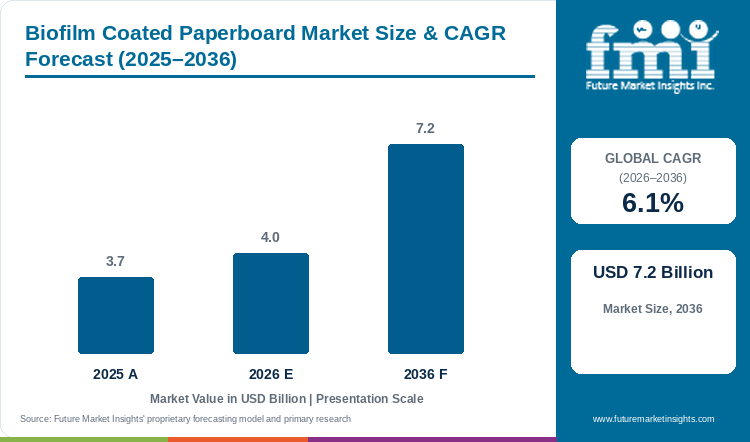
Demand for biofilm coated paperboard is projected to expand at 6.1% CAGR between 2026 and 2036. Industry value grows from USD 3.7 billion in 2025 to USD 4.0 billion in 2026 and is projected to reach USD 7.2 billion by 2036.
Biofilm coated paperboard market is valued at USD 3.7 billion in 2025 and is expected to increase from USD 4.0 billion in 2026 to USD 7.2 billion by 2036, registering 6.1% CAGR during 2026 to 2036, as noted by FMI. PLA is projected to hold 39.4% of coating material demand in 2026, as cups, trays and cartons require a functional layer for grease, moisture and sealing performance. The European Union generated 32.3 million tonnes of paper and cardboard packaging waste in 2023, accounting for 40.4% of total packaging waste, which shows the large volume of fiber packs already entering collection systems.[1] The U.S. Environmental Protection Agency reported that generation of paper and paperboard containers and packaging reached 67.4 million tons in municipal solid waste, confirming the substantial volume of recyclable fiber materials.[2] Availability of thinner functional barrier layers along with an expanding paperboard packaging base is expected to support use of biofilm coated paperboard in food packaging applications.
Key Market Trends & Insights
- By coating material: PLA is projected to account for 39.4% of demand in 2026, owing to established use in extrusion coated cups, trays, and cartons.
- By paperboard grade: SBS is estimated to hold 44.7% of demand in 2026, supported by smooth surface uniformity, higher stiffness, and graphic printing performance.
- By end use: Food and beverage is anticipated to account for 53.9% of demand in 2026, driven by liquid, grease, and temperature protection requirements across hot and cold applications.
- By coating method: Extrusion is projected to hold 47.0% of demand in 2026, as converters apply continuous barrier layers at high line speeds on commercial packaging equipment.
Regional Highlights
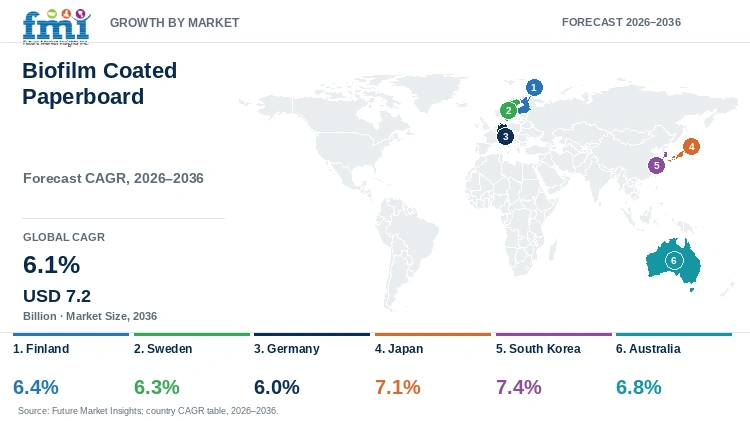
- Fastest-growing profiled country: South Korea is expected to register the highest profiled CAGR at 7.4% from 2026 to 2036.
- By country: Japan (7.1%) and Australia (6.8%) follow, while Finland (6.4%), Sweden (6.3%), and Germany (6.0%) complete the profiled group.
Market Size & Forecast
Table 1: Market Size and Forecast for the Biofilm Coated Paperboard Market (USD billion and percentage), 2025 to 2036
| Metric | Value |
|---|---|
| 2025 Market Size | USD 3.7 billion |
| Estimated Market Size in 2026 | USD 4.0 billion |
| Projected Market Size by 2036 | USD 7.2 billion |
| CAGR, 2026 to 2036 | 6.1% |
| Added Revenue, 2026 to 2036 | USD 3.2 billion |
| Market Expansion Multiple | 1.8x |
Recycling performance is expected to decide which coated paperboard structures receive wider commercial use. Europe recycled 53.9 million tonnes of paper and board in 2025, with a 76.4% recycling rate across paper products and 86.6% for fiber based packaging.[3] Regulation (EU) 2025/40 applies from 12 August 2026 and introduces recyclability performance grades from 2030, due to which converters will need evidence for collection, sorting and fiber recovery. As a result, demand is expected to move towards coatings which provide barrier performance on existing lines and also meet the selected recycling or composting route.
Barrier-Coating Revenue Exposure and Conversion Readiness
Table 2: Leading Segment Revenue Exposure and Conversion Indicators for the Biofilm Coated Paperboard Market (USD billion, percentages, metric tonnes, and temperature), 2026 market data with supporting indicators from 2023 to 2026
| Indicator | Market Input | Calculated or Reported Result | Commercial Meaning | Source or Basis |
|---|---|---|---|---|
| PLA coating material | USD 4.0 billion × 39.4% | USD 1.58 billion | Shows the 2026 revenue exposure associated with the leading coating material. | Calculated from report values |
| SBS paperboard grade | USD 4.0 billion × 44.7% | USD 1.79 billion | Indicates the revenue exposure of board requiring printability, stiffness and coating compatibility. | Calculated from report values |
| Food and beverage end use | USD 4.0 billion × 53.9% | USD 2.16 billion | Concentrates qualification around grease, liquid, temperature and food-contact requirements. | Calculated from report values |
| Extrusion coating method | USD 4.0 billion × 47.0% | USD 1.88 billion | Shows the exposure connected with continuous high-volume coating operations. | Calculated from report values |
| Australia paperboard recovery gap | 3.693 million tonnes placed on market less 2.437 million tonnes recovered | 1.256 million tonnes | Shows why repulpability and recovery documentation affect access to fiber-packaging demand. | APCO 2023 to 2024 data [16] |
| Ezycompost conversion benchmark | Standard forming lines; 40% thinner than PLA; stable to 100°C | Existing-line processing with thinner barrier layer | Connects coating performance with converter throughput and foodservice use. | BASF and Metpack, 2025 [6] |
Analyst Perspective
“Demand will move towards thin barrier coatings which protect food and continue through the selected recovery route. Over the years of analysis, converters using existing coating and forming lines will receive faster adoption as qualification cost remains lower.”
- Nandini Roy Choudhury, Principal Consultant, Future Market Insights.
How is the biofilm coated paperboard market segmented?
Biofilm coated paperboard market is segmented by four primary commercial axes and region: coating material, paperboard grade, end use, coating method, and region. In 2026, PLA is projected at 39.4%, SBS at 44.7%, food and beverage at 53.9%, and extrusion at 47.0%.
By coating material: PLA, PHA, starch blends, cellulose films, and other biopolymers (bio-based barrier coatings and films applied to paperboard).
By paperboard grade: SBS, folding boxboard, coated unbleached kraft, and white-top and specialty board.
By end use: food and beverage, personal care and cosmetics, pharmaceuticals, e-commerce and retail, and other end uses.
By coating method: extrusion, dispersion and curtain, lamination, and slot-die and other methods.
By region: North America, Latin America, Western Europe, Eastern Europe, East Asia, South Asia and Pacific, and Middle East and Africa.
Why does PLA retain a notable coating material share?
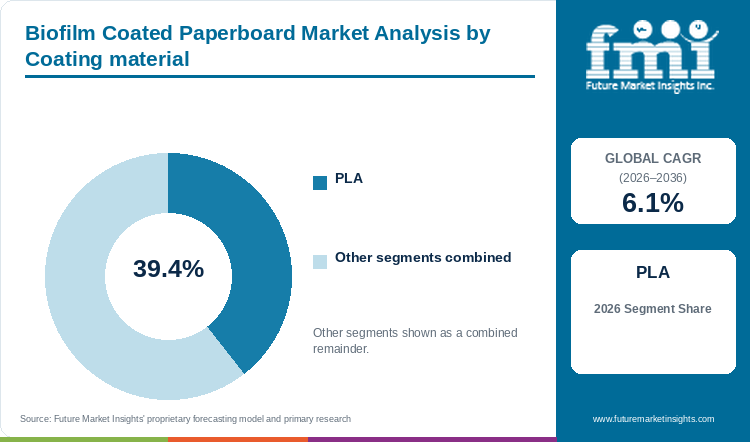
PLA is projected to hold 39.4% of coating material demand in 2026, supported by established use in extrusion coated food packaging.
Table 3: Coating Material Share for the Biofilm Coated Paperboard Market (percentage share), 2026
| Coating Material | Share (2026) |
|---|---|
| PLA | 39.4% |
| Other Segments Combined | 60.6%* |
| Total | 100.0% |
*Calculated as the balance remaining after deducting the leading segment's reported share from 100.0%.
Table 4: Coating Material Leadership and Market Growth for the Biofilm Coated Paperboard Market (segment and CAGR percentage), 2026 to 2036
| Metric | Value |
|---|---|
| Global CAGR (2026 to 2036) | 6.1% |
| Leading Segment | PLA |
PLA coating provides moisture resistance and sealing performance and can be processed through extrusion coating equipment. FMI research indicates that cups, trays and cartons use PLA where the paperboard needs a bio-based polymer layer without changing the complete pack format, expanding opportunities in bioplastics solutions. NatureWorks opened its 75,000-metric-ton-per-year integrated Ingeo PLA manufacturing facility in Thailand in 2025 to expand biopolymer availability for extrusion lines.[4] Availability of additional PLA along with its established processing route is expected to support the coating material segment.
- PLA is projected to hold 39.4% of coating material demand in 2026, supported by established use in extrusion coated food packaging.
- The Thailand facility supports the segment by adding material supply for converters using PLA on food packaging lines.
What supports SBS as a preferred paperboard grade choice?
By paperboard grade, SBS is estimated to represent 44.7% of demand in 2026, underpinned by its smooth surface and printing quality.
SBS is made from bleached fiber and provides brightness, stiffness and a uniform surface for printing and coating. Food, cosmetics and pharmaceutical folding cartons use this grade where appearance and pack strength have to remain consistent. The American Forest & Paper Association reported in January 2025 that U.S. bleached packaging board production reached 11.8 million tons in 2024, confirming steady virgin-fiber supply for premium folding cartons.[5] Demand for printable board carrying a functional coating is expected to remain higher where buyers also require a documented recycling route.
- By paperboard grade, SBS is estimated to represent 44.7% of demand in 2026, underpinned by its smooth surface and printing quality.
- The development is expected to support adoption by improving coating performance and processing availability for converters.
How is food and beverage sustaining end-use demand?
Food and beverage is expected to command 53.9% of end-use demand in 2026, driven by grease and moisture protection.
Biofilm coated paperboard is used in paper cups, frozen food packs, takeaway trays and microwave containers. These packs need resistance against liquids, fats, grease and temperature while remaining suitable for food contact. BASF reported in May 2025 that Ezycompost coated paper remained stable in boiling water up to 100°C and was approved for food contact.[6] Wider use in hot, cold and frozen applications is anticipated to keep food and beverage as the largest end-use segment across foodservice packaging.
- Food and beverage is expected to command 53.9% of end-use demand in 2026, driven by grease and moisture protection.
- Food-contact and boiling-water performance is expected to widen application across hot, cold and frozen food packs.
Why does extrusion remain relevant among coating methods?
Extrusion is projected to hold 47.0% of coating method demand in 2026, owing to continuous and high-speed coating application.
Extrusion coating forms a continuous film over paperboard and is commonly selected for manufacturing barrier coated paper and board for long runs of cups, trays and cartons. Davis-Standard introduced equipment updates for extrusion coating and laminating applications in September 2025.[7] Established machinery along with thinner biopolymer layers is expected to support extrusion where converters require speed, sealing and consistent coat weight.
- Extrusion is projected to hold 47.0% of coating method demand in 2026, owing to continuous and high-speed coating application.
- Established equipment and thinner coating layers are expected to keep extrusion suitable for continuous, high-volume production.
What are the drivers, restraints, and opportunities in the biofilm coated paperboard market?
In the biofilm coated paperboard market, plastic replacement drives adoption, recovery compatibility limits use, and thinner certified barriers create opportunity.
- Driver: Rising demand for paper based food packs is increasing use of grease and moisture resistant coated paperboard.
- Restraint: Difficult separation of coating from fiber may reduce recycling performance and limit product approval.
- Opportunity: Thin compostable and repulpable coatings are creating new application in hot, frozen and microwave food packaging.
Plastic Replacement Increases Product Demand
Restrictions on unnecessary plastic packaging are shifting cups, cartons and trays towards paperboard structures carrying a functional barrier. Regulation (EU) 2025/40 applies from 12 August 2026 and requires packaging to become recyclable by 2030.[8] Coated paperboard is expected to gain where it provides grease and moisture resistance while reducing use of a full plastic pack, accelerating the industry transition toward sustainable packaging.
Recycling Difficulty May Limit Adoption
Recycling remains a challenge when the coating does not separate from fiber during pulping. German authorities reported in January 2026 that about 5.5 million tonnes of household packaging were recycled in 2024, while composite packaging remained below its statutory target.[9] Higher non-fiber content can reduce recovered fiber and increase mill rejects, due to which difficult coated paper structures may receive slower approval.
Certified Coatings Create New Opportunities
Thinner compostable coatings are creating application opportunities in hot, frozen and microwave food packs. BASF expanded the ecovio range in April 2026 with home-compostable barrier structures for flexible and paper based packaging.[10] Coatings which combine grease, liquid and temperature resistance with certification are expected to receive stronger demand from food packaging converters seeking certified compostable packaging solutions.
Which country CAGRs are profiled in the biofilm coated paperboard market?
Table 5: Country CAGR Comparison for the Biofilm Coated Paperboard Market (CAGR percentage), 2026 to 2036
| Country | CAGR |
|---|---|
| Finland | 6.4% |
| Sweden | 6.3% |
| Germany | 6.0% |
| Japan | 7.1% |
| South Korea | 7.4% |
| Australia | 6.8% |
How do country-level CAGRs compare in the biofilm coated paperboard market?
As per the analysis from FMI, country growth rates differ through 2036 because fiber collection infrastructure, composite recycling mandates, and packaging recovery regulations vary across markets. South Korea and Japan are projected to grow faster, while Finland and Sweden will continue to benefit from paperboard production and organized collection.
Germany is expected to expand steadily as recyclability assessment becomes part of pack approval. Australia provides opportunity through its large paper packaging base and the remaining gap between placed and recovered volume.
- Finland demand is supported by domestic paperboard production and high collection of fiber packaging.
- Sweden uses material specific packaging statistics and recycling targets for producer reporting.
- Germany applies separate recyclability assessment for paperboard and paper based composite packaging.
- Japan is testing recovery of paper cups, paper plates and other difficult coated paper products.
- South Korea includes paper packs under extended producer responsibility requirements.
- Australia has a large paper and paperboard packaging base with scope for higher recovery.
Full report country CAGRs cover: North America; Latin America; Western Europe; Eastern Europe; East Asia; South Asia and Pacific; Middle East and Africa.
Country-wise Analysis
- Finland is projected to expand at 6.4% CAGR through 2036. Finnish Packaging Recycling RINKI reported a 96% recycling rate for fiber packaging in 2023.[11] High fiber collection and domestic board production are expected to favour coatings which separate during pulping and return the fiber to regular fiber based packaging recovery. This collection base provides recovered fiber for mills and supports preference for coated papers which remain compatible with pulping.
- Sweden is estimated to register 6.3% CAGR during the forecast period. Statistics Sweden reported in December 2025 that five packaging recycling targets were achieved during 2024.[12] Material-specific reporting is expected to increase attention on coating weight and the complete pack structure, supporting demand for thin barrier papers used in food and consumer products. Such reporting is expected to keep coating selection linked with the recycling result of the complete paperboard pack.
- Germany biofilm coated paperboard demand is projected to rise at 6.0% CAGR through 2036. The minimum standard for packaging recyclability was updated in August 2025 and provides separate assessment for paper, cardboard, liquid packaging board and paper-dominant composites.[13] Coating separation and non-fiber content will remain important in product acceptance, due to which difficult composite structures may grow at a slower rate. Suppliers showing lower coating weight and better fiber separation are expected to face fewer limitations during package assessment.
- Japan is expected to record 7.1% CAGR through 2036. Expo 2025 Osaka collected difficult paper products including cups, plates and capped cartons for conversion into toilet paper within three days after reaching the mill.[14] FMI data suggests that development of a separate recovery route is expected to support sales where coated foodservice products cannot enter normal paper recycling. The project shows how a separate collection route can support coated formats which are difficult to process with normal paper grades.
- South Korea is projected to register the highest profiled growth at 7.4% CAGR through 2036. Korea Environment Corporation includes paper packs under mandatory recycling duties and applies charges for a recycling shortfall.[15] Producer reporting is expected to favour packaging materials which can meet the selected recovery route without affecting food protection. Recycling plans and performance reports are expected to make recovery documentation an important part of supplier selection.
- Australia biofilm coated paperboard sales are projected to increase at 6.8% CAGR through 2036. APCO reported that 6.84 million tonnes of packaging was placed on the market during 2023 to 2024, with paper and paperboard accounting for 54% and recording 66% recovery.[16] The large paper packaging base along with room for higher recovery is expected to create opportunity for recyclable and compostable coatings. Opportunity will remain higher for coatings which protect food and allow the board to move through the selected recovery system.
Who are the notable companies in the biofilm coated paperboard market?
Stora Enso, Smurfit WestRock, Graphic Packaging International, Metsä Board, Mondi, Huhtamaki, Sappi, and Billerud are notable companies profiled in this market.
Biofilm coated paperboard market includes board manufacturers, carton converters and food packaging companies. Stora Enso, Metsä Board, Sappi and Billerud are developing board grades with barrier and recycling properties, while Smurfit WestRock and Graphic Packaging International supply converted cartons. Mondi and Huhtamaki are active in foodservice packaging formats. In the FMI report, competitive position is connected with board capacity, barrier depth, and customer qualification for food contact. Product trials, coating development and customer qualification are expected to decide which suppliers gain repeat orders.
- Paperboard and barrier coating manufacturers: Stora Enso, Metsä Board, Sappi and Billerud.
- Converted carton manufacturers: Smurfit WestRock and Graphic Packaging International.
- Food and consumer packaging companies: Mondi and Huhtamaki.
Competitive Benchmarking: Biofilm Coated Paperboard Market
Table 6: Competitive Benchmarking for the Biofilm Coated Paperboard Market (qualitative capability ratings), 2026
| Company | Barrier Portfolio | Board Depth | Current Activity | Geographic Reach |
|---|---|---|---|---|
| Stora Enso | High | High | High | High |
| Smurfit WestRock | High | High | High | High |
| Graphic Packaging International | High | High | High | High |
| Metsä Board | High | High | Medium | High |
| Mondi | High | High | High | High |
| Huhtamaki | High | Medium | High | High |
| Sappi | High | High | Medium | High |
| Billerud | High | High | Medium | High |
High indicates wider public evidence, Medium indicates limited public evidence and Low indicates less direct evidence. These ratings do not represent product quality, company rank or market share.
Key Developments in the Biofilm Coated Paperboard Market
- In September 2026, Stora Enso expanded development of renewable consumer packaging and barrier paperboard for food contact application.[17] The development is expected to support food-contact packs requiring grease and moisture resistance from the board structure.
- In June 2025, Metsä Board introduced enhanced barrier folding boxboard grades designed for food and consumer packaging applications.[18] The product adds a certified coating route for cups, pots, trays and microwave packs requiring food-contact performance.
- In March 2026, Graphic Packaging International expanded its fiber-based barrier carton offerings for foodservice and chilled food brands.[19] The expansion is expected to make recyclability evidence more important during packaging design and supplier qualification in Europe.
- In 2025, Billerud continued development of recyclable barrier board for food and consumer packaging.[20] Availability of recyclable barrier board is expected to widen product choice for food brands and carton converters.
Key Players in the Biofilm Coated Paperboard Market
Integrated Board and Barrier Platforms
- Stora Enso
- Metsä Board
- Sappi
- Billerud
Converted Carton and Packaging Platforms
- Smurfit WestRock
- Graphic Packaging International
- Mondi
- Huhtamaki
Biofilm Coated Paperboard Market - Report Scope
Table 7: Report Scope for the Biofilm Coated Paperboard Market (coverage fields and definitions), 2026 to 2036
| Coverage field | Report scope |
|---|---|
| Market breakdown | Coating material; paperboard grade; end use; coating method; region |
| Quantitative units | USD billion |
| Market definition | First-sale revenue from paperboard carrying a bio-based, biodegradable or compostable functional coating. Uncoated board, conventional fossil-only extrusion coating, filling services and downstream packaged goods are excluded. |
| Regions covered | North America; Latin America; Western Europe; Eastern Europe; East Asia; South Asia and Pacific; Middle East and Africa |
| Countries covered | Finland; Sweden; Germany; Japan; South Korea; Australia |
| Key companies profiled | Stora Enso, Smurfit WestRock, Graphic Packaging International, Metsä Board, Mondi, Huhtamaki, Sappi, Billerud |
| Forecast period | 2026 to 2036 |
| Approach | Bottom-up and top-down market sizing based on paperboard demand, coating use, end-use application, company activity and country demand. |
Biofilm Coated Paperboard Market - Research Methodology
Table 8: Research Methodology for the Biofilm Coated Paperboard Market (research methods and approach), 2026 edition
| Method | Approach |
|---|---|
| Primary Research | Primary research includes interviews with paperboard manufacturers, coating suppliers, converters, distributors, end users, procurement teams and industry experts. These interviews cover product use, pricing, adoption barriers, coating performance and purchasing requirements. |
| Desk Research | Desk research covers government publications, regulatory documents, trade data, industry associations, technical literature, company filings, product information and official company announcements. |
| Market Sizing and Forecasting | Market sizing uses the base market value, historical performance, segment structure, pricing, volume indicators, adoption level, company participation and country demand conditions. |
| Data Validation | Market estimates are checked against public data, company activity, packaging recovery and product developments along with primary research. Adjacent products and overlapping revenue are excluded from the market definition. |
Biofilm Coated Paperboard Market by Segments
Coating material
- PLA
- PHA
- Starch blends
- Cellulose films
- Other biopolymers
Paperboard grade
- SBS
- Folding boxboard
- Coated unbleached kraft
- White-top and specialty board
End use
- Food and beverage
- Personal care and cosmetics
- Pharmaceuticals
- E-commerce and retail
- Other end uses
Coating method
- Extrusion
- Dispersion and curtain
- Lamination
- Slot-die and other methods
Biofilm Coated Paperboard Market by Region
- North America
- United States
- Canada
- Latin America
- Brazil
- Mexico
- Argentina
- Chile
- Western Europe
- Germany
- France
- United Kingdom
- Italy
- Spain
- Benelux
- Nordics
- Eastern Europe
- Poland
- Czech Republic
- Romania
- Hungary
- East Asia
- Japan
- South Korea
- South Asia and Pacific
- ASEAN
- Australia and New Zealand
- Middle East and Africa
- GCC Countries
- South Africa
- Türkiye
- Israel
Research Sources and Bibliography
- [1] Eurostat. (2026, August 28). Packaging waste statistics. https://ec.europa.eu/eurostat/statistics-explained/SEPDF/cache/10547.pdf
- [2] U.S. Environmental Protection Agency. (2025, October 23). Containers and packaging: Product-specific data. https://www.epa.gov/facts-and-figures-about-materials-waste-and-recycling/containers-and-packaging-product-specific
- [3] European Paper Recycling Council. (2026, October 1). European paper recycling rate remains stable, confirming a balanced and resilient market.
- [4] NatureWorks LLC. (2025, May). Ingeo PLA manufacturing facility progress update.
- [5] American Forest & Paper Association. (2025, January 23). AF&PA releases December 2024 packaging board report.
- [6] BASF SE. (2025, May 6). Metpack and BASF cooperate to demonstrate certified home-compostable, coated paper for food packaging.
- [7] Davis-Standard, LLC. (2025, September). Extrusion coating and laminating equipment update.
- [8] European Union. (2025, January 22). Regulation (EU) 2025/40 on packaging and packaging waste. https://eur-lex.europa.eu/eli/reg/2025/40/oj/eng
- [9] German Environment Agency. (2026, January 27). Facts against myths: Packaging waste recycling in Germany is working.
- [10] BASF SE. (2026, April). Ecovio range for home-compostable barrier structures.
- [11] Finnish Packaging Recycling RINKI Ltd.. (2026). Packaging statistics.
- [12] Statistics Sweden. (2025, December 5). Waste, packaging.
- [13] Central Agency Packaging Register. (2025, August 28). Minimum standard for determining the recyclability of packaging.
- [14] Japan Association for the 2025 World Exposition. (2025, March 13). Future Society Showcase Project “Green Expo”: Recycling of Hard-to-Recycle Paper project sponsors decided.
- [15] Korea Environment Corporation. (2026). Extended Producer Responsibility.
- [16] Australian Packaging Covenant Organisation. (2025, November). Australian Packaging Consumption & Recovery Data 2023-24. https://documents.packagingcovenant.org.au/public-documents/APCO%20Australian%20Packaging%20Consumption%20and%20Recovery%20Data%202023-24.pdf
- [17] Stora Enso Oyj. (2026, September). Renewable consumer packaging and barrier paperboard development.
- [18] Metsä Board Oyj. (2025, June). Barrier folding boxboard product portfolio update.
- [19] Graphic Packaging International, LLC. (2026, March). Fiber-based barrier carton innovation update.
- [20] Billerud AB. (2025). Recyclable barrier board for food and consumer packaging.
This bibliography is provided for reader reference. The full report contains the complete reference list and detailed citations.
This Report Answers
- How large is the biofilm coated paperboard market during 2026?
- What market value is projected for biofilm coated paperboard by 2036?
- Which coating material holds a notable share in the market?
- Which paperboard grade holds a notable share in 2026?
- Which countries show a notable expansion outlook through 2036?
- Which companies are notable in the biofilm coated paperboard market?
Frequently Asked Questions
How large is the biofilm coated paperboard market expected in 2026?
As per FMI, biofilm coated paperboard market is expected to reach USD 4.0 billion in 2026 and USD 7.2 billion by 2036.
What CAGR is projected for the market through 2036?
According to FMI, the market is projected to expand at 6.1% CAGR from 2026 to 2036.
Which coating material holds a notable share in 2026?
PLA is projected to hold 39.4% of coating material demand in 2026 owing to its use in extrusion coated food packaging.
Which paperboard grade holds a notable share in 2026?
SBS is estimated to account for 44.7% of paperboard grade demand in 2026 due to its printing, stiffness and coating properties.
Which country has a notable expansion outlook through 2036?
South Korea is projected to expand at 7.4% CAGR through 2036, supported by recycling duties and wider use of paper packs.
Who are the notable companies in this market?
Notable companies include Stora Enso, Smurfit WestRock, Graphic Packaging International, Metsä Board, Mondi, Huhtamaki, Sappi and Billerud.
Preview the report firsthand - request a free sample
Get SampleGet the brochure for pricing and purchase details.
Get PDFTable of Content
- Key Takeaways
- Market Size and CAGR
- Top Growth Driver
- Fastest Growing Segment
- Leading Region
- Key Companies
- Emerging Opportunities
- Executive Summary
- Global Market Outlook
- Demand-side Trends
- Supply-side Trends
- Technology Roadmap Analysis
- Analysis and Recommendations
- Analyst Perspective (What is happening? Why now? What should investors know?)
- Key Questions Answered
- How large is the market?
- What is the CAGR?
- What are key trends?
- Which region dominates?
- Who are the leaders?
- Market Overview
- Market Coverage / Taxonomy
- Market Definition / Scope / Limitations
- Research Methodology
- Chapter Orientation
- Analytical Lens and Working Hypotheses
- Market Structure, Signals, and Trend Drivers
- Benchmarking and Cross-market Comparability
- Market Sizing, Forecasting, and Opportunity Mapping
- Research Design and Evidence Framework
- Desk Research Programme (Secondary Evidence)
- Expert Input and Fieldwork (Primary Evidence)
- Tooling, Models, and Reference Databases
- Data Engineering and Model Build
- Quality Assurance and Audit Trail
- Market Background
- Market Dynamics (Drivers, Restraints, Opportunity, Trends)
- Scenario Forecast (Optimistic, Likely, Conservative)
- Impact Analysis
- AI Impact
- Sustainability Impact
- Regulatory Impact
- Technology Impact
- Consumer / Buyer Analysis
- Purchase Drivers
- Adoption Barriers
- Buyer Journey
- Opportunity Map Analysis
- Product Life Cycle Analysis
- Supply Chain Analysis
- Investment Feasibility Matrix
- Value Chain Analysis
- PESTLE and Porter's Analysis
- Regulatory Landscape
- Regional Parent Market Outlook
- Production and Consumption Statistics
- Import and Export Statistics
- Global Market Analysis and Forecast, 2021 to 2036
- Historical Market Size Value (USD Billion) Analysis, 2021 to 2025
- Current and Future Market Size Value (USD Billion) Projections, 2026 to 2036
- Y-o-Y Growth Trend Analysis
- Absolute $ Opportunity Analysis
- Global Market Pricing Analysis, 2021 to 2036
- Global Market Analysis and Forecast, By Coating material, 2021 to 2036
- Introduction / Key Findings
- Historical Market Size Value (USD Billion) Analysis By Coating material, 2021 to 2025
- Current and Future Market Size Value (USD Billion) Analysis and Forecast By Coating material, 2026 to 2036
- PLA
- PHA
- Starch blends
- Cellulose films
- Other biopolymers
- Y-o-Y Growth Trend Analysis By Coating material, 2021 to 2025
- Absolute $ Opportunity Analysis By Coating material, 2026 to 2036
- Global Market Analysis and Forecast, By Paperboard grade, 2021 to 2036
- Introduction / Key Findings
- Historical Market Size Value (USD Billion) Analysis By Paperboard grade, 2021 to 2025
- Current and Future Market Size Value (USD Billion) Analysis and Forecast By Paperboard grade, 2026 to 2036
- SBS
- Folding boxboard
- Coated unbleached kraft
- White-top and specialty board
- Y-o-Y Growth Trend Analysis By Paperboard grade, 2021 to 2025
- Absolute $ Opportunity Analysis By Paperboard grade, 2026 to 2036
- Global Market Analysis and Forecast, By End use, 2021 to 2036
- Introduction / Key Findings
- Historical Market Size Value (USD Billion) Analysis By End use, 2021 to 2025
- Current and Future Market Size Value (USD Billion) Analysis and Forecast By End use, 2026 to 2036
- Food and beverage
- Personal care and cosmetics
- Pharmaceuticals
- E-commerce and retail
- Other end uses
- Y-o-Y Growth Trend Analysis By End use, 2021 to 2025
- Absolute $ Opportunity Analysis By End use, 2026 to 2036
- Global Market Analysis and Forecast, By Coating method, 2021 to 2036
- Introduction / Key Findings
- Historical Market Size Value (USD Billion) Analysis By Coating method, 2021 to 2025
- Current and Future Market Size Value (USD Billion) Analysis and Forecast By Coating method, 2026 to 2036
- Extrusion
- Dispersion and curtain
- Lamination
- Slot-die and other methods
- Y-o-Y Growth Trend Analysis By Coating method, 2021 to 2025
- Absolute $ Opportunity Analysis By Coating method, 2026 to 2036
- Global Market Analysis and Forecast, By Region, 2021 to 2036
- Introduction
- Historical Market Size Value (USD Billion) Analysis By Region, 2021 to 2025
- Current Market Size Value (USD Billion) Analysis and Forecast By Region, 2026 to 2036
- North America
- Latin America
- Western Europe
- Eastern Europe
- East Asia
- South Asia and Pacific
- Middle East and Africa
- Market Attractiveness Analysis By Region
- North America Market Analysis and Forecast, By Country, 2021 to 2036
- Historical Market Size Value (USD Billion) Trend Analysis By Market Taxonomy, 2021 to 2025
- Market Size Value (USD Billion) Forecast By Market Taxonomy, 2026 to 2036
- By Country
- United States
- Canada
- By Coating material
- By Paperboard grade
- By End use
- By Coating method
- By Country
- Market Attractiveness Analysis
- By Country
- By Coating material
- By Paperboard grade
- By End use
- By Coating method
- Key Takeaways
- Latin America Market Analysis and Forecast, By Country
- Historical Market Size Value (USD Billion) Trend Analysis By Market Taxonomy, 2021 to 2025
- Market Size Value (USD Billion) Forecast By Market Taxonomy, 2026 to 2036
- By Country
- Brazil
- Mexico
- Argentina
- Chile
- By Coating material
- By Paperboard grade
- By End use
- By Coating method
- By Country
- Market Attractiveness Analysis
- By Country
- By Coating material
- By Paperboard grade
- By End use
- By Coating method
- Key Takeaways
- Western Europe Market Analysis and Forecast, By Country
- Historical Market Size Value (USD Billion) Trend Analysis By Market Taxonomy, 2021 to 2025
- Market Size Value (USD Billion) Forecast By Market Taxonomy, 2026 to 2036
- By Country
- Germany
- France
- United Kingdom
- Italy
- Spain
- Benelux
- Nordics
- By Coating material
- By Paperboard grade
- By End use
- By Coating method
- By Country
- Market Attractiveness Analysis
- By Country
- By Coating material
- By Paperboard grade
- By End use
- By Coating method
- Key Takeaways
- Eastern Europe Market Analysis and Forecast, By Country
- Historical Market Size Value (USD Billion) Trend Analysis By Market Taxonomy, 2021 to 2025
- Market Size Value (USD Billion) Forecast By Market Taxonomy, 2026 to 2036
- By Country
- Poland
- Czech Republic
- Romania
- Hungary
- By Coating material
- By Paperboard grade
- By End use
- By Coating method
- By Country
- Market Attractiveness Analysis
- By Country
- By Coating material
- By Paperboard grade
- By End use
- By Coating method
- Key Takeaways
- East Asia Market Analysis and Forecast, By Country
- Historical Market Size Value (USD Billion) Trend Analysis By Market Taxonomy, 2021 to 2025
- Market Size Value (USD Billion) Forecast By Market Taxonomy, 2026 to 2036
- By Country
- Japan
- South Korea
- By Coating material
- By Paperboard grade
- By End use
- By Coating method
- By Country
- Market Attractiveness Analysis
- By Country
- By Coating material
- By Paperboard grade
- By End use
- By Coating method
- Key Takeaways
- South Asia and Pacific Market Analysis and Forecast, By Country
- Historical Market Size Value (USD Billion) Trend Analysis By Market Taxonomy, 2021 to 2025
- Market Size Value (USD Billion) Forecast By Market Taxonomy, 2026 to 2036
- By Country
- ASEAN
- Australia and New Zealand
- By Coating material
- By Paperboard grade
- By End use
- By Coating method
- By Country
- Market Attractiveness Analysis
- By Country
- By Coating material
- By Paperboard grade
- By End use
- By Coating method
- Key Takeaways
- Middle East and Africa Market Analysis and Forecast, By Country
- Historical Market Size Value (USD Billion) Trend Analysis By Market Taxonomy, 2021 to 2025
- Market Size Value (USD Billion) Forecast By Market Taxonomy, 2026 to 2036
- By Country
- GCC Countries
- South Africa
- Türkiye
- Israel
- By Coating material
- By Paperboard grade
- By End use
- By Coating method
- By Country
- Market Attractiveness Analysis
- By Country
- By Coating material
- By Paperboard grade
- By End use
- By Coating method
- Key Takeaways
- Key Countries Market Analysis
- United States
- Pricing Analysis
- Market Share Analysis, 2025
- By Coating material
- By Paperboard grade
- By End use
- By Coating method
- Canada
- Pricing Analysis
- Market Share Analysis, 2025
- By Coating material
- By Paperboard grade
- By End use
- By Coating method
- Mexico
- Pricing Analysis
- Market Share Analysis, 2025
- By Coating material
- By Paperboard grade
- By End use
- By Coating method
- Brazil
- Pricing Analysis
- Market Share Analysis, 2025
- By Coating material
- By Paperboard grade
- By End use
- By Coating method
- Chile
- Pricing Analysis
- Market Share Analysis, 2025
- By Coating material
- By Paperboard grade
- By End use
- By Coating method
- Germany
- Pricing Analysis
- Market Share Analysis, 2025
- By Coating material
- By Paperboard grade
- By End use
- By Coating method
- United Kingdom
- Pricing Analysis
- Market Share Analysis, 2025
- By Coating material
- By Paperboard grade
- By End use
- By Coating method
- Italy
- Pricing Analysis
- Market Share Analysis, 2025
- By Coating material
- By Paperboard grade
- By End use
- By Coating method
- Spain
- Pricing Analysis
- Market Share Analysis, 2025
- By Coating material
- By Paperboard grade
- By End use
- By Coating method
- France
- Pricing Analysis
- Market Share Analysis, 2025
- By Coating material
- By Paperboard grade
- By End use
- By Coating method
- ASEAN
- Pricing Analysis
- Market Share Analysis, 2025
- By Coating material
- By Paperboard grade
- By End use
- By Coating method
- Australia and New Zealand
- Pricing Analysis
- Market Share Analysis, 2025
- By Coating material
- By Paperboard grade
- By End use
- By Coating method
- Japan
- Pricing Analysis
- Market Share Analysis, 2025
- By Coating material
- By Paperboard grade
- By End use
- By Coating method
- South Korea
- Pricing Analysis
- Market Share Analysis, 2025
- By Coating material
- By Paperboard grade
- By End use
- By Coating method
- Poland
- Pricing Analysis
- Market Share Analysis, 2025
- By Coating material
- By Paperboard grade
- By End use
- By Coating method
- Hungary
- Pricing Analysis
- Market Share Analysis, 2025
- By Coating material
- By Paperboard grade
- By End use
- By Coating method
- Türkiye
- Pricing Analysis
- Market Share Analysis, 2025
- By Coating material
- By Paperboard grade
- By End use
- By Coating method
- South Africa
- Pricing Analysis
- Market Share Analysis, 2025
- By Coating material
- By Paperboard grade
- By End use
- By Coating method
- Finland
- Pricing Analysis
- Market Share Analysis, 2025
- By Coating material
- By Paperboard grade
- By End use
- By Coating method
- Sweden
- Pricing Analysis
- Market Share Analysis, 2025
- By Coating material
- By Paperboard grade
- By End use
- By Coating method
- Australia
- Pricing Analysis
- Market Share Analysis, 2025
- By Coating material
- By Paperboard grade
- By End use
- By Coating method
- United States
- Market Structure Analysis
- Competition Dashboard
- Competition Benchmarking
- Market Share Analysis of Top Players
- By Regional
- By Coating material
- By Paperboard grade
- By End use
- By Coating method
- Emerging Startups
- Innovation Benchmarking
- Competition Analysis
- Competition Deep Dive
- Stora Enso
- Overview
- Product Portfolio
- Profitability by Market Segments
- Sales Footprint
- Strategy Overview
- Marketing Strategy
- Product Strategy
- Channel Strategy
- Smurfit WestRock
- Graphic Packaging International
- Metsä Board
- Mondi
- Huhtamaki
- Sappi
- Billerud
- Stora Enso
- Case Studies
- Success Stories
- Recent Developments
- Competition Deep Dive
- Assumptions & Acronyms Used


