

- Market Size (2026)
- USD 1680.60 Mn
- Forecast (2036)
- USD 3561.70 Mn
- CAGR (2026 to 2036)
- 7.8%
How big is the Biofilm Control Chemicals Market in 2026?
USD 1,680.60 million in 2026 and USD 3,561.70 million by 2036 at a 7.8% CAGR.
The biofilm control chemicals industry value is anticipated to rise from USD 1,558.99 million in 2025 to USD 3,561.70 million by 2036 at 7.8% CAGR as industrial water and oilfield programs move toward validated biofilm control. Liquid is projected to secure 64.0% share in 2026, guided by pump-fed delivery and rapid operator use across water systems and sanitation teams. Chemical + service program is expected to hold 57.0% share in 2026, supported by monitoring and field troubleshooting.
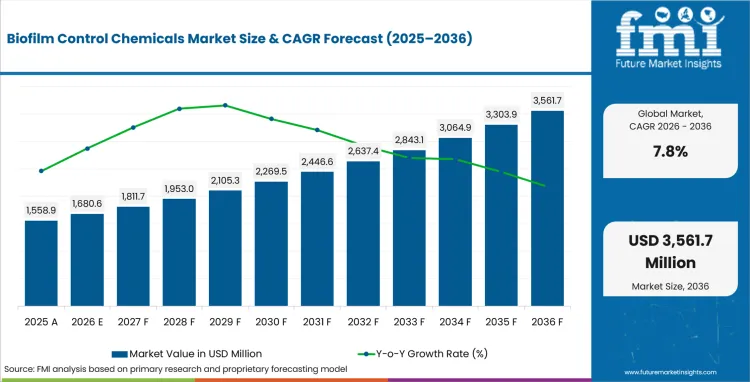
| Metric | Value |
|---|---|
| 2026 Market Size | USD 1,680.60 million |
| 2036 Market Size | USD 3,561.70 million |
| Forecast CAGR (2026-2036) | 7.8% |
| Leading Delivery Form | Liquid |
| Liquid Share (2026) | 64.0% |
| Leading Sales Model | Chemical + Service Program |
| Chemical + Service Program Share (2026) | 57.0% |
| Fastest-growing Country | India |
| India CAGR by 2036 | 9.4% |
Summary of the Biofilm Control Chemicals Market
| Market Signal | Commercial Impact |
|---|---|
| Demand and Growth Drivers | Demand for biofilm control chemicals is expected to expand steadily through 2036 as industrial users prioritize water-system reliability, sanitation performance, and service-based treatment programs.
|
| Product and Segment View | Oxidizing biocides, chemical-service programs, and liquid formulations continue to dominate their respective market segments.
|
| Geography and Growth Outlook | Asia continues to lead market expansion through industrial water management, food processing growth, and wastewater modernization initiatives.
|
| Competitive Landscape | Competition increasingly focuses on treatment effectiveness, technical service capabilities, and application-specific chemical expertise.
|
| Analyst Perspective | Biofilm control is increasingly shifting from commodity chemical supply toward integrated treatment programs that combine chemistry, diagnostics, and ongoing technical support.
- Nikhil Kaitwade, Principal Consultant for Chemicals at Future Market Insights |
Market outlook is being shaped by healthcare infection-control programs and proof-led antimicrobial labeling. UN-Water reported in 2024 that industrial wastewater data came from only 22 countries, representing 8% of the global population, and only 38% of reported industrial wastewater was treated while 27% was safely treated. CDC reported in January 2026 that more than 38,000 active hospitals, long-term care facilities, and other healthcare facilities provide data to the National Healthcare Safety Network. Kemira stated in June 2025 that its KemConnect DEX performic-acid solution was selected by the Greater Paris Sanitation Authority to disinfect treated wastewater before Seine discharge, strengthening demand signals for controlled disinfection chemistry.
Which factors support expansion in the Biofilm Control Chemicals Market?
- Water-system reliability supports market value as cooling loops and process-water lines need routine treatment against microbial attachment.
- Food and beverage processors increase demand as sanitation teams need chemicals that support cleaning verification after contamination or residue findings.
- Healthcare facilities strengthen institutional demand through environmental cleaning programs and equipment reprocessing support.
- Oilfield and industrial equipment operators create demand for non-oxidizing biocides that address sulfate-reducing bacteria and microbiologically influenced corrosion.
Why is the Biofilm Control Chemicals Market growing?
Biofilm control chemicals are gaining budget priority as facilities connect microbial attachment with corrosion and audit exposure.
WHO reported in 2024 that an active national infection prevention and control program existed in 54.7% of surveyed countries, while only 4 of 106 countries met all minimum requirements. Such gaps push healthcare, food, and industrial buyers toward documented chemical programs that combine product efficacy and staff training. Water-system buyers add another demand path as recirculation and reuse increase organic load and microbial stress inside operating assets.
How is the Biofilm Control Chemicals Market segmented?
Biofilm Control Chemicals Market is segmented by chemical type, application, end use, delivery form, and sales model.
- Oxidizing Biocides are projected to account for 46.0% share in 2026, influenced by quick microbial knockdown and routine water-system dosing.
- Water Systems are expected to hold 38.5% share in 2026, shaped by process-water loops and recirculating lines exposed to biofouling.
- Industrial Water Treatment is anticipated to account for 41.0% share in 2026, led by plants linking biofilm control to uptime and water reuse.
- Liquid is projected to represent 64.0% share in 2026, guided by pump-fed dosing and field service convenience.
- Chemical + Service Program is expected to secure 57.0% share in 2026, supported by buyer demand for monitoring and corrective support.
Why do Oxidizing Biocides lead the Biofilm Control Chemicals Market by chemical type?
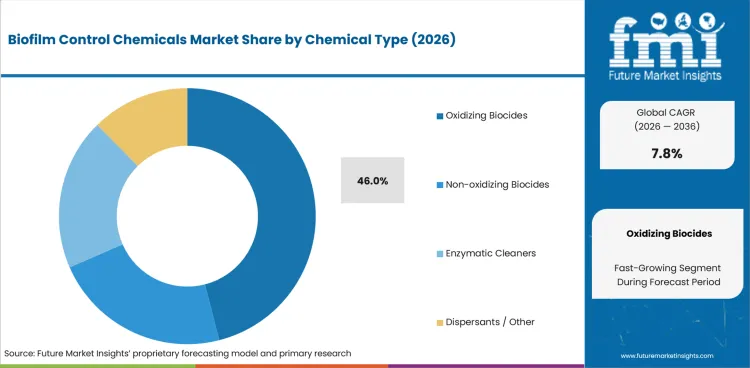
- Oxidizing Biocides are projected to account for 46.0% share in 2026, driven by rapid microbial reduction and measurable residual control across cooling water and sanitation programs.
- Non-oxidizing Biocides gain demand in systems facing high organic load or targeted microbial threats that need periodic shock treatment.
Which application leads the Biofilm Control Chemicals Market?
- Water systems are expected to hold 38.5% share in 2026, shaped by cooling towers and pipework facing recurring biofilm formation.
- Food & beverage processing grows as plants require chemical programs that remove organic residue and support environmental monitoring after sanitation failures.
Which end use leads the Biofilm Control Chemicals Market?
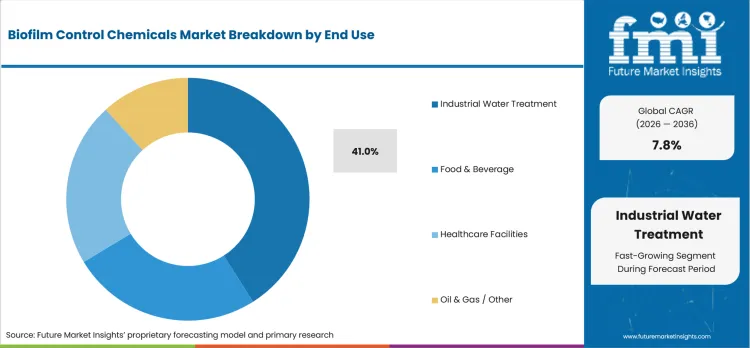
- Industrial water treatment is anticipated to account for 41.0% share in 2026, led by facilities linking microbial control to heat-transfer performance and reuse reliability.
- Healthcare facilities retain demand as cleaning teams evaluate disinfectants and surface instructions for high-risk institutional settings.
Which delivery form leads the Biofilm Control Chemicals Market?
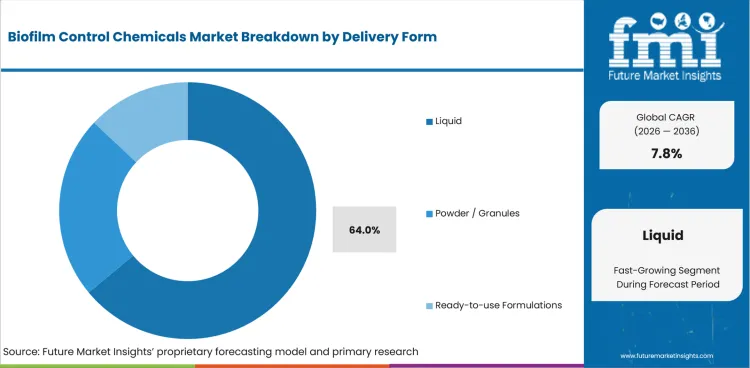
- Liquid is projected to represent 64.0% share in 2026, reflected by dosing-pump compatibility and easier field adjustment across water and sanitation programs.
- Powder and granule formats remain active in logistics-sensitive accounts that prefer storage stability and lower shipping water content.
Which sales model leads the Biofilm Control Chemicals Market?
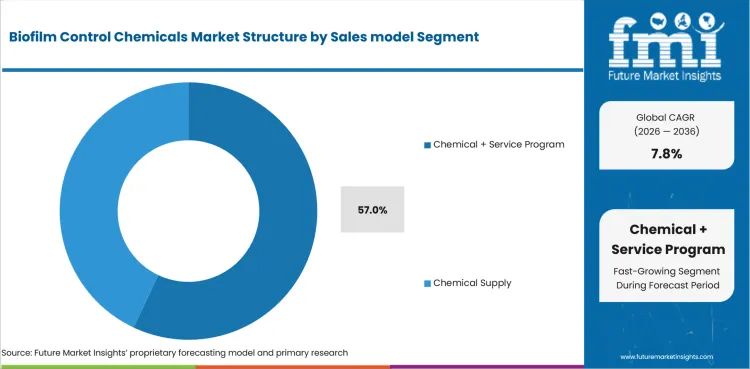
- Chemical + Service Program is expected to secure 57.0% share in 2026, guided by buyer preference for test kits and dosage records.
- Chemical supply remains active for price-sensitive accounts using standard oxidants or commodity biocides through distributors and local cleaning contractors.
What are the drivers, restraints, and opportunities in the Biofilm Control Chemicals Market?
Industrial water reliability and service-led dosing programs are shaping biofilm control chemical buying decisions.
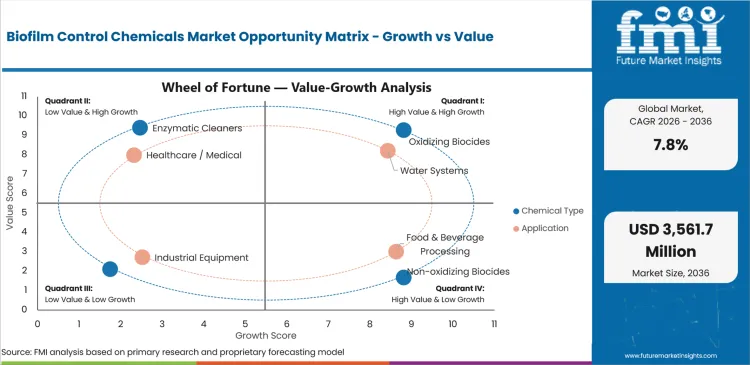
- Driver: Recirculating water systems require controlled chemistry before biofilm affects membrane pressure and corrosion outcomes.
- Restraint: Application-specific label limits can restrict broad product claims across water systems and food-contact workflows.
- Opportunity: Field diagnostics and dosing automation can raise supplier renewal rates as buyers request proof of biofilm control and corrective action.
Water Reuse Raises Biofilm Load
Water reuse and recirculation create a direct reason for biofilm control chemicals as recycled streams can carry variable nutrients and microbial load. UN-Water’s 2024 update stated that industrial wastewater data were reported by 22 countries covering 8% of the global population, and only 38% of reported industrial wastewater was treated. Biofilm control suppliers can use such operating pressure to position oxidizing biocides and monitored programs as part of water security and asset protection rather than routine chemical spend.
Claim Boundaries Limit Broad Product Use
Regulatory claim boundaries create restraint for suppliers trying to sell one biofilm claim across all surfaces and systems. EPA’s July 2025 guidance evaluates products against 2 biofilm bacteria, Pseudomonas aeruginosa and Staphylococcus aureus, and example hard-surface claims require at least 99.9999% bacterial reduction. Water-system claims need separate consideration due to flow and system conditions. Such boundaries can slow product switching and require stronger technical proof.
Service Programs Create Premium Renewal Paths
Service-backed biofilm programs create expansion as buyers increasingly compare supplier field support rather than active ingredients alone. OECD and European Commission reporting in 2024 estimated that about 4.3 million people acquire a healthcare-associated infection each year in acute care hospitals across EU countries, Iceland, and Norway. Infection prevention pressure supports demand for validated surface cleaning and water-system control programs that include product selection and documentation.
Which countries are growing in the Biofilm Control Chemicals Market?
India 9.4% CAGR, China 9.0% CAGR, South Korea 8.3% CAGR, Japan 7.4% CAGR, United States 7.2% CAGR, Germany 7.1% CAGR, France 7.0% CAGR, and United Kingdom 6.9% CAGR through 2036.
.webp "Top Country Growth Comparison Biofilm Control Chemicals Market Cagr (2026 2036)")
| Country | CAGR |
|---|---|
| India | 9.4% |
| China | 9.0% |
| South Korea | 8.3% |
| Japan | 7.4% |
| United States | 7.2% |
| Germany | 7.1% |
| France | 7.0% |
| United Kingdom | 6.9% |
Source: Future Market Insights, 2026.
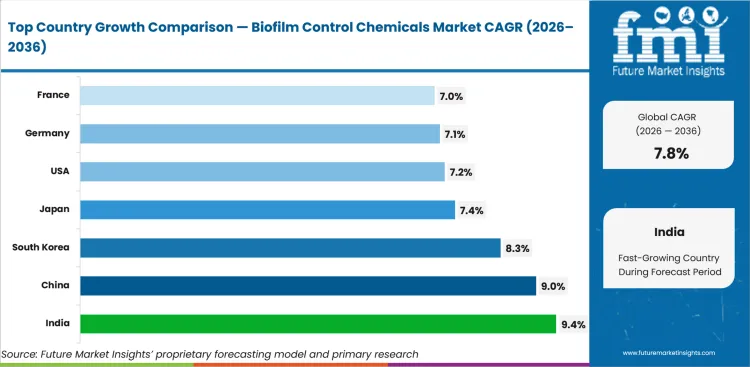
How do country-level CAGRs compare in the Biofilm Control Chemicals Market?
- India leads country expansion, while United Kingdom records a more cautious pace among profiled markets.
- India is forecast to record 9.4% CAGR by 2036 due to healthcare cleaning and industrial water reuse.
- China is expected to expand at 9.0% CAGR from 2026 to 2036, led by wastewater modernization and manufacturing water control.
- South Korea is projected to grow at 8.3% CAGR through 2036 as infection-control policy and advanced manufacturing need documented sanitation programs.
- Japan is estimated to rise at 7.4% CAGR by 2036, reflected by reliability-focused water-treatment programs and premium service models.
- United States is expected to advance at 7.2% CAGR over the forecast period as antimicrobial claims and industrial water reuse shape product selection.
- Germany is forecast to grow at 7.1% CAGR by 2036, backed by industrial wastewater control and strict biocidal compliance.
- France is projected to post 7.0% CAGR by 2036, guided by healthcare surveillance and wastewater disinfection projects.
- United Kingdom is expected to record 6.9% CAGR by 2036, driven by HCAI surveillance and water-quality compliance.
How fast is the Biofilm Control Chemicals Market growing in India?
A 9.4% CAGR through 2036 reflects healthcare cleaning and industrial water stress.
Country Market Snapshot Table
| Parameter | Value |
|---|---|
| Market Size in 2025 (Value) | USD 124.7 million |
| Market Size in 2026 (Value) | USD 136.4 million |
| Market Forecast in 2036 (Value) | USD 335.0 million |
| Forecast CAGR | 9.4% |
| Leading Application | Water Systems |
| Leading Sales Model | Chemical + Service Program |
India Biofilm Control Chemicals Market Outlook
India biofilm control chemical demand is driven by hospital water requirements and industrial water reuse. Buyers often begin with oxidizing biocides and disinfectants before moving into monitored dosing programs as downtime or audit pressure increases.
Distributor training and service documentation will decide wider adoption. Local suppliers able to combine affordable chemistry with testing support can gain acceptance across food plants and industrial clusters.
Key Growth Drivers
- Hospital water-system control supports chemical cleaning demand; national IPC guidance specifies 340 litres/bed/day for hospitals below 100 beds and 400 litres/bed/day for hospitals above 100 beds.
- Food processing investment supports sanitation chemicals; official 2026 reporting places budget allocation at Rs 4,064 Crore, a 13.79% increase from the revised 2025-26 estimate.
- Industrial reuse and cooling-water pressure create repeat demand for oxidants and corrosion-aware microbial programs.
- Tier-two manufacturing clusters create room for distributors that can add site visits and dosing instructions to basic chemical supply.
Key Restraints
- Price sensitivity can limit premium monitored dosing programs in small plants and institutional accounts.
- Distributor training gaps can cause underdosing, poor contact time, and weak field performance.
- Treatment-capacity gaps can complicate reuse planning; 2025 official reporting for 5 Ganga main-stem states cited about 10,160 MLD sewage generation against 7,820 MLD available STP capacity.
What makes India unique
India stands apart through a combined demand base across hospitals and water-stressed industrial clusters.
Key Companies
- Thermax Chemical Solutions
- Ion Exchange India
- Chembond Water Technologies
- Vasu Chemicals
- Acuro Organics
- Rossari Biotech
- Aquachem Enviro Engineers
Sales & Marketing Channels
- Industrial distributors
- Hospital housekeeping contractors
- Food plant sanitation suppliers
- Water-treatment service firms
- OEM and plant engineering partners
- Tender and institutional procurement
Country Segment Breakdown Table
| Segment | Sub-Segments |
|---|---|
| By Chemical Type | Oxidizing Biocides · Non-oxidizing Biocides · Enzymatic Cleaners · Dispersants / Other |
| By Application | Water Systems · Food & Beverage Processing · Healthcare / Medical · Industrial Equipment |
| By End Use | Industrial Water Treatment · Food & Beverage · Healthcare Facilities · Oil & Gas / Other |
| By Delivery Form | Liquid · Powder / Granules · Ready-to-use Formulations |
| By Sales Model | Chemical Supply · Chemical + Service Program |
| Key Sub-Regions Covered, Industrial Corridors | Gujarat · Maharashtra · Tamil Nadu · Karnataka · Delhi-NCR · Telangana |
Frequently Asked Questions
How fast is India Biofilm Control Chemicals Market growing?
India demand is predicted to grow at 9.4% CAGR, guided by sanitation upgrades and industrial water stress.
Who leads India Biofilm Control Chemicals Market?
Ion Exchange India and Thermax Chemical Solutions lead local supply, supported by Chembond Water Technologies and Vasu Chemicals.
What is driving adoption in India Biofilm Control Chemicals Market?
Hospital water requirements and cooling-loop biofouling are moving buyers toward monitored chemical programs.
How fast is the Biofilm Control Chemicals Market growing in China?
A 9.0% CAGR through 2036 reflects wastewater modernization and process-water needs in manufacturing clusters.
Country Market Snapshot Table
| Parameter | Value |
|---|---|
| Market Size in 2025 (Value) | USD 183.1 million |
| Market Size in 2026 (Value) | USD 199.6 million |
| Market Forecast in 2036 (Value) | USD 472.5 million |
| Forecast CAGR | 9.0% |
| Leading Application | Water Systems |
| Leading Sales Model | Chemical + Service Program |
China Biofilm Control Chemicals Market Outlook
China biofilm control chemical demand is shaped by industrial water reuse food sanitation, and large manufacturing clusters. Premium accounts buy service-backed chemistry, while smaller facilities often use local distributors for lower-cost chemical supply.
Supplier success will depend on separating technical accounts from price-led buyers. Domestic firms with water-treatment portfolios and fast local service can compete strongly across industrial parks and municipal-linked projects.
Key Growth Drivers
- Wastewater modernization supports microbial-control chemicals, as a 2025 national climate report targeted 100 green, low-carbon benchmark wastewater treatment plants by 2025.
- Water efficiency pressure supports reuse-focused chemical programs. National statistics reported 2024 industrial water consumption at 25 cubic meters per 10,000 yuan of industrial value added, down 5.3%.
- Food processors need more consistent sanitation as domestic supply chains expand and quality systems become more formal.
- Industrial parks create bundled service opportunities for suppliers managing cooling water and process hygiene accounts.
Key Restraints
- Price pressure limits uptake of premium chemical-plus-service programs outside large plants.
- Local distributor variation can complicate national rollout and consistent dosing practice.
- Rapid reuse scale can raise water-quality variability for chemical programs. Chinese cities used over 22 billion cubic meters of recycled water in 2025, requiring buyers to validate dosing before scaling.
What makes China unique
China’s profile differs through manufacturing scale and a two-tier buyer base split between technical accounts and price-led distributor channels.
Key Companies
- Shandong Taihe Water Treatment Technologies
- Henan Qingshuiyuan Technology
- Shandong Xintai Water Treatment Technology
- Jiangsu Feymer Technology
- Nanjing Sino Chemical
- Zaozhuang Kerui Chemicals
- Shanghai Shengxuan Environmental Engineering
Sales & Marketing Channels
- Direct sales to multinational plants
- Regional chemical distributors
- Water-treatment integrators
- Food sanitation suppliers
- Industrial park service contracts
- OEM-linked process-water support
Country Segment Breakdown Table
| Segment | Sub-Segments |
|---|---|
| By Chemical Type | Oxidizing Biocides · Non-oxidizing Biocides · Enzymatic Cleaners · Dispersants / Other |
| By Application | Water Systems · Food & Beverage Processing · Healthcare / Medical · Industrial Equipment |
| By End Use | Industrial Water Treatment · Food & Beverage · Healthcare Facilities · Oil & Gas / Other |
| By Delivery Form | Liquid · Powder / Granules · Ready-to-use Formulations |
| By Sales Model | Chemical Supply · Chemical + Service Program |
| Key Sub-Regions Covered, Industrial Corridors | Jiangsu · Zhejiang · Guangdong · Shandong · Shanghai · Fujian |
Frequently Asked Questions
How fast is China Biofilm Control Chemicals Market growing?
China demand is predicted to grow at 9.0% CAGR, supported by wastewater modernization and manufacturing water control.
Who leads China Biofilm Control Chemicals Market?
Shandong Taihe Water Treatment Technologies leads among local water-treatment chemical suppliers, supported by Henan Qingshuiyuan Technology.
What is driving adoption in China Biofilm Control Chemicals Market?
Industrial water reuse and food sanitation are moving buyers toward biofilm control programs.
How fast is the Biofilm Control Chemicals Market growing in South Korea?
An 8.3% CAGR through 2036 reflects infection-control policy and advanced manufacturing water quality needs.
Country Market Snapshot Table
| Parameter | Value |
|---|---|
| Market Size in 2025 (Value) | USD 49.2 million |
| Market Size in 2026 (Value) | USD 53.3 million |
| Market Forecast in 2036 (Value) | USD 118.3 million |
| Forecast CAGR | 8.3% |
| Leading Application | Water Systems |
| Leading Sales Model | Chemical + Service Program |
South Korea Biofilm Control Chemicals Market Outlook
South Korea biofilm control chemical demand links hospital infection-control policy with electronics and precision manufacturing water requirements. Buyers value documented performance and local technical service.
Institutional cleaning demand also supports surface disinfectant and enzymatic cleaner sales. Suppliers that can train users and document results should gain better renewal rates than commodity sellers.
Key Growth Drivers
- Healthcare policy supports institutional cleaning demand. A KDCA 2024 awareness survey covered 3,000 healthcare users who visited medical institutions.
- Korean HAI surveillance improvement supports program demand. ICU HAI incidence fell from 4.83 cases per 1,000 patient-days in 2012 to 2.72 cases in 2022 in national plan reporting.
- Advanced manufacturing raises process-water quality expectations across electronics and battery supply chains.
- Export-facing food processors value documented sanitation programs that help protect audit outcomes.
Key Restraints
- Smaller healthcare facilities may face budget limits and training gaps.
- New supplier approval can be slow without local service records and Korean-language documentation.
- Export exposure can delay plant-level spending, since 2025 official trade reporting showed exports to China declined 1.7% and exports to the United States declined 3.8%.
What makes South Korea unique
South Korea differs through healthcare policy attention paired with high-spec industrial water requirements.
Key Companies
- Kukdo Chemical
- OCI Company
- Hansol Chemical
- Miwon Commercial
- Dongbang Chemicals
- Youngjin Chemical
- Korea Bio-Gen
Sales & Marketing Channels
- Hospital procurement groups
- Industrial water-treatment service
- Electronics plant engineering teams
- Food sanitation distributors
- Local chemical agents
- OEM service partners
Country Segment Breakdown Table
| Segment | Sub-Segments |
|---|---|
| By Chemical Type | Oxidizing Biocides · Non-oxidizing Biocides · Enzymatic Cleaners · Dispersants / Other |
| By Application | Water Systems · Food & Beverage Processing · Healthcare / Medical · Industrial Equipment |
| By End Use | Industrial Water Treatment · Food & Beverage · Healthcare Facilities · Oil & Gas / Other |
| By Delivery Form | Liquid · Powder / Granules · Ready-to-use Formulations |
| By Sales Model | Chemical Supply · Chemical + Service Program |
| Key Sub-Regions Covered, Industrial Corridors | Seoul · Gyeonggi · Incheon · Ulsan · Daegu · Busan |
Frequently Asked Questions
How fast is South Korea Biofilm Control Chemicals Market growing?
South Korea demand is predicted to grow at 8.3% CAGR, guided by infection-control policy and advanced manufacturing.
Who leads South Korea Biofilm Control Chemicals Market?
Hansol Chemical and OCI Company are key local chemical suppliers, supported by Kukdo Chemical and Miwon Commercial.
What is driving adoption in South Korea Biofilm Control Chemicals Market?
Healthcare infection-control programs and precision manufacturing water quality are moving buyers toward documented treatment programs.
How fast is the Biofilm Control Chemicals Market growing in Japan?
A 7.4% CAGR through 2036 reflects reliability-focused chemical programs and premium water-treatment service.
Country Market Snapshot Table
| Parameter | Value |
|---|---|
| Market Size in 2025 (Value) | USD 86.4 million |
| Market Size in 2026 (Value) | USD 92.8 million |
| Market Forecast in 2036 (Value) | USD 189.5 million |
| Forecast CAGR | 7.4% |
| Leading Application | Water Systems |
| Leading Sales Model | Chemical + Service Program |
Japan Biofilm Control Chemicals Market Outlook
Japan biofilm control chemical demand is influenced by reliability-focused industrial buyers and healthcare institutions. Buyers validate compatibility with stainless steel and maintenance routines before scaling a chemical program.
Local service quality carries high weight. Kurita Water and other domestic water-treatment firms can benefit as buyers link chemicals with dosing equipment and preventive maintenance.
Key Growth Drivers
- Water treatment coverage supports cleaning-chemical depth. Japan’s 2025 environment reporting placed population coverage of wastewater treatment systems at 93.3%.
- Water recycling technology supports reuse attention. A 2024 government feature reported a portable system reclaiming more than 98% of wastewater on site after disaster disruption.
- Food processors need consistent sanitation for high-throughput packaged food lines and cold-chain facilities.
- Aging infrastructure increases interest in asset-preserving biofilm control for cooling loops and utility systems.
Key Restraints
- Conservative approval routines can slow supplier switching and product trials.
- Premium chemistry must prove compatibility with membranes and existing operating routines.
- Mature infection-control benchmarks raise proof expectations. Japan’s 2024 AMR report stated carbapenem resistance in Enterobacterales remained below 1%.
What makes Japan unique
Japan’s distinction comes from domestic water-treatment expertise and cautious validation before supplier switching.
Key Companies
- Kurita Water Industries
- Organo Corporation
- Nomura Micro Science
- Toagosei
- ADEKA Corporation
- Nippon Soda
- Nippon Shokubai
Sales & Marketing Channels
- Direct water-treatment service
- Plant engineering relationships
- Healthcare cleaning distributors
- Food plant sanitation suppliers
- OEM equipment partnerships
- Long-term maintenance contracts
Country Segment Breakdown Table
| Segment | Sub-Segments |
|---|---|
| By Chemical Type | Oxidizing Biocides · Non-oxidizing Biocides · Enzymatic Cleaners · Dispersants / Other |
| By Application | Water Systems · Food & Beverage Processing · Healthcare / Medical · Industrial Equipment |
| By End Use | Industrial Water Treatment · Food & Beverage · Healthcare Facilities · Oil & Gas / Other |
| By Delivery Form | Liquid · Powder / Granules · Ready-to-use Formulations |
| By Sales Model | Chemical Supply · Chemical + Service Program |
| Key Sub-Regions Covered, Industrial Corridors | Tokyo · Osaka · Aichi · Kanagawa · Hyogo · Fukuoka |
Frequently Asked Questions
How fast is Japan Biofilm Control Chemicals Market growing?
Japan demand is predicted to grow at 7.4% CAGR, supported by reliability-focused water treatment and premium service programs.
Who leads Japan Biofilm Control Chemicals Market?
Kurita Water Industries leads local biofilm-control chemical and water-treatment service supply, supported by Organo Corporation.
What is driving adoption in Japan Biofilm Control Chemicals Market?
Process reliability and healthcare surveillance are moving buyers toward controlled chemical programs.
How fast is the Biofilm Control Chemicals Market growing in United States?
A 7.2% CAGR through 2036 reflects antimicrobial claim discipline and industrial water reuse.
Country Market Snapshot Table
| Parameter | Value |
|---|---|
| Market Size in 2025 (Value) | USD 391.2 million |
| Market Size in 2026 (Value) | USD 419.4 million |
| Market Forecast in 2036 (Value) | USD 840.6 million |
| Forecast CAGR | 7.2% |
| Leading Application | Water Systems |
| Leading Sales Model | Chemical + Service Program |
United States Biofilm Control Chemicals Market Outlook
United States biofilm control chemical demand is shaped by EPA antimicrobial claim guidance, FDA sanitation expectations, and water infrastructure investment. Buyers compare product claims carefully across water systems and institutional cleaning applications.
Service-backed programs are expected to perform well as industrial facilities need support for monitoring and regulatory documentation. Domestic suppliers with field teams and label expertise should retain strong positions.
Key Growth Drivers
- Water infrastructure investment supports treatment chemical demand. EPA’s 2025 annual performance reporting cited USD 15 billion in Clean Water and Drinking Water State Revolving Fund financing for over 1,986 wastewater projects and 1,600 drinking-water projects.
- Healthcare cleaning remains a major institutional driver; CDC reported a 9% decrease in CLABSI and 11% decrease in hospital-onset C. difficile infections in acute care hospitals during 2024 versus 2023.
- Food sanitation programs support demand as FDA’s 2025 draft guidance addresses corrective action after pathogen contamination events in low-moisture ready-to-eat foods.
- Water reuse programs create demand for chemicals that can support microbial control in non-potable and industrial reuse applications.
Key Restraints
- Claim-specific EPA requirements can slow broad positioning across hard surfaces and water systems.
- Facilities can resist premium programs if corrosion and worker-handling risks are not addressed.
- Grant timing can delay municipal water upgrades; EPA’s 2025 audit found about USD 20 million, or 18% of allocated sewer-overflow and stormwater-reuse grant funds, had not been awarded as of January 2024.
What makes United States unique
United States stands out through strict antimicrobial claim review and a large installed base of industrial and institutional water systems.
Key Companies
- Buckman
- ChemTreat
- Chem-Aqua
- Garratt-Callahan
- Enviro Tech Chemical Services
- Bond Water Technologies
- Hillyard
Sales & Marketing Channels
- Direct water-treatment service
- Food sanitation service contracts
- Healthcare distributor networks
- Industrial chemical distributors
- Oilfield service suppliers
- Facility-management contractors
Country Segment Breakdown Table
| Segment | Sub-Segments |
|---|---|
| By Chemical Type | Oxidizing Biocides · Non-oxidizing Biocides · Enzymatic Cleaners · Dispersants / Other |
| By Application | Water Systems · Food & Beverage Processing · Healthcare / Medical · Industrial Equipment |
| By End Use | Industrial Water Treatment · Food & Beverage · Healthcare Facilities · Oil & Gas / Other |
| By Delivery Form | Liquid · Powder / Granules · Ready-to-use Formulations |
| By Sales Model | Chemical Supply · Chemical + Service Program |
| Key Sub-Regions Covered, Industrial Corridors | Gulf Coast · Great Lakes · California · Northeast · Southeast · Midwest |
Frequently Asked Questions
How fast is United States Biofilm Control Chemicals Market growing?
United States demand is predicted to grow at 7.2% CAGR, guided by healthcare cleaning and water reuse.
Who leads United States Biofilm Control Chemicals Market?
Buckman leads local specialty microbial-control supply, supported by ChemTreat and Chem-Aqua in water-treatment channels.
What is driving adoption in United States Biofilm Control Chemicals Market?
Water infrastructure needs and claim-specific antimicrobial labeling are moving buyers toward documented biofilm control programs.
How fast is the Biofilm Control Chemicals Market growing in Germany?
A 7.1% CAGR through 2036 reflects industrial wastewater management and strict chemical compliance.
Country Market Snapshot Table
| Parameter | Value |
|---|---|
| Market Size in 2025 (Value) | USD 118.0 million |
| Market Size in 2026 (Value) | USD 126.4 million |
| Market Forecast in 2036 (Value) | USD 251.0 million |
| Forecast CAGR | 7.1% |
| Leading Application | Water Systems |
| Leading Sales Model | Chemical + Service Program |
Germany Biofilm Control Chemicals Market Outlook
Germany biofilm control chemical demand is linked to process water and plant hygiene. Buyers often require product compatibility checks and strong documentation before switching suppliers.
Premium local suppliers benefit from technical validation and regulatory discipline. Water-treatment service firms can convert plant concerns into recurring chemical programs through compatibility tests and service audits.
Key Growth Drivers
- Wastewater control supports treatment chemistry demand. Federal environmental reporting in 2026 stated that more than 5 billion cubic metres of wastewater are generated annually by households and commerce.
- Water resource planning supports reuse scrutiny. The German Environment Agency reported in 2024 that Germany uses 11.4% of 188 billion cubic metres of renewable water resources.
- Industrial cooling and process-water users need stable treatment programs that protect heat exchangers and reduce corrosion risk.
- EU biocidal compliance supports suppliers with strong registration teams and safety documentation.
Key Restraints
- Strict chemical safety review can lengthen product switching cycles.
- Buyers may avoid harsh oxidants in systems with corrosion-sensitive assets.
- Pilot surveillance coordination can add operational complexity. RKI states the AMELAG project samples up to 14 wastewater treatment plants in Thuringia weekly for SARS-CoV-2 and influenza.
What makes Germany unique
Germany separates itself through technical validation culture and strict industrial hygiene expectations.
Key Companies
- LANXESS
- Schülke & Mayr
- Dr. Weigert
- Stockmeier Chemie
- BWT Wassertechnik
- Brenntag Specialties
- Kurita Europe
Sales & Marketing Channels
- Direct industrial water-service contracts
- Specialty chemical distributors
- OEM-linked cleaning programs
- Food plant sanitation suppliers
- Hospital procurement frameworks
- Technical trade fairs
Country Segment Breakdown Table
| Segment | Sub-Segments |
|---|---|
| By Chemical Type | Oxidizing Biocides · Non-oxidizing Biocides · Enzymatic Cleaners · Dispersants / Other |
| By Application | Water Systems · Food & Beverage Processing · Healthcare / Medical · Industrial Equipment |
| By End Use | Industrial Water Treatment · Food & Beverage · Healthcare Facilities · Oil & Gas / Other |
| By Delivery Form | Liquid · Powder / Granules · Ready-to-use Formulations |
| By Sales Model | Chemical Supply · Chemical + Service Program |
| Key Sub-Regions Covered, Industrial Corridors | North Rhine-Westphalia · Bavaria · Baden-Wurttemberg · Lower Saxony · Hesse · Saxony |
Frequently Asked Questions
How fast is Germany Biofilm Control Chemicals Market growing?
Germany demand is predicted to grow at 7.1% CAGR, supported by industrial water treatment and strict chemical review.
Who leads Germany Biofilm Control Chemicals Market?
LANXESS leads domestic specialty microbial-control supply, supported by Schülke & Mayr and Dr. Weigert.
What is driving adoption in Germany Biofilm Control Chemicals Market?
Process-water reliability and plant hygiene are moving buyers toward documented treatment programs.
How fast is the Biofilm Control Chemicals Market growing in France?
A 7.0% CAGR through 2036 reflects infection-prevention surveillance and wastewater disinfection projects.
Country Market Snapshot Table
| Parameter | Value |
|---|---|
| Market Size in 2025 (Value) | USD 87.1 million |
| Market Size in 2026 (Value) | USD 93.2 million |
| Market Forecast in 2036 (Value) | USD 183.3 million |
| Forecast CAGR | 7.0% |
| Leading Application | Water Systems |
| Leading Sales Model | Chemical + Service Program |
France Biofilm Control Chemicals Market Outlook
France biofilm control chemical demand is shaped by healthcare surveillance and public water-quality projects. Buyers compare chemical performance against by-product and regulatory expectations.
Municipal disinfection projects also influence industrial buyer views. Suppliers that combine controlled dosing with low-residue performance can gain attention across wastewater and plant hygiene programs.
Key Growth Drivers
- Healthcare cleaning demand is supported by national surveillance, as 2024 nursing-home HAI prevalence was estimated at 2.35%, equal to nearly 1 in 40 residents on a given day.
- Water-quality projects support advanced disinfection. The Seine Aval wastewater treatment plant treats wastewater from 6 million people in the Paris metropolitan area.
- Food processors require sanitation products that align with EU biocidal rules and residue expectations.
- Public water-quality visibility creates interest in disinfection chemistry that can reduce pathogen load without chlorine by-product concerns.
Key Restraints
- Public tenders can take longer as sustainability and performance review become more demanding.
- Chlorine by-product concerns can limit some conventional oxidant programs in high-visibility water projects.
- National surveillance coverage can raise documentation expectations. The 2024 invasive-device infection program included 625 facilities across 17 regions and 276 intensive care units.
What makes France unique
France is differentiated by public water-quality visibility and national infection-prevention surveillance across healthcare settings.
Key Companies
- SUEZ Water Technologies
- Veolia Water Technologies
- Laboratoires Anios
- Kersia
- Christeyns France
- Arkema
- Sopura France
Sales & Marketing Channels
- Municipal water tenders
- Industrial water-treatment service
- Food sanitation contracts
- Hospital procurement groups
- Specialty distributor networks
- Environmental project partnerships
Country Segment Breakdown Table
| Segment | Sub-Segments |
|---|---|
| By Chemical Type | Oxidizing Biocides · Non-oxidizing Biocides · Enzymatic Cleaners · Dispersants / Other |
| By Application | Water Systems · Food & Beverage Processing · Healthcare / Medical · Industrial Equipment |
| By End Use | Industrial Water Treatment · Food & Beverage · Healthcare Facilities · Oil & Gas / Other |
| By Delivery Form | Liquid · Powder / Granules · Ready-to-use Formulations |
| By Sales Model | Chemical Supply · Chemical + Service Program |
| Key Sub-Regions Covered, Industrial Corridors | Paris Region · Auvergne-Rhone-Alpes · Hauts-de-France · Grand Est · Normandy · Occitanie |
Frequently Asked Questions
How fast is France Biofilm Control Chemicals Market growing?
France demand is predicted to grow at 7.0% CAGR, guided by healthcare surveillance and wastewater disinfection.
Who leads France Biofilm Control Chemicals Market?
SUEZ Water Technologies and Veolia Water Technologies lead local water-treatment channels, supported by Kersia and Anios in hygiene programs.
What is driving adoption in France Biofilm Control Chemicals Market?
Public water-quality projects and infection-prevention programs are moving buyers toward controlled disinfection chemistry.
How fast is the Biofilm Control Chemicals Market growing in United Kingdom?
A 6.9% CAGR through 2036 reflects food safety monitoring and water-quality compliance.
Country Market Snapshot Table
| Parameter | Value |
|---|---|
| Market Size in 2025 (Value) | USD 81.5 million |
| Market Size in 2026 (Value) | USD 87.1 million |
| Market Forecast in 2036 (Value) | USD 169.7 million |
| Forecast CAGR | 6.9% |
| Leading Application | Water Systems |
| Leading Sales Model | Chemical + Service Program |
United Kingdom Biofilm Control Chemicals Market Outlook
United Kingdom biofilm control chemical demand is linked to healthcare-associated infection surveillance and water-system treatment. Buyers often focus on service documentation and practical compatibility with building systems.
Local suppliers and distributors remain important across hospitals and industrial water accounts. Adoption is expected to favor clear instructions and lower handling risk.
Key Growth Drivers
- Food sanitation pressure supports demand. The United Kingdom Food Security Report 2024 recorded an average of 2,133 food safety incidents annually across England, Wales, and Northern Ireland between 2019/20 and 2023/24.
- Hygiene-rating activity supports sanitation chemical pull. Food Standards Agency reporting in 2025 stated that 9 out of 10 UK food businesses covered by hygiene rating schemes held satisfactory or better ratings.
- Water compliance programs support treatment chemistry across wastewater and water-treatment works with numeric discharge permit conditions.
- Care-sector and hospital cleaning teams require disinfectants that can be linked to training and local service support.
Key Restraints
- Smaller food and care sites can delay premium programs if service cost exceeds perceived risk.
- Water-system chemical switching can be slow in facilities requiring contractor approval and safety review.
- Chemical-sector scrutiny can raise compliance costs. Environment Agency evidence reported 10 serious incidents from the chemicals sector in 2024.
What makes United Kingdom unique
United Kingdom stands apart through food safety incident monitoring and a strong local water-treatment distributor base.
Key Companies
- Accepta
- Feedwater
- Hydrosense
- Chemiphase
- Airedale Chemical
- Fernox
- B & V Chemicals
Sales & Marketing Channels
- NHS and care-sector procurement
- Food sanitation service contracts
- Specialty chemical distributors
- Facility-management contractors
- Water-treatment service firms
- Trade-event technical selling
Country Segment Breakdown Table
| Segment | Sub-Segments |
|---|---|
| By Chemical Type | Oxidizing Biocides · Non-oxidizing Biocides · Enzymatic Cleaners · Dispersants / Other |
| By Application | Water Systems · Food & Beverage Processing · Healthcare / Medical · Industrial Equipment |
| By End Use | Industrial Water Treatment · Food & Beverage · Healthcare Facilities · Oil & Gas / Other |
| By Delivery Form | Liquid · Powder / Granules · Ready-to-use Formulations |
| By Sales Model | Chemical Supply · Chemical + Service Program |
| Key Sub-Regions Covered, Industrial Corridors | Midlands · North West · Yorkshire · London · Scotland · Wales |
Frequently Asked Questions
How fast is United Kingdom Biofilm Control Chemicals Market growing?
United Kingdom demand is predicted to grow at 6.9% CAGR, guided by food safety monitoring and healthcare cleaning.
Who leads United Kingdom Biofilm Control Chemicals Market?
Accepta and Feedwater lead local biofilm-control and water-treatment supply, supported by Hydrosense and Chemiphase.
What is driving adoption in United Kingdom Biofilm Control Chemicals Market?
HCAI surveillance and discharge compliance are moving buyers toward documented chemical programs.
Who are the leading companies in the Biofilm Control Chemicals Market?
Ecolab, Solenis, Veolia, Kurita Water, LANXESS, Buckman, Italmatch Chemicals, Arxada, and Kemira.
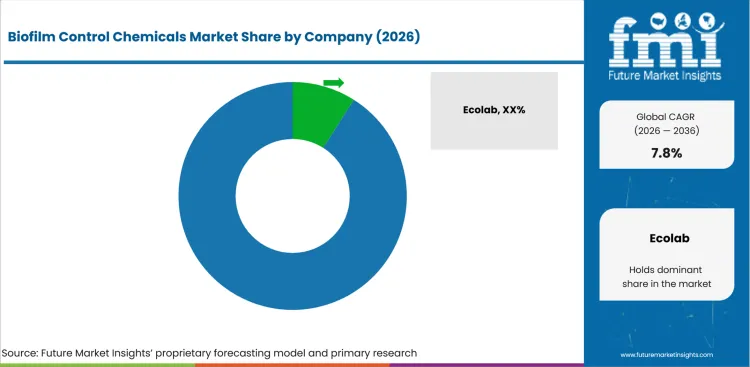
- Integrated water and hygiene suppliers hold an advantage through chemistry portfolios and customer documentation.
- Specialty biocide companies compete through microbial-control testing and compatibility knowledge.
- Regional suppliers win country accounts through service speed and lower-cost formulations.
- Application-focused sellers improve renewal chances by proving performance on real water chemistry, sanitation surfaces, and industrial operating conditions.
Competition is best understood by application proof. Ecolab and Solenis compete across hygiene, institutional cleaning, and water-treatment programs. Veolia and Kurita Water compete through industrial water service and monitoring support. LANXESS, Buckman, Italmatch Chemicals, and Arxada compete through biocidal actives and microbial-control portfolios. Kemira adds a project-led disinfection angle through wastewater treatment and controlled dosing chemistry. Buyers compare supplier strength through label fit and evidence under the exact use condition.
How do top Biofilm Control Chemicals companies compare?
Integrated suppliers score on service depth, while specialty biocide firms score on active-ingredient performance and targeted microbial claims.
| Company | Biofilm Claim Depth | Dosing and Monitoring Support | Water-System Program Fit | Geographic Footprint |
|---|---|---|---|---|
| Ecolab | High | Strong | Strong | Global |
| Solenis | High | High | Strong | Global |
| Veolia | High | High | Strong | Global |
| Kurita Water | Medium | High | Strong | Japan and global |
| LANXESS | High | Medium | Strong | Global |
| Buckman | Medium | Strong | Strong | Global |
| Italmatch Chemicals | Medium | Medium | Strong | Global |
| Kemira | Medium | High | Project-led | Europe and North America |
Source: Future Market Insights competitive analysis, 2026.
Who are the key players in the Biofilm Control Chemicals Market?
Ecolab, Solenis, Veolia, Kurita Water, LANXESS, Buckman, Italmatch Chemicals, Arxada, and Kemira are listed with regional suppliers across industrial water and oilfield programs.
Key global companies leading the Biofilm Control Chemicals Market include:
- Ecolab
- Solenis
- Veolia
- Kurita Water
- LANXESS
- Buckman
- Italmatch Chemicals
- Arxada
- Kemira
- Regional water-treatment chemical specialists
Key Developments in Biofilm Control Chemicals Market
- In June 2024, Solenis acquired Aqua ChemPacs, expanding its cleaning and disinfection solutions with pre-portioned concentrated liquid chemical packs.
- In April 2024, LANXESS introduced Aqucar A 20, a 20% dimethyloxazolidine microbial-control product approved by EPA for oilfield biocide use.
- In June 2025, Kemira continued its collaboration with the Greater Paris Sanitation Authority by supplying KemConnect DEX for treated wastewater disinfection before Seine discharge.
Key Players in the Biofilm Control Chemicals Market
Integrated Water and Hygiene Suppliers
- Ecolab
- Solenis
- Veolia
- Kurita Water
Specialty Biocide and Microbial-Control Firms
- LANXESS
- Buckman
- Italmatch Chemicals
- Arxada
Application-Specific Formulators and Service Partners
- Kemira
- Regional water-treatment chemical firms
- Food sanitation specialists
- Oilfield chemical suppliers
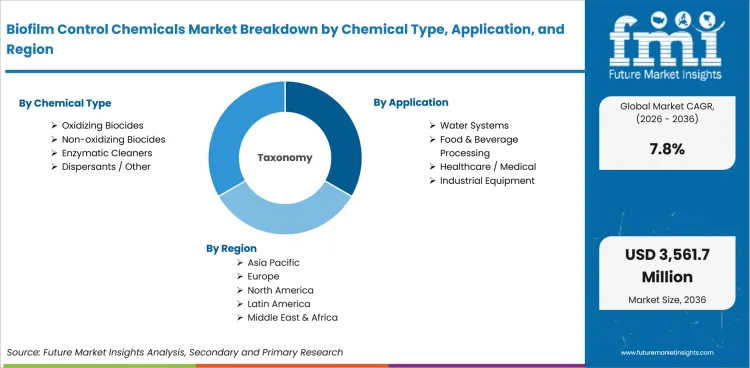
Biofilm Control Chemicals Market - Report Scope
| Parameter | Details |
|---|---|
| Forecast period | 2026 to 2036 |
| Historical period | 2021 to 2025 |
| Quantitative unit | Revenue in USD million |
| By chemical type | Oxidizing Biocides, Non-oxidizing Biocides, Enzymatic Cleaners, Dispersants / Other |
| By application | Water Systems, Food & Beverage Processing, Healthcare / Medical, Industrial Equipment |
| By end use | Industrial Water Treatment, Food & Beverage, Healthcare Facilities, Oil & Gas / Other |
| By delivery form | Liquid, Powder / Granules, Ready-to-use Formulations |
| By sales model | Chemical Supply, Chemical + Service Program |
| Regions covered | North America, Latin America, Europe, East Asia, South Asia and Pacific, Middle East and Africa |
| Countries covered | India, China, South Korea, Japan, United States, Germany, France, United Kingdom |
| Key companies profiled | Ecolab, Solenis, Veolia, Kurita Water, LANXESS, Buckman, Italmatch Chemicals, Arxada, Kemira |
| Approach | Bottom-up chemical revenue approach using application intensity, chemical use rates, service-program share, channel mix, and country-level water and sanitation exposure |
Source: Future Market Insights competitive analysis, 2026.
Biofilm Control Chemicals Market - Scope & Definition
| Attribute | Detail |
|---|---|
| Market Definition | Chemical products and service-linked formulations used to prevent, remove, disrupt, or control microbial films on surfaces and inside water-bearing systems |
| Functions Covered | Microbial kill, biofilm disruption, surface sanitation, biodispersion, residual control, dosing adjustment, cleaning support, and corrosion risk reduction |
| Applications Covered | Cooling water treatment, process-water treatment, food-contact sanitation, healthcare environmental cleaning, medical equipment cleaning support, drain cleaning, membrane cleaning, and oilfield microbial control |
| End-Use Industries | Industrial water treatment, food and beverage processing, healthcare facilities, oil and gas, institutional cleaning, utilities, chemicals, and process manufacturing |
| Grades Covered | Oxidizing biocides, non-oxidizing biocides, enzymatic cleaners, biodispersants, ready-to-use formulations, concentrates, and service-backed chemical programs |
| Inclusions | All commercially traded biofilm control chemicals across chemical type, application, end use, delivery form, sales model, and country-level industrial water and sanitation use |
| Exclusions | Antibiotics, human therapeutic antimicrobials, medical implants, wound-care antimicrobials, standalone sterilization equipment, membrane hardware, wastewater biofilm carriers, non-chemical cleaning tools, and general detergents sold without biofilm-control positioning |
Biofilm Control Chemicals Market - Research Methodology
| Method | Description |
|---|---|
| Primary Research | FMI analyst interviews with industrial water-treatment users, food plant sanitation teams, healthcare cleaning managers, oilfield chemical buyers, distributors, and water-treatment service providers across selected markets |
| Desk Research | Review of antimicrobial guidance, official wastewater data, healthcare cleaning references, food sanitation guidance, company product literature, and country-level water and hygiene indicators |
| Market Sizing & Forecasting | Bottom-up chemical revenue approach using product consumption estimates, application intensity, average treatment cost, service-program penetration, delivery-form mix, and country-level end-use weights |
| Data Validation | Cross-verification using company portfolios, official regulatory claims, water-treatment service depth, sanitation evidence, distributor checks, and country-level industrial water demand signals |
Biofilm Control Chemicals Market Breakdown by Chemical Type, Application, End Use, Delivery Form, Sales Model, and Region
Biofilm Control Chemicals Market Segmented by Chemical Type
- Oxidizing Biocides
- Non-oxidizing Biocides
- Enzymatic Cleaners
- Dispersants / Other
Biofilm Control Chemicals Market Segmented by Application
- Water Systems
- Food & Beverage Processing
- Healthcare / Medical
- Industrial Equipment
Biofilm Control Chemicals Market Segmented by End Use
- Industrial Water Treatment
- Food & Beverage
- Healthcare Facilities
- Oil & Gas / Other
Biofilm Control Chemicals Market Segmented by Delivery Form
- Liquid
- Powder / Granules
- Ready-to-use Formulations
Biofilm Control Chemicals Market Segmented by Sales Model
- Chemical Supply
- Chemical + Service Program
Biofilm Control Chemicals Market by Region
- North America
- Latin America
- Europe
- East Asia
- South Asia and Pacific
- Middle East and Africa
Research Sources and Bibliography
- Centers for Disease Control and Prevention. (2026, January 29). 2024 National and State Healthcare-Associated Infections Progress Report.
- Environment Agency. (2025, November 21). Environment Agency Chief Regulator’s report 2024-25: Supporting evidence.
- Federal Ministry for the Environment, Nature Conservation, Nuclear Safety and Consumer Protection. (2026, February 11). Waste water.
- Food Standards Agency and Department for Environment, Food & Rural Affairs. (2024, December 11). United Kingdom Food Security Report 2024: Theme 5, food safety and consumer confidence.
- German Environment Agency. (2024, July 17). Water reuse.
- Government of Japan. (2024, May 10). Small-scale and portable: A new water recycling system for times of disaster.
- Korea Disease Control and Prevention Agency. (2024, October 24). Healthcare-associated infection prevention and control begins with simple practices.
- Korea Disease Control and Prevention Agency. (2024, April 4). The 2nd National Action Plan for Prevention and Control of Healthcare-Associated Infections (2023-2027).
- Kemira. (2025, June 18). Kemira continues its collaboration with the Greater Paris Sanitation Authority.
- LANXESS. (2024, April 4). LANXESS introduces Aqucar A 20: Advanced microbial control for oil and gas applications.
- Ministry of Ecology and Environment of the People’s Republic of China. (2025, January 21). China’s policies and actions addressing climate change.
- Ministry of Food Processing Industries, Government of India. (2026, January 9). Achievements and initiatives of Ministry of Food Processing Industries.
- Ministry of Health, Labour and Welfare, Japan. (2025, April 18). Nippon AMR One Health Report 2024.
- National Centre for Disease Control. (2024). National guidelines for infection prevention and control in healthcare facilities.
- National Bureau of Statistics of China. (2025, February 28). Statistical communiqué of the People’s Republic of China on the 2024 national economic and social development.
- OECD and European Commission. (2024, November 18). Health at a Glance: Europe 2024: Healthcare-associated infections.
- Press Information Bureau. (2025, December 4). Pollution in Ganga River.
- Press Information Bureau. (2026, April 2). Progress made under Namami Gange Programme.
- Santé publique France. (2025, May 21). Healthcare-associated infections and antimicrobial treatments in nursing homes, 2024.
- Santé publique France. (2026, February 25). Surveillance of infections associated with invasive devices: SPIADI National Surveillance Program, 2024 results.
- Solenis. (2024, June 10). Solenis acquires Aqua ChemPacs, expanding offering of cleaning and disinfection solutions.
- SUEZ. (2025, July 9). SIAAP and SUEZ inaugurate the new biogas production unit at Seine Aval wastewater treatment plant.
- USA Environmental Protection Agency. (2024, May 14). New EPA survey highlights wastewater infrastructure needs to protect waterbodies.
- USA Environmental Protection Agency. (2025, January 10). FY 2024 Annual Performance Report.
- USA Environmental Protection Agency. (2025, February 10). The EPA left USD 20 million unawarded in the sewer overflow and stormwater reuse municipal grants program.
- USA Environmental Protection Agency. (2025, July 31). Efficacy test methods, test criteria, and labeling guidance for antimicrobial products with claims against biofilm on hard, non-porous surfaces.
- USA Food and Drug Administration. (2025, January 6). Draft guidance for industry: Establishing sanitation programs for low-moisture ready-to-eat human foods and taking corrective actions following a pathogen contamination event.
- UN-Water. (2024, August 25). Progress on wastewater treatment: 2024 update.
- World Health Organization. (2024, November 29). Global report on infection prevention and control 2024.
This bibliography is provided for reader reference and is not exhaustive. The full report contains the complete reference list and detailed citations.
This Report Answers
- Market size estimates for 2026 and forecasts through 2036 for the Biofilm Control Chemicals Market.
- Insights across regional and country-level water, sanitation, and microbial-control demand.
- Analysis of demand drivers and purchasing behavior.
- Evaluation of chemical types, applications, end uses, delivery forms, and sales models.
- Assessment of industrial water reliability and sanitation verification requirements.
- Identification of opportunities across service-backed chemical programs and dosing support.
- Evaluation of chemical supply models and chemical-plus-service channels.
- Country-level analysis covering India, China, South Korea, Japan, United States, Germany, France, and United Kingdom.
- Assessment of competition, including leading water-treatment and microbial-control companies.
- Analysis of plant-level decision drivers and service criteria.
- Regional outlooks across North America, Europe, East Asia, South Asia and Pacific, Latin America, and Middle East and Africa.
- Delivery of market data, forecasts, and supporting analysis in report-ready format.
Frequently Asked Questions
What is the growth prospect for biofilm control chemicals?
Demand for biofilm control chemicals is expected to rise at a considerable pace as food sanitation and healthcare cleaning programs require verified microbial control.
Which companies are expected to shape the biofilm control chemicals market?
Ecolab, Solenis, Veolia, Kurita Water, LANXESS, Buckman, Italmatch Chemicals, Arxada, and Kemira are expected to shape market competition due to chemical portfolios and service support.
Why are water-treatment companies investing in biofilm control chemicals?
Water-treatment companies are investing in biofilm control chemicals to support plants managing cooling loops and microbial contamination.
Why are chemical-plus-service models important in the biofilm control chemicals market?
Chemical-plus-service models support dosing accuracy and documentation across biofilm control programs.
Which chemical formats are gaining attention in biofilm control chemicals?
Oxidizing biocides and non-oxidizing biocides are gaining attention as buyers target fast microbial reduction and targeted shock treatment.
How does water reuse influence biofilm control chemical demand?
Water reuse influences demand through nutrient variability and recirculation conditions that increase microbial attachment risk.
Why is application type important for biofilm control chemicals?
Application type is important since hard surfaces and medical cleaning workflows need different claims and chemical instructions.
What role does liquid delivery play in biofilm control chemical adoption?
Liquid delivery supports adoption by combining pump-fed dosing and faster field adjustment.
Preview the report firsthand - request a free sample
Get SampleGet the brochure for pricing and purchase details.
Get PDFTable of Content
- Key Takeaways
- Market Size and CAGR
- Top Growth Driver
- Fastest Growing Segment
- Leading Region
- Key Companies
- Emerging Opportunities
- Executive Summary
- Global Market Outlook
- Demand-side Trends
- Supply-side Trends
- Technology Roadmap Analysis
- Analysis and Recommendations
- Analyst Perspective (What is happening? Why now? What should investors know?)
- Key Questions Answered
- How large is the market?
- What is the CAGR?
- What are key trends?
- Which region dominates?
- Who are the leaders?
- Market Overview
- Market Coverage / Taxonomy
- Market Definition / Scope / Limitations
- Research Methodology
- Chapter Orientation
- Analytical Lens and Working Hypotheses
- Market Structure, Signals, and Trend Drivers
- Benchmarking and Cross-market Comparability
- Market Sizing, Forecasting, and Opportunity Mapping
- Research Design and Evidence Framework
- Desk Research Programme (Secondary Evidence)
- Expert Input and Fieldwork (Primary Evidence)
- Tooling, Models, and Reference Databases
- Data Engineering and Model Build
- Quality Assurance and Audit Trail
- Market Background
- Market Dynamics (Drivers, Restraints, Opportunity, Trends)
- Scenario Forecast (Optimistic, Likely, Conservative)
- Impact Analysis
- AI Impact
- Sustainability Impact
- Regulatory Impact
- Technology Impact
- Consumer / Buyer Analysis
- Purchase Drivers
- Adoption Barriers
- Buyer Journey
- Opportunity Map Analysis
- Product Life Cycle Analysis
- Supply Chain Analysis
- Investment Feasibility Matrix
- Value Chain Analysis
- PESTLE and Porter's Analysis
- Regulatory Landscape
- Regional Parent Market Outlook
- Production and Consumption Statistics
- Import and Export Statistics
- Global Market Analysis and Forecast, 2021 to 2036
- Historical Market Size Value (USD Million) & Volume (Unit) Analysis, 2021 to 2025
- Current and Future Market Size Value (USD Million) & Volume (Unit) Projections, 2026 to 2036
- Y-o-Y Growth Trend Analysis
- Absolute $ Opportunity Analysis
- Global Market Pricing Analysis, 2021 to 2036
- Global Market Analysis and Forecast, By Chemical Type, 2021 to 2036
- Introduction / Key Findings
- Historical Market Size Value (USD Million) & Volume (Unit) Analysis By Chemical Type, 2021 to 2025
- Current and Future Market Size Value (USD Million) & Volume (Unit) Analysis and Forecast By Chemical Type, 2026 to 2036
- Oxidizing Biocides
- Non-oxidizing Biocides
- Enzymatic Cleaners
- Dispersants / Other
- Oxidizing Biocides
- Y-o-Y Growth Trend Analysis By Chemical Type, 2021 to 2025
- Absolute $ Opportunity Analysis By Chemical Type, 2026 to 2036
- Global Market Analysis and Forecast, By Application, 2021 to 2036
- Introduction / Key Findings
- Historical Market Size Value (USD Million) & Volume (Unit) Analysis By Application, 2021 to 2025
- Current and Future Market Size Value (USD Million) & Volume (Unit) Analysis and Forecast By Application, 2026 to 2036
- Water Systems
- Food & Beverage Processing
- Healthcare / Medical
- Industrial Equipment
- Water Systems
- Y-o-Y Growth Trend Analysis By Application, 2021 to 2025
- Absolute $ Opportunity Analysis By Application, 2026 to 2036
- Global Market Analysis and Forecast, By End Use, 2021 to 2036
- Introduction / Key Findings
- Historical Market Size Value (USD Million) & Volume (Unit) Analysis By End Use, 2021 to 2025
- Current and Future Market Size Value (USD Million) & Volume (Unit) Analysis and Forecast By End Use, 2026 to 2036
- Industrial Water Treatment
- Food & Beverage
- Healthcare Facilities
- Oil & Gas / Other
- Industrial Water Treatment
- Y-o-Y Growth Trend Analysis By End Use, 2021 to 2025
- Absolute $ Opportunity Analysis By End Use, 2026 to 2036
- Global Market Analysis and Forecast, By Delivery Form, 2021 to 2036
- Introduction / Key Findings
- Historical Market Size Value (USD Million) & Volume (Unit) Analysis By Delivery Form, 2021 to 2025
- Current and Future Market Size Value (USD Million) & Volume (Unit) Analysis and Forecast By Delivery Form, 2026 to 2036
- Liquid
- Powder / Granules
- Ready-to-use Formulations
- Liquid
- Y-o-Y Growth Trend Analysis By Delivery Form, 2021 to 2025
- Absolute $ Opportunity Analysis By Delivery Form, 2026 to 2036
- Global Market Analysis and Forecast, By Sales model, 2021 to 2036
- Introduction / Key Findings
- Historical Market Size Value (USD Million) & Volume (Unit) Analysis By Sales model, 2021 to 2025
- Current and Future Market Size Value (USD Million) & Volume (Unit) Analysis and Forecast By Sales model, 2026 to 2036
- Chemical + Service Program
- Chemical Supply
- Chemical + Service Program
- Y-o-Y Growth Trend Analysis By Sales model, 2021 to 2025
- Absolute $ Opportunity Analysis By Sales model, 2026 to 2036
- Global Market Analysis and Forecast, By Region, 2021 to 2036
- Introduction
- Historical Market Size Value (USD Million) & Volume (Unit) Analysis By Region, 2021 to 2025
- Current Market Size Value (USD Million) & Volume (Unit) Analysis and Forecast By Region, 2026 to 2036
- North America
- Latin America
- Western Europe
- Eastern Europe
- East Asia
- South Asia and Pacific
- Middle East & Africa
- Market Attractiveness Analysis By Region
- North America Market Analysis and Forecast, By Country, 2021 to 2036
- Historical Market Size Value (USD Million) & Volume (Unit) Trend Analysis By Market Taxonomy, 2021 to 2025
- Market Size Value (USD Million) & Volume (Unit) Forecast By Market Taxonomy, 2026 to 2036
- By Country
- USA
- Canada
- Mexico
- By Chemical Type
- By Application
- By End Use
- By Delivery Form
- By Sales model
- By Country
- Market Attractiveness Analysis
- By Country
- By Chemical Type
- By Application
- By End Use
- By Delivery Form
- By Sales model
- Key Takeaways
- Latin America Market Analysis and Forecast, By Country
- Historical Market Size Value (USD Million) & Volume (Unit) Trend Analysis By Market Taxonomy, 2021 to 2025
- Market Size Value (USD Million) & Volume (Unit) Forecast By Market Taxonomy, 2026 to 2036
- By Country
- Brazil
- Chile
- Rest of Latin America
- By Chemical Type
- By Application
- By End Use
- By Delivery Form
- By Sales model
- By Country
- Market Attractiveness Analysis
- By Country
- By Chemical Type
- By Application
- By End Use
- By Delivery Form
- By Sales model
- Key Takeaways
- Western Europe Market Analysis and Forecast, By Country
- Historical Market Size Value (USD Million) & Volume (Unit) Trend Analysis By Market Taxonomy, 2021 to 2025
- Market Size Value (USD Million) & Volume (Unit) Forecast By Market Taxonomy, 2026 to 2036
- By Country
- Germany
- UK
- Italy
- Spain
- France
- Nordic
- BENELUX
- Rest of Western Europe
- By Chemical Type
- By Application
- By End Use
- By Delivery Form
- By Sales model
- By Country
- Market Attractiveness Analysis
- By Country
- By Chemical Type
- By Application
- By End Use
- By Delivery Form
- By Sales model
- Key Takeaways
- Eastern Europe Market Analysis and Forecast, By Country
- Historical Market Size Value (USD Million) & Volume (Unit) Trend Analysis By Market Taxonomy, 2021 to 2025
- Market Size Value (USD Million) & Volume (Unit) Forecast By Market Taxonomy, 2026 to 2036
- By Country
- Russia
- Poland
- Hungary
- Balkan & Baltic
- Rest of Eastern Europe
- By Chemical Type
- By Application
- By End Use
- By Delivery Form
- By Sales model
- By Country
- Market Attractiveness Analysis
- By Country
- By Chemical Type
- By Application
- By End Use
- By Delivery Form
- By Sales model
- Key Takeaways
- East Asia Market Analysis and Forecast, By Country
- Historical Market Size Value (USD Million) & Volume (Unit) Trend Analysis By Market Taxonomy, 2021 to 2025
- Market Size Value (USD Million) & Volume (Unit) Forecast By Market Taxonomy, 2026 to 2036
- By Country
- China
- Japan
- South Korea
- By Chemical Type
- By Application
- By End Use
- By Delivery Form
- By Sales model
- By Country
- Market Attractiveness Analysis
- By Country
- By Chemical Type
- By Application
- By End Use
- By Delivery Form
- By Sales model
- Key Takeaways
- South Asia and Pacific Market Analysis and Forecast, By Country
- Historical Market Size Value (USD Million) & Volume (Unit) Trend Analysis By Market Taxonomy, 2021 to 2025
- Market Size Value (USD Million) & Volume (Unit) Forecast By Market Taxonomy, 2026 to 2036
- By Country
- India
- ASEAN
- Australia & New Zealand
- Rest of South Asia and Pacific
- By Chemical Type
- By Application
- By End Use
- By Delivery Form
- By Sales model
- By Country
- Market Attractiveness Analysis
- By Country
- By Chemical Type
- By Application
- By End Use
- By Delivery Form
- By Sales model
- Key Takeaways
- Middle East & Africa Market Analysis and Forecast, By Country
- Historical Market Size Value (USD Million) & Volume (Unit) Trend Analysis By Market Taxonomy, 2021 to 2025
- Market Size Value (USD Million) & Volume (Unit) Forecast By Market Taxonomy, 2026 to 2036
- By Country
- Kingdom of Saudi Arabia
- Other GCC Countries
- Türkiye
- South Africa
- Other African Union
- Rest of Middle East & Africa
- By Chemical Type
- By Application
- By End Use
- By Delivery Form
- By Sales model
- By Country
- Market Attractiveness Analysis
- By Country
- By Chemical Type
- By Application
- By End Use
- By Delivery Form
- By Sales model
- Key Takeaways
- Key Countries Market Analysis
- USA
- Pricing Analysis
- Market Share Analysis, 2025
- By Chemical Type
- By Application
- By End Use
- By Delivery Form
- By Sales model
- Canada
- Pricing Analysis
- Market Share Analysis, 2025
- By Chemical Type
- By Application
- By End Use
- By Delivery Form
- By Sales model
- Mexico
- Pricing Analysis
- Market Share Analysis, 2025
- By Chemical Type
- By Application
- By End Use
- By Delivery Form
- By Sales model
- Brazil
- Pricing Analysis
- Market Share Analysis, 2025
- By Chemical Type
- By Application
- By End Use
- By Delivery Form
- By Sales model
- Chile
- Pricing Analysis
- Market Share Analysis, 2025
- By Chemical Type
- By Application
- By End Use
- By Delivery Form
- By Sales model
- Germany
- Pricing Analysis
- Market Share Analysis, 2025
- By Chemical Type
- By Application
- By End Use
- By Delivery Form
- By Sales model
- UK
- Pricing Analysis
- Market Share Analysis, 2025
- By Chemical Type
- By Application
- By End Use
- By Delivery Form
- By Sales model
- Italy
- Pricing Analysis
- Market Share Analysis, 2025
- By Chemical Type
- By Application
- By End Use
- By Delivery Form
- By Sales model
- Spain
- Pricing Analysis
- Market Share Analysis, 2025
- By Chemical Type
- By Application
- By End Use
- By Delivery Form
- By Sales model
- France
- Pricing Analysis
- Market Share Analysis, 2025
- By Chemical Type
- By Application
- By End Use
- By Delivery Form
- By Sales model
- India
- Pricing Analysis
- Market Share Analysis, 2025
- By Chemical Type
- By Application
- By End Use
- By Delivery Form
- By Sales model
- ASEAN
- Pricing Analysis
- Market Share Analysis, 2025
- By Chemical Type
- By Application
- By End Use
- By Delivery Form
- By Sales model
- Australia & New Zealand
- Pricing Analysis
- Market Share Analysis, 2025
- By Chemical Type
- By Application
- By End Use
- By Delivery Form
- By Sales model
- China
- Pricing Analysis
- Market Share Analysis, 2025
- By Chemical Type
- By Application
- By End Use
- By Delivery Form
- By Sales model
- Japan
- Pricing Analysis
- Market Share Analysis, 2025
- By Chemical Type
- By Application
- By End Use
- By Delivery Form
- By Sales model
- South Korea
- Pricing Analysis
- Market Share Analysis, 2025
- By Chemical Type
- By Application
- By End Use
- By Delivery Form
- By Sales model
- Russia
- Pricing Analysis
- Market Share Analysis, 2025
- By Chemical Type
- By Application
- By End Use
- By Delivery Form
- By Sales model
- Poland
- Pricing Analysis
- Market Share Analysis, 2025
- By Chemical Type
- By Application
- By End Use
- By Delivery Form
- By Sales model
- Hungary
- Pricing Analysis
- Market Share Analysis, 2025
- By Chemical Type
- By Application
- By End Use
- By Delivery Form
- By Sales model
- Kingdom of Saudi Arabia
- Pricing Analysis
- Market Share Analysis, 2025
- By Chemical Type
- By Application
- By End Use
- By Delivery Form
- By Sales model
- Türkiye
- Pricing Analysis
- Market Share Analysis, 2025
- By Chemical Type
- By Application
- By End Use
- By Delivery Form
- By Sales model
- South Africa
- Pricing Analysis
- Market Share Analysis, 2025
- By Chemical Type
- By Application
- By End Use
- By Delivery Form
- By Sales model
- USA
- Market Structure Analysis
- Competition Dashboard
- Competition Benchmarking
- Market Share Analysis of Top Players
- By Regional
- By Chemical Type
- By Application
- By End Use
- By Delivery Form
- By Sales model
- Emerging Startups
- Innovation Benchmarking
- Competition Analysis
- Competition Deep Dive
- Ecolab
- Overview
- Product Portfolio
- Profitability by Market Segments (Product/Region/Sales Channel)
- Sales Footprint
- Strategy Overview
- Marketing Strategy
- Product Strategy
- Channel Strategy
- Solenis
- Veolia
- Kurita Water
- LANXESS
- Buckman
- Italmatch Chemicals
- Kemira
- Ecolab
- Case Studies
- Success Stories
- Recent Developments
- Competition Deep Dive
- Assumptions & Acronyms Used


