
- Market Size (2026)
- USD 16800.0 Mn
- Forecast (2036)
- USD 24868.1 Mn
- CAGR (2026 to 2036)
- 4.0%
How big is the Offshore Support Vessel (OSV) Market in 2026?
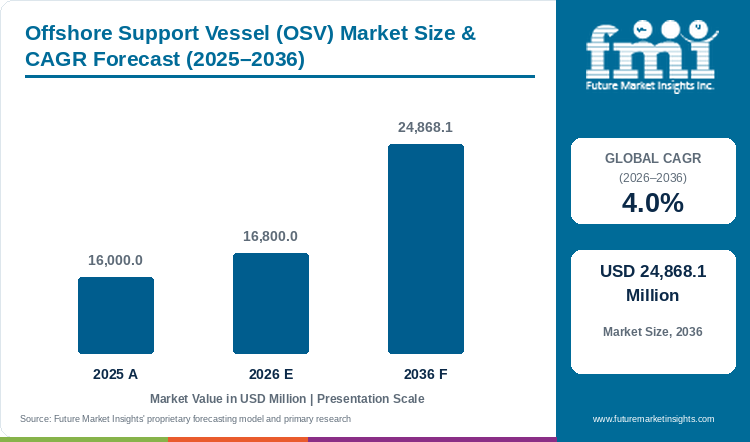
The global offshore support vessel market should reach USD 24,868.1 million by 2036 at a 4.0% CAGR across 2026 to 2036. The market was valued at USD 16,000.0 million in 2025, and FMI estimates USD 16,800.0 million for 2026.
Offshore Support Vessel (OSV) Market Size and Forecast
Table 1: Offshore Support Vessel (OSV) Market Size and Forecast
| Market size and forecast | Value |
|---|---|
| Market size in 2025 | USD 16,000.0 million |
| Estimated market size in 2026 | USD 16,800.0 million |
| Projected market size by 2036 | USD 24,868.1 million |
| CAGR from 2026 to 2036 | 4.0% |
Source: Future Market Insights analysis of the offshore support vessel (OSV) market, 2026.
Charter earnings follow the work a vessel performs more than the size of the fleet. Tidewater reported that its average day rate increased 6.1% in 2025, although revenue grew only 0.5%. Platform Supply Vessels retain the leading individual vessel-type share in FMI's 2026 outlook, but service and construction support is projected to overtake them by 2036. The higher-value work includes subsea intervention and project execution, which require equipment and personnel beyond a cargo deck.
Demand also depends on the commitment behind an offshore programme. Petrobras' 2026 to 2030 business plan includes chartering 40.0 new support vessels for fleet renewal. DOF separately announced four-year Brazilian anchor-handler contracts in May 2025 with expected starts in early 2026. They support a commercial case for available, suitable tonnage. The subsea equipment market provides related context for the installed infrastructure that generates inspection and construction assignments.
Key Market Trends & Insights
- UK operators are considering shared vessel campaigns for final wellhead removal. In August 2026, the North Sea Transition Authority reported that 17.0 operators had signed a collaboration charter. Coordinated campaigns could give vessel contractors longer work packages while reducing repeated mobilisation.
- Fuel conversion is becoming a contracting issue. The Apollo project announced a February 2026 yard agreement for Viking Energy's ammonia conversion. Its existing Equinor relationship makes this a customer-backed retrofit.
- Offshore wind creates a different vessel specification. Edison Chouest Offshore's ECO Liberty was launched in June 2025 for Empire Wind with accommodation for up to 60.0 workers. The procurement covers offshore access and extended personnel support as well as the carriage of supplies.
Regional Highlights
- Brazil expands faster than the global total. Projected 2036 shares are Brazil 13.9% (from 12.0%).
- Revenue rises in Norway, Mexico and the United Kingdom, though each loses global share. Projected 2036 shares are Norway 11.0% (from 12.0%), Mexico 4.6% (from 5.0%) and the United Kingdom 9.6% (from 10.0%).
Analyst Perspective
“The most attractive contract is not necessarily the one with the highest quoted day rate. Vessel owners need enough committed work to recover mobilisation, maintenance and specialist-equipment costs. Brazilian multi-year awards and coordinated North Sea campaigns offer different ways to improve that visibility. For charterers, the decisive comparison is the cost of completing the offshore assignment with an available, qualified vessel.”
- Nikhil Kaitwade, Principal Consultant, FMI
How is the Offshore Support Vessel (OSV) Market segmented?
- By vessel type: Platform Supply Vessels, Anchor Handling Tug Supply Vessels, Service and Construction Support Vessels, and Crew and Other Support Vessels.
- By water depth: Shallow Water, Deepwater, and Ultra-deepwater.
- By end use: Oil and Gas, Offshore Wind, and Other.
- By region: Latin America, Western Europe, North America, Middle East and Africa, East Asia, and the Rest of world aggregate.
Why does the Platform Supply Vessels segment lead by Vessel Type in the Offshore Support Vessel (OSV) Market in 2026?
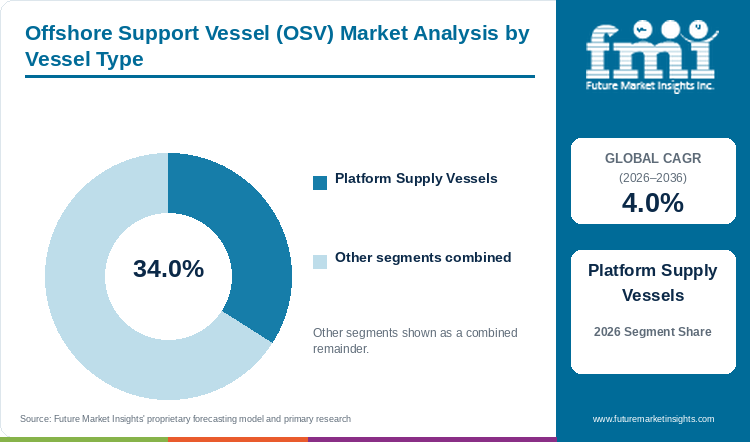
The Platform Supply Vessels segment holds 34.0% of the Offshore Support Vessel (OSV) Market by vessel type in 2026.
The platform supply category has a broad recurring work base, but its commercial position differs from that of a project vessel. Logistics contracts are exposed to the number of offshore facilities being served and the efficiency of the supply schedule. They are also more sensitive to the availability of alternative tonnage when specialised equipment is not essential to the assignment. Petrobras' business-plan presentation identifies 12.0 platform supply vessels within its planned 40.0-vessel renewal programme. That allocation demonstrates a continuing place for supply vessels even as the operator renews other parts of its support fleet. Fleet renewal across other vessel types is covered more broadly in FMI's marine vessels market.
FMI projects Platform Supply Vessel revenue at USD 7,819.7 million in 2036, with a 3.2% segment CAGR. Its share falls to 31.4% because other vessel categories grow faster. Owners seeking fleet renewal orders need to match the customer's cargo requirements and delivery schedule before committing to a hull. A vessel that misses the contracted start date can lose the value of an otherwise attractive technical offer. Charter duration and the allocation of off-hire risk therefore deserve the same attention as nominal cargo capacity.
Anchor Handling Tug Supply Vessels, Service and Construction Support Vessels and Crew and Other Support Vessels together hold the remaining 66.0% by vessel type.
Table 2: Vessel Type, 2026 Share
| Leading Share | 2026 market share |
|---|---|
| Platform Supply Vessels | 34.0% |
| All Other Segments Combined Share | 66.0% |
Source: Future Market Insights analysis of the offshore support vessel (OSV) market, 2026.
Why does the Shallow Water segment lead by Water Depth in the Offshore Support Vessel (OSV) Market in 2026?
The Shallow Water segment holds 50.0% of the Offshore Support Vessel (OSV) Market by water depth in 2026.
Water depth changes the composition of a vessel package, but shallow-water work remains commercially substantial. Aramco's reporting on Marjan and Berri provides evidence of continuing investment in established offshore production systems. ADNOC Offshore's 2025 jack-up awards provide another example of long-duration commitments around shelf operations. Together they show why shallow-water support retains a substantial demand base in FMI's outlook.
The category grows at a projected 2.8% CAGR to USD 11,021.2 million in 2036, when its share is 44.3%. Deepwater and Ultra-deepwater gain share over the same period. A contract may require a crane, remote intervention equipment, additional berths or a different station-keeping capability beyond the depth classification. The positioning system market addresses one related equipment category. Fleet planning should therefore consider the expected assignment and contractual specification alongside water depth.
Deepwater and Ultra-deepwater together hold the remaining 50.0% by water depth.
Table 3: Water Depth, 2026 Share
| Leading Share | 2026 market share |
|---|---|
| Shallow Water | 50.0% |
| All Other Segments Combined Share | 50.0% |
Source: Future Market Insights analysis of the offshore support vessel (OSV) market, 2026.
Why does the Oil and Gas segment lead by End Use in the Offshore Support Vessel (OSV) Market in 2026?
The Oil and Gas segment holds 82.0% of the Offshore Support Vessel (OSV) Market by end use in 2026.
The scale of operating oil and gas infrastructure gives this end use a much larger starting point than offshore wind. CNOOC brought new projects into production in 2025, while Petrobras is renewing the marine fleet supporting exploration and production. These programmes create a mix of continuing logistics and intermittent project work. A producing asset can require marine support after the original construction campaign has ended, although the nature and frequency of assignments change.
FMI forecasts Oil and Gas revenue at USD 18,138.4 million in 2036. Its 2.8% CAGR is below Offshore Wind's 9.6%, reducing its share to 72.9%. Wind nevertheless remains a distinct procurement channel. ECO Liberty's launch for Empire Wind illustrates purpose-built service accommodation within a defined development. The offshore wind market provides the broader project context. Owners can pursue both end uses, but should evaluate the work programme and vessel specification separately.
Offshore Wind and Other together hold the remaining 18.0% by end use.
Table 4: End Use, 2026 Share
| Leading Share | 2026 market share |
|---|---|
| Oil and Gas | 82.0% |
| All Other Segments Combined Share | 18.0% |
Source: Future Market Insights analysis of the offshore support vessel (OSV) market, 2026.
What are the key drivers restraints and opportunities?
Committed offshore production programmes support charter demand. Mobilisation costs and fleet suitability constrain the available response. Service packages and coordinated campaigns create opportunities to earn more from each operating vessel.
Driver
Multi-year offshore programmes create identifiable charter requirements beyond the initial drilling or construction phase.
Restraint
A vessel's location and equipment can prevent it from competing for an otherwise attractive assignment.
Opportunity
Contractors can combine vessel capacity with subsea equipment, personnel or campaign coordination where the customer purchases an offshore result.
How do purchasing rules and qualification affect offshore support vessel (OSV) market demand?
The strongest demand signal is a committed programme with a defined vessel requirement. DOF's Brazilian awards cover four-year charter and service periods, with three contracts including work-class remotely operated vehicles. For an owner, that structure links fleet availability with a service capability that must be ready at the same time. It can support maintenance planning and crew preparation across a longer operating period.
FMI expects Service and Construction Support Vessel revenue to grow at 6.2% a year through 2036. This category reaches a 34.5% share, compared with 28.0% in 2026. The forecast reflects a greater revenue allocation to specialised assignments. Equipment integration, execution responsibility and the timing of offshore work remain central to the commercial offer.
What limits reliable offshore support vessel (OSV) market supply and quality?
An available hull is not automatically available for a customer's specific project. Maintenance commitments, transit and the need to prepare equipment can consume the interval between two fixtures. Tidewater's annual reporting identifies mobilisation and drydocking as factors affecting utilisation and costs. Owners accepting a distant contract must consider the paid work that remains after those requirements.
Demand also differs by basin. SEACOR Marine's 2025 annual report describes difficult repair access and spare-parts logistics in the Persian Gulf during 2026. A vessel already in a region can therefore face operating constraints even when customers need its services. Redeployment is only attractive if the next contract recovers the transfer cost and fits the asset's remaining commitments. A firm work programme needs an achievable operating plan behind it.
Where can suppliers win additional business in the offshore support vessel (OSV) market?
The UK wellhead-removal charter creates an opening for shared campaigns. The NSTA describes using vessels for the final removal stage after earlier well-abandonment work, not substituting vessels for every rig operation. Contractors able to coordinate a sequence of removals could reduce unproductive transit and provide customers with a clearer delivery programme.
Alternative-fuel projects offer a different route. Apollo's Viking Energy conversion is tied to a vessel already serving Equinor. Customer participation can align a retrofit with continuing work, although a first-of-a-kind conversion retains technical and schedule risk. Across both opportunities, the commercial proposition begins with the assignment and its economics. The vessel is one component of the offer.
Offshore Support Vessel (OSV) Market by Country (2026 to 2036)
Table 5: Offshore Support Vessel (OSV) Market Country Growth Forecast
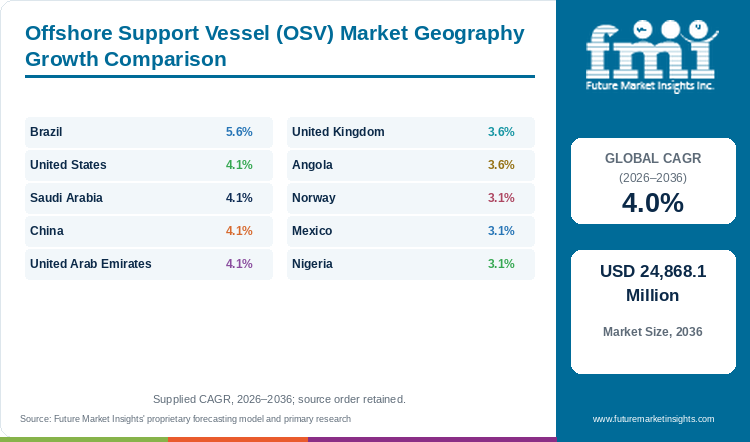
| Country | CAGR, 2026 to 2036 |
|---|---|
| Brazil | 5.6% |
| United States | 4.1% |
| Saudi Arabia | 4.1% |
| China | 4.1% |
| United Arab Emirates | 4.1% |
| United Kingdom | 3.6% |
| Angola | 3.6% |
| Norway | 3.1% |
| Mexico | 3.1% |
| Nigeria | 3.1% |
Source: Future Market Insights analysis of the offshore support vessel (OSV) market, 2026.
Brazil
Brazil offers vessel owners unusually visible fleet-renewal demand alongside the work generated by offshore production. Petrobras' 2026 to 2030 plan includes new support-vessel charters, giving suppliers a specific programme against which to assess available vessels and future deliveries. FMI forecasts Brazilian revenue to increase from USD 2,016.0 million in 2026 to USD 3,467.8 million in 2036. No other assessed country grows faster than the 5.6% CAGR from 2026 to 2036.
The commercial attraction extends beyond supplying a hull. DOF's May 2025 awards combine charter and service work, with remotely operated vehicles included in three of the four contracts. A bidder must therefore be able to assemble the marine asset and supporting capability for the same start date. This favours an owner with a deliverable operating package over one offering a vessel that still needs major preparation. It also favours owners able to mobilise within a Brazilian tender window, since a vessel positioned elsewhere carries repositioning time and cost.
For fleet planners, the difficult decision is how much capacity to commit before the customer's programme becomes firm. A long charter improves revenue visibility but can limit participation in later spot-market strength. Conversely, holding a vessel uncommitted may preserve flexibility while leaving an owner exposed to idle time. FMI's Brazilian outlook supports continued investment in suitable tonnage, with the most credible commercial case tied to actual tender scope and contract duration.
United States
The United States has a distinct combination of deepwater support and a developing wind-service fleet. ECO Liberty's June 2025 launch shows how Gulf Coast shipbuilding capability can serve an East Coast offshore project. Its intended role connects Louisiana construction with offshore personnel support in New York. That geographic separation places vessel delivery and the readiness of the customer's offshore programme on the same commercial schedule.
FMI projects US revenue of USD 1,848.0 million in 2026 and USD 2,754.7 million in 2036, representing a 4.1% CAGR over 2026 to 2036. For owners, these two demand channels create different requirements for accommodation, offshore access and support equipment. A fleet strategy built only around headline offshore spending would miss that difference. The cost of adapting a vessel must be considered against the length and certainty of its intended employment.
Corporate consolidation also changes the offers available to customers. The Hornbeck and Helix business combination completed on 1 September 2026, according to the issuer's SEC filing. The transaction joins businesses with different offshore service capabilities. Their combined offer places greater emphasis on how marine transport and specialist offshore tasks are contracted together.
Customers comparing a wider service package with a separate vessel charter need to identify which execution responsibilities sit with each supplier. Bundling can simplify interfaces but only when the included equipment and offshore tasks are clearly specified. US growth therefore creates opportunities for both marine transportation and specialised execution, with distinct economics for each.
Saudi Arabia
Aramco's latest full-year disclosure reports Marjan coming onstream and water injection beginning at the Berri increment. These are different stages of operational readiness, so they should not be collapsed into a single statement that every development is fully producing. For marine contractors, the distinction changes the expected work mix between construction completion and continuing field support.
Saudi Arabian offshore support vessel revenue is projected to rise from USD 1,176.0 million in 2026 to USD 1,753.0 million in 2036. The forecast CAGR is 4.1% from 2026 to 2036. A vessel owner seeking this demand must connect its available tonnage to the customer's actual field programme. A long-term production objective on its own does not specify the number of vessels that will be chartered or the price paid for them.
Aramco also reports a substantial domestic procurement contribution through its iktva programme. The implication for an international bidder is commercial: local operating support and a credible delivery chain can affect the competitiveness of an offer. The report does not assume a single localisation threshold applies to every vessel tender.
Owners should distinguish the recurring logistics needed around established offshore facilities from the temporary intensity of a major increment. A fleet committed at the peak of construction may require a different employment plan once that phase ends. Maintaining an appropriate balance between charter duration and redeployment flexibility will shape returns through the forecast period.
China
CNOOC's 2025 results describe record production and new offshore projects entering service. For the Chinese support-vessel market, the commercial importance is the combination of new development activity with a larger operating asset base. Construction work can be concentrated around a project schedule, while producing fields create a different pattern of logistics and maintenance assignments.
FMI forecasts Chinese offshore support vessel revenue at USD 1,008.0 million in 2026 and USD 1,502.6 million in 2036. The market expands at 4.1% CAGR between 2026 and 2036. They should therefore be assessed against the marine scope that operators actually procure. In the offshore support vessel market, China grows 4.1% a year, 0.1 points above the global rate.
An owner allocating a vessel to China needs to judge which work stream offers the strongest fit. A supply vessel suitable for repeated cargo runs does not have the same earnings or capital requirements as an asset prepared for subsea construction. The decision should consider expected paid days, preparation time and the chance of follow-on employment after the first contract.
CNOOC's reporting distinguishes offshore China activity from its overseas portfolio. An international development can compete for the same owner's available vessels without adding domestic Chinese charter revenue. For contractors, deployment decisions therefore require visibility of work both inside and outside China. The most attractive destination depends on preparation costs and the length of committed employment, as well as the customer's wider production programme.
United Arab Emirates
Long-duration offshore drilling commitments provide a useful demand signal in the United Arab Emirates. ADNOC Offshore awarded a 15.0-year contract for two jack-up rigs in May 2025. The rigs are outside this report's support-vessel revenue boundary. Their programme nevertheless indicates offshore activity around which marine logistics and support work can be procured.
FMI expects the UAE offshore support vessel market to grow from USD 840.0 million in 2026 to USD 1,252.2 million by 2036. The CAGR is 4.1% over 2026 to 2036. Contractors should distinguish the duration of an upstream programme from the duration of each marine contract serving it. A long-lived rig agreement does not automatically guarantee a similarly long charter for every supporting vessel.
SEACOR Marine's 2026 discussion of Persian Gulf operating difficulties adds a near-term constraint to the longer-term activity case. A competitive offer needs more than an available hull. Repair access, crew arrangements and dependable supply of parts can affect the owner's ability to maintain the promised schedule once the vessel is mobilised.
The UAE also contains maritime groups serving projects beyond its own waters. Topaz Energy and Marine's acquisition by DP World forms part of that corporate history. An international fleet offers more deployment choices, but a domestic charterer still needs a named asset with a feasible arrival date. A large corporate fleet list has limited value when the suitable vessel is committed elsewhere for the required period.
United Kingdom
Late-life offshore infrastructure gives the United Kingdom a source of vessel demand that differs from a new-field construction cycle. The NSTA's August 2026 wellhead initiative focuses on organising final removal work more efficiently. A contractor needs to identify the part of the programme that its equipment and execution team can address.
UK offshore support vessel revenue is forecast at USD 1,680.0 million in 2026 and USD 2,386.5 million in 2036. FMI's 3.6% CAGR for 2026 to 2036 reflects continuing demand across a mature offshore market. The opportunity lies partly in combining individual assignments into workable campaigns. A sequence of nearby tasks can give an owner better utilisation than a series of unrelated short fixtures, while allowing customers to share mobilisation effort.
This commercial proposition still needs firm timing. If several operators defer their work simultaneously, a contractor may be left with equipment and personnel prepared for a campaign that cannot proceed. Early engagement should therefore establish readiness of the offshore sites and the division of responsibility before a vessel is reserved.
The service mix is also broadening beyond conventional oil and gas standby work. Vroon reported in April 2026 that its emergency-response business increased revenue by 9.0% in 2025 after expanding deployment in wind and survey markets. This is one operator's experience, but it illustrates a practical route for specialist assets to serve more than one customer group.
Angola
Angola combines established floating-production infrastructure with new deepwater development. TotalEnergies' 2025 registration document identifies Kaminho among projects under development after an investment decision. That status matters to the support-vessel outlook. A project in development can generate installation work before first production, but its future logistics demand should not be described as already operating.
Angolan offshore support vessel revenue is projected at USD 504.0 million in 2026 and USD 715.9 million in 2036. FMI forecasts a 3.6% CAGR across 2026 to 2036. The commercial opportunity differs across the project cycle. Construction-related assignments can involve an intensive period of equipment and personnel deployment, while an operating field can support longer recurring schedules at a different service scope.
For a contractor, the critical issue is the period after a campaign ends. Committing a specialised vessel may be attractive when the offshore package is sufficiently large, but the owner also needs a credible next employment plan. A charterer's willingness to provide schedule visibility can affect the price required to reserve the asset.
DOF's corporate disclosure identifies Angola among its operating centres, illustrating the presence of international offshore-service capability in the country. Local execution support can accompany an international fleet and help organise work around an individual offshore programme. A charterer assessing that offer needs to establish which personnel and equipment are committed to its assignment. The delivery team behind the vessel matters when preparation and offshore execution must follow a tightly sequenced plan.
Norway
Norway's opportunity rests on continuing offshore field work and the effort to reduce emissions from the vessels serving it. The Norwegian Offshore Directorate's 2026 resource report records 40.0 exploration wells and 21.0 discoveries in 2025. Exploration success is not an immediate support-vessel order, but it gives operators additional development choices that can sustain future marine activity if projects proceed.
FMI expects Norway's offshore support vessel market to expand at 3.1% CAGR from 2026 to 2036. Revenue rises from USD 2,016.0 million to USD 2,728.4 million. The comparatively moderate growth rate makes contract retention and the cost of keeping existing vessels competitive especially relevant. An owner needs to judge whether a retrofit extends access to customer work or merely adds capital to a vessel without sufficient employment. In the offshore support vessel market, Norway's 3.1% CAGR sits 0.9 points below the global 4.0%.
Viking Energy illustrates a customer-linked route. Equinor's original conversion agreement and the subsequent Apollo yard contract describe an ammonia project on an existing supply vessel. The appropriate commercial reading is that one operator and contractor are pursuing a specific conversion.
For a shipowner, the investment decision should connect expected paid vessel days with the time lost during conversion and the obligations accepted after return to service. Customers also need confidence that a novel propulsion arrangement will fit the offshore work programme. Commercial adoption therefore depends on contract support as well as the technical design.
Mexico
Mexico's marine-service opportunity is closely connected to the operating and investment choices of its offshore customers. PEMEX's 2025 annual report places exploration and extraction activity both onshore and in the Gulf of Mexico. The offshore portion provides the relevant context for this assessment. Company-wide spending cannot be assigned directly to support vessels because it includes other operations and asset categories.
The Mexican offshore support vessel market is forecast to grow at 3.1% CAGR from 2026 to 2036. Revenue increases from USD 840.0 million to USD 1,136.8 million. A moderate growth outlook makes the quality of an employment programme as important as winning an initial fixture. Vessel owners need to understand whether a contract supports a continuing field operation or a limited campaign with a defined end point.
One operator's 2025 annual report identifies low activity in Mexico among the factors affecting its operating results. That company evidence helps explain why a continuing offshore resource base need not translate into strong utilisation in every period. Where assignments are intermittent, the contractor must decide whether to wait locally for the next job or accept the cost of moving elsewhere. The answer depends on credible work visibility and the vessel's preparation needs.
Nearby US offshore work provides an alternative destination for some vessel owners. Accepting it can make the next Mexican opportunity more expensive to serve if transit and preparation need to be repeated. A regional deployment plan must therefore account for the entire sequence of contracts. A modest initial rate can be commercially attractive when it leads directly into another suitable assignment with limited unproductive time.
Nigeria
Nigeria's deepwater projects create a marine-service market with substantial differences between individual assignments. TotalEnergies describes Egina as an offshore development in water depths of 1,400.0 to 1,700.0 metres. That provides a concrete example of the operating environment.
FMI forecasts Nigerian offshore support vessel revenue to increase from USD 672.0 million in 2026 to USD 909.5 million in 2036. The projected CAGR is 3.1% from 2026 to 2036. Contractors need to connect that demand to the specific facilities and campaigns they can serve. A deepwater asset can create recurring logistics work as well as specialised subsea assignments, with different entry requirements for each. Global revenue share for Nigeria decreases from 4.0% to 3.7%. Nigeria records a USD 237.5 million increase, ninth of the ten.
Shell's May 2025 announcement about the Bonga licence linked an intended ownership increase with its earlier Bonga North investment decision. The announcement explicitly retained closing conditions for the transaction. Its commercial relevance here is continued operator commitment to the offshore asset base, instead of an assumption that the ownership announcement itself constitutes a vessel contract.
Owners pursuing Nigerian work should make the interface between marine transport and offshore execution clear. If a contract includes specialist equipment or project personnel, the vessel must be prepared for those commitments before departure. If it is a logistics charter, reliability of the agreed service schedule becomes the main operating proposition.
Who are the notable companies in the Offshore Support Vessel (OSV) Market?
Notable companies in the Offshore Support Vessel (OSV) Market include Tidewater, Edison Chouest Offshore, DOF Group, Solstad Offshore and Maersk Supply Service, whose international business sits within DOF following the November 2024 acquisition.
Tidewater's operating model emphasises an internationally deployed support-vessel fleet. Edison Chouest Offshore combines marine services with vessel construction, illustrated by ECO Liberty. DOF's offer extends from chartered vessels into integrated offshore services, while Solstad's 2025 annual report describes construction-support and anchor-handling activities. These positions matter because customers do not always purchase the same scope. Some want a vessel and crew. Others contract for a broader offshore task.
The competitive count needs careful interpretation. Tidewater acquired Swire Pacific Offshore in 2022. DOF completed the Maersk Supply Service acquisition in November 2024, excluding the Brazilian operations and Maersk Offshore Wind. Siem Offshore changed its corporate name to Sea1 Offshore in May 2024. These names remain relevant to fleet history and customer recognition, but should not be added together as independent current groups.
SEACOR Marine, Eidesvik Offshore and Hornbeck Offshore add further operating models. Hornbeck's 2026 combination with Helix expands its service context, while Eidesvik's Viking Energy project centres on an existing customer relationship. Scale alone therefore does not settle competition. The vessel, equipment package and execution responsibility behind the offer determine which suppliers can bid credibly.
Key Developments in the Offshore Support Vessel (OSV) Market
- September 2026: Hornbeck and Helix completed their business combination. The resulting company retained the Hornbeck Offshore Services name.
Key Players in the Offshore Support Vessel (OSV) Market
- Tidewater
- Edison Chouest Offshore
- DOF Group
- Solstad Offshore
- Maersk Supply Service (international business now within DOF)
- Swire Pacific Offshore (acquired by Tidewater)
- SEACOR Marine
- Eidesvik Offshore
- Siem Offshore (now Sea1 Offshore)
- Vroon Offshore (assessed through its emergency-response vessel business)
- Hornbeck Offshore
- Topaz Energy and Marine (acquired by DP World)
Offshore Support Vessel (OSV) Market Report Scope
Table 6: Offshore Support Vessel (OSV) Market Report Scope
| Coverage field | Report scope |
|---|---|
| Market definition | Charter and associated marine-service revenue from offshore support vessels serving oil, gas and wind projects. |
| Vessel coverage | Platform supply, anchor handling tug supply, service and construction support, crew and other support vessels. |
| Revenue boundary | Vessel services and relevant contracted support. Ship purchase prices and upstream project expenditure are excluded. |
| Quantitative Units | USD million |
| Operating volume | Annual vessel-equivalent operating volume, with a 2026 annual revenue realisation per vessel. |
| Segmentation | Vessel type, water depth and end use. |
| Country coverage | Brazil, Norway, United States, United Kingdom, Saudi Arabia, China, Mexico, United Arab Emirates, Nigeria and Angola |
| Competitive coverage | International operators, regional specialists and relevant legacy fleet identities, with ownership changes distinguished. |
Source: Future Market Insights analysis of the offshore support vessel (OSV) market, 2026.
Offshore Support Vessel (OSV) Market Research Methodology
This assessment combines FMI's offshore support vessel outlook with secondary review of primary corporate, energy-operator and regulatory publications. The review distinguishes charter-service revenue from ship values and upstream project spending. Segment complements and country coverage were checked for consistency. Company comparisons reflect documented operating roles and material ownership changes, with announced projects kept separate from completed activity.
Offshore Support Vessel (OSV) Market by Segments
Offshore Support Vessel (OSV) Market segmented by Vessel Type:
- Platform Supply Vessels
- Anchor Handling Tug Supply Vessels
- Service and Construction Support Vessels
- Crew and Other Support Vessels
Offshore Support Vessel (OSV) Market segmented by Water Depth:
- Shallow Water
- Deepwater
- Ultra-deepwater
Offshore Support Vessel (OSV) Market segmented by End Use:
- Oil and Gas
- Offshore Wind
- Other
Offshore Support Vessel (OSV) Market by Region
- Latin America
- Brazil
- Mexico
- Western Europe
- Norway
- United Kingdom
- North America
- United States
- Middle East and Africa
- Saudi Arabia
- United Arab Emirates
- Nigeria
- Angola
- East Asia
- China
- Rest of world aggregate
Research Sources and Bibliography
- ADNOC Drilling. (2025, May 27). ADNOC Drilling Secures USD 1.15 Billion, 15-Year Contract for Two Jack-up Rigs.
- Apollo Project. (2026, February 26). Eidesvik Offshore signs yard contract for ammonia retrofit of PSV Viking Energy.
- CNOOC Limited. (2026, March 26). CNOOC Limited Hits New Records of Reserves and Production in 2025, Profit Resilience Continues to Consolidate.
- DOF Group ASA. (2024, November 1). DOF completes acquisition of Maersk Supply Service.
- DOF Group ASA. (2025, May 20). Four long-term AHTS contracts in Brazil. https://www.dof.com/news/dof-group-asa---four-long-term-ahts-contracts-in-brazil
- DP World. (2020, March 11). DP World announces 2019 Full Year Results, including the Topaz acquisition. https://www.dpworld.com/en/news/dp-world-announces-financial-results
- Empire Wind. (2025, June 30). US-Built Service Operations Vessel ECO Liberty Launched to Support Equinor's Empire Wind Project. https://www.empirewind.com/2025/06/30/us-built-service-operations-vessel-eco-liberty-launched-to-support-equinors-empire-wind-project/
- Hornbeck Offshore Services Inc. (2026, September 2). Current Report on Form 8-K. US Securities and Exchange Commission. https://www.sec.gov/Archives/edgar/data/866829/000119312526380348/d466077d8k.htm
- North Sea Transition Authority. (2026, August 13). Leading North Sea operators back NSTA well decommissioning charter. https://www.nstauthority.co.uk/news-publications/leading-north-sea-operators-back-nsta-well-decommissioning-charter/
- Norwegian Offshore Directorate. (2026). Resource Report 2026: Exploration. Accessed 9 November 2026. https://www.sodir.no/en/whats-new/publications/reports/resource-report/resource-report-2026/exploration/
- Petrobras. (2025). Petrobras approves Business Plan 2026-2030, and Competitive Logistics presentation, page 78. Accessed 9 November 2026. https://agencia.petrobras.com.br/en/w/negocio/petrobras-aprova-plano-de-neg%C3%B3cios-2026-2030
- Petróleos Mexicanos. (2026). Annual Report on Form 20-F for the year ended December 31, 2025. US Securities and Exchange Commission. https://www.sec.gov/Archives/edgar/data/932782/000093278226000006/ck0000932782-20251231.htm
- Saudi Aramco. (2026, March 10). Aramco announces fourth quarter and full-year 2025 results. https://www.aramco.com/en/news-media/news/2026/fourth-quarter-and-full-year-press-release
- SEACOR Marine Holdings Inc. (2026). Annual Report 2025, shareholder letter and operating discussion. https://ir.seacormarine.com/static-files/4dc08f9f-2af8-4d61-97c7-ec42e9ef30b3
- Sea1 Offshore. (2024, May 13). Change of company name. https://www.sea1offshore.com/news/change-of-company-name
- Shell plc. (2025, May 29). Shell to increase interest in Nigeria's deep-water Bonga field. https://www.shell.com/news-and-insights/newsroom/news-and-media-releases/2025/shell-to-increase-interest-in-nigerias-deep-water-bonga-field.html
- Solstad Offshore ASA. (2026, March 26). Annual Report 2025. https://live.euronext.com/sites/default/files/company_press_releases/attachments_oslo/2026/03/26/669481_SOFF_Annual_report_2025.pdf
- Tidewater Inc. (2022, April 22). Current Report on Form 8-K: acquisition of Swire Pacific Offshore Holdings Limited. US Securities and Exchange Commission. https://www.sec.gov/Archives/edgar/data/98222/000143774922009681/tdw20220422_8k.htm
- Tidewater Inc. (2026, March 2). Tidewater Reports Results for the Three and Twelve Months Ended December 31, 2025. https://investor.tdw.com/news/news-details/2026/Tidewater-Reports-Results-for-the-Three-and-Twelve-Months-Ended-December-31-2025/
- TotalEnergies in Nigeria. (n.d.). Our Projects. Accessed 9 November 2026. https://corporate.totalenergies.ng/our-projects
- TotalEnergies SE. (2026). Universal Registration Document 2025, investment policy and Angola operations. US Securities and Exchange Commission copy. https://www.sec.gov/Archives/edgar/data/879764/000110465926035876/tot-20251231xex15d1.htm
- Vroon. (2026, April 30). Vroon reports strong 2025 figures and positive outlook. https://www.vroon.nl/news/vroon-reports-strong-2025-figures-and-positive-outlook
Table of Content
- Key Takeaways
- Market Size and CAGR
- Top Growth Driver
- Fastest Growing Segment
- Leading Region
- Key Companies
- Emerging Opportunities
- Executive Summary
- Global Market Outlook
- Demand-side Trends
- Supply-side Trends
- Technology Roadmap Analysis
- Analysis and Recommendations
- Analyst Perspective (What is happening? Why now? What should investors know?)
- Key Questions Answered
- How large is the market?
- What is the CAGR?
- What are key trends?
- Which region dominates?
- Who are the leaders?
Read More...
- Market Overview
- Market Coverage / Taxonomy
- Market Definition / Scope / Limitations
- Research Methodology
- Chapter Orientation
- Analytical Lens and Working Hypotheses
- Market Structure, Signals, and Trend Drivers
- Benchmarking and Cross-market Comparability
- Market Sizing, Forecasting, and Opportunity Mapping
- Research Design and Evidence Framework
- Desk Research Programme (Secondary Evidence)
- Expert Input and Fieldwork (Primary Evidence)
- Tooling, Models, and Reference Databases
- Data Engineering and Model Build
- Quality Assurance and Audit Trail
- Market Background
- Market Dynamics (Drivers, Restraints, Opportunity, Trends)
- Scenario Forecast (Optimistic, Likely, Conservative)
- Impact Analysis
- AI Impact
- Sustainability Impact
- Regulatory Impact
- Technology Impact
- Consumer / Buyer Analysis
- Purchase Drivers
- Adoption Barriers
- Buyer Journey
- Opportunity Map Analysis
- Product Life Cycle Analysis
- Supply Chain Analysis
- Investment Feasibility Matrix
- Value Chain Analysis
- PESTLE and Porter's Analysis
- Regulatory Landscape
- Regional Parent Market Outlook
- Production and Consumption Statistics
- Import and Export Statistics
- Global Market Analysis and Forecast, 2021 to 2036
- Historical Market Size Value (USD Million) Analysis, 2021 to 2025
- Current and Future Market Size Value (USD Million) Projections, 2026 to 2036
- Y-o-Y Growth Trend Analysis
- Absolute $ Opportunity Analysis
- Global Market Pricing Analysis, 2021 to 2036
- Global Market Analysis and Forecast, By Vessel Type, 2021 to 2036
- Introduction / Key Findings
- Historical Market Size Value (USD Million) Analysis By Vessel Type, 2021 to 2025
- Current and Future Market Size Value (USD Million) Analysis and Forecast By Vessel Type, 2026 to 2036
- Platform Supply Vessels
- Anchor Handling Tug Supply Vessels
- Service and Construction Support Vessels
- Crew and Other Support Vessels
- Y-o-Y Growth Trend Analysis By Vessel Type, 2021 to 2025
- Absolute $ Opportunity Analysis By Vessel Type, 2026 to 2036
- Global Market Analysis and Forecast, By Water Depth, 2021 to 2036
- Introduction / Key Findings
- Historical Market Size Value (USD Million) Analysis By Water Depth, 2021 to 2025
- Current and Future Market Size Value (USD Million) Analysis and Forecast By Water Depth, 2026 to 2036
- Shallow Water
- Deepwater
- Ultra-deepwater
- Y-o-Y Growth Trend Analysis By Water Depth, 2021 to 2025
- Absolute $ Opportunity Analysis By Water Depth, 2026 to 2036
- Global Market Analysis and Forecast, By End Use, 2021 to 2036
- Introduction / Key Findings
- Historical Market Size Value (USD Million) Analysis By End Use, 2021 to 2025
- Current and Future Market Size Value (USD Million) Analysis and Forecast By End Use, 2026 to 2036
- Oil and Gas
- Offshore Wind
- Other
- Y-o-Y Growth Trend Analysis By End Use, 2021 to 2025
- Absolute $ Opportunity Analysis By End Use, 2026 to 2036
- Global Market Analysis and Forecast, By Region, 2021 to 2036
- Introduction
- Historical Market Size Value (USD Million) Analysis By Region, 2021 to 2025
- Current Market Size Value (USD Million) Analysis and Forecast By Region, 2026 to 2036
- Latin America
- Western Europe
- North America
- Middle East and Africa
- East Asia
- Market Attractiveness Analysis By Region
- Latin America Market Analysis and Forecast, By Country
- Historical Market Size Value (USD Million) Trend Analysis By Market Taxonomy, 2021 to 2025
- Market Size Value (USD Million) Forecast By Market Taxonomy, 2026 to 2036
- By Country
- Brazil
- Mexico
- By Vessel Type
- By Water Depth
- By End Use
- By Country
- Market Attractiveness Analysis
- By Country
- By Vessel Type
- By Water Depth
- By End Use
- Key Takeaways
- Western Europe Market Analysis and Forecast, By Country
- Historical Market Size Value (USD Million) Trend Analysis By Market Taxonomy, 2021 to 2025
- Market Size Value (USD Million) Forecast By Market Taxonomy, 2026 to 2036
- By Country
- Norway
- United Kingdom
- By Vessel Type
- By Water Depth
- By End Use
- By Country
- Market Attractiveness Analysis
- By Country
- By Vessel Type
- By Water Depth
- By End Use
- Key Takeaways
- North America Market Analysis and Forecast, By Country, 2021 to 2036
- Historical Market Size Value (USD Million) Trend Analysis By Market Taxonomy, 2021 to 2025
- Market Size Value (USD Million) Forecast By Market Taxonomy, 2026 to 2036
- By Country
- United States
- By Vessel Type
- By Water Depth
- By End Use
- By Country
- Market Attractiveness Analysis
- By Country
- By Vessel Type
- By Water Depth
- By End Use
- Key Takeaways
- Middle East and Africa Market Analysis and Forecast, By Country
- Historical Market Size Value (USD Million) Trend Analysis By Market Taxonomy, 2021 to 2025
- Market Size Value (USD Million) Forecast By Market Taxonomy, 2026 to 2036
- By Country
- Saudi Arabia
- United Arab Emirates
- Nigeria
- Angola
- By Vessel Type
- By Water Depth
- By End Use
- By Country
- Market Attractiveness Analysis
- By Country
- By Vessel Type
- By Water Depth
- By End Use
- Key Takeaways
- East Asia Market Analysis and Forecast, By Country
- Historical Market Size Value (USD Million) Trend Analysis By Market Taxonomy, 2021 to 2025
- Market Size Value (USD Million) Forecast By Market Taxonomy, 2026 to 2036
- By Country
- China
- Rest of world aggregate
- By Vessel Type
- By Water Depth
- By End Use
- By Country
- Market Attractiveness Analysis
- By Country
- By Vessel Type
- By Water Depth
- By End Use
- Key Takeaways
- Key Countries Market Analysis
- United States
- Pricing Analysis
- Market Share Analysis, 2025
- By Vessel Type
- By Water Depth
- By End Use
- Mexico
- Pricing Analysis
- Market Share Analysis, 2025
- By Vessel Type
- By Water Depth
- By End Use
- Brazil
- Pricing Analysis
- Market Share Analysis, 2025
- By Vessel Type
- By Water Depth
- By End Use
- United Kingdom
- Pricing Analysis
- Market Share Analysis, 2025
- By Vessel Type
- By Water Depth
- By End Use
- China
- Pricing Analysis
- Market Share Analysis, 2025
- By Vessel Type
- By Water Depth
- By End Use
- Saudi Arabia
- Pricing Analysis
- Market Share Analysis, 2025
- By Vessel Type
- By Water Depth
- By End Use
- United Arab Emirates
- Pricing Analysis
- Market Share Analysis, 2025
- By Vessel Type
- By Water Depth
- By End Use
- Angola
- Pricing Analysis
- Market Share Analysis, 2025
- By Vessel Type
- By Water Depth
- By End Use
- Norway
- Pricing Analysis
- Market Share Analysis, 2025
- By Vessel Type
- By Water Depth
- By End Use
- Nigeria
- Pricing Analysis
- Market Share Analysis, 2025
- By Vessel Type
- By Water Depth
- By End Use
- United States
- Market Structure Analysis
- Competition Dashboard
- Competition Benchmarking
- Market Share Analysis of Top Players
- By Regional
- By Vessel Type
- By Water Depth
- By End Use
- Emerging Startups
- Innovation Benchmarking
- Competition Analysis
- Competition Deep Dive
- Tidewater
- Overview
- Product Portfolio
- Profitability by Market Segments
- Sales Footprint
- Strategy Overview
- Marketing Strategy
- Product Strategy
- Channel Strategy
- Edison Chouest Offshore
- DOF Group
- Solstad Offshore
- Eidesvik Offshore
- Sea1 Offshore
- Hornbeck Offshore
- Maersk Supply Service (international business now within DOF)
- Swire Pacific Offshore (acquired by Tidewater)
- SEACOR Marine
- Siem Offshore (now Sea1 Offshore)
- Vroon Offshore (assessed through its emergency-response vessel business)
- Topaz Energy and Marine (acquired by DP World)
- Tidewater
- Case Studies
- Success Stories
- Recent Developments
- Competition Deep Dive
- Assumptions & Acronyms Used
List of Tables
- Table 1: Global Market Value (USD Million) Forecast by Region, 2021 to 2036
- Table 2: Global Market Value (USD Million) Forecast by Vessel Type, 2021 to 2036
- Table 3: Global Market Value (USD Million) Forecast by Water Depth, 2021 to 2036
- Table 4: Global Market Value (USD Million) Forecast by End Use, 2021 to 2036
- Table 5: Latin America Market Value (USD Million) Forecast by Country, 2021 to 2036
- Table 6: Latin America Market Value (USD Million) Forecast by Vessel Type, 2021 to 2036
- Table 7: Latin America Market Value (USD Million) Forecast by Water Depth, 2021 to 2036
- Table 8: Latin America Market Value (USD Million) Forecast by End Use, 2021 to 2036
- Table 9: Western Europe Market Value (USD Million) Forecast by Country, 2021 to 2036
- Table 10: Western Europe Market Value (USD Million) Forecast by Vessel Type, 2021 to 2036
- Table 11: Western Europe Market Value (USD Million) Forecast by Water Depth, 2021 to 2036
- Table 12: Western Europe Market Value (USD Million) Forecast by End Use, 2021 to 2036
- Table 13: North America Market Value (USD Million) Forecast by Country, 2021 to 2036
- Table 14: North America Market Value (USD Million) Forecast by Vessel Type, 2021 to 2036
- Table 15: North America Market Value (USD Million) Forecast by Water Depth, 2021 to 2036
- Table 16: North America Market Value (USD Million) Forecast by End Use, 2021 to 2036
- Table 17: Middle East and Africa Market Value (USD Million) Forecast by Country, 2021 to 2036
- Table 18: Middle East and Africa Market Value (USD Million) Forecast by Vessel Type, 2021 to 2036
- Table 19: Middle East and Africa Market Value (USD Million) Forecast by Water Depth, 2021 to 2036
- Table 20: Middle East and Africa Market Value (USD Million) Forecast by End Use, 2021 to 2036
- Table 21: East Asia Market Value (USD Million) Forecast by Country, 2021 to 2036
- Table 22: East Asia Market Value (USD Million) Forecast by Vessel Type, 2021 to 2036
- Table 23: East Asia Market Value (USD Million) Forecast by Water Depth, 2021 to 2036
- Table 24: East Asia Market Value (USD Million) Forecast by End Use, 2021 to 2036
List of Figures
- Figure 1: Global Market Pricing Analysis
- Figure 2: Global Market Value (USD Million) Forecast 2021-2036
- Figure 3: Global Market Value Share and BPS Analysis by Vessel Type, 2026 and 2036
- Figure 4: Global Market Y-o-Y Growth Comparison by Vessel Type, 2026-2036
- Figure 5: Global Market Attractiveness Analysis by Vessel Type
- Figure 6: Global Market Value Share and BPS Analysis by Water Depth, 2026 and 2036
- Figure 7: Global Market Y-o-Y Growth Comparison by Water Depth, 2026-2036
- Figure 8: Global Market Attractiveness Analysis by Water Depth
- Figure 9: Global Market Value Share and BPS Analysis by End Use, 2026 and 2036
- Figure 10: Global Market Y-o-Y Growth Comparison by End Use, 2026-2036
- Figure 11: Global Market Attractiveness Analysis by End Use
- Figure 12: Global Market Value (USD Million) Share and BPS Analysis by Region, 2026 and 2036
- Figure 13: Global Market Y-o-Y Growth Comparison by Region, 2026-2036
- Figure 14: Global Market Attractiveness Analysis by Region
- Figure 15: Latin America Market Incremental Dollar Opportunity, 2026-2036
- Figure 16: Western Europe Market Incremental Dollar Opportunity, 2026-2036
- Figure 17: North America Market Incremental Dollar Opportunity, 2026-2036
- Figure 18: Middle East and Africa Market Incremental Dollar Opportunity, 2026-2036
- Figure 19: East Asia Market Incremental Dollar Opportunity, 2026-2036
- Figure 20: Latin America Market Value Share and BPS Analysis by Country, 2026 and 2036
- Figure 21: Latin America Market Value Share and BPS Analysis by Vessel Type, 2026 and 2036
- Figure 22: Latin America Market Y-o-Y Growth Comparison by Vessel Type, 2026-2036
- Figure 23: Latin America Market Attractiveness Analysis by Vessel Type
- Figure 24: Latin America Market Value Share and BPS Analysis by Water Depth, 2026 and 2036
- Figure 25: Latin America Market Y-o-Y Growth Comparison by Water Depth, 2026-2036
- Figure 26: Latin America Market Attractiveness Analysis by Water Depth
- Figure 27: Latin America Market Value Share and BPS Analysis by End Use, 2026 and 2036
- Figure 28: Latin America Market Y-o-Y Growth Comparison by End Use, 2026-2036
- Figure 29: Latin America Market Attractiveness Analysis by End Use
- Figure 30: Western Europe Market Value Share and BPS Analysis by Country, 2026 and 2036
- Figure 31: Western Europe Market Value Share and BPS Analysis by Vessel Type, 2026 and 2036
- Figure 32: Western Europe Market Y-o-Y Growth Comparison by Vessel Type, 2026-2036
- Figure 33: Western Europe Market Attractiveness Analysis by Vessel Type
- Figure 34: Western Europe Market Value Share and BPS Analysis by Water Depth, 2026 and 2036
- Figure 35: Western Europe Market Y-o-Y Growth Comparison by Water Depth, 2026-2036
- Figure 36: Western Europe Market Attractiveness Analysis by Water Depth
- Figure 37: Western Europe Market Value Share and BPS Analysis by End Use, 2026 and 2036
- Figure 38: Western Europe Market Y-o-Y Growth Comparison by End Use, 2026-2036
- Figure 39: Western Europe Market Attractiveness Analysis by End Use
- Figure 40: North America Market Value Share and BPS Analysis by Country, 2026 and 2036
- Figure 41: North America Market Value Share and BPS Analysis by Vessel Type, 2026 and 2036
- Figure 42: North America Market Y-o-Y Growth Comparison by Vessel Type, 2026-2036
- Figure 43: North America Market Attractiveness Analysis by Vessel Type
- Figure 44: North America Market Value Share and BPS Analysis by Water Depth, 2026 and 2036
- Figure 45: North America Market Y-o-Y Growth Comparison by Water Depth, 2026-2036
- Figure 46: North America Market Attractiveness Analysis by Water Depth
- Figure 47: North America Market Value Share and BPS Analysis by End Use, 2026 and 2036
- Figure 48: North America Market Y-o-Y Growth Comparison by End Use, 2026-2036
- Figure 49: North America Market Attractiveness Analysis by End Use
- Figure 50: Middle East and Africa Market Value Share and BPS Analysis by Country, 2026 and 2036
- Figure 51: Middle East and Africa Market Value Share and BPS Analysis by Vessel Type, 2026 and 2036
- Figure 52: Middle East and Africa Market Y-o-Y Growth Comparison by Vessel Type, 2026-2036
- Figure 53: Middle East and Africa Market Attractiveness Analysis by Vessel Type
- Figure 54: Middle East and Africa Market Value Share and BPS Analysis by Water Depth, 2026 and 2036
- Figure 55: Middle East and Africa Market Y-o-Y Growth Comparison by Water Depth, 2026-2036
- Figure 56: Middle East and Africa Market Attractiveness Analysis by Water Depth
- Figure 57: Middle East and Africa Market Value Share and BPS Analysis by End Use, 2026 and 2036
- Figure 58: Middle East and Africa Market Y-o-Y Growth Comparison by End Use, 2026-2036
- Figure 59: Middle East and Africa Market Attractiveness Analysis by End Use
- Figure 60: East Asia Market Value Share and BPS Analysis by Country, 2026 and 2036
- Figure 61: East Asia Market Value Share and BPS Analysis by Vessel Type, 2026 and 2036
- Figure 62: East Asia Market Y-o-Y Growth Comparison by Vessel Type, 2026-2036
- Figure 63: East Asia Market Attractiveness Analysis by Vessel Type
- Figure 64: East Asia Market Value Share and BPS Analysis by Water Depth, 2026 and 2036
- Figure 65: East Asia Market Y-o-Y Growth Comparison by Water Depth, 2026-2036
- Figure 66: East Asia Market Attractiveness Analysis by Water Depth
- Figure 67: East Asia Market Value Share and BPS Analysis by End Use, 2026 and 2036
- Figure 68: East Asia Market Y-o-Y Growth Comparison by End Use, 2026-2036
- Figure 69: East Asia Market Attractiveness Analysis by End Use
- Figure 70: Global Market - Tier Structure Analysis
- Figure 71: Global Market - Company Share Analysis
Frequently Asked Questions
How big is the offshore support vessel (OSV) market in 2026?
FMI estimates the market at USD 16,800.0 million in 2026, up from USD 16,000.0 million in 2025. It is forecast to reach USD 24,868.1 million by 2036 at a 4.0% CAGR.
Which vessel type leads the offshore support vessel (OSV) market in 2026?
Platform Supply Vessels leads by vessel type with 34.0% in 2026. All other segments together hold 66.0%.
Which water depth and end use lead in 2026?
Shallow Water holds 50.0% by water depth and Oil and Gas holds 82.0% by end use in FMI's 2026 assessment.
Which market is forecast to grow fastest through 2036?
Brazil has the highest forecast CAGR at 5.6% during 2026 to 2036, followed by United States, Saudi Arabia, China and United Arab Emirates at 4.1%.
Does average revenue per vessel represent a ship purchase price?
No. The 2026 figure of USD 5,100,000.0 is an annual service-revenue realisation benchmark within this assessment's charter-services boundary.
Preview the report firsthand - request a free sample
Get SampleGet the brochure for pricing and purchase details.
Get PDF
