

- Market Size (2026)
- USD 760.7 Mn
- Forecast (2036)
- USD 1868.0 Mn
- CAGR (2026 to 2036)
- 9.4%
How big is the oil spill detection sensors market in 2026?
USD 760.7 million in 2026 and USD 1,868.0 million by 2036 at a 9.4% CAGR.
The oil spill detection sensors market was valued at USD 695.3 million in 2025. It is expected to grow from USD 760.7 million in 2026 to USD 1,868.0 million in 2036 at a CAGR of 9.4% due to offshore safety instrumentation and port risk control programs. UV fluorescence sensors are forecast to hold 34.0% share in 2026 owing to thin-sheen detection near terminals and discharge points. Fixed offshore platforms are expected to secure 39.0% share in 2026 as operators prioritize continuous alarms and incident records.
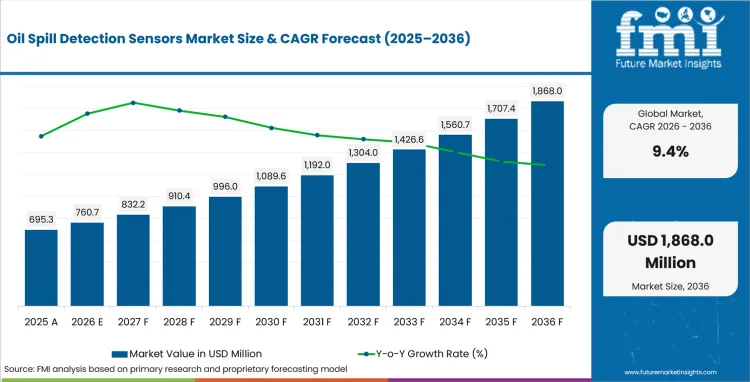
| Metric | Value |
|---|---|
| 2026 Market Size | USD 760.7 million |
| 2036 Market Size | USD 1,868.0 million |
| Forecast CAGR (2026-2036) | 9.4% |
| Leading Sensor Type | UV Fluorescence Sensors |
| UV Fluorescence Sensors Share (2026) | 34.0% |
| Leading Deployment | Fixed Offshore Platforms |
| Fixed Offshore Platforms Share (2026) | 39.0% |
| Fastest-growing Country | China |
Summary of the Oil Spill Detection Sensors Market
| Market Signal | Commercial Impact |
|---|---|
| Demand and Growth Drivers | Oil spill detection sensor demand is expanding as offshore operators, ports, and environmental agencies strengthen continuous monitoring, incident verification, and regulatory compliance across marine assets.
|
| Product and Segment View | UV Fluorescence Sensors, Fixed Offshore Platforms, Offshore Oil & Gas, and Sea Surface Detection dominate their respective market segments.
|
| Geography and Growth Outlook | China, India, and the United States are expected to remain key growth markets as offshore infrastructure, port safety systems, and environmental monitoring investments expand.
|
| Competitive Landscape | Competition is increasingly focused on integrated spill detection technologies, real-time monitoring, and environmental response capabilities.
|
| Analyst Perspective | Oil spill detection sensors are evolving into intelligent environmental monitoring systems that improve spill verification, regulatory compliance, and emergency response efficiency.
- Nikhil Kaitwade, Principal Consultant for Oil & Gas at Future Market Insights |
Demand is shaped by historical spill exposure and the need for continuous maritime and offshore surveillance. ITOPF reported in January 2026 that three large and three medium tanker spills occurred in 2025, with an estimated 4,000 tonnes of oil released from tanker incidents during the year. The EEA stated in March 2025 that EMSA’s CleanSeaNet identified 7,513 possible oil spill detections in 2023. These indicators explain why buyers increasingly integrate fixed sensors and satellite data, aiming to shorten confirmation times before response teams are deployed. These figures show why buyers combine fixed sensors and marine radar to reduce confirmation delays before response teams mobilize.
Which factors support expansion in the oil spill detection sensors market?
Installed safety instrumentation and monitoring services support market value across offshore assets and port operations.
- Market value is supported by equipment sales at platforms and terminals before service contracts add recurring surveillance revenue.
- Supplier pricing reflects harsh-weather reliability and integration support before buyers compare the cost of unnecessary response mobilization.
- Revenue improves as buyers connect oil detection to oil and gas sensor programs that already guide safety-critical instrumentation spending.
- Retail and industrial spill planning reinforces replacement demand for systems tied to valves and containment actions. Tank farms in the oil storage space also require early alarms that support valve and pump decisions.
Why is the oil spill detection sensors market growing?
Buyers are installing continuous oil detection systems to shorten spill confirmation time and produce records for response reviews.
Growth is expected to be reinforced by offshore production scale and regulator inspection pressure. EIA reported in June 2025 that Federal Offshore Gulf of America crude oil production was forecast at 1.80 million barrels per day in 2025. BSEE states that it conducts about 20,000 component inspections each year across more than 2,000 offshore facilities. These operating conditions keep continuous monitoring relevant around platforms and support vessels. The service side also benefits as emergency spill response budgets shift toward earlier detection and documentation. Adjacent gas sensors programs can share integration budgets where operators standardize safety alarms across hazardous assets.
How is the oil spill detection sensors market segmented?
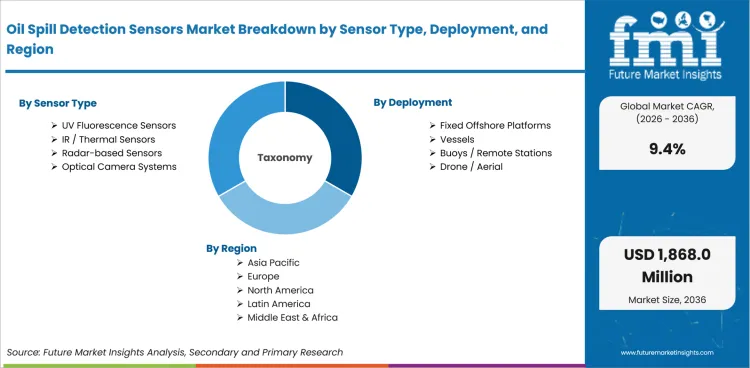
The oil spill detection sensors industry is segmented by sensor type plus deployment plus application plus detection medium and sales model.
- UV fluorescence sensors are projected to secure 34.0% share in 2026 due to sensitivity around thin hydrocarbon films.
- Fixed offshore platforms are anticipated to hold 39.0% share in 2026 owing to permanent asset monitoring needs.
- Offshore Oil & Gas is expected to represent 46.0% share in 2026 due to higher spill consequence around platforms.
- Sea Surface detection is forecast to capture 61.0% share in 2026 because most response workflows start with slick tracking.
- Equipment Sale is projected to account for 54.0% share in 2026 due to buyer preference for owned site hardware.
Which sensor type category holds a notable share in the oil spill detection sensors market?
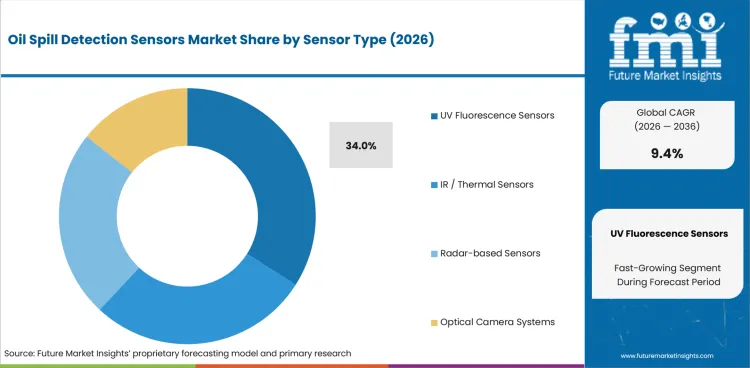
- UV fluorescence sensors are expected to account for 34.0% share in 2026 due to thin-sheen detection near terminals and intakes.
- Radar-based sensors gain relevance in offshore areas that need wide slick tracking and lower manual confirmation time.
How does deployment shape demand in the oil spill detection sensors market?
- Fixed offshore platforms are projected to hold 39.0% share in 2026 due to continuous monitoring needs around unmanned assets.
- Vessels and buoys gain support from response teams that need mobile confirmation during uncertain spill events.
What drives application choices in the oil spill detection sensors market?
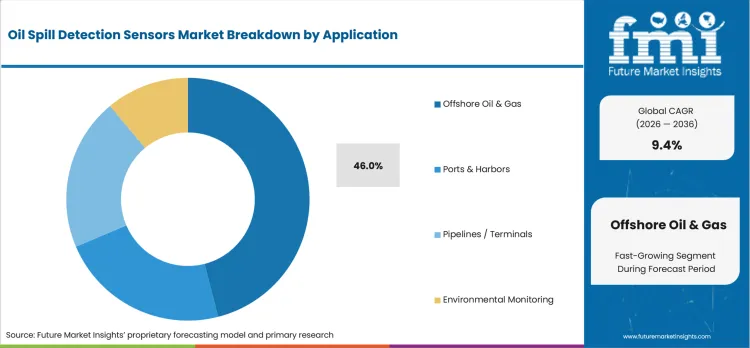
- Offshore Oil & Gas is forecast to account for 46.0% share in 2026 due to higher incident cost around production assets.
- Ports and Harbors gain practical importance as fuel handling zones and water intakes require local alarm coverage.
Which detection medium shows a prominent position in the oil spill detection sensors market?
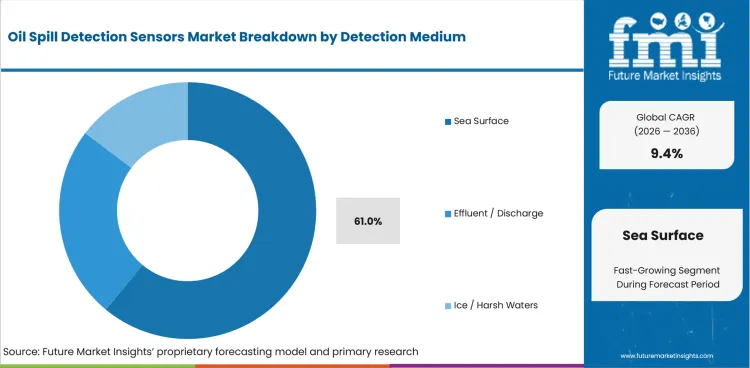
- Sea Surface detection is expected to secure 61.0% share in 2026 as slick evidence appears first at the water surface.
- Effluent and discharge monitoring benefits from fluorescence sensors installed near industrial outfalls and terminal drainage points.
How are buyers selecting across sales model options in the oil spill detection sensors market?
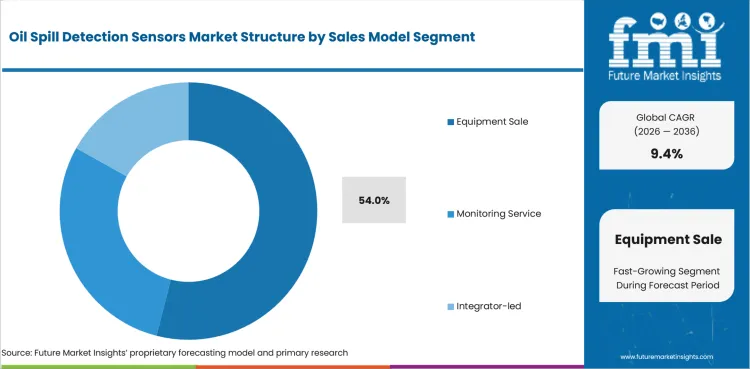
- Equipment Sale is projected to represent 54.0% share in 2026 due to preference for owned sensor networks at regulated sites.
- Monitoring Service gains relevance as satellite screening and synthetic aperture radar interpretation move into recurring surveillance contracts.
What are the driver, restraints, and opportunities in the oil spill detection sensors market?
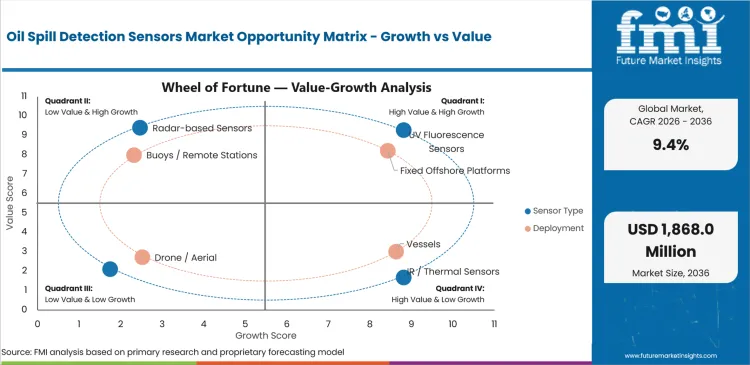
Early spill proof is expected to support growth while false alarms and installation cost limit faster deployment.
- Driver: Offshore operators and port authorities are buying sensors that produce alarm records before cleanup decisions escalate.
- Restraint: Buyers remain cautious about radar false alarms caused by wind shadows and natural slicks in low sea clutter.
- Opportunity: Monitoring service bundling can expand revenue by combining installed sensors with satellite feeds and reporting dashboards.
Offshore Alarm Proof
Offshore buyers are moving toward systems that connect detection records with verification and response decisions. NOAA reported in February 2026 that its Office of Response and Restoration supported 132 oil spills and 13 chemical releases among new incidents in 2025. This incident load supports demand for alarms that can be shared by operators and cleanup contractors.
Port Intake Protection
Port buyers need sensors close to berths, fuel handling areas and industrial intakes. India’s Ministry of Ports, Shipping and Waterways reported in February 2025 that major ports handled 769.72 million tonnes of cargo during April to February 2024 to 2025. This cargo scale raises the value of early alarms near jetties and tanker berths. Cleanup planning tied to spill kits can support sensor purchases when ports want faster containment readiness.
False Alarm Control
The main restraint is buyer confidence in alarm reliability during complex sea conditions and mixed slick signatures. A January 2026 oil spill change detection study found that static SAR segmentation can create high false positives around ocean features that resemble oil. This makes algorithm validation and local sea-state testing important in supplier selection.
Which countries are growing fastest in the oil spill detection sensors market?
China 10.5% CAGR, India 10.2% CAGR, United States 9.8% CAGR, South Korea 9.6% CAGR, Japan 9.4% CAGR, Germany 8.7% CAGR, France 8.5% CAGR, and United Kingdom 8.2% CAGR through 2036.
.webp "Top Country Growth Comparison Oil Spill Detection Sensors Market Cagr (2026 2036)")
| Country | CAGR |
|---|---|
| China | 10.5% |
| India | 10.2% |
| United States | 9.8% |
| South Korea | 9.6% |
| Japan | 9.4% |
| Germany | 8.7% |
| France | 8.5% |
| United Kingdom | 8.2% |
Source: Future Market Insights, 2026.
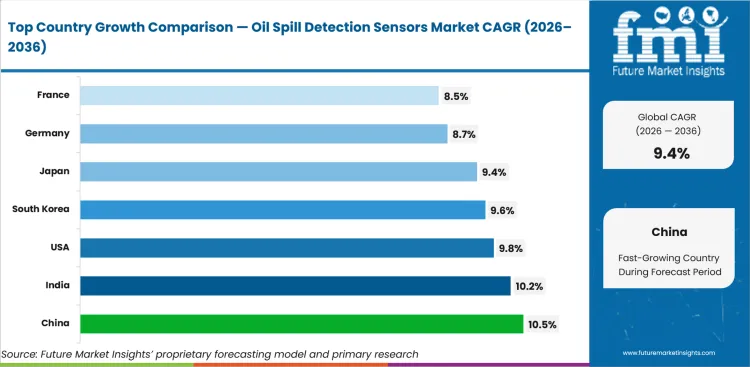
How do country-level CAGRs compare in the oil spill detection sensors market?
China and India show the most prominent country outlooks and the United Kingdom records a more measured expansion profile.
- China is expected to post a 10.5% CAGR through 2036, driven by offshore energy development and high‑volume port traffic that is accelerating monitoring system upgrades.
- India is forecast to grow at a 10.2% CAGR by 2036, as large‑scale port expansion and stronger coastal response readiness encourage wider sensor integration.
- The United States is projected to expand at a 9.8% CAGR by 2036, supported by Gulf offshore infrastructure and federal spill response programs sustaining replacement demand.
- South Korea is anticipated to record a 9.6% CAGR by 2036, with dense port clusters and shipbuilding activity increasing vessel‑side monitoring requirements.
- Japan is expected to reach a 9.4% CAGR by 2036, as heavy bay traffic and structured contingency planning maintain interest in port and platform monitoring systems.
- Germany is forecast to grow at an 8.7% CAGR by 2036, with Hamburg port operations and North Sea surveillance needs supporting harbor‑focused deployments.
- France is projected to advance at an 8.5% CAGR by 2036, driven by satellite data interpretation capabilities and ongoing coastal oversight programs.
How fast is the oil spill detection sensors market growing in the United States?
A 9.8% CAGR through 2036 reflects Gulf offshore activity and federal spill-response documentation needs across regulated assets.
Country Market Snapshot Table
| Parameter | Value |
|---|---|
| Market Size in 2025 (Value) | USD 150.3 million |
| Market Size in 2026 (Value) | USD 165.0 million |
| Market Forecast in 2036 (Value) | USD 420.2 million |
| CAGR (2026 to 2036) | 9.8% |
| Years Considered | 2021 to 2036 |
| Base Year | 2025 |
| Forecast Period | 2026 to 2036 |
| Units Considered | Value (USD million) |
| Leading Sub-Region | Gulf Coast and major Atlantic port corridors |
United States Oil Spill Detection Sensors Market Outlook
United States demand is shaped by Gulf offshore production and refinery terminals that require traceable alarms. Buyers often prefer fixed monitoring tied to control rooms and response contractors.
Procurement is split between asset owners and public response users that value field references. Systems that combine radar with fluorescence records are better positioned for longer contracts.
Key Growth Drivers
- Gulf platform monitoring is expected to support fixed radar upgrades as operators need evidence before response costs rise. EIA reported in June 2025 that Federal Offshore Gulf of America crude oil production was forecast at 1.80 million barrels per day in 2025.
- Regulator inspection pressure reinforces demand for traceable safety records around offshore facilities. BSEE states that it conducts about 20,000 component inspections each year across more than 2,000 facilities.
- Port and refinery buyers are expected to use fluorescence sensors near intakes and stormwater outlets to reduce shutdown risk.
- Coastal response agencies gain value from satellite and aerial screening that narrows search areas before vessel confirmation.
Key Restraints
- False-alarm concern can slow buyer approval due to seepage and natural slick signatures in Gulf waters. A January 2026 SAR change detection study stated that static segmentation can generate high false positives.
- Offshore installation cost is expected to remain elevated due to access limits and safety permits during shutdown windows.
- Procurement cycles can extend when buyers require field trials across weather conditions before accepting automated alarms.
What makes United States unique
The United States combines Gulf offshore production and federal response capacity with a private service ecosystem that supports field validation.
Key Companies
- InterOcean Systems
- Rutter
- Miros
- NORBIT Aptomar
- Kongsberg Satellite Services
Sales & Marketing Channels
- Direct offshore operator sales
- Marine safety integrators
- Environmental response contractors
- Port authority tenders
- Offshore engineering firms
- Distributor-led sensor supply
Country Segment Breakdown Table
| Segment | Sub-Segments |
|---|---|
| By Sensor Type | UV Fluorescence Sensors · IR / Thermal Sensors · Radar-based Sensors · Optical Camera Systems |
| By Deployment | Fixed Offshore Platforms · Vessels · Buoys / Remote Stations · Drone / Aerial |
| By Application | Offshore Oil & Gas · Ports & Harbors · Pipelines / Terminals · Environmental Monitoring |
| By Detection Medium | Sea Surface · Effluent / Discharge · Ice / Harsh Waters |
| By Sales Model | Equipment Sale · Monitoring Service · Integrator-led |
| Key Sub-Regions Covered, Manufacturing and automation corridors | Coastal terminals · Offshore platforms · Port clusters · Industrial waterfronts · Response zones |
Frequently Asked Questions
How fast is United States oil spill detection sensors market growing?
Sales in United States are expected to expand at 9.8% CAGR from 2026 to 2036 across regulated offshore and port monitoring programs.
Who leads United States oil spill detection sensors market?
InterOcean Systems and Rutter compete alongside Miros and NORBIT Aptomar on relevant portfolios and regional service access.
What is driving adoption in United States oil spill detection sensors market?
Adoption is shaped by offshore monitoring and port safety documentation needs across United States response programs.
What is the oil spill detection sensors market outlook in the United Kingdom?
An 8.2% CAGR through 2036 reflects mature offshore assets and local sensor expertise across regulated marine operations.
Country Market Snapshot Table
| Parameter | Value |
|---|---|
| Market Size in 2025 (Value) | USD 31.4 million |
| Market Size in 2026 (Value) | USD 34.0 million |
| Market Forecast in 2036 (Value) | USD 74.8 million |
| CAGR (2026 to 2036) | 8.2% |
| Years Considered | 2021 to 2036 |
| Base Year | 2025 |
| Forecast Period | 2026 to 2036 |
| Units Considered | Value (USD million) |
| Leading Sub-Region | North Sea and major port corridors |
United Kingdom Oil Spill Detection Sensors Market Outlook
Industry in United Kingdom is concentrated around North Sea asset life extension and decommissioning work. Buyers need monitoring systems that fit environmental plans and operating permits.
Local supply is stronger in fluorescence sensors and buoy-based monitoring than in national platform contracts. Documentation quality and UK service support are important selection factors for operators.
Key Growth Drivers
- North Sea operators are expected to require monitoring during late-life operations and decommissioning phases. OPRED states that it regulates offshore oil and gas environmental activity on the UK continental shelf.
- Local sensor supply supports faster pilot activity for fluorescence and buoy-based oil detection. Chelsea Technologies states that UviLux OIL is depth rated to 1000m for offshore source monitoring.
- Port buyers are expected to place sensors around liquid bulk berths and industrial water intake locations.
- Environmental consultancy channels gain relevance as buyers need evidence packs for permit and incident reviews.
Key Restraints
- Capital discipline at mature offshore assets can delay optional upgrades when buyers focus on decommissioning and life extension budgets. OEUK reported in September 2024 that unintentional oil releases in 2023 were 4.75 tonnes.
- Weather and sea-state limits can make radar-only systems harder to approve without local validation trials.
- Smaller port buyers may prefer service contracts before committing to owned sensor networks.
What makes United Kingdom unique
The United Kingdom is distinct because local fluorescence expertise meets North Sea documentation requirements.
Key Companies
- Chelsea Technologies
- Ocean Scientific International
- Laser Diagnostic Instruments
- Rutter
- Miros
Sales & Marketing Channels
- Offshore operator procurement
- Port authority tenders
- Environmental consultancy channels
- UK distributor networks
- Marine engineering contractors
- Research-linked pilots
Country Segment Breakdown Table
| Segment | Sub-Segments |
|---|---|
| By Sensor Type | UV Fluorescence Sensors · IR / Thermal Sensors · Radar-based Sensors · Optical Camera Systems |
| By Deployment | Fixed Offshore Platforms · Vessels · Buoys / Remote Stations · Drone / Aerial |
| By Application | Offshore Oil & Gas · Ports & Harbors · Pipelines / Terminals · Environmental Monitoring |
| By Detection Medium | Sea Surface · Effluent / Discharge · Ice / Harsh Waters |
| By Sales Model | Equipment Sale · Monitoring Service · Integrator-led |
| Key Sub-Regions Covered, Manufacturing and automation corridors | Coastal terminals · Offshore platforms · Port clusters · Industrial waterfronts · Response zones |
Frequently Asked Questions
How fast is United Kingdom oil spill detection sensors market growing?
Sales in United Kingdom are expected to expand at 8.2% CAGR from 2026 to 2036, guided by country-specific monitoring needs.
Who leads United Kingdom oil spill detection sensors market?
Chelsea Technologies and Ocean Scientific International compete alongside Laser Diagnostic Instruments and Rutter on sensor portfolios and service access.
What is driving adoption in United Kingdom oil spill detection sensors market?
Adoption is shaped by offshore monitoring and compliance documentation needs across United Kingdom marine operations.
How is Germany performing in the oil spill detection sensors market?
An 8.7% CAGR through 2036 reflects port-centered demand and North Sea surveillance needs across German waters.
Country Market Snapshot Table
| Parameter | Value |
|---|---|
| Market Size in 2025 (Value) | USD 38.6 million |
| Market Size in 2026 (Value) | USD 42.0 million |
| Market Forecast in 2036 (Value) | USD 96.7 million |
| CAGR (2026 to 2036) | 8.7% |
| Years Considered | 2021 to 2036 |
| Base Year | 2025 |
| Forecast Period | 2026 to 2036 |
| Units Considered | Value (USD million) |
| Leading Sub-Region | Hamburg and North Sea port corridors |
Germany Oil Spill Detection Sensors Market Outlook
Germany demand is more port-centered as liquid bulk and industrial waterfronts create local detection points. Buyers often expect integration with harbor control tools.
European satellite surveillance creates the wider monitoring background for German buyers. Near-field confirmation still matters because ports need alarms at tanker berths and discharge locations.
Key Growth Drivers
- Hamburg port activity is expected to support harbor-facing oil slick detection around tanker and bunkering zones. Port of Hamburg statistics show seaborne cargo throughput of 114.6 million tonnes for 2025.
- European maritime surveillance reinforces buyer awareness of suspected pollution events. EEA stated in March 2025 that CleanSeaNet detected 7,513 possible oil spills in European seas in 2023.
- Industrial waterfronts gain value from fluorescence sensors near outfalls and intake points that require fast local confirmation.
- Marine electronics distributors support sales when sensors must connect with existing traffic and harbor systems.
Key Restraints
- Port budgets can slow dedicated oil detection purchases when buyers prioritize traffic systems and emissions projects. Hamburg’s 2025 cargo increase was 2.6%, which still keeps spending competition visible.
- Interface checks with established harbor systems can extend purchasing decisions for radar and camera packages.
- Public procurement can favor proven European references before newer sensor suppliers receive wider access.
What makes Germany unique
Germany is unique because port scale and industrial water interfaces shape demand more than offshore production.
Key Companies
- Miros
- NORBIT Aptomar
- Rutter
- Kongsberg Satellite Services
- Viridien
Sales & Marketing Channels
- Port authority tenders
- Marine electronics distributors
- Environmental engineering consultants
- Industrial plant procurement
- EU project-linked pilots
- Systems integrator channels
Country Segment Breakdown Table
| Segment | Sub-Segments |
|---|---|
| By Sensor Type | UV Fluorescence Sensors · IR / Thermal Sensors · Radar-based Sensors · Optical Camera Systems |
| By Deployment | Fixed Offshore Platforms · Vessels · Buoys / Remote Stations · Drone / Aerial |
| By Application | Offshore Oil & Gas · Ports & Harbors · Pipelines / Terminals · Environmental Monitoring |
| By Detection Medium | Sea Surface · Effluent / Discharge · Ice / Harsh Waters |
| By Sales Model | Equipment Sale · Monitoring Service · Integrator-led |
| Key Sub-Regions Covered, Manufacturing and automation corridors | Coastal terminals · Offshore platforms · Port clusters · Industrial waterfronts · Response zones |
Frequently Asked Questions
How fast is Germany oil spill detection sensors market growing?
Sales in Germany are expected to expand at 8.7% CAGR from 2026 to 2036, guided by country-specific monitoring needs.
Who leads Germany oil spill detection sensors market?
Miros and NORBIT Aptomar compete alongside Rutter and Kongsberg Satellite Services on portfolios and service reach.
What is driving adoption in Germany oil spill detection sensors market?
Adoption is shaped by port safety and compliance documentation needs across Germany marine operations.
What supports oil spill detection sensors demand in France?
An 8.5% CAGR through 2036 reflects satellite monitoring capacity and coastal oversight needs across French waters.
Country Market Snapshot Table
| Parameter | Value |
|---|---|
| Market Size in 2025 (Value) | USD 35.0 million |
| Market Size in 2026 (Value) | USD 38.0 million |
| Market Forecast in 2036 (Value) | USD 85.9 million |
| CAGR (2026 to 2036) | 8.5% |
| Years Considered | 2021 to 2036 |
| Base Year | 2025 |
| Forecast Period | 2026 to 2036 |
| Units Considered | Value (USD million) |
| Leading Sub-Region | Atlantic and Mediterranean port corridors |
France Oil Spill Detection Sensors Market Outlook
France industry is projected to be driven by demand for ports and satellite-backed monitoring across Atlantic and Mediterranean waters. Buyers value independent slick interpretation before deploying response assets.
The service route is especially relevant because French satellite mapping firms support offshore interpretation and drift assessment. Hardware still matters near terminals and sensitive coastal sites.
Key Growth Drivers
- Satellite-backed slick detection supports offshore and coastal risk screening for public and private users. CLS states that it detects oil spills and calculates drift before identifying potential polluters for response support.
- European surveillance evidence reinforces recurring monitoring demand around French waters. EEA stated in March 2025 that EMSA CleanSeaNet detected 7,513 possible oil spills in 2023.
- Port and terminal buyers are expected to use near-field alarms around industrial water zones and fuel handling areas.
- Service providers gain relevance when operators need independent interpretation without building a full internal surveillance stack.
Key Restraints
- Hardware vendors can face slower entry when buyers prefer established satellite services and institutional contracts. Viridien stated in June 2025 that SeaScope uses SAR and multi-spectral data for oil pollution detection.
- Public procurement can require French-language support and multi-year references before broader deployment.
- Coastal users may delay owned equipment if service-based screening meets their minimum reporting needs.
What makes France unique
France is distinct because satellite interpretation capacity is central to spill detection and monitoring service demand.
Key Companies
- Viridien
- CLS Group
- Kongsberg Satellite Services
- Miros
- NORBIT Aptomar
Sales & Marketing Channels
- Satellite monitoring service contracts
- Port authority procurement
- Offshore operator accounts
- Environmental consultancy channels
- Public agency tenders
- European integrator networks
Country Segment Breakdown Table
| Segment | Sub-Segments |
|---|---|
| By Sensor Type | UV Fluorescence Sensors · IR / Thermal Sensors · Radar-based Sensors · Optical Camera Systems |
| By Deployment | Fixed Offshore Platforms · Vessels · Buoys / Remote Stations · Drone / Aerial |
| By Application | Offshore Oil & Gas · Ports & Harbors · Pipelines / Terminals · Environmental Monitoring |
| By Detection Medium | Sea Surface · Effluent / Discharge · Ice / Harsh Waters |
| By Sales Model | Equipment Sale · Monitoring Service · Integrator-led |
| Key Sub-Regions Covered, Manufacturing and automation corridors | Coastal terminals · Offshore platforms · Port clusters · Industrial waterfronts · Response zones |
Frequently Asked Questions
How fast is France oil spill detection sensors market growing?
Sales in France are expected to expand at 8.5% CAGR from 2026 to 2036, guided by country-specific monitoring needs.
Who leads France oil spill detection sensors market?
Viridien and CLS Group compete alongside Kongsberg Satellite Services and Miros on portfolios and monitoring service reach.
What is driving adoption in France oil spill detection sensors market?
Adoption is shaped by coastal oversight and port safety documentation needs across France marine operations.
How is the oil spill detection sensors forecast developing in Japan?
A 9.4% CAGR through 2036 reflects dense bay traffic and detailed contingency planning across Japanese waters.
Country Market Snapshot Table
| Parameter | Value |
|---|---|
| Market Size in 2025 (Value) | USD 53.0 million |
| Market Size in 2026 (Value) | USD 58.0 million |
| Market Forecast in 2036 (Value) | USD 142.4 million |
| CAGR (2026 to 2036) | 9.4% |
| Years Considered | 2021 to 2036 |
| Base Year | 2025 |
| Forecast Period | 2026 to 2036 |
| Units Considered | Value (USD million) |
| Leading Sub-Region | Tokyo Bay, Ise Bay, and Seto Inland Sea |
Japan Oil Spill Detection Sensors Market Outlook
Japan demand is shaped by crowded coastal waters and emergency planning around enclosed sea areas. Buyers need reliable alarms that avoid disrupting port movement.
The market favors compact systems and trusted service partners that support integrated displays. Foreign suppliers need local channel support and documentation that fits Japanese procurement practice.
Key Growth Drivers
- Dense bay traffic supports surveillance and response-ready monitoring near tanker routes and refinery corridors. ITOPF notes that Japan has contingency plans for a maximum spill of 810,000 tonnes in three sea areas.
- Local radar capability supports oil slick detection in busy waters. Furuno states that its Oil Radar solution was created to identify oil spills on the ocean surface.
- Ports and refineries are expected to need sensors near water intakes and fuel handling areas that require quick confirmation.
- Coastal agency tenders gain relevance when response teams need shared views across bays and vessel routes.
Key Restraints
- False-alarm caution is expected to remain high in dense shipping zones that contain many look-alike surface signatures. A January 2026 SAR study reported a 64.4% reduction in false detections versus baseline methods.
- Local certification and support expectations can slow foreign supplier entry before long-term service access is proven.
- Buyers may favor established marine electronics brands when new suppliers lack port-specific validation.
What makes Japan unique
Japan combines high traffic density with contingency planning for enclosed and semi-enclosed sea areas.
Key Companies
- Furuno Electric
- Kongsberg Maritime
- Rutter
- Miros
- NORBIT Aptomar
Sales & Marketing Channels
- Port technology integrators
- Marine electronics distributors
- Government procurement channels
- Refinery and terminal accounts
- Coastal agency tenders
- Engineering consultant networks
Country Segment Breakdown Table
| Segment | Sub-Segments |
|---|---|
| By Sensor Type | UV Fluorescence Sensors · IR / Thermal Sensors · Radar-based Sensors · Optical Camera Systems |
| By Deployment | Fixed Offshore Platforms · Vessels · Buoys / Remote Stations · Drone / Aerial |
| By Application | Offshore Oil & Gas · Ports & Harbors · Pipelines / Terminals · Environmental Monitoring |
| By Detection Medium | Sea Surface · Effluent / Discharge · Ice / Harsh Waters |
| By Sales Model | Equipment Sale · Monitoring Service · Integrator-led |
| Key Sub-Regions Covered, Manufacturing and automation corridors | Coastal terminals · Offshore platforms · Port clusters · Industrial waterfronts · Response zones |
Frequently Asked Questions
How fast is Japan oil spill detection sensors market growing?
Sales in Japan are expected to expand at 9.4% CAGR from 2026 to 2036, guided by country-specific monitoring needs.
Who leads Japan oil spill detection sensors market?
Furuno Electric and Kongsberg Maritime compete alongside Rutter and Miros on portfolios and marine service access.
What is driving adoption in Japan oil spill detection sensors market?
Adoption is shaped by port safety and contingency documentation needs across Japan marine operations.
What is shaping oil spill detection sensors demand in China?
A 10.5% CAGR through 2036 reflects offshore scale and high-volume port activity across Chinese coastal provinces.
Country Market Snapshot Table
| Parameter | Value |
|---|---|
| Market Size in 2025 (Value) | USD 117.6 million |
| Market Size in 2026 (Value) | USD 130.0 million |
| Market Forecast in 2036 (Value) | USD 352.8 million |
| CAGR (2026 to 2036) | 10.5% |
| Years Considered | 2021 to 2036 |
| Base Year | 2025 |
| Forecast Period | 2026 to 2036 |
| Units Considered | Value (USD million) |
| Leading Sub-Region | Bohai Bay and South China Sea corridors |
China Oil Spill Detection Sensors Market Outlook
China demand is driven by Bohai offshore production and state-linked energy procurement. Buyers need systems that can work across large coastal waters and platform clusters.
Domestic qualification and integration requirements influence supplier access. Foreign suppliers may need local partners while domestic sensor makers compete on cost and fast deployment.
Key Growth Drivers
- Bohai offshore development supports fixed platform detection and monitoring software demand. CNOOC reported in September 2024 that Kenli 10-2 sits in southern Bohai Bay at about 15.7 meters average water depth.
- Large offshore projects raise the need for alarms around platforms and tanker routes. State media reported in May 2026 that Kenli 10-2 holds geological reserves exceeding 100 million metric tons.
- High-volume ports are expected to create demand for slick detection around tanker berths and fuel handling zones.
- Maritime agencies gain value from satellite and radar monitoring that can cover dense coastal waters before vessel confirmation.
Key Restraints
- Local qualification can restrict direct foreign access when public and state-linked buyers require domestic integration paths. Desun Uniwill lists CE and CNEX certificates for its DSOD703 oil spill detector.
- Buyers often need compatibility with domestic command systems before selecting imported radar or fluorescence packages.
- Price competition can pressure international suppliers that sell higher-cost service and validation packages.
What makes China unique
China is unique because offshore development and coastal traffic shape deployment speed under state-directed procurement.
Key Companies
- Desun Uniwill
- Chinatwinno
- Rika Sensors
- CNOOC Energy Technology
- Kongsberg Maritime China
Sales & Marketing Channels
- State energy procurement
- Port group tenders
- Maritime agency programs
- Local systems integrators
- Offshore engineering contractors
- Satellite service partnerships
Country Segment Breakdown Table
| Segment | Sub-Segments |
|---|---|
| By Sensor Type | UV Fluorescence Sensors · IR / Thermal Sensors · Radar-based Sensors · Optical Camera Systems |
| By Deployment | Fixed Offshore Plat5forms · Vessels · Buoys / Remote Stations · Drone / Aerial |
| By Application | Offshore Oil & Gas · Ports & Harbors · Pipelines / Terminals · Environmental Monitoring |
| By Detection Medium | Sea Surface · Effluent / Discharge · Ice / Harsh Waters |
| By Sales Model | Equipment Sale · Monitoring Service · Integrator-led |
| Key Sub-Regions Covered, Manufacturing and automation corridors | Coastal terminals · Offshore platforms · Port clusters · Industrial waterfronts · Response zones |
Frequently Asked Questions
How fast is China oil spill detection sensors market growing?
Sales in China are expected to expand at 10.5% CAGR from 2026 to 2036, guided by country-specific monitoring needs.
Who leads China oil spill detection sensors market?
Desun Uniwill and Chinatwinno compete alongside Rika Sensors and CNOOC Energy Technology on relevant portfolios and service access.
What is driving adoption in China oil spill detection sensors market?
Adoption is shaped by offshore monitoring and port safety documentation needs across China coastal operations.
How does South Korea compare in the oil spill detection sensors market?
A 9.6% CAGR through 2036 reflects port clusters and refinery-linked coastal monitoring needs across South Korea.
Country Market Snapshot Table
| Parameter | Value |
|---|---|
| Market Size in 2025 (Value) | USD 40.1 million |
| Market Size in 2026 (Value) | USD 44.0 million |
| Market Forecast in 2036 (Value) | USD 110.0 million |
| CAGR (2026 to 2036) | 9.6% |
| Years Considered | 2021 to 2036 |
| Base Year | 2025 |
| Forecast Period | 2026 to 2036 |
| Units Considered | Value (USD million) |
| Leading Sub-Region | Busan, Ulsan, and refinery-linked coastal corridors |
South Korea Oil Spill Detection Sensors Market Outlook
South Korea demand is shaped by port safety and refinery waterfronts around shipbuilding clusters that require technical integration. Buyers can evaluate sensor fit closely due to local marine engineering capability.
Vessel-mounted systems suit response operations while fluorescence sensors support industrial waterfront monitoring. International vendors need dependable local service to compete through marine electronics channels.
Key Growth Drivers
- Spill liability rules create value for traceable detection around ports and terminals. ITOPF states that Korean law obliges the spiller to respond and prevent oil from spreading.
- Refinery and port clusters support monitoring near terminals and water intakes. South Korea handled 31.7 million TEUs of container traffic in 2024 according to national port statistics.
- Shipyard integrators are expected to support vessel-mounted radar systems that help response teams verify slick movement.
- Coast guard-related tenders gain relevance when public agencies need evidence before response assets are deployed.
Key Restraints
- Existing patrol and response assets can slow sensor adoption when buyers need proof of added value. A January 2026 SAR study noted that conventional segmentation struggles with look-alike ocean features.
- Local service expectations can delay foreign supplier access when products require calibration in Korean sea states.
- Industrial buyers may prefer lower-cost point sensors unless wide-area detection proves measurable response savings.
What makes South Korea unique
South Korea is distinct because marine electronics capability and refinery-linked ports shape technical buying behavior.
Key Companies
- Kongsberg Maritime Korea
- Furuno Korea
- Miros
- Rutter
- NORBIT Aptomar
Sales & Marketing Channels
- Port authority procurement
- Marine electronics distributors
- Shipyard integrator channels
- Coast guard-related tenders
- Refinery procurement
- Offshore service contractors
Country Segment Breakdown Table
| Segment | Sub-Segments |
|---|---|
| By Sensor Type | UV Fluorescence Sensors · IR / Thermal Sensors · Radar-based Sensors · Optical Camera Systems |
| By Deployment | Fixed Offshore Platforms · Vessels · Buoys / Remote Stations · Drone / Aerial |
| By Application | Offshore Oil & Gas · Ports & Harbors · Pipelines / Terminals · Environmental Monitoring |
| By Detection Medium | Sea Surface · Effluent / Discharge · Ice / Harsh Waters |
| By Sales Model | Equipment Sale · Monitoring Service · Integrator-led |
| Key Sub-Regions Covered, Manufacturing and automation corridors | Coastal terminals · Offshore platforms · Port clusters · Industrial waterfronts · Response zones |
Frequently Asked Questions
How fast is South Korea oil spill detection sensors market growing?
Sales in South Korea are expected to expand at 9.6% CAGR from 2026 to 2036, guided by country-specific monitoring needs.
Who leads South Korea oil spill detection sensors market?
Kongsberg Maritime Korea and Furuno Korea compete alongside Miros and Rutter on portfolios and service access.
What is driving adoption in South Korea oil spill detection sensors market?
Adoption is shaped by port safety and refinery-linked documentation needs across South Korea coastal operations.
What supports oil spill detection sensors growth in India?
A 10.2% CAGR through 2036 reflects port expansion and coastal incident readiness across Indian maritime corridors.
Country Market Snapshot Table
| Parameter | Value |
|---|---|
| Market Size in 2025 (Value) | USD 36.3 million |
| Market Size in 2026 (Value) | USD 40.0 million |
| Market Forecast in 2036 (Value) | USD 105.7 million |
| CAGR (2026 to 2036) | 10.2% |
| Years Considered | 2021 to 2036 |
| Base Year | 2025 |
| Forecast Period | 2026 to 2036 |
| Units Considered | Value (USD million) |
| Leading Sub-Region | Kochi, Mumbai, Chennai, and major port corridors |
India Oil Spill Detection Sensors Market Outlook
India demand is shaped by major port expansion and public-sector influence in coastal safety procurement. Buyers look for systems that justify spending through shutdown avoidance and faster response.
Public tenders and marine contractors control much of the route to market. International vendors need Indian integration partners and service support to move beyond pilot projects.
Key Growth Drivers
- Port expansion creates more monitoring points around liquid bulk and container terminals. PIB reported in May 2025 that major ports handled about 855 million tonnes of cargo in FY 2024 to 2025.
- Coastal incidents raise interest in satellite-backed slick tracking and rapid coordination. PIB stated in May 2025 that MSC ELSA 3 carried 84.44 tonnes of diesel when it sank off Kochi.
- Public infrastructure spending is expected to support sensor integration into port safety and environmental monitoring programs.
- Local distributor networks help foreign suppliers reach terminal operators that need installation and maintenance support.
Key Restraints
- Price-sensitive procurement can favor minimum-compliance systems when buyers compare sensors against other port upgrades. India’s major ports recorded 4.3% cargo growth in FY 2024 to 2025 according to PIB.
- Long public tender cycles can slow sales even when coastal incidents increase the practical need for monitoring.
- Premium radar and satellite packages may require stronger local proof before port buyers approve recurring service budgets.
What makes India unique
India combines fast port expansion with high public-sector influence in coastal safety procurement.
Key Companies
- Kongsberg Maritime India
- Unique Group India
- Chelsea Technologies
- Ocean Scientific International
- InterOcean Systems
Sales & Marketing Channels
- Major port tenders
- Marine engineering contractors
- Public safety procurement
- Offshore operator accounts
- Local distributor networks
- Environmental monitoring consultants
Country Segment Breakdown Table
| Segment | Sub-Segments |
|---|---|
| By Sensor Type | UV Fluorescence Sensors · IR / Thermal Sensors · Radar-based Sensors · Optical Camera Systems |
| By Deployment | Fixed Offshore Platforms · Vessels · Buoys / Remote Stations · Drone / Aerial |
| By Application | Offshore Oil & Gas · Ports & Harbors · Pipelines / Terminals · Environmental Monitoring |
| By Detection Medium | Sea Surface · Effluent / Discharge · Ice / Harsh Waters |
| By Sales Model | Equipment Sale · Monitoring Service · Integrator-led |
| Key Sub-Regions Covered, Manufacturing and automation corridors | Coastal terminals · Offshore platforms · Port clusters · Industrial waterfronts · Response zones |
Frequently Asked Questions
How fast is India oil spill detection sensors market growing?
Sales in India are expected to expand at 10.2% CAGR from 2026 to 2036, guided by country-specific monitoring needs.
Who leads India oil spill detection sensors market?
Kongsberg Maritime India and Unique Group India compete alongside Chelsea Technologies and OSIL on portfolios and regional service access.
What is driving adoption in India oil spill detection sensors market?
Adoption is shaped by port expansion and coastal readiness documentation across India maritime operations.
Who are the leading companies in the oil spill detection sensors market?
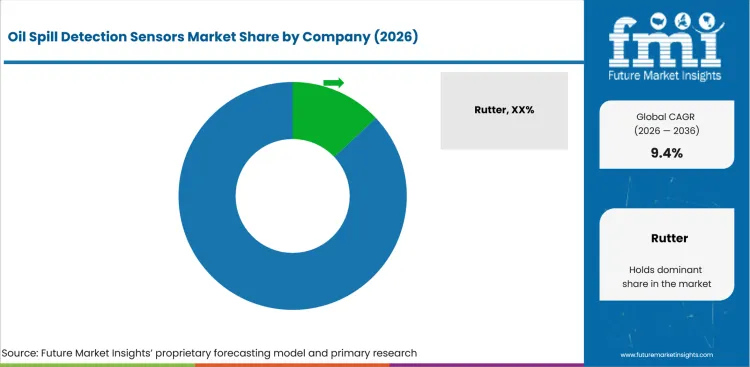
Rutter, Miros, NORBIT Aptomar, InterOcean Systems, Chelsea Technologies, OSIL, KSAT, Viridien, CLS Group, and Furuno are profiled in the market.
- Competition is shaped by radar accuracy and fluorescence sensitivity alongside satellite interpretation and response workflow integration.
- Offshore buyers evaluate suppliers by false-alarm control and harsh-weather reliability before reviewing control-room integration support.
- Port and terminal accounts compare sensor price against shutdown avoidance and maintenance requirements tied to alarm records.
- Service providers compete on coverage and analyst validation before buyers compare delivery speed for wide-area slick screening.
Radar and vessel-system suppliers in the market are focusing on turning existing marine radar data into response-ready slick evidence. Rutter provides sigma S6 Oil Spill Detection for estimated volume and drift. NORBIT Aptomar uses SeaDarQ inside SeaCOP to support detection and response views. Buyers comparing marine electronics investments often favor suppliers that reduce separate hardware needs.
Fluorescence and buoy suppliers are competing in markets where buyers need local hydrocarbon confirmation at terminals and discharge points. InterOcean Systems offers Slick Sleuth models for tank farms and marine terminals. Chelsea Technologies and OSIL support in-situ and buoy-based monitoring. Adjacent spill containment systems spending strengthens the case for alarms that can trigger response actions.
Service-led companies are positioned for wide-area surveillance because satellite screening can monitor large waters before vessel checks begin. KSAT uses a ground network of more than 300 antennas across 28 locations. Viridien and CLS support satellite-based interpretation for oil pollution monitoring. Firms that combine hardware and digital oilfield solutions workflows are better placed for multi-asset contracts.
How do top oil spill detection sensors companies compare?
Rutter and NORBIT Aptomar score strongly on radar integration while InterOcean and Chelsea Technologies show stronger point-sensor relevance.
| Company | Portfolio/Focus | Account Access | Footprint/Service Reach |
|---|---|---|---|
| Rutter | sigma S6 oil spill detection and monitoring system. | Offshore platforms, response vessels, and marine operators. | Global. |
| Miros | Oil spill detection monitoring and cloud surveillance. | Offshore operators, integrators, and production asset owners. | Global. |
| NORBIT Aptomar | SeaDarQ oil spill detection and SeaCOP response display systems. | Offshore control rooms, vessel operators, and response teams. | Global. |
| InterOcean Systems | Slick Sleuth and Rig Guard oil detection systems. | Terminals, refineries, offshore platforms, and tank farms. | United States and export markets. |
| Chelsea Technologies | UviLux OIL sensors and fluorescence detection systems. | Buoy makers, source monitoring users, and offshore monitoring teams. | United Kingdom and export markets. |
| Ocean Scientific International | Oil spill monitoring buoys and environmental monitoring systems. | Coastal agencies, researchers, and environmental monitoring users. | United Kingdom and export markets. |
| Kongsberg Satellite Services | Oil spill detection service using satellite data and analyst review. | Public agencies, offshore operators, and wide-area surveillance users. | Global. |
| Viridien | SeaScope oil pollution monitoring using SAR and multispectral data. | Energy companies, public monitoring accounts, and environmental users. | Europe and global. |
Source: Future Market Insights competitive analysis, 2026.
Who are the key players in the oil spill detection sensors market?
Rutter, Miros, NORBIT Aptomar, InterOcean Systems, Chelsea Technologies, OSIL, KSAT, Viridien, CLS Group, and Furuno are listed among profiled suppliers.
Key global companies leading the oil spill detection sensors market include:
- Rutter
- Miros
- NORBIT Aptomar
- InterOcean Systems
- Chelsea Technologies
- Ocean Scientific International
- Kongsberg Satellite Services
- Viridien
- CLS Group
- Furuno Electric
Key Developments in Oil Spill Detection Sensors Market
- In June 2025, Viridien detailed its SeaScope solution for detecting oil pollution patterns using SAR and multi-spectral Earth observation data.
- In June 2025, Miros released cloud-based oil spill monitoring capability in Brazil for offshore production asset surveillance.
- In May 2025, NORBIT Aptomar demonstrated SeaCOP in a remote sensing exercise covering drift buoys and vessel-mounted imaging systems.
Key Players in the Oil Spill Detection Sensors Market
Radar and Vessel Systems
- Rutter
- Miros
- NORBIT Aptomar
- Furuno Electric
Fluorescence and Buoy Sensors
- InterOcean Systems
- Chelsea Technologies
- Ocean Scientific International
- Laser Diagnostic Instruments
Satellite and Monitoring Services
- Kongsberg Satellite Services
- Viridien
- CLS Group
Regional Sensor and Integration Companies
- Desun Uniwill
- Chinatwinno
- Rika Sensors
- Unique Group India
Oil Spill Detection Sensors Market - Report Scope
| Attribute | Description |
|---|---|
| Forecast period | 2026 to 2036 |
| Historical period | 2021 to 2025 |
| Quantitative unit | Value in USD million |
| Segmentation rows | Sensor Type, Deployment, Application, Detection Medium, Sales Model, and Region |
| Regions covered | North America, Latin America, Western Europe, Eastern Europe, East Asia, South Asia and Pacific, and Middle East & Africa |
| Countries covered | United States, United Kingdom, Germany, France, Japan, China, South Korea, and India |
| Key companies profiled | Rutter, Miros, NORBIT Aptomar, InterOcean Systems, Chelsea Technologies, OSIL, KSAT, Viridien, CLS Group, and Furuno |
| Approach | Bottom-up installation assessment, supplier portfolio review, country risk weighting, and primary interview validation |
Source: Future Market Insights, 2026.
Oil Spill Detection Sensors Market - Scope & Definition
| Scope Item | Description |
|---|---|
| Market Definition | Oil spill detection sensors identify oil slicks, hydrocarbon films, or oil-in-water contamination before a spill spreads. |
| Functions Covered | Detection, alarm generation, slick tracking, data recording, response handoff, and monitoring service support. |
| Applications Covered | Offshore oil and gas, ports and harbors, pipelines and terminals, and environmental monitoring. |
| End-Use Industries | Oil and gas, marine transport, port operations, industrial waterfronts, utilities, and public response agencies. |
| Grades Covered | UV fluorescence, infrared, thermal, radar-based, optical camera, buoy-mounted, vessel-mounted, and service-integrated systems. |
| Inclusions | Fixed and mobile sensors, software dashboards, monitoring services, integrator-led systems, and connected alarm workflows. |
| Exclusions | Cleanup booms, skimmers, dispersants, absorbent pads, general water probes, and emergency cleanup services without detection technology. |
Oil Spill Detection Sensors Market - Research Methodology
| Methodology Step | Description |
|---|---|
| Primary Research | FMI analysts reviewed buyer needs from offshore operators, port safety teams, terminal operators, maritime integrators, and environmental monitoring service providers. |
| Desk Research | Desk research covered oil spill statistics, maritime surveillance programs, regulator guidance, official port data, and company product evidence. |
| Market Sizing & Forecasting | The model combined installed system volume, average selling prices, monitoring service revenue, country exposure, and application mix. |
| Market Calibration | Spill response activity, maritime surveillance coverage, offshore production signals, and supplier portfolios support the forecast outlook. |
Oil Spill Detection Sensors Market Breakdown by Sensor Type, Deployment, Application, Detection Medium, Sales Model, and Region
Oil Spill Detection Sensors Market Segmented by Sensor Type:
- UV Fluorescence Sensors
- IR / Thermal Sensors
- Radar-based Sensors
- Optical Camera Systems
Oil Spill Detection Sensors Market Segmented by Deployment:
- Fixed Offshore Platforms
- Vessels
- Buoys / Remote Stations
- Drone / Aerial
Oil Spill Detection Sensors Market Segmented by Application:
- Offshore Oil & Gas
- Ports & Harbors
- Pipelines / Terminals
- Environmental Monitoring
Oil Spill Detection Sensors Market Segmented by Detection Medium:
- Sea Surface
- Effluent / Discharge
- Ice / Harsh Waters
Oil Spill Detection Sensors Market Segmented by Sales Model:
- Equipment Sale
- Monitoring Service
- Integrator-led
Oil Spill Detection Sensors Market by Region:
- North America
- United States
- Canada
- Europe
- Germany
- United Kingdom
- France
- Italy
- Spain
- Asia Pacific
- China
- Japan
- South Korea
- Taiwan
- Singapore
- Latin America
- Brazil
- Mexico
- Argentina
- Middle East & Africa
- GCC Countries
- South Africa
- Israel
Research Sources and Bibliography
- International Tanker Owners Pollution Federation. (2026, January 23). ITOPF publishes 2025 oil tanker spill statistics. ITOPF.
- European Environment Agency. (2025, March 2). Oil spills in Europe’s seas. European Environment Agency.
- European Maritime Safety Agency. (2025, June 18). Consolidated annual activity report 2024. European Maritime Safety Agency.
- U.S. Energy Information Administration. (2025, June 6). Gulf of America oil and natural gas production expected to remain flat through 2026. U.S. Energy Information Administration.
- Bureau of Safety and Environmental Enforcement. (2025). Oil and gas. Bureau of Safety and Environmental Enforcement.
- National Oceanic and Atmospheric Administration. (2026, February 9). Safeguarding coasts from pollution: A look back at 2025. NOAA Office of Response and Restoration.
- Ministry of Ports, Shipping and Waterways. (2025, February). Cargo handled at major ports February 2025. Government of India.
- Press Information Bureau. (2025, May 13). India’s major ports achieve historic milestones in FY 2024-25. Government of India.
- Press Information Bureau. (2025, May 25). ICG along with Indian Navy rescues all crew members from MSC ELSA 3. Government of India.
- Offshore Petroleum Regulator for Environment and Decommissioning. (2026). Offshore Petroleum Regulator for Environment and Decommissioning. GOV.UK.
- Offshore Energies UK. (2024, September). Environmental insight 2024. Offshore Energies UK.
- Port of Hamburg. (2026). Statistics: Seaborne cargo throughput 2025. Port of Hamburg.
- China National Offshore Oil Corporation Limited. (2024, September 25). CNOOC Limited announces a large-sized discovery in Bohai. CNOOC Limited.
- China Daily. (2026, May 27). CNOOC’s Kenli 10-2 oilfield starts production in Bohai Sea. China Daily.
- International Tanker Owners Pollution Federation. (2026). Japan country profile. ITOPF.
- Rutter. (2026). Oil spill detection and monitoring system. Rutter.
- Miros. (2025, June 18). Miros secure cloud technology sets a new benchmark for oil spill monitoring in Brazil. Miros.
- NORBIT Aptomar. (2026). SeaDarQ oil spill detection. NORBIT.
- InterOcean Systems. (2026). Oil spill detection and monitoring. InterOcean Systems.
- Chelsea Technologies. (2022, September 12). Oil spill detection. Chelsea Technologies.
- Ocean Scientific International. (2026). Oil spill monitoring buoys. OSIL.
- Kongsberg Satellite Services. (2026). Oil spill detection service. KSAT.
- Viridien. (2025, June 5). Advances in oil pollution monitoring: The development and application of SeaScope solution. Viridien.
- CLS Group. (2026). Oil spill monitoring. CLS Maritime Intelligence.
- Furuno. (2026). Oil spill detection radar. Furuno.
- Desun Uniwill. (2026). Non-contact DSOD703 oil spill detector for real-time water monitoring. Desun Uniwill.
- Lai, C., Huang, T., Song, S., Cheng, G., & Luo, C. (2026, January). Beyond segmentation: An oil spill change detection framework using synthetic SAR imagery. arXiv.
- Yata, P. K., Pradeep, P., & Himanish, G. (2026, January). SAR-based marine oil spill detection using the DeepSegFusion architecture. arXiv.
This bibliography is provided for reader reference and is not exhaustive. The full report contains the complete reference list and detailed citations.
This Report Answers
- What is the current value and forecast value of the oil spill detection sensors market from 2026 to 2036?
- What CAGR is the oil spill detection sensors market expected to record during the forecast period?
- Which sensor type is projected to lead oil spill detection sensor demand in 2026?
- Which application is expected to account for the most visible share of oil spill detection sensor spending?
- Why are offshore operators and port authorities buying real-time spill detection systems?
- How are satellite plus radar and fluorescence technologies changing oil spill surveillance workflows?
- Which countries are forecast to record the most notable demand expansion for oil spill detection sensors?
- Which companies are active across radar systems plus fluorescence sensors plus buoy systems and satellite-based spill detection?
- What systems and services are included in the oil spill detection sensors market definition?
- How does FMI forecast demand across equipment sales plus monitoring services and integrator-led supply?
Frequently Asked Questions
What is the growth prospect for oil spill detection sensors?
Demand for oil spill detection sensors is expected to rise as offshore operators and port authorities require faster alarm records.
Which companies are expected to shape the oil spill detection sensors market?
Rutter and Miros are expected to shape competition alongside NORBIT Aptomar and InterOcean Systems across sensor and monitoring workflows.
Why are offshore operators investing in oil spill detection sensors?
Offshore operators are investing in oil spill detection sensors to confirm releases faster and preserve response evidence.
Why are port channels important in the oil spill detection sensors market?
Port channels support controlled buying because terminals need alarms near berths and water intakes.
Which sensor formats are gaining attention in oil spill detection?
UV fluorescence sensors and radar-based systems are gaining attention because they support near-field confirmation and wide-area slick tracking.
How do regulations influence oil spill detection sensor purchases?
Regulations influence purchases by increasing the value of documented alarms and response records during incident reviews.
Why is satellite monitoring important for oil spill detection?
Satellite monitoring helps agencies and operators screen wider waters before sending vessels or aircraft for confirmation.
What role do service contracts play in oil spill detection?
Service contracts support recurring surveillance by combining satellite data with analyst validation and incident reporting dashboards.
How do buyers reduce false-alarm risk in oil spill detection?
Buyers reduce false-alarm risk by testing sensors in local sea states and pairing automated alarms with human validation.
Preview the report firsthand - request a free sample
Get SampleGet the brochure for pricing and purchase details.
Get PDFTable of Content
- Key Takeaways
- Market Size and CAGR
- Top Growth Driver
- Fastest Growing Segment
- Leading Region
- Key Companies
- Emerging Opportunities
- Executive Summary
- Global Market Outlook
- Demand-side Trends
- Supply-side Trends
- Technology Roadmap Analysis
- Analysis and Recommendations
- Analyst Perspective (What is happening? Why now? What should investors know?)
- Key Questions Answered
- How large is the market?
- What is the CAGR?
- What are key trends?
- Which region dominates?
- Who are the leaders?
- Market Overview
- Market Coverage / Taxonomy
- Market Definition / Scope / Limitations
- Research Methodology
- Chapter Orientation
- Analytical Lens and Working Hypotheses
- Market Structure, Signals, and Trend Drivers
- Benchmarking and Cross-market Comparability
- Market Sizing, Forecasting, and Opportunity Mapping
- Research Design and Evidence Framework
- Desk Research Programme (Secondary Evidence)
- Expert Input and Fieldwork (Primary Evidence)
- Tooling, Models, and Reference Databases
- Data Engineering and Model Build
- Quality Assurance and Audit Trail
- Market Background
- Market Dynamics (Drivers, Restraints, Opportunity, Trends)
- Scenario Forecast (Optimistic, Likely, Conservative)
- Impact Analysis
- AI Impact
- Sustainability Impact
- Regulatory Impact
- Technology Impact
- Consumer / Buyer Analysis
- Purchase Drivers
- Adoption Barriers
- Buyer Journey
- Opportunity Map Analysis
- Product Life Cycle Analysis
- Supply Chain Analysis
- Investment Feasibility Matrix
- Value Chain Analysis
- PESTLE and Porter's Analysis
- Regulatory Landscape
- Regional Parent Market Outlook
- Production and Consumption Statistics
- Import and Export Statistics
- Global Market Analysis and Forecast, 2021 to 2036
- Historical Market Size Value (USD Million) & Volume (Unit) Analysis, 2021 to 2025
- Current and Future Market Size Value (USD Million) & Volume (Unit) Projections, 2026 to 2036
- Y-o-Y Growth Trend Analysis
- Absolute $ Opportunity Analysis
- Global Market Pricing Analysis, 2021 to 2036
- Global Market Analysis and Forecast, By Sensor Type, 2021 to 2036
- Introduction / Key Findings
- Historical Market Size Value (USD Million) & Volume (Unit) Analysis By Sensor Type, 2021 to 2025
- Current and Future Market Size Value (USD Million) & Volume (Unit) Analysis and Forecast By Sensor Type, 2026 to 2036
- UV Fluorescence Sensors
- IR / Thermal Sensors
- Radar-based Sensors
- Optical Camera Systems
- UV Fluorescence Sensors
- Y-o-Y Growth Trend Analysis By Sensor Type, 2021 to 2025
- Absolute $ Opportunity Analysis By Sensor Type, 2026 to 2036
- Global Market Analysis and Forecast, By Deployment, 2021 to 2036
- Introduction / Key Findings
- Historical Market Size Value (USD Million) & Volume (Unit) Analysis By Deployment, 2021 to 2025
- Current and Future Market Size Value (USD Million) & Volume (Unit) Analysis and Forecast By Deployment, 2026 to 2036
- Fixed Offshore Platforms
- Vessels
- Buoys / Remote Stations
- Drone / Aerial
- Fixed Offshore Platforms
- Y-o-Y Growth Trend Analysis By Deployment, 2021 to 2025
- Absolute $ Opportunity Analysis By Deployment, 2026 to 2036
- Global Market Analysis and Forecast, By Application, 2021 to 2036
- Introduction / Key Findings
- Historical Market Size Value (USD Million) & Volume (Unit) Analysis By Application, 2021 to 2025
- Current and Future Market Size Value (USD Million) & Volume (Unit) Analysis and Forecast By Application, 2026 to 2036
- Offshore Oil & Gas
- Ports & Harbors
- Pipelines / Terminals
- Environmental Monitoring
- Offshore Oil & Gas
- Y-o-Y Growth Trend Analysis By Application, 2021 to 2025
- Absolute $ Opportunity Analysis By Application, 2026 to 2036
- Global Market Analysis and Forecast, By Detection Medium, 2021 to 2036
- Introduction / Key Findings
- Historical Market Size Value (USD Million) & Volume (Unit) Analysis By Detection Medium, 2021 to 2025
- Current and Future Market Size Value (USD Million) & Volume (Unit) Analysis and Forecast By Detection Medium, 2026 to 2036
- Sea Surface
- Effluent / Discharge
- Ice / Harsh Waters
- Sea Surface
- Y-o-Y Growth Trend Analysis By Detection Medium, 2021 to 2025
- Absolute $ Opportunity Analysis By Detection Medium, 2026 to 2036
- Global Market Analysis and Forecast, By Sales Model, 2021 to 2036
- Introduction / Key Findings
- Historical Market Size Value (USD Million) & Volume (Unit) Analysis By Sales Model, 2021 to 2025
- Current and Future Market Size Value (USD Million) & Volume (Unit) Analysis and Forecast By Sales Model, 2026 to 2036
- Equipment Sale
- Monitoring Service
- Integrator-led
- Equipment Sale
- Y-o-Y Growth Trend Analysis By Sales Model, 2021 to 2025
- Absolute $ Opportunity Analysis By Sales Model, 2026 to 2036
- Global Market Analysis and Forecast, By Region, 2021 to 2036
- Introduction
- Historical Market Size Value (USD Million) & Volume (Unit) Analysis By Region, 2021 to 2025
- Current Market Size Value (USD Million) & Volume (Unit) Analysis and Forecast By Region, 2026 to 2036
- North America
- Latin America
- Western Europe
- Eastern Europe
- East Asia
- South Asia and Pacific
- Middle East & Africa
- Market Attractiveness Analysis By Region
- North America Market Analysis and Forecast, By Country, 2021 to 2036
- Historical Market Size Value (USD Million) & Volume (Unit) Trend Analysis By Market Taxonomy, 2021 to 2025
- Market Size Value (USD Million) & Volume (Unit) Forecast By Market Taxonomy, 2026 to 2036
- By Country
- USA
- Canada
- Mexico
- By Sensor Type
- By Deployment
- By Application
- By Detection Medium
- By Sales Model
- By Country
- Market Attractiveness Analysis
- By Country
- By Sensor Type
- By Deployment
- By Application
- By Detection Medium
- By Sales Model
- Key Takeaways
- Latin America Market Analysis and Forecast, By Country
- Historical Market Size Value (USD Million) & Volume (Unit) Trend Analysis By Market Taxonomy, 2021 to 2025
- Market Size Value (USD Million) & Volume (Unit) Forecast By Market Taxonomy, 2026 to 2036
- By Country
- Brazil
- Chile
- Rest of Latin America
- By Sensor Type
- By Deployment
- By Application
- By Detection Medium
- By Sales Model
- By Country
- Market Attractiveness Analysis
- By Country
- By Sensor Type
- By Deployment
- By Application
- By Detection Medium
- By Sales Model
- Key Takeaways
- Western Europe Market Analysis and Forecast, By Country
- Historical Market Size Value (USD Million) & Volume (Unit) Trend Analysis By Market Taxonomy, 2021 to 2025
- Market Size Value (USD Million) & Volume (Unit) Forecast By Market Taxonomy, 2026 to 2036
- By Country
- Germany
- UK
- Italy
- Spain
- France
- Nordic
- BENELUX
- Rest of Western Europe
- By Sensor Type
- By Deployment
- By Application
- By Detection Medium
- By Sales Model
- By Country
- Market Attractiveness Analysis
- By Country
- By Sensor Type
- By Deployment
- By Application
- By Detection Medium
- By Sales Model
- Key Takeaways
- Eastern Europe Market Analysis and Forecast, By Country
- Historical Market Size Value (USD Million) & Volume (Unit) Trend Analysis By Market Taxonomy, 2021 to 2025
- Market Size Value (USD Million) & Volume (Unit) Forecast By Market Taxonomy, 2026 to 2036
- By Country
- Russia
- Poland
- Hungary
- Balkan & Baltic
- Rest of Eastern Europe
- By Sensor Type
- By Deployment
- By Application
- By Detection Medium
- By Sales Model
- By Country
- Market Attractiveness Analysis
- By Country
- By Sensor Type
- By Deployment
- By Application
- By Detection Medium
- By Sales Model
- Key Takeaways
- East Asia Market Analysis and Forecast, By Country
- Historical Market Size Value (USD Million) & Volume (Unit) Trend Analysis By Market Taxonomy, 2021 to 2025
- Market Size Value (USD Million) & Volume (Unit) Forecast By Market Taxonomy, 2026 to 2036
- By Country
- China
- Japan
- South Korea
- By Sensor Type
- By Deployment
- By Application
- By Detection Medium
- By Sales Model
- By Country
- Market Attractiveness Analysis
- By Country
- By Sensor Type
- By Deployment
- By Application
- By Detection Medium
- By Sales Model
- Key Takeaways
- South Asia and Pacific Market Analysis and Forecast, By Country
- Historical Market Size Value (USD Million) & Volume (Unit) Trend Analysis By Market Taxonomy, 2021 to 2025
- Market Size Value (USD Million) & Volume (Unit) Forecast By Market Taxonomy, 2026 to 2036
- By Country
- India
- ASEAN
- Australia & New Zealand
- Rest of South Asia and Pacific
- By Sensor Type
- By Deployment
- By Application
- By Detection Medium
- By Sales Model
- By Country
- Market Attractiveness Analysis
- By Country
- By Sensor Type
- By Deployment
- By Application
- By Detection Medium
- By Sales Model
- Key Takeaways
- Middle East & Africa Market Analysis and Forecast, By Country
- Historical Market Size Value (USD Million) & Volume (Unit) Trend Analysis By Market Taxonomy, 2021 to 2025
- Market Size Value (USD Million) & Volume (Unit) Forecast By Market Taxonomy, 2026 to 2036
- By Country
- Kingdom of Saudi Arabia
- Other GCC Countries
- Türkiye
- South Africa
- Other African Union
- Rest of Middle East & Africa
- By Sensor Type
- By Deployment
- By Application
- By Detection Medium
- By Sales Model
- By Country
- Market Attractiveness Analysis
- By Country
- By Sensor Type
- By Deployment
- By Application
- By Detection Medium
- By Sales Model
- Key Takeaways
- Key Countries Market Analysis
- USA
- Pricing Analysis
- Market Share Analysis, 2025
- By Sensor Type
- By Deployment
- By Application
- By Detection Medium
- By Sales Model
- Canada
- Pricing Analysis
- Market Share Analysis, 2025
- By Sensor Type
- By Deployment
- By Application
- By Detection Medium
- By Sales Model
- Mexico
- Pricing Analysis
- Market Share Analysis, 2025
- By Sensor Type
- By Deployment
- By Application
- By Detection Medium
- By Sales Model
- Brazil
- Pricing Analysis
- Market Share Analysis, 2025
- By Sensor Type
- By Deployment
- By Application
- By Detection Medium
- By Sales Model
- Chile
- Pricing Analysis
- Market Share Analysis, 2025
- By Sensor Type
- By Deployment
- By Application
- By Detection Medium
- By Sales Model
- Germany
- Pricing Analysis
- Market Share Analysis, 2025
- By Sensor Type
- By Deployment
- By Application
- By Detection Medium
- By Sales Model
- UK
- Pricing Analysis
- Market Share Analysis, 2025
- By Sensor Type
- By Deployment
- By Application
- By Detection Medium
- By Sales Model
- Italy
- Pricing Analysis
- Market Share Analysis, 2025
- By Sensor Type
- By Deployment
- By Application
- By Detection Medium
- By Sales Model
- Spain
- Pricing Analysis
- Market Share Analysis, 2025
- By Sensor Type
- By Deployment
- By Application
- By Detection Medium
- By Sales Model
- France
- Pricing Analysis
- Market Share Analysis, 2025
- By Sensor Type
- By Deployment
- By Application
- By Detection Medium
- By Sales Model
- India
- Pricing Analysis
- Market Share Analysis, 2025
- By Sensor Type
- By Deployment
- By Application
- By Detection Medium
- By Sales Model
- ASEAN
- Pricing Analysis
- Market Share Analysis, 2025
- By Sensor Type
- By Deployment
- By Application
- By Detection Medium
- By Sales Model
- Australia & New Zealand
- Pricing Analysis
- Market Share Analysis, 2025
- By Sensor Type
- By Deployment
- By Application
- By Detection Medium
- By Sales Model
- China
- Pricing Analysis
- Market Share Analysis, 2025
- By Sensor Type
- By Deployment
- By Application
- By Detection Medium
- By Sales Model
- Japan
- Pricing Analysis
- Market Share Analysis, 2025
- By Sensor Type
- By Deployment
- By Application
- By Detection Medium
- By Sales Model
- South Korea
- Pricing Analysis
- Market Share Analysis, 2025
- By Sensor Type
- By Deployment
- By Application
- By Detection Medium
- By Sales Model
- Russia
- Pricing Analysis
- Market Share Analysis, 2025
- By Sensor Type
- By Deployment
- By Application
- By Detection Medium
- By Sales Model
- Poland
- Pricing Analysis
- Market Share Analysis, 2025
- By Sensor Type
- By Deployment
- By Application
- By Detection Medium
- By Sales Model
- Hungary
- Pricing Analysis
- Market Share Analysis, 2025
- By Sensor Type
- By Deployment
- By Application
- By Detection Medium
- By Sales Model
- Kingdom of Saudi Arabia
- Pricing Analysis
- Market Share Analysis, 2025
- By Sensor Type
- By Deployment
- By Application
- By Detection Medium
- By Sales Model
- Türkiye
- Pricing Analysis
- Market Share Analysis, 2025
- By Sensor Type
- By Deployment
- By Application
- By Detection Medium
- By Sales Model
- South Africa
- Pricing Analysis
- Market Share Analysis, 2025
- By Sensor Type
- By Deployment
- By Application
- By Detection Medium
- By Sales Model
- USA
- Market Structure Analysis
- Competition Dashboard
- Competition Benchmarking
- Market Share Analysis of Top Players
- By Regional
- By Sensor Type
- By Deployment
- By Application
- By Detection Medium
- By Sales Model
- Emerging Startups
- Innovation Benchmarking
- Competition Analysis
- Competition Deep Dive
- Rutter
- Overview
- Product Portfolio
- Profitability by Market Segments (Product/Region/Sales Channel)
- Sales Footprint
- Strategy Overview
- Marketing Strategy
- Product Strategy
- Channel Strategy
- Miros
- NORBIT Aptomar
- InterOcean Systems
- Chelsea Technologies
- Ocean Scientific International
- Kongsberg Satellite Services
- Viridien
- Rutter
- Case Studies
- Success Stories
- Recent Developments
- Competition Deep Dive
- Assumptions & Acronyms Used


