
- Market Size (2026)
- USD 21.2 Bn
- Forecast (2036)
- USD 35.9 Bn
- CAGR (2026 to 2036)
- 5.4%
How big is the Organosilicon Polymers Market in 2026?
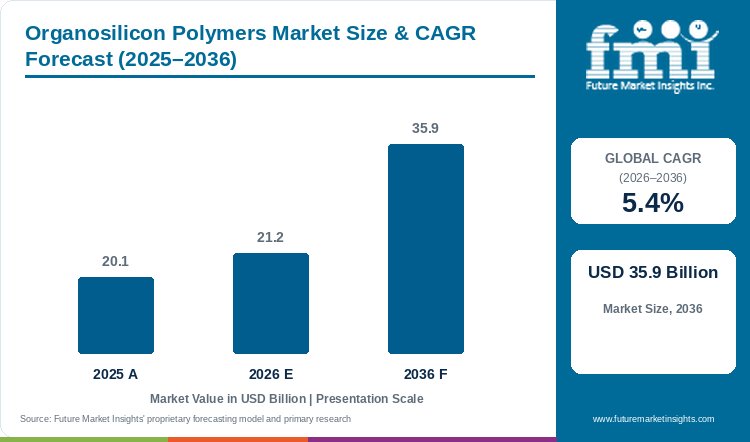
The Organosilicon Polymers Market is projected to reach USD 35.9 billion by 2036, growing at a 5.4% CAGR from 2026 to 2036. The market is estimated at USD 21.2 billion in 2026. The market was valued at USD 20.1 billion in 2025. On 29 October 2026 Wacker reported third-quarter silicones sales of EUR 729 million, up 8% from EUR 673 million a year earlier [1]. It attributed the rise to higher selling prices and an improved product mix [1]. Dow said on 22 October 2026 that volume in its Performance Materials & Coatings segment rose 3% in the third quarter, led by growth in downstream silicones [5].
Input costs are the main force on price. Wacker raised prices on selected silicone products by up to 25% from 1 February 2026 [2]. It cited a platinum price that had more than doubled since the start of 2025 [2]. From 1 April 2026 it raised prices across its wider silicone range. The stated causes were energy, raw material and logistics costs linked to the conflict in the Middle East [2][3]. Bluestar Silicones followed on 21 October 2026 with increases of roughly 5% to 25% for customers in Europe and the Americas [8]. In Germany, producer prices for basic chemicals were 11.3% above the level of September 2025 [23]. Precious metals within intermediate goods were up 26.5% over the same period [23].
Key Market Trends & Insights
- On 17 June 2026 Wacker opened a specialty silicones production site in Karlovy Vary, Czech Republic, after two years of construction. The site makes room-temperature-curing silicones and solid silicone rubber, with up to 200 jobs planned by 2028 [4].
- Ownership of a major producer changed in 2026. Bluestar acquired a majority of Elkem's silicones division. The deal closed on 30 April 2026, and the business returned to the Bluestar Silicones name [7].
- Circular supply is moving toward sale. Bluestar's Saint-Fons site in France was certified under ISCC PLUS on 23 July 2026. On 6 October 2026 the company launched a silicone masterbatch containing 33% mechanically recycled silicone [9][10].
Regional Highlights
- North America: United States housing starts ran at a seasonally adjusted annual rate of 1,221,000 in September 2026, 7.4% below September 2025. This tempers demand from sealants and coatings [21].
- Europe: German industrial production rose 0.7% in September 2026 from August. Construction output fell 2.6% in the month. Output of energy-intensive industries was 1.9% below September 2025 [22].
- Asia Pacific: China's economy grew 4.5% year on year in the third quarter of 2026. In the first three quarters, industrial robot output rose 29.1% and lithium-ion battery output rose 39.5% [24].
Organosilicon Polymers Market Size and Forecast
Table 1: Organosilicon Polymers Market Size and Forecast
| Market size and forecast | Value |
|---|---|
| Market size in 2025 | USD 20.1 billion |
| Estimated market size in 2026 | USD 21.2 billion |
| Projected market size by 2036 | USD 35.9 billion |
| CAGR from 2026 to 2036 | 5.4% |
Source: Future Market Insights analysis of the organosilicon polymers market, 2026.
Analyst Perspective
“Silicone buyers are paying for a metal as well as a polymer. Platinum sits inside addition-curing rubbers, release coatings and resins. That is why 2026 price rounds have been large and frequent. The most useful buyer signals are the platinum price, the closure of upstream siloxane plants in Europe, and how quickly suppliers pass energy costs into contracts. Buyers who split volume between a siloxane producer and a downstream formulator have more room to negotiate than buyers tied to one site.”
- Nikhil Kaitwade, Principal Consultant, FMI
How is the Organosilicon Polymers Market segmented?
- By application: Coatings, Foams, Adhesives & Sealants, Elastomers and Others
- By region: North America, Europe, Asia Pacific and Latin America
Why does Coatings lead by Application in the Organosilicon Polymers Market in 2026?
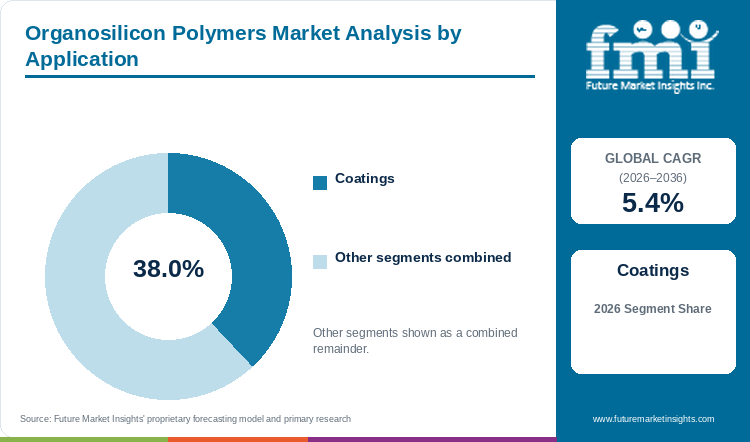
Coatings is estimated to account for 38.0% of the Organosilicon Polymers Market by application in 2026. Silicones act in coatings in two ways. They form the film itself, as in release coatings on paper and film. They also work as a small additive that changes the surface of a paint. Wacker lists silicone-based release coatings among the products it repriced in February 2026. It also names release coating among its affected customer sectors [2]. Bluestar launched its SILCOLEASE POLY 7600 Series release coating for MLCC films at the China International Import Expo in Shanghai, which runs from 5 to 10 November 2026 [12]. Architectural paint and other specialty coatings form the second demand route. Momentive describes its CoatOSil silicone additives as replacements for PFAS in architectural paints, which it says keep stain resistance and washability [18]. It also sells CoatOSil masonry water repellents for stone, brick, concrete and fibre cement. It says they help prevent moisture intrusion, efflorescence and freeze-thaw damage [18]. Silicone is therefore specified where a coating must release or repel, and where a paint must stay clean.
Table 2: Application, 2026 Share
| Leading Share | 2026 market share |
|---|---|
| Coatings | 38.0% |
| All Other Segments Combined Share | 62.0% |
Source: Future Market Insights analysis of the organosilicon polymers market, 2026.
What are the key drivers, restraints and opportunities?
Driver
Electronics and mobility buyers use silicones in thermal management, cable insulation and encapsulation. At the China International Import Expo, Bluestar is showing a cable insulation compound, a coolant for heat dissipation, a thermal interface material for robot chips and an encapsulant for high-speed rail [12]. Wacker says its Karlovy Vary site serves electromobility, medical technology, power-grid expansion and household appliances [4]. Dow said downstream silicone volume rose in all regions in the third quarter of 2026, driven by consumer, electronics and home care applications [5]. Wacker's nine-month group EBITDA rose 74.2% to EUR 601.4 million [1]. Its Silicones EBITDA for the third quarter was helped by cost savings and currency effects as well as price [1].
Wacker reports that silicone products made up about 49% of its group sales in 2024 [2]. It names automotive, pharmaceutical, medical technology, electrical engineering, energy transmission and release coating as the sectors most affected by its February price rise [2]. Momentive says it serves more than 4,000 customer companies in over 100 countries [15]. A spread of buyers across cycles makes demand steadier than any single end market would.
Restraint
On 29 October 2026 Wacker said demand from many customer sectors, such as automotive and construction, remained cautious [1]. It described the economic environment as remaining challenging [1]. US housing starts in September 2026 were 7.4% below a year earlier [21]. German construction output fell 2.6% in the month [22]. Repeated price rounds of up to 25% [2][8] push buyers to renegotiate or look for alternates.
The US Environmental Protection Agency issued a draft risk evaluation for D4 under TSCA in September 2025. A Science Advisory Committee on Chemicals reviewed it in December 2025. The page lists no final evaluation. In the draft, EPA preliminarily found unreasonable risk to workers from 23 conditions of use, without counting protective equipment [20]. It found one consumer use with unreasonable risk: certain paints and coatings [20]. It found no unreasonable risk to the general population from any condition of use [20]. A final evaluation could change how D4 is handled in paints and coatings, so formulators should track the docket.
Opportunity
Bluestar's Saint-Fons site can supply nearly all eligible silicone materials made there with ISCC Sustainability Declarations under a mass balance model [9]. Formulation and specifications stay unchanged [9]. Its BLUESIL MR 460 U 33P masterbatch carries 33% mechanically recycled silicone [10]. It is open for pre-commercial sales, and processing conditions are still being validated at industrial scale [10]. Shin-Etsu markets a Green Silicones line described as carbon-neutral certified [19].
Bluestar added dedicated European capacity for medical-grade platinum-cured high consistency rubber for pharmaceutical tubing on 3 November 2026 [11]. Momentive lists healthcare among the industries it serves [15]. Readers who also follow silicone elastomers can compare medical grades with industrial rubber.
Momentive says its Niax additives improve comfort in mattresses, furniture and automotive seating [16]. They also support fire-resistant polyisocyanurate foams for building insulation [16]. They reduce volatile organic compound emissions without compromising quality [16]. Foam makers that must document emissions can use silicone stabilisers as part of that case. The Foams segment holds 22.0% of the market in 2026.
Organosilicon Polymers Market by Country (2026 to 2036)
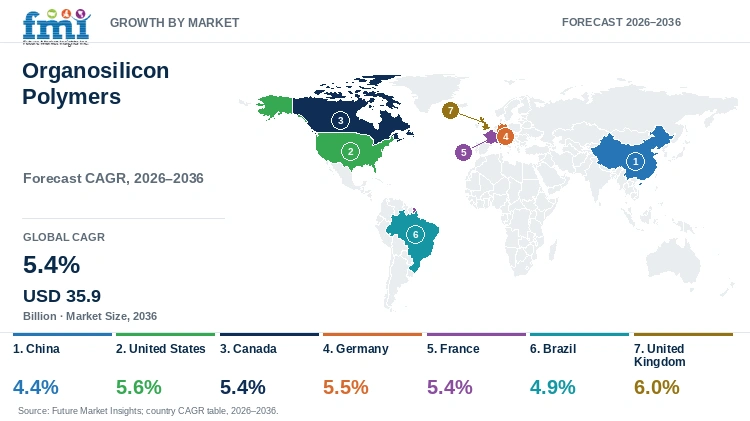
Table 3: Organosilicon Polymers Market Country Growth Forecast
| Country | CAGR, 2026 to 2036 |
|---|---|
| China | 4.4% |
| United States | 5.6% |
| Canada | 5.4% |
| Germany | 5.5% |
| France | 5.4% |
| Brazil | 4.9% |
| United Kingdom | 6.0% |
Source: Future Market Insights analysis of the organosilicon polymers market, 2026.
China
China is both a large silicone user and a place where suppliers are localising advanced grades. National Bureau of Statistics figures published on 19 October 2026 show third-quarter GDP growth of 4.5% year on year [24]. In the first three quarters, industrial robot output grew 29.1%, lithium-ion battery output 39.5% and high-tech manufacturing 14.3% [24]. These are growing users of thermal interface materials, encapsulants and cable compounds.
Bluestar is using the China International Import Expo in Shanghai, held from 5 to 10 November 2026, to launch an MLCC release coating and a locally developed medical-grade elastomer gel [12]. The company describes the MLCC coating as contributing to the localisation of key advanced materials [12]. It says it will focus on embodied intelligence, the low-altitude economy and intelligent computing [12].
Near-term pressure is visible in the supply chain. Dow said its third-quarter 2026 volume rose in every region except Asia Pacific [5]. The effects of the Middle East conflict were most pronounced in that region [5]. China has the slowest forecast rate of the seven profiled countries, at 4.4%. Growth will come from electronics and mobility grades, not from bulk fluids.
United States
The Census Bureau reported on 20 October 2026 that September housing starts were at a seasonally adjusted annual rate of 1,221,000. That was 5.2% below August and 7.4% below September 2025 [21]. Building permits were at 1,400,000, 3.0% below a year earlier [21]. Construction-linked silicone demand is therefore flat to soft. Electronics, healthcare and consumer products are the growth outlets Dow cites [5].
EPA's draft risk evaluation for D4, released in September 2025, preliminarily found unreasonable risk to workers from 23 conditions of use [20]. Among consumer uses, only certain paints and coatings showed that risk [20]. The draft identified no unreasonable risk to the general population [20]. The agency's page does not list a final evaluation [20]. The Silicones Environmental, Health, and Safety Center is a sector group of the American Chemistry Council [26]. It promotes stewardship for siloxanes and silanes across transportation, electronics, energy and construction [26].
Momentive is headquartered in Niskayuna, New York. It is an indirect wholly-owned subsidiary of KCC Corporation [15]. Dow's Performance Materials & Coatings segment reported third-quarter 2026 sales of USD 2.3 billion, up 8% [5]. Operating EBIT was USD 154 million, up from USD 80 million [5]. Bluestar's 21 October 2026 increase of about 5% to 25% applies to customers in the Americas [8]. US buyers therefore face price rounds from several suppliers at once.
Canada
Canadian buyers deal with the same global suppliers as their US counterparts, so supplier price rounds reach them directly. Bluestar's 21 October 2026 announcement covers customers in Europe and the Americas. Increases are about 5% to 25%, depending on product and market sector, effective immediately or when contract terms allow [8]. Wacker's February 2026 round of up to 25% applied to addition-curing rubbers, resins, silanes and release coatings [2]. Existing contracts were amended as needed [2].
The Silicones Environmental, Health, and Safety Center lists a 9 January 2024 press release welcoming Canada's use of a risk-based assessment of key silicone materials [26]. Canadian formulators can therefore follow the EPA's D4 review in the United States as the nearest regulatory signal [20].
Dow reported that downstream silicone volume rose in all regions in the third quarter of 2026 [5]. For Canadian converters in sealants, release liners and personal care, the practical step is to hold index-linked supply agreements with two named producers. Price rounds in 2026 have been frequent and sizeable.
Germany
Germany hosts the core of Wacker's silicone chain. Wacker's Karlovy Vary release describes Burghausen as the site that will make liquid silicone rubber [4]. Nünchritz is one of its silicone specialty sites, in a European network that also includes Plzeň [4]. Wacker reported group EBITDA of EUR 217.2 million for the third quarter of 2026, up 94.4% [1]. Silicones EBITDA was EUR 116 million, up 35% [1].
Destatis reported on 6 November 2026 that production rose 0.7% in September from August [22]. Automotive output jumped 17.1% after two weak months [22]. Construction fell 2.6%, and energy-intensive industries produced 1.9% less than in September 2025 [22]. On 20 October 2026 Destatis reported that producer prices were up 6.7% on the year, energy up 14.9% and basic chemicals up 11.3% [23].
Wacker confirmed its full-year 2026 EBITDA guidance of EUR 625 million to EUR 750 million [1]. It said the upper half is likely, and that the outlook remains highly uncertain because of Middle East developments [1]. Buyers in German automotive and construction supply chains should expect suppliers to keep passing on energy and platinum costs while volumes stay cautious.
France
France is the base of Bluestar Silicones. The company announces from Lyon and operates Saint-Fons and Roussillon [9][14]. It names Roussillon as one of its largest silicone manufacturing operations [14]. Bluestar acquired a majority of Elkem's silicones division, and the deal closed on 30 April 2026 [7]. Sites, processes, raw materials, product names and trademarks stayed unchanged under the new name [7].
On 23 July 2026 Saint-Fons became the first silicone production facility in Europe certified under ISCC PLUS [9]. The certification uses the mass balance allocation model. It covers silicone polymers, fluids, emulsions, heat-cured rubber and room-temperature vulcanising formulations [9]. The company said it is ready to consider certifying more plants in line with customer demand [9].
On 3 November 2026 Bluestar said it had added dedicated European capacity for medical-grade platinum-cured high consistency rubber for tubing [11]. The capacity came from upgrades and process changes to existing equipment [11]. The company did not name the plant or give a volume. The company's October 2026 price increase also covers Europe [8]. French buyers in healthcare and cosmetics gain a documented local source. Industrial buyers should expect the same price pressure as elsewhere.
Brazil
Brazil is a consumer-led silicone market. The Brazilian Chemical Industry Association reports net annual revenue of USD 167.8 billion for the chemical industry (base year 2025) [25]. It ranks Brazil sixth among the world's largest chemical industries on 2023 data [25]. The association also reports more than 150 member companies in 2026 [25].
Personal care is the visible silicone outlet. Bluestar exhibited at in-cosmetics Latin America in São Paulo on 23 and 24 September 2026 [13]. It showed PURESIL ORG elastomer gels in biobased carriers and prototype formulations for skin, hair, sun care and colour cosmetics [13]. Specialists from the Americas, Europe and Asia Pacific staffed its stand [13].
On 3 November 2026 the association said segments of the chemical industry had been brought into the first phase of Brazil's regulated carbon market, the Sistema Brasileiro de Comércio de Emissões [25]. For silicone buyers, this raises the value of suppliers that can document lower-carbon production. Bluestar's ISCC PLUS declarations from France are one example [9].
United Kingdom
The United Kingdom lost a siloxane plant. Dow announced on 7 July 2025 that it would shut its Barry siloxanes plant [6]. It gave the expected shutdown as mid-year 2026 [6]. The plan carried a cash outlay of about USD 180 million and an operating EBITDA uplift of about USD 90 million at full run rate [6]. In its 22 October 2026 results, Dow said upstream volumes declined after the shutdown [5]. The closure also contributed to higher operating EBIT in Performance Materials & Coatings [5].
The closure removes UK upstream siloxane supply. Buyers that took intermediates or fluids from Barry must qualify material from continental Europe or elsewhere. Wacker's Karlovy Vary site and its Burghausen, Nünchritz and Plzeň sites form a European silicone specialties network [4]. Bluestar has made medical-grade rubber capacity available in Europe [11].
Bluestar's October 2026 increase covers Europe [8]. Wacker's March 2026 round covered its global silicones range from 1 April 2026 [3]. The United Kingdom has the highest forecast rate of the seven profiled countries, at 6.0%. UK buyers should secure multi-supplier contracts before demand for downstream grades tightens.
Who are the notable companies in the Organosilicon Polymers Market?
Notable companies in the Organosilicon Polymers Market include Wacker Chemie AG, Dow, Momentive Performance Materials, Bluestar Silicones and Shin-Etsu Chemical.
Position in the siloxane chain decides how a supplier competes. Wacker makes silicones as part of a chemicals group, in which they accounted for about 49% of 2024 sales [2]. Bluestar describes itself as a leader in fully integrated silicone manufacturing [14]. Dow, by contrast, is closing its Barry siloxanes plant while its downstream silicone volume grows [5][6]. Integrated producers carry the cost of platinum, energy and silicon metal. That explains why Wacker and Bluestar announced several price rounds in 2026 [2][3][8].
Downstream breadth separates the formulators. Momentive, owned by KCC Corporation, sells adhesives and sealants, coatings, elastomers and additives to customers in more than 100 countries [15]. Its range includes silicone stabilisers for polyurethane foam used in mattresses, furniture, automotive seating and building insulation [16]. Shin-Etsu lists silicone fluids, resins, rubbers, silanes, coatings and electronics materials [19]. A buyer who needs one qualified grade for medical tubing will look at Bluestar's platinum-cured high consistency rubber [11]. A construction buyer will look at Momentive's silicone sealants and prepolymers [17].
Company financials show who can absorb cost swings. Wacker's group sales were EUR 1.5 billion in the third quarter of 2026, up 9.4% [1]. Nine-month EBITDA was EUR 601.4 million, up 74.2% from EUR 345.3 million [1]. Wacker expects capital expenditure of about EUR 300 million for 2026 and net financial debt of about EUR 200 million [1]. Dow's Performance Materials & Coatings segment earned operating EBIT of USD 154 million in the quarter, against USD 80 million a year earlier [5]. The Barry closure helped that result [5]. Momentive reports serving more than 4,000 customer companies [15]. That gives it a broad base across formulations, without concentration in one grade.
Sustainability credentials are now part of the offer. Bluestar's ISCC PLUS certification at Saint-Fons and its 33% recycled masterbatch [9][10] are examples. Shin-Etsu's carbon-neutral certified Green Silicones line is another [19]. Documentation of origin is becoming a selling point alongside price and performance.
Key Developments in the Organosilicon Polymers Market
- On 17 June 2026 Wacker officially opened its new specialty silicones production site in Karlovy Vary, Czech Republic. The first production line is running, and Wacker expects up to 200 jobs there by 2028 [4].
- On 30 April 2026 Bluestar closed its acquisition of a majority of Elkem's silicones division [7]. In June 2026 the business returned to the Bluestar Silicones name [7].
- On 23 July 2026 Bluestar announced that its Saint-Fons site in France had become the first silicone production facility in Europe certified under ISCC PLUS, using the mass balance model [9].
- On 21 October 2026 Bluestar announced silicone price increases of roughly 5% to 25% for customers in Europe and the Americas [8]. The increases take effect immediately or when contract terms allow [8].
Key Players in the Organosilicon Polymers Market
- Wacker Chemie AG
- Dow
- Momentive Performance Materials
- Bluestar Silicones
- Shin-Etsu Chemical Co., Ltd.
Organosilicon Polymers Market Report Scope
Table 4: Organosilicon Polymers Market Report Scope
| Coverage field | Report scope |
|---|---|
| Market definition | Organosilicon polymers (silicones), including siloxane fluids, resins, elastomers, emulsions and silane-based products, measured by value of sales to end-use applications |
| Application | Coatings, Foams, Adhesives & Sealants, Elastomers, Others |
| Regions and profiled countries | North America, Europe, Asia Pacific and Latin America (profiled countries: China, United States, Canada, Germany, France, Brazil, United Kingdom) |
| Companies covered | Wacker Chemie AG, Dow, Momentive Performance Materials, Bluestar Silicones, Shin-Etsu Chemical Co., Ltd. |
| Forecast period | 2026 to 2036, with 2025 as the historical base year |
| Quantitative Units | USD billion |
Source: Future Market Insights analysis of the organosilicon polymers market, 2026.
Organosilicon Polymers Market by Segments
Organosilicon Polymers Market segmented by Application:
- Coatings
- Foams
- Adhesives & Sealants
- Elastomers
- Others
Organosilicon Polymers Market by Region
- North America
- Europe
- Asia Pacific
- Latin America
- China
- United States
- Canada
- Germany
- France
- Brazil
- United Kingdom
Research Sources and Bibliography
- [1] Wacker Chemie AG. (2026, October 29). WACKER reports significant year-over-year increase in earnings in Q3. https://www.wacker.com/cms/en-us/press-and-media/press/press-releases/2026/press-releases-detail-2026-319680.html
- [2] Wacker Chemie AG. (2026, January 30). WACKER raises prices for selected silicone products. https://www.wacker.com/cms/en-us/press-and-media/press/press-releases/2026/press-releases-detail-2026-308353.html
- [3] Wacker Chemie AG. (2026, March 20). WACKER to raise prices for silicone-based products. https://www.wacker.com/cms/en-us/press-and-media/press/press-releases/2026/press-releases-detail-2026-310722.html
- [4] Wacker Chemie AG. (2026, June 17). WACKER opens new production site for specialty silicones. https://www.wacker.com/cms/en-us/press-and-media/press/press-releases/2026/press-releases-detail-2026-314180.html
- [5] Dow Inc. (2026, October 22). Dow reports third quarter 2026 results. https://investors.dow.com/en/news/news-details/2026/Dow-reports-third-quarter-2026-results/default.aspx
- [6] Dow Inc. (2025, July 7). Dow will shut down three upstream European assets in response to structural challenges in the region. https://corporate.dow.com/en-us/news/press-releases/dow-will-shut-down-three-upstream-european-assets-in-response-to.html
- [7] Bluestar Silicones. (2026, June 23). Elkem Silicones becomes Bluestar Silicones. https://www.elkem.com/about-elkem/corporate-structure/elkem-silicones/about-elkem-silicones/silicones-news/elkem-silicones-becomes-bluestar-silicones/
- [8] Bluestar Silicones. (2026, October 21). Bluestar Silicones announces silicone price increases in Europe and the Americas. https://www.elkem.com/about-elkem/corporate-structure/elkem-silicones/about-elkem-silicones/silicones-news/price-increases---october-2026/
- [9] Bluestar Silicones. (2026, July 23). Bluestar Silicones main site in France becomes the first ISCC PLUS certified silicone plant in Europe. https://www.elkem.com/about-elkem/corporate-structure/elkem-silicones/about-elkem-silicones/silicones-news/bluestar-silicones-main-site-in-france-becomes-the-first-iscc-plus-certified-silicone-plant-in-europe/
- [10] Bluestar Silicones. (2026, October 6). First mechanically recycled silicone masterbatch (BLUESIL MR 460 U 33P). https://www.elkem.com/about-elkem/corporate-structure/elkem-silicones/about-elkem-silicones/silicones-news/first-recycled-silicone-masterbatch-bluestar-silicones/
- [11] Bluestar Silicones. (2026, November 3). Bluestar Silicones expands European manufacturing footprint for medical grade silicone rubber serving pharmaceutical tubing applications. https://www.elkem.com/about-elkem/corporate-structure/elkem-silicones/about-elkem-silicones/silicones-news/medical-grade-hcr-in-santa-perpetua/
- [12] Bluestar Silicones. (2026, October 26). Powering the Intelligent Future with Silicones: Bluestar Silicones to showcase full-stack solutions at the China International Import Expo. https://www.elkem.com/about-elkem/corporate-structure/elkem-silicones/about-elkem-silicones/silicones-news/CIIE-2026/
- [13] Bluestar Silicones. (2026, March 13). Bluestar at in-cosmetics Latin America 2026. https://www.elkem.com/about-elkem/corporate-structure/elkem-silicones/about-elkem-silicones/silicones-news/incosmetics-latam-2026/
- [14] Elkem. (n.d.). Elkem Silicones, now Bluestar Silicones. https://www.elkem.com/silicones/
- [15] Momentive Performance Materials. (n.d.). Company overview. https://www.momentive.com/en-us/company/company-overview
- [16] Momentive Performance Materials. (n.d.). Polyurethane additives. https://www.momentive.com/en-us/product-categories/additives/polyurethane-additives
- [17] Momentive Performance Materials. (n.d.). Adhesives and sealants for building and construction. https://www.momentive.com/en-us/industry/building-construction-materials/adhesives-sealants-for-building-construction
- [18] Momentive Performance Materials. (n.d.). Architectural coatings. https://www.momentive.com/en-us/industry/paints-coatings/architectural-coatings
- [19] Shin-Etsu Chemical Co., Ltd. (n.d.). Shin-Etsu Silicones. https://www.shinetsusilicone-global.com/
- [20] U.S. Environmental Protection Agency. (n.d.). Risk evaluation for octamethylcyclotetrasiloxane (D4). https://www.epa.gov/assessing-and-managing-chemicals-under-tsca/risk-evaluation-octamethylcyclotetrasiloxane-d4
- [21] U.S. Census Bureau and U.S. Department of Housing and Urban Development. (2026, October 20). Monthly New Residential Construction, September 2026 (CB26-162). https://www.census.gov/construction/nrc/pdf/newresconst.pdf
- [22] Statistisches Bundesamt (Destatis). (2026, November 6). Production in September 2026: +0.7% on the previous month (Press release No. 389). https://www.destatis.de/EN/Press/2026/11/PE26_389_421.html
- [23] Statistisches Bundesamt (Destatis). (2026, October 20). Producer prices in September 2026: +6.7% on September 2025 (Press release No. 373). https://www.destatis.de/EN/Press/2026/10/PE26_373_61241.html
- [24] Government of China, citing National Bureau of Statistics. (2026, October 19). China's GDP expands 4.5 pct year on year in Q3. https://english.www.gov.cn/archive/statistics/202610/19/content_WS6ad5a59bc6d00ca5f9a0dc86.html
- [25] Associação Brasileira da Indústria Química (ABIQUIM). (2026, November 3). Home page and sector indicators. https://www.abiquim.org.br/
- [26] American Chemistry Council. (n.d.). Silicones Environmental, Health, and Safety Center (SEHSC). https://www.americanchemistry.com/industry-groups/silicones-environmental-health-and-safety-center-sehsc
Table of Content
Table of Content
- Key Takeaways
- Market Size and CAGR
- Top Growth Driver
- Fastest Growing Segment
- Leading Region
- Key Companies
- Emerging Opportunities
- Executive Summary
- Global Market Outlook
- Demand-side Trends
- Supply-side Trends
- Technology Roadmap Analysis
- Analysis and Recommendations
- Analyst Perspective (What is happening? Why now? What should investors know?)
- Key Questions Answered
- How large is the market?
- What is the CAGR?
- What are key trends?
- Which region dominates?
- Who are the leaders?
Read More...
- Market Overview
- Market Coverage / Taxonomy
- Market Definition / Scope / Limitations
- Research Methodology
- Chapter Orientation
- Analytical Lens and Working Hypotheses
- Market Structure, Signals, and Trend Drivers
- Benchmarking and Cross-market Comparability
- Market Sizing, Forecasting, and Opportunity Mapping
- Research Design and Evidence Framework
- Desk Research Programme (Secondary Evidence)
- Expert Input and Fieldwork (Primary Evidence)
- Tooling, Models, and Reference Databases
- Data Engineering and Model Build
- Quality Assurance and Audit Trail
- Market Background
- Market Dynamics (Drivers, Restraints, Opportunity, Trends)
- Scenario Forecast (Optimistic, Likely, Conservative)
- Impact Analysis
- AI Impact
- Sustainability Impact
- Regulatory Impact
- Technology Impact
- Consumer / Buyer Analysis
- Purchase Drivers
- Adoption Barriers
- Buyer Journey
- Opportunity Map Analysis
- Product Life Cycle Analysis
- Supply Chain Analysis
- Investment Feasibility Matrix
- Value Chain Analysis
- PESTLE and Porter's Analysis
- Regulatory Landscape
- Regional Parent Market Outlook
- Production and Consumption Statistics
- Import and Export Statistics
- Global Market Analysis and Forecast, 2021 to 2036
- Historical Market Size Value (USD Billion) Analysis, 2021 to 2025
- Current and Future Market Size Value (USD Billion) Projections, 2026 to 2036
- Y-o-Y Growth Trend Analysis
- Absolute $ Opportunity Analysis
- Global Market Pricing Analysis, 2021 to 2036
- Global Market Analysis and Forecast, By Application, 2021 to 2036
- Introduction / Key Findings
- Historical Market Size Value (USD Billion) Analysis By Application, 2021 to 2025
- Current and Future Market Size Value (USD Billion) Analysis and Forecast By Application, 2026 to 2036
- Coatings
- Foams
- Adhesives & Sealants
- Elastomers
- Others
- Y-o-Y Growth Trend Analysis By Application, 2021 to 2025
- Absolute $ Opportunity Analysis By Application, 2026 to 2036
- Global Market Analysis and Forecast, By Region, 2021 to 2036
- Introduction
- Historical Market Size Value (USD Billion) Analysis By Region, 2021 to 2025
- Current Market Size Value (USD Billion) Analysis and Forecast By Region, 2026 to 2036
- North America
- Europe
- Asia Pacific
- Latin America
- Market Attractiveness Analysis By Region
- North America Market Analysis and Forecast, By Country, 2021 to 2036
- Historical Market Size Value (USD Billion) Trend Analysis By Market Taxonomy, 2021 to 2025
- Market Size Value (USD Billion) Forecast By Market Taxonomy, 2026 to 2036
- By Country
- By Application
- Market Attractiveness Analysis
- By Country
- By Application
- Key Takeaways
- Europe Market Analysis and Forecast, By Country
- Historical Market Size Value (USD Billion) Trend Analysis By Market Taxonomy, 2021 to 2025
- Market Size Value (USD Billion) Forecast By Market Taxonomy, 2026 to 2036
- By Country
- By Application
- Market Attractiveness Analysis
- By Country
- By Application
- Key Takeaways
- Asia Pacific Market Analysis and Forecast, By Country
- Historical Market Size Value (USD Billion) Trend Analysis By Market Taxonomy, 2021 to 2025
- Market Size Value (USD Billion) Forecast By Market Taxonomy, 2026 to 2036
- By Country
- By Application
- Market Attractiveness Analysis
- By Country
- By Application
- Key Takeaways
- Latin America Market Analysis and Forecast, By Country
- Historical Market Size Value (USD Billion) Trend Analysis By Market Taxonomy, 2021 to 2025
- Market Size Value (USD Billion) Forecast By Market Taxonomy, 2026 to 2036
- By Country
- China
- United States
- Canada
- Germany
- France
- Brazil
- United Kingdom
- By Application
- By Country
- Market Attractiveness Analysis
- By Country
- By Application
- Key Takeaways
- Key Countries Market Analysis
- United States
- Pricing Analysis
- Market Share Analysis, 2025
- By Application
- Canada
- Pricing Analysis
- Market Share Analysis, 2025
- By Application
- Brazil
- Pricing Analysis
- Market Share Analysis, 2025
- By Application
- Germany
- Pricing Analysis
- Market Share Analysis, 2025
- By Application
- United Kingdom
- Pricing Analysis
- Market Share Analysis, 2025
- By Application
- France
- Pricing Analysis
- Market Share Analysis, 2025
- By Application
- China
- Pricing Analysis
- Market Share Analysis, 2025
- By Application
- United States
- Market Structure Analysis
- Competition Dashboard
- Competition Benchmarking
- Market Share Analysis of Top Players
- By Regional
- By Application
- Emerging Startups
- Innovation Benchmarking
- Competition Analysis
- Competition Deep Dive
- Wacker Chemie AG
- Overview
- Product Portfolio
- Profitability by Market Segments
- Sales Footprint
- Strategy Overview
- Marketing Strategy
- Product Strategy
- Channel Strategy
- Dow
- Momentive Performance Materials
- Bluestar Silicones
- Shin-Etsu Chemical Co., Ltd.
- Wacker Chemie AG
- Case Studies
- Success Stories
- Recent Developments
- Competition Deep Dive
- Assumptions & Acronyms Used
List of Tables
- Table 1: Global Market Value (USD Billion) Forecast by Region, 2021 to 2036
- Table 2: Global Market Value (USD Billion) Forecast by Application, 2021 to 2036
- Table 3: North America Market Value (USD Billion) Forecast by Country, 2021 to 2036
- Table 4: North America Market Value (USD Billion) Forecast by Application, 2021 to 2036
- Table 5: Europe Market Value (USD Billion) Forecast by Country, 2021 to 2036
- Table 6: Europe Market Value (USD Billion) Forecast by Application, 2021 to 2036
- Table 7: Asia Pacific Market Value (USD Billion) Forecast by Country, 2021 to 2036
- Table 8: Asia Pacific Market Value (USD Billion) Forecast by Application, 2021 to 2036
- Table 9: Latin America Market Value (USD Billion) Forecast by Country, 2021 to 2036
- Table 10: Latin America Market Value (USD Billion) Forecast by Application, 2021 to 2036
List of Figures
- Figure 1: Global Market Pricing Analysis
- Figure 2: Global Market Value (USD Billion) Forecast 2021-2036
- Figure 3: Global Market Value Share and BPS Analysis by Application, 2026 and 2036
- Figure 4: Global Market Y-o-Y Growth Comparison by Application, 2026-2036
- Figure 5: Global Market Attractiveness Analysis by Application
- Figure 6: Global Market Value (USD Billion) Share and BPS Analysis by Region, 2026 and 2036
- Figure 7: Global Market Y-o-Y Growth Comparison by Region, 2026-2036
- Figure 8: Global Market Attractiveness Analysis by Region
- Figure 9: North America Market Incremental Dollar Opportunity, 2026-2036
- Figure 10: Europe Market Incremental Dollar Opportunity, 2026-2036
- Figure 11: Asia Pacific Market Incremental Dollar Opportunity, 2026-2036
- Figure 12: Latin America Market Incremental Dollar Opportunity, 2026-2036
- Figure 13: North America Market Value Share and BPS Analysis by Country, 2026 and 2036
- Figure 14: North America Market Value Share and BPS Analysis by Application, 2026 and 2036
- Figure 15: North America Market Y-o-Y Growth Comparison by Application, 2026-2036
- Figure 16: North America Market Attractiveness Analysis by Application
- Figure 17: Europe Market Value Share and BPS Analysis by Country, 2026 and 2036
- Figure 18: Europe Market Value Share and BPS Analysis by Application, 2026 and 2036
- Figure 19: Europe Market Y-o-Y Growth Comparison by Application, 2026-2036
- Figure 20: Europe Market Attractiveness Analysis by Application
- Figure 21: Asia Pacific Market Value Share and BPS Analysis by Country, 2026 and 2036
- Figure 22: Asia Pacific Market Value Share and BPS Analysis by Application, 2026 and 2036
- Figure 23: Asia Pacific Market Y-o-Y Growth Comparison by Application, 2026-2036
- Figure 24: Asia Pacific Market Attractiveness Analysis by Application
- Figure 25: Latin America Market Value Share and BPS Analysis by Country, 2026 and 2036
- Figure 26: Latin America Market Value Share and BPS Analysis by Application, 2026 and 2036
- Figure 27: Latin America Market Y-o-Y Growth Comparison by Application, 2026-2036
- Figure 28: Latin America Market Attractiveness Analysis by Application
- Figure 29: Global Market - Tier Structure Analysis
- Figure 30: Global Market - Company Share Analysis
Frequently Asked Questions
How big is the organosilicon polymers market in 2026?
The Organosilicon Polymers Market is estimated at USD 21.2 billion in 2026, up from USD 20.1 billion in 2025. It is projected to reach USD 35.9 billion by 2036, a 5.4% CAGR from 2026 to 2036. On 29 October 2026 Wacker reported third-quarter silicones sales of EUR 729 million, up 8%, on higher selling prices and an improved product mix [1].
Which application leads the organosilicon polymers market?
Coatings leads with 38.0% of the market in 2026. Wacker names silicone-based release coatings among the products in its February 2026 price round, and Momentive sells silicone additives and masonry water repellents for architectural coatings [2][18].
Which other applications matter?
Foams hold 22.0%, Adhesives & Sealants 16.0%, Elastomers 13.0% and Others 11.0%. Momentive describes silicone stabilisers for flexible, molded and rigid polyurethane foam, and silicone sealants and prepolymers for building envelopes [16][17].
Which profiled country is forecast to grow fastest?
The United Kingdom has the highest forecast CAGR of the seven profiled countries at 6.0% from 2026 to 2036, ahead of the United States at 5.6% and Germany at 5.5%. Dow's Barry siloxanes plant in the United Kingdom has shut down, and Dow said the closure contributed to higher operating EBIT in its Performance Materials & Coatings segment [5][6].
What regulation and cost items are affecting supply?
EPA issued a draft risk evaluation for D4 in September 2025 and lists no final evaluation. It preliminarily found no unreasonable risk to the general population from any condition of use [20]. On cost, Wacker raised some silicone prices by up to 25% from 1 February 2026, citing platinum [2]. Bluestar announced increases of about 5% to 25% on 21 October 2026 [8].
What should a buyer check when qualifying a silicone supplier?
Check the cure system and grade first, then the production site and its certification. Bluestar's Saint-Fons site holds ISCC PLUS certification under a mass balance model, with formulation unchanged [9]. Also check how the supplier passes through platinum and energy costs, because Wacker and Bluestar both announced increases in 2026 [2][8]. Confirm the supply site too, since Dow has closed its Barry plant [5].
Preview the report firsthand - request a free sample
Get SampleGet the brochure for pricing and purchase details.
Get PDF
