
- Market Size (2026)
- USD 2.2 Bn
- Forecast (2036)
- USD 3.6 Bn
- CAGR (2026 to 2036)
- 5.0%
How big is the Overprint Varnishes Market in 2026?
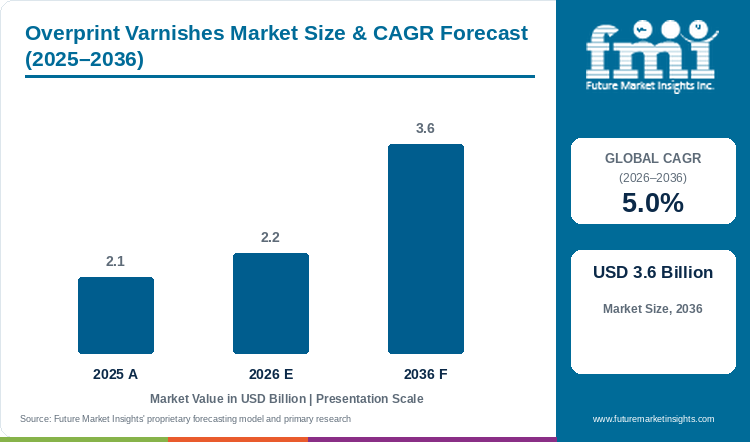
The Overprint Varnishes Market is forecast to reach USD 3.6 billion by 2036 at a 5.0% CAGR from 2026 to 2036. Revenue is projected at USD 2.2 billion in 2026. The market was valued at USD 2.1 billion in 2025. Demand is concentrated in printed packaging where protective gloss, slip resistance and scuff performance have to survive converting, filling and distribution. In the United States, the American Forest & Paper Association reported that 2025 packaging-paper production grew 1.7% while boxboard output remained broadly stable at 12.4 million tons [1].
Coatings now face a recovery test on redesigned packs. Regulation (EU) 2025/40 began applying on 12 August 2026. Its general recyclability obligation now operates alongside detailed design-for-recycling requirements scheduled for 2030 or later when the delegated-act timetable requires it [2][19]. A varnish can be chosen for appearance and still fail a converter’s substrate, migration or recovery check. Germany’s printing-ink and varnish provisions begin on 1 January 2027 [3], and suppliers are preparing for that date. Sun Chemical said in January 2026 that it already supplied compatible inks, coatings and overprint varnishes for it [4]. Repeat orders depend on a finish passing press trials and later pack testing.
Key Market Trends & Insights
- Finish performance is becoming a purchasing specification, not a decorative extra. UV-curable systems offer fast surface curing and strong finish properties, but press settings and the printed substrate govern the usable result. INX describes separate UV flexo and solvent gravure functional coatings for board and shrink labels [11].
- Food-packaging applications create separate technical obligations. hubergroup launched HYDRO-X CONTACT in July 2025 with water-based inks and overprint varnishes for specified direct-food-contact uses. The supplier ties the offer to defined press processes and packaging constructions, not a universal permission to print every food-contact surface [5].
- Supplier consolidation is changing service coverage in Asia. Siegwerk completed the acquisition of Hi-Tech Inks in June 2026, adding Indian production facilities and varnish products to its packaging-ink offering [16]. Local blending and technical support can shorten qualification cycles for converters buying repeat finishes.
Regional Highlights
- North America combines recurring paperboard production with packaging recovery accountability. U.S. boxboard output reached 12.4 million tons in 2025 [1]. Ontario completed its Blue Box transition to producer responsibility on 1 January 2026, making the full printed package relevant to a producer’s collection obligations [6].
- Western Europe is the clearest near-term regulatory testing market. EU packaging rules began applying in August 2026 [19], Germany’s specified food-contact printing requirements start in January 2027 [3], and UK fee modulation adds an immediate cost reason to assess packaging recyclability [8].
- Mexico has a different timing. Its revised NOM-051 nutritional labelling timetable retains the second phase to December 2027 and moves the third phase to January 2028 [7]. That adjustment changes the timing of new label specifications while regular replacement of printed consumer packaging continues.
Overprint Varnishes Market Size and Forecast
Table 1: Overprint Varnishes Market Size and Forecast
| Market size and forecast | Value |
|---|---|
| Market size in 2025 | USD 2.1 billion |
| Estimated market size in 2026 | USD 2.2 billion |
| Projected market size by 2036 | USD 3.6 billion |
| CAGR from 2026 to 2036 | 5.0% |
Source: Future Market Insights analysis of the overprint varnishes market, 2026.
The market covers finished varnishes sold for printed-packaging and commercial-print protection or surface effects. It does not equate every ink, resin or barrier coating sale with varnish demand. That distinction is important when interpreting developments among diversified suppliers. For instance, the packaging coating market includes coating applications that are outside a post-print varnish specification. By contrast, the value assessed here follows varnishes sold for printing finishes on paper, board and supported films. Changes in mix affect procurement more directly than production headlines for the wider chemical industry.
Analyst Perspective
“Converters pay for an overprint varnish that runs consistently on their press and survives the next finishing step. The suppliers best placed to win repeat programmes can document substrate compatibility, migration limits and recovery performance for the specific package. Poor curing and an unapproved pack construction remain the main risks to adoption through 2036.”
- Nikhil Kaitwade, Principal Consultant, FMI
How is the Overprint Varnishes Market segmented?
- By technology: UV-curable varnish, water-based varnish, solvent-based varnish and other varnish systems. Digital and conventional refer to print-process applications and are considered separately when matching product chemistry to a press.
- By end use: Food and Beverage, Pharmaceuticals and Healthcare, Cosmetics and Personal Care, Household and Industrial Goods, and Other End Uses.
- By region: North America, Latin America, Europe, East Asia, South Asia, Oceania, the Middle East and Africa. The country assessment profiles the United States, Canada, Mexico, Germany, the United Kingdom, France and Italy.
Why does UV-curable Varnish lead by Technology in the Overprint Varnishes Market in 2026?
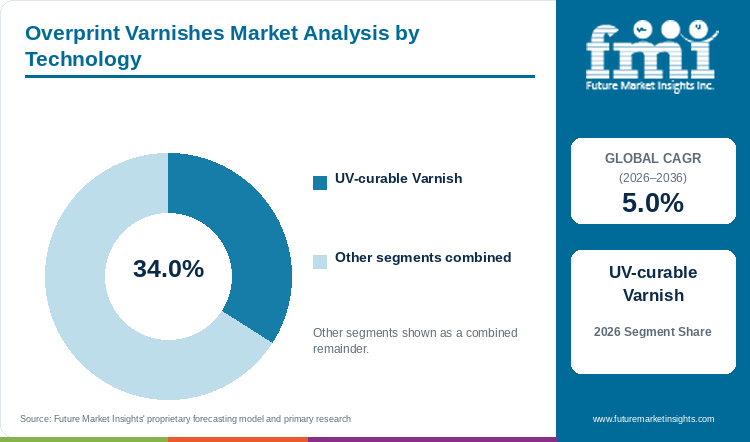
UV-curable varnish is the largest technology category with a 34.0% share of the technology mix. A UV finish suits printed surfaces that must be handled or converted soon after coating, because the material cures under controlled irradiation. A printer can reach a defined gloss or protective finish without waiting for the longer evaporation stage of certain conventional drying systems. Lamp output, press speed and coating weight still need qualification for each job, since an under-cured surface can look acceptable on press yet block when stacked. The commercial use also varies by substrate. INXShield UVF is described for paper and paperboard, designed for use over supported dry water-based or UV-cured inks [11], which is a different application from the company’s GS Slip gravure product for shrink labels. Spot finishes on folding cartons add another requirement, because embossed, foil-stamped and laminated areas may run as a separate operation. A broad UV description cannot replace a production trial on the proposed pack. UV demand also intersects with the wider flexographic printing inks market, where converters qualify ink and final coating together. Buyers should ask for adhesion, curing and subsequent-process compatibility under the intended production conditions, because those checks shape total conversion cost and the reliability of repeat orders.
Table 2: Technology, 2026 Share
| Leading Share | 2026 market share |
|---|---|
| UV-curable Varnish | 34.0% |
| All Other Segments Combined Share | 66.0% |
Source: Future Market Insights analysis of the overprint varnishes market, 2026.
Why does Food and Beverage lead by End Use in the Overprint Varnishes Market in 2026?
Food and beverage applications represent 38.0% of overprint-varnish demand by end use, the largest share. Food packs create steady demand for finishes because graphics are handled repeatedly after printing. Cartons move through cutting, gluing and filling before distribution, and flexible labels may shrink during application yet still need legible branding at retail. A successful varnish has to hold its appearance without interfering with the next process, so brands qualify the coating alongside the ink, printing method and base material. The flexible plastic packaging market gives wider context for these film-packaging applications, but the varnish is only one component of the pack. Food-contact requirements narrow the choice further. In July 2025, hubergroup introduced water-based overprint varnishes within its HYDRO-X CONTACT system for specified direct-contact applications [5]. Germany’s ordinance sets chemical substance requirements for defined printed food-contact articles from January 2027 [3], and the EU Packaging and Packaging Waste Regulation places recovery assessment alongside print performance [2]. Approval for one varnish in a stated construction does not cover every ink beneath it or the same product on an untested film, so buyers should keep migration and application documentation for the actual package.
Table 4: End Use, 2026 Share
| Leading Share | 2026 market share |
|---|---|
| Food and Beverage | 38.0% |
| All Other Segments Combined Share | 62.0% |
Source: Future Market Insights analysis of the overprint varnishes market, 2026.
Why does Pharmaceuticals and Healthcare rank second by End Use in the Overprint Varnishes Market in 2026?
Pharmaceuticals and healthcare represent 22.0% of the end-use allocation and hold the second-largest position. Healthcare cartons and labels are bought for legibility and process reliability more than for decorative effect alone. Print on a folding carton must stay readable after packing, storage and repeated handling, so coating approval extends to scuff resistance, the opacity of the underlying graphics and compatibility with any later coding or finishing step. A premium gloss that interferes with overprinting or variable information can fail even when it passes the first visual check. The commercial role of varnish is limited to the finished printed surface. It should not be confused with an active drug coating, a sterile barrier or a medical-device functional coating, so procurement teams keep these categories apart to avoid approving a product for an unintended use. Superior Printing Ink notes wax-free overprint varnishes for lamination and foil stamping and recommends adhesion and curing tests for unusual substrates [12], which matters where several finishing steps run on one healthcare package. For the USA folding carton market, healthcare and other regulated categories are notable users of decorated paperboard. Suppliers that provide repeatable coat weights and instructions for later coding or inspection help these converters, and a varnish that preserves approved artwork through transport avoids extra approval work when a carton order is repeated.
Table 5: Pharmaceuticals and Healthcare Share
| Leading Share | 2026 market share |
|---|---|
| Pharmaceuticals and Healthcare | 22.0% |
| All Other Segments Combined Share | 78.0% |
Source: Future Market Insights analysis of the overprint varnishes market, 2026.
What are the key drivers, restraints and opportunities?
Driver
Printed-packaging replacement demand. The volume of repeated print and converting jobs gives varnish makers an established customer base. AF&PA recorded 12.4 million tons of U.S. boxboard production in 2025 alongside a 1.7% increase in packaging-paper output [1]. These are production indicators for the wider substrate industry, not varnish consumption. They nevertheless show why converters need finishing materials that perform over long runs and recurrent orders. The willingness to use a premium varnish increases when it reduces scuffs, blocking or rework on a demanding print job.
Recovery assessment and food-pack qualification. EU Regulation 2025/40 began applying in August 2026 while its detailed recyclability obligations follow their own later timetables [2]. In the United Kingdom, red-rated packaging attracts a 1.2 fee-modulation factor during 2026 to 2027 [8]. Germany adds a separate food-contact printing-ink requirement from January 2027 [3]. These rules affect different aspects of the finished package. They create demand for verifiable coating properties, but no instrument establishes a blanket preference for all UV or all water-based varnishes.
Restraint
Qualification cost and production risk. Gloss, matte appearance or slip can change with press conditions, coating thickness and substrate. A converter may need to repeat trials before using a replacement varnish on a production run. Poor curing can lead to blocking after sheets are stacked. Inadequate adhesion may become apparent only when a coated film is shrunk or laminated. Suppliers face resistance when a new product requires costly machine changes without a dependable reduction in waste or production time.
Limits of product-level compliance statements. A food-pack coating description does not by itself establish that the final article meets the relevant requirements. The buyer must account for inks, set-off, contact surfaces and actual exposure conditions. France’s mineral-oil restrictions are tied to specified substances and thresholds in printing inks, not a general ban on all varnishes [9]. Companies also need to distinguish technical recyclability from compliance with the legislation in their markets. Claims beyond the tested pack can delay approval and invite disputes with brand owners.
Opportunity
Specific varnishes for difficult film and carton jobs. INX markets different formulations for UV-flexo board coatings and solvent gravure slip coatings for shrinkable OPS, PETG and PVC labels [11]. Superior Printing Ink offers wax-free options intended for later lamination and stamping [12]. These are examples of product differentiation through a demonstrated finishing requirement, not a generic premium finish. Suppliers that help printers hold adhesion and scratch resistance on a narrow set of demanding applications can defend repeat orders and improve customer retention.
Local technical service and customer access. Siegwerk’s completed June 2026 purchase of Hi-Tech Inks added production operations in Bhiwadi and Vapi plus finished-varnish capability [16]. INX completed the acquisition of Servicom New Zealand in May 2025, bringing an established distributor into its own network [17]. Both developments show how reach and application support can influence purchasing when a coating must be qualified locally. The opportunity is to solve press-level problems quickly and maintain consistent supply after initial approval.
Overprint Varnishes Market by Country (2026 to 2036)
Table 6: Overprint Varnishes Market Country Growth Forecast
| Country | CAGR, 2026 to 2036 |
|---|---|
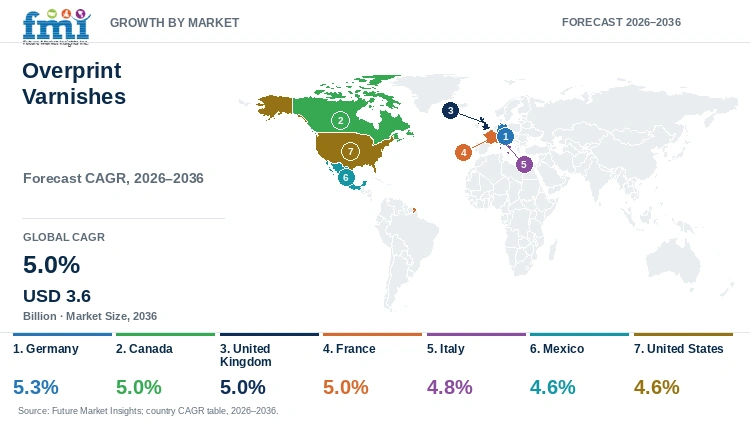
| Germany | 5.3% |
| Canada | 5.0% |
| United Kingdom | 5.0% |
| France | 5.0% |
| Italy | 4.8% |
| Mexico | 4.6% |
| United States | 4.6% |
Source: Future Market Insights analysis of the overprint varnishes market, 2026.
United States
The U.S. market is forecast to grow at 4.6% from 2026 to 2036. Established carton and commercial-print production supports recurring varnish purchases, although a converter’s order book can shift between products and substrates. AF&PA recorded total U.S. paper and paperboard production at 66.3 million tons in 2025, a decrease of 3.7% [1]. Packaging paper provided one brighter component with a 1.7% increase, while boxboard production was broadly stable at 12.4 million tons. Packaging output therefore needs to be read by grade, not treated as a uniformly rising market.
A U.S. converter choosing an overprint varnish often starts with line reliability and finishing sequence. Folding cartons may need scuff resistance after folding and gluing. Shrink labels demand film adhesion and heat performance. INX’s product descriptions show why a film-label gravure varnish and a board coating are different purchases [11]. Superior Printing Ink also identifies post-print lamination and foil stamping as uses for wax-free varnishes [12]. The qualification problem changes with the print job even when both are sold under the same product heading.
Canada
Canada is projected to expand at 5.0% over the forecast decade. Ontario’s producer-run Blue Box programme reached full implementation on 1 January 2026 after the end of the legacy arrangement in December 2025 [6]. Producers are responsible for the collection-system costs and operation for covered packaging and paper categories. This changes the discussion between pack owners and converters, because the surface finish must be considered as part of the finished packaging construction, not treated only as a print effect.
The requirement does not mean that every coated box becomes unacceptable. It means a customer has a stronger reason to retain practical evidence on the pack it places into the recovery system. Aqueous varnishes on paperboard, UV finishes on cartons and coated film labels can behave differently during sorting and reprocessing. A varnish supplier should supply the information a converter needs for the actual material combination. Switching chemistry without checking the new construction may introduce a new print problem while leaving the recovery question unanswered.
Mexico
Mexico has a forecast CAGR of 4.6% from 2026 to 2036. Label redesign in packaged food is influenced by NOM-051-SCFI/SSA1-2010, but the timetable needs careful interpretation. The official amendment dated 31 July 2025 retained the second phase of the supplementary nutritional information criteria until 31 December 2027. Its third phase starts on 1 January 2028 [7]. That schedule should not be described as a 2026 implementation of the final phase.
For varnish suppliers, the difference is commercial timing. Brands and printers still need packaging with legible nutrition statements and a finish that withstands filling and retail handling. However, the next scheduled change in nutritional-profile criteria does not force every pack to be reformulated immediately. Printers can plan new artwork and qualify coating systems around customer changeovers while existing packaging continues under the rules applicable to it.
Germany
Germany is forecast to grow at 5.3% through 2036, the strongest rate among the profiled countries. The immediate qualification issue is its food-contact printing-ink framework. The Bedarfsgegenständeverordnung includes varnishes in the relevant printing-ink definitions, while specified provisions begin applying on 1 January 2027 [3]. Its transition arrangements also address qualifying printed articles already placed on the market under provisions applicable through the end of 2026. A coating seller therefore needs to discuss the article and the substance limits precisely, instead of claiming that every product requires the same approval route.
Sun Chemical announced in January 2026 that it had a German Ink Ordinance-compliant portfolio including overprint varnishes [4]. This shows that suppliers can prepare products and documentation ahead of enforcement. For German food-packaging printers, the purchasing decision is particularly sensitive to continuity: an approved coating has to work with the ink and substrate already selected and meet the customer’s intended use. A last-minute switch could affect production performance as well as qualification.
United Kingdom
The United Kingdom is forecast to expand at 5.0% during 2026 to 2036. PackUK’s extended producer responsibility framework is bringing recyclability into packaging cost discussions. Its fee-modulation statement, updated on 17 February 2026, sets a 1.2 factor for red-rated packaging during the 2026 to 2027 assessment year. The corresponding factors increase in later years under that published framework [8]. The factor acts on the relevant household packaging waste disposal-fee component. It should not be presented as a surcharge imposed directly on every varnish.
Packaging specifiers may now request evidence about how a printed board or film structure performs against the applicable assessment method. A customer could choose a varnish for appearance and then discover that the combination with its substrate is problematic. Coating manufacturers are therefore asked to support practical material evaluation early in the design process. This gives a service advantage to suppliers with well-defined formulations and documented packaging applications.
France
France is projected to record a 5.0% CAGR through 2036. Its mineral-oil restrictions already affect some printing-ink choices for packaging and materials printed for public distribution. The order of 13 April 2022 established substance definitions and transition rules. Tighter thresholds have applied since 1 January 2025 to specified mineral-oil aromatic hydrocarbons and saturated hydrocarbons in printing inks [9]. The law refers to particular substance concentrations. It does not assert that every petroleum-derived varnish is banned from all printed applications.
For suppliers, this encourages precise declarations about formulation and approved use. A converter may need to check the ink layer underneath the varnish as well as the finish itself. France also falls under EU Regulation 2025/40, which began applying on 12 August 2026 [2]. A printed pack can therefore raise two separate questions: the chemical suitability of the printing system and the recovery performance of the assembled packaging. The documentation needed for one does not replace the other.
Italy
Italy is projected to grow at 4.8% from 2026 to 2036. The country has a substantial fibre-based packaging recovery system, which influences printed-packaging design. CONAI announced in July 2026 that 92.6% of paper and cardboard packaging was recycled in 2025, equal to 4.6 million tonnes [10]. That percentage describes packaging material recovery, not the share of overprint varnishes or coatings that passed a recycling test. Coating selection still depends on the construction being processed by the converter.
Italy’s packaging printers serve food, beverage, cosmetics and other consumer goods with different finishing requirements. A protective varnish on a paper carton is purchased for a different application from the slip finish on a label. Durable graphics can be important where a pack moves through automated filling, transport and display. Suppliers therefore need to qualify the coating against paper and film substrates separately, instead of selling a single generic environmental claim.
Who are the notable companies in the Overprint Varnishes Market?
Notable suppliers of finished overprint varnishes include W-R Industries, Superior Printing Ink, INX International Ink Co., Print Area Technology, Anwin Technology, ACTEGA, Siegwerk, Sun Chemical and hubergroup Print Solutions. These companies differ in service reach and varnish formulation portfolios. Their participation is established through documented finished-product offerings, not general presence in the resins, printing equipment or decorative-paint industries [5][11][12][13][14][15][18].
Corporate activity is relevant only when it changes access to actual varnish products. Siegwerk completed the purchase of Hi-Tech Inks in June 2026, expanding Indian production and adding varnish lines [16]. INX completed the Servicom New Zealand acquisition in May 2025 and described the distributor’s aqueous and UV coating offer [17]. These developments broaden local service but do not prove a particular global market-share ranking. Buyers should compare local stock, substrate trials and repeatability before judging a supplier by the size of its parent company.
Key Developments in the Overprint Varnishes Market
- On 15 January 2026, Sun Chemical announced a German Ink Ordinance-compliant portfolio covering inks, coatings and overprint varnishes ahead of the requirements taking effect on 1 January 2027 [4]. The commercial impact is earlier product qualification for food-packaging print customers.
- In June 2026, Siegwerk completed its acquisition of Hi-Tech Inks in India. The acquired business brought production in Bhiwadi and Vapi with varnishes and overprint-varnish products [16]. The completed deal expands the group’s local supply and application support.
- On 12 August 2026, Regulation (EU) 2025/40 began applying across the European Union [19]. Packaging designers now work within its general obligations while detailed recyclability criteria follow later dates set out in the regulation and Commission guidance [2].
Key Players in the Overprint Varnishes Market
- W-R Industries
- Superior Printing Ink
- INX International Ink Co.
- Print Area Technology Co., Ltd.
- Anwin Technology Co., Ltd. (AWT)
- ACTEGA
- Siegwerk
- Sun Chemical
- hubergroup Print Solutions
Overprint Varnishes Market Report Scope
Table 7: Overprint Varnishes Market Report Scope
| Coverage field | Report scope |
|---|---|
| Market definition | Finished varnishes applied to printed paper, board and supported plastic films for protective or decorative surface properties. Excludes raw coating resins, printing machinery and unrelated industrial finishes. |
| Technology | UV-curable varnish; water-based varnish; solvent-based varnish; other varnish systems. Digital and conventional are print-process applications, not additional chemical families. |
| End Use | Food and Beverage; Pharmaceuticals and Healthcare; Cosmetics and Personal Care; Household and Industrial Goods; Other End Uses. |
| Regions and profiled countries | North America, Latin America, Europe, East Asia, South Asia, Oceania, Middle East and Africa. Countries: United States, Canada, Mexico, Germany, United Kingdom, France and Italy. |
| Companies covered | W-R Industries; Superior Printing Ink; INX International Ink Co.; Print Area Technology; Anwin Technology; ACTEGA; Siegwerk; Sun Chemical; hubergroup Print Solutions. |
| Quantitative Units | USD billion |
| Historical and forecast period | Historical 2021 to 2025; forecast 2026 to 2036. |
| Product boundary | Includes finished varnishes used after ink application. Excludes standalone barrier coatings unless sold and qualified as overprint varnishes. |
Overprint Varnishes Market by Segments
Overprint Varnishes Market segmented by Technology:
- UV-curable Varnish
- Water-based Varnish
- Solvent-based Varnish
- Other Technologies
Overprint Varnishes Market segmented by End Use:
- Food & Beverage
- Pharmaceuticals & Healthcare
- Cosmetics & Personal Care
- Household & Industrial Goods
- Other End Uses
Overprint Varnishes Market by Region
- North America
- Latin America
- Europe
- East Asia
- South Asia
- Oceania
- Middle East
- Africa
- United States
- Canada
- Mexico
- Germany
- United Kingdom
- France
- Italy
Research Sources and Bibliography
- [1] American Forest & Paper Association. (2026, May 29). AF&PA releases 66th annual paper industry capacity and fiber consumption survey. https://www.afandpa.org/news/2026/afpa-releases-66th-annual-paper-industry-capacity-and-fiber-consumption-survey
- [2] European Commission. (2026, June 10). Commission notice: Guidance document for Regulation (EU) 2025/40 on packaging and packaging waste. Official Journal of the European Union, C/2026/3084. https://eur-lex.europa.eu/legal-content/EN/TXT/?uri=CELEX:52026XC03084
- [3] Federal Republic of Germany. (2025, December 19). Bedarfsgegenständeverordnung, sections 2 and 16, as amended. Federal Ministry of Justice. https://www.gesetze-im-internet.de/bedggstv/BJNR008660992.html
- [4] Sun Chemical. (2026, January 15). Sun Chemical supports safe, future-proof packaging with a full GIO-compliant portfolio ahead of the German Ink Ordinance enforcement. https://www.sunchemical.com/sun-chemical-supports-safe-future-proof-packaging-with-a-full-gio-compliant-portfolio-ahead-of-the-german-ink-ordinance-enforcement/
- [5] hubergroup Print Solutions. (2025, July 15). hubergroup launches water-based inks and varnishes for direct food contact. https://www.hubergroup.com/uk/en/news/press-releases/detail/info/hubergroup-print-solutions-launches-water-based-inks-and-varnishes-for-direct-food-contact
- [6] Resource Productivity and Recovery Authority. (2026, January 5). Ontario completes transition to producer-run Blue Box program. https://rpra.ca/2026/01/ontario-completes-transition-to-producer-run-blue-box-program/
- [7] Secretaría de Economía and COFEPRIS. (2025, July 31). Acuerdo por el que se amplía el plazo de la segunda fase y se actualiza el inicio de la tercera fase de NOM-051-SCFI/SSA1-2010. Diario Oficial de la Federación. https://sidofqa.segob.gob.mx/notas/docFuente/5764197
- [8] PackUK. (2026, February 17). Extended producer responsibility for packaging: Producer disposal fees modulation statement. UK Government. https://www.gov.uk/government/publications/extended-producer-responsibility-for-packaging-modulated-disposal-fees
- [9] French Republic. (2022, April 13). Arrêté précisant les substances contenues dans les huiles minérales dont l’utilisation est interdite sur les emballages et pour les impressions à destination du public. Légifrance. https://www.legifrance.gouv.fr/jorf/id/JORFTEXT000045733481
- [10] CONAI. (2026, July 16). L’Italia supera il 77% di riciclo degli imballaggi. https://www.conai.org/news-e-press/litalia-supera-il-77-di-riciclo-degli-imballaggi/
- [11] INX International Ink Co. (2022, April 11). INX introduces INXShield line of functional coatings. https://www.inxinternational.com/news/inx-international-introduces-inxshieldtm-line-coatings-protected-biocoter-technology
- [12] Superior Printing Ink. (n.d.). Overprint varnishes: Oil-based and energy-curable products. https://www.superiorink.com/overprint-varnishes/
- [13] W-R Industries. (n.d.). About us: Commercial-print varnish and coating manufacturing. https://w-rindustries.com/about-us
- [14] Print Area Technology Co., Ltd. (2023, March 24). What is UV varnish? https://www.printarea.cn/news/what-is-uv-varnish
- [15] PACK PRINT INTERNATIONAL. (2025). 2025 product highlights: Anwin Technology Co., Ltd. https://www.pack-print.de/product-highlights
- [16] Siegwerk. (2026, June 17). Siegwerk completes acquisition of Hi-Tech Inks, creating India’s largest flexible packaging inks business. https://www.siegwerk.com/en/news-media/press-releases/details/siegwerk-completes-acquisition-of-hi-tech-inks-creating-indias-largest-flexible-packaging-inks-business.html
- [17] INX International Ink Co. (2025, May 1). INX announces acquisition of Servicom New Zealand and agreement to acquire Galaxy Inks & Coatings Australia. https://inxinternational.com/news/inx-international-announces-acquisition-servicom-new-zealand-and-galaxy-inks-coatings
- [18] Siegwerk. (n.d.). Printing inks and coatings for paper and board packaging. https://www.siegwerk.com/en/company/what-we-do/paper-board.html
- [19] European Commission. (2026, August 11). New EU rules on packaging enter into application. https://environment.ec.europa.eu/news/new-eu-rules-packaging-enter-application-2026-08-11_en
Table of Content
Table of Content
- Key Takeaways
- Market Size and CAGR
- Top Growth Driver
- Fastest Growing Segment
- Leading Region
- Key Companies
- Emerging Opportunities
- Executive Summary
- Global Market Outlook
- Demand-side Trends
- Supply-side Trends
- Technology Roadmap Analysis
- Analysis and Recommendations
- Analyst Perspective (What is happening? Why now? What should investors know?)
- Key Questions Answered
- How large is the market?
- What is the CAGR?
- What are key trends?
- Which region dominates?
- Who are the leaders?
Read More...
- Market Overview
- Market Coverage / Taxonomy
- Market Definition / Scope / Limitations
- Research Methodology
- Chapter Orientation
- Analytical Lens and Working Hypotheses
- Market Structure, Signals, and Trend Drivers
- Benchmarking and Cross-market Comparability
- Market Sizing, Forecasting, and Opportunity Mapping
- Research Design and Evidence Framework
- Desk Research Programme (Secondary Evidence)
- Expert Input and Fieldwork (Primary Evidence)
- Tooling, Models, and Reference Databases
- Data Engineering and Model Build
- Quality Assurance and Audit Trail
- Market Background
- Market Dynamics (Drivers, Restraints, Opportunity, Trends)
- Scenario Forecast (Optimistic, Likely, Conservative)
- Impact Analysis
- AI Impact
- Sustainability Impact
- Regulatory Impact
- Technology Impact
- Consumer / Buyer Analysis
- Purchase Drivers
- Adoption Barriers
- Buyer Journey
- Opportunity Map Analysis
- Product Life Cycle Analysis
- Supply Chain Analysis
- Investment Feasibility Matrix
- Value Chain Analysis
- PESTLE and Porter's Analysis
- Regulatory Landscape
- Regional Parent Market Outlook
- Production and Consumption Statistics
- Import and Export Statistics
- Global Market Analysis and Forecast, 2021 to 2036
- Historical Market Size Value (USD Billion) Analysis, 2021 to 2025
- Current and Future Market Size Value (USD Billion) Projections, 2026 to 2036
- Y-o-Y Growth Trend Analysis
- Absolute $ Opportunity Analysis
- Global Market Pricing Analysis, 2021 to 2036
- Global Market Analysis and Forecast, By Technology, 2021 to 2036
- Introduction / Key Findings
- Historical Market Size Value (USD Billion) Analysis By Technology, 2021 to 2025
- Current and Future Market Size Value (USD Billion) Analysis and Forecast By Technology, 2026 to 2036
- UV-curable Varnish
- Water-based Varnish
- Solvent-based Varnish
- Other Technologies
- Y-o-Y Growth Trend Analysis By Technology, 2021 to 2025
- Absolute $ Opportunity Analysis By Technology, 2026 to 2036
- Global Market Analysis and Forecast, By End Use, 2021 to 2036
- Introduction / Key Findings
- Historical Market Size Value (USD Billion) Analysis By End Use, 2021 to 2025
- Current and Future Market Size Value (USD Billion) Analysis and Forecast By End Use, 2026 to 2036
- Food & Beverage
- Pharmaceuticals & Healthcare
- Cosmetics & Personal Care
- Household & Industrial Goods
- Other End Uses
- Y-o-Y Growth Trend Analysis By End Use, 2021 to 2025
- Absolute $ Opportunity Analysis By End Use, 2026 to 2036
- Global Market Analysis and Forecast, By Region, 2021 to 2036
- Introduction
- Historical Market Size Value (USD Billion) Analysis By Region, 2021 to 2025
- Current Market Size Value (USD Billion) Analysis and Forecast By Region, 2026 to 2036
- North America
- Latin America
- Europe
- East Asia
- South Asia
- Oceania
- Middle East
- Africa
- Market Attractiveness Analysis By Region
- North America Market Analysis and Forecast, By Country, 2021 to 2036
- Historical Market Size Value (USD Billion) Trend Analysis By Market Taxonomy, 2021 to 2025
- Market Size Value (USD Billion) Forecast By Market Taxonomy, 2026 to 2036
- By Country
- By Technology
- By End Use
- Market Attractiveness Analysis
- By Country
- By Technology
- By End Use
- Key Takeaways
- Latin America Market Analysis and Forecast, By Country
- Historical Market Size Value (USD Billion) Trend Analysis By Market Taxonomy, 2021 to 2025
- Market Size Value (USD Billion) Forecast By Market Taxonomy, 2026 to 2036
- By Country
- By Technology
- By End Use
- Market Attractiveness Analysis
- By Country
- By Technology
- By End Use
- Key Takeaways
- Europe Market Analysis and Forecast, By Country
- Historical Market Size Value (USD Billion) Trend Analysis By Market Taxonomy, 2021 to 2025
- Market Size Value (USD Billion) Forecast By Market Taxonomy, 2026 to 2036
- By Country
- By Technology
- By End Use
- Market Attractiveness Analysis
- By Country
- By Technology
- By End Use
- Key Takeaways
- East Asia Market Analysis and Forecast, By Country
- Historical Market Size Value (USD Billion) Trend Analysis By Market Taxonomy, 2021 to 2025
- Market Size Value (USD Billion) Forecast By Market Taxonomy, 2026 to 2036
- By Country
- By Technology
- By End Use
- Market Attractiveness Analysis
- By Country
- By Technology
- By End Use
- Key Takeaways
- South Asia Market Analysis and Forecast, By Country
- Historical Market Size Value (USD Billion) Trend Analysis By Market Taxonomy, 2021 to 2025
- Market Size Value (USD Billion) Forecast By Market Taxonomy, 2026 to 2036
- By Country
- By Technology
- By End Use
- Market Attractiveness Analysis
- By Country
- By Technology
- By End Use
- Key Takeaways
- Oceania Market Analysis and Forecast, By Country
- Historical Market Size Value (USD Billion) Trend Analysis By Market Taxonomy, 2021 to 2025
- Market Size Value (USD Billion) Forecast By Market Taxonomy, 2026 to 2036
- By Country
- By Technology
- By End Use
- Market Attractiveness Analysis
- By Country
- By Technology
- By End Use
- Key Takeaways
- Middle East Market Analysis and Forecast, By Country
- Historical Market Size Value (USD Billion) Trend Analysis By Market Taxonomy, 2021 to 2025
- Market Size Value (USD Billion) Forecast By Market Taxonomy, 2026 to 2036
- By Country
- By Technology
- By End Use
- Market Attractiveness Analysis
- By Country
- By Technology
- By End Use
- Key Takeaways
- Africa Market Analysis and Forecast, By Country
- Historical Market Size Value (USD Billion) Trend Analysis By Market Taxonomy, 2021 to 2025
- Market Size Value (USD Billion) Forecast By Market Taxonomy, 2026 to 2036
- By Country
- United States
- Canada
- Mexico
- Germany
- United Kingdom
- France
- Italy
- By Technology
- By End Use
- By Country
- Market Attractiveness Analysis
- By Country
- By Technology
- By End Use
- Key Takeaways
- Key Countries Market Analysis
- United States
- Pricing Analysis
- Market Share Analysis, 2025
- By Technology
- By End Use
- Canada
- Pricing Analysis
- Market Share Analysis, 2025
- By Technology
- By End Use
- Mexico
- Pricing Analysis
- Market Share Analysis, 2025
- By Technology
- By End Use
- Germany
- Pricing Analysis
- Market Share Analysis, 2025
- By Technology
- By End Use
- United Kingdom
- Pricing Analysis
- Market Share Analysis, 2025
- By Technology
- By End Use
- Italy
- Pricing Analysis
- Market Share Analysis, 2025
- By Technology
- By End Use
- France
- Pricing Analysis
- Market Share Analysis, 2025
- By Technology
- By End Use
- United States
- Market Structure Analysis
- Competition Dashboard
- Competition Benchmarking
- Market Share Analysis of Top Players
- By Regional
- By Technology
- By End Use
- Emerging Startups
- Innovation Benchmarking
- Competition Analysis
- Competition Deep Dive
- W-R Industries
- Overview
- Product Portfolio
- Profitability by Market Segments
- Sales Footprint
- Strategy Overview
- Marketing Strategy
- Product Strategy
- Channel Strategy
- Superior Printing Ink
- INX International Ink Co.
- Print Area Technology Co., Ltd.
- Anwin Technology Co., Ltd. (AWT)
- Siegwerk
- hubergroup Print Solutions
- Sun Chemical
- ACTEGA
- W-R Industries
- Case Studies
- Success Stories
- Recent Developments
- Competition Deep Dive
- Assumptions & Acronyms Used
List of Tables
- Table 1: Global Market Value (USD Billion) Forecast by Region, 2021 to 2036
- Table 2: Global Market Value (USD Billion) Forecast by Technology, 2021 to 2036
- Table 3: Global Market Value (USD Billion) Forecast by End Use, 2021 to 2036
- Table 4: North America Market Value (USD Billion) Forecast by Country, 2021 to 2036
- Table 5: North America Market Value (USD Billion) Forecast by Technology, 2021 to 2036
- Table 6: North America Market Value (USD Billion) Forecast by End Use, 2021 to 2036
- Table 7: Latin America Market Value (USD Billion) Forecast by Country, 2021 to 2036
- Table 8: Latin America Market Value (USD Billion) Forecast by Technology, 2021 to 2036
- Table 9: Latin America Market Value (USD Billion) Forecast by End Use, 2021 to 2036
- Table 10: Europe Market Value (USD Billion) Forecast by Country, 2021 to 2036
- Table 11: Europe Market Value (USD Billion) Forecast by Technology, 2021 to 2036
- Table 12: Europe Market Value (USD Billion) Forecast by End Use, 2021 to 2036
- Table 13: East Asia Market Value (USD Billion) Forecast by Country, 2021 to 2036
- Table 14: East Asia Market Value (USD Billion) Forecast by Technology, 2021 to 2036
- Table 15: East Asia Market Value (USD Billion) Forecast by End Use, 2021 to 2036
- Table 16: South Asia Market Value (USD Billion) Forecast by Country, 2021 to 2036
- Table 17: South Asia Market Value (USD Billion) Forecast by Technology, 2021 to 2036
- Table 18: South Asia Market Value (USD Billion) Forecast by End Use, 2021 to 2036
- Table 19: Oceania Market Value (USD Billion) Forecast by Country, 2021 to 2036
- Table 20: Oceania Market Value (USD Billion) Forecast by Technology, 2021 to 2036
- Table 21: Oceania Market Value (USD Billion) Forecast by End Use, 2021 to 2036
- Table 22: Middle East Market Value (USD Billion) Forecast by Country, 2021 to 2036
- Table 23: Middle East Market Value (USD Billion) Forecast by Technology, 2021 to 2036
- Table 24: Middle East Market Value (USD Billion) Forecast by End Use, 2021 to 2036
- Table 25: Africa Market Value (USD Billion) Forecast by Country, 2021 to 2036
- Table 26: Africa Market Value (USD Billion) Forecast by Technology, 2021 to 2036
- Table 27: Africa Market Value (USD Billion) Forecast by End Use, 2021 to 2036
List of Figures
- Figure 1: Global Market Pricing Analysis
- Figure 2: Global Market Value (USD Billion) Forecast 2021-2036
- Figure 3: Global Market Value Share and BPS Analysis by Technology, 2026 and 2036
- Figure 4: Global Market Y-o-Y Growth Comparison by Technology, 2026-2036
- Figure 5: Global Market Attractiveness Analysis by Technology
- Figure 6: Global Market Value Share and BPS Analysis by End Use, 2026 and 2036
- Figure 7: Global Market Y-o-Y Growth Comparison by End Use, 2026-2036
- Figure 8: Global Market Attractiveness Analysis by End Use
- Figure 9: Global Market Value (USD Billion) Share and BPS Analysis by Region, 2026 and 2036
- Figure 10: Global Market Y-o-Y Growth Comparison by Region, 2026-2036
- Figure 11: Global Market Attractiveness Analysis by Region
- Figure 12: North America Market Incremental Dollar Opportunity, 2026-2036
- Figure 13: Latin America Market Incremental Dollar Opportunity, 2026-2036
- Figure 14: Europe Market Incremental Dollar Opportunity, 2026-2036
- Figure 15: East Asia Market Incremental Dollar Opportunity, 2026-2036
- Figure 16: South Asia Market Incremental Dollar Opportunity, 2026-2036
- Figure 17: Oceania Market Incremental Dollar Opportunity, 2026-2036
- Figure 18: Middle East Market Incremental Dollar Opportunity, 2026-2036
- Figure 19: Africa Market Incremental Dollar Opportunity, 2026-2036
- Figure 20: North America Market Value Share and BPS Analysis by Country, 2026 and 2036
- Figure 21: North America Market Value Share and BPS Analysis by Technology, 2026 and 2036
- Figure 22: North America Market Y-o-Y Growth Comparison by Technology, 2026-2036
- Figure 23: North America Market Attractiveness Analysis by Technology
- Figure 24: North America Market Value Share and BPS Analysis by End Use, 2026 and 2036
- Figure 25: North America Market Y-o-Y Growth Comparison by End Use, 2026-2036
- Figure 26: North America Market Attractiveness Analysis by End Use
- Figure 27: Latin America Market Value Share and BPS Analysis by Country, 2026 and 2036
- Figure 28: Latin America Market Value Share and BPS Analysis by Technology, 2026 and 2036
- Figure 29: Latin America Market Y-o-Y Growth Comparison by Technology, 2026-2036
- Figure 30: Latin America Market Attractiveness Analysis by Technology
- Figure 31: Latin America Market Value Share and BPS Analysis by End Use, 2026 and 2036
- Figure 32: Latin America Market Y-o-Y Growth Comparison by End Use, 2026-2036
- Figure 33: Latin America Market Attractiveness Analysis by End Use
- Figure 34: Europe Market Value Share and BPS Analysis by Country, 2026 and 2036
- Figure 35: Europe Market Value Share and BPS Analysis by Technology, 2026 and 2036
- Figure 36: Europe Market Y-o-Y Growth Comparison by Technology, 2026-2036
- Figure 37: Europe Market Attractiveness Analysis by Technology
- Figure 38: Europe Market Value Share and BPS Analysis by End Use, 2026 and 2036
- Figure 39: Europe Market Y-o-Y Growth Comparison by End Use, 2026-2036
- Figure 40: Europe Market Attractiveness Analysis by End Use
- Figure 41: East Asia Market Value Share and BPS Analysis by Country, 2026 and 2036
- Figure 42: East Asia Market Value Share and BPS Analysis by Technology, 2026 and 2036
- Figure 43: East Asia Market Y-o-Y Growth Comparison by Technology, 2026-2036
- Figure 44: East Asia Market Attractiveness Analysis by Technology
- Figure 45: East Asia Market Value Share and BPS Analysis by End Use, 2026 and 2036
- Figure 46: East Asia Market Y-o-Y Growth Comparison by End Use, 2026-2036
- Figure 47: East Asia Market Attractiveness Analysis by End Use
- Figure 48: South Asia Market Value Share and BPS Analysis by Country, 2026 and 2036
- Figure 49: South Asia Market Value Share and BPS Analysis by Technology, 2026 and 2036
- Figure 50: South Asia Market Y-o-Y Growth Comparison by Technology, 2026-2036
- Figure 51: South Asia Market Attractiveness Analysis by Technology
- Figure 52: South Asia Market Value Share and BPS Analysis by End Use, 2026 and 2036
- Figure 53: South Asia Market Y-o-Y Growth Comparison by End Use, 2026-2036
- Figure 54: South Asia Market Attractiveness Analysis by End Use
- Figure 55: Oceania Market Value Share and BPS Analysis by Country, 2026 and 2036
- Figure 56: Oceania Market Value Share and BPS Analysis by Technology, 2026 and 2036
- Figure 57: Oceania Market Y-o-Y Growth Comparison by Technology, 2026-2036
- Figure 58: Oceania Market Attractiveness Analysis by Technology
- Figure 59: Oceania Market Value Share and BPS Analysis by End Use, 2026 and 2036
- Figure 60: Oceania Market Y-o-Y Growth Comparison by End Use, 2026-2036
- Figure 61: Oceania Market Attractiveness Analysis by End Use
- Figure 62: Middle East Market Value Share and BPS Analysis by Country, 2026 and 2036
- Figure 63: Middle East Market Value Share and BPS Analysis by Technology, 2026 and 2036
- Figure 64: Middle East Market Y-o-Y Growth Comparison by Technology, 2026-2036
- Figure 65: Middle East Market Attractiveness Analysis by Technology
- Figure 66: Middle East Market Value Share and BPS Analysis by End Use, 2026 and 2036
- Figure 67: Middle East Market Y-o-Y Growth Comparison by End Use, 2026-2036
- Figure 68: Middle East Market Attractiveness Analysis by End Use
- Figure 69: Africa Market Value Share and BPS Analysis by Country, 2026 and 2036
- Figure 70: Africa Market Value Share and BPS Analysis by Technology, 2026 and 2036
- Figure 71: Africa Market Y-o-Y Growth Comparison by Technology, 2026-2036
- Figure 72: Africa Market Attractiveness Analysis by Technology
- Figure 73: Africa Market Value Share and BPS Analysis by End Use, 2026 and 2036
- Figure 74: Africa Market Y-o-Y Growth Comparison by End Use, 2026-2036
- Figure 75: Africa Market Attractiveness Analysis by End Use
- Figure 76: Global Market - Tier Structure Analysis
- Figure 77: Global Market - Company Share Analysis
Frequently Asked Questions
How big is the overprint varnishes market in 2026?
The market was valued at USD 2.1 billion in 2025 and is projected at USD 2.2 billion in 2026. It is forecast to reach USD 3.6 billion by 2036, with a 5.0% CAGR from 2026 to 2036.
Which technology has the largest share?
UV-curable varnish is the largest technology category with 34.0%. The chemistry and print-process terms are distinct and should not be interpreted as interchangeable product types.
Which end-use categories are the largest buyers?
Food and beverage packaging accounts for 38.0% of demand. Pharmaceuticals and healthcare follow at 22.0%, while cosmetics and personal care represent 16.0%.
Which country has the fastest projected growth through 2036?
Germany has the highest forecast CAGR among the seven profiled countries at 5.3%. Product qualification before the food-contact ink provisions that start on 1 January 2027 is one relevant commercial consideration [3].
Are water-based varnishes automatically suitable for recycling?
No. The finished printed construction must be assessed for the intended recovery system. The chemistry of one varnish is not enough to establish recyclability under the applicable framework [2].
What should a printer test before changing varnishes?
The buyer should check adhesion, cure or drying, blocking, abrasion performance and compatibility with later lamination, foil stamping or coding. Food-packaging applications also require evaluation of the applicable contact and migration conditions [5][12].
Preview the report firsthand - request a free sample
Get SampleGet the brochure for pricing and purchase details.
Get PDF
