- Market Size (2026)
- USD 18.5 Billion
- Forecast (2036)
- USD 31.9 Billion
- CAGR (2026 to 2036)
- 5.6%
How big is Packaging Barrier Film Market in 2026?
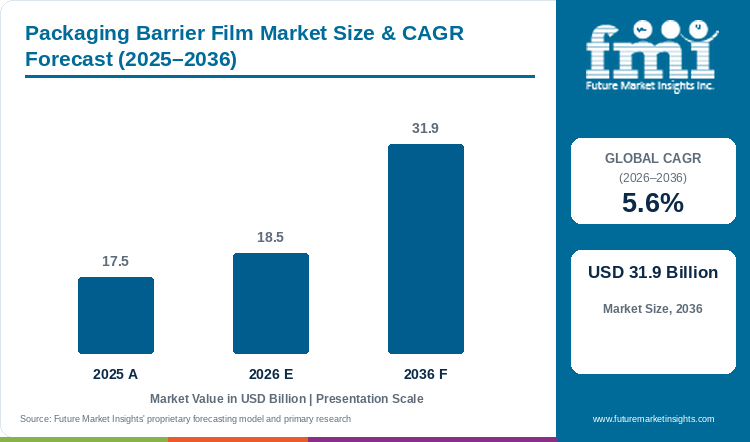
Demand for packaging barrier film is projected to expand at 5.6% CAGR between 2026 and 2036. Industry value grows from USD 17.5 billion in 2025 to USD 18.5 billion in 2026 and is projected to reach USD 31.9 billion by 2036.
Co-extruding microscopic ethylene vinyl alcohol tie layers inside oriented polyolefin webs allows automated form-fill-seal lines to block oxygen and moisture ingress without relying on unrecyclable aluminum foil laminates. Packaged food and medical device brands are converting heavy glass jars and multi-material pouches into mono-material barrier webs that maintain shelf life while qualifying for mechanical polyolefin recovery streams. At a 5.6% compound annual pace, worldwide packaging barrier film demand is forecast to attain USD 31.9 billion by 2036, building on USD 17.5 billion in 2025 and an estimated USD 18.5 billion in 2026 to yield USD 13.4 billion in ten-year expansion. Through its voluntary food-contact substance evaluation program, the U.S. Food and Drug Administration reviews post-consumer recycled polymeric materials so contaminant migration stays below safety thresholds in food packaging. Polyethylene (LLDPE / HDPE) anchors 40.0% of 2026 polymer demand across multi-layer high-barrier laminates.
Key Market Trends & Insights
- By material resin / polymer: Polyethylene (LLDPE / HDPE) holds 40.0% of 2026 polymer revenue due to low-temperature hermetic heat sealing and recycle-ready mono-PE pouch redesigns.
- By product format: Pre-Formed Pouches & Bags generate 47.8% of 2026 format sales as co-packers adopt ready-to-fill stand-up and spouted bags with pre-welded zippers.
- By barrier level: High-Barrier Modified Atmosphere (EVOH) claims 38.6% of 2026 barrier demand where sub-1.0 cc/m2/day oxygen transmission limits protect chilled meat and roast coffee.
- By end-use industry: Processed Food & Snacks delivers 30.9% of 2026 industry turnover through high-speed vertical bagging of moisture-sensitive chips and convenience meals.
Regional Highlights
- Fastest national trajectory: Mexican film converters top all five analyzed countries on a 6.8% yearly expansion curve to 2036 driven by food and medical export packing.
- Remaining country growth rates: South African pouch converting increases 6.3% annually and Chilean cold-chain web usage advances 5.8%, whereas German (4.9%) and Portuguese (4.5%) extruders post steadier European gains.
Market Size & Forecast
Table 1: Market Size and Forecast for the Packaging Barrier Film Market (USD billion and CAGR percentage), 2025 to 2036
| Metric | Value |
|---|---|
| 2025 Market Size | USD 17.5 billion |
| Estimated Market Size in 2026 | USD 18.5 billion |
| Projected Market Size by 2036 | USD 31.9 billion |
| CAGR, 2026 to 2036 | 5.6% |
| Added Revenue, 2026 to 2036 | USD 13.4 billion |
European Union food-safety authorities and Latin American Extended Producer Responsibility agencies are enforcing strict chemical-migration and recyclability thresholds on multi-layer plastic films to guide converter capital spending. Under European Commission food-contact rules (Regulation (EC) No 10/2011 and Regulation (EU) 2022/1616), recycled plastic food-contact materials may only enter commercial use when decontamination processes and functional barrier performance are verified. Consequently, film extruders are replacing non-recyclable polyester-foil structures with 7-to-11-layer blown and cast co-extruded barrier webs containing under 5% ethylene vinyl alcohol copolymer. Suppliers that deliver drop-in mono-polyolefin barrier rollstock capture multi-year contracts from multinational snack and pet-food brands.
Film Extrusion Volume and Barrier Web Sizing
Table 2: Extruded Film Tonnage and Realized Value Indicators for the Packaging Barrier Film Market (USD billion, million tonnes, and USD per tonne), mixed historical and forecast years from 2025 to 2036
| Metric | 2025 | 2026 | 2036 |
|---|---|---|---|
| Market size (USD billion) | 17.5 | 18.5 | 31.9 |
| Converted barrier film volume (million tonnes) | 5.1 to 5.4 | 5.3 to 5.7 | 8.4 to 9.0 |
| High-barrier EVOH / SiOx / AlOx volume (million tonnes) | 1.9 to 2.1 | 2.0 to 2.2 | 3.4 to 3.7 |
| Average realized film value (USD per tonne) | 3,240 to 3,430 | 3,250 to 3,490 | 3,540 to 3,800 |
Operational note: Film tonnage covers co-extruded blown and cast barrier webs alongside biaxially oriented laminates and vacuum-coated films (20 to 120 microns thick) sold as pre-formed pouches or converted rollstock.
Per Capita & Food-Packing Line Sizing
Multi-layer barrier films enable food and pharmaceutical processors to extend ambient and chilled product shelf life from days to months while cutting packaging weight by up to 70% when compared with rigid containers. Designing effective barrier pouches requires matching oxygen transmission rates and moisture vapor transmission rates to the exact oxidation profile of the packaged product. Expanding retail adoption of single-serve snack packs and portioned protein trays drives steady orders for oxygen-scavenging barrier structures across automated packing lines.
Table 3: Per Capita and Converter Spending Indicators for the Packaging Barrier Film Market (USD), mixed historical and forecast years from 2025 to 2036
| Metric | 2025 | 2026 | 2036 |
|---|---|---|---|
| World population (billion) | 8.23 | 8.30 | 8.95 |
| Spend per capita (USD) | 2.13 | 2.23 | 3.56 |
| Spend per 1,000 people (USD) | 2,126 | 2,229 | 3,564 |
| Annual barrier film spend per food plant (USD thousand) | 540 to 595 | 565 to 625 | 920 to 1,020 |
Table 4: Converter and End-Use Spending Indicators for the Packaging Barrier Film Market (USD and percentages), mixed reporting years from 2025 to 2026
| Metric | Value | Basis |
|---|---|---|
| Market size, 2026 | USD 18.5 billion | Report value |
| Commercial flexible film & pouch plants worldwide | 6,800 facilities | 2025 industry estimate |
| Pre-formed pouches & bags revenue, 2026 | USD 8.8 billion | 47.8% format share |
| High-barrier modified atmosphere (EVOH) revenue, 2026 | USD 7.1 billion | 38.6% barrier share |
Analyst Perspective
"Machine-direction-oriented polyethylene paired with sub-5% EVOH tie layers lets snack and coffee brands hit 2030 recyclability targets without sacrificing oxygen barrier. Film converters still face narrow heat-seal temperature windows on high-speed vertical form-fill-seal lines when switching away from polyester outer webs."
- Nandini Roy Choudhury, Principal Consultant, Future Market Insights.
How is the packaging barrier film market segmented?
The packaging barrier film market is segmented by material resin / polymer, product format, barrier level, end-use industry, and region. In 2026, Polyethylene (LLDPE / HDPE) is projected at 40.0%, Pre-Formed Pouches & Bags at 47.8%, High-Barrier Modified Atmosphere (EVOH) at 38.6%, and Processed Food & Snacks at 30.9%.
By material resin / polymer: Polyethylene (LLDPE / HDPE), Polypropylene (BOPP / CPP), Recycled Post-Consumer PET, and Bio-Based Compostable Resins.
By product format: Pre-Formed Pouches & Bags, Rollstock Barrier Films, and Thermoformed Bladders & Tubes.
By barrier level: High-Barrier Modified Atmosphere (EVOH), Medium-Barrier Standard, and Breathable Micro-Perforated.
By end-use industry: Processed Food & Snacks, Beverages & Liquid Foods, Pharmaceutical Medical Devices, and Industrial Chemical Logistics.
Why Does Polyethylene (LLDPE / HDPE) Lead the Packaging Barrier Film Market by Material Resin / Polymer?
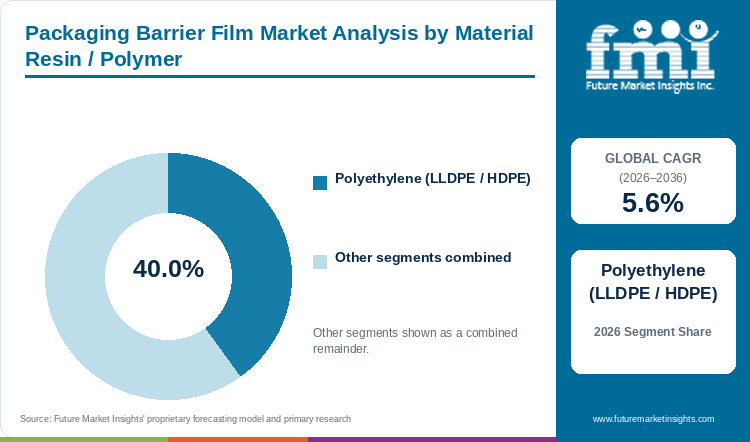
Polyethylene (LLDPE / HDPE) is expected to hold 40.0% of material resin / polymer revenue in 2026, aided by recyclability.
Table 5: Material Resin / Polymer Share for the Packaging Barrier Film Market (percentage share), 2026
| Material Resin / Polymer | Share (2026) |
|---|---|
| Polyethylene (LLDPE / HDPE) | 40.0% |
| Other Segments Combined | 60.0%* |
| Total | 100.0% |
*Calculated as the balance remaining after deducting the leading segment's reported share from 100.0%.
Table 6: Material Resin / Polymer Leadership and Market Growth for the Packaging Barrier Film Market (segment and CAGR percentage), 2026 to 2036
| Metric | Value |
|---|---|
| Global CAGR (2026 to 2036) | 5.6% |
| Leading Segment | Polyethylene (LLDPE / HDPE) |
Polyethylene (LLDPE / HDPE) captures the largest polymer share because high-density polyethylene provides a natural moisture vapor barrier while metallocene linear low-density polyethylene forms leak-proof hermetic seals through greasy or dusty filling zones. Even when a laminate uses an oriented polypropylene or polyester outer print web, polyethylene still forms the inner food-contact sealant layer representing 60% to 75% of total film gauge. Furthermore, brand owners are rapidly shifting toward all-PE structures using mono-material polyethylene films so finished pouches qualify for store-drop-off and curbside polyolefin recycling.
- Universal inner sealant functionality and mono-PE recyclability redesigns put Polyethylene (LLDPE / HDPE) at 40.0% of 2026 material resin / polymer sales.
- In January 2026, Huhtamaki Oyj earned WorldStar Awards 2026 recognition for its high-barrier mono-material polyethylene flexible packaging implementations.
What Makes Pre-Formed Pouches & Bags Central to the Product Format Category?
Pre-Formed Pouches & Bags is estimated to represent 47.8% of product format demand in 2026, stemming from stand-up shelf conversion.
Pre-Formed Pouches & Bags generate nearly half of format revenue because co-packers and mid-sized food brands prefer buying ready-to-fill stand-up and spouted bags rather than investing in complex inline pouch-forming machinery. Pre-made pouches arrive with pre-welded press-to-close zippers and corner spouts already tested for burst strength. Compared with rigid glass jars or metal cans, pre-made stand-up pouches cut empty-pack inbound truckloads by 85% while offering a wide 360-degree billboard for rotogravure or digital brand graphics.
- Lower filling-line capital requirements and strong retail shelf visibility give Pre-Formed Pouches & Bags 47.8% of 2026 product format demand.
- In April 2026, Taghleef Industries LLC published its case study on high-performance mono-material barrier film structures engineered for spouted stand-up pouches.
Why Does High-Barrier Modified Atmosphere (EVOH) Anchor the Barrier Level Category?
High-Barrier Modified Atmosphere (EVOH) is projected to capture 38.6% of barrier level demand in 2026, linked to oxygen-sensitive food protection.
High-Barrier Modified Atmosphere (EVOH) leads the barrier hierarchy because a 2-to-5-micron ethylene vinyl alcohol copolymer layer sandwiched between polyolefin tie resins reduces oxygen transmission below 0.5 cc/m2/day without opaque metal foil. Chilled red meat and grated cheese alongside roast coffee require nitrogen-carbon dioxide gas flushing or thermoformed vacuum skin webs to prevent lipid rancidity and microbial discoloration. Unlike polyvinylidene chloride (PVDC) coatings that face chlorine-incineration restrictions from retailers, EVOH co-extrusions at under 5% total structure weight pass European RecyClass and US APR polyolefin recyclability protocols.
- Chlorine-free gas retention in modified-atmosphere protein and coffee packs secures 38.6% of 2026 barrier level turnover for High-Barrier Modified Atmosphere (EVOH).
- In its 2026 sustainability report, Kuraray Co., Ltd. detailed initiatives for sustained growth through its EVAL ethylene vinyl alcohol copolymer business alongside its 18,000-tonne Singapore plant investment.
What Supports Processed Food & Snacks Leadership within End-Use Industry?
With a 30.9% share in 2026, Processed Food & Snacks leads end-use industry, on the strength of high-velocity snack packs.
Processed Food & Snacks represents the largest end-use industry because extruded potato chips and roasted nuts as well as dehydrated meals rapidly lose crispness or turn rancid if moisture vapor or ultraviolet light penetrates the pack. Snack manufacturers consume vast reels of metallized and transparent biaxially oriented polypropylene films and co-extruded polyethylene laminates running at 100 to 180 bags per minute on vertical form-fill-seal baggers. Moreover, rising urban demand for single-serve convenience packs increases total barrier film surface area consumed per kilogram of food sold.
- Continuous moisture and lipid-oxidation barrier requirements across savoury snacks keep Processed Food & Snacks at 30.9% of 2026 end-use industry sales.
- In January 2026, Sealed Air Corporation marked 85 years of CRYOVAC brand food packaging innovation by highlighting its high-barrier vacuum shrink bags and mono-material thermoforming webs for fresh meat and processed foods.
What are the drivers, restraints, and opportunities in the packaging barrier film market?
In the Packaging Barrier Film Market, retail shelf-life extension and rigid-to-flexible pack conversion drive volume growth, whereas multi-layer recycling penalties and narrow mono-PE heat-seal windows create technical friction, and AlOx/SiOx and water-based barrier coatings open recyclable premium applications through 2036.
- Driver:Food and healthcare brands are converting rigid cans and non-recyclable foil laminates into lightweight mono-polyolefin barrier pouches that cut freight emissions and EPR fees.
- Restraint:Replacing thermally stable PET outer layers with mono-material polyethylene narrows heat-seal temperature windows on existing packing lines and requires costly MDO-PE extrusion retrofits.
- Opportunity:Scaling transparent aluminum-oxide and silicon-oxide vapor-deposited films alongside high-barrier functional paper dispersions unlocks microwaveable and low-EPR-fee packaging.
Growth Analysis and Future Potential: Qualitative Demand Catalysts
Multinational food and personal-care companies are redesigning multi-polymer laminates into recycle-ready mono-polyethylene and mono-polypropylene barrier webs before mandatory Extended Producer Responsibility fee escalations take effect. Switching from rigid metal cans or glass jars to flexible polymer packaging reduces packaging weight per serving by 60% to 80% while lowering warehouse and cold-chain transport fuel costs. In March 2026, Amcor plc invested in a major expansion of its Italian flexible packaging facility by adding a high-barrier production line and automated warehouse dedicated to recycle-ready barrier films for European food and healthcare brands. Converters must verify drop-in machinability on customer form-fill-seal lines before full commercial volume transitions.
Risk Assessment of the Packaging Barrier Film Market: Operational and Supply Friction
Thermal distortion during heat sealing and volatile virgin and post-consumer resin prices restrain rapid conversion from traditional polyester-foil laminates to mono-material barrier films. Conventional polyester outer layers withstand sealing-bar temperatures above 200 degrees Celsius while inner polyethylene layers melt at 110 to 130 degrees Celsius, giving packing lines a wide 80-degree operating window. When processors switch to all-PE protective food contact films, the outer and inner layers melt within 15 to 20 degrees of each other and cause film shrinkage unless baggers install precision ultrasonic or impulse sealing jaws. In June 2026, Germany's Federal Ministry for the Environment (BMUV) outlined strict European law requirements under Regulation (EU) 2025/40 mandating minimum post-consumer recycled plastic quotas and strict design-for-recycling grades.
Commercial Opportunity Analysis: Differentiation and Value-Add Formats
Barrier film producers are capturing premium margins by deploying transparent silicon-oxide and aluminum-oxide vacuum deposition alongside high-barrier dispersion-coated papers for brands seeking metal-free or fiber-dominant packs. Unlike aluminum foil laminates that block metal detectors and cannot be microwaved, AlOx/SiOx and functional dispersion barrier coatings allow full product visibility and inline foreign-body inspection. In August 2025, Mondi plc ramped up commercial production of its FunctionalBarrier Paper Ultimate range to deliver ultra-high oxygen and water-vapor barrier performance for coffee pods and savoury snacks without aluminum or PVDC. Suppliers offering both mono-polyolefin EVOH films and dispersion-coated barrier substrates retain customers across both plastic and paper-hybrid packaging mandates.
Packaging Barrier Film Market by Country (2026 to 2036)
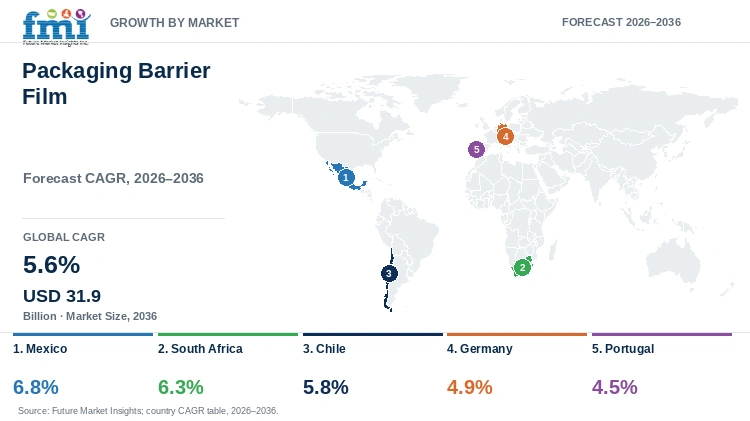
Ten-year expansion across the five evaluated barrier film markets is led by Mexican export converters (6.8% CAGR) and South African pouch makers (6.3%), followed by Chilean packhouses (5.8%) as German (4.9%) and Portuguese (4.5%) extruders retool for PPWR compliance. National demand patterns are shaped by perishable food-export corridors and statutory Extended Producer Responsibility fee modulations alongside retail stand-up pouch penetration.
Table 7: Country CAGR and Primary Growth Levers for the Packaging Barrier Film Market (CAGR percentage and operational drivers), 2026 to 2036
| Country | CAGR (2026 to 2036) | Primary Growth Lever |
|---|---|---|
| Mexico | 6.8% | US-bound meat, avocado, and snack export packing plus APR-ANIPAC circular polyolefin film standards |
| South Africa | 6.3% | Mandatory DFFE Extended Producer Responsibility targets and SA Plastics Pact mono-PE pouch redesigns |
| Chile | 5.8% | Salmon, fruit, and wine export modified-atmosphere packaging and Ley REP 20.920 recycling quotas |
| Germany | 4.9% | VerpackG eco-modulated dual-system fees and MDO-PE/EVOH substitution of multi-material laminates |
| Portugal | 4.5% | Iberian seafood, olive-oil, and dairy thermoforming demand paired with Sociedade Ponto Verde rules |
Source: Future Market Insights analysis
Mexico Packaging Barrier Film Market Outlook (2026 to 2036)
Duty-free fresh beef and medical-device export manufacturing bound for United States distribution centers makes Mexico the primary nearshoring growth engine for co-extruded barrier films in North America. During May 2026, the National Association of Plastics Industries (ANIPAC) in Mexico and the U.S. Association of Plastic Recyclers signed a bilateral cooperation agreement to harmonize post-consumer recycled resin certification and recyclable polyolefin film design standards. Propelled by cross-border trade, Mexican barrier web consumption will expand by 6.8% per year through 2036. While export snack and tortilla plants rapidly expand stand-up pouch consumption, domestic converters remain dependent on imported EVOH copolymers from Texas and Japan. Regional extruders are countering resin import costs by installing 9-layer MDO-PE lines in Monterrey and Guadalajara.
Key takeaway: In Mexico, cross-border APR-ANIPAC recyclability alignment and expanding US-bound meat and medical export lines propel 6.8% annual barrier film growth through 2036.
South Africa Packaging Barrier Film Market Outlook (2026 to 2036)
High retail reliance on affordable small-format flexible food pouches and statutory Extended Producer Responsibility mandates distinguish South Africa's converting sector from other African markets. In February 2026, Plastics SA published its revised national plastics recycling consumption report confirming that packaging accounted for over half of South Africa's recycled plastic output as brand owners redesigned multi-layer films under SA Plastics Pact targets. This retail and regulatory momentum drives a projected 6.3% compound annual expansion across South Africa's barrier film market through 2036. Even so, municipal waste-collection gaps outside major metro areas and periodic power-grid load curtailment at extrusion plants restrain operating efficiency. Domestic converters are investing in solar-backed blown-film lines and puncture-resistant mono-PE pouches for long-haul Southern African freight.
Key takeaway: In South Africa, statutory EPR recycling obligations and high-volume retail demand for affordable portioned food pouches drive converter migration toward mono-polyolefin barrier films.
Chile Packaging Barrier Film Market Outlook (2026 to 2036)
Twenty-five-day refrigerated ocean voyages for exported Atlantic salmon fillets and fresh cherries require ultra-high-barrier modified-atmosphere and vacuum shrink films across Chile. In July 2026, the Chilean Ministry of the Environment (MMA) opened the 2026 compliance declaration period under Extended Producer Responsibility Law 20.920 (Ley REP), enforcing escalating recovery obligations on priority packaging producers. Supported by expanding aquaculture and orchard packhouses, Chilean barrier film sales will rise 5.8% per annum until 2036. However, the absence of domestic specialty copolymer synthesis forces Chilean converters to import EVOH and metallocene resins across long maritime routes. Local film plants consequently focus on high-value custom rotogravure printing and vacuum-bag converting for export food packers.
Key takeaway: In Chile, long-distance salmon and fresh-fruit export cold chains combine with Ley REP 20.920 recycling obligations to sustain 5.8% annual demand growth for high-barrier vacuum and MAP films.
Germany Packaging Barrier Film Market Outlook (2026 to 2036)
Europe's highest concentration of automated dairy and pharmaceutical thermoforming lines alongside strict VerpackG dual-system fee modulation shapes barrier film engineering in Germany. In January 2026, the German Federal Environment Agency (Umweltbundesamt) published updated national packaging waste recycling verification data confirming that eco-modulated dual-system sorting rules strongly favor recyclable mono-polyolefin structures. German barrier film output is expected to move upward by 4.9% annually until 2036 as food packers replace polyamide-polyethylene webs with MDO-PE/EVOH laminates. Nonetheless, rigorous BfR chemical-migration testing and slower consumer volume growth in mature grocery categories restrain overall tonnage expansion. German extruders are capturing value growth by supplying ultra-thin 9-to-11-layer barrier webs that lower per-pack plastic weight and licensing fees.
Key takeaway: In Germany, VerpackG fee modulation and world-leading food and pharmaceutical thermoforming machinery drive steady replacement of multi-material laminates with mono-polyolefin barrier webs.
Portugal Packaging Barrier Film Market Outlook (2026 to 2036)
Export-oriented Atlantic seafood processing and wine bag-in-box bladders alongside agile short-run pouch converting differentiate Portugal within the Iberian flexible packaging sector. In July 2026, Sociedade Ponto Verde published its updated guide on critical packaging in sorting and recycling across Portugal to help food brands eliminate non-recyclable multi-material film components. Anchored by chilled octopus and dairy thermoforming, Portuguese barrier film sales are anticipated to post a 4.5% compound annual gain between 2026 and 2036. Nevertheless, smaller domestic brand production batches compared with Spain and France limit economies of scale on wide-web rotogravure presses. Portuguese converters overcome batch-size constraints by pairing digital and flexographic printing with fast-turn vacuum-skin and stand-up pouch converting.
Key takeaway: In Portugal, seafood vacuum-skin packing and Sociedade Ponto Verde recyclability guidelines sustain a 4.5% yearly growth pace in barrier webs until 2036.
Full report country CAGRs cover: North America; Latin America; Western Europe; Eastern Europe; East Asia; South Asia and Pacific; Middle East and Africa.
Who are the notable companies in the packaging barrier film market?
Amcor plc, Berry Global Group, Inc., Mondi plc, Sealed Air Corporation, Huhtamaki Oyj, Sonoco Products Company, TOPPAN Holdings Inc., and Kuraray Co., Ltd. are the notable companies in the packaging barrier film market.
Market leadership across flexible barrier converting hinges on 9-to-11-layer blown and cast co-extrusion capacity alongside vacuum vapor-deposition coating speed and proprietary EVOH resin chemistry. Global flexible-packaging converters Amcor plc and Berry Global Group, Inc. together with Mondi plc and Huhtamaki Oyj alongside Sonoco Products Company operate multi-continental extrusion and pre-made pouch converting networks serving food and healthcare multinationals. Sealed Air Corporation leads in integrated high-barrier meat shrink bags and automated bagging equipment. Meanwhile, TOPPAN Holdings Inc. and Kuraray Co., Ltd. anchor upstream technology through transparent AlOx/SiOx vapor-deposited GL BARRIER films and EVAL ethylene vinyl alcohol copolymer barrier resins.
- Global Multi-Layer Film & Pouch Converters: Amcor plc and Berry Global Group, Inc. alongside Huhtamaki Oyj and Sonoco Products Company supply co-extruded rollstock and stand-up pouches as well as pharmaceutical blister barrier films.
- Protein Shrink, Thermoforming & Paper-Hybrid Specialists: Sealed Air Corporation and Mondi plc engineer vacuum shrink bags and thermoformed skin webs alongside dispersion-coated barrier papers.
- Upstream EVOH Resin & Transparent Vapor-Deposition Leaders: Kuraray Co., Ltd. and TOPPAN Holdings Inc. supply EVAL EVOH copolymer resins and transparent AlOx/SiOx coated barrier films.
Competitive Benchmarking: Packaging Barrier Film Market
Table 8: Competitive Benchmarking for the Packaging Barrier Film Market (qualitative capability ratings), 2026
| Company | Film & Pouch Breadth | Geographic Reach | Food-Contact & Recyclability | Barrier Chemistry Innovation |
|---|---|---|---|---|
| Amcor plc | High | High | High | High |
| Berry Global Group, Inc. | High | High | High | High |
| Mondi plc | High | High | High | High |
| Sealed Air Corporation | High | High | High | High |
| Huhtamaki Oyj | High | High | High | High |
| Sonoco Products Company | Medium | High | High | Medium |
| TOPPAN Holdings Inc. | High | High | High | High |
| Kuraray Co., Ltd. | Medium | High | High | High |
Scoring basis: Film & Pouch Breadth achieves a High rating where a converter produces multiple co-extruded or vapor-deposited barrier formats across rollstock and pre-made pouches, whereas Medium indicates a focus on upstream barrier resins or select formats. Food-Contact & Recyclability reflects documented FDA and EU 10/2011 migration compliance paired with RecyClass and APR design-for-recycling validations. Barrier Chemistry Innovation evaluates commercial deployment of mono-MDO-PE and sub-5% EVOH alongside AlOx/SiOx and PFAS-free dispersion barriers.
Key Developments in the Packaging Barrier Film Market
- In September 2026, Huhtamaki Oyj published its strategic flexible packaging roadmap centered on mono-material polyolefin and foil-free high-barrier laminates designed to comply with European PPWR recyclability grades.
- In January 2026, Amcor plc demonstrated its high-speed automated vacuum shrink-bag system at the International Production & Processing Expo (IPPE), forming custom-length poultry and meat shrink bags directly from barrier rollstock film.
- In September 2025, Sealed Air Corporation launched its AUTOBAG 850HB hybrid bagging machine engineered to run both high-barrier polyethylene mailers and fiber-based flexible packs on automated fulfillment lines.
Key Players in the Packaging Barrier Film Market
Global Multi-Layer Film & Pouch Converters
- Amcor plc
- Berry Global Group, Inc.
- Huhtamaki Oyj
- Sonoco Products Company
Protein Shrink, Thermoforming & Paper-Hybrid Specialists
- Sealed Air Corporation
- Mondi plc
Upstream EVOH Resin & Transparent Vapor-Deposition Leaders
- TOPPAN Holdings Inc.
- Kuraray Co., Ltd.
Packaging Barrier Film Market - Report Scope
Table 9: Report Scope for the Packaging Barrier Film Market (coverage fields and definitions), 2026 to 2036
| Coverage field | Report scope |
|---|---|
| Market breakdown | Material Resin / Polymer; Product Format; Barrier Level; End-Use Industry; Region |
| Quantitative Units | USD Billion |
| Market Definition | Includes extruder and converter revenue from multi-layer co-extruded, laminated, metallized, vacuum-deposited (AlOx/SiOx), and dispersion-coated flexible barrier films and pre-formed barrier pouches/bladders sold within the listed segmentation. Category & Format Scope Note: Market valuation reflects both rollstock barrier films and converted flexible barrier pouches/thermoformed webs where pre-formed pouches and bags account for 47.8% of format value realization and polyethylene (LLDPE/HDPE) represents 40.0% of polymer demand, excluding non-barrier commodity stretch wraps, agricultural mulch films, and rigid injection-molded containers. |
| Regions Covered | North America; Latin America; Western Europe; Eastern Europe; East Asia; South Asia and Pacific; Middle East and Africa |
| Countries Covered | Mexico, South Africa, Chile, Germany, Portugal, and additional countries in the full report |
| Key Companies Covered | Amcor plc, Berry Global Group, Inc., Mondi plc, Sealed Air Corporation, Huhtamaki Oyj, Sonoco Products Company, TOPPAN Holdings Inc., Kuraray Co., Ltd. |
| Forecast Period | 2026 to 2036 |
| Approach | Primary and secondary research with rigorous market triangulation. |
Packaging Barrier Film Market - Research Methodology
Table 10: Research Methodology for the Packaging Barrier Film Market (research methods and approach), 2026 edition
| Method | Approach |
|---|---|
| Primary Research | Primary interviews were conducted with blown and cast film extruders, EVOH and polyolefin resin chemists, pre-made pouch converters, food and pharmaceutical packaging engineers, and EPR compliance directors across the barrier film value chain to validate OTR/MVTR specifications, demand dynamics, and mono-material transitions. |
| Secondary Research | Secondary research included analysis of company annual reports, investor presentations, FDA and EFSA food-contact recycled plastic registries, European Union PPWR and national EPR statutory publications, Plastics Recyclers Europe / RecyClass technical protocols, and verified corporate press releases. |
| Market Sizing and Forecasting | Market sizing and forecasting for the 2026 to 2036 forecast period were developed using top-down and bottom-up approaches reconciling extruded barrier resin tonnage, converted pouch and rollstock realizations, and rigid-to-flexible substitution rates. |
| Data Triangulation and Validation | Data is validated against polymer consumption registries, packaged food and pharmaceutical output indices, national EPR fee schedules, and historical trend analysis to ensure high accuracy without double counting non-barrier commodity films. |
| Country Forecasting Model | Country-level CAGRs are projected via FMI's flexible barrier packaging econometric model, calibrating evaluated national growth rates against the 5.6% global baseline through verified food-export packing growth, statutory EPR recyclability fee modulations, and retail stand-up pouch penetration. |
| Operational Benchmark Traceability | Operational benchmarks (converted barrier film tonnage, high-barrier EVOH/SiOx/AlOx volume, and realized film value per tonne) represent modeled estimates synthesized from Eurostat packaging waste databases, FDA recycled plastic food-contact registries, ANIPAC and Plastics SA industry surveys, and commercial film converter disclosures. |
Packaging Barrier Film Market by Segments
Packaging Barrier Film Market segmented by Material Resin / Polymer:
- Polyethylene (LLDPE / HDPE)
- Polypropylene (BOPP / CPP)
- Recycled Post-Consumer PET
- Bio-Based Compostable Resins
Packaging Barrier Film Market segmented by Product Format:
- Pre-Formed Pouches & Bags
- Rollstock Barrier Films
- Thermoformed Bladders & Tubes
Packaging Barrier Film Market segmented by Barrier Level:
- High-Barrier Modified Atmosphere (EVOH)
- Medium-Barrier Standard
- Breathable Micro-Perforated
Packaging Barrier Film Market segmented by End-Use Industry:
- Processed Food & Snacks
- Beverages & Liquid Foods
- Pharmaceutical Medical Devices
- Industrial Chemical Logistics
Packaging Barrier Film Market by Region
- North America
- United States
- Canada
- Latin America
- Brazil
- Mexico
- Argentina
- Chile
- Western Europe
- Germany
- France
- United Kingdom
- Spain
- Italy
- Portugal
- Eastern Europe
- Poland
- Russia
- East Asia
- China
- Japan
- South Korea
- South Asia and Pacific
- India
- Australia
- New Zealand
- Middle East and Africa
- GCC Countries
- South Africa
- Israel
Research Sources and Bibliography
- [1] U.S. Food and Drug Administration (FDA). (2025, June 16). Food Packaging & Other Substances that Come in Contact with Food – Information for Consumers. U.S. Food and Drug Administration.
- [2] European Commission. (2025, May 14). Plastic Recycling – Food Safety. European Commission Directorate-General for Health and Food Safety.
- [3] Huhtamaki Oyj. (2026, January 12). Huhtamaki Solutions Recognised at the WorldStar Awards 2026. Huhtamaki Flexible Packaging News.
- [4] Taghleef Industries LLC. (2026, April 30). High-Performance Spouted Stand-Up Pouches. Taghleef Industries Case Studies.
- [5] Kuraray Co., Ltd. (2026, June 01). Initiatives for Sustained Growth through the EVAL Business – Kuraray Report 2026. Kuraray Sustainability Report.
- [6] Sealed Air Corporation. (2026, January 07). CRYOVAC 85th Anniversary Press Release - Sealed Air. Sealed Air Media Center.
- [7] Amcor plc. (2026, March 09). Amcor Invests in Italy to Increase Recycle-Ready Packaging. Amcor Media News.
- [8] Federal Ministry for the Environment, Nature Conservation, Nuclear Safety and Consumer Protection (BMUV). (2026, June 26). European law on packaging and packaging waste. BMUV Germany.
- [9] Mondi plc. (2025, August 14). Mondi ramps up FunctionalBarrier Paper Ultimate to meet growing demand for sustainable high-barrier paper-based packaging. Mondi Group News and Insight.
- [10] Association of Plastic Recyclers (APR) & ANIPAC. (2026, May 27). APR and ANIPAC Sign Agreement to Advance Recycling and the Circular Economy in Mexico. Association of Plastic Recyclers (APR).
- [11] Plastics SA. (2026, February 11). South Africa Used More Recycled Plastics in 2024 as Circular Economy Gains Momentum. Plastics SA.
- [12] Ministerio del Medio Ambiente de Chile (MMA). (2026, July 20). Ley REP: el período de declaración 2026 para productores de productos prioritarios será a partir del último trimestre. Ministerio del Medio Ambiente Gobierno de Chile.
- [13] Umweltbundesamt (UBA). (2026, January 27). Facts against myths: Packaging waste recycling in Germany is working. Umweltbundesamt Press Information.
- [14] Sociedade Ponto Verde (SPV). (2026, July 16). SPV lança nova edição do Guia das Embalagens Críticas na Triagem e Reciclagem. Sociedade Ponto Verde.
- [15] Huhtamaki Oyj. (2026, September 10). Preparing flexible packaging for what comes next. Huhtamaki Flexible Packaging News.
- [16] Amcor plc. (2026, January 12). Amcor to Demonstrate Packaging Equipment & Materials at IPPE. Amcor Media News.
- [17] Sealed Air Corporation. (2025, September 16). Sealed Air Launches AUTOBAG Brand 850HB Hybrid Bagging Machine for Paper and Poly Mailers. Sealed Air Press Releases.
- [18] Amcor plc & Berry Global Group, Inc. (2026, February 10). Combination with Berry provides best-in-industry PE shrink portfolio. Amcor Media News.
- [19] TOPPAN Holdings Inc. (2025, November 10). TOPPAN Group Launches Hybrid Line Manufacturing BOPP and CPP Films in India. TOPPAN Holdings News Releases.
- [20] Sonoco Products Company. (2026, February 16). Sonoco Reports Fourth Quarter and Full Year 2025 Results. Sonoco Investor Relations.
- [21] Taghleef Industries LLC. (2025, December 17). Biobased, Recycled, Recyclable: Taghleef Industries brings the future of film solutions to Packaging Innovations 2026. Taghleef Industries News.
This bibliography is provided for reader reference and is not exhaustive. The full report contains the complete reference list and detailed citations.
This Report Answers
- How large is the packaging barrier film market in 2026 and what is forecast for 2036?
- Which shelf-life and recyclability regulations support demand for packaging barrier films?
- Why does Polyethylene (LLDPE / HDPE) lead the material resin / polymer category?
- Why do Pre-Formed Pouches & Bags lead the product format category globally?
- How do growth rates differ across Mexico, South Africa, Chile, Germany, and Portugal?
- Which leading companies extrude and convert packaging barrier films today?
- What limits adoption or supplier switching in the packaging barrier film market?
- What should food and pharmaceutical buyers evaluate before purchasing barrier films?
Table of Content
- Key Takeaways
- Market Size and CAGR
- Top Growth Driver
- Fastest Growing Segment
- Leading Region
- Key Companies
- Emerging Opportunities
- Executive Summary
- Global Market Outlook
- Demand-side Trends
- Supply-side Trends
- Technology Roadmap Analysis
- Analysis and Recommendations
- Analyst Perspective (What is happening? Why now? What should investors know?)
- Key Questions Answered
- How large is the market?
- What is the CAGR?
- What are key trends?
- Which region dominates?
- Who are the leaders?
Read More...
- Market Overview
- Market Coverage / Taxonomy
- Market Definition / Scope / Limitations
- Research Methodology
- Chapter Orientation
- Analytical Lens and Working Hypotheses
- Market Structure, Signals, and Trend Drivers
- Benchmarking and Cross-market Comparability
- Market Sizing, Forecasting, and Opportunity Mapping
- Research Design and Evidence Framework
- Desk Research Programme (Secondary Evidence)
- Expert Input and Fieldwork (Primary Evidence)
- Tooling, Models, and Reference Databases
- Data Engineering and Model Build
- Quality Assurance and Audit Trail
- Market Background
- Market Dynamics (Drivers, Restraints, Opportunity, Trends)
- Scenario Forecast (Optimistic, Likely, Conservative)
- Impact Analysis
- AI Impact
- Sustainability Impact
- Regulatory Impact
- Technology Impact
- Consumer / Buyer Analysis
- Purchase Drivers
- Adoption Barriers
- Buyer Journey
- Opportunity Map Analysis
- Product Life Cycle Analysis
- Supply Chain Analysis
- Investment Feasibility Matrix
- Value Chain Analysis
- PESTLE and Porter's Analysis
- Regulatory Landscape
- Regional Parent Market Outlook
- Production and Consumption Statistics
- Import and Export Statistics
- Global Market Analysis and Forecast, 2021 to 2036
- Historical Market Size Value (USD Billion) Analysis, 2021 to 2025
- Current and Future Market Size Value (USD Billion) Projections, 2026 to 2036
- Y-o-Y Growth Trend Analysis
- Absolute $ Opportunity Analysis
- Global Market Pricing Analysis, 2021 to 2036
- Global Market Analysis and Forecast, By Material Resin / Polymer, 2021 to 2036
- Introduction / Key Findings
- Historical Market Size Value (USD Billion) Analysis By Material Resin / Polymer, 2021 to 2025
- Current and Future Market Size Value (USD Billion) Analysis and Forecast By Material Resin / Polymer, 2026 to 2036
- Polyethylene (LLDPE / HDPE)
- Polypropylene (BOPP / CPP)
- Recycled Post-Consumer PET
- Bio-Based Compostable Resins
- Y-o-Y Growth Trend Analysis By Material Resin / Polymer, 2021 to 2025
- Absolute $ Opportunity Analysis By Material Resin / Polymer, 2026 to 2036
- Global Market Analysis and Forecast, By Product Format, 2021 to 2036
- Introduction / Key Findings
- Historical Market Size Value (USD Billion) Analysis By Product Format, 2021 to 2025
- Current and Future Market Size Value (USD Billion) Analysis and Forecast By Product Format, 2026 to 2036
- Pre-Formed Pouches & Bags
- Rollstock Barrier Films
- Thermoformed Bladders & Tubes
- Y-o-Y Growth Trend Analysis By Product Format, 2021 to 2025
- Absolute $ Opportunity Analysis By Product Format, 2026 to 2036
- Global Market Analysis and Forecast, By Barrier Level, 2021 to 2036
- Introduction / Key Findings
- Historical Market Size Value (USD Billion) Analysis By Barrier Level, 2021 to 2025
- Current and Future Market Size Value (USD Billion) Analysis and Forecast By Barrier Level, 2026 to 2036
- High-Barrier Modified Atmosphere (EVOH)
- Medium-Barrier Standard
- Breathable Micro-Perforated
- Y-o-Y Growth Trend Analysis By Barrier Level, 2021 to 2025
- Absolute $ Opportunity Analysis By Barrier Level, 2026 to 2036
- Global Market Analysis and Forecast, By End-Use Industry, 2021 to 2036
- Introduction / Key Findings
- Historical Market Size Value (USD Billion) Analysis By End-Use Industry, 2021 to 2025
- Current and Future Market Size Value (USD Billion) Analysis and Forecast By End-Use Industry, 2026 to 2036
- Processed Food & Snacks
- Beverages & Liquid Foods
- Pharmaceutical Medical Devices
- Industrial Chemical Logistics
- Y-o-Y Growth Trend Analysis By End-Use Industry, 2021 to 2025
- Absolute $ Opportunity Analysis By End-Use Industry, 2026 to 2036
- Global Market Analysis and Forecast, By Region, 2021 to 2036
- Introduction
- Historical Market Size Value (USD Billion) Analysis By Region, 2021 to 2025
- Current Market Size Value (USD Billion) Analysis and Forecast By Region, 2026 to 2036
- North America
- Latin America
- Western Europe
- Eastern Europe
- East Asia
- South Asia and Pacific
- Middle East and Africa
- Market Attractiveness Analysis By Region
- North America Market Analysis and Forecast, By Country, 2021 to 2036
- Historical Market Size Value (USD Billion) Trend Analysis By Market Taxonomy, 2021 to 2025
- Market Size Value (USD Billion) Forecast By Market Taxonomy, 2026 to 2036
- By Country
- United States
- Canada
- By Material Resin / Polymer
- By Product Format
- By Barrier Level
- By End-Use Industry
- By Country
- Market Attractiveness Analysis
- By Country
- By Material Resin / Polymer
- By Product Format
- By Barrier Level
- By End-Use Industry
- Key Takeaways
- Latin America Market Analysis and Forecast, By Country
- Historical Market Size Value (USD Billion) Trend Analysis By Market Taxonomy, 2021 to 2025
- Market Size Value (USD Billion) Forecast By Market Taxonomy, 2026 to 2036
- By Country
- Brazil
- Mexico
- Argentina
- Chile
- By Material Resin / Polymer
- By Product Format
- By Barrier Level
- By End-Use Industry
- By Country
- Market Attractiveness Analysis
- By Country
- By Material Resin / Polymer
- By Product Format
- By Barrier Level
- By End-Use Industry
- Key Takeaways
- Western Europe Market Analysis and Forecast, By Country
- Historical Market Size Value (USD Billion) Trend Analysis By Market Taxonomy, 2021 to 2025
- Market Size Value (USD Billion) Forecast By Market Taxonomy, 2026 to 2036
- By Country
- Germany
- France
- United Kingdom
- Spain
- Italy
- Portugal
- By Material Resin / Polymer
- By Product Format
- By Barrier Level
- By End-Use Industry
- By Country
- Market Attractiveness Analysis
- By Country
- By Material Resin / Polymer
- By Product Format
- By Barrier Level
- By End-Use Industry
- Key Takeaways
- Eastern Europe Market Analysis and Forecast, By Country
- Historical Market Size Value (USD Billion) Trend Analysis By Market Taxonomy, 2021 to 2025
- Market Size Value (USD Billion) Forecast By Market Taxonomy, 2026 to 2036
- By Country
- Poland
- Russia
- By Material Resin / Polymer
- By Product Format
- By Barrier Level
- By End-Use Industry
- By Country
- Market Attractiveness Analysis
- By Country
- By Material Resin / Polymer
- By Product Format
- By Barrier Level
- By End-Use Industry
- Key Takeaways
- East Asia Market Analysis and Forecast, By Country
- Historical Market Size Value (USD Billion) Trend Analysis By Market Taxonomy, 2021 to 2025
- Market Size Value (USD Billion) Forecast By Market Taxonomy, 2026 to 2036
- By Country
- China
- Japan
- South Korea
- By Material Resin / Polymer
- By Product Format
- By Barrier Level
- By End-Use Industry
- By Country
- Market Attractiveness Analysis
- By Country
- By Material Resin / Polymer
- By Product Format
- By Barrier Level
- By End-Use Industry
- Key Takeaways
- South Asia and Pacific Market Analysis and Forecast, By Country
- Historical Market Size Value (USD Billion) Trend Analysis By Market Taxonomy, 2021 to 2025
- Market Size Value (USD Billion) Forecast By Market Taxonomy, 2026 to 2036
- By Country
- India
- Australia
- New Zealand
- By Material Resin / Polymer
- By Product Format
- By Barrier Level
- By End-Use Industry
- By Country
- Market Attractiveness Analysis
- By Country
- By Material Resin / Polymer
- By Product Format
- By Barrier Level
- By End-Use Industry
- Key Takeaways
- Middle East and Africa Market Analysis and Forecast, By Country
- Historical Market Size Value (USD Billion) Trend Analysis By Market Taxonomy, 2021 to 2025
- Market Size Value (USD Billion) Forecast By Market Taxonomy, 2026 to 2036
- By Country
- GCC Countries
- South Africa
- Israel
- By Material Resin / Polymer
- By Product Format
- By Barrier Level
- By End-Use Industry
- By Country
- Market Attractiveness Analysis
- By Country
- By Material Resin / Polymer
- By Product Format
- By Barrier Level
- By End-Use Industry
- Key Takeaways
- Key Countries Market Analysis
- United States
- Pricing Analysis
- Market Share Analysis, 2025
- By Material Resin / Polymer
- By Product Format
- By Barrier Level
- By End-Use Industry
- Canada
- Pricing Analysis
- Market Share Analysis, 2025
- By Material Resin / Polymer
- By Product Format
- By Barrier Level
- By End-Use Industry
- Mexico
- Pricing Analysis
- Market Share Analysis, 2025
- By Material Resin / Polymer
- By Product Format
- By Barrier Level
- By End-Use Industry
- Brazil
- Pricing Analysis
- Market Share Analysis, 2025
- By Material Resin / Polymer
- By Product Format
- By Barrier Level
- By End-Use Industry
- Chile
- Pricing Analysis
- Market Share Analysis, 2025
- By Material Resin / Polymer
- By Product Format
- By Barrier Level
- By End-Use Industry
- Germany
- Pricing Analysis
- Market Share Analysis, 2025
- By Material Resin / Polymer
- By Product Format
- By Barrier Level
- By End-Use Industry
- United Kingdom
- Pricing Analysis
- Market Share Analysis, 2025
- By Material Resin / Polymer
- By Product Format
- By Barrier Level
- By End-Use Industry
- Italy
- Pricing Analysis
- Market Share Analysis, 2025
- By Material Resin / Polymer
- By Product Format
- By Barrier Level
- By End-Use Industry
- Spain
- Pricing Analysis
- Market Share Analysis, 2025
- By Material Resin / Polymer
- By Product Format
- By Barrier Level
- By End-Use Industry
- France
- Pricing Analysis
- Market Share Analysis, 2025
- By Material Resin / Polymer
- By Product Format
- By Barrier Level
- By End-Use Industry
- India
- Pricing Analysis
- Market Share Analysis, 2025
- By Material Resin / Polymer
- By Product Format
- By Barrier Level
- By End-Use Industry
- China
- Pricing Analysis
- Market Share Analysis, 2025
- By Material Resin / Polymer
- By Product Format
- By Barrier Level
- By End-Use Industry
- Japan
- Pricing Analysis
- Market Share Analysis, 2025
- By Material Resin / Polymer
- By Product Format
- By Barrier Level
- By End-Use Industry
- South Korea
- Pricing Analysis
- Market Share Analysis, 2025
- By Material Resin / Polymer
- By Product Format
- By Barrier Level
- By End-Use Industry
- Russia
- Pricing Analysis
- Market Share Analysis, 2025
- By Material Resin / Polymer
- By Product Format
- By Barrier Level
- By End-Use Industry
- Poland
- Pricing Analysis
- Market Share Analysis, 2025
- By Material Resin / Polymer
- By Product Format
- By Barrier Level
- By End-Use Industry
- South Africa
- Pricing Analysis
- Market Share Analysis, 2025
- By Material Resin / Polymer
- By Product Format
- By Barrier Level
- By End-Use Industry
- Portugal
- Pricing Analysis
- Market Share Analysis, 2025
- By Material Resin / Polymer
- By Product Format
- By Barrier Level
- By End-Use Industry
- United States
- Market Structure Analysis
- Competition Dashboard
- Competition Benchmarking
- Market Share Analysis of Top Players
- By Regional
- By Material Resin / Polymer
- By Product Format
- By Barrier Level
- By End-Use Industry
- Emerging Startups
- Innovation Benchmarking
- Competition Analysis
- Competition Deep Dive
- Amcor plc
- Overview
- Product Portfolio
- Profitability by Market Segments
- Sales Footprint
- Strategy Overview
- Marketing Strategy
- Product Strategy
- Channel Strategy
- Berry Global Group, Inc.
- Mondi plc
- Sealed Air Corporation
- Huhtamaki Oyj
- Sonoco Products Company
- TOPPAN Holdings Inc.
- Kuraray Co., Ltd.
- Amcor plc
- Case Studies
- Success Stories
- Recent Developments
- Competition Deep Dive
- Assumptions & Acronyms Used
List of Tables
- Table 1: Global Market Value (USD Billion) Forecast by Region, 2021 to 2036
- Table 2: Global Market Value (USD Billion) Forecast by Material Resin / Polymer, 2021 to 2036
- Table 3: Global Market Value (USD Billion) Forecast by Product Format, 2021 to 2036
- Table 4: Global Market Value (USD Billion) Forecast by Barrier Level, 2021 to 2036
- Table 5: Global Market Value (USD Billion) Forecast by End-Use Industry, 2021 to 2036
- Table 6: North America Market Value (USD Billion) Forecast by Country, 2021 to 2036
- Table 7: North America Market Value (USD Billion) Forecast by Material Resin / Polymer, 2021 to 2036
- Table 8: North America Market Value (USD Billion) Forecast by Product Format, 2021 to 2036
- Table 9: North America Market Value (USD Billion) Forecast by Barrier Level, 2021 to 2036
- Table 10: North America Market Value (USD Billion) Forecast by End-Use Industry, 2021 to 2036
- Table 11: Latin America Market Value (USD Billion) Forecast by Country, 2021 to 2036
- Table 12: Latin America Market Value (USD Billion) Forecast by Material Resin / Polymer, 2021 to 2036
- Table 13: Latin America Market Value (USD Billion) Forecast by Product Format, 2021 to 2036
- Table 14: Latin America Market Value (USD Billion) Forecast by Barrier Level, 2021 to 2036
- Table 15: Latin America Market Value (USD Billion) Forecast by End-Use Industry, 2021 to 2036
- Table 16: Western Europe Market Value (USD Billion) Forecast by Country, 2021 to 2036
- Table 17: Western Europe Market Value (USD Billion) Forecast by Material Resin / Polymer, 2021 to 2036
- Table 18: Western Europe Market Value (USD Billion) Forecast by Product Format, 2021 to 2036
- Table 19: Western Europe Market Value (USD Billion) Forecast by Barrier Level, 2021 to 2036
- Table 20: Western Europe Market Value (USD Billion) Forecast by End-Use Industry, 2021 to 2036
- Table 21: Eastern Europe Market Value (USD Billion) Forecast by Country, 2021 to 2036
- Table 22: Eastern Europe Market Value (USD Billion) Forecast by Material Resin / Polymer, 2021 to 2036
- Table 23: Eastern Europe Market Value (USD Billion) Forecast by Product Format, 2021 to 2036
- Table 24: Eastern Europe Market Value (USD Billion) Forecast by Barrier Level, 2021 to 2036
- Table 25: Eastern Europe Market Value (USD Billion) Forecast by End-Use Industry, 2021 to 2036
- Table 26: East Asia Market Value (USD Billion) Forecast by Country, 2021 to 2036
- Table 27: East Asia Market Value (USD Billion) Forecast by Material Resin / Polymer, 2021 to 2036
- Table 28: East Asia Market Value (USD Billion) Forecast by Product Format, 2021 to 2036
- Table 29: East Asia Market Value (USD Billion) Forecast by Barrier Level, 2021 to 2036
- Table 30: East Asia Market Value (USD Billion) Forecast by End-Use Industry, 2021 to 2036
- Table 31: South Asia and Pacific Market Value (USD Billion) Forecast by Country, 2021 to 2036
- Table 32: South Asia and Pacific Market Value (USD Billion) Forecast by Material Resin / Polymer, 2021 to 2036
- Table 33: South Asia and Pacific Market Value (USD Billion) Forecast by Product Format, 2021 to 2036
- Table 34: South Asia and Pacific Market Value (USD Billion) Forecast by Barrier Level, 2021 to 2036
- Table 35: South Asia and Pacific Market Value (USD Billion) Forecast by End-Use Industry, 2021 to 2036
- Table 36: Middle East and Africa Market Value (USD Billion) Forecast by Country, 2021 to 2036
- Table 37: Middle East and Africa Market Value (USD Billion) Forecast by Material Resin / Polymer, 2021 to 2036
- Table 38: Middle East and Africa Market Value (USD Billion) Forecast by Product Format, 2021 to 2036
- Table 39: Middle East and Africa Market Value (USD Billion) Forecast by Barrier Level, 2021 to 2036
- Table 40: Middle East and Africa Market Value (USD Billion) Forecast by End-Use Industry, 2021 to 2036
List of Figures
- Figure 1: Global Market Pricing Analysis
- Figure 2: Global Market Value (USD Billion) Forecast 2021-2036
- Figure 3: Global Market Value Share and BPS Analysis by Material Resin / Polymer, 2026 and 2036
- Figure 4: Global Market Y-o-Y Growth Comparison by Material Resin / Polymer, 2026-2036
- Figure 5: Global Market Attractiveness Analysis by Material Resin / Polymer
- Figure 6: Global Market Value Share and BPS Analysis by Product Format, 2026 and 2036
- Figure 7: Global Market Y-o-Y Growth Comparison by Product Format, 2026-2036
- Figure 8: Global Market Attractiveness Analysis by Product Format
- Figure 9: Global Market Value Share and BPS Analysis by Barrier Level, 2026 and 2036
- Figure 10: Global Market Y-o-Y Growth Comparison by Barrier Level, 2026-2036
- Figure 11: Global Market Attractiveness Analysis by Barrier Level
- Figure 12: Global Market Value Share and BPS Analysis by End-Use Industry, 2026 and 2036
- Figure 13: Global Market Y-o-Y Growth Comparison by End-Use Industry, 2026-2036
- Figure 14: Global Market Attractiveness Analysis by End-Use Industry
- Figure 15: Global Market Value (USD Billion) Share and BPS Analysis by Region, 2026 and 2036
- Figure 16: Global Market Y-o-Y Growth Comparison by Region, 2026-2036
- Figure 17: Global Market Attractiveness Analysis by Region
- Figure 18: North America Market Incremental Dollar Opportunity, 2026-2036
- Figure 19: Latin America Market Incremental Dollar Opportunity, 2026-2036
- Figure 20: Western Europe Market Incremental Dollar Opportunity, 2026-2036
- Figure 21: Eastern Europe Market Incremental Dollar Opportunity, 2026-2036
- Figure 22: East Asia Market Incremental Dollar Opportunity, 2026-2036
- Figure 23: South Asia and Pacific Market Incremental Dollar Opportunity, 2026-2036
- Figure 24: Middle East and Africa Market Incremental Dollar Opportunity, 2026-2036
- Figure 25: North America Market Value Share and BPS Analysis by Country, 2026 and 2036
- Figure 26: North America Market Value Share and BPS Analysis by Material Resin / Polymer, 2026 and 2036
- Figure 27: North America Market Y-o-Y Growth Comparison by Material Resin / Polymer, 2026-2036
- Figure 28: North America Market Attractiveness Analysis by Material Resin / Polymer
- Figure 29: North America Market Value Share and BPS Analysis by Product Format, 2026 and 2036
- Figure 30: North America Market Y-o-Y Growth Comparison by Product Format, 2026-2036
- Figure 31: North America Market Attractiveness Analysis by Product Format
- Figure 32: North America Market Value Share and BPS Analysis by Barrier Level, 2026 and 2036
- Figure 33: North America Market Y-o-Y Growth Comparison by Barrier Level, 2026-2036
- Figure 34: North America Market Attractiveness Analysis by Barrier Level
- Figure 35: North America Market Value Share and BPS Analysis by End-Use Industry, 2026 and 2036
- Figure 36: North America Market Y-o-Y Growth Comparison by End-Use Industry, 2026-2036
- Figure 37: North America Market Attractiveness Analysis by End-Use Industry
- Figure 38: Latin America Market Value Share and BPS Analysis by Country, 2026 and 2036
- Figure 39: Latin America Market Value Share and BPS Analysis by Material Resin / Polymer, 2026 and 2036
- Figure 40: Latin America Market Y-o-Y Growth Comparison by Material Resin / Polymer, 2026-2036
- Figure 41: Latin America Market Attractiveness Analysis by Material Resin / Polymer
- Figure 42: Latin America Market Value Share and BPS Analysis by Product Format, 2026 and 2036
- Figure 43: Latin America Market Y-o-Y Growth Comparison by Product Format, 2026-2036
- Figure 44: Latin America Market Attractiveness Analysis by Product Format
- Figure 45: Latin America Market Value Share and BPS Analysis by Barrier Level, 2026 and 2036
- Figure 46: Latin America Market Y-o-Y Growth Comparison by Barrier Level, 2026-2036
- Figure 47: Latin America Market Attractiveness Analysis by Barrier Level
- Figure 48: Latin America Market Value Share and BPS Analysis by End-Use Industry, 2026 and 2036
- Figure 49: Latin America Market Y-o-Y Growth Comparison by End-Use Industry, 2026-2036
- Figure 50: Latin America Market Attractiveness Analysis by End-Use Industry
- Figure 51: Western Europe Market Value Share and BPS Analysis by Country, 2026 and 2036
- Figure 52: Western Europe Market Value Share and BPS Analysis by Material Resin / Polymer, 2026 and 2036
- Figure 53: Western Europe Market Y-o-Y Growth Comparison by Material Resin / Polymer, 2026-2036
- Figure 54: Western Europe Market Attractiveness Analysis by Material Resin / Polymer
- Figure 55: Western Europe Market Value Share and BPS Analysis by Product Format, 2026 and 2036
- Figure 56: Western Europe Market Y-o-Y Growth Comparison by Product Format, 2026-2036
- Figure 57: Western Europe Market Attractiveness Analysis by Product Format
- Figure 58: Western Europe Market Value Share and BPS Analysis by Barrier Level, 2026 and 2036
- Figure 59: Western Europe Market Y-o-Y Growth Comparison by Barrier Level, 2026-2036
- Figure 60: Western Europe Market Attractiveness Analysis by Barrier Level
- Figure 61: Western Europe Market Value Share and BPS Analysis by End-Use Industry, 2026 and 2036
- Figure 62: Western Europe Market Y-o-Y Growth Comparison by End-Use Industry, 2026-2036
- Figure 63: Western Europe Market Attractiveness Analysis by End-Use Industry
- Figure 64: Eastern Europe Market Value Share and BPS Analysis by Country, 2026 and 2036
- Figure 65: Eastern Europe Market Value Share and BPS Analysis by Material Resin / Polymer, 2026 and 2036
- Figure 66: Eastern Europe Market Y-o-Y Growth Comparison by Material Resin / Polymer, 2026-2036
- Figure 67: Eastern Europe Market Attractiveness Analysis by Material Resin / Polymer
- Figure 68: Eastern Europe Market Value Share and BPS Analysis by Product Format, 2026 and 2036
- Figure 69: Eastern Europe Market Y-o-Y Growth Comparison by Product Format, 2026-2036
- Figure 70: Eastern Europe Market Attractiveness Analysis by Product Format
- Figure 71: Eastern Europe Market Value Share and BPS Analysis by Barrier Level, 2026 and 2036
- Figure 72: Eastern Europe Market Y-o-Y Growth Comparison by Barrier Level, 2026-2036
- Figure 73: Eastern Europe Market Attractiveness Analysis by Barrier Level
- Figure 74: Eastern Europe Market Value Share and BPS Analysis by End-Use Industry, 2026 and 2036
- Figure 75: Eastern Europe Market Y-o-Y Growth Comparison by End-Use Industry, 2026-2036
- Figure 76: Eastern Europe Market Attractiveness Analysis by End-Use Industry
- Figure 77: East Asia Market Value Share and BPS Analysis by Country, 2026 and 2036
- Figure 78: East Asia Market Value Share and BPS Analysis by Material Resin / Polymer, 2026 and 2036
- Figure 79: East Asia Market Y-o-Y Growth Comparison by Material Resin / Polymer, 2026-2036
- Figure 80: East Asia Market Attractiveness Analysis by Material Resin / Polymer
- Figure 81: East Asia Market Value Share and BPS Analysis by Product Format, 2026 and 2036
- Figure 82: East Asia Market Y-o-Y Growth Comparison by Product Format, 2026-2036
- Figure 83: East Asia Market Attractiveness Analysis by Product Format
- Figure 84: East Asia Market Value Share and BPS Analysis by Barrier Level, 2026 and 2036
- Figure 85: East Asia Market Y-o-Y Growth Comparison by Barrier Level, 2026-2036
- Figure 86: East Asia Market Attractiveness Analysis by Barrier Level
- Figure 87: East Asia Market Value Share and BPS Analysis by End-Use Industry, 2026 and 2036
- Figure 88: East Asia Market Y-o-Y Growth Comparison by End-Use Industry, 2026-2036
- Figure 89: East Asia Market Attractiveness Analysis by End-Use Industry
- Figure 90: South Asia and Pacific Market Value Share and BPS Analysis by Country, 2026 and 2036
- Figure 91: South Asia and Pacific Market Value Share and BPS Analysis by Material Resin / Polymer, 2026 and 2036
- Figure 92: South Asia and Pacific Market Y-o-Y Growth Comparison by Material Resin / Polymer, 2026-2036
- Figure 93: South Asia and Pacific Market Attractiveness Analysis by Material Resin / Polymer
- Figure 94: South Asia and Pacific Market Value Share and BPS Analysis by Product Format, 2026 and 2036
- Figure 95: South Asia and Pacific Market Y-o-Y Growth Comparison by Product Format, 2026-2036
- Figure 96: South Asia and Pacific Market Attractiveness Analysis by Product Format
- Figure 97: South Asia and Pacific Market Value Share and BPS Analysis by Barrier Level, 2026 and 2036
- Figure 98: South Asia and Pacific Market Y-o-Y Growth Comparison by Barrier Level, 2026-2036
- Figure 99: South Asia and Pacific Market Attractiveness Analysis by Barrier Level
- Figure 100: South Asia and Pacific Market Value Share and BPS Analysis by End-Use Industry, 2026 and 2036
- Figure 101: South Asia and Pacific Market Y-o-Y Growth Comparison by End-Use Industry, 2026-2036
- Figure 102: South Asia and Pacific Market Attractiveness Analysis by End-Use Industry
- Figure 103: Middle East and Africa Market Value Share and BPS Analysis by Country, 2026 and 2036
- Figure 104: Middle East and Africa Market Value Share and BPS Analysis by Material Resin / Polymer, 2026 and 2036
- Figure 105: Middle East and Africa Market Y-o-Y Growth Comparison by Material Resin / Polymer, 2026-2036
- Figure 106: Middle East and Africa Market Attractiveness Analysis by Material Resin / Polymer
- Figure 107: Middle East and Africa Market Value Share and BPS Analysis by Product Format, 2026 and 2036
- Figure 108: Middle East and Africa Market Y-o-Y Growth Comparison by Product Format, 2026-2036
- Figure 109: Middle East and Africa Market Attractiveness Analysis by Product Format
- Figure 110: Middle East and Africa Market Value Share and BPS Analysis by Barrier Level, 2026 and 2036
- Figure 111: Middle East and Africa Market Y-o-Y Growth Comparison by Barrier Level, 2026-2036
- Figure 112: Middle East and Africa Market Attractiveness Analysis by Barrier Level
- Figure 113: Middle East and Africa Market Value Share and BPS Analysis by End-Use Industry, 2026 and 2036
- Figure 114: Middle East and Africa Market Y-o-Y Growth Comparison by End-Use Industry, 2026-2036
- Figure 115: Middle East and Africa Market Attractiveness Analysis by End-Use Industry
- Figure 116: Global Market - Tier Structure Analysis
- Figure 117: Global Market - Company Share Analysis
Frequently Asked Questions
How big is the packaging barrier film market in 2026, and what is forecast for 2036?
Global packaging barrier film sales are estimated to reach USD 18.5 billion in 2026, up from USD 17.5 billion in 2025. The market is projected to expand further and reach USD 31.9 billion by 2036 as food and medical brands convert rigid packs and foil laminates into recycle-ready barrier webs.
What CAGR is forecast for the Packaging Barrier Film Market through 2036?
As per FMI, the packaging barrier film market is projected to grow at a 5.6% CAGR from 2026 to 2036. Growth is supported by expanding modified-atmosphere meat and snack packaging and statutory design-for-recycling mandates.
Which material resin / polymer holds a notable packaging barrier film demand share in 2026?
Polyethylene (LLDPE / HDPE) is projected to hold 40.0% of material resin / polymer demand in 2026. The segment benefits from low-temperature hermetic heat sealing and mono-material polyolefin recyclability.
Which product format segment holds a notable packaging barrier film share in 2026?
Pre-Formed Pouches & Bags is estimated to hold 47.8% of product format demand in 2026. Demand is supported by lower filling-line capital requirements and high supermarket shelf appeal.
Which country has a notable packaging barrier film expansion outlook during the forecast period?
FMI finds that Mexico is forecast to expand at a 6.8% CAGR during the 2026 to 2036 assessment period. Growth is supported by expanding US-bound meat and medical-device export packing alongside cross-border APR-ANIPAC recycling alignment.
Which companies are active in the Packaging Barrier Film Market during 2026?
Notable market participants include Amcor plc, Berry Global Group, Inc., Mondi plc, Sealed Air Corporation, Huhtamaki Oyj, Sonoco Products Company, TOPPAN Holdings Inc., and Kuraray Co., Ltd.. These companies focus on 9-to-11-layer MDO-PE/EVOH co-extrusion and recycle-ready stand-up pouches.
Preview the report firsthand - request a free sample
Get SampleGet the brochure for pricing and purchase details.
Get PDF