

- Industry Size (2026)
- USD 67.59 Bn
- Forecast (2036)
- USD 100.9 Bn
- CAGR (2026 to 2036)
- 4.10%
Paper Box Market Size, Market Forecast and Outlook By FMI
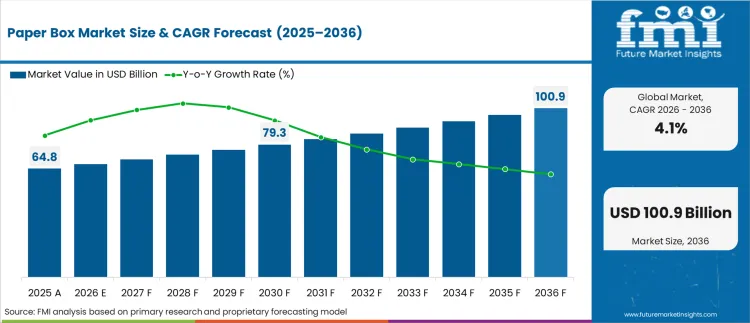
Paper box market is expected to expand from USD 67.59 billion in 2026 to USD 100.9 billion by 2036. The market is anticipated to register a 4.10% CAGR during the forecast period. Slotted box is likely to lead with 33.80% share, while recycled material is projected to account for 57.40% of material demand in 2026.
Summary of the Paper Box Market
- Demand and Growth Drivers
- E-commerce fulfillment is raising demand for standardized transit boxes.
- Plastic substitution is shifting brand packaging toward fiber-based formats.
- Warehouse automation requires boxes with consistent dimensions and stable scoring.
- Food and healthcare packaging demand favors recyclable protective formats.
- Local converting capacity is becoming important for shorter delivery cycles.
- Product and Segment View
- Slotted boxes lead because they suit automated case forming lines.
- Recycled paper boxes gain preference through sustainability commitments.
- Single wall board remains widely used for standard consumer goods.
- Liner grades support branding through clean print surfaces.
- Die cut formats gain use where product fit and display appeal matter.
- Geography and Competitive Outlook
- Asia Pacific leads growth through retail formalization and export packaging demand.
- India benefits from organized retail growth and domestic logistics upgrades.
- China remains important through manufacturing scale and export shipments.
- North America relies on right-sized boxes for fulfillment automation.
- Europe advances through plastic reduction rules and fiber packaging shifts.
- Analyst Opinion
- Ismail Sutaria notes that paper box demand is moving toward regional supply security, recycled fiber access, and automation-ready design. Converters with integrated paperboard supply and high-precision cutting lines will hold stronger pricing control. Brand owners will prefer suppliers that deliver stable dimensions, verified recycled content, and shorter lead times.
- Market Value Analysis
- Paper box demand is moving from basic shipping use toward engineered packaging formats.
- Growth is likely to rise as fulfillment centers adopt right-sized corrugated inputs.
- Recycled material adoption should improve as retailers tighten sustainability standards.
- Spending is forecast to stay supported by e-commerce, food, and healthcare packaging needs.
Key Takeaways, Market Size, and Forecast
- Paper box demand is valued at USD 67.59 billion in 2026.
- By 2036, the market is projected to reach USD 100.9 billion.
- Sales are anticipated to expand at 4.10% CAGR from 2026 to 2036.
- Slotted box is likely to lead the product segment with 33.80% share in 2026.
- Recycled material is estimated to dominate with 57.40% share in 2026.
- Single wall board is forecast to account for 52.70% share in 2026.
- Liner paperboard is likely to hold 61.30% share in 2026.
- India is projected to record the fastest growth at 5.30% CAGR through 2036.
Paper Box Market Definition
Structural containment units formed from cellulosic fiber matrices. Manufacturers utilize folding, die-cutting, and gluing processes to convert flat board into functional 3D enclosures. Product specifications range from lightweight single-face cartons to heavy-duty triple-wall transit cases. Common applications include protective shipping, retail display, and direct consumer delivery.
Paper Box Market Inclusions
Scope encompasses solid bleached sulfate cartons, folding rigid boxes, corrugated slotted containers, and multi-depth fulfillment formats. Specialty configurations like insulated fiber shippers and paperboard mailers are included. Printed and unprinted variants fall under analysis.
Paper Box Market Exclusions
Scope excludes flexible paper pouches, woven paper sacks, and liquid paperboard aseptic cartons. Unconverted flat paperboard reels and molded pulp trays without box geometry fall outside analytical boundaries. Plastic-lined hybrid containers exceeding 50% non-fiber mass remain omitted.
Paper Box Market Research Methodology
- Primary Research: Direct interviews with paper mill managers, corrugated converting facility directors, and retail packaging engineers provided baseline pricing and capacity utilization metrics.
- Desk Research: Custom import/export datasets from national forestry ministries, corporate capacity announcements, and patent filings substantiated regional supply flow models.
- Market-Sizing and Forecasting: Analysts developed a bottom-up adoption model starting from regional containerboard production volumes, applying historical conversion yield ratios to project available box tonnage.
- Data Validation and Update Cycle: Findings underwent cross-verification against official regulatory import logs and peer-reviewed material science journals before final forecast integration.
Segmental Analysis
Paper Box Market Analysis by Product
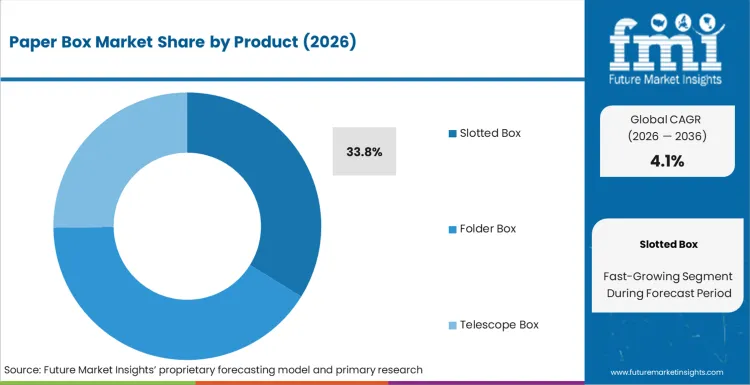
Slotted Box variations command 33.80% of 2026 volumes, reflecting logistical necessities across global trade. Symmetrical flap designs minimize material waste during rotary die-cutting, maximizing yield per square meter. Continuous paper boxes demand requires structural consistency for automated case erectors. To secure resilient supply, Smurfit Westrock announced a USD 19.3 million expansion at a Saltillo corrugated plant [3]. Brands utilizing high-speed packing lines reject non-standard formats, locking suppliers into rigid dimensional tolerances.
- Technical validation: Automated tape‑sealing systems perform with maximum reliability when paired with dimensionally consistent slotted box designs, ensuring stable flap alignment and uninterrupted high‑speed packaging operations.
- Procurement shift: Procurement teams increasingly prioritize universally standardized container formats, enabling streamlined vendor qualification, reduced line changeover time, and predictable supply continuity across distributed manufacturing networks.
- Product innovation: Reinforced corner architectures significantly enhance compression strength, preventing structural deformation and product damage during extended multi‑modal freight cycles.
Paper Box Market Analysis by Material
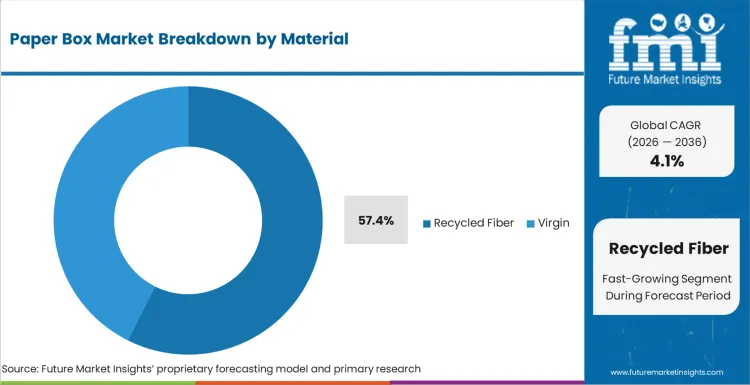
Recycled fiber holds a dominant 57.40% share in 2026. Secondary material integration satisfies aggressive sustainability pledges. Fibre Box Association statistics confirm corrugated packaging achieves recycling rates spanning 69 to 74 %, establishing true circularity [4]. Regulatory bodies mandate post-consumer content quotas, forcing converters to adapt machinery for shorter-fiber linerboard. Paper and paper-board packaging formats built on recovered material gain preferential retailer shelf placement.
- Dietary compliance: Recycled grades undergo advanced purification for indirect food contact approval.
- Cost structures tighten when waste paper collection infrastructure experiences localized shortfalls.
- Logistics advantage: Closed-loop recovery systems allow retailers to backhaul used boxes directly to partner mills.
Paper Box Market Analysis by Board Type
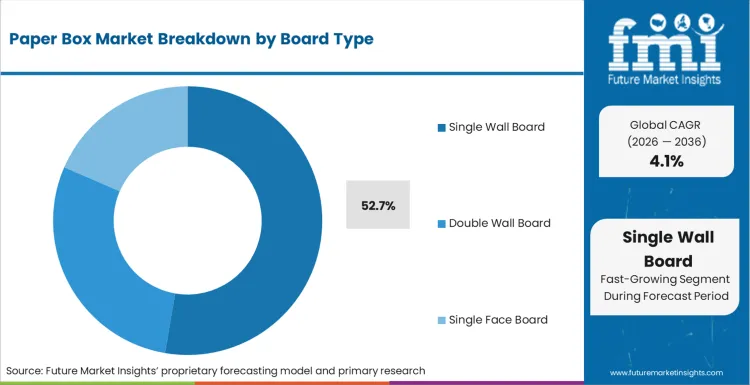
Single Wall Board captures 52.70% segment share. Fluted mediums sandwiched between two flat liners offer optimal strength-to-weight ratios for standard consumer goods. Shippers balance compression resistance against freight mass penalties. DS Smith invested EUR 34 million into strategic capacity expansion at a Hungarian facility [5]. Exploring advanced corrugated boxes, procurement teams specify exact flute profiles to match internal product fragility profiles.
- Shelf stability: Vertical flute orientation prevents structural collapse under warehouse stacking pressure.
- Adoption accelerates where lightweighting initiatives target excess transit packaging.
- Requalification cycles lengthen as custom flute recipes require extensive drop-testing protocols.
Paper Box Market Analysis by Grade Type
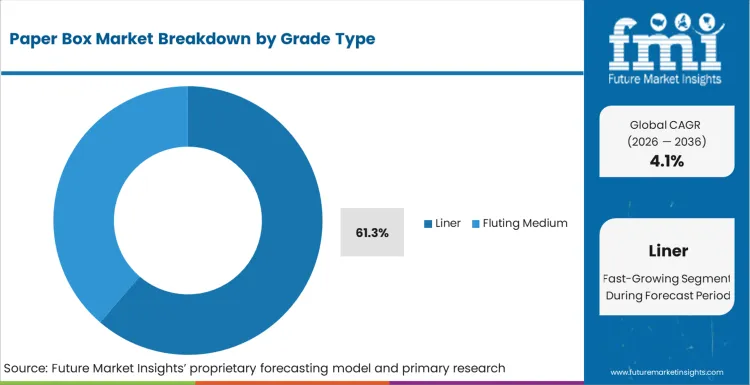
Liner paperboard commands 61.30% in 2026. Smooth outer surfaces facilitate high-resolution flexographic printing. Brand owners rely on superior printability for shelf impact. European production of packaging grades remained virtually unchanged at a 0.2% increase in 2025 [6]. A steady output enables uninterrupted supply for premium boxboard packaging applications. Printing press operators reject liner batches exhibiting surface porosity variations.
- Process compatibility: Consistent moisture profiles prevent board warp during high-speed corrugating.
- Volume concentration narrows to specialized mills capable of producing ultra-white top liner.
- Supplier positioning improves as proprietary coatings enhance water resistance without compromising recyclability.
Paper Box Market Drivers, Restraints, and Opportunities
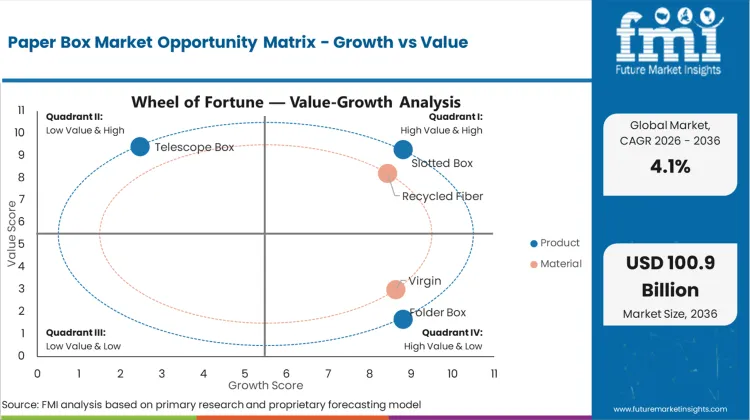
Circular economy legislation forces widespread material substitution across retail sectors. Regulators ban expanded polystyrene transit protectors, compelling shippers toward fiber-based configurations. High-performance corrugated solutions replace fossil-derived foam, achieving identical impact resistance. American Forest & Paper Association reports show USA paper and paperboard production increased 3.2% in 2024 [7]. Increased mill output ensures converters have sufficient raw board to meet escalating substitution mandates.
Margin compression from fluctuating recovered paper costs restricts rapid capacity expansion for independent converters. Used fiber collection rates vary seasonally, causing volatile input pricing. USA Census Bureau November 2025 data listed manufacturers' shipments of paperboard containers at USD 8,171 million, reflecting tight volume controls to preserve margins [8]. Integrated manufacturers mitigate price shocks through internal recovery networks, leaving non-integrated box makers exposed to spot market premiums.
- E-commerce Optimization: Direct-to-consumer fulfillment models demand variable-depth containers to eliminate void fill waste. Packaging Corporation of America acquired Greif’s containerboard assets, expanding integrated operations to serve evolving retail architectures [9].
- Premiumization: Luxury brands require flawless graphical reproduction on tactile uncoated substrates. Stora Enso introduced Ensovelvet, an uncoated premium paperboard tailored for high-end cosmetic enclosures [10].
- Capacity Localization: Shortening supply chains reduces vulnerability to international freight disruption. Saica Group announced investment in a new USA paper mill, commencing operations in Q4 2026 [11].
Regional Market Analysis
Based on the regional analysis, the Paper Box market is segmented into North America, Latin America, Europe, East Asia, South Asia, Oceania and Middle East & Africa across 40+ countries. The full report also offers market attractiveness analysis based on regional trends.
.webp "Top Country Growth Comparison Paper Box Market Cagr (2026 2036)")
| Country | CAGR (2026 to 2036) |
|---|---|
| India | 5.30% |
| China | 4.40% |
| USA | 3.10% |
| Japan | 2.90% |
| France | 1.90% |
| UK | 1.80% |
| Germany | 1.50% |
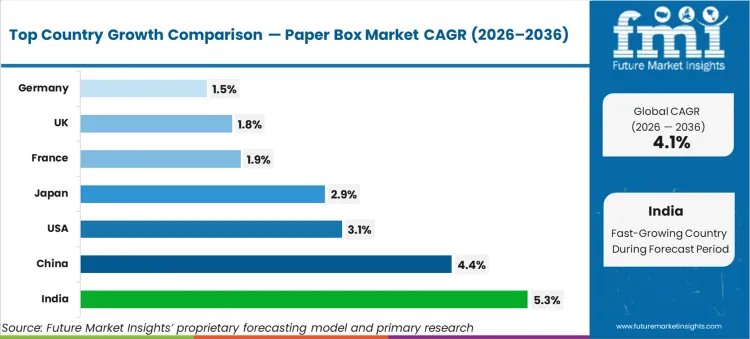
Source: Future Market Insights (FMI) analysis, based on proprietary forecasting model and primary research
Asia Pacific Paper Box Market Analysis
Manufacturing hubs across Asian territories dictate immense secondary packaging consumption. Export-oriented economies consume vast quantities of transit cases to protect goods bound for Western markets. IBEF reports Indian paper packaging reached USD 19.07 billion in August 2025 [12]. Surging domestic retail infrastructure compounds baseline export demands. Facility upgrades focus on high-speed automation. Regional converters lacking modern rotary die-cutters struggle to match output requirements set by multinational electronics brands.
- India: An expanding organized retail sector demands standardized protective enclosures. Demand is set for a 5.30% CAGR as domestic supply chains modernize. While multinational capital flows into Europe, such as DS Smith's EUR 25 million Polish investment [13], India based converters are replicating these exact high-speed automation templates locally. Brands require robust distribution packaging to navigate complex domestic logistics networks.
- China: Export volumes necessitate reliable transit protection. A CAGR of 4.40% is projected for paper boxes in China through 2036, anchored by global manufacturing dominance. Global manufacturers evaluate trade baselines, with USA October 2025 paperboard container shipments at USD 8,220 million acting as a closely watched export benchmark [14]. Local converting plants must adhere to strict international bursting strength standards.
- Japan: Aging demographics accelerate demand for easy-open, lightweight fulfillment solutions. Japan expects a 2.90% CAGR trajectory. Local operators observe global supply adjustments, such as USA December 2025 paperboard container shipments hitting USD 8,103 million [15], signaling potential global pulp price shifts. Electronics manufacturers specify pristine micro-flute materials for retail displays.
FMI’s report presents a granular view of Asia’s rapidly diversifying converting ecosystem, highlighting how South Korea and Indonesia are accelerating infrastructure upgrades to compete with China and India. South Korea’s emphasis on ultra‑high‑precision board converting equipment contrasts with Indonesia’s focus on scaling recycled‑fiber collection systems, creating two distinct development paths within the region.
North America Paper Box Market Analysis
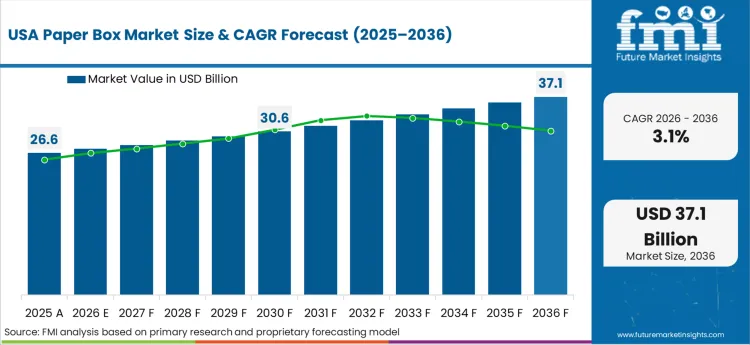
Warehouse automation requires absolutely precise dimensional tolerances. Robotic palletizers malfunction if corrugated cases display warping or inaccurate scoring lines. Paperboard Packaging Council projects North America market’s folding carton demand to grow 0.8% annually through 2029 [16]. Capitalizing on consistent revenue flows, America integrated producers acquire regional specialists. Supplier consolidation forces mid-tier brands to renegotiate long-term paperboard mailer contracts to avoid sudden stockouts.
- USA: E-commerce fulfillment algorithms dictate carton right-sizing. USA paper box sales are projected to rise at a CAGR of 3.10%. Smurfit Westrock completed expansion of production capacity at its Lee County facility targeting full operation by 2026 [17], ensuring steady supply lines. Logistics managers penalize vendors providing out-of-spec containers that jam automated sorting conveyors.
FMI’s analysis of North American markets extends beyond the USA to include Canada and Mexico, where integrated supply chains strengthen regional box availability for cross‑border manufacturing corridors. Canada’s emphasis on sustainable forestry‑based fiber inputs complements Mexico’s role as a high‑volume assembly hub supplying durable corrugated formats to maquiladora operations.
Europe Paper Box Market Analysis
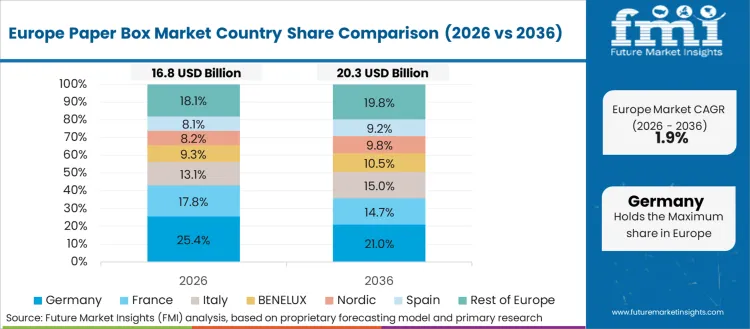
Aggressive plastic reduction mandates force rapid material substitution. Supermarket chains penalize brands utilizing non-recyclable secondary wrappers, mandating fiber alternatives. International Paper announced plans in January 2026 to create two independent publicly traded companies, spinning off its EMEA Packaging operations [18]. Mega-mergers reshape continental pricing dynamics. Independent buyers must secure paper goods allocations well before peak holiday seasons to avoid engineered scarcity premiums.
- France: Circular economy laws prohibit single-use plastic produce trays. France's paper box sector is poised to expand at a 1.90% CAGR. Mayr-Melnhof Karton AG completed the divestiture of its MM Packaging Leeuwarden operations [19], signaling corporate shifts toward high-efficiency regional alignments. Producers mandate entirely fiber-based solutions to clear rigorous compliance audits.
- UK: Retailers require shelf-ready designs to minimize store labor costs. Over the forecast period, paper boxes in UK are set for a 1.80% CAGR. UK Office for National Statistics reported PPI index output for corrugated containers showed stability through December 2025 [20]. Procurement teams lock in predictable pricing contracts based on these steady indexes.
- Germany: Heavy industrial exports demand maximum-strength triple-wall configurations. Germany is expected to see its paper box sector grow at 1.50% annually. Mondi completed Schumacher Packaging's Western European assets acquisition [21]. Automotive parts suppliers must partner with well-capitalized converters capable of meeting exacting strength specifications.
FMI’s report expands European coverage to include Italy and Spain, highlighting how southern markets are moving aggressively toward molded fiber transit inserts to comply with stringent polystyrene bans. Italy’s engineering‑driven converting sector focuses on premium folding carton aesthetics, while Spain’s producers concentrate on scalable corrugated formats for agricultural exports.
Competitive Aligners for Market Players
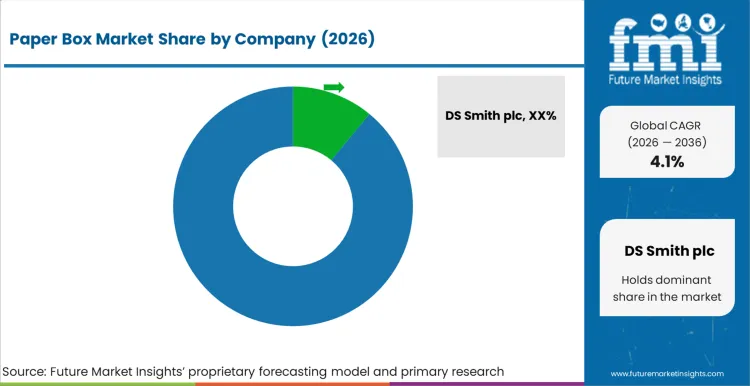
Winning share over the next decade will hinge on how well paper box producers synchronize three levers, scale, technology, and localization, around recycled‑fiber availability and automation‑ready design. Players that align these pillars convert volatility into repeatable margins and durable customer lock‑in.
Scale Through Purposeful Consolidation: Targeted M&A expands both capacity and geographic reach, creating integrated networks that balance recycled linerboard supply with converting throughput. Scale improves input bargaining power, evens out recovered‑fiber cost shocks, and enables multi‑year, multi‑site contracts with brand owners seeking uniform specs across regions. The integration mandate is clear: standardize specifications, harmonize quality systems, and centralize capex planning so every acquired site can run automation‑compatible, right‑sized formats without exception.
Technology as the Margin Wedge: Capital deployed to precision converting (high‑tolerance die‑cutting, fanfold for right‑sizing), high‑speed case‑erection compatibility, and inline/digital print becomes self‑funding via higher line uptime and lower waste. Functional, water‑based barrier systems applied directly to board enable fully recyclable monomaterial enclosures that displace plastic laminates while maintaining food‑contact compliance. The outcome is not only better unit economics but also spec leadership, boxes that run faster, print cleaner, and pass stricter sustainability audits.
Localization as a Service Advantage: A denser lattice of regional plants and quick‑response hubs cuts lead times, reduces freight emissions, and cushions disruption. For e‑commerce and omnichannel accounts, localization unlocks short runs, rapid SKU switches, and on‑demand right‑sizing, all without sacrificing dimensional consistency. Buyers increasingly weight awards toward suppliers that can prove OTIF reliability, fewer conveyor jams, and lower CO₂ per shipment, making proximity a commercial differentiator rather than a cost line.
Implications for Independents: Independent converters avoid margin squeeze by choosing a lane: (a) specialize in niches, micro‑flute premium displays, high‑graphic folding cartons, insulated fiber shippers, or (b) out‑compete on speed with 48-72‑hour replenishment SLAs, collaborative forecast sharing, and vendor‑managed inventory. Partnerships with mills, OEMs, and logistics providers can replicate scale benefits without balance‑sheet strain.
What buyers will pay for?
Procurement teams are consolidating spend with vendors who deliver automation‑ready dimensional control, verified PCR/recycled content, and documented emissions reduction. Where two offers price similarly, the tie‑break moves to line stability, regional coverage, and audit‑ready sustainability data.
Executive action checklist (next 12-18 months):
- Codify a single spec library (flute profiles, scoring tolerances, moisture windows) aligned to high‑speed tape‑sealing and case‑erector requirements.
- Sequence capex into right‑sizing, fanfold, and inline print/barrier capabilities that remove plastic films and reduce void fill.
- Build a regional hub‑and‑spoke footprint to guarantee <5‑day lead‑time coverage for top accounts while cutting freight miles.
- Lock recycled fiber via supply agreements and backhaul programs with retailers to stabilize input costs.
- Quantify value in buyer language: uptime gains, jam‑rate reductions, CO₂ per shipment, and verified post‑consumer content.
- Prepare an integration playbook (for acquirers) or a co‑manufacturing framework (for independents) to expand capacity without quality drift.
Recent Developments:
The report includes full coverage of key trends from competitive benchmarking. Some of the recent developments covered in the reports:
- In January 2026, International Paper announced plans to create two independent publicly traded companies, spinning off its EMEA Packaging operations. [25]
- In late 2025, Smurfit Westrock completed expansion of production capacity at its Lee County, Mississippi facility to serve evolving North American retail networks. [26]
- In April 2025, Mondi completed the acquisition of Schumacher Packaging's Western European assets to strengthen its regional corrugated packaging portfolio. [27]
Key Players in Paper Box Market
- DS Smith plc
- Robinson Plc
- Huhtamäki Oyj
- Smurfit Kappa Group Plc
- Stora Enso Oyj
- WestRock Company
- Mayr-Melnhof Karton AG
- International Paper
- Packaging Corporation of America
- Pratt Industries
Scope of the Report
| Metric | Value |
|---|---|
| Quantitative Units | USD 67.59 billion to USD 100.9 billion, at a CAGR of 4.10% |
| Market Definition | Structural containment units formed from cellulosic fiber matrices. |
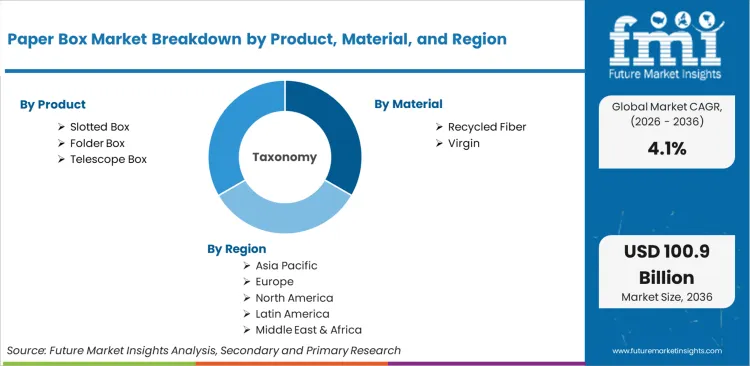
| Product Segmentation | Slotted Box, Folder Box, Telescope Box, Die Cut Box |
| Material Segmentation | Recycled, Virgin |
| Board Type Segmentation | Single Wall Board, Double Wall Board, Single Face Board, Triple Wall Board |
| Grade Type Segmentation | Liner, Fluting Medium |
| Regions Covered | North America, Latin America, Europe, East Asia, South Asia, Oceania, Middle East & Africa |
| Countries Covered | USA, Canada, Mexico, Brazil, Argentina, Germany, France, UK, Italy, Spain, China, India, Japan, South Korea, Indonesia, Australia and 40 plus countries |
| Key Companies Profiled | DS Smith plc, Robinson Plc, Huhtamäki Oyj, Smurfit Kappa Group Plc, Stora Enso Oyj |
| Forecast Period | 2026 to 2036 |
| Approach | Hybrid top-down and bottom-up market modeling validated through primary interviews with extraction managers and commodity traders, supported by trade data benchmarking. |
Source: Future Market Insights (FMI) analysis, based on proprietary forecasting model and primary research
Paper Box Market Analysis by Segments
Product:
- Slotted Box
- Folder Box
- Telescope Box
- Die Cut Box
Material:
- Recycled
- Virgin
Board Type:
- Single Wall Board
- Double Wall Board
- Single Face Board
- Triple Wall Board
Grade Type:
- Liner
- Fluting Medium
End Use:
- Food
- Beverages
- eCommerce
- Healthcare
- Others
Region:
- Asia Pacific
- India
- China
- Japan
- South Korea
- Indonesia
- Australia & New Zealand
- ASEAN
- Rest of Asia Pacific
- Europe
- Germany
- Italy
- France
- United Kingdom
- Spain
- Benelux
- Nordics
- Central & Eastern Europe
- Rest of Europe
- North America
- United States
- Canada
- Mexico
- Latin America
- Brazil
- Argentina
- Chile
- Rest of Latin America
- Middle East & Africa
- Kingdom of Saudi Arabia
- United Arab Emirates
- South Africa
- Turkey
- Rest of Middle East & Africa
Bibliography
- [1] Pratt Industries. (2025). Pratt Industries opens new Georgia plant (Press release).
- [2] Orwakbalers. (2021, March 25). Box boom gives upsurge in demand for cardboard.
- [3] Smurfit Westrock. (2025, October). Smurfit Westrock expanding in Saltillo (Press release).
- [4] Fibre Box Association. (2025). Life cycle assessments (Industry report).
- [5] DS Smith. (2024, November). Hungary 34m strategic investment (Press release).
- [6] Cepi. (2026, February). Preliminary statistics 2025 (Statistical database entry).
- [7] American Forest & Paper Association. (2025, March). AF&PA details US paper production and capacity trends (Industry report).
- [8] USA Census Bureau. (2025, November). Manufacturers' shipments of paperboard containers report (Statistical database entry).
- [9] Packaging Corporation of America. (2025). PCA acquires Greif containerboard assets (Press release).
- [10] Stora Enso. (2025, September). Stora Enso introduces Ensovelvet (Press release).
- [11] Saica Group. (2025). Saica invests in new US mill (Press release).
- [12] India Brand Equity Foundation. (2025, August). Paper packaging industry report (Government report).
- [13] DS Smith. (2024, November). Polish 25m investment (Press release).
- [14] USA Census Bureau. (2025, October). Manufacturers' shipments October 2025 (Statistical database entry).
- [15] USA Census Bureau. (2025, December). Manufacturers' shipments December 2025 (Statistical database entry).
- [16] Paperboard Packaging Council. (2025). 2025-26 Trends Report (Industry report).
- [17] Smurfit Westrock. (2025). Smurfit Westrock expanding production capacity in Lee County (Press release).
- [18] International Paper. (2026, January). International Paper to create two independent public companies (Press release).
- [19] Mayr-Melnhof Karton AG. (2025). Mayr-Melnhof Karton AG divests MM Packaging Leeuwarden (Press release).
- [20] UK Office for National Statistics. (2025, December). PPI index output (Government report).
- [21] Mondi. (2025, April). Mondi completes acquisition of Schumacher Packaging (Press release).
- [22] PaperTech. (2025). PaperTech acquires Bake-Best Trays (Press release).
- [23] Huhtamaki. (2025). Huhtamaki expands molded fiber capacity (Press release).
- [24] Stora Enso. (2025, August). Stora Enso’s billion-euro investment in renewable packaging inaugurated (Press release).
- [25] International Paper. (2026, January). International Paper to create two independent public companies (Press release).
- [26] Smurfit Westrock. (2025). Smurfit Westrock expanding production capacity in Lee County (Press release).
- [27] Mondi. (2025, April). Mondi completes acquisition of Schumacher Packaging (Press release).
This bibliography is provided for reader reference and is not exhaustive. The full report contains the complete reference list and detailed citations.
This Report Addresses
- Market intelligence to enable structured strategic decision-making across global paper box portfolios, including both established material categories and emerging bio-based innovation segments.
- Market size estimation and 10-year revenue forecasts from 2026 to 2036 for primary packaging applications, supported by validated production capacity data and conversion manufacturing benchmarks.
- Growth opportunity mapping across folding cartons and corrugated containers, with focus on e-commerce fulfillment and automated handling formats as value-driving differentiators.
- Segment and regional revenue forecasts covering major consumer categories including food processing, beverage distribution, and healthcare packaging, structured by material and board type geometries.
- Competition strategy assessment including corporate acquisition tracking, mill integration mapping, and positioning of key players such as DS Smith plc and WestRock Company.
- Supply chain vulnerability assessment identifying recycled fiber concentration risks, containerboard logistics dependencies, and conversion capacity bottlenecks across high-growth zones.
- Regulatory impact analysis covering European eco-modulation frameworks, plastic substitution mandates, and their direct effect on approved retail supplier lists.
- Market report delivery in PDF, Excel, PPT, and interactive dashboard formats for executive and operational use, providing actionable insights for brand owners and procurement directors.
Frequently Asked Questions
How large is the demand for Paper Box in the global market in 2026?
Demand for Paper Box in global markets is estimated to be valued at USD 67.59 Billion in 2026.
What will be the market size of Paper Box in the global market by 2036?
Market size for Paper Box is projected to reach USD 83.1 Billion by 2036.
What is the expected demand growth for Paper Box in the global market between 2026 and 2036?
Demand for Paper Box is expected to grow at a CAGR of 4.10% between 2026 and 2036.
Which Product is poised to lead global sales by 2026?
Slotted Box commands 33.80% of total segment share in 2026 as manufacturers prioritize standard automation dimensions.
How significant is the role of Recycled Material in driving Paper Box adoption in 2026?
Recycled formats represent 57.40% of segment share as brands replace virgin fiber structures to meet corporate sustainability goals.
What is driving demand in India?
Organized retail penetration and extensive e-commerce supply chain modernization drive functional enclosure adoption.
What compliance standards or regulations are referenced for India?
Quality standards governing transit strength and burst resistance directly influence domestic procurement behavior.
What is the India growth outlook in this report?
India is projected to grow at a CAGR of 5.30% during 2026 to 2036.
Why is North America described as a priority region in this report?
E-commerce volume surges and robust warehouse automation deployment accelerate structural corrugated demand.
What type of demand dominates in North America?
Variable-depth fulfillment containers and automated right-sizing configurations dominate regional formulation demand.
What is China growth outlook in this report?
China is projected to expand at a CAGR of 4.40% during 2026 to 2036.
Does the report cover USA in its regional analysis?
Yes, USA is included within North America under regional scope analysis.
What are the sources referred to for analyzing USA?
Official production data from American Forest & Paper Association and corporate capacity announcements form analytical baselines.
What is the main demand theme linked to USA in its region coverage?
Automated warehouse compatibility and high-speed fulfillment optimization shape continuous procurement demand.
Does the report cover France in its regional analysis?
Yes, France is included within Europe under regional coverage frameworks.
What is the main France related demand theme in its region coverage?
Aggressive plastic substitution mandates and agricultural cooperative shifts toward moisture-resistant corrugated flats dominate regional buyer behavior.
Which product formats or configurations are strategically important for Europe supply chains?
Fully recyclable monomaterial enclosures eliminating secondary plastic films hold immense strategic importance.
What is a Paper Box and what is it mainly used for?
Structural containment units formed from cellulosic fiber matrices utilized primarily in protective shipping and retail display.
What does Paper Box mean in this report?
Scope refers to global production, trade, and industrial consumption of converted paperboard enclosures.
What is included in the scope of this Paper Box report?
Scope includes folding cartons, corrugated containers, insulated shippers, and paperboard mailers.
What is excluded from the scope of this report?
Flexible paper pouches, unconverted paperboard reels, and plastic-lined hybrid containers exceeding 50% non-fiber mass are excluded.
What does market forecast mean on this page?
Market forecasts represent model-based projections built on defined industrial capacity and conversion yield assumptions for strategic planning purposes.
How does FMI build and validate the Paper Box forecast?
Forecasts combine containerboard production volumes with bottom-up conversion ratios, validated by primary facility manager interviews.
What does zero reliance on speculative third party market research mean here?
Primary interviews, verified corporate announcements, and official governmental datasets are used exclusively instead of unverified syndicated estimates.
Preview the report firsthand - request a free sample
Get SampleGet the brochure for pricing and purchase details.
Get PDFTable of Content
- Executive Summary
- Global Market Outlook
- Demand-side Trends
- Supply-side Trends
- Technology Roadmap Analysis
- Analysis and Recommendations
- Market Overview
- Market Coverage / Taxonomy
- Market Definition / Scope / Limitations
- Research Methodology
- Chapter Orientation
- Analytical Lens and Working Hypotheses
- Market Structure, Signals, and Trend Drivers
- Benchmarking and Cross-market Comparability
- Market Sizing, Forecasting, and Opportunity Mapping
- Research Design and Evidence Framework
- Desk Research Programme (Secondary Evidence)
- Company Annual and Sustainability Reports
- Peer-reviewed Journals and Academic Literature
- Corporate Websites, Product Literature, and Technical Notes
- Earnings Decks and Investor Briefings
- Statutory Filings and Regulatory Disclosures
- Technical White Papers and Standards Notes
- Trade Journals, Industry Magazines, and Analyst Briefs
- Conference Proceedings, Webinars, and Seminar Materials
- Government Statistics Portals and Public Data Releases
- Press Releases and Reputable Media Coverage
- Specialist Newsletters and Curated Briefings
- Sector Databases and Reference Repositories
- FMI Internal Proprietary Databases and Historical Market Datasets
- Subscription Datasets and Paid Sources
- Social Channels, Communities, and Digital Listening Inputs
- Additional Desk Sources
- Expert Input and Fieldwork (Primary Evidence)
- Primary Modes
- Qualitative Interviews and Expert Elicitation
- Quantitative Surveys and Structured Data Capture
- Blended Approach
- Why Primary Evidence is Used
- Field Techniques
- Interviews
- Surveys
- Focus Groups
- Observational and In-context Research
- Social and Community Interactions
- Stakeholder Universe Engaged
- C-suite Leaders
- Board Members
- Presidents and Vice Presidents
- R&D and Innovation Heads
- Technical Specialists
- Domain Subject-matter Experts
- Scientists
- Physicians and Other Healthcare Professionals
- Governance, Ethics, and Data Stewardship
- Research Ethics
- Data Integrity and Handling
- Primary Modes
- Tooling, Models, and Reference Databases
- Desk Research Programme (Secondary Evidence)
- Data Engineering and Model Build
- Data Acquisition and Ingestion
- Cleaning, Normalisation, and Verification
- Synthesis, Triangulation, and Analysis
- Quality Assurance and Audit Trail
- Market Background
- Market Dynamics
- Drivers
- Restraints
- Opportunity
- Trends
- Scenario Forecast
- Demand in Optimistic Scenario
- Demand in Likely Scenario
- Demand in Conservative Scenario
- Opportunity Map Analysis
- Product Life Cycle Analysis
- Supply Chain Analysis
- Investment Feasibility Matrix
- Value Chain Analysis
- PESTLE and Porter’s Analysis
- Regulatory Landscape
- Regional Parent Market Outlook
- Production and Consumption Statistics
- Import and Export Statistics
- Market Dynamics
- Global Market Analysis 2021 to 2025 and Forecast, 2026 to 2036
- Historical Market Size Value (USD Billion) Analysis, 2021 to 2025
- Current and Future Market Size Value (USD Billion) Projections, 2026 to 2036
- Y-o-Y Growth Trend Analysis
- Absolute $ Opportunity Analysis
- Global Market Pricing Analysis 2021 to 2025 and Forecast 2026 to 2036
- Global Market Analysis 2021 to 2025 and Forecast 2026 to 2036, By Product
- Introduction / Key Findings
- Historical Market Size Value (USD Billion) Analysis By Product , 2021 to 2025
- Current and Future Market Size Value (USD Billion) Analysis and Forecast By Product , 2026 to 2036
- Slotted Box
- Folder Box
- Telescope Box
- Slotted Box
- Y-o-Y Growth Trend Analysis By Product , 2021 to 2025
- Absolute $ Opportunity Analysis By Product , 2026 to 2036
- Global Market Analysis 2021 to 2025 and Forecast 2026 to 2036, By Material
- Introduction / Key Findings
- Historical Market Size Value (USD Billion) Analysis By Material, 2021 to 2025
- Current and Future Market Size Value (USD Billion) Analysis and Forecast By Material, 2026 to 2036
- Recycled Fiber
- Virgin
- Recycled Fiber
- Y-o-Y Growth Trend Analysis By Material, 2021 to 2025
- Absolute $ Opportunity Analysis By Material, 2026 to 2036
- Global Market Analysis 2021 to 2025 and Forecast 2026 to 2036, By Board Type
- Introduction / Key Findings
- Historical Market Size Value (USD Billion) Analysis By Board Type, 2021 to 2025
- Current and Future Market Size Value (USD Billion) Analysis and Forecast By Board Type, 2026 to 2036
- Single Wall Board
- Double Wall Board
- Single Face Board
- Single Wall Board
- Y-o-Y Growth Trend Analysis By Board Type, 2021 to 2025
- Absolute $ Opportunity Analysis By Board Type, 2026 to 2036
- Global Market Analysis 2021 to 2025 and Forecast 2026 to 2036, By Grade Type
- Introduction / Key Findings
- Historical Market Size Value (USD Billion) Analysis By Grade Type, 2021 to 2025
- Current and Future Market Size Value (USD Billion) Analysis and Forecast By Grade Type, 2026 to 2036
- Liner
- Fluting Medium
- Liner
- Y-o-Y Growth Trend Analysis By Grade Type, 2021 to 2025
- Absolute $ Opportunity Analysis By Grade Type, 2026 to 2036
- Global Market Analysis 2021 to 2025 and Forecast 2026 to 2036, By Region
- Introduction
- Historical Market Size Value (USD Billion) Analysis By Region, 2021 to 2025
- Current Market Size Value (USD Billion) Analysis and Forecast By Region, 2026 to 2036
- North America
- Latin America
- Western Europe
- Eastern Europe
- East Asia
- South Asia and Pacific
- Middle East & Africa
- Market Attractiveness Analysis By Region
- North America Market Analysis 2021 to 2025 and Forecast 2026 to 2036, By Country
- Historical Market Size Value (USD Billion) Trend Analysis By Market Taxonomy, 2021 to 2025
- Market Size Value (USD Billion) Forecast By Market Taxonomy, 2026 to 2036
- By Country
- USA
- Canada
- Mexico
- By Product
- By Material
- By Board Type
- By Grade Type
- By Country
- Market Attractiveness Analysis
- By Country
- By Product
- By Material
- By Board Type
- By Grade Type
- Key Takeaways
- Latin America Market Analysis 2021 to 2025 and Forecast 2026 to 2036, By Country
- Historical Market Size Value (USD Billion) Trend Analysis By Market Taxonomy, 2021 to 2025
- Market Size Value (USD Billion) Forecast By Market Taxonomy, 2026 to 2036
- By Country
- Brazil
- Chile
- Rest of Latin America
- By Product
- By Material
- By Board Type
- By Grade Type
- By Country
- Market Attractiveness Analysis
- By Country
- By Product
- By Material
- By Board Type
- By Grade Type
- Key Takeaways
- Western Europe Market Analysis 2021 to 2025 and Forecast 2026 to 2036, By Country
- Historical Market Size Value (USD Billion) Trend Analysis By Market Taxonomy, 2021 to 2025
- Market Size Value (USD Billion) Forecast By Market Taxonomy, 2026 to 2036
- By Country
- Germany
- UK
- Italy
- Spain
- France
- Nordic
- BENELUX
- Rest of Western Europe
- By Product
- By Material
- By Board Type
- By Grade Type
- By Country
- Market Attractiveness Analysis
- By Country
- By Product
- By Material
- By Board Type
- By Grade Type
- Key Takeaways
- Eastern Europe Market Analysis 2021 to 2025 and Forecast 2026 to 2036, By Country
- Historical Market Size Value (USD Billion) Trend Analysis By Market Taxonomy, 2021 to 2025
- Market Size Value (USD Billion) Forecast By Market Taxonomy, 2026 to 2036
- By Country
- Russia
- Poland
- Hungary
- Balkan & Baltic
- Rest of Eastern Europe
- By Product
- By Material
- By Board Type
- By Grade Type
- By Country
- Market Attractiveness Analysis
- By Country
- By Product
- By Material
- By Board Type
- By Grade Type
- Key Takeaways
- East Asia Market Analysis 2021 to 2025 and Forecast 2026 to 2036, By Country
- Historical Market Size Value (USD Billion) Trend Analysis By Market Taxonomy, 2021 to 2025
- Market Size Value (USD Billion) Forecast By Market Taxonomy, 2026 to 2036
- By Country
- China
- Japan
- South Korea
- By Product
- By Material
- By Board Type
- By Grade Type
- By Country
- Market Attractiveness Analysis
- By Country
- By Product
- By Material
- By Board Type
- By Grade Type
- Key Takeaways
- South Asia and Pacific Market Analysis 2021 to 2025 and Forecast 2026 to 2036, By Country
- Historical Market Size Value (USD Billion) Trend Analysis By Market Taxonomy, 2021 to 2025
- Market Size Value (USD Billion) Forecast By Market Taxonomy, 2026 to 2036
- By Country
- India
- ASEAN
- Australia & New Zealand
- Rest of South Asia and Pacific
- By Product
- By Material
- By Board Type
- By Grade Type
- By Country
- Market Attractiveness Analysis
- By Country
- By Product
- By Material
- By Board Type
- By Grade Type
- Key Takeaways
- Middle East & Africa Market Analysis 2021 to 2025 and Forecast 2026 to 2036, By Country
- Historical Market Size Value (USD Billion) Trend Analysis By Market Taxonomy, 2021 to 2025
- Market Size Value (USD Billion) Forecast By Market Taxonomy, 2026 to 2036
- By Country
- Kingdom of Saudi Arabia
- Other GCC Countries
- Turkiye
- South Africa
- Other African Union
- Rest of Middle East & Africa
- By Product
- By Material
- By Board Type
- By Grade Type
- By Country
- Market Attractiveness Analysis
- By Country
- By Product
- By Material
- By Board Type
- By Grade Type
- Key Takeaways
- Key Countries Market Analysis
- USA
- Pricing Analysis
- Market Share Analysis, 2025
- By Product
- By Material
- By Board Type
- By Grade Type
- Canada
- Pricing Analysis
- Market Share Analysis, 2025
- By Product
- By Material
- By Board Type
- By Grade Type
- Mexico
- Pricing Analysis
- Market Share Analysis, 2025
- By Product
- By Material
- By Board Type
- By Grade Type
- Brazil
- Pricing Analysis
- Market Share Analysis, 2025
- By Product
- By Material
- By Board Type
- By Grade Type
- Chile
- Pricing Analysis
- Market Share Analysis, 2025
- By Product
- By Material
- By Board Type
- By Grade Type
- Germany
- Pricing Analysis
- Market Share Analysis, 2025
- By Product
- By Material
- By Board Type
- By Grade Type
- UK
- Pricing Analysis
- Market Share Analysis, 2025
- By Product
- By Material
- By Board Type
- By Grade Type
- Italy
- Pricing Analysis
- Market Share Analysis, 2025
- By Product
- By Material
- By Board Type
- By Grade Type
- Spain
- Pricing Analysis
- Market Share Analysis, 2025
- By Product
- By Material
- By Board Type
- By Grade Type
- France
- Pricing Analysis
- Market Share Analysis, 2025
- By Product
- By Material
- By Board Type
- By Grade Type
- India
- Pricing Analysis
- Market Share Analysis, 2025
- By Product
- By Material
- By Board Type
- By Grade Type
- ASEAN
- Pricing Analysis
- Market Share Analysis, 2025
- By Product
- By Material
- By Board Type
- By Grade Type
- Australia & New Zealand
- Pricing Analysis
- Market Share Analysis, 2025
- By Product
- By Material
- By Board Type
- By Grade Type
- China
- Pricing Analysis
- Market Share Analysis, 2025
- By Product
- By Material
- By Board Type
- By Grade Type
- Japan
- Pricing Analysis
- Market Share Analysis, 2025
- By Product
- By Material
- By Board Type
- By Grade Type
- South Korea
- Pricing Analysis
- Market Share Analysis, 2025
- By Product
- By Material
- By Board Type
- By Grade Type
- Russia
- Pricing Analysis
- Market Share Analysis, 2025
- By Product
- By Material
- By Board Type
- By Grade Type
- Poland
- Pricing Analysis
- Market Share Analysis, 2025
- By Product
- By Material
- By Board Type
- By Grade Type
- Hungary
- Pricing Analysis
- Market Share Analysis, 2025
- By Product
- By Material
- By Board Type
- By Grade Type
- Kingdom of Saudi Arabia
- Pricing Analysis
- Market Share Analysis, 2025
- By Product
- By Material
- By Board Type
- By Grade Type
- Turkiye
- Pricing Analysis
- Market Share Analysis, 2025
- By Product
- By Material
- By Board Type
- By Grade Type
- South Africa
- Pricing Analysis
- Market Share Analysis, 2025
- By Product
- By Material
- By Board Type
- By Grade Type
- USA
- Market Structure Analysis
- Competition Dashboard
- Competition Benchmarking
- Market Share Analysis of Top Players
- By Regional
- By Product
- By Material
- By Board Type
- By Grade Type
- Competition Analysis
- Competition Deep Dive
- DS Smith plc
- Overview
- Product Portfolio
- Profitability by Market Segments (Product/Age /Sales Channel/Region)
- Sales Footprint
- Strategy Overview
- Marketing Strategy
- Product Strategy
- Channel Strategy
- Robinson Plc
- Huhtamäki Oyj
- Smurfit Kappa Group Plc
- Stora Enso Oyj
- WestRock Company
- DS Smith plc
- Competition Deep Dive
- Assumptions & Acronyms Used


