

- Market Size (2026)
- USD 342.5 Mn
- Forecast (2036)
- USD 856.6 Mn
- CAGR (2026 to 2036)
- 9.6%
How big is PCIe Clock Buffers Market in 2026?
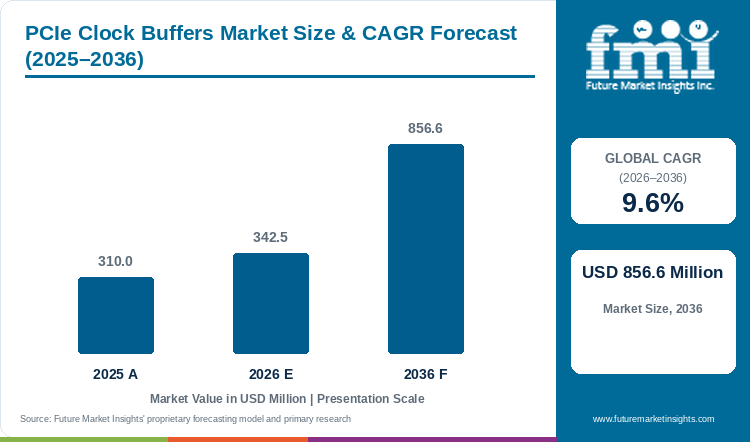
Assessed at USD 310.0 million in 2025 and progressing to USD 342.5 million in 2026, the global PCIe clock buffers market valuation is on course to reach USD 856.6 million by 2036, supported by a forecast-period CAGR of 9.6%.
Hyperscale data center operators are expanding their procurement of standalone PCIe clock buffers because 8-GPU AI training servers and PCIe 6.0 backplanes cannot maintain signal synchronization across dozens of accelerators and NVMe drives using integrated CPU chipset clocks alone. Starting from a 2025 baseline of USD 310.0 million, global PCIe clock buffer industry valuation is projected to reach USD 342.5 million in 2026 while a 9.6% compound annual rate lifts 2036 market size to USD 856.6 million, adding USD 514.1 million in yearly market value. For example, Renesas Electronics updated its 9DBL0252 2-output 3.3V zero-delay and fanout clock buffer specification (Rev. 1.05) in November 2025 to deliver sub-18-femtosecond RMS additive PCIe Gen 6 jitter with direct connection to 85-ohm transmission lines, allowing server designers to preserve SerDes timing margin without external termination passives [1]. Because of these strict timing budgets, cloud server motherboards are expected to direct 48.6% of 2026 additive phase jitter demand toward PCIe Gen 6.0 (<30 fs RMS Additive Jitter) Buffers paired with electronic timing devices.
Key Market Trends & Insights
- By PCIe additive phase jitter spec: Backward-compatible qualification across Gen 5 and Gen 6 server motherboards is forecast to yield a 48.6% share for PCIe Gen 6.0 (<30 fs RMS Additive Jitter) Buffers in 2026.
- By output differential signaling format: Push-pull output drivers that remove up to 80 passive resistors per 20-channel IC are expected to lift Low-Power HCSL (LP-HCSL) Integrated Termination to 67.4% in 2026.
- By output channel fanout count: Intel DB2000QL reference designs fanning 100 MHz clocks across GPUs and NICs are projected to put 12-Output to 20-Output AI Server Baseboard Buffers at 53.2% in 2026.
- By end-use hardware: Synchronous reference-clock trees spanning eight-GPU sleds and CXL 3.0 switches are anticipated to give Multi-GPU AI Servers & CXL Memory Pooling Chassis 56.8% of 2026 demand.
Regional Highlights
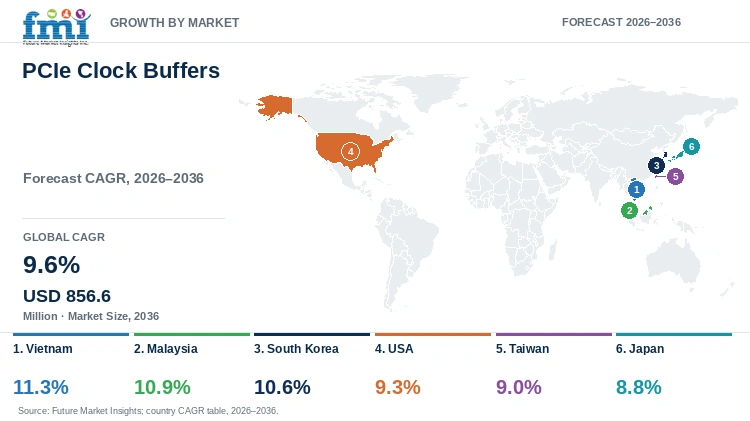
- Top country growth rate: Vietnam is forecast to top national growth rankings at an 11.3% yearly clip through 2036 as AI server motherboard and SmartNIC SMT lines scale across Thai Nguyen and Bac Giang industrial parks.
- Multi-country outlook: Ten-year compound growth is projected at 10.9% in Malaysia and 10.6% in South Korea ahead of 9.3% in the USA, whereas Taiwan (9.0%) and Japan (8.8%) anchor high-channel OEM engineering.
Market Size & Forecast
Table 1: Market Size and Forecast for the PCIe Clock Buffers Market (USD million and CAGR percentage), 2025 to 2036
| Metric | Value |
|---|---|
| 2025 Market Size | USD 310.0 million |
| Estimated Market Size in 2026 | USD 342.5 million |
| Projected Market Size by 2036 | USD 856.6 million |
| CAGR, 2026 to 2036 | 9.6% |
| Added Revenue, 2026 to 2036 | USD 514.1 million |
What is multiplying unit consumption of PCIe clock buffers per server rack is the physical disaggregation of AI server motherboards into separate GPU accelerator sleds and MCIO cable risers with E3.S NVMe storage backplanes. Because each cabled riser and PCIe retimer card requires its own phase-aligned 100 MHz differential reference clock without exceeding the 100-femtosecond PCIe 6.0 system ceiling, hardware architects must cascade multiple low-additive-jitter fanout buffers across the chassis. To capture this multi-stage timing demand, in May 2026, Diodes Incorporated expanded its PCI Express Clock Generator and Buffer IC portfolio across PCIe Gen 6.0 and Gen 7.0 with zero-delay and fanout buffers supporting both spread-spectrum and non-spread-spectrum server and automotive architectures [2]. As a result, server ODMs are bundling high-channel fanout buffers with upstream PLL clock generators on every AI baseboard.
Buffer IC Shipment & Server Clock-Tree Sizing
Table 2: IC Unit Shipment and Clock-Tree Content Sizing for the PCIe Clock Buffers Market (USD million and operational ranges), 2025 to 2036
| Metric | 2025 | 2026 | 2036 |
|---|---|---|---|
| Market size (USD million) | 310.0 | 342.5 | 856.6 |
| PCIe clock buffer ICs shipped globally (million units) | 172.0 to 190.0 | 185.0 to 205.0 | 390.0 to 435.0 |
| Blended average price per buffer IC (USD) | 1.63 to 1.80 | 1.67 to 1.85 | 1.97 to 2.20 |
| PCIe clock buffers per 8-GPU AI server chassis (units) | 6.0 to 8.0 | 7.0 to 9.0 | 10.0 to 14.0 |
Operational note: Server clock-tree ranges reflect primary 19/20-output baseboard DB2000QL buffers paired with secondary 4-to-8-output riser and CXL switch fanout buffers.
Unit shipment and attach-rate figures in Table 2 show that market value expands faster than server unit shipments because the number of PCIe clock buffers installed per 8-GPU server rises from 7 to 9 ICs per chassis in 2026 toward 10 to 14 ICs by 2036, while the shift toward sub-30-femtosecond 20-output devices lifts blended ASPs from USD 1.67 to 1.85 toward USD 1.97 to 2.20. To protect phase lock across these cascaded clock trees under heavy fan vibration, server architects pair zero-delay buffers with MEMS oscillators.
Passive Component Elimination & Jitter Economics
Table 3: Board-Space Savings and Jitter-Tier Indicators for the PCIe Clock Buffers Market (USD and percentages), 2025 to 2036
| Metric | 2025 | 2026 | 2036 |
|---|---|---|---|
| LP-HCSL integrated termination contract share (%) | 63.5% to 66.5% | 66.0% to 69.0% | 84.0% to 88.0% |
| External resistors eliminated per 20-output buffer (count) | 80 resistors | 80 resistors | 80 resistors |
| Clock buffer timing BOM per multi-GPU AI server (USD) | 16.5 to 22.0 | 18.5 to 25.0 | 28.0 to 38.0 |
| Sub-30 fs RMS additive jitter shipment share (%) | 42.0% to 45.5% | 47.0% to 50.0% | 74.0% to 79.0% |
Table 4: Hardware & Channel Fanout Valuation Indicators for the PCIe Clock Buffers Market (USD and percentages), 2026
| Metric | Value | Institutional Reference Basis |
|---|---|---|
| Market size, 2026 | USD 342.5 million | 2026 global clock buffer valuation baseline |
| PCIe 6.0 total system jitter ceiling | < 100 fs RMS | PCI-SIG 64 GT/s PAM4 base specification |
| 20-output DB2000QL package footprint | 6x6 mm to 8x8 mm QFN/LGA | JEDEC / Intel DB2000QL server reference spec |
| Multi-GPU AI server & CXL chassis share, 2026 | 56.8% (USD 194.5 million allocation) | 56.8% end-use hardware segment allocation |
Board-space and BOM benchmarks across Tables 3 and 4 show why server ODMs pay a premium for LP-HCSL buffers: eliminating 80 external termination resistors around each 20-output DB2000QL chip lowers surface-mount assembly costs and frees top-layer PCB escape routing into PCIe interconnect hardware.
Analyst Perspective
"At 64 GT/s PAM4 and 128 GT/s PCIe 7.0 signaling rates, reference-clock phase noise directly dictates SerDes eye margin across multi-GPU AI clusters. Timing IC suppliers that combine sub-25-femtosecond additive jitter with integrated 85-ohm LP-HCSL termination and Sideband Interface control will dominate hyperscale server baseboard bills of materials."
- Sudip Saha, Principal Consultant, Future Market Insights.
How is the PCIe clock buffers market segmented?
The PCIe clock buffers market is segmented by PCIe additive phase jitter spec, output differential signaling format, output channel fanout count, end-use hardware, and region. In 2026, PCIe Gen 6.0 (<30 fs RMS Additive Jitter) Buffers are expected at 48.6%, Low-Power HCSL (LP-HCSL) Integrated Termination is estimated at 67.4%, 12-Output to 20-Output AI Server Baseboard Buffers are projected at 53.2%, and Multi-GPU AI Servers & CXL Memory Pooling Chassis are forecast at 56.8%.
By PCIe additive phase jitter spec: PCIe Gen 6.0 (<30 fs RMS Additive Jitter) Buffers, PCIe Gen 5.0 (<50 fs RMS) Server Fanout Buffers, PCIe Gen 4.0 Automotive & Industrial Grade Buffers, and Others.
By output differential signaling format: Low-Power HCSL (LP-HCSL) Integrated Termination, Standard HCSL (85Ω / 100Ω) External Resistor, and Others.
By output channel fanout count: 12-Output to 20-Output AI Server Baseboard Buffers, 4-Output to 8-Output Riser, NIC & Storage Card Buffers, 2-Output Compact Edge & Automotive SoC Buffers, and Others.
By end-use hardware: Multi-GPU AI Servers & CXL Memory Pooling Chassis, Enterprise NVMe All-Flash Storage Arrays, Automotive Zonal ADAS Central Compute, and Others.
Why do PCIe Gen 6.0 (<30 fs RMS Additive Jitter) Buffers lead the PCIe additive phase jitter spec segment?
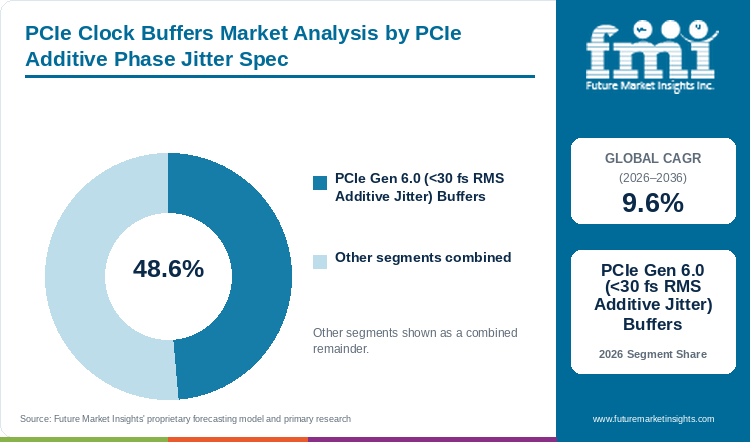
Sub-30-femtosecond root-sum-square timing margins across server backplanes are slated to assign 48.6% of the PCIe additive phase jitter spec segment to PCIe Gen 6.0 (<30 fs RMS Additive Jitter) Buffers in 2026.
Table 5: PCIe Additive Phase Jitter Spec Share for the PCIe Clock Buffers Market (percentage share), 2026
| PCIe Additive Phase Jitter Spec | Share (2026) |
|---|---|
| PCIe Gen 6.0 (<30 fs RMS Additive Jitter) Buffers | 48.6% |
| Other Segments Combined | 51.4%* |
| Total | 100.0% |
*Calculated as the balance remaining after deducting the leading segment's reported share from 100.0%.
Table 6: PCIe Additive Phase Jitter Spec Leadership and Market Growth for the PCIe Clock Buffers Market (segment and CAGR percentage), 2026 to 2036
| Metric | Value |
|---|---|
| Global CAGR (2026 to 2036) | 9.6% |
| Leading Segment | PCIe Gen 6.0 (<30 fs RMS Additive Jitter) Buffers |
Demand for PCIe Gen 6.0 (<30 fs RMS) clock buffers exceeds actual Gen 6 CPU shipment volumes in 2026 because Taiwanese and U.S. server ODMs are qualifying a single sub-30-femtosecond buffer SKU across both PCIe Gen 5 and Gen 6 motherboards to consolidate component inventory and widen SerDes eye margins over long MCIO cables. Because additive buffer jitter combines via root-sum-square with the reference oscillator, holding buffer noise below 25 femtoseconds allows hardware engineers to use lower-cost precision crystal and MEMS oscillators without violating the 100-femtosecond system ceiling.
- Drop-in pin compatibility with Intel DB2000QL and AMD EPYC server sockets is predicted to put PCIe Gen 6.0 (<30 fs RMS Additive Jitter) Buffers at 48.6% in 2026.
- For instance, Microchip Technology's October 2025 press release unveiling its 3-nanometer Switchtec Gen 6 PCIe switch family details how 160-lane 64 GT/s PAM4 switches integrate up to 20 ports and 10 stacks with four input reference clocks per stack [3].
Why does Low-Power HCSL (LP-HCSL) Integrated Termination lead the output differential signaling format segment?
Direct 85-ohm transmission-line driving without external passives is predicted to place Low-Power HCSL (LP-HCSL) Integrated Termination at 67.4% of the output differential signaling format segment in 2026.
Server and storage hardware buyers have overwhelmingly shifted procurement from standard current-mode HCSL to voltage-mode Low-Power HCSL (LP-HCSL) because standard HCSL wastes board space on four external resistors per output pair and burns excessive current into 50-ohm ground terminations. By integrating 85-ohm or 100-ohm series termination resistors directly on the buffer die, LP-HCSL cuts output driver power dissipation by more than 60% and removes up to 80 passive components around a 20-channel IC. As a result, high-density trace routing becomes far simpler on multilayer printed circuit board assemblies.
- An estimated 67.4% of 2026 differential signaling format demand is forecast to flow to Low-Power HCSL (LP-HCSL) Integrated Termination across hyperscale server baseboards.
- Specifically, Texas Instruments' October 2025 CDCDB803 8-output clock buffer datasheet confirms that integrated LP-HCSL push-pull outputs eliminate external termination resistors while maintaining DB800ZL and PCIe Gen 6 compliance [4].
What keeps 12-Output to 20-Output AI Server Baseboard Buffers ahead in the output channel fanout count segment?
Within the output channel fanout count segment, 53.2% of 2026 demand is anticipated to center on 12-Output to 20-Output AI Server Baseboard Buffers for multi-root GPU clock trees.
High-fanout 12-to-20-output buffers command the largest revenue share because dual-socket Intel Xeon 6 and AMD EPYC server reference designs mandate a centralized DB2000QL-compliant clock distributor to synchronize x16 GPU slots and OCP 3.0 network cards plus E3.S NVMe drive bays from one phase-locked source. In addition, these 20-output devices incorporate daisy-chained Sideband Interface control that lets baseboard management controllers mute unused clock channels to save power across high-density data center SSD connectors.
- Multi-socket Intel Xeon 6 and AMD EPYC Turin motherboard architectures are slated to give 12-Output to 20-Output AI Server Baseboard Buffers 53.2% of fanout-count volume in 2026.
- For example, Diodes Incorporated's August 2025 PI6CB332001 product specification details a 20-output PCIe Gen 6 and Gen 5 clock buffer with on-chip termination engineered for high-density data center motherboards [5].
Why do Multi-GPU AI Servers & CXL Memory Pooling Chassis lead the end-use hardware segment?
Within the end-use hardware segment, Multi-GPU AI Servers & CXL Memory Pooling Chassis are forecast to capture a 56.8% share in 2026 due to dense reference-clock fanout across accelerator trays.
Multi-GPU AI servers and Compute Express Link (CXL) 3.0 memory pooling drawers drive over half of market demand because CXL memory expanders run over physical PCIe 6.0 SerDes lanes that require tightly phase-aligned reference clocks across host boards and fabric switches. Whereas a standard 2U enterprise server uses one or two clock buffers, an 8-GPU training node with CXL memory trays integrates 7 to 14 buffers, which also stimulates companion timing demand in NVMe storage arrays and edge server platforms.
- Deployment of 7 to 14 PCIe clock buffers per 8-GPU server chassis is expected to place Multi-GPU AI Servers & CXL Memory Pooling Chassis at 56.8% of hardware demand in 2026.
- As a matter of fact, Texas Instruments' May 2026 LMKDB1120 20-output LP-HCSL clock buffer specification (Rev. G) achieves 3 femtoseconds maximum additive jitter for PCIe Gen 6 and 2.1 femtoseconds maximum for PCIe Gen 7 while saving 250 milliwatts on a 1.8V supply [6].
What are the drivers, restraints, and opportunities in the PCIe clock buffers market?
Within the PCIe clock buffers market, 64 GT/s PCIe 6.0 and CXL 3.0 server deployments are projected to expand high-fanout buffer demand, whereas client SoC clock integration restrains low-end volumes and AEC-Q100 automotive zonal ADAS compute creates margin opportunities.
- Driver: Hyperscale transitions to PCIe 6.0 PAM4 and CXL memory pooling multiply sub-30-femtosecond LP-HCSL fanout buffers per server rack.
- Restraint: Integration of 2-to-4 reference-clock outputs directly inside client PC chipsets reduces discrete clock buffer sockets on consumer motherboards.
- Opportunity: Early qualification of sub-20-femtosecond PCIe 7.0 (128 GT/s) buffers and AEC-Q100 Grade 1 automotive zonal ADAS clock trees commands premium prices.
Growth Analysis and Future Potential: Qualitative Demand Catalysts
Rapid generational transitions from 32 GT/s PCIe 5.0 to 64 GT/s PCIe 6.0 and 128 GT/s PCIe 7.0 are the primary growth catalyst because higher signaling frequencies suffer severe copper trace attenuation, forcing server architects to add retimer cards and active cables that each require independent low-jitter clock distribution. As a matter of fact, official specification documentation published by PCI-SIG in June 2025 confirms that the PCIe 7.0 architecture doubles data rates to 128.0 GT/s PAM4 and 512 GB/s bi-directional x16 bandwidth ahead of 2026 compliance testing [7]. Because every added retimer stage consumes a portion of the total system jitter budget, OEMs must upgrade to higher-ASP sub-20-femtosecond clock buffers across boards equipped with high-speed PCB connectors.
Risk Assessment of the PCIe Clock Buffers Market: Operational and Formulation Friction
On the downside, unit growth in consumer desktop and notebook PCs is restrained because CPU makers now integrate two to four PCIe reference-clock outputs directly inside client platform controller hubs, while server boards face phase-noise degradation when operating buffers in zero-delay PLL mode. Specifically, Renesas Electronics' November 2025 9DBL0651 6-output 3.3V buffer specification (Rev. 1.05) shows that while fanout mode achieves sub-18-femtosecond RMS additive PCIe Gen 6 jitter, switching the device into High-Bandwidth Zero-Delay Buffer PLL mode raises additive jitter toward 100 femtoseconds RMS [8]. In addition to this PLL noise trade-off, voltage-regulator switching ripple on crowded GPU power planes can inject spurious jitter unless buffers incorporate expensive multi-stage on-chip LDO regulators.
Commercial Opportunity Analysis: Formulation Differentiation and Value-Add Formats
Timing IC vendors are capturing high-margin revenue outside data centers by qualifying AEC-Q100 Grade 1 PCIe Gen 4 and Gen 5 clock buffers for software-defined automotive zonal ADAS central compute platforms. As electric vehicle makers consolidate camera and LiDAR processing onto centralized PCIe backbones, automotive domain controllers require compact 2-to-8-output LP-HCSL buffers that operate reliably from -40 to +125 degrees Celsius under severe vibration. For instance, in March 2026, Microchip Technology expanded its Automotive Timing Solutions portfolio with AEC-Q100 qualified SYA75604 PCIe Gen 5.0 fanout buffers and DSA557-05 crystal-less clock generators that save up to 80% board space in ADAS controllers [9]. Because automotive design wins remain in production for seven to ten years, suppliers offering wettable-flank QFN packages capture highly stable recurring revenue.
PCIe Clock Buffers Market by Country (2026 to 2036)
Regional surface-mount consumption patterns show Vietnam pacing country-level PCIe clock buffer demand at an 11.3% yearly rate through 2036, followed by Malaysia (10.9%) and South Korea (10.6%). Meanwhile, the USA records 9.3% growth while Taiwan posts 9.0% and Japan registers 8.8% across high-value engineering and ODM procurement. Server motherboard SMT relocations and OSAT mixed-signal packaging capacity govern regional expansion.
Table 7: Country CAGR and Primary Growth Levers for the PCIe Clock Buffers Market (CAGR percentage and operational drivers), 2026 to 2036
| Country | CAGR (2026 to 2036) | Primary Growth Lever |
|---|---|---|
| Vietnam | 11.3% | Rapid expansion of AI server motherboard and SmartNIC SMT assembly across Thai Nguyen and Bac Giang |
| Malaysia | 10.9% | Penang and Kulim QFN/LGA timing IC packaging and automated phase-noise test lines with Johor server EMS |
| South Korea | 10.6% | Enterprise PCIe Gen 5/6 NVMe SSD controller cards and CXL memory expanders in domestic AI servers |
| USA | 9.3% | Hyperscale AI cluster architecture design and domestic timing IC R&D by SiTime, TI, Skyworks, and Microchip |
| Taiwan | 9.0% | Global ODM leadership in 8-GPU AI server baseboards (Foxconn, Quanta, Wiwynn) consuming 20-output buffers |
| Japan | 8.8% | Automotive zonal ADAS central compute platforms and industrial automation PCIe backplane upgrades |
Source: Future Market Insights analysis
Vietnam PCIe Clock Buffers Market Outlook (2026 to 2036)
What makes Vietnam the fastest-growing national market for PCIe clock buffers is not domestic cloud server ownership, but the rapid relocation of Taiwanese and multinational server motherboard and SmartNIC surface-mount assembly lines into Thai Nguyen and Bac Giang. Across Vietnam, PCIe clock buffer demand is projected to pace Southeast Asian growth at an 11.3% yearly clip to 2036, driven by high-volume SMT placement of 4-to-20-output LP-HCSL buffers on export server risers. For example, Microchip Technology's August 2025 ZL40294 20-output DB2000QL-compliant PCIe Gen 6 fanout buffer delivers 14-femtosecond RMS typical additive jitter and 85-ohm internal termination in an 80-pin VGQFN package shipped in tape-and-reel volumes to Asian EMS factories [10]. However, local procurement remains dictated by Taiwanese and U.S. approved-vendor lists.
Key takeaway: In Vietnam, large-scale server motherboard and SmartNIC SMT assembly relocations are projected to drive rapid unit consumption of LP-HCSL clock buffers.
Malaysia PCIe Clock Buffers Market Outlook (2026 to 2036)
Malaysia stands out in the global PCIe clock buffer market because it combines backend QFN/LGA timing IC packaging and phase-noise testing in Penang with a booming hyperscale AI data center and server integration corridor in Johor. Specifically, Texas Instruments' November 2025 Rev. C datasheet for its DB2000QL-compliant 20-output CDCDB2000 LP-HCSL clock buffer details PCIe Gen 1 to Gen 7 reference-clock distribution supported by regional assembly and automated test operations [11]. Demand for PCIe clock buffers in Malaysia is forecast to grow at a 10.9% compound annual pace over the 2026 to 2036 window, supported by rising server rack assembly and bonded-warehouse reel fulfillment. Even so, competition for mixed-signal test engineers in Penang is pushing OSAT wages upward.
Key takeaway: In Malaysia, mixed-signal timing IC test hubs in Penang combined with Johor data center server manufacturing are forecast to sustain double-digit market growth.
South Korea PCIe Clock Buffers Market Outlook (2026 to 2036)
Unlike Taiwan where 20-output server baseboard buffers dominate, South Korea's consumption pattern is uniquely skewed toward compact 2-to-8-output low-jitter buffers embedded on enterprise PCIe Gen 5/6 E3.S NVMe solid-state drives and CXL 2.0/3.0 DRAM memory pooling cards. Commercial PCIe clock buffer turnover in South Korea is anticipated to achieve a 10.6% annual expansion rate through 2036 because Samsung Electronics and SK hynix are scaling multi-terabyte AI data center SSDs and CXL memory expanders that require local SRIS clock conditioning. In fact, Microchip Technology's January 2026 PCIe Timing catalog highlights DB2000Q/QL and low-power HCSL buffers tailored for storage and memory expansion cards [12]. This storage-driven demand pairs with growing AEC-Q100 buffer orders from Korean automotive ADAS suppliers.
Key takeaway: In South Korea, commercial mass production of CXL memory pooling modules and PCIe Gen 6 enterprise NVMe SSDs is anticipated to propel demand for low-jitter fanout buffers.
USA PCIe Clock Buffers Market Outlook (2026 to 2036)
While bulk surface-mount assembly occurs in Asia, the USA controls global vendor lock-in because U.S. hyperscalers and CPU architects write the reference-board bills of materials that Asian ODMs must follow. As a matter of fact, Santa Clara-based SiTime Corporation completed its acquisition of Renesas Electronics' Timing Business in July 2026 to unite MEMS resonator technology with the industry's broadest PCIe clock buffer and synthesizer portfolio [13]. Within the USA, national PCIe clock buffer industry valuation is expected to record a 9.3% yearly growth rate over the ten-year forecast window to 2036 on the strength of domestic AI supercomputing cluster builds and ruggedized defense radar backplanes plus hyperscale reference-board engineering in Silicon Valley and Austin.
Key takeaway: In the USA, hyperscale AI server reference-platform engineering and SiTime's July 2026 acquisition of Renesas's timing business are expected to anchor high-value demand.
Taiwan PCIe Clock Buffers Market Outlook (2026 to 2036)
Taiwan represents the world's largest baseline procurement hub for 12-to-20-output server clock buffers because Taiwanese ODMs led by Quanta Cloud Technology and Wiwynn with Foxconn Ingrasys design and manufacture over 80% of global multi-GPU AI server baseboards. Across Taiwan, the PCIe clock buffers market value is predicted to sustain a 9.0% annual growth pace through 2036 since high-density AI server baseboards are ramping in Taoyuan and Hsinchu while lower-end SMT lines shift to Vietnam. For instance, March 2026 product documentation for Renesas Electronics' 9FGL06 6-output 3.3V PCIe Gen 1 to Gen 6 LP-HCSL family confirms integrated 100-ohm and 85-ohm terminations saving four external resistors per output pair across Common Clock and SRIS server architectures [14].
Key takeaway: In Taiwan, unmatched ODM concentration in 8-GPU AI server baseboards and CXL switch trays is predicted to sustain the largest national volume of 20-output DB2000QL buffers.
Japan PCIe Clock Buffers Market Outlook (2026 to 2036)
Unlike Taiwan's data-center-heavy market, Japan's PCIe clock buffer demand is uniquely anchored by automotive zonal ADAS central compute modules and high-reliability factory-automation robotics controllers that require extended -40 to +125 degrees Celsius operating ratings. Specifically, Renesas Electronics and SiTime announced a definitive timing business transaction and strategic partnership in February 2026 to integrate MEMS resonators into automotive and industrial computing products [15]. Commercial PCIe clock buffer valuation in Japan is estimated to move upward at an 8.8% yearly rate through 2036, owing to Japanese automotive tier-1 adoption of PCIe Gen 4 and Gen 5 links connecting camera and LiDAR sensor hubs with central AI domain controllers. Stringent 18-month automotive qualification cycles protect incumbent Japanese socket share.
Key takeaway: In Japan, automotive zonal ADAS central compute backbones and industrial factory-automation controllers are estimated to drive steady procurement of AEC-Q100 PCIe buffers.
Full report country CAGRs cover: North America; Latin America; Western Europe; Eastern Europe; East Asia; South Asia and Pacific; Middle East and Africa.
Who are the notable companies in the PCIe clock buffers market?
Renesas Electronics Corporation (IDT Timing Heritage), Skyworks Solutions, Inc. (Silicon Labs Timing Acquisition), Texas Instruments Incorporated, Microchip Technology Inc., Diodes Incorporated (Pericom Timing), SiTime Corporation (Aura Semiconductor Clock Buffers), and onsemi are the notable companies in the PCIe clock buffers market.
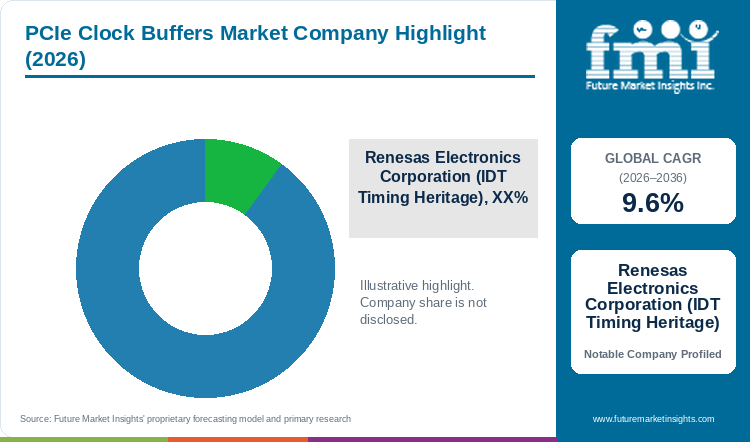
The competitive arena in the PCIe clock buffers market has consolidated around full-stack data center timing platforms and broad-line analog and mixed-signal semiconductor manufacturers. SiTime Corporation completed its acquisition of Renesas Electronics' Timing Business on July 1, 2026, combining its Aura Semiconductor clock buffer products with the heritage Integrated Device Technology (IDT) 9DBL/9DBV PCIe buffer catalog.
- Data Center & MEMS Full-Stack Timing Platforms: Renesas Electronics (IDT Timing Heritage) and SiTime Corporation (Aura Semiconductor Clock Buffers) join Microchip Technology in supplying end-to-end DB2000QL server buffers and PCIe switch clocking.
- High-Performance Analog & Mixed-Signal Timing Leaders: Skyworks Solutions (Silicon Labs Timing Acquisition) and Texas Instruments deliver sub-20-femtosecond additive jitter fanout buffers and multi-rail LDO-filtered clocking ICs.
- Server, Storage & Automotive Clocking Specialists: Diodes Incorporated (Pericom Timing) and onsemi supply cost-optimized LP-HCSL fanout buffers and AEC-Q100 automotive differential buffers.
Competitive Benchmarking: PCIe Clock Buffers Market
Table 8: Competitive Benchmarking for the PCIe Clock Buffers Market (qualitative capability ratings), 2026
| Company | Sub-30 fs Gen 6/7 Jitter Performance | LP-HCSL & DB2000QL Fanout Breadth | AI Server & Automotive OEM Qualification | Geographic Reach |
|---|---|---|---|---|
| Renesas Electronics Corporation (IDT Timing Heritage) | High | High | High | High |
| Skyworks Solutions, Inc. (Silicon Labs Timing Acquisition) | High | High | High | High |
| Texas Instruments Incorporated | High | High | High | High |
| Microchip Technology Inc. | High | High | High | High |
| Diodes Incorporated (Pericom Timing) | High | High | High | High |
| SiTime Corporation (Aura Semiconductor Clock Buffers) | High | High | High | High |
| onsemi | Medium | Medium | Medium | High |
Evaluation basis: Capability tiers evaluate verified PCI-SIG PCIe 6.0 and 7.0 additive phase jitter (<18 to <30 fs RMS) plus integrated 85-ohm/100-ohm LP-HCSL termination across 2-to-20-output packages and server ODM plus AEC-Q100 Grade 1 qualification.
Key Developments in the PCIe Clock Buffers Market
- SiTime Corporation expanded its unified Clocks & Timing platform in July 2026 following the close of its Renesas Timing Business acquisition to pair MEMS oscillators with 9DBL and Aura-heritage PCIe buffers [16].
- Skyworks Solutions scaled its Si53154 and Si53208 PCIe fanout buffer deployments across cloud server and storage hardware platforms in December 2025 [17].
- Texas Instruments expanded its DB800ZL-compliant 4-output CDCDB400 and 20-output CDCDB2000 LP-HCSL clock buffer family in September 2025 for compact riser and baseboard clocking [18].
Key Players in the PCIe Clock Buffers Market
Data Center & MEMS Full-Stack Timing Platforms
- Renesas Electronics Corporation (IDT Timing Heritage)
- SiTime Corporation (Aura Semiconductor Clock Buffers)
- Microchip Technology Inc.
High-Performance Analog & Mixed-Signal Timing Leaders
- Skyworks Solutions, Inc. (Silicon Labs Timing Acquisition)
- Texas Instruments Incorporated
Server, Storage & Automotive Clocking Specialists
- Diodes Incorporated (Pericom Timing)
- onsemi
PCIe Clock Buffers Market - Report Scope
Table 9: Report Scope for the PCIe Clock Buffers Market (coverage fields and definitions), 2026 to 2036
| Coverage field | Report scope |
|---|---|
| Market breakdown | PCIe Additive Phase Jitter Spec; Output Differential Signaling Format; Output Channel Fanout Count; End-Use Hardware; Region |
| Quantitative Units | USD Million |
| Market Definition | Includes commercial supplier revenue from standalone PCI Express fanout clock buffers and zero-delay buffers (ZDB) plus DB800ZL/DB1200ZL/DB2000QL-compliant differential clock distribution ICs (LP-HCSL and standard HCSL) engineered for PCIe Gen 1 through Gen 6/7 reference-clock distribution. Segment Scope Note: Excludes standalone quartz crystals or MEMS resonators and PCIe data-path retimers/redrivers. |
| Regions Covered | North America; Latin America; Western Europe; Eastern Europe; East Asia; South Asia and Pacific; Middle East and Africa |
| Countries Covered | Vietnam, Malaysia, South Korea, USA, Taiwan, Japan, and additional countries in the full report |
| Key Companies Covered | Renesas Electronics Corporation (IDT Timing Heritage), Skyworks Solutions, Inc. (Silicon Labs Timing Acquisition), Texas Instruments Incorporated, Microchip Technology Inc., Diodes Incorporated (Pericom Timing), SiTime Corporation (Aura Semiconductor Clock Buffers), onsemi |
| Forecast Period | 2026 to 2036 |
| Approach | Primary and secondary research with top-down and bottom-up market triangulation. |
PCIe Clock Buffers Market - Research Methodology
Table 10: Research Methodology for the PCIe Clock Buffers Market (research methods and approach), 2026 edition
| Method | Approach |
|---|---|
| Primary Research | Structured interviews with server ODM hardware timing architects and mixed-signal semiconductor product directors across the USA, Taiwan, South Korea, and Southeast Asia. |
| Secondary Research | Analysis of PCI-SIG PCIe 6.0 and 7.0 base specifications, Intel DB2000QL/CK440 reference guides, vendor datasheets, and corporate M&A disclosures. |
| Market Sizing and Forecasting | Top-down server and automotive timing IC expenditure models reconciled against bottom-up AI server baseboard shipments and buffers per chassis from 2026 to 2036. |
| Country Forecasting Model | Econometric national projections weight server/NIC/SSD surface-mount assembly volumes and OSAT timing IC packaging capacity across six key countries. |
| Operational Benchmark Traceability | Additive phase jitter (<18 to <30 fs RMS) and LP-HCSL resistor savings (80 resistors per 20-output buffer) in Tables 2, 3, and 4 trace to Renesas, TI, and PCI-SIG technical specifications. |
| Data Triangulation and Validation | Buffer IC valuation estimates are cross-checked against multi-GPU AI server shipments and DB2000QL socket counts while excluding standalone crystal oscillators and PCIe SerDes retimers. |
PCIe Clock Buffers Market by Segments
PCIe Clock Buffers Market segmented by PCIe Additive Phase Jitter Spec:
- PCIe Gen 6.0 (<30 fs RMS Additive Jitter) Buffers
- PCIe Gen 5.0 (<50 fs RMS) Server Fanout Buffers
- PCIe Gen 4.0 Automotive & Industrial Grade Buffers
- Others
PCIe Clock Buffers Market segmented by Output Differential Signaling Format:
- Low-Power HCSL (LP-HCSL) Integrated Termination
- Standard HCSL (85Ω / 100Ω) External Resistor
- Others
PCIe Clock Buffers Market segmented by Output Channel Fanout Count:
- 12-Output to 20-Output AI Server Baseboard Buffers
- 4-Output to 8-Output Riser, NIC & Storage Card Buffers
- 2-Output Compact Edge & Automotive SoC Buffers
- Others
PCIe Clock Buffers Market segmented by End-Use Hardware:
- Multi-GPU AI Servers & CXL Memory Pooling Chassis
- Enterprise NVMe All-Flash Storage Arrays
- Automotive Zonal ADAS Central Compute
- Others
PCIe Clock Buffers Market by Region
- North America
- USA
- Canada
- Latin America
- Brazil
- Mexico
- Argentina
- Chile
- Western Europe
- Germany
- France
- United Kingdom
- Italy
- Spain
- Benelux
- Nordics
- Eastern Europe
- Poland
- Czech Republic
- Romania
- Hungary
- East Asia
- South Korea
- Taiwan
- Japan
- China
- South Asia and Pacific
- Vietnam
- Malaysia
- India
- ASEAN
- Australia and New Zealand
- Middle East and Africa
- GCC Countries
- South Africa
- Türkiye
- Israel
Research Sources and Bibliography
- [1] Renesas Electronics Corporation. (2025, November 05). 9DBL0252 - 2-Output 3.3V PCIe Zero-Delay/Fanout Clock Buffer. Renesas Electronics Corporation.
- [2] Diodes Incorporated. (2026, May 06). PCI Express (PCIe) Clock Generator and Buffer ICs. Diodes Incorporated.
- [3] Microchip Technology Inc. (2025, October 13). Microchip Unveils First 3 nm PCIe® Gen 6 Switch to Power Modern AI Infrastructure | Microchip Technology. Microchip Technology News Releases.
- [4] Texas Instruments Incorporated. (2025, October 18). CDCDB803 DB800ZL-Compliant 8-Output Clock Buffer for PCIe Gen 1 to Gen 6 datasheet (Rev. A). Texas Instruments Incorporated.
- [5] Diodes Incorporated. (2025, August 09). PI6CB332001: 20-Output PCIe Gen 6/Gen 5/Gen 4 Clock Buffer With On-Chip Termination (PI6CB332001). Diodes Incorporated.
- [6] Texas Instruments Incorporated. (2026, May 29). LMKDB1120 data sheet, product information and support | TI.com. Texas Instruments Incorporated (Rev. G).
- [7] PCI-SIG Consortium. (2025, June 15). FAQ | PCI-SIG. PCI-SIG Official Specification FAQ.
- [8] Renesas Electronics Corporation. (2025, November 05). 9DBL0651 - 6-Output 3.3V PCIe Zero-Delay/Fanout Clock Buffer | Renesas. Renesas Electronics Corporation (Rev. 1.05).
- [9] Microchip Technology Inc. (2026, March 18). Automotive Timing Solutions | Microchip Technology. Microchip Technology Inc.
- [10] Microchip Technology Inc. (2025, August 19). ZL40294 | Microchip Technology. Microchip Technology Inc.
- [11] Texas Instruments Incorporated. (2025, November 12). CDCDB2000 DB2000QL-Compliant 20-Output Clock Buffer for PCIe Gen 1 to Gen 7 datasheet (Rev. C). Texas Instruments Incorporated.
- [12] Microchip Technology Inc. (2026, January 28). PCIe Timing | Microchip Technology. Microchip Technology Inc.
- [13] SiTime Corporation. (2026, July 01). SiTime Completes Acquisition of Renesas' Timing Business. SiTime Corporation Newsroom.
- [14] Renesas Electronics Corporation. (2026, March 02). 9FGL06 - 6-Output 3.3V PCIe Gen 1-6 Clock Generator. Renesas Electronics Corporation.
- [15] Renesas Electronics Corporation. (2026, February 04). SiTime to Acquire Renesas' Timing Business. Renesas Electronics Newsroom.
- [16] SiTime Corporation. (2026, July 15). SiTime Clocks & Timing. SiTime Corporation.
- [17] Skyworks Solutions, Inc. (2025, December 10). PCI Express Clock Fanout Buffer Si53154 - Skyworks | Product Details. Skyworks Solutions, Inc.
- [18] Texas Instruments Incorporated. (2025, September 22). CDCDB400 DB800ZL-Compliant 4-Output Clock Buffer for PCIe Gen 1 to Gen 7 datasheet (Rev. B). Texas Instruments Incorporated.
- [19] Skyworks Solutions, Inc. (2026, January 12). Si53112 PCIe Fanout/Zero-Delay Buffer - Skyworks | Product Details. Skyworks Solutions, Inc.
- [20] SiTime Corporation. (2026, April 04). SiT92216. SiTime Corporation.
- [21] PCI-SIG Consortium. (2026, June 03). PCI-SIG Developers Conference 2026 Agenda. PCI-SIG.
This bibliography is provided for reader reference and is not exhaustive. The full report contains the complete reference list and detailed citations.
This Report Answers
- How large is the PCIe clock buffers market in 2026 and what is forecast for 2036?
- Which 64 GT/s PAM4 phase-jitter and board-density pressures support demand for PCIe clock buffers?
- Why do PCIe Gen 6.0 (<30 fs RMS Additive Jitter) Buffers lead the phase-jitter specification segment?
- Why does Low-Power HCSL (LP-HCSL) Integrated Termination lead the signaling format segment globally?
- How do growth rates differ across Vietnam, Malaysia, South Korea, the USA, Taiwan, and Japan?
- Which leading timing IC companies supply PCIe Gen 5 and Gen 6/7 clock buffers today?
- What power-supply noise or SoC integration factors limit growth in the PCIe clock buffers market?
- What should AI server and automotive hardware engineers evaluate before selecting a PCIe clock buffer?
Frequently Asked Questions
How big is the PCIe clock buffers market in 2026, and what is forecast for 2036?
Building on a 2025 market value of USD 310.0 million, global PCIe clock buffer demand is anticipated to reach a 2026 valuation of USD 342.5 million and a 2036 total of USD 856.6 million as hyperscale data centers roll out PCIe 6.0 AI servers.
What is the CAGR for the PCIe clock buffers market from 2026 to 2036?
Ten-year projections show a 9.6% compound annual growth rate across the 2026 to 2036 decade, which translates into a net USD 514.1 million gain in annual market value for differential PCIe clocking ICs.
Which PCIe additive phase jitter specification segment leads the PCIe clock buffers market?
Hyperscale server baseboard designs place PCIe Gen 6.0 (<30 fs RMS Additive Jitter) Buffers in the lead with a projected 48.6% share of the phase-jitter segment in 2026 to preserve 64 GT/s PAM4 eye margins across lossy copper channels.
Which output differential signaling format segment leads the PCIe clock buffers market?
Motherboard engineering teams place Low-Power HCSL (LP-HCSL) Integrated Termination in the lead at an anticipated 67.4% share of the output differential signaling format segment in 2026 since internal push-pull drivers cut output power consumption by more than 60%.
Which country has a notable growth outlook during the assessment period?
Vietnam is forecast to top national growth rankings at an 11.3% yearly clip through 2036, driven by server motherboard and SmartNIC surface-mount assembly lines expanding across Thai Nguyen and Bac Giang.
Who are the key players in the market?
Renesas Electronics Corporation (IDT Timing Heritage), Skyworks Solutions, Inc. (Silicon Labs Timing Acquisition), Texas Instruments Incorporated, Microchip Technology Inc., Diodes Incorporated (Pericom Timing), SiTime Corporation (Aura Semiconductor Clock Buffers), and onsemi supply global server and automotive accounts.
Preview the report firsthand - request a free sample
Get SampleGet the brochure for pricing and purchase details.
Get PDFTable of Content
- Key Takeaways
- Market Size and CAGR
- Top Growth Driver
- Fastest Growing Segment
- Leading Region
- Key Companies
- Emerging Opportunities
- Executive Summary
- Global Market Outlook
- Demand-side Trends
- Supply-side Trends
- Technology Roadmap Analysis
- Analysis and Recommendations
- Analyst Perspective (What is happening? Why now? What should investors know?)
- Key Questions Answered
- How large is the market?
- What is the CAGR?
- What are key trends?
- Which region dominates?
- Who are the leaders?
- Market Overview
- Market Coverage / Taxonomy
- Market Definition / Scope / Limitations
- Research Methodology
- Chapter Orientation
- Analytical Lens and Working Hypotheses
- Market Structure, Signals, and Trend Drivers
- Benchmarking and Cross-market Comparability
- Market Sizing, Forecasting, and Opportunity Mapping
- Research Design and Evidence Framework
- Desk Research Programme (Secondary Evidence)
- Expert Input and Fieldwork (Primary Evidence)
- Tooling, Models, and Reference Databases
- Data Engineering and Model Build
- Quality Assurance and Audit Trail
- Market Background
- Market Dynamics (Drivers, Restraints, Opportunity, Trends)
- Scenario Forecast (Optimistic, Likely, Conservative)
- Impact Analysis
- AI Impact
- Sustainability Impact
- Regulatory Impact
- Technology Impact
- Consumer / Buyer Analysis
- Purchase Drivers
- Adoption Barriers
- Buyer Journey
- Opportunity Map Analysis
- Product Life Cycle Analysis
- Supply Chain Analysis
- Investment Feasibility Matrix
- Value Chain Analysis
- PESTLE and Porter's Analysis
- Regulatory Landscape
- Regional Parent Market Outlook
- Production and Consumption Statistics
- Import and Export Statistics
- Global Market Analysis and Forecast, 2021 to 2036
- Historical Market Size Value (USD Million) Analysis, 2021 to 2025
- Current and Future Market Size Value (USD Million) Projections, 2026 to 2036
- Y-o-Y Growth Trend Analysis
- Absolute $ Opportunity Analysis
- Global Market Pricing Analysis, 2021 to 2036
- Global Market Analysis and Forecast, By PCIe Additive Phase Jitter Spec, 2021 to 2036
- Introduction / Key Findings
- Historical Market Size Value (USD Million) Analysis By PCIe Additive Phase Jitter Spec, 2021 to 2025
- Current and Future Market Size Value (USD Million) Analysis and Forecast By PCIe Additive Phase Jitter Spec, 2026 to 2036
- PCIe Gen 6.0 (<30 fs RMS Additive Jitter) Buffers
- PCIe Gen 5.0 (<50 fs RMS) Server Fanout Buffers
- PCIe Gen 4.0 Automotive & Industrial Grade Buffers
- Others
- Y-o-Y Growth Trend Analysis By PCIe Additive Phase Jitter Spec, 2021 to 2025
- Absolute $ Opportunity Analysis By PCIe Additive Phase Jitter Spec, 2026 to 2036
- Global Market Analysis and Forecast, By Output Differential Signaling Format, 2021 to 2036
- Introduction / Key Findings
- Historical Market Size Value (USD Million) Analysis By Output Differential Signaling Format, 2021 to 2025
- Current and Future Market Size Value (USD Million) Analysis and Forecast By Output Differential Signaling Format, 2026 to 2036
- Low-Power HCSL (LP-HCSL) Integrated Termination
- Standard HCSL (85Ω / 100Ω) External Resistor
- Others
- Y-o-Y Growth Trend Analysis By Output Differential Signaling Format, 2021 to 2025
- Absolute $ Opportunity Analysis By Output Differential Signaling Format, 2026 to 2036
- Global Market Analysis and Forecast, By Output Channel Fanout Count, 2021 to 2036
- Introduction / Key Findings
- Historical Market Size Value (USD Million) Analysis By Output Channel Fanout Count, 2021 to 2025
- Current and Future Market Size Value (USD Million) Analysis and Forecast By Output Channel Fanout Count, 2026 to 2036
- 12-Output to 20-Output AI Server Baseboard Buffers
- 4-Output to 8-Output Riser, NIC & Storage Card Buffers
- 2-Output Compact Edge & Automotive SoC Buffers
- Others
- Y-o-Y Growth Trend Analysis By Output Channel Fanout Count, 2021 to 2025
- Absolute $ Opportunity Analysis By Output Channel Fanout Count, 2026 to 2036
- Global Market Analysis and Forecast, By End-Use Hardware, 2021 to 2036
- Introduction / Key Findings
- Historical Market Size Value (USD Million) Analysis By End-Use Hardware, 2021 to 2025
- Current and Future Market Size Value (USD Million) Analysis and Forecast By End-Use Hardware, 2026 to 2036
- Multi-GPU AI Servers & CXL Memory Pooling Chassis
- Enterprise NVMe All-Flash Storage Arrays
- Automotive Zonal ADAS Central Compute
- Others
- Y-o-Y Growth Trend Analysis By End-Use Hardware, 2021 to 2025
- Absolute $ Opportunity Analysis By End-Use Hardware, 2026 to 2036
- Global Market Analysis and Forecast, By Region, 2021 to 2036
- Introduction
- Historical Market Size Value (USD Million) Analysis By Region, 2021 to 2025
- Current Market Size Value (USD Million) Analysis and Forecast By Region, 2026 to 2036
- North America
- Latin America
- Western Europe
- Eastern Europe
- East Asia
- South Asia and Pacific
- Middle East and Africa
- Market Attractiveness Analysis By Region
- North America Market Analysis and Forecast, By Country, 2021 to 2036
- Historical Market Size Value (USD Million) Trend Analysis By Market Taxonomy, 2021 to 2025
- Market Size Value (USD Million) Forecast By Market Taxonomy, 2026 to 2036
- By Country
- USA
- Canada
- By PCIe Additive Phase Jitter Spec
- By Output Differential Signaling Format
- By Output Channel Fanout Count
- By End-Use Hardware
- By Country
- Market Attractiveness Analysis
- By Country
- By PCIe Additive Phase Jitter Spec
- By Output Differential Signaling Format
- By Output Channel Fanout Count
- By End-Use Hardware
- Key Takeaways
- Latin America Market Analysis and Forecast, By Country
- Historical Market Size Value (USD Million) Trend Analysis By Market Taxonomy, 2021 to 2025
- Market Size Value (USD Million) Forecast By Market Taxonomy, 2026 to 2036
- By Country
- Brazil
- Mexico
- Argentina
- Chile
- By PCIe Additive Phase Jitter Spec
- By Output Differential Signaling Format
- By Output Channel Fanout Count
- By End-Use Hardware
- By Country
- Market Attractiveness Analysis
- By Country
- By PCIe Additive Phase Jitter Spec
- By Output Differential Signaling Format
- By Output Channel Fanout Count
- By End-Use Hardware
- Key Takeaways
- Western Europe Market Analysis and Forecast, By Country
- Historical Market Size Value (USD Million) Trend Analysis By Market Taxonomy, 2021 to 2025
- Market Size Value (USD Million) Forecast By Market Taxonomy, 2026 to 2036
- By Country
- Germany
- France
- United Kingdom
- Italy
- Spain
- Benelux
- Nordics
- By PCIe Additive Phase Jitter Spec
- By Output Differential Signaling Format
- By Output Channel Fanout Count
- By End-Use Hardware
- By Country
- Market Attractiveness Analysis
- By Country
- By PCIe Additive Phase Jitter Spec
- By Output Differential Signaling Format
- By Output Channel Fanout Count
- By End-Use Hardware
- Key Takeaways
- Eastern Europe Market Analysis and Forecast, By Country
- Historical Market Size Value (USD Million) Trend Analysis By Market Taxonomy, 2021 to 2025
- Market Size Value (USD Million) Forecast By Market Taxonomy, 2026 to 2036
- By Country
- Poland
- Czech Republic
- Romania
- Hungary
- By PCIe Additive Phase Jitter Spec
- By Output Differential Signaling Format
- By Output Channel Fanout Count
- By End-Use Hardware
- By Country
- Market Attractiveness Analysis
- By Country
- By PCIe Additive Phase Jitter Spec
- By Output Differential Signaling Format
- By Output Channel Fanout Count
- By End-Use Hardware
- Key Takeaways
- East Asia Market Analysis and Forecast, By Country
- Historical Market Size Value (USD Million) Trend Analysis By Market Taxonomy, 2021 to 2025
- Market Size Value (USD Million) Forecast By Market Taxonomy, 2026 to 2036
- By Country
- South Korea
- Taiwan
- Japan
- China
- By PCIe Additive Phase Jitter Spec
- By Output Differential Signaling Format
- By Output Channel Fanout Count
- By End-Use Hardware
- By Country
- Market Attractiveness Analysis
- By Country
- By PCIe Additive Phase Jitter Spec
- By Output Differential Signaling Format
- By Output Channel Fanout Count
- By End-Use Hardware
- Key Takeaways
- South Asia and Pacific Market Analysis and Forecast, By Country
- Historical Market Size Value (USD Million) Trend Analysis By Market Taxonomy, 2021 to 2025
- Market Size Value (USD Million) Forecast By Market Taxonomy, 2026 to 2036
- By Country
- Vietnam
- Malaysia
- India
- ASEAN
- Australia and New Zealand
- By PCIe Additive Phase Jitter Spec
- By Output Differential Signaling Format
- By Output Channel Fanout Count
- By End-Use Hardware
- By Country
- Market Attractiveness Analysis
- By Country
- By PCIe Additive Phase Jitter Spec
- By Output Differential Signaling Format
- By Output Channel Fanout Count
- By End-Use Hardware
- Key Takeaways
- Middle East and Africa Market Analysis and Forecast, By Country
- Historical Market Size Value (USD Million) Trend Analysis By Market Taxonomy, 2021 to 2025
- Market Size Value (USD Million) Forecast By Market Taxonomy, 2026 to 2036
- By Country
- GCC Countries
- South Africa
- Türkiye
- Israel
- By PCIe Additive Phase Jitter Spec
- By Output Differential Signaling Format
- By Output Channel Fanout Count
- By End-Use Hardware
- By Country
- Market Attractiveness Analysis
- By Country
- By PCIe Additive Phase Jitter Spec
- By Output Differential Signaling Format
- By Output Channel Fanout Count
- By End-Use Hardware
- Key Takeaways
- Key Countries Market Analysis
- USA
- Pricing Analysis
- Market Share Analysis, 2025
- By PCIe Additive Phase Jitter Spec
- By Output Differential Signaling Format
- By Output Channel Fanout Count
- By End-Use Hardware
- Canada
- Pricing Analysis
- Market Share Analysis, 2025
- By PCIe Additive Phase Jitter Spec
- By Output Differential Signaling Format
- By Output Channel Fanout Count
- By End-Use Hardware
- Mexico
- Pricing Analysis
- Market Share Analysis, 2025
- By PCIe Additive Phase Jitter Spec
- By Output Differential Signaling Format
- By Output Channel Fanout Count
- By End-Use Hardware
- Brazil
- Pricing Analysis
- Market Share Analysis, 2025
- By PCIe Additive Phase Jitter Spec
- By Output Differential Signaling Format
- By Output Channel Fanout Count
- By End-Use Hardware
- Chile
- Pricing Analysis
- Market Share Analysis, 2025
- By PCIe Additive Phase Jitter Spec
- By Output Differential Signaling Format
- By Output Channel Fanout Count
- By End-Use Hardware
- Germany
- Pricing Analysis
- Market Share Analysis, 2025
- By PCIe Additive Phase Jitter Spec
- By Output Differential Signaling Format
- By Output Channel Fanout Count
- By End-Use Hardware
- United Kingdom
- Pricing Analysis
- Market Share Analysis, 2025
- By PCIe Additive Phase Jitter Spec
- By Output Differential Signaling Format
- By Output Channel Fanout Count
- By End-Use Hardware
- Italy
- Pricing Analysis
- Market Share Analysis, 2025
- By PCIe Additive Phase Jitter Spec
- By Output Differential Signaling Format
- By Output Channel Fanout Count
- By End-Use Hardware
- Spain
- Pricing Analysis
- Market Share Analysis, 2025
- By PCIe Additive Phase Jitter Spec
- By Output Differential Signaling Format
- By Output Channel Fanout Count
- By End-Use Hardware
- France
- Pricing Analysis
- Market Share Analysis, 2025
- By PCIe Additive Phase Jitter Spec
- By Output Differential Signaling Format
- By Output Channel Fanout Count
- By End-Use Hardware
- India
- Pricing Analysis
- Market Share Analysis, 2025
- By PCIe Additive Phase Jitter Spec
- By Output Differential Signaling Format
- By Output Channel Fanout Count
- By End-Use Hardware
- ASEAN
- Pricing Analysis
- Market Share Analysis, 2025
- By PCIe Additive Phase Jitter Spec
- By Output Differential Signaling Format
- By Output Channel Fanout Count
- By End-Use Hardware
- Australia and New Zealand
- Pricing Analysis
- Market Share Analysis, 2025
- By PCIe Additive Phase Jitter Spec
- By Output Differential Signaling Format
- By Output Channel Fanout Count
- By End-Use Hardware
- China
- Pricing Analysis
- Market Share Analysis, 2025
- By PCIe Additive Phase Jitter Spec
- By Output Differential Signaling Format
- By Output Channel Fanout Count
- By End-Use Hardware
- Japan
- Pricing Analysis
- Market Share Analysis, 2025
- By PCIe Additive Phase Jitter Spec
- By Output Differential Signaling Format
- By Output Channel Fanout Count
- By End-Use Hardware
- South Korea
- Pricing Analysis
- Market Share Analysis, 2025
- By PCIe Additive Phase Jitter Spec
- By Output Differential Signaling Format
- By Output Channel Fanout Count
- By End-Use Hardware
- Poland
- Pricing Analysis
- Market Share Analysis, 2025
- By PCIe Additive Phase Jitter Spec
- By Output Differential Signaling Format
- By Output Channel Fanout Count
- By End-Use Hardware
- Hungary
- Pricing Analysis
- Market Share Analysis, 2025
- By PCIe Additive Phase Jitter Spec
- By Output Differential Signaling Format
- By Output Channel Fanout Count
- By End-Use Hardware
- Türkiye
- Pricing Analysis
- Market Share Analysis, 2025
- By PCIe Additive Phase Jitter Spec
- By Output Differential Signaling Format
- By Output Channel Fanout Count
- By End-Use Hardware
- South Africa
- Pricing Analysis
- Market Share Analysis, 2025
- By PCIe Additive Phase Jitter Spec
- By Output Differential Signaling Format
- By Output Channel Fanout Count
- By End-Use Hardware
- Vietnam
- Pricing Analysis
- Market Share Analysis, 2025
- By PCIe Additive Phase Jitter Spec
- By Output Differential Signaling Format
- By Output Channel Fanout Count
- By End-Use Hardware
- Malaysia
- Pricing Analysis
- Market Share Analysis, 2025
- By PCIe Additive Phase Jitter Spec
- By Output Differential Signaling Format
- By Output Channel Fanout Count
- By End-Use Hardware
- Taiwan
- Pricing Analysis
- Market Share Analysis, 2025
- By PCIe Additive Phase Jitter Spec
- By Output Differential Signaling Format
- By Output Channel Fanout Count
- By End-Use Hardware
- USA
- Market Structure Analysis
- Competition Dashboard
- Competition Benchmarking
- Market Share Analysis of Top Players
- By Regional
- By PCIe Additive Phase Jitter Spec
- By Output Differential Signaling Format
- By Output Channel Fanout Count
- By End-Use Hardware
- Emerging Startups
- Innovation Benchmarking
- Competition Analysis
- Competition Deep Dive
- Renesas Electronics Corporation (IDT Timing Heritage)
- Overview
- Product Portfolio
- Profitability by Market Segments
- Sales Footprint
- Strategy Overview
- Marketing Strategy
- Product Strategy
- Channel Strategy
- Skyworks Solutions, Inc. (Silicon Labs Timing Acquisition)
- Texas Instruments Incorporated
- Microchip Technology Inc.
- Diodes Incorporated (Pericom Timing)
- SiTime Corporation (Aura Semiconductor Clock Buffers)
- onsemi
- Renesas Electronics Corporation (IDT Timing Heritage)
- Case Studies
- Success Stories
- Recent Developments
- Competition Deep Dive
- Assumptions & Acronyms Used


