

- Market Size (2026)
- USD 60.0 Mn
- Forecast (2036)
- USD 145.0 Mn
- CAGR (2026 to 2036)
- 9.2%
How big is Pediatric Digital Inhaler Monitoring Sensors Market in 2026?
USD 60.0 million in 2026 and USD 145.0 million by 2036 at a 9.2% CAGR.
Demand for pediatric digital inhaler monitoring sensors is projected to expand at 9.2% CAGR from 2026 to 2036, increasing from USD 60.0 million in 2026 to USD 145.0 million by 2036. Growth depends on smart inhalers that convert actuation and technique signals into records that families and clinical teams can use. In May 2026, the World Health Organization issued childhood asthma guidance covering patients aged zero to nineteen across primary and referral care. The guidance reinforces inhaled treatment management but does not endorse connected monitoring as routine care. Developers combining connected drug delivery with caregiver alerts therefore need validated measurements and age-appropriate interfaces. Their systems must also preserve records through device replacement and shared caregiving without adding avoidable work for respiratory teams.
United States clinics have a clearer service route for eligible remote monitoring than health systems that depend mainly on device budgets. In March 2026, CMS added three remote therapeutic monitoring codes to the list of codes that sometimes describe therapy services. The agency also revised two existing RTM code descriptions that affect billing for qualifying therapy services. The changes do not guarantee coverage for pediatric inhaler sensors but give participating practices a defined coding framework for monitored services. Programs serving pediatric home healthcare populations must train caregivers and manage consent across several daily settings. Japanese and German health systems apply separate review requirements for device evidence and health-data handling. Commercial plans for respiratory inhaler devices therefore need country-specific regulatory files and dependable support routes.
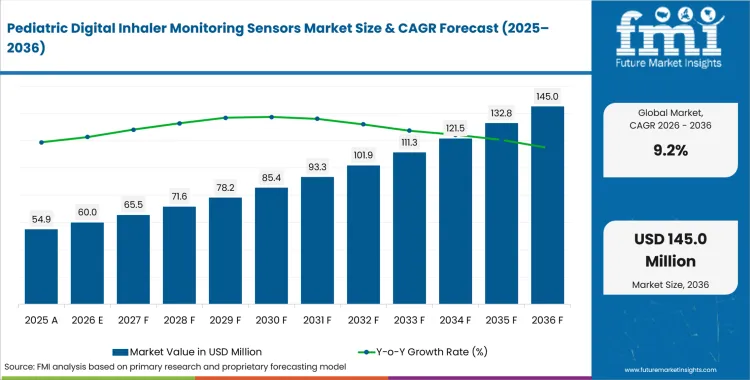
Key Takeaways of Pediatric Digital Inhaler Monitoring Sensors Market
- Pediatric adoption advances as connected sensors turn scattered inhaler events into usable adherence and technique records for families and clinical teams.
- Software is expected to account for 28.0% of product type demand in 2026, supported by recurring analytics and configurable caregiver functions.
- Home care is projected to represent 46.0% of care setting demand in 2026, reflecting the location of routine pediatric inhaler use.
- Monitoring is anticipated to capture 55.0% of application demand in 2026, underpinned by the need for continuous medication-use visibility.
- Interoperability gaps and limited pediatric workflow evidence remain material barriers across hospitals, homes and payer-funded monitoring programs.
- Competition spans regulated platforms from Adherium and Aptar Digital Health alongside integrated systems from FindAir and Amiko and four focused developers.
Analyst Perspective
“Pediatric programs fail if a sensor records dose events but leaves families and respiratory teams with unclear actions. A useful system must fit the child’s prescribed inhaler and identify technique errors without complicating daily care. It must also protect caregiver access and route meaningful exceptions to a named clinical team. Durable commercial models therefore combine validated sensing with replacement support and a service design that limits alert burden across home and clinic care.”
- Anurag Sharma, Principal Analyst, Future Market Insights
How is the Pediatric Digital Inhaler Monitoring Sensors Market segmented?
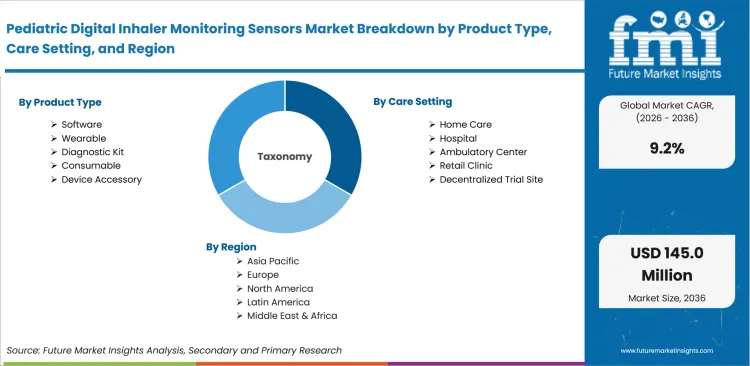
The pediatric digital inhaler monitoring sensors industry is segmented by product type, care setting, application, end user, and region.
Product type separates software, wearable sensors, diagnostic kits, consumables, and device accessories according to what the purchaser receives. Care setting distinguishes hospital programs, home care, ambulatory centers, retail clinics, and decentralized trial sites according to the location managing each sensor. Application separates monitoring, diagnosis, workflow automation, therapy support, and infection control by the function performed. End user identifies hospitals, payers, diagnostic laboratories, medtech firms, and patients according to who purchases or uses the information. Regional analysis compares approval, reimbursement, and service conditions that influence deployment across major geographies worldwide.
Why does software account for the largest product type share?
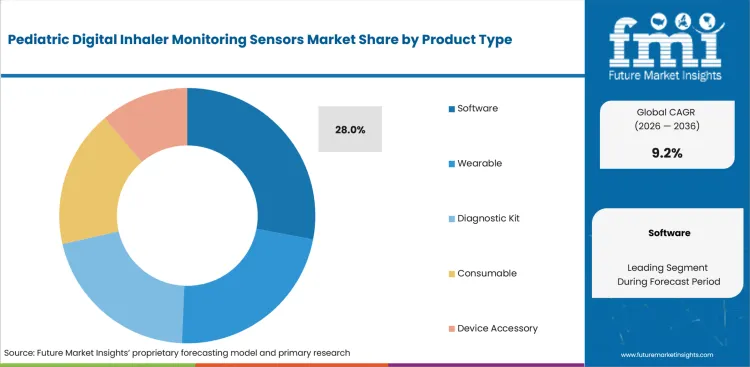
Software converts sensor events into reminders and adherence histories that follow a child across home and clinic care. It also creates technique summaries and exception alerts that support focused action from families and respiratory teams. In January 2026 FindAir partnered with WeGuide to combine connected inhaler devices with a platform for real-world data collection. The arrangement covers device pairing and firmware updates together with replacements during clinical study programs. The model shows why digital therapeutics for inhaled care need dependable data transfer and technical management rather than an isolated dashboard.
- Software is likely to capture 28.0% share in 2026 attributable to recurring analytics and configurable caregiver support. A shared software layer can serve several compatible sensors without duplicating dashboards or reminder functions. Platform reuse concentrates spending around systems that maintain secure records and manage changing therapy schedules across pediatric care networks.
- Hospital groups and medtech developers favor software that connects with clinical systems through documented interfaces and permission controls. Pediatric programs need caregiver access that changes as a child becomes more independent or moves between households. Adoption slows if a platform cannot separate family reminders from clinical alerts or export a reliable adherence history for review.
Why does home care remain central to care setting demand?
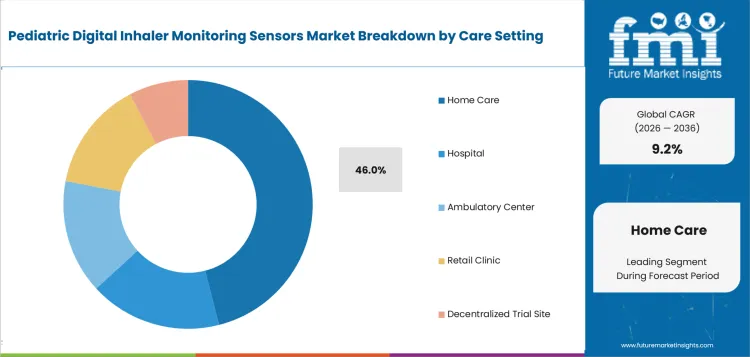
Most pediatric inhaler use occurs outside direct clinical supervision, so caregivers must recognize missed controller doses and repeated reliever use. Home programs need simple pairing, replacement and training routes that protect records through family changes. In December 2025 Adherium reported an 83.1% increase in remote monitoring device shipments with 756 units shipped during October and November. The figures document scale in a remote monitoring channel but do not prove pediatric adoption. The shipment evidence shows why connected home healthcare products require dependable fulfillment and technical support throughout monitored care.
- Based on care setting, home care is projected to account for 46.0% in 2026 due to the location of routine pediatric inhaler use. Reliable pairing and replacement support protect each monitoring record across family routines and reduce avoidable service interruptions. Home adoption therefore favors systems that remain simple across changing caregivers and extended treatment schedules.
- Families use home systems more consistently if reminders remain clear and support occasional schedule changes. Respiratory teams need escalation rules that separate missed controller doses from urgent reliever use across age groups. Training must also shift responsibility from parents to older children without removing caregiver visibility or breaking the existing adherence record.
How does monitoring shape demand within the application category?
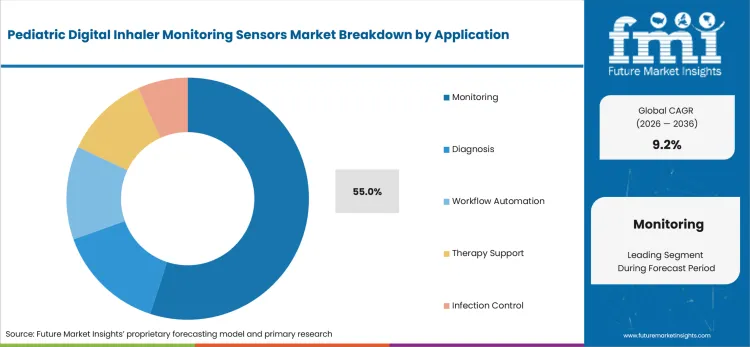
Monitoring creates a continuous record of medication events and technique signals that periodic appointments cannot reconstruct reliably. Accurate timestamps provide the base for reminders and focused respiratory review across routine pediatric care. The wider remote monitoring systems market offers service-model context, but connected inhaler programs require validated inputs for responsible clinical action. Monitoring performs a narrower function than diagnosis by recording behavior and technique without independently determining disease status or treatment.
- Monitoring is set to lead the application category with 55.0% share in 2026 due to the need for objective adherence visibility. The function creates a common database for reminders and technique coaching without claiming diagnostic authority. Accurate event capture receives greater spending priority through its role in every later clinical intervention.
- Health plans and hospitals assess monitoring programs through alert burden and documented clinical action rather than raw data volume. In March 2025 Amiko reported intraclass correlation above 0.95 for every measured RS01X inhalation parameter across 97 participants in a study of its smart dry powder inhaler (DPI). The study validated measurement accuracy without directly evaluating changes in symptoms or other patient outcomes. Adoption weakens if caregivers receive frequent notifications without clear instructions or clinical teams cannot audit earlier readings.
What keeps hospitals relevant within the end user category?
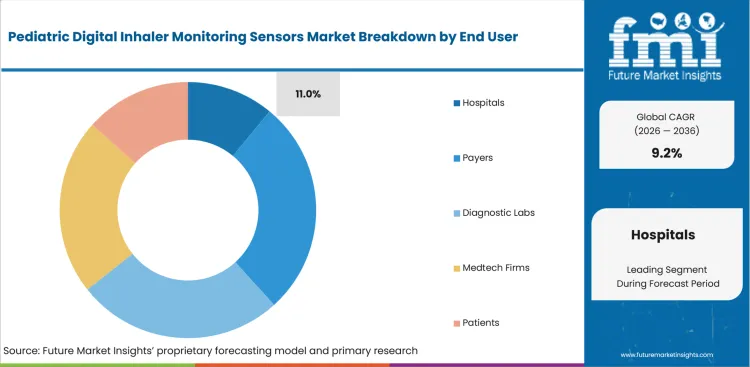
Hospitals coordinate severe pediatric asthma pathways through respiratory specialists and community clinicians alongside family caregivers. Institutional programs need onboarding rules that assign alert review and device support to named teams. In October 2025 Adherium reported that the iCARE program deployed 4,000 connected inhalers across five Intermountain Health facilities for patients with asthma or COPD. The deployment was not pediatric-specific, yet it demonstrates the operational oversight required for hospital-led connected inhaler services. Portable medical devices must fit centralized support and escalation routes that remain clear across participating facilities.
- Hospitals are projected to hold 11.0% share in 2026 owing to their role in high-risk pediatric respiratory pathways. Hospital programs connect sensor records with specialist review and treatment changes across complex cases managed by multidisciplinary clinical teams. Spending decisions emphasize measurement accuracy and escalation ownership rather than consumer engagement features or the lowest available unit price.
- Respiratory departments favor systems that enter established review queues and assign alerts to named clinical roles. Medication changes must update monitoring rules across connected devices and caregiver accounts without interrupting existing patient histories. Adoption stalls if a manufacturer cannot manage device maintenance or explain how staff should handle records created outside scheduled appointments across participating sites.
What are the drivers, restraints, and opportunities in the Pediatric Digital Inhaler Monitoring Sensors Market?
Objective medication-use records support pediatric asthma management; limited routine-use evidence and fragmented device compatibility constrain adoption; reimbursed monitoring services create a practical commercial opening.
- Driver: Objective medication-use records help respiratory teams identify missed controller doses and repeated reliever use between scheduled pediatric appointments.
- Restraint: Limited routine-use recommendations and fragmented inhaler compatibility delay broad pediatric commissioning across health systems with different prescribing pathways.
- Opportunity: Reimbursed monitoring services can connect sensor records with timely coaching and clearly assigned clinical follow-up across participating respiratory programs.
Formal evidence-generation routes give health systems a controlled way to test digital asthma tools without treating early access as routine adoption. In May 2026 NICE allowed seven self-management technologies in the NHS during an evidence-generation period. The listed technologies include options for parents and require appropriate regulatory approval plus active evidence collection. Connected inhaler sensor developers can use similar programs to prove whether adherence data improves a defined pediatric care pathway. Commercial demand strengthens through clear outcome measures and named responsibility for reviewing collected information throughout each program.
Limited routine guideline support creates a material restraint for broad pediatric purchasing across public health systems. NICE stated in November 2024 that digital inhalers are not recommended for routine asthma use. Its evidence review found stronger adherence in some studies but no clinically important improvement in asthma control across the assessed evidence. The committee also found routine deployment considerably more expensive than usual care and considered targeted use more plausible for selected patients with poor adherence. Developers must therefore prove a defined pediatric use case with manageable alerts and compatible inhalers rather than position monitoring as a universal replacement for standard care.
Service-linked monitoring is expected to offer opportunity by connecting sensor records with accountable clinical action and recurring reimbursement. In March 2026 Adherium reported that an analysis of about 850 iCARE participants showed 67% fewer 30-day readmissions, 53% fewer inpatient admissions, and 57% lower total cost of care. The analyzed population included adults with asthma or COPD and therefore does not establish outcomes among children. The operating model remains relevant through its combination of devices and managed follow-up under a defined service. Pediatric developers can pursue this opening through age-specific evidence and clear clinical responsibility in each program.
Which country CAGRs are profiled in the Pediatric Digital Inhaler Monitoring Sensors Market?
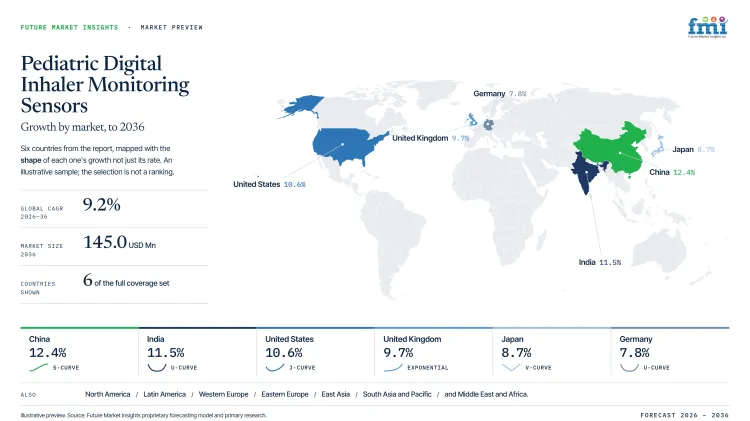
| Country | CAGR |
|---|---|
| China | 12.4% |
| India | 11.5% |
| United States | 10.6% |
| United Kingdom | 9.7% |
| Japan | 8.7% |
| Germany | 7.8% |
How do country-level CAGRs compare in the Pediatric Digital Inhaler Monitoring Sensors Market?
The profiled country rates span 4.6 percentage points and reflect different routes to pediatric connected inhaler adoption. China and India form a close group separated by 0.9 points as both markets strengthen medical device and software oversight. The United States and United Kingdom create another 0.9-point interval but differ sharply in reimbursement and guideline support. Japan and Germany form the steadier group under established review systems for medical devices and digital health services. The spacing shows that similar forecast rates do not create identical entry conditions or service obligations.
- China combines improving routes for localized device production with registration duties and long service distances beyond major urban hospitals.
- India combines new software guidance with concentrated specialist capacity and uneven replacement support outside metropolitan respiratory networks.
- The United States links cleared sensors with remote monitoring codes, although payer coverage and age-specific labeling continue to shape program economics.
- The United Kingdom applies centralized guideline review and NHS commissioning, creating a stronger evidence threshold for routine digital inhaler use.
- Japan offers structured SaMD consultation and specialized respiratory review, but foreign developers face demanding local documentation and service requirements.
- Germany combines formal digital reimbursement routes with separate hardware obligations and insurer-specific implementation across federal states.
Comparable CAGRs can therefore conceal substantial differences in approval burden, reimbursement requirements and technical support responsibilities. The full report provides country-level CAGR analysis across North America, Latin America, Europe, East Asia, South Asia, Oceania and the Middle East and Africa.
Country-wise Analysis
- China requires imported Class II and Class III devices to complete registration through the national medical device pathway, whereas local production follows a separate regulated route. In March 2025 NMPA revised the route for producing already registered imported devices through eligible foreign-invested enterprises in China. Pediatric digital inhaler monitoring sensor sales in China are forecast to expand at 12.4% CAGR by 2036, supported by improving device localization and large urban hospital networks. Local production can shorten sensor replacement routes and support faster technical service across major cities. The route requires registration dossiers and quality-system verification that compares domestic and overseas production processes. Long service distances can interrupt pediatric monitoring outside major cities, so developers need trained distributors and Chinese-language support.
- India’s respiratory technology market operates through CDSCO device rules and specialist care concentrated in metropolitan hospitals. India’s pediatric digital inhaler monitoring sensors market is anticipated to advance at 11.5% CAGR over the assessment period, aided by formal software guidance and local device development. Hospital-led programs can provide caregiver training and technical oversight during initial pediatric deployments in major cities. CDSCO posted its Guidance document on Medical Device Software under MDR-2017 on July 21, 2026. The guidance gives connected software developers a formal national reference but does not remove device-specific classification or licensing duties. Fragmented purchasing and uneven replacement support restrict expansion across smaller cities and dispersed respiratory networks. Manufacturers need local service partners and affordable replacement plans that preserve longitudinal records during hardware interruptions.
- United States pediatric respiratory programs operate through FDA-cleared devices and provider contracts that assign monitoring responsibilities. The FDA cleared the Ochsner Connected Inhaler Sensor on August 30, 2023 for patients older than two years. The United States pediatric digital inhaler monitoring sensors market is projected to record 10.6% CAGR during the assessment period, underpinned by specialty networks and defined remote monitoring routes. Established device logistics give clinical programs a direct route for family onboarding and prompt sensor replacement. Payer coverage and age-specific labeling remain material frictions across the country’s diverse public and private insurance arrangements. Contracts should separate sensor supply from clinical review so each service failure has a clearly accountable party. National scale depends on regulated device availability and a reimbursed workflow that families can follow consistently.
- United Kingdom pediatric asthma services depend on NHS commissioning and national guideline review rather than direct clinic purchasing. In April 2025 the MHRA advised people to seek a clinical review if blue inhaler use exceeds twice weekly. Adoption of pediatric digital inhaler monitoring sensors in the United Kingdom is estimated to expand at 9.7% CAGR through 2036, influenced by concern over reliever use. The outlook also reflects the routine need for clearer adherence records between scheduled respiratory appointments. Medication-use data can help community and specialist teams identify repeated reliever use between routine reviews. Routine guidance remains cautious about digital inhalers and requires developers to prove a selected use case. Commercial programs also need alert rules that protect limited respiratory staff time and preserve useful family support.
- Japan applies the PMD Act to medical software with meaningful patient risk and uses structured PMDA consultation for approval planning. By 2036 Japan’s pediatric digital inhaler monitoring sensor demand is projected to grow at 8.7% CAGR, supported by specialist respiratory care and formal software review. PMDA’s current SaMD materials include review principles and consultation guidance that the agency released during March 2025. Foreign developers must prepare Japanese documentation and secure local marketing authorization through a domestic route. Limited service coverage outside major academic hospitals creates another practical barrier for monitored pediatric care. Commercial entry therefore needs an experienced domestic partner and a replacement process that protects monitoring continuity across family and clinic settings.
- Germany combines statutory insurance purchasing with separate requirements for medical device hardware and digital health software. BfArM published version 3.6 of its DiGA guide in December 2025 for digital reimbursement applicants. Germany’s pediatric digital inhaler monitoring sensors market is estimated to post 7.8% CAGR over the forecast period, shaped by formal evidence review and established outpatient respiratory care. Specialist practices can provide caregiver training and structured monitoring across insured pediatric populations through established local clinical relationships. Data protection review and insurer-specific implementation create material friction across the country’s several federal states and regional care systems. A software listing does not satisfy the separate service obligations attached to physical monitoring devices. Manufacturers therefore need German-language assistance and clearly assigned responsibility for sensor replacement throughout each contracted program.
Who are the notable companies in the Pediatric Digital Inhaler Monitoring Sensors Market?
Adherium, Aptar Digital Health, FindAir, Amiko, Cognita Labs, BreatheSuite, Smart Respiratory Products, and Roundworks Technologies are notable companies in this market.
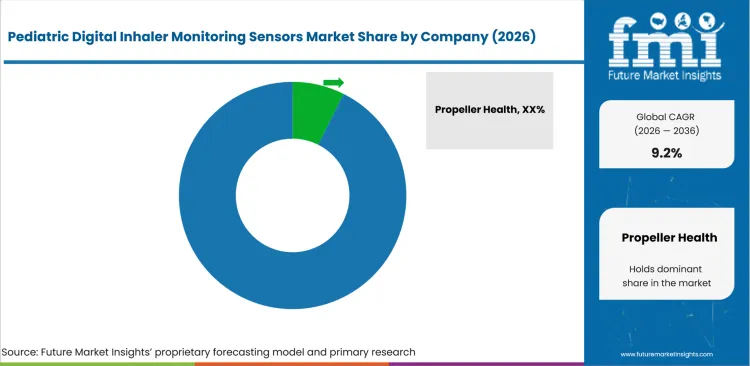
Adherium and Aptar Digital Health offer regulated add-ons that record medication events and support clinician review across monitored respiratory programs. FindAir connects smart inhaler records with partner research platforms and Amiko supplies validated inhalation measurements for evidence development. Cognita Labs combines technique coaching with home spirometry and BreatheSuite links sensor records with virtual respiratory care in North America. Smart Respiratory Products reported a March 2026 pharmacy pilot that evaluated an MDI optimization service in community care. Roundworks Technologies markets AlveoDot for app-connected MDI tracking in India but identifies the sensor as being in beta trials.
- Adherium and Aptar Digital Health focus on regulated sensors that capture medication events and support patient and clinician software. Their commercial position depends on compatible inhaler coverage, onboarding services and dependable replacement routes rather than sensor hardware alone across routine respiratory programs.
- FindAir and Amiko emphasize integration and multi-parameter inhalation data, whereas Cognita Labs combines technique coaching with connected home spirometry. Their platforms fit research or clinical workflows that require objective measurements, configurable interfaces and controlled data access across several respiratory programs.
- BreatheSuite and Smart Respiratory Products address focused virtual care and pharmacy-led monitoring routes across North American and British respiratory services. Roundworks Technologies provides a regionally oriented MDI sensor with app connectivity for Indian respiratory programs. The three focused developers need stronger pediatric deployment evidence and dependable replacement support to compete with platforms holding broader regulatory and commercial records.
Competitive Benchmarking: Pediatric Digital Inhaler Monitoring Sensors Market
| Company | Sensor and Technique Capture | Patient and Clinician Software | Regulatory and Deployment Evidence | Geographic Reach |
|---|---|---|---|---|
| Adherium | High | High | High | North America and Oceania |
| Aptar Digital Health | High | High | Medium | North America and Europe |
| FindAir | High | High | High | Europe and North America |
| Amiko | High | High | Medium | Europe |
| Cognita Labs | High | Medium | Medium | North America |
| BreatheSuite | High | High | Medium | North America |
| Smart Respiratory Products | Medium | High | Medium | United Kingdom |
| Roundworks Technologies | Medium | Medium | Low | India |
Key Developments in the Pediatric Digital Inhaler Monitoring Sensors Market
- FindAir received ISO 13485 certification confirming adherence to international standards in medical device quality management. The certification covers the design and production of active medical devices that monitor and support inhalation therapies, including storage and marketing under a documented quality management system. Certified processes strengthen manufacturing controls and commercialization support across respiratory programs that require dependable technical service. Product-specific clearance remains necessary, but institutional teams can use the certification to assess FindAir's quality framework and service readiness. Note: The original attributed this to "March 2025," but public sources confirm the certification without specifying that month. The date reference has been removed to avoid a potentially inaccurate attribution.
- As of November 26, 2025, Adherium had activated clinics across 70% of the Allergy Partners network, with the rollout of Hailie sensors and digital monitoring services reaching 110 clinic locations nationwide in less than six months. Nearly 700 Allergy Partners patients had been enrolled and actively monitored under the company's remote patient monitoring fee-for-service model. The Allergy Partners system serves an estimated 90,000 asthma patients eligible for the Hailie Smartinhaler platform. The rollout demonstrates that decentralized specialty networks require coordinated onboarding and replacement support beyond hardware supply, and provides a commercial reference for scaling monitored inhaler services across distributed clinical locations.
- On October 16, 2025, Aptar Digital Health received FDA 510(k) clearance for HeroTracker Sense as a Class II medical device. The Bluetooth-enabled add-on attaches to compatible pressurized metered-dose inhalers for patients aged 12 and above and records inhaler actuation, shake, orientation, coordination, and inspiratory strength and duration. Aptar integrated the sensor with its Respiratory Disease Management Platform to support patient and clinician workflows. The clearance strengthens competition for adolescent monitoring programs but does not establish use among younger children.
- On July 14, 2025, Amiko published results of the PIATTAFORMA RESPIRO 2024-2025 project, carried out with the support of ARTES 4.0 and co-financed under the PNRR. The project, which began in February 2024 and ran for 18 months, introduced computational fluid dynamics modeling and automated data acquisition into the development and engineering process for Respiro inhaler sensors, achieving up to a 40% reduction in overall sensor development time. Amiko applied the work to improve calibration and validation processes during manufacturing development. The advance shortens engineering cycles but does not replace clinical evidence needed for pediatric deployment.
Key Players in the Pediatric Digital Inhaler Monitoring Sensors Market
Cleared Sensor and Platform Providers
- Adherium
- Aptar Digital Health
- FindAir
Connected Inhaler Technology Developers
- Amiko
- Cognita Labs
- BreatheSuite
Specialist and Regional Developers
- Smart Respiratory Products
- Roundworks Technologies
Pediatric Digital Inhaler Monitoring Sensors Market - Report Scope
| Coverage field | Report scope |
|---|---|
| Market breakdown | Product Type, Care Setting, Application, End User, and Region. |
| Quantitative Units | USD Million, CAGR in %. |
| Market Definition | Commercial demand for pediatric digital inhaler monitoring sensors across product type, care setting, application, and end user. |
| Regions Covered | North America, Latin America, Western Europe, Eastern Europe, East Asia, South Asia and Pacific, and Middle East and Africa. |
| Countries Covered | United States, Germany, United Kingdom, Japan, China, India, and 30+ countries. |
| Key Companies Profiled | Adherium, Aptar Digital Health, FindAir, Amiko, Cognita Labs, BreatheSuite, Smart Respiratory Products, and Roundworks Technologies. |
| Forecast Period | 2026 to 2036. |
| Approach | Hybrid bottom-up and top-down market sizing supported by completed primary research and authoritative desk research. |
Pediatric Digital Inhaler Monitoring Sensors Market - Research Methodology
| Method | Approach |
|---|---|
| Primary Research | FMI analysts gathered input from manufacturers, service providers, technology developers, distributors, end users, procurement teams, and subject-matter experts. Interviews examined purchasing decisions, product or service evaluation, adoption barriers, approval requirements, pricing considerations, and expectations for technical or commercial support. Respondents were also asked what evidence is required before a trial, pilot, or initial order develops into regular purchasing. |
| Desk Research | Desk research covered government statistics, regulatory publications, trade data, industry associations, technical literature, standards, company filings, product information, and official corporate announcements. Sources were reviewed for relevance, publication date, geographic coverage, and consistency with the defined market scope. Claims relating to performance, applications, approvals, capacity, investment, and commercial activity were retained only when supported by credible public evidence. |
| Market Sizing and Forecasting | The market model combined the baseline value with historical performance, segment structure, pricing and volume indicators, adoption levels, company participation, and country-level demand conditions. Forecast assumptions considered economic activity, investment trends, regulatory developments, technology adoption, purchasing cycles, supply availability, and barriers to wider market use. Segment and regional estimates were reconciled before the final market total was calculated. |
| Data Validation | Estimates were checked against multiple independent indicators, including public data, company activity, trade patterns, industry developments, and findings from primary interviews. Validation also tested whether products, services, applications, and company revenues fell within the defined market boundaries. Adjacent categories, unsupported claims, overlapping revenues, and activities without direct market relevance were excluded to reduce double counting and maintain consistency across segments and countries. |
Pediatric Digital Inhaler Monitoring Sensors Market by Segments
Pediatric Digital Inhaler Monitoring Sensors Market segmented by Product Type:
- Software
- Wearable
- Diagnostic Kit
- Consumable
- Device Accessory
Pediatric Digital Inhaler Monitoring Sensors Market segmented by Care Setting:
- Hospital
- Home Care
- Ambulatory Center
- Retail Clinic
- Decentralized Trial Site
Pediatric Digital Inhaler Monitoring Sensors Market segmented by Application:
- Monitoring
- Diagnosis
- Workflow Automation
- Therapy Support
- Infection Control
Pediatric Digital Inhaler Monitoring Sensors Market segmented by End User:
- Hospitals
- Payers
- Diagnostic Labs
- Medtech Firms
- Patients
Pediatric Digital Inhaler Monitoring Sensors Market by Region:
- North America
- United States
- Canada
- Mexico
- Latin America
- Brazil
- Chile
- Rest of Latin America
- Western Europe
- Germany
- United Kingdom
- Italy
- Spain
- France
- Nordics
- Benelux
- Rest of Western Europe
- Eastern Europe
- Russia
- Poland
- Hungary
- Balkan and Baltic
- Rest of Eastern Europe
- East Asia
- China
- Japan
- South Korea
- South Asia and Pacific
- India
- ASEAN
- Australia and New Zealand
- Rest of South Asia and Pacific
- Middle East and Africa
- Kingdom of Saudi Arabia
- Other GCC Countries
- Türkiye
- South Africa
- Other African Union
- Rest of Middle East and Africa
Research Sources and Bibliography
- World Health Organization. (2026, May 7). WHO consolidated guidelines for the management of common childhood illness: Management of asthma in children and adolescents and bronchiolitis in infants and young children.
- Centers for Medicare & Medicaid Services. (2026, March 10). Therapy services.
- FindAir. (2026, January 27). Advancing respiratory research together: FindAir and WeGuide join forces.
- Adherium Limited. (2025, December 16). Adherium quarter-to-date sales update.
- Amiko S.r.l. (2025, March). RS01X’s measurements, validated in a clinical study.
- Adherium Limited. (2025, October 3). Breakthrough real-world evidence: New data reveals Hailie Smartinhaler powers medication adherence in patients with COPD and asthma.
- USA Food and Drug Administration. (2021, September 17). 510(k) premarket notification: BreatheSuite MDI V1 (K203155).
- National Institute for Health and Care Excellence. (2026, May 5). Digital technologies to support self-management of asthma: Early-use assessment.
- National Institute for Health and Care Excellence. (2024, November). Asthma: Diagnosis, monitoring and chronic asthma management (update): [R] Evidence reviews for smart inhalers.
- Adherium Limited. (2026, March 11). iCARE study demonstrates reductions in hospitalisations and cost of care.
- National Medical Products Administration. (2025, March 17). NMPA announcement on further improvement and optimization of matters concerning the production of imported medical devices in domestic enterprises in China (No. 30, 2025).
- Central Drugs Standard Control Organization. (2026, July 21). Guidance document on Medical Device Software under MDR-2017.
- USA Food and Drug Administration. (2023, August 30). 510(k) premarket notification: Ochsner Connected Inhaler Sensor (K223367).
- Medicines and Healthcare products Regulatory Agency. (2025, April 24). Patients with asthma reminded of the increased risk of severe asthma attacks from overusing blue inhalers.
- Pharmaceuticals and Medical Devices Agency. (2025, March 17). Software as a Medical Device (SaMD).
- Federal Institute for Drugs and Medical Devices. (2025, December 11). DiGA (Digitale Gesundheitsanwendungen)-Leitfaden, Version 3.6.
- Smart Respiratory Products Ltd. (2026, March). Clinical results of piloting an MDI optimisation service at the Pearl Chemist Group (PCG) -
- Singh, S. (2025, October 30). How the AlveoDot® smart MDI sensor makes asthma care smarter and easier.
- FindAir. (2026, June 22). FindAir secures FDA clearance to launch smart inhaler add-ons in the US market.
- Adherium Limited. (2025, November 26). Adherium reaches major milestone in Allergy Partners rollout.
- AptarGroup, Inc. (2025, October 16). Aptar Digital Health announces FDA 510(k) clearance for HeroTracker® Sense.
- Amiko S.r.l. (2025, July 14). A PNRR project with ARTES 4.0 to build better sensors, faster.
- FindAir. (2025, March 20). FindAir receives ISO 13485 certification.
This bibliography is provided for reader reference and is not exhaustive. The full report contains the complete reference list and detailed citations
This Report Answers
- How large is the pediatric digital inhaler monitoring sensors market in 2026 and 2036?
- Why do software platforms account for the largest product type share in 2026?
- How does home care shape sensor design and family onboarding requirements?
- Why does monitoring capture the largest application share in 2026?
- How do country growth rates differ across China, India, the United States, the United Kingdom, Japan and Germany?
- Which companies provide cleared sensors, technique capture or connected respiratory platforms?
- What evidence limits routine pediatric adoption across major health systems?
- How should hospitals and payers evaluate integration, support and alert management?
- Which recent company developments influence competition through 2026?
Frequently Asked Questions
How big is the Pediatric Digital Inhaler Monitoring Sensors Market in 2026?
The pediatric digital inhaler monitoring sensors market is valued at USD 60.0 million in 2026 and is forecast to reach USD 145.0 million by 2036.
What is the CAGR of the Pediatric Digital Inhaler Monitoring Sensors Market from 2026 to 2036?
The pediatric digital inhaler monitoring sensors market is projected to grow at a CAGR of 9.2% between 2026 and 2036, supported by objective medication-use records helping respiratory teams identify missed controller doses and repeated reliever use between scheduled pediatric appointments.
Which application leads the Pediatric Digital Inhaler Monitoring Sensors Market?
Monitoring accounts for 55.0% of the pediatric digital inhaler monitoring sensors market by application in 2026, driven by the need for continuous medication-use visibility creating a common database for reminders and technique coaching across home and clinical care settings.
Which country is growing fastest in the Pediatric Digital Inhaler Monitoring Sensors Market?
China is the fastest-growing country in the pediatric digital inhaler monitoring sensors market, expanding at a 12.4% CAGR through 2036, ahead of the market average of 9.2%, supported by improving device localization routes and large urban hospital networks serving pediatric respiratory care.
Who are the leading companies in the Pediatric Digital Inhaler Monitoring Sensors Market?
Leading companies in the pediatric digital inhaler monitoring sensors market include Adherium, Aptar Digital Health, FindAir, Amiko, Cognita Labs, BreatheSuite, Smart Respiratory Products, and Roundworks Technologies, competing across cleared sensor and platform provision, connected inhaler technology development, and specialist regional monitoring programs.
Preview the report firsthand - request a free sample
Get SampleGet the brochure for pricing and purchase details.
Get PDFTable of Content
- Key Takeaways
- Market Size and CAGR
- Top Growth Driver
- Fastest Growing Segment
- Leading Region
- Key Companies
- Emerging Opportunities
- Executive Summary
- Global Market Outlook
- Demand-side Trends
- Supply-side Trends
- Technology Roadmap Analysis
- Analysis and Recommendations
- Analyst Perspective (What is happening? Why now? What should investors know?)
- Key Questions Answered
- How large is the market?
- What is the CAGR?
- What are key trends?
- Which region dominates?
- Who are the leaders?
- Market Overview
- Market Coverage / Taxonomy
- Market Definition / Scope / Limitations
- Research Methodology
- Chapter Orientation
- Analytical Lens and Working Hypotheses
- Market Structure, Signals, and Trend Drivers
- Benchmarking and Cross-market Comparability
- Market Sizing, Forecasting, and Opportunity Mapping
- Research Design and Evidence Framework
- Desk Research Programme (Secondary Evidence)
- Expert Input and Fieldwork (Primary Evidence)
- Tooling, Models, and Reference Databases
- Data Engineering and Model Build
- Quality Assurance and Audit Trail
- Market Background
- Market Dynamics (Drivers, Restraints, Opportunity, Trends)
- Scenario Forecast (Optimistic, Likely, Conservative)
- Impact Analysis
- AI Impact
- Sustainability Impact
- Regulatory Impact
- Technology Impact
- Consumer / Buyer Analysis
- Purchase Drivers
- Adoption Barriers
- Buyer Journey
- Opportunity Map Analysis
- Product Life Cycle Analysis
- Supply Chain Analysis
- Investment Feasibility Matrix
- Value Chain Analysis
- PESTLE and Porter's Analysis
- Regulatory Landscape
- Regional Parent Market Outlook
- Production and Consumption Statistics
- Import and Export Statistics
- Global Market Analysis and Forecast, 2021 to 2036
- Historical Market Size Value (USD Million) Analysis, 2021 to 2025
- Current and Future Market Size Value (USD Million) Projections, 2026 to 2036
- Y-o-Y Growth Trend Analysis
- Absolute $ Opportunity Analysis
- Global Market Pricing Analysis, 2021 to 2036
- Global Market Analysis and Forecast, By Product Type, 2021 to 2036
- Introduction / Key Findings
- Historical Market Size Value (USD Million) Analysis By Product Type, 2021 to 2025
- Current and Future Market Size Value (USD Million) Analysis and Forecast By Product Type, 2026 to 2036
- Software
- Wearable
- Diagnostic Kit
- Consumable
- Device Accessory
- Software
- Y-o-Y Growth Trend Analysis By Product Type, 2021 to 2025
- Absolute $ Opportunity Analysis By Product Type, 2026 to 2036
- Global Market Analysis and Forecast, By Care Setting, 2021 to 2036
- Introduction / Key Findings
- Historical Market Size Value (USD Million) Analysis By Care Setting, 2021 to 2025
- Current and Future Market Size Value (USD Million) Analysis and Forecast By Care Setting, 2026 to 2036
- Home Care
- Hospital
- Ambulatory Center
- Retail Clinic
- Decentralized Trial Site
- Home Care
- Y-o-Y Growth Trend Analysis By Care Setting, 2021 to 2025
- Absolute $ Opportunity Analysis By Care Setting, 2026 to 2036
- Global Market Analysis and Forecast, By Application, 2021 to 2036
- Introduction / Key Findings
- Historical Market Size Value (USD Million) Analysis By Application, 2021 to 2025
- Current and Future Market Size Value (USD Million) Analysis and Forecast By Application, 2026 to 2036
- Monitoring
- Diagnosis
- Workflow Automation
- Therapy Support
- Infection Control
- Monitoring
- Y-o-Y Growth Trend Analysis By Application, 2021 to 2025
- Absolute $ Opportunity Analysis By Application, 2026 to 2036
- Global Market Analysis and Forecast, By End User, 2021 to 2036
- Introduction / Key Findings
- Historical Market Size Value (USD Million) Analysis By End User, 2021 to 2025
- Current and Future Market Size Value (USD Million) Analysis and Forecast By End User, 2026 to 2036
- Hospitals
- Payers
- Diagnostic Labs
- Medtech Firms
- Patients
- Hospitals
- Y-o-Y Growth Trend Analysis By End User, 2021 to 2025
- Absolute $ Opportunity Analysis By End User, 2026 to 2036
- Global Market Analysis and Forecast, By Region, 2021 to 2036
- Introduction
- Historical Market Size Value (USD Million) Analysis By Region, 2021 to 2025
- Current Market Size Value (USD Million) Analysis and Forecast By Region, 2026 to 2036
- North America
- Latin America
- Western Europe
- Eastern Europe
- East Asia
- South Asia and Pacific
- Middle East & Africa
- Market Attractiveness Analysis By Region
- North America Market Analysis and Forecast, By Country, 2021 to 2036
- Historical Market Size Value (USD Million) Trend Analysis By Market Taxonomy, 2021 to 2025
- Market Size Value (USD Million) Forecast By Market Taxonomy, 2026 to 2036
- By Country
- USA
- Canada
- By Product Type
- By Care Setting
- By Application
- By End User
- By Country
- Market Attractiveness Analysis
- By Country
- By Product Type
- By Care Setting
- By Application
- By End User
- Key Takeaways
- Latin America Market Analysis and Forecast, By Country
- Historical Market Size Value (USD Million) Trend Analysis By Market Taxonomy, 2021 to 2025
- Market Size Value (USD Million) Forecast By Market Taxonomy, 2026 to 2036
- By Country
- Brazil
- Mexico
- Chile
- Rest of Latin America
- By Product Type
- By Care Setting
- By Application
- By End User
- By Country
- Market Attractiveness Analysis
- By Country
- By Product Type
- By Care Setting
- By Application
- By End User
- Key Takeaways
- Western Europe Market Analysis and Forecast, By Country
- Historical Market Size Value (USD Million) Trend Analysis By Market Taxonomy, 2021 to 2025
- Market Size Value (USD Million) Forecast By Market Taxonomy, 2026 to 2036
- By Country
- Germany
- UK
- Italy
- Spain
- France
- Nordic
- BENELUX
- Rest of Western Europe
- By Product Type
- By Care Setting
- By Application
- By End User
- By Country
- Market Attractiveness Analysis
- By Country
- By Product Type
- By Care Setting
- By Application
- By End User
- Key Takeaways
- Eastern Europe Market Analysis and Forecast, By Country
- Historical Market Size Value (USD Million) Trend Analysis By Market Taxonomy, 2021 to 2025
- Market Size Value (USD Million) Forecast By Market Taxonomy, 2026 to 2036
- By Country
- Russia
- Poland
- Hungary
- Balkan & Baltic
- Rest of Eastern Europe
- By Product Type
- By Care Setting
- By Application
- By End User
- By Country
- Market Attractiveness Analysis
- By Country
- By Product Type
- By Care Setting
- By Application
- By End User
- Key Takeaways
- East Asia Market Analysis and Forecast, By Country
- Historical Market Size Value (USD Million) Trend Analysis By Market Taxonomy, 2021 to 2025
- Market Size Value (USD Million) Forecast By Market Taxonomy, 2026 to 2036
- By Country
- China
- Japan
- South Korea
- By Product Type
- By Care Setting
- By Application
- By End User
- By Country
- Market Attractiveness Analysis
- By Country
- By Product Type
- By Care Setting
- By Application
- By End User
- Key Takeaways
- South Asia and Pacific Market Analysis and Forecast, By Country
- Historical Market Size Value (USD Million) Trend Analysis By Market Taxonomy, 2021 to 2025
- Market Size Value (USD Million) Forecast By Market Taxonomy, 2026 to 2036
- By Country
- India
- ASEAN
- Australia & New Zealand
- Rest of South Asia and Pacific
- By Product Type
- By Care Setting
- By Application
- By End User
- By Country
- Market Attractiveness Analysis
- By Country
- By Product Type
- By Care Setting
- By Application
- By End User
- Key Takeaways
- Middle East & Africa Market Analysis and Forecast, By Country
- Historical Market Size Value (USD Million) Trend Analysis By Market Taxonomy, 2021 to 2025
- Market Size Value (USD Million) Forecast By Market Taxonomy, 2026 to 2036
- By Country
- Kingdom of Saudi Arabia
- Other GCC Countries
- Türkiye
- South Africa
- Other African Union
- Rest of Middle East & Africa
- By Product Type
- By Care Setting
- By Application
- By End User
- By Country
- Market Attractiveness Analysis
- By Country
- By Product Type
- By Care Setting
- By Application
- By End User
- Key Takeaways
- Key Countries Market Analysis
- USA
- Pricing Analysis
- Market Share Analysis, 2025
- By Product Type
- By Care Setting
- By Application
- By End User
- Canada
- Pricing Analysis
- Market Share Analysis, 2025
- By Product Type
- By Care Setting
- By Application
- By End User
- Mexico
- Pricing Analysis
- Market Share Analysis, 2025
- By Product Type
- By Care Setting
- By Application
- By End User
- Brazil
- Pricing Analysis
- Market Share Analysis, 2025
- By Product Type
- By Care Setting
- By Application
- By End User
- Chile
- Pricing Analysis
- Market Share Analysis, 2025
- By Product Type
- By Care Setting
- By Application
- By End User
- Germany
- Pricing Analysis
- Market Share Analysis, 2025
- By Product Type
- By Care Setting
- By Application
- By End User
- UK
- Pricing Analysis
- Market Share Analysis, 2025
- By Product Type
- By Care Setting
- By Application
- By End User
- Italy
- Pricing Analysis
- Market Share Analysis, 2025
- By Product Type
- By Care Setting
- By Application
- By End User
- Spain
- Pricing Analysis
- Market Share Analysis, 2025
- By Product Type
- By Care Setting
- By Application
- By End User
- France
- Pricing Analysis
- Market Share Analysis, 2025
- By Product Type
- By Care Setting
- By Application
- By End User
- India
- Pricing Analysis
- Market Share Analysis, 2025
- By Product Type
- By Care Setting
- By Application
- By End User
- ASEAN
- Pricing Analysis
- Market Share Analysis, 2025
- By Product Type
- By Care Setting
- By Application
- By End User
- Australia & New Zealand
- Pricing Analysis
- Market Share Analysis, 2025
- By Product Type
- By Care Setting
- By Application
- By End User
- China
- Pricing Analysis
- Market Share Analysis, 2025
- By Product Type
- By Care Setting
- By Application
- By End User
- Japan
- Pricing Analysis
- Market Share Analysis, 2025
- By Product Type
- By Care Setting
- By Application
- By End User
- South Korea
- Pricing Analysis
- Market Share Analysis, 2025
- By Product Type
- By Care Setting
- By Application
- By End User
- Russia
- Pricing Analysis
- Market Share Analysis, 2025
- By Product Type
- By Care Setting
- By Application
- By End User
- Poland
- Pricing Analysis
- Market Share Analysis, 2025
- By Product Type
- By Care Setting
- By Application
- By End User
- Hungary
- Pricing Analysis
- Market Share Analysis, 2025
- By Product Type
- By Care Setting
- By Application
- By End User
- Kingdom of Saudi Arabia
- Pricing Analysis
- Market Share Analysis, 2025
- By Product Type
- By Care Setting
- By Application
- By End User
- Türkiye
- Pricing Analysis
- Market Share Analysis, 2025
- By Product Type
- By Care Setting
- By Application
- By End User
- South Africa
- Pricing Analysis
- Market Share Analysis, 2025
- By Product Type
- By Care Setting
- By Application
- By End User
- USA
- Market Structure Analysis
- Competition Dashboard
- Competition Benchmarking
- Market Share Analysis of Top Players
- By Regional
- By Product Type
- By Care Setting
- By Application
- By End User
- Emerging Startups
- Innovation Benchmarking
- Competition Analysis
- Competition Deep Dive
- Propeller Health
- Overview
- Product Portfolio
- Profitability by Market Segments
- Sales Footprint
- Strategy Overview
- Marketing Strategy
- Product Strategy
- Channel Strategy
- Adherium
- Aptar Digital Health
- Teva
- FindAir
- Cohero Health
- Cognita Labs
- Amiko
- Propeller Health
- Case Studies
- Success Stories
- Recent Developments
- Competition Deep Dive
- Assumptions & Acronyms Used


