

- Market Size (2026)
- USD 165.5 Mn
- Forecast (2036)
- USD 377.7 Mn
- CAGR (2026 to 2036)
- 8.6%
How Big is the Persipan Market in 2026?
The persipan market is estimated at USD 165.5 million in 2026.
The global persipan market was valued at USD 152.4 million in 2025 and is estimated to reach USD 165.5 million in 2026. The market is projected to reach USD 377.7 million by 2036, expanding at a compound annual growth rate (CAGR) of 8.6% between 2026 and 2036. Standard grade accounted for the largest share of the market, contributing 41.0% of total revenue in 2026. Persipan is made mainly from processed apricot or peach kernels and sugar, and is used in sweet breads, pastries and confectionery as an alternative to almond-based marzipan. The supply of apricot kernels was severely disrupted in 2025. A spring frost in April 2025 damaged nearly all of the 13 million apricot trees in Malatya, the province that accounts for 85.0% of Türkiye's apricot production, and estimated output fell from 750,000 tonnes in 2024 to just 10,000 tonnes[5]. Prices responded sharply, with dried apricot prices on international markets more than doubling after May 2025[6]. A partial recovery is expected, with sector observers forecasting 60.0% to 80.0% of normal production in 2026[7].
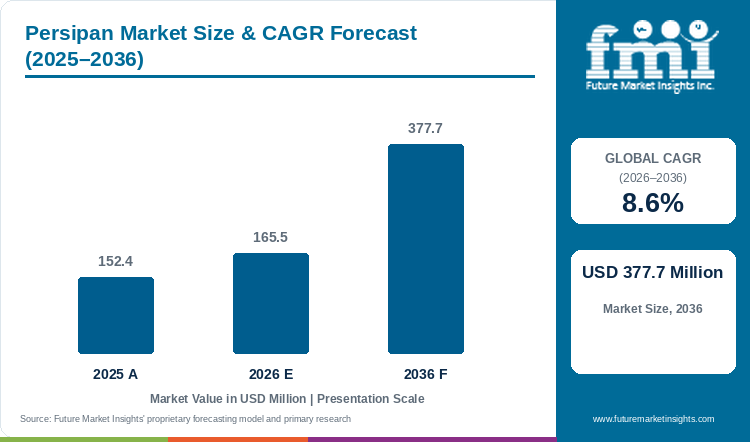
Table 1: Persipan Market Size and Forecast (USD million), 2025 to 2036
| Market size and forecast | Value |
|---|---|
| 2025 market size | USD 152.4 million |
| Estimated market size in 2026 | USD 165.5 million |
| Projected market size by 2036 | USD 377.7 million |
| CAGR (2026-2036) | 8.6% |
| Added revenue, 2026 to 2036 | USD 212.2 million |
Key Market Trends & Insights
- By Product Type: The Standard grade segment accounted for the largest share of the persipan market in 2026, representing 41.0% of total market revenue.
- By Form: Powder / dry products held the leading market position with a share of 47.0% in 2026.
- By Application: Bread & rolls remained the largest application segment, accounting for 35.0% of the market in 2026.
Regional Highlights
- Fastest-growing country: The UAE is expected to record the highest growth rate among the eight profiled countries, with a projected CAGR of 9.9% between 2026 and 2036.
- Growth across other countries: Saudi Arabia is projected to expand at a CAGR of 9.6%, followed by South Korea at 9.2% and the USA at 8.9%. Japan is expected to register comparatively slower growth, with a CAGR of 7.6% during the forecast period.
The availability of kernels remains the most important factor influencing persipan supply. Türkiye exported USD 475.0 million of apricots in 2024, of which dried apricots accounted for USD 400.0 million[5], making it the main source of apricot fruit and kernels for processors. After the 2025 frost, Turkish exports of dried apricots and related products fell to 20,007 tons between August 2025 and February 2026, compared with 55,479 tons in the same period a year earlier, while shipments to the European Union declined by 60.0% to 6,420 tons[7]. Lower fruit processing reduces the volume of kernels available to persipan manufacturers. Composition also matters. Lubeca's persipan raw-mass specification identifies kernel and sugar content[1], which distinguishes the material from generic bakery fillings and determines dose and sweetness.
Almond supply provides an important comparison, as persipan is used as a lower-cost alternative to marzipan. The United States Department of Agriculture (USDA) forecast the 2026 California almond crop at 2.7 billion pounds, down 1.0% from the previous year[8]. With almond supply broadly stable and apricot kernels scarce, the cost advantage of persipan over almond-based marzipan may have narrowed in the 2025/26 season. South Bakels' 2023 product guide lists Persipan Fancy for baking, pastry and biscuits[2], which links a named grade with heat exposure and finished-product requirements. A raw mass adjusted by the bakery leaves control over consistency with the user, while a more prepared grade reduces the work before shaping or depositing.
Food safety requirements also shape procurement. The European Food Safety Authority (EFSA) identified a cyanide exposure risk associated with amygdalin in raw apricot kernels in 2016[3], and EU Regulation 2023/915 contains contaminant provisions relevant to apricot kernels and other specified foods[4]. These sources make the nature and treatment of the kernel input relevant to purchasing, with the applicable material category determining the documentation required. During a period of scarce supply, buyers considering kernels from new origins must review these records as carefully as the commercial specification.
Table 2: Supporting Industry Indicators for the Persipan Market, 2016 to 2026
| Indicator | Data point | Why it matters | Source |
|---|---|---|---|
| Frost damage | An April 2025 frost damaged nearly all 13 million apricot trees in Malatya, which accounts for 85.0% of Türkiye's apricot production. | Apricot processing is the main source of kernels for persipan. | [5] |
| Apricot output | Estimated Turkish apricot output fell from 750,000 tonnes in 2024 to 10,000 tonnes in 2025. | The collapse in fruit supply sharply reduced kernel availability. | [5] |
| Crop loss | The frost wiped out nearly 98.0% of Turkey's apricot crop. | Few alternative origins can replace Turkish volumes in the short term. | [6] |
| Prices | Dried apricot prices on international markets more than doubled after May 2025. | Higher fruit prices indicate higher kernel costs for processors. | [6] |
| Exports | Turkish dried apricot exports fell to 20,007 tons between August 2025 and February 2026, from 55,479 tons a year earlier. | Lower exports reduce the supply of processed apricot products to Europe. | [7] |
| Recovery outlook | Sector observers expect 2026 production at 60.0% to 80.0% of normal levels. | A partial recovery should ease kernel supply over the forecast period. | [7] |
| Almond supply | USDA forecast the 2026 California almond crop at 2.7 billion pounds, down 1.0%. | Almond supply sets the cost of marzipan, the main alternative to persipan. | [8] |
| Raw-mass composition | Lubeca publishes kernel-and-sugar specifications for its persipan raw mass. | Composition determines dose and sweetness in bakery recipes. | [1] |
| Raw-kernel assessment | EFSA identified amygdalin in raw apricot kernels as a cyanide exposure concern in April 2016. | Kernel treatment records form part of ingredient qualification. | [3] |
| Contaminant provisions | EU Regulation 2023/915 includes provisions relevant to apricot kernels. | Documentation must address the applicable material category. | [4] |
Demand Intensity Analysis
A comparison of FMI's market estimate with Turkish apricot trade provides a measure of the scale of the persipan market relative to its main raw material source. Türkiye exported USD 475.0 million of apricots in 2024[5]. FMI estimated the persipan market at USD 152.4 million in 2025, which is equivalent to approximately 32.0% of the value of Türkiye's 2024 apricot exports. Since kernels are a by-product of apricot processing, the comparison shows that persipan represents a valuable outlet for a material that would otherwise be of lower value.
The scale of the 2025 supply shock provides another reference point. The fall in estimated Turkish apricot output from 750,000 tonnes to 10,000 tonnes represents a decline of approximately 98.7%[5], while Turkish dried apricot exports fell by approximately 64.0% in the first seven months of the 2025/26 season[7]. Even if 2026 production recovers to 60.0% to 80.0% of normal levels[7], kernel supply is likely to remain below pre-frost levels in the near term.
A similar comparison can be made between projected market growth and raw material supply. FMI expects the persipan market to grow at a CAGR of 8.6% between 2026 and 2036, while almond supply, which determines the price of the competing marzipan, is forecast to fall by 1.0% in 2026[8]. Recovery in apricot production from the 2025 low would allow persipan to regain its cost advantage over marzipan, which supports the long-term forecast.
Segment values show where demand is concentrated. Standard grade represented USD 67.9 million of Product Type revenue in 2026, while Bread & rolls accounted for USD 57.9 million on the Application axis. Direct to industrial bakeries accounted for USD 74.5 million of Sales Channel revenue. FMI projects added market revenue of USD 212.2 million from 2026 to 2036, with the market reaching 2.3 times its 2026 value.
Table 3: Demand Intensity Metrics for the Persipan Market, Apricot Trade Data Against 2025 and 2026 Market Values
| Demand intensity metric | Value | Basis |
|---|---|---|
| FMI market value, 2025 | USD 152.4 million | FMI estimate of persipan revenue. |
| Türkiye apricot exports, 2024 | USD 475.0 million | Expana, including USD 400.0 million of dried apricots. |
| FMI value as a share of Turkish apricot exports | Approximately 32.0% | USD 152.4 million divided by USD 475.0 million. |
| Decline in Turkish apricot output, 2025 | Approximately 98.7% | 750,000 tonnes in 2024 against 10,000 tonnes in 2025. |
| Change in Turkish dried apricot exports | Approximately -64.0% | 20,007 tons against 55,479 tons, August to February. |
| Expected 2026 apricot production | 60.0% to 80.0% of normal | Sector observers, March 2026. |
| Change in 2026 California almond crop | -1.0% | USDA May 2026 forecast. |
| FMI value CAGR, 2026 to 2036 | 8.6% | FMI market forecast. |
| Standard grade revenue, 2026 | USD 67.9 million | 41.0% of the market. |
| Direct industrial bakery revenue, 2026 | USD 74.5 million | 45.0% of the market. |
| Market expansion multiple | 2.3 times | Projected 2036 market value relative to 2026. |
Analyst Perspective
"The 2025 apricot frost showed how exposed persipan is to a single growing region, so buyers should qualify more than one kernel source before the next seasonal peak."
- Nandini Roy Choudhury, Principal Analyst at Future Market Insights
How is the persipan market segmented?
The persipan market is segmented by product type, form, application, claim and sales channel. Product Type comprises Standard grade, Premium / specialty grade, Organic certified and Clean label grade. Form comprises Powder / dry, Liquid, Paste / semi-solid and Granules / pieces. Application comprises Bread & rolls, Cakes & muffins, Biscuits & cookies, Viennoiserie & pastry and Other bakery & snacks. Claim comprises Conventional, Clean label, Organic and Non-GMO / identity preserved. Sales Channel comprises Direct to industrial bakeries, Ingredient distributors, Foodservice & artisan supply and Online B2B.
Why does Standard grade anchor the Product Type mix?
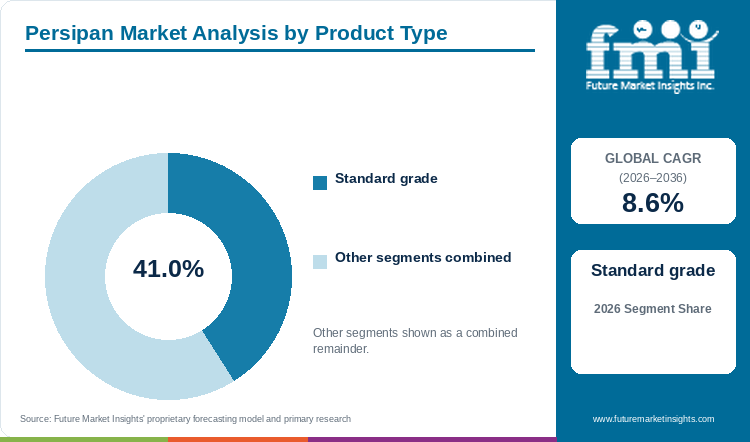
Standard grade represents 41.0% of Product Type in 2026.
The kernel-and-sugar ratio sets a standard persipan grade's sweetness, dose and working texture, and Standard grade generated approximately USD 67.9 million in 2026. Lubeca's published raw-mass specification illustrates the detail available for comparison[1]. Similar product names can still cover different proportions, which changes the preparation required or the aroma retained after baking. Once these conditions are established, routine purchasing can follow the same grade across seasonal and regular output. During the 2025 kernel shortage[5], a clear standard specification also helped buyers judge whether substitute material matched the accepted grade.
- Standard grade represents 41.0% of Product Type in 2026.
- The approved kernel-and-sugar specification provides a reference for dose, aroma and working consistency.
What supports the Powder / dry lead in Form?
Powder / dry accounts for 47.0% of Form in 2026.
Dry and powdered products accounted for 47.0% of the Form classification, or approximately USD 77.8 million, in 2026. Persipan selection depends on the exact composition and preparation described by the supplier, as published raw-mass and paste specifications identify different handling routes, including the ingredients added before a grade is shaped or incorporated into another formulation. Pack size and storage after opening affect the material available for later batches, and clear grade identification keeps these conditions attached to the accepted recipe.
- Powder / dry accounts for 47.0% of Form in 2026.
- Preparation instructions need to account for dispersion, added ingredients and storage after opening.
How do Bread & rolls lead among applications?
Bread & rolls have a 35.0% share of Application in 2026.
Sweet breads and rolls are the largest application, accounting for approximately USD 57.9 million in 2026. Persipan used in sweet bread interacts with the dough through portioning, proofing and baking. Softer preparations can be blended into a filling, while firmer masses can be shaped before enclosure. South Bakels lists Persipan Fancy for baking, pastry and biscuits, linking a named grade with these requirements[2]. The retained aroma and consistency of the centre determine its suitability, so repeat purchasing depends on a preparation that preserves the intended dose and sensory balance across normal batches.
- Bread & rolls have a 35.0% share of Application in 2026.
- The centre should be assessed with its dough after proofing and baking, when the final flavour and texture are apparent.
Why does Conventional hold the Claim lead?
Conventional represents 48.0% of Claim in 2026.
Conventional grades held 48.0% of the Claim segment in 2026, combining a specified composition with the processing and handling conditions required for persipan use. Organic or identity-preserved alternatives add sourcing and traceability requirements while retaining the need for suitable kernel treatment[3][4]. A change in formulation can affect sweetness, dose or consistency, so its consequences extend into production. Portion cost and continued availability also matter, particularly when persipan supports seasonal items with limited time for substitution trials.
- Conventional represents 48.0% of Claim in 2026.
- A claim-specific grade must still reproduce the recipe's accepted aroma and texture.
Why are direct industrial bakery contracts the main Sales Channel?
Direct to industrial bakeries accounts for 45.0% of Sales Channel in 2026.
Industrial bakeries buying directly share a single specification with the processor, and direct supply accounted for approximately USD 74.5 million in 2026. Depositing behaviour can be agreed with the party that controls the grade, followed by thermal and sensory acceptance in the finished product. Pack format and the response to an out-of-specification batch can be settled within the same relationship. When kernel supply is disrupted, as in 2025[5][7], direct contracts also give bakeries earlier notice of shortages. Distributors serve smaller volumes and mixed orders.
- Direct to industrial bakeries accounts for 45.0% of Sales Channel in 2026.
- An explicit grade reference keeps purchasing aligned with the mass qualified for the production line.
What are the drivers, restraints and opportunities in the persipan market?
A distinct kernel profile and lower cost than marzipan sustain demand, while kernel scarcity and food safety requirements restrain supply and application-specific grades can widen bakery use.
A distinct kernel profile and lower cost than marzipan sustain demand
Kernel flavour, sweetness and texture give persipan a distinct function in bakery recipes, and its traditional advantage is a lower cost than marzipan. Lubeca's raw-mass information shows how kernel and sugar content can be stated for comparison[1]. These proportions affect both the amount used and the balance achieved in the finished product, and distinguish persipan from almond-based preparations. With California almond supply forecast to decline by 1.0% in 2026[8], the cost difference remains relevant to buyers. Once a grade is accepted, stable supply preserves the recipe development already completed.
Kernel scarcity and food safety requirements restrain supply
The 2025 frost exposed the dependence of persipan on Turkish apricots. Estimated Turkish output fell by around 98.0%[5][6], and exports of dried apricots and related products fell by approximately 64.0% in the following season[7]. New kernel sources cannot be adopted quickly, as EFSA identifies amygdalin in raw apricot kernels as a source of cyanide exposure[3], and EU Regulation 2023/915 contains contaminant provisions relevant to apricot kernels[4]. A cheaper alternative must match the accepted aroma, texture and baking behaviour, and documentation and application assessment must travel together. Where information is incomplete, qualification time can offset the advantage of changing supply.
Application-specific grades can widen bakery use
Raw masses and more prepared persipan grades divide consistency adjustment differently between processor and bakery. A raw mass retains flexibility for several recipes, while a grade suited to shaping or depositing reduces preparation for a defined application, as shown by South Bakels' Persipan Fancy[2]. Performance assessment includes the bake and subsequent holding period, when the kernel component interacts with the surrounding dough, fruit or chocolate. Its role within the wider bakery ingredient system depends on the combination rather than the mass alone. As apricot production recovers to an expected 60.0% to 80.0% of normal in 2026[7], suppliers can use application-specific grades to rebuild volumes.
Which country CAGRs are profiled in the persipan market?
Table 4: Country growth outlook for the persipan market
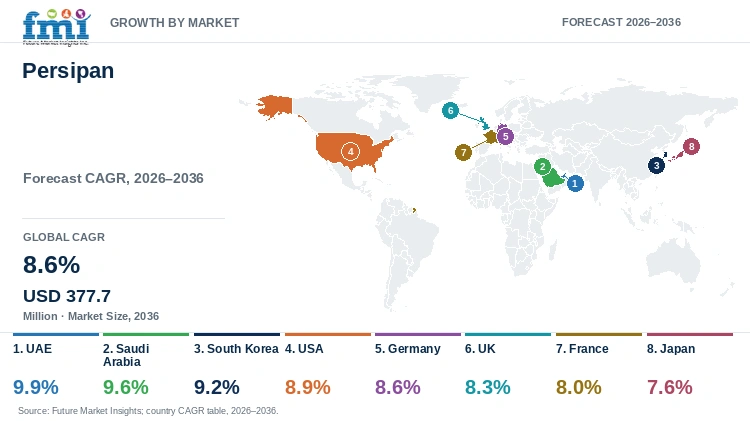
| Country | CAGR |
|---|---|
| UAE | 9.9% |
| Saudi Arabia | 9.6% |
| South Korea | 9.2% |
| USA | 8.9% |
| Germany | 8.6% |
| UK | 8.3% |
| France | 8.0% |
| Japan | 7.6% |
UAE
- The UAE is the fastest-growing market among the profiled countries, with a forecast CAGR of 9.9% from 2026 to 2036. The kernel flavour retained after baking determines persipan's role in UAE pastry and sweet-bread applications, while working consistency separates preparations suited to shaping from those used in fillings. Central kitchens need these properties to remain stable at larger batch sizes. Imported supply and clear pack identification preserve the accepted grade through replenishment, which is particularly important during periods of kernel scarcity.
Saudi Arabia
- In Saudi sweet rolls and pastries, persipan is judged on the flavour and texture retained after baking, which determines how it must be handled before enclosure or mixing. Saudi Arabia is projected to grow at a CAGR of 9.6% from 2026 to 2036. Composition records and application instructions connect the selected grade with a repeatable batch method. Trial quantities limit initial stock commitments, while recurring production across outlets requires continuity of the approved mass through seasonal orders.
South Korea
- With a projected CAGR of 9.2% for 2026 to 2036, South Korea ranks third among the profiled countries. Kernel intensity and sweetness need to be balanced against the surrounding dough in South Korean applications, so comparing samples at an arbitrary dose can be misleading. Raw masses also need a complete preparation method. Smaller packs and clear product identification make early trials more manageable, and as an item moves into regular production, changes in kernel content need attention because they affect handling as well as flavour.
USA
- US bakeries compare persipan with almond-based alternatives on composition, dose and baking performance. With California's 2026 almond crop forecast at 2.7 billion pounds[8], domestic almond supply provides a ready alternative. The USA market is forecast to grow at a CAGR of 8.9% from 2026 to 2036. Imported persipan grades bring pack quantities and lead times into the production plan, and shaping and baking assessment establish whether a particular mass delivers the intended character at the selected portion weight.
Germany
- Germany is home to several specialist persipan manufacturers, and its raw masses and preparations can be compared through defined specifications. Lubeca's kernel-and-sugar information, for example, helps a bakery consider the sweetness and texture of the intended centre[1]. The market is projected to grow at a CAGR of 8.6% from 2026 to 2036. German buyers were directly affected by the 60.0% fall in Turkish dried apricot shipments to the European Union in the 2025/26 season[7]. Material records also support assessment against EU contaminant provisions[4].
UK
- Turning a raw mass into a finished filling or shaped centre is the central application task for UK persipan users. The UK is forecast to grow at a CAGR of 8.3% from 2026 to 2036. Sweetness and firmness need to suit the dough, and the actual bake cycle determines whether the combination works. Distributors can support initial trials and smaller purchases, while larger requirements may be served directly. Clear identification of the kernel-based composition remains necessary through either route.
France
- In French pastry and confectionery, persipan is judged together with the fruit, chocolate or dough around it, and a dose that works in one combination may make another too sweet. France is forecast to grow at a CAGR of 8.0% from 2026 to 2036. Mixing the ingredient into a cream requires different handling from shaping a mass that will be baked. Once the intended balance has been established, repeatable performance matters more than the breadth of possible uses.
Japan
- Japan is expected to register the slowest growth among the profiled countries, with a projected CAGR of 7.6% from 2026 to 2036. Portion size and kernel intensity shape persipan use in Japanese pastries, while working temperature affects preparation and storage reveals the texture retained in the finished item. For imported grades, shipment quantities and pack sizes influence the stock committed to a launch, and continuity of the grade gives later production the same starting material.
Who are the notable companies in the persipan market?
Lubeca; Georg Lemke; Moll Marzipan; Kondima; South Bakels
Persipan supply includes specialist kernel processors and bakery ingredient businesses, among them Lubeca, Georg Lemke, Moll Marzipan, Kondima and South Bakels. Most rely on processed apricot or peach kernels, so the 2025 Turkish frost, which cut estimated apricot output from 750,000 tonnes to 10,000 tonnes[5], affected the whole supplier base. Their preparations need to be compared at grade level, with attention to raw-mass consistency, forming behaviour and suitability for baking.
Grade-level composition, processing documentation and working texture provide the basis for comparing persipan offers. Application work connects those specifications with mixing, shaping and baking, and establishes which preparation supports the intended centre.
Competitive Benchmarking: Persipan Market
Table 5: Company capabilities in the persipan market
| Company | Relevant offering | Purchasing consideration |
|---|---|---|
| Lubeca | Persipan raw mass | Compare declared kernel and sugar content |
| Georg Lemke | Apricot-kernel persipan raw paste | Select pack size and intended preparation |
| Moll Marzipan | Persipan from processed apricot kernels | Review treatment and product specifications |
| Kondima | Persipan raw paste and forming preparations | Match the degree of preparation to the recipe |
| South Bakels | Persipan Fancy for baking and pastry | Confirm the exact grade and heat exposure |
Key Developments in the Persipan Market
- In April 2023, EU Regulation 2023/915 consolidated maximum levels for specified food contaminants, including provisions relevant to apricot kernels[4].
- In 2023, South Bakels' product guide listed Persipan Fancy for baking, pastry and biscuit applications[2].
- In May 2025, Expana reported that frost had damaged nearly all 13 million apricot trees in Malatya, with estimated Turkish output falling from 750,000 tonnes to 10,000 tonnes[5].
- In December 2025, FreshPlaza reported that dried apricot prices had more than doubled since May 2025[6].
- In March 2026, sector observers forecast Turkish apricot production at 60.0% to 80.0% of normal levels for 2026, after exports fell to 20,007 tons in August 2025 to February 2026[7].
Key Players in the Persipan Market
- Lubeca
- Georg Lemke
- Moll Marzipan
- Kondima
- South Bakels
Persipan Market - Report Scope
Table 6: Report scope for the persipan market
| Coverage field | Report scope |
|---|---|
| Market breakdown | Product Type; Form; Application; Claim; Sales Channel |
| Quantitative Units | USD Million |
| Market Definition | Revenue from commercial persipan ingredients and persipan-containing preparations attributable to their processed apricot- or peach-kernel persipan content within the defined segments. Finished baked goods, untreated kernel inputs, almond marzipan, standalone fruit/nut/chocolate fillings and unrelated services are excluded. Only the separable persipan component of a bundled formulation counts. |
| Regions Covered | North America, Latin America, Western Europe, Eastern Europe, East Asia, South Asia and Pacific, Middle East and Africa |
| Countries Covered | UAE; Saudi Arabia; South Korea; USA; Germany; UK; France; Japan |
| Key Companies Profiled | Lubeca; Georg Lemke; Moll Marzipan; Kondima; South Bakels |
| Forecast Period | 2026 to 2036 |
| Approach | Market assessment supported by official technical and regulatory publications, company product information and country operating conditions. |
Persipan Market - Research Methodology
Table 7: Research approach for the persipan market
| Method | Approach |
|---|---|
| Market definition | The assessment separates qualifying ingredient revenue from finished bakery products and unrelated formulation inputs. |
| Secondary evidence | Government publications, regulatory material, technical literature and first-party product documentation establish the operating context. |
| Commercial assessment | Product performance, supply continuity and customer qualification requirements are considered within each segment and country profile. |
| Comparability | Market values, segment shares and country forecasts use the stated revenue boundary, units and forecast period. |
Persipan Market by Segments
Product Type
- Standard grade
- Premium / specialty grade
- Organic certified
- Clean label grade
Form
- Powder / dry
- Liquid
- Paste / semi-solid
- Granules / pieces
Application
- Bread & rolls
- Cakes & muffins
- Biscuits & cookies
- Viennoiserie & pastry
- Other bakery & snacks
Claim
- Conventional
- Clean label
- Organic
- Non-GMO / identity preserved
Sales Channel
- Direct to industrial bakeries
- Ingredient distributors
- Foodservice & artisan supply
- Online B2B
Persipan Market by Region
- North America
- United States
- Canada
- Latin America
- Brazil
- Mexico
- Argentina
- Chile
- Western Europe
- Germany
- France
- United Kingdom
- Italy
- Spain
- Benelux
- Nordics
- Eastern Europe
- Poland
- Czech Republic
- Romania
- Hungary
- East Asia
- China
- Japan
- South Korea
- South Asia and Pacific
- India
- ASEAN
- Australia and New Zealand
- Middle East and Africa
- GCC Countries
- South Africa
- Türkiye
- Israel
Research Sources and Bibliography
- [1] Lübecker Marzipan-Fabrik (Lubeca). (n.d.). Persipan-Rohmasse.
- [2] South Bakels. (2023). South Bakels Product Guide.
- [3] European Food Safety Authority. (2016, April 27). Apricot kernels pose risk of cyanide poisoning.
- [4] European Union. (2023, April 25). Commission Regulation (EU) 2023/915 on maximum levels for certain contaminants in food.
- [5] Idoniboye, I. (2025, May 19). Expana. Apricot market: Severe Türkiye frost slashes output, sends global prices soaring.
- [6] FreshPlaza. (2025, December 12). Caucasus fruit exporters seize opportunity as Turkey's frost decimates apricot harvest.
- [7] FreshPlaza. (2026, March 10). Turkish Malatya apricot crop recovers after 2025 frost damage.
- [8] Almond Board of California. (2026, May 12). USDA forecasts slightly smaller almond crop.
Future Market Insights. (2026). Persipan Market: Global Industry Analysis and Opportunity Assessment 2036.
This Report Answers
- How large is the persipan market in 2026 and what value is projected for 2036?
- Which industrial bakery needs underpin demand for persipan ingredients?
- Why does Standard grade lead the Product Type mix?
- Why does Powder / dry lead the Form mix?
- How do projected CAGRs differ across the eight profiled countries?
- What documented persipan and adjacent ingredient capabilities do the profiled companies offer?
Frequently Asked Questions
How big is the persipan market in 2026, and what is forecast for 2036?
The market is valued at USD 165.5 million in 2026 and is forecast to reach USD 377.7 million by 2036.
What is the CAGR of the persipan market from 2026 to 2036?
The market is forecast to grow at a CAGR of 8.6% from 2026 to 2036, supported by a recovery in apricot kernel supply after the 2025 frost.
Which Product Type leads the persipan market?
Standard grade leads with a 41.0% share in 2026, as buyers favour familiar specifications and repeatable purchasing.
Which Form leads the persipan market?
Powder / dry leads with a 47.0% share in 2026, although industrial use depends on each product's compatibility with feeding systems and baking conditions.
Which profiled countries have the fastest persipan growth?
The UAE leads at 9.9%, followed by Saudi Arabia at 9.6% and South Korea at 9.2% from 2026 to 2036. These are growth rates rather than rankings by market size.
Which companies are profiled in the persipan market?
The report profiles Lubeca, Georg Lemke, Moll Marzipan, Kondima and South Bakels.
Preview the report firsthand - request a free sample
Get SampleGet the brochure for pricing and purchase details.
Get PDFTable of Content
- Key Takeaways
- Market Size and CAGR
- Top Growth Driver
- Fastest Growing Segment
- Leading Region
- Key Companies
- Emerging Opportunities
- Executive Summary
- Global Market Outlook
- Demand-side Trends
- Supply-side Trends
- Technology Roadmap Analysis
- Analysis and Recommendations
- Analyst Perspective (What is happening? Why now? What should investors know?)
- Key Questions Answered
- How large is the market?
- What is the CAGR?
- What are key trends?
- Which region dominates?
- Who are the leaders?
- Market Overview
- Market Coverage / Taxonomy
- Market Definition / Scope / Limitations
- Research Methodology
- Chapter Orientation
- Analytical Lens and Working Hypotheses
- Market Structure, Signals, and Trend Drivers
- Benchmarking and Cross-market Comparability
- Market Sizing, Forecasting, and Opportunity Mapping
- Research Design and Evidence Framework
- Desk Research Programme (Secondary Evidence)
- Expert Input and Fieldwork (Primary Evidence)
- Tooling, Models, and Reference Databases
- Data Engineering and Model Build
- Quality Assurance and Audit Trail
- Market Background
- Market Dynamics (Drivers, Restraints, Opportunity, Trends)
- Scenario Forecast (Optimistic, Likely, Conservative)
- Impact Analysis
- AI Impact
- Sustainability Impact
- Regulatory Impact
- Technology Impact
- Consumer / Buyer Analysis
- Purchase Drivers
- Adoption Barriers
- Buyer Journey
- Opportunity Map Analysis
- Product Life Cycle Analysis
- Supply Chain Analysis
- Investment Feasibility Matrix
- Value Chain Analysis
- PESTLE and Porter's Analysis
- Regulatory Landscape
- Regional Parent Market Outlook
- Production and Consumption Statistics
- Import and Export Statistics
- Global Market Analysis and Forecast, 2021 to 2036
- Historical Market Size Value (USD Million) Analysis, 2021 to 2025
- Current and Future Market Size Value (USD Million) Projections, 2026 to 2036
- Y-o-Y Growth Trend Analysis
- Absolute $ Opportunity Analysis
- Global Market Pricing Analysis, 2021 to 2036
- Global Market Analysis and Forecast, By Product Type, 2021 to 2036
- Introduction / Key Findings
- Historical Market Size Value (USD Million) Analysis By Product Type, 2021 to 2025
- Current and Future Market Size Value (USD Million) Analysis and Forecast By Product Type, 2026 to 2036
- Standard grade
- Premium / specialty grade
- Organic certified
- Clean label grade
- Y-o-Y Growth Trend Analysis By Product Type, 2021 to 2025
- Absolute $ Opportunity Analysis By Product Type, 2026 to 2036
- Global Market Analysis and Forecast, By Form, 2021 to 2036
- Introduction / Key Findings
- Historical Market Size Value (USD Million) Analysis By Form, 2021 to 2025
- Current and Future Market Size Value (USD Million) Analysis and Forecast By Form, 2026 to 2036
- Powder / dry
- Liquid
- Paste / semi-solid
- Granules / pieces
- Y-o-Y Growth Trend Analysis By Form, 2021 to 2025
- Absolute $ Opportunity Analysis By Form, 2026 to 2036
- Global Market Analysis and Forecast, By Application, 2021 to 2036
- Introduction / Key Findings
- Historical Market Size Value (USD Million) Analysis By Application, 2021 to 2025
- Current and Future Market Size Value (USD Million) Analysis and Forecast By Application, 2026 to 2036
- Bread & rolls
- Cakes & muffins
- Biscuits & cookies
- Viennoiserie & pastry
- Other bakery & snacks
- Y-o-Y Growth Trend Analysis By Application, 2021 to 2025
- Absolute $ Opportunity Analysis By Application, 2026 to 2036
- Global Market Analysis and Forecast, By Claim, 2021 to 2036
- Introduction / Key Findings
- Historical Market Size Value (USD Million) Analysis By Claim, 2021 to 2025
- Current and Future Market Size Value (USD Million) Analysis and Forecast By Claim, 2026 to 2036
- Conventional
- Clean label
- Organic
- Non-GMO / identity preserved
- Y-o-Y Growth Trend Analysis By Claim, 2021 to 2025
- Absolute $ Opportunity Analysis By Claim, 2026 to 2036
- Global Market Analysis and Forecast, By Sales Channel, 2021 to 2036
- Introduction / Key Findings
- Historical Market Size Value (USD Million) Analysis By Sales Channel, 2021 to 2025
- Current and Future Market Size Value (USD Million) Analysis and Forecast By Sales Channel, 2026 to 2036
- Direct to industrial bakeries
- Ingredient distributors
- Foodservice & artisan supply
- Online B2B
- Y-o-Y Growth Trend Analysis By Sales Channel, 2021 to 2025
- Absolute $ Opportunity Analysis By Sales Channel, 2026 to 2036
- Global Market Analysis and Forecast, By Region, 2021 to 2036
- Introduction
- Historical Market Size Value (USD Million) Analysis By Region, 2021 to 2025
- Current Market Size Value (USD Million) Analysis and Forecast By Region, 2026 to 2036
- North America
- Latin America
- Western Europe
- Eastern Europe
- East Asia
- South Asia and Pacific
- Middle East and Africa
- Market Attractiveness Analysis By Region
- North America Market Analysis and Forecast, By Country, 2021 to 2036
- Historical Market Size Value (USD Million) Trend Analysis By Market Taxonomy, 2021 to 2025
- Market Size Value (USD Million) Forecast By Market Taxonomy, 2026 to 2036
- By Country
- United States
- Canada
- By Product Type
- By Form
- By Application
- By Claim
- By Sales Channel
- By Country
- Market Attractiveness Analysis
- By Country
- By Product Type
- By Form
- By Application
- By Claim
- By Sales Channel
- Key Takeaways
- Latin America Market Analysis and Forecast, By Country
- Historical Market Size Value (USD Million) Trend Analysis By Market Taxonomy, 2021 to 2025
- Market Size Value (USD Million) Forecast By Market Taxonomy, 2026 to 2036
- By Country
- Brazil
- Mexico
- Argentina
- Chile
- By Product Type
- By Form
- By Application
- By Claim
- By Sales Channel
- By Country
- Market Attractiveness Analysis
- By Country
- By Product Type
- By Form
- By Application
- By Claim
- By Sales Channel
- Key Takeaways
- Western Europe Market Analysis and Forecast, By Country
- Historical Market Size Value (USD Million) Trend Analysis By Market Taxonomy, 2021 to 2025
- Market Size Value (USD Million) Forecast By Market Taxonomy, 2026 to 2036
- By Country
- Germany
- France
- United Kingdom
- Italy
- Spain
- Benelux
- Nordics
- By Product Type
- By Form
- By Application
- By Claim
- By Sales Channel
- By Country
- Market Attractiveness Analysis
- By Country
- By Product Type
- By Form
- By Application
- By Claim
- By Sales Channel
- Key Takeaways
- Eastern Europe Market Analysis and Forecast, By Country
- Historical Market Size Value (USD Million) Trend Analysis By Market Taxonomy, 2021 to 2025
- Market Size Value (USD Million) Forecast By Market Taxonomy, 2026 to 2036
- By Country
- Poland
- Czech Republic
- Romania
- Hungary
- By Product Type
- By Form
- By Application
- By Claim
- By Sales Channel
- By Country
- Market Attractiveness Analysis
- By Country
- By Product Type
- By Form
- By Application
- By Claim
- By Sales Channel
- Key Takeaways
- East Asia Market Analysis and Forecast, By Country
- Historical Market Size Value (USD Million) Trend Analysis By Market Taxonomy, 2021 to 2025
- Market Size Value (USD Million) Forecast By Market Taxonomy, 2026 to 2036
- By Country
- China
- Japan
- South Korea
- By Product Type
- By Form
- By Application
- By Claim
- By Sales Channel
- By Country
- Market Attractiveness Analysis
- By Country
- By Product Type
- By Form
- By Application
- By Claim
- By Sales Channel
- Key Takeaways
- South Asia and Pacific Market Analysis and Forecast, By Country
- Historical Market Size Value (USD Million) Trend Analysis By Market Taxonomy, 2021 to 2025
- Market Size Value (USD Million) Forecast By Market Taxonomy, 2026 to 2036
- By Country
- India
- ASEAN
- Australia and New Zealand
- By Product Type
- By Form
- By Application
- By Claim
- By Sales Channel
- By Country
- Market Attractiveness Analysis
- By Country
- By Product Type
- By Form
- By Application
- By Claim
- By Sales Channel
- Key Takeaways
- Middle East and Africa Market Analysis and Forecast, By Country
- Historical Market Size Value (USD Million) Trend Analysis By Market Taxonomy, 2021 to 2025
- Market Size Value (USD Million) Forecast By Market Taxonomy, 2026 to 2036
- By Country
- GCC Countries
- South Africa
- Türkiye
- Israel
- By Product Type
- By Form
- By Application
- By Claim
- By Sales Channel
- By Country
- Market Attractiveness Analysis
- By Country
- By Product Type
- By Form
- By Application
- By Claim
- By Sales Channel
- Key Takeaways
- Key Countries Market Analysis
- United States
- Pricing Analysis
- Market Share Analysis, 2025
- By Product Type
- By Form
- By Application
- By Claim
- By Sales Channel
- Canada
- Pricing Analysis
- Market Share Analysis, 2025
- By Product Type
- By Form
- By Application
- By Claim
- By Sales Channel
- Mexico
- Pricing Analysis
- Market Share Analysis, 2025
- By Product Type
- By Form
- By Application
- By Claim
- By Sales Channel
- Brazil
- Pricing Analysis
- Market Share Analysis, 2025
- By Product Type
- By Form
- By Application
- By Claim
- By Sales Channel
- Chile
- Pricing Analysis
- Market Share Analysis, 2025
- By Product Type
- By Form
- By Application
- By Claim
- By Sales Channel
- Germany
- Pricing Analysis
- Market Share Analysis, 2025
- By Product Type
- By Form
- By Application
- By Claim
- By Sales Channel
- United Kingdom
- Pricing Analysis
- Market Share Analysis, 2025
- By Product Type
- By Form
- By Application
- By Claim
- By Sales Channel
- Italy
- Pricing Analysis
- Market Share Analysis, 2025
- By Product Type
- By Form
- By Application
- By Claim
- By Sales Channel
- Spain
- Pricing Analysis
- Market Share Analysis, 2025
- By Product Type
- By Form
- By Application
- By Claim
- By Sales Channel
- France
- Pricing Analysis
- Market Share Analysis, 2025
- By Product Type
- By Form
- By Application
- By Claim
- By Sales Channel
- India
- Pricing Analysis
- Market Share Analysis, 2025
- By Product Type
- By Form
- By Application
- By Claim
- By Sales Channel
- ASEAN
- Pricing Analysis
- Market Share Analysis, 2025
- By Product Type
- By Form
- By Application
- By Claim
- By Sales Channel
- Australia and New Zealand
- Pricing Analysis
- Market Share Analysis, 2025
- By Product Type
- By Form
- By Application
- By Claim
- By Sales Channel
- China
- Pricing Analysis
- Market Share Analysis, 2025
- By Product Type
- By Form
- By Application
- By Claim
- By Sales Channel
- Japan
- Pricing Analysis
- Market Share Analysis, 2025
- By Product Type
- By Form
- By Application
- By Claim
- By Sales Channel
- South Korea
- Pricing Analysis
- Market Share Analysis, 2025
- By Product Type
- By Form
- By Application
- By Claim
- By Sales Channel
- Poland
- Pricing Analysis
- Market Share Analysis, 2025
- By Product Type
- By Form
- By Application
- By Claim
- By Sales Channel
- Hungary
- Pricing Analysis
- Market Share Analysis, 2025
- By Product Type
- By Form
- By Application
- By Claim
- By Sales Channel
- Türkiye
- Pricing Analysis
- Market Share Analysis, 2025
- By Product Type
- By Form
- By Application
- By Claim
- By Sales Channel
- South Africa
- Pricing Analysis
- Market Share Analysis, 2025
- By Product Type
- By Form
- By Application
- By Claim
- By Sales Channel
- UAE
- Pricing Analysis
- Market Share Analysis, 2025
- By Product Type
- By Form
- By Application
- By Claim
- By Sales Channel
- Saudi Arabia
- Pricing Analysis
- Market Share Analysis, 2025
- By Product Type
- By Form
- By Application
- By Claim
- By Sales Channel
- United States
- Market Structure Analysis
- Competition Dashboard
- Competition Benchmarking
- Market Share Analysis of Top Players
- By Regional
- By Product Type
- By Form
- By Application
- By Claim
- By Sales Channel
- Emerging Startups
- Innovation Benchmarking
- Competition Analysis
- Competition Deep Dive
- Lubeca
- Overview
- Product Portfolio
- Profitability by Market Segments
- Sales Footprint
- Strategy Overview
- Marketing Strategy
- Product Strategy
- Channel Strategy
- Georg Lemke
- Moll Marzipan
- Kondima
- South Bakels
- Lubeca
- Case Studies
- Success Stories
- Recent Developments
- Competition Deep Dive
- Assumptions & Acronyms Used


