

- Market Size (2026)
- USD 213.1 Mn
- Forecast (2036)
- USD 499.9 Mn
- CAGR (2026 to 2036)
- 8.9%
How big is Shea Stearin Market in 2026?
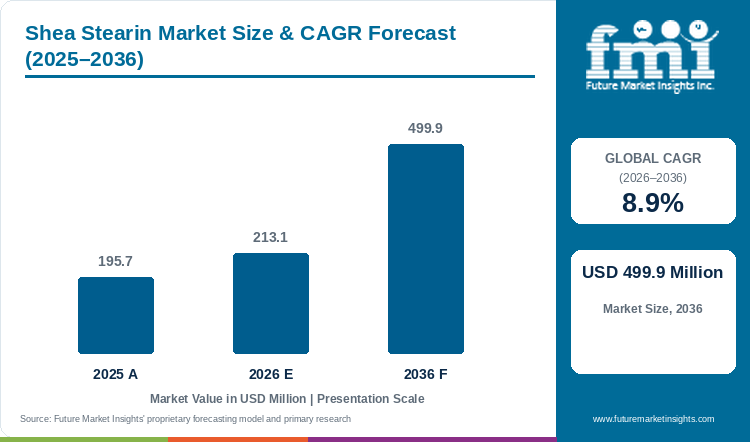
The shea stearin market is estimated at USD 195.7 million in 2025 and is expected to reach USD 213.1 million in 2026. Sales of shea stearin are projected to grow at an 8.9% CAGR for the decade to 2036 and reach USD 499.9 million by 2036.
Key trends in the shea stearin market are shaped by two pressures, high cocoa butter costs at chocolate plants and tighter kernel supply in the shea belt. From USD 195.7 million in 2025, demand for shea stearin is forecast to move to USD 213.1 million in 2026, and on chocolate fat orders the shea stearin market is likely to reach USD 499.9 million by 2036. Kernel access is tightening faster than demand. On the supply side, four West African producers, Mali and Nigeria among them, kept nut export bans, and Burkina Faso reopened exports in May 2026 with 25% of volumes reserved for local processors.[1] As a consequence, fractionators inside West Africa now get first call on kernels, and CBE blenders elsewhere will pay more for secured stearin.
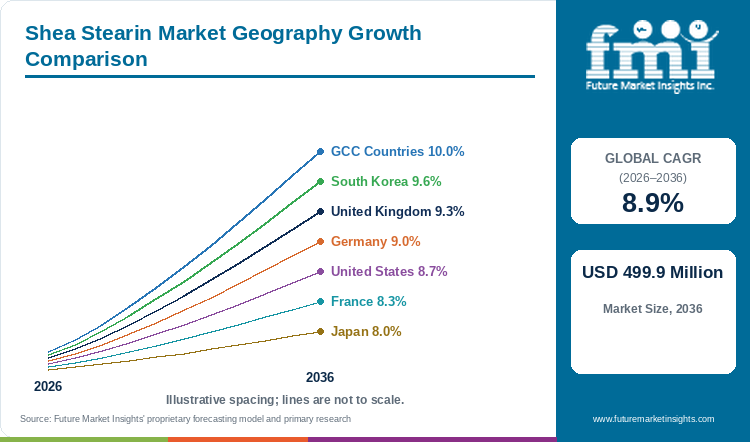
Gulf buyers lead country growth, as the GCC Countries are projected to grow at a 10% CAGR through 2036 against 8% for Japanese chocolate and bakery plants. Cargill added a specialty fats line at Port Klang in March 2026 to serve Asia Pacific and EMEA buyers, a region that includes the Gulf, with cocoa butter equivalents and filling fats that can draw on shea.[2] That line matters for Gulf confectionery plants, which import most hard fats, so a closer Asian line shortens lead times. By comparison, FMI data indicate slower gains in Japan, as domestic chocolate makers already run long-qualified hard butter recipes.
Key Market Trends & Insights
- Standard grade is expected to hold 42% of 2026 grade sales on hardstock orders from bakery and filling fat makers, with CBE grade near 36.8% and cosmetic grade at about 21.2%.
- Flakes and powder are likely to make up 44% of form sales in 2026, since small food and cosmetic plants weigh stearin by hand, with cartoned blocks at 32.5% and heated tanker loads of bulk liquid at 23.5%.
- Chocolate and confectionery is estimated at 38.4% of 2026 application sales on CBE blends for coatings and compound bars, and bakery fats at about 27% on non-hydrogenated shortenings. Specialty fat suppliers are already seeing firmer CBE orders. Reflecting this, operating profit in the AAK Chocolate & Confectionery Fats unit rose 9% to SEK 491 million in the June 2026 quarter.[3] Profit growth in the CBE unit points to steady stearin offtake from chocolate plants into 2027.
- Direct supply is projected to cover 50% of sales channel volume in 2026, as CBE and bakery fat makers sign seasonal contracts straight with fractionators.
Regional Highlights
- FMI forecasts the GCC Countries at 10%, ahead of every other country, as imported hard fats feed new confectionery and bakery lines.
- South Korea is forecast to expand at 9.6% on snack reformulation and the United Kingdom at 9.3% on demand for CBE fats, both ahead of the 8.9% global rate, with Germany close to that rate at 9%. Growth is projected below the global pace in the United States, at 8.7%, as chocolate volumes stay weak, and in France and Japan, at 8.3% and 8%, on butter-led pastry and mature recipes.
- Origin governments now set the terms of kernel trade. Burkina Faso ended the shea nut export suspension on 22 May 2026 with a levy of CFA 200 per kilogram, Ecofin reported on 25 May 2026.[1] A levy and local quota of this kind raise the landed cost of nuts for overseas crushers, which favours fractionators with plants in West Africa.
Market Size & Forecast
Table 1: Market Size and Forecast for the Shea Stearin Market (USD million and percentage), 2025 to 2036
| Metric | Value |
|---|---|
| 2025 Market Size | USD 195.7 million |
| Estimated Market Size in 2026 | USD 213.1 million |
| Projected Market Size by 2036 | USD 499.9 million |
| CAGR, 2026 to 2036 | 8.9% |
| Added Revenue, 2026 to 2036 | USD 286.8 million |
| Market Expansion Multiple | 2.3x |
Two choices shape sales of shea stearin, how much cocoa butter chocolate makers replace with CBE blends, and how many kernels reach fractionation plants. Kernel flows are already shifting toward origin processing. Nigeria, which accounts for 40% of the world's supply of shea nuts, ordered a six-month ban on raw nut exports in August 2025, joining Burkina Faso, Mali, Togo, Ivory Coast and Ghana in restricting shipments, the Associated Press reported.[4] In effect, more butter and fewer nuts leave origin, which moves the first processing step into Africa and changes who sells stearin to Europe. On the demand side, chocolate volume itself moves slowly, with only 3.3% CAGR growth expected for the chocolate market, so CBE share gains inside each bar matter more than tonnage. FMI analysis puts the 2036 total at about 2.3 times the 2026 level, close to USD 286.8 million of added sales for the shea stearin market. In the near term, a fall in cocoa butter prices toward stearin levels is the main risk.
Kernel Supply, CBE Blending and Price Spreads
Kernel supply sets the ceiling for every stearin buyer. For example, Ghana plans a phased ban on raw shea nut exports by 2026, announced at the World Shea Expo 2025 launch in July 2025.[5] A ban in a second large origin would cut the raw nuts open to crushers in Europe and Asia. Ghana is also building the capacity to absorb those nuts at home. The Ghanaian government also plans a EUR 4 million injection to restart the PBC Shea plant, which can process up to 200 tons of nuts a day, and raw nuts still make up about 75% of Ghanaian shea exports.[6] As a result, local crushing and fractionation will grow, and importers will buy more semi-processed butter.
Price spreads decide how much stearin goes into chocolate. OFI Magazine reported in October 2025 that cocoa and cocoa butter prices had eased since late August but remained high by historical standards, and that further falls toward the shea stearin price would cut the appeal of stearin.[7] A narrower gap between cocoa butter and stearin prices would slow CBE reformulation, so stearin volumes rest on cocoa prices staying high. Supply at origin points the other way. At origin, Nigeria was expected to harvest about 150,000 tonnes of shea nuts and process only 10,000 tonnes locally.[7] A crop that large with so little local crushing leaves ample room for new origin fractionation. Faced with both swings, CBE makers will hedge by locking kernel and butter contracts ahead of the cocoa season.
Table 2: Supply and Price Indicators for the Shea Stearin Market (volumes, prices and capacity), 2025 to 2026
| Indicator | Data Point | Relevance | Source |
|---|---|---|---|
| Nigeria raw shea nut export ban, August 2025 | Six months, then review; about 40% of world supply | Kernel supply for export fractionation | [4] |
| West African export restrictions, 2024 to 2025 | Burkina Faso, Mali, Togo, Ivory Coast and Ghana | Processing moving to origin | [4] |
| Burkina Faso export rules, May 2026 | 25% local allocation; CFA 200 per kilogram levy | Kernel cost and access | [1] |
| Ghana raw nut export policy, July 2025 | Phased ban by 2026 | Origin processing | [5] |
| Nigeria shea nut crop, 2025 | About 150,000 tonnes; 10,000 tonnes processed locally | Unprocessed kernel surplus | [7] |
| AAK Chocolate & Confectionery Fats, Q2 2026 | Operating profit SEK 491 million; up 9% | Demand for CBE and specialty fats | [3] |
| AAK and KLK NURA plant, 2026 | Ramp-up in 2028; full production in 2029 | Palm mid fraction for CBE blends | [8] |
Analyst Perspective
“Shea stearin has become a supply contract business. Chocolate makers want a cocoa butter equivalent that tastes and melts like the real thing, and the stearin fraction is the hardest part of that blend to source. With most of the shea belt now holding raw nuts at home, I expect the fractionators that own crushing and fractionation in West Africa to set prices for the decade. Buyers that secure multi-season butter contracts now will face fewer reformulations later.”
- Nandini Roy Choudhury, Principal Consultant, Future Market Insights.
How is the shea stearin market segmented?
The market is segmented into grade, form, application, sales channel, and region. Standard grade is expected to lead grade sales with 42% share in 2026, and flakes and powder lead form with 44%.
By grade: standard grade, CBE grade, and cosmetic grade.
By form: flakes and powder, blocks, and bulk liquid.
By application: chocolate and confectionery, bakery fats, cosmetics and personal care, fillings and spreads, and others.
By sales channel: direct supply, ingredient distributors, and online B2B.
By region: chocolate, bakery and cosmetic buyers in North America, Latin America, Western Europe, Eastern Europe, East Asia, South Asia and Pacific, and Middle East and Africa.
Why does standard grade lead shea stearin sales by grade?
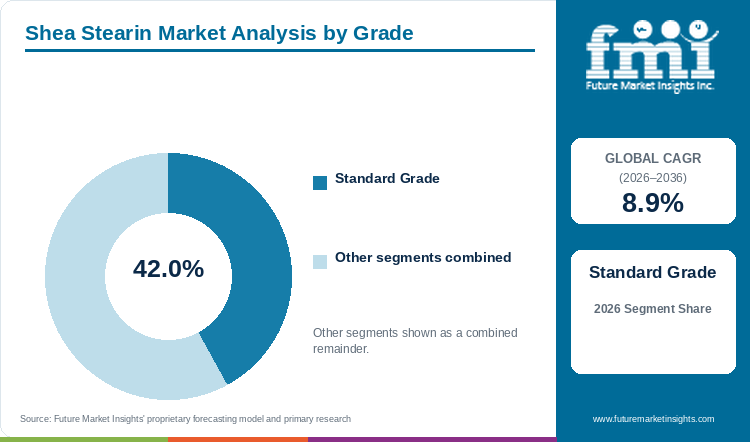
Standard grade is expected to lead grade sales with 42% share in 2026, ahead of CBE grade at about 36.8% and cosmetic grade at an estimated 21.2%.
Table 3: Grade Share for the Shea Stearin Market (percentage share), 2026
| Grade | Estimated Share (2026) |
|---|---|
| Standard Grade | 42% |
| CBE Grade | 36.8% |
| Cosmetic Grade | 21.2% |
| Total | 100.0% |
Table 4: Grade Leadership and Market Growth for the Shea Stearin Market (segment and CAGR percentage), 2026 to 2036
| Metric | Value |
|---|---|
| Global CAGR (2026 to 2036) | 8.9% |
| Leading Segment | Standard Grade |
Bakery shortening, filling fat and margarine makers use the general food fraction as a hardstock, so standard grade will hold the grade lead at 42% in 2026. CBE grade, near 36.8%, is a narrower cut rich in stearic-oleic-stearic triglycerides that chocolate makers blend with palm mid fraction. To that end, AAK is building a palm mid fraction plant with KLK at Pasir Gudang, due to ramp up in 2028, which will raise CBE blending capacity in Asia.[8] More palm mid fraction in Asia increases the call on the matching hard stearin fraction. Cosmetic grade, about 21.2%, goes into balms, creams and soap bases, and buyers there usually also buy whole shea butter, tracked in the shea butter market. Above all, every grade starts from the same kernel, so a short crop raises costs across all three.
- Bakery hardstock, filling fats and margarine blends make up most standard grade volume.
- Filling fat makers are adding capacity close to Asian buyers. Cargill launched Cargill Bakefill filling fat alongside the Port Klang specialty fats line in March 2026.[2] New filling fat lines widen the outlet for standard grade hardstock in bakery and confectionery fillings.
Why do flakes and powder lead shea stearin sales by form?
Flakes and powder are likely to lead form sales with 44% share in 2026, with blocks at about 32.5% and bulk liquid at roughly 23.5%.
Table 5: Form Share for the Shea Stearin Market (percentage share), 2026
| Form | Estimated Share (2026) |
|---|---|
| Flakes and Powder | 44% |
| Blocks | 32.5% |
| Bulk Liquid | 23.5% |
| Total | 100.0% |
Small bakery, cosmetic and filling plants weigh stearin into batches by hand or by dosing screw, so flakes and powder are projected to lead form sales at 44% in 2026. Blocks, about 32.5%, instead travel in cartons to mid-sized plants with melting tanks. Meanwhile, bulk liquid, an estimated 23.5%, moves in heated tankers from the fractionator to large chocolate and CBE plants that hold product molten. As more butter is crushed at origin and fractionated in Europe or Asia, bulk liquid will gain at the largest CBE sites.
- Pastilles, flakes and spray-cooled powder suit plants without heated storage.
- Export bans are moving crushing to origin, which changes the form in which stearin travels. Burkina Faso now requires exporters to allocate at least 25% of intended export volumes to domestic processing units.[1] More butter shipped from Africa means more stearin fractionated near the buyer and delivered as bulk liquid or blocks.
Why does chocolate and confectionery lead shea stearin sales by application?
Chocolate and confectionery is estimated to lead application sales with 38.4% share in 2026, ahead of bakery fats at 27% and cosmetics and personal care at about 21.2%.
Table 6: Application Share for the Shea Stearin Market (percentage share), 2026
| Application | Estimated Share (2026) |
|---|---|
| Chocolate and Confectionery | 38.4% |
| Bakery Fats | 27% |
| Cosmetics and Personal Care | 21.2% |
| Fillings and Spreads | 9.1% |
| Others | 4.3% |
| Total | 100.0% |
With cocoa butter still expensive, chocolate and confectionery will lead application sales at 38.4% in 2026, through CBE blends in coatings, compound chocolate and the 5% non-cocoa fat allowance in European chocolate. With growth of only 1.8% CAGR expected for the cocoa butter market, cocoa butter supply will lag chocolate makers' needs, and CBE gains will carry most new stearin volume. Bakery fats, near 27%, likewise use stearin as a non-hydrogenated hardstock in laminating and shortening blends that also feed the bakery fat market. Among the smaller outlets, cosmetics and personal care take about 21.2%, fillings and spreads 9.1% and other uses 4.3%.
- Compound coatings, CBE chocolate and confectionery fillings make up most confectionery volume.
- Specialty fat capacity in Asia is aimed squarely at confectionery. Cargill named chocolate confectionery, bakery, dairy and foodservice makers as target buyers for the Port Klang line in March 2026.[2] Confectionery buyers in Asia and the Gulf gain a nearer source of CBE blends, shortening supply chains for stearin-based fats.
Why does direct supply lead shea stearin sales by sales channel?
Direct supply is projected to lead sales channel volume with 50% share in 2026, ahead of ingredient distributors at about 36.2% and online B2B at 13.8%.
Table 7: Sales Channel Share for the Shea Stearin Market (percentage share), 2026
| Sales Channel | Estimated Share (2026) |
|---|---|
| Direct Supply | 50% |
| Ingredient Distributors | 36.2% |
| Online B2B | 13.8% |
| Total | 100.0% |
CBE makers and large bakery fat producers sign seasonal volume contracts with the fractionator, so direct supply is expected to hold 50% of channel sales in 2026. By comparison, ingredient distributors, near 36.2%, break bulk for mid-sized food plants and cosmetic formulators that need a few tonnes at a time. Online B2B, about 13.8%, in turn serves small soap, balm and craft chocolate makers that reorder qualified grades. Over the forecast period, direct contracts will grow fastest as kernel supply tightens and buyers seek guaranteed volume.
- Multi-season contracts with fractionators cover most CBE and large bakery volume.
- Large fractionators are holding tonnage flat and moving the mix toward contracted specialty fats. AAK group volumes were 486 thousand tonnes in Q2 2026, against 490 thousand tonnes in Q2 2025.[3] Flat volume alongside higher CBE profit keeps direct contracts ahead of distributor sales.
What are the drivers, restraints, and opportunities in the shea stearin market?
High cocoa butter costs keep chocolate makers interested in CBE blends that use shea stearin. Kernel export bans and volatile shea harvests restrain supply, and origin processing plus non-hydrogenated fat systems open new contracts.
- Driver: Chocolate and compound coating makers blend CBEs to manage cocoa butter cost, and shea stearin is the hard fraction that gives those blends the right melt.
- Restraint: Export bans across West Africa and a wild-harvested crop make kernel volume and price hard to plan.
- Opportunity: Fractionation at origin and non-hydrogenated bakery and filling fats give suppliers with secure kernels new long-term accounts.
Cocoa Costs Keep CBE Blends on the Table
High cocoa butter costs are pushing chocolate makers toward CBE blends. As a case in point, AAK raised Chocolate & Confectionery Fats operating profit to SEK 491 million in Q2 2026 from SEK 450 million, a 9% gain, as Food Ingredients profit fell 14%.[3] A profit gain in the CBE unit as the wider food business weakened shows CBE fats holding demand through a soft year. Capacity is moving with that demand. Alongside this, Cargill added a Port Klang line for cocoa butter equivalents and cocoa butter replacers in March 2026.[2] Each new CBE line, in turn, adds a steady call on stearin.
Export Bans Tighten Kernel Supply
Kernel supply is the first constraint, and in FMI's view the export bans across the shea belt now matter more than harvest swings. First, Mali suspended nut exports in October 2024, and Nigeria has held restrictions since August 2025. Côte d'Ivoire and Togo halted shipments in 2025 as well.[1] With four origins closed to raw nut exports at once, overseas crushers compete for a smaller pool of butter. Reopening came with conditions. Burkina Faso reopened in May 2026 only with a 25% local allocation and a CFA 200 per kilogram levy.[1] Consequently, fractionators without origin plants will pay more for butter and face longer lead times.
Origin Processing and Non-Hydrogenated Fats Open New Accounts
Processing at origin creates new suppliers and new contracts. For instance, Ghana plans to restart the idle PBC Shea plant with a EUR 4 million injection backed by the African Development Bank.[6] A restarted plant adds a West African seller of butter and stearin for European and Asian blenders. Fractionation costs are falling as well. Similarly, AAK will put a patented dry-fractionation process into first commercial use at NURA in Malaysia, aiming at lower capital and operating costs for CBE fractions.[8] Suppliers that pair secured kernels with efficient fractionation will gain the long contracts, widening the supply map for CBE blenders outside Europe.
Which country CAGRs are profiled in the shea stearin market?
Table 8: Country CAGR Comparison for the Shea Stearin Market (CAGR percentage), 2026 to 2036
| Country | CAGR (2026 to 2036) |
|---|---|
| GCC Countries | 10% |
| South Korea | 9.6% |
| United Kingdom | 9.3% |
| Germany | 9% |
| United States | 8.7% |
| France | 8.3% |
| Japan | 8% |
How do country-level CAGRs compare in the shea stearin market?
Gulf confectionery and bakery lines run on imported hard fats, and growth in the GCC Countries is projected at 10%, the fastest of the seven countries. FMI data indicate South Korea next at 9.6% as snack and bakery makers reformulate hard fats. Behind them, the United Kingdom (9.3%) and Germany (9%) are within 0.3 points of each other, both drawing on large CBE and chocolate plants in Europe. The United States, on the other hand, is forecast at 8.7%, under the overall 8.9% CAGR of the shea stearin market, as US chocolate makers face weak demand. France is forecast at 8.3%, as butter-led pastry limits hardstock use, and Japan, at 8%, grows slowest in the table on long-qualified hard butter recipes.
- Gulf confectionery and bakery plants import nearly all hard fats, so each new line adds direct demand for CBE blends. Suppliers with Asian refineries close to the Gulf can cut lead times and hold these accounts.
- Korean snack makers are moving filled biscuits to non-hydrogenated hardstocks, raising the stearin content of each recipe. New Malaysian CBE capacity from 2028 gives local buyers more choice of supplier.
- Private-label compound coatings and filled bars in the United Kingdom use CBE within the 5% allowance, keeping stearin in standard recipes. Fractionators that supply own-label makers see the steadiest volume.
- German praline and biscuit plants buy CBE blends in large contract lots. Any outage at a European fractionation site therefore tightens supply quickly and favours buyers with second sources.
- In the United States, weak chocolate demand slows CBE orders and pushes bakery fat makers toward palm and domestic oils. Stearin suppliers there need bakery and filling accounts to grow.
- Butter claims on French pastry cap the room for hardstocks. Growth rests on industrial biscuit and filling makers and on cosmetic formulators, a narrower buyer base.
- Japanese chocolate makers run hard butter recipes qualified years ago and rarely switch. Incumbent domestic fat suppliers keep most volume, leaving little opening for new stearin sources.
Full report country CAGRs cover: four countries above the 8.9% world figure, led by the GCC Countries and South Korea, then the United Kingdom and Germany, with the United States, France and Japan under that figure, and a rate for every other standard country grouped by region.
Country-wise Analysis
GCC Countries Shea Stearin Market Outlook (2026 to 2036)
Saudi and Emirati confectionery groups are adding lines, and demand for shea stearin in the GCC Countries is forecast to expand at a 10% CAGR, ahead of every other country in the table. Supply is moving closer to these buyers. Cargill said in March 2026 that the Malaysian plants, including the new Port Klang specialty fats line, serve Asia Pacific and EMEA customers with cocoa butter equivalents, low-trans replacers and filling fats.[2] This supply route counts, as Saudi and Emirati confectionery and bakery plants import most hard fats, so new Asian supply shortens lead times and widens the choice of blends.
Key takeaway: Every new Gulf line adds imported blend demand.
South Korea Shea Stearin Market Outlook (2026 to 2036)
Korean buyers are moving away from hydrogenated fats. Korean snack, bakery and confectionery groups buy specialty fats from Malaysian and Japanese refiners, and the AAK and KLK palm mid fraction plant under construction in Malaysia will add CBE blending capacity close to Korean buyers from 2028.[8] As Korean makers move filled biscuits and coated snacks to non-hydrogenated hardstocks, shea stearin sales there are expected to rise at a 9.6% CAGR through 2036.
Key takeaway: Reformulated snack fats add stearin demand in South Korea.
United Kingdom Shea Stearin Market Outlook (2026 to 2036)
British chocolate, biscuit and filled bar makers use CBE blends within the 5% non-cocoa fat allowance and in compound coatings. In line with this, AAK reported a 9% rise in Chocolate & Confectionery Fats operating profit for Q2 2026, a sign of firm demand for CBE fats.[3] On that demand, FMI forecasts shea stearin sales in the United Kingdom to expand at a 9.3% CAGR, supported by private-label compound coatings and filled bars.
Key takeaway: Compound coatings and filled bars lead demand in the United Kingdom.
Germany Shea Stearin Market Outlook (2026 to 2036)
Germany hosts large chocolate, praline and bakery plants that buy CBE blends and non-hydrogenated hardstocks through European fractionators. Supply concentration is the main risk there. AAK said production challenges at the Karlshamn site weighed on Q2 2026 profit, a reminder that a few large plants carry European CBE supply.[3] Buyers there now favour suppliers with more than one plant, and demand for shea stearin in Germany is projected to grow at 9%, close to the global rate.
Key takeaway: Contract CBE buying at big praline and biscuit sites defines Germany.
United States Shea Stearin Market Outlook (2026 to 2036)
Chocolate demand in the United States is soft. Fuji Oil booked a JPY 4,137 million goodwill impairment on US chocolate maker Blommer in April 2026, citing prolonged weak demand and higher fixed costs.[9] Such weak chocolate volumes slow CBE orders, and US bakery and confectionery fat makers lean on palm and domestic oils. As a result, an 8.7% CAGR is forecast for shea stearin in the United States, just under the 8.9% global rate.
Key takeaway: US growth stays just under the global rate on soft chocolate demand.
France Shea Stearin Market Outlook (2026 to 2036)
French pastry and viennoiserie lean on butter, and many artisan and premium products carry butter claims, so hardstock use is lower than in other large European markets. Even so, industrial biscuit, filling and compound coating makers buy CBE and non-hydrogenated blends, and cosmetic formulators use cosmetic grade stearin in creams and balms. On these buyers, sales of shea stearin in France are forecast to rise at an 8.3% CAGR, under the overall 8.9% CAGR.
Key takeaway: Butter-led pastry keeps France below the global rate.
Japan Shea Stearin Market Outlook (2026 to 2036)
Domestic fat suppliers in Japan are large and established. Japanese specialty fat maker Fuji Oil revised the forecast for the year to March 2026 to JPY 772.3 billion of net sales and JPY 11.1 billion of profit attributable to owners.[9] Group sales on that scale give domestic suppliers the reach to keep Japanese chocolate and bakery accounts. At home, Japanese chocolate and bakery makers run hard butter recipes qualified years ago and change suppliers slowly. For this reason, FMI expects Japanese buyers to add shea stearin slowly, at an 8% CAGR, the slowest pace in the table.
Key takeaway: Mature recipes and incumbent suppliers slow Japan.
Who are the notable companies in the shea stearin market?
AAK, Bunge Loders Croklaan, Cargill, Fuji Oil, Wilmar International, Savannah Fruits Company and Sophim are the profiled companies.
FMI analysis shows specialty fat groups with fractionation plants, a Ghanaian shea processor and a cosmetic ingredient maker competing in the market. Among these, in the June 2026 quarter, AAK grew Chocolate & Confectionery Fats operating profit to SEK 491 million.[3] Rising CBE profit at the largest specialty fat group shows pricing power for qualified capacity. In addition, a Port Klang specialty fats line opened by Cargill in March 2026 makes CBEs, replacers and filling fats from palm and specialty oils such as shea.[2] A Malaysian line brings Cargill closer to Asian and Gulf buyers. Japanese groups remain large rivals. Fuji Oil revised group net sales for the year to March 2026 to JPY 772.3 billion.[9] Scale of this size keeps Fuji Oil a core supplier to Japanese and US chocolate makers despite the Blommer impairment. Bunge Loders Croklaan, Wilmar International, Savannah Fruits Company and Sophim complete the group.
- Specialty fat groups with fractionation and CBE plants: AAK, Bunge Loders Croklaan, Fuji Oil and Cargill.
- Diversified edible oil groups: Wilmar International.
- Shea processors and cosmetic ingredient makers: Savannah Fruits Company and Sophim.
Competitive Benchmarking: Shea Stearin Market
Table 9: Competitive Benchmarking for the Shea Stearin Market (qualitative ratings), 2026
| Company | CBE Fats | Shea Sourcing | Cosmetic Grades | Recent Activity |
|---|---|---|---|---|
| AAK | High | High | Medium | High |
| Bunge Loders Croklaan | High | High | Low | Low |
| Cargill | High | Medium | Low | High |
| Fuji Oil | High | Medium | Low | High |
| Wilmar International | Medium | Low | Low | Low |
Ratings compare the companies on CBE fats, shea sourcing, cosmetic grades and recent activity.
Key Developments in the Shea Stearin Market
- AAK said on 2 October 2026 that a patented dry-fractionation process will see first commercial use at the NURA plant in Malaysia, with ramp-up in 2028, which points to lower-cost CBE fractions in Asia.[8]
- A 9% rise to SEK 491 million in Chocolate & Confectionery Fats operating profit led the AAK second-quarter report of 17 July 2026; for CBE buyers this signals firm supplier pricing.[3]
- On 22 May 2026, Burkina Faso ended a shea nut export suspension imposed in September 2024, with new export controls that keep part of the crop for local processors.[1]
- Fuji Oil announced a JPY 4,137 million impairment on Blommer Chocolate Company on 24 April 2026, a sign of weak US chocolate demand that slows CBE orders there.[9]
- In a 31 March 2026 announcement, Cargill set out a specialty fats line for CBEs and filling fats at Port Klang, Malaysia, adding capacity near Asian and Gulf buyers.[2]
- Cocoa butter prices eased and shea nut prices rose in October 2025, according to OFI Magazine on 22 October 2025, narrowing the cost edge of CBE blends.[7]
- Nigerian Vice President Kashim Shettima announced a six-month ban on raw shea nut exports in August 2025, cutting overseas crushers off from a country that supplies about 40% of world shea nuts.[4]
- Ghana announced a EUR 4 million plan to restart the PBC Shea processing plant on 22 July 2025, a step that adds origin crushing capacity.[6]
Key Players in the Shea Stearin Market
Specialty Fat Groups
- AAK
- Bunge Loders Croklaan
- Fuji Oil
- Cargill
Diversified Edible Oil Groups
- Wilmar International
Shea Processors and Cosmetic Ingredient Makers
- Savannah Fruits Company
- Sophim
Shea Stearin Market - Report Scope
Table 10: Report Scope for the Shea Stearin Market (coverage fields and definitions), 2026 to 2036
| Coverage field | Report scope |
|---|---|
| Market breakdown | Grade; form; application; sales channel; region |
| Quantitative units | USD million |
| Market definition | The hard, high-melting fraction separated from shea butter by fractionation, sold as an ingredient for cocoa butter equivalents, chocolate and confectionery fats, bakery and filling fats, and cosmetic and personal care products. Shea olein, unfractionated shea butter and finished foods or cosmetics are excluded. |
| Regions covered | North America; Latin America; Western Europe; Eastern Europe; East Asia; South Asia and Pacific; Middle East and Africa |
| Countries covered | United States; Canada; Brazil; Mexico; Argentina; Chile; Germany; France; United Kingdom; Italy; Spain; Benelux; Nordics; Poland; Czech Republic; Romania; Hungary; China; Japan; South Korea; India; ASEAN; Australia and New Zealand; GCC Countries; South Africa; Türkiye; Israel |
| Key companies profiled | AAK, Bunge Loders Croklaan, Cargill, Fuji Oil, Wilmar International, Savannah Fruits Company, Sophim |
| Forecast period | 2026 to 2036 |
Shea Stearin Market - Research Methodology
Table 11: Research Methodology for the Shea Stearin Market (research methods and approach), 2026 edition
| Method | Approach |
|---|---|
| Data Sources | Company results, industry associations, government statistics and trade publications. |
| Desk Research | Desk research covers kernel supply, export rules, CBE capacity, cocoa butter prices and bakery and cosmetic fat use. |
| Market Sizing and Forecasting | Sizing starts from the 2026 base of USD 213.1 million and the 8.9% CAGR for 2026 to 2036. |
| Data Validation | Figures are cross-checked across company, industry and government sources. |
Shea Stearin Market by Segments
Shea Stearin Market segmented by Grade:
- Standard Grade
- CBE Grade
- Cosmetic Grade
Shea Stearin Market segmented by Form:
- Flakes and Powder
- Blocks
- Bulk Liquid
Shea Stearin Market segmented by Application:
- Chocolate and Confectionery
- Bakery Fats
- Cosmetics and Personal Care
- Fillings and Spreads
- Others
Shea Stearin Market segmented by Sales Channel:
- Direct Supply
- Ingredient Distributors
- Online B2B
Shea Stearin Market by Region
- North America
- United States
- Canada
- Latin America
- Brazil
- Mexico
- Argentina
- Chile
- Western Europe
- Germany
- France
- United Kingdom
- Italy
- Spain
- Benelux
- Nordics
- Eastern Europe
- Poland
- Czech Republic
- Romania
- Hungary
- East Asia
- China
- Japan
- South Korea
- South Asia and Pacific
- India
- ASEAN
- Australia and New Zealand
- Middle East and Africa
- GCC Countries
- South Africa
- Türkiye
- Israel
Research Sources and Bibliography
- [1] Ecofin Agency. (2026, May 25). Burkina Faso Lifts Shea Nut Export Ban Under Tight New Controls. https://www.ecofinagency.com/news-agriculture/2505-55880-burkina-faso-lifts-shea-nut-export-ban-under-tight-new-controls
- [2] Cargill. (2026, March 31). Cargill strengthens global specialty fats portfolio with expansion of Port Klang, Malaysia facility. https://www.cargill.com/2026/cargill-strengthens-global-specialty-fats-portfolio
- [3] AAK AB. (2026, July 17). AAK's Interim report for the second quarter 2026. https://www.aak.com/news-and-media/press-releases/2026/aaks-interim-report-for-the-second-quarter-2026/
- [4] PBS NewsHour. (2025, August 28). Nigeria bans exports of raw shea nuts used for cosmetic products. https://www.pbs.org/newshour/world/nigeria-bans-exports-of-raw-shea-nuts-used-for-cosmetic-products
- [5] FreshPlaza. (2025, July 10). Ghana to ban raw shea exports by 2026. https://www.freshplaza.com/article/9749475/ghana-to-ban-raw-shea-exports-by-2026
- [6] Ecofin Agency. (2025, July 23). Ghana to Revive Shea Processing Plant with €4 Million Injection. https://www.ecofinagency.com/news/2307-47810-ghana-to-revive-shea-processing-plant-with-4-million-injection
- [7] OFI Magazine. (2025, October 22). Cocoa and cocoa butter prices decline while shea nuts trend upwards. https://www.ofimagazine.com/news/cocoa-and-cocoa-butter-prices-decline-while-shea-nuts-trend-upwards
- [8] AAK AB. (2026, October 2). AAK's patented dry-fractionation technology set for first commercial deployment at NURA. https://www.aak.com/news-and-media/news/aaks-patented-dry-fractionation-technology-set-for-first-commercial-deployment-at-nura/
- [9] Fuji Oil Co., Ltd. (2026, April 24). Notice of Concerning Recognition of Impairment Loss, Reversal of Deferred Tax Asset, and Revision of Full-Year Earnings Forecast. https://www.fujioil.co.jp/en/pdf/news/2026/260424_en.pdf
This bibliography is provided for reader reference. The full report contains the complete reference list and detailed citations.
This Report Answers
- How big is the shea stearin market during 2026?
- What market size is projected by 2036?
- Which grade holds notable share?
- Which form holds notable share?
- Which countries have notable growth?
- Which companies are notable in the market?
Frequently Asked Questions
How large is the shea stearin market expected in 2026?
FMI puts the shea stearin market at USD 213.1 million in 2026, from USD 195.7 million in 2025. Sales of shea stearin are projected to reach USD 499.9 million by 2036.
What CAGR is projected for the shea stearin market through 2036?
The shea stearin market is expected to grow at an 8.9% CAGR through 2036. CBE blending in chocolate, non-hydrogenated bakery fats and cosmetic use carry that growth.
Which grade holds a notable market share in 2026?
Standard grade will lead with 42% share in 2026. CBE grade follows at about 36.8%.
Which form holds a notable market share in 2026?
Flakes and powder are likely to lead with 44% share. Blocks follow at an estimated 32.5%.
Which country has a notable expansion outlook through 2036?
FMI projects the GCC Countries to grow fastest, at a 10% CAGR. South Korea follows at 9.6%.
Who are the key companies in the shea stearin market?
AAK, Bunge Loders Croklaan, Fuji Oil and Cargill lead the specialty fat group, with Wilmar International among diversified oil groups. Savannah Fruits Company and Sophim complete the company group.
Preview the report firsthand - request a free sample
Get SampleGet the brochure for pricing and purchase details.
Get PDFTable of Content
- Key Takeaways
- Market Size and CAGR
- Top Growth Driver
- Fastest Growing Segment
- Leading Region
- Key Companies
- Emerging Opportunities
- Executive Summary
- Global Market Outlook
- Demand-side Trends
- Supply-side Trends
- Technology Roadmap Analysis
- Analysis and Recommendations
- Analyst Perspective (What is happening? Why now? What should investors know?)
- Key Questions Answered
- How large is the market?
- What is the CAGR?
- What are key trends?
- Which region dominates?
- Who are the leaders?
- Market Overview
- Market Coverage / Taxonomy
- Market Definition / Scope / Limitations
- Research Methodology
- Chapter Orientation
- Analytical Lens and Working Hypotheses
- Market Structure, Signals, and Trend Drivers
- Benchmarking and Cross-market Comparability
- Market Sizing, Forecasting, and Opportunity Mapping
- Research Design and Evidence Framework
- Desk Research Programme (Secondary Evidence)
- Expert Input and Fieldwork (Primary Evidence)
- Tooling, Models, and Reference Databases
- Data Engineering and Model Build
- Quality Assurance and Audit Trail
- Market Background
- Market Dynamics (Drivers, Restraints, Opportunity, Trends)
- Scenario Forecast (Optimistic, Likely, Conservative)
- Impact Analysis
- AI Impact
- Sustainability Impact
- Regulatory Impact
- Technology Impact
- Consumer / Buyer Analysis
- Purchase Drivers
- Adoption Barriers
- Buyer Journey
- Opportunity Map Analysis
- Product Life Cycle Analysis
- Supply Chain Analysis
- Investment Feasibility Matrix
- Value Chain Analysis
- PESTLE and Porter's Analysis
- Regulatory Landscape
- Regional Parent Market Outlook
- Production and Consumption Statistics
- Import and Export Statistics
- Global Market Analysis and Forecast, 2021 to 2036
- Historical Market Size Value (USD Million) Analysis, 2021 to 2025
- Current and Future Market Size Value (USD Million) Projections, 2026 to 2036
- Y-o-Y Growth Trend Analysis
- Absolute $ Opportunity Analysis
- Global Market Pricing Analysis, 2021 to 2036
- Global Market Analysis and Forecast, By Grade, 2021 to 2036
- Introduction / Key Findings
- Historical Market Size Value (USD Million) Analysis By Grade, 2021 to 2025
- Current and Future Market Size Value (USD Million) Analysis and Forecast By Grade, 2026 to 2036
- Standard Grade
- CBE Grade
- Cosmetic Grade
- Y-o-Y Growth Trend Analysis By Grade, 2021 to 2025
- Absolute $ Opportunity Analysis By Grade, 2026 to 2036
- Global Market Analysis and Forecast, By Form, 2021 to 2036
- Introduction / Key Findings
- Historical Market Size Value (USD Million) Analysis By Form, 2021 to 2025
- Current and Future Market Size Value (USD Million) Analysis and Forecast By Form, 2026 to 2036
- Flakes and Powder
- Blocks
- Bulk Liquid
- Y-o-Y Growth Trend Analysis By Form, 2021 to 2025
- Absolute $ Opportunity Analysis By Form, 2026 to 2036
- Global Market Analysis and Forecast, By Application, 2021 to 2036
- Introduction / Key Findings
- Historical Market Size Value (USD Million) Analysis By Application, 2021 to 2025
- Current and Future Market Size Value (USD Million) Analysis and Forecast By Application, 2026 to 2036
- Chocolate and Confectionery
- Bakery Fats
- Cosmetics and Personal Care
- Fillings and Spreads
- Others
- Y-o-Y Growth Trend Analysis By Application, 2021 to 2025
- Absolute $ Opportunity Analysis By Application, 2026 to 2036
- Global Market Analysis and Forecast, By Sales Channel, 2021 to 2036
- Introduction / Key Findings
- Historical Market Size Value (USD Million) Analysis By Sales Channel, 2021 to 2025
- Current and Future Market Size Value (USD Million) Analysis and Forecast By Sales Channel, 2026 to 2036
- Direct Supply
- Ingredient Distributors
- Online B2B
- Y-o-Y Growth Trend Analysis By Sales Channel, 2021 to 2025
- Absolute $ Opportunity Analysis By Sales Channel, 2026 to 2036
- Global Market Analysis and Forecast, By Region, 2021 to 2036
- Introduction
- Historical Market Size Value (USD Million) Analysis By Region, 2021 to 2025
- Current Market Size Value (USD Million) Analysis and Forecast By Region, 2026 to 2036
- North America
- Latin America
- Western Europe
- Eastern Europe
- East Asia
- South Asia and Pacific
- Middle East and Africa
- Market Attractiveness Analysis By Region
- North America Market Analysis and Forecast, By Country, 2021 to 2036
- Historical Market Size Value (USD Million) Trend Analysis By Market Taxonomy, 2021 to 2025
- Market Size Value (USD Million) Forecast By Market Taxonomy, 2026 to 2036
- By Country
- United States
- Canada
- By Grade
- By Form
- By Application
- By Sales Channel
- By Country
- Market Attractiveness Analysis
- By Country
- By Grade
- By Form
- By Application
- By Sales Channel
- Key Takeaways
- Latin America Market Analysis and Forecast, By Country
- Historical Market Size Value (USD Million) Trend Analysis By Market Taxonomy, 2021 to 2025
- Market Size Value (USD Million) Forecast By Market Taxonomy, 2026 to 2036
- By Country
- Brazil
- Mexico
- Argentina
- Chile
- By Grade
- By Form
- By Application
- By Sales Channel
- By Country
- Market Attractiveness Analysis
- By Country
- By Grade
- By Form
- By Application
- By Sales Channel
- Key Takeaways
- Western Europe Market Analysis and Forecast, By Country
- Historical Market Size Value (USD Million) Trend Analysis By Market Taxonomy, 2021 to 2025
- Market Size Value (USD Million) Forecast By Market Taxonomy, 2026 to 2036
- By Country
- Germany
- France
- United Kingdom
- Italy
- Spain
- Benelux
- Nordics
- By Grade
- By Form
- By Application
- By Sales Channel
- By Country
- Market Attractiveness Analysis
- By Country
- By Grade
- By Form
- By Application
- By Sales Channel
- Key Takeaways
- Eastern Europe Market Analysis and Forecast, By Country
- Historical Market Size Value (USD Million) Trend Analysis By Market Taxonomy, 2021 to 2025
- Market Size Value (USD Million) Forecast By Market Taxonomy, 2026 to 2036
- By Country
- Poland
- Czech Republic
- Romania
- Hungary
- By Grade
- By Form
- By Application
- By Sales Channel
- By Country
- Market Attractiveness Analysis
- By Country
- By Grade
- By Form
- By Application
- By Sales Channel
- Key Takeaways
- East Asia Market Analysis and Forecast, By Country
- Historical Market Size Value (USD Million) Trend Analysis By Market Taxonomy, 2021 to 2025
- Market Size Value (USD Million) Forecast By Market Taxonomy, 2026 to 2036
- By Country
- China
- Japan
- South Korea
- By Grade
- By Form
- By Application
- By Sales Channel
- By Country
- Market Attractiveness Analysis
- By Country
- By Grade
- By Form
- By Application
- By Sales Channel
- Key Takeaways
- South Asia and Pacific Market Analysis and Forecast, By Country
- Historical Market Size Value (USD Million) Trend Analysis By Market Taxonomy, 2021 to 2025
- Market Size Value (USD Million) Forecast By Market Taxonomy, 2026 to 2036
- By Country
- India
- ASEAN
- Australia and New Zealand
- By Grade
- By Form
- By Application
- By Sales Channel
- By Country
- Market Attractiveness Analysis
- By Country
- By Grade
- By Form
- By Application
- By Sales Channel
- Key Takeaways
- Middle East and Africa Market Analysis and Forecast, By Country
- Historical Market Size Value (USD Million) Trend Analysis By Market Taxonomy, 2021 to 2025
- Market Size Value (USD Million) Forecast By Market Taxonomy, 2026 to 2036
- By Country
- GCC Countries
- South Africa
- Türkiye
- Israel
- By Grade
- By Form
- By Application
- By Sales Channel
- By Country
- Market Attractiveness Analysis
- By Country
- By Grade
- By Form
- By Application
- By Sales Channel
- Key Takeaways
- Key Countries Market Analysis
- United States
- Pricing Analysis
- Market Share Analysis, 2025
- By Grade
- By Form
- By Application
- By Sales Channel
- Canada
- Pricing Analysis
- Market Share Analysis, 2025
- By Grade
- By Form
- By Application
- By Sales Channel
- Mexico
- Pricing Analysis
- Market Share Analysis, 2025
- By Grade
- By Form
- By Application
- By Sales Channel
- Brazil
- Pricing Analysis
- Market Share Analysis, 2025
- By Grade
- By Form
- By Application
- By Sales Channel
- Chile
- Pricing Analysis
- Market Share Analysis, 2025
- By Grade
- By Form
- By Application
- By Sales Channel
- Germany
- Pricing Analysis
- Market Share Analysis, 2025
- By Grade
- By Form
- By Application
- By Sales Channel
- United Kingdom
- Pricing Analysis
- Market Share Analysis, 2025
- By Grade
- By Form
- By Application
- By Sales Channel
- Italy
- Pricing Analysis
- Market Share Analysis, 2025
- By Grade
- By Form
- By Application
- By Sales Channel
- Spain
- Pricing Analysis
- Market Share Analysis, 2025
- By Grade
- By Form
- By Application
- By Sales Channel
- France
- Pricing Analysis
- Market Share Analysis, 2025
- By Grade
- By Form
- By Application
- By Sales Channel
- India
- Pricing Analysis
- Market Share Analysis, 2025
- By Grade
- By Form
- By Application
- By Sales Channel
- ASEAN
- Pricing Analysis
- Market Share Analysis, 2025
- By Grade
- By Form
- By Application
- By Sales Channel
- Australia and New Zealand
- Pricing Analysis
- Market Share Analysis, 2025
- By Grade
- By Form
- By Application
- By Sales Channel
- China
- Pricing Analysis
- Market Share Analysis, 2025
- By Grade
- By Form
- By Application
- By Sales Channel
- Japan
- Pricing Analysis
- Market Share Analysis, 2025
- By Grade
- By Form
- By Application
- By Sales Channel
- South Korea
- Pricing Analysis
- Market Share Analysis, 2025
- By Grade
- By Form
- By Application
- By Sales Channel
- Poland
- Pricing Analysis
- Market Share Analysis, 2025
- By Grade
- By Form
- By Application
- By Sales Channel
- Hungary
- Pricing Analysis
- Market Share Analysis, 2025
- By Grade
- By Form
- By Application
- By Sales Channel
- Türkiye
- Pricing Analysis
- Market Share Analysis, 2025
- By Grade
- By Form
- By Application
- By Sales Channel
- South Africa
- Pricing Analysis
- Market Share Analysis, 2025
- By Grade
- By Form
- By Application
- By Sales Channel
- GCC Countries
- Pricing Analysis
- Market Share Analysis, 2025
- By Grade
- By Form
- By Application
- By Sales Channel
- United States
- Market Structure Analysis
- Competition Dashboard
- Competition Benchmarking
- Market Share Analysis of Top Players
- By Regional
- By Grade
- By Form
- By Application
- By Sales Channel
- Emerging Startups
- Innovation Benchmarking
- Competition Analysis
- Competition Deep Dive
- AAK
- Overview
- Product Portfolio
- Profitability by Market Segments
- Sales Footprint
- Strategy Overview
- Marketing Strategy
- Product Strategy
- Channel Strategy
- Bunge Loders Croklaan
- Cargill
- Fuji Oil
- Wilmar International
- Savannah Fruits Company
- Sophim
- AAK
- Case Studies
- Success Stories
- Recent Developments
- Competition Deep Dive
- Assumptions & Acronyms Used


