

- Market Size (2026)
- USD 3.1 Bn
- Forecast (2036)
- USD 5.8 Bn
- CAGR (2026 to 2036)
- 6.5%
How big is Sugar-Free Functional Confectionery Ingredients Market in 2026?
USD 3.1 billion in 2026 and USD 5.8 billion by 2036 at a 6.5% CAGR.
Demand for sugar-free functional confectionery ingredients is projected to expand at 6.5% CAGR between 2026 and 2036. Valuation is expected to rise from USD 3.1 billion in 2026 and USD 5.8 billion by 2036. Regulatory attention on added sugar content is encouraging manufacturers to strengthen investment in sugar-free formulations and functional ingredient systems. In February 2025 the United States Food and Drug Administration delayed the effective date of updated healthy-claim criteria that include limits for added sugars by 60 days, pending regulatory reviews. The criteria increase interest in ingredient systems that lower declared sugar without weakening texture or shelf stability. Growth across the confectionery ingredients market depends on complete replacement systems rather than sweetness intensity alone. Demand for sugar-free sweets strengthens as manufacturers reproduce cooking performance and finished texture across repeated production runs.
Country qualification follows separate ingredient approval and claim pathways across major confectionery markets with different finished-product evidence duties. In March 2026, the United Kingdom Department of Health and Social Care opened a consultation on applying a new nutrient profiling model to advertising and promotions restrictions. The proposal illustrates how national policy can reclassify finished products despite completed ingredient approval and formulation work. China requires new-food authorization for qualifying rare sugars and processing enzymes prior to commercial production. Japan separates notified functional claims from formally approved health uses through different evidence and filing routes. Expansion in the rare sugar market depends on legal status and dependable scale-up performance within each country. Revenue across the sugar-free candy market becomes repeatable through recipe specifications aligned with serving tolerance and permitted package language.
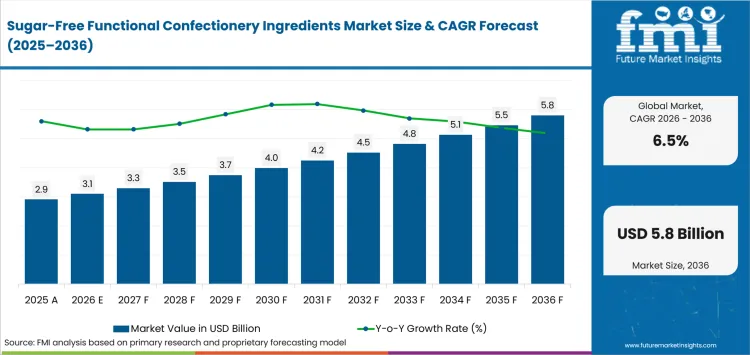
Key Takeaways of Sugar-Free Functional Confectionery Ingredients Market
- Sugar reduction increases ingredient spending by requiring sweetness replacement with reliable bulk and shelf-life control.
- By ingredient, isomalt is expected to account for 45.8% share in 2026 owing to its fit with hard-candy cooking and moisture control.
- Candy is projected to capture 43.4% of application revenue in 2026 as reformulation programs prioritize repeatable boiling and forming performance.
- The dental benefit is anticipated to represent 62.5% of revenue in 2026, supported by non-cariogenic positioning that gives gum and hard candy a clear consumer purpose.
- Digestive-tolerance limits and country-specific claim rules constrain recipe transfer across products that use different sweetener combinations and serving sizes.
- BENEO and Roquette concentrate on polyol applications, whereas Cargill and ADM provide broader sweetener resources. Tate & Lyle and Ingredion add texture systems; Samyang and Matsutani contribute rare-sugar capabilities for regional development programs.
Analyst Perspective
"Confectionery manufacturers should judge sugar-reduction systems by the production failures they prevent, especially candy stickiness and moisture pickup during storage. Isomalt supplies bulk and low hygroscopicity for hard candy, whereas rare sugars widen formulation choices but require separate heat and browning controls. Ingredient companies that document serving tolerance and line performance for each recipe are better positioned to convert laboratory reformulation into repeat factory orders."
- Nandini Roy Choudhury, Principal Analyst, Future Market Insights
How is the Sugar-Free Functional Confectionery Ingredients Market segmented?
The sugar-free functional confectionery ingredients market is segmented by ingredient, application, benefit, and region.
The market is segmented by ingredient, application, benefit, and region to reflect formulation choices and country-specific qualification requirements. Ingredient includes isomalt, palatinose, polyols, and fibers according to each material's role in sweetness, bulk, moisture control, and digestive tolerance. Application separates candy, gummies, and chocolate through different cooking temperatures, gelling systems, and fat-phase behavior. Benefit compares dental and low-GI positioning through product-specific evidence and permitted label claims that influence package communication. Regional analysis records differences in ingredient approval, warning statements, nutrition claims, manufacturing access, and technical support. The isomalt ingredients market provides focused context for hard-candy processing and moisture control across commercial production. The polyol sweeteners market covers broader bulking systems used across several confectionery formats and serving designs.
What drives isomalt's position in the ingredient category?
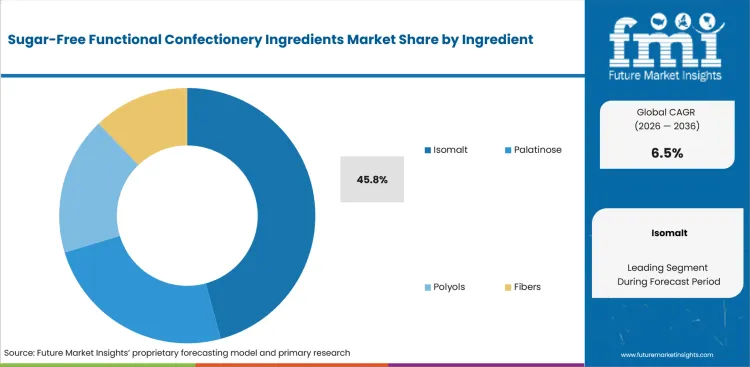
Hard candy manufacturers need a bulk sweetener that withstands high cooking temperatures and limits moisture uptake during storage. Germany's Federal Institute for Risk Assessment listed isomalt among eight authorized European sugar substitutes in July 2025. The agency also explained that sugar substitutes usually have lower calorific value and cause little or no caries. The regulatory position supports a sugar alcohol system with defined oral-health value rather than an intense sweetener that replaces sweetness alone. Commercial trials must also confirm crystallization behavior and digestive tolerance at the intended serving size.
- Based on the ingredient category, isomalt is projected to account for 45.8% in 2026 due to its combined bulking and moisture-control performance in hard candy. Low moisture uptake protects surface quality during storage and reduces reliance on separate stability ingredients. Manufacturers can evaluate sweetness and process behavior within the same commercial trial using representative hard-candy recipes.
- Confectionery plants adopt isomalt for transparent or filled candies that require stable shape and controlled moisture behavior. Pilot trials compare cooker settings and cooling profiles across representative flavors during commercial qualification work. Digestive tolerance and mandatory polyol statements can restrict serving sizes across products designed for frequent consumption.
What makes candy central to the application category?
Candy presents the market's hardest replacement problem through sucrose's combined control of sweetness and solids behavior during cooking and cooling. Formulation teams must rebuild texture through polyols or fibers without creating excessive cooling or surface stickiness. In July 2025 Ingredion showcased coffee-inspired gummies with a soft and multitextural chew that delivered sugar reduction at IFT FIRST. The prototype demonstrates that reduced-sugar candy needs texture reconstruction beside sweetness replacement during commercial recipe development. Commercial trials must confirm water activity and forming behavior throughout the intended package life under realistic storage conditions.
- Candy is set to lead the application category with 43.4% share in 2026 due to solids and texture replacement across boiled and deposited products. Hard candy needs transparent appearance and moisture control throughout storage; chewy formats require balanced gel strength and consistent flavor release. Different process demands increase the value of application support during reformulation and commercial scale-up programs.
- Manufacturers adopt sugar-free candy systems through line trials that compare cooker throughput and forming behavior against the full-sugar reference. Successful programs document water activity and texture throughout shelf-life testing under representative commercial storage and distribution conditions. Reformulation expense and changeover losses can exceed product margins across small production runs with uncertain repeat volume.
Why does dental lead the benefit category?
Dental positioning gives consumers a specific reason to choose sugar-free confectionery beyond broad wellness language. In October 2025 Japan's health information service reported that non-fermentable substitute sweeteners can support tooth-decay prevention in properly designed foods. The guidance gives sweetener systems a defined functional purpose and places package wording under close regulatory review. Brands must connect selected ingredients with verified non-cariogenic performance and permitted claims for each finished formulation.
- By benefit, dental is estimated to hold 62.5% in 2026 owing to clear non-cariogenic positioning in gum and hard candy. Extended oral exposure makes this benefit easier to explain than general lower-sugar positioning across other confectionery formats. Manufacturers gain stronger differentiation through technical performance and claim documentation that support the same consumer message.
- Oral-care confectionery programs use approved polyols with flavor systems that encourage repeat use without adding fermentable sugars. Adoption depends on local claim pathways and supporting evidence that covers the complete finished formulation and intended serving. Different national treatments require separate labels and supporting files across regional launches, increasing review costs for smaller brands.
What are the drivers, restraints, and opportunities in the Sugar-Free Functional Confectionery Ingredients Market?
Sugar reduction supports recurring ingredient demand, but processing stability and claim restrictions determine which formulations reach commercial scale.
- Driver: Added-sugar reduction increases demand for ingredient systems that restore bulk and texture during commercial confectionery production.
- Restraint: Digestive-tolerance limits and claim rules can restrict serving sizes or delay coordinated launches across several countries.
- Opportunity: New rare-sugar approvals and enzyme routes broaden formulation choices for lower-sugar candy and chocolate products.
Greater label scrutiny is increasing the value of lower-sugar confectionery systems that preserve familiar taste and texture. In November 2025 Cargill reported that more than 70% of 2,000 APAC respondents checked product labels across categories including chocolate confectionery. The finding makes ingredient recognition and clear declarations more relevant during recipe design and packaging review. Manufacturers can respond through balanced systems that reduce sugar and rebuild bulk and flavor release across commercial production.
Digestive-tolerance limits require careful serving design and direct consumer communication across polyol-based commercial confectionery products. In January 2025, the FDA proposed mandatory front-of-package nutrition information that would classify added sugars as low, medium, or high on most packaged foods. The proposal gives confectionery brands a stronger reason to review serving size, declared added sugars and the complete nutrition panel during package approval. Uncertain implementation timing can delay national launches and create extra packaging inventory or costly reformulation work across multiple product lines.
Rare sugars create a credible opening for reducing added sugar without relying exclusively on polyols or high-intensity sweeteners. In February 2026 China's National Health Commission approved a D-allulose-3-epimerase variant as a new food enzyme. The approval broadens permitted allulose production routes by authorizing an enzyme process that converts fructose under defined conditions. Commercial value depends on reliable supply and finished-product testing; legal enzyme status does not establish consistent confectionery performance.
Which country CAGRs are profiled in the Sugar-Free Functional Confectionery Ingredients Market?
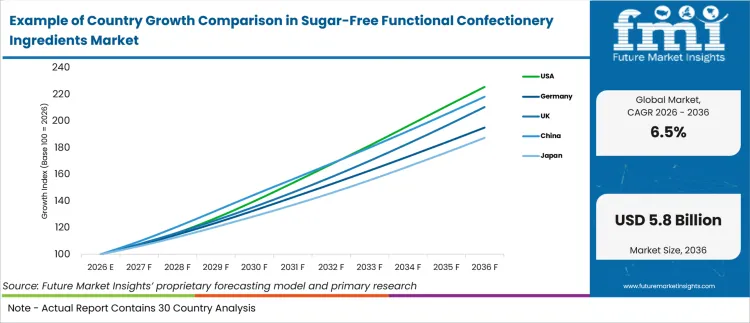
| Country | CAGR |
|---|---|
| China | 8.1% |
| UK | 7.7% |
| USA | 7.3% |
| Germany | 6.9% |
| Japan | 6.5% |
How do country-level CAGRs compare in the Sugar-Free Functional Confectionery Ingredients Market?
The country comparison spans 1.6 percentage points and reflects a relatively concentrated growth outlook across the sugar-free functional confectionery ingredients market. China, the UK and the USA create a closely aligned upper group with only modest differences between their forecasts. Germany and Japan form a lower pair and remain separated by a limited gap, keeping the overall market structure fairly compressed. The narrow spread between countries suggests that demand for sugar reduction and functional ingredient fortification is expanding across multiple confectionery markets at a comparable pace.
- China shows a notable position within the comparison as confectionery manufacturers continue to expand the use of functional sweeteners, fiber-based ingredients and health-oriented product formulations.
- The UK remains closely aligned with China as sugar reduction initiatives and consumer interest in better-for-you confectionery encourage ongoing ingredient innovation.
- The USA benefits from growing demand for confectionery products that combine reduced sugar content with added functional benefits such as wellness and lifestyle support.
- Germany reflects steady market development through continued reformulation efforts and the incorporation of alternative sweetening systems that maintain product quality and taste.
- Japan maintains a meaningful position within the comparison as demand for portion-conscious and health-focused confectionery supports the use of specialized functional ingredients.
Comparable CAGRs do not create identical market conditions across countries. Differences in consumer preferences, regulatory frameworks, ingredient approval requirements and product development strategies can influence commercialization pathways and adoption rates. Similar growth forecasts may therefore reflect different routes to market and distinct innovation priorities. The full report provides country-level CAGR analysis across North America, Latin America, Europe, East Asia, South Asia, Oceania and the Middle East and Africa.
Country-wise Analysis
- China-based confectionery manufacturers must confirm new-food status and approved production specifications for every commercial rare-sugar formulation. Sugar-free functional confectionery ingredient sales in China are forecast to expand at 8.1% CAGR by 2036, supported by broader legal access to D-allulose. In July 2025 the National Health Commission approved D-allulose produced through fermentation or enzymatic conversion and recommended no more than 20 grams daily. The authorization creates a direct enabler for local candy and chocolate reformulation across domestic plants. Serving guidance and consumer exclusions create material friction for brands seeking broad mass-market positioning across multiple confectionery formats. Ingredient companies need stable supply specifications and local regulatory support to establish repeat manufacturing programs.
- United Kingdom confectionery brands operate under national advertising and nutrition rules that require separate review from European Union documentation. Adoption of sugar-free functional confectionery ingredients in the United Kingdom is estimated to expand at 7.7% CAGR through 2036, reinforced by clearer treatment for qualifying sugar-free products. Advertising eligibility depends on whether a finished recipe falls outside the regulated confectionery category under national guidance. In June 2025 the Department of Health and Social Care confirmed that sugar-free sweets and chewing gum remain outside the specified less-healthy confectionery category. The exclusion supports differentiated promotion for qualifying sugar-free products within national advertising and related sales channels. Separate ingredient and label reviews create material friction across coordinated United Kingdom and European launches. Local application guidance can reduce duplicated testing and packaging revision costs across related regional product programs.
- United States manufacturers must align sugar-free claims with federal serving rules and complete package disclosures. The United States sugar-free functional confectionery ingredients outlook is anticipated to advance at 7.3% CAGR over the assessment period, aided by stronger attention to added-sugar disclosure. In January 2025 the Food and Drug Administration proposed front-of-package information with three added-sugar levels ranging from low through high. The proposal gives formulation teams another reason to reduce added sugars without sacrificing texture or production performance. Uncertain implementation timing and label redesign costs create material friction for manufacturers planning nationwide product launches. Validated prototypes can connect ingredient choice with expected package outcomes and reduce late-stage changes during commercial planning.
- German confectionery plants combine substantial chocolate output with European additive rules that define permitted polyols and label conditions. Sugar-free functional confectionery ingredient demand in Germany is forecast to rise at 6.9% CAGR over the forecast period, underpinned by established manufacturing and formulation capacity. Reduced-sugar trials must preserve chocolate viscosity across equipment designed for full-sugar recipes and established throughput targets. The Federal Statistical Office reported in December 2025 that Germany produced nearly 1.07 million tonnes of cocoa-containing chocolate products during 2024. Production scale supports ingredient trials across formats and manufacturing lines with different viscosity targets under commercial operating conditions. Heat behavior creates material friction during reduced-sugar conversion across existing chocolate equipment and planned production yields. Application laboratories must demonstrate process stability through representative trials that reflect actual recipes and line settings.
- Japanese confectionery manufacturers use separate pathways for ordinary foods and products carrying specified or notified functional claims. The Japanese sugar-free functional confectionery ingredients sector is projected to record 6.5% CAGR during the assessment period, influenced by established dental-confectionery routes and detailed evidence duties. In April 2025 the Consumer Affairs Agency held briefings on revisions to the Foods with Function Claims system. The briefings gave filing businesses a direct route for reviewing updated notification responsibilities across functional product submissions. Scientific support remains the business operator's responsibility and creates material friction for smaller brands or imported products. Japanese documentation support and local testing can improve market access for products with clear functional positioning.
Who are the notable companies in the Sugar-Free Functional Confectionery Ingredients Market?
BENEO GmbH; Roquette Frères; Cargill Incorporated; Tate & Lyle PLC; Ingredion Incorporated; Archer Daniels Midland Company (ADM); Samyang Corporation; and Matsutani Chemical Industry Co., Ltd. are notable companies shaping this market.
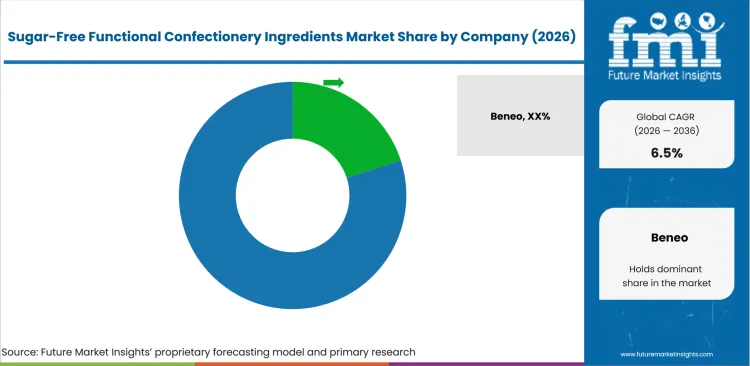
Competition combines polyol specialists with global ingredient groups that support sugar reduction through sweeteners and texture systems. BENEO and Roquette focus on polyols for candy and chocolate recipes requiring controlled moisture and stable processing. Cargill and ADM provide broader sweetener portfolios with regional formulation resources for manufacturers handling several confectionery formats. Tate & Lyle and Ingredion add rare sugars and texture systems that rebuild solids during commercial recipe scale-up. In July 2026 Roquette published sugar-free confectionery guidance for gum and mints across oral-care and impulse occasions. Samyang and Matsutani strengthen allulose commercialization across Asia, and competition in functional food ingredients depends on plant-scale evidence and dependable technical support.
- BENEO and Roquette support high-temperature candy development through polyols and functional carbohydrates with distinct moisture behavior. Their commercial test centers on stable texture and appearance throughout the intended package life under realistic storage conditions. Matsutani adds allulose commercialization experience for programs that need lower sugar without relying solely on traditional polyols.
- Cargill and ADM combine broad sweetener coverage with formulation resources across several operating regions for confectionery manufacturers. Tate & Lyle and Ingredion extend the comparison through rare sugars and texture support for solids replacement. Manufacturers compare these portfolios through sensory performance and production behavior rather than sweetness intensity alone.
- Samyang combines allulose with sugar alcohols and functional carbohydrates across a food-ingredient portfolio designed for sugar reduction. Regional approval and dependable technical support determine whether those ingredients reach repeat use in finished confectionery formulations. Confectionery manufacturers must verify local ingredient status and production access across every country-specific launch program.
Competitive Benchmarking: Sugar-Free Functional Confectionery Ingredients Market
| Company | Bulk Sweetener Coverage | Confectionery Application Support | Functional Benefit Evidence | Geographic Reach |
|---|---|---|---|---|
| BENEO GmbH | High | High | High | Global |
| Roquette Frères | High | High | High | Global |
| Cargill Incorporated | High | High | Medium | Global |
| Tate & Lyle PLC | Medium | High | Medium | Global |
| Ingredion Incorporated | Medium | High | Medium | Global |
| Archer Daniels Midland Company (ADM) | High | High | Medium | Global |
| Samyang Corporation | High | Medium | Medium | East Asia and selected export markets |
| Matsutani Chemical Industry Co., Ltd. | Medium | Medium | Medium | Asia, North America and Europe |
Key Developments in the Sugar-Free Functional Confectionery Ingredients Market
- In June 2026, BENEO launched sugar-free hard-candy concepts through its Sweets Box application program for confectionery manufacturers. The prototypes use isomalt across filled and layered formats with separate attention to moisture control and visual design. The development gives confectionery teams reference formulations for comparing taste and process stability during plant trials. It also creates a clearer qualification route for manufacturers evaluating differentiated shapes and package requirements.
- In February 2026, Tate & Lyle and Manus launched Yume with Yume M Stevia as the first branded ingredient. The partnership combines commercial-scale bioconversion with formulation expertise across food categories that require reduced-sugar sweetness systems. The launch expands sweetness choices for confectionery products that need separate bulking and texture systems. Manufacturers must therefore evaluate Yume within a complete replacement formulation rather than treat it as a direct sugar substitute.
- In July 2026, Matsutani Chemical Industry documented D-allulose commercialization from mass-production technology through Foods with Function Claims in Japan. The announcement connects proprietary enzyme development with finished products that use the ingredient's functional positioning. The development gives manufacturers a stronger commercial reference that extends beyond isolated laboratory feasibility results. Confectionery applications require product-specific testing for browning and texture with serving design across each finished format.
- In March 2025, Cargill presented a starch-based pectin replacer for gummies and jellies at AAHAR 2025. The development expands texture options for manufacturers reformulating chewy products that need stable gels and efficient processing. Sweetener replacement requires separate trials; gelling behavior cannot establish sweetness or digestive tolerance across a complete sugar-free formulation. The launch supports commercial gummy development without overstating its role within the separate sweetener system.
Key Players in the Sugar-Free Functional Confectionery Ingredients Market
Isomalt and Polyol Specialists
- BENEO GmbH
- Roquette Frères
- Cargill Incorporated
- Archer Daniels Midland Company (ADM)
Sweetening and Texture Solution Providers
- Tate & Lyle PLC
- Ingredion Incorporated
Rare Sugar and Functional Carbohydrate Developers
- Samyang Corporation
- Matsutani Chemical Industry Co., Ltd.
Sugar-Free Functional Confectionery Ingredients Market - Report Scope
| Coverage field | Report scope |
|---|---|
| Market breakdown | Ingredient, application, benefit, and region. |
| Quantitative Units | Revenue in USD Million, CAGR in %. |
| Market Definition | Ingredients replace or reduce sugar and add defined functional value across candy and related confectionery products. The scope covers isomalt, palatinose, polyols, and fibers, including rare sugars and functional actives within those categories, used in commercial confectionery formulations. |
| Regions Covered | North America, Latin America, Europe, East Asia, South Asia, Oceania, and Middle East and Africa. |
| Countries Covered | USA, Germany, UK, China, and Japan, with 30+ countries assessed in the full report. |
| Key Companies Profiled | BENEO GmbH; Roquette Frères; Cargill Incorporated; Tate & Lyle PLC; Ingredion Incorporated; Archer Daniels Midland Company (ADM); Samyang Corporation; and Matsutani Chemical Industry Co., Ltd. |
| Forecast Period | 2026 to 2036. |
| Approach | Hybrid demand-side and supply-side sizing combines manufacturer input with official desk research across the defined market. |
Sugar-Free Functional Confectionery Ingredients Market - Research Methodology
| Method | Approach |
|---|---|
| Primary Research | FMI analysts gathered input from manufacturers, service providers, technology developers, distributors, end users, procurement teams, and subject-matter experts. Interviews examined purchasing decisions, product or service evaluation, adoption barriers, approval requirements, pricing considerations, and expectations for technical or commercial support. Respondents were also asked what evidence is required before a trial, pilot, or initial order develops into regular purchasing. |
| Desk Research | Desk research covered government statistics, regulatory publications, trade data, industry associations, technical literature, standards, company filings, product information, and official corporate announcements. Sources were reviewed for relevance, publication date, geographic coverage, and consistency with the defined market scope. Claims relating to performance, applications, approvals, capacity, investment, and commercial activity were retained only when supported by credible public evidence. |
| Market Sizing and Forecasting | The market model combined the baseline value with historical performance, segment structure, pricing and volume indicators, adoption levels, company participation, and country-level demand conditions. Forecast assumptions considered economic activity, investment trends, regulatory developments, technology adoption, purchasing cycles, supply availability, and barriers to wider market use. Segment and regional estimates were reconciled before the final market total was calculated. |
| Data Validation | Estimates were checked against multiple independent indicators, including public data, company activity, trade patterns, industry developments, and findings from primary interviews. Validation also tested whether products, services, applications, and company revenues fell within the defined market boundaries. Adjacent categories, unsupported claims, overlapping revenues, and activities without direct market relevance were excluded to reduce double counting and maintain consistency across segments and countries. |
Sugar-Free Functional Confectionery Ingredients Market by Segments
Sugar-Free Functional Confectionery Ingredients Market segmented by Ingredient:
- Isomalt
- Palatinose
- Polyols
- Fibers
Sugar-Free Functional Confectionery Ingredients Market segmented by Application:
- Candy
- Gummies
- Chocolate
Sugar-Free Functional Confectionery Ingredients Market segmented by Benefit:
- Dental
- Low-GI
Sugar-Free Functional Confectionery Ingredients Market by Region:
- North America
- United States
- Canada
- Latin America
- Brazil
- Mexico
- Argentina
- Chile
- Western Europe
- Germany
- France
- United Kingdom
- Italy
- Spain
- Benelux
- Nordics
- Eastern Europe
- Poland
- Czech Republic
- Romania
- Hungary
- East Asia
- China
- Japan
- South Korea
- South Asia and Pacific
- India
- ASEAN
- Australia and New Zealand
- Middle East and Africa
- GCC Countries
- South Africa
- Türkiye
- Israel
Research Sources and Bibliography
- USA Food and Drug Administration. (2025, February 24). FDA finalizes updated “healthy” nutrient content claim.
- Department of Health and Social Care. (2025, June 4). Restricting advertising of less healthy food or drink on TV and online: Products in scope.
- German Federal Institute for Risk Assessment. (2025, July 15). Sweeteners in food - Selected questions and answers.
- Roquette. (2026, July 7). How to reconnect creativity and the impulsive purchasing for sugar-free confectionery.
- Ministry of Health, Labour and Welfare. (2025, October 15). う蝕の原因とならない代用甘味料の利用法.
- Cargill. (2025, November 14). Cargill APAC IngredienTracker™ 2025 assessed consumer attitudes towards 91 ingredients across four groups: Chocolate & Cocoa, Sweeteners, Texturizers, and Fats & Oils.
- Department of Health and Social Care. (2026, March 25). Applying the new NPM to advertising and promotions restrictions.
- National Health Commission of the People’s Republic of China. (2026, February 5). 解读《关于栀子油等22种“三新食品”的公告》(2026年第1号).
- National Health Commission of the People’s Republic of China. (2025, July 2). 解读《关于D-阿洛酮糖等20种“三新食品”的公告》(2025年第4号).
- USA Food and Drug Administration. (2025, January 14). FDA proposes requiring at-a-glance nutrition information on the front of packaged foods.
- Statistisches Bundesamt. (2025, December 2). 12,8 Kilo Schokolade pro Kopf wurden 2024 produziert.
- Consumer Affairs Agency. (2025, April 11). 機能性表示食品制度に関する説明会.
- Ingredion. (2025, July 22). Ingredion at IFT FIRST 2025 - Connecting texture, health and innovation.
- BENEO. (2026, June 25). BENEO launches collection of inspirational sugar-free confectionery concepts to boost category innovation.
- Tate & Lyle. (2026, February 23). Introducing Yume™: A new standard for sweetness.
- Matsutani Chemical Industry Co., Ltd. (2026, July 17). 希少糖「D-アルロース」の社会実装と最新研究を『生物工学会誌』で紹介 ~大量生産技術の確立から機能性表示食品の実用化まで~.
- Cargill. (2025, March 4). Cargill showcases full range of innovative food solutions at AAHAR 2025.
- ADM. (n.d.). Confectionery products & solutions.
- Samyang Corporation. (2025, July 4). Visit Samyang at IFT Chicago (#S1114). Discover New Sugar Reduction & Fiber Solutions.
This bibliography is provided for reader reference and is not exhaustive. The full report contains the complete reference list and detailed citations
This Report Answers
- How large is the sugar-free functional confectionery ingredients market in 2026 and 2036?
- Which formulation pressures support demand for sugar-free confectionery ingredient systems?
- Why does isomalt account for the largest ingredient share in 2026?
- How does candy influence application demand across reduced-sugar formulation programs?
- Why does dental represent the largest benefit share during 2026?
- How do profiled growth rates compare across China, the UK, the USA, Germany and Japan?
- Which companies supply polyols, rare sugars and confectionery application support?
- What limits formulation transfer across claims, serving sizes and processing conditions?
- How can new allulose routes expand functional confectionery product development?
Frequently Asked Questions
How big is the Sugar-Free Functional Confectionery Ingredients Market in 2026?
The sugar-free functional confectionery ingredients market is valued at USD 3.1 billion in 2026 and is forecast to reach USD 5.8 billion by 2036, supported by growing regulatory attention on added sugar content and increasing manufacturer demand for complete bulk and texture replacement systems across candy, gummies, and chocolate formulations.
What is the CAGR of the Sugar-Free Functional Confectionery Ingredients Market from 2026 to 2036?
The sugar-free functional confectionery ingredients market is projected to grow at a CAGR of 6.5% between 2026 and 2036, supported by stronger added-sugar disclosure requirements, expanding rare-sugar authorizations across major markets, and growing confectionery manufacturer investment in ingredient systems that preserve cooking performance and finished texture across commercial production runs.
Which ingredient leads the Sugar-Free Functional Confectionery Ingredients Market?
Isomalt accounts for 45.8% of the sugar-free functional confectionery ingredients market by ingredient in 2026, driven by its combined bulking and moisture-control performance in hard candy, with low hygroscopicity protecting surface quality during storage and allowing manufacturers to evaluate sweetness and process behavior within the same commercial trial.
How much will the Sugar-Free Functional Confectionery Ingredients Market add between 2026 and 2036?
The sugar-free functional confectionery ingredients market is set to add USD 2.7 billion between 2026 and 2036, growing from USD 3.1 billion to USD 5.8 billion as front-of-package nutrition labeling requirements, new D-allulose enzyme approvals, and dental-benefit positioning accelerate adoption of functional sugar-free ingredient systems across global confectionery manufacturing.
Who are the leading companies in the Sugar-Free Functional Confectionery Ingredients Market?
Leading companies in the sugar-free functional confectionery ingredients market include BENEO, Roquette, Cargill, ADM, Tate & Lyle, Ingredion, Samyang, and Matsutani Chemical Industry, competing across isomalt and polyol specialist platforms, broad sweetening and texture solution systems, and rare sugar and functional carbohydrate development with global and regional application reach.
Preview the report firsthand - request a free sample
Get SampleGet the brochure for pricing and purchase details.
Get PDFTable of Content
- Key Takeaways
- Market Size and CAGR
- Top Growth Driver
- Fastest Growing Segment
- Leading Region
- Key Companies
- Emerging Opportunities
- Executive Summary
- Global Market Outlook
- Demand-side Trends
- Supply-side Trends
- Technology Roadmap Analysis
- Analysis and Recommendations
- Analyst Perspective (What is happening? Why now? What should investors know?)
- Key Questions Answered
- How large is the market?
- What is the CAGR?
- What are key trends?
- Which region dominates?
- Who are the leaders?
- Market Overview
- Market Coverage / Taxonomy
- Market Definition / Scope / Limitations
- Research Methodology
- Chapter Orientation
- Analytical Lens and Working Hypotheses
- Market Structure, Signals, and Trend Drivers
- Benchmarking and Cross-market Comparability
- Market Sizing, Forecasting, and Opportunity Mapping
- Research Design and Evidence Framework
- Desk Research Programme (Secondary Evidence)
- Expert Input and Fieldwork (Primary Evidence)
- Tooling, Models, and Reference Databases
- Data Engineering and Model Build
- Quality Assurance and Audit Trail
- Market Background
- Market Dynamics (Drivers, Restraints, Opportunity, Trends)
- Scenario Forecast (Optimistic, Likely, Conservative)
- Impact Analysis
- AI Impact
- Sustainability Impact
- Regulatory Impact
- Technology Impact
- Consumer / Buyer Analysis
- Purchase Drivers
- Adoption Barriers
- Buyer Journey
- Opportunity Map Analysis
- Product Life Cycle Analysis
- Supply Chain Analysis
- Investment Feasibility Matrix
- Value Chain Analysis
- PESTLE and Porter's Analysis
- Regulatory Landscape
- Regional Parent Market Outlook
- Production and Consumption Statistics
- Import and Export Statistics
- Global Market Analysis and Forecast, 2021 to 2036
- Historical Market Size Value (USD Billion) Analysis, 2021 to 2025
- Current and Future Market Size Value (USD Billion) Projections, 2026 to 2036
- Y-o-Y Growth Trend Analysis
- Absolute $ Opportunity Analysis
- Global Market Pricing Analysis, 2021 to 2036
- Global Market Analysis and Forecast, By Ingredient, 2021 to 2036
- Introduction / Key Findings
- Historical Market Size Value (USD Billion) Analysis By Ingredient, 2021 to 2025
- Current and Future Market Size Value (USD Billion) Analysis and Forecast By Ingredient, 2026 to 2036
- Isomalt
- Palatinose
- Polyols
- Fibers
- Isomalt
- Y-o-Y Growth Trend Analysis By Ingredient, 2021 to 2025
- Absolute $ Opportunity Analysis By Ingredient, 2026 to 2036
- Global Market Analysis and Forecast, By Application, 2021 to 2036
- Introduction / Key Findings
- Historical Market Size Value (USD Billion) Analysis By Application, 2021 to 2025
- Current and Future Market Size Value (USD Billion) Analysis and Forecast By Application, 2026 to 2036
- Candy
- Gummies
- Chocolate
- Candy
- Y-o-Y Growth Trend Analysis By Application, 2021 to 2025
- Absolute $ Opportunity Analysis By Application, 2026 to 2036
- Global Market Analysis and Forecast, By Benefit, 2021 to 2036
- Introduction / Key Findings
- Historical Market Size Value (USD Billion) Analysis By Benefit, 2021 to 2025
- Current and Future Market Size Value (USD Billion) Analysis and Forecast By Benefit, 2026 to 2036
- Dental
- Low-GI
- Dental
- Y-o-Y Growth Trend Analysis By Benefit, 2021 to 2025
- Absolute $ Opportunity Analysis By Benefit, 2026 to 2036
- Global Market Analysis and Forecast, By Region, 2021 to 2036
- Introduction
- Historical Market Size Value (USD Billion) Analysis By Region, 2021 to 2025
- Current Market Size Value (USD Billion) Analysis and Forecast By Region, 2026 to 2036
- North America
- Latin America
- Western Europe
- Eastern Europe
- East Asia
- South Asia and Pacific
- Middle East & Africa
- Market Attractiveness Analysis By Region
- North America Market Analysis and Forecast, By Country, 2021 to 2036
- Historical Market Size Value (USD Billion) Trend Analysis By Market Taxonomy, 2021 to 2025
- Market Size Value (USD Billion) Forecast By Market Taxonomy, 2026 to 2036
- By Country
- USA
- Canada
- By Ingredient
- By Application
- By Benefit
- By Country
- Market Attractiveness Analysis
- By Country
- By Ingredient
- By Application
- By Benefit
- Key Takeaways
- Latin America Market Analysis and Forecast, By Country
- Historical Market Size Value (USD Billion) Trend Analysis By Market Taxonomy, 2021 to 2025
- Market Size Value (USD Billion) Forecast By Market Taxonomy, 2026 to 2036
- By Country
- Brazil
- Mexico
- Chile
- Rest of Latin America
- By Ingredient
- By Application
- By Benefit
- By Country
- Market Attractiveness Analysis
- By Country
- By Ingredient
- By Application
- By Benefit
- Key Takeaways
- Western Europe Market Analysis and Forecast, By Country
- Historical Market Size Value (USD Billion) Trend Analysis By Market Taxonomy, 2021 to 2025
- Market Size Value (USD Billion) Forecast By Market Taxonomy, 2026 to 2036
- By Country
- Germany
- UK
- Italy
- Spain
- France
- Nordic
- BENELUX
- Rest of Western Europe
- By Ingredient
- By Application
- By Benefit
- By Country
- Market Attractiveness Analysis
- By Country
- By Ingredient
- By Application
- By Benefit
- Key Takeaways
- Eastern Europe Market Analysis and Forecast, By Country
- Historical Market Size Value (USD Billion) Trend Analysis By Market Taxonomy, 2021 to 2025
- Market Size Value (USD Billion) Forecast By Market Taxonomy, 2026 to 2036
- By Country
- Russia
- Poland
- Hungary
- Balkan & Baltic
- Rest of Eastern Europe
- By Ingredient
- By Application
- By Benefit
- By Country
- Market Attractiveness Analysis
- By Country
- By Ingredient
- By Application
- By Benefit
- Key Takeaways
- East Asia Market Analysis and Forecast, By Country
- Historical Market Size Value (USD Billion) Trend Analysis By Market Taxonomy, 2021 to 2025
- Market Size Value (USD Billion) Forecast By Market Taxonomy, 2026 to 2036
- By Country
- China
- Japan
- South Korea
- By Ingredient
- By Application
- By Benefit
- By Country
- Market Attractiveness Analysis
- By Country
- By Ingredient
- By Application
- By Benefit
- Key Takeaways
- South Asia and Pacific Market Analysis and Forecast, By Country
- Historical Market Size Value (USD Billion) Trend Analysis By Market Taxonomy, 2021 to 2025
- Market Size Value (USD Billion) Forecast By Market Taxonomy, 2026 to 2036
- By Country
- India
- ASEAN
- Australia & New Zealand
- Rest of South Asia and Pacific
- By Ingredient
- By Application
- By Benefit
- By Country
- Market Attractiveness Analysis
- By Country
- By Ingredient
- By Application
- By Benefit
- Key Takeaways
- Middle East & Africa Market Analysis and Forecast, By Country
- Historical Market Size Value (USD Billion) Trend Analysis By Market Taxonomy, 2021 to 2025
- Market Size Value (USD Billion) Forecast By Market Taxonomy, 2026 to 2036
- By Country
- Kingdom of Saudi Arabia
- Other GCC Countries
- Türkiye
- South Africa
- Other African Union
- Rest of Middle East & Africa
- By Ingredient
- By Application
- By Benefit
- By Country
- Market Attractiveness Analysis
- By Country
- By Ingredient
- By Application
- By Benefit
- Key Takeaways
- Key Countries Market Analysis
- USA
- Pricing Analysis
- Market Share Analysis, 2025
- By Ingredient
- By Application
- By Benefit
- Canada
- Pricing Analysis
- Market Share Analysis, 2025
- By Ingredient
- By Application
- By Benefit
- Mexico
- Pricing Analysis
- Market Share Analysis, 2025
- By Ingredient
- By Application
- By Benefit
- Brazil
- Pricing Analysis
- Market Share Analysis, 2025
- By Ingredient
- By Application
- By Benefit
- Chile
- Pricing Analysis
- Market Share Analysis, 2025
- By Ingredient
- By Application
- By Benefit
- Germany
- Pricing Analysis
- Market Share Analysis, 2025
- By Ingredient
- By Application
- By Benefit
- UK
- Pricing Analysis
- Market Share Analysis, 2025
- By Ingredient
- By Application
- By Benefit
- Italy
- Pricing Analysis
- Market Share Analysis, 2025
- By Ingredient
- By Application
- By Benefit
- Spain
- Pricing Analysis
- Market Share Analysis, 2025
- By Ingredient
- By Application
- By Benefit
- France
- Pricing Analysis
- Market Share Analysis, 2025
- By Ingredient
- By Application
- By Benefit
- India
- Pricing Analysis
- Market Share Analysis, 2025
- By Ingredient
- By Application
- By Benefit
- ASEAN
- Pricing Analysis
- Market Share Analysis, 2025
- By Ingredient
- By Application
- By Benefit
- Australia & New Zealand
- Pricing Analysis
- Market Share Analysis, 2025
- By Ingredient
- By Application
- By Benefit
- China
- Pricing Analysis
- Market Share Analysis, 2025
- By Ingredient
- By Application
- By Benefit
- Japan
- Pricing Analysis
- Market Share Analysis, 2025
- By Ingredient
- By Application
- By Benefit
- South Korea
- Pricing Analysis
- Market Share Analysis, 2025
- By Ingredient
- By Application
- By Benefit
- Russia
- Pricing Analysis
- Market Share Analysis, 2025
- By Ingredient
- By Application
- By Benefit
- Poland
- Pricing Analysis
- Market Share Analysis, 2025
- By Ingredient
- By Application
- By Benefit
- Hungary
- Pricing Analysis
- Market Share Analysis, 2025
- By Ingredient
- By Application
- By Benefit
- Kingdom of Saudi Arabia
- Pricing Analysis
- Market Share Analysis, 2025
- By Ingredient
- By Application
- By Benefit
- Türkiye
- Pricing Analysis
- Market Share Analysis, 2025
- By Ingredient
- By Application
- By Benefit
- South Africa
- Pricing Analysis
- Market Share Analysis, 2025
- By Ingredient
- By Application
- By Benefit
- USA
- Market Structure Analysis
- Competition Dashboard
- Competition Benchmarking
- Market Share Analysis of Top Players
- By Regional
- By Ingredient
- By Application
- By Benefit
- Emerging Startups
- Innovation Benchmarking
- Competition Analysis
- Competition Deep Dive
- Beneo
- Overview
- Product Portfolio
- Profitability by Market Segments
- Sales Footprint
- Strategy Overview
- Marketing Strategy
- Product Strategy
- Channel Strategy
- Cargill
- Roquette
- SÜDZUCKER
- Tate & Lyle
- ADM
- Beneo
- Case Studies
- Success Stories
- Recent Developments
- Competition Deep Dive
- Assumptions & Acronyms Used


