

- Market Size (2026)
- USD 48.5 Mn
- Forecast (2036)
- USD 129.3 Mn
- CAGR (2026 to 2036)
- 10.3%
How big is Allanblackia Confectionery Stearins Market in 2026?
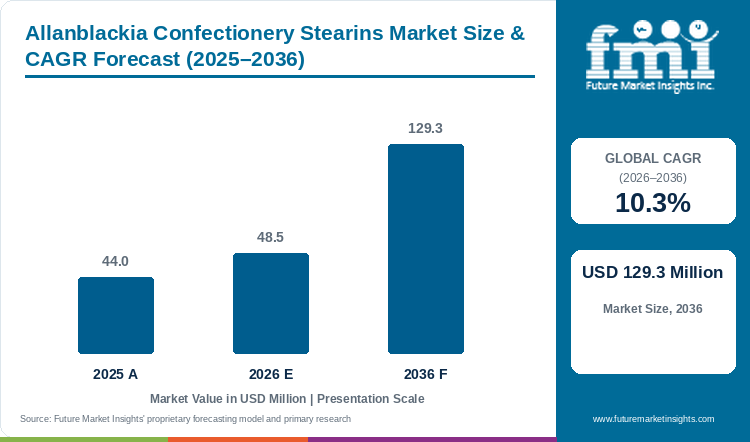
Worldwide allanblackia confectionery stearins market size moves past its 2025 level of USD 44.0 million to record USD 48.5 million in 2026 industry value while a 10.3% CAGR lifts 2036 demand to USD 129.3 million.
Extreme swings in West African cocoa bean prices and warm-climate distribution requirements have pushed industrial chocolatiers to blend high-melting symmetric stearins (`StOSt`, 1,3-distearoyl-2-oleoyl-glycerol) that raise chocolate heat resistance up to 38 degrees Celsius without waxy mouthfeel. In April 2026, Barry Callebaut Group reported in its Half-Year Results for Fiscal Year 2025/26 that six-month group chocolate and cocoa volume stood at 1,010,247 tonnes valued at CHF 6,752.2 million as food manufacturers reformulated coatings and fillings after multi-year cocoa turbulence [1]. Because seed fat pressed from Allanblackia parviflora and Allanblackia floribunda naturally contains roughly 70% symmetric StOSt and 25% StOO triacylglycerols without chemical hydrogenation, Non-Hydrogenated Cocoa Butter Equivalent (CBE) & Improver (CBI) claims 56.2% of 2026 functional lipid role valuation across sustainable cocoa butter alternatives refineries. Supported by dual demand from super-compound chocolate bars and palm-free spread blocks, global allanblackia confectionery stearins industry valuation progresses beyond its USD 44.0 million 2025 level to attain USD 48.5 million in 2026 market size before reaching a 2036 horizon of USD 129.3 million through a 10.3% CAGR generating USD 80.8 million in added value. Nevertheless, reliance on rural wild-pod collection across Ghana and Tanzania still limits annual kernel tonnage.
Key Market Trends & Insights
- By botanical species & triglyceride profile: Allanblackia parviflora & floribunda (High-SOS / StOSt Symmetric Fat) accounts for 68.5% of 2026 species valuation because native unfractionated kernel fat already exceeds the StOSt concentration of crude shea butter.
- By functional lipid role: Non-Hydrogenated Cocoa Butter Equivalent (CBE) & Improver (CBI) holds 56.2% of 2026 functional role market value due to its ability to co-crystallize in beta-prime and beta-V polymorphs with pure cocoa butter.
- By end-use product: Compound & Super-Compound Chocolate Moldings capture 51.4% of 2026 product valuation as biscuit enrobers and tablet molders replace expensive cocoa butter above the 5% statutory threshold.
Regional Highlights
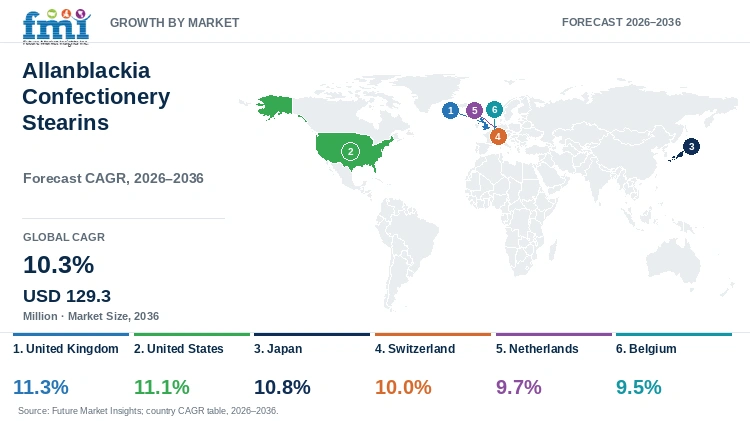
- British & North American CBE momentum: United Kingdom confectionery and plant-butter processors top the six profiled nations at an 11.3% yearly clip to 2036, closely trailed by United States super-compound enrobers at 11.1%.
- Japanese & Continental European refining hubs: Japanese demand advances 10.8% annually across the 2026-2036 decade, outpacing Swiss export chocolatiers (10.0%) plus Dutch (9.7%) and Belgian (9.5%) couverture refineries.
Market Size & Forecast
Table 1: Global Allanblackia Confectionery Stearins Valuation Trajectory (USD Million), 2025 to 2036
| Industry Valuation Metric | Baseline & Forecast Figure |
|---|---|
| 2025 Historical Market Size | USD 44.0 million |
| 2026 Estimated Market Valuation | USD 48.5 million |
| 2036 Projected Market Size | USD 129.3 million |
| 10-Year Compound Annual Growth Rate (2026 to 2036) | 10.3% |
| 10-Year Increase in Annual Market Value (2026 to 2036) | USD 80.8 million |
Unlike palm mid-fractions (`POP`) that soften rapidly above 30 degrees Celsius or shea stearin that requires intensive solvent fractionation from a 42% StOSt crude oil, crude allanblackia seed fat crystallizes cleanly with minimal dry fractionation because palmitic acid is below 3%. During February 2026, AAK AB disclosed in its fourth-quarter and year-end 2025 interim financial statement that Chocolate & Confectionery Fats earnings hit SEK 524 million for Q4 2025 while confectionery customers adopted high-performance cocoa butter equivalents and improvers [2]. Prompted by these cost-reduction and bloom-inhibition benefits, European and Asian fat refiners blend allanblackia stearin with palm mid-fractions and illipe butter to formulate tropicalized couverture and clean-label margarine hardstocks.
Agroforestry Seed Collection and Refined Stearin Tonnage Sizing
Table 2: Dried Kernel Collection Volume, Refined Stearin Tonnage, and Contract Pricing for Allanblackia Confectionery Stearins, 2025 to 2036
| Physical & Price Indicator | 2025 | 2026 | 2036 |
|---|---|---|---|
| Global market valuation (USD million) | 44.0 | 48.5 | 129.3 |
| Refined allanblackia fat & stearin volume (thousand metric tons) | 8.4 to 9.3 | 9.2 to 10.2 | 23.5 to 26.2 |
| Dried allanblackia seed kernel input (thousand metric tons) | 13.2 to 14.6 | 14.4 to 16.0 | 36.5 to 40.8 |
| Average B2B contract price for refined stearin (USD per metric ton) | 4,730 to 5,240 | 4,750 to 5,270 | 4,930 to 5,500 |
Extraction yield note: Kernel-to-stearin conversion reflects sun-dried Allanblackia parviflora and floribunda kernels holding 65% to 72% crude fat on a dry weight basis prior to physical refining and dry crystallization.
Because each mature female allanblackia tree produces 100 to 250 heavy football-sized pods per season across Ghana's Western Region and Tanzania's Usambara Mountains, rural collection networks coordinated under the Novella Africa partnership supply traceable non-deforestation kernels. Refiners also pair allanblackia hardstocks with refined shea butter to balance supply across West African harvest cycles.
Smallholder Collector Network & Formulation Dosage Sizing
Table 3: Smallholder Agroforestry Collector Base and Confectionery Dosage Indicators for Allanblackia Stearins, 2025 to 2036
| Supply Chain & Formulation Metric | 2025 | 2026 | 2036 |
|---|---|---|---|
| Active rural seed collectors & agroforestry outgrowers (thousand) | 14.5 to 16.2 | 15.8 to 17.6 | 34.0 to 38.5 |
| Domesticated clonal allanblackia trees in bearing age (million trees) | 0.85 to 0.98 | 0.96 to 1.12 | 3.20 to 3.75 |
| Typical CBE inclusion rate in EU Directive 2000/36/EC chocolate (%) | Up to 5.0% | Up to 5.0% | Up to 5.0% |
| Typical stearin inclusion in super-compound coatings & spreads (%) | 12.0% to 28.0% | 12.5% to 28.5% | 14.0% to 30.0% |
Table 4: Species, Functional Role, and End-Use Valuation Breakdown for Allanblackia Confectionery Stearins, 2026
| Segment Dimension | 2026 Valuation / Share | Formulation Basis |
|---|---|---|
| Global allanblackia confectionery stearins market size | USD 48.5 million | 2026 global B2B specialty stearin baseline |
| Allanblackia parviflora & floribunda symmetric fat | USD 33.2 million (68.5%) | 65% to 75% natural StOSt triacylglycerol kernel fat |
| Non-hydrogenated CBE & CBI functional role | USD 27.3 million (56.2%) | Polymorphic beta-V chocolate tempering & bloom control |
| Compound & super-compound chocolate moldings | USD 24.9 million (51.4%) | Biscuit enrobing, confectionery bars & praline shells |
In addition to chocolate moldings, European yellow-fat spread manufacturers dose 8% to 15% allanblackia stearin into liquid rapeseed and sunflower oil blends to create tub spreads that hold their structure at room temperature without palm oil or trans fats. These clean-label hardstocks compete directly within plant-based spreadable alternatives and food emulsifiers across Dutch and British grocery chillers.
Analyst Perspective
"Allanblackia seed fat is nature's purest source of symmetric StOSt triacylglycerols, offering a sharp 34 to 36 degree Celsius melting curve that prevents chocolate bloom in warm climates while structured plant butters eliminate palm hardstocks. As grafted clonal trees planted across Ghana and Tanzania enter full bearing age, refiners with direct African outgrower partnerships will hold a decisive cost and EUDR-traceability advantage."
- Nandini Roy Choudhury, Principal Consultant, Future Market Insights.
How is the allanblackia confectionery stearins market segmented?
The allanblackia confectionery stearins market is segmented by botanical species & triglyceride profile, functional lipid role, end-use product, and region. In 2026, Allanblackia parviflora & floribunda (High-SOS / StOSt Symmetric Fat) holds 68.5%, Non-Hydrogenated Cocoa Butter Equivalent (CBE) & Improver (CBI) accounts for 56.2%, and Compound & Super-Compound Chocolate Moldings represent 51.4%.
By botanical species & triglyceride profile: Allanblackia parviflora & floribunda (High-SOS / StOSt Symmetric Fat) and Dry-Fractionated Allanblackia Stearin Crystal Concentrates.
By functional lipid role: Non-Hydrogenated Cocoa Butter Equivalent (CBE) & Improver (CBI), Zero-Trans Clean-Label Margarine & Spread Hardstock, and Heat-Resistant Tropical Chocolate Structurant (Up to 38°C).
By end-use product: Compound & Super-Compound Chocolate Moldings, Plant-Based Dairy Spreads & Baking Blocks, and Cosmetic Lip-Balm & Emollient Body Butters.
Why does Allanblackia parviflora & floribunda High-SOS Fat lead botanical profiles?
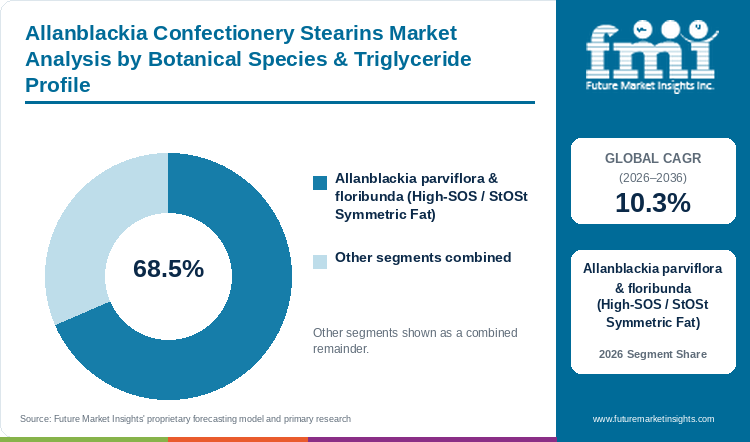
Allanblackia parviflora & floribunda symmetric fat holds 68.5% of 2026 species valuation through native 70% StOSt purity.
Table 5: Botanical Species & Triglyceride Profile Share for Allanblackia Confectionery Stearins, 2026
| Botanical Species & Triglyceride Profile | 2026 Valuation Share (%) |
|---|---|
| Allanblackia parviflora & floribunda (High-SOS / StOSt Symmetric Fat) | 68.5% |
| Dry-Fractionated Allanblackia Stearin Crystal Concentrates | 31.5%* |
| Total | 100.0% |
*Note: Botanical species and triglyceride profile segments sum to 100.0% of 2026 market size.
Table 6: Botanical Profile Leadership and Forecast Growth for Allanblackia Confectionery Stearins, 2026 to 2036
| Benchmark Attribute | Verified Metric |
|---|---|
| Global 10-Year CAGR (2026 to 2036) | 10.3% |
| Leading Botanical Profile | Allanblackia parviflora & floribunda (High-SOS / StOSt Symmetric Fat) |
Unlike shea or sal fats that require energy-intensive solvent or multi-stage dry fractionation to enrich symmetric disaturated-monounsaturated triacylglycerols, refined seed oil from West African Allanblackia parviflora and East African Allanblackia floribunda already consists of 65% to 75% StOSt and 20% to 28% StOO. That native triacylglycerol symmetry allows refiners to blend refined allanblackia fat directly into cocoa bean derivatives and spread emulsions with minimal processing waste.
- Allanblackia parviflora & floribunda (High-SOS / StOSt Symmetric Fat) accounts for 68.5% of 2026 species valuation because its native solid fat content curve drops steeply from 30°C to 35°C without solvent fractionation.
- In November 2025, Olam Food Ingredients (ofi) highlighted in its Specialty Fats technical documentation that cocoa butter improvers and equivalents engineered with high symmetric stearin content prevent fat bloom and enhance snap in warm distribution environments [3].
Why do Non-Hydrogenated Cocoa Butter Equivalents & Improvers lead functional roles?
Non-Hydrogenated Cocoa Butter Equivalent & Improver grades hold 56.2% of 2026 functional valuation via beta-V co-crystallization.
Pure cocoa butter owes its glossy snap and rapid melt-in-mouth release to symmetric POP and POSt plus StOSt triacylglycerols that pack into stable beta-V crystals during tempering. Because allanblackia stearin shares this exact 2-oleoyl-1,3-distearoyl symmetry while carrying a higher melting point than POP, adding it as a CBE or CBI raises solid fat content across the 30°C-to-35°C range in commercial baking chocolates without causing eutectic softening.
- Non-Hydrogenated Cocoa Butter Equivalent (CBE) & Improver (CBI) claims 56.2% of 2026 functional role market value as chocolate manufacturers buffer cocoa butter costs and prevent surface fat bloom.
- In February 2026, Cargill Incorporated detailed in its EMEA Edible Oils and Fats for Chocolate Confectionery technical portfolio that tailored non-hydrogenated specialty fats and CremoFLEX filling systems deliver glossy appearance and bloom stability across filled tablets and biscuits [4].
What places Compound & Super-Compound Chocolate Moldings first among end-use products?
Compound & Super-Compound Chocolate Moldings claim 51.4% of 2026 application valuation across enrobed biscuits and confectionery bars.
Whereas standard European chocolate tablets are legally capped at 5% non-cocoa vegetable fat under Directive 2000/36/EC, super-compound coatings and molded confectionery shells face no 5% ceiling and can replace 100% of added cocoa butter with symmetric StOSt stearins. Super-compound coatings formulated with allanblackia stearin give industrial confectionery ingredients buyers real-chocolate snap and flavor release without lauric soapy notes or trans fats.
- Compound & Super-Compound Chocolate Moldings capture 51.4% of 2026 application valuation because higher inclusion rates (15% to 28% fat weight) in super-compound bars consume far more stearin per ton than 5%-capped chocolate.
- In October 2026, Flora Food Group (formerly Upfield) highlighted across its Wageningen Food R&D Centre and culinary brand portfolio that advanced non-hydrogenated plant fats and hardstocks underpin both confectionery baking blocks and clean-label dairy alternatives across 100 countries [5].
What are the drivers, restraints, and opportunities in the allanblackia confectionery stearins market?
Elevated cocoa butter replacement demand and palm-free clean-label spread reformulation drive the allanblackia confectionery stearins market through 2036, while wild-harvest supply bottlenecks restrain bulk availability and tropical heat-resistant chocolate (up to 38°C) creates high-margin growth in emerging markets.
- Driver: High native StOSt triacylglycerol concentration (65% to 75%) lets chocolatiers and plant-butter makers replace cocoa butter and palm stearin without hydrogenation or trans fats.
- Restraint: Seasonal wild-pod harvesting across West and East African rainforest buffer zones and slow germination of un-grafted seeds limit annual kernel export tonnage.
- Opportunity: Dry-fractionated allanblackia stearin crystal concentrates enable heat-resistant chocolate bars (stable up to 38°C) for unrefrigerated retail distribution across tropical Asia and Latin America.
Growth Analysis and Future Potential: Qualitative Demand Catalysts
Two structural shifts in global food manufacturing reinforce multi-year demand for allanblackia stearins: confectionery cost engineering after historic cocoa bean price spikes and European retail mandates for palm-free EUDR-compliant plant spreads. During June 2026, United Nations agricultural trade analysts reported in the FAO Food Outlook that the global food import bill rose 7.9% in 2025 to a record USD 2.22 trillion on sharply higher cocoa and coffee import costs in high-income economies [6]. Because allanblackia stearin crystallizes in the exact same beta-V lattice as cocoa butter while structuring liquid rapeseed oil at low dosage in spreadable dairy fats and vegan blocks, European and North American refiners lock in multi-year African kernel supply.
Risk Assessment of the Allanblackia Confectionery Stearins Market: Operational and Supply Friction
Raw material origination remains the principal constraint on market expansion because commercial allanblackia oil still depends heavily on smallholder wild-pod collection in Tanzania and Ghana together with maturing clonal outgrower plots in Nigeria. Furthermore, while the European Food Safety Authority approved refined allanblackia seed oil for yellow fat spreads and cream-based spreads under Novel Food rules, expanding its statutory inclusion into additional food categories across strict jurisdictions requires dedicated regulatory filings. In December 2025, EFSA noted in its Novel Food regulatory overview under Regulation (EU) 2015/2283 that extensions of use for authorized novel fats require updated dietary exposure assessments across target population cohorts [7]. As a result, specialty fat refiners must balance confectionery CBE demand against contracted spread-hardstock commitments.
Commercial Opportunity Analysis: Formulation Differentiation and Value-Add Formats
Dry-fractionating crude allanblackia fat to isolate ultra-high-StOSt stearin crystal concentrates opens lucrative applications in tropicalized chocolate and clean-beauty emollients. Because symmetric StOSt melts sharply across the 35°C-to-38°C window, incorporating 3% to 5% dry-fractionated allanblackia stearin as a Cocoa Butter Improver prevents chocolate bars from melting or blooming inside non-air-conditioned shops in Southeast Asia and Brazil. In November 2025, the World Health Organization reiterated in its Healthy Diet fact sheet that industrially produced trans-fatty acids must be eliminated from the global food supply by replacing partially hydrogenated oils with un-hydrogenated plant lipids [8]. Concurrently, dermo-cosmetic formulators use refined allanblackia butter in natural cosmetics lip balms and body butters for its non-greasy skin slip and sharp melting point at human body temperature.
Allanblackia Confectionery Stearins Market by Country (2026 to 2036)
In Table 7, British chocolate and plant-butter manufacturers post the highest national growth trajectory with an 11.3% yearly pace to 2036, outpacing United States super-compound enrobers (11.1%) and Japanese specialty fat refiners (10.8%). Across continental Europe, Swiss demand compounds at 10.0% annually whereas Dutch refineries record 9.7% and Belgian couverture mills register 9.5%.
Table 7: National Growth Rates and Industrial Demand Levers for Allanblackia Confectionery Stearins (2026 to 2036)
| Country | CAGR (2026 to 2036) | Primary Industrial Demand Lever |
|---|---|---|
| United Kingdom | 11.3% | Long-standing 5% vegetable fat CBE usage in milk chocolate plus palm-free retail plant-butter blocks |
| United States | 11.1% | Zero-trans super-compound bakery enrobing, confectionery coatings, and dairy-free spread hardstocks |
| Japan | 10.8% | Heat-resistant summer commuter chocolates and dry-fractionated StOSt specialty fats by Fuji Oil & Nisshin OilliO |
| Switzerland | 10.0% | Export praline center fillings, tropicalized couverture, and alpine dermo-cosmetic body butter formulations |
| Netherlands | 9.7% | Zaandam and Rotterdam specialty lipid fractionation plus Wageningen clean-label spread hardstock R&D |
| Belgium | 9.5% | Industrial compound coatings, biscuit enrobing lines, and export-oriented couverture viscosity optimization |
Source: Future Market Insights analysis
Netherlands Allanblackia Confectionery Stearins Market Outlook (2026 to 2036)
Specialty lipid refineries in Zaandam and Rotterdam together with food-science centers in Wageningen make the Netherlands Europe's primary processing and R&D gateway for imported African allanblackia oil. Dutch refiners including Bunge Loders Croklaan and Flora Food Group's Wageningen R&D Centre blend symmetric StOSt stearins into zero-trans margarine hardstocks and bulk cocoa butter equivalents shipped across the European Union. In July 2026, DG SANTE novel-food administrators updated the Union Novel Foods register under Regulation (EU) 2017/2470 governing authorized novel food lipids and yellow-fat spread specifications across Member States [9]. Supported by both spread plants and bulk CBE exports, Dutch allanblackia confectionery stearins valuation expands 9.7% yearly through 2036 across Zaandam and Rotterdam lipid terminals.
Key takeaway: In Holland, Zaandam symmetric stearin fractionation and Wageningen palm-free spread R&D anchor continental European distribution.
Switzerland Allanblackia Confectionery Stearins Market Outlook (2026 to 2036)
Export-oriented Swiss chocolate manufacturers and alpine dermo-cosmetic laboratories use high-StOSt allanblackia stearin to stabilize praline center fillings and emollient lip balms against seasonal temperature swings during intercontinental transit. While domestic Swiss chocolate tablets adhere to strict cocoa-butter purity traditions, Swiss industrial couverture plants formulate heat-resistant fillings and super-compound biscuit coatings for warm export destinations in Asia and the Middle East. In August 2026, USDA oilseed analysts noted in issue OCS-26h of the monthly Oil Crops Outlook that tight global vegetable oil supplies continue to elevate specialty tropical stearin premiums [10]. Due to export demand for heat-stable filled chocolates, Swiss allanblackia confectionery stearins demand will rise 10.0% yearly to 2036 across Zurich and Bern plants.
Key takeaway: In Switzerland, praline filling heat-resistance for warm-climate exports and traceable cosmetic body butters fuel steady refiner demand.
Belgium Allanblackia Confectionery Stearins Market Outlook (2026 to 2036)
Industrial chocolate mills and biscuit enrobers concentrated around Antwerp and Wieze position Belgium as a core European buyer of non-hydrogenated cocoa butter improvers and super-compound coating fats. Although traditional Belgian artisanal pralines highlight pure cocoa butter, high-speed industrial wafer and speculoos biscuit coating lines rely on symmetric StOSt vegetable fats to control coating viscosity and prevent fat bloom during export shipping. During July 2026, AAK's confectionery lipid division reported in its second-quarter interim statement that Chocolate & Confectionery Fats operating profit rose 9% year-on-year to SEK 491 million on strong specialty fat co-development [11]. Backed by export biscuit enrobing, Belgian allanblackia confectionery stearins demand grows 9.5% annually to 2036 across Antwerp and Ghent mills.
Key takeaway: In Belgium, couverture viscosity specifications and cooling-tunnel crystallization speed across biscuit enrobers sustain specialty stearin procurement.
United Kingdom Allanblackia Confectionery Stearins Market Outlook (2026 to 2036)
Unlike continental purist chocolate markets, the United Kingdom has a long-standing statutory tradition of incorporating up to 5% non-hydrogenated vegetable fat cocoa butter equivalents into mainstream milk chocolate bars together with rapid retail growth in palm-free plant butters. In July 2026, the UK Office for National Statistics published its UK Manufacturers' Sales by Product (PRODCOM) bulletin documenting resilient domestic output across British chocolate confectionery and margarine manufacturing lines [12]. Because of these confectionery and vegan spread conversions across British retail chains, United Kingdom allanblackia confectionery stearins valuation rises at an anticipated 11.3% annual clip until 2036 as food brands replace palm hardstocks across Midlands and Yorkshire factories.
Key takeaway: In Britain, five-percent vegetable fat chocolate traditions and palm-free retail plant-butter blocks drive the fastest national growth rate.
United States Allanblackia Confectionery Stearins Market Outlook (2026 to 2036)
Since the U.S. Food and Drug Administration banned partially hydrogenated oils in commercial food products, North American cookie enrobers and plant-butter brands rely on high-melting symmetric stearins to achieve crisp snap and room-temperature firmness without artificial trans fats. During October 2026, federal commodity analysts noted in report OCS-26j (monthly Oil Crops Outlook) that firm domestic demand for specialty vegetable oils and fats continues to shape industrial food formulation across the United States [13]. Supported by super-compound bakery enrobing and clean-label dairy-free spread blocks, United States allanblackia confectionery stearins demand advances 11.1% yearly to 2036 as food manufacturers replace hydrogenated palm kernel oil across Pennsylvania and Illinois confectionery plants.
Key takeaway: In America, zero-trans biscuit enrobing and plant-based baking blocks propel bulk demand for non-hydrogenated symmetric stearins.
Japan Allanblackia Confectionery Stearins Market Outlook (2026 to 2036)
Humid Japanese summers exceeding 35 degrees Celsius create intense formulation demand for heat-resistant cocoa butter improvers and sharp-melting cream fillings in convenience-store chocolates and baked snacks. Domestic lipid leaders Fuji Oil Holdings Inc. and Nisshin OilliO specialize in dry-fractionating and enzymatic-blending symmetric StOSt fats so molded chocolates resist finger-melting without leaving a waxy film on the palate. In April 2026, Nisshin OilliO confectionery fat specialists noted in their commercial product portfolio that high-functionality chocolate fats remain a core growth pillar for Japanese food processing [14]. Driven by summer-stable chocolate bars and premium pastry fillings across Tokyo and Osaka, Japanese allanblackia confectionery stearins demand will progress 10.8% annually through 2036.
Key takeaway: In Japan, summer-stable commuting chocolates and enzymatic StOSt fractionation expertise underpin high-value confectionery stearin imports.
Full report country CAGRs cover: North America; Latin America; Western Europe; Eastern Europe; East Asia; South Asia and Pacific; Middle East and Africa.
Who are the notable companies in the allanblackia confectionery stearins market?
AAK AB (Novella Africa Partnership), Upfield / Flora Food Group (Clean-Label Spread Hardstocks), Barry Callebaut AG, Fuji Oil Holdings Inc., Bunge Loders Croklaan, Olam Food Ingredients (ofi), Cargill, Incorporated, and The Nisshin OilliO Group, Ltd. are the notable companies in the allanblackia confectionery stearins market.
Competitive structure in allanblackia confectionery stearins links African agroforestry origination and clean-label spread pioneers with global cocoa butter equivalent refiners and industrial chocolate processors. Origination pioneers manage wild-harvest and clonal outgrower collection in Ghana and Tanzania, while multinational specialty fat refiners fractionate StOSt concentrates for chocolate and bakery customers.
- African Origination & Clean-Label Spread Hardstock Pioneers: AAK AB (Novella Africa Partnership) and Upfield / Flora Food Group (Clean-Label Spread Hardstocks) co-developed the commercial allanblackia supply chain and EU Novel Food spread authorizations.
- Global Cocoa Butter Equivalent (CBE) & Exotic Fat Refiners: Bunge Loders Croklaan and Cargill Incorporated together with Fuji Oil Holdings Inc. and Nisshin OilliO fractionate symmetric StOSt stearins for heat-resistant confectionery.
- Industrial Couverture & African Supply Integrators: Barry Callebaut AG and Olam Food Ingredients (ofi) integrate West African tree-crop origination with industrial chocolate and compound coating formulation.
Competitive Benchmarking: Allanblackia Confectionery Stearins Market
Table 8: Capability Matrix for Key Participants in the Allanblackia Confectionery Stearins Market, 2026
| Company | African Kernel Origination | StOSt Dry Fractionation & CBE IP | Confectionery & Spread Access | Geographic Footprint |
|---|---|---|---|---|
| AAK AB (Novella Africa Partnership) | High | High | High | High |
| Upfield / Flora Food Group (Clean-Label Spread Hardstocks) | High | High | High | High |
| Barry Callebaut AG | High | Medium | High | High |
| Fuji Oil Holdings Inc. | Medium | High | High | High |
| Bunge Loders Croklaan | High | High | High | High |
| Olam Food Ingredients (ofi) | High | High | High | High |
| Cargill, Incorporated | Medium | High | High | High |
| The Nisshin OilliO Group, Ltd. | Medium | High | Medium | Medium |
Matrix criteria note: Table 8 tiers reflect documented West and East African kernel sourcing together with symmetric StOSt dry-fractionation capacity. Confectionery access ratings and regional footprints correspond to verified delivery contracts serving European couverture plants and North American bakeries plus Asian specialty fat refineries.
Key Developments in the Allanblackia Confectionery Stearins Market
- During May 2026, Osaka-based Fuji Oil Co. Ltd. reported in its FY2025 performance review that segment profit in its Vegetable Oils and Fats business rose on steady demand for chocolate vegetable fats (CBE) together with improved industrial chocolate margins at Blommer Chocolate Company [15].
- In February 2026, Bunge Global SA reported full-year 2025 adjusted total EBIT of USD 2,034 million (up from the 2024 figure of USD 2,017 million) and Q4 2025 Other Oilseeds Processing and Refining adjusted segment EBIT of USD 68 million on stronger specialty oils performance [16].
- During March 2026, Cargill upgraded its Port Klang specialty fats refinery and Lipid R&D center in Malaysia to increase production of Coconera cocoa butter equivalents and Olinera NH non-hydrogenated replacers for Asia-Pacific and EMEA chocolate makers [17].
Key Players in the Allanblackia Confectionery Stearins Market
African Origination & Clean-Label Spread Hardstock Pioneers
- AAK AB (Novella Africa Partnership)
- Upfield / Flora Food Group (Clean-Label Spread Hardstocks)
Global Cocoa Butter Equivalent (CBE) & Exotic Fat Refiners
- Fuji Oil Holdings Inc.
- Bunge Loders Croklaan
- Cargill, Incorporated
- The Nisshin OilliO Group, Ltd.
Industrial Couverture, Compound & African Supply Integrators
- Barry Callebaut AG
- Olam Food Ingredients (ofi)
Allanblackia Confectionery Stearins Market - Report Scope
Table 9: Coverage Architecture and Scope Definitions for the Allanblackia Confectionery Stearins Market, 2026 to 2036
| Coverage Field | Report scope |
|---|---|
| Market Breakdown | Botanical Species & Triglyceride Profile; Functional Lipid Role; End-Use Product; Region |
| Quantitative Units | USD Million |
| Market Definition | Covers commercial B2B valuation of refined allanblackia seed fat and dry-fractionated allanblackia stearin concentrates (from Allanblackia parviflora, Allanblackia floribunda, and Allanblackia stuhlmannii) sold as non-hydrogenated cocoa butter equivalents (CBE), cocoa butter improvers (CBI), heat-resistant chocolate structurants, zero-trans margarine/spread hardstocks, and cosmetic body-butter emollients. Scope Boundary Note: Excludes unrefined village soap-making tallow, commodity palm oil or hydrogenated palm kernel lauric replacers (CBRs) lacking allanblackia fractions, and finished retail chocolate bar revenues. |
| Regions Covered | North America; Latin America; Western Europe; Eastern Europe; East Asia; South Asia and Pacific; Middle East and Africa |
| Countries Profiled | Netherlands, Switzerland, Belgium, United Kingdom, United States, Japan, and additional countries in the full dataset |
| Notable Companies | AAK AB (Novella Africa Partnership), Upfield / Flora Food Group (Clean-Label Spread Hardstocks), Barry Callebaut AG, Fuji Oil Holdings Inc., Bunge Loders Croklaan, Olam Food Ingredients (ofi), Cargill, Incorporated, The Nisshin OilliO Group, Ltd. |
| Forecast Horizon | 2026 to 2036 (with 2025 historical baseline) |
| Research Triangulation | Primary interviews with Novella Africa supply coordinators and European CBE refiners cross-checked against EFSA and customs data. |
Allanblackia Confectionery Stearins Market - Research Methodology
Table 10: Econometric Triangulation and Source Validation Protocol for Allanblackia Confectionery Stearins, 2026 Edition
| Methodology Pillar | Analytical Execution |
|---|---|
| Primary Interviews | Structured interviews with West and East African allanblackia seed collection coordinators, European specialty lipid fractionation engineers, and confectionery R&D directors. |
| Secondary Regulatory & Trade Sources | Verification against EFSA Novel Food dossiers, EU Directive 2000/36/EC vegetable fat rules, FAO Food Outlook cocoa and vegetable oil bulletins, UK ONS PRODCOM confectionery output data, and corporate filings from AAK AB, Barry Callebaut AG, Bunge Global SA, and Fuji Oil Holdings Inc. |
| Top-Down & Bottom-Up Sizing | Bottom-up dried kernel collection and clonal tree yields (65% to 72% crude lipid) reconciled against refined StOSt stearin contract pricing (USD 4,730 to USD 5,500/MT) across CBE, spread, and cosmetic accounts. |
| Country Forecasting Model | National CAGRs weight statutory 5% CBE chocolate permissions, super-compound bakery enrobing volume, palm-free retail spread conversion, and warm-climate chocolate export shares. |
| Operational Benchmark Traceability | Kernel input, collector counts, and stearin inclusion rates in Tables 2, 3, and 4 trace to Novella Africa agroforestry records, EFSA Novel Food exposure models, and NIST weighing tolerances. |
| Financial Reconciliation | Isolates B2B allanblackia fat and stearin ingredient revenues while excluding pure shea/illipe fractions and downstream retail confectionery brand markups. |
Allanblackia Confectionery Stearins Market by Segments
Allanblackia Confectionery Stearins Market segmented by Botanical Species & Triglyceride Profile:
- Allanblackia parviflora & floribunda (High-SOS / StOSt Symmetric Fat)
- Dry-Fractionated Allanblackia Stearin Crystal Concentrates
Allanblackia Confectionery Stearins Market segmented by Functional Lipid Role:
- Non-Hydrogenated Cocoa Butter Equivalent (CBE) & Improver (CBI)
- Zero-Trans Clean-Label Margarine & Spread Hardstock
- Heat-Resistant Tropical Chocolate Structurant (Up to 38°C)
Allanblackia Confectionery Stearins Market segmented by End-Use Product:
- Compound & Super-Compound Chocolate Moldings
- Plant-Based Dairy Spreads & Baking Blocks
- Cosmetic Lip-Balm & Emollient Body Butters
Allanblackia Confectionery Stearins Market by Region
- North America
- United States
- Canada
- Latin America
- Brazil
- Mexico
- Argentina
- Chile
- Western Europe
- Germany
- France
- United Kingdom
- Italy
- Spain
- Benelux
- Nordics
- Eastern Europe
- Poland
- Czech Republic
- Romania
- Hungary
- East Asia
- China
- Japan
- South Korea
- South Asia and Pacific
- India
- ASEAN
- Australia and New Zealand
- Middle East and Africa
- GCC Countries
- South Africa
- Türkiye
- Israel
Research Sources and Bibliography
- [1] Barry Callebaut Group. (2026, April 16). Barry Callebaut Group – Half-Year Results, Fiscal Year 2025/26. Barry Callebaut AG Media & Investor Relations.
- [2] AAK AB. (2026, February 5). AAK's Interim report for the fourth quarter and year-end report 2025 | AAK. AAK AB Investor Relations.
- [3] Olam Food Ingredients (ofi). (2025, November 14). Specialty Fats - ofi. Olam Food Ingredients Cocoa & Specialty Fats Division.
- [4] Cargill, Incorporated. (2026, February 10). Edible Oils and Fats for Chocolate Confectionery Applications | Cargill. Cargill EMEA Chocolate Confectionery Portfolio.
- [5] Flora Food Group. (2026, October 16). About Us | Flora Food Group. Flora Food Group Corporate & Wageningen R&D Overview (formerly Upfield).
- [6] Food and Agriculture Organization of the United Nations (FAO). (2026, June 18). FAO Food Outlook: Global food commodity market trends face rising geopolitical and weather risks. FAO Markets and Trade Portal.
- [7] European Food Safety Authority (EFSA). (2025, December 17). Novel food | EFSA. EFSA Scientific Risk Assessment Portal.
- [8] World Health Organization (WHO). (2025, November 20). Healthy diet. WHO Nutrition & Food Safety Fact Sheets.
- [9] European Commission, Directorate-General for Health and Food Safety. (2026, July 20). Union list of novel foods - Food Safety - European Commission. European Commission Food Safety Portal.
- [10] U.S. Department of Agriculture, Economic Research Service (USDA ERS). (2026, August 14). Oil Crops Outlook: August 2026 | Economic Research Service. USDA Economic Research Service (OCS-26h).
- [11] AAK AB. (2026, July 17). AAK's Interim report for the second quarter 2026 | AAK. AAK AB Press & Investor Releases.
- [12] Office for National Statistics (ONS). (2026, July 15). UK manufacturers' sales by product: 2025. UK Office for National Statistics PRODCOM Bulletin.
- [13] U.S. Department of Agriculture, Economic Research Service (USDA ERS). (2026, October 14). Oil Crops Outlook: October 2026 | Economic Research Service. USDA Economic Research Service (OCS-26j).
- [14] The Nisshin OilliO Group, Ltd. (2026, April 10). Products | The Nisshin OilliO Group, Ltd. | "The Natural Power of Plants". The Nisshin OilliO Group Confectionery Fats Division.
- [15] Fuji Oil Co., Ltd. (2026, May 14). Business Summary|Financial and Performance Overview|Investor Relations|FUJI OIL CO.,LTD. Fuji Oil Group Investor Relations.
- [16] Bunge Global SA. (2026, February 4). Bunge Reports Fourth Quarter and Full-Year 2025 Results – Bunge. Bunge Global SA Investor Relations.
- [17] Cargill, Incorporated. (2026, March 31). Cargill Expands Specialty Fats Facility in Port Klang, Malaysia | Cargill. Cargill Global Food & Specialty Fats Newsroom.
- [18] Bunge Global SA. (2026, March 10). Bunge Outlines Strategic Growth and Value Creation Plan at 2026 Investor Day – Bunge. Bunge Global SA Investor Relations.
- [19] U.S. Bureau of Labor Statistics (BLS). (2026, March 12). A recipe for growth: food and beverage manufacturing projected to expand through 2034. U.S. Department of Labor, The Economics Daily.
- [20] National Institute of Standards and Technology (NIST). (2025, December 18). NIST Handbook 44: Specifications, Tolerances and Other Technical Requirements for Weighing and Measuring Devices (2026 Ed.). U.S. Department of Commerce.
This bibliography is provided for reader reference and is not exhaustive. The full report contains the complete reference list and detailed citations.
This Report Answers
- How big is the allanblackia confectionery stearins market in 2026 and what is projected for 2036?
- Why does native 65% to 75% symmetric StOSt triacylglycerol content distinguish allanblackia seed fat from palm or shea?
- What gives Allanblackia parviflora & floribunda (High-SOS / StOSt Symmetric Fat) a 68.5% share in 2026?
- Why do Non-Hydrogenated Cocoa Butter Equivalents (CBE) & Improvers (CBI) lead functional lipid roles?
- How do national growth rates compare across the UK, the USA, Japan, Switzerland, the Netherlands, and Belgium?
- Which specialty fat refiners and agroforestry partners lead the allanblackia confectionery stearins market?
- How do West and East African wild-harvest collection limits affect bulk stearin supply?
- What melting-curve and EUDR traceability standards do chocolate and plant-butter buyers require?
Frequently Asked Questions
What is the 2026 market size and 2036 forecast for the allanblackia confectionery stearins market?
In 2026, allanblackia confectionery stearins demand reaches an estimated USD 48.5 million, advancing from USD 44.0 million in 2025. By 2036, global valuation hits USD 129.3 million as chocolate molders and clean-label spread makers expand symmetric StOSt utilization.
What is the 10-year CAGR and net dollar expansion for the market?
Across the 2026-to-2036 window, allanblackia confectionery stearins valuation climbs at a 10.3% annual rate to deliver USD 80.8 million in net expansion.
Which botanical species and triglyceride profile segment leads the market?
Allanblackia parviflora & floribunda (High-SOS / StOSt Symmetric Fat) accounts for 68.5% of 2026 valuation because its native kernel oil delivers 65% to 75% symmetric StOSt triacylglycerols without solvent fractionation.
Which functional lipid role and end-use product segments capture the top shares?
Non-Hydrogenated Cocoa Butter Equivalent (CBE) & Improver (CBI) holds 56.2% of 2026 functional role valuation, while Compound & Super-Compound Chocolate Moldings lead end-use products at 51.4%.
Which country posts the fastest CAGR between 2026 and 2036?
The United Kingdom heads the six profiled countries at an 11.3% CAGR through 2036 on statutory 5% vegetable fat CBE usage in milk chocolate and rapid retail conversion toward palm-free plant-butter blocks.
Who are the notable companies operating in the allanblackia confectionery stearins market?
Notable companies include AAK AB (Novella Africa Partnership) and Upfield / Flora Food Group (Clean-Label Spread Hardstocks) together with Barry Callebaut AG and Fuji Oil Holdings Inc. plus Bunge Loders Croklaan and Olam Food Ingredients (ofi) as well as Cargill, Incorporated and The Nisshin OilliO Group, Ltd.
Preview the report firsthand - request a free sample
Get SampleGet the brochure for pricing and purchase details.
Get PDFTable of Content
- Key Takeaways
- Market Size and CAGR
- Top Growth Driver
- Fastest Growing Segment
- Leading Region
- Key Companies
- Emerging Opportunities
- Executive Summary
- Global Market Outlook
- Demand-side Trends
- Supply-side Trends
- Technology Roadmap Analysis
- Analysis and Recommendations
- Analyst Perspective (What is happening? Why now? What should investors know?)
- Key Questions Answered
- How large is the market?
- What is the CAGR?
- What are key trends?
- Which region dominates?
- Who are the leaders?
- Market Overview
- Market Coverage / Taxonomy
- Market Definition / Scope / Limitations
- Research Methodology
- Chapter Orientation
- Analytical Lens and Working Hypotheses
- Market Structure, Signals, and Trend Drivers
- Benchmarking and Cross-market Comparability
- Market Sizing, Forecasting, and Opportunity Mapping
- Research Design and Evidence Framework
- Desk Research Programme (Secondary Evidence)
- Expert Input and Fieldwork (Primary Evidence)
- Tooling, Models, and Reference Databases
- Data Engineering and Model Build
- Quality Assurance and Audit Trail
- Market Background
- Market Dynamics (Drivers, Restraints, Opportunity, Trends)
- Scenario Forecast (Optimistic, Likely, Conservative)
- Impact Analysis
- AI Impact
- Sustainability Impact
- Regulatory Impact
- Technology Impact
- Consumer / Buyer Analysis
- Purchase Drivers
- Adoption Barriers
- Buyer Journey
- Opportunity Map Analysis
- Product Life Cycle Analysis
- Supply Chain Analysis
- Investment Feasibility Matrix
- Value Chain Analysis
- PESTLE and Porter's Analysis
- Regulatory Landscape
- Regional Parent Market Outlook
- Production and Consumption Statistics
- Import and Export Statistics
- Global Market Analysis and Forecast, 2021 to 2036
- Historical Market Size Value (USD Million) Analysis, 2021 to 2025
- Current and Future Market Size Value (USD Million) Projections, 2026 to 2036
- Y-o-Y Growth Trend Analysis
- Absolute $ Opportunity Analysis
- Global Market Pricing Analysis, 2021 to 2036
- Global Market Analysis and Forecast, By Botanical Species & Triglyceride Profile, 2021 to 2036
- Introduction / Key Findings
- Historical Market Size Value (USD Million) Analysis By Botanical Species & Triglyceride Profile, 2021 to 2025
- Current and Future Market Size Value (USD Million) Analysis and Forecast By Botanical Species & Triglyceride Profile, 2026 to 2036
- Allanblackia parviflora & floribunda (High-SOS / StOSt Symmetric Fat)
- Dry-Fractionated Allanblackia Stearin Crystal Concentrates
- Y-o-Y Growth Trend Analysis By Botanical Species & Triglyceride Profile, 2021 to 2025
- Absolute $ Opportunity Analysis By Botanical Species & Triglyceride Profile, 2026 to 2036
- Global Market Analysis and Forecast, By Functional Lipid Role, 2021 to 2036
- Introduction / Key Findings
- Historical Market Size Value (USD Million) Analysis By Functional Lipid Role, 2021 to 2025
- Current and Future Market Size Value (USD Million) Analysis and Forecast By Functional Lipid Role, 2026 to 2036
- Non-Hydrogenated Cocoa Butter Equivalent (CBE) & Improver (CBI)
- Zero-Trans Clean-Label Margarine & Spread Hardstock
- Heat-Resistant Tropical Chocolate Structurant (Up to 38°C)
- Y-o-Y Growth Trend Analysis By Functional Lipid Role, 2021 to 2025
- Absolute $ Opportunity Analysis By Functional Lipid Role, 2026 to 2036
- Global Market Analysis and Forecast, By End-Use Product, 2021 to 2036
- Introduction / Key Findings
- Historical Market Size Value (USD Million) Analysis By End-Use Product, 2021 to 2025
- Current and Future Market Size Value (USD Million) Analysis and Forecast By End-Use Product, 2026 to 2036
- Compound & Super-Compound Chocolate Moldings
- Plant-Based Dairy Spreads & Baking Blocks
- Cosmetic Lip-Balm & Emollient Body Butters
- Y-o-Y Growth Trend Analysis By End-Use Product, 2021 to 2025
- Absolute $ Opportunity Analysis By End-Use Product, 2026 to 2036
- Global Market Analysis and Forecast, By Region, 2021 to 2036
- Introduction
- Historical Market Size Value (USD Million) Analysis By Region, 2021 to 2025
- Current Market Size Value (USD Million) Analysis and Forecast By Region, 2026 to 2036
- North America
- Latin America
- Western Europe
- Eastern Europe
- East Asia
- South Asia and Pacific
- Middle East and Africa
- Market Attractiveness Analysis By Region
- North America Market Analysis and Forecast, By Country, 2021 to 2036
- Historical Market Size Value (USD Million) Trend Analysis By Market Taxonomy, 2021 to 2025
- Market Size Value (USD Million) Forecast By Market Taxonomy, 2026 to 2036
- By Country
- United States
- Canada
- By Botanical Species & Triglyceride Profile
- By Functional Lipid Role
- By End-Use Product
- By Country
- Market Attractiveness Analysis
- By Country
- By Botanical Species & Triglyceride Profile
- By Functional Lipid Role
- By End-Use Product
- Key Takeaways
- Latin America Market Analysis and Forecast, By Country
- Historical Market Size Value (USD Million) Trend Analysis By Market Taxonomy, 2021 to 2025
- Market Size Value (USD Million) Forecast By Market Taxonomy, 2026 to 2036
- By Country
- Brazil
- Mexico
- Argentina
- Chile
- By Botanical Species & Triglyceride Profile
- By Functional Lipid Role
- By End-Use Product
- By Country
- Market Attractiveness Analysis
- By Country
- By Botanical Species & Triglyceride Profile
- By Functional Lipid Role
- By End-Use Product
- Key Takeaways
- Western Europe Market Analysis and Forecast, By Country
- Historical Market Size Value (USD Million) Trend Analysis By Market Taxonomy, 2021 to 2025
- Market Size Value (USD Million) Forecast By Market Taxonomy, 2026 to 2036
- By Country
- Germany
- France
- United Kingdom
- Italy
- Spain
- Benelux
- Nordics
- By Botanical Species & Triglyceride Profile
- By Functional Lipid Role
- By End-Use Product
- By Country
- Market Attractiveness Analysis
- By Country
- By Botanical Species & Triglyceride Profile
- By Functional Lipid Role
- By End-Use Product
- Key Takeaways
- Eastern Europe Market Analysis and Forecast, By Country
- Historical Market Size Value (USD Million) Trend Analysis By Market Taxonomy, 2021 to 2025
- Market Size Value (USD Million) Forecast By Market Taxonomy, 2026 to 2036
- By Country
- Poland
- Czech Republic
- Romania
- Hungary
- By Botanical Species & Triglyceride Profile
- By Functional Lipid Role
- By End-Use Product
- By Country
- Market Attractiveness Analysis
- By Country
- By Botanical Species & Triglyceride Profile
- By Functional Lipid Role
- By End-Use Product
- Key Takeaways
- East Asia Market Analysis and Forecast, By Country
- Historical Market Size Value (USD Million) Trend Analysis By Market Taxonomy, 2021 to 2025
- Market Size Value (USD Million) Forecast By Market Taxonomy, 2026 to 2036
- By Country
- China
- Japan
- South Korea
- By Botanical Species & Triglyceride Profile
- By Functional Lipid Role
- By End-Use Product
- By Country
- Market Attractiveness Analysis
- By Country
- By Botanical Species & Triglyceride Profile
- By Functional Lipid Role
- By End-Use Product
- Key Takeaways
- South Asia and Pacific Market Analysis and Forecast, By Country
- Historical Market Size Value (USD Million) Trend Analysis By Market Taxonomy, 2021 to 2025
- Market Size Value (USD Million) Forecast By Market Taxonomy, 2026 to 2036
- By Country
- India
- ASEAN
- Australia and New Zealand
- By Botanical Species & Triglyceride Profile
- By Functional Lipid Role
- By End-Use Product
- By Country
- Market Attractiveness Analysis
- By Country
- By Botanical Species & Triglyceride Profile
- By Functional Lipid Role
- By End-Use Product
- Key Takeaways
- Middle East and Africa Market Analysis and Forecast, By Country
- Historical Market Size Value (USD Million) Trend Analysis By Market Taxonomy, 2021 to 2025
- Market Size Value (USD Million) Forecast By Market Taxonomy, 2026 to 2036
- By Country
- GCC Countries
- South Africa
- Türkiye
- Israel
- By Botanical Species & Triglyceride Profile
- By Functional Lipid Role
- By End-Use Product
- By Country
- Market Attractiveness Analysis
- By Country
- By Botanical Species & Triglyceride Profile
- By Functional Lipid Role
- By End-Use Product
- Key Takeaways
- Key Countries Market Analysis
- United States
- Pricing Analysis
- Market Share Analysis, 2025
- By Botanical Species & Triglyceride Profile
- By Functional Lipid Role
- By End-Use Product
- Canada
- Pricing Analysis
- Market Share Analysis, 2025
- By Botanical Species & Triglyceride Profile
- By Functional Lipid Role
- By End-Use Product
- Mexico
- Pricing Analysis
- Market Share Analysis, 2025
- By Botanical Species & Triglyceride Profile
- By Functional Lipid Role
- By End-Use Product
- Brazil
- Pricing Analysis
- Market Share Analysis, 2025
- By Botanical Species & Triglyceride Profile
- By Functional Lipid Role
- By End-Use Product
- Chile
- Pricing Analysis
- Market Share Analysis, 2025
- By Botanical Species & Triglyceride Profile
- By Functional Lipid Role
- By End-Use Product
- Germany
- Pricing Analysis
- Market Share Analysis, 2025
- By Botanical Species & Triglyceride Profile
- By Functional Lipid Role
- By End-Use Product
- United Kingdom
- Pricing Analysis
- Market Share Analysis, 2025
- By Botanical Species & Triglyceride Profile
- By Functional Lipid Role
- By End-Use Product
- Italy
- Pricing Analysis
- Market Share Analysis, 2025
- By Botanical Species & Triglyceride Profile
- By Functional Lipid Role
- By End-Use Product
- Spain
- Pricing Analysis
- Market Share Analysis, 2025
- By Botanical Species & Triglyceride Profile
- By Functional Lipid Role
- By End-Use Product
- France
- Pricing Analysis
- Market Share Analysis, 2025
- By Botanical Species & Triglyceride Profile
- By Functional Lipid Role
- By End-Use Product
- India
- Pricing Analysis
- Market Share Analysis, 2025
- By Botanical Species & Triglyceride Profile
- By Functional Lipid Role
- By End-Use Product
- ASEAN
- Pricing Analysis
- Market Share Analysis, 2025
- By Botanical Species & Triglyceride Profile
- By Functional Lipid Role
- By End-Use Product
- Australia and New Zealand
- Pricing Analysis
- Market Share Analysis, 2025
- By Botanical Species & Triglyceride Profile
- By Functional Lipid Role
- By End-Use Product
- China
- Pricing Analysis
- Market Share Analysis, 2025
- By Botanical Species & Triglyceride Profile
- By Functional Lipid Role
- By End-Use Product
- Japan
- Pricing Analysis
- Market Share Analysis, 2025
- By Botanical Species & Triglyceride Profile
- By Functional Lipid Role
- By End-Use Product
- South Korea
- Pricing Analysis
- Market Share Analysis, 2025
- By Botanical Species & Triglyceride Profile
- By Functional Lipid Role
- By End-Use Product
- Poland
- Pricing Analysis
- Market Share Analysis, 2025
- By Botanical Species & Triglyceride Profile
- By Functional Lipid Role
- By End-Use Product
- Hungary
- Pricing Analysis
- Market Share Analysis, 2025
- By Botanical Species & Triglyceride Profile
- By Functional Lipid Role
- By End-Use Product
- Türkiye
- Pricing Analysis
- Market Share Analysis, 2025
- By Botanical Species & Triglyceride Profile
- By Functional Lipid Role
- By End-Use Product
- South Africa
- Pricing Analysis
- Market Share Analysis, 2025
- By Botanical Species & Triglyceride Profile
- By Functional Lipid Role
- By End-Use Product
- Switzerland
- Pricing Analysis
- Market Share Analysis, 2025
- By Botanical Species & Triglyceride Profile
- By Functional Lipid Role
- By End-Use Product
- Netherlands
- Pricing Analysis
- Market Share Analysis, 2025
- By Botanical Species & Triglyceride Profile
- By Functional Lipid Role
- By End-Use Product
- Belgium
- Pricing Analysis
- Market Share Analysis, 2025
- By Botanical Species & Triglyceride Profile
- By Functional Lipid Role
- By End-Use Product
- United States
- Market Structure Analysis
- Competition Dashboard
- Competition Benchmarking
- Market Share Analysis of Top Players
- By Regional
- By Botanical Species & Triglyceride Profile
- By Functional Lipid Role
- By End-Use Product
- Emerging Startups
- Innovation Benchmarking
- Competition Analysis
- Competition Deep Dive
- AAK AB (Novella Africa Partnership)
- Overview
- Product Portfolio
- Profitability by Market Segments
- Sales Footprint
- Strategy Overview
- Marketing Strategy
- Product Strategy
- Channel Strategy
- Upfield / Flora Food Group (Clean-Label Spread Hardstocks)
- Barry Callebaut AG
- Fuji Oil Holdings Inc.
- Bunge Loders Croklaan
- Olam Food Ingredients (ofi)
- Cargill, Incorporated
- The Nisshin OilliO Group, Ltd.
- AAK AB (Novella Africa Partnership)
- Case Studies
- Success Stories
- Recent Developments
- Competition Deep Dive
- Assumptions & Acronyms Used


