

- Market Size (2026)
- USD 193.4 Mn
- Forecast (2036)
- USD 590.0 Mn
- CAGR (2026 to 2036)
- 11.8%
How big is Latin America Alfajores Market in 2026?
USD 193.4 Million in 2026 and USD 590.0 Million by 2036 at an 11.8% CAGR.
The Latin America alfajores market is forecast to rise from USD 193.4 Million in 2026 to USD 590.0 Million in 2036 at an 11.8% CAGR. Its 2025 value was USD 173.0 Million. Premium fillings, multipacks and gifting add options to the everyday snack purchase. Argentina’s April 2002 food-code definition describes two or more baked units joined by permitted sweet fillings, giving producers a clear category reference. Buenos Aires tourism authorities describe the familiar biscuit, dulce de leche and chocolate-coated form. Brands can extend that recognizable product into new price points and occasions if texture and freshness remain consistent through distribution.
Argentine kiosks and supermarkets serve everyday purchases, while cafés and brand stores offer premium versions and gifts. Uruguay’s food fairs give smaller makers a way to reach retail and export buyers. Chile and Mexico require close attention to front-of-pack labeling.Specialty shops and online sellers introduce the product to a less familiar audience. Across these routes, retailers need reliable shelf life, suitable case sizes and consistent replenishment before extending an assortment.
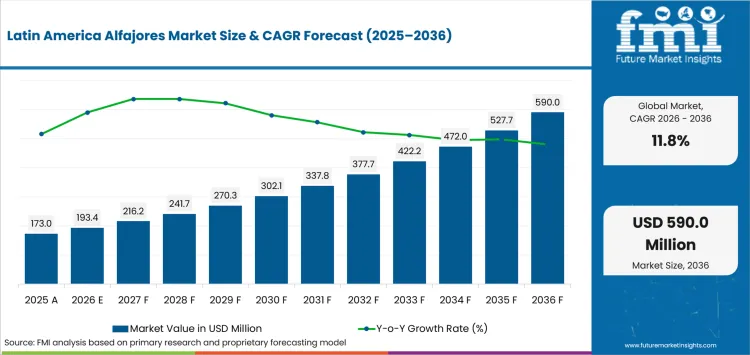
Key Takeaways of Latin America Alfajores Market
- Classic / original holds 34.0% of product demand in 2026. Familiar flavors support everyday purchases and consistent production at scale.
- Conventional accounts for 56.0% of demand by claim / nature in 2026. Established recipes remain suited to broad distribution and mainstream prices.
- Fresh represents 37.0% of format demand in 2026. Softness and aroma matter most when the alfajor is bought for immediate consumption.
- Multipack holds 32.0% of packaging demand in 2026. It gives households and gift buyers several portions in one purchase.
- Supermarkets & hypermarkets account for 41.0% of sales in 2026. Regular shelf availability makes a familiar alfajor easy to add to the grocery basket.
- Opportunity: Export-ready ambient packs and credible gluten-free or premium lines can open higher-value channels.
- Companies include Arcor, Bagley Latinoamerica, Mondelez (Terrabusi), Grupo Bimbo, Havanna, Cachafaz, Georgalos, Guaymallen, Jorgito, Fantoche.
Analyst Perspective
"A new filling can attract a first purchase, but texture and stability determine whether it earns another. The pack has to protect the alfajor all the way to the buyer."
- Nandini Roy Choudhury, Principal Consultant, Future Market Insights
How is the Latin America Alfajores Market segmented?
The market is segmented by Product Type, Claim / Nature, Format, Packaging Format, and Sales Channel.
By Product Type: Classic / original, Whole grain & seeded, Flavored & filled, Mini & snacking formats, Premium / artisan; By Claim / Nature: Conventional, Clean label, Organic, Gluten-free, High-protein / fortified; By Format: Fresh, Frozen, Ambient packaged, Chilled, Par-baked / thaw-and-serve; By Packaging Format: Multipack, Single-serve, Family / loaf pack, Bulk foodservice; By Sales Channel: Supermarkets & hypermarkets, Artisan & specialty bakeries, Convenience & forecourt, Online & DTC, Foodservice distributors.
Why does the conventional segment lead demand within the claim / nature category?
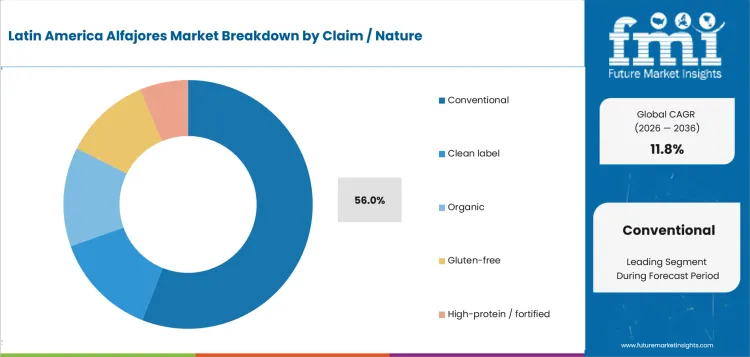
Conventional formulas lead because they combine familiar ingredients with established production economics. Standard wheat-based layers and dairy fillings support the texture most shoppers expect. They also allow producers to serve a wide price ladder. Clean-label and organic lines can earn higher value from specific audiences. Gluten-free and fortified lines require similarly focused sourcing and process separation. Conventional products therefore remain the easiest option for mass retail and kiosk replenishment. Taste and affordability give conventional recipes a broad customer base alongside more specialized products. Conventional bakery ingredients support recipe consistency across larger production runs.
- Conventional accounts for a 56.0% share in 2026 because established recipes support broad access and predictable processing.
- Mexico modified NOM-051 in March 2020 for prepackaged foods. Nutrition information and front labeling are therefore core commercial requirements rather than optional product claims.
Why does the classic / original segment lead demand within the product type category?
Classic / original alfajores give shoppers a recognizable combination of baked layers, sweet filling and a coating or sugar finish. The familiar dulce de leche filling helps retain that identity. Manufacturers can vary the chocolate intensity or filling quantity while retaining the expected structure. Whole grain, flavored, mini and artisan versions still need to deliver a bite that buyers recognize as an alfajor.
- Classic / original holds a 34.0% share in 2026 because recognition and production repeatability support broad distribution.
- Argentina’s April 2002 food-code definition formalized the familiar sandwich construction. That definition supports clear merchandising and consistent manufacturing specifications.
Why does the fresh segment lead demand within the format category?
Fresh formats lead where bakeries and cafés can sell close to production. Tourist outlets and local producers also benefit from short distribution cycles. Softness and filling texture are important when storage time is controlled. That sensory advantage matters because the product is judged by bite quality as much as flavor. Frozen and par-baked formats help extend operating reach. Ambient packaged products offer wider distribution. Fresh still commands the central role in channels where tasting and immediacy support a premium. Producers that choose this format must match daily demand closely. Otherwise waste and inconsistent texture can erode the value that freshness is meant to create. Coatings made with baking chocolate add temperature and handling requirements around a fresh eating experience.
- Fresh represents a 37.0% share in 2026 because softness and aroma remain central to immediate sensory appeal.
- Uruguay's Ministry of Tourism announced the fourth International Alfajor Fair in May 2026, with the event held 5–7 June at LATU. Tasting and direct maker participation reinforced the commercial value of immediate sensory evaluation, underpinned by the presence of more than 60 stands and national and international producers.
Why does the multipack segment lead demand within the packaging format category?
Multipacks convert a single-serve treat into a household and gifting purchase. They reduce the effort of buying several units while giving retailers a larger basket value. Assorted boxes also let brands present contrasting coatings or claims in one purchase. Single-serve packs remain essential for kiosks and convenience outlets. Bulk foodservice packs support cafés and hospitality. Multipack leads because it can bridge everyday consumption with sharing and travel gifting. The format also gives suppliers more surface area for product information. That matters when warning labels or allergen declarations must remain legible without obscuring the brand cue. Gift and household packs use paper packaging to organize units while protective inner wraps preserve texture.
- Multipack holds a 32.0% share in 2026 because it serves household use and gifting while improving basket value.
- Havanna’s official product catalog lists classic presentations in boxes of six, twelve, and twenty-four units. Specialized lines are also offered in nine-unit boxes.
Why do supermarkets & hypermarkets lead demand within the sales channel category?
Supermarkets & hypermarkets lead because they combine planned grocery shopping with visible impulse placement. Their category teams can support national brands and premium challengers in the same aisle. The channel also accommodates single units beside larger boxes. This creates a clear price ladder. Artisan bakeries provide freshness and storytelling. Convenience outlets deliver immediacy. Online and DTC channels are effective for gifting or exports. Supermarkets remain central because they can scale replenishment and run repeat promotions. Suppliers must still prove shelf life and case efficiency before that reach becomes dependable revenue. Supermarkets place alfajores alongside other bakery products, so replenishment and recognizable shelf presentation matter.
- Supermarkets & hypermarkets account for a 41.0% share in 2026 because shelf visibility and routine replenishment support repeat purchase.
- Arcor states that Bagley Latinoamerica operates eight manufacturing plants. The business launches more than 50 products a year across cookies and alfajores plus related baked snacks.
What are the drivers, restraints and opportunities in the Latin America Alfajores Market?
Cultural familiarity supports premium and channel expansion, while nutrition rules and shelf-life risks raise execution costs, and export-ready special-diet formats create a higher-value opening.
- Driver: Familiar alfajores are reaching more occasions through premium variants, multipacks, gifting, and wider retail access.
- Restraint: Nutrition-warning, allergen, and shelf-life requirements add reformulation and onboarding cost.
- Opportunity: Export-ready ambient packs and credible gluten-free or premium lines can open higher-value channels.
Consumers already understand the product and its core eating occasion. Suppliers do not need to create category awareness from zero. Growth comes from changing the basket. Havanna launched a pistachio-and-kadaif Dubai alfajor in July 2025. Arcor introduced GOAT in May 2026 with dulce de leche and a Bon o Bon center. These launches show how a familiar architecture can absorb new flavor signals without losing the category cue. The commercial gain appears when retailers can carry both an everyday classic and a premium trade-up. Producers therefore need innovation that preserves recognition and survives distribution. It must also fit an existing impulse or gifting occasion.
High sugar and fat content can trigger warning labels or promotion limits. Chile requires ALTO EN front labels when added sugar or saturated fat exceeds defined thresholds. Mexico’s NOM-051 also governs prepackaged nutrition information. These rules limit packaging and promotions and add the cost of adapting labels for each destination. Suppliers face another constraint when fresh fillings or chocolate coatings must remain stable in warm distribution conditions. That combination can delay retailer approval and narrow the practical shipping radius.
Premium and special-diet lines create an addressable opening when product claims are matched by process control. Havanna’s catalog includes gluten-free and vegan variants. It also includes high-cacao and sugar-free products. Cachafaz announced a USD 2 million investment in November 2023 to move production from 450 to 800 tonnes per month and support exports. Those examples point to two paths. Specialists can use transparent ingredients and distinctive fillings to earn premium placement. Scaled producers can improve output and packaging so a wider range travels without quality loss. Entry requires certified allergen controls and stable shelf life. Packaging must also communicate authenticity in unfamiliar markets.
Which country CAGRs are profiled in the Latin America Alfajores Market?
| Country | CAGR (2026 to 2036) |
|---|---|
| Argentina | 11.9% |
| Uruguay | 12.6% |
| Chile | 12.3% |
| Mexico | 12.9% |
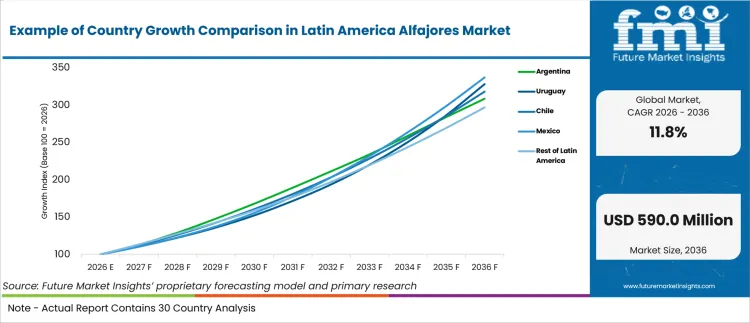
How do country-level CAGRs compare in the Latin America alfajores market?
The country forecasts span 1.3 percentage points: the Mexico at 12.9%, Uruguay at 12.6%, Chile at 12.3% and Argentina at 11.9%. The faster rates accompany specialty imports or wider channel development. Argentina’s established everyday consumption can support a substantial base without the highest percentage growth. These rates therefore compare expansion pace, not the present size of the markets.
- Argentina: The government reported Cachafaz’s capacity investment in November 2023. Production expansion can support domestic and export sales, provided the filling and coating remain stable during distribution.
- Uruguay: The Tourism Ministry announced the fourth International Alfajor Fair for June 2026. Such events let smaller makers test recipes and meet buyers before committing to wider packaged distribution.
- Chile: Health Ministry guidance requires ALTO EN warnings where nutrient thresholds are exceeded. Importers and local producers need compliant labels and must account for the resulting limits on promotion and school channels.
- Mexico: The July 2025 NOM-051 agreement extended the second phase through 2027. Exporters need labels that follow the applicable phase, with case sizes and shelf life suited to local distributors.
Country-wise Analysis
- Argentina: Argentina's market is projected to expand at 11.9% CAGR over 2026 to 2036. In November 2023, the national government reported Cachafaz’s USD 2 million capacity investment. The project was designed to move output from 450 to 800 tonnes per month and support exports. Local suppliers still face food-code compliance and input volatility. They also need to defend texture in warm distribution. An accessible classic can retain routine purchases, with premium fillings and multipacks adding higher-value choices.
- Uruguay: A 12.6% CAGR is forecast for Uruguay between 2026 and 2036. In May 2026, the Ministry of Tourism announced the fourth International Alfajor Fair for June at LATU. The event was planned with more than 60 stands and broad maker participation. Front-label compliance and limited domestic scale can raise per-unit cost. Fairs provide a place to test recipes and meet retail buyers. Proven products can then move into stable ambient packs for regional or overseas specialty retail.
- Chile: Alfajor sales in Chile are forecast to expand at 12.3% CAGR from 2026 to 2036. The Ministry of Health’s June 2019 guidance requires ALTO EN labels when critical nutrient thresholds are exceeded. Current guidance extends the obligation across smaller food producers. Warning labels and school-channel restrictions can limit promotion for indulgent products. Nutrition panels must be adapted before shipment. Smaller portions or reformulation may help meet channel requirements if the expected texture and filling are preserved.
- Mexico: Alfajor sales in Mexico are forecast to expand at 12.9% CAGR from 2026 to 2036. In July 2025, Mexico extended the second phase of NOM-051 through 2027. The agreement moved the third phase to January 2028. The staged rule still requires close label management. Importers also need case sizes and prices suited to local outlets. Spanish labeling, shelf-stable coatings and a dependable distributor are needed to sustain orders beyond the launch.
Who are the notable companies in the Latin America alfajores market?
Arcor, Bagley Latinoamerica, Mondelez (Terrabusi), Grupo Bimbo, Havanna, Cachafaz, Georgalos, Guaymallen, Jorgito, Fantoche.
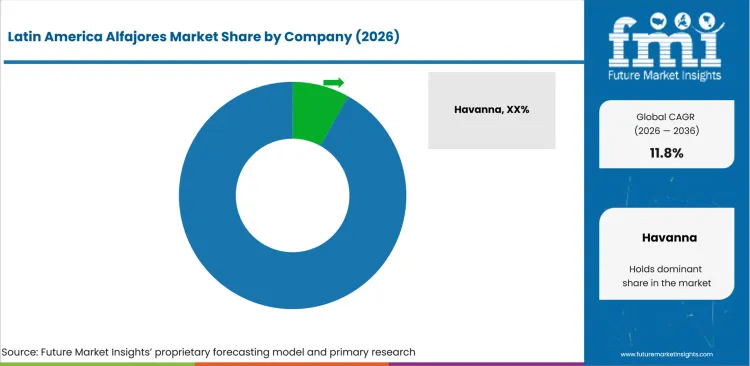
Arcor, Bagley Latinoamerica, Mondelez (Terrabusi) and Grupo Bimbo bring manufacturing scale or broad retail access from larger baked-snack portfolios. Premium houses and focused alfajor makers compete through fillings, gifting and everyday availability.
- Scaled Multi-Category Platforms: Arcor, Bagley Latinoamerica, Mondelez (Terrabusi), and Grupo Bimbo compete through manufacturing depth and broad retail access.
- Premium and Specialty Brand Houses: Havanna, Cachafaz, and Georgalos use differentiated fillings, stronger gifting cues, or direct brand experiences.
- Focused Alfajor Specialists: Guaymallen, Jorgito, and Fantoche emphasize familiar formats and everyday availability.
Competitive Benchmarking: Latin America Alfajores Market
| Company | Alfajor assortment | Pack and occasion range | Retail and distribution access | Geographic reach |
|---|---|---|---|---|
| Arcor | High | High | High | Argentina and international distribution |
| Bagley Latinoamerica | High | High | High | Argentina and Latin America |
| Mondelez (Terrabusi) | High | High | High | Argentina and Latin American distribution |
| Grupo Bimbo | Medium | High | High | Latin America and international bakery markets |
| Havanna | High | High | High | Argentina and international franchise and export markets |
| Cachafaz | High | High | High | Argentina and export markets |
| Georgalos | High | High | High | Argentina and regional distribution |
| Guaymallen | High | Medium | High | Argentina and regional distribution |
| Jorgito | High | Medium | High | Argentina-led retail distribution |
| Fantoche | High | High | High | Argentina and export distribution |
Arcor and Bagley operate within the same wider business structure, while Terrabusi is a Mondelez brand. Havanna combines alfajores with branded stores and export access. Guaymallen and Jorgito concentrate on familiar everyday formats. These differences shape route-to-market choices without assigning company market shares.
Key Developments in the Latin America Alfajores Market
- In May 2026, Arcor introduced GOAT for the mass market. The alfajor combined intense chocolate layers with a double coating, dulce de leche, and a Bon o Bon center. The launch created an extra-indulgent trade-up inside a widely recognized format. It also demonstrated how established confectionery assets can be used to build differentiated fillings for broad retail distribution.
Key Players in the Latin America Alfajores Market
Scaled Multi-Category Platforms
- Arcor
- Bagley Latinoamerica
- Mondelez (Terrabusi)
- Grupo Bimbo
Premium and Specialty Brand Houses
- Havanna
- Cachafaz
- Georgalos
Focused Alfajor Specialists
- Guaymallen
- Jorgito
- Fantoche
Latin America Alfajores Market - Report Scope
| Coverage field | Report scope |
|---|---|
| Market breakdown | Product Type; Claim / Nature; Format; Packaging Format; Sales Channel |
| Quantitative Units | Revenue in USD Million and CAGR in %. |
| Market Definition | Includes revenue from finished alfajores sold through the listed product, claim, format, packaging, and sales-channel categories. Excludes adjacent biscuits and sandwich cookies. It also excludes pastries, dulce de leche sold separately, and downstream desserts or ice creams that use alfajor pieces or flavors. |
| Regions Covered | Latin America |
| Countries Covered | Argentina, Uruguay, Chile, Mexico |
| Key Companies Profiled | Havanna, Arcor, Bagley Latinoamerica, Mondelez (Terrabusi), Georgalos, Cachafaz, Guaymallen, Jorgito, Fantoche, Grupo Bimbo |
| Forecast Period | 2026 to 2036 |
| Approach | FMI applies a hybrid bottom-up and top-down approach using supplier revenue, channel checks, trade context, product availability, and triangulated demand indicators. |
Latin America Alfajores Market - Research Methodology
| Method | Approach |
|---|---|
| Primary Research | FMI uses structured discussions with alfajor producers, ingredient and packaging suppliers, importers, distributors, retail category managers, bakery operators, and foodservice buyers. The discussions test product boundaries, price ladders, route-to-market conditions, shelf-life requirements, claim acceptance, and purchase constraints. |
| Desk Research | The review covers food codes, nutrition-label rules, company filings, official news releases, trade-promotion material, retailer assortment checks, and product documentation. Sources are retained when they clarify scope, compliance, capacity, product architecture, or channel access. |
| Market Sizing and Forecasting | Market sizing combines bottom-up supplier and channel estimates with top-down consumption, retail, trade, and economic indicators. Forecast assumptions consider price realization, product mix, store coverage, consumer acceptance, input conditions, and country-specific regulatory effects. |
| Data Validation | FMI reconciles supplier, channel, and country signals through triangulation. The validation process removes double counting, excludes adjacent biscuits and derivative desserts, and rejects unsupported claims or revenue outside the defined boundary. |
Latin America Alfajores Market by Segments
Latin America Alfajores Market segmented by Product Type:
- Classic / original
- Whole grain & seeded
- Flavored & filled
- Mini & snacking formats
- Premium / artisan
Latin America Alfajores Market segmented by Claim / Nature:
- Conventional
- Clean label
- Organic
- Gluten-free
- High-protein / fortified
Latin America Alfajores Market segmented by Format:
- Fresh
- Frozen
- Ambient packaged
- Chilled
- Par-baked / thaw-and-serve
Latin America Alfajores Market segmented by Packaging Format:
- Multipack
- Single-serve
- Family / loaf pack
- Bulk foodservice
Latin America Alfajores Market segmented by Sales Channel:
- Supermarkets & hypermarkets
- Artisan & specialty bakeries
- Convenience & forecourt
- Online & DTC
- Foodservice distributors
Latin America Alfajores Market by Region:
- Latin America
- Brazil
- Mexico
- Argentina
- Chile
Research Sources and Bibliography
- Secretaría de Políticas y Regulación Sanitaria and Secretaría de Agricultura, Ganadería, Pesca y Alimentación (2002, April 29). Resolución Conjunta 196 / 2001 y 1020 / 2001: Alfajor - Definición.
- Ministerio de Salud Pública, Uruguay (2022, June 20). Ordenanza N° 892/022: Manual para Rotulado Frontal de Alimentos.
- Ministerio de Turismo, Uruguay (2026, May 19). Montevideo recibirá la cuarta edición de la Feria Internacional del Alfajor.
- Ministerio de Salud, Chile (2019, June 27). Ley de Alimentos: Manual de Etiquetado Nutricional.
- Diario Oficial de la Federación, Mexico (2025, July 31). Acuerdo que amplía la segunda fase y actualiza el inicio de la tercera fase de NOM-051-SCFI/SSA1-2010.
- Argentina.gob.ar (2023, November 16). La fábrica de alfajores y galletitas Cachafaz invierte USD 2 millones para incrementar 80% su producción.
- Havanna (n.d.). Alfajores: productos y presentaciones. Accessed August 27, 2026.
- Arcor (n.d.). Companies and Strategic Alliances. Accessed August 27, 2026.
- Mondelēz International (n.d.). Argentina and Southern Cone operations. Accessed August 27, 2026.
- Alfajores Guaymallén (n.d.). Historia and production overview. Accessed August 27, 2026.
- Grupo Bimbo (n.d.). Our brands and geographic presence. Accessed August 27, 2026.
- Arcor. (2026, May). Grupo Arcor presenta GOAT: el nuevo alfajor extra indulgente que combina dulce de leche con corazón de bon o bon.
- Havanna USA (n.d.; accessed September 9, 2026). Alfajores and brand information.
This Report Answers
- Which cultural, retail, and regulatory conditions support demand for alfajores?
- Why does Classic / original hold the leading position in Product Type?
- How does Conventional influence claim-based demand and production economics?
- Why does Fresh hold the leading position in Format?
- How do growth rates differ across Argentina, Uruguay, Chile, Mexico?
- How do Havanna, Arcor, Bagley Latinoamerica, Mondelez (Terrabusi), Georgalos, Cachafaz, Guaymallen, Jorgito, Fantoche, and Grupo Bimbo differ by competitive role?
- Which nutrition-label, allergen, shelf-life, and distribution constraints can slow adoption?
- What should retailers, distributors, and brand owners evaluate before purchasing or launching alfajores?
Frequently Asked Questions
How big is the Latin America Alfajores Market in 2026?
The market is estimated at USD 193.4 Million in 2026 and is projected to reach USD 590.0 Million by 2036.
What is the CAGR of the Latin America Alfajores Market from 2026 to 2036?
The market is forecast to expand at an 11.8% CAGR from 2026 to 2036.
Which segment leads the product type category?
Classic / original is expected to lead with a 34.0% share in 2026.
How much value is the Latin America Alfajores Market expected to add by 2036?
The projected increase between 2026 and 2036 is USD 396.6 Million.
Which companies participate in the Latin America Alfajores Market?
Arcor, Bagley Latinoamerica, Mondelez (Terrabusi), Grupo Bimbo, Havanna, Cachafaz, Georgalos, Guaymallen, Jorgito, Fantoche.
What notable restraint affects the Latin America Alfajores Market?
Nutrition-warning rules and allergen requirements can restrict packaging and promotion while increasing localization cost. Fresh fillings and chocolate coatings also require careful shelf-life control, so a product that tastes strong at origin may underperform after extended distribution.
Preview the report firsthand - request a free sample
Get SampleGet the brochure for pricing and purchase details.
Get PDFTable of Content
- Key Takeaways
- Market Size and CAGR
- Top Growth Driver
- Fastest Growing Segment
- Leading Region
- Key Companies
- Emerging Opportunities
- Executive Summary
- Latin America Market Outlook
- Demand-side Trends
- Supply-side Trends
- Technology Roadmap Analysis
- Analysis and Recommendations
- Analyst Perspective (What is happening? Why now? What should investors know?)
- Key Questions Answered
- How large is the market?
- What is the CAGR?
- What are key trends?
- Which region dominates?
- Who are the leaders?
- Market Overview
- Market Coverage / Taxonomy
- Market Definition / Scope / Limitations
- Research Methodology
- Chapter Orientation
- Analytical Lens and Working Hypotheses
- Market Structure, Signals, and Trend Drivers
- Benchmarking and Cross-market Comparability
- Market Sizing, Forecasting, and Opportunity Mapping
- Research Design and Evidence Framework
- Desk Research Programme (Secondary Evidence)
- Expert Input and Fieldwork (Primary Evidence)
- Tooling, Models, and Reference Databases
- Data Engineering and Model Build
- Quality Assurance and Audit Trail
- Market Background
- Market Dynamics (Drivers, Restraints, Opportunity, Trends)
- Scenario Forecast (Optimistic, Likely, Conservative)
- Impact Analysis
- AI Impact
- Sustainability Impact
- Regulatory Impact
- Technology Impact
- Consumer / Buyer Analysis
- Purchase Drivers
- Adoption Barriers
- Buyer Journey
- Opportunity Map Analysis
- Product Life Cycle Analysis
- Supply Chain Analysis
- Investment Feasibility Matrix
- Value Chain Analysis
- PESTLE and Porter's Analysis
- Regulatory Landscape
- Regional Parent Market Outlook
- Production and Consumption Statistics
- Import and Export Statistics
- Latin America Market Analysis and Forecast, 2021 to 2036
- Historical Market Size Value (USD Million) Analysis, 2021 to 2025
- Current and Future Market Size Value (USD Million) Projections, 2026 to 2036
- Y-o-Y Growth Trend Analysis
- Absolute $ Opportunity Analysis
- Latin America Market Pricing Analysis, 2021 to 2036
- Latin America Market Analysis and Forecast, By Product Type, 2021 to 2036
- Introduction / Key Findings
- Historical Market Size Value (USD Million) Analysis By Product Type, 2021 to 2025
- Current and Future Market Size Value (USD Million) Analysis and Forecast By Product Type, 2026 to 2036
- Classic / original
- Whole grain & seeded
- Flavored & filled
- Mini & snacking formats
- Premium / artisan
- Classic / original
- Y-o-Y Growth Trend Analysis By Product Type, 2021 to 2025
- Absolute $ Opportunity Analysis By Product Type, 2026 to 2036
- Latin America Market Analysis and Forecast, By Claim / Nature, 2021 to 2036
- Introduction / Key Findings
- Historical Market Size Value (USD Million) Analysis By Claim / Nature, 2021 to 2025
- Current and Future Market Size Value (USD Million) Analysis and Forecast By Claim / Nature, 2026 to 2036
- Conventional
- Clean label
- Organic
- Gluten-free
- High-protein / fortified
- Conventional
- Y-o-Y Growth Trend Analysis By Claim / Nature, 2021 to 2025
- Absolute $ Opportunity Analysis By Claim / Nature, 2026 to 2036
- Latin America Market Analysis and Forecast, By Format, 2021 to 2036
- Introduction / Key Findings
- Historical Market Size Value (USD Million) Analysis By Format, 2021 to 2025
- Current and Future Market Size Value (USD Million) Analysis and Forecast By Format, 2026 to 2036
- Fresh
- Frozen
- Ambient packaged
- Chilled
- Par-baked / thaw-and-serve
- Fresh
- Y-o-Y Growth Trend Analysis By Format, 2021 to 2025
- Absolute $ Opportunity Analysis By Format, 2026 to 2036
- Latin America Market Analysis and Forecast, By Packaging Format, 2021 to 2036
- Introduction / Key Findings
- Historical Market Size Value (USD Million) Analysis By Packaging Format, 2021 to 2025
- Current and Future Market Size Value (USD Million) Analysis and Forecast By Packaging Format, 2026 to 2036
- Multipack
- Single-serve
- Family / loaf pack
- Bulk foodservice
- Multipack
- Y-o-Y Growth Trend Analysis By Packaging Format, 2021 to 2025
- Absolute $ Opportunity Analysis By Packaging Format, 2026 to 2036
- Latin America Market Analysis and Forecast, By Sales Channel, 2021 to 2036
- Introduction / Key Findings
- Historical Market Size Value (USD Million) Analysis By Sales Channel, 2021 to 2025
- Current and Future Market Size Value (USD Million) Analysis and Forecast By Sales Channel, 2026 to 2036
- Supermarkets & hypermarkets
- Artisan & specialty bakeries
- Convenience & forecourt
- Online & DTC
- Foodservice distributors
- Supermarkets & hypermarkets
- Y-o-Y Growth Trend Analysis By Sales Channel, 2021 to 2025
- Absolute $ Opportunity Analysis By Sales Channel, 2026 to 2036
- Latin America Market Analysis and Forecast, By Region, 2021 to 2036
- Introduction
- Historical Market Size Value (USD Million) Analysis By Region, 2021 to 2025
- Current Market Size Value (USD Million) Analysis and Forecast By Region, 2026 to 2036
- Latin America
- Market Attractiveness Analysis By Region
- Latin America Market Analysis and Forecast, By Country, 2021 to 2036
- Historical Market Size Value (USD Million) Trend Analysis By Market Taxonomy, 2021 to 2025
- Market Size Value (USD Million) Forecast By Market Taxonomy, 2026 to 2036
- By Country
- Argentina
- Uruguay
- Chile
- Mexico
- Rest of Latin America
- By Product Type
- By Claim / Nature
- By Format
- By Packaging Format
- By Sales Channel
- By Country
- Market Attractiveness Analysis
- By Country
- By Product Type
- By Claim / Nature
- By Format
- By Packaging Format
- By Sales Channel
- Key Takeaways
- Key Countries Market Analysis
- Argentina
- Pricing Analysis
- Market Share Analysis, 2025
- By Product Type
- By Claim / Nature
- By Format
- By Packaging Format
- By Sales Channel
- Uruguay
- Pricing Analysis
- Market Share Analysis, 2025
- By Product Type
- By Claim / Nature
- By Format
- By Packaging Format
- By Sales Channel
- Chile
- Pricing Analysis
- Market Share Analysis, 2025
- By Product Type
- By Claim / Nature
- By Format
- By Packaging Format
- By Sales Channel
- Mexico
- Pricing Analysis
- Market Share Analysis, 2025
- By Product Type
- By Claim / Nature
- By Format
- By Packaging Format
- By Sales Channel
- Rest of Latin America
- Pricing Analysis
- Market Share Analysis, 2025
- By Product Type
- By Claim / Nature
- By Format
- By Packaging Format
- By Sales Channel
- Argentina
- Market Structure Analysis
- Competition Dashboard
- Competition Benchmarking
- Market Share Analysis of Top Players
- By Regional
- By Product Type
- By Claim / Nature
- By Format
- By Packaging Format
- By Sales Channel
- Emerging Startups
- Innovation Benchmarking
- Competition Analysis
- Competition Deep Dive
- Havanna
- Overview
- Product Portfolio
- Profitability by Market Segments
- Sales Footprint
- Strategy Overview
- Marketing Strategy
- Product Strategy
- Channel Strategy
- Arcor
- Bagley Latinoamerica
- Mondelez (Terrabusi)
- Georgalos
- Cachafaz
- Guaymallen
- Jorgito
- Fantoche
- Grupo Bimbo
- Havanna
- Case Studies
- Success Stories
- Recent Developments
- Competition Deep Dive
- Assumptions & Acronyms Used


