

- Market Size (2026)
- USD 172.4 Mn
- Forecast (2036)
- USD 512.0 Mn
- CAGR (2026 to 2036)
- 11.5%
How big is Dulce de Leche Market in 2026?
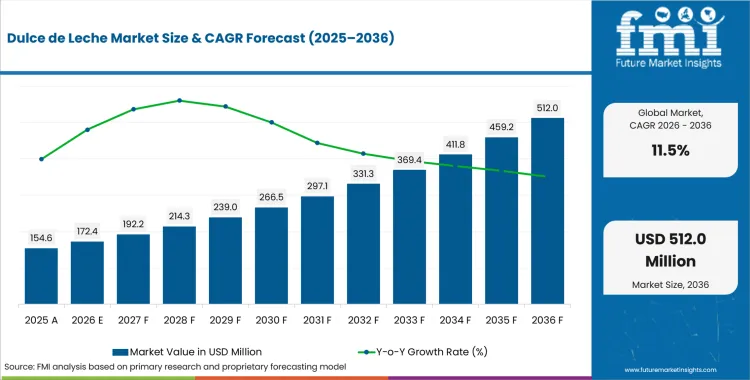
USD 172.4 million in 2026 and USD 512.0 million by 2036 at 11.5% CAGR.
Demand for dulce de leche is projected to expand at 11.5% CAGR between 2026 and 2036, increasing valuation from USD 172.4 million in 2026 to USD 512.0 million by 2036. Industrial bakeries prefer fillings that fit existing sweet-goods lines because repeating qualification work raises development cost. Barry Callebaut said in June 2026 that recipe reformulation was increasing demand for compounds and fillings, which raises the value of repeatable processing performance.
Foodservice density determines how quickly a caramelized-dairy flavor reaches repeat orders. Dubai recorded 19.59 million international overnight visitors in 2025, the Department of Economy and Tourism stated in February 2026. The visitor base gives hotels more menu-refresh occasions, although industrial programs depend on stable specifications.
Key Takeaways
- Industrial bakeries expand use after dulce de leche passes dosing and bake trials for several sweet bakery formats.
- Based on product type, standard grade is projected to account for 39.0% in 2026 due to attainable cost and broad formulation flexibility.
- By form, powder / dry is estimated to hold 39.0% in 2026 owing to dry-batch dosing and efficient storage.
- In 2026, cakes & muffins are expected to lead application with 27.0% share because one filling supports several placements.
- Milk-allergen declarations and line trials lengthen approval in shared plants handling dairy and non-dairy formulations.
- Some of the key players in this market include Barry Callebaut, Puratos, Dawn Foods, Zeelandia, CSM Ingredients, Bakels, AGRANA, Zentis, Fabbri 1905, and Irca Group.
Analyst Perspective
"Commercial value comes from the specification that survives depositing, baking, cooling, and packing without changing finished-unit economics. Dulce de leche earns repeat orders where a bakery can reproduce that result and replenish the same formulation without reopening qualification."
- Nandini Roy Choudhury, Principal Consultant, Future Market Insights
How is the dulce de leche market segmented?
The market is segmented by product type, form, application, claim, sales channel, and region.
Product type covers standard grade, premium / specialty grade, organic certified, and clean label grade. Form includes powder / dry, liquid, paste / semi-solid, and granules / pieces. Application covers cakes & muffins, bread & rolls, biscuits & cookies, viennoiserie & pastry, and other bakery & snacks. Claim includes conventional, clean label, organic, and non-GMO / identity preserved. Sales channel covers direct to industrial bakeries, ingredient distributors, foodservice & artisan supply, and online B2B.
What makes standard grade central to the product type category?
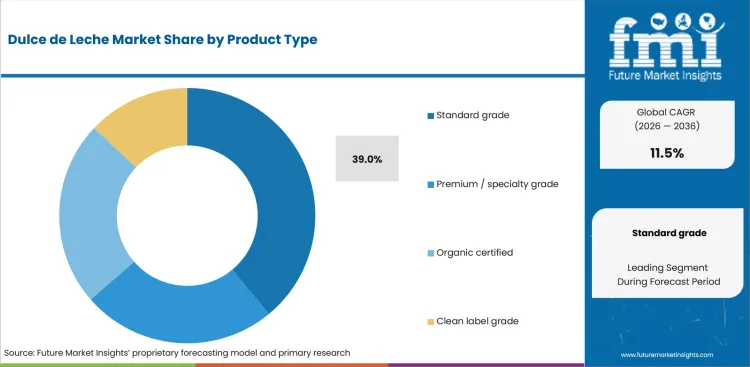
Standard grade fits industrial programs that start with a costed specification, adding premium claims only to programs that can recover extra requirements. CSM Ingredients launched its Creami filling range in May 2026 for bakery, pastry, and confectionery professionals, giving development teams formats built for practical application and stable production performance.
- Based on product type, standard grade is projected to account for 39.0% in 2026 due to flexible control of flavor, solids, viscosity, and shelf life.
- Industrial bakeries can qualify taste and line behavior, adding premium claims only where the brief justifies them. Organic and clean label grades carry extra sourcing records during program approval.
Why does powder / dry lead the form category?
Powder / dry formats suit plants that already meter flour, sugar, milk solids, and premixes through dry handling equipment at industrial scale. The format reduces dependence on heated transfer systems for viscous material and gives production teams a familiar batch-control route.
- By form, powder / dry is estimated to hold 39.0% in 2026 owing to storage efficiency and compatibility with existing dry-batch dosing routines.
- Bakels documented recent upgrades to its Malaysian powder-blending facility in June 2025. The work increased blending capacity and strengthened homogeneous mixing plus hygiene controls, which are practical qualification points for industrial dry systems.
How do cakes & muffins anchor the application category?
Cakes and muffins accept dulce de leche as a center, swirl, layer, topping, or post-bake injection without changing the base format. In September 2025, Dawn Foods expanded its Royal Steensma range in North America with ready-to-use products for bakery and pastry work, including fillings and finishing applications.
- In 2026, cakes & muffins are expected to lead application with 27.0% share because one validated filling can serve several placements and pack sizes.
- Cake systems give developers visible color contrast and controlled portions within familiar batter formats. Cookies and laminated pastry place tighter limits on leakage, water activity, and sweetness during line trials.
What drives direct sales to industrial bakeries within the sales channel category?
Direct contracts become more useful once a filling must be tuned to depositing, baking, cooling, and packing on production equipment. The channel keeps specification changes and planned bulk deliveries under one commercial relationship instead of separating technical approval from replenishment.
- By sales channel, direct to industrial bakeries is forecast to represent 54.0% in 2026 driven by joint specification approval and planned volume commitments.
- IRCA Group said in February 2025 that its St. Louis facility was operational and would produce fillings and creams in the United States. Domestic production shortens the route between line trials, adjustment, and repeat supply for qualified accounts.
What are the drivers, restraints and opportunities in the Dulce de Leche Market?
Industrial bakery differentiation supports demand, milk-allergen and line-qualification requirements restrict adoption, and localized technical supply provides the clearest route to wider commercial use.
- Driver: Industrial bakeries use a recognizable caramelized-dairy profile to refresh sweet goods without adding an in-house milk concentration step.
- Restraint: Allergen controls and bake validation lengthen qualification in shared plants handling dairy and non-dairy formulations.
- Opportunity: Local application support and service-ready pack sizes can turn regional flavor interest into qualified repeat orders.
Indulgent bakery launches convert more easily when a new flavor can use an existing cake base or depositing system. Dawn Foods found in May 2025 that 72% of surveyed consumers viewed sweet baked goods as affordable luxuries. Industrial bakeries can therefore test dulce de leche in familiar formats, provided the filling preserves texture through baking and cooling without rebuilding the base formula.
Milk makes dulce de leche qualification a labeling and cross-contact issue alongside sensory performance. FDA issued its fifth-edition food-allergen labeling guidance in January 2025 and restated the requirement to declare major allergens by food source. Shared plants must settle ingredient declarations and sanitation controls ahead of routine production, which can weaken smaller programs with limited changeover capacity during short promotional runs.
Regional application teams can shorten the route from a concept sample to a production-ready specification. Puratos formed Puratos Cascarano in January 2026 to deepen local support for bakers and patissiers in southern Italy. That model gives specialty fillings a local adjustment and replenishment route without forcing every account into large imported pack sizes and reducing restart work during commercial scale-up.
Which country CAGRs are profiled in the Dulce de Leche Market?
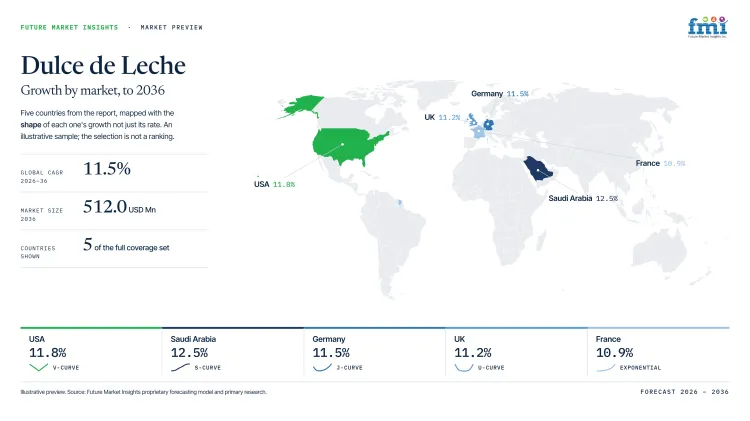
| Country | CAGR |
|---|---|
| UAE | 12.8% |
| Saudi Arabia | 12.5% |
| South Korea | 12.2% |
| USA | 11.8% |
| Germany | 11.5% |
| UK | 11.2% |
| France | 10.9% |
| Japan | 10.5% |
How do country-level CAGRs compare in the Dulce de Leche Market?
The forecasts span 2.3 percentage points, with the UAE, Saudi Arabia, and South Korea forming the upper band. The USA through the UK occupy a narrow middle range, while France and Japan are below 11.0%. The spread is modest, so commercial differences depend more on route-to-market speed, production qualification, and menu cadence than on headline growth alone.
- UAE hotel openings shorten trial cycles.
- Saudi central kitchens concentrate replenishment.
- South Korean convenience calendars reward seasonal runs.
- USA co-manufacturers scale after site transfer.
- German bake-off programs scrutinize yield.
- UK private-label ranges tighten portion economics.
- French pâtisserie channels sustain premium pricing.
- Japanese convenience formats reward portion control.
Comparable rates therefore hide different qualification costs and service expectations.The full report provides country-level CAGR analysis across North America, Latin America, Western Europe, Eastern Europe, East Asia, South Asia and Pacific, and Middle East and Africa.
Country-wise Analysis
- UAE hotels and premium pastry operators rely on importers that can replenish trial packs quickly during frequent menu changes. Dubai Municipality recorded about 2,336 new food establishments during the first half of 2025. That turnover widens the number of outlets able to test a new filling ahead of long-term menu placement. Dulce de leche demand is forecast to rise at 12.8% CAGR over the forecast period, given dense foodservice activity and short menu cycles. Local stock and halal-ready documentation give importers a faster route through customer approval. Import lead times remain the main friction, so companies without nearby technical support risk losing short seasonal windows during qualification.
- Saudi hospitality accounts concentrate purchasing through distributors that can serve hotels, central kitchens, and growing bakery chains. The Saudi dulce de leche sector is projected to record 12.5% CAGR during the assessment period, propelled by a larger hospitality base and frequent dessert programs. GASTAT counted 5,622 licensed tourism hospitality facilities in the third quarter of 2025. That installed outlet base gives new fillings more locations for trial and repeat use. Ambient-stable formats and Arabic technical files reduce handling friction during long replenishment cycles. Long import cycles still expose operators to stock gaps, which makes local inventory depth a structural entry requirement for high-volume accounts.
- South Korean cafe and bakery chains can move a social-media flavor into seasonal testing within a short merchandising cycle. MFDS issued Food Labeling Standards Notification No. 2025-27 on April 21 2025, resetting the current compliance baseline for packaged foods. Fast sample approval therefore depends on Korean-language product files as much as flavor novelty. Adoption of dulce de leche ingredients is expected to register 12.2% CAGR through 2036, tied to frequent menu rotation and responsive distribution. Small trial lots give chain teams a direct route to limited seasonal promotions. Irregular imports are a constraint since a short campaign can end prior to replacement stock reaching the chain.
- USA national bakery programs usually transfer one approved filling specification between several production sites ahead of chain-wide rollout. The USA Census Bureau counted 70.1 million Hispanic residents as of July 1 2025, giving Latin American flavor cues a large familiar consumer base. Dulce de leche sales is forecast to advance at 11.8% CAGR through 2036, supported by large bakery programs and broad flavor recognition. Domestic manufacturing and co-manufacturing capacity shorten replenishment after approval, while shared plants require allergen controls and documented bake trials. A formulation that changes dosage or texture between sites can lose the economics that made a national program attractive.
- German industrial bakeries compare sweet fillings against metering accuracy and finished-unit yield during specification approval. Destatis documented a 14.6% year-on-year increase in wholesale prices for sugar plus confectionery and bakery products in September 2025. Dulce de leche sales are expected to maintain 11.5% CAGR over the assessment period, attributable to a mature bakery base and controlled production routines. Accurate dosing is the direct enabler because it protects yield under price pressure. Premium formulations must prove sensory improvement and process economy during line trials ahead of higher-cost approval by German accounts. German accounts are therefore less forgiving of fillings that raise unit cost without measurable process or product benefit.
- UK bakery chains test indulgent launches against portion economics and nutrition policy during national shelf planning. Government guidance updated in June 2025 confirmed that less-healthy food advertising restrictions would take effect on January 5 2026. Full nutrition data therefore enters commercial planning earlier for retail and foodservice programs. The UK is anticipated to deliver 11.2% CAGR over the forecast period, with mature bakery channels offering several placement routes. Reformulation capability lets chains preserve an approved flavor concept while adjusting sweetness or portion size for promotion limits. Promotion limits can still narrow the available launch plan, so a filling may need lower sweetness or smaller portions without reopening the complete production trial.
- French pâtisserie and bakery accounts can recover higher ingredient costs where sensory quality and formal claims support premium pricing. Dulce de leche demand is projected to progress at 10.9% CAGR through 2036, driven by premium pastry use and selective retailer programs. The French agriculture ministry stated in April 2025 that processed foods using the AB mark must contain at least 95% organic agricultural ingredients. Certified sourcing therefore gives organic dulce de leche a defined route into premium programs. The same certification rule narrows ingredient choice and raises documentation work for processors and retailers. Growth is more selective than in the Gulf markets because certification earns value only where the finished product can recover the extra cost.
- Japanese bakery and convenience teams specify sweetness, viscosity, and portion size closely ahead of routine production of a dairy-rich filling. The Consumer Affairs Agency revised its processed-food allergy labeling handbook in April 2026, reinforcing current documentation work for packaged foods. A standard export recipe can therefore require both sensory and label adjustment during approval. Dulce de leche sales are forecast to post 10.5% CAGR by 2036, aided by controlled portions and detailed specifications for cafe and convenience programs. Local application work gives manufacturers a practical qualification route for sweetness, viscosity, and package-label adjustments. The slower forecast reflects a tighter fit requirement, not an absence of indulgent dessert demand.
Who are the notable companies in the Dulce de Leche Market?
Barry Callebaut, Puratos, Dawn Foods, Zeelandia, CSM Ingredients, Bakels, AGRANA, Zentis, Fabbri 1905, and Irca Group are notable companies serving the dulce de leche market.
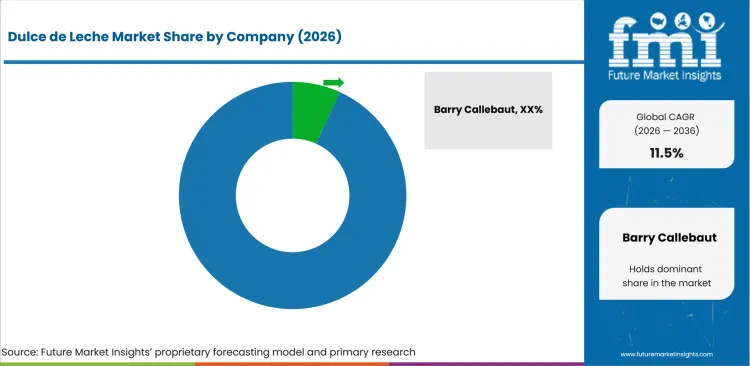
The company set covers bakery systems, chocolate and caramel platforms, and customized fruit or sweet preparations. Entry depends on proving that a brown-flavor system can meet line conditions, claim requirements, and regional service expectations without losing finished-product economics.
- Puratos, Dawn Foods, Zeelandia, CSM Ingredients, and Bakels provide broad bakery systems with application support and industrial production knowledge.
- Barry Callebaut, Fabbri 1905, and Irca Group serve chocolate, caramel, cream, topping, and related sweet-specialty routes used in bakery and pastry.
- AGRANA and Zentis bring preparation expertise into industrial or foodservice programs that require customized flavor and texture work.
Competitive Benchmarking: Dulce de Leche Market
| Company | Caramelized-Dairy and Brown-Flavor Capability | Bakery-Process Format Adaptability | Claim and Customization Support | Geographic Reach |
|---|---|---|---|---|
| Barry Callebaut | High | High | Medium | Global |
| Puratos | High | High | High | Global |
| Dawn Foods | Medium | High | High | North America, Europe, Middle East, and selected Asia-Pacific markets |
| Zeelandia | Medium | High | High | Europe, Americas, Asia, and Africa |
| CSM Ingredients | Medium | High | High | Europe, UK, and selected international markets |
| Bakels | High | High | High | Operations on five continents |
| AGRANA | High | High | High | Europe, Americas, Asia, and foodservice markets |
| Zentis | Medium | High | High | Europe and North America |
| Fabbri 1905 | High | Medium | High | Europe, North America, and distributor-led international markets |
| Irca Group | High | High | High | More than 100 countries |
Scoring basis: High requires broad documented coverage in several relevant bakery or sweet-ingredient routes. Medium indicates documented coverage in a narrower set of relevant routes than the High threshold. Low identifies one documented route or an explicit limitation within the assessed criterion. Geographic reach records verified operating or distribution coverage without converting company size into a capability score.
Key Developments in the Dulce de Leche Market
- In March 2026, AGRANA completed its acquisition of Mercator-Emba, adding a producer of syrups, sauces, and dessert toppings serving foodservice and processing customers.
- In January 2026, Puratos acquired Vör Foods, adding USA manufacturing for clean label nut pastes and fillings with shorter lead times for regional customers.
- In November 2025, CSM Ingredients opened its Cheshire product development centre with a test bakery and mock-production environment for customer line trials.
Key Players in the Dulce de Leche Market
Integrated Bakery-System Suppliers
- Puratos
- Dawn Foods
- Zeelandia
- CSM Ingredients
- Bakels
Caramel and Premium Sweet-Specialty Platforms
- Barry Callebaut
- Fabbri 1905
- Irca Group
Customized Preparations and Industrial Fillings
- AGRANA
- Zentis
Dulce de Leche Market - Report Scope
| Coverage field | Report scope |
|---|---|
| Market breakdown | By product type, form, application, claim, sales channel, and region. |
| Quantitative Units | USD million. |
| Market Definition | Revenue from dulce de leche ingredients sold within the defined product type, form, application, claim, and sales-channel universe. Finished bakery-product revenue and adjacent substitutes are excluded. |
| Regions Covered | North America, Latin America, Western Europe, Eastern Europe, East Asia, South Asia and Pacific, and Middle East and Africa. |
| Countries Covered | UAE, Saudi Arabia, South Korea, USA, Germany, UK, France, Japan, and 20+ countries included in the full report. |
| Key Companies Profiled | Barry Callebaut, Puratos, Dawn Foods, Zeelandia, CSM Ingredients, Bakels, AGRANA, Zentis, Fabbri 1905, and Irca Group. |
| Forecast Period | 2026 to 2036. |
| Approach | Primary and secondary research with market triangulation. |
Dulce de Leche Market - Research Methodology
| Method | Approach |
|---|---|
| Primary Research | FMI analysts gathered input from manufacturers, service providers, technology developers, distributors, end users, procurement teams, and subject-matter experts. Interviews examined purchasing decisions, product or service evaluation, adoption barriers, approval requirements, pricing considerations, and expectations for technical or commercial support. Respondents were also asked what evidence is required before a trial, pilot, or initial order develops into regular purchasing. |
| Desk Research | Desk research covered government statistics, regulatory publications, trade data, industry associations, technical literature, standards, company filings, product information, and official corporate announcements. Sources were reviewed for relevance, publication date, geographic coverage, and consistency with the defined market scope. Claims relating to performance, applications, approvals, capacity, investment, and commercial activity were retained only when supported by credible public evidence. |
| Market Sizing and Forecasting | The market model combined the baseline value with historical performance, segment structure, pricing and volume indicators, adoption levels, company participation, and country-level demand conditions. Forecast assumptions considered economic activity, investment trends, regulatory developments, technology adoption, purchasing cycles, supply availability, and barriers to wider market use. Segment and regional estimates were reconciled before the final market total was calculated. |
| Data Validation | Estimates were checked against multiple independent indicators, including public data, company activity, trade patterns, industry developments, and findings from primary interviews. Validation also tested whether products, services, applications, and company revenues fell within the defined market boundaries. Adjacent categories, unsupported claims, overlapping revenues, and activities without direct market relevance were excluded to reduce double counting and maintain consistency across segments and countries. |
Dulce de Leche Market by Segments
Dulce de Leche Market segmented by Product Type:
- Standard grade
- Premium / specialty grade
- Organic certified
- Clean label grade
Dulce de Leche Market segmented by Form:
- Powder / dry
- Liquid
- Paste / semi-solid
- Granules / pieces
Dulce de Leche Market segmented by Application:
- Cakes & muffins
- Bread & rolls
- Biscuits & cookies
- Viennoiserie & pastry
- Other bakery & snacks
Dulce de Leche Market segmented by Claim:
- Conventional
- Clean label
- Organic
- Non-GMO / identity preserved
Dulce de Leche Market segmented by Sales Channel:
- Direct to industrial bakeries
- Ingredient distributors
- Foodservice & artisan supply
- Online B2B
Dulce de Leche Market by Region:
- North America
- United States
- Canada
- Latin America
- Brazil
- Mexico
- Argentina
- Chile
- Western Europe
- Germany
- France
- United Kingdom
- Italy
- Spain
- Benelux
- Nordics
- Eastern Europe
- Poland
- Czech Republic
- Romania
- Hungary
- East Asia
- China
- Japan
- South Korea
- South Asia and Pacific
- India
- ASEAN
- Australia and New Zealand
- Middle East and Africa
- GCC Countries
- South Africa
- Türkiye
- Israel
Research Sources and Bibliography
- Barry Callebaut Group. (2026, June 2). Barry Callebaut Group launches Focus for Growth.
- Dubai Department of Economy and Tourism. (2026, February 9). Dubai’s tourism industry achieves third successive record-breaking year.
- CSM Ingredients. (2026, May 12). CSM Ingredients launches Creami®, a comprehensive range of indulgent fillings for bakery, pastry and confectionery professionals.
- Bakels Group. (2025, June). Bakels Worldwide Review, Issue 176.
- Dawn Foods. (2025, September 15). Dawn Foods expands Royal Steensma product line in North America with four new premium, easy-to-use products.
- IRCA Group. (2025, February 18). Crafted in Italy, produced in the USA.
- Dawn Foods. (2025, May 18). Dawn Foods unveils Dawn Global Bakery Trends at IBA.
- USA Food and Drug Administration. (2025, January). Guidance for Industry: Questions and Answers Regarding Food Allergen Labeling (Edition 5).
- Puratos. (2026, January 23). Puratos Strengthens Its Presence in Italy with the Creation of Puratos Cascarano.
- Dubai Municipality. (2025, July 30). Over 34,000 food inspections conducted in first half of 2025.
- General Authority for Statistics, Saudi Arabia. (2026, January 8). GASTAT publishes Tourism Establishments Statistics for Q3 of 2025.
- Ministry of Food and Drug Safety, Republic of Korea. (2025, April 21). Food Labeling Standards, Notification No. 2025-27.
- USA Census Bureau. (2026, August 11). National Hispanic Heritage Month: 2026.
- Federal Statistical Office of Germany. (2025, October 13). Wholesale prices in September 2025: +1.2% on September 2024.
- UK Department of Health and Social Care. (2025, June 4). Restricting advertising of less healthy food or drink on TV and online: products in scope.
- French Ministry of Agriculture. (2025, April 14). La certification en agriculture biologique.
- Consumer Affairs Agency, Japan. (2026, April). Food allergy labeling information.
- AGRANA. (2026). Annual Report 2025/26.
- Puratos. (2026, January 21). Puratos acquires Vör Foods, accelerating USA nut-based innovation.
- CSM Ingredients. (2025, November 18). CSM Ingredients - a Nexture company - opens new £3m state-of-the-art customer focused product development centre in the UK.
- Zeelandia. (2026). Zeelandia publishes Sustainability Report 2025.
- Zentis. (2026, April 28). Natürlich geprägt von Verantwortung: Zentis veröffentlicht 8. Nachhaltigkeitsbericht.
- Barry Callebaut. (2025, November 13). Barry Callebaut Opens Third Canadian Chocolate Factory in Brantford, Ontario.
- Puratos. (2026, February 24). Puratos Launches World’s First Professional Chocolate with Cultured Cocoa.
- Dawn Foods. (2026, March 10). Puratos to Acquire Dawn Foods, Bringing Together Complementary Capabilities in Professional Bakery.
- Court-appointed bankruptcy trustee for IXL Netherlands B.V. (2025, October 31). Bankruptcy report IXL Netherlands B.V..
- CSM Ingredients. (2025, November 13). CSM Ingredients Group launches Nuaré, a range of cocoa alternatives which opens new creative possibilities in bakery and ice cream.
- AGRANA. (2025, November 4). AGRANA Austrian Small and Midcap Day 2025.
- Zentis. (2025, August 15). Jetzt wird’s bärig lecker - Zentis und Bärchen® launchen Fruchtaufstriche für die ganze Familie.
- Fabbri 1905. (2026, January 16). Fabbri 1905 entra nel mondo dello street food e ridefinisce il fuoricasa Made in Italy.
- IRCA Group. (2026, June 29). CVC Capital Partners agrees to acquire Irca from Advent.
- Barry Callebaut. (2026, February 10). Barry Callebaut opens Global Innovation Center in Singapore, pioneering the future of chocolate through AI and advanced innovation.
- Puratos. (2026, February 25). Puratos launches direct presence in Albania with Puratos Albania.
- Fabbri 1905. (2025, October 17). Fabbri Gelato System: una nuova esperienza di gusto ad Host Milano 2025.
- Puratos. (2025, September 12). Puratos and Guelph Announced Strategic Joint Venture to Ignite a New Chapter for Asia Pacific Bakery Industry.
- Barry Callebaut. (2025, November 18). Barry Callebaut partners with NotCo AI to unlock next-level chocolate innovation.
- IRCA Group. (2026, May 8). Dobla Asia achieves BRC A+ rating in Vietnam.
This bibliography is provided for reader reference and is not exhaustive. The full report contains the complete reference list and detailed citations.
This Report Answers
- What values define the dulce de leche market forecast?
- Why do industrial bakeries use dulce de leche fillings?
- Which segments hold the leading 2026 shares?
- How do allergen controls affect filling qualification?
- Why do country growth rates differ?
- Which companies serve the dulce de leche market?
- What must bakeries test before approving a filling?
- How does local technical support affect repeat ordering?
Frequently Asked Questions
How big is the dulce de leche market in 2026?
The dulce de leche market is valued at USD 172.4 million in 2026 and is projected to reach USD 512.0 million by 2036. Industrial bakery adoption depends on fillings that pass line trials without changing established process economics.
What is the CAGR of the dulce de leche market from 2026 to 2036?
The dulce de leche market is projected to grow at a CAGR of 11.5% between 2026 and 2036. Expansion depends on bakery differentiation, foodservice menu rotation, and more localized application support for qualified fillings.
Which product type leads the dulce de leche market?
The standard grade segment is expected to hold 39.0% of the dulce de leche market in 2026, attributable to attainable cost and broad formulation flexibility. Industrial bakeries can qualify performance without carrying premium claim requirements into every program.
Which sales channel leads the dulce de leche market?
Direct to industrial bakeries is expected to account for 54.0% of the dulce de leche market in 2026, supported by joint specification and volume planning. Direct technical contact keeps line trials and replenishment decisions under one commercial relationship.
Which countries are projected to record the highest growth in the dulce de leche market?
UAE is projected to grow at 12.8% CAGR, followed by Saudi Arabia at 12.5% and South Korea at 12.2% through 2036. Short menu cycles and dense hospitality channels increase the value of local stock and technical response.
Which companies are active in the dulce de leche market?
Key companies operating in the market include Barry Callebaut, Puratos, Dawn Foods, Zeelandia, CSM Ingredients, Bakels, AGRANA, Zentis, Fabbri 1905, and Irca Group. Their positions differ by filling breadth, regional production depth, and the amount of application support available to industrial accounts.
Preview the report firsthand - request a free sample
Get SampleGet the brochure for pricing and purchase details.
Get PDFTable of Content
- Key Takeaways
- Market Size and CAGR
- Top Growth Driver
- Fastest Growing Segment
- Leading Region
- Key Companies
- Emerging Opportunities
- Executive Summary
- Global Market Outlook
- Demand-side Trends
- Supply-side Trends
- Technology Roadmap Analysis
- Analysis and Recommendations
- Analyst Perspective (What is happening? Why now? What should investors know?)
- Key Questions Answered
- How large is the market?
- What is the CAGR?
- What are key trends?
- Which region dominates?
- Who are the leaders?
- Market Overview
- Market Coverage / Taxonomy
- Market Definition / Scope / Limitations
- Research Methodology
- Chapter Orientation
- Analytical Lens and Working Hypotheses
- Market Structure, Signals, and Trend Drivers
- Benchmarking and Cross-market Comparability
- Market Sizing, Forecasting, and Opportunity Mapping
- Research Design and Evidence Framework
- Desk Research Programme (Secondary Evidence)
- Expert Input and Fieldwork (Primary Evidence)
- Tooling, Models, and Reference Databases
- Data Engineering and Model Build
- Quality Assurance and Audit Trail
- Market Background
- Market Dynamics (Drivers, Restraints, Opportunity, Trends)
- Scenario Forecast (Optimistic, Likely, Conservative)
- Impact Analysis
- AI Impact
- Sustainability Impact
- Regulatory Impact
- Technology Impact
- Consumer / Buyer Analysis
- Purchase Drivers
- Adoption Barriers
- Buyer Journey
- Opportunity Map Analysis
- Product Life Cycle Analysis
- Supply Chain Analysis
- Investment Feasibility Matrix
- Value Chain Analysis
- PESTLE and Porter's Analysis
- Regulatory Landscape
- Regional Parent Market Outlook
- Production and Consumption Statistics
- Import and Export Statistics
- Global Market Analysis and Forecast, 2021 to 2036
- Historical Market Size Value (USD Million) Analysis, 2021 to 2025
- Current and Future Market Size Value (USD Million) Projections, 2026 to 2036
- Y-o-Y Growth Trend Analysis
- Absolute $ Opportunity Analysis
- Global Market Pricing Analysis, 2021 to 2036
- Global Market Analysis and Forecast, By Product Type, 2021 to 2036
- Introduction / Key Findings
- Historical Market Size Value (USD Million) Analysis By Product Type, 2021 to 2025
- Current and Future Market Size Value (USD Million) Analysis and Forecast By Product Type, 2026 to 2036
- Standard grade
- Premium / specialty grade
- Organic certified
- Clean label grade
- Standard grade
- Y-o-Y Growth Trend Analysis By Product Type, 2021 to 2025
- Absolute $ Opportunity Analysis By Product Type, 2026 to 2036
- Global Market Analysis and Forecast, By Form, 2021 to 2036
- Introduction / Key Findings
- Historical Market Size Value (USD Million) Analysis By Form, 2021 to 2025
- Current and Future Market Size Value (USD Million) Analysis and Forecast By Form, 2026 to 2036
- Powder / dry
- Liquid
- Paste / semi-solid
- Granules / pieces
- Powder / dry
- Y-o-Y Growth Trend Analysis By Form, 2021 to 2025
- Absolute $ Opportunity Analysis By Form, 2026 to 2036
- Global Market Analysis and Forecast, By Application, 2021 to 2036
- Introduction / Key Findings
- Historical Market Size Value (USD Million) Analysis By Application, 2021 to 2025
- Current and Future Market Size Value (USD Million) Analysis and Forecast By Application, 2026 to 2036
- Cakes & muffins
- Bread & rolls
- Biscuits & cookies
- Viennoiserie & pastry
- Other bakery & snacks
- Cakes & muffins
- Y-o-Y Growth Trend Analysis By Application, 2021 to 2025
- Absolute $ Opportunity Analysis By Application, 2026 to 2036
- Global Market Analysis and Forecast, By Claim, 2021 to 2036
- Introduction / Key Findings
- Historical Market Size Value (USD Million) Analysis By Claim, 2021 to 2025
- Current and Future Market Size Value (USD Million) Analysis and Forecast By Claim, 2026 to 2036
- Conventional
- Clean label
- Organic
- Non-GMO / identity preserved
- Conventional
- Y-o-Y Growth Trend Analysis By Claim, 2021 to 2025
- Absolute $ Opportunity Analysis By Claim, 2026 to 2036
- Global Market Analysis and Forecast, By Sales Channel, 2021 to 2036
- Introduction / Key Findings
- Historical Market Size Value (USD Million) Analysis By Sales Channel, 2021 to 2025
- Current and Future Market Size Value (USD Million) Analysis and Forecast By Sales Channel, 2026 to 2036
- Direct to industrial bakeries
- Ingredient distributors
- Foodservice & artisan supply
- Online B2B
- Direct to industrial bakeries
- Y-o-Y Growth Trend Analysis By Sales Channel, 2021 to 2025
- Absolute $ Opportunity Analysis By Sales Channel, 2026 to 2036
- Global Market Analysis and Forecast, By Region, 2021 to 2036
- Introduction
- Historical Market Size Value (USD Million) Analysis By Region, 2021 to 2025
- Current Market Size Value (USD Million) Analysis and Forecast By Region, 2026 to 2036
- North America
- Latin America
- Western Europe
- Eastern Europe
- East Asia
- South Asia and Pacific
- Middle East & Africa
- Market Attractiveness Analysis By Region
- North America Market Analysis and Forecast, By Country, 2021 to 2036
- Historical Market Size Value (USD Million) Trend Analysis By Market Taxonomy, 2021 to 2025
- Market Size Value (USD Million) Forecast By Market Taxonomy, 2026 to 2036
- By Country
- USA
- Canada
- By Product Type
- By Form
- By Application
- By Claim
- By Sales Channel
- By Country
- Market Attractiveness Analysis
- By Country
- By Product Type
- By Form
- By Application
- By Claim
- By Sales Channel
- Key Takeaways
- Latin America Market Analysis and Forecast, By Country
- Historical Market Size Value (USD Million) Trend Analysis By Market Taxonomy, 2021 to 2025
- Market Size Value (USD Million) Forecast By Market Taxonomy, 2026 to 2036
- By Country
- Brazil
- Mexico
- Chile
- Rest of Latin America
- By Product Type
- By Form
- By Application
- By Claim
- By Sales Channel
- By Country
- Market Attractiveness Analysis
- By Country
- By Product Type
- By Form
- By Application
- By Claim
- By Sales Channel
- Key Takeaways
- Western Europe Market Analysis and Forecast, By Country
- Historical Market Size Value (USD Million) Trend Analysis By Market Taxonomy, 2021 to 2025
- Market Size Value (USD Million) Forecast By Market Taxonomy, 2026 to 2036
- By Country
- Germany
- UK
- Italy
- Spain
- France
- Nordic
- BENELUX
- Rest of Western Europe
- By Product Type
- By Form
- By Application
- By Claim
- By Sales Channel
- By Country
- Market Attractiveness Analysis
- By Country
- By Product Type
- By Form
- By Application
- By Claim
- By Sales Channel
- Key Takeaways
- Eastern Europe Market Analysis and Forecast, By Country
- Historical Market Size Value (USD Million) Trend Analysis By Market Taxonomy, 2021 to 2025
- Market Size Value (USD Million) Forecast By Market Taxonomy, 2026 to 2036
- By Country
- Russia
- Poland
- Hungary
- Balkan & Baltic
- Rest of Eastern Europe
- By Product Type
- By Form
- By Application
- By Claim
- By Sales Channel
- By Country
- Market Attractiveness Analysis
- By Country
- By Product Type
- By Form
- By Application
- By Claim
- By Sales Channel
- Key Takeaways
- East Asia Market Analysis and Forecast, By Country
- Historical Market Size Value (USD Million) Trend Analysis By Market Taxonomy, 2021 to 2025
- Market Size Value (USD Million) Forecast By Market Taxonomy, 2026 to 2036
- By Country
- China
- Japan
- South Korea
- By Product Type
- By Form
- By Application
- By Claim
- By Sales Channel
- By Country
- Market Attractiveness Analysis
- By Country
- By Product Type
- By Form
- By Application
- By Claim
- By Sales Channel
- Key Takeaways
- South Asia and Pacific Market Analysis and Forecast, By Country
- Historical Market Size Value (USD Million) Trend Analysis By Market Taxonomy, 2021 to 2025
- Market Size Value (USD Million) Forecast By Market Taxonomy, 2026 to 2036
- By Country
- India
- ASEAN
- Australia & New Zealand
- Rest of South Asia and Pacific
- By Product Type
- By Form
- By Application
- By Claim
- By Sales Channel
- By Country
- Market Attractiveness Analysis
- By Country
- By Product Type
- By Form
- By Application
- By Claim
- By Sales Channel
- Key Takeaways
- Middle East & Africa Market Analysis and Forecast, By Country
- Historical Market Size Value (USD Million) Trend Analysis By Market Taxonomy, 2021 to 2025
- Market Size Value (USD Million) Forecast By Market Taxonomy, 2026 to 2036
- By Country
- Kingdom of Saudi Arabia
- Other GCC Countries
- Türkiye
- South Africa
- Other African Union
- Rest of Middle East & Africa
- By Product Type
- By Form
- By Application
- By Claim
- By Sales Channel
- By Country
- Market Attractiveness Analysis
- By Country
- By Product Type
- By Form
- By Application
- By Claim
- By Sales Channel
- Key Takeaways
- Key Countries Market Analysis
- USA
- Pricing Analysis
- Market Share Analysis, 2025
- By Product Type
- By Form
- By Application
- By Claim
- By Sales Channel
- Canada
- Pricing Analysis
- Market Share Analysis, 2025
- By Product Type
- By Form
- By Application
- By Claim
- By Sales Channel
- Mexico
- Pricing Analysis
- Market Share Analysis, 2025
- By Product Type
- By Form
- By Application
- By Claim
- By Sales Channel
- Brazil
- Pricing Analysis
- Market Share Analysis, 2025
- By Product Type
- By Form
- By Application
- By Claim
- By Sales Channel
- Chile
- Pricing Analysis
- Market Share Analysis, 2025
- By Product Type
- By Form
- By Application
- By Claim
- By Sales Channel
- Germany
- Pricing Analysis
- Market Share Analysis, 2025
- By Product Type
- By Form
- By Application
- By Claim
- By Sales Channel
- UK
- Pricing Analysis
- Market Share Analysis, 2025
- By Product Type
- By Form
- By Application
- By Claim
- By Sales Channel
- Italy
- Pricing Analysis
- Market Share Analysis, 2025
- By Product Type
- By Form
- By Application
- By Claim
- By Sales Channel
- Spain
- Pricing Analysis
- Market Share Analysis, 2025
- By Product Type
- By Form
- By Application
- By Claim
- By Sales Channel
- France
- Pricing Analysis
- Market Share Analysis, 2025
- By Product Type
- By Form
- By Application
- By Claim
- By Sales Channel
- India
- Pricing Analysis
- Market Share Analysis, 2025
- By Product Type
- By Form
- By Application
- By Claim
- By Sales Channel
- ASEAN
- Pricing Analysis
- Market Share Analysis, 2025
- By Product Type
- By Form
- By Application
- By Claim
- By Sales Channel
- Australia & New Zealand
- Pricing Analysis
- Market Share Analysis, 2025
- By Product Type
- By Form
- By Application
- By Claim
- By Sales Channel
- China
- Pricing Analysis
- Market Share Analysis, 2025
- By Product Type
- By Form
- By Application
- By Claim
- By Sales Channel
- Japan
- Pricing Analysis
- Market Share Analysis, 2025
- By Product Type
- By Form
- By Application
- By Claim
- By Sales Channel
- South Korea
- Pricing Analysis
- Market Share Analysis, 2025
- By Product Type
- By Form
- By Application
- By Claim
- By Sales Channel
- Russia
- Pricing Analysis
- Market Share Analysis, 2025
- By Product Type
- By Form
- By Application
- By Claim
- By Sales Channel
- Poland
- Pricing Analysis
- Market Share Analysis, 2025
- By Product Type
- By Form
- By Application
- By Claim
- By Sales Channel
- Hungary
- Pricing Analysis
- Market Share Analysis, 2025
- By Product Type
- By Form
- By Application
- By Claim
- By Sales Channel
- Kingdom of Saudi Arabia
- Pricing Analysis
- Market Share Analysis, 2025
- By Product Type
- By Form
- By Application
- By Claim
- By Sales Channel
- Türkiye
- Pricing Analysis
- Market Share Analysis, 2025
- By Product Type
- By Form
- By Application
- By Claim
- By Sales Channel
- South Africa
- Pricing Analysis
- Market Share Analysis, 2025
- By Product Type
- By Form
- By Application
- By Claim
- By Sales Channel
- USA
- Market Structure Analysis
- Competition Dashboard
- Competition Benchmarking
- Market Share Analysis of Top Players
- By Regional
- By Product Type
- By Form
- By Application
- By Claim
- By Sales Channel
- Emerging Startups
- Innovation Benchmarking
- Competition Analysis
- Competition Deep Dive
- Barry Callebaut
- Overview
- Product Portfolio
- Profitability by Market Segments
- Sales Footprint
- Strategy Overview
- Marketing Strategy
- Product Strategy
- Channel Strategy
- Puratos
- Dawn Foods
- Zeelandia
- CSM Ingredients
- Bakels
- AGRANA
- Zentis
- Fabbri 1905
- Irca Group
- Barry Callebaut
- Case Studies
- Success Stories
- Recent Developments
- Competition Deep Dive
- Assumptions & Acronyms Used


