

- Market Size (2026)
- USD 412.7 Mn
- Forecast (2036)
- USD 941.7 Mn
- CAGR (2026 to 2036)
- 8.6%
How big is Satiety Cookies Market in 2026?
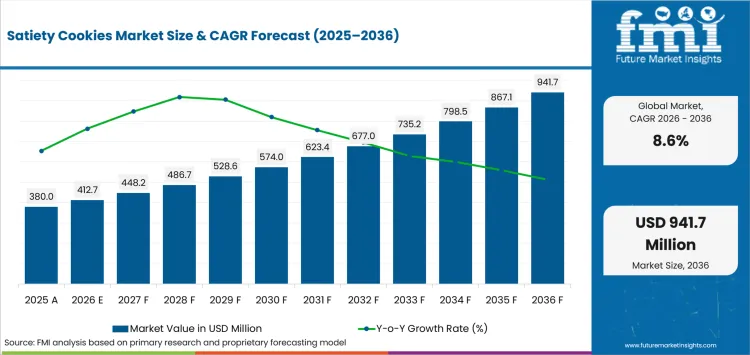
USD 412.7 Million in 2026 and USD 941.7 Million by 2036 at an 8.6% CAGR.
Demand for satiety cookies is projected to expand at 8.6% CAGR between 2026 and 2036, increasing valuation from USD 412.7 Million in 2026 to USD 941.7 Million by 2036. The category grows when a familiar sweet snack can provide measurable protein or fiber while retaining acceptable taste and portion value.
Public-health and nutrition data keep the use case visible without proving demand for any individual cookie. The USA National Center for Health Statistics reported adult obesity prevalence of 40.3% for August 2021 to August 2023, while UK dietary-survey results show widespread fibre shortfalls. That context supports healthy snacks built around credible nutrition, but repeat purchase still depends on sensory quality and price.
Key Takeaways
- Satiety cookies compete mainly by improving the nutritional return from an existing snack occasion while keeping the format familiar.
- High-Protein is projected at 43.6% share of Satiety Driver in 2026 because gram-level protein gives shoppers a clear comparison point.
- Soft-Baked is estimated at 37.4% of Product Type in 2026 as the format can accommodate concentrated protein and fiber with less texture penalty.
- Weight Management is forecast at 31.3% of Claim in 2026 because it connects portion control with protein, fiber or lower sugar across several diet routines.
- Texture trade-offs and claim rules can limit repeat purchase when nutrition targets weaken the eating experience or complicate market entry.
- Lenny & Larry's, Quest Nutrition (Simply Good Foods), Catalina Crunch, HighKey, , , General Mills (Fiber One) and Simple Mills serve direct or adjacent better-for-you snack positions.
Analyst Perspective
"The commercial test is simple: a satiety cookie must earn repeat use as a cookie before its nutrition architecture can create value. Protein, fiber and sugar targets should be designed together with texture and portion size, because a strong front-of-pack number cannot compensate for a weak eating experience."
- Nandini Roy Choudhury, Principal Analyst at Future Market Insights
How is the Satiety Cookies Market segmented?
The satiety cookies market is segmented by Satiety Driver, Product Type, Claim, Packaging, Sales Channel and Region.
Satiety Driver covers High-Protein, Protein + Fiber Combos, High-Fiber, Healthy Fats (Nut-Based) and Others. Product Type includes Soft-Baked, Crunchy, Filled, Mini Cookies and Others. Claim covers Weight Management, Meal Replacement, Keto-Friendly, Low-Sugar and Others. Packaging includes Single-Serve, Multipacks, Boxes and Others. Sales Channel covers Supermarkets & Hypermarkets, Online / DTC, Convenience Stores, Specialty & Health Stores and Others. Each axis describes a separate purchase or formulation decision, so leadership on one axis does not determine leadership on another.
Why does Soft-Baked lead the Product Type category?
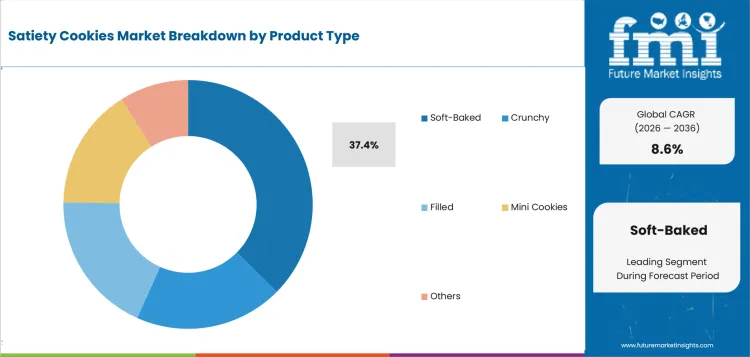
Soft-baked formats give formulators more room to manage the texture consequences of concentrated protein and added fiber. Moisture-retaining ingredients and fat systems can offset dryness, while a thick cookie body supports inclusions such as chocolate pieces without requiring the brittle structure of a crisp biscuit. This matters because repeat buying is exposed quickly to sensory disappointment. The format also supports larger single-cookie servings that can carry enough protein to function as a planned snack. Soft-baked therefore leads through formulation tolerance and eating familiarity. Crunchy and filled formats serve different occasions. Mini formats do as well, but each can face tighter limits on nutrient loading or portion size. The formulation problem is similar to the one faced across enriched bakery products, where moisture and structure must absorb added functional ingredients without losing the expected bite.
- Soft-Baked holds a 37.4% share of Product Type in 2026 because its moisture-rich matrix better accommodates dense protein and fiber systems while preserving the familiar bite consumers expect from a cookie.
- Quest Nutrition announced in January 2018 that its new Protein Cookies were soft and chewy while providing 15 grams of protein, 9 grams of fiber, and less than 3 grams of sugar, demonstrating how the format can carry a concentrated nutrition profile.
What makes High-Protein central to the Satiety Driver category?
High-Protein leads because protein grams give buyers a clear front-of-pack comparison point and fit established fitness, meal-gap, and weight-management routines. Protein can also be paired with soluble or prebiotic fiber to strengthen the fullness proposition without turning the product into a conventional meal replacement. The clinical mechanism is directionally credible, but outcomes depend on dose and total formulation. A 2006 randomized crossover study found lower subsequent food intake after a high-protein, high-fiber snack bar than after an isocaloric high-fat comparator. For cookie brands, this favors formulas that combine protein with fiber and controlled sugar rather than relying on a protein number alone.
- High-Protein accounts for 43.6% of the Satiety Driver category in 2026 because it gives consumers an immediately legible nutritional reason to substitute the cookie for a conventional snack.
- Lenny & Larry's announced in February 2021 that The Boss! Cookie delivered 18 grams of protein, 1 gram of sugar, and 6 grams of prebiotic fiber in a 2-ounce cookie, illustrating the category's use of dense protein with complementary fiber.
How does Weight Management shape the Claim category?
Weight-management positioning sits closest to the core purchase job: replacing a higher-sugar snack with a controlled portion that offers more protein, fiber, or both. The claim is commercially broad because it can accommodate several diet styles without requiring every product to use the same macronutrient pattern. It is also more demanding than generic better-for-you language. Consumers can compare calories and sugar directly against alternatives. Protein and serving size are equally visible. Brands therefore need a coherent formula rather than one favorable number. Low-sugar and keto claims remain important, but weight management can bridge mainstream shoppers and specialized diet users when the product still tastes like an indulgent cookie.
- Weight Management represents 31.3% of the Claim category in 2026 because it links satiety-oriented nutrition to a broad consumer job rather than to a single diet protocol.
- HighKey announced in January 2021 a product expansion built around low-carb, no-added-sugar snacks including mini cookies and wafer cookies, showing how sugar and carbohydrate control are used to support disciplined snacking propositions.
What supports Single-Serve in the Packaging category?
Single-serve packaging converts the nutritional proposition into a clear eating occasion. One unit creates an obvious portion cue and can be carried in a work bag, gym bag, or car without resealing a larger package. It also simplifies trial because shoppers can buy one portion before committing to a multipack or box. For retailers, individual units fit checkout and grab-and-go fixtures. They also work in convenience displays where a cookie competes directly with bars and conventional sweet snacks. Multipacks are stronger for household economics and repeat users. The leading single-serve position reflects the importance of portion visibility and portable use when satiety cookies are purchased as functional snacks rather than pantry desserts.
- Single-Serve accounts for 40.0% of Packaging in 2026 because it combines portion control with portability and lowers the commitment required for first purchase.
- Catalina Crunch announced in June 2022 that Vanilla Creme and Chocolate Vanilla keto-friendly sandwich cookies would be offered in Grab & Go sleeves containing four cookies, explicitly moving its cookie line toward portable portioned use.
What drives Supermarkets & Hypermarkets in the Sales Channel category?
Supermarkets and hypermarkets lead because they place satiety cookies beside both conventional cookies and functional snacks. That shelf context lets buyers compare taste cues and pack price at the same time. Protein, fiber, and sugar remain visible decision points. Mass retail also supports routine replenishment, which matters more than one-time trial for a product intended to replace recurring snack occasions. Online and DTC channels remain important for targeted acquisition, subscriptions, and niche diet communities. Specialty stores help establish health credentials. The channel advantage comes from repeated household traffic and broad category adjacency. Brands that can secure mainstream distribution can convert a specialized nutrition proposition into a normal grocery purchase rather than a search-led specialty purchase.
- Supermarkets & Hypermarkets hold a 33.3% share of Sales Channel in 2026 because regular grocery traffic and shelf comparison make the channel efficient for both trial and repeat buying.
- Flowers Foods stated in January 2025 that Simple Mills products were available in more than 30,000 natural and conventional stores nationwide, showing the distribution depth available to better-for-you cookie platforms that cross into mainstream retail.
What are the drivers, restraints and opportunities in the Satiety Cookies Market?
Demand is supported by appetite- and weight-management use cases, while formulation and claim credibility constrain repeat purchase and protein-plus-fiber products create a defined expansion route.
- Driver: Consumers are seeking familiar snacks that deliver more protein or fiber while fitting weight-management routines.
- Restraint: Protein and fiber loading can weaken texture, while sugar reduction can change sweetness and cost structure.
- Opportunity: Brands can combine protein with fiber and lower sugar, then use portioned formats and localized claims to widen access.
The driver is substitution inside an existing snack occasion rather than creation of a new eating occasion. Consumers already buy cookies, bars, and sweet snacks between meals. Satiety cookies compete by changing the nutritional return from that purchase. The public-health context keeps the use case visible. The CDC reported in September 2024 that 40.3% of USA adults had obesity during August 2021 to August 2023. That statistic does not prove cookie demand, but it supports the continuing relevance of weight-management behavior. Brands capture the opportunity only when protein or fiber is delivered in a format consumers are willing to repeat. Familiar taste and portable portions therefore matter as much as the nutrient claim.
The restraint sits in formulation and claim discipline. Raising protein and fiber can make a cookie dense or dry. Reducing sugar can change sweetness and browning. It can also alter spread and moisture retention. Those effects can force manufacturers to add sweeteners or texture systems that some consumers dislike. Brand strategy can also tighten the target after launch. explains on its founders page that its former Protein Cookies contained 16 grams of total sugar and no longer met the company's newer goal of 1 gram of sugar for its snacks. It discontinued the cookies after concluding that it could not reach the new nutrition standard without sacrificing taste. The example shows why a technically feasible cookie can still fail a portfolio-level nutrition threshold.
The opportunity is to make satiety nutrition easier to compare and easier to buy. High-protein cookies that also provide fiber and lower sugar can serve a wider set of shoppers than narrowly defined keto products. Single-serve packs can reinforce portion cues, while multipacks support value after trial. The regulatory layer makes localization part of product design. The FDA updated the USA definition for the voluntary “healthy” claim in December 2024. The revised definition includes limits on saturated fat and sodium as well as added sugars. Brands do not need that claim to compete, but the rule illustrates the direction of evidence-based nutrition labeling. Suppliers that design formulas and claim language together can reduce rework when expanding across mainstream retail and multiple countries.
What are the country CAGRs in the Satiety Cookies Market?
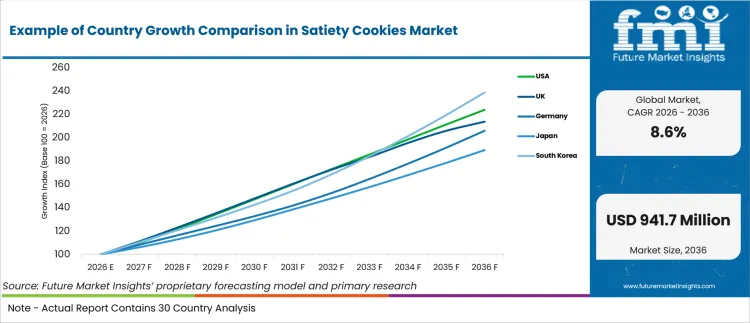
| Country | CAGR |
|---|---|
| USA | 8.4% |
| UK | 7.9% |
| Germany | 7.5% |
| Japan | 6.6% |
| South Korea | 9.1% |
How do country-level CAGRs compare in the Satiety Cookies Market?
The five country CAGRs span 2.5 percentage points from 6.6% to 9.1%. The spacing indicates forecast pace, not absolute market size. Commercial planning still depends on the addressable retail base, nutrition rules and the cost of adapting claims or recipes to local conditions.
- South Korea is forecast at 9.1% CAGR, supported by a market where nutrition labeling gives shoppers a direct basis for comparing processed snacks.
- USA is forecast at 8.4% CAGR, with mass retail and online access supporting comparison across protein-led and lower-sugar snack formats.
- UK is forecast at 7.9% CAGR, while advertising restrictions for identifiable less-healthy foods increase the value of nutrient-profile discipline.
- Germany is forecast at 7.5% CAGR, with product-monitoring policy attention reinforcing pressure on sugar reduction in sweet baked goods.
- Japan is forecast at 6.6% CAGR, where local-language labeling and functional-claim rules make evidence discipline part of market entry.
Comparable growth rates can lead to different commercial outcomes because retail penetration and claim flexibility vary by country. The full report therefore combines country growth with broader regional coverage and product-fit analysis.
Country-wise Analysis
- USA: Shoppers can compare satiety cookies across mass retail and specialty stores as well as online channels, making visible protein and sugar numbers central to conversion. Demand for Satiety Cookies in the USA is forecast to expand at 8.4% CAGR from 2026 to 2036. In December 2024, the FDA updated the voluntary “healthy” claim so qualifying foods must meet food-group requirements and limits for saturated fat and sodium as well as added sugars. The friction is balancing those nutrition thresholds with indulgent taste and price. Suppliers need disciplined formulation and clear serving information plus enough retail availability to convert trial into a routine snack purchase.
- UK: Supermarket economics are closely tied to nutrient profiling because advertising and promotion rules can change the commercial value of less-healthy products. Demand for Satiety Cookies in the UK are forecast to rise at 7.9% CAGR from 2026 to 2036. On January 5, 2026, UK restrictions took effect that prohibit paid online advertising of identifiable less-healthy foods and apply a 9 p.m. watershed on TV advertising. The friction is that a cookie can lose promotional flexibility if its nutrient profile falls within the restricted category. Suppliers should prioritize lower-sugar recipes, compliant claims, and channel plans that do not depend on high-intensity promotional exposure.
- Germany: Retailers and manufacturers operate inside a policy environment that has explicitly tracked sugar and fat plus salt and energy in processed foods. Demand for Satiety Cookies in Germany is forecast to expand at 7.5% CAGR from 2026 to 2036. In July 2025, the Max Rubner-Institut published 2024 product-monitoring results that included sweet baked goods and reported lower average sugar than the 2016 baseline. The local friction is reformulating sugar downward without producing an inferior texture or sweetness profile. Suppliers need product testing that treats protein and fiber alongside sugar and sensory performance as one system rather than four separate targets.
- Japan: Functional positioning requires more label discipline than a simple translation of USA packaging. Adoption of Satiety Cookies in Japan is forecast to expand at 6.6% CAGR from 2026 to 2036. In August 2024, Japan’s Consumer Affairs Agency announced revisions to the Foods with Function Claims system, including a September 1 implementation for strengthened health-damage information reporting. The friction is that functional language can trigger evidence, notification, and reporting obligations that conventional nutrition claims do not. Suppliers should decide early whether a product needs formal functional positioning or whether protein and fiber plus sugar and portion information can carry the proposition without that pathway.
- South Korea: Nutrition labeling gives shoppers a direct basis for comparing sugar and protein across processed snacks. Demand for Satiety Cookies in South Korea are forecast to rise at 9.1% CAGR from 2026 to 2036. On August 13, 2026, the Ministry of Food and Drug Safety registered Regulation No. 2026-33 on recognition of functional ingredients and standards for health functional foods. The local friction is the boundary between ordinary food nutrition communication and formal health-functional positioning. Suppliers should localize Korean labeling, choose claim language conservatively, and use recognized functional pathways only when the product and evidence justify them.
Who are the notable companies in the Satiety Cookies Market?
Lenny & Larry's, Quest Nutrition (Simply Good Foods), Catalina Crunch, HighKey, , General Mills (Fiber One) and Simple Mills are notable companies active in the satiety cookies market and adjacent better-for-you snack competition.
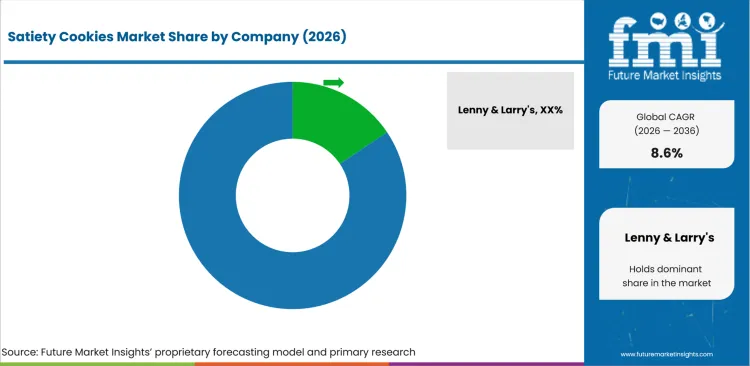
Competition is shaped by the nutrition architecture each brand brings to the cookie occasion. Lenny & Larry's and Quest Nutrition are direct protein-cookie references with high gram-level protein and established cookie formats. Catalina Crunch and HighKey compete from low-sugar and keto-compatible positions, which makes carbohydrate control as important as protein. is strategically relevant because it exited protein cookies after its nutrition standard changed, illustrating the difficulty of sustaining taste while tightening sugar targets. General Mills (Fiber One) and Simple Mills approach the occasion through broader better-for-you portfolios. competes primarily through protein wafer bars, so its role is adjacent rather than direct within cookie revenue. These positions create different strengths in formulation and claim language. Format breadth and retail access further separate the offers.
- Protein-led cookie specialists and legacy formulations: Lenny & Larry's, Quest Nutrition (Simply Good Foods), and compete around protein density, fiber support, and the ability to make a cookie function as a planned snack.
- Low-sugar and keto-oriented cookie specialists: Catalina Crunch and HighKey emphasize sugar or net-carbohydrate control and use mini, sandwich, or crunchy formats to widen occasions.
- Broader better-for-you snack platforms with cookie exposure: , General Mills (Fiber One), and Simple Mills bring fiber, nut- or seed-based ingredients, and mainstream snack distribution to the competitive set, although not every product is a direct satiety cookie.
Competitive Benchmarking: Satiety Cookies Market
| Company | Satiety Formula | Weight / Sugar | Format Breadth | Geographic Reach |
|---|---|---|---|---|
| Lenny & Larry's | High | Medium | High | Primarily USA retail, DTC, and wholesale |
| Quest Nutrition (Simply Good Foods) | High | High | Medium | Broad USA retail with documented international distribution |
| Catalina Crunch | High | High | High | USA DTC and multi-retailer distribution |
| HighKey | High | High | High | Primarily USA DTC and selected retail |
| Low | High | Low | USA DTC and retail for current snack bars; protein cookies discontinued | |
| Low | Medium | Low | USA DTC and store-locator retail; current portfolio centers on wafer protein bars | |
| General Mills (Fiber One) | Medium | Medium | Medium | Broad USA mass retail through General Mills |
| Simple Mills | Medium | Medium | High | More than 30,000 natural and conventional USA stores plus online distribution |
Scoring basis: Cookie-Specific Satiety Formulation measures documented use of protein, fiber, or related nutrient architecture in a cookie format. Low-Sugar / Weight-Management Positioning measures how explicitly the documented proposition controls sugar, net carbohydrate, or similar weight-management variables. Portion and Cookie-Format Breadth measures the documented range across single cookies and minis; crunchy and sandwich styles; or filled and multipack forms. High indicates broad or deep documented capability, Medium indicates narrower capability and Low marks a documented limitation such as an absent or discontinued direct cookie offer.
Key Developments in the Satiety Cookies Market
- In February 2025, Flowers Foods completed its acquisition of Simple Mills, adding a better-for-you platform with cookies alongside crackers and other snack formats.
Key Players in the Satiety Cookies Market
Protein-Led Cookie and Adjacent Protein Snack Brands
- Lenny & Larry's
- Quest Nutrition (Simply Good Foods)
Low-Sugar and Keto-Oriented Cookie Brands
- Catalina Crunch
- HighKey
Broader Better-for-You Snack Platforms
- General Mills (Fiber One)
- Simple Mills
Satiety Cookies Market - Report Scope
| Coverage field | Report scope |
|---|---|
| Market breakdown | By Satiety Driver, Product Type, Claim, Packaging, Sales Channel and Region. |
| Quantitative Units | USD Million. |
| Market Definition | Branded finished cookies positioned around satiety-oriented nutrition through protein, fiber, lower sugar, portion control or related weight-management cues. Adjacent snack bars and conventional cookies without this positioning are excluded from market revenue. |
| Regions Covered | North America, Latin America, Western Europe, Eastern Europe, East Asia, South Asia and Pacific, and Middle East and Africa. |
| Countries Covered | USA, UK, Germany, Japan, South Korea, with additional countries covered in the full report. |
| Notable Companies | Lenny & Larry's, Quest Nutrition (Simply Good Foods), Catalina Crunch, HighKey, , , General Mills (Fiber One) and Simple Mills. |
| Forecast Period | 2026 to 2036. |
| Approach | Primary and secondary research with market triangulation. |
Satiety Cookies Market - Research Methodology
| Method | Approach |
|---|---|
| Primary Research | FMI analysts gathered input from manufacturers, distributors, retailers, category buyers and subject-matter specialists. Interviews examined product positioning, channel economics, formulation trade-offs, purchase triggers and adoption barriers. |
| Desk Research | Desk research covered public-health agencies, regulators, scientific literature, company filings, official brand material and relevant trade sources. Evidence was retained when it directly supported the defined market boundary or a clearly identified mechanism proxy. |
| Market Sizing and Forecasting | Market sizing reconciled product availability, channel structure, country growth conditions and segment mix within the defined revenue boundary. Forecast assumptions considered formulation trends, claim regulation, retail access and consumer adoption. |
| Cross-Checks | Figures and narrative claims were checked for consistency with the market definition, source authority and publication date. Adjacent categories were separated from finished satiety-cookie revenue to reduce double counting. |
Satiety Cookies Market by Segments
Satiety Cookies Market segmented by Satiety Driver:
- High-Protein
- Protein + Fiber Combos
- High-Fiber
- Healthy Fats (Nut-Based)
- Others
Satiety Cookies Market segmented by Product Type:
- Soft-Baked
- Crunchy
- Filled
- Mini Cookies
- Others
Satiety Cookies Market segmented by Claim:
- Weight Management
- Meal Replacement
- Keto-Friendly
- Low-Sugar
- Others
Satiety Cookies Market segmented by Packaging:
- Single-Serve
- Multipacks
- Boxes
- Others
Satiety Cookies Market segmented by Sales Channel:
- Supermarkets & Hypermarkets
- Online / DTC
- Convenience Stores
- Specialty & Health Stores
- Others
Satiety Cookies Market by Region:
- North America
- United States
- Canada
- Latin America
- Brazil
- Mexico
- Argentina
- Chile
- Western Europe
- Germany
- France
- United Kingdom
- Italy
- Spain
- Benelux
- Nordics
- Eastern Europe
- Poland
- Czech Republic
- Romania
- Hungary
- East Asia
- China
- Japan
- South Korea
- South Asia and Pacific
- India
- ASEAN
- Australia and New Zealand
- Middle East and Africa
- GCC Countries
- South Africa
- Türkiye
- Israel
Research Sources and Bibliography
- Williams, G., et al. (2006). High protein high fibre snack bars reduce food intake and improve short term glucose and insulin profiles compared with high fat snack bars.
- National Center for Health Statistics (2024, September 24). Obesity and Severe Obesity Prevalence in Adults: United States, August 2021-August 2023.
- World Health Organization (2025). Obesity and overweight.
- USA Department of Agriculture (2026). Dietary Guidelines for Americans.
- UK Government (2025). National Diet and Nutrition Survey, years 12 to 15 combined.
- European Food Safety Authority (2010). Dietary Reference Values for carbohydrates and dietary fibre.
- USA Food and Drug Administration (2024, December 19). FDA Updates “Healthy” Claim, Providing a Refreshed Tool for Consumers.
- UK Department of Health and Social Care (2024, December 3). Restricting advertising of less healthy food or drink on TV and online: products in scope.
- UK Government (2026, January 5). Landmark junk food ad ban to protect kids’ health.
- Max Rubner-Institut (2025, July 2). Zahlen und Fakten zum Produktmonitoring 2024.
- Consumer Affairs Agency, Japan (2024, August 22). Commissioner press conference summary on revision of the Foods with Function Claims system.
- Ministry of Food and Drug Safety, South Korea (2026, August 13). Regulation on Recognition of Functional Ingredient and of Standard-Specification for Health Functional Foods (No. 2026-33).
- Ministry of Food and Drug Safety, South Korea (n.d.). Food Labeling System.
- Lenny & Larry's (2021, February 16). Lenny & Larry’s Unveils New 18G Protein Cookie.
- Quest Nutrition (2018, January 8). Quest Nutrition Launches New Line of Protein Cookies.
- HighKey (2021, January 12). HighKey Announces New Low-Carb Products.
- Flowers Foods (2025, January 8). Flowers Foods, Inc. to Acquire Simple Mills.
- (n.d.). Protein Cookie Update.
This bibliography is provided for reader reference and is not exhaustive. The full report contains the complete reference list and detailed citations.
This Report Answers
- How large is the Satiety Cookies Market in 2026 and 2036?
- Which nutrition and snack-substitution conditions support recurring demand?
- Which Satiety Driver segment accounts for the 43.6% share in 2026?
- How does Soft-Baked product architecture affect formulation and repeat purchase?
- Which claim and packaging choices shape satiety-cookie positioning?
- How do country growth rates change entry conditions across the five assessed countries?
- Which companies compete through direct cookie and adjacent better-for-you snack positions?
- Which formulation and claim constraints can limit adoption?
Frequently Asked Questions
How big is the Satiety Cookies Market in 2026?
USD 412.7 Million represents the satiety cookies market value in 2026. Demand is expected to advance toward USD 941.7 Million by 2036 as protein-led and fiber-supported cookies compete for recurring snack occasions.
What is the CAGR of the Satiety Cookies Market from 2026 to 2036?
An 8.6% CAGR is projected for the satiety cookies market between 2026 and 2036. Growth depends on repeat purchase, which requires the nutrition proposition to work alongside acceptable texture, taste and price.
Which Satiety Driver segment is projected to account for 43.6% of the satiety cookies market?
High-Protein is projected to account for 43.6% of Satiety Driver demand in 2026. Protein gives shoppers a clear front-of-pack comparison point and can be paired with fiber or lower sugar to support a more complete satiety proposition.
How much will the Satiety Cookies Market add between 2026 and 2036?
USD 529.0 Million is expected to be added to the satiety cookies market between 2026 and 2036. The increase depends on product formats that can move from trial to repeat use through mainstream retail and online channels.
Which companies are active in the Satiety Cookies Market?
Lenny & Larry's, Quest Nutrition (Simply Good Foods), Catalina Crunch, HighKey, , , General Mills (Fiber One) and Simple Mills are active in direct or adjacent better-for-you snack positions. Their roles vary by protein density, sugar control, cookie format and retail access.
Preview the report firsthand - request a free sample
Get SampleGet the brochure for pricing and purchase details.
Get PDFTable of Content
- Key Takeaways
- Market Size and CAGR
- Top Growth Driver
- Fastest Growing Segment
- Leading Region
- Key Companies
- Emerging Opportunities
- Executive Summary
- Global Market Outlook
- Demand-side Trends
- Supply-side Trends
- Technology Roadmap Analysis
- Analysis and Recommendations
- Analyst Perspective (What is happening? Why now? What should investors know?)
- Key Questions Answered
- How large is the market?
- What is the CAGR?
- What are key trends?
- Which region dominates?
- Who are the leaders?
- Market Overview
- Market Coverage / Taxonomy
- Market Definition / Scope / Limitations
- Research Methodology
- Chapter Orientation
- Analytical Lens and Working Hypotheses
- Market Structure, Signals, and Trend Drivers
- Benchmarking and Cross-market Comparability
- Market Sizing, Forecasting, and Opportunity Mapping
- Research Design and Evidence Framework
- Desk Research Programme (Secondary Evidence)
- Expert Input and Fieldwork (Primary Evidence)
- Tooling, Models, and Reference Databases
- Data Engineering and Model Build
- Quality Assurance and Audit Trail
- Market Background
- Market Dynamics (Drivers, Restraints, Opportunity, Trends)
- Scenario Forecast (Optimistic, Likely, Conservative)
- Impact Analysis
- AI Impact
- Sustainability Impact
- Regulatory Impact
- Technology Impact
- Consumer / Buyer Analysis
- Purchase Drivers
- Adoption Barriers
- Buyer Journey
- Opportunity Map Analysis
- Product Life Cycle Analysis
- Supply Chain Analysis
- Investment Feasibility Matrix
- Value Chain Analysis
- PESTLE and Porter's Analysis
- Regulatory Landscape
- Regional Parent Market Outlook
- Production and Consumption Statistics
- Import and Export Statistics
- Global Market Analysis and Forecast, 2021 to 2036
- Historical Market Size Value (USD Million) Analysis, 2021 to 2025
- Current and Future Market Size Value (USD Million) Projections, 2026 to 2036
- Y-o-Y Growth Trend Analysis
- Absolute $ Opportunity Analysis
- Global Market Pricing Analysis, 2021 to 2036
- Global Market Analysis and Forecast, By Satiety Driver, 2021 to 2036
- Introduction / Key Findings
- Historical Market Size Value (USD Million) Analysis By Satiety Driver, 2021 to 2025
- Current and Future Market Size Value (USD Million) Analysis and Forecast By Satiety Driver, 2026 to 2036
- High-Protein
- Protein + Fiber Combos
- High-Fiber
- Healthy Fats (Nut-Based)
- Others
- High-Protein
- Y-o-Y Growth Trend Analysis By Satiety Driver, 2021 to 2025
- Absolute $ Opportunity Analysis By Satiety Driver, 2026 to 2036
- Global Market Analysis and Forecast, By Product Type, 2021 to 2036
- Introduction / Key Findings
- Historical Market Size Value (USD Million) Analysis By Product Type, 2021 to 2025
- Current and Future Market Size Value (USD Million) Analysis and Forecast By Product Type, 2026 to 2036
- Soft-Baked
- Crunchy
- Filled
- Mini Cookies
- Others
- Soft-Baked
- Y-o-Y Growth Trend Analysis By Product Type, 2021 to 2025
- Absolute $ Opportunity Analysis By Product Type, 2026 to 2036
- Global Market Analysis and Forecast, By Claim, 2021 to 2036
- Introduction / Key Findings
- Historical Market Size Value (USD Million) Analysis By Claim, 2021 to 2025
- Current and Future Market Size Value (USD Million) Analysis and Forecast By Claim, 2026 to 2036
- Weight Management
- Meal Replacement
- Keto-Friendly
- Low-Sugar
- Others
- Weight Management
- Y-o-Y Growth Trend Analysis By Claim, 2021 to 2025
- Absolute $ Opportunity Analysis By Claim, 2026 to 2036
- Global Market Analysis and Forecast, By Packaging, 2021 to 2036
- Introduction / Key Findings
- Historical Market Size Value (USD Million) Analysis By Packaging, 2021 to 2025
- Current and Future Market Size Value (USD Million) Analysis and Forecast By Packaging, 2026 to 2036
- Single-Serve
- Multipacks
- Boxes
- Others
- Single-Serve
- Y-o-Y Growth Trend Analysis By Packaging, 2021 to 2025
- Absolute $ Opportunity Analysis By Packaging, 2026 to 2036
- Global Market Analysis and Forecast, By Sales Channel, 2021 to 2036
- Introduction / Key Findings
- Historical Market Size Value (USD Million) Analysis By Sales Channel, 2021 to 2025
- Current and Future Market Size Value (USD Million) Analysis and Forecast By Sales Channel, 2026 to 2036
- Supermarkets & Hypermarkets
- Online / DTC
- Convenience Stores
- Specialty & Health Stores
- Others
- Supermarkets & Hypermarkets
- Y-o-Y Growth Trend Analysis By Sales Channel, 2021 to 2025
- Absolute $ Opportunity Analysis By Sales Channel, 2026 to 2036
- Global Market Analysis and Forecast, By Region, 2021 to 2036
- Introduction
- Historical Market Size Value (USD Million) Analysis By Region, 2021 to 2025
- Current Market Size Value (USD Million) Analysis and Forecast By Region, 2026 to 2036
- North America
- Latin America
- Western Europe
- Eastern Europe
- East Asia
- South Asia and Pacific
- Middle East & Africa
- Market Attractiveness Analysis By Region
- North America Market Analysis and Forecast, By Country, 2021 to 2036
- Historical Market Size Value (USD Million) Trend Analysis By Market Taxonomy, 2021 to 2025
- Market Size Value (USD Million) Forecast By Market Taxonomy, 2026 to 2036
- By Country
- USA
- Canada
- By Satiety Driver
- By Product Type
- By Claim
- By Packaging
- By Sales Channel
- By Country
- Market Attractiveness Analysis
- By Country
- By Satiety Driver
- By Product Type
- By Claim
- By Packaging
- By Sales Channel
- Key Takeaways
- Latin America Market Analysis and Forecast, By Country
- Historical Market Size Value (USD Million) Trend Analysis By Market Taxonomy, 2021 to 2025
- Market Size Value (USD Million) Forecast By Market Taxonomy, 2026 to 2036
- By Country
- Brazil
- Mexico
- Chile
- Rest of Latin America
- By Satiety Driver
- By Product Type
- By Claim
- By Packaging
- By Sales Channel
- By Country
- Market Attractiveness Analysis
- By Country
- By Satiety Driver
- By Product Type
- By Claim
- By Packaging
- By Sales Channel
- Key Takeaways
- Western Europe Market Analysis and Forecast, By Country
- Historical Market Size Value (USD Million) Trend Analysis By Market Taxonomy, 2021 to 2025
- Market Size Value (USD Million) Forecast By Market Taxonomy, 2026 to 2036
- By Country
- Germany
- UK
- Italy
- Spain
- France
- Nordic
- BENELUX
- Rest of Western Europe
- By Satiety Driver
- By Product Type
- By Claim
- By Packaging
- By Sales Channel
- By Country
- Market Attractiveness Analysis
- By Country
- By Satiety Driver
- By Product Type
- By Claim
- By Packaging
- By Sales Channel
- Key Takeaways
- Eastern Europe Market Analysis and Forecast, By Country
- Historical Market Size Value (USD Million) Trend Analysis By Market Taxonomy, 2021 to 2025
- Market Size Value (USD Million) Forecast By Market Taxonomy, 2026 to 2036
- By Country
- Russia
- Poland
- Hungary
- Balkan & Baltic
- Rest of Eastern Europe
- By Satiety Driver
- By Product Type
- By Claim
- By Packaging
- By Sales Channel
- By Country
- Market Attractiveness Analysis
- By Country
- By Satiety Driver
- By Product Type
- By Claim
- By Packaging
- By Sales Channel
- Key Takeaways
- East Asia Market Analysis and Forecast, By Country
- Historical Market Size Value (USD Million) Trend Analysis By Market Taxonomy, 2021 to 2025
- Market Size Value (USD Million) Forecast By Market Taxonomy, 2026 to 2036
- By Country
- China
- Japan
- South Korea
- By Satiety Driver
- By Product Type
- By Claim
- By Packaging
- By Sales Channel
- By Country
- Market Attractiveness Analysis
- By Country
- By Satiety Driver
- By Product Type
- By Claim
- By Packaging
- By Sales Channel
- Key Takeaways
- South Asia and Pacific Market Analysis and Forecast, By Country
- Historical Market Size Value (USD Million) Trend Analysis By Market Taxonomy, 2021 to 2025
- Market Size Value (USD Million) Forecast By Market Taxonomy, 2026 to 2036
- By Country
- India
- ASEAN
- Australia & New Zealand
- Rest of South Asia and Pacific
- By Satiety Driver
- By Product Type
- By Claim
- By Packaging
- By Sales Channel
- By Country
- Market Attractiveness Analysis
- By Country
- By Satiety Driver
- By Product Type
- By Claim
- By Packaging
- By Sales Channel
- Key Takeaways
- Middle East & Africa Market Analysis and Forecast, By Country
- Historical Market Size Value (USD Million) Trend Analysis By Market Taxonomy, 2021 to 2025
- Market Size Value (USD Million) Forecast By Market Taxonomy, 2026 to 2036
- By Country
- Kingdom of Saudi Arabia
- Other GCC Countries
- Türkiye
- South Africa
- Other African Union
- Rest of Middle East & Africa
- By Satiety Driver
- By Product Type
- By Claim
- By Packaging
- By Sales Channel
- By Country
- Market Attractiveness Analysis
- By Country
- By Satiety Driver
- By Product Type
- By Claim
- By Packaging
- By Sales Channel
- Key Takeaways
- Key Countries Market Analysis
- USA
- Pricing Analysis
- Market Share Analysis, 2025
- By Satiety Driver
- By Product Type
- By Claim
- By Packaging
- By Sales Channel
- Canada
- Pricing Analysis
- Market Share Analysis, 2025
- By Satiety Driver
- By Product Type
- By Claim
- By Packaging
- By Sales Channel
- Mexico
- Pricing Analysis
- Market Share Analysis, 2025
- By Satiety Driver
- By Product Type
- By Claim
- By Packaging
- By Sales Channel
- Brazil
- Pricing Analysis
- Market Share Analysis, 2025
- By Satiety Driver
- By Product Type
- By Claim
- By Packaging
- By Sales Channel
- Chile
- Pricing Analysis
- Market Share Analysis, 2025
- By Satiety Driver
- By Product Type
- By Claim
- By Packaging
- By Sales Channel
- Germany
- Pricing Analysis
- Market Share Analysis, 2025
- By Satiety Driver
- By Product Type
- By Claim
- By Packaging
- By Sales Channel
- UK
- Pricing Analysis
- Market Share Analysis, 2025
- By Satiety Driver
- By Product Type
- By Claim
- By Packaging
- By Sales Channel
- Italy
- Pricing Analysis
- Market Share Analysis, 2025
- By Satiety Driver
- By Product Type
- By Claim
- By Packaging
- By Sales Channel
- Spain
- Pricing Analysis
- Market Share Analysis, 2025
- By Satiety Driver
- By Product Type
- By Claim
- By Packaging
- By Sales Channel
- France
- Pricing Analysis
- Market Share Analysis, 2025
- By Satiety Driver
- By Product Type
- By Claim
- By Packaging
- By Sales Channel
- India
- Pricing Analysis
- Market Share Analysis, 2025
- By Satiety Driver
- By Product Type
- By Claim
- By Packaging
- By Sales Channel
- ASEAN
- Pricing Analysis
- Market Share Analysis, 2025
- By Satiety Driver
- By Product Type
- By Claim
- By Packaging
- By Sales Channel
- Australia & New Zealand
- Pricing Analysis
- Market Share Analysis, 2025
- By Satiety Driver
- By Product Type
- By Claim
- By Packaging
- By Sales Channel
- China
- Pricing Analysis
- Market Share Analysis, 2025
- By Satiety Driver
- By Product Type
- By Claim
- By Packaging
- By Sales Channel
- Japan
- Pricing Analysis
- Market Share Analysis, 2025
- By Satiety Driver
- By Product Type
- By Claim
- By Packaging
- By Sales Channel
- South Korea
- Pricing Analysis
- Market Share Analysis, 2025
- By Satiety Driver
- By Product Type
- By Claim
- By Packaging
- By Sales Channel
- Russia
- Pricing Analysis
- Market Share Analysis, 2025
- By Satiety Driver
- By Product Type
- By Claim
- By Packaging
- By Sales Channel
- Poland
- Pricing Analysis
- Market Share Analysis, 2025
- By Satiety Driver
- By Product Type
- By Claim
- By Packaging
- By Sales Channel
- Hungary
- Pricing Analysis
- Market Share Analysis, 2025
- By Satiety Driver
- By Product Type
- By Claim
- By Packaging
- By Sales Channel
- Kingdom of Saudi Arabia
- Pricing Analysis
- Market Share Analysis, 2025
- By Satiety Driver
- By Product Type
- By Claim
- By Packaging
- By Sales Channel
- Türkiye
- Pricing Analysis
- Market Share Analysis, 2025
- By Satiety Driver
- By Product Type
- By Claim
- By Packaging
- By Sales Channel
- South Africa
- Pricing Analysis
- Market Share Analysis, 2025
- By Satiety Driver
- By Product Type
- By Claim
- By Packaging
- By Sales Channel
- USA
- Market Structure Analysis
- Competition Dashboard
- Competition Benchmarking
- Market Share Analysis of Top Players
- By Regional
- By Satiety Driver
- By Product Type
- By Claim
- By Packaging
- By Sales Channel
- Emerging Startups
- Innovation Benchmarking
- Competition Analysis
- Competition Deep Dive
- Lenny & Larry's
- Overview
- Product Portfolio
- Profitability by Market Segments
- Sales Footprint
- Strategy Overview
- Marketing Strategy
- Product Strategy
- Channel Strategy
- Quest Nutrition (Simply Good Foods)
- Catalina Crunch
- HighKey
- Munk Pack
- Power Crunch
- General Mills (Fiber One)
- Simple Mills
- Lenny & Larry's
- Case Studies
- Success Stories
- Recent Developments
- Competition Deep Dive
- Assumptions & Acronyms Used


