

- Market Size (2026)
- USD 65.1 Bn
- Forecast (2036)
- USD 110.1 Bn
- CAGR (2026 to 2036)
- 5.4%
Pharmaceutical Caps and Closures Market Outlook 2025 to 2035
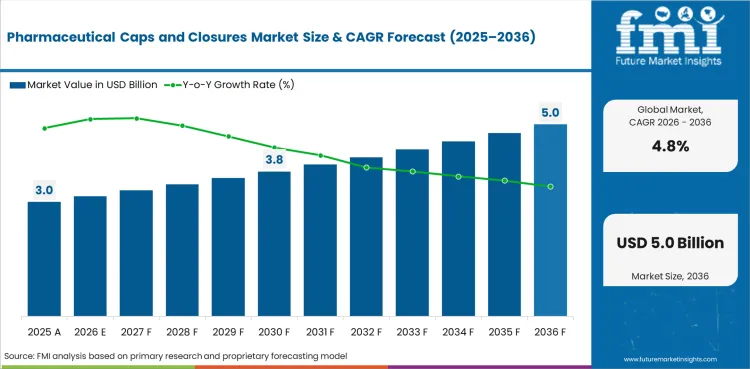
The pharmaceutical caps and closures market was valued at USD 2.9 billion in 2025. The market is expected to cross USD 3.0 billion in 2026 and reach USD 4.8 billion by 2036 at a CAGR of 4.8%. Plastic will lead materials with a 59.8% share in 2026. Pharmaceutical and biotechnology companies will lead end-user demand with a 51.2% share in 2026.
Summary of the Pharmaceutical Caps and Closures Market
- Demand And Growth Drivers
- Drug output keeps closure demand tied to every bottle and vial that needs a qualified seal. Jar packs create the same requirement across medicine packaging.
- Pharmaceutical packaging demand supports repeat orders because pack integrity rules keep closure replacement steady.
- Plastic formats are commercially important because they support child resistant and tamper evident designs with stable molding economics.
- Product and segment view
- Plastic remains the leading material because it combines low weight with design flexibility across regulated drug packs.
- Pharmaceutical and biotechnology companies remain the leading end user group because commercial filling programs absorb the largest closure volumes.
- Screw caps and closures continue to lead product demand because bottle-based drug packs use resealable closure systems across tablets and liquids.
- Geography and competitive outlook
- China and India remain the fastest-rising countries because medicine output and packaging component demand keep moving upward.
- The United States and Germany show steadier expansion because their supplier bases are mature and qualification cycles stay disciplined.
- Competition centers on seal reliability and child-resistant performance. Material choice and validated supply support remain important in supplier selection.
- Analyst opinion
- Sabyasachi Ghosh, Principal Consultant at Future Market Insights, opines, "Supplier preference is shaped by closure reliability and material familiarity. Line-level compatibility remains a third filter in component selection. Pharmaceutical packaging teams prioritize components that support compliance and efficient conversion across large-scale filling operations."
- Pharmaceutical Caps and Closures Market value analysis
- Recurring medicine packaging forms a stable revenue base because closures move with each approved primary pack.
- Value remains concentrated in plastic systems because high volume drug packs use molded formats across oral solids and liquids.
- Pharmaceutical and biotechnology companies form the largest revenue block because direct commercial filling absorbs the highest closure volumes.
- Pricing pressure remains measured because pack validation slows supplier change and protects approved formats.
Key Takeaways
- The pharmaceutical caps and closures market was valued at USD 2.9 billion in 2025.
- By 2036, the pharmaceutical caps and closures market is expected to be worth USD 4.8 billion.
- From 2026 to 2036, the market is projected to expand at a CAGR of 4.8%.
- The market is projected to create an incremental opportunity of USD 1.8 billion between 2026 and 2036.
- In 2026, plastic is expected to account for 59.8% share of material demand because molded resin formats support safety features at scale.
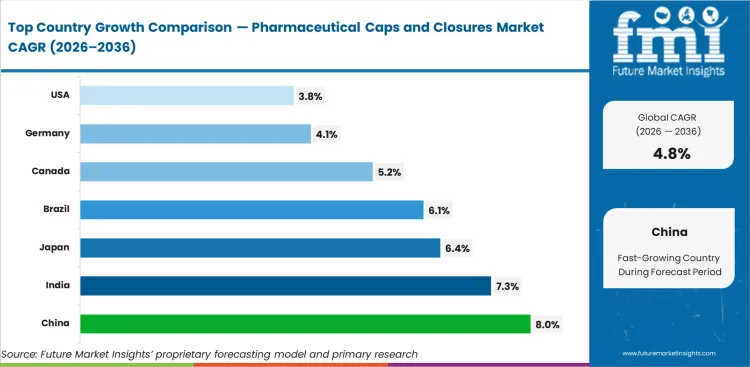
- China at 8.0% CAGR and India at 7.3% CAGR are the two fastest growing countries in the current study.
Pharmaceutical Caps and Closures Market Definition
The market covers caps, closures, seals, and related systems used in pharmaceutical primary packaging to secure drug containers, preserve pack integrity, support dispensing, and meet safety requirements across prescription products, OTC products, and research use products.
Pharmaceutical Caps and Closures Market Inclusions
Market scope includes screw caps and closures, snap caps and closures, push-pull caps and closures, cork closures, stoppers and seals, dispensing closures, and allied specialty formats sold to pharmaceutical and biotechnology companies, contract manufacturing organizations, contract research organizations, and academic and research institutes.
Pharmaceutical Caps and Closures Market Exclusions
The scope excludes empty bottles sold without closures, secondary cartons, labels, transport packaging, standalone dosing accessories sold outside closure systems, and packaging machinery unless closure compatibility is under discussion.
Pharmaceutical Caps and Closures Market Research Methodology
- Primary Research: Interviews covered pharmaceutical packaging teams, filling line specialists, material distributors, and contract manufacturing personnel.
- Desk Research: Published company documents, packaging catalogues, compliance materials, and pharmaceutical packaging references were used to map product design and material use.
- Market Sizing and Forecasting: Revenue estimates were aligned to pharmaceutical packaging throughput, closure to container demand mapping, material mix, and end user consumption.
- Data Validation: Final ranges were tested for variance and internal consistency before peer review.
Why are the Pharmaceutical Caps and Closures Market Growing?
- Recurring drug output sustains a steady demand base across bottles and jars. Vials add the same requirement for routine closure supply.
- Plastic closure systems support value because feature-rich molded designs fit child-resistant and tamper-evident packs.
- Pack integrity requirements raise the importance of qualified components on regulated filling lines.
- Biologic and liquid medicine output supports added demand for droppers and dispensing closures. Specialty sealing formats gain from the same trend.
Demand for pharmaceutical caps and closures aligns with pharmaceutical packaging volumes. Pharmaceutical container demand and vial use keep closures tied to routine pack conversion across medicine programs. Growth reflects a steady expansion toward feature-rich closure formats. Plastic caps and child-resistant systems gain commercial advantage for companies as safety expectations and line stability influence component selection.
Market Segmentation Analysis
- Plastic is estimated to account for 59.8% share of material demand in 2026 because molded resin formats support light packs and integrated safety features.
- Pharmaceutical and biotechnology companies are expected to represent 51.2% share of end user demand in 2026 because direct commercial filling programs absorb the largest closure volumes.
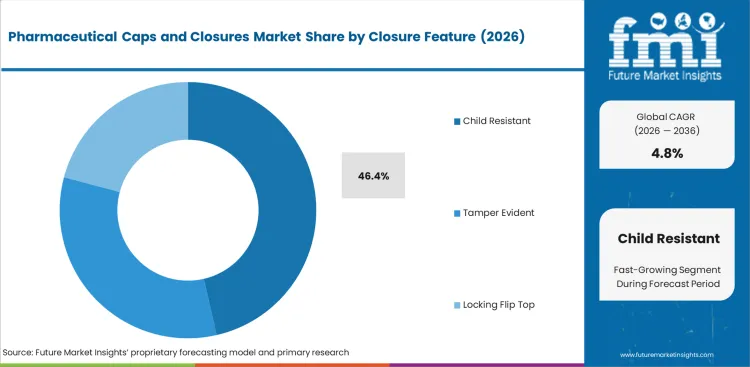
- Child resistant formats are projected to capture 46.4% share of closure feature demand in 2026 because household medicine packs need strong safety performance.
- Screw caps and closures are anticipated to hold 26.3% share of product demand in 2026 because bottle-based drug packs use resealable formats across tablets and liquid medicines.
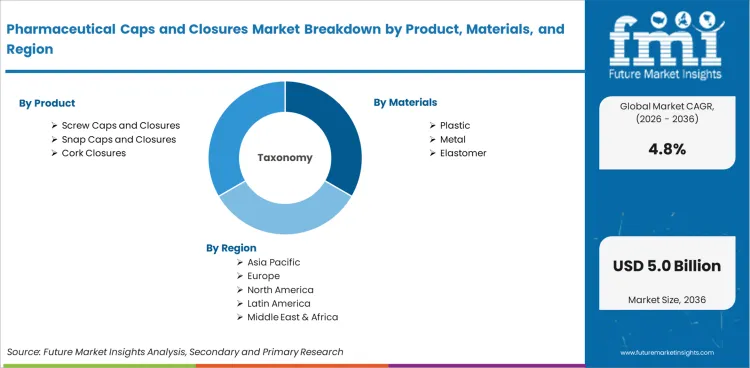
The market is segmented by product, covering screw caps and closures along with snap caps and closures, push-pull caps and closures, cork closures, stoppers and seals, dispensing closures, and other formats, with screw caps and closures leading due to wide use across bottle-based pharmaceutical packaging. It is further segmented by neck finish across caps, cork, and closures used with regulated drug packs. By material the market covers plastic and metal options. It includes elastomer and other materials as well, with plastic leading because it supports lightweight molding and child-resistant designs at industrial scale. By end user the market serves pharmaceutical and biotechnology companies. It extends to contract manufacturing organizations, contract research organizations, and academic and research institutes that use closures across bottles, jars, and vials.
Pharmaceutical Caps and Closures Market analysis by Product
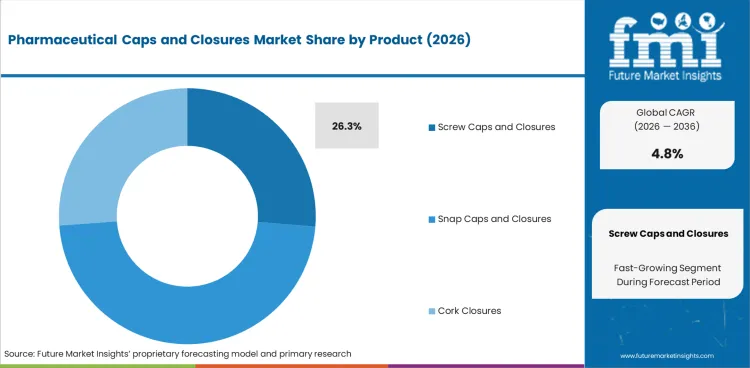
- Screw caps and closures are expected to hold 26.3% share of product demand in 2026 because bottle-based drug packs use simple resealable formats across tablets and powders. Liquid medicines use the same resealable format.
- Their lead position is supported by strong line familiarity and easy adaptation into child resistant or tamper evident designs.
Insights into the Snap Caps and Closures segment
- Snap caps and closures are likely to expand at a faster pace because short cycle liquid packs and sample formats use quick sealing formats with low handling effort.
- Parenteral drug packaging supports elastomer use because injectable formats require dependable closure compression and stable contact performance during storage.
Pharmaceutical Caps and Closures Market analysis by Materials
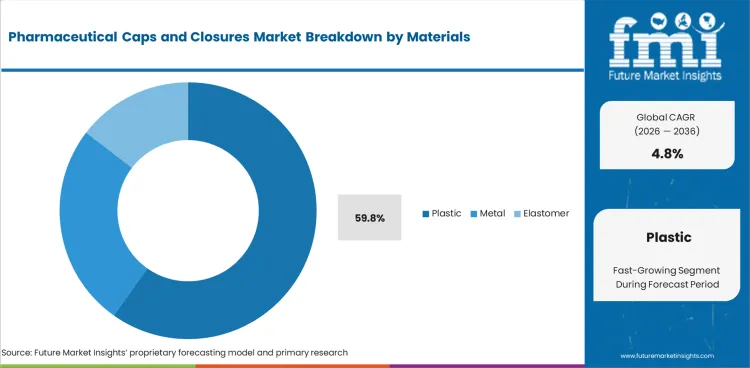
- Plastic is projected to account for 59.8% share of material demand in 2026 because molded resin formats combine low weight with stable processing and easy safety feature integration.
- Its lead is reinforced by design flexibility across threaded closures and droppers. Flip-top structures used in regulated drug packs add further support.
Insights into the Elastomer segment
- Elastomer formats hold value in sterile and vial-based packs because barrier control and sealing performance remain important in sensitive medicine applications.
- Injectable drug packs and vial closures support elastomer demand because sealing stability and drug-contact performance remain important in sensitive pharmaceutical applications.
Pharmaceutical Caps and Closures Market analysis by End User
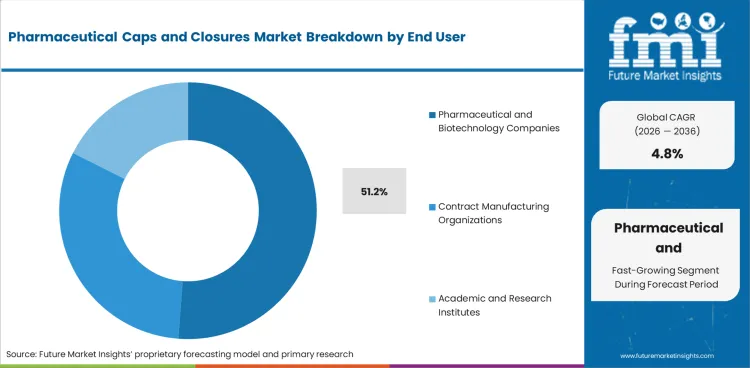
- Pharmaceutical and biotechnology companies are expected to represent 51.2% share of end user demand in 2026 because direct commercial filling programs consume more closure volume than research-oriented channels.
- Approved pack formats stay in place for long production cycles. That protects repeat orders once a closure system clears validation.
Insights into the Contract Manufacturing Organizations segment
- Contract manufacturing organizations are likely to rise at a faster pace because outsourced drug production leads to packaging volume in Asia and Latin America.
- Rising outsourced filling programs continue to lift closure demand. Contract manufacturers handle larger drug volumes for pharmaceutical brands across multiple packaging lines.
Pharmaceutical Caps and Closures Market analysis by Neck Finish
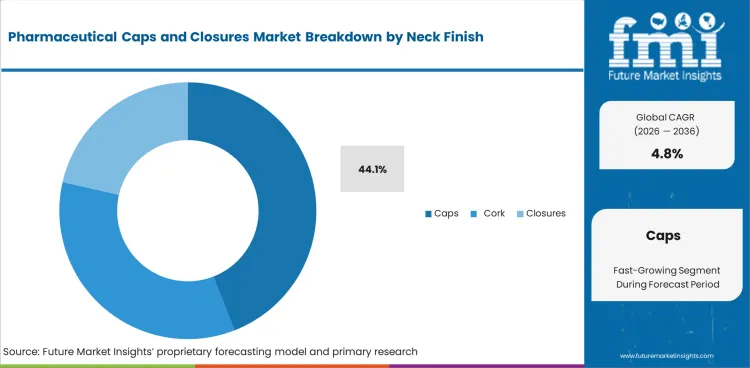
- Caps are estimated to hold 44.1% share of neck finish demand in 2026 because threaded bottle openings dominate oral solid and syrup packs across regulated drug packaging.
- This share reflects strong use of standard screw finishes on packs that need secure reseal performance on commercial lines.
Insights into the Closures segment
- Closures under dispensing and specialty forms should post healthy gains because droppers and pumps serve liquid products that need controlled delivery. Spray formats support the same requirement.
- Oral drops and liquid therapies continue to support specialty closure demand as these formats rely on controlled dispensing for accurate and convenient use.
Pharmaceutical Caps and Closures Market analysis by Dispensing Type
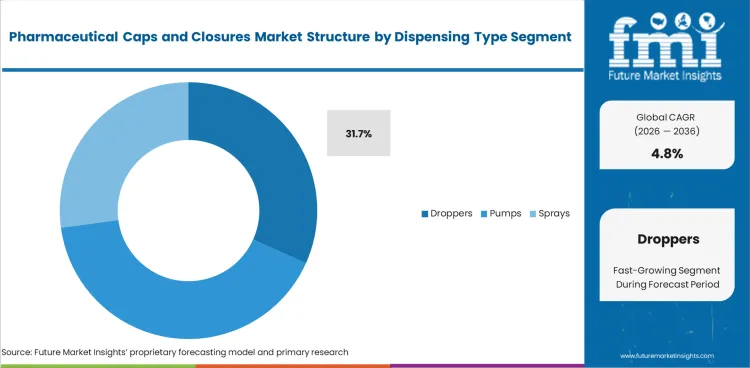
- Droppers are forecast to represent 31.7% share of dispensing type demand in 2026 because ophthalmic packs and measured liquid medicines need simple dose control at the point of use.
- Drug pack teams favor this format in products that require repeat low volume dispensing with controlled handling.
Insights into the Pumps segment
- Pumps are likely to advance at a faster pace because select topical and specialty liquid products are moving toward measured delivery systems.
- Dermatology packs and specialty liquid medicines are adding pump formats because controlled output improves dosing consistency across repeated patient use.
Pharmaceutical Caps and Closures Market analysis by Closure Feature
- Child resistant formats are projected to capture 46.4% share of closure feature demand in 2026 because oral dose packs stored in homes need strong safety performance without harming daily access.
- The lead is reinforced by continued use of protective packs across OTC lines and controlled prescription products.
Insights into the Tamper Evident segment
- Tamper evident closures remain commercially important because visible pack security helps protect medicine integrity across retail and hospital channels.
- Hospital dispensaries and retail drug outlets continue to favor tamper evident closures because visible opening proof helps reduce pack handling risk before patient use.
Pharmaceutical Caps and Closures Market Drivers, Restraints, and Opportunities
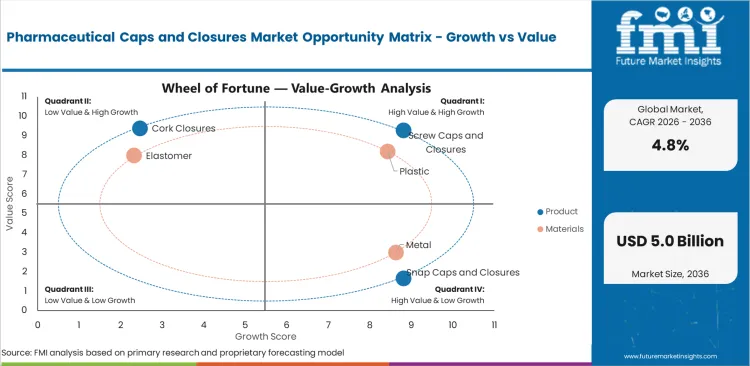
- Recurring demand for bottles and vials keeps the main volume base for pharmaceutical caps and closures.
- Mature closure lines face price discipline because approved suppliers compete in standard formats and requalification slows format change.
- Child-resistant and tamper-evident formats create higher-value product lanes for suppliers that support safety and filling-line performance.
Price Discipline in Mature Closure Formats
Price expansion stays controlled in standard closure lines because approved suppliers already serve mature pharmaceutical formats. Format change is slow after line validation and stability review. That limits fast switching in routine programs. Mature supplier bases in the United States and Western Europe keep buying terms disciplined in established closure programs. That pattern keeps value expansion measured in standard formats that have long qualification histories with drug producers.
Higher Value Safety and Dispensing Formats
Child-resistant and tamper-evident formats support added value in this industry because medicine packs need stronger safety performance. Dispensing closures add another path for growth in products that need controlled delivery or easier handling. Suppliers are introducing metal-free and functionality-enhanced formats to improve pack performance without forcing major packaging changes. These product moves support value creation in closure lines that carry tighter safety and usability needs.
Regional Market Analysis
.webp "Top Country Growth Comparison Pharmaceutical Caps And Closures Market Cagr (2026 2036)")
| Country | CAGR |
|---|---|
| United States | 3.8% |
| Canada | 5.2% |
| Brazil | 6.1% |
| China | 8.0% |
| India | 7.3% |
| Germany | 4.1% |
| Japan | 6.4% |
Source. Future Market Insights analysis based on the supplied market model and covered country narratives.
Analysis of Pharmaceutical Caps and Closures Market by Key Countries
- China is projected to record the fastest growth at 8.0% CAGR through 2036 as medicine output and packaging component demand keep rising.
- India follows at 7.3% CAGR because domestic pharmaceutical manufacturing and export packing both support closure demand.
- Japan is projected to grow at 6.4% CAGR through 2036. Brazil follows at 6.1% CAGR because significant medicine output and local packaging use keep component demand firm.
- The United States is projected at 3.8% CAGR through 2036. Germany is projected at 4.1% CAGR and stays closer to the global pace because supplier bases are mature and validation cycles remain disciplined.
Country differences reflect pharmaceutical manufacturing scale and packaging throughput. The pace of closure demand across local drug production programs shapes the rest of the variation. China and India stay above the global growth rate because drug manufacturing is rising and packaging component use is expanding across large-volume lines. Japan and Brazil also post healthy growth because medicine output and packaging needs continue to increase across domestic supply chains. The United States and Germany hold a steadier position because established supplier bases and mature packaging operations keep expansion more measured.
Opportunity analysis of Pharmaceutical Caps and Closures in Germany
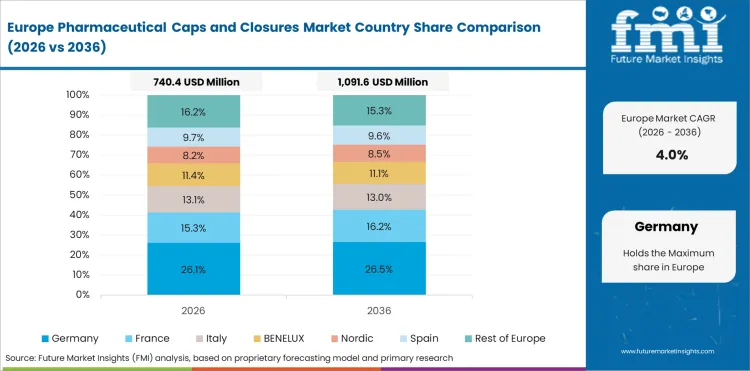
Germany has a mature pharmaceutical manufacturing base and closure demand stays tied to validated packaging programs. The pharmaceutical caps and closures market in Germany is expected to rise at a 4.1% CAGR through 2036 because regulated drug production keeps using qualified closure components across routine packaging lines. Steady medicine output supports repeat demand for bottle and vial closures in this country.
- Mature pharmaceutical plants support regular demand for qualified closure components across bottle and vial packaging lines.
- Stable packaging throughput supports repeat orders for screw caps and other approved closure formats in Germany.
- A mature supplier base limits faster value expansion across this established pharmaceutical packaging market.
Future outlook for Pharmaceutical Caps and Closures in the United Kingdom
The United Kingdom keeps a steady medicine packaging flow and contract manufacturing adds useful support to closure consumption. The demand for pharmaceutical caps and closures in the United Kingdom is expected to grow at a 4.7% CAGR through 2036 because drug packagers keep using reliable closure systems across regulated filling activity. Stable medicine-packaging throughput keeps volume movement consistent in standard closure formats.
- Contract manufacturing activity supports closure consumption across repeat packaging programs in the United Kingdom.
- Stable medicine-packaging throughput supports regular demand for compliance-aligned caps and closures across routine formats.
- Reliable closure preference supports steady orders in an established and quality-led pharmaceutical packaging environment.
In-depth analysis of Pharmaceutical Caps and Closures in China
China is adding pharmaceutical production scale and that keeps packaging component demand on a stronger upward path. China is likely to record an 8.0% CAGR in pharmaceutical caps and closures through 2036 because rising medicine output increases use of caps and seals across regulated drug supply chains. Healthcare-packaging demand is expanding with local manufacturing intensity in this country.
- Rising pharmaceutical production increases closure use across bottle packs and other regulated drug presentations in China.
- Healthcare-packaging demand is expanding and that supports stronger consumption of packaging components across domestic supply chains.
- China stays ahead of the global growth rate because local drug output is increasing across large manufacturing programs.
Sales analysis of Pharmaceutical Caps and Closures in Brazil
Brazil is building closure demand from local medicine production and from rising consumption of packaged drugs. The pharmaceutical caps and closures market in Brazil is estimated to expand at a 6.1% CAGR through 2036 because local pharmaceutical manufacturing keeps using scalable closure systems in commercial drug packs. Packaging demand is rising with broader use of packaged medicines across the country.
- Local pharmaceutical manufacturing supports closure demand across routine bottle and container packaging lines in Brazil.
- Packaged medicine consumption supports sales of scalable plastic closure systems across commercial formats.
- Brazil posts faster growth than mature Western markets because its packaging demand base is still expanding.
Demand outlook for Pharmaceutical Caps and Closures in India
India continues to add pharmaceutical manufacturing capacity and that keeps closure demand on a strong volume path. Demand for pharmaceutical caps and closures in India is expected to rise at a 7.3% CAGR through 2036 because generics production keeps consuming scalable closure systems across solid-dose and liquid-medicine packaging. High-volume drug output supports repeat demand for approved caps and seals in this country.
- Generics production supports strong closure consumption across high-volume pharmaceutical packaging programs in India.
- Solid-dose and liquid-medicine packs keep demand active for scalable caps and seals across local drug lines.
- India stays above the global growth rate because manufacturing expansion keeps adding packaging component demand.
Future outlook for Pharmaceutical Caps and Closures in Japan
Japan has a strong pharmaceutical production base and closure demand stays linked to regulated medicine packaging activity. The pharmaceutical caps and closures market in Japan is expected to grow at a 6.4% CAGR through 2036 because healthcare-packaging demand is rising and packaging-component use is increasing across drug supply chains. Bottle and vial closure demand is rising due to repeat pharmaceutical output in this country.
- Pharmaceutical production supports repeat use of caps and seals across bottle and vial packaging programs in Japan.
- Healthcare-packaging demand is increasing and that supports stronger closure consumption across regulated medicine formats in this country.
- Japan stays above the global growth rate because packaging-component demand is increasing with local drug supply activity.
Demand outlook for Pharmaceutical Caps and Closures in Canada
Canada has a steady pharmaceutical supply chain and closure demand stays supported by regulated drug packaging activity. Demand for pharmaceutical caps and closures in Canada is projected to rise at 5.2% CAGR through 2036 because healthcare-packaging demand stays firm and plastic-based closures continue to serve regulated medicine packs. Stable pharmaceutical supply activity keeps packaging volume on a consistent path in this country.
- Healthcare-packaging demand supports regular closure orders across regulated bottle and container formats in Canada.
- Plastic-based closures continue to hold steady use across routine drug packaging lines in this country.
- Stable pharmaceutical supply activity supports consistent closure demand across approved medicine packaging programs in Canada.
Competitive landscape and strategic positioning
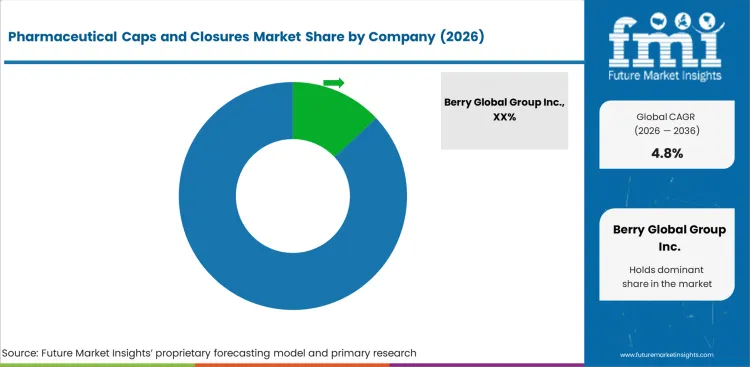
- Competition is moderately concentrated around suppliers with validated pharmaceutical closure formats and dependable supply across regulated packaging programs.
- Large companies hold an advantage because line qualification is slow and pharmaceutical packagers prefer closure systems with proven material consistency.
- Smaller specialists can compete in selected closure formats and new functionality. Entry still needs validation readiness and stable multi-format supply.
Closure suppliers compete on performance that pharmaceutical packagers can verify during qualification and commercial filling. Material consistency influences supplier selection. Child-resistant performance and line compatibility matter across bottles and vials used in regulated drug programs. Berry’s healthcare portfolio and West’s closure-system position reflect a market that values technical credibility over simple catalog size.
Established suppliers benefit from qualified relationships that are hard to replace after stability review and compatibility checks are complete. Pharmaceutical packagers do not change closure vendors quickly after commercial approval. This pattern raises the value of recurring supply consistency and technical support across several pack formats. ALPLA’s purchase of KM Packaging shows how larger groups are adding closure depth to strengthen pharmaceutical packaging coverage and direct customer access.
Specialist suppliers can separate themselves through metal-free formats and safety-led closure design for higher specification applications. West showed that path in 2025 through its Daikyo PLASCAP RUV closure launch in a new nested format. Innovation still creates commercial distance in this industry if it improves compliance or pack usability. Entry stays difficult because pharmaceutical packagers need validation confidence before approving any new closure source.
Key companies in the Pharmaceutical Caps and Closures Market
- Global Leaders: Berry Global Group Inc., West Pharmaceutical Services Inc., AptarGroup Inc., and Amcor Plc. maintain wider closure portfolios and stronger pharmaceutical packaging reach.
- Participants: Gerresheimer AG, WestRock Company, and MOLD-RITE Plastics LLC remain active where material range, custom formats, or regional supply support influence choice.
Competitive benchmarking: Pharmaceutical Caps and Closures Market
| Company | Closure Breadth | Pharma Validation Depth | Material Capability | Geographic Footprint |
|---|---|---|---|---|
| Berry Global Group Inc. | High | High | High | Global |
| West Pharmaceutical Services, Inc. | High | High | Medium | Global |
| AptarGroup, Inc. | High | High | High | Global |
| Amcor Plc. | High | Moderate | High | Global |
| Gerresheimer AG | Medium | High | Medium | Global |
| WestRock Company | Medium | Moderate | High | Global |
| MOLD-RITE Plastics, LLC | Medium | Moderate | Medium | Regional |
Source. Future Market Insights analysis based on the supplied market model and covered country narratives.
Key Developments in the Pharmaceutical Caps and Closures Market
- In January 2025, West Pharmaceutical Services introduced Daikyo PLASCAP Ready-to-Use validated closures in a new nested format at Pharmapack.
- In August 2025, SGD Pharma agreed to acquire Alphial S.r.l. to deepen its pharmaceutical glass packaging position in Europe.
- In August 2025, BERICAP announced the industrial availability of the easyconnect cap solution and noted continued feature development in closure systems.
- In January 2026, Butterfly Equity acquired ePac Flexible Packaging in a major consolidation move that underlined continuing deal activity in packaging supply.
Key players in the Pharmaceutical Caps and Closures Market
Major global players
- Berry Global Group Inc.
- West Pharmaceutical Services, Inc.
- AptarGroup, Inc.
- Amcor Plc.
- Gerresheimer AG
Emerging players and challengers
- WestRock Company
- O. Berk Company, LLC
- C.L. Smith Company
- Drug Plastics & Glass Co. Inc.
- MOLD-RITE Plastics, LLC
Report Scope and Coverage
| Parameter | Details |
|---|---|
| Quantitative Units | USD 2.9 billion in 2025 to USD 4.8 billion in 2036, at a CAGR of 4.8% |
| Market Definition | Closure systems used to seal and protect pharmaceutical primary packs across regulated drug formats. |
| Regions Covered | North America, Latin America, East Asia, South Asia and Pacific, Western Europe |
| Countries Covered | United States, Canada, Brazil, China, India, Germany, Japan, and 30+ countries |
| Key Companies Profiled | Berry Global Group Inc., West Pharmaceutical Services Inc., AptarGroup Inc., Amcor Plc., Gerresheimer AG, WestRock Company, O. Berk Company, LLC |
| Forecast Period | 2026 to 2036 |
| Historical Reference Year | 2025 |
| Approach | Hybrid demand mapping aligned to packaging throughput, closure format use, and material mix |
Source. Future Market Insights analysis based on the supplied market model and covered country narratives.
Pharmaceutical Caps and Closures Market breakdown by Product, Neck Finish, Materials, End User, Dispensing Type, Closure Feature, and Region
Pharmaceutical Caps and Closures Market by Product
- Screw Caps and Closures
- Snap Caps and Closures
- Push-Pull Caps and Closures
- Cork Closures
- Stoppers and Seals
- Dispensing Closures
- Others
Pharmaceutical Caps and Closures Market by Neck Finish
- Caps
- Cork
- Closures
Pharmaceutical Caps and Closures Market by Materials
- Plastic
- Metal
- Elastomer
- Others
Pharmaceutical Caps and Closures Market by End User
- Pharmaceutical and Biotechnology Companies
- Contract Manufacturing Organizations
- Contract Research Organizations
- Academic and Research Institutes
Pharmaceutical Caps and Closures Market by Dispensing Type
- Droppers
- Pumps
- Sprays
- Flip Top Closures
Pharmaceutical Caps and Closures Market by Closure Feature
- Child Resistant
- Tamper Evident
- Locking Flip Top
Pharmaceutical Caps and Closures Market by Region
- North America
- Latin America
- East Asia
- South Asia and Pacific
- Western Europe
Research Sources and Bibliography
- ALPLA Group. (2025, June 24). ALPLA acquires closure specialist KM Packaging.
- U.S. Food and Drug Administration. (2020, May 6). Container closure systems for packaging human drugs and biologics.
- Lv, Y. (2025). Pharmaceutical packaging materials and medication safety: A mini-review. Safety, 11(3), 69.
- Raut, A., et al. (2024). Standards of child resistant packaging: A regulatory view. Indian Journal of Pharmaceutical Education and Research.
- ePac Flexible Packaging. (2026, January 15). Butterfly Equity acquires ePac Flexible Packaging.
- SGD Pharma. (2025, August 28). A strategic step forward: Alphial S.r.l. joins SGD Pharma.
- BERICAP. (2025, August 11). BERICAP announces industrial launch of easyconnect cap.
- West Pharmaceutical Services, Inc. (2025, January 22). West introduces Daikyo PLASCAP RUV closures in new nested format at Pharmapack.
The bibliography is provided for reader reference.
This Report Answers
- What size is the pharmaceutical caps and closures market in 2026 and how large can it become by 2036?
- How fast is pharmaceutical caps and closures demand expected to expand between 2026 and 2036?
- Which product, material, end user, neck finish, dispensing type, and closure feature segments lead 2026 demand?
- Why do plastic materials and pharmaceutical and biotechnology companies hold the largest share of 2026 demand?
- Which countries are expected to post the fastest growth through 2036?
- Which companies remain most visible across validated pharmaceutical closure supply?
Frequently Asked Questions
How large is the Pharmaceutical Caps and Closures Market in 2026?
The Pharmaceutical Caps and Closures Market is expected to reach USD 3.0 billion in 2026 under the current demand model.
How big can the Pharmaceutical Caps and Closures Market become by 2036?
The Pharmaceutical Caps and Closures Market is projected to reach USD 4.8 billion by 2036 under steady medicine packaging demand.
What growth rate is expected through the forecast period for the Pharmaceutical Caps and Closures Market?
The Pharmaceutical Caps and Closures Market is expected to expand at a CAGR of 4.8% from 2026 to 2036.
Which product leads the Pharmaceutical Caps and Closures Market by 2026?
Screw caps and closures are expected to lead the Pharmaceutical Caps and Closures Market with a 26.3% share in 2026.
Which material leads the Pharmaceutical Caps and Closures Market by 2026?
Plastic is expected to lead the Pharmaceutical Caps and Closures Market with a 59.8% share in 2026.
Which country grows the fastest in the Pharmaceutical Caps and Closures Market?
China is expected to record the fastest rise in the Pharmaceutical Caps and Closures Market with an 8.0% CAGR through 2036.
Preview the report firsthand - request a free sample
Get SampleGet the brochure for pricing and purchase details.
Get PDFTable of Content
- Key Takeaways
- Market Size and CAGR
- Top Growth Driver
- Fastest Growing Segment
- Leading Region
- Key Companies
- Emerging Opportunities
- Executive Summary
- Global Market Outlook
- Demand-side Trends
- Supply-side Trends
- Technology Roadmap Analysis
- Analysis and Recommendations
- Analyst Perspective (What is happening? Why now? What should investors know?)
- Key Questions Answered
- How large is the market?
- What is the CAGR?
- What are key trends?
- Which region dominates?
- Who are the leaders?
- Market Overview
- Market Coverage / Taxonomy
- Market Definition / Scope / Limitations
- Research Methodology
- Chapter Orientation
- Analytical Lens and Working Hypotheses
- Market Structure, Signals, and Trend Drivers
- Benchmarking and Cross-market Comparability
- Market Sizing, Forecasting, and Opportunity Mapping
- Research Design and Evidence Framework
- Desk Research Programme (Secondary Evidence)
- Expert Input and Fieldwork (Primary Evidence)
- Tooling, Models, and Reference Databases
- Data Engineering and Model Build
- Quality Assurance and Audit Trail
- Market Background
- Market Dynamics (Drivers, Restraints, Opportunity, Trends)
- Scenario Forecast (Optimistic, Likely, Conservative)
- Impact Analysis
- AI Impact
- Sustainability Impact
- Regulatory Impact
- Technology Impact
- Consumer / Buyer Analysis
- Purchase Drivers
- Adoption Barriers
- Buyer Journey
- Opportunity Map Analysis
- Product Life Cycle Analysis
- Supply Chain Analysis
- Investment Feasibility Matrix
- Value Chain Analysis
- PESTLE and Porter's Analysis
- Regulatory Landscape
- Regional Parent Market Outlook
- Production and Consumption Statistics
- Import and Export Statistics
- Global Market Analysis and Forecast, 2021 to 2036
- Historical Market Size Value (USD Billion) Analysis, 2021 to 2025
- Current and Future Market Size Value (USD Billion) Projections, 2026 to 2036
- Y-o-Y Growth Trend Analysis
- Absolute $ Opportunity Analysis
- Global Market Pricing Analysis, 2021 to 2036
- Global Market Analysis and Forecast, By Product, 2021 to 2036
- Introduction / Key Findings
- Historical Market Size Value (USD Billion) Analysis By Product, 2021 to 2025
- Current and Future Market Size Value (USD Billion) Analysis and Forecast By Product, 2026 to 2036
- Screw Caps and Closures
- Snap Caps and Closures
- Push-Pull Caps and Closures
- Cork Closures
- Stoppers and Seals
- Dispensing Closures
- Others
- Screw Caps and Closures
- Y-o-Y Growth Trend Analysis By Product, 2021 to 2025
- Absolute $ Opportunity Analysis By Product, 2026 to 2036
- Global Market Analysis and Forecast, By Neck Finish, 2021 to 2036
- Introduction / Key Findings
- Historical Market Size Value (USD Billion) Analysis By Neck Finish, 2021 to 2025
- Current and Future Market Size Value (USD Billion) Analysis and Forecast By Neck Finish, 2026 to 2036
- Caps
- Cork
- Closures
- Caps
- Y-o-Y Growth Trend Analysis By Neck Finish, 2021 to 2025
- Absolute $ Opportunity Analysis By Neck Finish, 2026 to 2036
- Global Market Analysis and Forecast, By Materials, 2021 to 2036
- Introduction / Key Findings
- Historical Market Size Value (USD Billion) Analysis By Materials, 2021 to 2025
- Current and Future Market Size Value (USD Billion) Analysis and Forecast By Materials, 2026 to 2036
- Plastic
- Metal
- Elastomer
- Others
- Plastic
- Y-o-Y Growth Trend Analysis By Materials, 2021 to 2025
- Absolute $ Opportunity Analysis By Materials, 2026 to 2036
- Global Market Analysis and Forecast, By End User, 2021 to 2036
- Introduction / Key Findings
- Historical Market Size Value (USD Billion) Analysis By End User, 2021 to 2025
- Current and Future Market Size Value (USD Billion) Analysis and Forecast By End User, 2026 to 2036
- Pharmaceutical and Biotechnology Companies
- Contract Manufacturing Organizations
- Contract Research Organizations
- Academic and Research Institutes
- Pharmaceutical and Biotechnology Companies
- Y-o-Y Growth Trend Analysis By End User, 2021 to 2025
- Absolute $ Opportunity Analysis By End User, 2026 to 2036
- Global Market Analysis and Forecast, By Dispensing Type, 2021 to 2036
- Introduction / Key Findings
- Historical Market Size Value (USD Billion) Analysis By Dispensing Type, 2021 to 2025
- Current and Future Market Size Value (USD Billion) Analysis and Forecast By Dispensing Type, 2026 to 2036
- Droppers
- Pumps
- Sprays
- Flip Top Closures
- Droppers
- Y-o-Y Growth Trend Analysis By Dispensing Type, 2021 to 2025
- Absolute $ Opportunity Analysis By Dispensing Type, 2026 to 2036
- Global Market Analysis and Forecast, By Closure Feature
- Introduction / Key Findings
- Historical Market Size Value (USD Billion) Analysis By Closure Feature, 2021 to 2025
- Current and Future Market Size Value (USD Billion) Analysis and Forecast By Closure Feature, 2026 to 2036
- Child Resistant
- Tamper Evident
- Locking Flip Top
- Child Resistant
- Y-o-Y Growth Trend Analysis By Closure Feature, 2021 to 2025
- Absolute $ Opportunity Analysis By Closure Feature, 2026 to 2036
- Global Market Analysis and Forecast, By Region, 2021 to 2036
- Introduction
- Historical Market Size Value (USD Billion) Analysis By Region, 2021 to 2025
- Current Market Size Value (USD Billion) Analysis and Forecast By Region, 2026 to 2036
- North America
- Latin America
- Western Europe
- Eastern Europe
- East Asia
- South Asia and Pacific
- Middle East & Africa
- Market Attractiveness Analysis By Region
- North America Market Analysis and Forecast, By Country, 2021 to 2036
- Historical Market Size Value (USD Billion) Trend Analysis By Market Taxonomy, 2021 to 2025
- Market Size Value (USD Billion) Forecast By Market Taxonomy, 2026 to 2036
- By Country
- USA
- Canada
- By Product
- By Neck Finish
- By Materials
- By End User
- By Dispensing Type
- By Closure Feature
- By Country
- Market Attractiveness Analysis
- By Country
- By Product
- By Neck Finish
- By Materials
- By End User
- By Dispensing Type
- By Closure Feature
- Key Takeaways
- Latin America Market Analysis and Forecast, By Country
- Historical Market Size Value (USD Billion) Trend Analysis By Market Taxonomy, 2021 to 2025
- Market Size Value (USD Billion) Forecast By Market Taxonomy, 2026 to 2036
- By Country
- Brazil
- Mexico
- Chile
- Rest of Latin America
- By Product
- By Neck Finish
- By Materials
- By End User
- By Dispensing Type
- By Closure Feature
- By Country
- Market Attractiveness Analysis
- By Country
- By Product
- By Neck Finish
- By Materials
- By End User
- By Dispensing Type
- By Closure Feature
- Key Takeaways
- Western Europe Market Analysis and Forecast, By Country
- Historical Market Size Value (USD Billion) Trend Analysis By Market Taxonomy, 2021 to 2025
- Market Size Value (USD Billion) Forecast By Market Taxonomy, 2026 to 2036
- By Country
- Germany
- UK
- Italy
- Spain
- France
- Nordic
- BENELUX
- Rest of Western Europe
- By Product
- By Neck Finish
- By Materials
- By End User
- By Dispensing Type
- By Closure Feature
- By Country
- Market Attractiveness Analysis
- By Country
- By Product
- By Neck Finish
- By Materials
- By End User
- By Dispensing Type
- By Closure Feature
- Key Takeaways
- Eastern Europe Market Analysis and Forecast, By Country
- Historical Market Size Value (USD Billion) Trend Analysis By Market Taxonomy, 2021 to 2025
- Market Size Value (USD Billion) Forecast By Market Taxonomy, 2026 to 2036
- By Country
- Russia
- Poland
- Hungary
- Balkan & Baltic
- Rest of Eastern Europe
- By Product
- By Neck Finish
- By Materials
- By End User
- By Dispensing Type
- By Closure Feature
- By Country
- Market Attractiveness Analysis
- By Country
- By Product
- By Neck Finish
- By Materials
- By End User
- By Dispensing Type
- By Closure Feature
- Key Takeaways
- East Asia Market Analysis and Forecast, By Country
- Historical Market Size Value (USD Billion) Trend Analysis By Market Taxonomy, 2021 to 2025
- Market Size Value (USD Billion) Forecast By Market Taxonomy, 2026 to 2036
- By Country
- China
- Japan
- South Korea
- By Product
- By Neck Finish
- By Materials
- By End User
- By Dispensing Type
- By Closure Feature
- By Country
- Market Attractiveness Analysis
- By Country
- By Product
- By Neck Finish
- By Materials
- By End User
- By Dispensing Type
- By Closure Feature
- Key Takeaways
- South Asia and Pacific Market Analysis and Forecast, By Country
- Historical Market Size Value (USD Billion) Trend Analysis By Market Taxonomy, 2021 to 2025
- Market Size Value (USD Billion) Forecast By Market Taxonomy, 2026 to 2036
- By Country
- India
- ASEAN
- Australia & New Zealand
- Rest of South Asia and Pacific
- By Product
- By Neck Finish
- By Materials
- By End User
- By Dispensing Type
- By Closure Feature
- By Country
- Market Attractiveness Analysis
- By Country
- By Product
- By Neck Finish
- By Materials
- By End User
- By Dispensing Type
- By Closure Feature
- Key Takeaways
- Middle East & Africa Market Analysis and Forecast, By Country
- Historical Market Size Value (USD Billion) Trend Analysis By Market Taxonomy, 2021 to 2025
- Market Size Value (USD Billion) Forecast By Market Taxonomy, 2026 to 2036
- By Country
- Kingdom of Saudi Arabia
- Other GCC Countries
- Türkiye
- South Africa
- Other African Union
- Rest of Middle East & Africa
- By Product
- By Neck Finish
- By Materials
- By End User
- By Dispensing Type
- By Closure Feature
- By Country
- Market Attractiveness Analysis
- By Country
- By Product
- By Neck Finish
- By Materials
- By End User
- By Dispensing Type
- By Closure Feature
- Key Takeaways
- Key Countries Market Analysis
- USA
- Pricing Analysis
- Market Share Analysis, 2025
- By Product
- By Neck Finish
- By Materials
- By End User
- By Dispensing Type
- By Closure Feature
- Canada
- Pricing Analysis
- Market Share Analysis, 2025
- By Product
- By Neck Finish
- By Materials
- By End User
- By Dispensing Type
- By Closure Feature
- Mexico
- Pricing Analysis
- Market Share Analysis, 2025
- By Product
- By Neck Finish
- By Materials
- By End User
- By Dispensing Type
- By Closure Feature
- Brazil
- Pricing Analysis
- Market Share Analysis, 2025
- By Product
- By Neck Finish
- By Materials
- By End User
- By Dispensing Type
- By Closure Feature
- Chile
- Pricing Analysis
- Market Share Analysis, 2025
- By Product
- By Neck Finish
- By Materials
- By End User
- By Dispensing Type
- By Closure Feature
- Germany
- Pricing Analysis
- Market Share Analysis, 2025
- By Product
- By Neck Finish
- By Materials
- By End User
- By Dispensing Type
- By Closure Feature
- UK
- Pricing Analysis
- Market Share Analysis, 2025
- By Product
- By Neck Finish
- By Materials
- By End User
- By Dispensing Type
- By Closure Feature
- Italy
- Pricing Analysis
- Market Share Analysis, 2025
- By Product
- By Neck Finish
- By Materials
- By End User
- By Dispensing Type
- By Closure Feature
- Spain
- Pricing Analysis
- Market Share Analysis, 2025
- By Product
- By Neck Finish
- By Materials
- By End User
- By Dispensing Type
- By Closure Feature
- France
- Pricing Analysis
- Market Share Analysis, 2025
- By Product
- By Neck Finish
- By Materials
- By End User
- By Dispensing Type
- By Closure Feature
- India
- Pricing Analysis
- Market Share Analysis, 2025
- By Product
- By Neck Finish
- By Materials
- By End User
- By Dispensing Type
- By Closure Feature
- ASEAN
- Pricing Analysis
- Market Share Analysis, 2025
- By Product
- By Neck Finish
- By Materials
- By End User
- By Dispensing Type
- By Closure Feature
- Australia & New Zealand
- Pricing Analysis
- Market Share Analysis, 2025
- By Product
- By Neck Finish
- By Materials
- By End User
- By Dispensing Type
- By Closure Feature
- China
- Pricing Analysis
- Market Share Analysis, 2025
- By Product
- By Neck Finish
- By Materials
- By End User
- By Dispensing Type
- By Closure Feature
- Japan
- Pricing Analysis
- Market Share Analysis, 2025
- By Product
- By Neck Finish
- By Materials
- By End User
- By Dispensing Type
- By Closure Feature
- South Korea
- Pricing Analysis
- Market Share Analysis, 2025
- By Product
- By Neck Finish
- By Materials
- By End User
- By Dispensing Type
- By Closure Feature
- Russia
- Pricing Analysis
- Market Share Analysis, 2025
- By Product
- By Neck Finish
- By Materials
- By End User
- By Dispensing Type
- By Closure Feature
- Poland
- Pricing Analysis
- Market Share Analysis, 2025
- By Product
- By Neck Finish
- By Materials
- By End User
- By Dispensing Type
- By Closure Feature
- Hungary
- Pricing Analysis
- Market Share Analysis, 2025
- By Product
- By Neck Finish
- By Materials
- By End User
- By Dispensing Type
- By Closure Feature
- Kingdom of Saudi Arabia
- Pricing Analysis
- Market Share Analysis, 2025
- By Product
- By Neck Finish
- By Materials
- By End User
- By Dispensing Type
- By Closure Feature
- Türkiye
- Pricing Analysis
- Market Share Analysis, 2025
- By Product
- By Neck Finish
- By Materials
- By End User
- By Dispensing Type
- By Closure Feature
- South Africa
- Pricing Analysis
- Market Share Analysis, 2025
- By Product
- By Neck Finish
- By Materials
- By End User
- By Dispensing Type
- By Closure Feature
- USA
- Market Structure Analysis
- Competition Dashboard
- Competition Benchmarking
- Market Share Analysis of Top Players
- By Regional
- By Product
- By Neck Finish
- By Materials
- By End User
- By Dispensing Type
- By Closure Feature
- Emerging Startups
- Innovation Benchmarking
- Competition Analysis
- Competition Deep Dive
- Berry Global Group Inc.
- Overview
- Product Portfolio
- Profitability by Market Segments
- Sales Footprint
- Strategy Overview
- Marketing Strategy
- Product Strategy
- Channel Strategy
- West Pharmaceutical Services, Inc.
- AptarGroup, Inc.
- Amcor Plc.
- Gerresheimer AG
- WestRock Company
- O. Berk Company, LLC
- C.L. Smith Company
- Drug Plastics & Glass Co. Inc.
- MOLD-RITE Plastics, LLC
- Berry Global Group Inc.
- Case Studies
- Success Stories
- Recent Developments
- Competition Deep Dive
- Assumptions & Acronyms Used


