

- Industry Size (2026)
- USD 19.4 Bn
- Forecast (2036)
- USD 36.1 Bn
- CAGR (2026 to 2036)
- 6.4%
Pillow Market Size, Market Forecast and Outlook By FMI
The pillow market is expected to expand from USD 19.4 billion in 2026 to USD 36.1 billion by 2036. The market is projected to register a 6.4% CAGR during the forecast period. Memory foam is likely to lead filling material with a 34.0% share in 2026, while rectangle pillows are anticipated to account for 46.0% share of shape demand in 2026.
Summary of the Pillow Market
- Demand and Growth Drivers
- Bedding replacement cycles are expected to support consistent demand across household and institutional purchases.
- Premium comfort positioning is likely to increase spending on memory foam and cooling pillow formats.
- Hospitality procurement is anticipated to support stable orders where suppliers maintain consistent specifications.
- Product and Segment View
- Memory foam is expected to lead filling material due to strong positioning in premium comfort assortments.
- Rectangle pillows are likely to remain the main shape due to standard pillowcase compatibility and retail acceptance.
- Cooling pillows are anticipated to gain wider shelf space as buyers trade up from standard sleeping formats.
- Geography and Competitive Outlook
- India is expected to lead country-level expansion as modern retail and online bedding purchases increase.
- China is likely to record strong growth as feature-led bedding formats gain traction through digital channels.
- Companies with stronger portfolio discipline and replenishment reliability are anticipated to improve their position.
- Analyst Opinion
- Ronak Shah, Principal consultant for Consumer Product at FMI, suggests, “The pillow market is likely to shift toward standardized product families with clearer comfort tiers and feature-led upgrades. Brands with memory foam depth, cooling claims consistency, and reliable replenishment systems are expected to gain advantage as retailers reduce slow-moving variants.”
- Pillow Market Value Analysis
- The pillow market is moving from basic bedding replacement into comfort-led home and lifestyle purchasing.
- Demand is likely to rise as consumers trade up to memory foam and cooling pillow formats.
- Adoption is expected to gain support from rectangle pillows that simplify retail planning and repeat purchase.
- Spending is anticipated to be backed by premium bedding adoption and organized retail expansion.
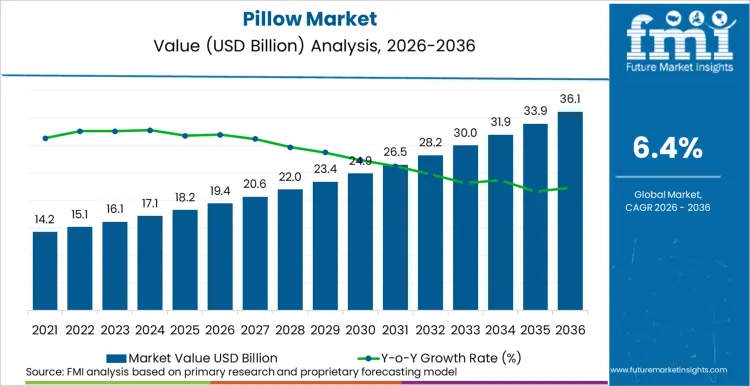
Key Takeaways, Market Size, and Forecast
| Metric | Value |
|---|---|
| Market Size (2026) | USD 19.4 Billion |
| Market Size (2036) | USD 36.1 Billion |
| CAGR (2026–2036) | 6.4% |
| Leading Filling Material (2026) | Memory Foam |
| Memory Foam Share (2026) | 34.0% |
| Leading Shape (2026) | Rectangle Pillows |
| Rectangle Pillows Share (2026) | 46.0% |
| Fastest-Growing Country | India |
| India CAGR | 7.8% |
Consumers are consolidating SKUs around fewer high-performing formats that deliver predictable sell-through, stable quality, and repeat purchase patterns across core sleeping, decorative, bedding, and travel-led lines.
Competitive differentiation is being defined by supply reliability, product tier clarity, and channel execution discipline. Manufacturers are tightening cost control through standardized shells, optimized filling material sourcing, and higher production efficiency in core rectangle and premium comfort formats.
At the same time, feature-driven formats are being scaled with tighter governance around claims, packaging integrity, and retailer compliance expectations, particularly in high-volume cooling and therapy segments.
Key Industry Insights
How are Brands Improving Revenue Quality While Keeping Product Catalogs Manageable?
Portfolio discipline is increasingly based on tiered families built around a small number of shapes and performance specifications. Suppliers are limiting low-velocity variants, strengthening replenishment reliability for top sellers, and improving pricing architecture across mass, premium, and specialist offerings.
Why are Retailers Prioritizing Standardized Rectangle Formats across Channels?
Rectangle pillows support predictable planograms, efficient packaging, stable dimensional logistics, and repeat buying behaviour. Retailers prefer vendors that can maintain consistent specifications across production runs to reduce returns and service issues.
What is Driving Scale In Feature-Led Formats Such as Cooling and Therapy?
Feature-led formats are gaining shelf allocation due to clear tiering against standard pillows and strong merchandising alignment in modern trade and online channels. Category managers are supporting these lines when suppliers provide consistent material inputs, stable QA documentation, and reliable fulfilment windows.
Pillow Market Key Takeaways
| Metric | Value |
|---|---|
| Industry Size (2026) | USD 19.4 Billion |
| Industry Value (2036) | USD 36.1 Billion |
| CAGR (2026-2036) | 6.4% |
Source: Future Market Insights (FMI) analysis, based on proprietary forecasting model and primary research
What Drivers Are Accelerating Market Penetration?
Category expansion is being supported by steady replacement cycles in core bedding assortments, rising premiumisation across comfort positioning, and stronger channel distribution discipline across modern retail and digital-first storefronts. Growth is also being reinforced by institutional buying patterns where procurement focuses on supplier reliability, pricing stability, and consistent product specifications.
Specialist formats are influencing how brands structure their premium and feature-led tiers. Demand signals remain aligned with performance positioning visible in the cervical pillow market, where portfolio tiering and targeted consumer propositions are supporting higher value realization.
Travel-oriented formats are also supporting incremental growth, particularly where buyers expect portability and standardized dimensions. This direction is consistent with purchasing patterns reflected in the neck pillows market, where channel expansion and premium travel accessory alignment are shaping assortment investments.
How is the Pillow Market Segmented Across Key Categories?
The market is segmented by filling material, shape, feature, and application, reflecting how buyers allocate budgets across high-volume sleeping pillows and incremental feature-led categories. Brands and retailers to rationalize SKU counts while preserving trade-up pathways across entry, mid-tier, and premium portfolios increasingly use segmentation.
Why Does Memory Foam Lead Filling Material Demand?
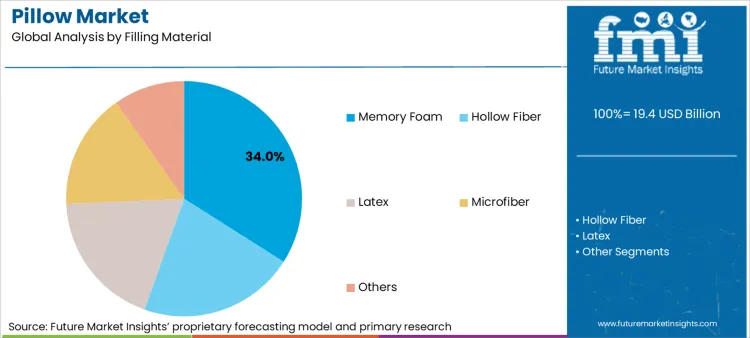
Memory foam pillows will likely account for a 34.0% share in 2026, supported by its strong positioning in premium comfort tiers and consistent uptake across mass-premium portfolios. Suppliers are scaling this segment due to predictable merchandising value and margin stability compared to undifferentiated commodity formats.
Why Do Rectangle Pillows Hold Dominant Shape Share?
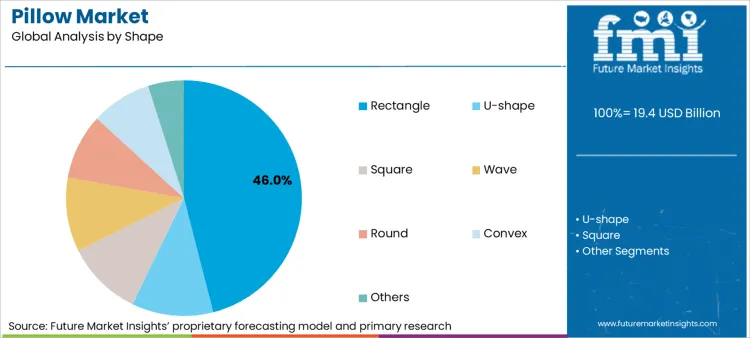
Rectangle pillows are expected to hold a 46.0% share in 2026, driven by their standardization across sleeping and bedding assortments, strong compatibility with core pillowcase offerings, and broad retailer acceptance for inventory planning and fulfilment efficiency.
Why is Cooling the Most Scaled Feature?
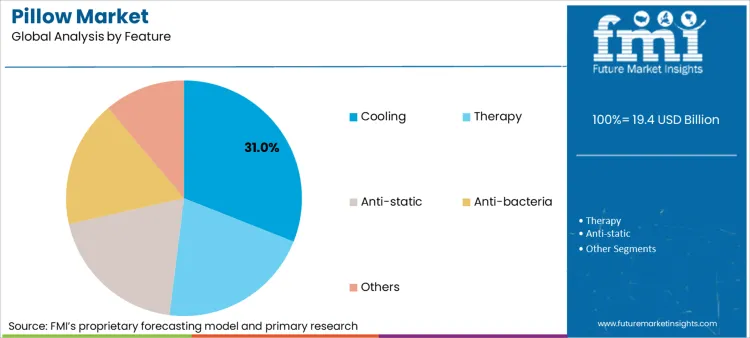
By feature, cooling pillows will likely represent a 31.0% share in 2026, supported by strong shelf visibility in premium lines and sustained pull across both online and in-store channels. Buyers continue to allocate space to cooling formats when suppliers maintain performance consistency and stable replenishment.
Why does Sleeping Remain the Largest Application?
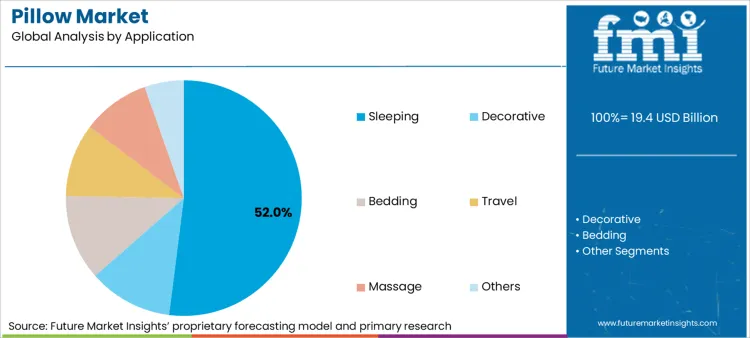
Sleeping pillows are likely to account for a 52.0% share in 2026, reflecting the market’s core demand base and consistent replacement-led purchasing. This segment benefits from reliable order volumes and stable channel performance across modern retail, specialty bedding stores, and digital channels.
What Strategic Shifts Will Shape the Market through 2036?
How will Procurement Discipline influence Supplier Selections?
Retailers and institutional buyers are tightening supplier qualification toward consistency of specification, reduced return risk, and predictable lead-times. Vendors that offer stable product architecture across materials and features are more likely to secure multi-quarter supply commitments.
What is Changing in Pricing and Portfolio Tiering?
Tiering strategy is becoming more structured as brands reduce SKU noise and protect price integrity. The market is seeing sharper differentiation between entry formats, feature-led mid tiers, and premium cooling or therapy-aligned lines, supported by clearer merchandising narratives and tighter discount governance.
Why is Packaging and Dimensional Logistics Gaining Attention?
Dimensional efficiency is treated as a profitability lever for both suppliers and retailers, especially in e-commerce shipments where volumetric cost sensitivity is high. Manufacturers are prioritizing consistent compression performance, packaging durability, and standardized carton planning to control fulfilment costs.
How will the Pillow Industry Evolve in Major Nations?
Growth outlook varies by consumer spend patterns, channel maturity, and the pace of premium bedding adoption. High-growth markets are benefiting from expanding modern retail penetration and stronger D2C scaling, while developed markets remain anchored in replacement demand and premium upgrade cycles.
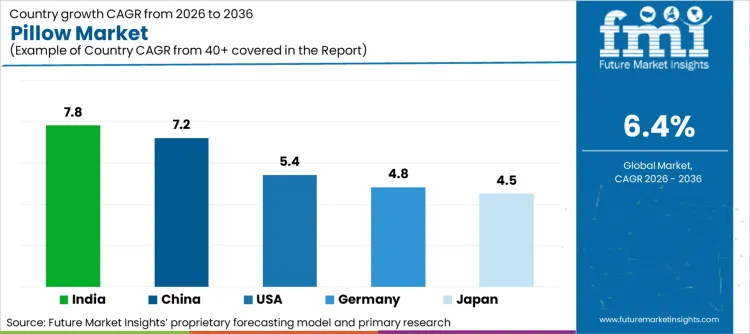
| Country | CAGR (2026 to 2036) |
|---|---|
| India | 7.8% |
| China | 7.2% |
| USA | 5.4% |
| Germany | 4.8% |
| Japan | 4.5% |
Source: Future Market Insights (FMI) analysis, based on proprietary forecasting model and primary research
Why is the Pillow Industry in India Showing Strong Growth?
India is projected to expand at a 7.8% CAGR through 2036, supported by rising premium bedding adoption, stronger modern trade expansion, and increasing digital retail penetration in home and lifestyle categories. Suppliers that execute consistent quality and price-tier clarity are expected to sustain share gains across organized retail channels.
Why is the Pillow Industry in China Expanding Rapidly?
China is forecast to grow at 7.2% CAGR, driven by scale expansion in mid-to-premium bedding assortments and strong online conversion in feature-led formats. Brands are investing in structured portfolios that support higher value realization while maintaining high-volume availability in core shapes.
Why is the Pillow Industry in the United States Sustaining Growth?
The pillow landscape in USA is expected to grow at 5.4% CAGR, supported by predictable replacement cycles, premiumisation in comfort positioning, and sustained demand visibility in bed pillow categories, consistent with trends tracked in the US bed pillow market.
Why is the Pillow Industry in Germany Expanding Steadily?
Germany is projected to expand at 4.8% CAGR, supported by demand stability in bedding categories and disciplined retailer assortment planning. Suppliers are expected to benefit from predictable reorder behaviour and quality-led vendor selection in premium and performance-oriented lines.
Why is the Pillow Industry in Japan Maintaining Moderate Momentum?
Japan is projected to grow at 4.5% CAGR, supported by premium comfort positioning and measured category growth across bedding and travel-led formats. Disciplined channel execution and controlled portfolio scaling in feature-led product tiers anchor market performance.
What is the Competitive Outlook for the Pillow Market?
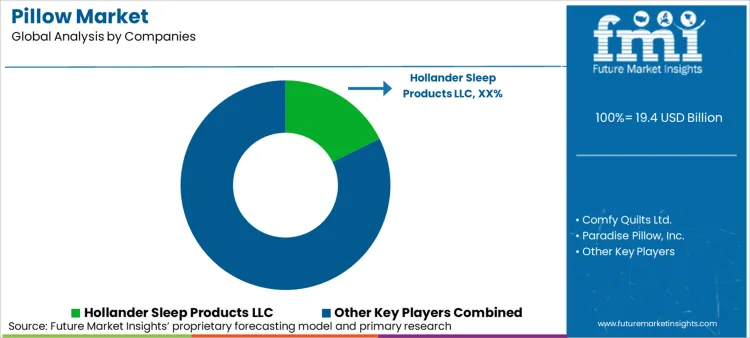
Competition is defined by portfolio strength across core sleeping pillows, feature-led premium lines, and travel-focused formats that align with accessory-driven channels. Market leaders are strengthening supply security for filling materials, improving quality consistency across production runs, and reducing catalog fragmentation through tiered programs built on fewer standardized shapes.
Players are also managing channel risks more actively, with tighter discount control and selective distribution to protect price integrity. Product differentiation is increasingly expressed through feature-led positioning, with cooling and therapy formats used to strengthen premium mix and improve contribution margins. Portfolio expansion is also supported by adjacent demand patterns in the pillow cases market, where coordinated bedding upgrades and merchandising alignment are strengthening cross-category conversion.
Key Players in Pillow Market
- Hollander Sleep Products LLC
- Comfy Quilts Ltd.
- Paradise Pillow, Inc.
- My Pillow Inc.
- Samsonite
- Tempur Sealy International Inc.
- Tempur-Pedic
- Kuhi-comfort
- Cabeau
- Wolf Manufacturing Company
- Core Products International Inc.
- Lewis N. Clark
- SleepMax
- U.S. Jaclean, Inc.
- Originalbones
Scope of Report
| Items | Values |
|---|---|
| Quantitative Units | USD Billion |
| Filling Material | Memory Foam, Hollow Fiber, Latex, Microfiber, Others |
| Shape | Rectangle, U-shape, Square, Wave, Round, Convex, Others |
| Feature | Cooling, Therapy, Anti-static, Anti-bacteria, Massage, Others |
| Application | Sleeping, Decorative, Bedding, Travel, Others |
| Regions | North America, Latin America, Western Europe, Eastern Europe, East Asia, South Asia & Pacific, Middle East and Africa |
Source: Future Market Insights (FMI) analysis, based on proprietary forecasting model and primary research
Pillow Market by Segments
Filling Material
- Memory Foam
- Hollow Fiber
- Latex
- Microfiber
- Others
Shape
- Rectangle
- U-shape
- Square
- Wave
- Round
- Convex
- Others
Feature
- Cooling
- Therapy
- Anti-static
- Anti-bacteria
- Massage
- Others
Application
- Sleeping
- Decorative
- Bedding
- Travel
- Others
By Region
- North America
- Latin America
- Western Europe
- Eastern Europe
- East Asia
- South Asia & Pacific
- Middle East and Africa
Bibliography
- International Organization for Standardization. (2010). ISO 12952-1:2010: Textiles Assessment of the ignitability of bedding items Part 1: Ignition source: smouldering cigarette. ISO.
- International Organization for Standardization. (2010). ISO 12952-2:2010: Textiles Assessment of the ignitability of bedding items Part 2: Ignition source: match-flame equivalent. ISO.
- European Commission. (n.d.). REACH Regulation: Chemicals policy framework for risk management and restrictions. European Commission.
- European Chemicals Agency. (n.d.). Tools for the textile industry: Guidance and support for safer chemical use in textile value chains. ECHA.
- Fédération Equestre Internationale. (2024). Protective headgear guidance and safety standards alignment. FEI.
Frequently Asked Questions
How large is the demand for pillows in the global market in 2026?
Demand for pillows in the global market is estimated to be valued at USD 19.4 billion in 2026.
What will be the market size of pillows in the global market by 2036?
Market size for pillows is projected to reach USD 36.1 billion by 2036.
What is the expected demand growth for pillows in the global market between 2026 and 2036?
Demand for pillows in the global market is expected to grow at a CAGR of 6.4% between 2026 and 2036.
Which Filling Material is poised to Lead Global Sales by 2026?
Memory foam is expected to be the dominant filling material, capturing approximately 34.0% share of the global market in 2026.
Which shape is expected to account for the highest share by 2026?
Rectangle pillows are expected to lead the shape mix, accounting for approximately 46.0% share of global demand in 2026.
Preview the report firsthand - request a free sample
Get SampleGet the brochure for pricing and purchase details.
Get PDFTable of Content
- Executive Summary
- Global Market Outlook
- Demand-side Trends
- Supply-side Trends
- Technology Roadmap Analysis
- Analysis and Recommendations
- Market Overview
- Market Coverage / Taxonomy
- Market Definition / Scope / Limitations
- Research Methodology
- Chapter Orientation
- Analytical Lens and Working Hypotheses
- Market Structure, Signals, and Trend Drivers
- Benchmarking and Cross-market Comparability
- Market Sizing, Forecasting, and Opportunity Mapping
- Research Design and Evidence Framework
- Desk Research Programme (Secondary Evidence)
- Company Annual and Sustainability Reports
- Peer-reviewed Journals and Academic Literature
- Corporate Websites, Product Literature, and Technical Notes
- Earnings Decks and Investor Briefings
- Statutory Filings and Regulatory Disclosures
- Technical White Papers and Standards Notes
- Trade Journals, Industry Magazines, and Analyst Briefs
- Conference Proceedings, Webinars, and Seminar Materials
- Government Statistics Portals and Public Data Releases
- Press Releases and Reputable Media Coverage
- Specialist Newsletters and Curated Briefings
- Sector Databases and Reference Repositories
- Roots Internal Knowledge Base and Historical Datasets
- Subscription Datasets and Paid Sources
- Social Channels, Communities, and Digital Listening Inputs
- Additional Desk Sources
- Expert Input and Fieldwork (Primary Evidence)
- Primary Modes
- Qualitative Interviews and Expert Elicitation
- Quantitative Surveys and Structured Data Capture
- Blended A9oach
- Why Primary Evidence is Used
- Field Techniques
- Interviews
- Surveys
- Focus Groups
- Observational and In-context Research
- Social and Community Interactions
- Stakeholder Universe Engaged
- C-suite Leaders
- Board Members
- Presidents and Vice Presidents
- R&D and Innovation Heads
- Technical Specialists
- Domain Subject-matter Experts
- Scientists
- Physicians and Other Healthcare Professionals
- Governance, Ethics, and Data Stewardship
- Research Ethics
- Data Integrity and Handling
- Primary Modes
- Tooling, Models, and Reference Databases
- Desk Research Programme (Secondary Evidence)
- Data Engineering and Model Build
- Data Acquisition and Ingestion
- Cleaning, Normalisation, and Verification
- Synthesis, Triangulation, and Analysis
- Quality Assurance and Audit Trail
- Market Background
- Market Dynamics
- Drivers
- Restraints
- Opportunity
- Trends
- Scenario Forecast
- Demand in Optimistic Scenario
- Demand in Likely Scenario
- Demand in Conservative Scenario
- Opportunity Map Analysis
- Product Life Cycle Analysis
- Supply Chain Analysis
- Investment Feasibility Matrix
- Value Chain Analysis
- PESTLE and Porter’s Analysis
- Regulatory Landscape
- Regional Parent Market Outlook
- Production and Consumption Statistics
- Import and Export Statistics
- Market Dynamics
- Global Market Analysis 2021 to 2025 and Forecast, 2026 to 2036
- Historical Market Size Value (USD Million) Analysis, 2021 to 2025
- Current and Future Market Size Value (USD Million) Projections, 2026 to 2036
- Y-o-Y Growth Trend Analysis
- Absolute $ Opportunity Analysis
- Global Market Pricing Analysis 2021 to 2025 and Forecast 2026 to 2036
- Global Market Analysis 2021 to 2025 and Forecast 2026 to 2036, By Filling Material
- Introduction / Key Findings
- Historical Market Size Value (USD Million) Analysis By Filling Material , 2021 to 2025
- Current and Future Market Size Value (USD Million) Analysis and Forecast By Filling Material , 2026 to 2036
- Memory Foam
- Hollow Fiber
- Latex
- Microfiber
- Others
- Memory Foam
- Y-o-Y Growth Trend Analysis By Filling Material , 2021 to 2025
- Absolute $ Opportunity Analysis By Filling Material , 2026 to 2036
- Global Market Analysis 2021 to 2025 and Forecast 2026 to 2036, By Shape
- Introduction / Key Findings
- Historical Market Size Value (USD Million) Analysis By Shape, 2021 to 2025
- Current and Future Market Size Value (USD Million) Analysis and Forecast By Shape, 2026 to 2036
- Rectangle
- U-shape
- Square
- Wave
- Round
- Convex
- Others
- Rectangle
- Y-o-Y Growth Trend Analysis By Shape, 2021 to 2025
- Absolute $ Opportunity Analysis By Shape, 2026 to 2036
- Global Market Analysis 2021 to 2025 and Forecast 2026 to 2036, By Feature
- Introduction / Key Findings
- Historical Market Size Value (USD Million) Analysis By Feature, 2021 to 2025
- Current and Future Market Size Value (USD Million) Analysis and Forecast By Feature, 2026 to 2036
- Cooling
- Therapy
- Anti-static
- Anti-bacteria
- Others
- Cooling
- Y-o-Y Growth Trend Analysis By Feature, 2021 to 2025
- Absolute $ Opportunity Analysis By Feature, 2026 to 2036
- Global Market Analysis 2021 to 2025 and Forecast 2026 to 2036, By Application
- Introduction / Key Findings
- Historical Market Size Value (USD Million) Analysis By Application, 2021 to 2025
- Current and Future Market Size Value (USD Million) Analysis and Forecast By Application, 2026 to 2036
- Sleeping
- Decorative
- Bedding
- Travel
- Massage
- Others
- Sleeping
- Y-o-Y Growth Trend Analysis By Application, 2021 to 2025
- Absolute $ Opportunity Analysis By Application, 2026 to 2036
- Global Market Analysis 2021 to 2025 and Forecast 2026 to 2036, By Region
- Introduction
- Historical Market Size Value (USD Million) Analysis By Region, 2021 to 2025
- Current Market Size Value (USD Million) Analysis and Forecast By Region, 2026 to 2036
- North America
- Latin America
- Western Europe
- Eastern Europe
- East Asia
- South Asia and Pacific
- Middle East & Africa
- Market Attractiveness Analysis By Region
- North America Market Analysis 2021 to 2025 and Forecast 2026 to 2036, By Country
- Historical Market Size Value (USD Million) Trend Analysis By Market Taxonomy, 2021 to 2025
- Market Size Value (USD Million) Forecast By Market Taxonomy, 2026 to 2036
- By Country
- USA
- Canada
- Mexico
- By Filling Material
- By Shape
- By Feature
- By Application
- By Country
- Market Attractiveness Analysis
- By Country
- By Filling Material
- By Shape
- By Feature
- By Application
- Key Takeaways
- Latin America Market Analysis 2021 to 2025 and Forecast 2026 to 2036, By Country
- Historical Market Size Value (USD Million) Trend Analysis By Market Taxonomy, 2021 to 2025
- Market Size Value (USD Million) Forecast By Market Taxonomy, 2026 to 2036
- By Country
- Brazil
- Chile
- Rest of Latin America
- By Filling Material
- By Shape
- By Feature
- By Application
- By Country
- Market Attractiveness Analysis
- By Country
- By Filling Material
- By Shape
- By Feature
- By Application
- Key Takeaways
- Western Europe Market Analysis 2021 to 2025 and Forecast 2026 to 2036, By Country
- Historical Market Size Value (USD Million) Trend Analysis By Market Taxonomy, 2021 to 2025
- Market Size Value (USD Million) Forecast By Market Taxonomy, 2026 to 2036
- By Country
- Germany
- UK
- Italy
- Spain
- France
- Nordic
- BENELUX
- Rest of Western Europe
- By Filling Material
- By Shape
- By Feature
- By Application
- By Country
- Market Attractiveness Analysis
- By Country
- By Filling Material
- By Shape
- By Feature
- By Application
- Key Takeaways
- Eastern Europe Market Analysis 2021 to 2025 and Forecast 2026 to 2036, By Country
- Historical Market Size Value (USD Million) Trend Analysis By Market Taxonomy, 2021 to 2025
- Market Size Value (USD Million) Forecast By Market Taxonomy, 2026 to 2036
- By Country
- Russia
- Poland
- Hungary
- Balkan & Baltic
- Rest of Eastern Europe
- By Filling Material
- By Shape
- By Feature
- By Application
- By Country
- Market Attractiveness Analysis
- By Country
- By Filling Material
- By Shape
- By Feature
- By Application
- Key Takeaways
- East Asia Market Analysis 2021 to 2025 and Forecast 2026 to 2036, By Country
- Historical Market Size Value (USD Million) Trend Analysis By Market Taxonomy, 2021 to 2025
- Market Size Value (USD Million) Forecast By Market Taxonomy, 2026 to 2036
- By Country
- China
- Japan
- South Korea
- By Filling Material
- By Shape
- By Feature
- By Application
- By Country
- Market Attractiveness Analysis
- By Country
- By Filling Material
- By Shape
- By Feature
- By Application
- Key Takeaways
- South Asia and Pacific Market Analysis 2021 to 2025 and Forecast 2026 to 2036, By Country
- Historical Market Size Value (USD Million) Trend Analysis By Market Taxonomy, 2021 to 2025
- Market Size Value (USD Million) Forecast By Market Taxonomy, 2026 to 2036
- By Country
- India
- ASEAN
- Australia & New Zealand
- Rest of South Asia and Pacific
- By Filling Material
- By Shape
- By Feature
- By Application
- By Country
- Market Attractiveness Analysis
- By Country
- By Filling Material
- By Shape
- By Feature
- By Application
- Key Takeaways
- Middle East & Africa Market Analysis 2021 to 2025 and Forecast 2026 to 2036, By Country
- Historical Market Size Value (USD Million) Trend Analysis By Market Taxonomy, 2021 to 2025
- Market Size Value (USD Million) Forecast By Market Taxonomy, 2026 to 2036
- By Country
- Kingdom of Saudi Arabia
- Other GCC Countries
- Turkiye
- South Africa
- Other African Union
- Rest of Middle East & Africa
- By Filling Material
- By Shape
- By Feature
- By Application
- By Country
- Market Attractiveness Analysis
- By Country
- By Filling Material
- By Shape
- By Feature
- By Application
- Key Takeaways
- Key Countries Market Analysis
- USA
- Pricing Analysis
- Market Share Analysis, 2025
- By Filling Material
- By Shape
- By Feature
- By Application
- Canada
- Pricing Analysis
- Market Share Analysis, 2025
- By Filling Material
- By Shape
- By Feature
- By Application
- Mexico
- Pricing Analysis
- Market Share Analysis, 2025
- By Filling Material
- By Shape
- By Feature
- By Application
- Brazil
- Pricing Analysis
- Market Share Analysis, 2025
- By Filling Material
- By Shape
- By Feature
- By Application
- Chile
- Pricing Analysis
- Market Share Analysis, 2025
- By Filling Material
- By Shape
- By Feature
- By Application
- Germany
- Pricing Analysis
- Market Share Analysis, 2025
- By Filling Material
- By Shape
- By Feature
- By Application
- UK
- Pricing Analysis
- Market Share Analysis, 2025
- By Filling Material
- By Shape
- By Feature
- By Application
- Italy
- Pricing Analysis
- Market Share Analysis, 2025
- By Filling Material
- By Shape
- By Feature
- By Application
- Spain
- Pricing Analysis
- Market Share Analysis, 2025
- By Filling Material
- By Shape
- By Feature
- By Application
- France
- Pricing Analysis
- Market Share Analysis, 2025
- By Filling Material
- By Shape
- By Feature
- By Application
- India
- Pricing Analysis
- Market Share Analysis, 2025
- By Filling Material
- By Shape
- By Feature
- By Application
- ASEAN
- Pricing Analysis
- Market Share Analysis, 2025
- By Filling Material
- By Shape
- By Feature
- By Application
- Australia & New Zealand
- Pricing Analysis
- Market Share Analysis, 2025
- By Filling Material
- By Shape
- By Feature
- By Application
- China
- Pricing Analysis
- Market Share Analysis, 2025
- By Filling Material
- By Shape
- By Feature
- By Application
- Japan
- Pricing Analysis
- Market Share Analysis, 2025
- By Filling Material
- By Shape
- By Feature
- By Application
- South Korea
- Pricing Analysis
- Market Share Analysis, 2025
- By Filling Material
- By Shape
- By Feature
- By Application
- Russia
- Pricing Analysis
- Market Share Analysis, 2025
- By Filling Material
- By Shape
- By Feature
- By Application
- Poland
- Pricing Analysis
- Market Share Analysis, 2025
- By Filling Material
- By Shape
- By Feature
- By Application
- Hungary
- Pricing Analysis
- Market Share Analysis, 2025
- By Filling Material
- By Shape
- By Feature
- By Application
- Kingdom of Saudi Arabia
- Pricing Analysis
- Market Share Analysis, 2025
- By Filling Material
- By Shape
- By Feature
- By Application
- Turkiye
- Pricing Analysis
- Market Share Analysis, 2025
- By Filling Material
- By Shape
- By Feature
- By Application
- South Africa
- Pricing Analysis
- Market Share Analysis, 2025
- By Filling Material
- By Shape
- By Feature
- By Application
- USA
- Market Structure Analysis
- Competition Dashboard
- Competition Benchmarking
- Market Share Analysis of Top Players
- By Regional
- By Filling Material
- By Shape
- By Feature
- By Application
- Competition Analysis
- Competition Deep Dive
- Hollander Sleep Products LLC
- Overview
- Product Portfolio
- Profitability by Market Segments (Product/Age /Sales Channel/Region)
- Sales Footprint
- Strategy Overview
- Marketing Strategy
- Product Strategy
- Channel Strategy
- Comfy Quilts Ltd.
- Paradise Pillow, Inc.
- My Pillow Inc.
- Samsonite
- Tempur Sealy International Inc.
- Tempur-Pedic
- Kuhi-comfort
- Cabeau
- Wolf Manufacturing Company
- Core Products International Inc.
- Lewis N. Clark
- SleepMax
- U.S. Jaclean, Inc.
- Originalbones
- Hollander Sleep Products LLC
- Competition Deep Dive
- Assumptions & Acronyms Used


