

- Industry Size (2026)
- USD 327.0 Mn
- Forecast (2036)
- USD 591.2 Mn
- CAGR (2026 to 2036)
- 6.10%
Ceramic Travel Mug Market Size, Market Forecast, and Outlook By FMI
The ceramic travel mug market was valued at USD 308.2 million in 2025. Demand is estimated to reach USD 327.0 million in 2026, and the market is projected to reach USD 591.2 million by 2036, expanding at a CAGR of 6.10% during the forecast period. Growth is being supported by rising demand for flavor-neutral drinkware that offers portability without the taste transfer often associated with metal interiors.
Summary of Ceramic Travel Mug Market
- The market is forecast to reach USD 591.2 million by 2036.
- The market is expected to grow at a CAGR of 6.1% from 2026 to 2036.
- The market was estimated at USD 308.2 million in 2025.
- The forecast period represents an incremental opportunity of USD 264.2 million.
- The market is a niche drinkware category positioned between traditional ceramic mugs and insulated commuter drinkware, driven by flavor neutrality and premium aesthetics.
- Demand is supported by high daily coffee consumption, with 66% of USA adults consuming coffee daily as of Spring 2025.
- Ceramic-lined designs are gaining traction due to better taste preservation compared to metal interiors while maintaining portability and insulation.
- Regulatory push toward reuse and durable beverage containers, particularly in Europe, is strengthening category relevance.
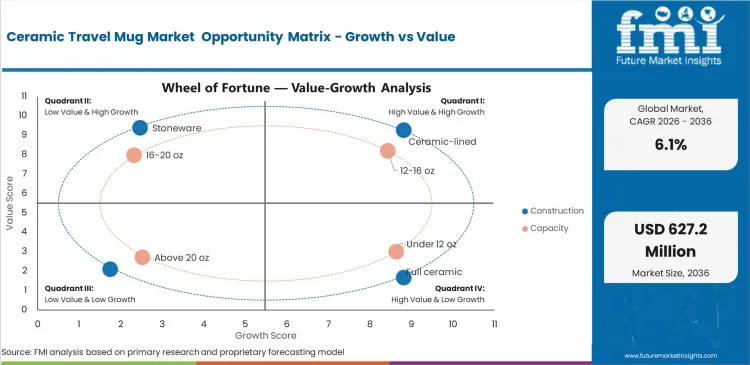
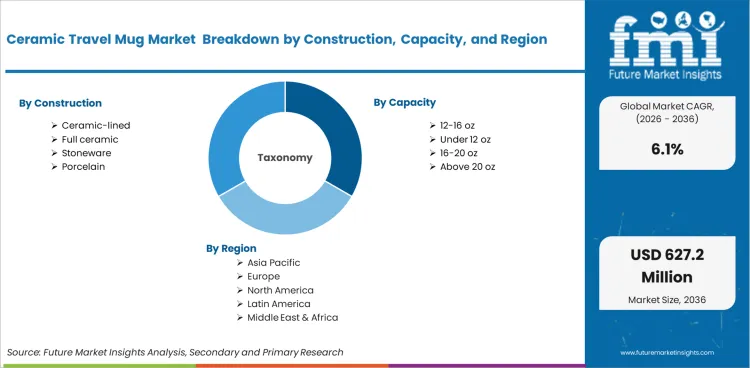
- Ceramic-lined mugs are expected to lead with a 58.0% share in the construction segment, while the 12-16 oz format holds 44.0% of capacity demand.
- Spill-lock lids account for 41.0% share, online channels hold 39.0% distribution share, and personal use dominates with 52.0% of end use.
- India, China, and Australia are the fastest-growing markets, while the United States remains the largest stable demand base.
- Key companies include Frank Green, Fellow, Ember, STTOKE, W&P, Contigo, and Stanley 1913, with the market remaining fragmented and no single brand holding a dominant share.
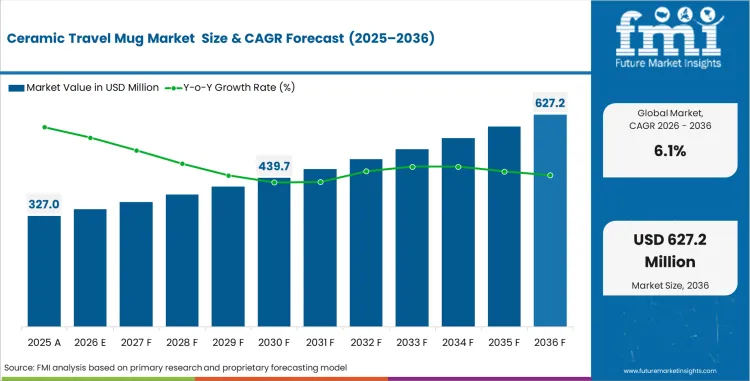
Flavor preservation and drop durability remain the core design trade-off in this category. Ceramic-lined formats are gaining traction because they reduce metallic taste transfer while offering better durability than full-ceramic formats. Buyers are increasingly looking for products that preserve taste without becoming too fragile for daily use. This keeps hybrid designs commercially relevant across premium coffee and tea consumption occasions.
Once ceramic-coating inputs and bonding consistency improve, production scale-up becomes more viable. Better manufacturing stability can support cost control and wider placement beyond specialty retail. This is likely to help brands move from niche premium channels into broader online and mass-retail distribution over time.
India is expected to record a 7.4% CAGR between 2026 and 2036, supported by urban expansion and rising specialty coffee consumption. China is anticipated to register a 6.8% CAGR over the forecast period, driven by stronger digital retail access among younger working consumers. Australia is set to post a 6.2% CAGR from 2026 to 2036, as reusable cup habits remain well established across café channels.
Demand in the United States is projected to advance at a 5.8% CAGR, reflecting replacement demand from a large existing user base. Revenue in the United Kingdom is estimated to rise at a 5.3% CAGR, while Germany is likely to witness a 5.1% CAGR under stable replacement cycles. Japan is poised to register a 4.4% CAGR during the forecast period, reflecting mature buying habits and a preference for lighter drinkware formats. Growth patterns differ clearly between mature replacement-led markets and faster-developing geographies where reusable drinkware adoption is still broadening.
Segmental Analysis
Ceramic Travel Mug Market Analysis by Construction
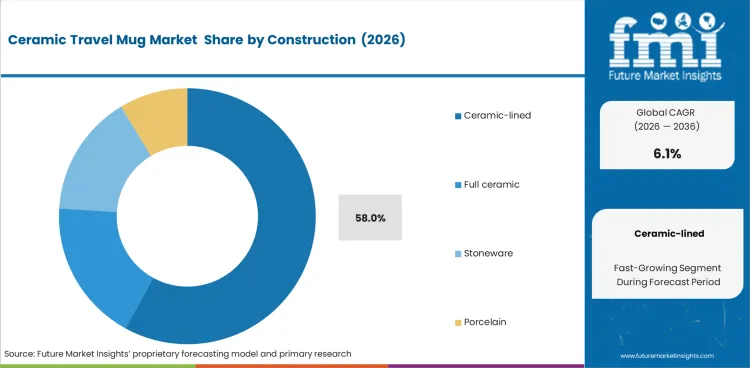
Hybrid construction leads this segment because portable drinkware must preserve flavor without becoming too fragile for daily movement. Full ceramic formats support taste integrity, yet repeated commuting use exposes them to breakage risk that limits wider acceptance across office carry, transit use, and routine handling. Ceramic-lined formats overcome that limitation by pairing an inert interior with a stronger outer body, allowing manufacturers in the broader thermos drinkware category to offer ceramic drinking performance with better everyday durability. Ceramic-lined construction is expected to hold 58.0% share of the Construction segment in 2026, supported by its ability to maintain beverage taste while lowering the replacement burden tied to fully ceramic bodies. Bonding consistency remains a critical product requirement, since coating failure affects user satisfaction well before visible structural damage appears. Preference for this format remains firm because buyers want ceramic-like taste performance without taking on the handling drawbacks of an all-ceramic travel mug.
- Taste preservation: Metallic taste transfer in conventional interiors continues to support demand for ceramic-lined formats, especially in coffee-led use where flavor clarity matters.
- Coating stability: Adhesion must remain stable through repeated washing, thermal cycling, and daily handling, since early micro-fractures can shorten usable life and increase replacement risk.
- Repeat demand: Positive experience with flavor-neutral interiors can support repeat purchases across home, office, and commute settings, helping this format maintain its lead.
Ceramic Travel Mug Market Analysis by Capacity
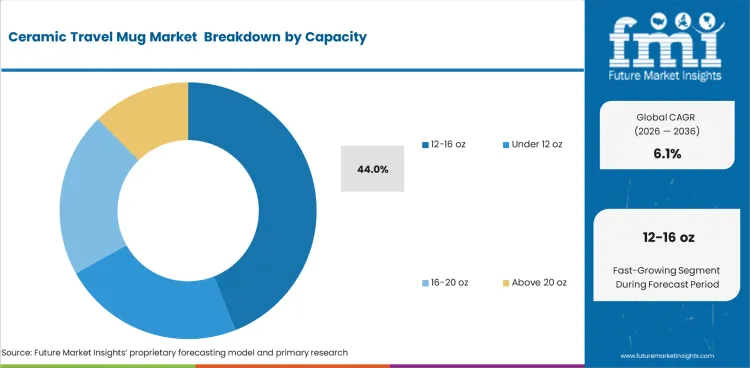
Everyday coffee routines favor the 12-16 oz range because it fits established café serving sizes without compromising portability, cup-holder fit, or normal drinking habits. Demand in this range also overlaps with purchase behavior seen across insulated tumblers, where familiar beverage sizing often carries as much weight as insulation in repeat daily use. The 12–16 oz format is anticipated to capture 44.0% share, reflecting its close fit with routine beverage orders and stronger everyday usability. Larger formats may attract some interest at retail, yet commuter use continues to favor dimensions that align with standard espresso-based and brewed coffee servings rather than excess volume. External proportions remain important, since added capacity loses value once a mug becomes awkward to carry, difficult to place under dispensing equipment, or less convenient for routine travel use. Uneven heat distribution in oversized formats also weakens the drinking experience before the beverage is finished. Preference for this range remains firm because it offers the most workable balance of serving relevance, portability, and repeat-use convenience.
- Size efficiency: Slimmer wall construction helps preserve usable internal volume without pushing outer dimensions beyond standard cup-holder and hand-carry limits.
- Trade-off: Larger-capacity mugs increase packaging and freight burden while often delivering weaker practical value in daily commuter use.
- Usage pattern: Mid-capacity formats tend to support more frequent weekly use because they match habitual beverage ordering patterns more closely than oversized alternatives.
Ceramic Travel Mug Market Analysis by Lid Type
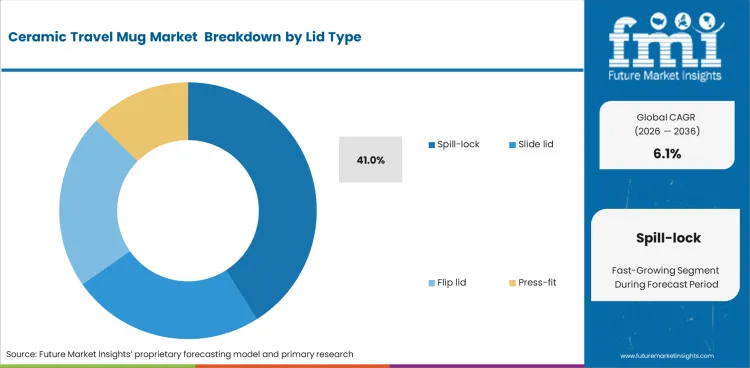
Leak prevention remains the first condition for portable drinkware acceptance in commuter use, especially where bags, work items, and electronics travel together. Spill-lock is estimated to account for 41.0% share, reflecting the clear preference for secure closure systems over easier-access formats in on-the-go beverage use. Similar sealing priorities also shape demand in adjacent formats such as the self-stirring mug category, where movement during carrying raises the penalty attached to even minor leakage. Mechanical complexity remains the trade-off in this segment, since stronger closure performance often introduces more parts, tighter tolerances, and greater cleaning difficulty over repeated use. Hygiene remains the main structural limitation, as intricate closures can trap residue and shorten product life when disassembly and cleaning access are poorly executed. Continued preference for spill-lock lids rests on a basic commercial reality: transport safety carries more purchase weight than drinking convenience as long as maintenance remains manageable.
- Seal integrity: Leakage during daily travel creates direct inconvenience, making closure performance a core acceptance factor in this segment.
- Cleaning concern: Multi-part closures can retain milk, sugar, and coffee residue, raising sanitation concerns where cleaning access remains limited.
- User behavior: Poorly designed lids often see reduced long-term use in desk settings, since repeated cleaning friction can push owners to drink with the lid removed.
Ceramic Travel Mug Market Analysis by Distribution
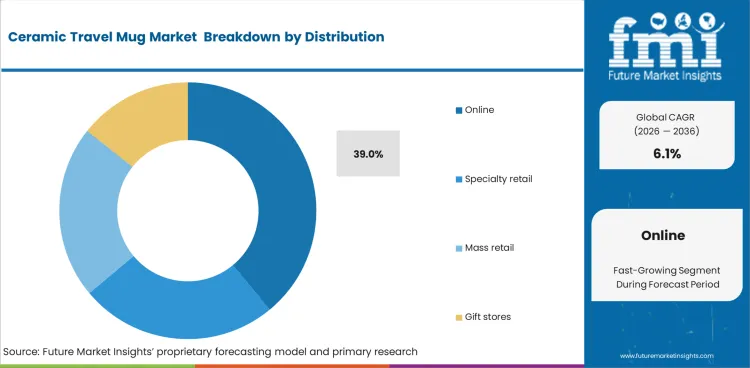
Online distribution remains central to this market because ceramic travel mugs are purchased as much for finish, color, and design identity as for everyday utility. Digital channels give brands more room to present that visual value clearly, refresh assortments quickly, and communicate premium positioning without waiting for conventional retail resets. Direct-to-consumer selling also fits adjacent reusable tumblers categories, where gifting appeal, limited editions, and aesthetic differentiation often shape conversion alongside insulation and portability. Fragility keeps execution discipline critical, since ceramic components demand stronger packaging, tighter inventory handling, and better control over breakage during individual shipment. Brands that manage those requirements well are in a stronger position to scale new launches, test variants, and sustain margin across smaller production runs. Online is poised to garner 39.0% share of the Distribution segment in 2026, as that channel offers the most practical combination of merchandising flexibility, premium storytelling, and direct consumer reach for a design-led drinkware category.
- Small-batch fit: Small-batch manufacturing aligns well with online channels because shorter runs allow faster refresh cycles across color, finish, and gifting-oriented variants.
- Fulfillment pressure: Peak seasonal demand can pressure fulfillment speed and inventory accuracy, especially where fragile-unit packing requires greater handling discipline.
- Execution risk: Breakage in transit, reverse logistics, and protective packaging costs can narrow profitability when execution standards fall short.
Ceramic Travel Mug Market Analysis by End Use
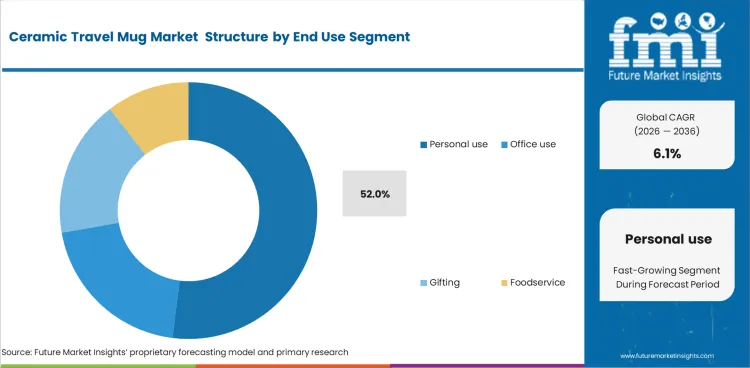
Personal use remains the core demand base in this market because ceramic travel mugs are purchased as everyday carry items that combine beverage function with visible design preference, especially in workplaces, reducing reliance on free disposable cups. Personal use is set to represent 52.0% share in 2026, reflecting the category’s strong alignment with individual routines, desk presence, commute habits, and style-led product selection. Reusable drinkware in this format often extends beyond basic utility, particularly in office environments where product finish, color, and material choice shape repeat purchase behavior and support ownership across multiple settings. Workplace restrictions on single-use beverage service also reinforce this segment by pushing more consumers toward personally selected reusable vessels rather than shared or generic alternatives. Gifting remains commercially relevant, especially in seasonal periods, yet it does not displace the larger role of self-purchase across the year. Continued strength in personal use keeps this segment ahead because category adoption is still anchored in daily individual behavior rather than institutional or event-driven demand.
- Daily visibility: Desk use, commuting, and daily café visits keep personal-use mugs in constant view, strengthening demand for design-led and premium-finish formats.
- Repeat purchase: Repeat purchases often come from style refresh, secondary-location use, or wear-related replacement rather than first-time category entry alone.
- Gifting role: Gifting supports short-term sales spikes, but personal purchase remains the more stable volume base across the full year.
Ceramic Travel Mug Market Drivers, Restraints, and Opportunities
Demand is being supported by consumers who prefer drinkware that does not alter beverage taste, especially in premium coffee use. Ceramic-lined interiors are gaining attention because they help reduce metallic taste transfer while preserving portability. For manufacturers, the main implication is product design: taste neutrality is becoming a clearer selling point in a category still dominated by metal and plastic alternatives.
Weight remains a key restraint in this market. Full-ceramic formats are heavier than plastic or thin-steel alternatives, which can reduce their appeal in daily commuting use. Brands are trying to address this through ceramic-lined and thinner-wall designs, but these approaches introduce their own manufacturing and durability challenges.
Opportunities in the Ceramic Travel Mug Market
- Modular components: Standardized lids that fit multiple vessel bodies can reduce manufacturing complexity and simplify replacement-part inventory.
- Smart features: NFC-enabled designs could support loyalty integration in selected premium use cases, though this remains a secondary opportunity rather than a category-wide growth driver.
- Corporate customization: Branded bulk orders for offices and events can create an additional B2B channel, especially for gifting and employee-use programs.
Regional Analysis
Based on regional analysis, the ceramic travel mug market is segmented into North America, Europe, and Asia Pacific, with country-level discussion focused on the key markets covered in this report.
.webp "Top Country Growth Comparison Ceramic Travel Mug Market Cagr (2026 2036)")
| Country | CAGR (2026 to 2036) |
|---|---|
| India | 7.4% |
| China | 6.8% |
| Australia | 6.2% |
| United States | 5.8% |
| United Kingdom | 5.3% |
| Germany | 5.1% |
| Japan | 4.4% |
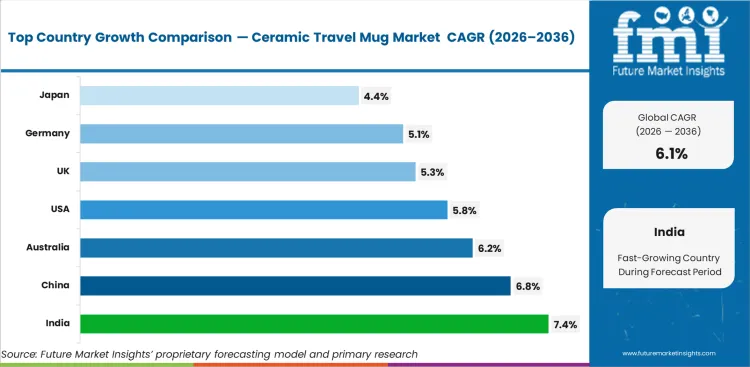
Source: Future Market Insights (FMI) analysis, based on proprietary forecasting model and primary research
North America Ceramic Travel Mug Market Analysis
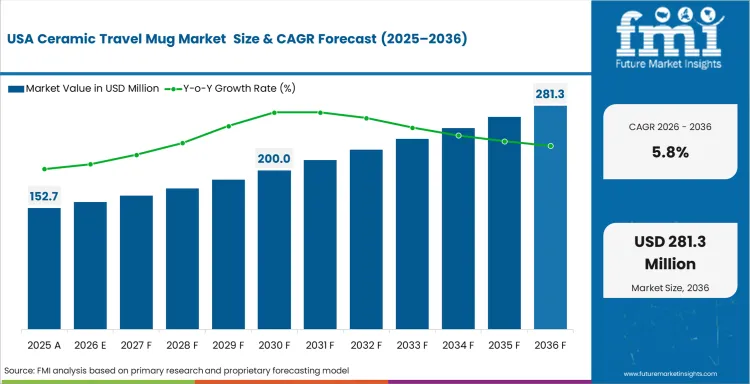
North America remains a replacement-led market where demand depends less on first-time category entry and more on product refinement that can justify repeat purchase. Reusable drinkware is already well established across the region, so incremental demand is being shaped by better lid hygiene, stronger flavor neutrality, improved thermal performance, and dimensions suited to daily commuting. Cup-holder fit, one-handed handling, and leak resistance remain important purchase factors alongside finish quality and brand positioning.
- United States: High vehicle dependence and longer commute routines keep the United States structurally important within the regional outlook. Demand for ceramic travel mugs in the country is projected to advance at a 5.8% CAGR from 2026 to 2036, supported by a large installed base of reusable drinkware users replacing older units with better-designed alternatives. Ergonomic handling, spill resistance, and standard cup-holder compatibility remain central to product acceptance in this market. Commercial headroom is expected to come from premium replacement and design-led upgrading rather than broad first-time adoption.
FMI’s report includes Canada and Mexico. Canada remains relevant because office use, commuting, and specialty coffee routines continue to support replacement-led purchases. Mexico is also likely to gain relevance over time as regional manufacturing integration and shorter delivery routes improve the case for North America-focused supply realignment.
Europe Ceramic Travel Mug Market Analysis
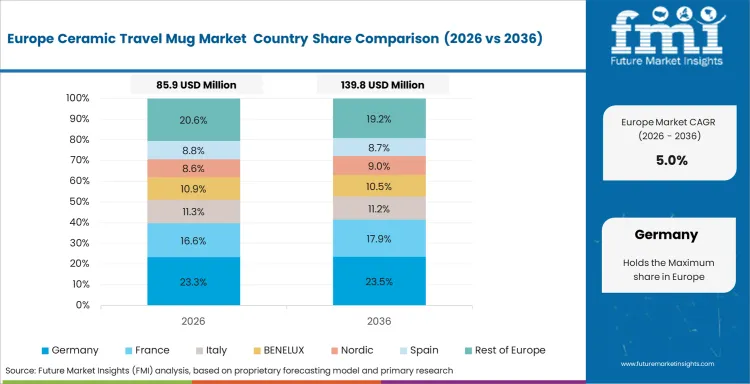
Europe is shaped by tight food-contact compliance, where commercialization depends on testing discipline, glaze safety, and consistent migration control rather than price-led volume alone. Single-use reduction policies and wider reuse-oriented systems continue to support durable beverageware adoption, but the same environment raises entry barriers for lower-quality suppliers. Established brands remain better positioned because regulatory readiness, testing consistency, and product traceability carry real weight in distributor and retailer acceptance.
- United Kingdom: Dense café traffic, strong commuter footfall, and routine reusable cup use keep compact portable formats commercially relevant in the United Kingdom. Demand for ceramic travel mugs in this market is expected to rise at a CAGR of 5.3% from 2026 to 2036, supported by everyday takeaway coffee habits and stronger alignment with pedestrian-led urban consumption. Preference remains centered on formats that balance portability with visual appeal, since daily café use turns drinkware into both a practical and visible accessory. This keeps the United Kingdom important where repeat-use convenience and urban retail behavior reinforce category replacement demand.
- Germany: Mechanical precision carries greater commercial importance in Germany, where lid performance, fit consistency, and long-use durability directly influence product acceptance. Long product life expectations and lower tolerance for closure defects favor manufacturers able to deliver dependable construction rather than short-cycle style variation. Quality-led purchasing behavior also keeps repeat demand tied to functional reliability, especially in products expected to withstand extended daily use without performance drift. Sales of ceramic travel mugs in Germany are projected to increase at a 5.1% CAGR. Germany remains relevant as a market where durability standards shape category growth more strongly than novelty-driven replacement.
FMI's report includes France and Italy. France adds depth to the regional outlook through established retail demand and food-contact compliance scrutiny. Italy also remains relevant because of its strong coffee culture and preference for well-finished drinkware.
Asia Pacific Ceramic Travel Mug Market Analysis
Asia Pacific remains the fastest-growing arena in this market because urban coffee consumption, digital retail reach, and premium reusable drinkware adoption are all expanding. Demand is being shaped by younger working consumers who use ceramic travel mugs as both functional products and visible lifestyle items. Regional manufacturing depth also shortens design iteration cycles and supports faster product refresh, which helps online-led brands scale more quickly.
- India: Urban café expansion and rising acceptance of reusable drinkware are expected to keep demand in India on a faster growth path than most mature markets. Ceramic travel mug adoption in the country is forecast to increase at a 7.4% CAGR from 2026 to 2036, supported by a growing professional consumer base, stronger digital merchandising, and wider movement away from single-use beverage formats. Local styling preferences also matter here, since visual differentiation and aspirational positioning influence product turnover alongside utility. This keeps India commercially relevant for both premium imports and rapidly adapting domestic brands.
- China: Deep digital commerce infrastructure gives China a structurally different demand profile, with product discovery, comparison, and purchase often occurring within the same retail ecosystem. Social commerce integration, promotional retail events, and premium lifestyle positioning continue to support strong volume movement across this category. Fast scaling remains commercially attractive, although reverse logistics, breakage handling, and packaging discipline carry more weight in this market because shipping intensity is so high. Sales of ceramic travel mugs in China are projected to rise at a 6.8% CAGR from 2026 to 2036. China remains important not only for consumption growth but also for the speed at which new product formats can be tested and commercialized.
- Australia: Specialty coffee culture already has deep everyday relevance in Australia, keeping reusable drinkware closer to a habitual purchase than an occasional accessory. Demand for ceramic travel mugs is likely to advance at a 6.2% CAGR during 2026 to 2036, with replacement demand supported by aesthetic refresh cycles and continued preference for flavor-preserving beverageware. Product acceptance in this market depends heavily on finish quality, lid performance, and sensory credibility, since users are already familiar with reusable cup formats. Australia remains a smaller-volume market with strong premium signaling value.
- Japan: Minimalist product expectations shape demand conditions in Japan more sharply than in most other markets covered here. Lighter form factors, cleaner silhouettes, and precise finishing standards limit the appeal of bulky ceramic-heavy designs, keeping engineering execution central to category success. Ceramic travel mug sales in Japan are anticipated to expand at a 4.4% CAGR. Market relevance remains tied to design discipline and product refinement, with purchase decisions influenced more by usability and finish quality than by volume expansion alone.
FMI’s report includes South Korea and Southeast Asia. South Korea remains commercially relevant because design-conscious consumers and dense café culture support faster adoption of premium reusable drinkware. Southeast Asia adds medium-term potential as urban coffee consumption and online retail access continue to expand.
Competitive Aligners for Market Players
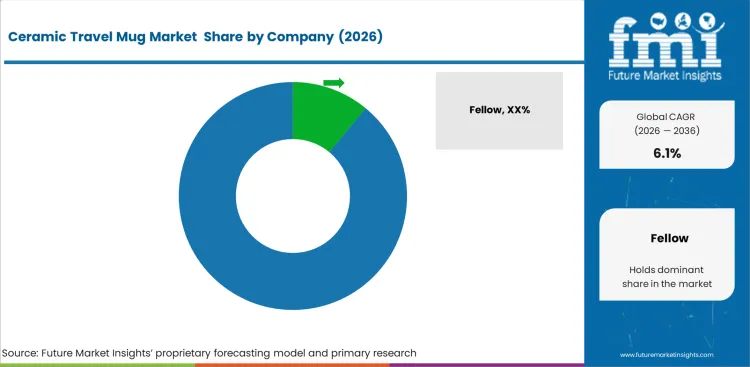
Aesthetic differentiation remains one of the clearest dividing lines between premium leaders and volume-oriented ceramic travel mug manufacturers in this fragmented market. Brands such as Frank Green and Fellow preserve pricing strength by positioning ceramic travel mugs as lifestyle accessories with visible design value rather than as basic kitchenware. Exclusive finishes, tighter color control, and design-led assortment planning help sustain direct-to-consumer demand where visual identity carries as much weight as functional performance. Competing only on utility becomes harder once acceptable thermal retention and leak resistance are already built into the category, leaving weaker brands with limited room to defend premium pricing.
Manufacturing process control plays a central role in long-term competitive stability across the premium consumerware segment. Established players such as Ember and Stanley 1913 benefit from deeper experience in material bonding, coating consistency, and temperature-related performance tolerance across repeated use conditions. Strong execution in these areas reduces the risk of finish degradation, coating separation, and early product-life failure, all of which can quickly damage brand trust in a premium drinkware category. Newer entrants often face a steeper path because ceramic-lined construction demands tighter process discipline, specialized equipment, and repeatable application quality that is not easy to build quickly.
Retail distribution remains competitive because large chains rarely allow one brand to dominate shelf space for long. Assortment strategies tend to favor multiple brands with distinct lid systems, ergonomic profiles, and usage propositions, keeping pressure on suppliers to refine product features without breaking price architecture. Contigo and W&P remain relevant in this environment by addressing different commuter and lifestyle use cases rather than relying on a single premium proposition. Material transparency is also becoming more commercially important, since brands that explain construction quality, finish integrity, and sourcing clarity more convincingly are better placed to retain credibility as buyer scrutiny rises.
Key Players in Ceramic Travel Mug Market
- Frank Green
- Fellow
- Ember
- STTOKE
- W&P
- Contigo
- Stanley 1913
Scope of the Report
| Metric | Value |
|---|---|
| Quantitative Units | USD 327.0 million to USD 591.2 million, at a CAGR of 6.10% |
| Market Definition | This market covers portable drinkware made as full ceramic vessels or ceramic-lined formats designed for commuting and everyday beverage consumption. |
| Segmentation | Construction, Capacity, Lid Type, Distribution, End Use, Region |
| Regions Covered | North America, Latin America, Europe, Asia Pacific, Middle East and Africa |
| Countries Covered | United States, Canada, Mexico, Brazil, Germany, United Kingdom, France, Italy, China, Japan, India, Australia, South Korea |
| Key Companies Profiled | frank green, Fellow, Ember, STTOKE, W&P, Contigo, Stanley 1913 |
| Forecast Period | 2026 to 2036 |
| Approach | The market estimate is based on a top-down model supported by trade flows, usage patterns, product benchmarking, and primary research. |
Source: Future Market Insights (FMI) analysis, based on proprietary forecasting model and primary research
Ceramic Travel Mug Market Analysis by Segments
Construction
- Ceramic-lined
- Full ceramic
- Stoneware
- Porcelain
Capacity
- 12-16 oz
- Under 12 oz
- 16-20 oz
- Above 20 oz
Lid Type
- Spill-lock
- Slide lid
- Flip lid
- Press-fit
Distribution
- Online
- Specialty retail
- Mass retail
- Gift stores
End Use
- Personal use
- Office use
- Gifting
- Foodservice
Region
- North America
- United States
- Canada
- Latin America
- Brazil
- Mexico
- Europe
- Germany
- United Kingdom
- France
- Italy
- Spain
- Asia Pacific
- China
- Japan
- India
- Australia
- South Korea
- Middle East and Africa
- GCC Countries
- South Africa
Bibliography
- European Commission. (2025). Revision of EU rules on food contact materials.
- European Commission. (2025). Legislation concerning food contact materials.
- National Coffee Association. (2025, April 15). More Americans drink coffee each day than any other beverage, bottled water back in second place.
- Turner, A. (2025). Migration kinetics of cadmium and lead from ceramic mugs. Journal of Hazardous Materials, 496, 139204.
- Sheppard, S. B., Argentopoulos, S., Ware, J., Swearingen, A., & Zhao, J. (2025). Probabilistic rewards increase the use of reusable cups. Resources, Conservation and Recycling, 212, 108001.
- United States Food and Drug Administration. (2025, January 6). Lead in food and foodwares.
- The Observatory of Economic Complexity. (2026). Ceramic tableware (HS: 6912) product trade, exporters and importers.
- World Bank. (2024). Ceramic tableware, kitchenware, other household imports by country in 2024 (HS 691200). World Integrated Trade Solution.
This bibliography is provided for reader reference. The full FMI report contains the complete reference list with primary source documentation.
This Report Addresses
- Taste-neutral interiors as a key reason for shifting away from standard metal drinkware.
- Food-contact compliance requirements related to glaze safety and heavy-metal migration.
- Design trade-offs between ceramic weight, portability, and standard cup-holder compatibility.
- Cleaning and hygiene challenges associated with complex spill-lock lid mechanisms.
- Online channels as a key route for premium positioning, customization, and direct consumer reach.
- Commuting habits that increase the importance of one-handed use and leak resistance.
- Hybrid ceramic-lined designs that balance taste preservation with better durability.
- Coating durability risks that can affect product life and user experience before visible failure appears.
Frequently Asked Questions
What is the ceramic travel mug market size in 2025 and 2036?
The market was valued at USD 308.2 million in 2025 and is projected to reach USD 591.2 million by 2036.
What is the forecast CAGR for the ceramic travel mug market?
The market is projected to expand at a CAGR of 6.10% during the forecast period.
Which companies lead the ceramic travel mug market?
Key industry participants include Frank Green, Fellow, Ember, STTOKE, W&P, Contigo, and Stanley 1913.
What is the difference between ceramic-lined and full ceramic travel mugs?
Full-ceramic mugs offer taste neutrality but are more prone to breakage. Ceramic-lined mugs balance flavor preservation with better durability and broader everyday use.
Which regions are growing fastest in ceramic travel mugs?
India is projected to be the fastest-growing market at 7.4%, followed by China at 6.8%.
Why are ceramic-lined mugs gaining popularity over metal interiors?
Ceramic-lined mugs are gaining popularity because they help reduce metallic taste transfer while preserving travel utility.
Are ceramic travel mugs considered safe food-contact products?
Yes. Ceramic travel mugs must comply with food-contact regulations, including testing related to glaze safety and heavy-metal migration.
Which distribution channel is strongest for ceramic travel mugs?
Online remains the strongest channel because it supports design-led merchandising, customization, and direct brand communication.
What lid type is most common in ceramic travel mugs?
Spill-lock lids are the most common because leak prevention remains the first requirement in portable drinkware use.
What capacity range sells best in ceramic commuter mugs?
The 12-16 oz range remains the leading format because it aligns with everyday coffee serving sizes and standard commuting use.
Preview the report firsthand - request a free sample
Get SampleGet the brochure for pricing and purchase details.
Get PDFTable of Content
- Executive Summary
- Global Market Outlook
- Demand-side Trends
- Supply-side Trends
- Technology Roadmap Analysis
- Analysis and Recommendations
- Market Overview
- Market Coverage / Taxonomy
- Market Definition / Scope / Limitations
- Research Methodology
- Chapter Orientation
- Analytical Lens and Working Hypotheses
- Market Structure, Signals, and Trend Drivers
- Benchmarking and Cross-market Comparability
- Market Sizing, Forecasting, and Opportunity Mapping
- Research Design and Evidence Framework
- Desk Research Programme (Secondary Evidence)
- Company Annual and Sustainability Reports
- Peer-reviewed Journals and Academic Literature
- Corporate Websites, Product Literature, and Technical Notes
- Earnings Decks and Investor Briefings
- Statutory Filings and Regulatory Disclosures
- Technical White Papers and Standards Notes
- Trade Journals, Industry Magazines, and Analyst Briefs
- Conference Proceedings, Webinars, and Seminar Materials
- Government Statistics Portals and Public Data Releases
- Press Releases and Reputable Media Coverage
- Specialist Newsletters and Curated Briefings
- Sector Databases and Reference Repositories
- FMI Internal Proprietary Databases and Historical Market Datasets
- Subscription Datasets and Paid Sources
- Social Channels, Communities, and Digital Listening Inputs
- Additional Desk Sources
- Expert Input and Fieldwork (Primary Evidence)
- Primary Modes
- Qualitative Interviews and Expert Elicitation
- Quantitative Surveys and Structured Data Capture
- Blended Approach
- Why Primary Evidence is Used
- Field Techniques
- Interviews
- Surveys
- Focus Groups
- Observational and In-context Research
- Social and Community Interactions
- Stakeholder Universe Engaged
- C-suite Leaders
- Board Members
- Presidents and Vice Presidents
- R&D and Innovation Heads
- Technical Specialists
- Domain Subject-matter Experts
- Scientists
- Physicians and Other Healthcare Professionals
- Governance, Ethics, and Data Stewardship
- Research Ethics
- Data Integrity and Handling
- Primary Modes
- Tooling, Models, and Reference Databases
- Desk Research Programme (Secondary Evidence)
- Data Engineering and Model Build
- Data Acquisition and Ingestion
- Cleaning, Normalisation, and Verification
- Synthesis, Triangulation, and Analysis
- Quality Assurance and Audit Trail
- Market Background
- Market Dynamics
- Drivers
- Restraints
- Opportunity
- Trends
- Scenario Forecast
- Demand in Optimistic Scenario
- Demand in Likely Scenario
- Demand in Conservative Scenario
- Opportunity Map Analysis
- Product Life Cycle Analysis
- Supply Chain Analysis
- Investment Feasibility Matrix
- Value Chain Analysis
- PESTLE and Porter’s Analysis
- Regulatory Landscape
- Regional Parent Market Outlook
- Production and Consumption Statistics
- Import and Export Statistics
- Market Dynamics
- Global Market Analysis 2021 to 2025 and Forecast, 2026 to 2036
- Historical Market Size Value (USD Million) Analysis, 2021 to 2025
- Current and Future Market Size Value (USD Million) Projections, 2026 to 2036
- Y-o-Y Growth Trend Analysis
- Absolute $ Opportunity Analysis
- Global Market Pricing Analysis 2021 to 2025 and Forecast 2026 to 2036
- Global Market Analysis 2021 to 2025 and Forecast 2026 to 2036, By Construction
- Introduction / Key Findings
- Historical Market Size Value (USD Million) Analysis By Construction , 2021 to 2025
- Current and Future Market Size Value (USD Million) Analysis and Forecast By Construction , 2026 to 2036
- Ceramic-lined
- Full ceramic
- Stoneware
- Porcelain
- Ceramic-lined
- Y-o-Y Growth Trend Analysis By Construction , 2021 to 2025
- Absolute $ Opportunity Analysis By Construction , 2026 to 2036
- Global Market Analysis 2021 to 2025 and Forecast 2026 to 2036, By Capacity
- Introduction / Key Findings
- Historical Market Size Value (USD Million) Analysis By Capacity, 2021 to 2025
- Current and Future Market Size Value (USD Million) Analysis and Forecast By Capacity, 2026 to 2036
- 12-16 oz
- Under 12 oz
- 16-20 oz
- Above 20 oz
- 12-16 oz
- Y-o-Y Growth Trend Analysis By Capacity, 2021 to 2025
- Absolute $ Opportunity Analysis By Capacity, 2026 to 2036
- Global Market Analysis 2021 to 2025 and Forecast 2026 to 2036, By Lid Type
- Introduction / Key Findings
- Historical Market Size Value (USD Million) Analysis By Lid Type, 2021 to 2025
- Current and Future Market Size Value (USD Million) Analysis and Forecast By Lid Type, 2026 to 2036
- Spill-lock
- Slide lid
- Flip lid
- Press-fit
- Spill-lock
- Y-o-Y Growth Trend Analysis By Lid Type, 2021 to 2025
- Absolute $ Opportunity Analysis By Lid Type, 2026 to 2036
- Global Market Analysis 2021 to 2025 and Forecast 2026 to 2036, By Distribution
- Introduction / Key Findings
- Historical Market Size Value (USD Million) Analysis By Distribution, 2021 to 2025
- Current and Future Market Size Value (USD Million) Analysis and Forecast By Distribution, 2026 to 2036
- Online
- Specialty retail
- Mass retail
- Gift stores
- Online
- Y-o-Y Growth Trend Analysis By Distribution, 2021 to 2025
- Absolute $ Opportunity Analysis By Distribution, 2026 to 2036
- Global Market Analysis 2021 to 2025 and Forecast 2026 to 2036, By End Use
- Introduction / Key Findings
- Historical Market Size Value (USD Million) Analysis By End Use, 2021 to 2025
- Current and Future Market Size Value (USD Million) Analysis and Forecast By End Use, 2026 to 2036
- Personal use
- Office use
- Gifting
- Foodservice
- Personal use
- Y-o-Y Growth Trend Analysis By End Use, 2021 to 2025
- Absolute $ Opportunity Analysis By End Use, 2026 to 2036
- Global Market Analysis 2021 to 2025 and Forecast 2026 to 2036, By Region
- Introduction
- Historical Market Size Value (USD Million) Analysis By Region, 2021 to 2025
- Current Market Size Value (USD Million) Analysis and Forecast By Region, 2026 to 2036
- North America
- Latin America
- Western Europe
- Eastern Europe
- East Asia
- South Asia and Pacific
- Middle East & Africa
- Market Attractiveness Analysis By Region
- North America Market Analysis 2021 to 2025 and Forecast 2026 to 2036, By Country
- Historical Market Size Value (USD Million) Trend Analysis By Market Taxonomy, 2021 to 2025
- Market Size Value (USD Million) Forecast By Market Taxonomy, 2026 to 2036
- By Country
- USA
- Canada
- Mexico
- By Construction
- By Capacity
- By Lid Type
- By Distribution
- By End Use
- By Country
- Market Attractiveness Analysis
- By Country
- By Construction
- By Capacity
- By Lid Type
- By Distribution
- By End Use
- Key Takeaways
- Latin America Market Analysis 2021 to 2025 and Forecast 2026 to 2036, By Country
- Historical Market Size Value (USD Million) Trend Analysis By Market Taxonomy, 2021 to 2025
- Market Size Value (USD Million) Forecast By Market Taxonomy, 2026 to 2036
- By Country
- Brazil
- Chile
- Rest of Latin America
- By Construction
- By Capacity
- By Lid Type
- By Distribution
- By End Use
- By Country
- Market Attractiveness Analysis
- By Country
- By Construction
- By Capacity
- By Lid Type
- By Distribution
- By End Use
- Key Takeaways
- Western Europe Market Analysis 2021 to 2025 and Forecast 2026 to 2036, By Country
- Historical Market Size Value (USD Million) Trend Analysis By Market Taxonomy, 2021 to 2025
- Market Size Value (USD Million) Forecast By Market Taxonomy, 2026 to 2036
- By Country
- Germany
- UK
- Italy
- Spain
- France
- Nordic
- BENELUX
- Rest of Western Europe
- By Construction
- By Capacity
- By Lid Type
- By Distribution
- By End Use
- By Country
- Market Attractiveness Analysis
- By Country
- By Construction
- By Capacity
- By Lid Type
- By Distribution
- By End Use
- Key Takeaways
- Eastern Europe Market Analysis 2021 to 2025 and Forecast 2026 to 2036, By Country
- Historical Market Size Value (USD Million) Trend Analysis By Market Taxonomy, 2021 to 2025
- Market Size Value (USD Million) Forecast By Market Taxonomy, 2026 to 2036
- By Country
- Russia
- Poland
- Hungary
- Balkan & Baltic
- Rest of Eastern Europe
- By Construction
- By Capacity
- By Lid Type
- By Distribution
- By End Use
- By Country
- Market Attractiveness Analysis
- By Country
- By Construction
- By Capacity
- By Lid Type
- By Distribution
- By End Use
- Key Takeaways
- East Asia Market Analysis 2021 to 2025 and Forecast 2026 to 2036, By Country
- Historical Market Size Value (USD Million) Trend Analysis By Market Taxonomy, 2021 to 2025
- Market Size Value (USD Million) Forecast By Market Taxonomy, 2026 to 2036
- By Country
- China
- Japan
- South Korea
- By Construction
- By Capacity
- By Lid Type
- By Distribution
- By End Use
- By Country
- Market Attractiveness Analysis
- By Country
- By Construction
- By Capacity
- By Lid Type
- By Distribution
- By End Use
- Key Takeaways
- South Asia and Pacific Market Analysis 2021 to 2025 and Forecast 2026 to 2036, By Country
- Historical Market Size Value (USD Million) Trend Analysis By Market Taxonomy, 2021 to 2025
- Market Size Value (USD Million) Forecast By Market Taxonomy, 2026 to 2036
- By Country
- India
- ASEAN
- Australia & New Zealand
- Rest of South Asia and Pacific
- By Construction
- By Capacity
- By Lid Type
- By Distribution
- By End Use
- By Country
- Market Attractiveness Analysis
- By Country
- By Construction
- By Capacity
- By Lid Type
- By Distribution
- By End Use
- Key Takeaways
- Middle East & Africa Market Analysis 2021 to 2025 and Forecast 2026 to 2036, By Country
- Historical Market Size Value (USD Million) Trend Analysis By Market Taxonomy, 2021 to 2025
- Market Size Value (USD Million) Forecast By Market Taxonomy, 2026 to 2036
- By Country
- Kingdom of Saudi Arabia
- Other GCC Countries
- Turkiye
- South Africa
- Other African Union
- Rest of Middle East & Africa
- By Construction
- By Capacity
- By Lid Type
- By Distribution
- By End Use
- By Country
- Market Attractiveness Analysis
- By Country
- By Construction
- By Capacity
- By Lid Type
- By Distribution
- By End Use
- Key Takeaways
- Key Countries Market Analysis
- USA
- Pricing Analysis
- Market Share Analysis, 2025
- By Construction
- By Capacity
- By Lid Type
- By Distribution
- By End Use
- Canada
- Pricing Analysis
- Market Share Analysis, 2025
- By Construction
- By Capacity
- By Lid Type
- By Distribution
- By End Use
- Mexico
- Pricing Analysis
- Market Share Analysis, 2025
- By Construction
- By Capacity
- By Lid Type
- By Distribution
- By End Use
- Brazil
- Pricing Analysis
- Market Share Analysis, 2025
- By Construction
- By Capacity
- By Lid Type
- By Distribution
- By End Use
- Chile
- Pricing Analysis
- Market Share Analysis, 2025
- By Construction
- By Capacity
- By Lid Type
- By Distribution
- By End Use
- Germany
- Pricing Analysis
- Market Share Analysis, 2025
- By Construction
- By Capacity
- By Lid Type
- By Distribution
- By End Use
- UK
- Pricing Analysis
- Market Share Analysis, 2025
- By Construction
- By Capacity
- By Lid Type
- By Distribution
- By End Use
- Italy
- Pricing Analysis
- Market Share Analysis, 2025
- By Construction
- By Capacity
- By Lid Type
- By Distribution
- By End Use
- Spain
- Pricing Analysis
- Market Share Analysis, 2025
- By Construction
- By Capacity
- By Lid Type
- By Distribution
- By End Use
- France
- Pricing Analysis
- Market Share Analysis, 2025
- By Construction
- By Capacity
- By Lid Type
- By Distribution
- By End Use
- India
- Pricing Analysis
- Market Share Analysis, 2025
- By Construction
- By Capacity
- By Lid Type
- By Distribution
- By End Use
- ASEAN
- Pricing Analysis
- Market Share Analysis, 2025
- By Construction
- By Capacity
- By Lid Type
- By Distribution
- By End Use
- Australia & New Zealand
- Pricing Analysis
- Market Share Analysis, 2025
- By Construction
- By Capacity
- By Lid Type
- By Distribution
- By End Use
- China
- Pricing Analysis
- Market Share Analysis, 2025
- By Construction
- By Capacity
- By Lid Type
- By Distribution
- By End Use
- Japan
- Pricing Analysis
- Market Share Analysis, 2025
- By Construction
- By Capacity
- By Lid Type
- By Distribution
- By End Use
- South Korea
- Pricing Analysis
- Market Share Analysis, 2025
- By Construction
- By Capacity
- By Lid Type
- By Distribution
- By End Use
- Russia
- Pricing Analysis
- Market Share Analysis, 2025
- By Construction
- By Capacity
- By Lid Type
- By Distribution
- By End Use
- Poland
- Pricing Analysis
- Market Share Analysis, 2025
- By Construction
- By Capacity
- By Lid Type
- By Distribution
- By End Use
- Hungary
- Pricing Analysis
- Market Share Analysis, 2025
- By Construction
- By Capacity
- By Lid Type
- By Distribution
- By End Use
- Kingdom of Saudi Arabia
- Pricing Analysis
- Market Share Analysis, 2025
- By Construction
- By Capacity
- By Lid Type
- By Distribution
- By End Use
- Turkiye
- Pricing Analysis
- Market Share Analysis, 2025
- By Construction
- By Capacity
- By Lid Type
- By Distribution
- By End Use
- South Africa
- Pricing Analysis
- Market Share Analysis, 2025
- By Construction
- By Capacity
- By Lid Type
- By Distribution
- By End Use
- USA
- Market Structure Analysis
- Competition Dashboard
- Competition Benchmarking
- Market Share Analysis of Top Players
- By Regional
- By Construction
- By Capacity
- By Lid Type
- By Distribution
- By End Use
- Competition Analysis
- Competition Deep Dive
- Fellow
- Overview
- Product Portfolio
- Profitability by Market Segments (Product/Age /Sales Channel/Region)
- Sales Footprint
- Strategy Overview
- Marketing Strategy
- Product Strategy
- Channel Strategy
- Ember
- STTOKE
- W&P
- Contigo
- Stanley 1913
- Fellow
- Competition Deep Dive
- Assumptions & Acronyms Used


