

- Market Size (2026)
- USD 252.8 Mn
- Forecast (2036)
- USD 388.8 Mn
- CAGR (2026 to 2036)
- 4.4%
How big is Pillow & Linen Sprays Market in 2026?
USD 252.8 million in 2026 and USD 388.8 million by 2036 at a 4.4% CAGR.
Demand for pillow & linen sprays is projected to expand at 4.4% CAGR between 2026 and 2036, increasing valuation from USD 252.8 million in 2026 to USD 388.8 million by 2036. Consumers use these products as sensory bedding refresh instead of clinical sleep aids at home. The National Center for Health Statistics reported in April 2026 that 30.5% of USA adults averaged less than seven hours of sleep in 2024. The figure documents attention to sleep routines without establishing fragrance efficacy for any pillow or linen spray.
Country demand converts differently because hospitality and e-commerce produce distinct replenishment routes for home fragrance. Dubai hotels averaged 80.7% occupancy in 2025 according to a February 2026 Government of Dubai release. High room utilization gives hotels repeated textile-refresh cycles and more predictable fragrance replenishment than occasional household purchasing. Germany and the UK depend more heavily on consumer scent discovery before online reordering begins.
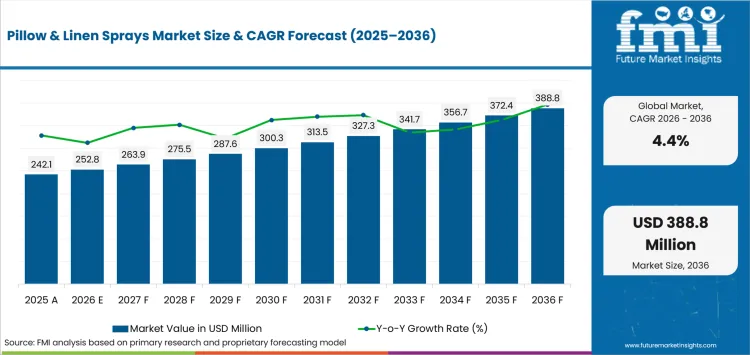
Key Takeaways of Pillow & Linen Sprays Market
- Demand rises because consumers use pillow and linen sprays for bedding refresh within repeatable evening scent routines.
- By product type, core - classic lines are estimated to hold 34.0% in 2026 owing to recognizable fragrance identities that support replenishment.
- Conventional products are projected to represent 49.0% of nature revenue in 2026 attributable to formulation flexibility and broad price coverage.
- In 2026, cream & balm is expected to account for 27.0% of format revenue because bundled bedtime routines support gifting and trial.
- Fragrance sensitivity and ingredient restrictions can increase reformulation work before brands widen distribution into regulated consumer channels.
- Some of the key players in this market include Estee Lauder Companies, Symrise, Swiss Arabian, Puig, DSM-Firmenich, Givaudan, Coty, L'Oreal, Ajmal Perfumes, and Rasasi.
Analyst Perspective
"A pillow or linen spray earns repeat purchase only after scent appeal is matched by clean fabric application and clear directions. Brand economics improve when trial formats and digital scent guidance reduce first-order uncertainty without making medical sleep claims."
- Rahul Pandita, Principal Consultant, Future Market Insights
How is the Pillow & Linen Sprays Market segmented?
The market is segmented by product type, nature, format, price positioning, and sales channel.
Product type includes core - classic lines, targeted treatment lines, sensitive & gentle lines, premium & clinical lines, and kits & sets. Nature covers conventional, vegan & cruelty-free, natural & organic, dermocosmetic - clinical, and fragrance-free & sensitive. Format includes cream & balm, liquid & serum, stick & solid, spray & mist, sheet & patch, and powder. Price positioning covers mass, masstige, premium, and professional. Sales channel includes e-commerce & DTC, specialty beauty retail, pharmacies & drugstores, supermarkets & hypermarkets, and salons & spas.
What makes core - classic lines central to the product type category?
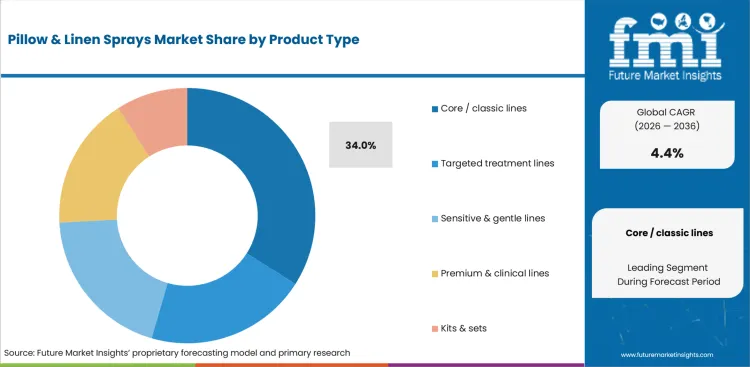
Core - classic lines shorten scent learning because familiar lavender and soft floral cues communicate the use case quickly. Adjacent aromatherapy products use comparable scent associations without turning a fabric spray into a therapeutic claim.
- By product type, core - classic lines are estimated to hold 34.0% in 2026 because recognizable fragrance identities support replenishment.
- Swiss Arabian launched three perfumes within established collections in October 2025, showing how recognizable scent families can carry new variants without rebuilding category awareness.
Why does conventional lead the nature category?
Conventional formulations let developers balance solvent choice and fragrance load before adding narrower sourcing claims. Fragrance houses use perfume ingredients to adjust scent character and delivery, but textile use still requires residue and compatibility testing.
- Conventional products are projected to represent 49.0% of nature revenue in 2026 because formulation flexibility supports broader price coverage.
- Symrise presented fragrance and home-care concepts at Beautyworld Middle East in October 2025, providing current evidence of cross-application scent development for consumer products.
How does cream & balm shape the format category?
Cream & balm represents the tactile part of a bedtime bundle instead of the spray delivery system itself. Fragranced personal care products demonstrate how brands extend one scent identity into another sensory format within the same evening routine.
- In 2026, cream & balm is expected to account for 27.0% of format revenue because bundled routines support gifting and product trial.
- Coty launched adidas Vibes Hair & Body Mists in June 2025, demonstrating how fragrance brands extend a scent proposition into another everyday application format.
What supports mass in the price positioning category?
Mass pricing reduces the financial cost of testing a fragrance that cannot be judged fully before opening. Personal and home care purchasing through drugstores and mass retail also gives lower-ticket scent products frequent exposure beside routine household purchases.
- By price positioning, mass is forecast to represent 33.0% in 2026 driven by accessible ticket sizes that reduce unsuccessful trial costs.
- Coty introduced the Jawhara collection below the USD 25 price point in October 2025, pairing detailed fragrance storytelling with an accessible retail price.
What drives E-commerce & DTC in the sales channel category?
E-commerce and DTC let brands explain fabric directions and scent notes without relying on limited shelf space. Digital discovery works particularly well for fragrance products after shoppers establish scent preferences through samples or previous purchases.
- E-commerce & DTC is projected to represent 35.0% of sales channel revenue in 2026 owing to detailed product education and repeat ordering.
- Estee Lauder Companies and Jo Malone London launched Scent Scanner in June 2026, translating saved visual preferences into personalized fragrance recommendations for digital users.
What are the drivers, restraints and opportunities in the Pillow & Linen Sprays Market?
Bedroom scent routines support repeat demand, fragrance safety limits raise formulation work, and guided scent discovery can convert more first purchases into replenishment.
- Driver: Evening self-care routines give non-medical scent products a repeatable use occasion tied to bedding refresh and personal wind-down.
- Restraint: Fragrance safety limits and textile tolerance can narrow ingredient choices because residue concerns increase fabric-testing requirements.
- Opportunity: Guided digital discovery reduces scent uncertainty and hospitality programs establish scheduled replenishment for familiar fragrance profiles.
Bedroom routines give non-medical scent products a repeatable use occasion tied to bedding refresh and personal wind-down. An American Academy of Sleep Medicine survey published in December 2025 found that 56% of USA adults had tried a viral sleep-related social-media trend. The 56% response documents active experimentation with bedtime habits without proving any benefit from fragrance. Fragrance formulation teams can compete for that attention by keeping sensory positioning separate from clinical sleep claims and explaining textile use clearly.
Textile sprays need fragrance concentrations that remain acceptable on fabric and within current ingredient safety limits. IFRA opened consultation on the 52nd Amendment to its Standards in December 2025 with review continuing through June 2026. Revised restrictions require perfumers to recheck safe-use limits before new scent formulas advance toward commercialization. Brands serving air care applications must also validate residue and spray behavior on bedding before adapting ambient-fragrance formulas for textile use.
Remote scent selection gives brands a practical route to reduce first-purchase uncertainty without making stronger product claims. Estee Lauder Companies launched Jo Malone London’s AI Scent Advisor in December 2025 to turn natural-language preferences into fragrance recommendations. Pillow-spray brands can pair guided discovery with fabric care guidance that sets textile compatibility and application expectations before checkout.
Which country CAGRs are covered in the Pillow & Linen Sprays Market?
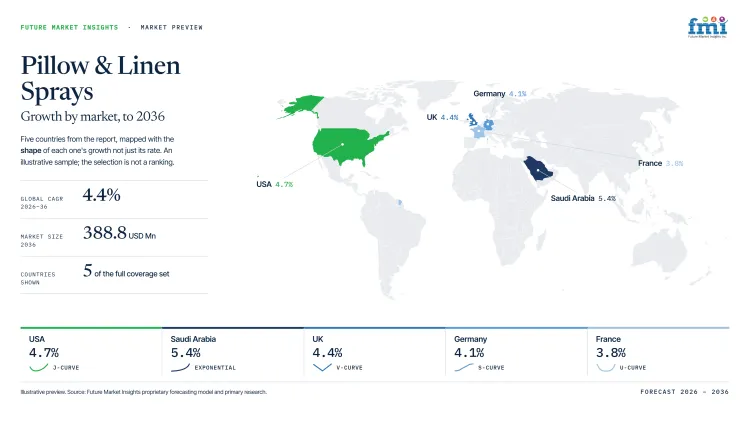
| Country | CAGR |
|---|---|
| UAE | 5.7% |
| Saudi Arabia | 5.4% |
| South Korea | 5.1% |
| USA | 4.7% |
| UK | 4.4% |
| Germany | 4.1% |
| France | 3.8% |
| Japan | 3.5% |
How do country-level CAGRs compare in the Pillow & Linen Sprays Market?
The 2.2-point spread separates hospitality-led Gulf growth from mature markets that depend more on scent discovery. UAE and Saudi Arabia form the upper band because hotels and gifting generate frequent fragrance occasions. South Korea follows through mobile commerce. The USA and UK sit in the middle. Germany and France trail them before Japan closes the range.
- The UAE’s thriving hotel sector is driving higher demand for institutional refill programs and bulk fragrance consumption.
- Saudi Arabia’s hospitality expansion is creating a broader base of commercial accounts for room-scent solutions.
- South Korea’s mobile-first retail landscape accelerates fragrance discovery and shortens consumer trial cycles.
- The USA’s extensive retail and distribution channels help support scale despite increasing formulation complexity.
- The UK’s prestige retail environment effectively converts product sampling into repeat fragrance purchases.
- Germany’s efficient parcel-delivery network supports convenient replenishment and recurring scent purchases.
- France’s highly competitive perfume sector increases the need for differentiated textile and linen fragrance offerings.
- Japan’s cautious claims environment limits sleep-related positioning and encourages more restrained product messaging.
Country CAGR cannot indicate revenue scale because channel costs and hotel purchasing intensity differ materially. The full report provides country-level CAGR analysis for North America, Latin America, Western Europe, Eastern Europe, East Asia, South Asia and Pacific, and Middle East and Africa.
Country-wise Analysis
- Prestige fragrance retail and DTC wellness content give United States consumers several routes to encounter textile scent products. Pillow & linen spray demand in the USA is forecast to rise at 4.7% CAGR over the forecast period, supported by e-commerce that makes known scents easier to replenish. The USA Census Bureau reported in August 2026 that e-commerce represented 17.1% of total retail sales during the second quarter. Digital access widens distribution, but California formulation rules and textile-residue concerns require brands to prove fabric compatibility before one formula can move through national retail and hospitality accounts with use directions.
- German consumers can replenish familiar scents through mature online retail, but an unfamiliar textile fragrance still carries sensory risk at first purchase. Destatis data updated in November 2025 show that 70% of people aged 16 to 74 bought online during the previous three months. Germany is estimated to post 4.1% CAGR over the forecast period, attributable to parcel delivery and established digital purchasing that make known scents easier to reorder. Channel depth gives brands direct household access, but discovery bundles and specific scent descriptions remain necessary for unfamiliar products to earn repeat purchases without physical sampling or store-based consultation.
- French perfume culture gives pillow sprays a familiar scent vocabulary, but the product competes with room fragrance and personal fragrance for evening use. Sales of pillow & linen sprays in France are forecast to expand at 3.8% CAGR by 2036, supported by digital purchasing that makes replenishment easier after trial. INSEE reported in October 2025 that 63% of people aged 15 or older bought goods or services online during the previous three months in 2024. Online access gives brands a reorder channel, but fabric-specific directions and smaller trial sizes must distinguish textile scent from established fragrance alternatives within crowded assortments.
- UK shoppers move between prestige home-fragrance stores and online retail, giving brands separate routes for sensory discovery and later replenishment. Office for National Statistics data show that internet sales represented 27.4% of total retail sales in May 2025, with the monthly share tracking in the range of 27–29% across 2025. The UK pillow & linen sprays sector is projected to record 4.4% CAGR during the assessment period, driven by digital retail that supports known-scent reordering after physical or sample-based discovery. Physical sampling and smaller discovery sizes reduce first-order uncertainty, especially for collections that ask consumers to judge fabric use and scent intensity from a product page before purchase.
- Hotel expansion and specialist perfume retail give Saudi Arabia commercial routes that extend beyond routine household self-use for textile fragrance products. Pillow & linen spray demand in Saudi Arabia is predicted to advance at 5.4% CAGR through 2036, driven by hospitality growth that supplies institutional room-scent occasions. GASTAT reported in January 2026 that licensed tourist hospitality facilities reached 5,622 during the third quarter of 2025. Hotels can absorb standardized scent programs, but fragrance houses must provide consistent intensity and dependable replenishment before a discretionary room ritual becomes regular institutional volume for routine guest-room use and scheduled housekeeping cycles and room turnover.
- Dubai hotels and premium gifting channels give UAE fragrance companies direct access to international visitors evaluating textile scent. Government of Dubai data published in June 2025 recorded 7.15 million international overnight visitors during the first four months of that year. UAE is projected to grow at 5.7% CAGR by 2036, attributable to hotel turnover and premium retail that generate repeated scenting occasions. Hospitality access gives brands an institutional route, but properties still require consistent supply and fabric-safe execution before adjacent air freshener products can translate into scheduled pillow and linen spray replenishment for guest rooms and gifting programs.
- Japanese retailers often favor restrained sensory positioning, making fabric directions and non-therapeutic wording central to the fit of pillow and linen sprays. Adoption of pillow & linen sprays in Japan is estimated to expand at 3.5% CAGR through 2036, supported by online access that lets households reorder known scents after trial. Japan’s Statistics Bureau reported in September 2026 that 55.6% of two-or-more-person households used internet shopping during July 2026. Digital reach lowers reorder friction, but discretionary scent products compete with unscented bedding care and ambient fragrance unless smaller formats establish a clear textile-use routine for repeat purchase and gifting.
- Mobile commerce gives South Korean beauty consumers fast access to scent-led products, but screens cannot reproduce fragrance character before the first order. Statistics Korea reported that mobile transactions represented 77.2% of online shopping value during May 2025. Sales of pillow & linen sprays in South Korea are forecast to expand at 5.1% CAGR by 2036, driven by mobile-first retail that shortens assortment discovery. Beauty e-commerce provides a direct enabler, but brands must make fabric compatibility explicit before natural cosmetics audiences treat textile scent as a repeat household routine instead of another discretionary fragrance purchase for home use and gifting occasions.
Who are the notable companies in the Pillow & Linen Sprays Market?
Estee Lauder Companies, Symrise, Swiss Arabian, Puig, DSM-Firmenich, Givaudan, Coty, L'Oreal, Ajmal Perfumes, and Rasasi are the notable companies in this market.
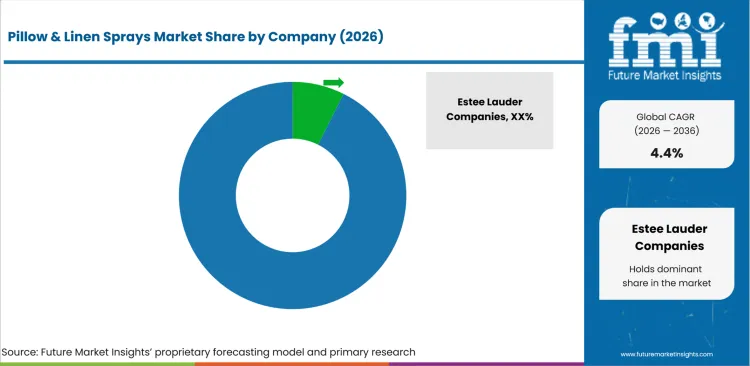
Consumer fragrance groups and B2B scent creators occupy different positions in the pillow and linen spray value chain. Estee Lauder Companies and Puig control branded fragrance portfolios alongside Coty and L'Oreal through major retail channels. Symrise and DSM-Firmenich influence formulation alongside Givaudan through B2B application resources for finished-product fragrance development. Swiss Arabian and Ajmal Perfumes bring GCC fragrance recognition alongside Rasasi, but public evidence places their pillow-spray exposure beside broader fragrance and home-scent categories.
- Consumer fragrance groups: Estee Lauder Companies and Puig compete beside Coty and L'Oreal through branded launches and multichannel distribution.
- B2B fragrance creators: Symrise and DSM-Firmenich compete beside Givaudan through formulation resources and industrial fragrance production.
- GCC fragrance houses: Swiss Arabian and Ajmal Perfumes compete beside Rasasi through regional scent recognition and direct consumer distribution.
Competitive Benchmarking: Pillow & Linen Sprays Market
| Company | Direct Home-Scent Proposition | Fragrance Formulation & Delivery | Digital / Multichannel Access | Geographic Reach |
|---|---|---|---|---|
| Estee Lauder Companies | High | Medium | High | North America, Europe, Asia-Pacific, and Middle East |
| Symrise | Low | High | Medium | Europe, Americas, Asia-Pacific, and Middle East |
| Swiss Arabian | Medium | Low | Medium | GCC markets and selected international e-commerce |
| Puig | Low | Medium | High | Europe, Americas, Asia-Pacific, and Middle East |
| DSM-Firmenich | Low | High | Medium | Global B2B fragrance footprint |
| Givaudan | Low | High | Medium | Global B2B fragrance footprint |
| Coty | Low | Medium | High | More than 120 countries and territories |
| L'Oreal | Medium | Medium | High | Global beauty and luxury retail |
| Ajmal Perfumes | Medium | Low | Medium | GCC, India, and selected international markets |
| Rasasi | Medium | Low | Medium | GCC-centered distribution with international reach |
Key Developments in the Pillow & Linen Sprays Market
- In March 2026, L'Oreal completed the acquisition of Kering Beauté including Creed and long-term fragrance licenses for Bottega Veneta and Balenciaga. The transaction expands the group’s luxury fragrance portfolio and gives it additional brand platforms that compete for premium scent spending.
- In September 2025, Coty announced closer integration of its prestige and mass fragrance operations as fragrance represented 69% of company sales. The change concentrates consumer insight and manufacturing resources around scent categories that span several price tiers.
- In September 2025, Givaudan broke ground on a new Fragrance & Beauty facility in Guangzhou to expand local creation and production capacity. The investment shortens development distance for Asian customers that need fragrance adaptation and application support closer to market.
Key Players in the Pillow & Linen Sprays Market
Consumer Fragrance and Beauty Groups
- Estee Lauder Companies
- Puig
- Coty
- L'Oreal
Fragrance Creation and Delivery Companies
- Symrise
- DSM-Firmenich
- Givaudan
GCC-Centered Fragrance Houses
- Swiss Arabian
- Ajmal Perfumes
- Rasasi
Pillow & Linen Sprays Market - Report Scope
| Coverage field | Report scope |
|---|---|
| Market breakdown | By product type, nature, format, price positioning, sales channel and region. |
| Quantitative Units | Revenue in USD million and CAGR in %. |
| Market Definition | Revenue captures pillow and linen sprays sold for application to bedding or household textiles at the brand or manufacturer level. |
| Regions Covered | North America; Latin America; Western Europe; Eastern Europe; East Asia; South Asia and Pacific; Middle East and Africa. |
| Countries Covered | USA, Germany, France, UK, Saudi Arabia, UAE, Japan, South Korea, and 20+ countries included in the full report. |
| Key Companies | Estee Lauder Companies, Symrise, Swiss Arabian, Puig, DSM-Firmenich, Givaudan, Coty, L'Oreal, Ajmal Perfumes, Rasasi. |
| Forecast Period | 2026 to 2036. |
| Approach | Primary and secondary research with market triangulation. |
Pillow & Linen Sprays Market - Research Methodology
| Method | Approach |
|---|---|
| Primary Research | FMI analysts gathered input from manufacturers, service providers, technology developers, distributors, end users, procurement teams, and subject-matter experts. Interviews examined purchasing decisions, product or service evaluation, adoption barriers, approval requirements, pricing considerations, and expectations for technical or commercial support. Respondents were also asked what evidence is required before a trial, pilot, or initial order develops into regular purchasing. |
| Desk Research | Desk research covered government statistics, regulatory publications, trade data, industry associations, technical literature, standards, company filings, product information, and official corporate announcements. Sources were reviewed for relevance, publication date, geographic coverage, and consistency with the defined market scope. Claims relating to performance, applications, approvals, capacity, investment, and commercial activity were retained only when supported by credible public evidence. |
| Market Sizing and Forecasting | The market model combined the baseline value with historical performance, segment structure, pricing and volume indicators, adoption levels, company participation, and country-level demand conditions. Forecast assumptions considered economic activity, investment trends, regulatory developments, technology adoption, purchasing cycles, supply availability, and barriers to wider market use. Segment and regional estimates were reconciled before the final market total was calculated. |
| Data Validation | Estimates were checked against multiple independent indicators, including public data, company activity, trade patterns, industry developments, and findings from primary interviews. Validation also tested whether products, services, applications, and company revenues fell within the defined market boundaries. Adjacent categories, unsupported claims, overlapping revenues, and activities without direct market relevance were excluded to reduce double counting and maintain consistency across segments and countries. |
Pillow & Linen Sprays Market by Segments
Pillow & Linen Sprays Market segmented by Product Type:
- Core - classic lines
- Targeted treatment lines
- Sensitive & gentle lines
- Premium & clinical lines
- Kits & sets
Pillow & Linen Sprays Market segmented by Nature:
- Conventional
- Vegan & cruelty-free
- Natural & organic
- Dermocosmetic - clinical
- Fragrance-free & sensitive
Pillow & Linen Sprays Market segmented by Format:
- Cream & balm
- Liquid & serum
- Stick & solid
- Spray & mist
- Sheet & patch
- Powder
Pillow & Linen Sprays Market segmented by Price Positioning:
- Mass
- Masstige
- Premium
- Professional
Pillow & Linen Sprays Market segmented by Sales Channel:
- E-commerce & DTC
- Specialty beauty retail
- Pharmacies & drugstores
- Supermarkets & hypermarkets
- Salons & spas
Pillow & Linen Sprays Market by Region:
- North America
- United States
- Canada
- Latin America
- Brazil
- Mexico
- Argentina
- Chile
- Western Europe
- Germany
- France
- United Kingdom
- Italy
- Spain
- Benelux
- Nordics
- Eastern Europe
- Poland
- Czech Republic
- Romania
- Hungary
- East Asia
- China
- Japan
- South Korea
- South Asia and Pacific
- India
- ASEAN
- Australia and New Zealand
- Middle East and Africa
- GCC Countries
- South Africa
- Türkiye
- Israel
Research Sources and Bibliography
- National Center for Health Statistics. (2026, April 29). Short Sleep Duration and Sleep Difficulties Among Adults: United States, 2024.
- Government of Dubai Media Office. (2026, February 9). Dubai’s tourism industry achieves third successive record-breaking year.
- Swiss Arabian. (2025, October 15). Swiss Arabian Unveils Three New Perfume Launches.
- Symrise. (2025, October 27). Symrise takes over Beauty World Middle East with an inspiring ‘Beach Club’ experience.
- Coty. (2025, June 11). Introducing Adidas Vibes Fragrance Hair & Body Mists - The Mood-boosting Sportswear Scents For Hair And Body.
- Coty. (2025, November 14). An Aura Takes Hold: Coty’s Jawhara Collection Captivates Consumers with Premium Fragrance Artistry.
- The Estee Lauder Companies. (2026, June 17). The Estee Lauder Companies and Jo Malone London Launch Experience That Turns Visual Taste into a Personalized Fragrance Wardrobe, exclusively on Pinterest.
- American Academy of Sleep Medicine. (2025, December 2). Scrolling for sleep: The social media trends impacting Americans’ sleep habits.
- International Fragrance Association. (2025, December 12). IFRA launches consultation on latest update to its safe use program.
- The Estee Lauder Companies. (2025, December 2). The Estee Lauder Companies and Jo Malone London Introduce AI-Powered Scent Advisor Experience.
- USA Census Bureau. (2026, August 18). Quarterly Retail E-Commerce Sales: Second Quarter 2026.
- Statistisches Bundesamt. (2025, November 27). Internet users and online shoppers.
- INSEE. (2025, October 14). Achats de produits et de services en ligne.
- Office for National Statistics. (2026, July 24). Internet sales as a percentage of total retail sales (ratio) (%).
- General Authority for Statistics, Saudi Arabia. (2026, January 8). GASTAT Publishes Tourism Establishments Statistics for Q3 of 2025.
- Government of Dubai Media Office. (2025, June 11). Dubai Department of Economy and Tourism Highlights Community Effort and Industry Growth Momentum at First City Briefing of 2025.
- Statistics Bureau of Japan. (2026, September 4). Family Income and Expenditure Survey: Internet shopping, July 2026.
- Statistics Korea. (2025, July 1). Online Shopping in May 2025.
- L'Oreal. (2026, March 31). L’Oréal completes the acquisition of Kering Beauté within the framework of its strategic alliance with Kering.
- Coty. (2025, September 30). Coty Announces Plans to Bolster Its Leading Position in Fragrance and Launches a Strategic Review of Its Consumer Beauty Business.
- Givaudan. (2025, September 29). Givaudan breaks ground on new Fragrance & Beauty facility in Guangzhou, China.
- The Estee Lauder Companies. (2026, June 8). The Estée Lauder Companies Strengthens UK Manufacturing Network as Whitman Facility Celebrates 60 Years of British Craftsmanship.
- Symrise. (2026, May 28). Symrise launches SYM ALPHA™ Think Tank.
- dsm-firmenich. (2025, July 28). dsm-firmenich presents Connect: Future You.
- Coty. (2026, January 26). Coty Unveils the Bridgerton Fragrance Collection That Will Enchant the Ton.
- L'Oreal Canada. (2026, May 5). L’Oréal Canada and Shoppers Drug Mart partner to redefine luxe as they launch the first Multi-Brand Fragrance Refill Fountain.
- The Estee Lauder Companies. (2026, August 19). The Estée Lauder Companies Reports Fiscal 2026 Results.
- Symrise. (2025, July 2). Symrise subsidiary SFA NEROLI opens a new fragrance ecosystem in Grasse.
- Swiss Arabian. (2026, April 7). Swiss Arabian Unveils Two New Perfumes and Launches.
- Puig. (2025, October 8). Colonias Absolutas Puig: A tribute to Puig, its identity, legacy, and Mediterranean roots.
- dsm-firmenich. (2026, February 4). dsm-firmenich continues expansion in the Middle East with a new creative concept in Riyadh.
- Givaudan. (2026, April 24). Givaudan breaks ground on its new fragrances manufacturing facility in Pedro Escobedo, Mexico.
- Coty. (2026, July 6). Megan Thee Stallion Enters Fragrance Industry & Introduces New Hot Girl Summer Eau de Parfum with Coty.
- L'Oreal Nordic. (2026, June 16). L’oréal Nordic accelerates circular beauty and calls on consumers to #jointherefillmovement.
- Ajmal Perfumes India. (2025, November 27). The Untold Stories By Ajmal.
- Rasasi Perfumes Manufacturing LLC. (2026, July 2). RASASI unveils the biggest launch of the year at ASD MARKET WEEK 2026, in LAS VEGAS.
- Puig. (2026, June 19). L’Artisan Parfumeur: 50 Years of Creative Freedom.
This bibliography is provided for reader reference and is not exhaustive. The full report contains the complete reference list and detailed citations.
This Report Answers
- How large is the pillow & linen sprays market through 2036?
- Which bedroom routines support repeat pillow and linen spray demand?
- Why do core - classic lines hold the approved product type share?
- How does conventional formulation support the approved nature share?
- Why does e-commerce & DTC hold the approved sales channel share?
- How do growth rates differ among the eight covered countries?
- Which companies compete through branded fragrance, scent creation, or GCC distribution?
- How do scent tolerance and ingredient-safety limits constrain wider adoption?
Frequently Asked Questions
How big is the Pillow & Linen Sprays Market in 2026?
The pillow & linen sprays market is valued at USD 252.8 million in 2026 and is projected to reach USD 388.8 million by 2036. Bedding-refresh routines and evening scent use provide repeat purchase occasions without positioning these products as medical sleep treatments.
What is the CAGR of the Pillow & Linen Sprays Market from 2026 to 2036?
The pillow & linen sprays market is projected to grow at a CAGR of 4.4% between 2026 and 2036. Digital replenishment and hospitality programs support repeat purchasing after consumers or hotel operators establish a preferred fragrance profile.
Which product type leads the Pillow & Linen Sprays Market?
The core - classic lines segment is expected to hold 34.0% of the pillow & linen sprays market in 2026, attributable to familiar scent identities that reduce trial uncertainty. Stable fragrance recognition supports repeat ordering after consumers establish an acceptable scent preference through prior use.
Which nature segment holds the stated share in the Pillow & Linen Sprays Market?
The conventional segment is projected to represent 49.0% of the pillow & linen sprays market by nature in 2026, attributable to broad formulation flexibility. Developers can balance fragrance delivery and price before adding narrower sourcing or certification requirements.
Which companies are active in the Pillow & Linen Sprays Market?
Key companies operating in the market include Estee Lauder Companies, Symrise, Swiss Arabian, Puig, DSM-Firmenich, Givaudan, Coty, L'Oreal, Ajmal Perfumes, and Rasasi. Their roles span branded fragrance distribution and B2B scent creation alongside GCC-centered consumer channels relevant to the defined category.
Preview the report firsthand - request a free sample
Get SampleGet the brochure for pricing and purchase details.
Get PDFTable of Content
- Key Takeaways
- Market Size and CAGR
- Top Growth Driver
- Fastest Growing Segment
- Leading Region
- Key Companies
- Emerging Opportunities
- Executive Summary
- Global Market Outlook
- Demand-side Trends
- Supply-side Trends
- Technology Roadmap Analysis
- Analysis and Recommendations
- Analyst Perspective (What is happening? Why now? What should investors know?)
- Key Questions Answered
- How large is the market?
- What is the CAGR?
- What are key trends?
- Which region dominates?
- Who are the leaders?
- Market Overview
- Market Coverage / Taxonomy
- Market Definition / Scope / Limitations
- Research Methodology
- Chapter Orientation
- Analytical Lens and Working Hypotheses
- Market Structure, Signals, and Trend Drivers
- Benchmarking and Cross-market Comparability
- Market Sizing, Forecasting, and Opportunity Mapping
- Research Design and Evidence Framework
- Desk Research Programme (Secondary Evidence)
- Expert Input and Fieldwork (Primary Evidence)
- Tooling, Models, and Reference Databases
- Data Engineering and Model Build
- Quality Assurance and Audit Trail
- Market Background
- Market Dynamics (Drivers, Restraints, Opportunity, Trends)
- Scenario Forecast (Optimistic, Likely, Conservative)
- Impact Analysis
- AI Impact
- Sustainability Impact
- Regulatory Impact
- Technology Impact
- Consumer / Buyer Analysis
- Purchase Drivers
- Adoption Barriers
- Buyer Journey
- Opportunity Map Analysis
- Product Life Cycle Analysis
- Supply Chain Analysis
- Investment Feasibility Matrix
- Value Chain Analysis
- PESTLE and Porter's Analysis
- Regulatory Landscape
- Regional Parent Market Outlook
- Production and Consumption Statistics
- Import and Export Statistics
- Global Market Analysis and Forecast, 2021 to 2036
- Historical Market Size Value (USD Million) Analysis, 2021 to 2025
- Current and Future Market Size Value (USD Million) Projections, 2026 to 2036
- Y-o-Y Growth Trend Analysis
- Absolute $ Opportunity Analysis
- Global Market Pricing Analysis, 2021 to 2036
- Global Market Analysis and Forecast, By Product Type, 2021 to 2036
- Introduction / Key Findings
- Historical Market Size Value (USD Million) Analysis By Product Type, 2021 to 2025
- Current and Future Market Size Value (USD Million) Analysis and Forecast By Product Type, 2026 to 2036
- Core / classic lines
- Targeted treatment lines
- Sensitive & gentle lines
- Premium & clinical lines
- Kits & sets
- Core / classic lines
- Y-o-Y Growth Trend Analysis By Product Type, 2021 to 2025
- Absolute $ Opportunity Analysis By Product Type, 2026 to 2036
- Global Market Analysis and Forecast, By Nature, 2021 to 2036
- Introduction / Key Findings
- Historical Market Size Value (USD Million) Analysis By Nature, 2021 to 2025
- Current and Future Market Size Value (USD Million) Analysis and Forecast By Nature, 2026 to 2036
- Conventional
- Vegan & cruelty-free
- Natural & organic
- Dermocosmetic / clinical
- Fragrance-free & sensitive
- Conventional
- Y-o-Y Growth Trend Analysis By Nature, 2021 to 2025
- Absolute $ Opportunity Analysis By Nature, 2026 to 2036
- Global Market Analysis and Forecast, By Format, 2021 to 2036
- Introduction / Key Findings
- Historical Market Size Value (USD Million) Analysis By Format, 2021 to 2025
- Current and Future Market Size Value (USD Million) Analysis and Forecast By Format, 2026 to 2036
- Cream & balm
- Liquid & serum
- Stick & solid
- Spray & mist
- Sheet & patch
- Powder
- Cream & balm
- Y-o-Y Growth Trend Analysis By Format, 2021 to 2025
- Absolute $ Opportunity Analysis By Format, 2026 to 2036
- Global Market Analysis and Forecast, By Price Positioning, 2021 to 2036
- Introduction / Key Findings
- Historical Market Size Value (USD Million) Analysis By Price Positioning, 2021 to 2025
- Current and Future Market Size Value (USD Million) Analysis and Forecast By Price Positioning, 2026 to 2036
- Mass
- Masstige
- Premium
- Professional
- Mass
- Y-o-Y Growth Trend Analysis By Price Positioning, 2021 to 2025
- Absolute $ Opportunity Analysis By Price Positioning, 2026 to 2036
- Global Market Analysis and Forecast, By Sales Channel, 2021 to 2036
- Introduction / Key Findings
- Historical Market Size Value (USD Million) Analysis By Sales Channel, 2021 to 2025
- Current and Future Market Size Value (USD Million) Analysis and Forecast By Sales Channel, 2026 to 2036
- E-commerce & DTC
- Specialty beauty retail
- Pharmacies & drugstores
- Supermarkets & hypermarkets
- Salons & spas
- E-commerce & DTC
- Y-o-Y Growth Trend Analysis By Sales Channel, 2021 to 2025
- Absolute $ Opportunity Analysis By Sales Channel, 2026 to 2036
- Global Market Analysis and Forecast, By Region, 2021 to 2036
- Introduction
- Historical Market Size Value (USD Million) Analysis By Region, 2021 to 2025
- Current Market Size Value (USD Million) Analysis and Forecast By Region, 2026 to 2036
- North America
- Latin America
- Western Europe
- Eastern Europe
- East Asia
- South Asia and Pacific
- Middle East & Africa
- Market Attractiveness Analysis By Region
- North America Market Analysis and Forecast, By Country, 2021 to 2036
- Historical Market Size Value (USD Million) Trend Analysis By Market Taxonomy, 2021 to 2025
- Market Size Value (USD Million) Forecast By Market Taxonomy, 2026 to 2036
- By Country
- USA
- Canada
- By Product Type
- By Nature
- By Format
- By Price Positioning
- By Sales Channel
- By Country
- Market Attractiveness Analysis
- By Country
- By Product Type
- By Nature
- By Format
- By Price Positioning
- By Sales Channel
- Key Takeaways
- Latin America Market Analysis and Forecast, By Country
- Historical Market Size Value (USD Million) Trend Analysis By Market Taxonomy, 2021 to 2025
- Market Size Value (USD Million) Forecast By Market Taxonomy, 2026 to 2036
- By Country
- Brazil
- Mexico
- Chile
- Rest of Latin America
- By Product Type
- By Nature
- By Format
- By Price Positioning
- By Sales Channel
- By Country
- Market Attractiveness Analysis
- By Country
- By Product Type
- By Nature
- By Format
- By Price Positioning
- By Sales Channel
- Key Takeaways
- Western Europe Market Analysis and Forecast, By Country
- Historical Market Size Value (USD Million) Trend Analysis By Market Taxonomy, 2021 to 2025
- Market Size Value (USD Million) Forecast By Market Taxonomy, 2026 to 2036
- By Country
- Germany
- UK
- Italy
- Spain
- France
- Nordic
- BENELUX
- Rest of Western Europe
- By Product Type
- By Nature
- By Format
- By Price Positioning
- By Sales Channel
- By Country
- Market Attractiveness Analysis
- By Country
- By Product Type
- By Nature
- By Format
- By Price Positioning
- By Sales Channel
- Key Takeaways
- Eastern Europe Market Analysis and Forecast, By Country
- Historical Market Size Value (USD Million) Trend Analysis By Market Taxonomy, 2021 to 2025
- Market Size Value (USD Million) Forecast By Market Taxonomy, 2026 to 2036
- By Country
- Russia
- Poland
- Hungary
- Balkan & Baltic
- Rest of Eastern Europe
- By Product Type
- By Nature
- By Format
- By Price Positioning
- By Sales Channel
- By Country
- Market Attractiveness Analysis
- By Country
- By Product Type
- By Nature
- By Format
- By Price Positioning
- By Sales Channel
- Key Takeaways
- East Asia Market Analysis and Forecast, By Country
- Historical Market Size Value (USD Million) Trend Analysis By Market Taxonomy, 2021 to 2025
- Market Size Value (USD Million) Forecast By Market Taxonomy, 2026 to 2036
- By Country
- China
- Japan
- South Korea
- By Product Type
- By Nature
- By Format
- By Price Positioning
- By Sales Channel
- By Country
- Market Attractiveness Analysis
- By Country
- By Product Type
- By Nature
- By Format
- By Price Positioning
- By Sales Channel
- Key Takeaways
- South Asia and Pacific Market Analysis and Forecast, By Country
- Historical Market Size Value (USD Million) Trend Analysis By Market Taxonomy, 2021 to 2025
- Market Size Value (USD Million) Forecast By Market Taxonomy, 2026 to 2036
- By Country
- India
- ASEAN
- Australia & New Zealand
- Rest of South Asia and Pacific
- By Product Type
- By Nature
- By Format
- By Price Positioning
- By Sales Channel
- By Country
- Market Attractiveness Analysis
- By Country
- By Product Type
- By Nature
- By Format
- By Price Positioning
- By Sales Channel
- Key Takeaways
- Middle East & Africa Market Analysis and Forecast, By Country
- Historical Market Size Value (USD Million) Trend Analysis By Market Taxonomy, 2021 to 2025
- Market Size Value (USD Million) Forecast By Market Taxonomy, 2026 to 2036
- By Country
- Kingdom of Saudi Arabia
- Other GCC Countries
- Türkiye
- South Africa
- Other African Union
- Rest of Middle East & Africa
- By Product Type
- By Nature
- By Format
- By Price Positioning
- By Sales Channel
- By Country
- Market Attractiveness Analysis
- By Country
- By Product Type
- By Nature
- By Format
- By Price Positioning
- By Sales Channel
- Key Takeaways
- Key Countries Market Analysis
- USA
- Pricing Analysis
- Market Share Analysis, 2025
- By Product Type
- By Nature
- By Format
- By Price Positioning
- By Sales Channel
- Canada
- Pricing Analysis
- Market Share Analysis, 2025
- By Product Type
- By Nature
- By Format
- By Price Positioning
- By Sales Channel
- Mexico
- Pricing Analysis
- Market Share Analysis, 2025
- By Product Type
- By Nature
- By Format
- By Price Positioning
- By Sales Channel
- Brazil
- Pricing Analysis
- Market Share Analysis, 2025
- By Product Type
- By Nature
- By Format
- By Price Positioning
- By Sales Channel
- Chile
- Pricing Analysis
- Market Share Analysis, 2025
- By Product Type
- By Nature
- By Format
- By Price Positioning
- By Sales Channel
- Germany
- Pricing Analysis
- Market Share Analysis, 2025
- By Product Type
- By Nature
- By Format
- By Price Positioning
- By Sales Channel
- UK
- Pricing Analysis
- Market Share Analysis, 2025
- By Product Type
- By Nature
- By Format
- By Price Positioning
- By Sales Channel
- Italy
- Pricing Analysis
- Market Share Analysis, 2025
- By Product Type
- By Nature
- By Format
- By Price Positioning
- By Sales Channel
- Spain
- Pricing Analysis
- Market Share Analysis, 2025
- By Product Type
- By Nature
- By Format
- By Price Positioning
- By Sales Channel
- France
- Pricing Analysis
- Market Share Analysis, 2025
- By Product Type
- By Nature
- By Format
- By Price Positioning
- By Sales Channel
- India
- Pricing Analysis
- Market Share Analysis, 2025
- By Product Type
- By Nature
- By Format
- By Price Positioning
- By Sales Channel
- ASEAN
- Pricing Analysis
- Market Share Analysis, 2025
- By Product Type
- By Nature
- By Format
- By Price Positioning
- By Sales Channel
- Australia & New Zealand
- Pricing Analysis
- Market Share Analysis, 2025
- By Product Type
- By Nature
- By Format
- By Price Positioning
- By Sales Channel
- China
- Pricing Analysis
- Market Share Analysis, 2025
- By Product Type
- By Nature
- By Format
- By Price Positioning
- By Sales Channel
- Japan
- Pricing Analysis
- Market Share Analysis, 2025
- By Product Type
- By Nature
- By Format
- By Price Positioning
- By Sales Channel
- South Korea
- Pricing Analysis
- Market Share Analysis, 2025
- By Product Type
- By Nature
- By Format
- By Price Positioning
- By Sales Channel
- Russia
- Pricing Analysis
- Market Share Analysis, 2025
- By Product Type
- By Nature
- By Format
- By Price Positioning
- By Sales Channel
- Poland
- Pricing Analysis
- Market Share Analysis, 2025
- By Product Type
- By Nature
- By Format
- By Price Positioning
- By Sales Channel
- Hungary
- Pricing Analysis
- Market Share Analysis, 2025
- By Product Type
- By Nature
- By Format
- By Price Positioning
- By Sales Channel
- Kingdom of Saudi Arabia
- Pricing Analysis
- Market Share Analysis, 2025
- By Product Type
- By Nature
- By Format
- By Price Positioning
- By Sales Channel
- Türkiye
- Pricing Analysis
- Market Share Analysis, 2025
- By Product Type
- By Nature
- By Format
- By Price Positioning
- By Sales Channel
- South Africa
- Pricing Analysis
- Market Share Analysis, 2025
- By Product Type
- By Nature
- By Format
- By Price Positioning
- By Sales Channel
- USA
- Market Structure Analysis
- Competition Dashboard
- Competition Benchmarking
- Market Share Analysis of Top Players
- By Regional
- By Product Type
- By Nature
- By Format
- By Price Positioning
- By Sales Channel
- Emerging Startups
- Innovation Benchmarking
- Competition Analysis
- Competition Deep Dive
- Estee Lauder Companies
- Overview
- Product Portfolio
- Profitability by Market Segments
- Sales Footprint
- Strategy Overview
- Marketing Strategy
- Product Strategy
- Channel Strategy
- Symrise
- Swiss Arabian
- Puig
- DSM-Firmenich
- Givaudan
- Coty
- L'Oreal
- Ajmal Perfumes
- Rasasi
- Estee Lauder Companies
- Case Studies
- Success Stories
- Recent Developments
- Competition Deep Dive
- Assumptions & Acronyms Used


