

- Market Size (2026)
- USD 2.3 Bn
- Forecast (2036)
- USD 5.0 Bn
- CAGR (2026 to 2036)
- 8.1%
How big is Plasma Protease C1 Inhibitor Market size?
USD 2.3 billion in 2026 and USD 5.0 billion by 2036 at an 8.1% CAGR.
Demand for Plasma Protease C1 Inhibitor is projected to expand at 8.1% CAGR between 2026 and 2036, increasing valuation from USD 2.3 billion in 2026 to USD 5.0 billion by 2036. Specialist medical teams prescribe plasma-derived and recombinant C1 esterase inhibitors to manage hereditary angioedema attacks. Intellia Therapeutics reported approximately 7,000 treated hereditary angioedema patients across the United States during April 2026. Expanding diagnosed patient coverage directly supports the continuous assessment of inherited orphan blood disorder therapeutics across specialist care pathways.
Treatment programs across the United States and Germany prioritize access records and formal payer documentation. Care networks throughout Australia and Japan focus primarily on specialist reach and dependable self-administration support. KalVista Pharmaceuticals recorded 1,702 United States patient start forms through February 2026 in its March 2026 corporate update. Early prescription activity demonstrates simplified administration able to alter therapy selection across established hereditary angioedema programs.
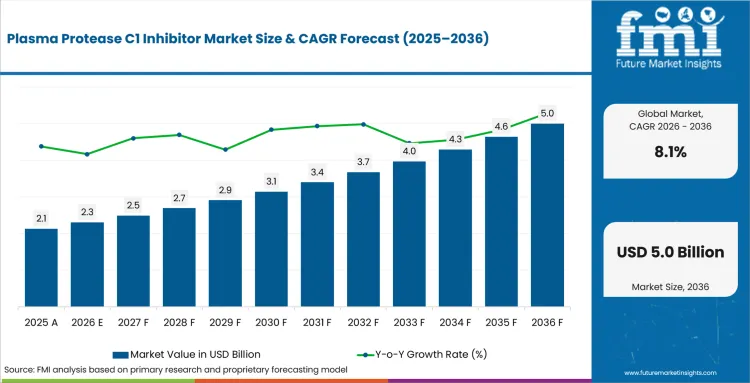
Key Takeaways for the Plasma Protease C1 Inhibitor Market
- Hereditary angioedema diagnosis supports demand by connecting confirmed attack patterns with acute or preventive C1 inhibitor therapy.
- Hereditary angioedema treatment is set to represent 76.0% share of application in 2026, led by established clinical use across acute attacks and long-term prophylaxis.
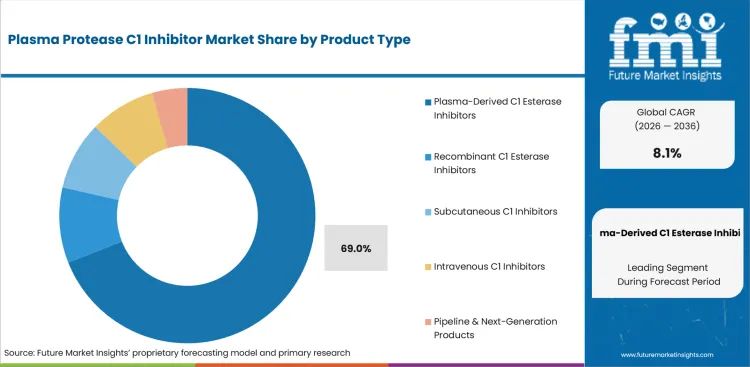
- Plasma-derived C1 esterase inhibitors are expected to dominate product type with 69.0% share in 2026, driven by physician familiarity and established treatment protocols.
- Plasma collection requirements and complex biological manufacturing are likely to restrict dependable supply across expanding care programs.
- Competition focusses on CSL Behring, Takeda Pharmaceutical Company Limited, Pharming Group N.V., KalVista Pharmaceuticals, BioCryst Pharmaceuticals, Ionis Pharmaceuticals, Intellia Therapeutics, and Pharvaris, with providers differentiating based on treatment coverage and patient-support capabilities.
Analyst Perspective
“Plasma protease C1 inhibitor demand reflects a narrow clinical decision supported by diagnosis and attack evidence. Suppliers need dependable product availability across emergency use and preventive treatment programs. Commercial progress follows therapies offering measurable attack control with practical administration support.”
- Anurag Sharma, Principal Analyst for Healthcare at Future Market Insights
How is Plasma Protease C1 Inhibitor Market segmented?
The plasma protease C1 inhibitor industry is segmented by product type, application, end user, distribution channel, route of administration, and region.
The plasma protease C1 inhibitor industry is segmented by product type, application, end user, distribution channel, route of administration, and region. Product Type coverage includes Plasma-Derived C1 Esterase Inhibitors and Recombinant C1 Esterase Inhibitors. Subcutaneous C1 Inhibitors and Intravenous C1 Inhibitors address different administration preferences. Pipeline & Next-Generation Products extend analysis toward emerging treatment technologies. Application coverage includes Hereditary Angioedema Treatment and Acquired Angioedema. Complement System Disorders and Transplantation represent additional clinical uses. Other Rare Diseases complete application assessment. End User coverage spans Hospitals and Specialty Clinics. Homecare Settings and Ambulatory Surgical Centers reflect decentralized treatment use. Research Institutes complete institutional coverage. Distribution Channel coverage includes Hospital Pharmacies and Specialty Pharmacies. Direct Sales and Retail Pharmacies support distinct access arrangements. Online Pharmacies extend delivery options for eligible prescriptions. Route of Administration coverage includes Intravenous and Subcutaneous delivery. Intramuscular and Other Routes complete administration analysis. Regional coverage comprises North America, Europe, East Asia, South Asia and Pacific, Latin America, Middle East and Africa.
What makes plasma-derived C1 esterase inhibitors central to product type selection?
Pharming Group reported 5 RUCONEST posters covering clinical and comparative evidence during October 2025. Continued evidence development across recombinant alternatives increases scrutiny of established plasma-derived treatment performance. Plasma-derived C1 esterase inhibitors support direct replacement of deficient or dysfunctional C1 inhibitor protein. Specialist physicians examine attack control and infusion practicality during therapy selection.
- Plasma-derived C1 esterase Inhibitors are predicted to represent 69.0% share of product type in 2026, driven by established clinical familiarity across acute treatment and preventive care. Supply continuity and documented patient response influence continued use across specialist treatment centers.
- Recombinant C1 esterase inhibitors reduce direct reliance on donated human plasma and support alternative production arrangements. Subcutaneous C1 inhibitors and pipeline & next-generation products compete through administration convenience and differentiated treatment intervals.
Why does hereditary angioedema treatment lead application demand?
Hereditary angioedema treatment forms the primary application through direct C1 inhibitor deficiency management. Confirmed diagnosis permits physicians to connect attack frequency with acute or prophylactic treatment. United States Food and Drug Administration reported 110 patients across the supporting EKTERLY clinical trial during July 2025. Multinational trial coverage strengthens clinical comparison across injectable and oral angioedema treatment options.
- By application, hereditary angioedema treatment is anticipated to account for 76.0% share in 2026 since it reflects direct clinical use among patients carrying C1 inhibitor deficiency or dysfunction. Acute attack management and preventive regimens create recurring demand across diagnosed populations.
- Acquired Angioedema requires separate diagnostic review because underlying conditions are likely to influence attack management and therapy duration. Complement System Disorders and Transplantation offer narrower uses requiring stronger clinical evidence and specialist oversight.
What supports hospitals across end user demand?
United States Food and Drug Administration reported 28 participating centers in the ANDEMBRY approval trial during September 2025. Multicenter evidence supports hospital review of efficacy and administration requirements across varied clinical environments. Hospitals coordinate emergency treatment and specialist confirmation for severe hereditary angioedema attacks. Pharmacy teams also manage biological-product storage and infusion readiness across inpatient services.
- Based on end user, hospitals are likely to represent 42.0% share in 2026 due to emergency capabilities and access to specialist immunology teams. Hospital protocols provide controlled administration for patients requiring observation or urgent airway management.
- Specialty clinics coordinate planned prophylaxis and recurring clinical monitoring across diagnosed patients. Homecare settings receive support from self-administration training and dependable medicine-delivery arrangements across suitable treatment plans.
Why do hospital pharmacies retain distribution channel leadership?
Hospital pharmacies connect specialist prescriptions with controlled biological-product storage and clinical administration. Established pharmacy procedures support batch records and dependable emergency access. KalVista Pharmaceuticals activated 580 United States prescribers through December 2025, according to its January 2026 update. Expanding prescriber participation increases pressure on pharmacy networks to coordinate authorization and medicine availability.
- In 2026, hospital pharmacies are projected to secure 44.0% share owing to direct integration with specialist services and emergency treatment protocols. Controlled inventory practices support medicines requiring cold-chain handling and documented clinical release.
- Specialty Pharmacies assist recurring home treatment through benefit verification and scheduled shipment coordination. Retail Pharmacies and ePharmacy services support eligible oral therapies under country-specific prescription and reimbursement requirements.
What keeps Intravenous central to route of administration selection?
Intravenous administration supports rapid delivery of C1 inhibitor during acute hereditary angioedema attacks. Clinical teams value established dosing protocols and direct circulation access during urgent treatment. United States Food and Drug Administration evaluated a 90-patient trial for subcutaneous DAWNZERA during August 2025. Expanding subcutaneous evidence increases comparison between established intravenous therapy and less frequent self-administered alternatives.
- Intravenous is estimated to capture 67.0% share in 2026, guided by established use across hospital infusion and home-infusion programs. Physician familiarity and rapid systemic delivery reinforce selection during acute treatment.
- Subcutaneous delivery supports preventive care based on trained self-administration and reduced infusion-service requirements. Injectable drug delivery improvements may increase competition led by prefilled devices and longer dosing intervals.
What are drivers, restraints, and opportunities in Plasma Protease C1 Inhibitor Market?
Improved diagnosis supports therapy initiation across hereditary angioedema programs. Biological manufacturing requirements may delay reliable product availability.
- Driver: Earlier diagnosis connects recurring swelling attacks with specialist treatment instead of repeated symptomatic care. Confirmed C1 inhibitor deficiency permits physicians to select acute therapy or long-term prophylaxis using documented attack profiles.
- Restraint: Plasma-derived products require dependable donor collection and complex fractionation under controlled manufacturing conditions. Disruptions across collection or processing may reduce inventory flexibility for hospitals and specialty pharmacies.
- Opportunity: Self-administered formulations reduce travel burdens across patients requiring recurring preventive treatment. Device simplicity and structured training may extend therapy access beyond specialist infusion centers.
Adolescent treatment delays reinforce demand for easier acute-attack administration. KalVista Pharmaceuticals reported an average delay approaching eight hours among adolescents using injectable therapies in February 2026. Earlier intervention may shorten attack progression and strengthen interest in accessible treatment options supported by molecular diagnostics.
Plasma supply remains linked to donor participation and regulated processing capacity. Paul-Ehrlich-Institut recorded 3,154,610 plasmapheresis donations in Germany during 2024 through its December 2025 report. Stable donation volumes support fractionation activity without removing capacity risks associated with biological manufacturing and quality release.
Alternative administration formats create expansion potential across preventive treatment programs. Takeda reported approval for an additional 2 mL prefilled pen option during February 2025. Simplified subcutaneous drug delivery are projected to support individualized treatment and reduce dependence on recurring infusion appointments.
How are country CAGRs aligned in Plasma Protease C1 Inhibitor Market?
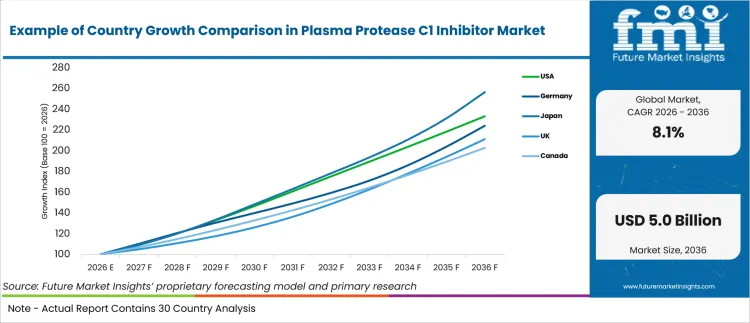
| Country | CAGR 2026-2036 |
|---|---|
| Australia | 10.2% |
| Japan | 9.9% |
| USA | 8.8% |
| Germany | 8.4% |
| UK | 7.8% |
| Canada | 7.3% |
| Brazil | 7.0% |
Source: Future Market Insights analysis, 2026.
How do country-level CAGRs compare in Plasma Protease C1 Inhibitor Market?
Country comparison forms a gradual step-down across profiled treatment systems. Australia leads disclosed rates and Japan follows at a limited distance. The United States and Germany form the central forecast band. The United Kingdom and Canada occupy the next positions. Brazil completes the disclosed comparison. A 3.2 percentage-point spread separates Australia from Brazil.
- Australia establishes South Asia and Pacific as the lead development area across countries shown.
- Japan follows Australia depending on specialist treatment access and new self-administration options.
- The United States and Germany form the central rate band led by established prescriber networks and structured medicine-access systems.
- The United Kingdom and Canada follow due to regulated authorization pathways and specialist distribution requirements.
- Brazil completes the comparison led by unmet diagnosis needs and constrained access to first-line therapies.
Countries carrying similar CAGRs are likely to present different entry conditions based on diagnosis coverage and reimbursement procedures. Full report coverage extends across North America, Europe, East Asia, South Asia and Pacific, Latin America, Middle East and Africa.
Country-wise Analysis
- Sales in Australia is forecast to record 10.2% CAGR between 2026 and 2036, driven by plasma-collection expansion and specialist treatment availability. Australian Red Cross Lifeblood anticipated approximately 95,000 additional plasma donations annually during July 2025, strengthening collection potential for fractionated biological products. Wider donor participation supports supply resilience across plasma-derived protein therapies without eliminating manufacturing lead times.
- CSL launched an ANDEMBRY 200 mg prefilled pen in Japan during April 2025, extending preventive treatment choice across trained self-administration programs. Local launch support and physician education influence conversion across diagnosed patients. Sector in Japan is projected to expand at 9.9% CAGR by 2036, led by specialist hereditary angioedema programs.
- The market in United States is predicted to rise at 8.8% CAGR during the assessment period, backed by established specialist networks and multiple therapy options. KalVista Pharmaceuticals received 460 patient start forms through August 2025, demonstrating early use following commercial introduction. Prescriber familiarity supports therapy switching under payer review and documented attack-management needs.
- KalVista reported European Commission approval covering 27 European Union member states during November 2025, followed by initial German product shipments. Common authorization permits market access planning while German reimbursement and physician review determine practical uptake. Industry in Germany is forecast to scale at 8.4% CAGR during the assessment period, reflected by structured authorization and specialist-care environment.
- Demand in the United Kingdom is set to increase at 7.8% CAGR between 2026 and 2036, aided by specialist standards and centralized health-technology review. KalVista reported eligibility for up to 10 years of market exclusivity following United Kingdom authorization during July 2025. Protected status supports commercial planning without replacing national reimbursement and access assessment.
- Canadian Blood Services collected 122,214 source-plasma donations during 2024, according to its October 2025 surveillance report. Collection infrastructure supports domestic plasma availability and therapeutic apheresis programs across provincial systems. Adoption in Canada is projected to register 7.3% CAGR during the forecast period, influenced by provincial access procedures and dispersed specialist populations.
- Sector in Brazil is estimated to expand at 7.0% CAGR through 2036, underpinned by diagnosis improvement and specialist education. A Brazilian study published during October 2024 included 178 hereditary angioedema patients and identified persistent treatment-access gaps. Better diagnostic referral and first-line medicine availability could improve conversion from symptomatic care toward defined hereditary angioedema treatment.
Who are notable companies in Plasma Protease C1 Inhibitor Market?
CSL Behring, Takeda Pharmaceutical Company Limited, Pharming Group N.V., KalVista Pharmaceuticals, BioCryst Pharmaceuticals, Ionis Pharmaceuticals, Intellia Therapeutics, and Pharvaris are notable companies influencing competition.
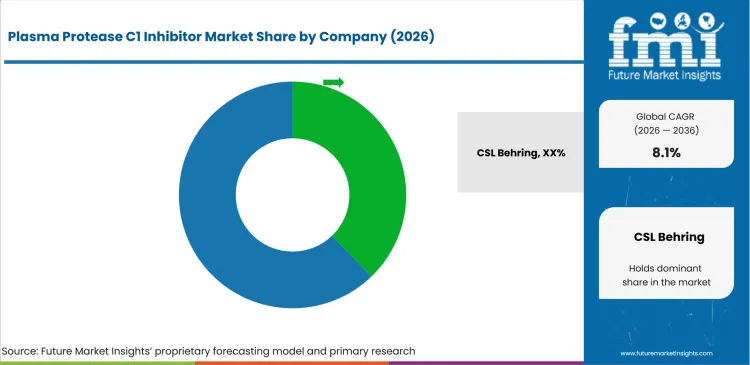
Competition reflects direct C1 inhibitor supply and alternative hereditary angioedema therapies. Established providers compete through clinical evidence and medicine availability across acute or preventive care. Oral and long-acting competitors influence treatment switching through administration convenience. Pipeline companies target kallikrein and bradykinin pathways through emerging mechanisms. Active company programs remained evident across approved products and development pipelines.
- CSL Behring and Takeda Pharmaceutical Company Limited compete based on established hereditary angioedema portfolios covering acute treatment and preventive care. Physician review focuses on supply continuity and administration requirements across patient-specific regimens.
- Pharming Group N.V. competes driven by recombinant C1 esterase inhibitor evidence across on-demand treatment. Clinical comparison emphasizes response consistency and dependable availability without reliance on human plasma collection.
- KalVista Pharmaceuticals and BioCryst Pharmaceuticals compete led by oral medicines targeting hereditary angioedema attacks or prevention. Simplified administration may influence patients seeking reduced injection or infusion burdens.
- Ionis Pharmaceuticals and Pharvaris develop differentiated approaches involving RNA targeting or bradykinin-pathway control. Pipeline progress across orphan drugs may reshape long-term competition against conventional C1 inhibitor therapies.
Competitive Benchmarking: Plasma Protease C1 Inhibitor Market
| Company | C1 Inhibitor or HAE Portfolio | Clinical Evidence | Administration Breadth | Service Reach |
|---|---|---|---|---|
| CSL Behring | High | High | High | Global |
| Takeda Pharmaceutical Company Limited | High | High | High | Global |
| Pharming Group N.V. | Focused | High | Medium | International |
| KalVista Pharmaceuticals, Inc. | Focused | High | Focused | Expanding international |
| BioCryst Pharmaceuticals, Inc. | High | High | Medium | International |
| Ionis Pharmaceuticals, Inc. | Focused | High | Focused | United States-led |
| Intellia Therapeutics, Inc. | Pipeline | Developing | Focused | Clinical programs |
| Pharvaris N.V. | Pipeline | Developing | Focused | Clinical programs |
Source: Future Market Insights competitive analysis, 2026.
Key Developments in Plasma Protease C1 Inhibitor Market
- In June 2025, United States Food and Drug Administration approved CSL Behring’s ANDEMBRY for hereditary angioedema attack prevention. Factor XIIa inhibition introduced another preventive mechanism competing with conventional plasma and recombinant C1 inhibitor therapies.
- In July 2025, KalVista Pharmaceuticals announced United States approval of EKTERLY as an oral on-demand hereditary angioedema treatment. Oral administration expanded acute-treatment choice for patients seeking an alternative to injected C1 inhibitor products.
- In August 2025, Ionis Pharmaceuticals received United States approval for DAWNZERA as an RNA-targeted preventive hereditary angioedema therapy. Extended subcutaneous dosing increased competitive pressure across long-term prophylaxis and pharmaceutical drug delivery strategies.
Plasma Protease C1 Inhibitor Market Report Scope
| Coverage field | Report scope |
|---|---|
| Market breakdown | Plasma protease C1 inhibitor market breakdown includes Product Type, Application, End User, Distribution Channel, Route of Administration, and Region. |
| Quantitative Units | Revenue in USD billion and CAGR in %. |
| Market Definition | Plasma-derived and related C1 esterase inhibitor products used primarily for treatment or prevention of hereditary angioedema attacks. |
| Regions Covered | North America, Latin America, Western Europe, Eastern Europe, East Asia, South Asia and Pacific, Middle East and Africa. |
| Countries Covered | Australia, Japan, United States, Germany, United Kingdom, Canada, Brazil, and more than 25 additional countries complete full report coverage. |
| Key Companies Profiled | CSL Behring, Takeda Pharmaceutical, Kedrion Biopharma, Pharming Group, Sanquin Plasma Products, Octapharma, BioCryst Pharmaceuticals, Intellia Therapeutics, Ionis Pharmaceuticals, and ADMA Biologics. |
| Forecast Period | 2026 to 2036 |
| Approach | Hybrid bottom-up and top-down methodology uses segment shares and country CAGRs. Company activity and buyer adoption support final market reconciliation. |
Source: Future Market Insights analysis, 2026.
Plasma Protease C1 Inhibitor Market - Research Methodology
| Method | Approach |
|---|---|
| Primary Research | FMI analysts gathered input from manufacturers, service providers, technology developers, distributors, end users, procurement teams, and subject-matter experts. Interviews examined purchasing decisions, product or service evaluation, adoption barriers, approval requirements, pricing considerations, and expectations for technical or commercial support. Respondents were also asked what evidence is required before a trial, pilot, or initial order develops into regular purchasing. |
| Desk Research | Desk research covered government statistics, regulatory publications, trade data, industry associations, technical literature, standards, company filings, product information, and official corporate announcements. Sources were reviewed for relevance, publication date, geographic coverage, and consistency with the defined market scope. Claims relating to performance, applications, approvals, capacity, investment, and commercial activity were retained only when supported by credible public evidence. |
| Market Sizing and Forecasting | The market model combined the baseline value with historical performance, segment structure, pricing and volume indicators, adoption levels, company participation, and country-level demand conditions. Forecast assumptions considered economic activity, investment trends, regulatory developments, technology adoption, purchasing cycles, supply availability, and barriers to wider market use. Segment and regional estimates were reconciled before the final market total was calculated. |
| Data Validation | Estimates were checked against multiple independent indicators, including public data, company activity, trade patterns, industry developments, and findings from primary interviews. Validation also tested whether products, services, applications, and company revenues fell within the defined market boundaries. Adjacent categories, unsupported claims, overlapping revenues, and activities without direct market relevance were excluded to reduce double counting and maintain consistency across segments and countries. |
Source: Future Market Insights analysis, 2026.
Plasma Protease C1 Inhibitor Market by Segments
Plasma Protease C1 Inhibitor Market segmented by Product Type:
- Plasma-Derived C1 Esterase Inhibitors
- Recombinant C1 Esterase Inhibitors
- Subcutaneous C1 Inhibitors
- Intravenous C1 Inhibitors
- Pipeline & Next-Generation Products
Plasma Protease C1 Inhibitor Market segmented by Application:
- Hereditary Angioedema Treatment
- Acquired Angioedema
- Complement System Disorders
- Transplantation
- Other Rare Diseases
Plasma Protease C1 Inhibitor Market segmented by End User:
- Hospitals
- Specialty Clinics
- Homecare Settings
- Ambulatory Surgical Centers
- Research Institutes
Plasma Protease C1 Inhibitor Market segmented by Distribution Channel:
- Hospital Pharmacies
- Specialty Pharmacies
- Direct Sales
- Retail Pharmacies
- Online Pharmacies
Plasma Protease C1 Inhibitor Market segmented by Route of Administration:
- Intravenous
- Subcutaneous
- Intramuscular
- Other Routes
Plasma Protease C1 Inhibitor Market segmented by Region:
- North America
- United States
- Canada
- Latin America
- Brazil
- Mexico
- Argentina
- Chile
- Western Europe
- Germany
- France
- United Kingdom
- Italy
- Spain
- Benelux
- Nordics
- Eastern Europe
- Poland
- Czech Republic
- Romania
- Hungary
- East Asia
- China
- Japan
- South Korea
- South Asia and Pacific
- India
- ASEAN
- Australia and New Zealand
- Middle East and Africa
- GCC Countries
- South Africa
- Türkiye
- Israel
Research Sources and Bibliography
- Australian Red Cross Lifeblood. (2025, July 14). No wait to donate for 625,000 Australians as Lifeblood lifts sexual activity rules for plasma donation.
- Canadian Blood Services. (2025, October 30). Surveillance report.
- CSL. (2025, April 18). CSL launches ANDEMBRY for the prevention of acute attacks in hereditary angioedema in Japan.
- Giavina-Bianchi, P., Giavina-Bianchi, M., de Oliveira Martins, R., Fortunato, M. C., & Guersoni, A. C. (2024, October 30). Unmet needs in the management of hereditary angioedema from the perspective of Brazilian patients. World Allergy Organization Journal, 17(11), 100992.
- Intellia Therapeutics, Inc. (2026, April 27). Our pipeline.
- Ionis Pharmaceuticals, Inc. (2025, August 21). DAWNZERA approved in the USa as first and only RNA-targeted prophylactic treatment for hereditary angioedema.
- KalVista Pharmaceuticals, Inc. (2025, July 7). KalVista Pharmaceuticals announces FDA approval of EKTERLY, first and only oral on-demand treatment for hereditary angioedema.
- KalVista Pharmaceuticals, Inc. (2025, July 15). KalVista Pharmaceuticals announces UK MHRA approval of EKTERLY, first and only oral on-demand treatment for hereditary angioedema.
- KalVista Pharmaceuticals, Inc. (2025, September 11). KalVista Pharmaceuticals provides operational update and reports fiscal quarter financial results.
- KalVista Pharmaceuticals, Inc. (2025, November 10). KalVista Pharmaceuticals provides operational update and reports third quarter financial results.
- KalVista Pharmaceuticals, Inc. (2026, January 8). KalVista Pharmaceuticals provides update on strong EKTERLY launch with preliminary fourth quarter and full year 2025 revenue results.
- KalVista Pharmaceuticals, Inc. (2026, February 18). KalVista Pharmaceuticals announces inclusion of EKTERLY as a first-line therapy for adolescents 12 and older in international pediatric HAE guideline.
- KalVista Pharmaceuticals, Inc. (2026, March 25). KalVista Pharmaceuticals reports eight months fiscal year 2025 financial results and provides corporate update.
- Paul-Ehrlich-Institut. (2025, December 8). Paul-Ehrlich-Institut publishes 2024 report on supply of blood and blood products.
- Pharming Group N.V. (2025, October 20). Pharming Group announces presentations at 2025 ACAAI Annual Scientific Meeting showcasing new data across rare disease portfolio.
- Takeda Pharmaceutical Company Limited. (2025, February 24). EMA approves new subcutaneous option for TAKHZYRO.
- USA Food and Drug Administration. (2025). Novel drug approvals for 2025.
- USA Food and Drug Administration. (2025, July 3). Drug trials snapshots: EKTERLY.
- USA Food and Drug Administration. (2025, August 21). Drug trials snapshots: DAWNZERA.
- USA Food and Drug Administration. (2025, September 16). Drug trials snapshots: ANDEMBRY.
This bibliography is provided for reader reference and is not exhaustive. The full report contains the complete reference list and detailed citations.
This Report Answers
- How do product types influence demand across plasma-derived and recombinant C1 esterase inhibitors?
- What criteria guide specialist physicians evaluating acute and preventive hereditary angioedema therapies?
- Why do country CAGRs differ across Australia, Japan, USA, Germany, UK, Canada, and Brazil?
- What companies compete through C1 inhibitor products and alternative hereditary angioedema treatments?
- How are forecasts validated using segment shares and independent clinical or supply indicators?
- What evidence supports hospital and specialty-pharmacy review across biological-product access?
- Why do plasma collection and biological manufacturing affect dependable product availability?
- How do administration preferences influence treatment selection across acute and preventive care?
- What clinical records influence therapy switching across specialist hereditary angioedema programs?
- What company capabilities support recurring use across approved patient-treatment plans?
Frequently Asked Questions
How big is the Plasma Protease C1 Inhibitor Market in 2026?
The plasma protease C1 inhibitor market is valued at USD 2.3 billion in 2026 and is forecast to reach USD 5.0 billion by 2036. Growth is supported by expanding hereditary angioedema diagnosis and specialist treatment access, which sustain recurring demand for plasma-derived and recombinant C1 esterase inhibitor therapies across established care pathways.
What is the CAGR of the Plasma Protease C1 Inhibitor Market from 2026 to 2036?
The plasma protease C1 inhibitor market grows at a CAGR of 8.1% between 2026 and 2036, supported by earlier hereditary angioedema diagnosis that connects confirmed attack patterns with acute or preventive C1 inhibitor therapy across specialist treatment centers and expanding diagnosed patient populations worldwide.
Which product type leads the Plasma Protease C1 Inhibitor Market?
Plasma-derived C1 esterase inhibitors account for 69.0% of the plasma protease C1 inhibitor market by product type in 2026, driven by physician familiarity, established treatment protocols, and dependable supply continuity across specialist hereditary angioedema treatment centers and emergency care programs worldwide.
How much will the Plasma Protease C1 Inhibitor Market add between 2026 and 2036?
The plasma protease C1 inhibitor market is set to add USD 2.7 billion between 2026 and 2036, growing from USD 2.3 billion to USD 5.0 billion as diagnosis expands and self-administered treatment options increase access across specialist and homecare treatment settings globally.
Who are the leading companies in the Plasma Protease C1 Inhibitor Market?
Eight companies lead the plasma protease C1 inhibitor market, including CSL Behring, Takeda Pharmaceutical, Pharming Group, KalVista Pharmaceuticals, BioCryst Pharmaceuticals, Ionis Pharmaceuticals, Intellia Therapeutics, and Pharvaris, competing through plasma-derived and recombinant therapies, oral and RNA-targeted mechanisms, and differentiated administration options across hereditary angioedema treatment programs worldwide.
Preview the report firsthand - request a free sample
Get SampleGet the brochure for pricing and purchase details.
Get PDFTable of Content
- Key Takeaways
- Market Size and CAGR
- Top Growth Driver
- Fastest Growing Segment
- Leading Region
- Key Companies
- Emerging Opportunities
- Executive Summary
- Global Market Outlook
- Demand-side Trends
- Supply-side Trends
- Technology Roadmap Analysis
- Analysis and Recommendations
- Analyst Perspective (What is happening? Why now? What should investors know?)
- Key Questions Answered
- How large is the market?
- What is the CAGR?
- What are key trends?
- Which region dominates?
- Who are the leaders?
- Market Overview
- Market Coverage / Taxonomy
- Market Definition / Scope / Limitations
- Research Methodology
- Chapter Orientation
- Analytical Lens and Working Hypotheses
- Market Structure, Signals, and Trend Drivers
- Benchmarking and Cross-market Comparability
- Market Sizing, Forecasting, and Opportunity Mapping
- Research Design and Evidence Framework
- Desk Research Programme (Secondary Evidence)
- Expert Input and Fieldwork (Primary Evidence)
- Tooling, Models, and Reference Databases
- Data Engineering and Model Build
- Quality Assurance and Audit Trail
- Market Background
- Market Dynamics (Drivers, Restraints, Opportunity, Trends)
- Scenario Forecast (Optimistic, Likely, Conservative)
- Impact Analysis
- AI Impact
- Sustainability Impact
- Regulatory Impact
- Technology Impact
- Consumer / Buyer Analysis
- Purchase Drivers
- Adoption Barriers
- Buyer Journey
- Opportunity Map Analysis
- Product Life Cycle Analysis
- Supply Chain Analysis
- Investment Feasibility Matrix
- Value Chain Analysis
- PESTLE and Porter's Analysis
- Regulatory Landscape
- Regional Parent Market Outlook
- Production and Consumption Statistics
- Import and Export Statistics
- Global Market Analysis and Forecast, 2021 to 2036
- Historical Market Size Value (USD Billion) Analysis, 2021 to 2025
- Current and Future Market Size Value (USD Billion) Projections, 2026 to 2036
- Y-o-Y Growth Trend Analysis
- Absolute $ Opportunity Analysis
- Global Market Pricing Analysis, 2021 to 2036
- Global Market Analysis and Forecast, By Product Type, 2021 to 2036
- Introduction / Key Findings
- Historical Market Size Value (USD Billion) Analysis By Product Type, 2021 to 2025
- Current and Future Market Size Value (USD Billion) Analysis and Forecast By Product Type, 2026 to 2036
- Plasma-Derived C1 Esterase Inhibitors
- Intravenous C1 Inhibitors
- High-Purity Plasma C1 Inhibitors
- Recombinant C1 Esterase Inhibitors
- Recombinant Human C1 Inhibitors
- Long-Acting Recombinant Products
- Subcutaneous C1 Inhibitors
- Self-Administered Formulations
- Homecare Formulations
- Intravenous C1 Inhibitors
- Hospital-Based Infusions
- Outpatient Infusions
- Pipeline & Next-Generation Products
- Gene Therapy Candidates
- Extended Half-Life Products
- Plasma-Derived C1 Esterase Inhibitors
- Y-o-Y Growth Trend Analysis By Product Type, 2021 to 2025
- Absolute $ Opportunity Analysis By Product Type, 2026 to 2036
- Global Market Analysis and Forecast, By Application, 2021 to 2036
- Introduction / Key Findings
- Historical Market Size Value (USD Billion) Analysis By Application, 2021 to 2025
- Current and Future Market Size Value (USD Billion) Analysis and Forecast By Application, 2026 to 2036
- Hereditary Angioedema Treatment
- Acute Attack Management
- Long-Term Prophylaxis
- Acquired Angioedema
- Autoimmune Disorders
- Lymphoproliferative Disorders
- Complement System Disorders
- C1 Deficiency Disorders
- Immune Dysregulation Disorders
- Transplantation
- Antibody-Mediated Rejection
- Complement Inhibition
- Other Rare Diseases
- Experimental Indications
- Off-Label Applications
- Hereditary Angioedema Treatment
- Y-o-Y Growth Trend Analysis By Application, 2021 to 2025
- Absolute $ Opportunity Analysis By Application, 2026 to 2036
- Global Market Analysis and Forecast, By End User, 2021 to 2036
- Introduction / Key Findings
- Historical Market Size Value (USD Billion) Analysis By End User, 2021 to 2025
- Current and Future Market Size Value (USD Billion) Analysis and Forecast By End User, 2026 to 2036
- Hospitals
- Tertiary Care Hospitals
- Specialty Hospitals
- Specialty Clinics
- Allergy Clinics
- Immunology Clinics
- Homecare Settings
- Home Infusion Services
- Self-Administration Programs
- Ambulatory Surgical Centers
- Outpatient Infusion Centers
- Day Care Centers
- Research Institutes
- Clinical Research Organizations
- Academic Medical Centers
- Hospitals
- Y-o-Y Growth Trend Analysis By End User, 2021 to 2025
- Absolute $ Opportunity Analysis By End User, 2026 to 2036
- Global Market Analysis and Forecast, By Distribution Channel, 2021 to 2036
- Introduction / Key Findings
- Historical Market Size Value (USD Billion) Analysis By Distribution Channel, 2021 to 2025
- Current and Future Market Size Value (USD Billion) Analysis and Forecast By Distribution Channel, 2026 to 2036
- Hospital Pharmacies
- Public Hospital Pharmacies
- Private Hospital Pharmacies
- Specialty Pharmacies
- Rare Disease Pharmacies
- Biologics Pharmacies
- Direct Sales
- Manufacturer Distribution
- Specialty Distribution Agreements
- Retail Pharmacies
- Chain Pharmacies
- Independent Pharmacies
- Online Pharmacies
- Licensed E-Pharmacies
- Specialty Online Providers
- Hospital Pharmacies
- Y-o-Y Growth Trend Analysis By Distribution Channel, 2021 to 2025
- Absolute $ Opportunity Analysis By Distribution Channel, 2026 to 2036
- Global Market Analysis and Forecast, By Route of Administration, 2021 to 2036
- Introduction / Key Findings
- Historical Market Size Value (USD Billion) Analysis By Route of Administration, 2021 to 2025
- Current and Future Market Size Value (USD Billion) Analysis and Forecast By Route of Administration, 2026 to 2036
- Intravenous
- Hospital Infusion
- Home Infusion
- Subcutaneous
- Prefilled Syringes
- Self-Injectable Devices
- Intramuscular
- Clinical Administration
- Emergency Administration
- Other Routes
- Investigational Delivery Systems
- Novel Drug Delivery Platforms
- Intravenous
- Y-o-Y Growth Trend Analysis By Route of Administration, 2021 to 2025
- Absolute $ Opportunity Analysis By Route of Administration, 2026 to 2036
- Global Market Analysis and Forecast, By Region, 2021 to 2036
- Introduction
- Historical Market Size Value (USD Billion) Analysis By Region, 2021 to 2025
- Current Market Size Value (USD Billion) Analysis and Forecast By Region, 2026 to 2036
- North America
- Latin America
- Western Europe
- Eastern Europe
- East Asia
- South Asia and Pacific
- Middle East & Africa
- Market Attractiveness Analysis By Region
- North America Market Analysis and Forecast, By Country, 2021 to 2036
- Historical Market Size Value (USD Billion) Trend Analysis By Market Taxonomy, 2021 to 2025
- Market Size Value (USD Billion) Forecast By Market Taxonomy, 2026 to 2036
- By Country
- USA
- Canada
- By Product Type
- By Application
- By End User
- By Distribution Channel
- By Route of Administration
- By Country
- Market Attractiveness Analysis
- By Country
- By Product Type
- By Application
- By End User
- By Distribution Channel
- By Route of Administration
- Key Takeaways
- Latin America Market Analysis and Forecast, By Country
- Historical Market Size Value (USD Billion) Trend Analysis By Market Taxonomy, 2021 to 2025
- Market Size Value (USD Billion) Forecast By Market Taxonomy, 2026 to 2036
- By Country
- Brazil
- Mexico
- Chile
- Rest of Latin America
- By Product Type
- By Application
- By End User
- By Distribution Channel
- By Route of Administration
- By Country
- Market Attractiveness Analysis
- By Country
- By Product Type
- By Application
- By End User
- By Distribution Channel
- By Route of Administration
- Key Takeaways
- Western Europe Market Analysis and Forecast, By Country
- Historical Market Size Value (USD Billion) Trend Analysis By Market Taxonomy, 2021 to 2025
- Market Size Value (USD Billion) Forecast By Market Taxonomy, 2026 to 2036
- By Country
- Germany
- UK
- Italy
- Spain
- France
- Nordic
- BENELUX
- Rest of Western Europe
- By Product Type
- By Application
- By End User
- By Distribution Channel
- By Route of Administration
- By Country
- Market Attractiveness Analysis
- By Country
- By Product Type
- By Application
- By End User
- By Distribution Channel
- By Route of Administration
- Key Takeaways
- Eastern Europe Market Analysis and Forecast, By Country
- Historical Market Size Value (USD Billion) Trend Analysis By Market Taxonomy, 2021 to 2025
- Market Size Value (USD Billion) Forecast By Market Taxonomy, 2026 to 2036
- By Country
- Russia
- Poland
- Hungary
- Balkan & Baltic
- Rest of Eastern Europe
- By Product Type
- By Application
- By End User
- By Distribution Channel
- By Route of Administration
- By Country
- Market Attractiveness Analysis
- By Country
- By Product Type
- By Application
- By End User
- By Distribution Channel
- By Route of Administration
- Key Takeaways
- East Asia Market Analysis and Forecast, By Country
- Historical Market Size Value (USD Billion) Trend Analysis By Market Taxonomy, 2021 to 2025
- Market Size Value (USD Billion) Forecast By Market Taxonomy, 2026 to 2036
- By Country
- China
- Japan
- South Korea
- By Product Type
- By Application
- By End User
- By Distribution Channel
- By Route of Administration
- By Country
- Market Attractiveness Analysis
- By Country
- By Product Type
- By Application
- By End User
- By Distribution Channel
- By Route of Administration
- Key Takeaways
- South Asia and Pacific Market Analysis and Forecast, By Country
- Historical Market Size Value (USD Billion) Trend Analysis By Market Taxonomy, 2021 to 2025
- Market Size Value (USD Billion) Forecast By Market Taxonomy, 2026 to 2036
- By Country
- India
- ASEAN
- Australia & New Zealand
- Rest of South Asia and Pacific
- By Product Type
- By Application
- By End User
- By Distribution Channel
- By Route of Administration
- By Country
- Market Attractiveness Analysis
- By Country
- By Product Type
- By Application
- By End User
- By Distribution Channel
- By Route of Administration
- Key Takeaways
- Middle East & Africa Market Analysis and Forecast, By Country
- Historical Market Size Value (USD Billion) Trend Analysis By Market Taxonomy, 2021 to 2025
- Market Size Value (USD Billion) Forecast By Market Taxonomy, 2026 to 2036
- By Country
- Kingdom of Saudi Arabia
- Other GCC Countries
- Türkiye
- South Africa
- Other African Union
- Rest of Middle East & Africa
- By Product Type
- By Application
- By End User
- By Distribution Channel
- By Route of Administration
- By Country
- Market Attractiveness Analysis
- By Country
- By Product Type
- By Application
- By End User
- By Distribution Channel
- By Route of Administration
- Key Takeaways
- Key Countries Market Analysis
- USA
- Pricing Analysis
- Market Share Analysis, 2025
- By Product Type
- By Application
- By End User
- By Distribution Channel
- By Route of Administration
- Canada
- Pricing Analysis
- Market Share Analysis, 2025
- By Product Type
- By Application
- By End User
- By Distribution Channel
- By Route of Administration
- Mexico
- Pricing Analysis
- Market Share Analysis, 2025
- By Product Type
- By Application
- By End User
- By Distribution Channel
- By Route of Administration
- Brazil
- Pricing Analysis
- Market Share Analysis, 2025
- By Product Type
- By Application
- By End User
- By Distribution Channel
- By Route of Administration
- Chile
- Pricing Analysis
- Market Share Analysis, 2025
- By Product Type
- By Application
- By End User
- By Distribution Channel
- By Route of Administration
- Germany
- Pricing Analysis
- Market Share Analysis, 2025
- By Product Type
- By Application
- By End User
- By Distribution Channel
- By Route of Administration
- UK
- Pricing Analysis
- Market Share Analysis, 2025
- By Product Type
- By Application
- By End User
- By Distribution Channel
- By Route of Administration
- Italy
- Pricing Analysis
- Market Share Analysis, 2025
- By Product Type
- By Application
- By End User
- By Distribution Channel
- By Route of Administration
- Spain
- Pricing Analysis
- Market Share Analysis, 2025
- By Product Type
- By Application
- By End User
- By Distribution Channel
- By Route of Administration
- France
- Pricing Analysis
- Market Share Analysis, 2025
- By Product Type
- By Application
- By End User
- By Distribution Channel
- By Route of Administration
- India
- Pricing Analysis
- Market Share Analysis, 2025
- By Product Type
- By Application
- By End User
- By Distribution Channel
- By Route of Administration
- ASEAN
- Pricing Analysis
- Market Share Analysis, 2025
- By Product Type
- By Application
- By End User
- By Distribution Channel
- By Route of Administration
- Australia & New Zealand
- Pricing Analysis
- Market Share Analysis, 2025
- By Product Type
- By Application
- By End User
- By Distribution Channel
- By Route of Administration
- China
- Pricing Analysis
- Market Share Analysis, 2025
- By Product Type
- By Application
- By End User
- By Distribution Channel
- By Route of Administration
- Japan
- Pricing Analysis
- Market Share Analysis, 2025
- By Product Type
- By Application
- By End User
- By Distribution Channel
- By Route of Administration
- South Korea
- Pricing Analysis
- Market Share Analysis, 2025
- By Product Type
- By Application
- By End User
- By Distribution Channel
- By Route of Administration
- Russia
- Pricing Analysis
- Market Share Analysis, 2025
- By Product Type
- By Application
- By End User
- By Distribution Channel
- By Route of Administration
- Poland
- Pricing Analysis
- Market Share Analysis, 2025
- By Product Type
- By Application
- By End User
- By Distribution Channel
- By Route of Administration
- Hungary
- Pricing Analysis
- Market Share Analysis, 2025
- By Product Type
- By Application
- By End User
- By Distribution Channel
- By Route of Administration
- Kingdom of Saudi Arabia
- Pricing Analysis
- Market Share Analysis, 2025
- By Product Type
- By Application
- By End User
- By Distribution Channel
- By Route of Administration
- Türkiye
- Pricing Analysis
- Market Share Analysis, 2025
- By Product Type
- By Application
- By End User
- By Distribution Channel
- By Route of Administration
- South Africa
- Pricing Analysis
- Market Share Analysis, 2025
- By Product Type
- By Application
- By End User
- By Distribution Channel
- By Route of Administration
- USA
- Market Structure Analysis
- Competition Dashboard
- Competition Benchmarking
- Market Share Analysis of Top Players
- By Regional
- By Product Type
- By Application
- By End User
- By Distribution Channel
- By Route of Administration
- Emerging Startups
- Innovation Benchmarking
- Competition Analysis
- Competition Deep Dive
- CSL Behring
- Overview
- Product Portfolio
- Profitability by Market Segments
- Sales Footprint
- Strategy Overview
- Marketing Strategy
- Product Strategy
- Channel Strategy
- Takeda Pharmaceutical
- Kedrion Biopharma
- Pharming Group
- Sanquin Plasma Products
- Octapharma
- BioCryst Pharmaceuticals
- Intellia Therapeutics
- Ionis Pharmaceuticals
- ADMA Biologics
- Others
- CSL Behring
- Case Studies
- Success Stories
- Recent Developments
- Competition Deep Dive
- Assumptions & Acronyms Used


