

- Market Size (2026)
- USD 6.3 Bn
- Forecast (2036)
- USD 10.2 Bn
- CAGR (2026 to 2036)
- 4.9%
How big is Point To Point Machines Market in 2026?
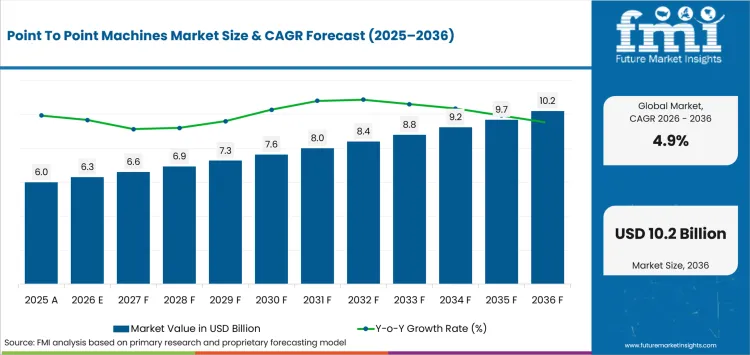
USD 6.3 Billion in 2026 and USD 10.2 Billion by 2036 at a 4.9% CAGR.
Demand for point-to-point machines is projected to expand at 4.9% CAGR between 2026 and 2036, lifting valuation from USD 6.3 billion in 2026 to USD 10.2 billion by 2036. Revenue expansion is tied to drilling and routing across short production runs. Grooving and fitting insertion add more operations that can be moved into the same controlled workflow. USA Bureau of Labor Statistics guidance updated in August 2025 describes modern woodworking as highly technical and notes the use of computerized numerical control equipment for accuracy. It also recorded 63,100 workers in the non-sawing woodworking machine setter and operator category in 2024. That operating base makes programming simplicity and repeatable setup commercially important. Buyers increasingly compare a point-to-point machine as a production workflow rather than as an isolated spindle platform. The purchase case strengthens when one system can absorb more part variants while reducing fixture changes and operator intervention.
The route to purchase varies sharply by country. Italy combines a mature machinery fleet with another incentive cycle for qualifying equipment. Mexico has a fragmented furniture manufacturing base that makes capital access and service coverage more decisive. USA buyers often place labor productivity and operator training alongside machine throughput. Japan presents a more mature production environment where compactness and replacement economics can carry more weight than greenfield capacity. These differences change the payback model even when the machine architecture is similar. Interest converts to an order when the buyer can prove usable capacity after software integration and workholding setup. Operator training and service requirements must also fit the payback case.
Key Takeaways
- High-mix panel production is turning drilling and routing capacity into a workflow decision, with programming speed, workholding flexibility and service-backed uptime shaping the investment case.
- CNC point-to-point borers account for 32.0% of the market in 2026 because recurring drilling patterns remain a basic requirement across panel-based production.
- Pod and rail holds a 41.0% share in 2026 because adjustable support and access can accommodate varied part shapes without forcing one workholding geometry.
- Cabinetry represents 33.0% of the market in 2026 because cabinets combine repetitive hardware patterns with frequent part-size and design variation.
- CAD/CAM integrated systems hold a 32.0% share in 2026 because design-to-program continuity reduces manual setup effort in high-mix production.
- Machinery OEMs hold a 43.0% share in 2026 because buyers often require machine engineering and commissioning under one accountable relationship. Software support and service reinforce that route to market.
- Capital approval remains sensitive to utilization, but compact cells that connect CAD/CAM, flexible fixturing and automation can widen the viable buyer base.
- Machinery suppliers include Biesse, HOMAG, SCM Group, Felder Group, Masterwood, IMA Schelling, Vitap, and Anderson Group.
Analyst Perspective
“Point-to-point investment pays when a plant can change jobs without surrendering spindle time to setup. The commercial edge sits in usable CAD/CAM, flexible workholding and local commissioning support, not machine speed in isolation.”
- Nikhil Kaitwade, Principal Consultant, Future Market Insights
How is the Point To Point Machines Market segmented?
The market is assessed by Machine Type, Workholding, End Use, Control System, and Sales Channel.
Machine Type separates architectures for boring and routing from insertion-focused or multi-axis work. Workholding separates pod-and-rail layouts from vacuum and clamp-based configurations as well as hybrid designs. End Use reflects the production environment in which repeatable panel or component machining is required. Control System distinguishes how job data moves from design and planning into CNC execution. Sales Channel captures four routes to market: machinery OEMs; dealer networks; direct factory sales; and used or refurbished equipment. Each axis changes the implementation problem and the payback case. This is why segment leadership must be read through workflow requirements rather than through machine specifications alone.
Why does CAD/CAM integrated lead the Control System category?
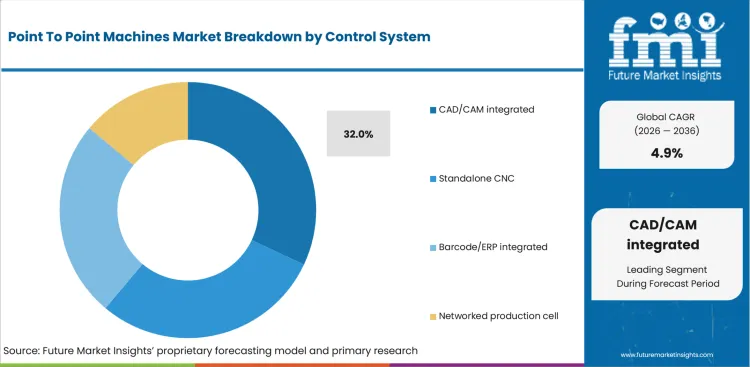
CAD/CAM integration shortens the path from a component design to machine-ready instructions. That matters in batch-one production because manual re-entry of dimensions and machining features can erase the time saved by faster CNC motion. Integrated design and programming also give operators a clearer way to reuse part logic and revise jobs before cutting or drilling begins. SCM reported in July 2025 that the morbidelli fx100 flexible drilling center uses Maestro active as its HMI and Maestro lab CAD/CAM for programming. The machine was presented for drilling, doweling, and routing across five sides of a panel in batch-one workflows. CAD/CAM adoption makes these systems part of a wider industrial automation decision rather than a standalone equipment purchase.
- CAD/CAM integrated systems hold a 32.0% share in 2026 because design-to-program continuity reduces manual setup effort in high-mix production.
- SCM reported in July 2025 that the morbidelli fx100 combined Maestro active control with Maestro lab CAD/CAM for batch-one drilling, doweling, and routing.
Why do CNC point-to-point borers lead the Machine Type category?
CNC point-to-point borers sit close to the core operations required for panel furniture and cabinetry. They place repeatable hole patterns for connectors and hinges while limiting the need for manual indexing. Dowel and fitting operations add further value when they remain inside the programmed sequence. Modern systems increasingly add routing and multi-side processing so the buyer can consolidate more work in one controlled process. HOMAG reported in May 2025 that its DRILLTEQ H-230 was introduced for complete six-sided drilling. The H-610 was positioned for batch-one or series production. That product direction reinforces programmable boring as a foundation for flexible panel machining. Investment in flexible cells also tracks broader demand for woodworking machines that can absorb high-mix panel work.
- CNC point-to-point borers account for 32.0% of the market in 2026 because recurring drilling patterns remain a basic requirement across panel-based production.
- HOMAG reported in May 2025 that its DRILLTEQ range combined six-sided drilling with options for batch-one production and broader processing flexibility.
Why does Pod and rail lead the Workholding category?
Pod and rail workholding gives manufacturers a flexible way to support different component geometries while keeping machining access around the workpiece. The layout is useful for doors and solid-wood elements. It also accommodates shaped components or mixed panel sizes that do not fit one fixed vacuum-table routine. This approach can reduce re-fixturing when edge or underside access is part of the sequence. Biesse reported in October 2024 that the Rover A Plus can be configured with pod-and-rail workholding and offers several table-setting systems. The design choice shows why flexible positioning remains a practical buying criterion for high-mix CNC work. Tooling economics increasingly sit alongside machine choice, linking the category with CNC tools used in repeatable boring and routing.
- Pod and rail holds a 41.0% share in 2026 because adjustable support and access can accommodate varied part shapes without forcing one workholding geometry.
- Biesse reported in October 2024 that the Rover A Plus retained pod-and-rail configurations with manual, assisted, and automatic positioning options.
Why does Cabinetry lead the End Use category?
Cabinetry generates repeated drilling and connector patterns across boxes and doors. Shelves and fitted components add more hole and routing combinations. At the same time, size variation and made-to-order layouts create a high mix of part programs. This combination favors equipment that can repeat precise hole locations while switching quickly between components. USA Bureau of Labor Statistics data updated in August 2025 counted 86,000 cabinetmakers and bench carpenters in 2024. The same source notes that modern woodworkers use CNC equipment to ensure accuracy. Those operating conditions support steady demand for programmable boring and routing in cabinet production rather than reliance on manual jigs alone. Cabinetry utilization moves with shifts in furniture demand where short runs raise changeover pressure.
- Cabinetry represents 33.0% of the market in 2026 because cabinets combine repetitive hardware patterns with frequent part-size and design variation.
- The USA Bureau of Labor Statistics reported in August 2025 that 86,000 cabinetmakers and bench carpenters were employed in 2024 and that CNC use is important in modern woodworking.
Why do Machinery OEMs lead the Sales Channel category?
Point-to-point equipment is rarely evaluated on the machine frame alone. Buyers need commissioning and application setup. Software support and operator training remain important after installation. Reliable service also affects the uptime case. Those requirements favor OEM-led relationships because the machine supplier can coordinate controls and workholding as one capital project. Automation options and technical support can remain under the same accountable relationship. IMA Schelling reported in September 2025 that it was investing in Italian automation specialist Sirio and planned a gradual integration. The company linked the move to batch-size-one systems as well as local service and project expertise. That illustrates why route-to-market value extends beyond the initial equipment transaction. OEM service packages often sit beside related woodworking tools needed to keep machining stable across changing materials.
- Machinery OEMs hold a 43.0% share in 2026 because buyers often require machine engineering and commissioning under one accountable relationship. Software support and service reinforce that route to market.
- IMA Schelling reported in September 2025 that its Sirio investment would add automation expertise and strengthen local service and project capabilities in Italy.
What are the drivers, restraints and opportunities in the Point To Point Machines Market?
Demand is supported by high-mix CNC automation, while capital payback and integration remain barriers, and compact digitally connected cells widen the addressable buyer base.
- Driver: Custom production and batch-one workflows increase the value of repeatable drilling, routing, and fast program changeover.
- Restraint: Capital approval can slow when utilization is uncertain or when training and integration costs extend the payback period.
- Opportunity: Compact machines with intuitive CAD/CAM, flexible workholding, and cell-ready automation can bring high-mix CNC economics to smaller manufacturers.
Driver. Furniture and joinery producers need to process more design variants without rebuilding a manual setup for each job. Digital production therefore matters most where programming and changeover become the bottleneck. VDMA’s LIGNA material identifies digital networking as a route to efficient and flexible woodworking production. Current point-to-point platforms add multi-side machining and software-driven job preparation to that principle. The commercial consequence is not simply higher machine speed. A plant can justify investment when it keeps precision consistent across changing part families while reducing the amount of non-cutting time between jobs.
Restraint. Point-to-point machinery is a capital purchase exposed to the cycle of downstream furniture demand. ABIMÓVEL reported in March 2026 that Brazil’s furniture and mattress production volume fell 1.2% in 2025. It also described expensive credit and tighter financing conditions as factors that delayed investment. This pattern shows where the friction enters the buying process. A technically suitable machine can remain unapproved if expected utilization is volatile or financing is costly. Integration work and operator training can further lengthen the payback calculation for smaller plants.
Opportunity. The leading opening is to reduce the implementation burden for smaller factories that still need batch-one capability. France announced in June 2025 a France 2030 robotics program and an initiative for intelligent machines. The policy emphasized modularity and reconfigurability. It also called for interoperability and interfaces suited to less-trained operators. Those attributes are directly relevant to product design even when the program is broader than woodworking. Suppliers can widen adoption by packaging compact machining with clear software and simplified workholding. Practical training and automation interfaces can then scale as the customer’s volume grows.
Which country CAGRs are profiled in the Point To Point Machines Market?
| Country | CAGR (2026-2036) |
|---|---|
| Italy | 6.1% |
| USA | 5.1% |
| Japan | 4.0% |
| Germany | 4.4% |
| Mexico | 5.7% |
| Brazil | 5.4% |
| France | 4.7% |
How do country-level CAGRs compare in the Point To Point Machines Market?
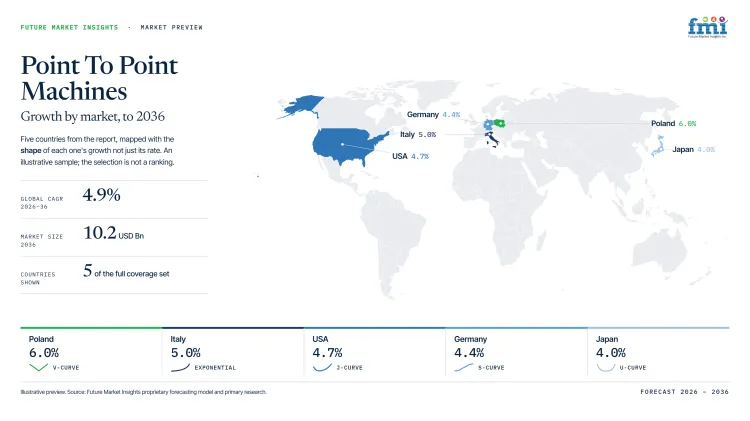
Italy has the highest profiled growth rate at 6.1% CAGR from 2026 to 2036, while Japan has the lowest at 4.0%. The spread is 2.1 percentage points. Mexico, Brazil, and USA form an upper-middle band between 5.7% and 5.1%. France and Germany form a lower middle band at 4.7% and 4.4%. Japan sits below that group at 4.0%. These bands describe expected growth tempo only. They do not establish which country has the leading installed base or the greatest absolute revenue opportunity.
- Italy is forecast at 6.1% CAGR. Italian buyers operate within a mature woodworking machinery environment where replacement timing is important.
- Buyers often evaluate automation against operator availability and training. In USA, that operating setting accompanies a 5.1% CAGR through 2036.
- A 4.0% CAGR places Japan within the profiled set, but purchasing hinges on a specific condition: Buyers in a mature manufacturing environment tend to emphasize precision, footprint, and replacement economics.
- Germany's 4.4% outlook is shaped by execution conditions. German buyers operate in a technically mature machinery environment with strong attention to interoperability and production engineering.
- For Mexico, the forecast reaches 5.7% CAGR. The buyer base is highly fragmented.
- Furniture producers face a more cyclical capital-spending environment. That gives Brazil a distinct Point To Point Machines path within its 5.4% CAGR forecast.
- France carries a 4.7% CAGR through 2036, with conversion tied to this market reality: Buyers can benefit from a policy environment that is encouraging intelligent and interoperable industrial equipment.
CAGR should be combined with the local structure of woodworking production and the installed equipment base. Financing conditions and service requirements also change conversion. A slower-growing country can still carry meaningful revenue if its addressable machinery base is large. The full market view therefore compares growth rates with buyer density and application mix. Channel structure and replacement timing complete the commercial assessment before resources are prioritized.
Country-wise Analysis
- Italy: The Point To Point Machines outlook for Italy points to a 6.1% CAGR from 2026 to 2036. Italian buyers operate within a mature woodworking machinery environment where replacement timing is important. ACIMALL reported in January 2026 that domestic wood-technology sales were EUR 710 million in 2025 and apparent consumption was EUR 950 million. It also noted new 2026 incentives for machines made in Italy or Europe. A recently renewed machinery fleet can restrain immediate replacement. Vendors need to show clear incremental gains in setup time, batch flexibility, and digital integration.
- USA: For USA, the Point To Point Machines market is projected to advance at 5.1% CAGR through 2036. Buyers often evaluate automation against operator availability and training. Accuracy and uptime also affect the purchase case. The USA Bureau of Labor Statistics reported in August 2025 that 214,600 woodworkers held jobs in 2024. It also counted 63,100 woodworking machine setters and operators outside sawing. The need to train people on computer-controlled equipment remains a friction. Suppliers can compete through intuitive programming and practical training. Remote diagnostics and responsive service coverage strengthen the offer.
- Japan: Point To Point Machines sales in Japan are expected to grow at 4.0% CAGR over 2026 to 2036. Buyers in a mature manufacturing environment tend to emphasize precision, footprint, and replacement economics. The Statistics Bureau of Japan reported METI production data showing furniture output at 34.764 million units in 2024 versus 36.587 million in 2023. System kitchen output was 120,619 sets in 2024. Softer production volumes make greenfield assumptions less persuasive. Competitive suppliers need compact platforms that reduce changeover losses and justify replacement through measurable productivity.
- Germany: A 4.4% CAGR is projected for Point To Point Machines in Germany between 2026 and 2036. German buyers operate in a technically mature machinery environment with strong attention to interoperability and production engineering. VDMA’s LIGNA material centers digital networking, automation, and flexible production as industry priorities. One persistent challenge is not access to machinery concepts but proof that a new platform fits existing software and material flows. Suppliers should demonstrate open integration, reliable service, and clear performance within a connected cell rather than sell isolated machine speed.
- Mexico: Through 2036, the market for Point To Point Machines in Mexico is set to register a 5.7% CAGR. The buyer base is highly fragmented. Data México reported in May 2026 that 28,908 furniture manufacturers in the relevant category had 0 to 10 employees. Another 1,114 had 11 to 50 employees. That structure can make financing and technical coverage more restrictive than raw production need. Suppliers can improve conversion through compact machine configurations and dealer support. Operator training and practical service models should not assume a large in-house engineering team.
- Brazil: Growth in Point To Point Machines across Brazil is projected at 5.4% CAGR from 2026 to 2036. Furniture producers face a more cyclical capital-spending environment. ABIMÓVEL reported in March 2026 that 2025 furniture and mattress production volume fell 1.2%. The association also linked expensive credit and restrictive financing to delayed investments. That weakens short-term capital approval even when modernization is needed. Suppliers should make the payback case visible through reduced setup labor and flexible batch handling. Local technical support and phased automation options can lower implementation risk.
- France: The ten-year forecast for Point To Point Machines in France reaches 4.7% CAGR. Buyers can benefit from a policy environment that is encouraging intelligent and interoperable industrial equipment. In June 2025, the French government announced three France 2030 measures for AI and robotics. The intelligent-machines initiative emphasized reconfigurable and operator-friendly systems. The harder operating issue is turning broad automation ambition into production-line economics for smaller factories. Suppliers can respond with modular controls, simple interfaces, and upgrades that integrate with existing cabinet and furniture workflows.
Who are the notable companies in the Point To Point Machines Market?
Biesse, HOMAG, SCM Group, Felder Group, Masterwood, IMA Schelling, Vitap, and Anderson Group.
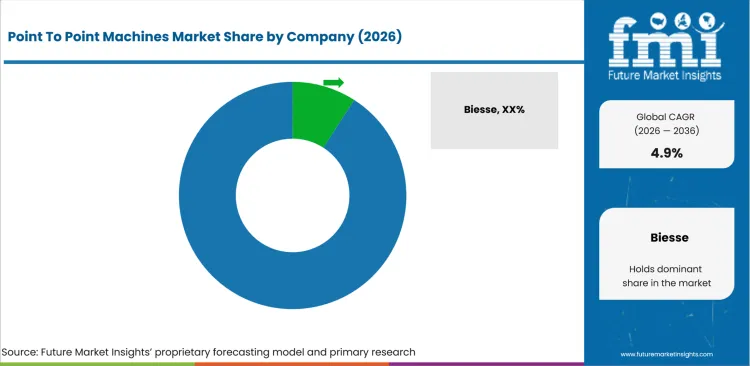
Buyer comparisons are increasingly made at the production-cell level. Biesse, HOMAG, SCM Group and IMA Schelling combine machining with wider software or automation ecosystems, while Felder Group, Masterwood, Vitap and Anderson Group give high-mix plants more configurable CNC routes. Morbidelli operates within SCM Group, while the Weeke product lineage sits within HOMAG's platform; both are discussed through their current parent suppliers.
- Integrated production systems: Biesse, HOMAG, SCM Group and IMA Schelling connect CNC processing with software, handling or wider line integration.
- Flexible machining portfolios: Felder Group, Masterwood, Vitap and Anderson Group address varied shop sizes and production mixes with configurable point-to-point architectures.
- Brand-lineage treatment: Morbidelli is treated within SCM Group and Weeke within HOMAG because those names sit inside their parent platforms rather than as separate current competitors.
Competitive Benchmarking: Point To Point Machines Market
| Company | Machine Architecture | Digital Workflow | Workholding / Automation | Commercial Footprint |
|---|---|---|---|---|
| Biesse | Broad CNC boring and routing platform | Integrated design-to-machine software | Pod/rail, table and automation options | Global woodworking customer base |
| HOMAG | Drilling and machining-cell portfolio | Production software and connected cells | Robotic feeding and flexible cell options | Global industrial woodworking base |
| SCM Group | Point-to-point and machining-center range | Maestro software ecosystem | Cell automation and flexible fixturing | Global furniture and joinery base |
| IMA Schelling | Integrated panel-processing systems | Project-level production integration | Automation engineering and handling | International industrial projects |
| Felder Group | Configurable CNC machining range | Workshop-oriented digital control | Flexible configurations for varied shop scales | Europe-led international footprint |
| Masterwood | Specialist CNC boring and routing | CAD/CAM-oriented machine control | High-mix cell and standalone configurations | International specialist network |
| Vitap | Compact boring and CNC systems | Digital CNC control | Space-efficient flexible machining | Europe and export markets |
| Anderson Group | CNC routing and drilling systems | Integrated control options | Customizable machine and handling setups | Asia-led international footprint |
Benchmarking compares production architecture, software connection, workholding or automation breadth, and the commercial support footprint buyers rely on during commissioning and ramp-up.
Key Developments in the Point To Point Machines Market
- In May 2025, HOMAG presented new CNC processing solutions for LIGNA 2025. The portfolio included the DRILLTEQ H-230 for six-sided drilling, the flexible DRILLTEQ H-610, and a DRILLTEQ V-310 cell with robotic feeding and camera-based part identification. The release shows how point-to-point drilling is being packaged with automation and software for batch-one and industrial production.
- In July 2025, SCM unveiled the morbidelli fx100 flexible drilling center for batch-one production. The machine performs drilling, doweling, and routing on five panel sides and combines Maestro active control with Maestro lab CAD/CAM. SCM also demonstrated the unit inside an automated furniture cell, which makes the development relevant to buyers seeking a path from standalone machining toward integrated production.
- In September 2025, IMA Schelling announced an investment in Italian automation specialist Sirio srl. The agreement begins with a minority stake and uses a staged integration plan. IMA Schelling linked the transaction to batch-size-one systems and stronger local project expertise. The move expands its ability to combine CNC equipment with automation engineering and service support in furniture-production projects.
Key Players in the Point To Point Machines Market
Integrated Production Platforms
- Biesse
- HOMAG
- SCM Group
- IMA Schelling
Flexible CNC Specialists
- Felder Group
- Masterwood
- Vitap
- Anderson Group
Point To Point Machines Market - Report Scope
| Coverage field | Report scope |
|---|---|
| Market breakdown | Machine Type; Workholding; End Use; Control System; Sales Channel; Region |
| Quantitative Units | USD Billion |
| Market Definition | Revenue from point-to-point woodworking machines sold for indexed boring, drilling, routing, insertion, and multi-axis component machining within the stated segmentation. Downstream finished-product revenue and adjacent or substitute machinery are excluded. |
| Regions Covered | North America; Latin America; Western Europe; Eastern Europe; East Asia; South Asia and Pacific; Middle East and Africa |
| Countries Covered | Italy, USA, Japan, Germany, Mexico, Brazil, France, and more than twenty-five additional countries in the full report |
| Key Companies Profiled | Biesse; HOMAG; SCM Group; Felder Group; Masterwood; IMA Schelling; Vitap; Anderson Group |
| Forecast Period | 2026 to 2036 |
| Approach | FMI uses a hybrid bottom-up and top-down sizing approach that reconciles supplier activity, application demand, channel structure, and country-level indicators within the defined revenue boundary. |
Point To Point Machines Market - Research Methodology
| Method | Approach |
|---|---|
| Primary Research | Structured discussions with market participants are used to test buying criteria, typical application boundaries, channel roles, service expectations, and adoption frictions. The process focuses on qualitative validation without stating respondent counts. |
| Desk Research | Public company materials, government statistics, trade-association publications, product documentation, and industry-event material are reviewed for market mechanisms, country conditions, and dated company actions. Adjacent categories are used only as context when they explain buyer behavior. |
| Market Sizing and Forecasting | Sizing reconciles equipment-revenue boundaries with the stated segmentation. Forecasting considers replacement cycles, downstream woodworking activity, automation intensity, software integration, financing conditions, and the pace at which high-mix production shifts toward CNC processing. |
| Data Validation | Claims are checked across source types and against the defined market boundary. The review removes double counting, downstream finished-product revenue, adjacent machine categories, and unsupported causal claims before the forecast narrative is finalized. |
Point To Point Machines Market by Segments
Point To Point Machines Market segmented by Machine Type:
- CNC point-to-point borers
- Routing point-to-point machines
- Boring-inserting machines
- 5-axis point-to-point systems
- Compact machining centers
Point To Point Machines Market segmented by Workholding:
- Pod and rail
- Vacuum table
- Clamp-based
- Hybrid workholding
Point To Point Machines Market segmented by End Use:
- Cabinetry
- Furniture production
- Door production
- Custom joinery
- Interior fixtures
Point To Point Machines Market segmented by Control System:
- CAD/CAM integrated
- Standalone CNC
- Barcode/ERP integrated
- Networked production cell
Point To Point Machines Market segmented by Sales Channel:
- Machinery OEMs
- Dealer network
- Direct factory sales
- Used/refurbished channel
Point To Point Machines Market by Region:
- North America
- United States
- Canada
- Latin America
- Brazil
- Mexico
- Argentina
- Chile
- Western Europe
- Germany
- France
- United Kingdom
- Italy
- Spain
- Benelux
- Nordics
- Eastern Europe
- Poland
- Czech Republic
- Romania
- Hungary
- East Asia
- China
- Japan
- South Korea
- South Asia and Pacific
- India
- ASEAN
- Australia and New Zealand
- Middle East and Africa
- GCC Countries
- South Africa
- Türkiye
- Israel
Research Sources and Bibliography
- ACIMALL (2026, January 30). ACIMALL: Preliminary 2025 Balance for Wood and Furniture Technology.
- USA Bureau of Labor Statistics (2025, August 28). Woodworkers, Occupational Outlook Handbook.
- VDMA (2025). LIGNA: Focus on Connectivity, Sustainable Production, and Woodworking Automation.
- Secretaría de Economía, Data México (2026, May). Fabricación de Muebles, Excepto de Oficina y Estantería.
- ABIMÓVEL (2026, March 5). Indústria de móveis fechou 2025 com queda na produção.
- Statistics Bureau of Japan (2026). 75th Japan Statistical Yearbook, Table 9-13: Production and Inventory of Textile Products and Other Products.
- French Ministry of the Economy and Finance (2025, June 13). France 2030: Three New Measures for AI and Robotics.
- Biesse (2024, October 1). A Plus for Biesse.
- HOMAG (2025, May 26). CNC Processing - New Solutions from Entry-Level to Industrial Production.
- SCM Group (2025, July 11). SCM New Entries for CNC Machining Centres and Flexible Drilling at Ligna 2025.
- IMA Schelling Group (2025, September 24). Investment in Automation Specialist Sirio srl.
- Felder Group (2025). LIGNA 2025: CNC Center and Software Solutions.
- Masterwood (n.d.). Project 385 - CNC for Furniture and Windows Processing.
- Vitap (n.d.). Woodworking Machines: CNC and Boring Portfolio.
- Anderson Group (n.d.). Point-to-Point Product Portfolio and Group Operations.
This Report Answers
- How is demand for the Point To Point Machines Market expected to evolve through 2036?
- Which production pressures and workflow changes support demand for point to point machines?
- Why do CNC point-to-point borers hold the leading position within Machine Type?
- How does Pod and rail workholding influence flexible downstream machining?
- Why does Cabinetry hold the leading position within End Use?
- How do growth rates differ across Italy, USA, Japan, Germany, Mexico, Brazil, and France?
- Which companies provide integrated platforms, flexible CNC systems, or established drilling brand families?
- What capital and integration frictions can limit adoption, including training and utilization risk?
- What should manufacturing decision-makers evaluate before purchasing a point-to-point machine?
Frequently Asked Questions
What is driving growth in the Point To Point Machines Market?
Growth is driven by the need to process more part variants with repeatable drilling and routing while reducing manual setup. CAD/CAM integration and flexible workholding improve batch-one economics when expected utilization supports the capital case.
Who are the key players in the Point To Point Machines Market?
Key players include Biesse, HOMAG, SCM Group, IMA Schelling, Felder Group, Masterwood, Vitap and Anderson Group. Their positions differ through machining breadth, software integration, flexible workholding and the depth of commissioning and service support.
What notable restraint affects the Point To Point Machines Market?
The main restraint is the investment case when demand is cyclical or production utilization is uncertain. Software integration and workholding setup can extend payback; training and service requirements add further implementation cost even when the machine is technically suitable.
Why should executives track the Point To Point Machines Market?
The market shows how furniture and joinery plants are converting customization into an automation problem. Executives can use the trend to judge when flexible CNC capacity, digital job preparation, and service-backed uptime create more value than additional manual equipment.
What business problem does the Point To Point Machines Market address?
Point-to-point machines address the need to place precise bores and routes across changing component designs without rebuilding a manual setup for every part. Groove and fitting operations can remain in the same CNC workflow, which reduces handling and programming friction.
What should manufacturing decision-makers evaluate in the Point To Point Machines Market?
Manufacturing decision-makers should compare processing coverage and workholding flexibility. CAD/CAM usability, automation options, and local service support should also be tested against the expected part mix so the selected machine can preserve utilization across real production variability.
What limits return on investment in the Point To Point Machines Market?
Return on investment weakens when a machine spends too much time in setup or is underused between large production runs. Financing cost and operator training can reduce expected savings, while integration effort and maintenance response can weaken throughput when workholding is mismatched.
What supports long-term commercial confidence in the Point To Point Machines Market?
Long-term confidence comes from the durable shift toward computer-controlled woodworking and the need for accurate high-mix production. Current supplier releases show continued investment in six-sided drilling and CAD/CAM, while flexible workholding and robotic handling remain active development areas.
Preview the report firsthand - request a free sample
Get SampleGet the brochure for pricing and purchase details.
Get PDFTable of Content
- Key Takeaways
- Market Size and CAGR
- Top Growth Driver
- Fastest Growing Segment
- Leading Region
- Key Companies
- Emerging Opportunities
- Executive Summary
- Global Market Outlook
- Demand-side Trends
- Supply-side Trends
- Technology Roadmap Analysis
- Analysis and Recommendations
- Analyst Perspective (What is happening? Why now? What should investors know?)
- Key Questions Answered
- How large is the market?
- What is the CAGR?
- What are key trends?
- Which region dominates?
- Who are the leaders?
- Market Overview
- Market Coverage / Taxonomy
- Market Definition / Scope / Limitations
- Research Methodology
- Chapter Orientation
- Analytical Lens and Working Hypotheses
- Market Structure, Signals, and Trend Drivers
- Benchmarking and Cross-market Comparability
- Market Sizing, Forecasting, and Opportunity Mapping
- Research Design and Evidence Framework
- Desk Research Programme (Secondary Evidence)
- Expert Input and Fieldwork (Primary Evidence)
- Tooling, Models, and Reference Databases
- Data Engineering and Model Build
- Quality Assurance and Audit Trail
- Market Background
- Market Dynamics (Drivers, Restraints, Opportunity, Trends)
- Scenario Forecast (Optimistic, Likely, Conservative)
- Impact Analysis
- AI Impact
- Sustainability Impact
- Regulatory Impact
- Technology Impact
- Consumer / Buyer Analysis
- Purchase Drivers
- Adoption Barriers
- Buyer Journey
- Opportunity Map Analysis
- Product Life Cycle Analysis
- Supply Chain Analysis
- Investment Feasibility Matrix
- Value Chain Analysis
- PESTLE and Porter's Analysis
- Regulatory Landscape
- Regional Parent Market Outlook
- Production and Consumption Statistics
- Import and Export Statistics
- Global Market Analysis and Forecast, 2021 to 2036
- Historical Market Size Value (USD Billion) Analysis, 2021 to 2025
- Current and Future Market Size Value (USD Billion) Projections, 2026 to 2036
- Y-o-Y Growth Trend Analysis
- Absolute $ Opportunity Analysis
- Global Market Pricing Analysis, 2021 to 2036
- Global Market Analysis and Forecast, By Machine Type, 2021 to 2036
- Introduction / Key Findings
- Historical Market Size Value (USD Billion) Analysis By Machine Type, 2021 to 2025
- Current and Future Market Size Value (USD Billion) Analysis and Forecast By Machine Type, 2026 to 2036
- CNC point-to-point borers
- Routing point-to-point machines
- Boring-inserting machines
- 5-axis point-to-point systems
- Compact machining centers
- CNC point-to-point borers
- Y-o-Y Growth Trend Analysis By Machine Type, 2021 to 2025
- Absolute $ Opportunity Analysis By Machine Type, 2026 to 2036
- Global Market Analysis and Forecast, By Workholding, 2021 to 2036
- Introduction / Key Findings
- Historical Market Size Value (USD Billion) Analysis By Workholding, 2021 to 2025
- Current and Future Market Size Value (USD Billion) Analysis and Forecast By Workholding, 2026 to 2036
- Pod and rail
- Vacuum table
- Clamp-based
- Hybrid workholding
- Pod and rail
- Y-o-Y Growth Trend Analysis By Workholding, 2021 to 2025
- Absolute $ Opportunity Analysis By Workholding, 2026 to 2036
- Global Market Analysis and Forecast, By End Use, 2021 to 2036
- Introduction / Key Findings
- Historical Market Size Value (USD Billion) Analysis By End Use, 2021 to 2025
- Current and Future Market Size Value (USD Billion) Analysis and Forecast By End Use, 2026 to 2036
- Cabinetry
- Furniture production
- Door production
- Custom joinery
- Interior fixtures
- Cabinetry
- Y-o-Y Growth Trend Analysis By End Use, 2021 to 2025
- Absolute $ Opportunity Analysis By End Use, 2026 to 2036
- Global Market Analysis and Forecast, By Control System, 2021 to 2036
- Introduction / Key Findings
- Historical Market Size Value (USD Billion) Analysis By Control System, 2021 to 2025
- Current and Future Market Size Value (USD Billion) Analysis and Forecast By Control System, 2026 to 2036
- CAD/CAM integrated
- Standalone CNC
- Barcode/ERP integrated
- Networked production cell
- CAD/CAM integrated
- Y-o-Y Growth Trend Analysis By Control System, 2021 to 2025
- Absolute $ Opportunity Analysis By Control System, 2026 to 2036
- Global Market Analysis and Forecast, By Sales Channel, 2021 to 2036
- Introduction / Key Findings
- Historical Market Size Value (USD Billion) Analysis By Sales Channel, 2021 to 2025
- Current and Future Market Size Value (USD Billion) Analysis and Forecast By Sales Channel, 2026 to 2036
- Machinery OEMs
- Dealer network
- Direct factory sales
- Used/refurbished channel
- Machinery OEMs
- Y-o-Y Growth Trend Analysis By Sales Channel, 2021 to 2025
- Absolute $ Opportunity Analysis By Sales Channel, 2026 to 2036
- Global Market Analysis and Forecast, By Region, 2021 to 2036
- Introduction
- Historical Market Size Value (USD Billion) Analysis By Region, 2021 to 2025
- Current Market Size Value (USD Billion) Analysis and Forecast By Region, 2026 to 2036
- North America
- Latin America
- Western Europe
- Eastern Europe
- East Asia
- South Asia and Pacific
- Middle East & Africa
- Market Attractiveness Analysis By Region
- North America Market Analysis and Forecast, By Country, 2021 to 2036
- Historical Market Size Value (USD Billion) Trend Analysis By Market Taxonomy, 2021 to 2025
- Market Size Value (USD Billion) Forecast By Market Taxonomy, 2026 to 2036
- By Country
- USA
- Canada
- By Machine Type
- By Workholding
- By End Use
- By Control System
- By Sales Channel
- By Country
- Market Attractiveness Analysis
- By Country
- By Machine Type
- By Workholding
- By End Use
- By Control System
- By Sales Channel
- Key Takeaways
- Latin America Market Analysis and Forecast, By Country
- Historical Market Size Value (USD Billion) Trend Analysis By Market Taxonomy, 2021 to 2025
- Market Size Value (USD Billion) Forecast By Market Taxonomy, 2026 to 2036
- By Country
- Brazil
- Mexico
- Chile
- Rest of Latin America
- By Machine Type
- By Workholding
- By End Use
- By Control System
- By Sales Channel
- By Country
- Market Attractiveness Analysis
- By Country
- By Machine Type
- By Workholding
- By End Use
- By Control System
- By Sales Channel
- Key Takeaways
- Western Europe Market Analysis and Forecast, By Country
- Historical Market Size Value (USD Billion) Trend Analysis By Market Taxonomy, 2021 to 2025
- Market Size Value (USD Billion) Forecast By Market Taxonomy, 2026 to 2036
- By Country
- Germany
- UK
- Italy
- Spain
- France
- Nordic
- BENELUX
- Rest of Western Europe
- By Machine Type
- By Workholding
- By End Use
- By Control System
- By Sales Channel
- By Country
- Market Attractiveness Analysis
- By Country
- By Machine Type
- By Workholding
- By End Use
- By Control System
- By Sales Channel
- Key Takeaways
- Eastern Europe Market Analysis and Forecast, By Country
- Historical Market Size Value (USD Billion) Trend Analysis By Market Taxonomy, 2021 to 2025
- Market Size Value (USD Billion) Forecast By Market Taxonomy, 2026 to 2036
- By Country
- Russia
- Poland
- Hungary
- Balkan & Baltic
- Rest of Eastern Europe
- By Machine Type
- By Workholding
- By End Use
- By Control System
- By Sales Channel
- By Country
- Market Attractiveness Analysis
- By Country
- By Machine Type
- By Workholding
- By End Use
- By Control System
- By Sales Channel
- Key Takeaways
- East Asia Market Analysis and Forecast, By Country
- Historical Market Size Value (USD Billion) Trend Analysis By Market Taxonomy, 2021 to 2025
- Market Size Value (USD Billion) Forecast By Market Taxonomy, 2026 to 2036
- By Country
- China
- Japan
- South Korea
- By Machine Type
- By Workholding
- By End Use
- By Control System
- By Sales Channel
- By Country
- Market Attractiveness Analysis
- By Country
- By Machine Type
- By Workholding
- By End Use
- By Control System
- By Sales Channel
- Key Takeaways
- South Asia and Pacific Market Analysis and Forecast, By Country
- Historical Market Size Value (USD Billion) Trend Analysis By Market Taxonomy, 2021 to 2025
- Market Size Value (USD Billion) Forecast By Market Taxonomy, 2026 to 2036
- By Country
- India
- ASEAN
- Australia & New Zealand
- Rest of South Asia and Pacific
- By Machine Type
- By Workholding
- By End Use
- By Control System
- By Sales Channel
- By Country
- Market Attractiveness Analysis
- By Country
- By Machine Type
- By Workholding
- By End Use
- By Control System
- By Sales Channel
- Key Takeaways
- Middle East & Africa Market Analysis and Forecast, By Country
- Historical Market Size Value (USD Billion) Trend Analysis By Market Taxonomy, 2021 to 2025
- Market Size Value (USD Billion) Forecast By Market Taxonomy, 2026 to 2036
- By Country
- Kingdom of Saudi Arabia
- Other GCC Countries
- Türkiye
- South Africa
- Other African Union
- Rest of Middle East & Africa
- By Machine Type
- By Workholding
- By End Use
- By Control System
- By Sales Channel
- By Country
- Market Attractiveness Analysis
- By Country
- By Machine Type
- By Workholding
- By End Use
- By Control System
- By Sales Channel
- Key Takeaways
- Key Countries Market Analysis
- USA
- Pricing Analysis
- Market Share Analysis, 2025
- By Machine Type
- By Workholding
- By End Use
- By Control System
- By Sales Channel
- Canada
- Pricing Analysis
- Market Share Analysis, 2025
- By Machine Type
- By Workholding
- By End Use
- By Control System
- By Sales Channel
- Mexico
- Pricing Analysis
- Market Share Analysis, 2025
- By Machine Type
- By Workholding
- By End Use
- By Control System
- By Sales Channel
- Brazil
- Pricing Analysis
- Market Share Analysis, 2025
- By Machine Type
- By Workholding
- By End Use
- By Control System
- By Sales Channel
- Chile
- Pricing Analysis
- Market Share Analysis, 2025
- By Machine Type
- By Workholding
- By End Use
- By Control System
- By Sales Channel
- Germany
- Pricing Analysis
- Market Share Analysis, 2025
- By Machine Type
- By Workholding
- By End Use
- By Control System
- By Sales Channel
- UK
- Pricing Analysis
- Market Share Analysis, 2025
- By Machine Type
- By Workholding
- By End Use
- By Control System
- By Sales Channel
- Italy
- Pricing Analysis
- Market Share Analysis, 2025
- By Machine Type
- By Workholding
- By End Use
- By Control System
- By Sales Channel
- Spain
- Pricing Analysis
- Market Share Analysis, 2025
- By Machine Type
- By Workholding
- By End Use
- By Control System
- By Sales Channel
- France
- Pricing Analysis
- Market Share Analysis, 2025
- By Machine Type
- By Workholding
- By End Use
- By Control System
- By Sales Channel
- India
- Pricing Analysis
- Market Share Analysis, 2025
- By Machine Type
- By Workholding
- By End Use
- By Control System
- By Sales Channel
- ASEAN
- Pricing Analysis
- Market Share Analysis, 2025
- By Machine Type
- By Workholding
- By End Use
- By Control System
- By Sales Channel
- Australia & New Zealand
- Pricing Analysis
- Market Share Analysis, 2025
- By Machine Type
- By Workholding
- By End Use
- By Control System
- By Sales Channel
- China
- Pricing Analysis
- Market Share Analysis, 2025
- By Machine Type
- By Workholding
- By End Use
- By Control System
- By Sales Channel
- Japan
- Pricing Analysis
- Market Share Analysis, 2025
- By Machine Type
- By Workholding
- By End Use
- By Control System
- By Sales Channel
- South Korea
- Pricing Analysis
- Market Share Analysis, 2025
- By Machine Type
- By Workholding
- By End Use
- By Control System
- By Sales Channel
- Russia
- Pricing Analysis
- Market Share Analysis, 2025
- By Machine Type
- By Workholding
- By End Use
- By Control System
- By Sales Channel
- Poland
- Pricing Analysis
- Market Share Analysis, 2025
- By Machine Type
- By Workholding
- By End Use
- By Control System
- By Sales Channel
- Hungary
- Pricing Analysis
- Market Share Analysis, 2025
- By Machine Type
- By Workholding
- By End Use
- By Control System
- By Sales Channel
- Kingdom of Saudi Arabia
- Pricing Analysis
- Market Share Analysis, 2025
- By Machine Type
- By Workholding
- By End Use
- By Control System
- By Sales Channel
- Türkiye
- Pricing Analysis
- Market Share Analysis, 2025
- By Machine Type
- By Workholding
- By End Use
- By Control System
- By Sales Channel
- South Africa
- Pricing Analysis
- Market Share Analysis, 2025
- By Machine Type
- By Workholding
- By End Use
- By Control System
- By Sales Channel
- USA
- Market Structure Analysis
- Competition Dashboard
- Competition Benchmarking
- Market Share Analysis of Top Players
- By Regional
- By Machine Type
- By Workholding
- By End Use
- By Control System
- By Sales Channel
- Emerging Startups
- Innovation Benchmarking
- Competition Analysis
- Competition Deep Dive
- Biesse
- Overview
- Product Portfolio
- Profitability by Market Segments
- Sales Footprint
- Strategy Overview
- Marketing Strategy
- Product Strategy
- Channel Strategy
- HOMAG
- SCM Group
- Felder Group
- Masterwood
- Morbidelli / SCM
- IMA Schelling
- Vitap
- Weeke / HOMAG
- Anderson Group
- Biesse
- Case Studies
- Success Stories
- Recent Developments
- Competition Deep Dive
- Assumptions & Acronyms Used


