

- Market Size (2026)
- USD 860.7 Mn
- Forecast (2036)
- USD 1526.9 Mn
- CAGR (2026 to 2036)
- 5.9%
How big is Pond Clarifiers Market in 2026?
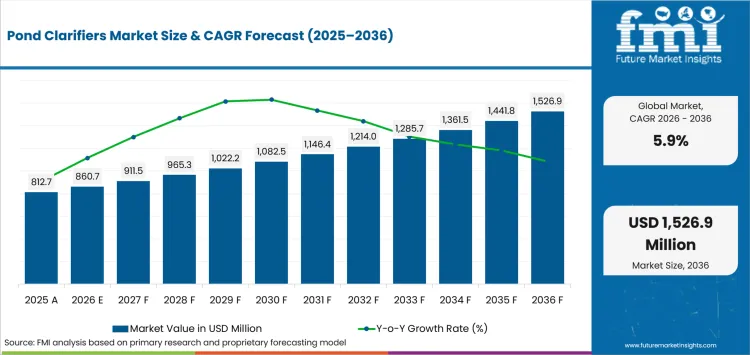
USD 860.7 million in 2026 and USD 1,526.9 million by 2036 at a 5.9% CAGR.
Pond clarifier demand is forecast to expand at 5.9% CAGR between 2026 and 2036, increasing from USD 860.7 million in 2026 to USD 1,526.9 million by 2036. Spending follows the need to keep suspended solids, nutrients and organic debris from degrading pond performance, particularly where water quality directly affects aquaculture output or managed-water maintenance.
Country conditions change how that need converts to product sales. Thailand and Indonesia combine extensive pond-based aquaculture with warm-water operating cycles, while the USA adds ornamental ponds, golf-course water bodies and managed lakes to its aquaculture base. Product conversion improves when operators can identify the cause of cloudiness, select the correct treatment mechanism and apply a repeatable dose.
Key Takeaways of Pond Clarifiers Market
- Recurring water-quality management supports demand where turbidity, organic loading or nutrient pressure requires repeat treatment.
- Bacterial clarifiers account for 24.0% of Product Type demand in 2026 as biological maintenance fits recurring organic-load control.
- Liquid formulations hold 43.0% of Form demand in 2026 because dose adjustment and surface distribution support both corrective and maintenance use.
- Aquaculture ponds represent 26.0% of Pond Type demand in 2026 because treatment is integrated with production-water management.
- Turbidity reduction accounts for 26.0% of Function demand, while pond supply retailers hold 32.0% of Sales Channel demand in 2026.
- Aquascape, API / Mars Fishcare, OASE, Microbe-Lift, Airmax, Inc., Aquacide Company, SEPRO Scientific, Natural Waterscapes, Aquatic Biologists, Inc. and Tetra are active across pond-care and professional water-management routes.
Analyst Perspective
"Revenue capture depends on diagnosis and application discipline more than on another generic clarity claim. Suppliers can reduce treatment errors by linking product choice to the source of cloudiness, dose per treated volume, oxygen conditions and compatibility with filtration or aeration."
- Anurag Sharma, Principal Consultant, Future Market Insights
How is the Pond Clarifiers Market segmented?
The pond clarifiers market is segmented by Product Type, Form, Pond Type, Function, Sales Channel and Region.
Product Type distinguishes biological digestion, enzymatic treatment, particle flocculation, barley-straw extract approaches, phosphate binding and UV-compatible clarification chemicals. Form covers liquids, powders, tablets or blocks and granules. Pond Type spans aquaculture ponds, ornamental ponds, golf-course ponds, stormwater ponds and retention lakes. Function separates turbidity reduction from algae-control support, organic debris breakdown, phosphate reduction and odor reduction. Sales Channel includes pond supply retailers, aquaculture distributors, landscape contractors, e-commerce or retail, and municipal lake service providers.
Why do Bacterial clarifiers lead the Product Type category?
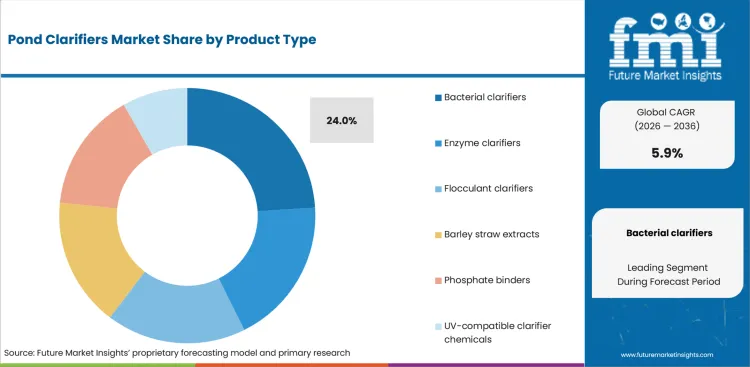
Bacterial clarifiers fit recurring maintenance because they work on organic material and nutrient cycling rather than depending on one particle-settling event. Enzyme clarifiers accelerate breakdown of organic residues, while flocculant clarifiers aggregate suspended fines for settling or filtration. Barley straw extracts occupy a slower maintenance route, phosphate binders target nutrient availability, and UV-compatible chemicals are selected where treatment must work alongside installed clarification equipment.
- Based on Product Type, bacterial clarifiers are projected to account for 24.0% in 2026 because biological dosing supports recurring organic-load management.
- Airmax positions PondClear around beneficial bacteria and enzymes for water clarity, nutrient reduction and odor control in ponds and lakes.
Why does Liquid lead the Form category?
Liquid formulations let operators meter treatment by pond volume and distribute material across the water surface. Powders can lower shipping weight and allow dry-dose handling, while tablets or blocks support fixed-dose convenience in smaller water bodies. Granular forms are useful when targeted placement or slower dispersion is preferred. The choice depends on pond size, mixing requirements and the precision needed during application. The same dosing logic appears in the flocculant and coagulant market, where treatment performance depends on matching chemistry and dose to particle load.
- In 2026, liquid formulations are expected to lead Form with 43.0% share because adjustable dosing supports corrective and maintenance treatment.
- OASE sells AquaActiv PondClear as a liquid treatment that binds mineral and organic turbidity and removes phosphates, supporting volume-based dosing across ornamental ponds.
How do Aquaculture ponds shape the Pond Type category?
Aquaculture ponds create recurring treatment demand because water quality is tied to stocked biomass, feeding and production continuity. Ornamental ponds prioritize appearance and fish health, while golf-course ponds require predictable presentation within maintenance schedules. Stormwater ponds face runoff-driven suspended solids and nutrients, and retention lakes create larger treatment areas where dosing logistics and professional application become more important.
- Aquaculture ponds are expected to lead Pond Type with 26.0% share in 2026 because treatment is integrated with recurring production-water management.
- USDA reported 3,453 aquaculture farms with sales in 2023, up 18% from 2018, showing an established managed-water operating base in the United States.
What supports Turbidity reduction in the Function category?
Turbidity is the visible symptom that converts a water-quality concern into a clarifier purchase. Suspended mineral particles, fine organic matter and disturbed sediment can reduce visibility. Flocculants aggregate fine particles, biological products address organic loading over time, and phosphate reduction can limit one nutrient pathway behind recurring algae pressure. Odor reduction adds value when decomposing organic matter affects amenity or pond-use conditions. Related demand also overlaps with the algaecides market where buyers separate clarity treatment from direct algae control.
- Turbidity reduction is projected to account for 26.0% of Function demand in 2026 because visible suspended solids create a direct treatment trigger.
- OASE describes PondClear as a treatment that binds fine mineral and organic turbidity, while Tetra states that its pond water clarifier clumps suspended fine particles so filtration can remove them more effectively.
What drives Pond supply retailers in the Sales Channel category?
Pond supply retailers sit close to the problem-identification step for ornamental ponds and many smaller managed water bodies. Aquaculture distributors become more important as treatment volumes rise, while landscape contractors influence recurring maintenance in installed water features. E-commerce expands access to packaged products when dose instructions are clear. Municipal lake service providers are relevant when treatment is linked to larger water bodies and professional field application. Retail advice also extends to pond filters when buyers combine clarification chemistry with circulation and particle removal.
- Pond supply retailers are expected to hold 32.0% of Sales Channel demand in 2026 because specialist advice helps buyers match cloudiness, dose and treatment mechanism.
- Aquascape packages pond treatments around defined water-quality problems and provides dose guidance through dealer-oriented products, which suits specialist retail purchasing.
What are the drivers, restraints and opportunities in the Pond Clarifiers Market?
Recurring water-quality management supports demand, while diagnosis and dosing complexity restrain adoption and integrated treatment programs expand the commercial opportunity.
- Driver: Recurring control of turbidity, nutrients and organic loading across aquaculture and managed ponds.
- Restraint: Incorrect diagnosis or dosing can delay results and can create water-chemistry or oxygen-management risks.
- Opportunity: Integrated biological, flocculation, phosphate-control and monitoring programs can shift buyers from reactive treatment toward preventive maintenance.
The driver begins with recurring water-quality pressure. Aquaculture operators treat clarity within a wider operating system that includes feeding, biomass and aeration. The same logic appears in ornamental and managed ponds when organic debris or nutrient loading creates recurring cloudiness. Suppliers benefit when a product is tied to a defined treatment mechanism. The wider water treatment chemicals category shows the same procurement need to match chemistry with the specific contaminant or treatment step.
The main restraint appears at diagnosis and dosing. Mississippi State University Extension notes that alum can clear muddy water but can also reduce alkalinity and pH, creating fish-safety risk in low-alkalinity ponds if treatment is poorly managed. Biological programs create a different constraint because added microbial activity can increase oxygen demand. Buyers therefore need reliable pond-volume estimates and basic water-chemistry awareness before repeat dosing.
The opportunity is to combine treatment with better diagnosis. SePRO Corporation expanded its surface-water monitoring capability through the April 2025 acquisition of Green Eyes, while Natural Waterscapes combines aeration, biological maintenance and targeted phosphorus management in pond-treatment programs. This supports a managed sequence from diagnosis through treatment selection and follow-up water checks. The commercial logic aligns with growing investment in water quality monitoring across aquaculture operations.
Which country CAGRs are profiled in the Pond Clarifiers Market?
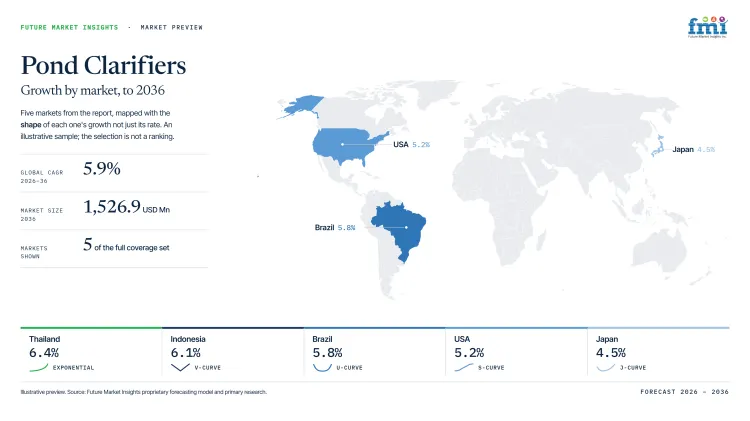
| Country | CAGR |
|---|---|
| Thailand | 6.4% |
| USA | 5.2% |
| Japan | 4.5% |
| Indonesia | 6.1% |
| Brazil | 5.8% |
| Australia | 5.5% |
| UK | 4.9% |
How do country-level CAGRs compare in the Pond Clarifiers Market?
Country CAGRs span 1.9 percentage points, from Thailand at 6.4% to Japan at 4.5% between 2026 and 2036. Indonesia follows Thailand at 6.1%, while Brazil and Australia sit at 5.8% and 5.5%. The USA is forecast at 5.2%, with the UK at 4.9%. These rates describe expected expansion rather than absolute country market size.
- Thailand exceeds Indonesia by 0.3 percentage points, supporting early channel development where pond aquaculture and recurring water management are closely linked.
- Indonesia leads Brazil by 0.3 points. Brackish and freshwater culture create different dose and water-chemistry requirements for distributors.
- Brazil sits 0.3 points above Australia and 0.6 points above the USA, but route-to-market requirements differ because farm geography and professional service networks are not equivalent.
- The USA remains above the UK, while Japan is at 4.5% in this seven-country set. Mature markets can still support repeat revenue when suppliers simplify treatment selection and application.
CAGR should not be used as a proxy for absolute revenue. Pond count, aquaculture intensity, treatment frequency, product mix and service penetration affect the revenue available in each country. The full report combines country growth with regional segmentation and competitive conditions.
Country-wise Analysis
- Thailand: Pond-based aquaculture creates repeat water-quality treatment demand, especially where warm conditions and intensive feeding increase organic and nutrient pressure. Demand is forecast to expand at 6.4% CAGR from 2026 to 2036.
- USA: Buyers span commercial aquaculture farms, ornamental ponds, golf-course water bodies and managed lakes. Demand is forecast to rise at 5.2% CAGR from 2026 to 2036, with specialty retail and professional lake-management channels both relevant.
- Japan: Operators work in a mature aquaculture setting where controlled water conditions and precise application matter. Demand is forecast to expand at 4.5% CAGR from 2026 to 2036.
- Indonesia: Brackish-water and freshwater pond aquaculture create recurring opportunities for turbidity and organic-load management. Demand is forecast to grow at 6.1% CAGR from 2026 to 2036.
- Brazil: Expanding fish farming increases the managed pond-water base that requires routine quality control. Demand is forecast to rise at 5.8% CAGR from 2026 to 2036.
- Australia: Demand combines aquaculture with professional management of farm ponds and amenity water bodies. The market is forecast to expand at 5.5% CAGR from 2026 to 2036.
- UK: Ornamental ponds and managed freshwater environments shape demand, while aquaculture adds a smaller precision-treatment route. Demand is forecast to increase at 4.9% CAGR from 2026 to 2036.
Who are the notable companies in the Pond Clarifiers Market?
Aquascape, API / Mars Fishcare, OASE, Microbe-Lift, Airmax, Inc., Aquacide Company, SEPRO Scientific, Natural Waterscapes, Aquatic Biologists, Inc. and Tetra are notable companies active in the pond clarifiers market.
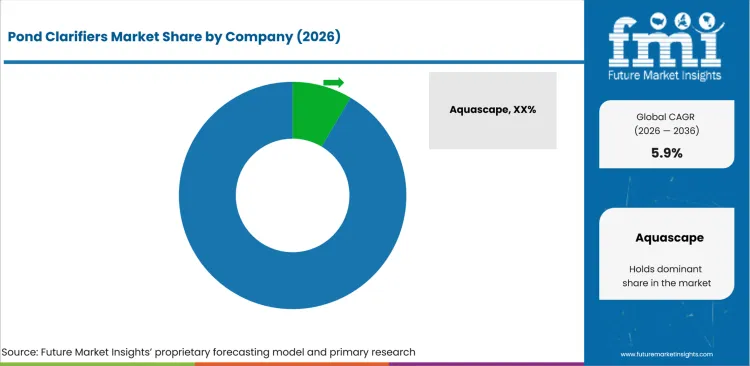
Competitive positioning depends on where a supplier enters the pond-care decision. Aquascape, API / Mars Fishcare, OASE and Tetra serve packaged pond-care purchasing. Microbe-Lift, Airmax, Inc., Aquacide Company and Natural Waterscapes focus on biological treatment or recurring pond-and-lake maintenance. SEPRO Scientific and Aquatic Biologists, Inc. operate closer to professional water-management workflows where field application and nutrient management influence product choice.
- Aquascape, API / Mars Fishcare, OASE and Tetra offer direct pond-water care products that fit specialist retail or dealer purchasing.
- Microbe-Lift, Airmax, Inc., Aquacide Company and Natural Waterscapes address biological treatment, muck reduction or recurring clarity maintenance.
- SEPRO Scientific and Aquatic Biologists, Inc. are positioned closer to large-waterbody management, diagnostics or technically guided treatment programs.
Competitive Benchmarking: Pond Clarifiers Market
| Company | Biological Clarifier Depth | Particle & Phosphate Binding Breadth | Large-Pond / Professional Application Coverage | Geographic Reach |
|---|---|---|---|---|
| Aquascape | High | High | Medium | North America with dealer-led international availability |
| API / Mars Fishcare | High | High | Medium | North America and international pet and pond-care channels |
| OASE | Medium | High | Medium | Europe, North America and Asia-Pacific dealer markets |
| Microbe-Lift | High | High | Medium | North America with international pond and koi distribution |
| Airmax, Inc. | High | Medium | High | United States, with large-pond treatment products and professional applicator support |
| Aquacide Company | High | Low | Medium | United States specialty pond and lake treatment channels |
| SEPRO Scientific | High | High | High | United States with professional water-management activity |
| Natural Waterscapes | High | High | High | United States direct retail and professional pond or lake management |
| Aquatic Biologists, Inc. | High | High | High | United States professional pond and lake management |
| Tetra | High | High | Medium | North America and international ornamental pond retail |
Scoring basis: Biological Clarifier Depth is High where a portfolio spans bacteria and enzyme solutions used for organic-load or nutrient management, Medium where one approach dominates and Low where the category is limited. Particle & Phosphate Binding Breadth is High where flocculation, phosphate binding or multiple clarification approaches are available, Medium for narrower coverage and Low for a single limited route. Large-Pond / Professional Application Coverage is High where products or services support acre-scale ponds, lakes or managed water bodies, Medium for narrower professional coverage and Low for consumer-scale use.
Key Developments in the Pond Clarifiers Market
- In April 2026, SePRO Corporation acquired Earth Science Laboratories, adding water-treatment technologies for lakes, reservoirs, conveyance infrastructure and drinking-water systems to its platform.
- In July 2025, Airmax acquired the Power House Aeration, Ice Eater, and Weeds Away brands, expanding its pond and lake equipment portfolio across aeration, aquatic circulation, and de-icing applications.
- In 2026, Aquascape continued strengthening its biological pond-treatment portfolio, including beneficial bacteria and its Maintain for Ponds XT formulation, which combines beneficial bacteria, phosphate binder, flocculant, and pond detoxifier for water clarity and pond maintenance
Key Players in the Pond Clarifiers Market
Retail-Led Ornamental Pond Water Care
- Aquascape
- API / Mars Fishcare
- OASE
- Tetra
Biological Pond and Lake Maintenance Specialists
- Microbe-Lift
- Airmax, Inc.
- Aquacide Company
- Natural Waterscapes
Professional Water Management and Applied Biology
- SEPRO Scientific
- Aquatic Biologists, Inc.
Pond Clarifiers Market - Report Scope
| Coverage field | Report scope |
|---|---|
| Market breakdown | By Product Type, Form, Pond Type, Function, Sales Channel and Region. |
| Quantitative Units | USD million. |
| Market Definition | Revenue from pond-clarifier formulations sold within the defined Product Type, Form, Pond Type, Function and Sales Channel universe. Includes bacterial, enzyme, flocculant, barley-straw extract, phosphate-binding and UV-compatible clarification chemicals. Excludes mechanical UV clarifier equipment, pumps, filters, aerators, stand-alone algaecides or herbicides, service labor and adjacent categories. |
| Regions Covered | North America; Latin America; Western Europe; Eastern Europe; East Asia; South Asia and Pacific; Middle East and Africa. |
| Countries Covered | Thailand, USA, Japan, Indonesia, Brazil, Australia, UK, plus additional countries covered in the full report. |
| Notable Companies | Aquascape; API / Mars Fishcare; OASE; Microbe-Lift; Airmax, Inc.; Aquacide Company; SEPRO Scientific; Natural Waterscapes; Aquatic Biologists, Inc.; Tetra. |
| Forecast Period | 2026 to 2036. |
| Approach | FMI applies bottom-up and top-down sizing techniques using pond applications, treatment frequency, channel economics, product pricing, aquaculture activity and managed-water demand while excluding adjacent equipment and service revenue. |
Pond Clarifiers Market - Research Methodology
| Method | Approach |
|---|---|
| Primary Research | FMI analysts gather input from pond-water treatment manufacturers, aquaculture distributors, specialty pond retailers, landscape contractors, lake-management practitioners, aquaculture operators and technical specialists. Interviews examine purchase triggers, dosing practices, channel roles, price behavior and product-selection criteria. |
| Desk Research | Desk research covers aquaculture statistics, fisheries-agency publications, water-quality guidance, company product documentation, corporate announcements and public technical material that supports the defined pond-clarifier market boundary. |
| Market Sizing and Forecasting | The market model combines pond applications, treatment occasions, package economics and channel activity with top-down checks from aquaculture, ornamental pond, landscape and managed-water demand. Forecast assumptions consider operating intensity, recurring treatment behavior, channel development and country adoption conditions. |
| Research Triangulation | Estimates are compared across independent public indicators, primary interviews, product evidence and country-level operating conditions. Duplicate revenue from equipment, services and stand-alone adjacent treatments is excluded from the defined market boundary. |
Pond Clarifiers Market by Segments
Pond Clarifiers Market segmented by Product Type:
- Bacterial clarifiers
- Enzyme clarifiers
- Flocculant clarifiers
- Barley straw extracts
- Phosphate binders
- UV-compatible clarifier chemicals
Pond Clarifiers Market segmented by Form:
- Liquid
- Powder
- Tablet / block
- Granular
Pond Clarifiers Market segmented by Pond Type:
- Aquaculture ponds
- Ornamental ponds
- Golf course ponds
- Stormwater ponds
- Retention lakes
Pond Clarifiers Market segmented by Function:
- Turbidity reduction
- Algae control support
- Organic debris breakdown
- Phosphate reduction
- Odor reduction
Pond Clarifiers Market segmented by Sales Channel:
- Pond supply retailers
- Aquaculture distributors
- Landscape contractors
- E-commerce / retail
- Municipal lake service
Pond Clarifiers Market by Region:
- North America
- United States
- Canada
- Latin America
- Brazil
- Mexico
- Argentina
- Chile
- Western Europe
- Germany
- France
- United Kingdom
- Italy
- Spain
- Benelux
- Nordics
- Eastern Europe
- Poland
- Czech Republic
- Romania
- Hungary
- East Asia
- China
- Japan
- South Korea
- South Asia and Pacific
- India
- ASEAN
- Australia and New Zealand
- Middle East and Africa
- GCC Countries
- South Africa
- Türkiye
- Israel
Research Sources and Bibliography
- Food and Agriculture Organization of the United Nations (2024). The State of World Fisheries and Aquaculture 2024.
- USDA National Agricultural Statistics Service (2024, December 16). USDA Releases the 2023 Census of Aquaculture Results.
- Thailand Department of Fisheries (2024). Fishery Statistics Analysis and Research Group: Thailand Fishery Statistics.
- BPS-Statistics Indonesia (2024, December 6). Statistics of Aquaculture Establishment 2023.
- Fisheries Agency of Japan (2025). FY2024 White Paper on Fisheries: Domestic Fisheries and Aquaculture Production Trends.
- IBGE News Agency (2025, September 18). Value of livestock and aquaculture production reaches R$132.8 billion in 2024.
- Australian Government Department of Agriculture, Fisheries and Forestry (2024, July 30). Australian Government Aquaculture Statement 2024.
- Scottish Government (2025, October 28). Scottish Fish Farm Production Survey 2024: Rainbow trout.
- Mississippi State University Extension. Pond and Lake Topics: Water Quality and Muddy Water Management.
- Aquascape. Aquascape Inc. Introduces All-In-One Water Treatment with QuickFix Pond Gummy.
- Aquascape. Pond & Debris Clarifier Professional Grade.
- API. API POND ACCU-CLEAR Pond Water Clarifier.
- MICROBE-LIFT. Sludge-Away.
- Airmax. PondClear.
- Aquacide Company. AquaClear Pellets.
- SePRO Corporation (2026, April 1). SePRO Corporation Acquires Earth Science Laboratories.
- SePRO Corporation (2025, September 9). SePRO Corporation Acquires Resolve Hydro to Add Satellite Diagnostics to Digital Strategy.
- SEPRO Scientific (2026, July 7). SePRO Corporation Becomes SEPRO Scientific, Reflecting Science-Led Leadership and Environmental Stewardship.
- Stanley Capital Partners (2025, April 22). Stanley Capital Partners expands SePRO water health capabilities with the acquisition of Green Eyes.
- Natural Waterscapes (2023, August 17). MetaFloc Phosphate Removal Case Study.
- OASE. PondClear.
- Tetra. Frequently Asked Pond Water Quality Questions.
- Aquatic Biologists, Inc. Bio Boost Liquid Bacteria.
This bibliography is provided for reader reference and is not exhaustive. The full report contains the complete reference list and detailed citations.
This Report Answers
- How large is the Pond Clarifiers Market in 2026 and 2036?
- Which operating conditions support recurring pond-clarifier demand?
- Which Product Type leads demand in 2026?
- How does formulation choice affect application and dosing?
- Which Pond Type supports recurring treatment demand?
- Which Function converts visible cloudiness into a purchase decision?
- How do country growth rates affect route-to-market priorities?
- Which companies serve retail, biological and professional water-management applications?
Frequently Asked Questions
How big is the pond clarifiers market in 2026?
USD 860.7 million represents the pond clarifiers market value in 2026. Demand comes from recurring treatment of suspended particles, organic loading and nutrient-related water-quality problems across aquaculture and managed ponds.
What is the CAGR of the pond clarifiers market from 2026 to 2036?
A 5.9% CAGR is forecast for the pond clarifiers market between 2026 and 2036, taking the market to USD 1,526.9 million by 2036.
Which Product Type leads the pond clarifiers market?
Bacterial clarifiers lead Product Type demand in 2026 because recurring organic-load management supports routine use across pond maintenance programs.
How much will the pond clarifiers market add between 2026 and 2036?
The pond clarifiers market is expected to add USD 666.2 million between 2026 and 2036 as aquaculture and managed-water users expand repeat treatment programs.
Which companies are active in the pond clarifiers market?
Companies active in the market include Aquascape, API / Mars Fishcare, OASE, Microbe-Lift, Airmax, Inc., Aquacide Company, SEPRO Scientific, Natural Waterscapes, Aquatic Biologists, Inc. and Tetra.
Preview the report firsthand - request a free sample
Get SampleGet the brochure for pricing and purchase details.
Get PDFTable of Content
- Key Takeaways
- Market Size and CAGR
- Top Growth Driver
- Fastest Growing Segment
- Leading Region
- Key Companies
- Emerging Opportunities
- Executive Summary
- Global Market Outlook
- Demand-side Trends
- Supply-side Trends
- Technology Roadmap Analysis
- Analysis and Recommendations
- Analyst Perspective (What is happening? Why now? What should investors know?)
- Key Questions Answered
- How large is the market?
- What is the CAGR?
- What are key trends?
- Which region dominates?
- Who are the leaders?
- Market Overview
- Market Coverage / Taxonomy
- Market Definition / Scope / Limitations
- Research Methodology
- Chapter Orientation
- Analytical Lens and Working Hypotheses
- Market Structure, Signals, and Trend Drivers
- Benchmarking and Cross-market Comparability
- Market Sizing, Forecasting, and Opportunity Mapping
- Research Design and Evidence Framework
- Desk Research Programme (Secondary Evidence)
- Expert Input and Fieldwork (Primary Evidence)
- Tooling, Models, and Reference Databases
- Data Engineering and Model Build
- Quality Assurance and Audit Trail
- Market Background
- Market Dynamics (Drivers, Restraints, Opportunity, Trends)
- Scenario Forecast (Optimistic, Likely, Conservative)
- Impact Analysis
- AI Impact
- Sustainability Impact
- Regulatory Impact
- Technology Impact
- Consumer / Buyer Analysis
- Purchase Drivers
- Adoption Barriers
- Buyer Journey
- Opportunity Map Analysis
- Product Life Cycle Analysis
- Supply Chain Analysis
- Investment Feasibility Matrix
- Value Chain Analysis
- PESTLE and Porter's Analysis
- Regulatory Landscape
- Regional Parent Market Outlook
- Production and Consumption Statistics
- Import and Export Statistics
- Global Market Analysis and Forecast, 2021 to 2036
- Historical Market Size Value (USD Million) Analysis, 2021 to 2025
- Current and Future Market Size Value (USD Million) Projections, 2026 to 2036
- Y-o-Y Growth Trend Analysis
- Absolute $ Opportunity Analysis
- Global Market Pricing Analysis, 2021 to 2036
- Global Market Analysis and Forecast, By Product Type, 2021 to 2036
- Introduction / Key Findings
- Historical Market Size Value (USD Million) Analysis By Product Type, 2021 to 2025
- Current and Future Market Size Value (USD Million) Analysis and Forecast By Product Type, 2026 to 2036
- Bacterial clarifiers
- Enzyme clarifiers
- Flocculant clarifiers
- Barley straw extracts
- Phosphate binders
- UV-compatible clarifier chemicals
- Bacterial clarifiers
- Y-o-Y Growth Trend Analysis By Product Type, 2021 to 2025
- Absolute $ Opportunity Analysis By Product Type, 2026 to 2036
- Global Market Analysis and Forecast, By Form, 2021 to 2036
- Introduction / Key Findings
- Historical Market Size Value (USD Million) Analysis By Form, 2021 to 2025
- Current and Future Market Size Value (USD Million) Analysis and Forecast By Form, 2026 to 2036
- Liquid
- Powder
- Tablet / block
- Granular
- Liquid
- Y-o-Y Growth Trend Analysis By Form, 2021 to 2025
- Absolute $ Opportunity Analysis By Form, 2026 to 2036
- Global Market Analysis and Forecast, By Pond Type, 2021 to 2036
- Introduction / Key Findings
- Historical Market Size Value (USD Million) Analysis By Pond Type, 2021 to 2025
- Current and Future Market Size Value (USD Million) Analysis and Forecast By Pond Type, 2026 to 2036
- Aquaculture ponds
- Ornamental ponds
- Golf course ponds
- Stormwater ponds
- Retention lakes
- Aquaculture ponds
- Y-o-Y Growth Trend Analysis By Pond Type, 2021 to 2025
- Absolute $ Opportunity Analysis By Pond Type, 2026 to 2036
- Global Market Analysis and Forecast, By Function, 2021 to 2036
- Introduction / Key Findings
- Historical Market Size Value (USD Million) Analysis By Function, 2021 to 2025
- Current and Future Market Size Value (USD Million) Analysis and Forecast By Function, 2026 to 2036
- Turbidity reduction
- Algae control support
- Organic debris breakdown
- Phosphate reduction
- Odor reduction
- Turbidity reduction
- Y-o-Y Growth Trend Analysis By Function, 2021 to 2025
- Absolute $ Opportunity Analysis By Function, 2026 to 2036
- Global Market Analysis and Forecast, By Sales Channel, 2021 to 2036
- Introduction / Key Findings
- Historical Market Size Value (USD Million) Analysis By Sales Channel, 2021 to 2025
- Current and Future Market Size Value (USD Million) Analysis and Forecast By Sales Channel, 2026 to 2036
- Pond supply retailers
- Aquaculture distributors
- Landscape contractors
- E-commerce / retail
- Municipal lake service
- Pond supply retailers
- Y-o-Y Growth Trend Analysis By Sales Channel, 2021 to 2025
- Absolute $ Opportunity Analysis By Sales Channel, 2026 to 2036
- Global Market Analysis and Forecast, By Region, 2021 to 2036
- Introduction
- Historical Market Size Value (USD Million) Analysis By Region, 2021 to 2025
- Current Market Size Value (USD Million) Analysis and Forecast By Region, 2026 to 2036
- North America
- Latin America
- Western Europe
- Eastern Europe
- East Asia
- South Asia and Pacific
- Middle East & Africa
- Market Attractiveness Analysis By Region
- North America Market Analysis and Forecast, By Country, 2021 to 2036
- Historical Market Size Value (USD Million) Trend Analysis By Market Taxonomy, 2021 to 2025
- Market Size Value (USD Million) Forecast By Market Taxonomy, 2026 to 2036
- By Country
- USA
- Canada
- By Product Type
- By Form
- By Pond Type
- By Function
- By Sales Channel
- By Country
- Market Attractiveness Analysis
- By Country
- By Product Type
- By Form
- By Pond Type
- By Function
- By Sales Channel
- Key Takeaways
- Latin America Market Analysis and Forecast, By Country
- Historical Market Size Value (USD Million) Trend Analysis By Market Taxonomy, 2021 to 2025
- Market Size Value (USD Million) Forecast By Market Taxonomy, 2026 to 2036
- By Country
- Brazil
- Mexico
- Chile
- Rest of Latin America
- By Product Type
- By Form
- By Pond Type
- By Function
- By Sales Channel
- By Country
- Market Attractiveness Analysis
- By Country
- By Product Type
- By Form
- By Pond Type
- By Function
- By Sales Channel
- Key Takeaways
- Western Europe Market Analysis and Forecast, By Country
- Historical Market Size Value (USD Million) Trend Analysis By Market Taxonomy, 2021 to 2025
- Market Size Value (USD Million) Forecast By Market Taxonomy, 2026 to 2036
- By Country
- Germany
- UK
- Italy
- Spain
- France
- Nordic
- BENELUX
- Rest of Western Europe
- By Product Type
- By Form
- By Pond Type
- By Function
- By Sales Channel
- By Country
- Market Attractiveness Analysis
- By Country
- By Product Type
- By Form
- By Pond Type
- By Function
- By Sales Channel
- Key Takeaways
- Eastern Europe Market Analysis and Forecast, By Country
- Historical Market Size Value (USD Million) Trend Analysis By Market Taxonomy, 2021 to 2025
- Market Size Value (USD Million) Forecast By Market Taxonomy, 2026 to 2036
- By Country
- Russia
- Poland
- Hungary
- Balkan & Baltic
- Rest of Eastern Europe
- By Product Type
- By Form
- By Pond Type
- By Function
- By Sales Channel
- By Country
- Market Attractiveness Analysis
- By Country
- By Product Type
- By Form
- By Pond Type
- By Function
- By Sales Channel
- Key Takeaways
- East Asia Market Analysis and Forecast, By Country
- Historical Market Size Value (USD Million) Trend Analysis By Market Taxonomy, 2021 to 2025
- Market Size Value (USD Million) Forecast By Market Taxonomy, 2026 to 2036
- By Country
- China
- Japan
- South Korea
- By Product Type
- By Form
- By Pond Type
- By Function
- By Sales Channel
- By Country
- Market Attractiveness Analysis
- By Country
- By Product Type
- By Form
- By Pond Type
- By Function
- By Sales Channel
- Key Takeaways
- South Asia and Pacific Market Analysis and Forecast, By Country
- Historical Market Size Value (USD Million) Trend Analysis By Market Taxonomy, 2021 to 2025
- Market Size Value (USD Million) Forecast By Market Taxonomy, 2026 to 2036
- By Country
- India
- ASEAN
- Australia & New Zealand
- Rest of South Asia and Pacific
- By Product Type
- By Form
- By Pond Type
- By Function
- By Sales Channel
- By Country
- Market Attractiveness Analysis
- By Country
- By Product Type
- By Form
- By Pond Type
- By Function
- By Sales Channel
- Key Takeaways
- Middle East & Africa Market Analysis and Forecast, By Country
- Historical Market Size Value (USD Million) Trend Analysis By Market Taxonomy, 2021 to 2025
- Market Size Value (USD Million) Forecast By Market Taxonomy, 2026 to 2036
- By Country
- Kingdom of Saudi Arabia
- Other GCC Countries
- Türkiye
- South Africa
- Other African Union
- Rest of Middle East & Africa
- By Product Type
- By Form
- By Pond Type
- By Function
- By Sales Channel
- By Country
- Market Attractiveness Analysis
- By Country
- By Product Type
- By Form
- By Pond Type
- By Function
- By Sales Channel
- Key Takeaways
- Key Countries Market Analysis
- USA
- Pricing Analysis
- Market Share Analysis, 2025
- By Product Type
- By Form
- By Pond Type
- By Function
- By Sales Channel
- Canada
- Pricing Analysis
- Market Share Analysis, 2025
- By Product Type
- By Form
- By Pond Type
- By Function
- By Sales Channel
- Mexico
- Pricing Analysis
- Market Share Analysis, 2025
- By Product Type
- By Form
- By Pond Type
- By Function
- By Sales Channel
- Brazil
- Pricing Analysis
- Market Share Analysis, 2025
- By Product Type
- By Form
- By Pond Type
- By Function
- By Sales Channel
- Chile
- Pricing Analysis
- Market Share Analysis, 2025
- By Product Type
- By Form
- By Pond Type
- By Function
- By Sales Channel
- Germany
- Pricing Analysis
- Market Share Analysis, 2025
- By Product Type
- By Form
- By Pond Type
- By Function
- By Sales Channel
- UK
- Pricing Analysis
- Market Share Analysis, 2025
- By Product Type
- By Form
- By Pond Type
- By Function
- By Sales Channel
- Italy
- Pricing Analysis
- Market Share Analysis, 2025
- By Product Type
- By Form
- By Pond Type
- By Function
- By Sales Channel
- Spain
- Pricing Analysis
- Market Share Analysis, 2025
- By Product Type
- By Form
- By Pond Type
- By Function
- By Sales Channel
- France
- Pricing Analysis
- Market Share Analysis, 2025
- By Product Type
- By Form
- By Pond Type
- By Function
- By Sales Channel
- India
- Pricing Analysis
- Market Share Analysis, 2025
- By Product Type
- By Form
- By Pond Type
- By Function
- By Sales Channel
- ASEAN
- Pricing Analysis
- Market Share Analysis, 2025
- By Product Type
- By Form
- By Pond Type
- By Function
- By Sales Channel
- Australia & New Zealand
- Pricing Analysis
- Market Share Analysis, 2025
- By Product Type
- By Form
- By Pond Type
- By Function
- By Sales Channel
- China
- Pricing Analysis
- Market Share Analysis, 2025
- By Product Type
- By Form
- By Pond Type
- By Function
- By Sales Channel
- Japan
- Pricing Analysis
- Market Share Analysis, 2025
- By Product Type
- By Form
- By Pond Type
- By Function
- By Sales Channel
- South Korea
- Pricing Analysis
- Market Share Analysis, 2025
- By Product Type
- By Form
- By Pond Type
- By Function
- By Sales Channel
- Russia
- Pricing Analysis
- Market Share Analysis, 2025
- By Product Type
- By Form
- By Pond Type
- By Function
- By Sales Channel
- Poland
- Pricing Analysis
- Market Share Analysis, 2025
- By Product Type
- By Form
- By Pond Type
- By Function
- By Sales Channel
- Hungary
- Pricing Analysis
- Market Share Analysis, 2025
- By Product Type
- By Form
- By Pond Type
- By Function
- By Sales Channel
- Kingdom of Saudi Arabia
- Pricing Analysis
- Market Share Analysis, 2025
- By Product Type
- By Form
- By Pond Type
- By Function
- By Sales Channel
- Türkiye
- Pricing Analysis
- Market Share Analysis, 2025
- By Product Type
- By Form
- By Pond Type
- By Function
- By Sales Channel
- South Africa
- Pricing Analysis
- Market Share Analysis, 2025
- By Product Type
- By Form
- By Pond Type
- By Function
- By Sales Channel
- USA
- Market Structure Analysis
- Competition Dashboard
- Competition Benchmarking
- Market Share Analysis of Top Players
- By Regional
- By Product Type
- By Form
- By Pond Type
- By Function
- By Sales Channel
- Emerging Startups
- Innovation Benchmarking
- Competition Analysis
- Competition Deep Dive
- Aquascape
- Overview
- Product Portfolio
- Profitability by Market Segments
- Sales Footprint
- Strategy Overview
- Marketing Strategy
- Product Strategy
- Channel Strategy
- API / Mars Fishcare
- OASE
- Microbe-Lift
- Pond Logic
- AquaClear
- SePRO
- Natural Waterscapes
- EcoFix / Aquatic Biologists
- Tetra
- Aquascape
- Case Studies
- Success Stories
- Recent Developments
- Competition Deep Dive
- Assumptions & Acronyms Used


