

- Industry Size (2026)
- USD 4.90 Bn
- Forecast (2036)
- USD 14.29 Bn
- CAGR (2026 to 2036)
- 11.3%
Correspondence Management Solution Market Size, Market Forecast and Outlook By FMI
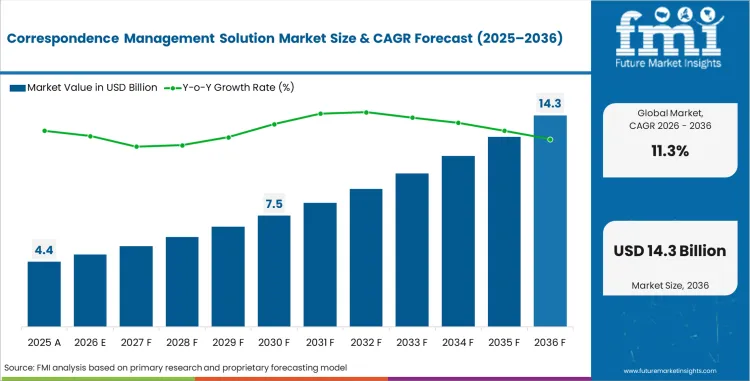
The correspondence management solution market was valued at USD 4.40 billion in 2025. Based on Future Market Insights' analysis, demand is estimated to reach USD 4.90 billion in 2026 and USD 14.29 billion by 2036. FMI projects a CAGR of 11.3% during the forecast period. The incremental opportunity from 2026 to 2036 stands at USD 9.39 billion.
The market covers enterprise software platforms that automate the capture, classification, routing, archival, and compliance tracking of inbound and outbound organisational correspondence across government, healthcare, financial services, education, legal, manufacturing, and retail verticals. As per FMI, digital transformation mandates across public and private sector organisations are converting paper-dependent correspondence workflows into auditable electronic document management systems.
Summary of Correspondence Management Solution Market
- By 2036, the market is projected to be worth USD 14.29 billion.
- A 11.3% compound annual growth rate is anticipated between 2026 and 2036.
- Market size in 2025 was estimated at USD 4.40 billion.
- An absolute dollar opportunity of USD 9.39 billion is anticipated between 2026 and 2036.
- The market is an enterprise software category driven by regulatory compliance requirements, digital transformation mandates, and the operational need to convert paper-dependent correspondence workflows into auditable electronic document management systems.
- Among key countries, India leads at 14% CAGR, followed by China at 13.2%, the USA at 10.5%, Canada at 10%, the UK at 9.6%, Germany at 9.2%, and Japan at 8.8%.
The core demand trigger is regulatory compliance. Government agencies, financial institutions, and healthcare providers face audit requirements that mandate traceable correspondence records with defined retention periods, access controls, and chain-of-custody documentation. Manual correspondence management exposes organisations to compliance violations, data breaches, and operational inefficiency. FMI analysts observe that cloud deployment models are gaining share as mid-sized organisations adopt software-as-a-service platforms that eliminate on-premises infrastructure requirements while meeting data residency regulations through regional cloud hosting. AI-powered document classification and intelligent routing capabilities are differentiating next-generation platforms from legacy document management systems.
India leads at 14% CAGR, driven by the Digital India programme mandating electronic document management across central and state government departments. China follows at 13.2%, supported by public sector digitalisation targets and financial services regulatory compliance requirements. The United States registers 10.5% growth, anchored by federal records management mandates and healthcare HIPAA compliance requirements for patient correspondence. Canada tracks at 10%, the United Kingdom at 9.6%, Germany at 9.2%, and Japan at 8.8%, where mature enterprise software markets sustain adoption through replacement cycles and compliance standard updates.
Correspondence Management Solution Market Key Takeaways
| Metric | Details |
|---|---|
| Industry Size (2026) | USD 4.90 billion |
| Industry Value (2036) | USD 14.29 billion |
| CAGR (2026-2036) | 11.3% |
Source: Future Market Insights, 2026
Correspondence Management Solution Market Definition
Correspondence management solutions are enterprise software platforms that automate the lifecycle management of organisational correspondence from capture through classification, routing, processing, archival, and disposal. These systems handle inbound and outbound communications across physical mail, email, and digital document formats. Core capabilities include document capture and digitisation, intelligent classification, automated routing, compliance tracking, retention management, and audit trail generation across government, healthcare, financial services, and other regulated verticals.
Correspondence Management Solution Market Inclusions
Market scope covers global and regional market sizes for correspondence management solutions from 2026 to 2036. Segmentation spans deployment (cloud, on-premises), organisation size (large enterprises, mid-sized businesses, small and medium-sized businesses), vertical (government, healthcare, financial services, education, legal, manufacturing, retail), and functionality (compliance management, document capture, classification, routing, archival, collaboration). The analysis includes AI capability assessments and regulatory compliance mapping.
Correspondence Management Solution Market Exclusions
The scope excludes general-purpose email clients and basic email archiving tools without document lifecycle management capabilities. Standalone customer relationship management systems and enterprise resource planning suites are omitted. Physical mailroom sorting equipment without integrated software platforms falls outside analytical parameters.
Correspondence Management Solution Market Research Methodology
- Primary Research: Analysts engaged with procurement specialists, facility operators, and technology integration leads to map decision gates triggering system upgrades and new deployments.
- Desk Research: Data collection phases aggregated regulatory filings, government procurement records, industry association publications, and company financial disclosures.
- Market-Sizing and Forecasting: Baseline values derive from a bottom-up aggregation of product shipments and installation records, applying region-specific adoption curves to project future demand.
- Data Validation and Update Cycle: Projections are tested against publicly reported capital expenditure guidance from leading companies and cross-referenced with government statistical agency data.
Why is the Correspondence Management Solution Market Growing?
Market Overview:
The correspondence management solution market is experiencing consistent growth, driven by the increasing need for organizations to streamline communication workflows, manage regulatory compliance, and ensure secure documentation handling. Rising adoption of digital transformation strategies across industries has elevated the demand for platforms capable of integrating email, records, case files, and official communications into centralized systems.
The market is also benefiting from advancements in cloud computing and artificial intelligence, which enable automated categorization, archiving, and retrieval of correspondence, thereby reducing manual workloads and improving efficiency. Growing emphasis on data privacy and compliance with global regulations is further pushing enterprises and government entities to adopt robust correspondence solutions.
Additionally, the growing complexity of customer engagement channels, including multi-platform communications, is fueling the adoption of integrated solutions capable of delivering transparency and traceability With organizations increasingly focused on operational efficiency and digital resilience, the market is positioned to expand steadily, supported by technology innovation and rising adoption in large-scale enterprises, public institutions, and regulated industries.
Segmental Analysis
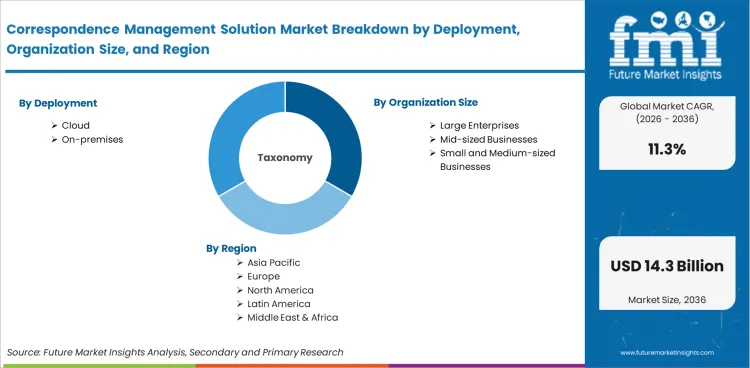
The correspondence management solution market is segmented by deployment type, organization size, vertical, functionality, and geographic regions. By deployment type, correspondence management solution market is divided into Cloud and On-premises. In terms of organization size, correspondence management solution market is classified into Large Enterprises, Mid-sized Businesses, and Small and Medium-sized Businesses (SMBs). Based on vertical, correspondence management solution market is segmented into Government, Healthcare, Financial Services, Education, Legal, Manufacturing, and Retail.
By functionality, correspondence management solution market is segmented into Compliance Management, Document Capture, Document Classification, Document Routing, Document Archival, and Document Collaboration. Regionally, the correspondence management solution industry is classified into North America, Latin America, Western Europe, Eastern Europe, Balkan & Baltic Countries, Russia & Belarus, Central Asia, East Asia, South Asia & Pacific, and the Middle East & Africa.
Insights into the Cloud Deployment Type Segment
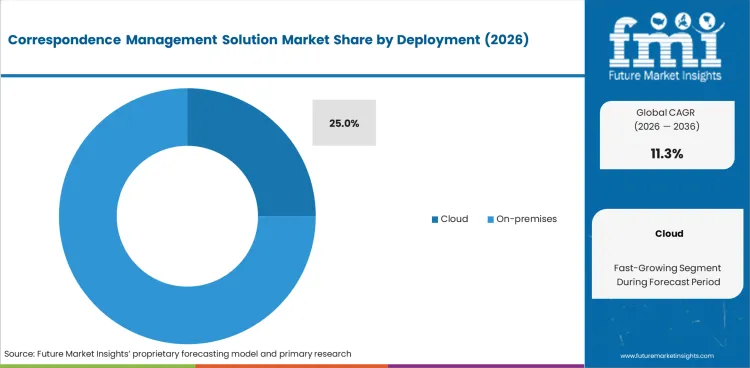
The cloud deployment type segment is projected to hold 25.0% of the correspondence management solution market revenue share in 2036, making it the leading deployment approach. Its leadership is being supported by cost efficiency, scalability, and reduced infrastructure requirements compared to on-premise systems. Cloud-based platforms enable organizations to streamline implementation timelines, reduce maintenance costs, and facilitate remote access, which has become increasingly critical in hybrid and distributed work environments.
The ability to integrate cloud-based correspondence solutions with enterprise applications and document repositories is also contributing to their rapid adoption. Enhanced features such as real-time collaboration, data backup, and disaster recovery capabilities are strengthening trust in cloud models.
Regulatory advancements in data security and availability of region-specific data centers are further addressing concerns of sensitive information handling, particularly in government and regulated sectors As enterprises continue prioritizing digital-first strategies, the flexibility and continuous improvement provided by cloud platforms are expected to maintain this segment’s dominant market position.
Insights into the Large Enterprises Organization Size Segment
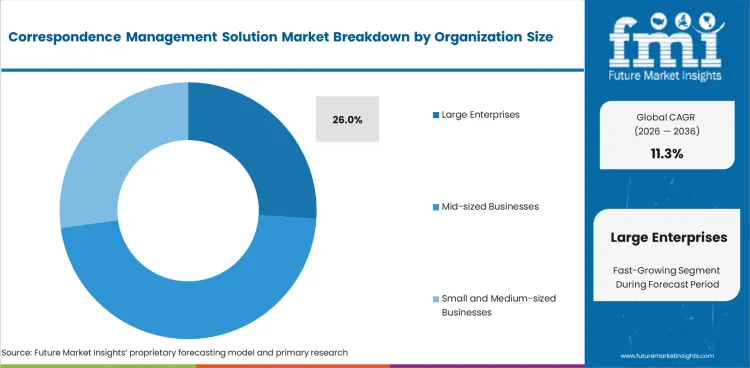
The large enterprises segment is expected to represent 26.0% of the correspondence management solution market revenue share in 2036, making it the largest organization size category. This dominance is being explained by the complex communication ecosystems managed by large corporations, which involve high volumes of correspondence across multiple departments, subsidiaries, and geographic locations.
The growing need to centralize workflows, ensure compliance with evolving regulations, and maintain transparency in communication processes is accelerating adoption. Large organizations are increasingly leveraging correspondence management solutions to integrate with enterprise resource planning, customer relationship management, and case management platforms, thereby improving efficiency and reducing operational risks.
The capability to scale solutions across thousands of users while maintaining role-based access controls and audit trails is another factor reinforcing preference among large enterprises With increasing regulatory scrutiny and the heightened importance of digital communication security, large enterprises are expected to continue investing significantly in advanced correspondence management platforms to safeguard information and optimize operations.
Insights into the Government Vertical Segment
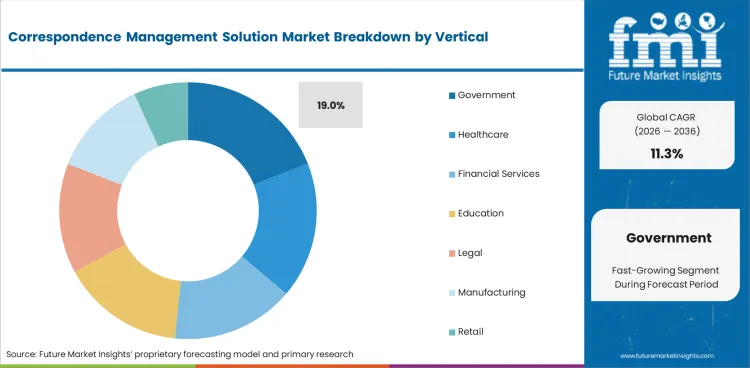
The government vertical is projected to account for 19.0% of the correspondence management solution market revenue share in 2036, positioning it as the leading vertical segment. This leadership is being driven by the critical role of government agencies in managing high volumes of citizen communication, policy documents, contracts, and regulatory records. Adoption of correspondence management solutions is being prioritized to enhance transparency, improve citizen services, and comply with stringent archival and documentation regulations.
Governments across various regions are accelerating digital transformation initiatives to modernize administrative processes, which is significantly contributing to demand. Secure document handling, efficient workflow management, and traceability are being recognized as essential for government operations, particularly in areas involving sensitive citizen data.
The shift toward paperless governance and e-government frameworks is further accelerating the deployment of correspondence management platforms As public sector institutions continue to emphasize accountability, efficiency, and secure communication management, the government vertical is expected to sustain its leadership position in the global market.
Market Overview
Correspondence Management Solution Market Overview
Over the years correspondence management has increasingly transformed itself to be one of the core business pillars for enterprises across industries. Across all industries from Banking & Financial Services to Public Sectors - real time and constant communication with client or other associated members in client value chain through correspondence management solution is witnessing ever increasing demand.
However, in spite of being crucial, many enterprises over the years are not able to leverage crucial solution like correspondence management to automate certain parts of their processes to save cost for document aggregation and delivery; other than that by not adopting relevant correspondence solutions enterprises have also failed to gain advantage of reusing existing content and avoid duplication.
Real adoption of correspondence management solutions not only save cost, but also provide enterprise with options like compliance with ever changing government regulations, enhanced content efficiency, & better employee productivity.
As going gets tough for enterprises and they are trying to save dollars from every opportunity, increasing uptake of correspondence management solutions can certainly improve the bottom line.
Overall, the market for correspondence management solution market size is close to US$1 billion in 2036 and is expected to register growth of 10.5% till 2036 and will reach US$ 1.8 billion by 2036.
For vendors it will represent an incremental correspondence management opportunity of US$820 million during the forecast period. In terms of regional adoption, North America is leading the pie of correspondence management by occupying more than 30% of the total market opportunity. At a country level, USA represents the highest potential market for correspondence management, followed by UK and Germany.
Within Europe, Scandinavian countries have also demonstrated their interest for the solution in the recent past. Among emerging geographies, Brazil is slightly green field geography, in process of dramatically reducing paper correspondence however, interestingly Middle East Africa is a growing market for correspondence management solution.
In terms of vertical adoption of correspondence management, Financial Services and Public Sector entities are leading the charge and constitute more than 60% of the total market share in 2036.
The key drivers for increasing uptake of correspondence management among public sector are increasing traction of electronic communication systems along with emphasis on digitization where old processes are getting streamlined by implementing new technologies. For financial services, increasing requirement of adhering to compliance is driving the correspondence management solution uptake.
Software License revenue primarily dominates the correspondence management market by holding more than 35% of the total correspondence management solution market opportunity; however for vendors this is an opportunity as the providers need to showcase this as an end-to-end solution; combination of software & services; FMI also noted that Service Providers with Case as a Service portfolio is witnessing preference in the market.
The correspondence management solution market is expected to flourish over the forecast period owing to the growing need to reduce budgeting and planning cycles. In addition to this, the market is predicted to witness rapid automation of internal as well as external communication as analytics, and big data solutions are increasing. Further, the correspondence management solution market size is expanding on account of the rapid adoption rate of correspondence management software by organisations to effectively implement real-time communication and thus manage correspondence. Companies, at a certain stage, requires to enhance efficiency, accuracy, auditability, and controls. A correspondence management system helps in automation and, thus, delivers speed and agility to deliver quality insights about customer and internal affairs.
Heightened Digitalisation to Boost the Demand for Correspondence Management Software
The correspondence management software enables businesses to boost revenues by keeping the shareholders and customers in the loop via regular correspondence, thereby resulting in a high adoption rate. Furthermore, the advent of new IT applications and related infrastructures, such as advanced analytics and big data, are accelerating the market growth of correspondence management systems. Coupled with this, companies are now leveraging big data, which helps make more precise decisions via correspondence management solutions’ predictive capabilities. The market is also being driven by rising internet access and the introduction of smart offices. Digitalisation across the globe is bolstering the implementation of correspondence management solutions among businesses to effectively communicate and manage documents.
Transition Towards Paper-Free Environment to Manoeuvre Market Growth
The usage of a correspondence management solution helps mitigate the utilisation of printed correspondence, which causes inefficiency and considerable time wastage. The correspondence management system is considered a valuable solution for institutions and organisations as it helps in minimising paper wastage, consequently reducing the printing cost. Thus, the move towards a paper-free environment is boosting the deployment of correspondence management solutions. The market, however, may impede due to expensive costs associated with the maintenance and implementation of the software and the dearth of technical experts in the market.
Analysis of Correspondence Management Solution Market By Key Countries
.webp "Top Country Growth Comparison Correspondence Management Solution Market Cagr (2026 2036)")
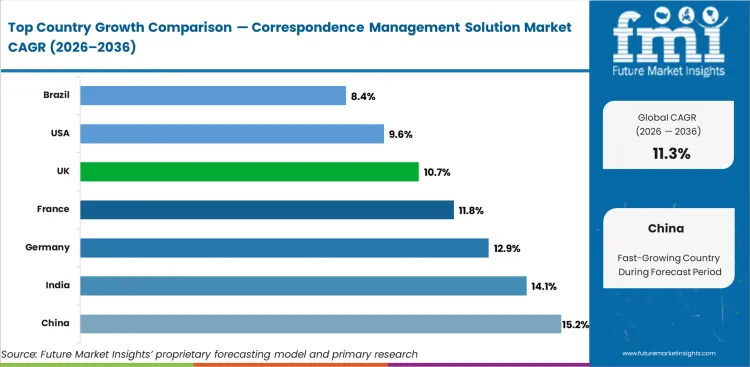
| Country | CAGR |
|---|---|
| China | 15.2% |
| India | 14.1% |
| Germany | 12.9% |
| France | 11.8% |
| UK | 10.7% |
| USA | 9.6% |
| Brazil | 8.4% |
Source: FMI analysis based on primary research and proprietary forecasting model
Country-wise Analysis
The Correspondence Management Solution Market is expected to register a CAGR of 11.3% during the forecast period, exhibiting varied country level momentum. China leads with the highest CAGR of 15.2%, followed by India at 14.1%. Developed markets such as Germany, France, and the UK continue to expand steadily, while the USA is likely to grow at consistent rates. Brazil posts the lowest CAGR at 8.4%, yet still underscores a broadly positive trajectory for the global Correspondence Management Solution Market. In 2024, Germany held a dominant revenue in the Western Europe market and is expected to grow with a CAGR of 12.9%. The USA Correspondence Management Solution Market is estimated to be valued at USD 1.5 billion in 2036 and is anticipated to reach a valuation of USD 3.8 billion by 2026. Sales are projected to rise at a CAGR of 9.6% over the forecast period between 2036 and 2026. While Japan and South Korea markets are estimated to be valued at USD 200.0 million and USD 121.4 million respectively in 2036.
Key Players in the Correspondence Management Solution Market
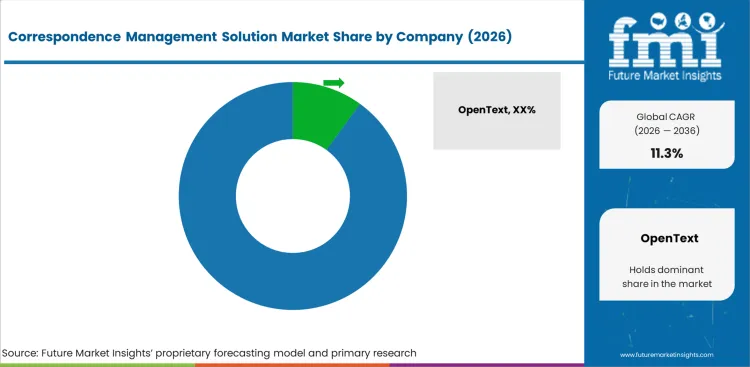
- OpenText
- Iron Mountain
- Hyland
- DocuWare
- Ephesoft
- Xerox
- Square 9
- MFiles
- Laserfiche
- ABBYY
- Nintex
- Serengeti
- Verint
- Kodak Alaris
- Kofax
Scope of the Report
| Metric | Value |
|---|---|
| Quantitative Units | USD 4.90 billion to USD 14.29 billion, at a CAGR of 11.3% |
| Market Definition | Correspondence management solutions are enterprise software platforms that automate the lifecycle management of organisational correspondence from capture through classification, routing, processing, archival, and disposal. These systems handle inbound and outbound communications across physical mail, email, and digital document formats. |
| Deployment Segmentation | Cloud, On-Premises |
| Organization Size Segmentation | Large Enterprises, Mid-Sized Businesses, Small and Medium-Sized Businesses |
| Vertical Segmentation | Government, Healthcare, Financial Services, Education, Legal, Manufacturing, Retail |
| Functionality Segmentation | Compliance Management, Document Capture, Document Classification, Document Routing, Document Archival, Document Collaboration |
| Regions Covered | North America, Latin America, Europe, East Asia, South Asia, Oceania, Middle East & Africa |
| Countries Covered | India, China, USA, Canada, UK, Germany, Japan, and 40 plus countries |
| Key Companies Profiled | OpenText, Iron Mountain, Hyland, DocuWare, Ephesoft, Xerox, Square 9, MFiles, Laserfiche, ABBYY, Nintex, Serengeti, Verint, Kodak Alaris, Kofax |
| Forecast Period | 2026 to 2036 |
| Approach | Forecasting models apply a bottom-up methodology starting with installed base metrics and projecting adoption rates using region-specific demand curves. |
Correspondence Management Solution Market by Segments
By Deployment Type:
- Cloud
- On-premises
By Organization Size:
- Large Enterprises
- Mid-sized Businesses
- Small and Medium-sized Businesses (SMBs)
By Vertical:
- Government
- Healthcare
- Financial Services
- Education
- Legal
- Manufacturing
- Retail
By Functionality:
- Compliance Management
- Document Capture
- Document Classification
- Document Routing
- Document Archival
- Document Collaboration
By Region:
- North America
- USA
- Canada
- Mexico
- Latin America
- Brazil
- Chile
- Rest of Latin America
- Western Europe
- Germany
- UK
- Italy
- Spain
- France
- Nordic
- BENELUX
- Rest of Western Europe
- Eastern Europe
- Russia
- Poland
- Hungary
- Balkan & Baltic
- Rest of Eastern Europe
- East Asia
- China
- Japan
- South Korea
- South Asia and Pacific
- India
- ASEAN
- Australia & New Zealand
- Rest of South Asia and Pacific
- Middle East & Africa
- Kingdom of Saudi Arabia
- Other GCC Countries
- Turkiye
- South Africa
- Other African Union
- Rest of Middle East & Africa
Bibliography
- 1. National Archives and Records Administration. (2025). Federal Records Management Annual Report. NARA.
- 2. International Organization for Standardization. (2024). ISO 15489-1: Information and Documentation, Records Management. ISO.
- 3. Ministry of Electronics and Information Technology, Government of India. (2025). Digital India Programme: Annual Progress Report 2024-25. MeitY.
- 4. European Commission. (2024). eGovernment Benchmark Report 2024. European Commission.
- 5. International Council on Archives. (2025). Digital Preservation and Records Management: Guidelines. ICA.
This bibliography is provided for reader reference. The full Future Market Insights report contains the complete reference list with primary research documentation.
Frequently Asked Questions
How large is the demand for Correspondence Management Solution in the global market in 2026?
Demand for Correspondence Management Solution in the global market is estimated to be valued at USD 4.90 billion in 2026.
What will be the market size of Correspondence Management Solution in the global market by 2036?
Market size for Correspondence Management Solution is projected to reach USD 14.29 billion by 2036.
What is the expected demand growth for Correspondence Management Solution in the global market between 2026 and 2036?
Demand for Correspondence Management Solution is expected to grow at a CAGR of 11.3% between 2026 and 2036.
Which Deployment category leads demand in 2026?
Cloud is estimated to lead demand by Deployment in 2026.
Which Organization Size category leads in 2026?
Large Enterprises is estimated to lead by Organization Size in 2026.
What is driving demand in India?
India is projected to grow at a CAGR of 14% during 2026 to 2036, supported by national policy frameworks and expanding infrastructure investment.
What is Correspondence Management Solution and what is it mainly used for?
Correspondence management solutions are enterprise software platforms that automate the lifecycle management of organisational correspondence from capture through classification, routing, processing, archival, and disposal. These systems handle inbound and outbound communications across physical mail, email, and digital document formats.
What is included in the scope of this Correspondence Management Solution report?
Market scope covers global and regional market sizes for correspondence management solutions from 2026 to 2036. Segmentation spans deployment (cloud, on-premises), organisation size (large enterprises, mid-sized businesses, small and medium-sized businesses), vertical (government, healthcare, financial services, education, legal, manufacturing, retail), and functionality (compliance management, document capture, classification, routing, archival, collaboration).
Preview the report firsthand - request a free sample
Get SampleGet the brochure for pricing and purchase details.
Get PDFTable of Content
- Executive Summary
- Global Market Outlook
- Demand-side Trends
- Supply-side Trends
- Technology Roadmap Analysis
- Analysis and Recommendations
- Market Overview
- Market Coverage / Taxonomy
- Market Definition / Scope / Limitations
- Research Methodology
- Chapter Orientation
- Analytical Lens and Working Hypotheses
- Market Structure, Signals, and Trend Drivers
- Benchmarking and Cross-market Comparability
- Market Sizing, Forecasting, and Opportunity Mapping
- Research Design and Evidence Framework
- Desk Research Programme (Secondary Evidence)
- Company Annual and Sustainability Reports
- Peer-reviewed Journals and Academic Literature
- Corporate Websites, Product Literature, and Technical Notes
- Earnings Decks and Investor Briefings
- Statutory Filings and Regulatory Disclosures
- Technical White Papers and Standards Notes
- Trade Journals, Industry Magazines, and Analyst Briefs
- Conference Proceedings, Webinars, and Seminar Materials
- Government Statistics Portals and Public Data Releases
- Press Releases and Reputable Media Coverage
- Specialist Newsletters and Curated Briefings
- Sector Databases and Reference Repositories
- FMI Internal Proprietary Databases and Historical Market Datasets
- Subscription Datasets and Paid Sources
- Social Channels, Communities, and Digital Listening Inputs
- Additional Desk Sources
- Expert Input and Fieldwork (Primary Evidence)
- Primary Modes
- Qualitative Interviews and Expert Elicitation
- Quantitative Surveys and Structured Data Capture
- Blended Approach
- Why Primary Evidence is Used
- Field Techniques
- Interviews
- Surveys
- Focus Groups
- Observational and In-context Research
- Social and Community Interactions
- Stakeholder Universe Engaged
- C-suite Leaders
- Board Members
- Presidents and Vice Presidents
- R&D and Innovation Heads
- Technical Specialists
- Domain Subject-matter Experts
- Scientists
- Physicians and Other Healthcare Professionals
- Governance, Ethics, and Data Stewardship
- Research Ethics
- Data Integrity and Handling
- Primary Modes
- Tooling, Models, and Reference Databases
- Desk Research Programme (Secondary Evidence)
- Data Engineering and Model Build
- Data Acquisition and Ingestion
- Cleaning, Normalisation, and Verification
- Synthesis, Triangulation, and Analysis
- Quality Assurance and Audit Trail
- Market Background
- Market Dynamics
- Drivers
- Restraints
- Opportunity
- Trends
- Scenario Forecast
- Demand in Optimistic Scenario
- Demand in Likely Scenario
- Demand in Conservative Scenario
- Opportunity Map Analysis
- Product Life Cycle Analysis
- Supply Chain Analysis
- Investment Feasibility Matrix
- Value Chain Analysis
- PESTLE and Porter’s Analysis
- Regulatory Landscape
- Regional Parent Market Outlook
- Production and Consumption Statistics
- Import and Export Statistics
- Market Dynamics
- Global Market Analysis 2021 to 2025 and Forecast, 2026 to 2036
- Historical Market Size Value (USD Million) Analysis, 2021 to 2025
- Current and Future Market Size Value (USD Million) Projections, 2026 to 2036
- Y-o-Y Growth Trend Analysis
- Absolute $ Opportunity Analysis
- Global Market Pricing Analysis 2021 to 2025 and Forecast 2026 to 2036
- Global Market Analysis 2021 to 2025 and Forecast 2026 to 2036, By Deployment
- Introduction / Key Findings
- Historical Market Size Value (USD Million) Analysis By Deployment , 2021 to 2025
- Current and Future Market Size Value (USD Million) Analysis and Forecast By Deployment , 2026 to 2036
- Cloud
- On-premises
- Cloud
- Y-o-Y Growth Trend Analysis By Deployment , 2021 to 2025
- Absolute $ Opportunity Analysis By Deployment , 2026 to 2036
- Global Market Analysis 2021 to 2025 and Forecast 2026 to 2036, By Organization Size
- Introduction / Key Findings
- Historical Market Size Value (USD Million) Analysis By Organization Size, 2021 to 2025
- Current and Future Market Size Value (USD Million) Analysis and Forecast By Organization Size, 2026 to 2036
- Large Enterprises
- Mid-sized Businesses
- Small and Medium-sized Businesses
- Large Enterprises
- Y-o-Y Growth Trend Analysis By Organization Size, 2021 to 2025
- Absolute $ Opportunity Analysis By Organization Size, 2026 to 2036
- Global Market Analysis 2021 to 2025 and Forecast 2026 to 2036, By Vertical
- Introduction / Key Findings
- Historical Market Size Value (USD Million) Analysis By Vertical, 2021 to 2025
- Current and Future Market Size Value (USD Million) Analysis and Forecast By Vertical, 2026 to 2036
- Government
- Healthcare
- Financial Services
- Education
- Legal
- Manufacturing
- Retail
- Government
- Y-o-Y Growth Trend Analysis By Vertical, 2021 to 2025
- Absolute $ Opportunity Analysis By Vertical, 2026 to 2036
- Global Market Analysis 2021 to 2025 and Forecast 2026 to 2036, By Functionality
- Introduction / Key Findings
- Historical Market Size Value (USD Million) Analysis By Functionality, 2021 to 2025
- Current and Future Market Size Value (USD Million) Analysis and Forecast By Functionality, 2026 to 2036
- Compliance Management
- Document Capture
- Document Classification
- Document Routing
- Document Archival
- Document Collaboration
- Compliance Management
- Y-o-Y Growth Trend Analysis By Functionality, 2021 to 2025
- Absolute $ Opportunity Analysis By Functionality, 2026 to 2036
- Global Market Analysis 2021 to 2025 and Forecast 2026 to 2036, By Region
- Introduction
- Historical Market Size Value (USD Million) Analysis By Region, 2021 to 2025
- Current Market Size Value (USD Million) Analysis and Forecast By Region, 2026 to 2036
- North America
- Latin America
- Western Europe
- Eastern Europe
- East Asia
- South Asia and Pacific
- Middle East & Africa
- Market Attractiveness Analysis By Region
- North America Market Analysis 2021 to 2025 and Forecast 2026 to 2036, By Country
- Historical Market Size Value (USD Million) Trend Analysis By Market Taxonomy, 2021 to 2025
- Market Size Value (USD Million) Forecast By Market Taxonomy, 2026 to 2036
- By Country
- USA
- Canada
- Mexico
- By Deployment
- By Organization Size
- By Vertical
- By Functionality
- By Country
- Market Attractiveness Analysis
- By Country
- By Deployment
- By Organization Size
- By Vertical
- By Functionality
- Key Takeaways
- Latin America Market Analysis 2021 to 2025 and Forecast 2026 to 2036, By Country
- Historical Market Size Value (USD Million) Trend Analysis By Market Taxonomy, 2021 to 2025
- Market Size Value (USD Million) Forecast By Market Taxonomy, 2026 to 2036
- By Country
- Brazil
- Chile
- Rest of Latin America
- By Deployment
- By Organization Size
- By Vertical
- By Functionality
- By Country
- Market Attractiveness Analysis
- By Country
- By Deployment
- By Organization Size
- By Vertical
- By Functionality
- Key Takeaways
- Western Europe Market Analysis 2021 to 2025 and Forecast 2026 to 2036, By Country
- Historical Market Size Value (USD Million) Trend Analysis By Market Taxonomy, 2021 to 2025
- Market Size Value (USD Million) Forecast By Market Taxonomy, 2026 to 2036
- By Country
- Germany
- UK
- Italy
- Spain
- France
- Nordic
- BENELUX
- Rest of Western Europe
- By Deployment
- By Organization Size
- By Vertical
- By Functionality
- By Country
- Market Attractiveness Analysis
- By Country
- By Deployment
- By Organization Size
- By Vertical
- By Functionality
- Key Takeaways
- Eastern Europe Market Analysis 2021 to 2025 and Forecast 2026 to 2036, By Country
- Historical Market Size Value (USD Million) Trend Analysis By Market Taxonomy, 2021 to 2025
- Market Size Value (USD Million) Forecast By Market Taxonomy, 2026 to 2036
- By Country
- Russia
- Poland
- Hungary
- Balkan & Baltic
- Rest of Eastern Europe
- By Deployment
- By Organization Size
- By Vertical
- By Functionality
- By Country
- Market Attractiveness Analysis
- By Country
- By Deployment
- By Organization Size
- By Vertical
- By Functionality
- Key Takeaways
- East Asia Market Analysis 2021 to 2025 and Forecast 2026 to 2036, By Country
- Historical Market Size Value (USD Million) Trend Analysis By Market Taxonomy, 2021 to 2025
- Market Size Value (USD Million) Forecast By Market Taxonomy, 2026 to 2036
- By Country
- China
- Japan
- South Korea
- By Deployment
- By Organization Size
- By Vertical
- By Functionality
- By Country
- Market Attractiveness Analysis
- By Country
- By Deployment
- By Organization Size
- By Vertical
- By Functionality
- Key Takeaways
- South Asia and Pacific Market Analysis 2021 to 2025 and Forecast 2026 to 2036, By Country
- Historical Market Size Value (USD Million) Trend Analysis By Market Taxonomy, 2021 to 2025
- Market Size Value (USD Million) Forecast By Market Taxonomy, 2026 to 2036
- By Country
- India
- ASEAN
- Australia & New Zealand
- Rest of South Asia and Pacific
- By Deployment
- By Organization Size
- By Vertical
- By Functionality
- By Country
- Market Attractiveness Analysis
- By Country
- By Deployment
- By Organization Size
- By Vertical
- By Functionality
- Key Takeaways
- Middle East & Africa Market Analysis 2021 to 2025 and Forecast 2026 to 2036, By Country
- Historical Market Size Value (USD Million) Trend Analysis By Market Taxonomy, 2021 to 2025
- Market Size Value (USD Million) Forecast By Market Taxonomy, 2026 to 2036
- By Country
- Kingdom of Saudi Arabia
- Other GCC Countries
- Turkiye
- South Africa
- Other African Union
- Rest of Middle East & Africa
- By Deployment
- By Organization Size
- By Vertical
- By Functionality
- By Country
- Market Attractiveness Analysis
- By Country
- By Deployment
- By Organization Size
- By Vertical
- By Functionality
- Key Takeaways
- Key Countries Market Analysis
- USA
- Pricing Analysis
- Market Share Analysis, 2025
- By Deployment
- By Organization Size
- By Vertical
- By Functionality
- Canada
- Pricing Analysis
- Market Share Analysis, 2025
- By Deployment
- By Organization Size
- By Vertical
- By Functionality
- Mexico
- Pricing Analysis
- Market Share Analysis, 2025
- By Deployment
- By Organization Size
- By Vertical
- By Functionality
- Brazil
- Pricing Analysis
- Market Share Analysis, 2025
- By Deployment
- By Organization Size
- By Vertical
- By Functionality
- Chile
- Pricing Analysis
- Market Share Analysis, 2025
- By Deployment
- By Organization Size
- By Vertical
- By Functionality
- Germany
- Pricing Analysis
- Market Share Analysis, 2025
- By Deployment
- By Organization Size
- By Vertical
- By Functionality
- UK
- Pricing Analysis
- Market Share Analysis, 2025
- By Deployment
- By Organization Size
- By Vertical
- By Functionality
- Italy
- Pricing Analysis
- Market Share Analysis, 2025
- By Deployment
- By Organization Size
- By Vertical
- By Functionality
- Spain
- Pricing Analysis
- Market Share Analysis, 2025
- By Deployment
- By Organization Size
- By Vertical
- By Functionality
- France
- Pricing Analysis
- Market Share Analysis, 2025
- By Deployment
- By Organization Size
- By Vertical
- By Functionality
- India
- Pricing Analysis
- Market Share Analysis, 2025
- By Deployment
- By Organization Size
- By Vertical
- By Functionality
- ASEAN
- Pricing Analysis
- Market Share Analysis, 2025
- By Deployment
- By Organization Size
- By Vertical
- By Functionality
- Australia & New Zealand
- Pricing Analysis
- Market Share Analysis, 2025
- By Deployment
- By Organization Size
- By Vertical
- By Functionality
- China
- Pricing Analysis
- Market Share Analysis, 2025
- By Deployment
- By Organization Size
- By Vertical
- By Functionality
- Japan
- Pricing Analysis
- Market Share Analysis, 2025
- By Deployment
- By Organization Size
- By Vertical
- By Functionality
- South Korea
- Pricing Analysis
- Market Share Analysis, 2025
- By Deployment
- By Organization Size
- By Vertical
- By Functionality
- Russia
- Pricing Analysis
- Market Share Analysis, 2025
- By Deployment
- By Organization Size
- By Vertical
- By Functionality
- Poland
- Pricing Analysis
- Market Share Analysis, 2025
- By Deployment
- By Organization Size
- By Vertical
- By Functionality
- Hungary
- Pricing Analysis
- Market Share Analysis, 2025
- By Deployment
- By Organization Size
- By Vertical
- By Functionality
- Kingdom of Saudi Arabia
- Pricing Analysis
- Market Share Analysis, 2025
- By Deployment
- By Organization Size
- By Vertical
- By Functionality
- Turkiye
- Pricing Analysis
- Market Share Analysis, 2025
- By Deployment
- By Organization Size
- By Vertical
- By Functionality
- South Africa
- Pricing Analysis
- Market Share Analysis, 2025
- By Deployment
- By Organization Size
- By Vertical
- By Functionality
- USA
- Market Structure Analysis
- Competition Dashboard
- Competition Benchmarking
- Market Share Analysis of Top Players
- By Regional
- By Deployment
- By Organization Size
- By Vertical
- By Functionality
- Competition Analysis
- Competition Deep Dive
- OpenText
- Overview
- Product Portfolio
- Profitability by Market Segments (Product/Age /Sales Channel/Region)
- Sales Footprint
- Strategy Overview
- Marketing Strategy
- Product Strategy
- Channel Strategy
- Iron Mountain
- Hyland
- DocuWare
- Ephesoft
- Xerox
- Square 9
- MFiles
- Laserfiche
- ABBYY
- Nintex
- Serengeti
- Verint
- Kodak Alaris
- Kofax
- OpenText
- Competition Deep Dive
- Assumptions & Acronyms Used


