

- Market Size (2026)
- USD 420.7 Mn
- Forecast (2036)
- USD 782.3 Mn
- CAGR (2026 to 2036)
- 6.4%
How big is Pond Oxygen Tablets Market in 2026?
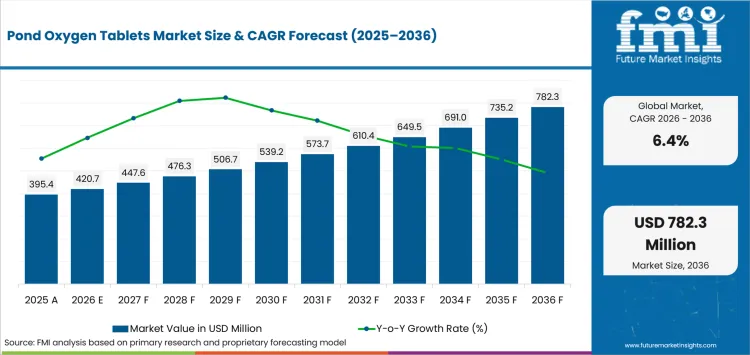
USD 420.7 Million in 2026 and USD 782.3 Million by 2036 at a 6.4% CAGR.
Demand for pond oxygen tablets is projected to expand at 6.4% CAGR between 2026 and 2036, increasing valuation from USD 420.7 Million in 2026 to USD 782.3 Million by 2036. Commercial demand is tied to the cost of a dissolved-oxygen shortfall and to situations where a stored, portable intervention can be deployed before a longer-term aeration response is available.
Aquaculture gives the category a defined operating context. FAO reported in June 2024 that global aquaculture production reached 130.9 million tonnes in 2022, including 94.4 million tonnes of aquatic animals. A 2025 Aquacultural Engineering study on biopolymer-encapsulated calcium peroxide tablets also showed the technical case for controlled oxygen release in fish tanks, reinforcing the need to match formulation behavior with monitoring and dosing practice.
Key Takeaways
- Portable oxygen support is most relevant when a pond, hatchery tank or transport tank faces a time-bound dissolved-oxygen gap that cannot wait for equipment service or water exchange.
- Calcium peroxide tablets are projected at 31.0% of Tablet Type demand in 2026 because the chemistry provides a direct route to oxygen release when formulation and dose are controlled.
- The 1-3 day release segment is estimated at 34.0% in 2026, matching short intervention windows that can be followed by a dissolved-oxygen recheck before redosing.
- Aquaculture ponds are forecast at 38.0% of Pond Type demand in 2026, while commercial farms are projected at 37.0% by Buyer Type because oxygen shortfalls carry production and fish-welfare costs.
- Aquaculture input distributors are expected at 39.0% of Sales Channel demand in 2026 as local stock and technical guidance matter when purchases are time-sensitive.
- Pentair Aquatic Eco-Systems, Inc., Aquafix, Inc., Airmax, Inc., OASE, Tetra, API (Mars), Ecological Laboratories, Inc., Aquascape, Inc., Kasco Marine, Inc. and The Pond Guy Services Inc. serve oxygen-management or adjacent pond-care workflows.
Analyst Perspective
"A pond oxygen tablet earns a place in farm inventory when dose, release window and post-dose monitoring are clear enough to use under pressure. Suppliers should prove where portable chemistry provides a practical bridge before installed aeration or water exchange can restore stable dissolved oxygen."
- Nikhil Kaitwade, Principal Consultant, Future Market Insights
How is the Pond Oxygen Tablets Market segmented?
The pond oxygen tablets market is segmented by Tablet Type, Release Duration, Pond Type, Buyer Type, Sales Channel and Region.
Pond oxygen tablets are segmented by formulation, release window, water setting, buyer and route to market. Tablet Type separates calcium peroxide and sodium percarbonate formulations from slow-release, bacterial-support and emergency formats. Release Duration distinguishes rapid intervention from multi-day or weekly use. Pond Type separates aquaculture and ornamental ponds from retention ponds, hatchery tanks and transport tanks. Buyer Type identifies who approves the purchase, while Sales Channel reflects how quickly a treatment can reach the user. Installed systems represented in the Aquaculture Equipment Market remain the main engineering alternative for recurring oxygen management, so tablets compete on portability, response time and dosing simplicity.
Why do calcium peroxide tablets lead the Tablet Type category?
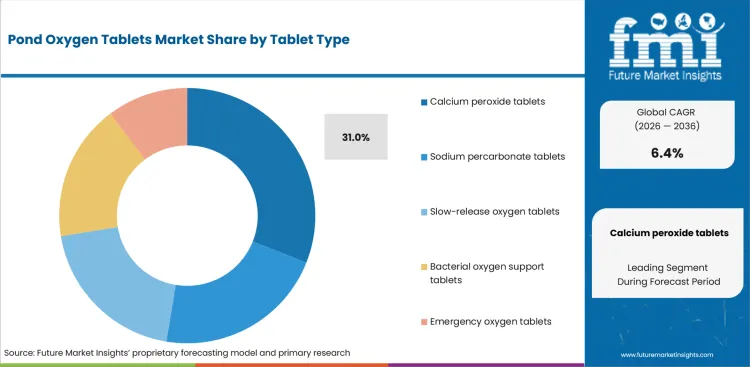
Calcium peroxide provides a direct oxygen-release mechanism that buyers can understand as emergency or supplemental support. The commercial question is whether the reaction can be moderated well enough to avoid an unnecessarily sharp dissolved-oxygen change. Coatings and encapsulation can extend release and make the treatment easier to fit into a monitoring routine. Sodium percarbonate remains relevant where oxidation and pond cleaning are part of the use case, while bacterial-support products act through a different biological route.
- Calcium peroxide tablets are projected to account for 31.0% of Tablet Type demand in 2026 because the formulation maps directly to oxygen replenishment and can be engineered for controlled release.
- A 2025 Aquacultural Engineering study on encapsulated calcium peroxide tablets found that coating extended oxygen release in fish-tank testing, supporting controlled-release design for temporary oxygen support.
Why does 1-3 day release lead the Release Duration category?
A short controlled window fits the way operators handle a heat event, temporary aeration interruption or transport-related oxygen risk. The treatment can bridge the immediate problem without committing the user to a long residual period that complicates redosing. Fast-release products remain relevant for acute rescue, while weekly and long-duration formats fit maintenance routines. The 1-3 day position gives the operator time to correct the underlying issue and then reassess dissolved oxygen before another dose.
- The 1-3 day release segment is projected at 34.0% in 2026 because it balances prompt response with a practical monitoring and redosing interval.
- FAO pond-management guidance notes that oxygen availability can deteriorate under intensive culture and during warm conditions, which supports short-duration interventions that are checked against actual dissolved-oxygen readings.
Why do aquaculture ponds lead the Pond Type category?
Aquaculture ponds concentrate the economic cost of oxygen failure because oxygen availability affects feeding, survival and production continuity. Higher stocking density and organic loading can push oxygen demand beyond natural replenishment, creating a practical role for tablets as a stored supplement or emergency reserve. Ornamental ponds share the same biological mechanism but usually carry a different loss profile. This operating context also connects tablet demand with the broader Aquaculture Market, where water-quality control becomes more important as managed production intensifies.
- Aquaculture ponds are forecast to account for 38.0% of Pond Type demand in 2026 because oxygen availability is a direct production constraint in managed pond farming.
- FAO reported that aquaculture produced 94.4 million tonnes of aquatic animals in 2022, showing the scale of managed production settings where oxygen control is an operating requirement.
Why do commercial farms lead the Buyer Type category?
Commercial farms buy against an identifiable loss from an oxygen event. A shortfall can interrupt feeding and add emergency labor; a severe event can cause mortality. That gives farms a clearer reason to hold a contingency treatment than a casual pond owner. Hatcheries face a similar need in dense tanks. Aquarium and pond retailers influence product choice but do not bear the same biological risk, while landscape contractors and municipal pond managers tend to buy around maintenance outcomes.
- Commercial farms are projected to account for 37.0% of Buyer Type demand in 2026 because oxygen readiness can be treated as an operating expense tied to production continuity.
- USDA reported that the 2023 Census of Aquaculture counted 3,453 USA aquaculture farms, illustrating the dispersed commercial-farm buyer base in one established market.
Why do aquaculture input distributors lead the Sales Channel category?
Aquaculture input distributors sit close to the farm replenishment cycle and can hold emergency stock near production clusters. The same relationship can cover water-quality tests, feed and equipment service without requiring a new supplier for each purchase. Connections to the Aquafeed Market are commercially relevant because feed intensity and oxygen demand rise together in many managed systems. Retail pond stores remain important for ornamental users, direct supply suits larger accounts, and e-commerce works well for standardized packs when immediate local stock is not required.
- Aquaculture input distributors are projected at 39.0% of Sales Channel demand in 2026 because local inventory and dosing guidance matter when oxygen-management purchases are time-sensitive.
- Distributor value comes from same-day availability and product-use support, especially where farms need to connect a treatment decision with dissolved-oxygen testing and an existing aeration plan.
What are the drivers, restraints and opportunities in the Pond Oxygen Tablets Market?
Intensive aquaculture raises the cost of dissolved-oxygen shortfalls, while dose and release validation restrain routine use and controlled-release formats create opportunities in emergency, transport and hatchery applications.
- Driver: Higher biomass and warm-water conditions increase the operational cost of dissolved-oxygen shortfalls.
- Restraint: Buyers must validate dose and release behavior against water volume and baseline dissolved oxygen before repeat use.
- Opportunity: Controlled-release formats can serve emergency, transport, hatchery and remote-pond applications where installed aeration is unavailable or temporarily insufficient.
The primary driver is the narrower oxygen margin created by intensive managed water. FAO guidance notes that natural oxygen supply becomes less sufficient as pond culture intensifies, while warm water carries less dissolved oxygen. Commercial farms respond through monitoring and backup interventions. Tablets fit when the event is localized or temporary. Their role sits beside aeration, filtration and other systems in the Water Treatment Equipment rather than replacing engineered oxygen-management systems for routine operation.
The central restraint is validation. Research on calcium peroxide tablets shows why release control matters: formulation affects how quickly oxygen becomes available. Buyers therefore need instructions tied to water volume, baseline dissolved oxygen and a defined recheck point. Mechanical aeration already has an established role in many farms and ponds, so a tablet must show a clear advantage in portability or response time. Weak dose discipline can damage repeat purchase even when the underlying oxygen risk is genuine.
The opportunity is a measured product system rather than a broad oxygen claim. Suppliers can pair controlled-release tablets with dissolved-oxygen testing guidance and pack sizes linked to common water volumes. Commercial farms and hatcheries provide an early adoption route because the avoided-loss case is visible. Transport tanks add a separate use case where space and mobility matter, while remote ponds can benefit when power or service access is constrained.
Which country CAGRs are covered in the Pond Oxygen Tablets Market?
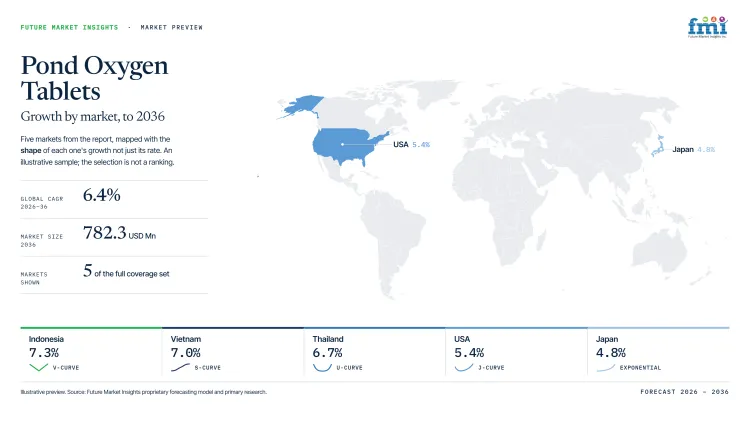
| Country | CAGR |
|---|---|
| Indonesia | 7.3% |
| USA | 5.4% |
| Japan | 4.8% |
| Vietnam | 7.0% |
| Thailand | 6.7% |
| Brazil | 6.0% |
| Norway | 5.1% |
How do country-level CAGRs compare in the Pond Oxygen Tablets Market?
The seven country CAGRs span 2.5 percentage points, from Indonesia at 7.3% to Japan at 4.8% during 2026 to 2036. Vietnam and Thailand remain close to Indonesia, while Brazil sits at 6.0%. The USA, Norway and Japan form a narrower band between 5.4% and 4.8%. The spacing indicates forecast growth pace only and should not be read as a ranking of current market size.
- Indonesia is set to grow at 7.3% CAGR as warm-water pond farming creates recurring need for dissolved-oxygen control and locally available emergency treatments.
- Vietnam is anticipated to expand at 7.0% CAGR, with shrimp and fish farming keeping pond-level water-quality management visible in commercial procurement.
- Thailand is likely to advance at 6.7% CAGR as established shrimp production and specialist input channels support defined oxygen-management routines.
- Brazil is expected to grow at 6.0% CAGR, with aquaculture expansion creating demand across geographically dispersed production clusters.
- The USA is set to expand at 5.4% CAGR, where tablets compete mainly as backup or portable complements to installed aeration and circulation equipment.
- Norway is anticipated to grow at 5.1% CAGR, with the credible use case centered on hatchery, transport and other enclosed-water settings that already use disciplined monitoring.
- Japan is likely to expand at 4.8% CAGR as buyers emphasize formulation consistency, clear labeling and compatibility with existing fish-care routines.
Comparable CAGRs can translate into different entry conditions. A mature market can support repeat purchasing when dissolved oxygen is already monitored, while a higher-growth market can still be difficult if farms are fragmented or technical guidance is inconsistent. Country opportunity therefore depends on farm structure, stocking intensity, local distribution and the operating protocol around each dose.
Country-wise Analysis
- Indonesia: Demand for Pond Oxygen Tablets in Indonesia is set to expand at 7.3% CAGR from 2026 to 2036. In May 2024, the Indonesian government inaugurated a saline tilapia cultivation model in Karawang and described plans to test the model before wider scaling. For tablet suppliers, the practical requirement is local stock and dosing guidance that works across farms with different pond infrastructure and operator experience.
- USA: Demand for Pond Oxygen Tablets in the USA is expected to rise at 5.4% CAGR from 2026 to 2036. USDA reported 3,453 aquaculture farms and USD 1.908 billion in sales in the 2023 Census of Aquaculture. Many commercial buyers already use mechanical oxygenation or circulation, so tablets need a specific backup, transport or small-tank role rather than a generic replacement claim.
- Japan: Demand for Pond Oxygen Tablets in Japan is anticipated to expand at 4.8% CAGR from 2026 to 2036. Japan’s Fisheries Agency lists Fisheries of Japan FY2024 as its current annual report for fisheries conditions. Suppliers will need consistent release specifications and clear use instructions because mature buyers are likely to compare a tablet directly with established water-management practices.
- Vietnam: Demand for Pond Oxygen Tablets in Vietnam is set to expand at 7.0% CAGR from 2026 to 2036. The Ministry of Agriculture and Environment continues to frame aquaculture development around larger-scale production with stronger environmental management. Suppliers can reduce purchase friction by using simple pond-volume dosing protocols and working through aquaculture distributors that already support intensive farms.
- Thailand: Demand for Pond Oxygen Tablets in Thailand is likely to grow at 6.7% CAGR from 2026 to 2036. SEAFDEC’s 2025 Thailand country profile identifies marine shrimp as a major aquaculture product, supporting a commercial environment where oxygen control is already part of farm management. A tablet must fit existing farm protocols and be available through specialist input channels.
- Brazil: Demand for Pond Oxygen Tablets in Brazil is anticipated to expand at 6.0% CAGR from 2026 to 2036. IBGE reports 2024 fish production of 724.9 thousand tonnes, up 10.3%, alongside higher cultured-shrimp output. Geographic dispersion makes distributor coverage and clear dose-per-volume instructions important for emergency inventory held away from technical service centers.
- Norway: Demand for Pond Oxygen Tablets in Norway is expected to expand at 5.1% CAGR from 2026 to 2036. The Institute of Marine Research’s 2025 Laksvel protocol treats oxygen as a routine environmental welfare indicator for salmon production. Tablet demand is therefore more credible in hatchery, transport and enclosed-water situations where a temporary chemical support can be monitored precisely.
Who are the notable companies in the Pond Oxygen Tablets Market?
Pentair Aquatic Eco-Systems, Inc., Aquafix, Inc., Airmax, Inc., OASE, Tetra, API (Mars), Ecological Laboratories, Inc., Aquascape, Inc., Kasco Marine, Inc. and The Pond Guy Services Inc. are the notable companies serving pond oxygen-management and adjacent pond-care workflows.
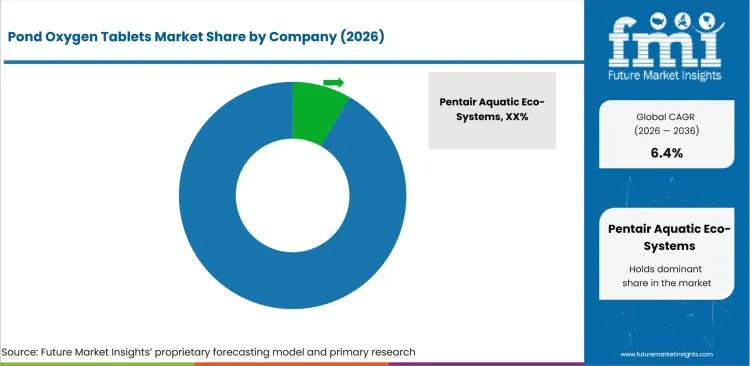
The competitive set spans oxygenation equipment, chemical or biological pond treatments and consumer water-care channels. Direct oxygen-tablet portfolios are not uniform across every company, so relevance is assessed through documented oxygen-management capability and access to the same pond or aquaculture buyer. Pond-treatment budgets also overlap with the Algaecides Market because water-quality problems are often handled through the same distributors and pond-care routines.
- Oxygen-management infrastructure: Pentair Aquatic Eco-Systems, Inc., Airmax, Inc., OASE and Kasco Marine, Inc. compete through aeration or oxygenation systems used in managed water.
- Pond-treatment platforms: Aquafix, Inc., Aquascape, Inc. and The Pond Guy Services Inc. connect treatment products with pond-maintenance workflows and replenishment channels.
- Aquatic-care brands: Tetra, API (Mars) and Ecological Laboratories, Inc. serve routine water-care or biological-treatment workflows that overlap with the same ornamental and managed-pond buyer base.
Competitive Benchmarking: Pond Oxygen Tablets Market
| Company | Oxygen-management capability | Water-care / treatment portfolio | Pond / aquaculture channel fit | Geographic Reach |
|---|---|---|---|---|
| Pentair Aquatic Eco-Systems, Inc. | High | Medium | High | Global commercial aquaculture support |
| Aquafix, Inc. | High | High | Medium | USA with pond, lagoon and wastewater applications |
| Airmax, Inc. | High | High | High | North America |
| OASE | High | High | High | International pond and water-management channels |
| Tetra | Low | High | High | International ornamental aquatic retail |
| API (Mars) | Low | High | High | International aquarium and pond retail |
| Ecological Laboratories, Inc. | Low | High | High | North America with wider distributor reach |
| Aquascape, Inc. | Medium | High | High | North America and United Kingdom |
| Kasco Marine, Inc. | High | Medium | High | North America with international distributors |
| The Pond Guy Services Inc. | Medium | High | High | North American direct and retail pond-care channel |
Scoring basis: Oxygen-management capability is High when the company documents a broad aeration, oxygenation or chemical oxygen-support offer. Medium marks a narrower documented route and Low marks adjacent water-care activity without a core oxygen-management position. Water-care / treatment portfolio follows the same evidence standard for pond-treatment breadth. Pond / aquaculture channel fit reflects documented access to commercial farms, pond professionals, retailers or direct pond owners. Geographic Reach records active sales or support markets documented by official company sources rather than total corporate footprint.
Key Developments in the Pond Oxygen Tablets Market
- In July 2025, Airmax, Inc. acquired the Power House Aeration, Ice Eater and Weeds Away brands from Hydrasearch, Inc., expanding its pond and lake equipment offering and dealer support around aeration, circulation and related water-management products.
- In January 2025, Aquascape, Inc. introduced Fountain Bowls and Fountain Bowl Biological Filter Kits, giving pond and water-garden users another packaged route to filtration and water-quality management through existing distributor and retail channels.
- In December 2024, Kasco Marine, Inc. introduced Home Series Diffused Aeration for smaller residential ponds, increasing the availability of installed aeration in a use setting where oxygen tablets must differentiate through portability and temporary-response value.
Key Players in the Pond Oxygen Tablets Market
Oxygenation and Aeration Specialists
- Pentair Aquatic Eco-Systems, Inc.
- Airmax, Inc.
- OASE
- Kasco Marine, Inc.
Pond Treatment and Water-Management Platforms
- Aquafix, Inc.
- Aquascape, Inc.
- The Pond Guy Services Inc.
Retail Aquatic-Care and Biological Treatment Brands
- Tetra
- API (Mars)
- Ecological Laboratories, Inc.
Pond Oxygen Tablets Market - Report Scope
| Coverage field | Report scope |
|---|---|
| Market breakdown | By Tablet Type, Release Duration, Pond Type, Buyer Type, Sales Channel and Region. |
| Quantitative Units | USD Million. |
| Market Definition | Revenue from preformed pond oxygen tablets sold for oxygen release or oxygen support in ponds, hatchery tanks and transport tanks. Mechanical aeration equipment, bulk non-tablet treatments and downstream aquaculture output are excluded. |
| Regions Covered | North America, Latin America, Western Europe, Eastern Europe, East Asia, South Asia and Pacific, and Middle East and Africa. |
| Countries Covered | Indonesia, USA, Japan, Vietnam, Thailand, Brazil, Norway, and additional countries included in the full report. |
| Key Companies Covered | Pentair Aquatic Eco-Systems, Inc., Aquafix, Inc., Airmax, Inc., OASE, Tetra, API (Mars), Ecological Laboratories, Inc., Aquascape, Inc., Kasco Marine, Inc. and The Pond Guy Services Inc. |
| Forecast Period | 2026 to 2036. |
| Approach | Primary and secondary research with market triangulation. |
Pond Oxygen Tablets Market - Research Methodology
| Method | Approach |
|---|---|
| Primary Research | FMI analysts gathered input from manufacturers, distributors, commercial farms, pond-care specialists and end users. Interviews examined formulation choice, purchase triggers, dose frequency, channel behavior, substitute use and repeat-order conditions. |
| Desk Research | Desk research covered government fisheries statistics, aquaculture policy material, peer-reviewed oxygen-management literature, company product documentation, official company announcements and relevant technical publications. Evidence was retained when it supported the defined market scope or a clearly identified adjacent workflow. |
| Market Sizing and Forecasting | The market model combined the baseline value with segment structure, pricing and volume indicators, adoption levels, channel participation and country demand conditions. Forecast assumptions considered aquaculture intensity, pond-care adoption, emergency-use behavior, distributor access and substitution by installed aeration. Segment and regional estimates were reconciled before the final market total was calculated. |
| Data Validation | Estimates were checked against multiple independent indicators, including public data, company activity and findings from primary interviews. Validation also tested whether products and company activity fell within the defined market boundaries. Adjacent equipment revenue, duplicate channel counting and unsupported claims were excluded. |
Pond Oxygen Tablets Market by Segments
Pond Oxygen Tablets Market segmented by Tablet Type:
- Calcium peroxide tablets
- Sodium percarbonate tablets
- Slow-release oxygen tablets
- Bacterial oxygen support tablets
- Emergency oxygen tablets
Pond Oxygen Tablets Market segmented by Release Duration:
- 1-3 day release
- Fast release
- Weekly release
- Long-duration release
Pond Oxygen Tablets Market segmented by Pond Type:
- Aquaculture ponds
- Ornamental ponds
- Retention ponds
- Hatchery tanks
- Transport tanks
Pond Oxygen Tablets Market segmented by Buyer Type:
- Commercial farms
- Aquarium / pond retailers
- Hatcheries
- Landscape contractors
- Municipal pond managers
Pond Oxygen Tablets Market segmented by Sales Channel:
- Aquaculture input distributors
- Retail pond stores
- Direct farm supply
- E-commerce
Pond Oxygen Tablets Market by Region:
- North America
- United States
- Canada
- Latin America
- Brazil
- Chile
- Mexico
- Rest of Latin America
- Western Europe
- Germany
- United Kingdom
- Italy
- Spain
- France
- Nordics
- Benelux
- Rest of Western Europe
- Eastern Europe
- Russia
- Poland
- Hungary
- Balkan and Baltic States
- Rest of Eastern Europe
- East Asia
- China
- Japan
- South Korea
- South Asia and Pacific
- India
- ASEAN
- Australia and New Zealand
- Rest of South Asia and Pacific
- Middle East and Africa
- Kingdom of Saudi Arabia
- Other GCC Countries
- Türkiye
- South Africa
- Other African Union Countries
- Rest of Middle East and Africa
Research Sources and Bibliography
- Food and Agriculture Organization of the United Nations. (2024, June 7). FAO Report: Global fisheries and aquaculture production reaches a new record high.
- Food and Agriculture Organization of the United Nations. (2024). The State of World Fisheries and Aquaculture 2024: Aquaculture production.
- Food and Agriculture Organization of the United Nations. Chapter 21: Aeration and Oxygenation in Aquaculture.
- Das, A., Sun, Y., Sarkar, D. J., Kumar, V. S., and Das, B. K. (2025). Biopolymer-encapsulated calcium peroxide tablets for slow sustained release of dissolved oxygen in fish tank. Aquacultural Engineering, 110, 102524.
- USA Department of Agriculture, Economic Research Service. (2025, June 9). Aquaculture.
- Cabinet Secretariat of the Republic of Indonesia. (2024, May 8). Remarks at the Inauguration of the Saline Tilapia Cultivation Model in Karawang Regency.
- Fisheries Agency of Japan. (2025). Fisheries of Japan FY2024 (2024/2025).
- Ministry of Agriculture and Environment of Viet Nam. (2025, September 3). Vietnam’s seafood industry achieves sustainable growth: mariculture steady steps to the future.
- Southeast Asian Fisheries Development Center. (2025). Fisheries Country Profile: Thailand 2025.
- Brazilian Institute of Geography and Statistics. (2025). Production of Livestock and Aquaculture: 2024 results.
- Institute of Marine Research, Norway. (2025, June 20). Laksvel: A standardised operational welfare monitoring protocol for Atlantic salmon held in sea cages.
- Airmax, Inc. (2025, July 14). Airmax, Inc. Acquires Power House Aeration, Ice Eater, and Weeds Away Brands from Hydrasearch, Inc.
- Aquascape, Inc. (2025, January 22). Aquascape Introduces Fountain Bowls and Fountain Bowl Biological Filter Kits.
- Kasco Marine, Inc. (2024, December 10). Kasco Introduces a Diffused Aeration System for Homeowners with Small Backyard Ponds.
- The Pond Guy. Pond Logic Rebranded as Airmax.
- The Pond Guy Services Inc. Oxy-Lift Defense Safety Data Sheet.
This bibliography is provided for reader reference and is not exhaustive. The full report contains the complete reference list and detailed citations.
This Report Answers
- How does the Pond Oxygen Tablets Market develop over the forecast period?
- Which operating conditions support demand for portable oxygen-support tablets?
- Which Tablet Type has the main commercial position and why?
- How does release duration affect dosing and repeat purchase behavior?
- Which pond settings create the clearest commercial use cases?
- How do country growth conditions differ across aquaculture systems?
- Which companies serve oxygen-management and adjacent pond-care applications?
- What limits adoption when dose, release behavior and baseline dissolved oxygen are uncertain?
Frequently Asked Questions
How big is the pond oxygen tablets market in 2026?
USD 420.7 Million represents the pond oxygen tablets market value in 2026. Demand centers on portable oxygen support for aquaculture ponds, hatchery tanks, transport tanks and managed ornamental water where operators need a defined intervention alongside routine oxygen-management practices.
What is the CAGR of the pond oxygen tablets market from 2026 to 2036?
A 6.4% CAGR is projected for the pond oxygen tablets market between 2026 and 2036, taking the market to USD 782.3 Million by 2036. Growth depends on wider aquaculture use, distributor access and controlled-release products that fit clear monitoring protocols.
Which Tablet Type segment is projected to account for 31.0% of the pond oxygen tablets market?
Calcium peroxide tablets are projected to account for 31.0% of Tablet Type demand in 2026. The segment benefits from a direct oxygen-release mechanism, while commercial acceptance depends on formulation control and dose guidance that matches water volume and measured oxygen conditions.
How much will the pond oxygen tablets market add between 2026 and 2036?
USD 361.6 Million is expected to be added to the pond oxygen tablets market between 2026 and 2036. The increase is tied to emergency oxygen readiness, short-duration controlled release and broader availability through aquaculture input and pond-care channels.
Which companies are active in the pond oxygen tablets market?
Companies active in oxygen-management and adjacent pond-care workflows include Pentair Aquatic Eco-Systems, Inc., Aquafix, Inc., Airmax, Inc., OASE, Tetra, API (Mars), Ecological Laboratories, Inc., Aquascape, Inc., Kasco Marine, Inc. and The Pond Guy Services Inc. Their roles span aeration, oxygen-support chemistry, pond treatment and distribution.
Preview the report firsthand - request a free sample
Get SampleGet the brochure for pricing and purchase details.
Get PDFTable of Content
- Key Takeaways
- Market Size and CAGR
- Top Growth Driver
- Fastest Growing Segment
- Leading Region
- Key Companies
- Emerging Opportunities
- Executive Summary
- Global Market Outlook
- Demand-side Trends
- Supply-side Trends
- Technology Roadmap Analysis
- Analysis and Recommendations
- Analyst Perspective (What is happening? Why now? What should investors know?)
- Key Questions Answered
- How large is the market?
- What is the CAGR?
- What are key trends?
- Which region dominates?
- Who are the leaders?
- Market Overview
- Market Coverage / Taxonomy
- Market Definition / Scope / Limitations
- Research Methodology
- Chapter Orientation
- Analytical Lens and Working Hypotheses
- Market Structure, Signals, and Trend Drivers
- Benchmarking and Cross-market Comparability
- Market Sizing, Forecasting, and Opportunity Mapping
- Research Design and Evidence Framework
- Desk Research Programme (Secondary Evidence)
- Expert Input and Fieldwork (Primary Evidence)
- Tooling, Models, and Reference Databases
- Data Engineering and Model Build
- Quality Assurance and Audit Trail
- Market Background
- Market Dynamics (Drivers, Restraints, Opportunity, Trends)
- Scenario Forecast (Optimistic, Likely, Conservative)
- Impact Analysis
- AI Impact
- Sustainability Impact
- Regulatory Impact
- Technology Impact
- Consumer / Buyer Analysis
- Purchase Drivers
- Adoption Barriers
- Buyer Journey
- Opportunity Map Analysis
- Product Life Cycle Analysis
- Supply Chain Analysis
- Investment Feasibility Matrix
- Value Chain Analysis
- PESTLE and Porter's Analysis
- Regulatory Landscape
- Regional Parent Market Outlook
- Production and Consumption Statistics
- Import and Export Statistics
- Global Market Analysis and Forecast, 2021 to 2036
- Historical Market Size Value (USD Million) Analysis, 2021 to 2025
- Current and Future Market Size Value (USD Million) Projections, 2026 to 2036
- Y-o-Y Growth Trend Analysis
- Absolute $ Opportunity Analysis
- Global Market Pricing Analysis, 2021 to 2036
- Global Market Analysis and Forecast, By Tablet Type, 2021 to 2036
- Introduction / Key Findings
- Historical Market Size Value (USD Million) Analysis By Tablet Type, 2021 to 2025
- Current and Future Market Size Value (USD Million) Analysis and Forecast By Tablet Type, 2026 to 2036
- Calcium peroxide tablets
- Sodium percarbonate tablets
- Slow-release oxygen tablets
- Bacterial oxygen support tablets
- Emergency oxygen tablets
- Calcium peroxide tablets
- Y-o-Y Growth Trend Analysis By Tablet Type, 2021 to 2025
- Absolute $ Opportunity Analysis By Tablet Type, 2026 to 2036
- Global Market Analysis and Forecast, By Release Duration, 2021 to 2036
- Introduction / Key Findings
- Historical Market Size Value (USD Million) Analysis By Release Duration, 2021 to 2025
- Current and Future Market Size Value (USD Million) Analysis and Forecast By Release Duration, 2026 to 2036
- 1-3 day release
- Fast release
- Weekly release
- Long-duration release
- 1-3 day release
- Y-o-Y Growth Trend Analysis By Release Duration, 2021 to 2025
- Absolute $ Opportunity Analysis By Release Duration, 2026 to 2036
- Global Market Analysis and Forecast, By Pond Type, 2021 to 2036
- Introduction / Key Findings
- Historical Market Size Value (USD Million) Analysis By Pond Type, 2021 to 2025
- Current and Future Market Size Value (USD Million) Analysis and Forecast By Pond Type, 2026 to 2036
- Aquaculture ponds
- Ornamental ponds
- Retention ponds
- Hatchery tanks
- Transport tanks
- Aquaculture ponds
- Y-o-Y Growth Trend Analysis By Pond Type, 2021 to 2025
- Absolute $ Opportunity Analysis By Pond Type, 2026 to 2036
- Global Market Analysis and Forecast, By Buyer Type, 2021 to 2036
- Introduction / Key Findings
- Historical Market Size Value (USD Million) Analysis By Buyer Type, 2021 to 2025
- Current and Future Market Size Value (USD Million) Analysis and Forecast By Buyer Type, 2026 to 2036
- Commercial farms
- Aquarium / pond retailers
- Hatcheries
- Landscape contractors
- Municipal pond managers
- Commercial farms
- Y-o-Y Growth Trend Analysis By Buyer Type, 2021 to 2025
- Absolute $ Opportunity Analysis By Buyer Type, 2026 to 2036
- Global Market Analysis and Forecast, By Sales Channel, 2021 to 2036
- Introduction / Key Findings
- Historical Market Size Value (USD Million) Analysis By Sales Channel, 2021 to 2025
- Current and Future Market Size Value (USD Million) Analysis and Forecast By Sales Channel, 2026 to 2036
- Aquaculture input distributors
- Retail pond stores
- Direct farm supply
- E-commerce
- Aquaculture input distributors
- Y-o-Y Growth Trend Analysis By Sales Channel, 2021 to 2025
- Absolute $ Opportunity Analysis By Sales Channel, 2026 to 2036
- Global Market Analysis and Forecast, By Region, 2021 to 2036
- Introduction
- Historical Market Size Value (USD Million) Analysis By Region, 2021 to 2025
- Current Market Size Value (USD Million) Analysis and Forecast By Region, 2026 to 2036
- North America
- Latin America
- Western Europe
- Eastern Europe
- East Asia
- South Asia and Pacific
- Middle East & Africa
- Market Attractiveness Analysis By Region
- North America Market Analysis and Forecast, By Country, 2021 to 2036
- Historical Market Size Value (USD Million) Trend Analysis By Market Taxonomy, 2021 to 2025
- Market Size Value (USD Million) Forecast By Market Taxonomy, 2026 to 2036
- By Country
- USA
- Canada
- By Tablet Type
- By Release Duration
- By Pond Type
- By Buyer Type
- By Sales Channel
- By Country
- Market Attractiveness Analysis
- By Country
- By Tablet Type
- By Release Duration
- By Pond Type
- By Buyer Type
- By Sales Channel
- Key Takeaways
- Latin America Market Analysis and Forecast, By Country
- Historical Market Size Value (USD Million) Trend Analysis By Market Taxonomy, 2021 to 2025
- Market Size Value (USD Million) Forecast By Market Taxonomy, 2026 to 2036
- By Country
- Brazil
- Mexico
- Chile
- Rest of Latin America
- By Tablet Type
- By Release Duration
- By Pond Type
- By Buyer Type
- By Sales Channel
- By Country
- Market Attractiveness Analysis
- By Country
- By Tablet Type
- By Release Duration
- By Pond Type
- By Buyer Type
- By Sales Channel
- Key Takeaways
- Western Europe Market Analysis and Forecast, By Country
- Historical Market Size Value (USD Million) Trend Analysis By Market Taxonomy, 2021 to 2025
- Market Size Value (USD Million) Forecast By Market Taxonomy, 2026 to 2036
- By Country
- Germany
- UK
- Italy
- Spain
- France
- Nordic
- BENELUX
- Rest of Western Europe
- By Tablet Type
- By Release Duration
- By Pond Type
- By Buyer Type
- By Sales Channel
- By Country
- Market Attractiveness Analysis
- By Country
- By Tablet Type
- By Release Duration
- By Pond Type
- By Buyer Type
- By Sales Channel
- Key Takeaways
- Eastern Europe Market Analysis and Forecast, By Country
- Historical Market Size Value (USD Million) Trend Analysis By Market Taxonomy, 2021 to 2025
- Market Size Value (USD Million) Forecast By Market Taxonomy, 2026 to 2036
- By Country
- Russia
- Poland
- Hungary
- Balkan & Baltic
- Rest of Eastern Europe
- By Tablet Type
- By Release Duration
- By Pond Type
- By Buyer Type
- By Sales Channel
- By Country
- Market Attractiveness Analysis
- By Country
- By Tablet Type
- By Release Duration
- By Pond Type
- By Buyer Type
- By Sales Channel
- Key Takeaways
- East Asia Market Analysis and Forecast, By Country
- Historical Market Size Value (USD Million) Trend Analysis By Market Taxonomy, 2021 to 2025
- Market Size Value (USD Million) Forecast By Market Taxonomy, 2026 to 2036
- By Country
- China
- Japan
- South Korea
- By Tablet Type
- By Release Duration
- By Pond Type
- By Buyer Type
- By Sales Channel
- By Country
- Market Attractiveness Analysis
- By Country
- By Tablet Type
- By Release Duration
- By Pond Type
- By Buyer Type
- By Sales Channel
- Key Takeaways
- South Asia and Pacific Market Analysis and Forecast, By Country
- Historical Market Size Value (USD Million) Trend Analysis By Market Taxonomy, 2021 to 2025
- Market Size Value (USD Million) Forecast By Market Taxonomy, 2026 to 2036
- By Country
- India
- ASEAN
- Australia & New Zealand
- Rest of South Asia and Pacific
- By Tablet Type
- By Release Duration
- By Pond Type
- By Buyer Type
- By Sales Channel
- By Country
- Market Attractiveness Analysis
- By Country
- By Tablet Type
- By Release Duration
- By Pond Type
- By Buyer Type
- By Sales Channel
- Key Takeaways
- Middle East & Africa Market Analysis and Forecast, By Country
- Historical Market Size Value (USD Million) Trend Analysis By Market Taxonomy, 2021 to 2025
- Market Size Value (USD Million) Forecast By Market Taxonomy, 2026 to 2036
- By Country
- Kingdom of Saudi Arabia
- Other GCC Countries
- Türkiye
- South Africa
- Other African Union
- Rest of Middle East & Africa
- By Tablet Type
- By Release Duration
- By Pond Type
- By Buyer Type
- By Sales Channel
- By Country
- Market Attractiveness Analysis
- By Country
- By Tablet Type
- By Release Duration
- By Pond Type
- By Buyer Type
- By Sales Channel
- Key Takeaways
- Key Countries Market Analysis
- USA
- Pricing Analysis
- Market Share Analysis, 2025
- By Tablet Type
- By Release Duration
- By Pond Type
- By Buyer Type
- By Sales Channel
- Canada
- Pricing Analysis
- Market Share Analysis, 2025
- By Tablet Type
- By Release Duration
- By Pond Type
- By Buyer Type
- By Sales Channel
- Mexico
- Pricing Analysis
- Market Share Analysis, 2025
- By Tablet Type
- By Release Duration
- By Pond Type
- By Buyer Type
- By Sales Channel
- Brazil
- Pricing Analysis
- Market Share Analysis, 2025
- By Tablet Type
- By Release Duration
- By Pond Type
- By Buyer Type
- By Sales Channel
- Chile
- Pricing Analysis
- Market Share Analysis, 2025
- By Tablet Type
- By Release Duration
- By Pond Type
- By Buyer Type
- By Sales Channel
- Germany
- Pricing Analysis
- Market Share Analysis, 2025
- By Tablet Type
- By Release Duration
- By Pond Type
- By Buyer Type
- By Sales Channel
- UK
- Pricing Analysis
- Market Share Analysis, 2025
- By Tablet Type
- By Release Duration
- By Pond Type
- By Buyer Type
- By Sales Channel
- Italy
- Pricing Analysis
- Market Share Analysis, 2025
- By Tablet Type
- By Release Duration
- By Pond Type
- By Buyer Type
- By Sales Channel
- Spain
- Pricing Analysis
- Market Share Analysis, 2025
- By Tablet Type
- By Release Duration
- By Pond Type
- By Buyer Type
- By Sales Channel
- France
- Pricing Analysis
- Market Share Analysis, 2025
- By Tablet Type
- By Release Duration
- By Pond Type
- By Buyer Type
- By Sales Channel
- India
- Pricing Analysis
- Market Share Analysis, 2025
- By Tablet Type
- By Release Duration
- By Pond Type
- By Buyer Type
- By Sales Channel
- ASEAN
- Pricing Analysis
- Market Share Analysis, 2025
- By Tablet Type
- By Release Duration
- By Pond Type
- By Buyer Type
- By Sales Channel
- Australia & New Zealand
- Pricing Analysis
- Market Share Analysis, 2025
- By Tablet Type
- By Release Duration
- By Pond Type
- By Buyer Type
- By Sales Channel
- China
- Pricing Analysis
- Market Share Analysis, 2025
- By Tablet Type
- By Release Duration
- By Pond Type
- By Buyer Type
- By Sales Channel
- Japan
- Pricing Analysis
- Market Share Analysis, 2025
- By Tablet Type
- By Release Duration
- By Pond Type
- By Buyer Type
- By Sales Channel
- South Korea
- Pricing Analysis
- Market Share Analysis, 2025
- By Tablet Type
- By Release Duration
- By Pond Type
- By Buyer Type
- By Sales Channel
- Russia
- Pricing Analysis
- Market Share Analysis, 2025
- By Tablet Type
- By Release Duration
- By Pond Type
- By Buyer Type
- By Sales Channel
- Poland
- Pricing Analysis
- Market Share Analysis, 2025
- By Tablet Type
- By Release Duration
- By Pond Type
- By Buyer Type
- By Sales Channel
- Hungary
- Pricing Analysis
- Market Share Analysis, 2025
- By Tablet Type
- By Release Duration
- By Pond Type
- By Buyer Type
- By Sales Channel
- Kingdom of Saudi Arabia
- Pricing Analysis
- Market Share Analysis, 2025
- By Tablet Type
- By Release Duration
- By Pond Type
- By Buyer Type
- By Sales Channel
- Türkiye
- Pricing Analysis
- Market Share Analysis, 2025
- By Tablet Type
- By Release Duration
- By Pond Type
- By Buyer Type
- By Sales Channel
- South Africa
- Pricing Analysis
- Market Share Analysis, 2025
- By Tablet Type
- By Release Duration
- By Pond Type
- By Buyer Type
- By Sales Channel
- USA
- Market Structure Analysis
- Competition Dashboard
- Competition Benchmarking
- Market Share Analysis of Top Players
- By Regional
- By Tablet Type
- By Release Duration
- By Pond Type
- By Buyer Type
- By Sales Channel
- Emerging Startups
- Innovation Benchmarking
- Competition Analysis
- Competition Deep Dive
- Pentair Aquatic Eco-Systems
- Overview
- Product Portfolio
- Profitability by Market Segments
- Sales Footprint
- Strategy Overview
- Marketing Strategy
- Product Strategy
- Channel Strategy
- AquaFix
- Airmax
- OASE
- Tetra
- API / Mars Fishcare
- Microbe-Lift
- Aquascape
- Kasco Marine
- Pond Logic
- Pentair Aquatic Eco-Systems
- Case Studies
- Success Stories
- Recent Developments
- Competition Deep Dive
- Assumptions & Acronyms Used


