

- Market Size (2026)
- USD 1.7 Bn
- Forecast (2036)
- USD 4.1 Bn
- CAGR (2026 to 2036)
- 8.8%
How big is Portable MRI Systems Market in 2026?
USD 1.7 billion in 2026 and USD 4.1 billion by 2036 at an 8.8% CAGR.
Demand for portable MRI systems is forecast to expand at 8.8% CAGR between 2026 and 2036, increasing valuation from USD 1.7 billion in 2026 to USD 4.1 billion by 2036. Hospital radiology leaders consider portable platforms when patient transport delays treatment or disrupts intensive care workflows. The OECD reported in November 2025 that insufficient diagnostic scanner availability can create access problems through distance or waiting times. Portable systems address a narrower part of that problem by bringing selected examinations closer to neurological and critical care patients. Investment becomes defensible when image quality and scan completion remain consistent under ordinary bedside conditions. Related magnetic resonance imaging market analysis shows that portable equipment competes with a much larger fixed-scanner installed base. Clinical engineering teams therefore evaluate service response and room requirements alongside the scanner purchase price.
United States hospitals can evaluate portable MRI through established device clearance pathways and large multisite health systems. Japanese hospitals operate within an exceptionally dense scanner base, which raises the performance threshold for a complementary portable platform. British adoption depends more directly on public procurement and measurable reductions in diagnostic waiting times across hospital networks. German facilities emphasize regulated integration and dependable maintenance across established high-capacity hospital imaging networks nationwide. South Korean tertiary centers can use digital infrastructure for rapid image transfer although local approval and support remain essential. Comparable diagnostic imaging services market conditions create different purchasing tests across each national health system. Manufacturers need local distributors and trained service engineers before hospital pilots can become repeatable commercial programs.
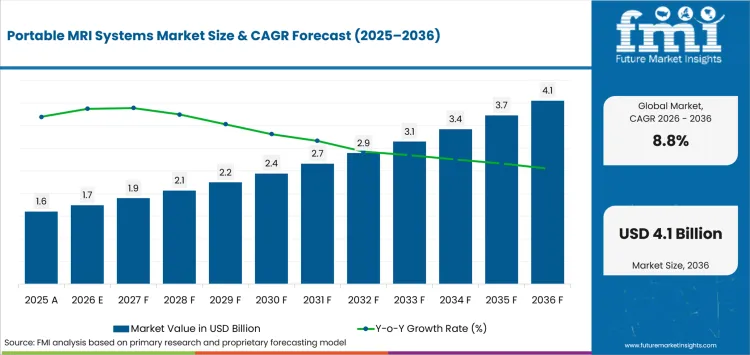
Key Takeaways of Portable MRI Systems Market
- Demand for portable MRI systems is driven by acute care teams needing brain imaging near patients whose transport creates clinical risk or operational delay, particularly across intensive care and emergency workflows.
- By product type, low-field portable MRI systems hold the leading share at 36.8% in 2026, reflecting a practical balance between imaging capability and installation demands.
- Neurology is the dominant application segment, accounting for 35.1% share in 2026, supported by brain imaging applications across intensive care and emergency settings.
- Hospitals hold the largest end-user position with 43.2% share in 2026, reflecting concentrated neurological workloads and access to specialist interpretation.
- AI-enabled imaging systems capture 34.2% share in 2026, underpinned by reconstruction and acquisition improvements that support sharper anatomical detail without requiring magnet hardware replacement.
- The USA and Japan occupy the higher growth band at 10.4% and 9.5% CAGR respectively through 2036, with South Korea following at 8.5%, while Germany and the UK form a narrower growth band at 7.4% and 7.0%.
- Competition centers on Hyperfine, Synaptive Medical, Promaxo, Aspect Imaging, Esaote, Siemens Healthineers, Fujifilm Healthcare, and Philips, with vendors differentiating through point-of-care alignment, installation simplicity, and clinical workflow fit across portable, compact low-field, and mobile full-field configurations.
Analyst Perspective
"Commercial adoption will depend on whether portable MRI systems improve diagnostic decision-making while fitting seamlessly into routine hospital workflows. Healthcare providers are assessing examination completion rates, clinical utility, and equipment utilization rather than imaging availability alone. Modular deployment strategies can reduce implementation risk, while dependable service support and rapid maintenance response will remain essential for sustaining bedside imaging programs."
- Anurag Sharma, Principal Analyst at Future Market Insights
Source: FMI's proprietary forecasting model and primary research
How is the Portable MRI Systems Market segmented?
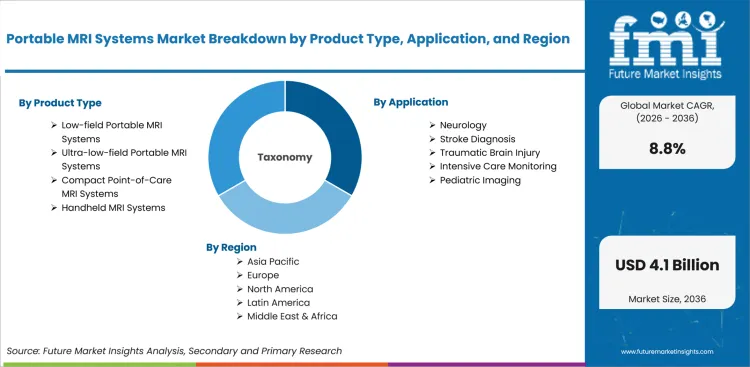
The portable MRI systems industry is segmented by product type, application, end user, technology, and region.
The segmentation framework separates magnetic field configuration from the clinical task and care setting that support each purchase. Product type distinguishes low-field and ultra-low-field systems from compact point-of-care and emerging handheld imaging concepts. Application analysis covers neurology and named acute care uses that require imaging close to the patient. End-user categories separate hospitals from diagnostic imaging centers and smaller ambulatory facilities or research institutions. Technology analysis distinguishes AI-enabled imaging from battery-powered systems and cart-based or bedside equipment configurations across care settings. Regional analysis examines how regulation and service infrastructure affect adoption across health systems with different installed scanner capacity.
How are low-field portable MRI systems positioned within the product type category?
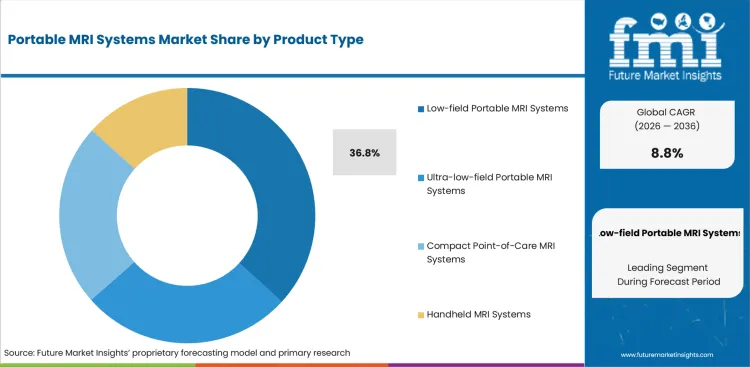
Low-field portable MRI systems balance manageable infrastructure with image quality suitable for defined clinical examinations. The FDA recorded substantial-equivalence clearance for Hyperfine's Swoop Portable MR Imaging System V2 on May 30, 2025. The clearance establishes a current United States commercial pathway for portable brain imaging rather than proving broad hospital adoption. Comparison with the point-of-care diagnostics market helps hospital planners separate near-patient access from complete diagnostic laboratory replacement. Purchasing committees therefore examine field strength and examination scope together with local clinical governance and service responsibilities.
- Low-field portable MRI systems hold 36.8% share in 2026, linked to a practical balance between imaging capability and installation demands. Reduced shielding and power requirements can widen feasible scanner placement across hospitals and specialized outpatient imaging clinics. The share position reflects operational flexibility rather than technical equivalence with conventional high-field magnetic resonance platforms.
- Clinical engineering departments favor systems that fit established electrical and safety controls without requiring a complete MRI suite. Radiology leaders also need protocols that identify patients suitable for portable imaging and cases requiring escalation. Adoption strengthens when room preparation and clinical staff training remain proportionate to sustained examination volumes across departments.
How does neurology shape demand within the application category?
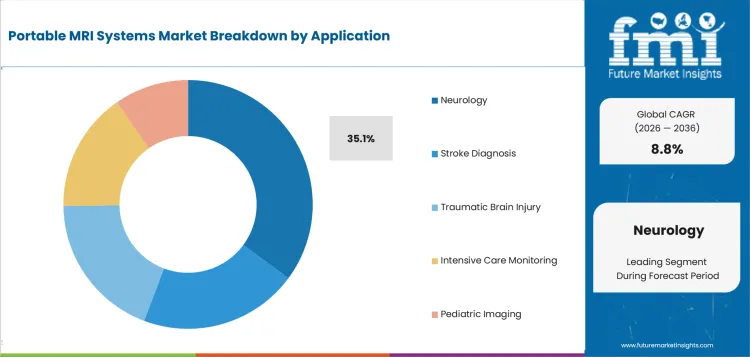
Neurology creates a direct use case because unstable patients may benefit from brain imaging near critical care teams. Hyperfine announced FDA clearance in December 2025 for a multidirection diffusion-weighted sequence designed to improve stroke lesion visualization. The action supports a defined neurological capability but does not establish clinical substitution across every stroke pathway. Adjacent ischemic stroke systems market activity underscores the importance of rapid diagnosis within time-sensitive treatment decisions. Hospital adoption depends on whether portable imaging changes triage or monitoring without adding uncertain interpretation steps.
- Neurology accounts for 35.1% share in 2026, supported by brain imaging applications across intensive care and emergency settings. Stroke assessment and serial neurological monitoring create clearer workflow ownership than unsupported broad whole-body imaging claims. The share position reflects concentrated neurological relevance within the current commercial boundary for portable imaging systems.
- Neurologists and intensivists use portable MRI when patient transport creates clinical disruption or repeated imaging supports treatment review. Successful hospital programs define acquisition protocols and remote interpretation routes before routine scheduling begins across acute care departments. Adoption remains strongest where a portable examination answers a named decision and avoids unnecessary patient transfers.
Why do hospitals hold the largest end user position?
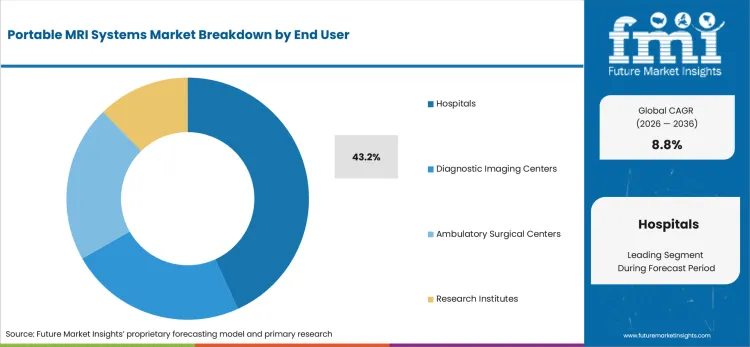
Hospitals contain intensive care and emergency workflows where patient transport can delay imaging or require additional clinical staff. Hyperfine reported in July 2025 that two United States hospitals purchased next-generation Swoop systems for intensive care and emergency departments. The sales demonstrate current purchasing activity within named hospital settings without proving a broader installed-base trend. Effective healthcare technology management market practices become essential because biomedical teams must govern maintenance and software changes. Hospital purchasing therefore combines clinical sponsorship with service planning and formal information security review across connected imaging systems.
- Hospitals hold 43.2% share in 2026, reflecting concentrated neurological workloads and access to specialist interpretation. Critical care units provide defined patient populations that can support measured pilot programs and accountable clinical evaluation. The share also reflects hospital capacity to manage device safety and clinical escalation requirements through established governance structures.
- Large health systems can distribute portable scanners across selected departments while maintaining centralized radiology oversight and quality controls. Smaller hospitals require dependable remote service and interpretation support because local specialist coverage may remain limited. Adoption expands through accountable care pathways rather than unrestricted scanner mobility across every clinical department and patient group.
How do AI-enabled imaging systems influence the technology category?
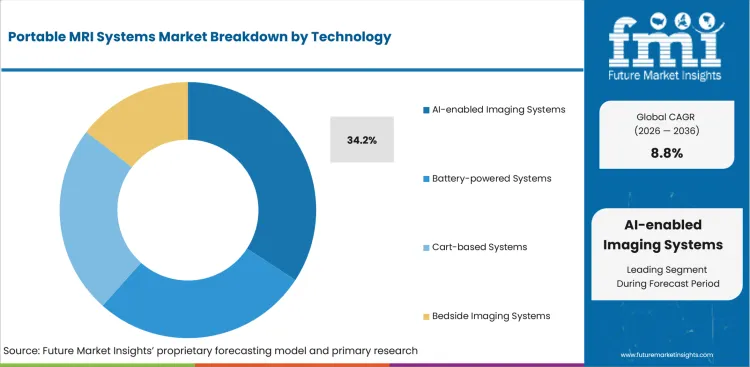
AI-enabled imaging systems use reconstruction and acquisition support to improve image consistency under low signal conditions. Hyperfine began commercial deployment of Optive AI software in July 2025 across initial United States hospitals and neurology offices. The company stated that the software supports noise cancellation and reconstruction across existing Swoop systems. Related medical imaging software market capabilities require controlled updates and documented performance across each supported examination. Radiology departments therefore evaluate software benefits together with version governance and documented scanner compatibility across installed systems.
- AI-enabled imaging systems capture 34.2% share in 2026, underpinned by reconstruction and acquisition improvements across lower-field platforms. Software can support sharper anatomical detail without requiring magnet hardware replacement during every approved imaging platform upgrade. The share position reflects the commercial importance of image quality improvement within portable operating and infrastructure constraints.
- Imaging departments adopt AI-enabled systems through controlled validation that compares representative studies across software versions and patient groups. Biomedical engineering teams need clear update schedules and documented rollback procedures before each clinical software deployment. Commercial value improves when software upgrades extend installed-system capability without creating unmanaged interpretation differences across clinical teams.
What are the drivers, restraints, and opportunities in the Portable MRI Systems Market?
Care teams need imaging closer to selected patients, yet portable systems require disciplined quality and safety governance.
- Driver: Acute care teams need brain imaging near patients whose transport creates clinical risk or operational delay.
- Restraint: Lower-field acquisition and changing environments can reduce image consistency without structured quality control.
- Opportunity: Regulatory expansion and software upgrades can extend portable imaging across additional professional care settings.
Near-patient neurological imaging supports market growth by reducing the operational burden associated with transporting selected acute care patients. A 2025 National Library of Medicine indexed study evaluated quality control across seventeen portable ultra-low-field MRI sites in twelve countries. The multicenter work supports the technical feasibility of distributed quality monitoring without proving commercial purchasing behavior. Demand strengthens when care teams connect portable examinations with a defined treatment or monitoring decision. The broader clinical diagnostics market provides comparable examples of near-patient testing governed by escalation rules.
Image consistency remains a material restraint because lower-field systems operate with less signal and may encounter changing environmental conditions. The FDA explains that patient movement and certain implants or accessory devices can degrade MRI images and create safety hazards. Hospitals need formal patient screening and quality-control procedures before portable scanners enter routine bedside clinical use. Adoption slows whenever repeat examinations erase the expected clinical and operational benefit from reduced patient transport. Manufacturers must state supported examination boundaries and provide representative performance evidence for intended care settings.
Regulatory access creates an opportunity for manufacturers that can support portable systems across multiple professional care settings. Hyperfine received CE and UKCA marks in April 2026 for its next-generation Swoop system and an Optive AI software advancement. The approvals establish legal market access within covered jurisdictions without guaranteeing hospital procurement or favorable reimbursement decisions. Expansion becomes commercially credible when local distributors provide clinical training and maintenance beside complete regulatory documentation. Connected teleradiology services market capacity can also support interpretation where onsite neurological radiology coverage remains limited.
Which country CAGRs are profiled in the Portable MRI Systems Market?
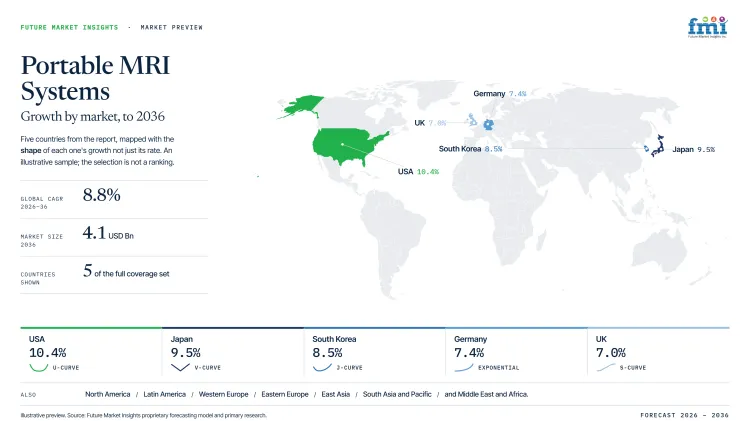
| Country | CAGR |
|---|---|
| USA | 10.4% |
| UK | 7.0% |
| Germany | 7.4% |
| Japan | 9.5% |
| South Korea | 8.5% |
How do country-level CAGRs compare in the Portable MRI Systems Market?
The country comparison forms two measured growth bands rather than one uniform portable imaging adoption pattern. The USA and Japan occupy the upper growth band through materially different hospital purchasing and service routes. South Korea follows between the two growth groups through high imaging use and digitally connected tertiary hospitals. Germany and the UK form a narrower European growth band with similar expectations under different procurement systems. The 3.4 percentage-point spread reflects differences in scanner capacity and purchasing systems rather than a direct ranking of national healthcare quality.
- The USA and Japan show stronger profiled growth although their installed scanner capacity and purchasing structures differ materially.
- South Korea occupies the middle position through high imaging use and digitally connected tertiary hospital networks.
- Germany follows with a mature hospital base that raises expectations for integration and dependable technical service.
- The UK records a slightly lower rate within procurement systems that require clear evidence of public-service benefit.
- Comparable CAGRs can conceal different approval routes and maintenance requirements across each national imaging system.
National entry conditions depend on legal sale status and service distance together with training and financing arrangements. The full report provides additional country analysis across North American and Latin American healthcare systems and commercial environments. It also covers Europe and East Asia together with South Asia and Pacific plus the Middle East and Africa.
Country-wise Analysis
- United States hospitals operate within a mature diagnostic imaging network with eighty-six combined CT and MRI or PET units per million people according to the OECD in November 2025. Portable MRI demand in the USA is projected to expand at 10.4% CAGR through 2036. FDA clearance creates a direct legal sale route for qualified systems and large health networks can fund controlled intensive care deployments. Local distributors and biomedical engineering departments provide installation and maintenance routes across major United States hospital regions. A material friction remains reimbursement and workflow approval because portable examinations must demonstrate value beyond existing fixed scanners. Commercial programs need defined interpretation coverage and reliable field service before multisite purchasing becomes practical.
- United Kingdom healthcare operates with nineteen combined CT and MRI or PET units per million people according to the OECD in November 2025. Portable MRI demand in the UK is forecast to rise at 7.0% CAGR from 2026 to 2036. UKCA certification provides a legal route for qualified equipment and public hospitals can evaluate systems through structured procurement programs. Centralized radiology networks can support clinical training and specialist interpretation across several hospitals and community care sites. A material friction remains the need to prove measurable waiting-time or capacity benefits within constrained public budgets. Manufacturers also need dependable national maintenance coverage because distant service routes can weaken bedside availability.
- German hospitals operate with seventy-four combined CT and MRI or PET units per million people according to the OECD in November 2025. Portable MRI demand in Germany is estimated to advance at 7.4% CAGR from 2026 to 2036. A dense hospital base and established medical-technology distributors support training and maintenance for compact imaging systems. Hospital purchasing can use capital budgets or equipment financing when clinical departments define a sustained examination pathway. A material friction comes from the extensive fixed-scanner base which raises the evidence threshold for complementary portable equipment. Equipment manufacturers need regulated integration and German-language technical service support across regional hospital provider networks.
- Japanese healthcare operates with one hundred eighty-four combined CT and MRI or PET units per million people according to the OECD in November 2025. Portable MRI demand in Japan is projected to increase at 9.5% CAGR during the 2026-2036 forecast period. High imaging familiarity and concentrated hospital capacity create an enabler for specialized bedside protocols and compact equipment evaluation. Local distributors can support training and maintenance within established medical-device channels after required national approval. A material friction remains the exceptionally large fixed-scanner installed base which narrows the economic case for complementary systems. Commercial adoption needs a distinct neurological workflow that cannot be served efficiently through nearby conventional scanners.
- South Korean healthcare combines high diagnostic imaging use with digitally connected tertiary hospitals and eighty-seven combined CT and MRI or PET units per million people according to the OECD in November 2025. Portable MRI demand in South Korea is forecast to grow at 8.5% CAGR from 2026 to 2036. Strong hospital information systems can enable rapid image transfer and centralized interpretation across acute care departments. Local medical-device distributors can provide clinical training and technical service after manufacturers obtain required national regulatory clearance. A material friction remains comparison with heavily used conventional scanners and demanding hospital technology assessments. Suppliers must demonstrate reliable performance and fast support response before broad purchasing becomes commercially defensible.
Who are the notable companies in the Portable MRI Systems Market?
Hyperfine, Synaptive Medical, Promaxo, Aspect Imaging, Esaote, Siemens Healthineers, Fujifilm Healthcare, and Philips are notable exact-market participants.
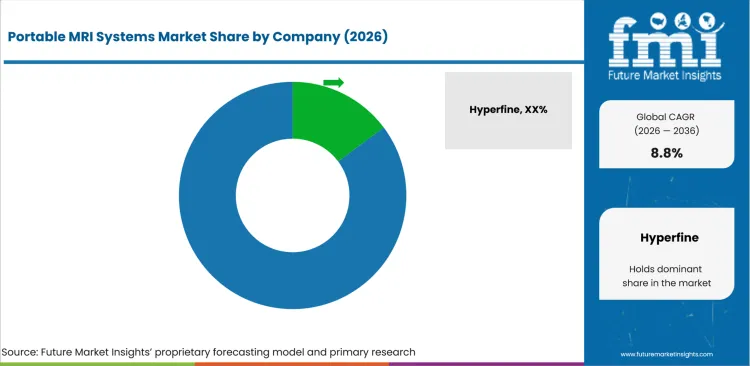
The competitive field combines dedicated portable developers with established imaging companies offering compact or mobile configurations. Hyperfine markets portable ultra-low-field brain imaging and Synaptive Medical offers the compact Evry head MRI platform. Promaxo provides office-based MRI for guided prostate procedures while Aspect Imaging supplies self-shielded neonatal systems for intensive care use. Esaote and Fujifilm Healthcare address compact low-field imaging applications through systems with reduced infrastructure demands. Siemens Healthineers offers a compact 0.55-tesla platform and Philips provides a helium-free mobile 1.5-tesla configuration. Related AI-enabled medical devices market capabilities influence image reconstruction and workflow automation across several portable imaging platforms. Competitive assessment therefore depends on exact clinical alignment and service reach rather than company revenue or reputation.
- Hyperfine and Synaptive Medical compete through neurological imaging systems designed for placement closer to acute care workflows. Hyperfine emphasizes portability across professional care settings while Synaptive uses a compact dedicated head scanner. Both companies require clinical protocols that connect specialized examinations with timely radiologist interpretation and documented escalation routes.
- Promaxo and Aspect Imaging address specialized clinical imaging pathways rather than broad conventional whole-body scanning applications. Promaxo connects point-of-care magnetic resonance imaging with defined office-based prostate biopsy and procedural guidance workflows. Aspect Imaging places a self-shielded neonatal magnetic resonance system inside specialized intensive care environments near vulnerable patients. Adjacent brain biomarkers market development may increase interest in accessible neurological imaging but does not replace validated diagnostic indications.
- Esaote and Fujifilm Healthcare emphasize compact permanent-magnet systems with lower installation requirements across musculoskeletal and general imaging workflows. Siemens Healthineers and Philips draw on broader service organizations while offering compact or mobile configurations. Their commercial advantage depends on local availability and exact product fit rather than corporate portfolio size.
Competitive Benchmarking: Portable MRI Systems Market
| Company | Point-of-Care Alignment | Installation Simplicity | Clinical Workflow Fit | Geographic Reach |
|---|---|---|---|---|
| Hyperfine | High | High | High | North America, Europe, and Asia-Pacific |
| Synaptive Medical | High | Medium | High | Canada and USA |
| Promaxo | High | High | High | USA and selected international sites |
| Aspect Imaging | High | High | High | USA and selected international markets |
| Esaote | Medium | High | High | Global |
| Siemens Healthineers | Medium | Medium | Medium | Global |
| Fujifilm Healthcare | Medium | Medium | Medium | Global |
| Philips | High | Medium | Medium | Global |
Key Developments in the Portable MRI Systems Market
- In June 2025, Hyperfine announced FDA clearance for its next-generation Swoop portable brain MRI system powered by Optive AI software. The cleared system targets brain imaging across professional care settings with a redesigned scanner and software platform. The action expands Hyperfine's current United States product offering without establishing broad clinical adoption. Hospitals still need local clinical workflow validation and dependable service planning before routine portable scanner deployment.
- In August 2025, Philips presented live cardiac magnetic resonance examinations using its BlueSeal Mobile system during the European Society of Cardiology Congress. The helium-free mobile 1.5-tesla platform combined transportable scanner infrastructure with automated imaging and workflow support. The demonstration establishes an active mobile full-field configuration rather than a dedicated bedside neurological imaging system. Commercial use depends on site logistics and qualified clinical staffing around each temporary or recurring mobile deployment.
- In March 2026, the FDA recorded substantial-equivalence clearance for Aspect Imaging's Embrace Neonatal MRI System under submission K254277. The clearance supports a current United States regulatory route for dedicated neonatal magnetic resonance imaging. The regulatory action strengthens specialized intensive care competition without proving widespread hospital purchasing across health systems. Providers need neonatal protocols and trained interpretation coverage before integrating the system into routine care.
- In July 2026, Hyperfine announced the European commercial launch of its next-generation Swoop system across initial markets. The company stated that the system held CE and UKCA approvals and included its Optive AI software. The launch extends commercial availability beyond North America while leaving country procurement and reimbursement decisions separate. European expansion requires local distributors and dependable maintenance routes across every served country and hospital network.
Key Players in the Portable MRI Systems Market
Portable and Point-of-Care MRI Providers
- Hyperfine
- Synaptive Medical
- Promaxo
- Aspect Imaging
Compact Low-field MRI Providers
- Esaote
- Siemens Healthineers
- Fujifilm Healthcare
Mobile Full-field MRI Provider
- Philips
Portable MRI Systems Market - Report Scope
| Coverage field | Report scope |
|---|---|
| Market breakdown | Product type, application, end user, technology, and region. |
| Quantitative Units | Revenue in USD Billion, CAGR in %. |
| Market Definition | Portable and compact magnetic resonance imaging systems designed for use closer to patients or within reduced-infrastructure clinical environments. |
| Regions Covered | North America, Latin America, Western Europe, Eastern Europe, East Asia, South Asia and Pacific, and Middle East and Africa. |
| Countries Covered | USA, UK, Germany, Japan, and South Korea within the profiled CAGR comparison, with additional countries covered in the full report. |
| Key Companies Profiled | Hyperfine, Synaptive Medical, Promaxo, Aspect Imaging, Esaote, Siemens Healthineers, Fujifilm Healthcare, and Philips. |
| Forecast Period | 2026 to 2036. |
| Approach | Hybrid bottom-up and top-down market sizing supported by structured industry research and authoritative desk research. |
Portable MRI Systems Market - Research Methodology
| Method | Approach |
|---|---|
| Primary Research | FMI analysts gathered input from manufacturers, service providers, technology developers, distributors, end users, sourcing teams, and subject-matter experts. Interviews examined purchasing decisions, product or service evaluation, adoption barriers, approval requirements, pricing considerations, and expectations for technical or commercial support. Respondents were also asked what evidence is required before a trial, pilot, or initial order develops into regular purchasing. |
| Desk Research | Desk research covered government statistics, regulatory publications, trade data, industry associations, technical literature, standards, company filings, product information, and official corporate announcements. Sources were reviewed for relevance, publication date, geographic coverage, and consistency with the defined market scope. Claims relating to performance, applications, approvals, capacity, investment, and commercial activity were retained only when supported by credible public evidence. |
| Market Sizing and Forecasting | The market model combined the baseline value with historical performance, segment structure, pricing and volume indicators, adoption levels, company participation, and country-level demand conditions. Forecast assumptions considered economic activity, investment trends, regulatory developments, technology adoption, purchasing cycles, supply availability, and barriers to wider market use. Segment and regional estimates were reconciled before the final market total was calculated. |
| Data Validation | Estimates were checked against multiple independent indicators, including public data, company activity, trade patterns, industry developments, and findings from primary interviews. Validation also tested whether products, services, applications, and company revenues fell within the defined market boundaries. Adjacent categories, unsupported claims, overlapping revenues, and activities without direct market relevance were excluded to reduce double counting and maintain consistency across segments and countries. |
Portable MRI Systems Market by Segments
Portable MRI Systems Market segmented by Product Type:
- Low-field Portable MRI Systems
- Ultra-low-field Portable MRI Systems
- Compact Point-of-Care MRI Systems
- Handheld MRI Systems
Portable MRI Systems Market segmented by Application:
- Neurology
- Stroke Diagnosis
- Traumatic Brain Injury
- Intensive Care Monitoring
- Pediatric Imaging
Portable MRI Systems Market segmented by End User:
- Hospitals
- Diagnostic Imaging Centers
- Ambulatory Surgical Centers
- Research Institutes
Portable MRI Systems Market segmented by Technology:
- AI-enabled Imaging Systems
- Battery-powered Systems
- Cart-based Systems
- Bedside Imaging Systems
Portable MRI Systems Market by Region:
- North America
- United States
- Canada
- Latin America
- Brazil
- Mexico
- Argentina
- Chile
- Western Europe
- Germany
- France
- United Kingdom
- Italy
- Spain
- Benelux
- Nordics
- Eastern Europe
- Poland
- Czech Republic
- Romania
- Hungary
- East Asia
- China
- Japan
- South Korea
- South Asia and Pacific
- India
- ASEAN
- Australia and New Zealand
- Middle East and Africa
- GCC Countries
- South Africa
- Türkiye
- Israel
Research Sources and Bibliography
- USA Food and Drug Administration. (2025, May 30). 510(k) premarket notification: Swoop Portable MR Imaging System (V2) (K250236).
- Hyperfine, Inc.. (2025, June 2). Hyperfine announces FDA clearance of a new next-generation Swoop system powered by Optive AI software, delivering a transformative leap in image quality.
- Hyperfine, Inc.. (2025, July 17). Hyperfine announces the first commercial sales of the next-generation Swoop system powered by Optive AI software.
- Hyperfine, Inc.. (2025, July 23). Hyperfine begins commercial launch of Optive AI software, bringing substantially improved image quality to the installed base of Swoop systems.
- Hyperfine, Inc.. (2025, December 15). Hyperfine announces FDA clearance of the first Optive AI software update with advanced diffusion imaging capability, focused on enhancing stroke detection with the Swoop system.
- Hyperfine, Inc.. (2026, April 9). Hyperfine receives CE and UKCA marks for next-generation Swoop system and latest advancement in Optive AI software.
- Hyperfine, Inc.. (2026, July 1). Hyperfine announces European launch of next-generation Swoop system.
- Philips. (2025, August 28). Philips redefines cardiac care with AI-driven solutions at ESC Congress 2025.
- USA Food and Drug Administration. (2026, March 13). 510(k) premarket notification: Embrace Neonatal MRI System (K254277).
- USA Food and Drug Administration. (n.d.). Benefits and risks of magnetic resonance imaging.
- OECD. (2025, November 13). Diagnostic technologies.
- OECD. (2025, November 13). United States.
- OECD. (2025, November 13). United Kingdom.
- OECD. (2025, November 13). Germany.
- OECD. (2025, November 13). Japan.
- OECD. (2025, November 13). Korea.
- Ljungberg, E., et al.. (2025). Characterization and quality control of portable ultra-low-field MRI across multiple sites.
- Synaptive Medical. (n.d.). Evry MRI.
- Promaxo. (n.d.). Point-of-care MRI and MRI-guided prostate biopsy.
- Aspect Imaging. (n.d.). Clinical imaging systems.
- Esaote. (n.d.). O-scan SMART.
- Siemens Healthineers. (n.d.). MAGNETOM Free.Max.
- Fujifilm Healthcare. (n.d.). APERTO Lucent V7.
- Philips. (n.d.). BlueSeal Mobile MRI system.
The bibliography provides the public sources supporting retained claims and current exact-market company assessment across the article. The full report contains additional source records and detailed market modeling documentation for every covered geography and segment.
This Report Answers
- How large is the portable MRI systems market in 2026 and 2036?
- Which clinical and operating pressures support investment in near-patient magnetic resonance imaging?
- Why do low-field portable MRI systems hold the main Product Type share in 2026?
- How does neurology influence portable MRI adoption across acute care settings?
- Why do hospitals account for the largest End User share in 2026?
- How do country growth rates differ across the USA and Europe together with Japan and South Korea?
- Which companies provide portable or compact or mobile magnetic resonance imaging systems?
- What limits image consistency and commercial adoption across portable MRI workflows?
- How can AI-enabled imaging software improve lower-field acquisition and reconstruction performance?
Frequently Asked Questions
How big is the Portable MRI Systems Market in 2026?
The portable MRI systems market is valued at USD 1.7 billion in 2026 and is forecast to reach USD 4.1 billion by 2036. Growth reflects hospital radiology leaders adopting portable platforms when patient transport delays treatment or disrupts intensive care and emergency imaging workflows.
What is the CAGR of the Portable MRI Systems Market from 2026 to 2036?
The portable MRI systems market grows at a CAGR of 8.8% between 2026 and 2036, supported by acute care teams needing brain imaging near patients whose transport creates clinical risk or operational delay across intensive care settings.
Which product type leads the Portable MRI Systems Market?
Low-field portable MRI systems account for 36.8% of the portable MRI systems market by product type in 2026, reflecting a practical balance between imaging capability and installation demands that widens feasible scanner placement across hospitals.
How much will the Portable MRI Systems Market add between 2026 and 2036?
The portable MRI systems market is set to add USD 2.4 billion between 2026 and 2036, growing from USD 1.7 billion to USD 4.1 billion as near-patient neurological imaging extends across a widening base of hospital critical care and emergency departments.
Who are the leading companies in the Portable MRI Systems Market?
Five companies lead the portable MRI systems market, including Hyperfine, Synaptive Medical, Promaxo, Aspect Imaging, and Esaote, competing through point-of-care alignment, installation simplicity, and clinical workflow fit across portable, compact low-field, and mobile full-field configurations.
Preview the report firsthand - request a free sample
Get SampleGet the brochure for pricing and purchase details.
Get PDFTable of Content
- Key Takeaways
- Market Size and CAGR
- Top Growth Driver
- Fastest Growing Segment
- Leading Region
- Key Companies
- Emerging Opportunities
- Executive Summary
- Global Market Outlook
- Demand-side Trends
- Supply-side Trends
- Technology Roadmap Analysis
- Analysis and Recommendations
- Analyst Perspective (What is happening? Why now? What should investors know?)
- Key Questions Answered
- How large is the market?
- What is the CAGR?
- What are key trends?
- Which region dominates?
- Who are the leaders?
- Market Overview
- Market Coverage / Taxonomy
- Market Definition / Scope / Limitations
- Research Methodology
- Chapter Orientation
- Analytical Lens and Working Hypotheses
- Market Structure, Signals, and Trend Drivers
- Benchmarking and Cross-market Comparability
- Market Sizing, Forecasting, and Opportunity Mapping
- Research Design and Evidence Framework
- Desk Research Programme (Secondary Evidence)
- Expert Input and Fieldwork (Primary Evidence)
- Tooling, Models, and Reference Databases
- Data Engineering and Model Build
- Quality Assurance and Audit Trail
- Market Background
- Market Dynamics (Drivers, Restraints, Opportunity, Trends)
- Scenario Forecast (Optimistic, Likely, Conservative)
- Impact Analysis
- AI Impact
- Sustainability Impact
- Regulatory Impact
- Technology Impact
- Consumer / Buyer Analysis
- Purchase Drivers
- Adoption Barriers
- Buyer Journey
- Opportunity Map Analysis
- Product Life Cycle Analysis
- Supply Chain Analysis
- Investment Feasibility Matrix
- Value Chain Analysis
- PESTLE and Porter's Analysis
- Regulatory Landscape
- Regional Parent Market Outlook
- Production and Consumption Statistics
- Import and Export Statistics
- Global Market Analysis and Forecast, 2021 to 2036
- Historical Market Size Value (USD Billion) Analysis, 2021 to 2025
- Current and Future Market Size Value (USD Billion) Projections, 2026 to 2036
- Y-o-Y Growth Trend Analysis
- Absolute $ Opportunity Analysis
- Global Market Pricing Analysis, 2021 to 2036
- Global Market Analysis and Forecast, By Product Type, 2021 to 2036
- Introduction / Key Findings
- Historical Market Size Value (USD Billion) Analysis By Product Type, 2021 to 2025
- Current and Future Market Size Value (USD Billion) Analysis and Forecast By Product Type, 2026 to 2036
- Low-field Portable MRI Systems
- Ultra-low-field Portable MRI Systems
- Compact Point-of-Care MRI Systems
- Handheld MRI Systems
- Low-field Portable MRI Systems
- Y-o-Y Growth Trend Analysis By Product Type, 2021 to 2025
- Absolute $ Opportunity Analysis By Product Type, 2026 to 2036
- Global Market Analysis and Forecast, By Application, 2021 to 2036
- Introduction / Key Findings
- Historical Market Size Value (USD Billion) Analysis By Application, 2021 to 2025
- Current and Future Market Size Value (USD Billion) Analysis and Forecast By Application, 2026 to 2036
- Neurology
- Stroke Diagnosis
- Traumatic Brain Injury
- Intensive Care Monitoring
- Pediatric Imaging
- Neurology
- Y-o-Y Growth Trend Analysis By Application, 2021 to 2025
- Absolute $ Opportunity Analysis By Application, 2026 to 2036
- Global Market Analysis and Forecast, By End User, 2021 to 2036
- Introduction / Key Findings
- Historical Market Size Value (USD Billion) Analysis By End User, 2021 to 2025
- Current and Future Market Size Value (USD Billion) Analysis and Forecast By End User, 2026 to 2036
- Hospitals
- Diagnostic Imaging Centers
- Ambulatory Surgical Centers
- Research Institutes
- Hospitals
- Y-o-Y Growth Trend Analysis By End User, 2021 to 2025
- Absolute $ Opportunity Analysis By End User, 2026 to 2036
- Global Market Analysis and Forecast, By Technology, 2021 to 2036
- Introduction / Key Findings
- Historical Market Size Value (USD Billion) Analysis By Technology, 2021 to 2025
- Current and Future Market Size Value (USD Billion) Analysis and Forecast By Technology, 2026 to 2036
- AI-enabled Imaging Systems
- Battery-powered Systems
- Cart-based Systems
- Bedside Imaging Systems
- AI-enabled Imaging Systems
- Y-o-Y Growth Trend Analysis By Technology, 2021 to 2025
- Absolute $ Opportunity Analysis By Technology, 2026 to 2036
- Global Market Analysis and Forecast, By Region, 2021 to 2036
- Introduction
- Historical Market Size Value (USD Billion) Analysis By Region, 2021 to 2025
- Current Market Size Value (USD Billion) Analysis and Forecast By Region, 2026 to 2036
- North America
- Latin America
- Western Europe
- Eastern Europe
- East Asia
- South Asia and Pacific
- Middle East & Africa
- Market Attractiveness Analysis By Region
- North America Market Analysis and Forecast, By Country, 2021 to 2036
- Historical Market Size Value (USD Billion) Trend Analysis By Market Taxonomy, 2021 to 2025
- Market Size Value (USD Billion) Forecast By Market Taxonomy, 2026 to 2036
- By Country
- USA
- Canada
- By Product Type
- By Application
- By End User
- By Technology
- By Country
- Market Attractiveness Analysis
- By Country
- By Product Type
- By Application
- By End User
- By Technology
- Key Takeaways
- Latin America Market Analysis and Forecast, By Country
- Historical Market Size Value (USD Billion) Trend Analysis By Market Taxonomy, 2021 to 2025
- Market Size Value (USD Billion) Forecast By Market Taxonomy, 2026 to 2036
- By Country
- Brazil
- Mexico
- Chile
- Rest of Latin America
- By Product Type
- By Application
- By End User
- By Technology
- By Country
- Market Attractiveness Analysis
- By Country
- By Product Type
- By Application
- By End User
- By Technology
- Key Takeaways
- Western Europe Market Analysis and Forecast, By Country
- Historical Market Size Value (USD Billion) Trend Analysis By Market Taxonomy, 2021 to 2025
- Market Size Value (USD Billion) Forecast By Market Taxonomy, 2026 to 2036
- By Country
- Germany
- UK
- Italy
- Spain
- France
- Nordic
- BENELUX
- Rest of Western Europe
- By Product Type
- By Application
- By End User
- By Technology
- By Country
- Market Attractiveness Analysis
- By Country
- By Product Type
- By Application
- By End User
- By Technology
- Key Takeaways
- Eastern Europe Market Analysis and Forecast, By Country
- Historical Market Size Value (USD Billion) Trend Analysis By Market Taxonomy, 2021 to 2025
- Market Size Value (USD Billion) Forecast By Market Taxonomy, 2026 to 2036
- By Country
- Russia
- Poland
- Hungary
- Balkan & Baltic
- Rest of Eastern Europe
- By Product Type
- By Application
- By End User
- By Technology
- By Country
- Market Attractiveness Analysis
- By Country
- By Product Type
- By Application
- By End User
- By Technology
- Key Takeaways
- East Asia Market Analysis and Forecast, By Country
- Historical Market Size Value (USD Billion) Trend Analysis By Market Taxonomy, 2021 to 2025
- Market Size Value (USD Billion) Forecast By Market Taxonomy, 2026 to 2036
- By Country
- China
- Japan
- South Korea
- By Product Type
- By Application
- By End User
- By Technology
- By Country
- Market Attractiveness Analysis
- By Country
- By Product Type
- By Application
- By End User
- By Technology
- Key Takeaways
- South Asia and Pacific Market Analysis and Forecast, By Country
- Historical Market Size Value (USD Billion) Trend Analysis By Market Taxonomy, 2021 to 2025
- Market Size Value (USD Billion) Forecast By Market Taxonomy, 2026 to 2036
- By Country
- India
- ASEAN
- Australia & New Zealand
- Rest of South Asia and Pacific
- By Product Type
- By Application
- By End User
- By Technology
- By Country
- Market Attractiveness Analysis
- By Country
- By Product Type
- By Application
- By End User
- By Technology
- Key Takeaways
- Middle East & Africa Market Analysis and Forecast, By Country
- Historical Market Size Value (USD Billion) Trend Analysis By Market Taxonomy, 2021 to 2025
- Market Size Value (USD Billion) Forecast By Market Taxonomy, 2026 to 2036
- By Country
- Kingdom of Saudi Arabia
- Other GCC Countries
- Türkiye
- South Africa
- Other African Union
- Rest of Middle East & Africa
- By Product Type
- By Application
- By End User
- By Technology
- By Country
- Market Attractiveness Analysis
- By Country
- By Product Type
- By Application
- By End User
- By Technology
- Key Takeaways
- Key Countries Market Analysis
- USA
- Pricing Analysis
- Market Share Analysis, 2025
- By Product Type
- By Application
- By End User
- By Technology
- Canada
- Pricing Analysis
- Market Share Analysis, 2025
- By Product Type
- By Application
- By End User
- By Technology
- Mexico
- Pricing Analysis
- Market Share Analysis, 2025
- By Product Type
- By Application
- By End User
- By Technology
- Brazil
- Pricing Analysis
- Market Share Analysis, 2025
- By Product Type
- By Application
- By End User
- By Technology
- Chile
- Pricing Analysis
- Market Share Analysis, 2025
- By Product Type
- By Application
- By End User
- By Technology
- Germany
- Pricing Analysis
- Market Share Analysis, 2025
- By Product Type
- By Application
- By End User
- By Technology
- UK
- Pricing Analysis
- Market Share Analysis, 2025
- By Product Type
- By Application
- By End User
- By Technology
- Italy
- Pricing Analysis
- Market Share Analysis, 2025
- By Product Type
- By Application
- By End User
- By Technology
- Spain
- Pricing Analysis
- Market Share Analysis, 2025
- By Product Type
- By Application
- By End User
- By Technology
- France
- Pricing Analysis
- Market Share Analysis, 2025
- By Product Type
- By Application
- By End User
- By Technology
- India
- Pricing Analysis
- Market Share Analysis, 2025
- By Product Type
- By Application
- By End User
- By Technology
- ASEAN
- Pricing Analysis
- Market Share Analysis, 2025
- By Product Type
- By Application
- By End User
- By Technology
- Australia & New Zealand
- Pricing Analysis
- Market Share Analysis, 2025
- By Product Type
- By Application
- By End User
- By Technology
- China
- Pricing Analysis
- Market Share Analysis, 2025
- By Product Type
- By Application
- By End User
- By Technology
- Japan
- Pricing Analysis
- Market Share Analysis, 2025
- By Product Type
- By Application
- By End User
- By Technology
- South Korea
- Pricing Analysis
- Market Share Analysis, 2025
- By Product Type
- By Application
- By End User
- By Technology
- Russia
- Pricing Analysis
- Market Share Analysis, 2025
- By Product Type
- By Application
- By End User
- By Technology
- Poland
- Pricing Analysis
- Market Share Analysis, 2025
- By Product Type
- By Application
- By End User
- By Technology
- Hungary
- Pricing Analysis
- Market Share Analysis, 2025
- By Product Type
- By Application
- By End User
- By Technology
- Kingdom of Saudi Arabia
- Pricing Analysis
- Market Share Analysis, 2025
- By Product Type
- By Application
- By End User
- By Technology
- Türkiye
- Pricing Analysis
- Market Share Analysis, 2025
- By Product Type
- By Application
- By End User
- By Technology
- South Africa
- Pricing Analysis
- Market Share Analysis, 2025
- By Product Type
- By Application
- By End User
- By Technology
- USA
- Market Structure Analysis
- Competition Dashboard
- Competition Benchmarking
- Market Share Analysis of Top Players
- By Regional
- By Product Type
- By Application
- By End User
- By Technology
- Emerging Startups
- Innovation Benchmarking
- Competition Analysis
- Competition Deep Dive
- Hyperfine
- Overview
- Product Portfolio
- Profitability by Market Segments
- Sales Footprint
- Strategy Overview
- Marketing Strategy
- Product Strategy
- Channel Strategy
- Siemens Healthineers
- GE HealthCare
- Koninklijke Philips
- Canon Medical Systems
- Aspect Imaging
- Fujifilm Healthcare
- United Imaging Healthcare
- Synaptive Medical
- Esaote
- Hyperfine
- Case Studies
- Success Stories
- Recent Developments
- Competition Deep Dive
- Assumptions & Acronyms Used


