

- Market Size (2026)
- USD 990.9 Mn
- Forecast (2036)
- USD 3334.1 Mn
- CAGR (2026 to 2036)
- 12.9%
How big is Portable Brain MRI Systems Market in 2026?
USD 990.9 million in 2026 and USD 3334.1 million by 2036 at a 12.9% CAGR.
Demand for portable brain MRI systems is forecast to expand at 12.9% CAGR between 2026 and 2036. The market valuation is projected to increase from USD 990.9 million in 2026 to USD 3,334.1 million by 2036. Hospitals invest in near-patient scanning when neurological teams can avoid hazardous transfers and obtain usable information during acute care. The commercial case depends on patient mobility and scan quality alongside staffing capacity and escalation rules for conventional imaging. Hyperfine reported in a January 2026 investor presentation that its installed base exceeded 200 systems and had produced about 250,000 images. The installed-use record gives portable MRI systems a measurable reference across several clinical environments and operating models. Broader brain imaging platforms remain relevant as comparison points for diagnostic depth and referral escalation across complex neurological cases. Hospital leaders should measure completed bedside scans and avoided transfers separately from repeat imaging and radiologist turnaround performance.
United States hospitals can purchase cleared bedside systems through established imaging budgets, while European providers coordinate regional approvals with distributor support. The USA Food and Drug Administration cleared the next-generation Swoop system through the 510(k) pathway on May 30, 2025. Public systems in Europe evaluate clinical value through procurement rules that place greater weight on service coverage and workforce planning. The role of diagnostic imaging services clarifies reporting capacity and downstream specialist responsibility after a portable examination. Experience with portable medical devices shows why installation simplicity does not remove maintenance duties or safe operating procedures. Adoption therefore follows different national routes even when hospitals share the same goal of reducing transfer delays for vulnerable patients. Commercial proposals become stronger when suppliers define legal sale status and local support before presenting throughput or accessibility benefits.
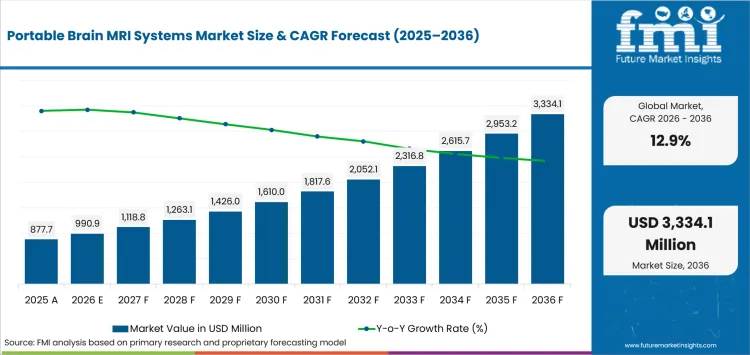
Key Takeaways of Portable Brain MRI Systems Market
- Demand for portable brain MRI systems is driven by the need for near-patient neurological imaging in intensive care and emergency environments that cannot support routine patient transport.
- By field design, low-field portable brain MRI systems hold the largest share at 37.3% in 2026, owing to mobility and reduced siting requirements.
- Stroke diagnosis is the dominant application segment, holding 34.1% share in 2026, supported by demand for repeated neurological assessment during acute care.
- Hospitals lead the end-user category with 37.3% share in 2026, as critical patients and specialist teams are concentrated within inpatient settings.
- AI-enabled imaging systems capture 35.8% share in 2026, as reconstruction software improves consistency from compact hardware.
- Japan, South Korea, Germany, the United States, and the United Kingdom post CAGRs of 15.8%, 15.4%, 13.4%, 12.8%, and 11.6% respectively, shaped by existing imaging capacity, approval status, and local service routes.
- Competition centers on Hyperfine, neuro42, Synaptive Medical, Aspect Imaging, Eyas Medical Imaging, Neoscan Solutions, Time Medical, and Dr. Sennewald, with vendors differentiating through mobile brain imaging platforms, compact head scanners, and neonatal-focused neuroimaging systems.
Analyst Perspective
"The portable brain MRI systems market is shifting from technology evaluation to clinical workflow integration. Long-term adoption will depend on whether portable imaging supports faster neurological assessment without compromising diagnostic confidence or disrupting established care pathways. Healthcare providers are placing greater emphasis on clinical validation, operational reliability, and seamless deployment. Suppliers that demonstrate consistent performance across diverse care settings will strengthen their position as point-of-care neuroimaging expands."
- Anurag Sharma, Principal Analyst at Future Market Insights
Source: FMI's proprietary forecasting model and primary research
How is the Portable Brain MRI Systems Market segmented?
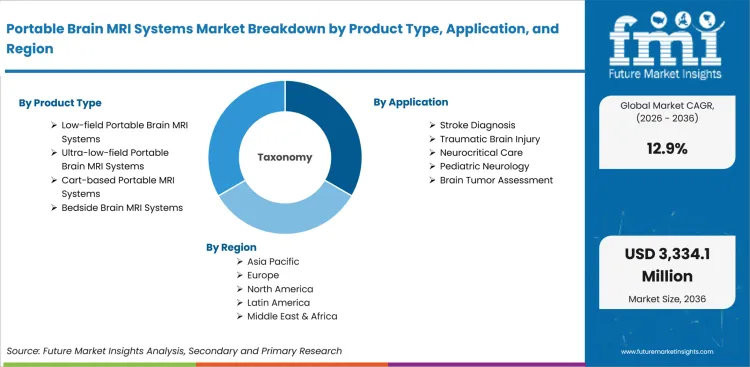
The portable brain MRI systems industry is segmented by product type, application, end user, technology, and region.
The segmentation framework separates scanner configuration from clinical use and operating responsibility across the care pathway. Product type covers low-field and ultra-low-field platforms alongside cart-based and bedside systems with different siting requirements. Application analysis follows stroke diagnosis and traumatic brain injury together with neurocritical care and pediatric or tumor assessment. End-user categories distinguish hospitals from imaging centers and ambulatory facilities as well as research institutions. Technology analysis covers AI-enabled imaging and battery power alongside point-of-care deployment and cloud connectivity within compact hospital workflows. Regional analysis examines how approvals and clinical capacity shape demand across countries with different service structures.
What supports demand for low-field portable brain MRI systems within the Product Type category?
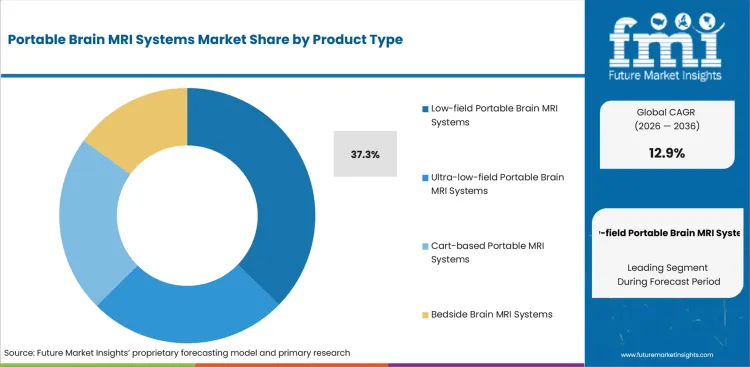
Low-field designs reduce the infrastructure burden that limits conventional MRI placement near intensive care and emergency departments. A 2025 European Radiology Experimental review found that modern low-field systems combine hardware miniaturization with improved reconstruction methods for point-of-care imaging. The review also identified lower spatial resolution and signal-to-noise performance as continuing technical limits during clinical use. Purchasing decisions therefore compare mobility with the clinical detail required for each neurological question during formal evaluation. The wider magnetic resonance imaging market provides a reference for conventional diagnostic depth and referral escalation.
- Low-field portable brain MRI systems are expected to hold 37.3% share in 2026, underpinned by reduced siting needs and direct access near vulnerable patients. Their share reflects the value of flexible placement rather than equivalence with high-field scanners across every neurological indication.
- Critical care teams favor low-field systems for repeated assessment of patients whose transport creates clinical or staffing risk. Adoption remains strongest when hospitals define suitable lesion types and require conventional imaging for questions beyond the portable protocol.
How does stroke diagnosis shape demand within the Application category?
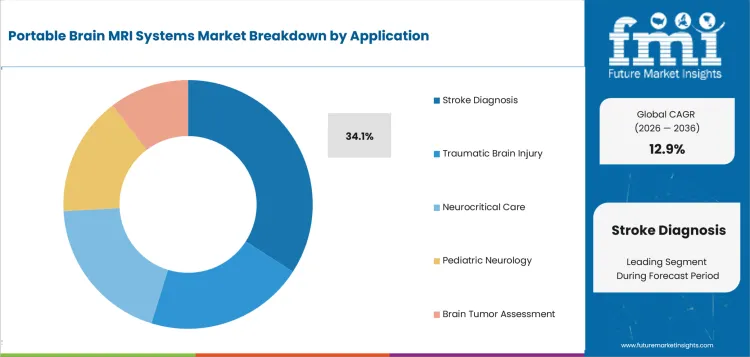
Stroke pathways require imaging information that supports rapid classification and later monitoring without interrupting acute treatment. Portable systems therefore need predefined use boundaries and a reliable route to vascular or high-resolution imaging. MRI coil design remains important because compact head systems must preserve signal while limiting overall scanner size.
- Stroke diagnosis is forecast to account for 34.1% share in 2026, attributable to repeated demand for neurological imaging within acute pathways. The segment position reflects a clear decision need across emergency assessment and follow-up rather than universal suitability for initial treatment selection.
- Stroke centers adopt portable systems as adjuncts for bedside monitoring and selected follow-up examinations after standard emergency imaging. A 2025 European Stroke Journal pilot study evaluated portable ultra-low-field MRI in seventeen patients with suspected ischemic stroke. The system detected eight of twelve ischemic lesions identified by high-field MRI and missed four lesions smaller than six millimeters. Commercial use expands when neurologists and radiologists agree which findings can guide care and which findings require vascular or high-resolution sequences.
Why do hospitals lead the End User category?
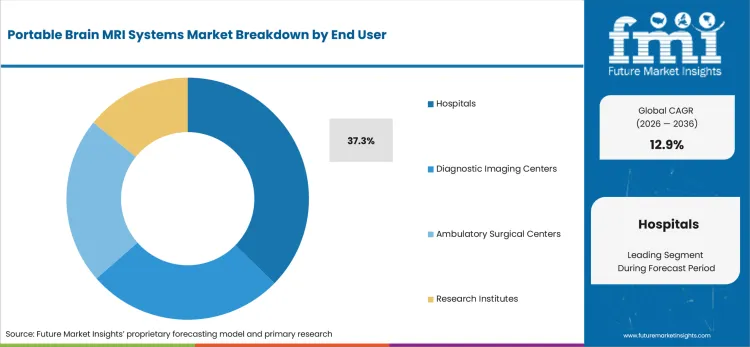
Hospitals concentrate unstable neurological patients and the multidisciplinary teams needed to interpret limited-field examinations safely. Atlantic Health reported in December 2025 that Morristown Medical Center was using a next-generation portable MRI system in intensive care and emergency departments. The deployment provides direct commercial evidence that bedside brain imaging can enter daily hospital operations. Hospitals must also coordinate infection control and electrical safety with scanner scheduling and radiology coverage. MRI-compatible patient monitoring systems offer a related comparison for maintaining critical care support during imaging.
- Hospitals are projected to hold 37.3% share in 2026, driven by inpatient settings that combine patient need with neurologists and radiologists. Their share also reflects existing capital approval processes and information systems that can support new imaging equipment.
- Hospital adoption begins in intensive care or emergency units with a defined transfer problem and sufficient scan volume. Expansion depends on training backup and reporting coverage as well as evidence that the system changes care without increasing duplicate examinations.
How are AI-enabled imaging systems positioned within the Technology category?
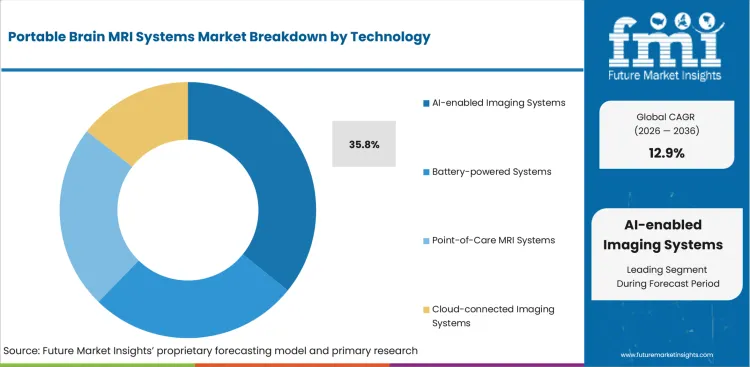
AI reconstruction addresses noise and blur that can limit image consistency at lower field strengths across compact systems. Hospitals evaluate reconstructed output through validated sequences and reader agreement rather than marketing descriptions or generic performance claims. Medical imaging software provides a broader benchmark for integration and version control across radiology operations.
- AI-enabled imaging systems are estimated to capture 35.8% share in 2026, linked to reconstruction support and standardized acquisition workflows. The share reflects software importance within compact scanners rather than independent revenue from unrelated radiology algorithms.
- Imaging departments adopt AI-enabled systems after radiologists compare output across representative patients and difficult motion conditions. The USA Food and Drug Administration issued a substantially equivalent decision for the Swoop portable MR imaging system on December 12, 2025. The regulatory record confirms an updated cleared system without proving better clinical outcomes across every use case. Technical approval also requires documented software updates and cybersecurity controls plus clear responsibility for scans that remain nondiagnostic.
What are the drivers, restraints, and opportunities in the Portable Brain MRI Systems Market?
Clinical demand rises through near-patient access, while image limitations and operating responsibility constrain routine deployment across broader neurological pathways.
- Driver: Acute neurological care creates demand for imaging that avoids transport and supports repeated assessment near unstable patients.
- Restraint: Compact and low-field systems have defined resolution and sequence limits that prevent unrestricted replacement of conventional MRI.
- Opportunity: Connected workflows can combine portable acquisition with specialist interpretation and structured escalation across distributed care settings.
Acute stroke care creates a recurring imaging workload that extends beyond the first diagnostic examination and treatment decision. The American Heart Association reported in its January 2026 guideline that more than 600,000 Americans experience a first ischemic stroke each year. Approximately 200,000 additional patients experience a recurrent stroke under the same national estimate within established care pathways. Portable brain MRI systems can address selected monitoring needs for patients who remain difficult to transport. Hospitals gain commercial value when each portable scan replaces a defined delay or transfer rather than duplicating standard imaging.
Image quality remains the central restraint because compact hardware cannot answer every neurological question at conventional resolution. A June 2025 Radiology review described portable low-field systems as mobile and accessible but noted quality trade-offs against fixed scanners. Small lesions and vascular findings can require higher resolution or specialized sequences beyond a portable protocol. Radiologists therefore need explicit confidence limits and escalation rules before accepting routine use across clinical departments. Adoption slows when a proposal measures portability without proving diagnostic sufficiency for the hospital’s intended patient group.
Connected interpretation creates an opportunity for smaller facilities that lack continuous on-site neuroradiology coverage during urgent neurological care. Hyperfine reported in its 2025 annual filing that the Swoop system transfers images through PACS and operates through a connected cloud ecosystem. The connected capabilities can support remote radiology without treating connectivity as evidence of diagnostic accuracy. A workable service model assigns acquisition and safety tasks locally and directs complex cases toward specialist review. The commercial opportunity depends on secure integration and contracted reporting availability across nights and weekends.
Which country CAGRs are profiled in the Portable Brain MRI Systems Market?
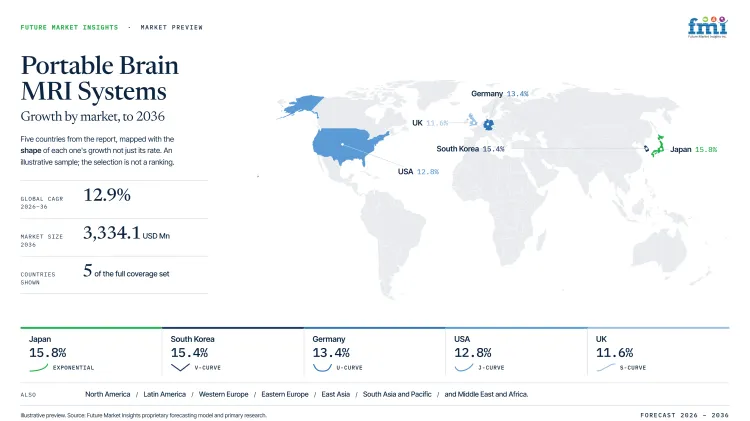
| Country | CAGR |
|---|---|
| USA | 12.8% |
| UK | 11.6% |
| Germany | 13.4% |
| Japan | 15.8% |
| South Korea | 15.4% |
How do country-level CAGRs compare in the Portable Brain MRI Systems Market?
The country comparison forms two measured growth bands rather than one sharply separated national ranking. Japan and South Korea occupy the upper band with rates above fifteen percent through 2036. Germany occupies the middle position between the East Asian pair and the two English-speaking markets. The United States and United Kingdom remain within a narrow range despite different payment and procurement structures. The complete spread equals 4.2 percentage points and suggests broadly favorable momentum across every profiled country.
- Japan and South Korea combine dense hospital infrastructure with rapid evaluation of specialized medical technologies. Their projected rates remain close enough that commercial entry conditions matter more than the small numerical difference.
- Germany represents the middle position within the comparison and benefits from a mature hospital equipment base. Regional distribution and service capability remain necessary because portable scanners require local installation and ongoing support.
- The United States retains a clear route through FDA clearance and direct hospital purchasing for selected bedside systems. Adoption remains selective because hospitals compare portable scans with established CT and fixed MRI pathways.
- The United Kingdom records the smallest disclosed rate within this group but remains an active market for approved point-of-care imaging. Public procurement places extra weight on service capacity and measurable effects on diagnostic workflow within public hospitals.
The country forecasts describe market-specific development and should not be interpreted as a universal national ranking across all imaging equipment. Similar rates can produce different commercial outcomes through regulation and clinical capacity for equipment manufacturers. The full report provides country-level CAGR analysis across North America, Latin America, Europe, East Asia, South Asia, Oceania and the Middle East and Africa.
Country-wise Analysis
- United States hospitals operate within an established clearance and accreditation environment for magnetic resonance imaging services. The portable brain MRI systems market is forecast to expand at 12.8% CAGR over the 2026-2036 forecast period. The Intersocietal Accreditation Commission published revised MRI standards in April 2025 that address personnel and quality requirements for accredited services. FDA-cleared systems and existing reimbursement codes provide a direct adoption enabler for hospitals and neurology practices. Implementation remains constrained by accreditation work and radiologist acceptance as well as training and maintenance coverage. Direct sales can support major health systems but smaller providers need documented service response across wider travel distances.
- United Kingdom providers manage MRI capacity through nationally monitored referral and reporting pathways across public healthcare organizations. The market is projected to record 11.6% CAGR from 2026 to 2036. NHS England reported almost 4.98 million MRI examinations from April 2025 through February 2026 within provisional management data. Hyperfine received UKCA approval in April 2026 for its next-generation Swoop system and related Optive AI software. Legal sale status and national imaging demand create a direct enabler for selected bedside deployment. Public procurement and radiology staffing remain material frictions because each new pathway needs measurable service benefit and reporting ownership.
- German hospitals purchase specialized imaging equipment through structured capital processes and expect dependable regional technical service. The market is estimated to advance at 13.4% CAGR during the forecast period. Dr. Sennewald Medizintechnik identifies itself as the exclusive DACH distribution partner for the Swoop portable MR imaging system. The local distributor provides a direct commercial route for demonstrations and installation support within Germany. Adoption remains constrained by hospital budget approval and radiologist training plus service distance outside major clinical centers. Commercial proposals need clear response times and escalation plans for cases that require conventional MRI.
- Japanese hospitals operate within an imaging-rich healthcare system that already supports extensive use of advanced diagnostic equipment. The market is forecast to rise at 15.8% CAGR during the projection period. The OECD reported in 2025 that Japan had 184 CT scanners and MRI or PET units per million residents. Japan’s installed equipment base enables clinical comparison and specialist oversight for compact brain scanners during hospital evaluation. Portable systems face friction because established fixed scanners raise the evidence threshold for new capital purchases. Suppliers also need local approval and service coverage plus training that fits disciplined hospital workflows.
- South Korean hospitals combine high diagnostic equipment density with digitally connected clinical systems across major urban centers. The market is projected to grow at 15.4% CAGR from 2026 to 2036. The OECD reported in 2025 that Korea had 87 CT scanners and MRI or PET units per million residents. Advanced hospital infrastructure creates a direct enabler for connected portable imaging and specialist review across major clinical centers. Commercial friction arises from comparison with abundant fixed imaging capacity and rigorous value expectations during hospital capital review. Suppliers need local regulatory status and maintenance partners before hospitals can rely on a new system during urgent neurological care.
Who are the notable companies in the Portable Brain MRI Systems Market?
Hyperfine, neuro42, Synaptive Medical, Aspect Imaging, Eyas Medical Imaging, Neoscan Solutions, Time Medical, and Dr. Sennewald Medizintechnik are the notable companies shaping this market.
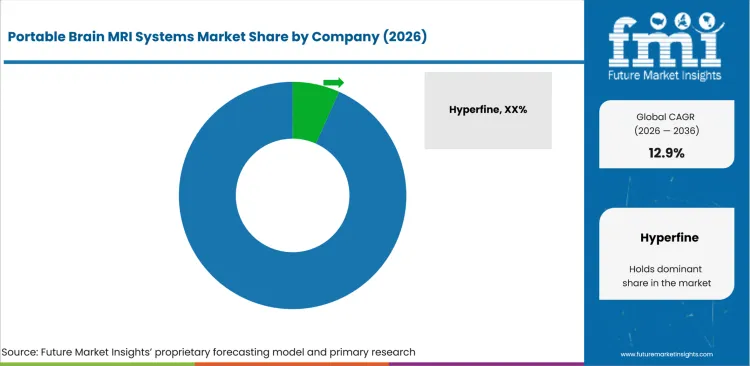
The competitive field spans true bedside scanners and compact head systems alongside neonatal platforms and regional distribution organizations. neuro42 states that its FDA-cleared neurological platform has completed more than 1,000 scans and can bring imaging directly to patients. Manufacturers compete through mobility and clinical scope as well as workflow integration and local support. The use of sealed MRI magnets provides a useful comparison for siting and maintenance across compact equipment. Commercial success depends on matching a verified product to a defined care pathway because broad corporate imaging portfolios do not establish exact-market participation.
- Hyperfine and neuro42 address mobile brain imaging near the patient through systems built around neurological use cases. Hyperfine combines an ultra-low-field scanner with AI reconstruction and global distribution for bedside neurological workflows. neuro42 combines mobile MRI with procedural guidance and a North American regulatory record for near-patient neurological care.
- Synaptive Medical supplies a compact head MRI platform with predefined protocols and patient transfer features. Aspect Imaging and Eyas Medical Imaging concentrate on neonatal neuroimaging through systems designed for intensive care placement and specialized infant handling.
- Neoscan Solutions and Time Medical provide dedicated pediatric or neonatal MRI systems with compact installation concepts. Dr. Sennewald Medizintechnik supports the DACH region through distribution of Hyperfine’s Swoop system and a local commercial contact route.
Competitive Benchmarking: Portable Brain MRI Systems Market
| Company | Near-patient mobility | Brain-specific scope | Workflow support | Geographic reach |
|---|---|---|---|---|
| Hyperfine | High | High | High | North America and Europe |
| neuro42 | High | High | Medium | North America |
| Synaptive Medical | Medium | High | High | North America |
| Aspect Imaging | Medium | High | High | United States |
| Eyas Medical Imaging | Medium | High | Medium | United States |
| Neoscan Solutions | Medium | Medium | High | Europe |
| Time Medical | Medium | Medium | Medium | North America and Asia |
| Dr. Sennewald Medizintechnik | High | High | Medium | DACH region |
Key Developments in the Portable Brain MRI Systems Market
- In April 2026, Hyperfine introduced the Swoop system at the All India Institute of Medical Sciences in New Delhi. The company described the installation as India’s first portable MRI system for bedside brain imaging. The development establishes a current institutional deployment and creates a reference site for neurological care in a large public medical center.
- In February 2026, Eyas Medical Imaging: Eyas received FDA 510(k) clearance for the Ascent3T neonatal MRI system. The company described a compact three-tesla platform designed for neonatal and infant anatomy within the NICU. Eyas stated that United States commercialization was expected later in 2026 and that the device was not commercially available in other countries.
- In March 2025, Neoscan Solutions: Neoscan announced the first neo315 installation at University Hospital Halle in Germany. The company identified the system as a dedicated pediatric MRI platform designed for hospital use. The installation provides a current European deployment reference for compact imaging near pediatric care environments.
- In March 2026, Aspect Imaging: The USA Food and Drug Administration issued a substantially equivalent decision for the Embrace Neonatal MRI System. The regulatory record identifies Aspect Imaging as the applicant and confirms the March 13 decision date. The clearance supports continued United States participation in dedicated neonatal neuroimaging across specialized hospital care settings.
Key Players in the Portable Brain MRI Systems Market
Portable Bedside Brain MRI Providers
- Hyperfine
- neuro42
Compact Head and Neonatal MRI Providers
- Synaptive Medical
- Aspect Imaging
- Eyas Medical Imaging
- Neoscan Solutions
- Time Medical
Regional Distribution and Service Providers
- Dr. Sennewald Medizintechnik
Portable Brain MRI Systems Market - Report Scope
| Coverage field | Report scope |
|---|---|
| Market breakdown | Product type, application, end user, technology, and region. |
| Market Definition | Portable, compact, or near-patient MRI systems designed specifically for brain, head, neonatal, or neurological imaging within clinical care settings. |
| Regions Covered | North America, Latin America, Western Europe, Eastern Europe, East Asia, South Asia and Pacific, and Middle East and Africa. |
| Countries Covered | USA, UK, Germany, Japan, and South Korea. |
| Key Companies Profiled | Hyperfine, neuro42, Synaptive Medical, Aspect Imaging, Eyas Medical Imaging, Neoscan Solutions, Time Medical, and Dr. Sennewald Medizintechnik |
| Forecast Period | 2026 to 2036. |
| Approach | Hybrid bottom-up and top-down market sizing supported by primary interviews and official desk research. |
Portable Brain MRI Systems Market - Research Methodology
| Method | Approach |
|---|---|
| Primary Research | FMI analysts gathered input from manufacturers, service providers, technology developers, distributors, end users, sourcing teams, and subject-matter experts. Interviews examined purchasing decisions, product or service evaluation, adoption barriers, approval requirements, pricing considerations, and expectations for technical or commercial support. Respondents were also asked what evidence is required before a trial, pilot, or initial order develops into regular purchasing. |
| Desk Research | Desk research covered government statistics, regulatory publications, trade data, industry associations, technical literature, standards, company filings, product information, and official corporate announcements. Sources were reviewed for relevance, publication date, geographic coverage, and consistency with the defined market scope. Claims relating to performance, applications, approvals, capacity, investment, and commercial activity were retained only when supported by credible public evidence. |
| Market Sizing and Forecasting | The market model combined the baseline value with historical performance, segment structure, pricing and volume indicators, adoption levels, company participation, and country-level demand conditions. Forecast assumptions considered economic activity, investment trends, regulatory developments, technology adoption, purchasing cycles, supply availability, and barriers to wider market use. Segment and regional estimates were reconciled before the final market total was calculated. |
| Data Validation | Estimates were checked against multiple independent indicators, including public data, company activity, trade patterns, industry developments, and findings from primary interviews. Validation also tested whether products, services, applications, and company revenues fell within the defined market boundaries. Adjacent categories, unsupported claims, overlapping revenues, and activities without direct market relevance were excluded to reduce double counting and maintain consistency across segments and countries. |
Portable Brain MRI Systems Market by Segments
Portable Brain MRI Systems Market segmented by Product Type:
- Low-field Portable Brain MRI Systems
- Ultra-low-field Portable Brain MRI Systems
- Cart-based Portable MRI Systems
- Bedside Brain MRI Systems
Portable Brain MRI Systems Market segmented by Application:
- Stroke Diagnosis
- Traumatic Brain Injury
- Neurocritical Care
- Pediatric Neurology
- Brain Tumor Assessment
Portable Brain MRI Systems Market segmented by End User:
- Hospitals
- Diagnostic Imaging Centers
- Ambulatory Surgical Centers
- Research Institutes
Portable Brain MRI Systems Market segmented by Technology:
- AI-enabled Imaging Systems
- Battery-powered Systems
- Point-of-Care MRI Systems
- Cloud-connected Imaging Systems
Portable Brain MRI Systems Market by Region:
- North America
- United States
- Canada
- Latin America
- Brazil
- Mexico
- Argentina
- Chile
- Western Europe
- Germany
- France
- United Kingdom
- Italy
- Spain
- Benelux
- Nordics
- Eastern Europe
- Poland
- Czech Republic
- Romania
- Hungary
- East Asia
- China
- Japan
- South Korea
- South Asia and Pacific
- India
- ASEAN
- Australia and New Zealand
- Middle East and Africa
- GCC Countries
- South Africa
- Türkiye
- Israel
Research Sources and Bibliography
- Hyperfine, Inc. (2026, January).
- USA Food and Drug Administration. (2025, May 30).
- Kravchenko, D., Hagar, M. T., Vecsey-Nagy, M., Kabat, I., Groteklaes, A., Luetkens, J. A., Kuetting, D., Isaak, A., Emrich, T., Varga-Szemes, A., & Spampinato, M. V. (2025, October 23).
- von Danwitz, N. M., Lehnen, N. C., Meißner, J. N., Shirvani Samani, O., Asperger, H., Thielscher, C., Ebrahimi, T., Layer, J., Nitsch, L., Dorn, F., Radbruch, A., Bode, F. J., Weller, J. M., Groteklaes, A., Petzold, G. C., Sabir, H., & Stösser, S. (2025, December 1).
- Atlantic Health. (2025, December 2).
- USA Food and Drug Administration. (2025, December 12).
- American Heart Association. (2026, January 26).
- Zhang, K., Ganjizadeh, A., Vahdati, S., Huston, J., III, Bernstein, M. A., Erickson, B. J., & Shu, Y. (2025, June 10).
- Hyperfine, Inc. (2026).
- Intersocietal Accreditation Commission. (2025, April 1).
- NHS England. (2026, June 18).
- Hyperfine, Inc. (2026, April 9).
- Dr. Sennewald Medizintechnik GmbH. (n.d.).
- Organisation for Economic Co-operation and Development. (2025).
- Organisation for Economic Co-operation and Development. (2025).
- neuro42. (n.d.).
- Hyperfine, Inc. (2026, July 1).
- USA Food and Drug Administration. (2024, February 8).
- Synaptive Medical. (2020, April 30).
- Aspect Imaging. (n.d.).
- Eyas Medical Imaging. (n.d.).
- Neoscan Solutions. (n.d.).
- Hyperfine, Inc. (2026, April 29).
- Eyas Medical Imaging. (2026, February 5).
- Neoscan Solutions. (2025, March 25).
- USA Food and Drug Administration. (2026, March 13).
This bibliography is provided for reader reference and is not exhaustive. The full report contains the complete reference list and detailed citations.
This Report Answers
- How large is the portable brain MRI systems market in 2026 and 2036?
- Which clinical and operational factors support investment in near-patient brain imaging?
- Why do low-field portable brain MRI systems hold the main Product Type share in 2026?
- How does stroke diagnosis influence portable brain MRI use across acute care pathways?
- Why do hospitals account for the main End User share in 2026?
- How do country growth rates differ across USA, UK, Germany, Japan, and South Korea?
- Which companies provide mobile brain scanners or compact neonatal and pediatric systems?
- What limits diagnostic use across low-field and compact imaging platforms?
- How can AI reconstruction improve output without replacing clinical validation?
- Which service and training conditions support sustained hospital deployment?
Frequently Asked Questions
What is driving growth in the portable brain MRI systems market?
Near-patient neurological imaging reduces transfer burden for unstable patients and supports selected repeated assessments during acute care. Hospitals also value compact systems that extend MRI access without constructing a conventional imaging suite.
Who are the key players in the portable brain MRI systems market?
Hyperfine and neuro42 provide mobile neurological platforms for near-patient use across selected hospital and critical care environments. Synaptive Medical and specialized neonatal suppliers address compact head imaging through different field strengths and workflow designs.
What is a notable restraint in the portable brain MRI systems market?
Portable and compact scanners cannot provide every sequence or resolution level available from conventional MRI systems. Adoption therefore depends on explicit use limits and reliable escalation for nondiagnostic or complex clinical findings.
Why should executives track the portable brain MRI systems market?
The category can change hospital capacity by bringing selected examinations closer to critical patients and neurological teams. Executives should track whether each deployment reduces delays or transfers without increasing repeat imaging and staffing burden.
What business problem does the portable brain MRI systems market address?
The market addresses limited MRI access for patients who cannot be moved safely or quickly to conventional scanners. Near-patient systems create another imaging route for defined brain conditions within emergency and inpatient care.
What should hospital imaging leaders evaluate in the portable brain MRI systems market?
Imaging leaders should compare diagnostic sufficiency and workflow ownership across the exact patients planned for portable scanning. They should also verify approval status and service response plus PACS integration and radiologist coverage.
What limits return on investment in the portable brain MRI systems market?
Low examination volume and frequent repeat scans can weaken returns even when installation costs remain below conventional MRI. Weak maintenance coverage or unclear reporting responsibility can create downtime and clinical risk during critical use.
What supports long-term commercial confidence in the portable brain MRI systems market?
Validated clinical use and current regulatory status support confidence across defined neurological pathways and patient groups. Local service capacity and measurable operating outcomes provide a stronger expansion basis than general portability claims.
Preview the report firsthand - request a free sample
Get SampleGet the brochure for pricing and purchase details.
Get PDFTable of Content
- Key Takeaways
- Market Size and CAGR
- Top Growth Driver
- Fastest Growing Segment
- Leading Region
- Key Companies
- Emerging Opportunities
- Executive Summary
- Global Market Outlook
- Demand-side Trends
- Supply-side Trends
- Technology Roadmap Analysis
- Analysis and Recommendations
- Analyst Perspective (What is happening? Why now? What should investors know?)
- Key Questions Answered
- How large is the market?
- What is the CAGR?
- What are key trends?
- Which region dominates?
- Who are the leaders?
- Market Overview
- Market Coverage / Taxonomy
- Market Definition / Scope / Limitations
- Research Methodology
- Chapter Orientation
- Analytical Lens and Working Hypotheses
- Market Structure, Signals, and Trend Drivers
- Benchmarking and Cross-market Comparability
- Market Sizing, Forecasting, and Opportunity Mapping
- Research Design and Evidence Framework
- Desk Research Programme (Secondary Evidence)
- Expert Input and Fieldwork (Primary Evidence)
- Tooling, Models, and Reference Databases
- Data Engineering and Model Build
- Quality Assurance and Audit Trail
- Market Background
- Market Dynamics (Drivers, Restraints, Opportunity, Trends)
- Scenario Forecast (Optimistic, Likely, Conservative)
- Impact Analysis
- AI Impact
- Sustainability Impact
- Regulatory Impact
- Technology Impact
- Consumer / Buyer Analysis
- Purchase Drivers
- Adoption Barriers
- Buyer Journey
- Opportunity Map Analysis
- Product Life Cycle Analysis
- Supply Chain Analysis
- Investment Feasibility Matrix
- Value Chain Analysis
- PESTLE and Porter's Analysis
- Regulatory Landscape
- Regional Parent Market Outlook
- Production and Consumption Statistics
- Import and Export Statistics
- Global Market Analysis and Forecast, 2021 to 2036
- Historical Market Size Value (USD Million) Analysis, 2021 to 2025
- Current and Future Market Size Value (USD Million) Projections, 2026 to 2036
- Y-o-Y Growth Trend Analysis
- Absolute $ Opportunity Analysis
- Global Market Pricing Analysis, 2021 to 2036
- Global Market Analysis and Forecast, By Product Type, 2021 to 2036
- Introduction / Key Findings
- Historical Market Size Value (USD Million) Analysis By Product Type, 2021 to 2025
- Current and Future Market Size Value (USD Million) Analysis and Forecast By Product Type, 2026 to 2036
- Low-field Portable Brain MRI Systems
- Ultra-low-field Portable Brain MRI Systems
- Cart-based Portable MRI Systems
- Bedside Brain MRI Systems
- Low-field Portable Brain MRI Systems
- Y-o-Y Growth Trend Analysis By Product Type, 2021 to 2025
- Absolute $ Opportunity Analysis By Product Type, 2026 to 2036
- Global Market Analysis and Forecast, By Application, 2021 to 2036
- Introduction / Key Findings
- Historical Market Size Value (USD Million) Analysis By Application, 2021 to 2025
- Current and Future Market Size Value (USD Million) Analysis and Forecast By Application, 2026 to 2036
- Stroke Diagnosis
- Traumatic Brain Injury
- Neurocritical Care
- Pediatric Neurology
- Brain Tumor Assessment
- Stroke Diagnosis
- Y-o-Y Growth Trend Analysis By Application, 2021 to 2025
- Absolute $ Opportunity Analysis By Application, 2026 to 2036
- Global Market Analysis and Forecast, By End User, 2021 to 2036
- Introduction / Key Findings
- Historical Market Size Value (USD Million) Analysis By End User, 2021 to 2025
- Current and Future Market Size Value (USD Million) Analysis and Forecast By End User, 2026 to 2036
- Hospitals
- Diagnostic Imaging Centers
- Ambulatory Surgical Centers
- Research Institutes
- Hospitals
- Y-o-Y Growth Trend Analysis By End User, 2021 to 2025
- Absolute $ Opportunity Analysis By End User, 2026 to 2036
- Global Market Analysis and Forecast, By Technology, 2021 to 2036
- Introduction / Key Findings
- Historical Market Size Value (USD Million) Analysis By Technology, 2021 to 2025
- Current and Future Market Size Value (USD Million) Analysis and Forecast By Technology, 2026 to 2036
- AI-enabled Imaging Systems
- Battery-powered Systems
- Point-of-Care MRI Systems
- Cloud-connected Imaging Systems
- AI-enabled Imaging Systems
- Y-o-Y Growth Trend Analysis By Technology, 2021 to 2025
- Absolute $ Opportunity Analysis By Technology, 2026 to 2036
- Global Market Analysis and Forecast, By Region, 2021 to 2036
- Introduction
- Historical Market Size Value (USD Million) Analysis By Region, 2021 to 2025
- Current Market Size Value (USD Million) Analysis and Forecast By Region, 2026 to 2036
- North America
- Latin America
- Western Europe
- Eastern Europe
- East Asia
- South Asia and Pacific
- Middle East & Africa
- Market Attractiveness Analysis By Region
- North America Market Analysis and Forecast, By Country, 2021 to 2036
- Historical Market Size Value (USD Million) Trend Analysis By Market Taxonomy, 2021 to 2025
- Market Size Value (USD Million) Forecast By Market Taxonomy, 2026 to 2036
- By Country
- USA
- Canada
- By Product Type
- By Application
- By End User
- By Technology
- By Country
- Market Attractiveness Analysis
- By Country
- By Product Type
- By Application
- By End User
- By Technology
- Key Takeaways
- Latin America Market Analysis and Forecast, By Country
- Historical Market Size Value (USD Million) Trend Analysis By Market Taxonomy, 2021 to 2025
- Market Size Value (USD Million) Forecast By Market Taxonomy, 2026 to 2036
- By Country
- Brazil
- Mexico
- Chile
- Rest of Latin America
- By Product Type
- By Application
- By End User
- By Technology
- By Country
- Market Attractiveness Analysis
- By Country
- By Product Type
- By Application
- By End User
- By Technology
- Key Takeaways
- Western Europe Market Analysis and Forecast, By Country
- Historical Market Size Value (USD Million) Trend Analysis By Market Taxonomy, 2021 to 2025
- Market Size Value (USD Million) Forecast By Market Taxonomy, 2026 to 2036
- By Country
- Germany
- UK
- Italy
- Spain
- France
- Nordic
- BENELUX
- Rest of Western Europe
- By Product Type
- By Application
- By End User
- By Technology
- By Country
- Market Attractiveness Analysis
- By Country
- By Product Type
- By Application
- By End User
- By Technology
- Key Takeaways
- Eastern Europe Market Analysis and Forecast, By Country
- Historical Market Size Value (USD Million) Trend Analysis By Market Taxonomy, 2021 to 2025
- Market Size Value (USD Million) Forecast By Market Taxonomy, 2026 to 2036
- By Country
- Russia
- Poland
- Hungary
- Balkan & Baltic
- Rest of Eastern Europe
- By Product Type
- By Application
- By End User
- By Technology
- By Country
- Market Attractiveness Analysis
- By Country
- By Product Type
- By Application
- By End User
- By Technology
- Key Takeaways
- East Asia Market Analysis and Forecast, By Country
- Historical Market Size Value (USD Million) Trend Analysis By Market Taxonomy, 2021 to 2025
- Market Size Value (USD Million) Forecast By Market Taxonomy, 2026 to 2036
- By Country
- China
- Japan
- South Korea
- By Product Type
- By Application
- By End User
- By Technology
- By Country
- Market Attractiveness Analysis
- By Country
- By Product Type
- By Application
- By End User
- By Technology
- Key Takeaways
- South Asia and Pacific Market Analysis and Forecast, By Country
- Historical Market Size Value (USD Million) Trend Analysis By Market Taxonomy, 2021 to 2025
- Market Size Value (USD Million) Forecast By Market Taxonomy, 2026 to 2036
- By Country
- India
- ASEAN
- Australia & New Zealand
- Rest of South Asia and Pacific
- By Product Type
- By Application
- By End User
- By Technology
- By Country
- Market Attractiveness Analysis
- By Country
- By Product Type
- By Application
- By End User
- By Technology
- Key Takeaways
- Middle East & Africa Market Analysis and Forecast, By Country
- Historical Market Size Value (USD Million) Trend Analysis By Market Taxonomy, 2021 to 2025
- Market Size Value (USD Million) Forecast By Market Taxonomy, 2026 to 2036
- By Country
- Kingdom of Saudi Arabia
- Other GCC Countries
- Türkiye
- South Africa
- Other African Union
- Rest of Middle East & Africa
- By Product Type
- By Application
- By End User
- By Technology
- By Country
- Market Attractiveness Analysis
- By Country
- By Product Type
- By Application
- By End User
- By Technology
- Key Takeaways
- Key Countries Market Analysis
- USA
- Pricing Analysis
- Market Share Analysis, 2025
- By Product Type
- By Application
- By End User
- By Technology
- Canada
- Pricing Analysis
- Market Share Analysis, 2025
- By Product Type
- By Application
- By End User
- By Technology
- Mexico
- Pricing Analysis
- Market Share Analysis, 2025
- By Product Type
- By Application
- By End User
- By Technology
- Brazil
- Pricing Analysis
- Market Share Analysis, 2025
- By Product Type
- By Application
- By End User
- By Technology
- Chile
- Pricing Analysis
- Market Share Analysis, 2025
- By Product Type
- By Application
- By End User
- By Technology
- Germany
- Pricing Analysis
- Market Share Analysis, 2025
- By Product Type
- By Application
- By End User
- By Technology
- UK
- Pricing Analysis
- Market Share Analysis, 2025
- By Product Type
- By Application
- By End User
- By Technology
- Italy
- Pricing Analysis
- Market Share Analysis, 2025
- By Product Type
- By Application
- By End User
- By Technology
- Spain
- Pricing Analysis
- Market Share Analysis, 2025
- By Product Type
- By Application
- By End User
- By Technology
- France
- Pricing Analysis
- Market Share Analysis, 2025
- By Product Type
- By Application
- By End User
- By Technology
- India
- Pricing Analysis
- Market Share Analysis, 2025
- By Product Type
- By Application
- By End User
- By Technology
- ASEAN
- Pricing Analysis
- Market Share Analysis, 2025
- By Product Type
- By Application
- By End User
- By Technology
- Australia & New Zealand
- Pricing Analysis
- Market Share Analysis, 2025
- By Product Type
- By Application
- By End User
- By Technology
- China
- Pricing Analysis
- Market Share Analysis, 2025
- By Product Type
- By Application
- By End User
- By Technology
- Japan
- Pricing Analysis
- Market Share Analysis, 2025
- By Product Type
- By Application
- By End User
- By Technology
- South Korea
- Pricing Analysis
- Market Share Analysis, 2025
- By Product Type
- By Application
- By End User
- By Technology
- Russia
- Pricing Analysis
- Market Share Analysis, 2025
- By Product Type
- By Application
- By End User
- By Technology
- Poland
- Pricing Analysis
- Market Share Analysis, 2025
- By Product Type
- By Application
- By End User
- By Technology
- Hungary
- Pricing Analysis
- Market Share Analysis, 2025
- By Product Type
- By Application
- By End User
- By Technology
- Kingdom of Saudi Arabia
- Pricing Analysis
- Market Share Analysis, 2025
- By Product Type
- By Application
- By End User
- By Technology
- Türkiye
- Pricing Analysis
- Market Share Analysis, 2025
- By Product Type
- By Application
- By End User
- By Technology
- South Africa
- Pricing Analysis
- Market Share Analysis, 2025
- By Product Type
- By Application
- By End User
- By Technology
- USA
- Market Structure Analysis
- Competition Dashboard
- Competition Benchmarking
- Market Share Analysis of Top Players
- By Regional
- By Product Type
- By Application
- By End User
- By Technology
- Emerging Startups
- Innovation Benchmarking
- Competition Analysis
- Competition Deep Dive
- Hyperfine
- Overview
- Product Portfolio
- Profitability by Market Segments
- Sales Footprint
- Strategy Overview
- Marketing Strategy
- Product Strategy
- Channel Strategy
- Siemens Healthineers
- GE HealthCare
- Koninklijke Philips
- Canon Medical Systems
- Aspect Imaging
- Fujifilm Healthcare
- United Imaging Healthcare
- Synaptive Medical
- Esaote
- Hyperfine
- Case Studies
- Success Stories
- Recent Developments
- Competition Deep Dive
- Assumptions & Acronyms Used


