

- Market Size (2026)
- USD 211.9 Mn
- Forecast (2036)
- USD 612.7 Mn
- CAGR (2026 to 2036)
- 11.2%
How big is Post-Harvest Bioprotectants Market in 2026?
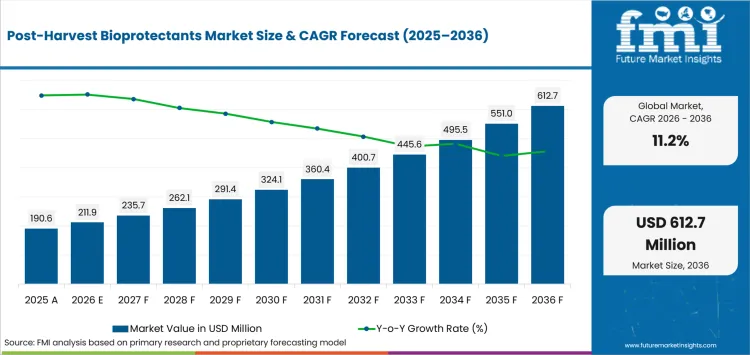
USD 211.9 million in 2026 and USD 612.7 million by 2036 at an 11.2% CAGR.
Demand for post-harvest bioprotectants is projected to expand at an 11.2% CAGR between 2026 and 2036, taking valuation from USD 211.9 million in 2026 to USD 612.7 million by 2036. Packhouse managers pay for protection when decay or moisture loss reduces saleable packout. In September 2025, FAO reported a 25.4% global food-loss rate for fruits and vegetables. Repeat use depends on crop protocols that preserve quality without slowing commercial handling.
National handling conditions change the proof required for routine use. The United Kingdom handles a large mix of domestic and imported fruit through storage and distribution. Defra's June 2026 data show that total UK fruit supply increased 7.3% during 2025. More volume exposes packhouses to different origin profiles and destination requirements. Residue rules must fit the packer's wash or coating sequence before crop performance is accepted for routine use.
Key Takeaways
- Fresh-produce losses make saleable packout and decay control the main economic case for post-harvest bioprotectants.
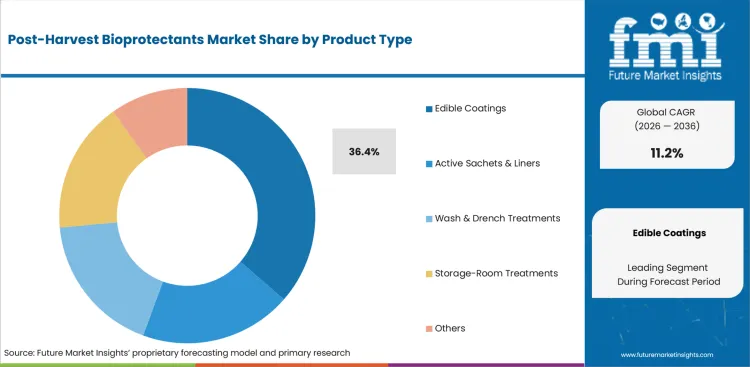
- By product type, edible coatings are estimated to hold 36.4% in 2026 owing to direct surface protection that fits current finishing lines.
- Pome & stone fruit is projected to hold 35.5% share in 2026 owing to long storage exposure and grade-sensitive selling.
- In 2026, packhouse is expected to lead application point with 49.6% share because treatment can be controlled before storage or dispatch.
- Some of the key players in this market include Syngenta, AgroFresh, Apeel Sciences, Hazel Technologies, DECCO (UPL), Pace International, Xeda International, and Citrosol.
Analyst Perspective
"Post-harvest bioprotectants earn repeat use when the treatment recovers saleable packout without slowing the packing line. Strong offers pair crop-specific efficacy with residue documentation and dosing control that packhouses can repeat through variable storage and transit conditions."
- Nandini Roy Choudhury, Principal Consultant, Future Market Insights
How is the post-harvest bioprotectants market segmented?
The post-harvest bioprotectants market is segmented by product type, commodity, application point, technology base, sales channel and region.
Product types cover edible coatings, active sachets & liners, wash & drench treatments, storage-room treatments and others. Commodities comprise pome & stone fruit, citrus, berries & grapes, tropical fruit, vegetables and others. Application points are packhouse, storage facility, transit & retail and others. Technology base includes biological - microbial, plant-extract-based, mineral & wax-based and others. Sales channels comprise packhouse suppliers, post-harvest service providers, direct sales and others. Regional analysis follows the report taxonomy.
What makes edible coatings central to the product type category?
Packers select surface treatments that fit washing or finishing without requiring a separate storage step. Edible films and coatings slow moisture transfer on the produce surface. AgroFresh's June 2025 NatuWrap agreement gave packers another commercial coating option inside an established post-harvest distribution network.
- By product type, edible coatings are estimated to hold 36.4% in 2026 owing to direct application on the produce surface.
- Packers can trial a coating on an existing line before extending it to more crops. Drying behavior and finish quality determine whether that trial becomes routine use.
Why does pome & stone fruit lead the commodity category?
Apples and pears spend longer periods in storage than many soft fruits. Post-harvest treatment becomes more valuable as packers protect firmness and saleable weight over that holding period. Stone fruit has a shorter decision window because quality can deteriorate quickly after harvest.
- Pome & stone fruit is projected to hold 35.5% share in 2026 owing to long storage exposure and repeat quality checks.
- Treatment choice differs by storage duration: pome fruit programs emphasize firmness, weight retention and controlled-atmosphere compatibility, while stone-fruit programs prioritize rapid decay control before short distribution windows close.
How does packhouse shape the application point category?
Fresh food packaging supports later distribution, but packhouse treatment is where wash, coating and drench decisions can be controlled before storage or dispatch. Packers prefer this point because operators can record dosage, drying time, commodity lot and sanitation conditions in one workflow. That makes performance easier to repeat across crop changeovers and destination requirements.
- In 2026, packhouse is expected to lead the application point category with 49.6% share because treatment can be standardized before dispatch.
- Packhouse application also reduces handoff risk because treatment evidence is created before the produce enters storage, transit or retail programs that may have stricter residue and quality documentation needs.
What supports biological - microbial within the technology base category?
Biological treatments are most relevant where packers want decay control with less reliance on conventional chemistry. Biocontrol agents must remain stable in storage and prove crop-specific efficacy before routine use. Packers then test formulation behavior under commercial temperature and sanitation conditions.
- Biological - microbial is set to lead the technology base with 45.3% share in 2026 due to demand for biologically based decay control.
- Biotalys and AgroFresh announced a collaboration in May 2025 to develop and commercialize biological fungicides for post-harvest use. The program targets mold and rot after harvest.
What drives packhouse suppliers within the sales channel category?
Packhouse suppliers work beside dosing equipment and crop changeovers where treatment performance is set. Cold chain packaging protects later distribution stages but cannot resolve a wash or coating problem on the line. AgroFresh's November 2025 partnerships with Aerobotics and Neolithics extended packhouse quality measurement within its FreshCloud service.
- By sales channel, packhouse suppliers are forecast to represent 42.6% in 2026 driven by line-side application support and replenishment.
- Local service and replenishment reduce the time between a successful trial and routine seasonal use during crop changeovers.
What are the drivers, restraints and opportunities in the Post-Harvest Bioprotectants Market?
Fresh-produce loss raises the value of preservation, residue and application checks slow switching, and loose-produce programs give freshness treatments a larger role in open-display quality.
- Driver: Produce loss turns preservation into a packout and claims decision for growers and packers.
- Restraint: Residue controls and application validation extend the route from a successful trial to routine use.
- Opportunity: Loose-produce programs increase the value of treatments that preserve open-display quality without a single-use pack.
Fresh-Produce Loss Makes Saleable Packout the Economic Test
Post-harvest loss directly reduces the volume a packhouse can sell. India's Ministry of Agriculture reported in July 2025 that fruit losses ranged from 6.02% to 15.05% and vegetable losses from 4.87% to 11.61%. The ministry linked those losses to harvesting and handling plus storage and transport. Treatment spending therefore competes against the value of recovered packout at normal line speed. Repeat use depends on recovering saleable packout without sensory or residue problems.
Residue Controls Extend the Qualification Cycle
Technical performance does not guarantee commercial approval. In April 2026, Commission Implementing Regulation (EU) 2026/748 set the Union pesticide-residue control programme for 2027 to 2029. Export packers must align crop permission with destination tolerances and sanitation records for each export program. Treatments without clear labels and application records take longer to approve for routine use.
Loose Produce Raises the Value of Packhouse Freshness Control
Loose-produce programs transfer part of the quality burden from packaging to handling and freshness control. In May 2025 WRAP documented a cucumber producer that switched to loose supply within 18 months with no increase in losses after testing several interventions. Packhouses can test coatings and compatible treatments for open-display produce if quality holds through the retail window. Revenue depends on preserving quality without replacing packaging cost with a larger treatment or labor burden.
Which country CAGRs are profiled in the Post-Harvest Bioprotectants Market?
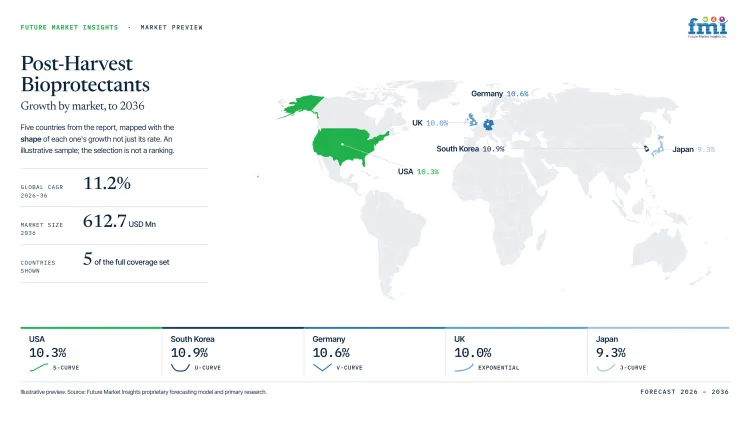
| Country | CAGR |
|---|---|
| South Korea | 10.9% |
| Germany | 10.6% |
| USA | 10.3% |
| UK | 10.0% |
| Japan | 9.3% |
How do country-level CAGRs compare in the Post-Harvest Bioprotectants Market?
The 1.6 percentage-point spread separates an upper pair from a lower-growth edge without creating a wide forecast gap. South Korea and Germany form the upper group at 10.9% and 10.6%. The ranking therefore turns on local crop programs and treatment economics more than rate dispersion alone.
- South Korean berry exporters judge treatments by arrival condition overseas.
- German grocery groups can standardize packhouse specifications at scale.
- US interstate routes expose one protocol to many crops and climates.
- UK seasonal sourcing mixes domestic and imported maturity profiles.
- Japanese premium retail gives little tolerance for visible quality drift.
Similar rates hide different trial economics. The full report provides country-level CAGR analysis across North America, Latin America, Western Europe, Eastern Europe, East Asia, South Asia and Pacific, and the Middle East and Africa.
Country-wise Analysis
- Large US commercial produce packhouses use recirculated wash systems and automated lines that make treatment control part of food-safety execution. Demand for post-harvest bioprotectants in USA is forecast to rise at 10.3% CAGR over the forecast period driven by repeatable preservation needs in high-volume packing. FDA confirmed in September 2025 that harvest and post-harvest water rules already applied to covered farms. Active packaging protects transit stages but wash and drench treatments must fit crop permissions and the installed sanitation program. Auditable dosing records let packhouses compare line performance during a trial and decide whether the same protocol merits seasonal reuse.
- UK fresh-produce programs increasingly test whether quality can be preserved with less single-use packaging as imported fruit arrives with varied origin and transit conditions. The UK post-harvest bioprotectants outlook is anticipated to advance at 10.0% CAGR over the assessment period attributable to retailer waste-reduction and loose-produce programs. WRAP found in March 2025 that shoppers preferred loose formats for 19 of 21 common fruit and vegetables surveyed. Food packaging protects some items but loose sale transfers more of the freshness burden to packhouse handling and treatment. Retail trials therefore judge whether an added treatment cuts shrink without raising line cost or residue risk.
- Harmonized EU residue rules give German produce packers a common compliance base for produce shipped between member-state markets. The German post-harvest bioprotectants sector is projected to record 10.6% CAGR during the assessment period supported by structured waste-reduction targets used by major grocery groups. A December 2025 Thünen Institute monitoring report recorded a 25% food-waste reduction among participating wholesale and retail companies for 2024. Active and intelligent packaging gives retailers another quality-control option but treatments need crop eligibility and traceable application records. Entrants with repeatable dosing records can compare discard reduction at large retail accounts before they widen a treatment program.
- Japanese produce programs impose tight appearance and eating-quality specifications through cold storage and long domestic distribution routes. New shelf-life treatments compete with crop breeding and modified atmosphere packaging for the same preservation budget at premium retail accounts. Adoption of post-harvest bioprotectants in Japan is estimated to expand at 9.3% CAGR through 2036 owing to demanding quality requirements and long-distance distribution needs. NARO's May 2026 melon study found that genome-edited fruit retained green rind and firm flesh for more than one month after harvest. A post-harvest treatment therefore needs crop-specific storage data that proves an advantage without disrupting the packer's ripening protocol.
- Centralized freshness control is already built into South Korea's strawberry export programs at agricultural distribution centers serving overseas markets. Post-harvest bioprotectant sales in South Korea are forecast to expand at 10.9% CAGR by 2036 driven by organized packhouse adoption and export-quality requirements. In April 2025, the Rural Development Administration documented deployment of its combined freshness treatment at 14 strawberry export complexes. Freshness ripening control technologies compete for the same quality budget during cold storage and overseas shipment to demanding retail customers. Joint export-packhouse trials let growers compare new biological or coating treatments with the installed program before deciding on seasonal use.
Who are the notable companies in the Post-Harvest Bioprotectants Market?
Syngenta, AgroFresh, Apeel Sciences, Hazel Technologies, DECCO (UPL), Pace International, Xeda International and Citrosol are the notable companies profiled in this market.
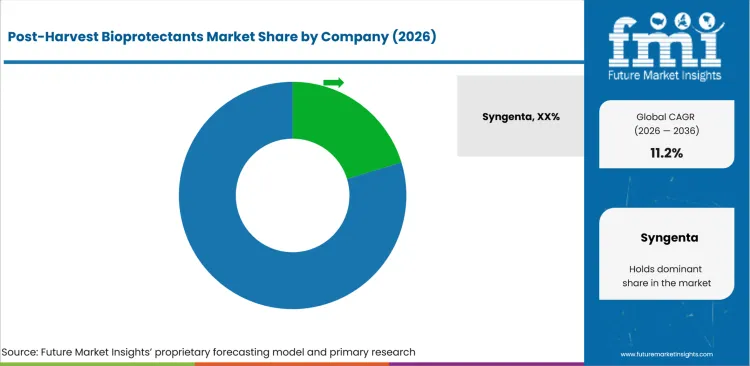
Competition turns on where protection enters the handling sequence. AgroFresh and Pace International pair treatment chemistry with application equipment and service. DECCO (UPL) and Citrosol concentrate on packhouse treatment and dosing control. Apeel Sciences and Hazel Technologies focus on surface or atmosphere-based preservation formats. Syngenta and Xeda International bring biological or plant-derived routes that depend more heavily on crop registrations. Crop approvals and line-side application support set the entry bar for new offers.
- AgroFresh and DECCO (UPL) join Pace International and Citrosol in covering multiple treatment or application steps.
- Apeel Sciences and Hazel Technologies specialize in surface or atmosphere-based freshness formats.
- Syngenta and Xeda International supply biological or plant-derived post-harvest treatments where registrations permit use.
Competitive Benchmarking: Post-Harvest Bioprotectants Market
| Company | Treatment Format Breadth | Natural or Biological Route | Packhouse or Storage Integration | Geographic Reach |
|---|---|---|---|---|
| Syngenta | Medium | Medium | Medium | Americas plus selected international post-harvest markets |
| AgroFresh | High | High | High | Global |
| Apeel Sciences | Low | Medium | Low | North America, Europe, Latin America and selected global programs |
| Hazel Technologies | Medium | Low | Medium | North America and international produce-shipping programs |
| DECCO (UPL) | High | Medium | High | Global production network serving major fruit regions |
| Pace International | High | Medium | High | North America and international fruit regions within AgroFresh |
| Xeda International | High | High | High | Europe and international distributor network |
| Citrosol | High | High | High | Europe, Latin America, Africa and selected Asian produce markets |
Scoring basis: High treatment breadth requires at least three documented post-harvest formats. Medium requires two formats and Low identifies one. Natural or biological coverage is High with two documented natural routes and Medium with one. Low requires a documented conventional-only route. Integration is High where treatment equipment or controls cover multiple packhouse or storage steps. Medium identifies one documented integration route and Low identifies a format without line integration.
Key Developments in the Post-Harvest Bioprotectants Market
- In February 2026, Syngenta expanded its agreement with Botanical Solution Inc. to distribute Quillibrium in Mexico and Canada plus the United States. The botanical biofungicide agreement includes post-harvest applications.
- In September 2025, DECCO announced a new manufacturing plant in Beniparrell near Valencia. The site was scheduled to begin operation in October 2025 and expand the network from eight plants to nine.
- In March 2025, Hazel Technologies announced development of a BreatheWay modified-atmosphere pallet bag for broccoli shipments. The company had completed case-liner studies and was seeking commercial partners for pallet trials.
Key Players in the Post-Harvest Bioprotectants Market
Integrated Post-Harvest Treatment Platforms
- AgroFresh
- DECCO (UPL)
- Pace International
- Citrosol
Surface and Active Freshness Specialists
- Apeel Sciences
- Hazel Technologies
Biological and Plant-Derived Protection Providers
- Syngenta
- Xeda International
Post-Harvest Bioprotectants Market - Report Scope
| Coverage field | Report scope |
|---|---|
| Market breakdown | By product type, commodity, application point, technology base, sales channel and region. |
| Quantitative Units | USD million. |
| Market Definition | Commercial post-harvest treatments and freshness-protection systems used on harvested fruits and vegetables or within their handling environment to reduce decay and quality loss. |
| Regions Covered | North America, Latin America, Western Europe, Eastern Europe, East Asia, South Asia and Pacific, and Middle East and Africa. |
| Countries Covered | South Korea, Germany, USA, UK, Japan and 20+ countries included in the full report. |
| Key Companies Profiled | Syngenta, AgroFresh, Apeel Sciences, Hazel Technologies, DECCO (UPL), Pace International, Xeda International and Citrosol. |
| Forecast Period | 2026 to 2036. |
| Approach | Primary and secondary research with market triangulation. |
Post-Harvest Bioprotectants Market - Research Methodology
| Method | Approach |
|---|---|
| Primary Research | FMI analysts gathered input from manufacturers, service providers, technology developers, distributors, end users, procurement teams, and subject-matter experts. Interviews examined purchasing decisions, product or service evaluation, adoption barriers, approval requirements, pricing considerations, and expectations for technical or commercial support. Respondents were also asked what evidence is required before a trial, pilot, or initial order develops into regular purchasing. |
| Desk Research | Desk research covered government statistics, regulatory publications, trade data, industry associations, technical literature, standards, company filings, product information, and official corporate announcements. Sources were reviewed for relevance, publication date, geographic coverage, and consistency with the defined market scope. Claims relating to performance, applications, approvals, capacity, investment, and commercial activity were retained only when supported by credible public evidence. |
| Market Sizing and Forecasting | The market model combined the baseline value with historical performance, segment structure, pricing and volume indicators, adoption levels, company participation, and country-level demand conditions. Forecast assumptions considered economic activity, investment trends, regulatory developments, technology adoption, purchasing cycles, supply availability, and barriers to wider market use. Segment and regional estimates were reconciled before the final market total was calculated. |
| Data Validation | Estimates were checked against multiple independent indicators, including public data, company activity, trade patterns, industry developments, and findings from primary interviews. Validation also tested whether products, services, applications, and company revenues fell within the defined market boundaries. Adjacent categories, unsupported claims, overlapping revenues, and activities without direct market relevance were excluded to reduce double counting and maintain consistency across segments and countries. |
Post-Harvest Bioprotectants Market by Segments
Post-Harvest Bioprotectants Market segmented by Product Type:
- Edible Coatings
- Active Sachets & Liners
- Wash & Drench Treatments
- Storage-Room Treatments
- Others
Post-Harvest Bioprotectants Market segmented by Commodity:
- Pome & Stone Fruit
- Citrus
- Berries & Grapes
- Tropical Fruit
- Vegetables
- Others
Post-Harvest Bioprotectants Market segmented by Application Point:
- Packhouse
- Storage Facility
- Transit & Retail
- Others
Post-Harvest Bioprotectants Market segmented by Technology Base:
- Biological - Microbial
- Plant-Extract-Based
- Mineral & Wax-Based
- Others
Post-Harvest Bioprotectants Market segmented by Sales Channel:
- Packhouse Suppliers
- Post-Harvest Service Providers
- Direct Sales
- Others
Post-Harvest Bioprotectants Market by Region:
- North America
- United States
- Canada
- Latin America
- Brazil
- Mexico
- Argentina
- Chile
- Western Europe
- Germany
- France
- United Kingdom
- Italy
- Spain
- Benelux
- Nordics
- Eastern Europe
- Poland
- Czech Republic
- Romania
- Hungary
- East Asia
- China
- Japan
- South Korea
- South Asia and Pacific
- India
- ASEAN
- Australia and New Zealand
- Middle East and Africa
- GCC Countries
- South Africa
- Türkiye
- Israel
Research Sources and Bibliography
- Food and Agriculture Organization of the United Nations. (2025, September 29). On the International Day of Awareness of Food Loss and Waste, learn how FAO is leveraging data to save food and advance the 2030 Agenda.
- Department for Environment, Food & Rural Affairs. (2026, June 25). Horticulture statistics 2025.
- AgroFresh Solutions, Inc. (2025, June 18). AgroFresh Expands Global Post-Harvest Solutions Portfolio with NatuWrap® in Exclusive Distribution Agreement with Nabaco®.
- Department for Environment, Food & Rural Affairs. (2026, September 3). Chapter 7: Crops.
- Citrosol. (2025, September 11). Citrosol renews itself at Fruit Attraction 2025 and premieres location in Hall 10.
- AgroFresh Solutions, Inc. (2025, May 20). Biotalys and AgroFresh Partner to Protect Fresh Produce.
- AgroFresh Solutions, Inc. (2025, November 5). AgroFresh Announces New AI-Powered Imaging and Orchard Analytics Partnerships with Aerobotics and Neolithics.
- Ministry of Agriculture & Farmers Welfare. (2025, July 25). SCHEMES TO MINIMISE POST-HARVEST LOSSES.
- European Commission. (2026, April 1). Commission Implementing Regulation (EU) 2026/748 of 31 March 2026 concerning a coordinated multiannual control programme of the Union for 2027, 2028 and 2029 to ensure compliance with maximum residue levels of pesticides and to assess the consumer exposure to pesticide residues in and on food of plant and animal origin, and repealing Implementing Regulation (EU) 2025/854.
- WRAP. (2025, May 5). Unpacking the Opportunity: Removing plastic from cucumbers case study.
- USA Food and Drug Administration. (2025, September 30). FDA Publishes Agricultural Water FAQs and Information on FDA’s Implementation of the Pre-harvest Agricultural Water Requirements under the FSMA Produce Safety Rule.
- WRAP. (2025, March 17). Buy loose, waste less: more than half of UK adults shopping for fresh fruit and veg prefer loose over packaged.
- Kuntscher, M., & Schmidt, T. G. (2025, December 4). Pakt gegen Lebensmittelverschwendung im Groß- und Einzelhandel - Ergebnisbericht zum Monitoring 2024.
- National Agriculture and Food Research Organization. (2026, May 26). Long-lasting melons developed through genome editing.
- Rural Development Administration, Republic of Korea. (2025, April 8). 딸기 신선도 유지 기술 고도화, 수출 경쟁력 높아져.
- Syngenta. (2026, February 19). From Chile’s Forests to Fields, Syngenta brings botanical-based biofungicide to the Americas.
- DECCO. (2025, September 23). DECCO Expands Global Footprint with New Plant in Valencia, Spain.
- Hazel Technologies. (2025, March 17). New packaging technology eliminates the need for ice when shipping broccoli.
- Apeel Sciences. (2025, June 3). Apeel Sciences Recognized by Food & Wine as a 2025 Game Changer for Food Innovation.
- AgroFresh Solutions, Inc. (2024, March 27). AgroFresh Acquires Pace International LLC Expanding Post-Harvest Solutions Portfolio.
- Xeda Ibérica. (2025, September 1). ¿Qué es la certificación de agricultura ecológica y cómo la apoyan nuestros productos?
- Oficina Española de Cambio Climático. (2026, January 23). Certificado de inscripción.
- AgroFresh Solutions, Inc. (2025, March 17). AgroFresh Presents New Digital Post-Harvest Technology at Fruit Attraction 2025 in São Paulo.
- AgroFresh Solutions, Inc. (2026, April 24). AgroFresh Opens New Asia Pacific R&D Center in Yangling, China.
- DECCO. (2025, January 21). DECCO Ibérica receives the registration for DECCO Zox: First Product formulated with Azoxystrobin in Europe in Postharvest Citrus Protection.
- Oregon Tilth Certified Organic. (2025, July 8). Organic Certificate of Operation: DECCO US Post-Harvest, Inc.
This bibliography is provided for reader reference and is not exhaustive. The full report contains the complete reference list and detailed citations
This Report Answers
- How large is the post-harvest bioprotectants market in 2026 and 2036?
- Which fresh-produce losses create the strongest commercial need for post-harvest protection?
- Why do edible coatings hold 36.4% of product-type demand in 2026?
- How does pome & stone fruit shape storage and treatment requirements?
- Why does packhouse account for 49.6% of application-point demand in 2026?
- How do the profiled country CAGRs differ from 2026 to 2036?
- Which companies compete through coatings and biological treatments plus active freshness formats?
- Which residue and workflow conditions can delay a successful trial from becoming routine use?
Frequently Asked Questions
How big is the Post-Harvest Bioprotectants Market in 2026?
The post-harvest bioprotectants market is valued at USD 211.9 million in 2026 and is projected to reach USD 612.7 million by 2036. Growth is driven by the need to protect saleable packout during storage and distribution.
What is the CAGR of the Post-Harvest Bioprotectants Market from 2026 to 2036?
The post-harvest bioprotectants market is projected to grow at a CAGR of 11.2% between 2026 and 2036. Expansion is supported by repeated packhouse treatment needs and stronger efforts to reduce food loss during storage and distribution.
Which product type leads the Post-Harvest Bioprotectants Market?
The edible coatings segment is expected to hold 36.4% of the post-harvest bioprotectants market in 2026, driven by direct surface protection that fits current finishing lines. Packers still require crop-specific proof before routine use.
How much value will the Post-Harvest Bioprotectants Market add between 2026 and 2036?
The post-harvest bioprotectants market is expected to add USD 400.8 million in value between 2026 and 2036. Wider commercial use depends on treatments protecting packout during storage and distribution.
Which companies are active in the Post-Harvest Bioprotectants Market?
Syngenta and AgroFresh operate alongside Apeel Sciences and Hazel Technologies in the post-harvest bioprotectants market. DECCO (UPL) and Pace International also compete with Xeda International and Citrosol through treatment breadth and packhouse application support.
Preview the report firsthand - request a free sample
Get SampleGet the brochure for pricing and purchase details.
Get PDFTable of Content
- Key Takeaways
- Market Size and CAGR
- Top Growth Driver
- Fastest Growing Segment
- Leading Region
- Key Companies
- Emerging Opportunities
- Executive Summary
- Global Market Outlook
- Demand-side Trends
- Supply-side Trends
- Technology Roadmap Analysis
- Analysis and Recommendations
- Analyst Perspective (What is happening? Why now? What should investors know?)
- Key Questions Answered
- How large is the market?
- What is the CAGR?
- What are key trends?
- Which region dominates?
- Who are the leaders?
- Market Overview
- Market Coverage / Taxonomy
- Market Definition / Scope / Limitations
- Research Methodology
- Chapter Orientation
- Analytical Lens and Working Hypotheses
- Market Structure, Signals, and Trend Drivers
- Benchmarking and Cross-market Comparability
- Market Sizing, Forecasting, and Opportunity Mapping
- Research Design and Evidence Framework
- Desk Research Programme (Secondary Evidence)
- Expert Input and Fieldwork (Primary Evidence)
- Tooling, Models, and Reference Databases
- Data Engineering and Model Build
- Quality Assurance and Audit Trail
- Market Background
- Market Dynamics (Drivers, Restraints, Opportunity, Trends)
- Scenario Forecast (Optimistic, Likely, Conservative)
- Impact Analysis
- AI Impact
- Sustainability Impact
- Regulatory Impact
- Technology Impact
- Consumer / Buyer Analysis
- Purchase Drivers
- Adoption Barriers
- Buyer Journey
- Opportunity Map Analysis
- Product Life Cycle Analysis
- Supply Chain Analysis
- Investment Feasibility Matrix
- Value Chain Analysis
- PESTLE and Porter's Analysis
- Regulatory Landscape
- Regional Parent Market Outlook
- Production and Consumption Statistics
- Import and Export Statistics
- Global Market Analysis and Forecast, 2021 to 2036
- Historical Market Size Value (USD Million) Analysis, 2021 to 2025
- Current and Future Market Size Value (USD Million) Projections, 2026 to 2036
- Y-o-Y Growth Trend Analysis
- Absolute $ Opportunity Analysis
- Global Market Pricing Analysis, 2021 to 2036
- Global Market Analysis and Forecast, By Product Type, 2021 to 2036
- Introduction / Key Findings
- Historical Market Size Value (USD Million) Analysis By Product Type, 2021 to 2025
- Current and Future Market Size Value (USD Million) Analysis and Forecast By Product Type, 2026 to 2036
- Edible Coatings
- Active Sachets & Liners
- Wash & Drench Treatments
- Storage-Room Treatments
- Others
- Edible Coatings
- Y-o-Y Growth Trend Analysis By Product Type, 2021 to 2025
- Absolute $ Opportunity Analysis By Product Type, 2026 to 2036
- Global Market Analysis and Forecast, By Commodity, 2021 to 2036
- Introduction / Key Findings
- Historical Market Size Value (USD Million) Analysis By Commodity, 2021 to 2025
- Current and Future Market Size Value (USD Million) Analysis and Forecast By Commodity, 2026 to 2036
- Pome & Stone Fruit
- Citrus
- Berries & Grapes
- Tropical Fruit
- Vegetables
- Others
- Pome & Stone Fruit
- Y-o-Y Growth Trend Analysis By Commodity, 2021 to 2025
- Absolute $ Opportunity Analysis By Commodity, 2026 to 2036
- Global Market Analysis and Forecast, By Application Point, 2021 to 2036
- Introduction / Key Findings
- Historical Market Size Value (USD Million) Analysis By Application Point, 2021 to 2025
- Current and Future Market Size Value (USD Million) Analysis and Forecast By Application Point, 2026 to 2036
- Packhouse
- Storage Facility
- Transit & Retail
- Others
- Packhouse
- Y-o-Y Growth Trend Analysis By Application Point, 2021 to 2025
- Absolute $ Opportunity Analysis By Application Point, 2026 to 2036
- Global Market Analysis and Forecast, By Technology Base, 2021 to 2036
- Introduction / Key Findings
- Historical Market Size Value (USD Million) Analysis By Technology Base, 2021 to 2025
- Current and Future Market Size Value (USD Million) Analysis and Forecast By Technology Base, 2026 to 2036
- Biological / Microbial
- Plant-Extract-Based
- Mineral & Wax-Based
- Others
- Biological / Microbial
- Y-o-Y Growth Trend Analysis By Technology Base, 2021 to 2025
- Absolute $ Opportunity Analysis By Technology Base, 2026 to 2036
- Global Market Analysis and Forecast, By Sales Channel, 2021 to 2036
- Introduction / Key Findings
- Historical Market Size Value (USD Million) Analysis By Sales Channel, 2021 to 2025
- Current and Future Market Size Value (USD Million) Analysis and Forecast By Sales Channel, 2026 to 2036
- Packhouse Suppliers
- Post-Harvest Service Providers
- Direct Sales
- Others
- Packhouse Suppliers
- Y-o-Y Growth Trend Analysis By Sales Channel, 2021 to 2025
- Absolute $ Opportunity Analysis By Sales Channel, 2026 to 2036
- Global Market Analysis and Forecast, By Region, 2021 to 2036
- Introduction
- Historical Market Size Value (USD Million) Analysis By Region, 2021 to 2025
- Current Market Size Value (USD Million) Analysis and Forecast By Region, 2026 to 2036
- North America
- Latin America
- Western Europe
- Eastern Europe
- East Asia
- South Asia and Pacific
- Middle East & Africa
- Market Attractiveness Analysis By Region
- North America Market Analysis and Forecast, By Country, 2021 to 2036
- Historical Market Size Value (USD Million) Trend Analysis By Market Taxonomy, 2021 to 2025
- Market Size Value (USD Million) Forecast By Market Taxonomy, 2026 to 2036
- By Country
- USA
- Canada
- By Product Type
- By Commodity
- By Application Point
- By Technology Base
- By Sales Channel
- By Country
- Market Attractiveness Analysis
- By Country
- By Product Type
- By Commodity
- By Application Point
- By Technology Base
- By Sales Channel
- Key Takeaways
- Latin America Market Analysis and Forecast, By Country
- Historical Market Size Value (USD Million) Trend Analysis By Market Taxonomy, 2021 to 2025
- Market Size Value (USD Million) Forecast By Market Taxonomy, 2026 to 2036
- By Country
- Brazil
- Mexico
- Chile
- Rest of Latin America
- By Product Type
- By Commodity
- By Application Point
- By Technology Base
- By Sales Channel
- By Country
- Market Attractiveness Analysis
- By Country
- By Product Type
- By Commodity
- By Application Point
- By Technology Base
- By Sales Channel
- Key Takeaways
- Western Europe Market Analysis and Forecast, By Country
- Historical Market Size Value (USD Million) Trend Analysis By Market Taxonomy, 2021 to 2025
- Market Size Value (USD Million) Forecast By Market Taxonomy, 2026 to 2036
- By Country
- Germany
- UK
- Italy
- Spain
- France
- Nordic
- BENELUX
- Rest of Western Europe
- By Product Type
- By Commodity
- By Application Point
- By Technology Base
- By Sales Channel
- By Country
- Market Attractiveness Analysis
- By Country
- By Product Type
- By Commodity
- By Application Point
- By Technology Base
- By Sales Channel
- Key Takeaways
- Eastern Europe Market Analysis and Forecast, By Country
- Historical Market Size Value (USD Million) Trend Analysis By Market Taxonomy, 2021 to 2025
- Market Size Value (USD Million) Forecast By Market Taxonomy, 2026 to 2036
- By Country
- Russia
- Poland
- Hungary
- Balkan & Baltic
- Rest of Eastern Europe
- By Product Type
- By Commodity
- By Application Point
- By Technology Base
- By Sales Channel
- By Country
- Market Attractiveness Analysis
- By Country
- By Product Type
- By Commodity
- By Application Point
- By Technology Base
- By Sales Channel
- Key Takeaways
- East Asia Market Analysis and Forecast, By Country
- Historical Market Size Value (USD Million) Trend Analysis By Market Taxonomy, 2021 to 2025
- Market Size Value (USD Million) Forecast By Market Taxonomy, 2026 to 2036
- By Country
- China
- Japan
- South Korea
- By Product Type
- By Commodity
- By Application Point
- By Technology Base
- By Sales Channel
- By Country
- Market Attractiveness Analysis
- By Country
- By Product Type
- By Commodity
- By Application Point
- By Technology Base
- By Sales Channel
- Key Takeaways
- South Asia and Pacific Market Analysis and Forecast, By Country
- Historical Market Size Value (USD Million) Trend Analysis By Market Taxonomy, 2021 to 2025
- Market Size Value (USD Million) Forecast By Market Taxonomy, 2026 to 2036
- By Country
- India
- ASEAN
- Australia & New Zealand
- Rest of South Asia and Pacific
- By Product Type
- By Commodity
- By Application Point
- By Technology Base
- By Sales Channel
- By Country
- Market Attractiveness Analysis
- By Country
- By Product Type
- By Commodity
- By Application Point
- By Technology Base
- By Sales Channel
- Key Takeaways
- Middle East & Africa Market Analysis and Forecast, By Country
- Historical Market Size Value (USD Million) Trend Analysis By Market Taxonomy, 2021 to 2025
- Market Size Value (USD Million) Forecast By Market Taxonomy, 2026 to 2036
- By Country
- Kingdom of Saudi Arabia
- Other GCC Countries
- Türkiye
- South Africa
- Other African Union
- Rest of Middle East & Africa
- By Product Type
- By Commodity
- By Application Point
- By Technology Base
- By Sales Channel
- By Country
- Market Attractiveness Analysis
- By Country
- By Product Type
- By Commodity
- By Application Point
- By Technology Base
- By Sales Channel
- Key Takeaways
- Key Countries Market Analysis
- USA
- Pricing Analysis
- Market Share Analysis, 2025
- By Product Type
- By Commodity
- By Application Point
- By Technology Base
- By Sales Channel
- Canada
- Pricing Analysis
- Market Share Analysis, 2025
- By Product Type
- By Commodity
- By Application Point
- By Technology Base
- By Sales Channel
- Mexico
- Pricing Analysis
- Market Share Analysis, 2025
- By Product Type
- By Commodity
- By Application Point
- By Technology Base
- By Sales Channel
- Brazil
- Pricing Analysis
- Market Share Analysis, 2025
- By Product Type
- By Commodity
- By Application Point
- By Technology Base
- By Sales Channel
- Chile
- Pricing Analysis
- Market Share Analysis, 2025
- By Product Type
- By Commodity
- By Application Point
- By Technology Base
- By Sales Channel
- Germany
- Pricing Analysis
- Market Share Analysis, 2025
- By Product Type
- By Commodity
- By Application Point
- By Technology Base
- By Sales Channel
- UK
- Pricing Analysis
- Market Share Analysis, 2025
- By Product Type
- By Commodity
- By Application Point
- By Technology Base
- By Sales Channel
- Italy
- Pricing Analysis
- Market Share Analysis, 2025
- By Product Type
- By Commodity
- By Application Point
- By Technology Base
- By Sales Channel
- Spain
- Pricing Analysis
- Market Share Analysis, 2025
- By Product Type
- By Commodity
- By Application Point
- By Technology Base
- By Sales Channel
- France
- Pricing Analysis
- Market Share Analysis, 2025
- By Product Type
- By Commodity
- By Application Point
- By Technology Base
- By Sales Channel
- India
- Pricing Analysis
- Market Share Analysis, 2025
- By Product Type
- By Commodity
- By Application Point
- By Technology Base
- By Sales Channel
- ASEAN
- Pricing Analysis
- Market Share Analysis, 2025
- By Product Type
- By Commodity
- By Application Point
- By Technology Base
- By Sales Channel
- Australia & New Zealand
- Pricing Analysis
- Market Share Analysis, 2025
- By Product Type
- By Commodity
- By Application Point
- By Technology Base
- By Sales Channel
- China
- Pricing Analysis
- Market Share Analysis, 2025
- By Product Type
- By Commodity
- By Application Point
- By Technology Base
- By Sales Channel
- Japan
- Pricing Analysis
- Market Share Analysis, 2025
- By Product Type
- By Commodity
- By Application Point
- By Technology Base
- By Sales Channel
- South Korea
- Pricing Analysis
- Market Share Analysis, 2025
- By Product Type
- By Commodity
- By Application Point
- By Technology Base
- By Sales Channel
- Russia
- Pricing Analysis
- Market Share Analysis, 2025
- By Product Type
- By Commodity
- By Application Point
- By Technology Base
- By Sales Channel
- Poland
- Pricing Analysis
- Market Share Analysis, 2025
- By Product Type
- By Commodity
- By Application Point
- By Technology Base
- By Sales Channel
- Hungary
- Pricing Analysis
- Market Share Analysis, 2025
- By Product Type
- By Commodity
- By Application Point
- By Technology Base
- By Sales Channel
- Kingdom of Saudi Arabia
- Pricing Analysis
- Market Share Analysis, 2025
- By Product Type
- By Commodity
- By Application Point
- By Technology Base
- By Sales Channel
- Türkiye
- Pricing Analysis
- Market Share Analysis, 2025
- By Product Type
- By Commodity
- By Application Point
- By Technology Base
- By Sales Channel
- South Africa
- Pricing Analysis
- Market Share Analysis, 2025
- By Product Type
- By Commodity
- By Application Point
- By Technology Base
- By Sales Channel
- USA
- Market Structure Analysis
- Competition Dashboard
- Competition Benchmarking
- Market Share Analysis of Top Players
- By Regional
- By Product Type
- By Commodity
- By Application Point
- By Technology Base
- By Sales Channel
- Emerging Startups
- Innovation Benchmarking
- Competition Analysis
- Competition Deep Dive
- Syngenta
- Overview
- Product Portfolio
- Profitability by Market Segments
- Sales Footprint
- Strategy Overview
- Marketing Strategy
- Product Strategy
- Channel Strategy
- AgroFresh
- Apeel Sciences
- Hazel Technologies
- DECCO (UPL)
- Pace International
- Xeda International
- Citrosol
- Syngenta
- Case Studies
- Success Stories
- Recent Developments
- Competition Deep Dive
- Assumptions & Acronyms Used


