

- Market Size (2026)
- USD 0.9 Bn
- Forecast (2036)
- USD 1.8 Bn
- CAGR (2026 to 2036)
- 7.2%
Private Label Coconut Milk Market Size, Forecast and Outlook By FMI
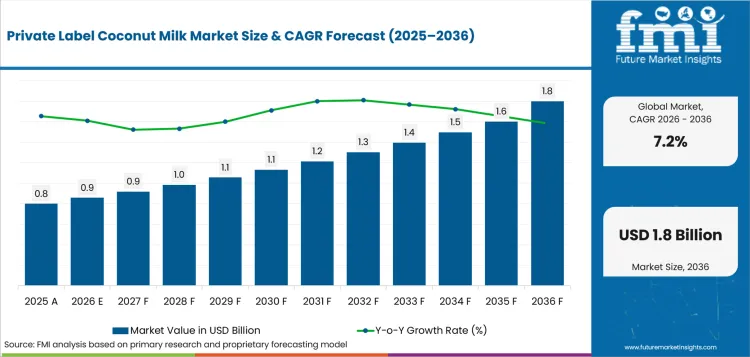
Private label coconut milk market is expected to rise from USD 0.8 billion in 2025 to USD 1.8 billion by 2036 at 7.2% CAGR. Growth is driven by retailer-owned Asian cooking ranges and importer-owned shelf-stable coconut lines. Conventional products are projected to account for 69.2% share as most canned and carton products use standard coconut extract formats. Retailer brands are forecast to secure 61.4% share as supermarkets expand own-label cooking milk and dairy-free shelf assortments.
Key Takeaways, Market Size, and Forecast
- 2026 Market Size: USD 0.9 billion
- 2036 Market Size: USD 1.8 billion
- Forecast CAGR: 7.2% from 2026 to 2036
- Leading Nature: Conventional
- Conventional Share in 2026: 69.2%
- Leading Label Owner: Retailer Brands
- Retailer Brands Share in 2026: 61.4%
- Fastest-expanding Region: GCC and Saudi Arabia
- GCC and Saudi Arabia CAGR: 8.2% by 2036
Summary of Private Label Coconut Milk Market
- Demand and Growth Drivers
- Retailers are adding private label coconut milk because it works well in everyday cooking and pantry stocking.
- Importers prefer coconut milk suppliers that can manage label files and export documents before product launch.
- Shelf-stable cans and cartons make coconut milk easier to handle than chilled dairy-free products.
- Product and Segment View
- Conventional coconut milk is expected to lead because it fits value-focused private label ranges.
- Canned coconut milk is preferred for cooking use because shoppers already connect it with curries and sauces.
- Carton coconut milk is expected to grow in dairy-free shelves where retailers test plant-based drink formats.
- Geography and Competitive Outlook
- North America and Europe are key regions because grocery chains already use private label across pantry products.
- GCC and Saudi Arabia are important import markets because retailers need Halal-ready coconut milk products.
- Asian coconut processors are expected to hold strong supplier positions because production sits close to coconut sourcing.
- Analyst Opinion
- Nandini Roy Choudhury, Principal Consultant for Food and Beverage at FMI, notes, “Private label coconut milk is moving from a low-price cooking item into a retailer-controlled shelf strategy. Buyers now compare supplier certificates, pack flexibility, and coconut extract consistency before awarding repeat programs. Asian processors with OEM systems and export documents are better placed to support store-brand expansion.”
- Private Label Coconut Milk Market Value Analysis
- Market value is expected to come from eligible private label coconut milk SKUs after branded coconut milk is excluded.
- Supplier pricing is expected to reflect coconut extract content and pack type before freight terms affect final cost.
- Revenue is expected to improve as retailers add coconut milk in Asian cooking ranges and dairy-free shelves.
- Buyer trust is expected to increase when suppliers provide label review support and batch-level export documents.
Retailers use private label coconut milk to defend shelf price while keeping vegan cooking and Asian cooking ranges complete. Contract demand is strongest in canned and carton formats because suppliers can repeat fixed recipes and apply retailer artwork across markets. Thailand’s Department of Public Relations reported that Thailand exported US$341.11 million worth of coconut milk from January to October 2024. The value was 16.85% higher than the same period in 2023. That export base makes Thai OEM capacity important for retailers seeking stable private label supply. Thai Coconut supports this sourcing model through OEM and private label coconut-based products backed by GMP and HACCP. The same service page lists BRC and IFS with EU Organic and USDA-NOP. It also lists Halal and Kosher coverage along with BSCI and SEDEX. Erawan Food adds another procurement route by offering coconut milk OEM service for supermarkets, hotels, restaurants and catering clients. The stronger buyer value is not only lower shelf price. It is the ability to combine certification proof and retailer-controlled branding in one supplier relationship.
Private Label Coconut Milk Market Definition
Private Label Coconut Milk Market covers coconut milk and coconut cream products produced by third-party manufacturers. These manufacturers serve retailers and importers. They also serve distributors and foodservice operators. Products are sold under a store brand or client-owned brand. Scope includes canned coconut milk and UHT carton coconut milk. It also includes coconut cream and low-fat coconut milk. Private label coconut milk drinks are included. Revenue includes shelf-stable and foodservice packs sold through grocery and club channels. It also covers online and cash-and-carry channels.
Private Label Coconut Milk Market Inclusions
Market scope covers private label coconut milk products categorized by label owner. Label owner includes retailer brands and importer brands. It also includes distributor brands, foodservice brands and co-packed brands. Product format includes canned coconut milk and carton coconut milk. It also covers pouch packs, aseptic bottles and bulk packs. Nature includes conventional and organic products. It also covers clean label, fortified and low fat products. Packaging type includes metal cans and aseptic cartons.
It also covers flexible pouches, glass bottles and bag-in-box formats. End use includes cooking and beverages. It also covers bakery, desserts and foodservice kitchens. The scope includes products manufactured by third-party coconut processors and sold under store-owned or importer-owned labels. It also includes distributor-owned and foodservice-owned labels. Revenue scope covers 2026 to 2036. The key stakeholders include coconut milk processors and private label manufacturers. Retailer brand teams and importers are also included. Grocery chains and foodservice distributors are included. Organic product certifiers and packaging suppliers are included. Export documentation teams and food safety authorities complete the stakeholder group.
Private Label Coconut Milk Market Exclusions
Scope excludes branded coconut milk sold under processor-owned consumer labels. Coconut water and desiccated coconut are excluded unless sold as part of a defined private label coconut milk set. Coconut oil and coconut butter are also excluded under the same condition. Finished curry sauces and ready meals are excluded because coconut milk is an ingredient inside the final product. Foodservice dishes and restaurant-prepared meals are not counted. Powdered coconut milk is included only when sold as a private label retail or foodservice product.
Private Label Coconut Milk Market Research Methodology
- Primary Research: FMI analysts reviewed supplier product lists and OEM service pages. Retailer shelf ranges, importer programs and buyer specifications were also reviewed.
- Desk Research: Public information from PLMA and USDA FAS was reviewed. CBI Europe, official supplier pages and food retail reports were also reviewed.
- Market Sizing and Forecasting: Estimated using a bottom-up product-boundary approach. Eligible SKU revenue and channel presence were used to construct the 2026 market estimate. Retail pricing, product positioning and country-level adoption were also reviewed.
- Data Validation: Forecast checks compared retail private-label demand and coconut milk supplier coverage. Export market access and pack-level pricing signals were also reviewed.
Why is the Private Label Coconut Milk Market Growing?
- Retailer brands are using coconut milk as a repeat pantry product for cooking and plant-based shelves.
- OEM processors reduce launch work by handling recipes and label files for store-owned products.
- Shelf-stable cans and cartons lower handling pressure compared with chilled dairy-free products.
- Export-focused coconut processors give buyers better supply access across grocery and foodservice channels.
Private label coconut milk is expected to grow because retailers can sell it under store brands without owning coconut processing plants. Thai Coconut reported total revenue of 6,619.17 million baht in 2024. This was up 41.44% from the prior year. The company said sales improved in Asia and other regions. Such export depth makes Thai Coconut useful for retailers and importers that need repeat coconut milk supply.
Market Segmentation Analysis
- Conventional products are forecast to hold 69.2% share in 2026 as standard coconut milk fits mainstream retailer price targets.
- Retailer brands are projected to account for 61.4% share in 2026, supported by supermarket control over price and shelf space.
- Canned format is expected to represent 54.8% share in 2026 through low pack cost and strong pantry use.
- Cooking applications are forecast to capture 57.6% share in 2026 as curries and sauces drive repeat buying.
- Supermarkets are anticipated to hold 46.9% channel share in 2026 due to store-brand shelf control.
The market is divided into six primary segment groups based on label owner and product format. Nature and packaging type complete the structure. End use and sales channel also complete it. Label owner covers retailer brands and importer brands. Distributor brands, foodservice brands and co-packed brands complete the group. Product format covers canned coconut milk and carton coconut milk. Pouch packs, aseptic bottles and bulk packs complete the format scope. Nature covers conventional and organic products. Clean label, fortified and low fat products complete the nature scope. Packaging type covers metal cans and aseptic cartons. Flexible pouches, glass bottles and bag-in-box formats complete the packaging scope. End use covers cooking and beverages. Bakery, desserts and foodservice kitchens complete the end-use scope. Sales channel covers supermarkets and club stores. Online grocery, specialty stores and cash-and-carry complete the channel scope.
Insights into Private Label Coconut Milk Market by Label Owner
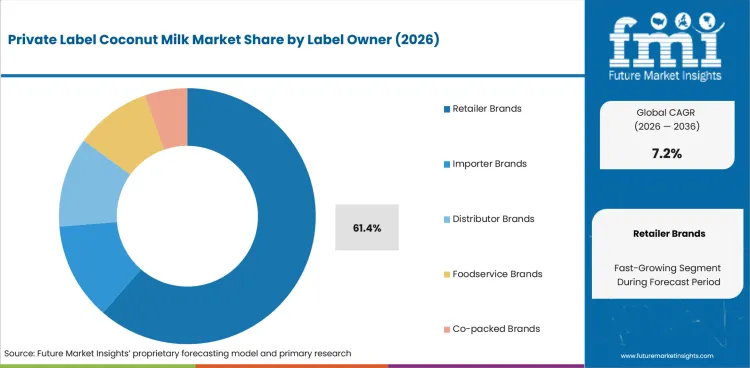
- Retailer brands are projected to account for 61.4% share in 2026, with supermarkets using store-owned coconut milk to manage shelf price and pack design.
- Importer brands are expected to grow through Asian grocery channels, since distributors can place coconut milk products under client-owned labels with lower launch work.
Insights into Private Label Coconut Milk Market by Product Format
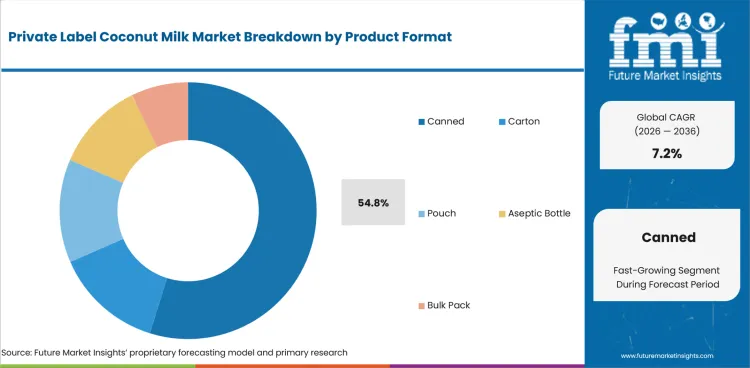
- Canned coconut milk is expected to secure 54.8% share in 2026, helped by pantry storage and easy use in curries and sauces.
- Carton coconut milk is projected to expand through dairy-free shelves, with milk alternatives giving retailers a clear placement route for shelf-stable packs.
Insights into Private Label Coconut Milk Market by Nature
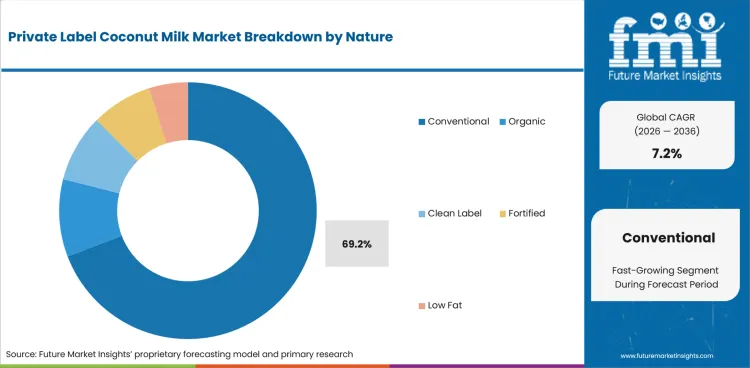
- Conventional coconut milk is forecast to hold 69.2% share in 2026, since standard recipes fit price-focused private label programs.
- Organic coconut milk is expected to move faster in premium store brands, with shoppers checking ingredient files and certification before repeat purchase.
Insights into Private Label Coconut Milk Market by Packaging Type
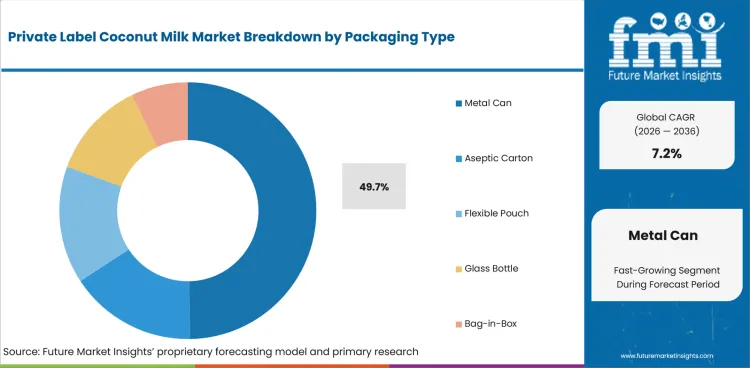
- Metal cans are projected to account for 49.7% share in 2026, mainly due to lower pack cost and wider use in cooking aisles.
- Aseptic cartons are expected to rise in beverage-style products, while food packaging choices affect shelf look and freight cost.
Insights into Private Label Coconut Milk Market by End Use
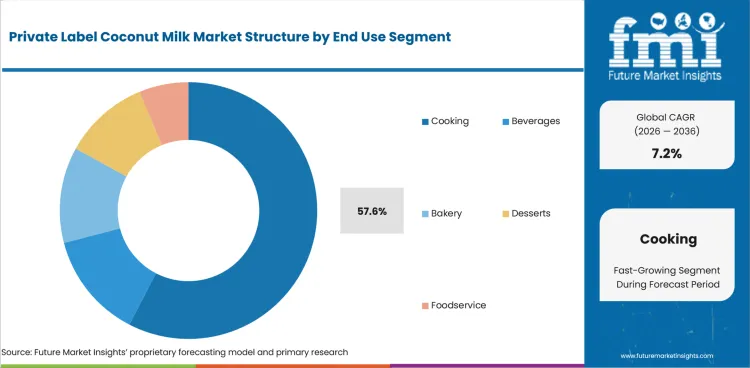
- Cooking applications are forecast to capture 57.6% share in 2026, with curries and sauces keeping coconut milk in repeat grocery baskets.
- Beverage applications are expected to widen through plant-based food shelves, especially in carton packs used for dairy-free drinks.
Insights into Private Label Coconut Milk Market by Sales Channel
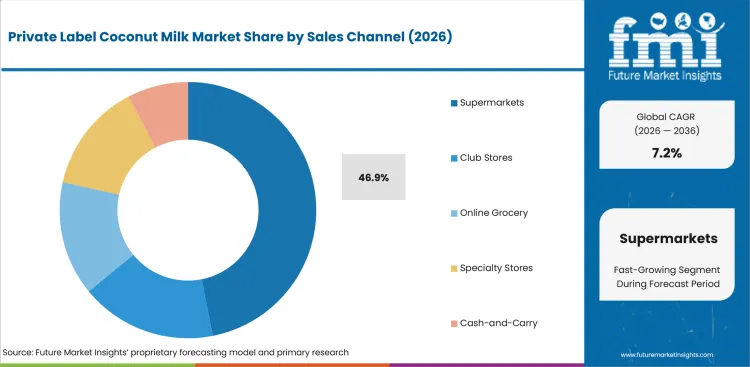
- Supermarkets are anticipated to hold 46.9% share in 2026, since retailers can place own-label coconut milk beside Asian cooking products.
- Online grocery is expected to support pack comparison, with shoppers reviewing cans and cartons before adding private label coconut milk to baskets.
Private Label Coconut Milk Market Drivers, Restraints, and Opportunities
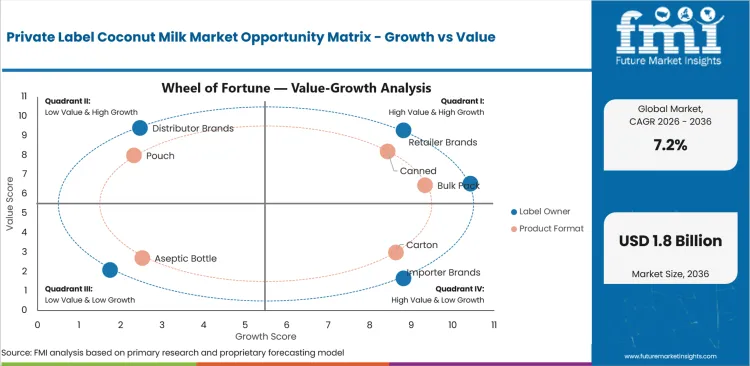
- Driver: Retailer-owned Asian cooking ranges are turning coconut milk into a repeat pantry product.
- Restraint: Annual shelf-price commitments can become hard to protect if coconut input cost rises.
- Opportunity: Carton and bulk formats can move private label coconut milk into beverage and foodservice use.
Pack choice is a practical driver in private label coconut milk. Erawan Food lists coconut milk in 165.0 ml and 400.0 ml cans. The 2,900.0 ml can supports larger kitchen use. The company also lists coconut cream in 400.0 ml and 560.0 ml cans. Such pack variety helps retailers plan household and foodservice ranges with fewer supplier changes. Demand for plant-based milk can support carton trials while canned lines protect the cooking shelf.
Raw Material Price and Formulation Cost Analysis
Private label costing starts with coconut extract level and fat band. Erawan Food lists light canned coconut milk at 7.0% to 9.0% fat and original canned coconut milk at 18.0% to 20.0% fat. Fat level affects texture and price, so buyers compare recipes before supplier approval. Liquid cans still fit retail cooking because shoppers understand the pack and recipe use. Buyers comparing dairy alternatives need to check ingredient depth instead of checking pack cost alone.
Consumer Segmentation and Purchase Behavior Analysis
Private label coconut milk serves two main shopper groups. Cooking buyers use cans for curries and sauces. Plant-based buyers use cartons for drinks and lighter recipes. Sambu Group stated in February 2024 that Kara won 2.0 Top Brand awards for ready-to-use packaged coconut milk and nata de coco. This gives retailers stronger proof that packaged coconut milk already has consumer familiarity. Brand activity supports shopper comfort with coconut-based products. Retailers can use the same comfort to place store-owned coconut milk beside plant milk choices.
Analysis of Private Label Coconut Milk Market by Key Regions
.webp "Top Country Growth Comparison Private Label Coconut Milk Market Cagr (2026 2036)")
| Region or Country | CAGR |
|---|---|
| GCC and Saudi Arabia | 8.2% |
| South Korea | 7.6% |
| European Union | 7.4% |
| United States | 6.9% |
| United Kingdom | 6.8% |
| Canada | 6.7% |
| Australia | 6.6% |
| Japan | 6.1% |
Source: Future Market Insights, 2026.
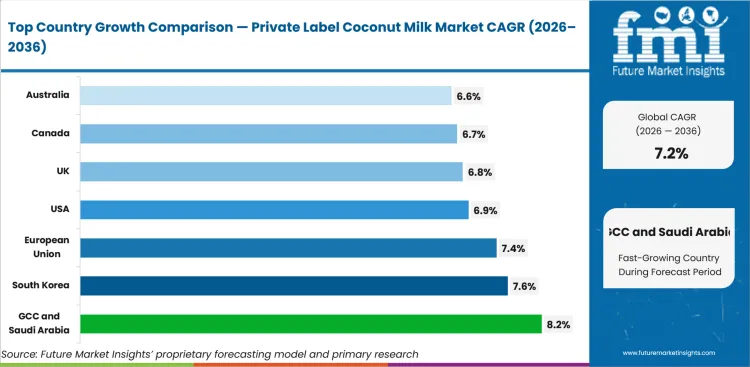
Private Label Coconut Milk Market CAGR Analysis by Country
- GCC and Saudi Arabia are expected to record 8.2% CAGR by 2036 due to import-led grocery retail and Halal-ready foodservice demand.
- South Korea is projected to expand at 7.6% CAGR during the forecast period, helped by imported food retail and online grocery testing.
- The European Union is forecast to advance at 7.4% CAGR between 2026 and 2036 due to discount retail depth and strong private label shelf habits.
- The United States is expected to rise at 6.9% CAGR by 2036 as store-brand pantry ranges move across cooking and dairy-free shelves.
- The United Kingdom is anticipated to move ahead at 6.8% CAGR during the forecast period due to own-brand grocery strength and online shelf visibility.
- Canada is projected to record 6.7% CAGR through 2036, helped by national grocery chains and importer-managed coconut milk listings.
- Australia is forecast to expand at 6.6% CAGR between 2026 and 2036 due to supermarket own brands and Asian cooking shelf demand.
- Japan is expected to advance at 6.1% CAGR by 2036 as compact pack formats fit smaller household cooking needs.
Demand Outlook for Private Label Coconut Milk Market in the United States
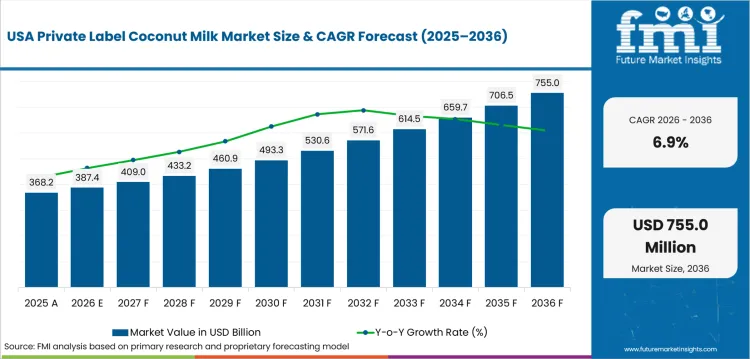
Store-brand grocery depth · 2026 to 2036
Country Market Snapshot Table
| Parameter | Value |
|---|---|
| Market Size in 2025 (Value) | USD 169.3 million |
| Market Size in 2026 (Value) | USD 181.0 million |
| Market Forecast in 2036 (Value) | USD 352.7 million |
| CAGR (2026 to 2036) | 6.9% |
| Years Considered | 2021 to 2036 |
| Base Year | 2025 |
| Forecast Period | 2026 to 2036 |
| Units Considered | Value (USD million) |
| Leading Sub-Region | Coastal grocery corridors |
United States Private Label Coconut Milk Market Outlook
- USA private label coconut milk demand comes from grocery chains that already use store brands across pantry aisles. The market in the United States is projected to expand at a CAGR of 6.9% during the forecast period. Coconut milk fits Asian cooking shelves and dairy-free areas without needing chilled handling.
- Retailers are expected to test cans and multipacks under their own labels. Suppliers with stable fat levels and simple ingredient files are expected to have a clearer route into repeat grocery listings.
Key Growth Drivers
- Store-brand grocery reach makes coconut milk easier to place beside imported Asian products. PLMA reported USA store-brand sales of USD 282.8 billion in 2025, which gives retailers a strong own-label base for pantry products.
- Plant-based shelves create another route for carton coconut milk. GFI reported plant-based milk was bought by 38.0% of USA households in 2025, with 75.0% buying more than once.
- Club stores can use multipacks to improve value perception without changing the core recipe. This suits canned coconut milk and coconut cream.
- Online grocery listings are expected to improve comparison across pack sizes. Clear product images can help shoppers choose between cooking cans and cartons.
Key Restraints
- Shelf space is crowded with many own-label food products. PLMA reported USA store brands held 21.3% dollar share in 2025, which makes new listings more difficult.
- Coconut milk can lose beverage shelf space to oat and almond products. Retailers are expected to favor products with clearer repeat use.
- Import timing can slow small pack changes during retailer trial programs. Buyers are expected to prefer suppliers with better container planning.
What sets the United States apart
United States demand has a dual route through Asian cooking aisles and plant-based shelves. That mix gives coconut milk more than one retail use under store-owned labels.
Key Companies
- Walmart Inc.
- The Kroger Co.
- Trader Joe's Company
- Whole Foods Market Services, Inc.
- Target Corporation
Sales & Marketing Channels
- Store-brand grocery programs
- Club store multipack listings
- Online grocery pages
- Asian food import distributors
Market Taxonomy and Sub-Regions Covered
| Segment | Sub-Segments |
|---|---|
| By Label Owner | Retailer Brands · Importer Brands · Distributor Brands · Foodservice Brands · Co-packed Brands |
| By Product Format | Canned · Carton · Pouch · Aseptic Bottle · Bulk Pack |
| By Nature | Conventional · Organic · Clean Label · Fortified · Low Fat |
| By Packaging Type | Metal Can · Aseptic Carton · Flexible Pouch · Glass Bottle · Bag-in-Box |
| By End Use | Cooking · Beverages · Bakery · Desserts · Foodservice |
| By Sales Channel | Supermarkets · Club Stores · Online Grocery · Specialty Stores · Cash-and-Carry |
| Key Sub-Regions Covered, Grocery Corridors | West Coast · Northeast · Southeast · Midwest · Texas · Florida · Pacific Northwest |
Frequently Asked Questions
How fast is the United States private label coconut milk market growing?
The United States private label coconut milk market is forecast to expand at 6.9% CAGR between 2026 and 2036. Store-brand pantry demand and dairy-free shelf use are expected to guide the pace.
Who leads the United States private label coconut milk market?
Walmart Inc. and The Kroger Co. are active retailers with strong grocery reach. Trader Joe's Company also supports differentiated store-brand reach.
What is driving adoption of private label coconut milk in the United States?
Retailers need shelf-stable food products that can serve cooking and plant-based use. Coconut milk can fit both needs through cans and cartons.
Demand Outlook for Private Label Coconut Milk Market in Canada
Concentrated grocery chains and bilingual label needs · 2026 to 2036
Country Market Snapshot Table
| Parameter | Value |
|---|---|
| Market Size in 2025 (Value) | USD 60.0 million |
| Market Size in 2026 (Value) | USD 64.0 million |
| Market Forecast in 2036 (Value) | USD 122.4 million |
| CAGR (2026 to 2036) | 6.7% |
| Years Considered | 2021 to 2036 |
| Base Year | 2025 |
| Forecast Period | 2026 to 2036 |
| Units Considered | Value (USD million) |
| Leading Sub-Region | Ontario and Quebec grocery belt |
Canada Private Label Coconut Milk Market Outlook
- Canada has a concentrated grocery structure, so store-brand rollouts can move quickly once supplier files are approved. Canada is expected to record 6.7% CAGR by 2036 in the market. Coconut milk can serve pantry cooking needs and premium organic shelf plans.
- Retail buyers are expected to focus on bilingual labels and allergen files before adding new private label SKUs. Importers are expected to connect Asian processors with national chains that need consistent coconut milk supply.
Key Growth Drivers
- Importer channels give Canadian retailers access to shelf-stable coconut products from Asian processors. USDA FAS reported Canada imported USD 21.8 billion worth of USA consumer-oriented agricultural products in 2024, which signals a large cross-border food import system.
- Food manufacturers can use coconut milk in sauces and prepared foods beyond retail cans. USDA FAS reported food and beverage processing sales of USD 116.0 billion in Canada in 2024. This creates a wider food ingredient route.
- Bilingual packaging creates a clear supplier selection point. Processors with artwork support are expected to have a smoother listing path.
- Organic coconut milk can work in premium private label ranges. Natural food stores are expected to favor suppliers with traceable ingredient files.
Key Restraints
- Grocery access is controlled by a small number of large chains. USDA FAS reported five companies made up over 65.0% of Canada’s retail grocery market in 2025, which can restrict access for smaller importers.
- Coast-to-coast shipping can raise the landed cost of low-margin cans. Retailers are expected to monitor freight terms closely.
- Bilingual label edits can delay product launch. Suppliers are expected to prepare files before buyer review starts.
Canada stands out through label discipline
Canada rewards suppliers that can combine steady shipping with clean bilingual product files. Private label coconut milk is expected to move through grocery chains that want value and premium tiers.
Key Companies
- Loblaw Companies Limited
- Metro Inc.
- Empire Company Limited
- Save-On-Foods Limited Partnership
- Federated Co-operatives Limited
Sales & Marketing Channels
- National grocery private label programs
- Importer-managed shelf listings
- Natural food retailers
- Online grocery platforms
Market Taxonomy and Sub-Regions Covered
| Segment | Sub-Segments |
|---|---|
| By Label Owner | Retailer Brands · Importer Brands · Distributor Brands · Foodservice Brands · Co-packed Brands |
| By Product Format | Canned · Carton · Pouch · Aseptic Bottle · Bulk Pack |
| By Nature | Conventional · Organic · Clean Label · Fortified · Low Fat |
| By Packaging Type | Metal Can · Aseptic Carton · Flexible Pouch · Glass Bottle · Bag-in-Box |
| By End Use | Cooking · Beverages · Bakery · Desserts · Foodservice |
| By Sales Channel | Supermarkets · Club Stores · Online Grocery · Specialty Stores · Cash-and-Carry |
| Key Sub-Regions Covered, Provinces | Ontario · Quebec · British Columbia · Alberta · Manitoba · Saskatchewan · Nova Scotia |
Frequently Asked Questions
How fast is the Canada private label coconut milk market growing?
Canada private label coconut milk demand is expected to rise at 6.7% CAGR during the forecast period. Grocery concentration is expected to help approved products scale faster.
Who leads the Canada private label coconut milk market?
Loblaw Companies Limited and Metro Inc. have strong grocery reach across Canada. Empire Company Limited adds national and regional store network reach.
What is driving adoption of private label coconut milk in Canada?
Retailers need value pantry products with clear label compliance. Coconut milk can serve Asian cooking and plant-based shelf use.
Demand Analysis for Private Label Coconut Milk Market in the European Union
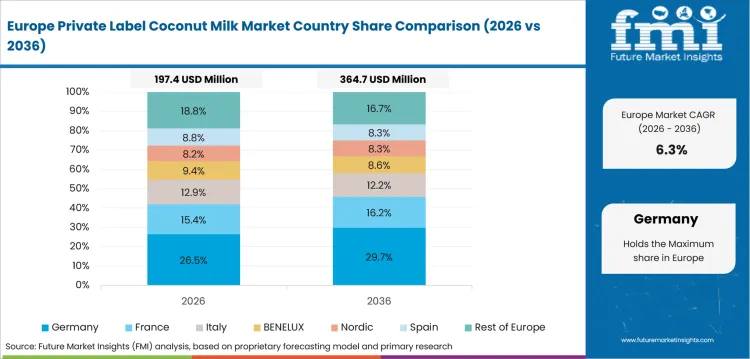
Discount retail and private label maturity · 2026 to 2036
Country Market Snapshot Table
| Parameter | Value |
|---|---|
| Market Size in 2025 (Value) | USD 146.2 million |
| Market Size in 2026 (Value) | USD 156.9 million |
| Market Forecast in 2036 (Value) | USD 320.6 million |
| CAGR (2026 to 2036) | 7.4% |
| Years Considered | 2021 to 2036 |
| Base Year | 2025 |
| Forecast Period | 2026 to 2036 |
| Units Considered | Value (USD million) |
| Leading Sub-Region | Western European discount corridors |
European Union Private Label Coconut Milk Market Outlook
- European Union demand is built around discount chains and mature retailer-owned food ranges. The industry outlook in the European Union points to 7.4% CAGR through 2036. Coconut milk can move through Asian cooking shelves and carton-based dairy-free ranges.
- Retailers are expected to choose suppliers that manage customs files and ingredient wording with fewer delays. Organic coconut milk is also expected to build premium private label space in Western Europe.
Key Growth Drivers
- Private label maturity gives coconut milk a strong store-brand route. PLMA reported private label share across 17 European markets reached 38.8% based on MAT W52 2025.
- German discount and supermarket networks create scale for private label pantry products. USDA FAS reported private label products held 36.2% share in Germany in 2024. This supports value-focused store-brand grocery programs.
- Retailers can use coconut milk in value cooking lines and premium organic tiers. This helps one ingredient serve two different shelf roles.
- Importers are expected to help Asian suppliers handle EU paperwork. Better file readiness can reduce launch delays for retailer labels.
Key Restraints
- Private label competition is already heavy across European grocery. PLMA reported retail brands increased in 12 out of 17 monitored markets in 2025, which makes new shelf wins harder.
- Customs classification can slow coconut milk imports when recipes and pack types differ. Retailers are expected to favor suppliers with stronger document control.
- Organic programs need deeper proof on sourcing and handling. Smaller processors may face longer approval cycles.
Europe differs through own-brand depth
The European Union has a strong private label culture and strict product paperwork in the same buying system. Suppliers are expected to win more repeat programs when price control and document accuracy work together.
Key Companies
- ALDI Einkauf SE & Co. oHG
- Lidl Stiftung & Co. KG
- EDEKA ZENTRALE Stiftung & Co. KG
- REWE-ZENTRALFINANZ eG
- Mercadona S.A.
Sales & Marketing Channels
- Discount retail private label programs
- Importer-led coconut milk listings
- Organic grocery networks
- Cash-and-carry foodservice channels
Market Taxonomy and Sub-Regions Covered
| Segment | Sub-Segments |
|---|---|
| By Label Owner | Retailer Brands · Importer Brands · Distributor Brands · Foodservice Brands · Co-packed Brands |
| By Product Format | Canned · Carton · Pouch · Aseptic Bottle · Bulk Pack |
| By Nature | Conventional · Organic · Clean Label · Fortified · Low Fat |
| By Packaging Type | Metal Can · Aseptic Carton · Flexible Pouch · Glass Bottle · Bag-in-Box |
| By End Use | Cooking · Beverages · Bakery · Desserts · Foodservice |
| By Sales Channel | Supermarkets · Club Stores · Online Grocery · Specialty Stores · Cash-and-Carry |
| Key Sub-Regions Covered, Member States | Germany · France · Netherlands · Spain · Italy · Belgium · Poland |
Frequently Asked Questions
How fast is the European Union private label coconut milk market growing?
European Union private label coconut milk demand is projected to expand at 7.4% CAGR between 2026 and 2036. Discount retail and private label maturity are expected to guide the pace.
Who leads the European Union private label coconut milk market?
ALDI Einkauf SE & Co. oHG, Lidl Stiftung & Co. KG, and EDEKA ZENTRALE Stiftung & Co. KG have strong private label grocery reach.
What is driving adoption of private label coconut milk in the European Union?
Discount retailers need affordable pantry products with clear label files. Coconut milk can fit Asian cooking and organic shelf plans.
Demand Outlook for Private Label Coconut Milk Market in the United Kingdom
Own-brand grocery culture and online shelf visibility · 2026 to 2036
Country Market Snapshot Table
| Parameter | Value |
|---|---|
| Market Size in 2025 (Value) | USD 76.8 million |
| Market Size in 2026 (Value) | USD 82.0 million |
| Market Forecast in 2036 (Value) | USD 158.3 million |
| CAGR (2026 to 2036) | 6.8% |
| Years Considered | 2021 to 2036 |
| Base Year | 2025 |
| Forecast Period | 2026 to 2036 |
| Units Considered | Value (USD million) |
| Leading Sub-Region | Greater London and national online grocery |
United Kingdom Private Label Coconut Milk Market Outlook
- UK retailers already use own-brand products across many grocery aisles. Adoption in the United Kingdom is anticipated to move ahead at a CAGR of 6.8% during the forecast period. Coconut milk can fit curry meal planning and shelf-stable dairy-free browsing.
- Online grocery is expected to help private label coconut milk because shoppers can compare cans and cartons before purchase. Suppliers are expected to provide clean product images and simple label wording.
Key Growth Drivers
- Online grocery gives private label coconut milk more shelf visibility. USDA FAS reported online purchases accounted for 13.1% of UK grocery sales in 2024, with 59.0% of consumers doing some grocery shopping online.
- Discount channels give value coconut milk a practical retail route. USDA FAS reported Aldi and Lidl together held 19.2% UK market share in 2025.
- Curry kits and Asian meal ingredients create repeat use for canned coconut milk. Retailers are expected to use recipe cues to help shoppers choose.
- Carton coconut milk can enter dairy-free shelves with clear pack wording. This is expected to help store brands test small batches before wider listings.
Key Restraints
- The top grocery chains control much of the buyer route. USDA FAS reported the top UK grocery stores accounted for 67.0% of the market in 2025, which can narrow access for smaller importers.
- Dairy-free wording needs careful review before online product pages go live. Retailers are expected to avoid unclear claims.
- Low-price competition can pressure margins on standard coconut milk cans. Suppliers need stable freight terms to protect contract pricing.
The United Kingdom has a distinct route through own brands
UK coconut milk demand is expected to move through supermarket own-brand lines and online grocery pages. Suppliers with clear labels and retail-ready images are expected to get better buyer response.
Key Companies
- Tesco PLC
- J Sainsbury plc
- Waitrose Limited
- Ocado Retail Limited
- Wm Morrison Supermarkets Limited
Sales & Marketing Channels
- Own-brand supermarket listings
- Online grocery pages
- Asian food importer channels
- Foodservice distributor supply
Market Taxonomy and Sub-Regions Covered
| Segment | Sub-Segments |
|---|---|
| By Label Owner | Retailer Brands · Importer Brands · Distributor Brands · Foodservice Brands · Co-packed Brands |
| By Product Format | Canned · Carton · Pouch · Aseptic Bottle · Bulk Pack |
| By Nature | Conventional · Organic · Clean Label · Fortified · Low Fat |
| By Packaging Type | Metal Can · Aseptic Carton · Flexible Pouch · Glass Bottle · Bag-in-Box |
| By End Use | Cooking · Beverages · Bakery · Desserts · Foodservice |
| By Sales Channel | Supermarkets · Club Stores · Online Grocery · Specialty Stores · Cash-and-Carry |
| Key Sub-Regions Covered, Retail Areas | England · Scotland · Wales · Northern Ireland · Greater London · Midlands · North West England |
Frequently Asked Questions
How fast is the United Kingdom private label coconut milk market growing?
United Kingdom private label coconut milk demand is forecast to rise at 6.8% CAGR by 2036. Own-brand grocery and online shelf visibility are expected to guide demand.
Who leads the United Kingdom private label coconut milk market?
Tesco PLC and J Sainsbury plc have strong own-brand grocery reach. Waitrose Limited adds premium own-brand reach.
What is driving adoption of private label coconut milk in the United Kingdom?
Retailers need shelf-stable cooking products and dairy-free shelf options. Coconut milk can serve both uses in simple pack formats.
Sales Outlook for Private Label Coconut Milk Market in GCC and Saudi Arabia
Import-led modern grocery and foodservice use · 2026 to 2036
Country Market Snapshot Table
| Parameter | Value |
|---|---|
| Market Size in 2025 (Value) | USD 70.2 million |
| Market Size in 2026 (Value) | USD 76.0 million |
| Market Forecast in 2036 (Value) | USD 167.1 million |
| CAGR (2026 to 2036) | 8.2% |
| Years Considered | 2021 to 2036 |
| Base Year | 2025 |
| Forecast Period | 2026 to 2036 |
| Units Considered | Value (USD million) |
| Leading Sub-Region | Riyadh and Gulf modern retail corridors |
GCC and Saudi Arabia Private Label Coconut Milk Market Outlook
- GCC and Saudi Arabia demand comes from imported grocery shelves and foodservice kitchens. The market is expected to record 8.2% CAGR between 2026 and 2036. Coconut milk suppliers need Halal files and Arabic labels before larger private label programs can expand.
- Foodservice use gives coconut milk another route beyond household cooking. Hotels and catering operators are expected to use coconut milk in sauces and desserts. Bulk kitchen packs can extend that route.
Key Growth Drivers
- Modern grocery chains need imported pantry products that can work under retailer labels. USDA FAS reported Saudi food retail sales reached about USD 59.0 billion in 2024, with about 4.0% sector expansion expected in 2025.
- Foodservice packs can serve hotels and catering kitchens. USDA FAS reported Saudi foodservice sales reached USD 29.0 billion in 2024, with about 8.0% annual expansion expected over the next few years.
- Halal certification gives coconut milk suppliers a clearer route into grocery and foodservice listings. Buyers are expected to review certificate files before product approval.
- Importer-owned labels help retailers reduce reliance on global Asian brands. This gives regional distributors more control over shelf pricing.
Key Restraints
- Food import reliance raises exposure to freight and clearance delays. USDA FAS stated Saudi Arabia depends on imports to meet 70.0% of its food demand.
- Arabic label changes can slow launch timing when supplier files are incomplete.
- Heat exposure during storage can create quality risk for low-cost carton products. Buyers are expected to check pack durability before repeat orders.
GCC and Saudi Arabia move through import-ready retail
GCC and Saudi Arabia favor suppliers that can combine Halal documents with stable export planning. Private label coconut milk is expected to benefit from modern retail and foodservice demand.
Key Companies
- Panda Retail Company
- BinDawood Holding Company
- Abdullah Al-Othaim Markets Company
- Tamimi Markets Company
- Danube Company Limited
Sales & Marketing Channels
- Modern grocery private label programs
- Importer-led retail supply
- Hotel and catering distributors
- Cash-and-carry channels
Market Taxonomy and Sub-Regions Covered
| Segment | Sub-Segments |
|---|---|
| By Label Owner | Retailer Brands · Importer Brands · Distributor Brands · Foodservice Brands · Co-packed Brands |
| By Product Format | Canned · Carton · Pouch · Aseptic Bottle · Bulk Pack |
| By Nature | Conventional · Organic · Clean Label · Fortified · Low Fat |
| By Packaging Type | Metal Can · Aseptic Carton · Flexible Pouch · Glass Bottle · Bag-in-Box |
| By End Use | Cooking · Beverages · Bakery · Desserts · Foodservice |
| By Sales Channel | Supermarkets · Club Stores · Online Grocery · Specialty Stores · Cash-and-Carry |
| Key Sub-Regions Covered, Retail Centers | Saudi Arabia · UAE · Qatar · Kuwait · Bahrain · Oman · Riyadh |
Frequently Asked Questions
How fast is the GCC and Saudi Arabia private label coconut milk market growing?
GCC and Saudi Arabia private label coconut milk demand is projected to expand at 8.2% CAGR during the forecast period. Modern retail and foodservice use are expected to guide the pace.
Who leads the GCC and Saudi Arabia private label coconut milk market?
Panda Retail Company and BinDawood Holding Company have strong grocery reach in Saudi Arabia. Abdullah Al-Othaim Markets Company adds another national retail route.
What is driving adoption of private label coconut milk in GCC and Saudi Arabia?
Retailers need imported pantry products with Halal documents and Arabic label support. Coconut milk can fit grocery and foodservice use.
Demand Analysis for Private Label Coconut Milk Market in South Korea
Imported food retail and premium grocery shelves · 2026 to 2036
Country Market Snapshot Table
| Parameter | Value |
|---|---|
| Market Size in 2025 (Value) | USD 49.3 million |
| Market Size in 2026 (Value) | USD 53.0 million |
| Market Forecast in 2036 (Value) | USD 110.3 million |
| CAGR (2026 to 2036) | 7.6% |
| Years Considered | 2021 to 2036 |
| Base Year | 2025 |
| Forecast Period | 2026 to 2036 |
| Units Considered | Value (USD million) |
| Leading Sub-Region | Seoul metropolitan grocery corridor |
South Korea Private Label Coconut Milk Market Outlook
- South Korea private label coconut milk demand is guided by imported food retail and premium grocery shelves. South Korea is expected to record 7.6% CAGR in the sector by 2036. Coconut milk can enter cooking ranges and plant-based shelves through online-first retail.
- Retailers are expected to prefer smaller packs and clear product wording. Suppliers with strong importer files are expected to have a better route into premium shelves.
Key Growth Drivers
- Imported food channels create room for Southeast Asian cooking products. USDA FAS reported Korea imported around USD 20.6 billion in consumer-oriented agricultural products in 2024.
- Retail food sales give private labels a large route to shoppers. USDA FAS reported Korean retail food sales totaled USD 132.0 billion in 2024, equal to 31.0% of total retail sales excluding automobiles.
- Online grocery platforms can test coconut milk SKUs with less physical shelf pressure. This can help small packs reach targeted shoppers.
- Premium supermarkets can use coconut milk in Thai and dairy-free cooking sets. Recipe placement is expected to improve shopper understanding.
Key Restraints
- Domestic food production does not meet all national demand. USDA FAS reported domestic production meets only 46.0% of Korea’s food demand, which raises import exposure.
- Label review can take time when coconut milk is positioned for both cooking and beverage use.
- Smaller household sizes can limit demand for large cans and bulk packs. Retailers are expected to favor compact formats.
South Korea has a more digital buying route
South Korea favors retailers that can test products online before expanding in premium stores. Coconut milk suppliers need small packs and reliable importer documents.
Key Companies
- Coupang Corp.
- Emart Inc.
- Lotte Shopping Co., Ltd.
- Homeplus Co., Ltd.
- Kurly Inc.
Sales & Marketing Channels
- Online grocery platforms
- Imported food retailers
- Premium supermarkets
- Foodservice distributors
Market Taxonomy and Sub-Regions Covered
| Segment | Sub-Segments |
|---|---|
| By Label Owner | Retailer Brands · Importer Brands · Distributor Brands · Foodservice Brands · Co-packed Brands |
| By Product Format | Canned · Carton · Pouch · Aseptic Bottle · Bulk Pack |
| By Nature | Conventional · Organic · Clean Label · Fortified · Low Fat |
| By Packaging Type | Metal Can · Aseptic Carton · Flexible Pouch · Glass Bottle · Bag-in-Box |
| By End Use | Cooking · Beverages · Bakery · Desserts · Foodservice |
| By Sales Channel | Supermarkets · Club Stores · Online Grocery · Specialty Stores · Cash-and-Carry |
| Key Sub-Regions Covered, Retail Areas | Seoul · Incheon · Gyeonggi · Busan · Daegu · Daejeon · Gwangju |
Frequently Asked Questions
How fast is the South Korea private label coconut milk market growing?
South Korea private label coconut milk demand is expected to expand at 7.6% CAGR between 2026 and 2036. Online grocery and imported food retail are expected to guide demand.
Who leads the South Korea private label coconut milk market?
Coupang Corp. and Emart Inc. have strong retail reach. Lotte Shopping Co., Ltd. adds food listing capacity.
What is driving adoption of private label coconut milk in South Korea?
Retailers need imported cooking products and shelf-stable plant-based options. Coconut milk can serve both uses in small packs.
Sales Analysis for Private Label Coconut Milk Market in Japan
Compact household formats and selective retail shelves · 2026 to 2036
Country Market Snapshot Table
| Parameter | Value |
|---|---|
| Market Size in 2025 (Value) | USD 65.0 million |
| Market Size in 2026 (Value) | USD 69.0 million |
| Market Forecast in 2036 (Value) | USD 124.7 million |
| CAGR (2026 to 2036) | 6.1% |
| Years Considered | 2021 to 2036 |
| Base Year | 2025 |
| Forecast Period | 2026 to 2036 |
| Units Considered | Value (USD million) |
| Leading Sub-Region | Kanto and Kansai retail corridors |
Japan Private Label Coconut Milk Market Outlook
- Japan private label coconut milk demand is smaller but highly quality-focused. The market in Japan is forecast to rise at 6.1% CAGR during the forecast period. Retailers are expected to favor smaller cans and cartons that match compact household needs.
- Coconut milk works best in Japan when placed with Southeast Asian meal kits and dairy-free recipes. Taste consistency and pack appearance are expected to matter more than wide pack variety.
Key Growth Drivers
- Retail food channels are large enough to support careful coconut milk placement. USDA FAS reported Japan’s retail food and beverage sales totaled USD 193.0 billion in 2024.
- Supermarket shelves can carry compact cooking products beside imported meal ingredients. USDA FAS reported supermarkets represented 45.0% of Japan’s retail food and beverage sales in 2024.
- Smaller packs can reduce waste after opening. Retailers are expected to use compact formats for first-time coconut milk users.
- Thai curry kits and ready meal ingredients give coconut milk a clearer cooking role. Product placement beside recipe items can improve trial.
Key Restraints
- Convenience retail leaves less space for large pantry packs. USDA FAS reported convenience stores accounted for 28.4% of Japan’s total retail food and beverage sales in 2024, which limits shelf fit for bulky formats.
- Large cans may not fit smaller household needs as well as compact packs. Suppliers are expected to adjust pack planning.
- Flavor consistency must be tight because repeat buying can fall quickly after taste variation.
Japan rewards smaller formats
Japan is expected to favor suppliers that deliver compact packs and stable taste. Private label coconut milk can expand through careful shelf placement and recipe-led selling.
Key Companies
- Seven & i Holdings Co., Ltd.
- AEON Co., Ltd.
- Kobe Bussan Co., Ltd.
- Life Corporation
- Seiyu Co., Ltd.
Sales & Marketing Channels
- Supermarket private label ranges
- Convenience-oriented retail shelves
- Imported food stores
- Online grocery platforms
Market Taxonomy and Sub-Regions Covered
| Segment | Sub-Segments |
|---|---|
| By Label Owner | Retailer Brands · Importer Brands · Distributor Brands · Foodservice Brands · Co-packed Brands |
| By Product Format | Canned · Carton · Pouch · Aseptic Bottle · Bulk Pack |
| By Nature | Conventional · Organic · Clean Label · Fortified · Low Fat |
| By Packaging Type | Metal Can · Aseptic Carton · Flexible Pouch · Glass Bottle · Bag-in-Box |
| By End Use | Cooking · Beverages · Bakery · Desserts · Foodservice |
| By Sales Channel | Supermarkets · Club Stores · Online Grocery · Specialty Stores · Cash-and-Carry |
| Key Sub-Regions Covered, Retail Areas | Kanto · Kansai · Chubu · Kyushu · Hokkaido · Tohoku · Chugoku |
Frequently Asked Questions
How fast is the Japan private label coconut milk market growing?
Japan private label coconut milk demand is projected to expand at 6.1% CAGR by 2036. Smaller packs and recipe-based placement are expected to guide the pace.
Who leads the Japan private label coconut milk market?
Seven & i Holdings and AEON have strong retail reach for private label food products. Kobe Bussan adds another retail route.
What is driving adoption of private label coconut milk in Japan?
Retailers need compact pantry products for Southeast Asian recipes and dairy-free cooking. Coconut milk can meet both needs with the right pack size.
Demand Outlook for Private Label Coconut Milk Market in Australia
Supermarket own brands and Asian cooking shelves · 2026 to 2036
Country Market Snapshot Table
| Parameter | Value |
|---|---|
| Market Size in 2025 (Value) | USD 41.3 million |
| Market Size in 2026 (Value) | USD 44.0 million |
| Market Forecast in 2036 (Value) | USD 83.4 million |
| CAGR (2026 to 2036) | 6.6% |
| Years Considered | 2021 to 2036 |
| Base Year | 2025 |
| Forecast Period | 2026 to 2036 |
| Units Considered | Value (USD million) |
| Leading Sub-Region | East coast supermarket corridor |
Australia Private Label Coconut Milk Market Outlook
- Australia has steady private label demand through supermarkets and Asian cooking shelves. The market in Australia is anticipated to expand at a CAGR of 6.6% between 2026 and 2036. Retailers are expected to use coconut milk in canned cooking lines and plant-based carton ranges.
- Private label buyers need reliable supply because long shipping routes can affect shelf planning. Importer-managed programs are expected to help retailers avoid supply gaps.
Key Growth Drivers
- Supermarkets give private label coconut milk a strong route to household shoppers. USDA FAS reported Australia’s food and liquor retailing value reached A$239.0 billion in 2024, equal to about USD 157.0 billion.
- Grocery expenditure is concentrated in supermarket channels. USDA FAS reported supermarkets and grocery stores accounted for 60.0% of food retail purchases in 2024.
- Asian cooking habits create a steady use case for canned coconut milk. Retailers can place coconut milk beside curry pastes and meal kits.
- Foodservice distributors can use coconut milk in catering packs and cash-and-carry supply. This gives suppliers another route beyond household cans.
Key Restraints
- Long-distance sourcing can raise inventory and landed-cost risk. USDA FAS reported Australia imported USD 15.3 billion of consumer-oriented foods in 2024.
- Smaller national volume can limit custom recipe runs for private label buyers.
- Heat and freight exposure can affect carton quality if storage is poorly managed. Buyers are expected to test pack durability before wider listings.
Australia has a practical store-brand route
Australia is different because supermarket own brands and Asian cooking needs meet in a smaller national market. Suppliers with stable export planning are expected to have a clearer route to retail shelves.
Key Companies
- Woolworths Group Limited
- Coles Group Limited
- Metcash Limited
- Harris Farm Markets Pty Ltd
- Drakes Supermarkets Pty Ltd
Sales & Marketing Channels
- Supermarket own-brand programs
- Asian grocery distributors
- Club store multipacks
- Foodservice distributor channels
Market Taxonomy and Sub-Regions Covered
| Segment | Sub-Segments |
|---|---|
| By Label Owner | Retailer Brands · Importer Brands · Distributor Brands · Foodservice Brands · Co-packed Brands |
| By Product Format | Canned · Carton · Pouch · Aseptic Bottle · Bulk Pack |
| By Nature | Conventional · Organic · Clean Label · Fortified · Low Fat |
| By Packaging Type | Metal Can · Aseptic Carton · Flexible Pouch · Glass Bottle · Bag-in-Box |
| By End Use | Cooking · Beverages · Bakery · Desserts · Foodservice |
| By Sales Channel | Supermarkets · Club Stores · Online Grocery · Specialty Stores · Cash-and-Carry |
| Key Sub-Regions Covered, Retail Areas | New South Wales · Victoria · Queensland · Western Australia · South Australia · Tasmania · Australian Capital Territory |
Frequently Asked Questions
How fast is the Australia private label coconut milk market growing?
Australia private label coconut milk demand is forecast to expand at 6.6% CAGR during the forecast period. Supermarket own brands and Asian cooking shelves are expected to guide demand.
Who leads the Australia private label coconut milk market?
Woolworths Group Limited and Coles Group Limited have strong grocery reach. Metcash Limited adds distribution reach through independent retailers.
What is driving adoption of private label coconut milk in Australia?
Retailers need shelf-stable cooking products and plant-based carton options. Coconut milk can serve both roles through supermarket own-brand ranges.
Competitive Landscape and Strategic Positioning
- Export-ready processors have an advantage when private label buyers need steady can and carton supply.
- Brands with consumer visibility can support retailer trust during private label planning.
- Pack depth affects supplier choice because buyers need household and foodservice sizes.
- Suppliers with organic and bulk formats can serve premium grocery and foodservice buyers.
Thai Coconut supports private label supply through large-scale coconut processing and export reach. Its official company page lists a 160000.0 square meter factory and annual capacity of 300000.0 tons. The company also states that export value accounts for over 90.0% of total revenue. Such scale gives importers a stronger route for repeat store-brand coconut milk programs.
Sambu Group adds bulk UHT capability to the supplier mix. The company lists aseptic UHT coconut milk in 20.0 kg bag-in-carton and 200.0 kg bag-in-drum formats. It also lists aseptic UHT coconut cream in 5.0 kg x 4.0 bag-in-box and 20.0 kg bag-in-carton formats. The 200.0 kg bag-in-drum format gives bulk buyers another option. Such pack depth supports foodservice and industrial private label planning.
Key Companies in Private Label Coconut Milk Market
- OEM Processors: Thai Coconut and Erawan Food support retailer and importer private label coconut milk programs with export-ready production.
- Retail-Ready Coconut Suppliers: Thai Agri Foods and Theppadungporn Coconut support canned and UHT coconut milk formats for global grocery shelves.
- Organic Specialists: Sambu Group and Kara support organic coconut milk and clean label coconut cream formats for premium private label ranges.
- Philippine Export Suppliers: Celebes Coconut Corporation and Primex Coco Products support coconut milk and coconut cream supply for importer-owned brands.
- Foodservice Pack Suppliers: Erawan Food and Thai Agri Foods support HoReCA packs for cash-and-carry and distributor private label programs.
Competitive Benchmarking: Private Label Coconut Milk Market
| Company | Label File Strength | Pack Manufacturing Control | Export Channel Reach |
|---|---|---|---|
| Thai Coconut Public Company Limited | Hi | High | High |
| Erawan Food Public Company Limited | High | High | High |
| Thai Agri Foods Public Company Limited | High | High | High |
| Theppadungporn Coconut Co., Ltd. | Medium | High | High |
| Sambu Group | High | Medium | Medium |
| Celebes Coconut Corporation | High | Medium | Medium |
| Primex Coco Products, Inc. | Medium | Medium | Medium |
Source: Future Market Insights competitive analysis, 2026.
Key Developments in Private Label Coconut Milk Market
- In 2026, the Stock Exchange of Thailand company factsheet listed Thai Coconut Public Company Limited as an active manufacturer and distributor of processed coconut products. The factsheet includes canned coconut milk and pasteurized coconut milk.
- In 2025, Erawan Food promoted coconut milk OEM service for supermarkets and HoReCA clients. The company stated that its coconut milk OEM service supports industrial customers and supermarkets.
Key Players in the Private Label Coconut Milk Market
- Thai Coconut Public Company Limited
- Erawan Food Public Company Limited
- Thai Agri Foods Public Company Limited
- Theppadungporn Coconut Co., Ltd.
- Sambu Group
- Celebes Coconut Corporation
- Primex Coco Products, Inc.
- PT Pulau Sambu
- Kara Coconut
- GraceKennedy Limited
Private Label Coconut Milk Market - Report Scope
| Parameter | Details |
|---|---|
| Market size by 2036 | USD 1,803.8 million |
| Growth rate | 7.2% CAGR from 2026 to 2036 |
| Forecast period | 2026 to 2036 |
| Base year value in 2025 | USD 839.6 million |
| By label owner | Retailer brands, importer brands, distributor brands, foodservice brands, co-packed brands |
| By product format | Canned, carton, pouch, aseptic bottle, bulk pack |
| By nature | Conventional, organic, clean label, fortified, low fat |
| By packaging type | Metal can, aseptic carton, flexible pouch, glass bottle, bag-in-box |
| By end use | Cooking, beverages, bakery, desserts, foodservice |
| By sales channel | Supermarkets, club stores, online grocery, specialty stores, cash-and-carry |
| Regions covered | North America, Europe, GCC, East Asia, Oceania |
| Countries covered | United States, Canada, European Union, United Kingdom, GCC and Saudi Arabia, South Korea, Japan, Australia |
| Key companies profiled | Thai Coconut Public Company Limited, Erawan Food Public Company Limited, Thai Agri Foods Public Company Limited, Theppadungporn Coconut Co., Ltd., Sambu Group, Celebes Coconut Corporation, Primex Coco Products, Inc., PT Pulau Sambu, Kara Coconut, GraceKennedy Limited |
| Approach | Bottom-up product-boundary approach using eligible SKU revenue, channel presence, retail pricing, product positioning, and country-level adoption |
| Source | Future Market Insights, 2026. |
Source: Future Market Insights, 2026.
Private Label Coconut Milk Market Breakdown by Segment Group
By Label Owner
- Retailer Brands
- Importer Brands
- Distributor Brands
- Foodservice Brands
- Co-packed Brands
By Product Format
- Canned
- Carton
- Pouch
- Aseptic Bottle
- Bulk Pack
By Nature
- Conventional
- Organic
- Clean Label
- Fortified
- Low Fat
By Packaging Type
- Metal Can
- Aseptic Carton
- Flexible Pouch
- Glass Bottle
- Bag-in-Box
By End Use
- Cooking
- Beverages
- Bakery
- Desserts
- Foodservice
By Sales Channel
- Supermarkets
- Club Stores
- Online Grocery
- Specialty Stores
- Cash-and-Carry
By Region
-
North America
- Europe
- GCC
- East Asia
- Oceania
Research Sources and Bibliography
- Celebes Coconut Corporation. (2026). Organic and fair trade certified coconut products manufacturer.
- Erawan Food Public Company Limited. (2026). Coconut milk rich.
- Erawan Food Public Company Limited. (2026). Private label OEM service.
- Primex Coco Products, Inc. (2026). Coconut milk powder.
- Sambu Group. (2024, February 28). Starting the year, Kara won 2 awards from Top Brand.
- Sambu Group. (2024, November 7). Kara won the Indonesia Best Brand Award 2024.
- Sambu Group. (2026). Consumer products.
- Stock Exchange of Thailand. (2026, April 30). COCOCO factsheet: Thai Coconut Public Company Limited.
- Thai Agri Foods Public Company Limited. (2026). Coconut product.
- Thai Coconut Public Company Limited. (2025, February 20). Management discussion and analysis for the year ended December 31, 2024.
- Thai Coconut Public Company Limited. (2026). About us.
- Thai Coconut Public Company Limited. (2026). Coconut milk and coconut cream.
- Good Food Institute. (2026). USA retail market insights for the plant-based industry.
- Private Label Manufacturers Association. (2026, January 20). USA private label industry reached USD 282.8 billion in sales in 2025.
- Private Label Manufacturers Association International. (2026). Private label today.
- Sambu Group. (2026). Industrial product.
- Stock Exchange of Thailand. (2026). COCOCO factsheet: Thai Coconut Public Company Limited.
- USA Department of Agriculture, Foreign Agricultural Service. (2025, April 9). Canada: Food processing ingredients annual.
- USA Department of Agriculture, Foreign Agricultural Service. (2025, May 5). South Korea: Food processing ingredients annual.
- USA Department of Agriculture, Foreign Agricultural Service. (2025, June 11). Saudi Arabia: Exporter guide annual.
- USA Department of Agriculture, Foreign Agricultural Service. (2025, June 16). United Kingdom: Exporter guide annual.
- USA Department of Agriculture, Foreign Agricultural Service. (2025, June 20). Australia: Exporter guide annual.
- USA Department of Agriculture, Foreign Agricultural Service. (2025, August 5). South Korea: Exporter guide annual.
- USA Department of Agriculture, Foreign Agricultural Service. (2025, September 24). Germany: Retail foods annual.
- USA Department of Agriculture, Foreign Agricultural Service. (2025, November 19). Australia: Retail foods annual.
- USA Department of Agriculture, Foreign Agricultural Service. (2025, November 19). Japan: Retail foods annual.
- USA Department of Agriculture, Foreign Agricultural Service. (2025, November 19). United Kingdom: Retail foods annual.
- USA Department of Agriculture, Foreign Agricultural Service. (2025, December 30). Canada: Retail foods annual.
This bibliography is provided for reader reference and is not exhaustive. The full reportcontainsthe complete reference list and detailed citations.
This Report Answers
- How large is private label coconut milk market in 2026?
- What value is expected for private label coconut milk market by 2036?
- Which nature segment is expected to lead in 2026?
- Which label owner is expected to hold the leading share in 2026?
- Which product format is expected to create stronger repeat demand in 2026?
- Which regions and countries are expected to grow faster than the global average?
- Which companies are most active across private label coconut milk supply?
- Which raw materials and pack formats shape private label coconut milk cost planning?
- Which end uses create repeat demand for private label coconut milk products?
Frequently Asked Questions
How big is the Private Label Coconut Milk Market in 2026?
Private label coconut milk demand is expected to reach USD 0.9 billion in 2026, supported by retailer-owned canned and carton coconut milk programs.
What is the expected market value by 2036?
Market value is forecast to reach USD 1.8 billion by 2036 as private label cooking and plant-based shelf programs expand.
What CAGR is expected for Private Label Coconut Milk Market?
The market is forecast to rise at 7.2% CAGR from 2026 to 2036.
Which segment is expected to lead by nature?
Conventional coconut milk is projected to hold 69.2% share in 2026 as price-sensitive private label programs favor standard recipes.
Which label owner is expected to lead in 2026?
Retailer brands are forecast to account for 61.4% share in 2026 because supermarkets control shelf space and own-label pricing.
Which region is expected to expand faster?
GCC and Saudi Arabia are expected to record 8.2% CAGR by 2036 due to modern retail expansion and import-led grocery supply.
Who are the leading companies in the market?
Thai Coconut Public Company Limited and Erawan Food Public Company Limited are active suppliers in the market. Thai Agri Foods Public Company Limited and Theppadungporn Coconut Co., Ltd. also support coconut milk supply. Sambu Group and Celebes Coconut Corporation add organic and export supplier depth. Primex Coco Products, Inc. adds another coconut-derived ingredient route.
Preview the report firsthand - request a free sample
Get SampleGet the brochure for pricing and purchase details.
Get PDFTable of Content
- Key Takeaways
- Market Size and CAGR
- Top Growth Driver
- Fastest Growing Segment
- Leading Region
- Key Companies
- Emerging Opportunities
- Executive Summary
- Global Market Outlook
- Demand-side Trends
- Supply-side Trends
- Technology Roadmap Analysis
- Analysis and Recommendations
- Analyst Perspective (What is happening? Why now? What should investors know?)
- Key Questions Answered
- How large is the market?
- What is the CAGR?
- What are key trends?
- Which region dominates?
- Who are the leaders?
- Market Overview
- Market Coverage / Taxonomy
- Market Definition / Scope / Limitations
- Research Methodology
- Chapter Orientation
- Analytical Lens and Working Hypotheses
- Market Structure, Signals, and Trend Drivers
- Benchmarking and Cross-market Comparability
- Market Sizing, Forecasting, and Opportunity Mapping
- Research Design and Evidence Framework
- Desk Research Programme (Secondary Evidence)
- Expert Input and Fieldwork (Primary Evidence)
- Tooling, Models, and Reference Databases
- Data Engineering and Model Build
- Quality Assurance and Audit Trail
- Market Background
- Market Dynamics (Drivers, Restraints, Opportunity, Trends)
- Scenario Forecast (Optimistic, Likely, Conservative)
- Impact Analysis
- AI Impact
- Sustainability Impact
- Regulatory Impact
- Technology Impact
- Consumer / Buyer Analysis
- Purchase Drivers
- Adoption Barriers
- Buyer Journey
- Opportunity Map Analysis
- Product Life Cycle Analysis
- Supply Chain Analysis
- Investment Feasibility Matrix
- Value Chain Analysis
- PESTLE and Porter's Analysis
- Regulatory Landscape
- Regional Parent Market Outlook
- Production and Consumption Statistics
- Import and Export Statistics
- Global Market Analysis and Forecast, 2021 to 2036
- Historical Market Size Value (USD Billion) & Volume (Unit) Analysis, 2021 to 2025
- Current and Future Market Size Value (USD Billion) & Volume (Unit) Projections, 2026 to 2036
- Y-o-Y Growth Trend Analysis
- Absolute $ Opportunity Analysis
- Global Market Pricing Analysis, 2021 to 2036
- Global Market Analysis and Forecast, By Label Owner, 2021 to 2036
- Introduction / Key Findings
- Historical Market Size Value (USD Billion) & Volume (Unit) Analysis By Label Owner, 2021 to 2025
- Current and Future Market Size Value (USD Billion) & Volume (Unit) Analysis and Forecast By Label Owner, 2026 to 2036
- Retailer Brands
- Importer Brands
- Distributor Brands
- Foodservice Brands
- Co-packed Brands
- Retailer Brands
- Y-o-Y Growth Trend Analysis By Label Owner, 2021 to 2025
- Absolute $ Opportunity Analysis By Label Owner, 2026 to 2036
- Global Market Analysis and Forecast, By Product Format, 2021 to 2036
- Introduction / Key Findings
- Historical Market Size Value (USD Billion) & Volume (Unit) Analysis By Product Format, 2021 to 2025
- Current and Future Market Size Value (USD Billion) & Volume (Unit) Analysis and Forecast By Product Format, 2026 to 2036
- Canned
- Carton
- Pouch
- Aseptic Bottle
- Bulk Pack
- Canned
- Y-o-Y Growth Trend Analysis By Product Format, 2021 to 2025
- Absolute $ Opportunity Analysis By Product Format, 2026 to 2036
- Global Market Analysis and Forecast, By Nature, 2021 to 2036
- Introduction / Key Findings
- Historical Market Size Value (USD Billion) & Volume (Unit) Analysis By Nature, 2021 to 2025
- Current and Future Market Size Value (USD Billion) & Volume (Unit) Analysis and Forecast By Nature, 2026 to 2036
- Conventional
- Organic
- Clean Label
- Fortified
- Low Fat
- Conventional
- Y-o-Y Growth Trend Analysis By Nature, 2021 to 2025
- Absolute $ Opportunity Analysis By Nature, 2026 to 2036
- Global Market Analysis and Forecast, By Packaging Type, 2021 to 2036
- Introduction / Key Findings
- Historical Market Size Value (USD Billion) & Volume (Unit) Analysis By Packaging Type, 2021 to 2025
- Current and Future Market Size Value (USD Billion) & Volume (Unit) Analysis and Forecast By Packaging Type, 2026 to 2036
- Metal Can
- Aseptic Carton
- Flexible Pouch
- Glass Bottle
- Bag-in-Box
- Metal Can
- Y-o-Y Growth Trend Analysis By Packaging Type, 2021 to 2025
- Absolute $ Opportunity Analysis By Packaging Type, 2026 to 2036
- Global Market Analysis and Forecast, By End Use, 2021 to 2036
- Introduction / Key Findings
- Historical Market Size Value (USD Billion) & Volume (Unit) Analysis By End Use, 2021 to 2025
- Current and Future Market Size Value (USD Billion) & Volume (Unit) Analysis and Forecast By End Use, 2026 to 2036
- Cooking
- Beverages
- Bakery
- Desserts
- Foodservice
- Cooking
- Y-o-Y Growth Trend Analysis By End Use, 2021 to 2025
- Absolute $ Opportunity Analysis By End Use, 2026 to 2036
- Global Market Analysis and Forecast, By Sales Channel
- Introduction / Key Findings
- Historical Market Size Value (USD Billion) & Volume (Unit) Analysis By Sales Channel, 2021 to 2025
- Current and Future Market Size Value (USD Billion) & Volume (Unit) Analysis and Forecast By Sales Channel, 2026 to 2036
- Supermarkets
- Club Stores
- Online Grocery
- Specialty Stores
- Cash-and-Carry
- Supermarkets
- Y-o-Y Growth Trend Analysis By Sales Channel, 2021 to 2025
- Absolute $ Opportunity Analysis By Sales Channel, 2026 to 2036
- Global Market Analysis and Forecast, By Region, 2021 to 2036
- Introduction
- Historical Market Size Value (USD Billion) & Volume (Unit) Analysis By Region, 2021 to 2025
- Current Market Size Value (USD Billion) & Volume (Unit) Analysis and Forecast By Region, 2026 to 2036
- North America
- Latin America
- Western Europe
- Eastern Europe
- East Asia
- South Asia and Pacific
- Middle East & Africa
- Market Attractiveness Analysis By Region
- North America Market Analysis and Forecast, By Country, 2021 to 2036
- Historical Market Size Value (USD Billion) & Volume (Unit) Trend Analysis By Market Taxonomy, 2021 to 2025
- Market Size Value (USD Billion) & Volume (Unit) Forecast By Market Taxonomy, 2026 to 2036
- By Country
- USA
- Canada
- Mexico
- By Label Owner
- By Product Format
- By Nature
- By Packaging Type
- By End Use
- By Sales Channel
- By Country
- Market Attractiveness Analysis
- By Country
- By Label Owner
- By Product Format
- By Nature
- By Packaging Type
- By End Use
- By Sales Channel
- Key Takeaways
- Latin America Market Analysis and Forecast, By Country
- Historical Market Size Value (USD Billion) & Volume (Unit) Trend Analysis By Market Taxonomy, 2021 to 2025
- Market Size Value (USD Billion) & Volume (Unit) Forecast By Market Taxonomy, 2026 to 2036
- By Country
- Brazil
- Chile
- Rest of Latin America
- By Label Owner
- By Product Format
- By Nature
- By Packaging Type
- By End Use
- By Sales Channel
- By Country
- Market Attractiveness Analysis
- By Country
- By Label Owner
- By Product Format
- By Nature
- By Packaging Type
- By End Use
- By Sales Channel
- Key Takeaways
- Western Europe Market Analysis and Forecast, By Country
- Historical Market Size Value (USD Billion) & Volume (Unit) Trend Analysis By Market Taxonomy, 2021 to 2025
- Market Size Value (USD Billion) & Volume (Unit) Forecast By Market Taxonomy, 2026 to 2036
- By Country
- Germany
- UK
- Italy
- Spain
- France
- Nordic
- BENELUX
- Rest of Western Europe
- By Label Owner
- By Product Format
- By Nature
- By Packaging Type
- By End Use
- By Sales Channel
- By Country
- Market Attractiveness Analysis
- By Country
- By Label Owner
- By Product Format
- By Nature
- By Packaging Type
- By End Use
- By Sales Channel
- Key Takeaways
- Eastern Europe Market Analysis and Forecast, By Country
- Historical Market Size Value (USD Billion) & Volume (Unit) Trend Analysis By Market Taxonomy, 2021 to 2025
- Market Size Value (USD Billion) & Volume (Unit) Forecast By Market Taxonomy, 2026 to 2036
- By Country
- Russia
- Poland
- Hungary
- Balkan & Baltic
- Rest of Eastern Europe
- By Label Owner
- By Product Format
- By Nature
- By Packaging Type
- By End Use
- By Sales Channel
- By Country
- Market Attractiveness Analysis
- By Country
- By Label Owner
- By Product Format
- By Nature
- By Packaging Type
- By End Use
- By Sales Channel
- Key Takeaways
- East Asia Market Analysis and Forecast, By Country
- Historical Market Size Value (USD Billion) & Volume (Unit) Trend Analysis By Market Taxonomy, 2021 to 2025
- Market Size Value (USD Billion) & Volume (Unit) Forecast By Market Taxonomy, 2026 to 2036
- By Country
- China
- Japan
- South Korea
- By Label Owner
- By Product Format
- By Nature
- By Packaging Type
- By End Use
- By Sales Channel
- By Country
- Market Attractiveness Analysis
- By Country
- By Label Owner
- By Product Format
- By Nature
- By Packaging Type
- By End Use
- By Sales Channel
- Key Takeaways
- South Asia and Pacific Market Analysis and Forecast, By Country
- Historical Market Size Value (USD Billion) & Volume (Unit) Trend Analysis By Market Taxonomy, 2021 to 2025
- Market Size Value (USD Billion) & Volume (Unit) Forecast By Market Taxonomy, 2026 to 2036
- By Country
- India
- ASEAN
- Australia & New Zealand
- Rest of South Asia and Pacific
- By Label Owner
- By Product Format
- By Nature
- By Packaging Type
- By End Use
- By Sales Channel
- By Country
- Market Attractiveness Analysis
- By Country
- By Label Owner
- By Product Format
- By Nature
- By Packaging Type
- By End Use
- By Sales Channel
- Key Takeaways
- Middle East & Africa Market Analysis and Forecast, By Country
- Historical Market Size Value (USD Billion) & Volume (Unit) Trend Analysis By Market Taxonomy, 2021 to 2025
- Market Size Value (USD Billion) & Volume (Unit) Forecast By Market Taxonomy, 2026 to 2036
- By Country
- Kingdom of Saudi Arabia
- Other GCC Countries
- Türkiye
- South Africa
- Other African Union
- Rest of Middle East & Africa
- By Label Owner
- By Product Format
- By Nature
- By Packaging Type
- By End Use
- By Sales Channel
- By Country
- Market Attractiveness Analysis
- By Country
- By Label Owner
- By Product Format
- By Nature
- By Packaging Type
- By End Use
- By Sales Channel
- Key Takeaways
- Key Countries Market Analysis
- USA
- Pricing Analysis
- Market Share Analysis, 2025
- By Label Owner
- By Product Format
- By Nature
- By Packaging Type
- By End Use
- By Sales Channel
- Canada
- Pricing Analysis
- Market Share Analysis, 2025
- By Label Owner
- By Product Format
- By Nature
- By Packaging Type
- By End Use
- By Sales Channel
- Mexico
- Pricing Analysis
- Market Share Analysis, 2025
- By Label Owner
- By Product Format
- By Nature
- By Packaging Type
- By End Use
- By Sales Channel
- Brazil
- Pricing Analysis
- Market Share Analysis, 2025
- By Label Owner
- By Product Format
- By Nature
- By Packaging Type
- By End Use
- By Sales Channel
- Chile
- Pricing Analysis
- Market Share Analysis, 2025
- By Label Owner
- By Product Format
- By Nature
- By Packaging Type
- By End Use
- By Sales Channel
- Germany
- Pricing Analysis
- Market Share Analysis, 2025
- By Label Owner
- By Product Format
- By Nature
- By Packaging Type
- By End Use
- By Sales Channel
- UK
- Pricing Analysis
- Market Share Analysis, 2025
- By Label Owner
- By Product Format
- By Nature
- By Packaging Type
- By End Use
- By Sales Channel
- Italy
- Pricing Analysis
- Market Share Analysis, 2025
- By Label Owner
- By Product Format
- By Nature
- By Packaging Type
- By End Use
- By Sales Channel
- Spain
- Pricing Analysis
- Market Share Analysis, 2025
- By Label Owner
- By Product Format
- By Nature
- By Packaging Type
- By End Use
- By Sales Channel
- France
- Pricing Analysis
- Market Share Analysis, 2025
- By Label Owner
- By Product Format
- By Nature
- By Packaging Type
- By End Use
- By Sales Channel
- India
- Pricing Analysis
- Market Share Analysis, 2025
- By Label Owner
- By Product Format
- By Nature
- By Packaging Type
- By End Use
- By Sales Channel
- ASEAN
- Pricing Analysis
- Market Share Analysis, 2025
- By Label Owner
- By Product Format
- By Nature
- By Packaging Type
- By End Use
- By Sales Channel
- Australia & New Zealand
- Pricing Analysis
- Market Share Analysis, 2025
- By Label Owner
- By Product Format
- By Nature
- By Packaging Type
- By End Use
- By Sales Channel
- China
- Pricing Analysis
- Market Share Analysis, 2025
- By Label Owner
- By Product Format
- By Nature
- By Packaging Type
- By End Use
- By Sales Channel
- Japan
- Pricing Analysis
- Market Share Analysis, 2025
- By Label Owner
- By Product Format
- By Nature
- By Packaging Type
- By End Use
- By Sales Channel
- South Korea
- Pricing Analysis
- Market Share Analysis, 2025
- By Label Owner
- By Product Format
- By Nature
- By Packaging Type
- By End Use
- By Sales Channel
- Russia
- Pricing Analysis
- Market Share Analysis, 2025
- By Label Owner
- By Product Format
- By Nature
- By Packaging Type
- By End Use
- By Sales Channel
- Poland
- Pricing Analysis
- Market Share Analysis, 2025
- By Label Owner
- By Product Format
- By Nature
- By Packaging Type
- By End Use
- By Sales Channel
- Hungary
- Pricing Analysis
- Market Share Analysis, 2025
- By Label Owner
- By Product Format
- By Nature
- By Packaging Type
- By End Use
- By Sales Channel
- Kingdom of Saudi Arabia
- Pricing Analysis
- Market Share Analysis, 2025
- By Label Owner
- By Product Format
- By Nature
- By Packaging Type
- By End Use
- By Sales Channel
- Türkiye
- Pricing Analysis
- Market Share Analysis, 2025
- By Label Owner
- By Product Format
- By Nature
- By Packaging Type
- By End Use
- By Sales Channel
- South Africa
- Pricing Analysis
- Market Share Analysis, 2025
- By Label Owner
- By Product Format
- By Nature
- By Packaging Type
- By End Use
- By Sales Channel
- USA
- Market Structure Analysis
- Competition Dashboard
- Competition Benchmarking
- Market Share Analysis of Top Players
- By Regional
- By Label Owner
- By Product Format
- By Nature
- By Packaging Type
- By End Use
- By Sales Channel
- Emerging Startups
- Innovation Benchmarking
- Competition Analysis
- Competition Deep Dive
- Thai Coconut Public Company Limited
- Overview
- Product Portfolio
- Profitability by Market Segments (Product/Region/Sales Channel)
- Sales Footprint
- Strategy Overview
- Marketing Strategy
- Product Strategy
- Channel Strategy
- Erawan Food Public Company Limited
- Thai Agri Foods Public Company Limited
- Theppadungporn Coconut Co., Ltd.
- Sambu Group
- Celebes Coconut Corporation
- Primex Coco Products, Inc.
- PT Pulau Sambu
- Kara Coconut
- GraceKennedy Limited
- Thai Coconut Public Company Limited
- Case Studies
- Success Stories
- Recent Developments
- Competition Deep Dive
- Assumptions & Acronyms Used


