

- Market Size (2026)
- USD 750 Mn
- Forecast (2036)
- USD 1355.9 Mn
- CAGR (2026 to 2036)
- 6.1%
Private Label Freeze Dried Fruits Market Size, Market Forecast and Outlook By FMI
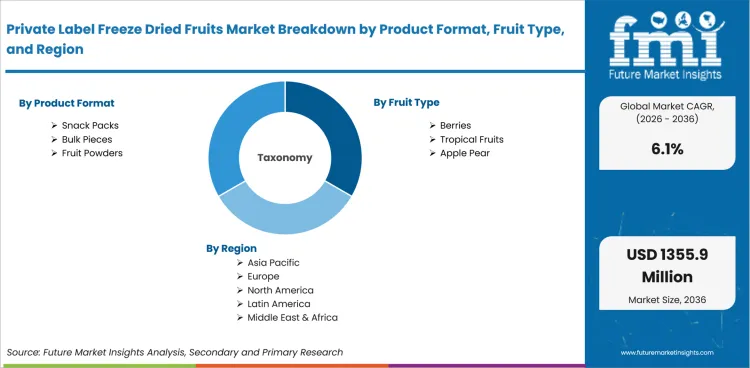
USD 750 million in 2026 and USD 1,355.9 million by 2036 at a 6.1% CAGR.
Private label freeze dried fruits industry value is forecast to move from USD 706.9 million in 2025 to USD 1,355.9 million by 2036 at 6.1% CAGR as retailers build customer-owned fruit snack packs and food brands use bulk fruit pieces in dry mixes. Retail Private Label is forecast to represent 51.2% share as grocery chains seek shelf control and customer-brand pricing. Snack Packs are expected to secure 42.6% share, supported by lunchbox use and single-serve pouch demand.
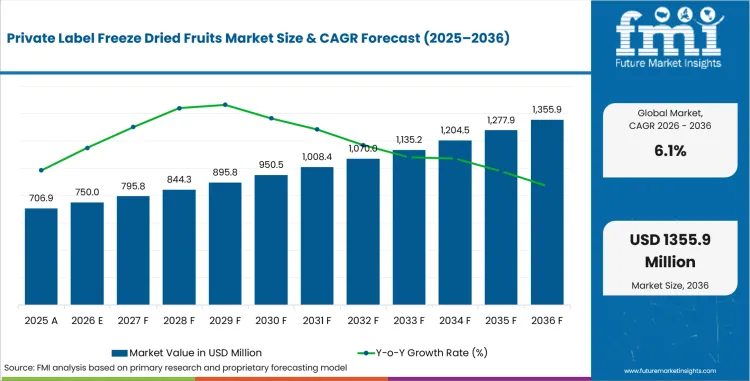
Private Label Freeze Dried Fruits Market Overview: Size and Forecast
- 2026 Market Size: USD 750 million
- 2036 Market Size: USD 1,355.9 million
- Forecast CAGR: 6.1% from 2026 to 2036
- Leading Buyer Type: Retail Private Label
- Retail Private Label Share in 2026: 51.2%
- Leading Product Format: Snack Packs
- Snack Packs Share in 2026: 42.6%
- Fastest-growing Country: South Korea
- South Korea CAGR: 7.7% by 2036
Summary of private label freeze dried fruits market
- Demand and Growth Drivers
- Retailers are building customer-owned fruit snack packs to protect shelf price and improve store-brand depth.
- Food brands are using freeze dried fruit pieces in cereals and dairy toppings to avoid cold-storage pressure.
- Contract packers are getting more work as retailers ask for custom pack sizes and artwork support.
- Clean ingredient labels support buyer interest in simple fruit snacks with no complex formulation story.
- Product and Segment View
- Retail Private Label is expected to lead as grocery chains use customer-brand packs for shelf control.
- Snack Packs are forecast to hold a strong position due to single-serve use and lunchbox demand.
- Berries are expected to stay important since strawberry and blueberry are familiar to household shoppers.
- Single-Fruit Packs support easier label work and lower artwork risk for private-label buyers.
- Geography and Competitive Outlook
- South Korea is expected to move fastest as convenience retail supports small fruit pouches.
- Saudi Arabia shows stronger readiness through modern grocery formats and imported snack demand.
- Australia has a clear route through supermarket health-snack shelves and premium pouch formats.
- Brothers International and Van Drunen Farms are positioned around retailer-ready pack support.
- Wanbang Food and Flex Foods serve export-ready private-label and bulk ingredient needs.
- Analyst Opinion
- Nandini Roy Choudhury, Principal Analyst at Future Market Insights, states, “Private label freeze dried fruits have moved into a retail control role. Grocery chains want real fruit snacks with clean labels and stable pack quality. Suppliers need audited plants and flexible artwork cycles before repeat programs start. Pack count, allergen files, and fruit identity now affect shortlists as much as price. B2B fruit pieces create a second route through cereals and dairy toppings. Retailers should watch small pouch tests since early pack trials can become multi-SKU awards.”
- What supports value in the private label freeze dried fruits market?
- Finished private-label fruit snack pack revenue and bulk ingredient sales support market value across retail and B2B channels.
- Market value is supported by customer-brand snack SKU revenue before bulk fruit pieces add sales from cereal and dairy applications.
- Supplier pricing reflects fruit sourcing and freeze-drying cost before pack size affects repeat retail orders.
- Revenue improves as grocery chains convert branded fruit snack shelf space into retailer-owned pouch programs.
- Retail trust rises as pack labels make fruit type along with serving size and allergen information easier to compare.
Retail buyers are using freeze dried fruit packs to offer real fruit snacks without chilled storage. Brothers International states its private-label program supplies over 60 million bags annually of freeze-dried fruit. Pack quality and allergen records now carry more weight during supplier approval. Bulk ingredient demand is creating another sales route as cereals and dairy toppings use fruit pieces with stable color and texture. Suppliers with audited plants and flexible pack sizes can win repeat private-label programs more easily.
How is the private label freeze dried fruits market segmented?
The private label freeze dried fruits industry is segmented by product format and fruit type. Pack type and sales channel complete most of the structure. Buyer type completes the commercial view.
- Snack Packs are forecast to hold 42.6% share in 2026 as single-serve pouch formats suit lunchbox use and retailer-owned snack programs.
- Berries are expected to capture 34.8% share in 2026, supported by familiar strawberry and blueberry demand across snack packs and cereal toppings.
- Single-Fruit Packs are projected to represent 38.5% share in 2026 as one-fruit labeling lowers artwork risk and makes repeat orders easier for retailers.
- Modern Retail is expected to secure 41.7% share in 2026, guided by grocery shelf resets and audited supplier approval.
- Retail Private Label is forecast to account for 51.2% share in 2026 with grocery chains using customer-brand packs to manage shelf price and store-brand depth.
Why do Snack Packs lead the private label freeze dried fruits market?
Snack Packs are projected to hold 42.6% share in 2026 through small pouch formats and easy lunchbox use.
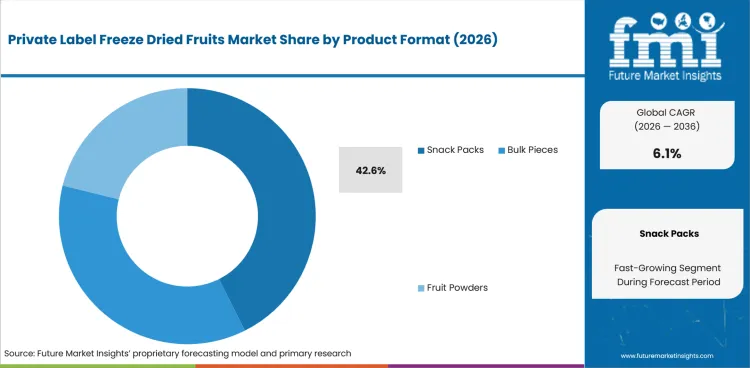
- Snack Packs are forecast to account for 42.6% share in 2026, supported by portion control and retailer-owned fruit snack programs.
- Bulk Pieces keep value as cereal and dairy brands need shelf-stable fruit inclusions without chilled handling.
Which fruit type leads the private label freeze dried fruits market?
Berries are expected to capture 34.8% share in 2026 as strawberry and blueberry carry familiar taste cues for household snack buyers.
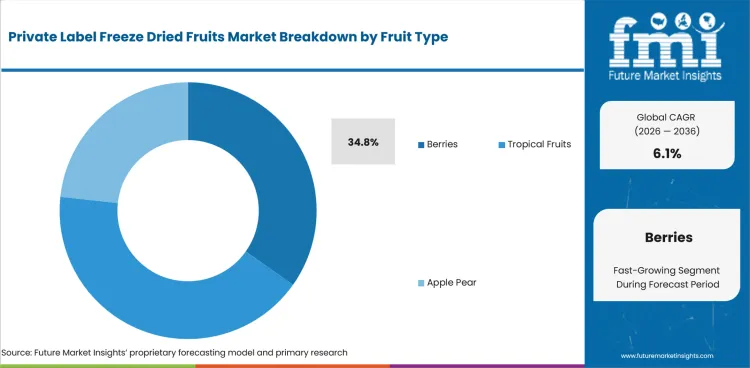
- Berries are forecast to secure 34.8% share in 2026, supported by use across snack packs and breakfast toppings.
- Tropical Fruits support premium pack trials as mango and pineapple help retailers test higher-value fruit pouches.
Which pack type leads the private label freeze dried fruits market?
Single-Fruit Packs are projected to represent 38.5% share in 2026 as one-fruit identity makes label work easier for private-label buyers.
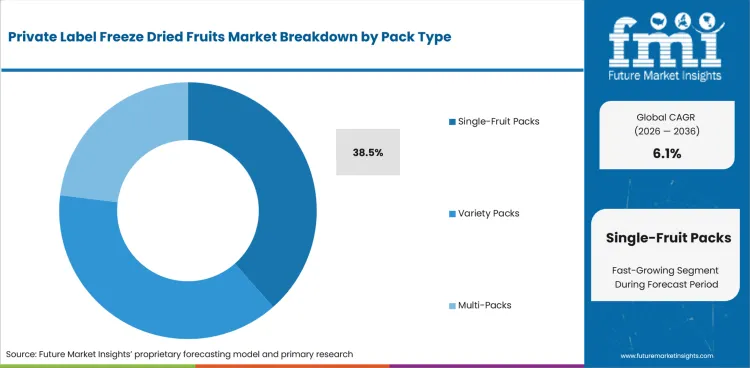
- Single-Fruit Packs are expected to hold 38.5% share in 2026, supported by lower artwork risk and easier repeat orders.
- Variety Packs support family trial as retailers can place two fruit choices inside one household pack.
Which sales channel leads the private label freeze dried fruits market?
Modern Retail is forecast to secure 41.7% share in 2026 as grocery chains control shelf placement and customer-brand snack pricing.
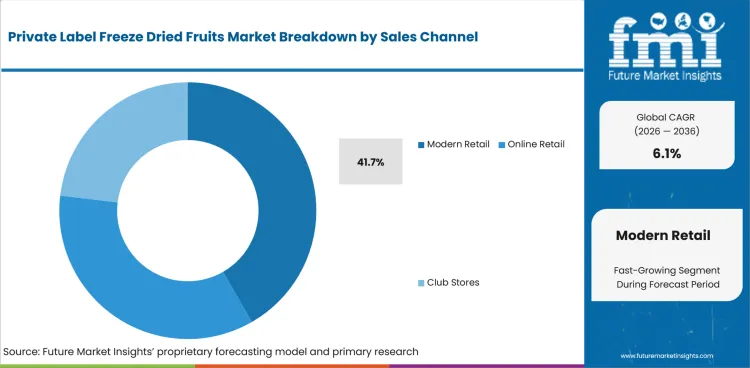
- Modern Retail is expected to represent 41.7% share in 2026, guided by grocery shelf resets and audited supplier approval.
- Online Retail supports trial packs as light pouch weight works well for grocery delivery.
Which buyer type leads the private label freeze dried fruits market?
Retail Private Label is projected to account for 51.2% share in 2026 as grocery chains use customer-brand packs to protect shelf price.
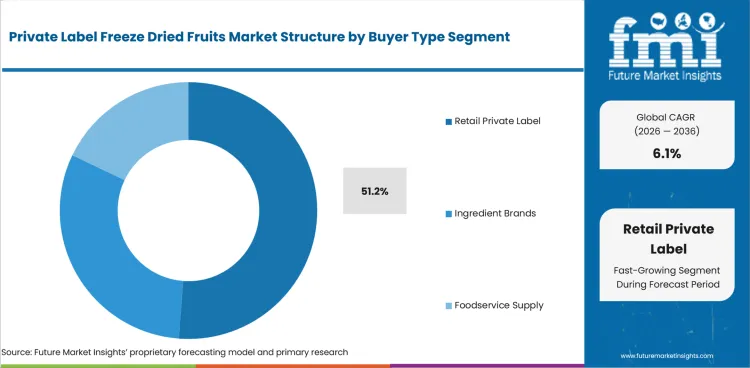
- Retail Private Label is forecast to hold 51.2% share in 2026, supported by retailer control over pack design and store-brand depth.
- Ingredient Brands create added demand as fruit powders and pieces serve cereals and dairy topping kits.
What are the driver, restraints, and opportunities in the private label freeze dried fruits market?
Retailer brand control and B2B fruit ingredient use support expansion while freeze-drying cost and traceability files limit wider rollout.
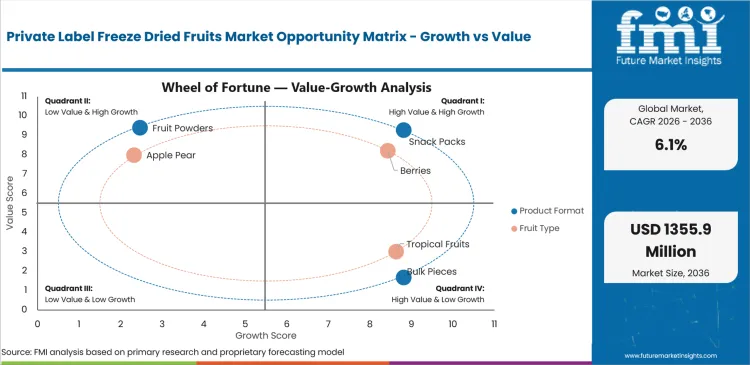
- Driver: Retailers are using customer-owned fruit snack packs to protect shelf price and improve store-brand depth.
- Restraint: Freeze-drying energy cost and fruit yield loss can pressure bids for value-tier private-label packs.
- Opportunity: Suppliers with audited packing lines and flexible artwork support can win repeat grocery programs.
Demand prediction is moving toward suppliers that combine finished pack support and clean fruit ingredient supply. PLMA reported in January 2026 that USA store-brand dollar sales rose 3.3% in 2025, while national brands advanced 1.2% in the same period. Retailers are putting more focus on customer-owned products as price control becomes harder. Food Industry Association reported in September 2025 that private-brand online sales rose 5.2% in 2024, with 9.3% of private-brand sales taking place online. Light fruit pouches fit online orders well. Van Drunen Farms’ Snack-to-Pack process covers sourcing and formulation development with packaging support, giving retailers a clearer route from idea to shelf.
Who buys private label freeze dried fruits?
Retailers, ingredient brands, and foodservice buyers form the main buying pool for private-label freeze dried fruit formats.
Consumer segmentation is expected to center on grocery chains and household snack buyers. Ingredient brands create another route through cereals and dairy toppings. Food Industry Association reported in June 2026 that nearly half of shoppers increased private-brand purchases over the past year. The same update stated that 94% of shoppers would continue buying store brands even if grocery prices decline. That finding matters for private-label freeze dried fruits since fruit snacks can move beyond budget positioning. Retailers can use single-fruit packs for simple shelf tests. Ingredient buyers can use powders and pieces to add fruit identity without chilled handling.
What influences private label freeze dried fruits purchase decisions?
Pack size, fruit identity, and supplier audit readiness shape repeat purchase behavior across grocery and online channels.
Purchase decisions are expected to depend more on pack clarity and trusted fruit sourcing as shoppers compare store-brand snacks with branded pouches. Food Industry Association reported in October 2024 that 71% of shoppers cited price and 72% cited good value as top reasons for buying more private-brand items. For freeze dried fruits, value does not only mean a lower shelf price. Buyers compare pouch count and fruit type before repeat orders. Retailers compare allergen records and moisture-control files before wider listing. Simple pack claims reduce buyer friction. Clear fruit identity can support repeat selection across snack packs and kids lunchbox formats.
Who are the leading companies in the private label freeze dried fruits market?
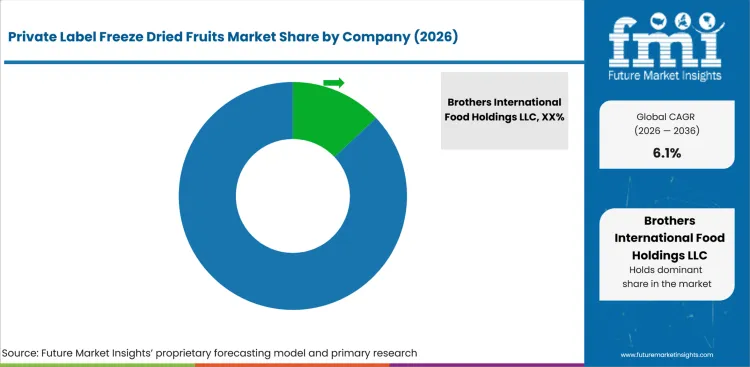
- Brothers International Food Holdings LLC and Van Drunen Farms are key private-label pack suppliers with strong fruit ingredient account coverage.
- Oregon Freeze Dry serves branded customers. European Freeze Dry supports B2B ingredient accounts through established freeze-drying capabilities.
- Flex Foods Limited supports export demand. Freeze-Dry Foods GmbH serves food manufacturing accounts. Wanbang Food / Sunward Global Trading Co. Ltd. supplies bulk fruit ingredient buyers.
- Established freeze-drying companies hold an advantage through audited plants and retailer-ready packaging. Specialist processors win shelf programs with fruit pieces and clear product files.
Customer-brand fruit snack suppliers in the market win business by combining fruit sourcing with pouch support. Brothers International Food Holdings LLC has a clear private-label position through freeze-dried fruit snack packs for mass grocery and related retail channels. Van Drunen Farms adds product development strength through its Snack-to-Pack process. Retailers use these suppliers when they need sourcing support and packaging help in one buying route.
Manufacturing depth has become a real separator as private-label programs move beyond small shelf tests. Oregon Freeze Dry brings long freeze-drying experience and contract manufacturing depth. European Freeze Dry supplies fruit in whole formats and powdered forms for snack or ingredient use. Freeze-Dry Foods GmbH serves food manufacturers with freeze-dried fruit ingredients in conventional and organic quality. Suppliers with pack flexibility can serve grocery snacks and breakfast ingredient needs without changing the core fruit stream.
Regional and export-ready players can win through faster pack work and buyer-specific formats. Flex Foods Limited gives India an export-facing freeze-dried fruit supply option. Wanbang Food / Sunward Global Trading Co. Ltd. supports private-label and bulk buyer needs for international accounts. Smaller processors can win when retailers need low order sizes or local fruit identity. Companies relying only on low price may face weaker acceptance if audit files and pack consistency are not strong.
How do top private label freeze dried fruits companies compare?
Brothers International Food Holdings LLC and Van Drunen Farms score strongest on customer-brand pack readiness.
| Company | Relevance to Market Title | Private-Label Pack Readiness | Fruit Format Range | Audit and Traceability Depth | Channel Reach | Geographic Footprint |
|---|---|---|---|---|---|---|
| Brothers International Food Holdings LLC | Very High | Very Strong | Very Strong | Strong | Very Strong | North America |
| Van Drunen Farms | Very High | Very Strong | Very Strong | Very Strong | Strong | North America |
| Oregon Freeze Dry | High | Strong | Strong | Very Strong | Strong | United States |
| European Freeze Dry Ltd | High | Strong | Very Strong | Very Strong | Strong | Europe |
| THRIVE FREEZEDRY Europe | High | Very Strong | Very Strong | Strong | Very Strong | Europe |
| Flex Foods Limited | High | Strong | Strong | Moderate to Strong | Strong | India and export |
| Wanbang Food / Sunward Global Trading Co. Ltd. | High | Strong | Strong | Moderate | Strong | China and export |
| Vancouver Freeze Dry Ltd. | Moderate to High | Strong | Moderate | Strong | Moderate | Canada |
| The Forager Food Co. | Moderate | Moderate | Moderate | Moderate | Moderate | Australia |
| Totally Pure Fruits | Moderate | Moderate | Moderate | Moderate | Moderate | Australia |
Source: Future Market Insights competitive analysis, 2026.
Who are the key players in the private label freeze dried fruits market?
Brothers International Food Holdings LLC and Van Drunen Farms are listed with Oregon Freeze Dry and Thrive Freeze Dry among key suppliers.
Key companies active in the private label freeze dried fruits market include:
- Brothers International Food Holdings LLC
- Van Drunen Farms
- Oregon Freeze Dry
- Thrive Freeze Dry
- European Freeze Dry Ltd.
- Freeze-Dry Foods GmbH
- Flex Foods Limited
- Wanbang Food / Sunward Global Trading Co. Ltd.
- Vancouver Freeze Dry Ltd.
- The Forager Food Co.
Key Developments in Private Label Freeze Dried Fruits Market
- In April 2024, Thrive Freeze Dry signed a definitive acquisition agreement with Paradiesfrucht GmbH. The move strengthened Thrive’s European freeze-dried fruit and ingredient position.
- In December 2025, Brothers International Food Holdings LLC acquired Food Partners. Food Partners is a global fruit ingredient supplier specializing in citrus supply and logistics coordination.
Key Players in the Private Label Freeze Dried Fruits Market
Private-Label Pack Specialists
- Brothers International Food Holdings LLC
- Van Drunen Farms
- Vancouver Freeze Dry Ltd.
- The Forager Food Co.
Freeze-Dried Ingredient Processors
- Oregon Freeze Dry
- European Freeze Dry Ltd.
- Freeze-Dry Foods GmbH
- Flex Foods Limited
Export-Ready Fruit Suppliers
- Thrive Freeze Dry
- Wanbang Food / Sunward Global Trading Co. Ltd.
- Totally Pure Fruits
- SunOpta Inc.
Retail and Customer-Brand Demand Owners
- Walmart Inc.
- Target Corporation
- Tesco PLC
- Woolworths Group Limited
- Coles Group Limited
Which countries are advancing fastest in the private label freeze dried fruits market?
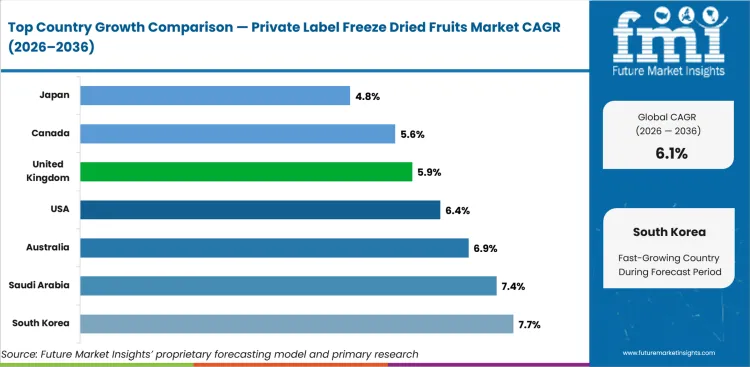
South Korea is forecast at 7.7% CAGR, followed by Saudi Arabia at 7.4% CAGR by 2036.
.webp "Top Country Growth Comparison Private Label Freeze Dried Fruits Market Cagr (2026 2036)")
| Country | CAGR |
|---|---|
| South Korea | 7.7% |
| Saudi Arabia | 7.4% |
| Australia | 6.9% |
| United States | 6.4% |
| United Kingdom | 5.9% |
| Canada | 5.6% |
| Japan | 4.8% |
Source: Future Market Insights, 2026.
How do country-level CAGRs compare in the private label freeze dried fruits market?
South Korea records the strongest pace, while Japan carries the most cautious outlook among the profiled markets.
- South Korea is forecast to record 7.7% CAGR by 2036 as convenience retail supports small fruit pouches and lunchbox packs.
- Saudi Arabia is expected to expand at 7.4% CAGR from 2026 to 2036 as modern grocery chains widen imported snack ranges.
- Australia is projected to move at 6.9% CAGR through 2036, supported by supermarket health-snack shelves and premium pouch formats.
- The United States is anticipated to register 6.4% CAGR by 2036 as grocery chains use customer-brand fruit snacks for shelf control.
- United Kingdom demand is forecast to rise at 5.9% CAGR during the forecast period as online grocery supports light snack packs.
- Canada is expected to record 5.6% CAGR by 2036 as concentrated grocery buying supports national private-label decisions.
- Japan is projected to expand at 4.8% CAGR through 2036 as exact pack quality and mature retail systems keep rollout more controlled.
mbj What is the Demand Outlook for Private Label Freeze Dried Fruits Market in the United States?
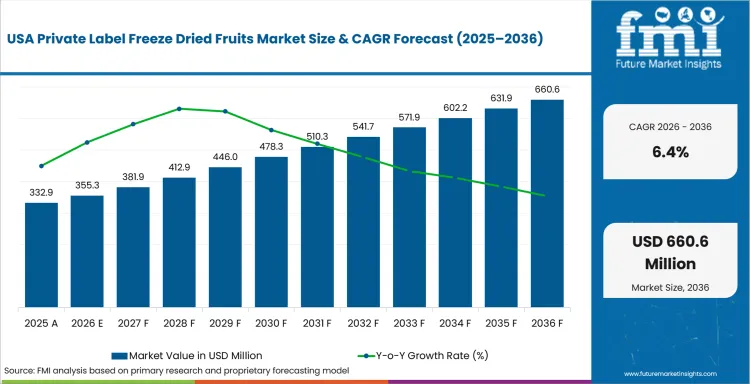
A 6.4% CAGR through 2036 reflects store-brand snack depth and national grocery control across household channels.
Country Market Snapshot Table
| Parameter | Value |
|---|---|
| Market Size in 2025 (Value) | USD 206.8 million |
| Market Forecast in 2036 (Value) | USD 409.1 million |
| CAGR (2026-2036) | 6.4% |
| Years Considered | 2021-2036 |
| Base Year | 2025 |
| Forecast Period | 2026-2036 |
| Units Considered | Value USD million |
| Leading Sub-Region | National grocery and club retail corridors |
United States Private Label Freeze Dried Fruits Market Outlook
USA demand comes from grocery chains that use store brands to manage snack price and pack identity. Freeze dried fruit fits customer-owned snack programs since packs are light and shelf stable. Club stores add order depth through family pouch counts and multi-pack offers. The market is forecast to expand at 6.4% CAGR from 2026 to 2036. Suppliers with audited pack rooms and artwork support are better placed for repeat private-label orders.
Key Growth Drivers
- Store-brand snack programs need reliable customer-owned products. PLMA reported USA store-brand sales reached USD 282.8 billion in 2025. This strengthens the route for private-label fruit pouches.
- Household acceptance of store brands creates room for fruit snacks. FMI reported 92% of USA grocery shoppers had private-brand products at home in June 2026. This makes fruit pouch trial easier for retailers.
- Club stores prefer larger pouch counts for family snack use. Retailers can test berry packs before wider private-label rollout.
- Cereal and dairy brands use fruit pieces to add fruit identity without chilled handling. Bulk pieces give processors another route beyond finished pouches.
Key Restraints
- Freeze-drying energy cost can pressure low-price bids for customer-brand snack packs.
- Strawberry yield swings can reduce pack margin when retailers request fixed shelf prices.
- Traceability work can slow supplier approval. FDA proposed a 30-month extension for the Food Traceability Rule in August 2025. Retailers may keep asking for lot-level records before formal enforcement.
What makes United States unique
The United States is unique because national grocery chains and club stores can turn a small fruit pouch test into a multi-SKU program. Supplier approval depends on pack files and reliable artwork cycles.
Key Companies
- Brothers International Food Holdings LLC
- Van Drunen Farms
- Oregon Freeze Dry
- Walmart Inc.
- Target Corporation
Sales & Marketing Channels
- National grocery private-label tenders
- Club store pouch programs
- Ingredient distributor accounts
- Online snack pack assortments
Country Segment Breakdown Table
| Segment | Sub-Segments |
|---|---|
| By Product Format | Snack Packs · Bulk Pieces · Fruit Powders · Granules · Mixed Formats |
| By Fruit Type | Berries · Tropical Fruits · Apple Pear · Banana · Mixed Fruit |
| By Pack Type | Single-Fruit Packs · Variety Packs · Multi-Packs · Kids Packs · Trial Packs |
| By Sales Channel | Modern Retail · Online Retail · Club Stores · Convenience Stores · Ingredient Distributors |
| By Buyer Type | Retail Private Label · Ingredient Brands · Foodservice Supply · Contract Packers · Family Snack Users |
| Key Sub-Regions Covered and Retail Corridors | Great Lakes · Pacific Coast · Northeast · Texas · Southeast · Mountain West · Midwest grocery accounts |
Frequently Asked Questions
How fast is the United States private label freeze dried fruits market expanding?
The United States private label freeze dried fruits market is forecast to expand at 6.4% CAGR from 2026 to 2036. Retailer-owned snack packs and club store pouch programs guide the pace.
Who leads the United States private label freeze dried fruits market?
Brothers International Food Holdings LLC and Van Drunen Farms lead supplier activity through private-label pack support and fruit ingredient depth.
What is driving adoption of private label freeze dried fruits in the United States?
Grocery chains want shelf-stable fruit snacks under customer-owned brands. Ingredient buyers need fruit pieces for dry mixes and dairy toppings.
How is Sales Progressing for Private Label Freeze Dried Fruits Market in Canada?
A 5.6% CAGR by 2036 reflects concentrated grocery buying and shorter local supply routes for fruit snack packs.
Country Market Snapshot Table
| Parameter | Value |
|---|---|
| Market Size in 2025 (Value) | USD 52.1 million |
| Market Forecast in 2036 (Value) | USD 94.8 million |
| CAGR (2026-2036) | 5.6% |
| Years Considered | 2021-2036 |
| Base Year | 2025 |
| Forecast Period | 2026-2036 |
| Units Considered | Value USD million |
| Leading Sub-Region | Ontario and Quebec grocery corridors |
Canada Private Label Freeze Dried Fruits Market Outlook
Canada demand is guided by grocery chains that use store brands to manage value and pack choice. Local processors can serve shorter routes for fruit pieces and pouch packs. Bilingual label work affects launch timing for customer-brand programs. Canada is expected to register 5.6% CAGR from 2026 to 2036. Ingredient buyers add another route through bakery mixes and breakfast products.
Key Growth Drivers
- Grocery chains have enough sales scale for repeat customer-brand fruit packs. USDA FAS reported Canada food retail sales reached USD 113 billion in 2024. This gives private-label fruit snacks a sizable retail base.
- Regional retail offers space for smaller fruit pouch tests. USDA FAS listed over 6,900 independent stores in Canada in 2025. This supports trial packs outside national chain shelves.
- Local freeze-drying capacity gives retailers shorter order routes for fruit snack pouches. Shorter routes can help seasonal packs reach shelves faster.
- Ingredient buyers use diced fruit and powders for bakery mixes and breakfast products. These accounts give processors another use for graded fruit streams.
Key Restraints
- Imported fruit input cost can pressure value-tier private-label programs.
- Bilingual label review can slow launch timing for smaller processors.
- Grocery access is narrow when few chains control shelf space. USDA FAS reported 5 leading retailers held over 65% of Canada grocery sales in 2024. This makes buyer approval harder for new suppliers.
What makes Canada unique
Canada is unique because grocery concentration can speed approval after a supplier passes review. The same concentration can block smaller processors if audit files or bilingual packs are incomplete.
Key Companies
- Vancouver Freeze Dry Ltd.
- Origo Foods Inc.
- Loblaw Companies Limited
- Empire Company Limited
- Metro Inc.
Sales & Marketing Channels
- Concentrated grocery listings
- Private-label co-packing agreements
- Wholesale ingredient accounts
- Natural food retail programs
Country Segment Breakdown Table
| Segment | Sub-Segments |
|---|---|
| By Product Format | Snack Packs · Bulk Pieces · Fruit Powders · Granules · Mixed Formats |
| By Fruit Type | Berries · Tropical Fruits · Apple Pear · Banana · Mixed Fruit |
| By Pack Type | Single-Fruit Packs · Variety Packs · Multi-Packs · Kids Packs · Trial Packs |
| By Sales Channel | Modern Retail · Online Retail · Club Stores · Convenience Stores · Ingredient Distributors |
| By Buyer Type | Retail Private Label · Ingredient Brands · Foodservice Supply · Contract Packers · Family Snack Users |
| Key Sub-Regions Covered and Provinces | Ontario · Quebec · British Columbia · Alberta · Atlantic Canada · Prairie provinces |
Frequently Asked Questions
How fast is the Canada private label freeze dried fruits market expanding?
The Canada private label freeze dried fruits market is forecast to expand at 5.6% CAGR from 2026 to 2036. Concentrated grocery buying guides national listing decisions.
Who leads the Canada private label freeze dried fruits market?
Vancouver Freeze Dry Ltd. and Origo Foods Inc. are active local suppliers. Loblaw Companies Limited and Empire Company Limited influence private-label shelf access.
What is driving adoption of private label freeze dried fruits in Canada?
Retailers need store-brand snacks with clean labels and stable supply. Local processors help reduce lead time for trial orders.
What is the Demand Outlook for Private Label Freeze Dried Fruits Market in the United Kingdom?
A 5.9% CAGR through 2036 reflects own-brand grocery depth and online pouch readiness across snack aisles.
Country Market Snapshot Table
| Parameter | Value |
|---|---|
| Market Size in 2025 (Value) | USD 68 million |
| Market Forecast in 2036 (Value) | USD 127.7 million |
| CAGR (2026-2036) | 5.9% |
| Years Considered | 2021-2036 |
| Base Year | 2025 |
| Forecast Period | 2026-2036 |
| Units Considered | Value USD million |
| Leading Sub-Region | England grocery and online retail corridors |
United Kingdom Private Label Freeze Dried Fruits Market Outlook
The United Kingdom has deep own-brand grocery use and a clear route for online pouch sales. Freeze dried fruit works in light packs that fit delivery baskets and health-snack shelves. European processors can serve fruit pieces for bakery and breakfast brands. The United Kingdom is forecast to advance at 5.9% CAGR from 2026 to 2036. Store-brand snack programs favor suppliers with clean label support and steady pouch quality.
Key Growth Drivers
- Large food retail accounts give own-brand fruit snacks a practical shelf route. USDA FAS valued the UK retail food industry at USD 342 billion in 2025. This scale gives private-label pouches room for testing.
- Grocery delivery makes lightweight snack formats easier to list. USDA FAS reported online purchases accounted for 13% of UK grocery sales in 2025. Freeze dried fruit suits this channel because packs are light.
- Own-brand grocery programs create shelf space for fruit snacks with simple ingredient claims. Retailers can test berry and apple packs before adding variety packs.
- European ingredient supply helps bakeries source diced fruit and fruit powders. Shorter supply routes can improve response time for recipe changes.
Key Restraints
- Retailers can reject new packs when allergen files or source records lack detail.
- Energy and freight cost can weaken bids for lower-price pouch lines.
- Price pressure is high in discount grocery. USDA FAS reported Aldi and Lidl held 19.2% combined UK grocery market share in 2024. This can narrow margin for premium fruit pouches.
What makes United Kingdom unique
The United Kingdom is unique because own-brand trust and online grocery depth work together. Freeze dried fruit suppliers need pack design support and strong food safety records before wider listing.
Key Companies
- European Freeze Dry Ltd.
- Tesco PLC
- J Sainsbury plc
- Iceland Foods Limited
- Marks and Spencer Group plc
Sales & Marketing Channels
- Grocer own-brand tenders
- Online grocery snack packs
- Food ingredient distributor accounts
- Health snack aisle programs
Country Segment Breakdown Table
| Segment | Sub-Segments |
|---|---|
| By Product Format | Snack Packs · Bulk Pieces · Fruit Powders · Granules · Mixed Formats |
| By Fruit Type | Berries · Tropical Fruits · Apple Pear · Banana · Mixed Fruit |
| By Pack Type | Single-Fruit Packs · Variety Packs · Multi-Packs · Kids Packs · Trial Packs |
| By Sales Channel | Modern Retail · Online Retail · Club Stores · Convenience Stores · Ingredient Distributors |
| By Buyer Type | Retail Private Label · Ingredient Brands · Foodservice Supply · Contract Packers · Family Snack Users |
| Key Sub-Regions Covered and Channels | England · Scotland · Wales · Northern Ireland · Online grocery platforms · Discount grocery chains |
Frequently Asked Questions
How fast is the United Kingdom private label freeze dried fruits market expanding?
The United Kingdom private label freeze dried fruits market is forecast to expand at 5.9% CAGR from 2026 to 2036. Own-brand grocery and online pouch sales keep demand active.
Who leads the United Kingdom private label freeze dried fruits market?
European Freeze Dry Ltd. is an active supplier. Tesco PLC and J Sainsbury plc shape own-brand grocery demand.
What is driving adoption of private label freeze dried fruits in the United Kingdom?
Retailers use store-brand snack packs to serve value and health-snack shoppers. Online grocery helps trial packs reach households.
What Opportunity Exists for Private Label Freeze Dried Fruits Market in Saudi Arabia?
A 7.4% CAGR through 2036 reflects imported snack depth and modern hypermarket testing across premium shelves.
Country Market Snapshot Table
| Parameter | Value |
|---|---|
| Market Size in 2025 (Value) | USD 33.5 million |
| Market Forecast in 2036 (Value) | USD 73.5 million |
| CAGR (2026-2036) | 7.4% |
| Years Considered | 2021-2036 |
| Base Year | 2025 |
| Forecast Period | 2026-2036 |
| Units Considered | Value USD million |
| Leading Sub-Region | Riyadh and Jeddah modern grocery corridors |
Saudi Arabia Private Label Freeze Dried Fruits Market Outlook
Saudi Arabia uses imported shelf-stable snacks to widen premium grocery ranges. Freeze dried fruit fits hot-market retail since moisture-safe packs protect texture. Hypermarkets can test imported customer-brand fruit pouches before wider branch rollout. Saudi Arabia is expected to move at 7.4% CAGR from 2026 to 2036. Retailers favor packs that can travel through long distribution routes without losing crunch.
Key Growth Drivers
- Modern grocery chains have room for imported customer-brand snacks. USDA FAS reported Saudi food retail sales topped USD 50 billion in 2024. This gives fruit pouches a sizable retail entry route.
- Retail food sales are still expanding. USDA FAS expected Saudi food retail to grow about 5% in 2025. New shelves give grocers more room to test private-label fruit snacks.
- Ambient fruit pouches reduce cold-storage pressure across long retail distribution routes. Moisture barrier packs can protect crunch in hot logistics conditions.
- Halal-ready documentation makes supplier approval easier for customer-brand fruit packs. Arabic label readiness can shorten retailer review time.
Key Restraints
- Heat exposure during transport can damage texture if moisture barriers are weak.
- Import paperwork can slow shelf entry for new private-label suppliers.
- Food supply relies heavily on imports. USDA FAS stated Saudi Arabia meets 70% of food demand through imports in 2025. Freight cost and document checks can raise listing risk.
What makes Saudi Arabia unique
Saudi Arabia is unique because imported premium snacks and modern grocery formats are central to retail planning. Suppliers need moisture-safe packs and halal documentation before customer-brand approval.
Key Companies
- Panda Retail Company
- BinDawood Holding Company
- Abdullah Al Othaim Markets Company
- Tamimi Markets Company
- LuLu Saudi Hypermarkets LLC
Sales & Marketing Channels
- Imported snack distributor contracts
- Hypermarket private-label programs
- Halal-compliant pack listings
- Premium grocery shelf trials
Country Segment Breakdown Table
| Segment | Sub-Segments |
|---|---|
| By Product Format | Snack Packs · Bulk Pieces · Fruit Powders · Granules · Mixed Formats |
| By Fruit Type | Berries · Tropical Fruits · Apple Pear · Banana · Mixed Fruit |
| By Pack Type | Single-Fruit Packs · Variety Packs · Multi-Packs · Kids Packs · Trial Packs |
| By Sales Channel | Modern Retail · Online Retail · Club Stores · Convenience Stores · Ingredient Distributors |
| By Buyer Type | Retail Private Label · Ingredient Brands · Foodservice Supply · Contract Packers · Family Snack Users |
| Key Sub-Regions Covered and Retail Corridors | Riyadh · Jeddah · Eastern Province · Makkah · Dammam · Hypermarket corridors |
Frequently Asked Questions
How fast is the Saudi Arabia private label freeze dried fruits market expanding?
The Saudi Arabia private label freeze dried fruits market is forecast to expand at 7.4% CAGR from 2026 to 2036. Imported shelf-stable snacks form the main route.
Who leads the Saudi Arabia private label freeze dried fruits market?
Panda Retail Company and BinDawood Holding Company shape modern grocery access. Abdullah Al Othaim Markets Company and Tamimi Markets Company influence private-label shelf space.
What is driving adoption of private label freeze dried fruits in Saudi Arabia?
Modern grocery chains need ambient fruit snacks with premium pack cues. Halal-ready files improve supplier approval.
What is the Future Outlook for Private Label Freeze Dried Fruits Market in South Korea?
A 7.7% CAGR by 2036 reflects convenience retail depth and fast small-pack testing across grocery platforms.
Country Market Snapshot Table
| Parameter | Value |
|---|---|
| Market Size in 2025 (Value) | USD 39 million |
| Market Forecast in 2036 (Value) | USD 88.2 million |
| CAGR (2026-2036) | 7.7% |
| Years Considered | 2021-2036 |
| Base Year | 2025 |
| Forecast Period | 2026-2036 |
| Units Considered | Value USD million |
| Leading Sub-Region | Seoul Capital Area convenience retail |
South Korea Private Label Freeze Dried Fruits Market Outlook
South Korea has a strong fit for small fruit pouches through convenience stores and grocery platforms. Shoppers can trial mango or berry packs without buying large family bags. Retailers can rotate flavors quickly when suppliers provide fast artwork support. The market is forecast to register 7.7% CAGR from 2026 to 2036. Private-label fruit packs work best when pouch design is simple and shelf testing is fast.
Key Growth Drivers
- Convenience retail gives small packs a clear shopping occasion. USDA FAS reported Korean retail food sales totaled USD 132 billion in 2024. Portable fruit pouches fit commuting and lunchbox needs.
- Korea’s online retail route is strong for small fruit pouches. USDA FAS reported total retail e-commerce transactions reached 224 trillion won in 2024. Agricultural and food products made up over 30% of online transactions.
- Grocery platforms allow retailers to test fruit packs without heavy shelf pressure. Small pouch formats can move through online assortments before store rollout.
- Beverage and bakery manufacturers use fruit powders for color and flavor identity. This gives processors a B2B route beyond snack packs.
Key Restraints
- Short retail cycles can create unsold stock risk after flavor tests.
- Import checks can slow the arrival of new fruit snack packs.
- Snack packs must fight for room in a broad retail channel. USDA FAS reported retail food sales formed 31% of Korea total retail sales in 2024. This keeps shelf decisions selective.
What makes South Korea unique
South Korea is unique because convenience retail and grocery platforms make small pack testing practical. Suppliers need fast label changes and reliable pouch texture.
Key Companies
- Lotte Shopping Co. Ltd.
- E-MART Inc.
- GS Retail Co. Ltd.
- BGF Retail Co. Ltd.
- Coupang Inc.
Sales & Marketing Channels
- Convenience retail pouch programs
- Grocery platform listings
- Food processor ingredient accounts
- Lunchbox snack promotions
Country Segment Breakdown Table
| Segment | Sub-Segments |
|---|---|
| By Product Format | Snack Packs · Bulk Pieces · Fruit Powders · Granules · Mixed Formats |
| By Fruit Type | Berries · Tropical Fruits · Apple Pear · Banana · Mixed Fruit |
| By Pack Type | Single-Fruit Packs · Variety Packs · Multi-Packs · Kids Packs · Trial Packs |
| By Sales Channel | Modern Retail · Online Retail · Club Stores · Convenience Stores · Ingredient Distributors |
| By Buyer Type | Retail Private Label · Ingredient Brands · Foodservice Supply · Contract Packers · Family Snack Users |
| Key Sub-Regions Covered and Retail Areas | Seoul Capital Area · Busan · Daegu · Incheon · Convenience networks · E-commerce grocery platforms |
Frequently Asked Questions
How fast is the South Korea private label freeze dried fruits market expanding?
The South Korea private label freeze dried fruits market is forecast to expand at 7.7% CAGR from 2026 to 2036. Convenience retail gives small pouches a clear route.
Who leads the South Korea private label freeze dried fruits market?
Lotte Shopping Co. Ltd. and E-MART Inc. influence grocery demand. GS Retail Co. Ltd. and BGF Retail Co. Ltd. shape convenience store access.
What is driving adoption of private label freeze dried fruits in South Korea?
Small snack packs fit convenience retail and online grocery use. Fruit powders serve bakery and beverage brands.
How is Demand Developing for Private Label Freeze Dried Fruits Market in Japan?
A 4.8% CAGR through 2036 reflects exact pack standards and quality-led private-brand snack use.
Country Market Snapshot Table
| Parameter | Value |
|---|---|
| Market Size in 2025 (Value) | USD 64.9 million |
| Market Forecast in 2036 (Value) | USD 108.7 million |
| CAGR (2026-2036) | 4.8% |
| Years Considered | 2021-2036 |
| Base Year | 2025 |
| Forecast Period | 2026-2036 |
| Units Considered | Value USD million |
| Leading Sub-Region | Kanto convenience and supermarket corridors |
Japan Private Label Freeze Dried Fruits Market Outlook
Japan demand centers on small packs with clean design and consistent fruit texture. Convenience stores and supermarkets favor tidy portions over large pouch formats. Mature shelves limit fast rollout but quality-focused buyers can pay for reliable pack appearance. Japan is projected to advance at 4.8% CAGR from 2026 to 2036. Suppliers with clear origin records are better suited to private-brand review.
Key Growth Drivers
- Food retail has enough scale for quality snack formats. USDA FAS reported Japan retail sector sales totaled USD 193 billion in 2024. Freeze dried fruit can fit premium snack and small pouch shelves.
- Convenience stores create steady small-pack demand. USDA FAS reported 208 more stores between January 2024 and January 2025. This gives fruit snack pouches more touchpoints.
- Supermarkets prefer clear labels and exact portion sizes for customer-brand snacks. One-fruit packs can reduce artwork risk.
- Confectionery makers use diced fruit for color and texture in dry products. Ingredient demand gives processors a route beyond retail pouches.
Key Restraints
- Mature retail shelves reduce space available for new fruit snack pouches.
- Strict quality checks can slow approval for imported private-label packs.
- Japan’s drugstore food channel can support small shelf-stable snack formats. USDA FAS reported drug stores accounted for 11.2% of total food retail sales in 2024.
What makes Japan unique
Japan is unique because pack precision and texture quality matter more than large-volume rollout. Suppliers need consistent fruit appearance and clean origin records.
Key Companies
- AEON Co. Ltd.
- Seven and i Holdings Co. Ltd.
- FamilyMart Co. Ltd.
- Lawson Inc.
- Ryohin Keikaku Co. Ltd.
Sales & Marketing Channels
- Convenience store snack placements
- Supermarket private-brand offers
- Ingredient supply to confectionery makers
- Drugstore snack displays
Country Segment Breakdown Table
| Segment | Sub-Segments |
|---|---|
| By Product Format | Snack Packs · Bulk Pieces · Fruit Powders · Granules · Mixed Formats |
| By Fruit Type | Berries · Tropical Fruits · Apple Pear · Banana · Mixed Fruit |
| By Pack Type | Single-Fruit Packs · Variety Packs · Multi-Packs · Kids Packs · Trial Packs |
| By Sales Channel | Modern Retail · Online Retail · Club Stores · Convenience Stores · Ingredient Distributors |
| By Buyer Type | Retail Private Label · Ingredient Brands · Foodservice Supply · Contract Packers · Family Snack Users |
| Key Sub-Regions Covered and Regions | Kanto · Kansai · Chubu · Kyushu · Hokkaido · Convenience store networks |
Frequently Asked Questions
How fast is the Japan private label freeze dried fruits market expanding?
The Japan private label freeze dried fruits market is forecast to expand at 4.8% CAGR from 2026 to 2036. Small packs and quality-focused retail guide the outlook.
Who leads the Japan private label freeze dried fruits market?
AEON Co. Ltd. and Seven and i Holdings Co. Ltd. shape grocery and convenience access. FamilyMart Co. Ltd. and Lawson Inc. influence small-pack testing.
What is driving adoption of private label freeze dried fruits in Japan?
Convenience retail and premium snack shelves drive demand for small fruit packs. Ingredient use in confectionery gives suppliers another route.
What is the In-depth Sales View for Private Label Freeze Dried Fruits Market in Australia?
A 6.9% CAGR by 2036 reflects supermarket health-snack shelf testing and local fruit-processing support.
Country Market Snapshot Table
| Parameter | Value |
|---|---|
| Market Size in 2025 (Value) | USD 28.1 million |
| Market Forecast in 2036 (Value) | USD 58.5 million |
| CAGR (2026-2036) | 6.9% |
| Years Considered | 2021-2036 |
| Base Year | 2025 |
| Forecast Period | 2026-2036 |
| Units Considered | Value USD million |
| Leading Sub-Region | Eastern supermarket and health-snack corridors |
Australia Private Label Freeze Dried Fruits Market Outlook
Australia has a clear private-label route through supermarket health-snack shelves. Local processors can supply berry and apple packs with a domestic fruit story. Grocery shoppers compare pouch count and fruit type closely. Australia is expected to rise at 6.9% CAGR from 2026 to 2036. Retailers need moisture-safe packs since long domestic routes can affect crunch and texture.
Key Growth Drivers
- Supermarket channels give fruit pouches a clear shelf route. USDA FAS reported Australia food and liquor retailing totaled A$239 billion in 2024. This creates room for customer-brand snack tests.
- Grocery concentration improves private-label shelf planning. USDA FAS reported supermarket and grocery expenditures held 60% share of food retailing purchases in 2024. Store-brand packs can scale after a successful trial.
- Local fruit processors help retailers test domestic-source pack stories. Berry and apple packs can carry simple origin cues.
- Club and online grocery channels suit light pouch packs for household snack orders. Larger pack counts can fit family snack occasions.
Key Restraints
- Long freight routes can raise packaging needs for moisture-sensitive fruit snacks.
- Imported fruit inputs can pressure shelf price during currency swings.
- Import exposure can affect ingredient cost. USDA FAS reported Australia imported USD 14.4 billion worth of consumer-oriented products in 2025. Suppliers need stronger sourcing plans to protect margins.
What makes Australia unique
Australia is unique because supermarket health-snack shelves and local freeze-dried processors work in the same market. Suppliers need strong pouch barriers and clear serving-size design.
Key Companies
- Woolworths Group Limited
- Coles Group Limited
- ALDI Stores Australia Pty Limited
- The Forager Food Co.
- Totally Pure Fruits
Sales & Marketing Channels
- Supermarket private-brand tenders
- Health snack aisle trials
- Club retail pouch packs
- Local processor co-packing
Country Segment Breakdown Table
| Segment | Sub-Segments |
|---|---|
| By Product Format | Snack Packs · Bulk Pieces · Fruit Powders · Granules · Mixed Formats |
| By Fruit Type | Berries · Tropical Fruits · Apple Pear · Banana · Mixed Fruit |
| By Pack Type | Single-Fruit Packs · Variety Packs · Multi-Packs · Kids Packs · Trial Packs |
| By Sales Channel | Modern Retail · Online Retail · Club Stores · Convenience Stores · Ingredient Distributors |
| By Buyer Type | Retail Private Label · Ingredient Brands · Foodservice Supply · Contract Packers · Family Snack Users |
| Key Sub-Regions Covered and States | New South Wales · Victoria · Queensland · Western Australia · South Australia · Tasmania |
Frequently Asked Questions
How fast is the Australia private label freeze dried fruits market expanding?
The Australia private label freeze dried fruits market is forecast to expand at 6.9% CAGR from 2026 to 2036. Supermarket health-snack shelves give fruit pouches a clear route.
Who leads the Australia private label freeze dried fruits market?
Woolworths Group Limited and Coles Group Limited shape private-brand demand. The Forager Food Co. and Totally Pure Fruits support local freeze-dried fruit supply.
What is driving adoption of private label freeze dried fruits in Australia?
Supermarket health aisles and local fruit stories help private-label pouches win trial. Ingredient buyers add demand for powders and diced fruit.
Private Label Freeze Dried Fruits Market - Report Scope
| Item | Value |
|---|---|
| Market size by 2036 | USD 1,355.9 million |
| Growth rate | 6.1% CAGR from 2026 to 2036 |
| Forecast period | 2026 to 2036 |
| Base year value (2025) | USD 706.9 million |
| By product format | Snack packs, bulk pieces, fruit powders, granules, mixed formats |
| By fruit type | Berries, tropical fruits, apple pear, banana, mixed fruit |
| By pack type | Single-fruit packs, variety packs, multi-packs, kids packs, trial packs |
| By sales channel | Modern retail, online retail, club stores, convenience stores, ingredient distributors |
| By buyer type | Retail private label, ingredient brands, foodservice supply, contract packers, family snack users |
| Regions covered | North America, Latin America, Europe, East Asia, South Asia and Pacific, Middle East and Africa |
| Countries covered | United States, Canada, United Kingdom, Saudi Arabia, South Korea, Japan, Australia |
| Key companies profiled | Brothers International Food Holdings LLC, Van Drunen Farms, Oregon Freeze Dry, Thrive Freeze Dry, European Freeze Dry Ltd., Freeze-Dry Foods GmbH, Flex Foods Limited, Wanbang Food / Sunward Global Trading Co. Ltd. |
| Approach | Bottom-up product-boundary approach using eligible SKU revenue, channel presence, retail pricing, product positioning, and country-level adoption |
Source: Future Market Insights, 2026
Private Label Freeze Dried Fruits Market - Scope & Definition
| Attribute | Detail |
|---|---|
| Market Definition | Freeze-dried fruit products made for retailer-owned brands and B2B ingredient accounts. Scope includes snack packs and bulk fruit ingredients sold under customer-brand or contract supply programs. |
| Functions Covered | Shelf-stable fruit snacking, Dry ingredient inclusion, Clean-label fruit identity, Texture and color support, Low-moisture fruit format |
| Applications Covered | Snack packs, Bulk fruit pieces, Fruit powders, Granules, Mixed fruit formats used in retail and food manufacturing |
| End-Use Industries | Retail food, Packaged food, Breakfast products, Dairy toppings, Bakery mixes, Foodservice supply |
| Formats Covered | Snack packs, Bulk pieces, Fruit powders, Granules, Mixed formats |
| Inclusions | All commercially traded private-label freeze dried fruits across product formats, fruit types, pack types, sales channels, and buyer groups. Retail private-label packs and B2B ingredient formats are included. |
| Exclusions | Branded freeze-dried fruit packs owned by manufacturers, Fresh fruit, Frozen fruit, Canned fruit, Air-dried fruit, Freeze-drying equipment, Finished cereals and yogurt products |
Private Label Freeze Dried Fruits Market - Research Methodology
| Method | Description |
|---|---|
| Primary Research | FMI analyst interviews with freeze-dried fruit processors, private-label packers, grocery retail teams, ingredient distributors, and food manufacturing buyers across key markets. |
| Desk Research | Review of FDA, USDA FAS, PLMA, FMI-The Food Industry Association, supplier product pages, certification files, and company-owned disclosures related to freeze-dried fruit supply. |
| Market Sizing & Forecasting | Bottom-up product-boundary approach using eligible SKU revenue, retail pricing, channel presence, product format segmentation, and country-level adoption trends. |
| Data Validation | Cross-verification using retailer private-label activity, supplier product portfolios, food safety documentation, channel readiness, and country-level grocery retail signals. |
Private Label Freeze Dried Fruits Market Breakdown by Product Format, Fruit Type, Pack Type, Sales Channel, Buyer Type, and Region
Private Label Freeze Dried Fruits Market Segmented by Product Format
- Snack Packs
- Bulk Pieces
- Fruit Powders
- Granules
- Mixed Formats
Private Label Freeze Dried Fruits Market Segmented by Fruit Type
- Berries
- Tropical Fruits
- Apple Pear
- Banana
- Mixed Fruit
Private Label Freeze Dried Fruits Market Segmented by Pack Type
- Single-Fruit Packs
- Variety Packs
- Multi-Packs
- Kids Packs
- Trial Packs
Private Label Freeze Dried Fruits Market Segmented by Sales Channel
- Modern Retail
- Online Retail
- Club Stores
- Convenience Stores
- Ingredient Distributors
Private Label Freeze Dried Fruits Market Segmented by Buyer Type
- Retail Private Label
- Ingredient Brands
- Foodservice Supply
- Contract Packers
- Family Snack Users
Private Label Freeze Dried Fruits Market by Region
- North America
- Latin America
- Europe
- East Asia
- South Asia and Pacific
- Middle East and Africa
Research Sources & Bibliography
- Brothers International Food Holdings, LLC. (2026, April 30). Private label fruit products. Brothers International.
- Brothers International Food Holdings, LLC. (2025, December 12). Food Partners joins the Brothers International team. Brothers International.
- FMI - The Food Industry Association. (2024, October 10). FMI’s Power of Private Brands 2024 identifies increased industry investment. FMI - The Food Industry Association.
- FMI - The Food Industry Association. (2025, September 11). FMI report: Ecommerce fueling growth and innovation in private brands. FMI - The Food Industry Association.
- FMI - The Food Industry Association. (2026, June 16). FMI research confirms private brands are a staple in American households. FMI - The Food Industry Association.
- Paradise Fruits. (2024, April 12). Thrive Freeze Dry signs definitive acquisition agreement with Paradiesfrucht GmbH. Paradise Fruits.
- Private Label Manufacturers Association. (2026, January 20). USA private label industry reached $282.8 billion in sales in 2025. Private Label Manufacturers Association.
- USA Department of Agriculture, Foreign Agricultural Service. (2025, August 5). South Korea: Exporter guide annual. USDA Foreign Agricultural Service.
- USA Department of Agriculture, Foreign Agricultural Service. (2025, September 24). Saudi Arabia: Retail foods annual. USDA Foreign Agricultural Service.
- USA Department of Agriculture, Foreign Agricultural Service. (2025, November 19). Australia: Retail foods annual. USDA Foreign Agricultural Service.
- USA Department of Agriculture, Foreign Agricultural Service. (2025, November 19). Japan: Retail foods annual. USDA Foreign Agricultural Service.
- USA Department of Agriculture, Foreign Agricultural Service. (2025, November 19). South Korea: Retail foods annual. USDA Foreign Agricultural Service.
- USA Department of Agriculture, Foreign Agricultural Service. (2025, December 30). Canada: Retail foods annual. USDA Foreign Agricultural Service.
- USA Department of Agriculture, Foreign Agricultural Service. (2026, March 24). United Kingdom: Food processing ingredients annual. USDA Foreign Agricultural Service.
- USA Food and Drug Administration. (2025, August 6). FDA proposes to extend compliance date for Food Traceability Rule and issues new FAQs and other resources. USA Food and Drug Administration.
This bibliography is provided for reader reference and is not exhaustive. The full report contains the complete reference list and detailed citations.
This Report Answers
- What is the 2026 value and 2036 forecast for private label freeze dried fruits market?
- Which buyer type is projected to hold the leading share during the forecast period?
- Which product format is expected to account for the leading 2026 share?
- How do retailer-owned brands and bulk ingredient use affect market growth?
- What companies operate in private label freeze dried fruits market?
Frequently Asked Questions
What is the private label freeze dried fruits market size in 2026?
The private label freeze dried fruits market size is forecast to reach USD 750 million in 2026.
What is the private label freeze dried fruits market forecast for 2036?
The private label freeze dried fruits industry revenue is expected to reach USD 1,355.9 million by 2036 as retailer-owned fruit snacks and B2B fruit ingredients expand.
What is the private label freeze dried fruits market CAGR?
The private label freeze dried fruits sector is projected to expand at 6.1% CAGR from 2026 to 2036.
What segment leads the private label freeze dried fruits market?
Retail Private Label is likely to capture 51.2% share in 2026 as grocery chains use customer-brand packs to control shelf price and pack identity.
What country grows fastest in the private label freeze dried fruits market?
South Korea is forecast to record 7.7% CAGR by 2036, backed by convenience retail and small fruit pouch testing.
Preview the report firsthand - request a free sample
Get SampleGet the brochure for pricing and purchase details.
Get PDFTable of Content
- Executive Summary
- Global Market Outlook
- Demand to side Trends
- Supply to side Trends
- Technology Roadmap Analysis
- Analysis and Recommendations
- Market Overview
- Market Coverage / Taxonomy
- Market Definition / Scope / Limitations
- Research Methodology
- Chapter Orientation
- Analytical Lens and Working Hypotheses
- Market Structure, Signals, and Trend Drivers
- Benchmarking and Cross-market Comparability
- Market Sizing, Forecasting, and Opportunity Mapping
- Research Design and Evidence Framework
- Desk Research Programme (Secondary Evidence)
- Company Annual and Sustainability Reports
- Peer-reviewed Journals and Academic Literature
- Corporate Websites, Product Literature, and Technical Notes
- Earnings Decks and Investor Briefings
- Statutory Filings and Regulatory Disclosures
- Technical White Papers and Standards Notes
- Trade Journals, Industry Magazines, and Analyst Briefs
- Conference Proceedings, Webinars, and Seminar Materials
- Government Statistics Portals and Public Data Releases
- Press Releases and Reputable Media Coverage
- Specialist Newsletters and Curated Briefings
- Sector Databases and Reference Repositories
- FMI Internal Proprietary Databases and Historical Market Datasets
- Subscription Datasets and Paid Sources
- Social Channels, Communities, and Digital Listening Inputs
- Additional Desk Sources
- Expert Input and Fieldwork (Primary Evidence)
- Primary Modes
- Qualitative Interviews and Expert Elicitation
- Quantitative Surveys and Structured Data Capture
- Blended Approach
- Why Primary Evidence is Used
- Field Techniques
- Interviews
- Surveys
- Focus Groups
- Observational and In-context Research
- Social and Community Interactions
- Stakeholder Universe Engaged
- C-suite Leaders
- Board Members
- Presidents and Vice Presidents
- R&D and Innovation Heads
- Technical Specialists
- Domain Subject-matter Experts
- Scientists
- Physicians and Other Healthcare Professionals
- Governance, Ethics, and Data Stewardship
- Research Ethics
- Data Integrity and Handling
- Primary Modes
- Tooling, Models, and Reference Databases
- Desk Research Programme (Secondary Evidence)
- Data Engineering and Model Build
- Data Acquisition and Ingestion
- Cleaning, Normalisation, and Verification
- Synthesis, Triangulation, and Analysis
- Quality Assurance and Audit Trail
- Market Background
- Market Dynamics
- Drivers
- Restraints
- Opportunity
- Trends
- Scenario Forecast
- Demand in Optimistic Scenario
- Demand in Likely Scenario
- Demand in Conservative Scenario
- Opportunity Map Analysis
- Product Life Cycle Analysis
- Supply Chain Analysis
- Investment Feasibility Matrix
- Value Chain Analysis
- PESTLE and Porter’s Analysis
- Regulatory Landscape
- Regional Parent Market Outlook
- Production and Consumption Statistics
- Import and Export Statistics
- Market Dynamics
- Global Market Analysis 2021 to 2025 and Forecast, 2026 to 2036
- Historical Market Size Value (USD Million) Analysis, 2021 to 2025
- Current and Future Market Size Value (USD Million) Projections, 2026 to 2036
- Y to o to Y Growth Trend Analysis
- Absolute $ Opportunity Analysis
- Global Market Pricing Analysis 2021 to 2025 and Forecast 2026 to 2036
- Global Market Analysis 2021 to 2025 and Forecast 2026 to 2036, By Product Format
- Introduction / Key Findings
- Historical Market Size Value (USD Million) Analysis By Product Format , 2021 to 2025
- Current and Future Market Size Value (USD Million) Analysis and Forecast By Product Format , 2026 to 2036
- Snack Packs
- Bulk Pieces
- Fruit Powders
- Snack Packs
- Y to o to Y Growth Trend Analysis By Product Format , 2021 to 2025
- Absolute $ Opportunity Analysis By Product Format , 2026 to 2036
- Global Market Analysis 2021 to 2025 and Forecast 2026 to 2036, By Fruit Type
- Introduction / Key Findings
- Historical Market Size Value (USD Million) Analysis By Fruit Type, 2021 to 2025
- Current and Future Market Size Value (USD Million) Analysis and Forecast By Fruit Type, 2026 to 2036
- Berries
- Tropical Fruits
- Apple Pear
- Berries
- Y to o to Y Growth Trend Analysis By Fruit Type, 2021 to 2025
- Absolute $ Opportunity Analysis By Fruit Type, 2026 to 2036
- Global Market Analysis 2021 to 2025 and Forecast 2026 to 2036, By Pack Type
- Introduction / Key Findings
- Historical Market Size Value (USD Million) Analysis By Pack Type, 2021 to 2025
- Current and Future Market Size Value (USD Million) Analysis and Forecast By Pack Type, 2026 to 2036
- Single-Fruit Packs
- Variety Packs
- Multi-Packs
- Single-Fruit Packs
- Y to o to Y Growth Trend Analysis By Pack Type, 2021 to 2025
- Absolute $ Opportunity Analysis By Pack Type, 2026 to 2036
- Global Market Analysis 2021 to 2025 and Forecast 2026 to 2036, By Sales Channel
- Introduction / Key Findings
- Historical Market Size Value (USD Million) Analysis By Sales Channel, 2021 to 2025
- Current and Future Market Size Value (USD Million) Analysis and Forecast By Sales Channel, 2026 to 2036
- Modern Retail
- Online Retail
- Club Stores
- Modern Retail
- Y to o to Y Growth Trend Analysis By Sales Channel, 2021 to 2025
- Absolute $ Opportunity Analysis By Sales Channel, 2026 to 2036
- Global Market Analysis 2021 to 2025 and Forecast 2026 to 2036, By Buyer Type
- Introduction / Key Findings
- Historical Market Size Value (USD Million) Analysis By Buyer Type, 2021 to 2025
- Current and Future Market Size Value (USD Million) Analysis and Forecast By Buyer Type, 2026 to 2036
- Retail Private Label
- Ingredient Brands
- Foodservice Supply
- Retail Private Label
- Y to o to Y Growth Trend Analysis By Buyer Type, 2021 to 2025
- Absolute $ Opportunity Analysis By Buyer Type, 2026 to 2036
- Global Market Analysis 2021 to 2025 and Forecast 2026 to 2036, By Region
- Introduction
- Historical Market Size Value (USD Million) Analysis By Region, 2021 to 2025
- Current Market Size Value (USD Million) Analysis and Forecast By Region, 2026 to 2036
- North America
- Latin America
- Western Europe
- Eastern Europe
- East Asia
- South Asia and Pacific
- Middle East & Africa
- Market Attractiveness Analysis By Region
- North America Market Analysis 2021 to 2025 and Forecast 2026 to 2036, By Country
- Historical Market Size Value (USD Million) Trend Analysis By Market Taxonomy, 2021 to 2025
- Market Size Value (USD Million) Forecast By Market Taxonomy, 2026 to 2036
- By Country
- USA
- Canada
- Mexico
- By Product Format
- By Fruit Type
- By Pack Type
- By Sales Channel
- By Buyer Type
- By Country
- Market Attractiveness Analysis
- By Country
- By Product Format
- By Fruit Type
- By Pack Type
- By Sales Channel
- By Buyer Type
- Key Takeaways
- Latin America Market Analysis 2021 to 2025 and Forecast 2026 to 2036, By Country
- Historical Market Size Value (USD Million) Trend Analysis By Market Taxonomy, 2021 to 2025
- Market Size Value (USD Million) Forecast By Market Taxonomy, 2026 to 2036
- By Country
- Brazil
- Chile
- Rest of Latin America
- By Product Format
- By Fruit Type
- By Pack Type
- By Sales Channel
- By Buyer Type
- By Country
- Market Attractiveness Analysis
- By Country
- By Product Format
- By Fruit Type
- By Pack Type
- By Sales Channel
- By Buyer Type
- Key Takeaways
- Western Europe Market Analysis 2021 to 2025 and Forecast 2026 to 2036, By Country
- Historical Market Size Value (USD Million) Trend Analysis By Market Taxonomy, 2021 to 2025
- Market Size Value (USD Million) Forecast By Market Taxonomy, 2026 to 2036
- By Country
- Germany
- UK
- Italy
- Spain
- France
- Nordic
- BENELUX
- Rest of Western Europe
- By Product Format
- By Fruit Type
- By Pack Type
- By Sales Channel
- By Buyer Type
- By Country
- Market Attractiveness Analysis
- By Country
- By Product Format
- By Fruit Type
- By Pack Type
- By Sales Channel
- By Buyer Type
- Key Takeaways
- Eastern Europe Market Analysis 2021 to 2025 and Forecast 2026 to 2036, By Country
- Historical Market Size Value (USD Million) Trend Analysis By Market Taxonomy, 2021 to 2025
- Market Size Value (USD Million) Forecast By Market Taxonomy, 2026 to 2036
- By Country
- Russia
- Poland
- Hungary
- Balkan & Baltic
- Rest of Eastern Europe
- By Product Format
- By Fruit Type
- By Pack Type
- By Sales Channel
- By Buyer Type
- By Country
- Market Attractiveness Analysis
- By Country
- By Product Format
- By Fruit Type
- By Pack Type
- By Sales Channel
- By Buyer Type
- Key Takeaways
- East Asia Market Analysis 2021 to 2025 and Forecast 2026 to 2036, By Country
- Historical Market Size Value (USD Million) Trend Analysis By Market Taxonomy, 2021 to 2025
- Market Size Value (USD Million) Forecast By Market Taxonomy, 2026 to 2036
- By Country
- China
- Japan
- South Korea
- By Product Format
- By Fruit Type
- By Pack Type
- By Sales Channel
- By Buyer Type
- By Country
- Market Attractiveness Analysis
- By Country
- By Product Format
- By Fruit Type
- By Pack Type
- By Sales Channel
- By Buyer Type
- Key Takeaways
- South Asia and Pacific Market Analysis 2021 to 2025 and Forecast 2026 to 2036, By Country
- Historical Market Size Value (USD Million) Trend Analysis By Market Taxonomy, 2021 to 2025
- Market Size Value (USD Million) Forecast By Market Taxonomy, 2026 to 2036
- By Country
- India
- ASEAN
- Australia & New Zealand
- Rest of South Asia and Pacific
- By Product Format
- By Fruit Type
- By Pack Type
- By Sales Channel
- By Buyer Type
- By Country
- Market Attractiveness Analysis
- By Country
- By Product Format
- By Fruit Type
- By Pack Type
- By Sales Channel
- By Buyer Type
- Key Takeaways
- Middle East & Africa Market Analysis 2021 to 2025 and Forecast 2026 to 2036, By Country
- Historical Market Size Value (USD Million) Trend Analysis By Market Taxonomy, 2021 to 2025
- Market Size Value (USD Million) Forecast By Market Taxonomy, 2026 to 2036
- By Country
- Kingdom of Saudi Arabia
- Other GCC Countries
- Turkiye
- South Africa
- Other African Union
- Rest of Middle East & Africa
- By Product Format
- By Fruit Type
- By Pack Type
- By Sales Channel
- By Buyer Type
- By Country
- Market Attractiveness Analysis
- By Country
- By Product Format
- By Fruit Type
- By Pack Type
- By Sales Channel
- By Buyer Type
- Key Takeaways
- Key Countries Market Analysis
- USA
- Pricing Analysis
- Market Share Analysis, 2025
- By Product Format
- By Fruit Type
- By Pack Type
- By Sales Channel
- By Buyer Type
- Canada
- Pricing Analysis
- Market Share Analysis, 2025
- By Product Format
- By Fruit Type
- By Pack Type
- By Sales Channel
- By Buyer Type
- Mexico
- Pricing Analysis
- Market Share Analysis, 2025
- By Product Format
- By Fruit Type
- By Pack Type
- By Sales Channel
- By Buyer Type
- Brazil
- Pricing Analysis
- Market Share Analysis, 2025
- By Product Format
- By Fruit Type
- By Pack Type
- By Sales Channel
- By Buyer Type
- Chile
- Pricing Analysis
- Market Share Analysis, 2025
- By Product Format
- By Fruit Type
- By Pack Type
- By Sales Channel
- By Buyer Type
- Germany
- Pricing Analysis
- Market Share Analysis, 2025
- By Product Format
- By Fruit Type
- By Pack Type
- By Sales Channel
- By Buyer Type
- UK
- Pricing Analysis
- Market Share Analysis, 2025
- By Product Format
- By Fruit Type
- By Pack Type
- By Sales Channel
- By Buyer Type
- Italy
- Pricing Analysis
- Market Share Analysis, 2025
- By Product Format
- By Fruit Type
- By Pack Type
- By Sales Channel
- By Buyer Type
- Spain
- Pricing Analysis
- Market Share Analysis, 2025
- By Product Format
- By Fruit Type
- By Pack Type
- By Sales Channel
- By Buyer Type
- France
- Pricing Analysis
- Market Share Analysis, 2025
- By Product Format
- By Fruit Type
- By Pack Type
- By Sales Channel
- By Buyer Type
- India
- Pricing Analysis
- Market Share Analysis, 2025
- By Product Format
- By Fruit Type
- By Pack Type
- By Sales Channel
- By Buyer Type
- ASEAN
- Pricing Analysis
- Market Share Analysis, 2025
- By Product Format
- By Fruit Type
- By Pack Type
- By Sales Channel
- By Buyer Type
- Australia & New Zealand
- Pricing Analysis
- Market Share Analysis, 2025
- By Product Format
- By Fruit Type
- By Pack Type
- By Sales Channel
- By Buyer Type
- China
- Pricing Analysis
- Market Share Analysis, 2025
- By Product Format
- By Fruit Type
- By Pack Type
- By Sales Channel
- By Buyer Type
- Japan
- Pricing Analysis
- Market Share Analysis, 2025
- By Product Format
- By Fruit Type
- By Pack Type
- By Sales Channel
- By Buyer Type
- South Korea
- Pricing Analysis
- Market Share Analysis, 2025
- By Product Format
- By Fruit Type
- By Pack Type
- By Sales Channel
- By Buyer Type
- Russia
- Pricing Analysis
- Market Share Analysis, 2025
- By Product Format
- By Fruit Type
- By Pack Type
- By Sales Channel
- By Buyer Type
- Poland
- Pricing Analysis
- Market Share Analysis, 2025
- By Product Format
- By Fruit Type
- By Pack Type
- By Sales Channel
- By Buyer Type
- Hungary
- Pricing Analysis
- Market Share Analysis, 2025
- By Product Format
- By Fruit Type
- By Pack Type
- By Sales Channel
- By Buyer Type
- Kingdom of Saudi Arabia
- Pricing Analysis
- Market Share Analysis, 2025
- By Product Format
- By Fruit Type
- By Pack Type
- By Sales Channel
- By Buyer Type
- Turkiye
- Pricing Analysis
- Market Share Analysis, 2025
- By Product Format
- By Fruit Type
- By Pack Type
- By Sales Channel
- By Buyer Type
- South Africa
- Pricing Analysis
- Market Share Analysis, 2025
- By Product Format
- By Fruit Type
- By Pack Type
- By Sales Channel
- By Buyer Type
- USA
- Market Structure Analysis
- Competition Dashboard
- Competition Benchmarking
- Market Share Analysis of Top Players
- By Regional
- By Product Format
- By Fruit Type
- By Pack Type
- By Sales Channel
- By Buyer Type
- Competition Analysis
- Competition Deep Dive
- Brothers International Food Holdings LLC
- Overview
- Product Portfolio
- Profitability by Market Segments (Product/Age /Sales Channel/Region)
- Sales Footprint
- Strategy Overview
- Marketing Strategy
- Product Strategy
- Channel Strategy
- Van Drunen Farms
- Oregon Freeze Dry
- Thrive Freeze Dry
- European Freeze Dry Ltd.
- Brothers International Food Holdings LLC
- Competition Deep Dive
- Assumptions & Acronyms Used


