

- Market Size (2026)
- USD 1.8 Bn
- Forecast (2036)
- USD 4.3 Bn
- CAGR (2026 to 2036)
- 9.1%
Private Label Plant-Based Meals Market Size, Market Forecast and Outlook By FMI
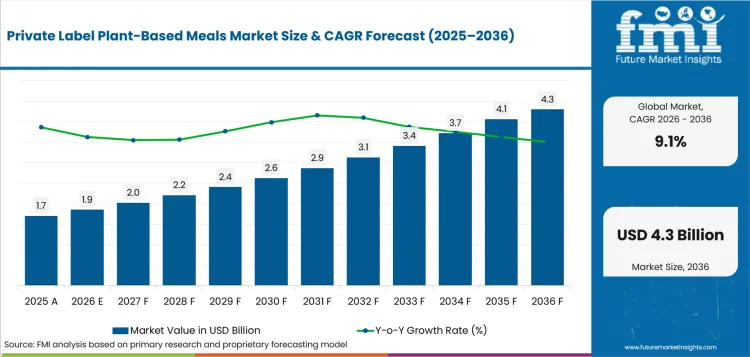
The private label plant-based meals market is expected to move from USD 1.7 billion in 2025 to USD 4.3 billion by 2036 at 9.1% CAGR, driven by retailer-owned frozen meals and value-focused plant-based eating. Frozen entrées are forecast to hold 54.8% share due to long shelf handling and strong freezer placement. Retail freezer is projected to secure 61.2% share because store-brand plant-based meals can sit beside familiar frozen ready meals.
Key Takeaways, Market Size, and Forecast
- 2026 Market Size: USD 1.8 billion
- 2036 Market Size: USD 4.3 billion
- Forecast CAGR: 9.1% from 2026 to 2036
- Leading Product Format: Frozen Entrées
- Frozen Entrées Share in 2026: 54.8%
- Leading Retail Channel: Retail Freezer
- Retail Freezer Share in 2026: 61.2%
- Fastest-growing Country: Saudi Arabia
- Saudi Arabia CAGR: 10.3% by 2036
Summary of Private Label Plant-Based Meals Market
- Demand and Growth Drivers
- Retailers are adding private-label plant-based meals because shoppers want lower-priced prepared food options.
- Frozen meal processors are using plant proteins because retailers need meat-free meals with steady texture after heating.
- Store brands are becoming more important because shoppers compare price and portion size before repeat purchase.
- Product and Segment View
- Frozen entrées are expected to lead because they fit existing freezer space and allow longer shelf handling.
- Soy and pea protein systems are expected to stay important because they help processors manage texture and cost.
- Meal bowls are expected to draw interest because they make plant-based eating feel closer to regular dinner use.
- Geography and Competitive Outlook
- The United States is expected to stay important because private-label food already has strong retail scale.
- Germany and the United Kingdom are expected to build demand through discount retail and store-brand plant-based ranges.
- Leading suppliers are expected to compete on price control and retailer program execution.
- Analyst Opinion
- Nandini Roy Choudhury, Principal Consultant for Food and Beverage at FMI, states, “Private-label plant-based meals are moving from vegan trial into value-led dinner planning. Retailers are asking suppliers to deliver taste, heat stability, and meal variety at store-brand price points. Processors that can control protein texture and freezer quality will have stronger access to repeat retail programs.”
- Private Label Plant-Based Meals Market Value Analysis
- Market value is based on retailer-owned frozen and chilled plant-based meals after branded ready meals are excluded.
- Supplier revenue reflects store-brand meals produced for supermarket chains and discount retailers.
- Revenue improves when retailers move plant-based meals from novelty launches into routine freezer programs.
- Buyer trust improves when processors prove taste stability and clean labels along with reliable supply for repeat orders.
Retailers are using owned food brands to refresh value-led meal ranges. Target said in March 2025 that it planned 600 new food and beverage items across Good & Gather and Favorite Day. This shows how large retailers can use store-brand food platforms to test new meal ideas at lower shelf prices.
Why is the Private Label Plant-Based Meals Market Growing?
- Retailers are adding plant-based meals under store brands because shoppers want lower-cost options in frozen and chilled cases.
- Frozen food processors are adapting plant proteins because retailers need meat-free meals that heat evenly and keep texture.
- Discount retailers are widening meal choices because plant-based eating needs lower prices before it becomes routine.
- Online grocery is expected to help shoppers compare private-label meals by price and portion size before buying.
Private-label demand is widening across daily grocery categories. NIQ reported in November 2024 that private labels delivered 5.6% value sales growth over a 12 month period through Q2 2024. This supports the view that shoppers are giving store-brand products more space in regular grocery baskets.
Store-brand meals are easier for retailers to adjust than national branded products. A retailer can change the recipe with the portion size and shelf price based on shopper response. This makes private label useful for plant-based meals because demand is still developing in many stores. Frozen bowls and rice meals can be tested first in urban outlets before wider rollout. Products that deliver familiar taste and simple heating steps are expected to earn repeat placement faster.
Market Segmentation Analysis
- Frozen entrées are forecast to account for 54.8% share in 2026 because freezer handling gives retailers better stock control.
- Soy protein is expected to hold 35.6% share in 2026 as cost and supply are easier to manage.
- Retail freezer is projected to capture 61.2% share in 2026 due to shoppers already using freezer aisles for ready meals.
- Dinner meals are likely to secure 48.5% share in 2026 because private-label programs focus on routine evening meals.
- Discount retailers are forecast to represent 39.4% buyer-group share in 2026 with lower prices improving trial.
The market is divided into five primary segment groups based on product format and protein source. Retail channel, meal type and buyer group complete the structure. Product format covers frozen entrées and chilled meals. Meal bowls, pasta meals and rice meals complete the format group. Protein source covers soy and pea. Wheat, lentil and chickpea complete the protein scope. Retail channel covers retail freezer and chilled cases. Discount retail, online grocery and club stores complete the channel scope. Meal type covers dinner meals and lunch meals. Global cuisine meals, high-protein meals and family meals complete the meal scope. Buyer group covers retailers and private-label manufacturers. Frozen food processors, chilled meal makers and retail foodservice teams complete the buyer scope. Product fit overlaps with frozen ready meals as store brands move into plant-based dinner formats.
Insights into Private Label Plant-Based Meals Market by Product Format
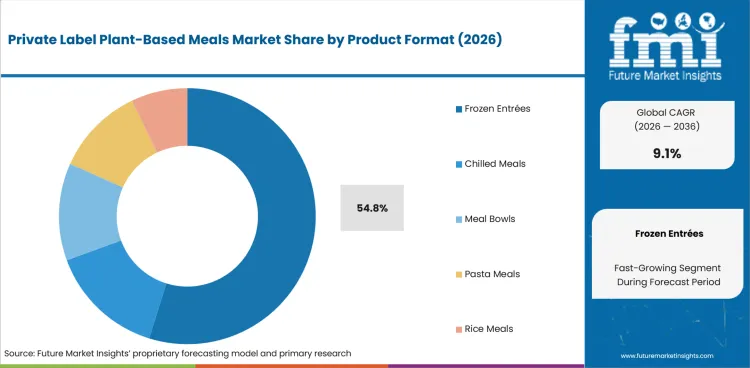
- Frozen entrées are projected to account for 54.8% share in 2026 because freezer stock gives retailers more time to manage demand.
- Chilled meals are expected to serve premium meal shelves, while ready-to-eat food demand can help stores test fresh-style plant-based ranges.
Insights into Private Label Plant-Based Meals Market by Protein Source
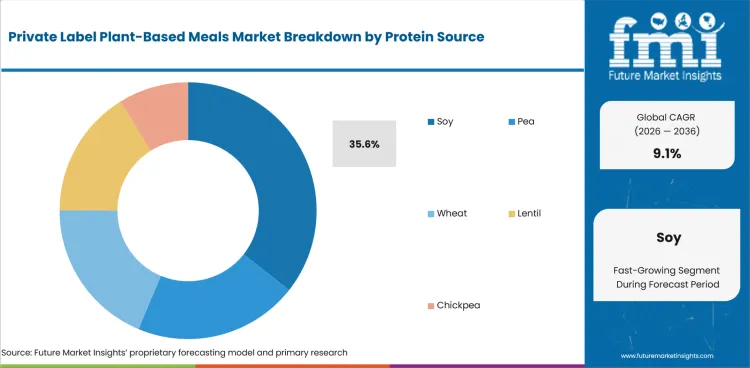
- Soy protein is expected to hold 35.6% share in 2026 due to its cost position and proven use in meat-free meals.
- Pea protein is likely to draw more interest from clean-label ranges because it fits many plant-based protein systems.
Insights into Private Label Plant-Based Meals Market by Retail Channel
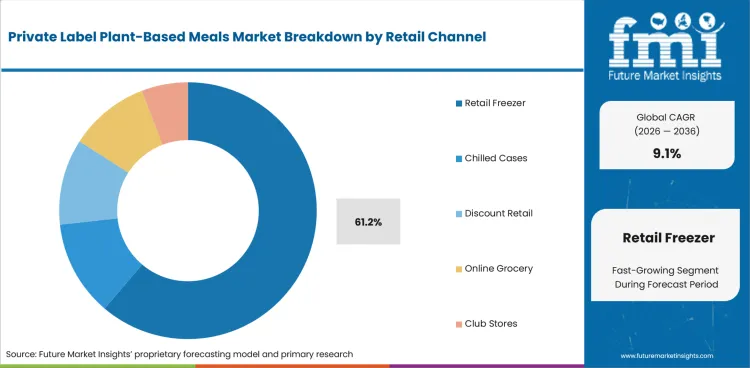
- Retail freezer is projected to capture 61.2% share in 2026, helped by shopper habits around frozen dinner meals.
- Chilled cases are expected to expand through premium grocery because fresh-style meals can sit beside salad bowls and prepared mains.
Insights into Private Label Plant-Based Meals Market by Meal Type
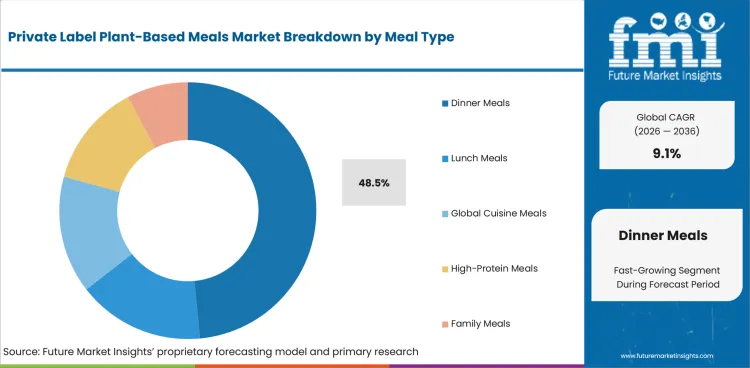
- Dinner meals are expected to secure 48.5% share in 2026 as households use ready meals most often for evening eating.
- Global cuisine meals are likely to grow as retailers test curry bowls and Asian-style meals under vegan food lines.
Insights into Private Label Plant-Based Meals Market by Buyer Group
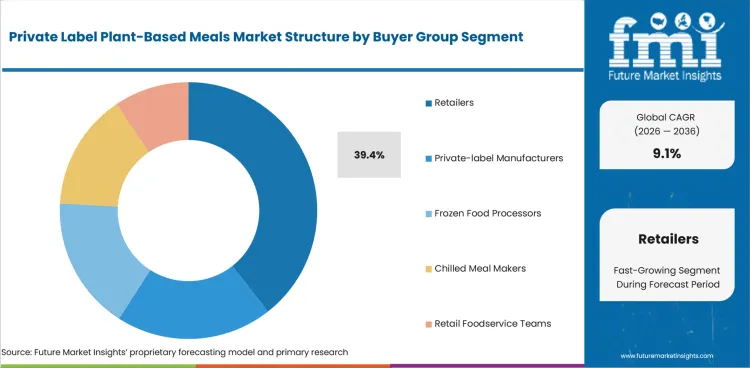
- Discount retailers are forecast to represent 39.4% share in 2026 because value pricing helps plant-based meals reach more shoppers.
- Private-label manufacturers are expected to play a larger role as frozen food retailers need recipe control and repeat supply.
Private Label Plant-Based Meals Market Drivers, Restraints, and Opportunities
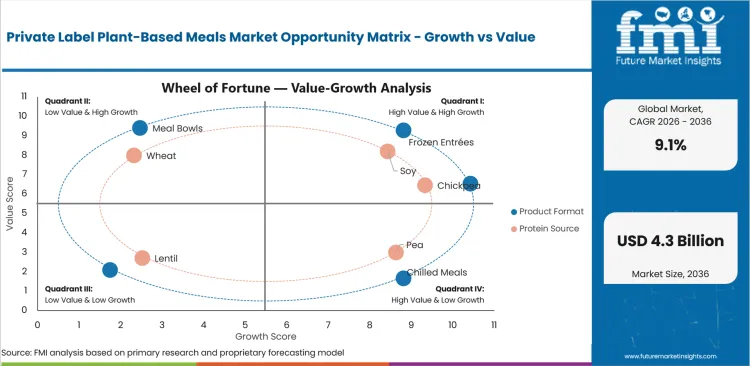
- Driver: Store brands give retailers better control over price and pack size in plant-based meals.
- Restraint: Chilled meal waste can pressure margins if demand is hard to forecast.
- Opportunity: Discount private-label ranges can move plant-based meals closer to everyday dinner use.
Private-label plant-based meal demand is becoming stronger where retailers can reduce the price gap with branded products. GFI Europe reported that private-label plant-based sales volume grew 41.4% in Germany from 2022 to 2024. The same source reported private-label plant-based volume grew 21.6% in France during the same period. These shifts show why store-brand pricing is important for plant-based food adoption across Europe.
Raw Material Price and Formulation Cost Analysis
Private-label plant-based meals need proteins that hold texture after freezing and reheating. Soy and wheat systems help processors manage cost in mainstream meals. Pea and chickpea systems can improve label appeal in premium store-brand ranges. Frozen meal processors compare protein price against sauce cost and freezer energy. A meal that uses too much protein can miss the retailer’s target price. Products with balanced protein and familiar sauces are expected to have a clearer route into store-brand programs.
Consumer Segmentation and Purchase Behavior Analysis
Shoppers buy private-label plant-based meals when the price feels safe enough for trial. Private-label demand is rising beyond one country. NIQ reported in November 2024 that private labels delivered 5.6% value sales growth over a year period through Q2 2024. This supports the view that shoppers are giving store-brand products more room in regular grocery baskets. That signal fits plant-based meals because many shoppers still compare meat-free meals with standard frozen dinners. Younger households may test bowls and pasta meals first. Families are more likely to choose familiar sauces and larger portions. Value-led shoppers need trusted store brands before they add plant-based meals to weekly baskets.
Analysis of Private Label Plant-Based Meals Market by Key Countries
.webp "Top Country Growth Comparison Private Label Plant Based Meals Market Cagr (2026 2036)")
| Country | CAGR |
|---|---|
| Saudi Arabia | 10.3% |
| United States | 9.5% |
| United Kingdom | 9.4% |
| South Korea | 9.2% |
| Germany | 8.8% |
| Canada | 8.4% |
| Australia | 8.1% |
| Japan | 7.6% |
Source: Future Market Insights, 2026.
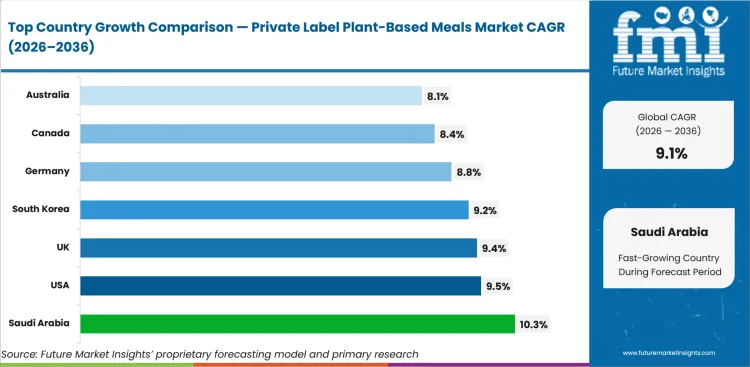
Private Label Plant-Based Meals Market CAGR Analysis by Country
- Saudi Arabia is expected to record 10.3% CAGR by 2036 because premium grocery and imported frozen foods are expanding.
- The United States is projected to expand at 9.5% CAGR through 2036, with strong store-brand scale helping private-label meals move faster.
- The United Kingdom is expected to post 9.4% CAGR by 2036, helped by plant-based retail familiarity and chilled meal testing.
- South Korea is forecast to advance at 9.2% CAGR over the same period as convenience food channels widen plant-based meal trial.
- Germany is anticipated to rise at 8.8% CAGR through 2036, with discount retailers pushing lower-priced plant-based options.
- Canada is projected to move at 8.4% CAGR by 2036 as grocers use private-label programs to manage value.
- Australia is expected to register 8.1% CAGR through 2036, driven by urban grocery and store-brand meal use.
- Japan is forecast to expand at 7.6% CAGR by 2036 as small pack meals fit convenience-led shopping.
Sales Outlook for Private Label Plant-Based Meals Market in Saudi Arabia
Premium grocery and imported frozen meals · 2026 to 2036
Country Market Snapshot Table
| Parameter | Value |
|---|---|
| Market Size in 2025 (Value) | USD 74.0 million |
| Market Forecast in 2036 (Value) | USD 218.0 million |
| CAGR (2026-2036) | 10.3% |
| Years Considered | 2021-2036 |
| Base Year | 2025 |
| Forecast Period | 2026-2036 |
| Units Considered | Value USD Mn |
| Leading Sub-Region | Riyadh premium grocery corridor |
Saudi Arabia Private Label Plant-Based Meals Market Outlook
Saudi Arabia private label plant-based meal demand is expected to begin through premium grocery stores and imported frozen meal sections. Retailers can test store-brand plant-based meals once halal review and cold-chain handling are clear.
Urban shoppers are expected to try frozen bowls and dinner entrées first. Retailers will likely prefer simple recipes with clear pack wording.
Key Growth Drivers
- Premium grocery retailers can test frozen plant-based meals with better shelf control. USDA FAS reported Saudi food retail sales at about USD 59 billion in 2024, which gives store-brand meals a strong entry route.
- Ready meals already fit Saudi Arabia’s import opportunity list. USDA FAS listed ready meals among Saudi Arabia’s top 10 growth products in 2024. This gives private-label frozen meals a clearer route through importers and premium grocery channels.
- Retailers can use private labels to manage recipe and pack size. This can make plant-based meals easier to price against standard frozen meals.
- Halal-ready documents can improve retailer confidence. Suppliers with simple ingredient panels are expected to move faster through approval.
Key Restraints
- Imported frozen products can carry higher freight and storage costs than local chilled meals.
- Halal and allergen files can slow first listings if supplier documents are incomplete.
- Import exposure can raise planning risk for store-brand frozen meals. USDA FAS reported Saudi consumer-oriented product imports at USD 15.6 billion in 2024.
What makes Saudi Arabia different
Saudi Arabia has a strong premium grocery route and a clear import structure. Private label plant-based meals are expected to start in frozen retail before wider household use.
Key Companies
- Panda Retail Company
- Tamimi Markets Company
- BinDawood Holding
- Abdullah Al Othaim Markets Company
- Almunajem Foods Company
Sales & Marketing Channels
- Premium grocery distributors
- Frozen food importers
- Hotel foodservice suppliers
- Online grocery platforms
Country Segment Breakdown Table
| Segment | Sub-Segments |
|---|---|
| By Product Format | Frozen Entrées · Chilled Meals · Meal Bowls · Pasta Meals · Rice Meals |
| By Protein Source | Soy · Pea · Wheat · Lentil · Chickpea |
| By Retail Channel | Retail Freezer · Chilled Cases · Discount Retail · Online Grocery · Club Stores |
| By Meal Type | Dinner Meals · Lunch Meals · Global Cuisine · High-Protein Meals · Family Meals |
| By Buyer Group | Retailers · Private-label Manufacturers · Frozen Food Processors · Chilled Meal Makers · Retail Foodservice Teams |
| Key Sub-Regions Covered, Retail and Foodservice Areas | Riyadh · Jeddah · Dammam · Makkah · Medina · Khobar |
Frequently Asked Questions
How fast is Saudi Arabia private label plant-based meals market growing?
Saudi Arabia private label plant-based meals market is forecast to expand at 10.3% CAGR from 2026 to 2036. Premium grocery channels are expected to guide early trial.
Who leads Saudi Arabia private label plant-based meals market?
Panda Retail Company, Tamimi Markets Company, and BinDawood Holding are relevant through grocery reach and frozen food placement.
What is driving adoption in Saudi Arabia?
Premium grocery growth and halal-ready supplier files are expected to drive private-label plant-based meal adoption.
Opportunity Analysis for Private Label Plant-Based Meals Market in the United States
Store-brand scale and frozen dinner habits · 2026 to 2036
Country Market Snapshot Table
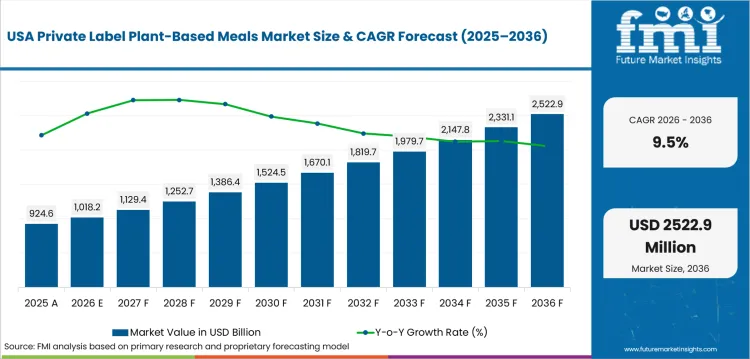
| Parameter | Value |
|---|---|
| Market Size in 2025 (Value) | USD 525.0 million |
| Market Forecast in 2036 (Value) | USD 1,400.0 million |
| CAGR (2026-2036) | 9.5% |
| Years Considered | 2021-2036 |
| Base Year | 2025 |
| Forecast Period | 2026-2036 |
| Units Considered | Value USD Mn |
| Leading Sub-Region | West Coast and Northeast freezer corridor |
United States Private Label Plant-Based Meals Market Outlook
The United States market is expected to grow through store-brand scale and frozen dinner buying habits. Retailers can place plant-based meals inside existing freezer sets without creating a separate shopping route.
Owned brand teams are expected to focus on taste and portion size before wider national rollout. Private-label plant-based meals are likely to gain trial through mass retailers and supermarket freezer aisles.
Key Growth Drivers
- Store-brand scale gives U.S. retailers room to test meat-free meals. Target said in its 2025 annual report that owned and exclusive brand products represented about 30% of overall merchandise sales. This makes private-label meal testing easier for retailers with strong owned-brand systems.
- Store-brand share keeps improving in grocery baskets. PLMA reported store-brand dollar share reached 21.3% in 2025, which gives private-label meals a stronger retail base.
- Retailers can use owned brands to lower the entry price for plant-based meals. This helps shoppers compare meat-free meals with standard frozen dinners.
- Club stores can test multipack plant-based meals for families. Larger packs can reduce per-serving price and improve trial.
Key Restraints
- Frozen shelf space is crowded and slow-moving meals can lose listings quickly.
- Plant-based meals must match branded ready meals on taste before repeat buying improves.
- Food price pressure can limit shopper trial of premium frozen meals. The U.S. Bureau of Labor Statistics reported food-at-home prices rose 2.7% over the 12 months ending May 2026. This can make shoppers compare plant-based meals more closely with standard frozen dinners.
What sets the United States apart
The United States has deep store-brand scale and strong frozen meal habits. Private label plant-based meals are expected to move through mass retailers and supermarket freezer aisles first.
Key Companies
- Walmart Inc.
- The Kroger Co.
- Target Corporation
- Albertsons Companies, Inc.
- Trader Joe’s Company
Sales & Marketing Channels
- Mass retail freezer aisles
- Supermarket owned-brand programs
- Club store multipacks
- Online grocery platforms
Country Segment Breakdown Table
| Segment | Sub-Segments |
|---|---|
| By Product Format | Frozen Entrées · Chilled Meals · Meal Bowls · Pasta Meals · Rice Meals |
| By Protein Source | Soy · Pea · Wheat · Lentil · Chickpea |
| By Retail Channel | Retail Freezer · Chilled Cases · Discount Retail · Online Grocery · Club Stores |
| By Meal Type | Dinner Meals · Lunch Meals · Global Cuisine · High-Protein Meals · Family Meals |
| By Buyer Group | Retailers · Private-label Manufacturers · Frozen Food Processors · Chilled Meal Makers · Retail Foodservice Teams |
| Key Sub-Regions Covered, Retail and Foodservice Areas | California · Texas · New York · Illinois · Florida · Washington · Massachusetts |
Frequently Asked Questions
How fast is the United States private label plant-based meals market growing?
The United States private label plant-based meals market is projected to rise at 9.5% CAGR from 2026 to 2036. Store-brand scale is expected to support wider meal trial.
Who leads the United States private label plant-based meals market?
Walmart Inc., The Kroger Co., and Target Corporation are relevant because each has large owned-brand food programs.
What is driving adoption in the United States?
Retailers are using private labels to offer lower-priced plant-based meals inside familiar frozen dinner aisles.
Demand Outlook for Private Label Plant-Based Meals Market in the United Kingdom
Chilled meals and own-brand plant ranges · 2026 to 2036
Country Market Snapshot Table
| Parameter | Value |
|---|---|
| Market Size in 2025 (Value) | USD 185.0 million |
| Market Forecast in 2036 (Value) | USD 498.0 million |
| CAGR (2026-2036) | 9.4% |
| Years Considered | 2021-2036 |
| Base Year | 2025 |
| Forecast Period | 2026-2036 |
| Units Considered | Value USD Mn |
| Leading Sub-Region | London and Southeast grocery corridor |
United Kingdom Private Label Plant-Based Meals Market Outlook
UK demand is expected to move through chilled meals and retailer-owned plant ranges. Shoppers already understand plant-based labels, so retailers can focus on taste and price.
Supermarkets are expected to use private-label meals to keep plant-based eating within routine grocery budgets. Chilled cases and frozen dinner ranges will likely guide early placement.
Key Growth Drivers
- UK retailers can use own-brand reformulation systems to refresh prepared meals. Tesco’s 2025 Sustainability Report kept a target to remove 100 billion calories from Own Brand ranges by December 2025. This shows how retailer-owned food lines can be adjusted at scale.
- UK plant-based retail has an existing buyer pool. GFI Europe reported UK plant-based food sales across six groups were GBP 848.0 million in 2025.
- Chilled meal cases can help retailers test plant-based mains near familiar prepared foods. This lowers the need for a separate vegan shopping section.
- Private-label processors can adjust flavor and portion size quickly for retailer trials. This makes store-brand meal testing easier.
Key Restraints
- Chilled meals have shorter shelf life than frozen entrées.
- Price-sensitive shoppers may trade down to standard ready meals if plant-based meals cost more.
- Food price pressure can reduce trial of premium meals. ONS reported food and non-alcoholic beverage prices rose 3.0% in the 12 months to April 2026.
What gives the United Kingdom a distinct position
The United Kingdom has strong supermarket own-brand systems and high plant-based meal awareness. Private label plant-based meals are expected to enter through chilled cases and frozen dinner ranges.
Key Companies
- Tesco PLC
- J Sainsbury plc
- Marks and Spencer Group plc
- Waitrose Limited
- Iceland Foods Ltd.
Sales & Marketing Channels
- Supermarket chilled cases
- Retail freezer aisles
- Online grocery platforms
- Discount freezer ranges
Country Segment Breakdown Table
| Segment | Sub-Segments |
|---|---|
| By Product Format | Frozen Entrées · Chilled Meals · Meal Bowls · Pasta Meals · Rice Meals |
| By Protein Source | Soy · Pea · Wheat · Lentil · Chickpea |
| By Retail Channel | Retail Freezer · Chilled Cases · Discount Retail · Online Grocery · Club Stores |
| By Meal Type | Dinner Meals · Lunch Meals · Global Cuisine · High-Protein Meals · Family Meals |
| By Buyer Group | Retailers · Private-label Manufacturers · Frozen Food Processors · Chilled Meal Makers · Retail Foodservice Teams |
| Key Sub-Regions Covered, Retail and Foodservice Areas | London · Manchester · Birmingham · Leeds · Bristol · Glasgow · Edinburgh |
Frequently Asked Questions
How fast is the United Kingdom private label plant-based meals market growing?
The United Kingdom private label plant-based meals market is expected to record 9.4% CAGR from 2026 to 2036. Chilled retail strength is expected to guide early demand.
Who leads the United Kingdom private label plant-based meals market?
Tesco PLC, J Sainsbury plc, and Marks and Spencer Group plc are relevant through own-brand meal programs.
What is driving adoption in the United Kingdom?
Own-brand plant ranges and chilled meal habits are expected to drive adoption of private-label plant-based meals.
Sales Analysis for Private Label Plant-Based Meals Market in South Korea
Convenience retail and ready-meal culture · 2026 to 2036
Country Market Snapshot Table
| Parameter | Value |
|---|---|
| Market Size in 2025 (Value) | USD 96.0 million |
| Market Forecast in 2036 (Value) | USD 252.0 million |
| CAGR (2026-2036) | 9.2% |
| Years Considered | 2021-2036 |
| Base Year | 2025 |
| Forecast Period | 2026-2036 |
| Units Considered | Value USD Mn |
| Leading Sub-Region | Seoul convenience retail corridor |
South Korea Private Label Plant-Based Meals Market Outlook
South Korea demand is expected to build through convenience stores and online grocery. Retailers can use private labels to test plant-based bowls and noodle meals with lower price risk.
Compact meals are expected to fit younger shoppers and single-person households. Korean-style sauces can make plant-based meals feel familiar to mainstream buyers.
Key Growth Drivers
- Convenience and grocery retailers can test small private-label meals at scale. USDA FAS reported Korean retail food sales totaled USD 132.0 billion in 2024, giving ready meals a broad retail base.
- Local manufacturing depth can help retailers develop meal programs faster. USDA FAS reported Korean food processing companies generated USD 65.0 billion in sales in 2023.
- Online grocery can help private labels test plant-based meals before wider store rollout. Reviews and repeat purchase data can guide recipe changes.
- Korean-style sauces can make plant-based meals feel familiar to mainstream shoppers. Retailers are expected to start with rice bowls and noodle formats.
Key Restraints
- Plant-based meals may face taste comparison against familiar meat and seafood dishes.
- Small store formats can limit freezer space for slower-moving products.
- Supplier slots can be hard to secure for small plant-based runs. USDA FAS reported Korea had more than 31,075 food processing companies in 2023, showing a broad factory base with many competing product lines.
What makes South Korea important
South Korea has strong ready-meal habits and fast retail testing through convenience channels. Private label plant-based meals are expected to work best in compact packs and Korean-style recipes.
Key Companies
- Emart Inc.
- Lotte Shopping Co., Ltd.
- GS Retail Co., Ltd.
- BGF Retail Co., Ltd.
- CJ CheilJedang Corporation
Sales & Marketing Channels
- Convenience stores
- Hypermarket freezer aisles
- Online grocery platforms
- Meal delivery-linked retail
Country Segment Breakdown Table
| Segment | Sub-Segments |
|---|---|
| By Product Format | Frozen Entrées · Chilled Meals · Meal Bowls · Pasta Meals · Rice Meals |
| By Protein Source | Soy · Pea · Wheat · Lentil · Chickpea |
| By Retail Channel | Retail Freezer · Chilled Cases · Discount Retail · Online Grocery · Club Stores |
| By Meal Type | Dinner Meals · Lunch Meals · Global Cuisine · High-Protein Meals · Family Meals |
| By Buyer Group | Retailers · Private-label Manufacturers · Frozen Food Processors · Chilled Meal Makers · Retail Foodservice Teams |
| Key Sub-Regions Covered, Retail and Foodservice Areas | Seoul · Busan · Incheon · Daegu · Daejeon · Gwangju |
Frequently Asked Questions
How fast is South Korea private label plant-based meals market growing?
South Korea private label plant-based meals market is forecast to advance at 9.2% CAGR from 2026 to 2036. Convenience retail is expected to support compact meal trials.
Who leads South Korea private label plant-based meals market?
Emart Inc., Lotte Shopping Co., Ltd., and GS Retail Co., Ltd. are relevant through private-label food and retail meal channels.
What is driving adoption in South Korea?
Convenience food habits and strong retail food sales are expected to help private-label plant-based meals enter routine shopping.
In-depth Analysis of Private Label Plant-Based Meals Market in Germany
Discount retail and plant-based price discipline · 2026 to 2036
Country Market Snapshot Table
| Parameter | Value |
|---|---|
| Market Size in 2025 (Value) | USD 215.0 million |
| Market Forecast in 2036 (Value) | USD 543.0 million |
| CAGR (2026-2036) | 8.8% |
| Years Considered | 2021-2036 |
| Base Year | 2025 |
| Forecast Period | 2026-2036 |
| Units Considered | Value USD Mn |
| Leading Sub-Region | Berlin and North Rhine-Westphalia retail corridor |
Germany Private Label Plant-Based Meals Market Outlook
Germany demand is expected to build through discount chains and retailer-owned plant ranges. Price discipline is important because shoppers compare private-label meals with meat-based ready meals.
Discount retailers are expected to keep plant-based meals close to mainstream frozen meal prices. Simple recipes and familiar meal formats are likely to decide early repeat purchase.
Key Growth Drivers
- Germany has a large plant-based retail base for meal trials. GFI Europe reported German plant-based food sales across six groups reached EUR 1.71 billion in 2025.
- Volume growth shows that price and availability still move demand. GFI Europe reported German plant-based sales volume rose 6.2% in 2025.
- Aldi and Lidl can use private labels to test lower-priced plant-based ready meals. Discounters can scale simple recipes once repeat purchase is proven.
- Retailers can use familiar pasta and rice formats to reduce trial risk. Store-brand meals are expected to work best when the dish feels easy to understand.
Key Restraints
- Discount pricing can narrow margins for processors using higher-cost proteins.
- Taste expectations are high because shoppers already compare many plant-based products.
- Food price increases can make premium plant-based meals harder to defend. Destatis reported dairy products and eggs rose 4.1% year on year in July 2025.
Why Germany deserves a separate view
Germany has strong discount retail power and a large plant-based shelf. Private-label meals are expected to grow where retailers keep price gaps low and recipes familiar.
Key Companies
- Aldi Nord
- Aldi Süd
- Lidl Stiftung & Co. KG
- REWE Group
- EDEKA Group
Sales & Marketing Channels
- Discount retailers
- Supermarket freezer sections
- Chilled meal cases
- Online grocery platforms
Country Segment Breakdown Table
| Segment | Sub-Segments |
|---|---|
| By Product Format | Frozen Entrées · Chilled Meals · Meal Bowls · Pasta Meals · Rice Meals |
| By Protein Source | Soy · Pea · Wheat · Lentil · Chickpea |
| By Retail Channel | Retail Freezer · Chilled Cases · Discount Retail · Online Grocery · Club Stores |
| By Meal Type | Dinner Meals · Lunch Meals · Global Cuisine · High-Protein Meals · Family Meals |
| By Buyer Group | Retailers · Private-label Manufacturers · Frozen Food Processors · Chilled Meal Makers · Retail Foodservice Teams |
| Key Sub-Regions Covered, Retail and Foodservice Areas | Berlin · Hamburg · Munich · Cologne · Frankfurt · Düsseldorf · Stuttgart |
Frequently Asked Questions
How fast is Germany private label plant-based meals market growing?
Germany private label plant-based meals market is projected to move at 8.8% CAGR from 2026 to 2036. Discount retail strength is expected to guide adoption.
Who leads Germany private label plant-based meals market?
Aldi Nord, Aldi Süd, and Lidl Stiftung & Co. KG are relevant through private-label food strength and plant-based retail reach.
What is driving adoption in Germany?
Discount retail access and price-led plant-based demand are expected to support private-label meal sales.
Opportunity Outlook for Private Label Plant-Based Meals Market in Canada
Store brands and value-led grocery · 2026 to 2036
Country Market Snapshot Table
| Parameter | Value |
|---|---|
| Market Size in 2025 (Value) | USD 112.0 million |
| Market Forecast in 2036 (Value) | USD 272.0 million |
| CAGR (2026-2036) | 8.4% |
| Years Considered | 2021-2036 |
| Base Year | 2025 |
| Forecast Period | 2026-2036 |
| Units Considered | Value USD Mn |
| Leading Sub-Region | Ontario and British Columbia grocery corridor |
Canada Private Label Plant-Based Meals Market Outlook
Canada demand is expected to grow through value-led grocery and retailer-owned meal programs. Store brands can help plant-based meals reach shoppers who want lower prices without shifting to unfamiliar brands.
Retailers are expected to test private-label meals first in Ontario and British Columbia. Frozen meal programs can benefit from familiar grocery loyalty systems.
Key Growth Drivers
- Store brands can use retailer loyalty to support plant-based meal trial. Loblaw reported more than CAD 1 billion in PC Optimum point awards and redemptions in 2024.
- Private-label product work has strong retail visibility in Canada. Retail Council of Canada said its 2026 Canadian Grand Prix finalists represented 88 new products launched in 2025.
- Frozen meal processors can use pea and lentil recipes to fit local ingredient familiarity. This can help retailers test meals with familiar crop stories.
- Online grocery can help retailers test plant-based meals before wider freezer placement. Search data and repeat orders can guide product changes.
Key Restraints
- Smaller national scale can make dedicated meal production harder.
- Long delivery routes can raise freezer costs outside dense retail areas.
- Grocery inflation can limit trial of premium substitutes. Statistics Canada reported grocery prices rose 3.5% in 2025.
What gives Canada a clear role
Canada has strong grocery loyalty programs and active private-label development. Private-label plant-based meals are expected to build first through major supermarket groups.
Key Companies
- Loblaw Companies Limited
- Metro Inc.
- Empire Company Limited
- Federated Co-operatives Limited
- Pattison Food Group
Sales & Marketing Channels
- National grocery chains
- Discount supermarket banners
- Online grocery platforms
- Private-label frozen meal programs
Country Segment Breakdown Table
| Segment | Sub-Segments |
|---|---|
| By Product Format | Frozen Entrées · Chilled Meals · Meal Bowls · Pasta Meals · Rice Meals |
| By Protein Source | Soy · Pea · Wheat · Lentil · Chickpea |
| By Retail Channel | Retail Freezer · Chilled Cases · Discount Retail · Online Grocery · Club Stores |
| By Meal Type | Dinner Meals · Lunch Meals · Global Cuisine · High-Protein Meals · Family Meals |
| By Buyer Group | Retailers · Private-label Manufacturers · Frozen Food Processors · Chilled Meal Makers · Retail Foodservice Teams |
| Key Sub-Regions Covered, Retail and Foodservice Areas | Ontario · British Columbia · Quebec · Alberta · Manitoba · Saskatchewan |
Frequently Asked Questions
How fast is Canada private label plant-based meals market growing?
Canada private label plant-based meals market is anticipated to rise at 8.4% CAGR from 2026 to 2036. Grocery loyalty and private-label development are expected to help early trials.
Who leads Canada private label plant-based meals market?
Loblaw Companies Limited, Metro Inc., and Empire Company Limited are relevant through store-brand food programs.
What is driving adoption in Canada?
Store-brand trust and value-led grocery behavior are expected to guide private-label plant-based meal growth.
Demand Analysis for Private Label Plant-Based Meals Market in Australia
Own-brand meals and urban grocery · 2026 to 2036
Country Market Snapshot Table
| Parameter | Value |
|---|---|
| Market Size in 2025 (Value) | USD 92.0 million |
| Market Forecast in 2036 (Value) | USD 216.0 million |
| CAGR (2026-2036) | 8.1% |
| Years Considered | 2021-2036 |
| Base Year | 2025 |
| Forecast Period | 2026-2036 |
| Units Considered | Value USD Mn |
| Leading Sub-Region | Sydney and Melbourne grocery corridor |
Australia Private Label Plant-Based Meals Market Outlook
Australia demand is expected to develop through supermarket own brands and urban frozen meal sections. Retailers can use private-label meals to offer plant-based options at lower price points.
Early demand is expected to come from Sydney and Melbourne grocery corridors. Frozen bowls and chilled dinner meals are likely to guide first-stage retail testing.
Key Growth Drivers
- Own-brand programs are central to Australian grocery value offers. Woolworths reported Own and Exclusive Brand sales grew 5% in F25.
- Imported food access gives retailers more sourcing routes for frozen meals. USDA FAS reported Australia imported USD 15.3 billion worth of consumer-oriented foods in 2024.
- Coles Nature’s Kitchen gives plant-based private-label meals a clear in-store identity. Similar ranges can help shoppers find meat-free meals faster.
- Frozen meal sections can support urban shoppers seeking quick weeknight meals. Retailers are expected to start with bowls and familiar dinner formats.
Key Restraints
- Smaller market size can limit dedicated private-label plant-based meal production.
- Imported ingredients can raise cost when currency or freight pressure changes.
- Grocery price pressure can make premium meals harder to defend. ABS reported food and non-alcoholic beverage prices rose 3.4% in the 12 months to December 2025.
What makes Australia commercially distinct
Australia has strong own-brand grocery systems and active plant-based shelf education. Private-label plant-based meals are expected to grow through frozen and chilled supermarket sections.
Key Companies
- Woolworths Group Limited
- Coles Group Limited
- Metcash Limited
- Harris Farm Markets Pty Ltd
- Beak & Johnston Pty Ltd
Sales & Marketing Channels
- Supermarket freezer aisles
- Chilled meal sections
- Online grocery platforms
- Foodservice-linked retail supply
Country Segment Breakdown Table
| Segment | Sub-Segments |
|---|---|
| By Product Format | Frozen Entrées · Chilled Meals · Meal Bowls · Pasta Meals · Rice Meals |
| By Protein Source | Soy · Pea · Wheat · Lentil · Chickpea |
| By Retail Channel | Retail Freezer · Chilled Cases · Discount Retail · Online Grocery · Club Stores |
| By Meal Type | Dinner Meals · Lunch Meals · Global Cuisine · High-Protein Meals · Family Meals |
| By Buyer Group | Retailers · Private-label Manufacturers · Frozen Food Processors · Chilled Meal Makers · Retail Foodservice Teams |
| Key Sub-Regions Covered, Retail and Foodservice Areas | Sydney · Melbourne · Brisbane · Perth · Adelaide · Canberra |
Frequently Asked Questions
How fast is Australia private label plant-based meals market growing?
Australia private label plant-based meals market is forecast to expand at 8.1% CAGR from 2026 to 2036. Own-brand grocery strength is expected to guide early demand.
Who leads Australia private label plant-based meals market?
Woolworths Group Limited, Coles Group Limited, and Metcash Limited are relevant through own-brand food and grocery reach.
What is driving adoption in Australia?
Own-brand meal programs and urban frozen grocery sections are expected to drive private-label plant-based meal adoption.
Sales Outlook for Private Label Plant-Based Meals Market in Japan
Convenience meals and compact frozen packs · 2026 to 2036
Country Market Snapshot Table
| Parameter | Value |
|---|---|
| Market Size in 2025 (Value) | USD 132.0 million |
| Market Forecast in 2036 (Value) | USD 294.0 million |
| CAGR (2026-2036) | 7.6% |
| Years Considered | 2021-2036 |
| Base Year | 2025 |
| Forecast Period | 2026-2036 |
| Units Considered | Value USD Mn |
| Leading Sub-Region | Tokyo and Kansai convenience corridor |
Japan Private Label Plant-Based Meals Market Outlook
Japan demand is expected to build through convenience meals and compact frozen packs. Retailers can test plant-based meals through smaller products that fit single-person eating.
Suppliers are expected to focus on mild flavor and neat presentation before wider rollout. Soy-based bowls and rice meals can help plant-based formats feel familiar.
Key Growth Drivers
- Convenience stores are a major route for small ready meals. USDA FAS reported Japan added 208 convenience stores between January 2024 and January 2025.
- Plant-based packaged foods have a measurable demand pool. Agriculture and Agri-Food Canada reported Japan plant-based protein packaged food volume at 39.2 thousand tonnes in 2024.
- Supermarkets can test private-label plant-based meals through compact freezer sections. Smaller tray sizes can match household freezer limits.
- Local taste expectations can guide soy-based meal bowls and rice meals. Familiar sauces can reduce trial risk for shoppers.
Key Restraints
- Taste standards are strict and weak texture can hurt repeat buying.
- Store space is tight in convenience retail.
- Private-label meals must compete with strong fresh bento and ready-meal choices. USDA FAS reported Japan retail food and beverage sales totaled USD 193.0 billion in 2024.
Why Japan needs a separate country view
Japan has strong convenience food habits and high quality expectations. Private-label plant-based meals are expected to grow through compact packs and familiar soy-based recipes.
Key Companies
- Seven & i Holdings Co., Ltd.
- AEON Co., Ltd.
- FamilyMart Co., Ltd.
- Lawson, Inc.
- Kewpie Corporation
Sales & Marketing Channels
- Convenience stores
- Supermarket freezer cases
- Online grocery platforms
- Chilled ready-meal sections
Country Segment Breakdown Table
| Segment | Sub-Segments |
|---|---|
| By Product Format | Frozen Entrées · Chilled Meals · Meal Bowls · Pasta Meals · Rice Meals |
| By Protein Source | Soy · Pea · Wheat · Lentil · Chickpea |
| By Retail Channel | Retail Freezer · Chilled Cases · Discount Retail · Online Grocery · Club Stores |
| By Meal Type | Dinner Meals · Lunch Meals · Global Cuisine · High-Protein Meals · Family Meals |
| By Buyer Group | Retailers · Private-label Manufacturers · Frozen Food Processors · Chilled Meal Makers · Retail Foodservice Teams |
| Key Sub-Regions Covered, Retail and Foodservice Areas | Tokyo · Osaka · Kyoto · Yokohama · Nagoya · Fukuoka |
Frequently Asked Questions
How fast is Japan private label plant-based meals market growing?
Japan private label plant-based meals market is projected to expand at 7.6% CAGR from 2026 to 2036. Convenience meal habits are expected to guide product testing.
Who leads Japan private label plant-based meals market?
Seven & i Holdings Co., Ltd., AEON Co., Ltd., and FamilyMart Co., Ltd. are relevant through private-label food and ready-meal retail reach.
What is driving adoption in Japan?
Convenience meals and compact packs are expected to support private-label plant-based meal trials.
Competitive Landscape and Strategic Positioning
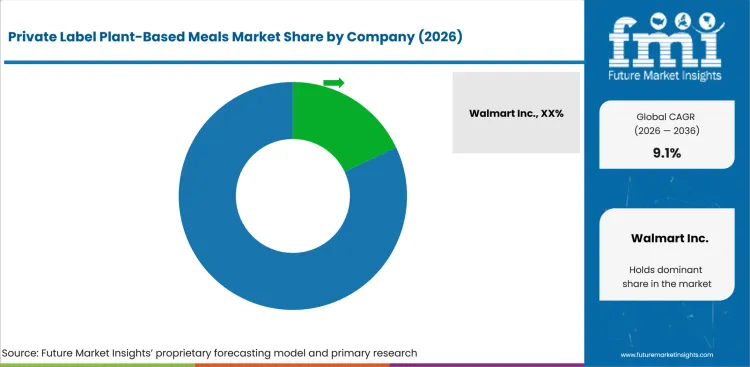
- Retailers with large own-brand systems have an advantage because they control shelf space and price points.
- Frozen food processors can win contracts by proving taste stability after freezing and microwave heating.
- Discount retailers can scale private-label meals when recipes stay simple and costs stay controlled.
- Plant protein suppliers influence meal quality by improving bite with texture and sauce compatibility.
Competitive strength of the market is expected to come from retailers with large owned-brand systems. Target said in March 2026 that its own-brand portfolio generates USD 30.0 billion in sales. This gives large retailers more room to test private-label plant-based meals across frozen and chilled shelves.
Supplier advantage is expected to come from recipe control and private-label manufacturing depth. Frozen processors must hold texture after freezing. Chilled meal makers must manage shelf life and waste. Retailers will prefer partners that can supply repeat volumes and adjust recipes quickly. Companies that combine private-label pricing with ready meals packaging discipline are expected to secure stronger long-term programs.
Key Companies in Private Label Plant-Based Meals Market
- Retail Private-Label Leaders: Walmart Inc. and The Kroger Co. support plant-based meal adoption through large owned-brand food systems.
- European Discount Retailers: Aldi and Lidl support lower-priced plant-based meals through private-label freezer and chilled programs.
- UK Store-Brand Meal Leaders: Tesco PLC and Sainsbury’s support plant-based meal trial through chilled and frozen own-brand ranges.
- Canadian Grocery Groups: Loblaw Companies Limited and Metro Inc. support private-label meal development through national grocery reach.
- Asia Pacific Retailers: AEON Co., Ltd. and Woolworths Group Limited support local private-label meal testing.
Company Benchmarking Table
| Company | Private-Label Scale | Plant-Based Meal Fit | Frozen or Chilled Strength |
|---|---|---|---|
| Walmart Inc. | High | High | High |
| The Kroger Co. | High | High | High |
| Tesco PLC | High | High | Medium |
| Aldi | High | High | High |
| Lidl Stiftung & Co. KG | High | High | High |
| Woolworths Group Limited | High | Medium | Medium |
| AEON Co., Ltd. | High | Medium | Medium |
Recent Industry Developments
- In March 2025, Kroger introduced 5 new Our Brands products across Kroger, Private Selection, and Simple Truth. The development shows how large grocers continue to refresh owned-brand food assortments with value and variety.
- In October 2025, PLMA said its 2025 “Store Brands Marketplace” trade show would feature more than 35,000 food and nonfood products. The event scale shows how private-label manufacturers are building broader retail supply options.
Key Players in the Private Label Plant-Based Meals Market
- Walmart Inc.
- The Kroger Co.
- Tesco PLC
- Sainsbury’s
- Aldi
- Lidl Stiftung & Co. KG
- Loblaw Companies Limited
- Woolworths Group Limited
- AEON Co., Ltd.
- Seven & i Holdings Co., Ltd.
Private Label Plant-Based Meals Market - Report Scope
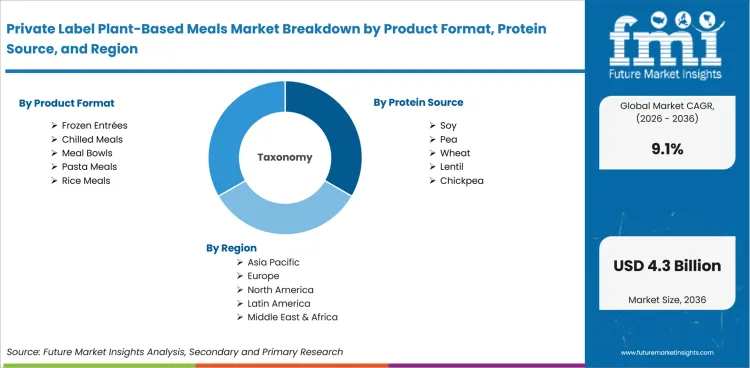
| Parameter | Details |
|---|---|
| Market size by 2036 | USD 4.3 billion |
| Growth rate | 9.1% CAGR from 2026 to 2036 |
| Forecast period | 2026 to 2036 |
| Base year value in 2025 | USD 1.7 billion |
| By product format | Frozen entrées · Chilled meals · Meal bowls · Pasta meals · Rice meals |
| By protein source | Soy · Pea · Wheat · Lentil · Chickpea |
| By retail channel | Retail freezer · Chilled cases · Discount retail · Online grocery · Club stores |
| By meal type | Dinner meals · Lunch meals · Global cuisine meals · High-protein meals · Family meals |
| By buyer group | Retailers · Private-label manufacturers · Frozen food processors · Chilled meal makers · Retail foodservice teams |
| Regions covered | North America · Europe · GCC · East Asia · Oceania |
| Countries covered | United States · Canada · European Union · United Kingdom · Saudi Arabia · South Korea · Japan · Australia |
| Key companies profiled | Walmart Inc. · The Kroger Co. · Tesco PLC · Sainsbury’s · Aldi · Lidl Stiftung & Co. KG · Loblaw Companies Limited · Woolworths Group Limited · AEON Co., Ltd. · Seven & i Holdings Co., Ltd. |
| Approach | Bottom-up product-boundary approach using eligible SKU revenue, retailer ownership, meal format, protein source, retail channel, and country-level adoption |
| Source | Future Market Insights, 2026. |
Private Label Plant-Based Meals Market Breakdown by Product Format, Protein Source, Retail Channel, Meal Type, Buyer Group, and Region
By Product Format:
- Frozen Entrées
- Chilled Meals
- Meal Bowls
- Pasta Meals
- Rice Meals
By Protein Source:
- Soy
- Pea
- Wheat
- Lentil
- Chickpea
By Retail Channel:
- Retail Freezer
- Chilled Cases
- Discount Retail
- Online Grocery
- Club Stores
By Meal Type:
- Dinner Meals
- Lunch Meals
- Global Cuisine Meals
- High-Protein Meals
- Family Meals
By Buyer Group:
- Retailers
- Private-label Manufacturers
- Frozen Food Processors
- Chilled Meal Makers
- Retail Foodservice Teams
By Region:
- North America
- Europe
- GCC
- East Asia
- Oceania
This Report Answers
- How large is private label plant-based meals market in 2026?
- What value is expected for private label plant-based meals market by 2036?
- Which product format is expected to lead in 2026?
- Which retail channel is expected to hold the leading share in 2026?
- Which protein source is expected to hold the leading parent-segment share in 2026?
- Which countries are expected to grow faster than the global average?
- Which retailers are most active across private-label plant-based meal supply?
- Which raw materials shape private-label plant-based meal cost and formulation?
- Which retail formats create repeat demand for private-label plant-based meals?
Research Sources & Bibliography
- Agriculture and Agri-Food Canada. (2025, July 2). Sector trend analysis: Plant-based protein food and drink trends in Japan. Government of Canada.
- Australian Bureau of Statistics. (2026, January 28). Consumer Price Index, Australia, December 2025. Australian Bureau of Statistics.
- Good Food Institute Europe. (2025, June 11). Affordable products driving plant-based retail sales growth. GFI Europe.
- Good Food Institute Europe. (2026). European plant-based sales data. GFI Europe.
- Loblaw Companies Limited. (2025, February 19). 2024 annual report. Loblaw Companies Limited.
- NielsenIQ. (2024, November 19). The rise of private labels: A global perspective on growth and consumer trends. NielsenIQ.
- Office for National Statistics. (2026, May 20). Consumer price inflation, UK: April 2026. Office for National Statistics.
- Private Label Manufacturers Association. (2025, October 21). PLMA trade show experiencing strong growth. PLMA.
- Retail Council of Canada. (2026, April 1). Canadian Grand Prix New Product Awards: Finalists announced. Retail Council of Canada.
- Statistics Canada. (2026, January 19). Consumer Price Index: Annual review, 2025. Statistics Canada.
- Statistisches Bundesamt. (2025, August 13). Inflation rate at +2.0% in July 2025. Destatis.
- Target Corporation. (2025, March 4). Target announces strategic plans to drive more than $15 billion in sales growth by 2030. Target Corporation.
- Target Corporation. (2026, March 3). 2026 financial community meeting. Target Corporation.
- Target Corporation. (2026, March 11). 2025 annual report. Target Corporation.
- Tesco PLC. (2025, May 25). Sustainability report 2025. Tesco PLC.
- The Kroger Co. (2025, March 31). Five new must-try items from Kroger Our Brands lineup. The Kroger Co.
- The Kroger Co. (2025, October). 2025 responsible business report. The Kroger Co.
- U.S. Bureau of Labor Statistics. (2026, June 10). Consumer Price Index summary: May 2026. U.S. Bureau of Labor Statistics.
- U.S. Department of Agriculture Foreign Agricultural Service. (2025, June 11). Exporter guide annual: Saudi Arabia. USDA FAS.
- U.S. Department of Agriculture Foreign Agricultural Service. (2025, September 24). Retail foods annual: Saudi Arabia. USDA FAS.
- U.S. Department of Agriculture Foreign Agricultural Service. (2025, November 19). Retail foods annual: Australia. USDA FAS.
- U.S. Department of Agriculture Foreign Agricultural Service. (2025, November 19). Retail foods annual: Japan. USDA FAS.
- U.S. Department of Agriculture Foreign Agricultural Service. (2025, November 19). Retail foods annual: South Korea. USDA FAS.
- U.S. Department of Agriculture Foreign Agricultural Service. (2025, May 5). Food processing ingredients annual: South Korea. USDA FAS.
- Woolworths Group Limited. (2025, August 27). Woolworths Group annual report 2025. Woolworths Group Limited.
This bibliography is provided for reader reference and is not exhaustive. The full report contains the complete reference list and detailed citations.
Private Label Plant-Based Meals Market - Scope & Definition
| Attribute | Detail |
|---|---|
| Market Definition | Private label plant-based meals are frozen or chilled ready meals sold under retailer-owned brands. They are made without meat and are used for lunch, dinner, meal prep, and quick home eating. |
| Product Formats Covered | Frozen entrées · Chilled meals · Meal bowls · Pasta meals · Rice meals |
| Protein Sources Covered | Soy · Pea · Wheat · Lentil · Chickpea |
| Retail Channels Covered | Retail freezer · Chilled cases · Discount retail · Online grocery · Club stores |
| Meal Types Covered | Dinner meals · Lunch meals · Global cuisine meals · High-protein meals · Family meals |
| Buyer Groups Covered | Retailers · Private-label manufacturers · Frozen food processors · Chilled meal makers · Retail foodservice teams |
| Forecast Period | 2026 to 2036 |
| Inclusions | All retailer-owned frozen and chilled plant-based meal products across the product formats, protein sources, retail channels, meal types, and buyer groups listed above. |
| Exclusions | Branded plant-based meals · Plant-based snacks · Ingredient-only plant proteins · Foodservice-only menu items · Meat analogue ingredients sold without a finished meal format |
Private Label Plant-Based Meals Market - Research Methodology
| Method | Description |
|---|---|
| Primary Research | FMI analyst reviews covered retailer-owned meal ranges, private-label processors, frozen food manufacturers, chilled meal makers, plant protein suppliers, and grocery channel teams in key markets. |
| Desk Research | Official retailer reports, company product pages, private-label association data, plant-based retail data, government food reports, and frozen meal channel sources were reviewed. |
| Market Sizing & Forecasting | Bottom-up aggregation was used across eligible private-label plant-based meal SKUs, product formats, protein sources, retail channels, meal types, and country adoption curves. |
| Data Validation | Cross-checks compared retailer shelf presence, frozen meal pricing, private-label food growth, plant-based sales data, processor capacity signals, and country-level grocery structure. |
Frequently Asked Questions
How large is private label plant-based meals market in 2026?
The private label plant-based meals market is expected to reach USD 1.8 billion in 2026.
What will private label plant-based meals market be worth by 2036?
The market is forecast to reach USD 4.3 billion by 2036.
What CAGR is expected for private label plant-based meals market from 2026 to 2036?
The market is projected to expand at 9.1% CAGR from 2026 to 2036.
Which product format is expected to lead in 2026?
Frozen entrées are forecast to hold 54.8% share in 2026 because freezer handling gives retailers better stock control.
Which retail channel is expected to lead in 2026?
Retail freezer is forecast to account for 61.2% share in 2026 because shoppers already use freezer aisles for ready meals.
Which protein source is expected to lead in 2026?
Soy protein is expected to hold 35.6% share in 2026 due to cost control and familiar texture in meat-free meals.
Which country is expected to grow fastest by 2036?
Saudi Arabia is expected to expand at 10.3% CAGR by 2036 because premium grocery and imported frozen foods are expanding.
Who are the leading companies in private label plant-based meals market?
Walmart Inc., The Kroger Co., Tesco PLC, Aldi, Lidl, Loblaw Companies Limited, Woolworths Group Limited and AEON Co., Ltd. are active across private-label food and meal retail.
What is driving private label plant-based meals adoption?
Value-led grocery buying, retailer-owned food programs and frozen meal convenience are driving private-label plant-based meal adoption.
What is the key restraint for private label plant-based meal suppliers?
Taste quality, freezer stability and retailer price targets are the main barriers for wider private-label rollout.
Preview the report firsthand - request a free sample
Get SampleGet the brochure for pricing and purchase details.
Get PDFTable of Content
- Executive Summary
- Global Market Outlook
- Demand to side Trends
- Supply to side Trends
- Technology Roadmap Analysis
- Analysis and Recommendations
- Market Overview
- Market Coverage / Taxonomy
- Market Definition / Scope / Limitations
- Research Methodology
- Chapter Orientation
- Analytical Lens and Working Hypotheses
- Market Structure, Signals, and Trend Drivers
- Benchmarking and Cross-market Comparability
- Market Sizing, Forecasting, and Opportunity Mapping
- Research Design and Evidence Framework
- Desk Research Programme (Secondary Evidence)
- Company Annual and Sustainability Reports
- Peer-reviewed Journals and Academic Literature
- Corporate Websites, Product Literature, and Technical Notes
- Earnings Decks and Investor Briefings
- Statutory Filings and Regulatory Disclosures
- Technical White Papers and Standards Notes
- Trade Journals, Industry Magazines, and Analyst Briefs
- Conference Proceedings, Webinars, and Seminar Materials
- Government Statistics Portals and Public Data Releases
- Press Releases and Reputable Media Coverage
- Specialist Newsletters and Curated Briefings
- Sector Databases and Reference Repositories
- FMI Internal Proprietary Databases and Historical Market Datasets
- Subscription Datasets and Paid Sources
- Social Channels, Communities, and Digital Listening Inputs
- Additional Desk Sources
- Expert Input and Fieldwork (Primary Evidence)
- Primary Modes
- Qualitative Interviews and Expert Elicitation
- Quantitative Surveys and Structured Data Capture
- Blended Approach
- Why Primary Evidence is Used
- Field Techniques
- Interviews
- Surveys
- Focus Groups
- Observational and In-context Research
- Social and Community Interactions
- Stakeholder Universe Engaged
- C-suite Leaders
- Board Members
- Presidents and Vice Presidents
- R&D and Innovation Heads
- Technical Specialists
- Domain Subject-matter Experts
- Scientists
- Physicians and Other Healthcare Professionals
- Governance, Ethics, and Data Stewardship
- Research Ethics
- Data Integrity and Handling
- Primary Modes
- Tooling, Models, and Reference Databases
- Desk Research Programme (Secondary Evidence)
- Data Engineering and Model Build
- Data Acquisition and Ingestion
- Cleaning, Normalisation, and Verification
- Synthesis, Triangulation, and Analysis
- Quality Assurance and Audit Trail
- Market Background
- Market Dynamics
- Drivers
- Restraints
- Opportunity
- Trends
- Scenario Forecast
- Demand in Optimistic Scenario
- Demand in Likely Scenario
- Demand in Conservative Scenario
- Opportunity Map Analysis
- Product Life Cycle Analysis
- Supply Chain Analysis
- Investment Feasibility Matrix
- Value Chain Analysis
- PESTLE and Porter’s Analysis
- Regulatory Landscape
- Regional Parent Market Outlook
- Production and Consumption Statistics
- Import and Export Statistics
- Market Dynamics
- Global Market Analysis 2021 to 2025 and Forecast, 2026 to 2036
- Historical Market Size Value (USD Million) Analysis, 2021 to 2025
- Current and Future Market Size Value (USD Million) Projections, 2026 to 2036
- Y to o to Y Growth Trend Analysis
- Absolute $ Opportunity Analysis
- Global Market Pricing Analysis 2021 to 2025 and Forecast 2026 to 2036
- Global Market Analysis 2021 to 2025 and Forecast 2026 to 2036, By Format
- Introduction / Key Findings
- Historical Market Size Value (USD Million) Analysis By Format , 2021 to 2025
- Current and Future Market Size Value (USD Million) Analysis and Forecast By Format , 2026 to 2036
- Whole Pieces
- Diced Pieces
- Slices
- Granules
- Powder
- Whole Pieces
- Y to o to Y Growth Trend Analysis By Format , 2021 to 2025
- Absolute $ Opportunity Analysis By Format , 2026 to 2036
- Global Market Analysis 2021 to 2025 and Forecast 2026 to 2036, By End Use
- Introduction / Key Findings
- Historical Market Size Value (USD Million) Analysis By End Use, 2021 to 2025
- Current and Future Market Size Value (USD Million) Analysis and Forecast By End Use, 2026 to 2036
- Retail Snacks
- Bakery Inclusions
- Cereal Toppings
- Dairy Mix-ins
- Beverage Blends
- Retail Snacks
- Y to o to Y Growth Trend Analysis By End Use, 2021 to 2025
- Absolute $ Opportunity Analysis By End Use, 2026 to 2036
- Global Market Analysis 2021 to 2025 and Forecast 2026 to 2036, By Sales Channel
- Introduction / Key Findings
- Historical Market Size Value (USD Million) Analysis By Sales Channel, 2021 to 2025
- Current and Future Market Size Value (USD Million) Analysis and Forecast By Sales Channel, 2026 to 2036
- Modern Retail
- Online Retail
- Ingredient Distributors
- Club Stores
- Foodservice Supply
- Modern Retail
- Y to o to Y Growth Trend Analysis By Sales Channel, 2021 to 2025
- Absolute $ Opportunity Analysis By Sales Channel, 2026 to 2036
- Global Market Analysis 2021 to 2025 and Forecast 2026 to 2036, By Claim Positioning
- Introduction / Key Findings
- Historical Market Size Value (USD Million) Analysis By Claim Positioning, 2021 to 2025
- Current and Future Market Size Value (USD Million) Analysis and Forecast By Claim Positioning, 2026 to 2036
- Clean Label
- Organic
- No Sugar
- Kids Snacks
- Premium Garnish
- Clean Label
- Y to o to Y Growth Trend Analysis By Claim Positioning, 2021 to 2025
- Absolute $ Opportunity Analysis By Claim Positioning, 2026 to 2036
- Global Market Analysis 2021 to 2025 and Forecast 2026 to 2036, By Packaging
- Introduction / Key Findings
- Historical Market Size Value (USD Million) Analysis By Packaging, 2021 to 2025
- Current and Future Market Size Value (USD Million) Analysis and Forecast By Packaging, 2026 to 2036
- Pouches
- Tubs
- Bulk Cartons
- Stick Packs
- Sachets
- Pouches
- Y to o to Y Growth Trend Analysis By Packaging, 2021 to 2025
- Absolute $ Opportunity Analysis By Packaging, 2026 to 2036
- Global Market Analysis 2021 to 2025 and Forecast 2026 to 2036, By Region
- Introduction
- Historical Market Size Value (USD Million) Analysis By Region, 2021 to 2025
- Current Market Size Value (USD Million) Analysis and Forecast By Region, 2026 to 2036
- North America
- Latin America
- Western Europe
- Eastern Europe
- East Asia
- South Asia and Pacific
- Middle East & Africa
- Market Attractiveness Analysis By Region
- North America Market Analysis 2021 to 2025 and Forecast 2026 to 2036, By Country
- Historical Market Size Value (USD Million) Trend Analysis By Market Taxonomy, 2021 to 2025
- Market Size Value (USD Million) Forecast By Market Taxonomy, 2026 to 2036
- By Country
- USA
- Canada
- Mexico
- By Format
- By End Use
- By Sales Channel
- By Claim Positioning
- By Packaging
- By Country
- Market Attractiveness Analysis
- By Country
- By Format
- By End Use
- By Sales Channel
- By Claim Positioning
- By Packaging
- Key Takeaways
- Latin America Market Analysis 2021 to 2025 and Forecast 2026 to 2036, By Country
- Historical Market Size Value (USD Million) Trend Analysis By Market Taxonomy, 2021 to 2025
- Market Size Value (USD Million) Forecast By Market Taxonomy, 2026 to 2036
- By Country
- Brazil
- Chile
- Rest of Latin America
- By Format
- By End Use
- By Sales Channel
- By Claim Positioning
- By Packaging
- By Country
- Market Attractiveness Analysis
- By Country
- By Format
- By End Use
- By Sales Channel
- By Claim Positioning
- By Packaging
- Key Takeaways
- Western Europe Market Analysis 2021 to 2025 and Forecast 2026 to 2036, By Country
- Historical Market Size Value (USD Million) Trend Analysis By Market Taxonomy, 2021 to 2025
- Market Size Value (USD Million) Forecast By Market Taxonomy, 2026 to 2036
- By Country
- Germany
- UK
- Italy
- Spain
- France
- Nordic
- BENELUX
- Rest of Western Europe
- By Format
- By End Use
- By Sales Channel
- By Claim Positioning
- By Packaging
- By Country
- Market Attractiveness Analysis
- By Country
- By Format
- By End Use
- By Sales Channel
- By Claim Positioning
- By Packaging
- Key Takeaways
- Eastern Europe Market Analysis 2021 to 2025 and Forecast 2026 to 2036, By Country
- Historical Market Size Value (USD Million) Trend Analysis By Market Taxonomy, 2021 to 2025
- Market Size Value (USD Million) Forecast By Market Taxonomy, 2026 to 2036
- By Country
- Russia
- Poland
- Hungary
- Balkan & Baltic
- Rest of Eastern Europe
- By Format
- By End Use
- By Sales Channel
- By Claim Positioning
- By Packaging
- By Country
- Market Attractiveness Analysis
- By Country
- By Format
- By End Use
- By Sales Channel
- By Claim Positioning
- By Packaging
- Key Takeaways
- East Asia Market Analysis 2021 to 2025 and Forecast 2026 to 2036, By Country
- Historical Market Size Value (USD Million) Trend Analysis By Market Taxonomy, 2021 to 2025
- Market Size Value (USD Million) Forecast By Market Taxonomy, 2026 to 2036
- By Country
- China
- Japan
- South Korea
- By Format
- By End Use
- By Sales Channel
- By Claim Positioning
- By Packaging
- By Country
- Market Attractiveness Analysis
- By Country
- By Format
- By End Use
- By Sales Channel
- By Claim Positioning
- By Packaging
- Key Takeaways
- South Asia and Pacific Market Analysis 2021 to 2025 and Forecast 2026 to 2036, By Country
- Historical Market Size Value (USD Million) Trend Analysis By Market Taxonomy, 2021 to 2025
- Market Size Value (USD Million) Forecast By Market Taxonomy, 2026 to 2036
- By Country
- India
- ASEAN
- Australia & New Zealand
- Rest of South Asia and Pacific
- By Format
- By End Use
- By Sales Channel
- By Claim Positioning
- By Packaging
- By Country
- Market Attractiveness Analysis
- By Country
- By Format
- By End Use
- By Sales Channel
- By Claim Positioning
- By Packaging
- Key Takeaways
- Middle East & Africa Market Analysis 2021 to 2025 and Forecast 2026 to 2036, By Country
- Historical Market Size Value (USD Million) Trend Analysis By Market Taxonomy, 2021 to 2025
- Market Size Value (USD Million) Forecast By Market Taxonomy, 2026 to 2036
- By Country
- Kingdom of Saudi Arabia
- Other GCC Countries
- Turkiye
- South Africa
- Other African Union
- Rest of Middle East & Africa
- By Format
- By End Use
- By Sales Channel
- By Claim Positioning
- By Packaging
- By Country
- Market Attractiveness Analysis
- By Country
- By Format
- By End Use
- By Sales Channel
- By Claim Positioning
- By Packaging
- Key Takeaways
- Key Countries Market Analysis
- USA
- Pricing Analysis
- Market Share Analysis, 2025
- By Format
- By End Use
- By Sales Channel
- By Claim Positioning
- By Packaging
- Canada
- Pricing Analysis
- Market Share Analysis, 2025
- By Format
- By End Use
- By Sales Channel
- By Claim Positioning
- By Packaging
- Mexico
- Pricing Analysis
- Market Share Analysis, 2025
- By Format
- By End Use
- By Sales Channel
- By Claim Positioning
- By Packaging
- Brazil
- Pricing Analysis
- Market Share Analysis, 2025
- By Format
- By End Use
- By Sales Channel
- By Claim Positioning
- By Packaging
- Chile
- Pricing Analysis
- Market Share Analysis, 2025
- By Format
- By End Use
- By Sales Channel
- By Claim Positioning
- By Packaging
- Germany
- Pricing Analysis
- Market Share Analysis, 2025
- By Format
- By End Use
- By Sales Channel
- By Claim Positioning
- By Packaging
- UK
- Pricing Analysis
- Market Share Analysis, 2025
- By Format
- By End Use
- By Sales Channel
- By Claim Positioning
- By Packaging
- Italy
- Pricing Analysis
- Market Share Analysis, 2025
- By Format
- By End Use
- By Sales Channel
- By Claim Positioning
- By Packaging
- Spain
- Pricing Analysis
- Market Share Analysis, 2025
- By Format
- By End Use
- By Sales Channel
- By Claim Positioning
- By Packaging
- France
- Pricing Analysis
- Market Share Analysis, 2025
- By Format
- By End Use
- By Sales Channel
- By Claim Positioning
- By Packaging
- India
- Pricing Analysis
- Market Share Analysis, 2025
- By Format
- By End Use
- By Sales Channel
- By Claim Positioning
- By Packaging
- ASEAN
- Pricing Analysis
- Market Share Analysis, 2025
- By Format
- By End Use
- By Sales Channel
- By Claim Positioning
- By Packaging
- Australia & New Zealand
- Pricing Analysis
- Market Share Analysis, 2025
- By Format
- By End Use
- By Sales Channel
- By Claim Positioning
- By Packaging
- China
- Pricing Analysis
- Market Share Analysis, 2025
- By Format
- By End Use
- By Sales Channel
- By Claim Positioning
- By Packaging
- Japan
- Pricing Analysis
- Market Share Analysis, 2025
- By Format
- By End Use
- By Sales Channel
- By Claim Positioning
- By Packaging
- South Korea
- Pricing Analysis
- Market Share Analysis, 2025
- By Format
- By End Use
- By Sales Channel
- By Claim Positioning
- By Packaging
- Russia
- Pricing Analysis
- Market Share Analysis, 2025
- By Format
- By End Use
- By Sales Channel
- By Claim Positioning
- By Packaging
- Poland
- Pricing Analysis
- Market Share Analysis, 2025
- By Format
- By End Use
- By Sales Channel
- By Claim Positioning
- By Packaging
- Hungary
- Pricing Analysis
- Market Share Analysis, 2025
- By Format
- By End Use
- By Sales Channel
- By Claim Positioning
- By Packaging
- Kingdom of Saudi Arabia
- Pricing Analysis
- Market Share Analysis, 2025
- By Format
- By End Use
- By Sales Channel
- By Claim Positioning
- By Packaging
- Turkiye
- Pricing Analysis
- Market Share Analysis, 2025
- By Format
- By End Use
- By Sales Channel
- By Claim Positioning
- By Packaging
- South Africa
- Pricing Analysis
- Market Share Analysis, 2025
- By Format
- By End Use
- By Sales Channel
- By Claim Positioning
- By Packaging
- USA
- Market Structure Analysis
- Competition Dashboard
- Competition Benchmarking
- Market Share Analysis of Top Players
- By Regional
- By Format
- By End Use
- By Sales Channel
- By Claim Positioning
- By Packaging
- Competition Analysis
- Competition Deep Dive
- Thrive Freeze Dry
- Overview
- Product Portfolio
- Profitability by Market Segments (Product/Age /Sales Channel/Region)
- Sales Footprint
- Strategy Overview
- Marketing Strategy
- Product Strategy
- Channel Strategy
- Van Drunen Farms
- Chaucer Foods Ltd.
- Paradise Fruits Solutions
- Flex Foods Limited
- Crispy Green, Inc.
- Brothers International Food Holdings
- Mercer Foods, LLC
- Thrive Freeze Dry
- Competition Deep Dive
- Assumptions & Acronyms Used


