

- Market Size (2026)
- USD 87.1 Bn
- Forecast (2036)
- USD 144.0 Bn
- CAGR (2026 to 2036)
- 5.2%
How big is Pulses Market in 2026?
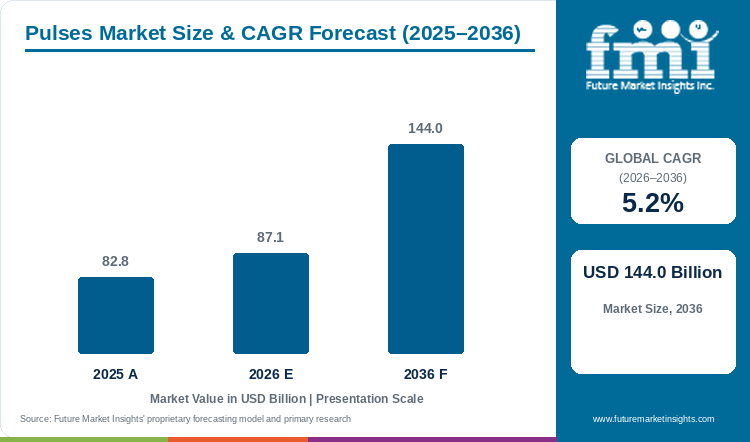
Sales of pulses are estimated to rise at 5.2% CAGR through 2036. Market valuation increases from USD 82.8 billion in 2025 to USD 87.1 billion in 2026 and is estimated to reach USD 144.0 billion by 2036.
As per updated analysis by FMI, increasing food use of beans, peas, chickpeas and lentils is supporting the demand for pulses across the globe. OECD-FAO projected pulse food consumption to reach 8.6 kg per person by 2034.[1] Sales of pulses are estimated to rise at 5.2% CAGR through 2036. Market valuation increases from USD 82.8 billion in 2025 to USD 87.1 billion in 2026 and is estimated to reach USD 144.0 billion by 2036. The traditional dry pulse category is already mature; however, the application of pulses in ready meals, snacks, bakery products and milled ingredients is creating further demand. As a result, manufacturers are increasing the use of grades having uniform color, hydration, cooking behavior and particle size.
Demand across regions develops unevenly as the UK is projected to grow at 6.7% CAGR, whilst Germany is anticipated at 6.2% through 2036. The European Commission reported in 2025 that only 25% of plant-based ingredients and protein crops in the EU was sourced domestically, requiring processors across the UK and Germany to maintain flexible import channels.[2] LeguDash is being used for improving the visibility of cultivation, harvest and prices. By the analysis of these situations, demand can increase in both countries; however, crop records, food-safety documents and consistent cleaning and milling quality will decide regular purchasing.
Key Takeaways
- Increasing use of pulses in ready meals, snacks and other convenient foods is widening purchases beyond household cooking; however, consistency of crop supply will continue to decide repeat contracts.
- Dry beans are projected at 37.0% in 2026 because one crop class can serve direct food use or ingredient conversion.
- Conventional supply is estimated at 94.4% in 2026 because processors can source more grades and origins without separate certification.
- Whole pulses are expected at 46.6% in 2026 because the same lot can move into retail, foodservice or further processing.
- The UK is projected at 6.7% CAGR and Germany at 6.2% through 2036, with import requirement, crop transparency and processing availability shaping growth in each country.
- Notable companies in the pulses market include ADM, Ingredion, IFF, Givaudan, Puratos, BASF, Fonterra, and Darling Ingredients.
Analyst Perspective
“Convenient pulse formats will move faster than traditional dry packs. Crop consistency will decide which suppliers receive repeat industrial orders.”
- Nandini Roy Choudhury, Principal Consultant, Future Market Insights.
How is the pulses market segmented?
Pulses market is segmented by four primary commercial axes and region: product type, nature, form, end use application, and region. Dry beans, conventional supply, whole pulses, and B2B are projected to hold 37.0%, 94.4%, 46.6%, and 40.8% in 2026.
By product type: dry beans, chickpeas, dry peas, cowpeas, lentils, pigeon peas, faba beans, and vetches.
By nature: conventional and organic.
By form: whole, flour, and split.
By end use application: B2B, food and beverage industry, household and retail, nutraceutical industry, animal feed industry, pharmaceutical industry, and food service.
By region: North America, Latin America, Western Europe, Eastern Europe, East Asia, South Asia and Pacific, and Middle East and Africa.
Why do dry beans hold notable product type demand?
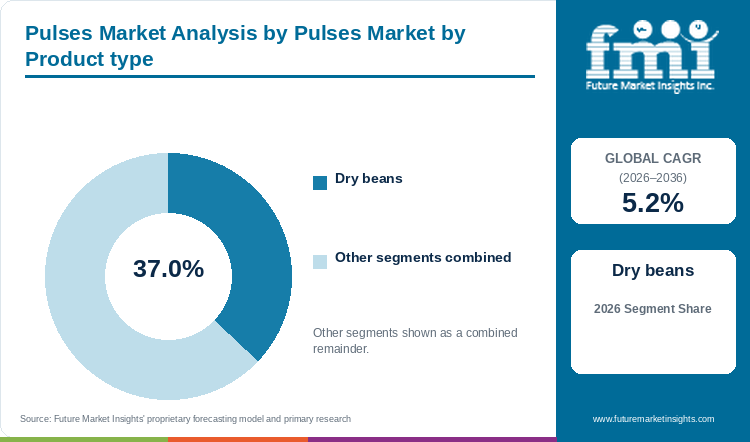
Based on product type, dry beans are projected to account for 37.0% in 2026, driven by broad food and processing use.
Dry beans are widely consumed in household foods and are also being used in canning, bean flour, snacks and prepared meals. This wider application of dry beans is supporting its higher preference among packers and food processors. FAO reported in 2025 that global dry bean production reached nearly 29 million tonnes, confirming its primary role across household cooking and commercial ingredient conversion.[3] Lower area can reduce the availability of selected colors and sizes, due to which buyers are expected to keep more than one origin available. However, the alternative origin can be used only when its cooking performance remains suitable for the final food product.
- Dry beans are projected at 37.0% in 2026 because one crop class can serve direct food use or ingredient conversion.
- Different bean classes allow processors to change origin when one crop becomes short, which supports purchasing continuity.
What supports conventional supply as the preferred nature category?
By nature, conventional supply is estimated to hold 94.4% in 2026, owing to scale and lower segregation requirements.
Conventional pulses are available from a wider number of farms and countries, which is one of the primary factors supporting its 94.4% share in 2026. These pulses can be purchased in bulk and moved through the existing cleaning, storage and processing system. Certified organic foods require documented separation, dedicated storage and controlled handling, due to which a replacement lot becomes difficult to arrange during a short crop. Research Institute of Organic Agriculture (FiBL) reported in February 2026 that organic pulses represent less than 3% of global pulse acreage, keeping conventional supply central for volume contracting.[4] Owing to these factors, conventional grades will continue to receive higher preference where scale and quick origin change are required.
- Conventional supply is estimated at 94.4% in 2026 because processors can source more grades and origins without separate certification.
- Lower segregation requirement allows conventional pulses to move through existing storage, cleaning and processing systems.
How does whole form meet changing application needs?
In 2026, whole pulses are expected to lead form with 46.6% share, supported by retail identity and processing flexibility.
Whole pulses are familiar among household and foodservice consumers and are also being converted into canned legumes, split and milled products. This processing flexibility allows packers, canners and mills to purchase the crop in whole form and apply the required process afterwards. FAO documented in February 2025 that global pulse production approached 96 million tonnes, sustaining large-scale whole-seed handling before downstream processing choices are made.[5] This scale allows processors to select lots having dependable crop quality. However, moisture, crop age and storage condition can change hydration and final texture, due to which the whole pulse lot needs to be tested before regular use.
- Whole pulses are expected at 46.6% in 2026 because the same lot can move into retail, foodservice or further processing.
- Processors can soak, cook, split or grind whole pulses as per the required food application.
Why is B2B central to end use application demand?
B2B is set to lead end use application with 40.8% share in 2026, underpinned by aggregated processor purchasing.
B2B buyers purchase crop volumes before pulses are converted into flour, canned foods, snacks, bakery products and ready meals. The buyers set limits for color, hydration, cooking, defects, particle size and food safety because one unsuitable lot can disturb the complete production run. In February 2026, Roquette introduced NUTRALYS Pea 850F for food processors, expanding application-ready ingredient choices across commercial food manufacturing.[6] This development shows that processor purchasing is increasingly moving towards application-ready pulse ingredients. Therefore, suppliers offering repeatable grades and continuous delivery are expected to gain higher preference under B2B contracts.
- B2B is projected at 40.8% in 2026 because processors aggregate crop volume before converting it into finished foods.
- Aggregated purchasing allows processors to secure crop volume before conversion into several finished-food formats.
What are the drivers, restraints, and opportunities in the pulses market?
In the pulses market, the key driver is convenient food use, the key restraint is preparation control, and the key opportunity is milled formats.
- Driver: Convenient foods bring pulses into scheduled manufacturing and recurring ingredient purchases.
- Restraint: Whole pulses require correct soaking or cooking, while crop variation can change hydration and texture.
- Opportunity: Flour and split formats remove preparation steps and fit established food-processing lines.
How are convenient foods driving the demand for pulses?
Convenient foods are reducing the preparation work which has restricted wider use of pulses among consumers. ADM's 2026 beans and pulses report identified convenience, taste and preparation as practical barriers.[7] Microwaveable packs, soups, ready meals and snacks remove part of this preparation and brings pulses into regular food manufacturing. This in turn is creating demand for beans and flours having similar color, flavor and hydration from one production lot to another. Thus, manufacturers that control variation in crop and processing are likely to receive better repeat orders from food companies.
Why does preparation requirement restrain whole-pulse adoption?
Whole pulses need correct soaking and cooking, which is one of the factors restricting its adoption among consumers requiring faster food preparation. EFSA reported in January 2026 that inadequately prepared foods containing active lectins can cause health problems, while suitable soaking and cooking can inactivate them.[8] This condition does not reduce the nutritional use of pulses; however, it provides a higher advantage to canned, prepared and clearly instructed products. As a result, validated cooking steps and plant-based food formats are expected to convert the growing consumer interest into actual consumption.
How are milled pulse formats creating an opportunity?
Milling pulses into flour, starch and other fractions allows its application in food lines without soaking an intact crop. Ingredion updated its PURITY P 1002 pea starch specification in July 2026 for cereals, savory snacks, bakery, meats and dairy alternatives.[9] These formats can be added through the existing mixing and processing equipment, which is widening their application across food manufacturing. However, particle size, flavor, viscosity and microbiological limits needs to remain suitable for each final food. Therefore, application testing will continue to decide whether an initial pulse ingredient order develops into regular purchasing.
Which country CAGRs are profiled in the pulses market?
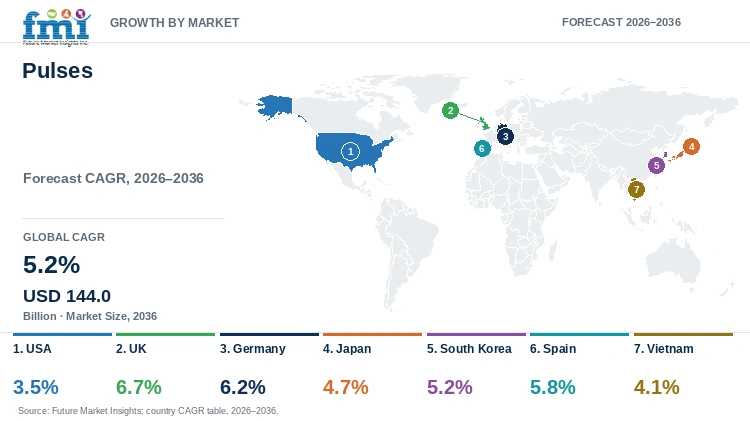
| Country | CAGR |
|---|---|
| USA | 3.5% |
| UK | 6.7% |
| Germany | 6.2% |
| Japan | 4.7% |
| South Korea | 5.2% |
| Spain | 5.8% |
| Vietnam | 4.1% |
How do country-level CAGRs compare in the pulses market?
Demand for pulses is expected to remain positive across the profiled countries; however, the factor supporting this demand is not same in every market. Mature consuming countries require stable replacement supply when domestic crop declines, while developing processing countries need storage, milling and trade channels. Therefore, country CAGRs indicate how domestic production, imported volume and food processing can work together, rather than only indicating higher consumer interest.
- The USA’s large food-processing sector supports pulse demand across packaged foods, snacks, and plant-based protein applications.
- In the UK, growing consumer interest in health, sustainability, and protein diversification encourages wider use of pulses in everyday diets.
- Germany’s expanding plant-based food industry increases demand for pulse ingredients across meat alternatives and prepared-food categories.
- Japan relies on established consumption patterns and stable import channels to maintain demand for pulse-based ingredients and traditional food products.
- South Korea’s convenience-food manufacturers increasingly incorporate pulses into nutrition-focused and functional food formulations.
- Spain’s strong culinary tradition of legume consumption continues to support demand across both household and foodservice channels.
- Vietnam’s developing milling, storage, and food-processing capabilities strengthen the role of pulses within domestic manufacturing and regional trade networks.
Established markets increasingly generate demand through prepared foods, ingredient applications, and specification-driven sourcing rather than dry-pack consumption alone.
Country-wise Analysis
- Demand for pulses in the USA is projected to expand at 3.5% CAGR through 2036. USDA estimated planted area for major pulses to decline by 739,000 acres from 2025, while dry bean area was placed at 1.16 million acres, down 15.0%.[10] Lower acreage can tighten the availability of selected colors and grades; however, demand from retail and food processing will continue. This is expected to increase early contracting and use of alternative origins. As per the analysis from FMI, the moderate growth rate reflects a mature market where convenient foods and sourcing control will add more sales than basic product awareness.
- The UK pulses market is projected to rise at 6.7% CAGR through 2036. The declared pulse area in 2025 was below 200,000 hectares, the lowest since 2019 and over 73,000 hectares lower than two years earlier.[11] Lower domestic area does not remove the demand from bakery, snacks and prepared meals; rather it increases the requirement for imported crops. Importers that can maintain cooking, color and grade when the origin changes are expected to receive higher preference. Thus, wider food application along with continuing need for flexible crop sourcing is likely to support the UK market.
- Demand for pulses in Germany is anticipated to increase at 6.2% CAGR over the forecast period. The grain-legume sector has limited transparency in prices and available volumes, due to which growers and processors face difficulty in forming long-term contracts.[12] LeguDash combines cultivation, harvest and price information for peas, field beans, soybeans and sweet lupins. Better information can support the contracts; however, cleaning, storage and milling capacity is also required for converting domestic crops into usable food grades. According to FMI, the market will grow stronger when policy interest connects with actual processing demand.
- Sales of pulses in Japan is estimated to grow at 4.7% CAGR through 2036. Traditional bean foods require a particular crop class, color, texture and cooking behavior. Japan's FY2025 food and agriculture report also retained food security and resilient domestic production as national priorities.[13] Imported crops therefore cannot be changed only because another origin is available at lower price. Processors need lots that match the familiar food format and remain stable during storage. This qualification requirement will keep growth measured; however, prepared products and dependable replacement supply are expected to create further opportunities.
- The South Korea pulses sector is projected to record 5.2% CAGR during the assessment period. The agriculture ministry's public data portal listed 2026 GAP-certified red-bean production with registered area and planned tonnage.[14] This shows the importance of traceable domestic crops in the certification system. Domestic specialty production remains smaller than the total food requirement, due to which imported beans and peas will continue to provide wider volume. Certified domestic crops will support provenance, whilst specification-matched imports are expected to provide scale for food manufacturers and retailers.
- Pulses demand in Spain is forecast to expand at 5.8% CAGR through 2036. The March 2026 crop advance updated area and production estimates for beans, lentils, chickpeas and faba beans.[15] These crops do not increase or decline at the same time and one pulse type cannot always replace another in household foods or processing. Importers and packers therefore maintain several origin options for continuous availability. This sourcing arrangement is expected to support market growth, especially where suppliers can preserve the required pulse type, size and cooking quality through uneven harvests.
- Sales of pulses and related plant ingredients in Vietnam are forecast to rise at 4.1% CAGR through 2036. USDA FAS forecast soybean imports at 2.8 million tonnes for 2025/26 as crushers added production lines, while domestic soybean production remained limited.[16] Soybeans remain outside the narrow dry-pulse definition; however, the processing investment can create shared storage, trade and formulation routes for other plant ingredients. Pulse suppliers can use these routes when landed cost, tariff treatment and suitability of the ingredient remains workable for the buyer.
Who are the notable companies in the pulses market?
ADM, Ingredion, IFF, Givaudan, Puratos, BASF, Fonterra, and Darling Ingredients are the notable companies profiled in this market.
The pulses market includes crop handlers, mills, ingredient processors, taste companies and agricultural technology suppliers. ADM and Ingredion are connecting crop sourcing with flour, starch and protein ingredients. IFF, Givaudan and Puratos are working closer to the final food where taste, texture and processing behavior needs to be tested. BASF remains present at the crop-technology side, while Fonterra and Darling Ingredients are used as wider protein references. By the analysis of these positions, competition remains moderately fragmented because one company does not control crop supply, processing and final application support together.
- Direct pulse and ingredient supply: ADM and Ingredion connect crop sourcing with flour or protein formats.
- Application and formulation: IFF, Givaudan and Puratos help manufacturers manage taste, texture and finished-food use.
- Upstream and reference competitors: BASF, Fonterra and Darling Ingredients influence crop technology or protein comparisons.
Competitive Benchmarking: Pulses Market
| Company | In-scope breadth | Application support | Conversion access | Geographic reach |
|---|---|---|---|---|
| ADM | High | High | High | High |
| Ingredion | Medium | High | High | High |
| IFF | Medium | High | High | High |
| Givaudan | Low | High | Medium | High |
| Puratos | Low | High | Medium | High |
| BASF | Low | Medium | Medium | High |
| Fonterra | Low | Medium | High | High |
| Darling Ingredients | Low | Medium | High | High |
High indicates wider public evidence across the stated criterion, Medium indicates credible but narrower capability, and Low indicates limited documented breadth. These ratings are used for comparing available capability and does not indicate company quality, revenue or verified market share.
Key Developments in the Pulses Market
- In May 2026, ADM launched eight protein ingredients, including pea flour for batters, breadings, baked goods, and cereals.
- In June 2025, Puratos joined the EUR 4.5 million EPIC-SHIFT project with 20 organizations from 14 countries to study protein diversification.
- In December 2025, Darling Ingredients signed a definitive agreement to combine collagen and gelatin operations with Tessenderlo Group in a business expected to have about USD 1.5 billion in annual revenue.
- In 2026, IFF continued to market TRUPRO pea protein powder, nuggets, and textured formats made from North American yellow peas.
Key Players in the Pulses Market
Pulse Supply and Ingredient Conversion
- ADM
- Ingredion
- IFF
Taste, Formulation, and Upstream Enablement
- Givaudan
- Puratos
- BASF
Alternative Protein Reference Companies
- Fonterra
- Darling Ingredients
Pulses Market - Report Scope
| Coverage field | Report scope |
|---|---|
| Market breakdown | Product type, nature, form, end use application, and region. |
| Quantitative units | USD billion. |
| Market definition | Revenue from dry edible pulses in the listed product types and forms. Finished foods and isolated downstream protein revenues are excluded. |
| Regions covered | North America; Latin America; Western Europe; Eastern Europe; East Asia; South Asia and Pacific; Middle East and Africa. |
| Countries covered | USA, UK, Germany, Japan, South Korea, Spain, Vietnam, and additional countries in the full report. |
| Key companies profiled | ADM; Ingredion; IFF; Givaudan; Puratos; BASF; Fonterra; Darling Ingredients. |
| Forecast period | 2026 to 2036. |
| Approach | The report covers product demand, crop availability, segment structure, and country adoption conditions. |
Pulses Market - Research Methodology
| Method | Approach |
|---|---|
| Primary Research | Inputs were gathered from manufacturers, distributors, processors, procurement teams, end users and subject experts. Discussions covered purchasing decisions, product trials, approval barriers, pricing and technical support. Respondents were also asked what evidence changes an initial order into regular purchasing. |
| Desk Research | Government statistics, trade data, regulatory publications, industry associations, company filings, product specifications and official announcements were reviewed. Claims were retained only where the publication date, product fit and market relevance could be checked. |
| Market Sizing and Forecasting | The baseline value was combined with product use, crop availability, pricing, company participation and country demand conditions. Forecast assumptions considered investment, purchasing cycles, processing capacity and barriers that can slow wider market use. |
| Data Validation | Estimates were checked against public data, trade movement, company activity and primary interviews. Products and revenues outside the defined pulse boundary were removed for reducing overlap and double counting. |
Pulses Market by Segments
Pulses Market by Product type
- Dry beans
- Chickpeas
- Dry peas
- Cowpeas
- Lentils
- Pigeon peas
- Faba beans
- Vetches
Pulses Market by Nature
- Conventional
- Organic
Pulses Market by Form
- Whole
- Flour
- Split
Pulses Market by End use application
- B2B
- Food and beverage industry
- Household and retail
- Nutraceutical industry
- Animal feed industry
- Pharmaceutical industry
- Food service
Pulses Market by Region
- North America
- United States
- Canada
- Latin America
- Brazil
- Mexico
- Argentina
- Chile
- Western Europe
- Germany
- France
- United Kingdom
- Italy
- Spain
- Benelux
- Nordics
- Eastern Europe
- Poland
- Czech Republic
- Romania
- Hungary
- East Asia
- Japan
- South Korea
- South Asia and Pacific
- ASEAN
- Australia and New Zealand
- Middle East and Africa
- GCC Countries
- South Africa
- Türkiye
- Israel
Research Sources and Bibliography
- [1] OECD and Food and Agriculture Organization of the United Nations. (2025, July). OECD-FAO Agricultural Outlook 2025-2034: Other products.
- [2] European Commission, Directorate-General for Agriculture and Rural Development. (2025, July). Reducing the plant protein deficit of the European Union.
- [3] Food and Agriculture Organization of the United Nations. (2025). Global production and trade of dry beans.
- [4] Research Institute of Organic Agriculture FiBL and IFOAM - Organics International. (2026, February). The World of Organic Agriculture: Statistics and Emerging Trends 2026.
- [5] Food and Agriculture Organization of the United Nations. (2025, February). Global pulse production and utilization: World Pulses Day overview.
- [6] Roquette Frères. (2026, February 18). Roquette expands plant-based ingredient portfolio with NUTRALYS Pea 850F.
- [7] Archer Daniels Midland Company. (2026). The world of beans and pulses: Trends and opportunities.
- [8] European Food Safety Authority. (2026, January 26). Risks for human health related to the presence of plant lectins in food.
- [9] Ingredion Incorporated. (2026, July 27). PURITY P 1002 pea starch technical specification.
- [10] U.S. Department of Agriculture, Economic Research Service. (2026, July 30). Vegetables and Pulses Outlook: July 2026.
- [11] Department for Environment, Food & Rural Affairs. (2026, September 3). Agriculture in the United Kingdom 2025: Chapter 7 - Crops.
- [12] German Federal Ministry of Agriculture, Food and Regional Identity. (2026). Existing and future information sources for market participants in the grain-legume sector.
- [13] Ministry of Agriculture, Forestry and Fisheries, Japan. (2026, May 29). Annual Report on Food, Agriculture and Rural Areas in Japan FY2025.
- [14] Ministry of Agriculture, Food and Rural Affairs, South Korea. (2026). Agricultural public data portal: GAP certification information.
- [15] Ministry of Agriculture, Fisheries and Food, Spain. (2026, March). Advances in crop areas and production, March 2026.
- [16] U.S. Department of Agriculture, Foreign Agricultural Service. (2025, September 30). Vietnam: Oilseeds and Products Update.
This bibliography is provided for reader reference. The full report contains the complete reference list and detailed citations.
This Report Answers
- What is Pulses Market worth in 2026 and 2036?
- What CAGR is projected for Pulses Market through 2036?
- Which product type holds notable Pulses Market share?
- Which form holds notable Pulses Market share during 2026?
- Which countries have notable Pulses Market growth outlooks?
- Which companies are notable in Pulses Market today?
Frequently Asked Questions
How big is the pulses market in 2026?
As per FMI, the pulses market is valued at USD 87.1 billion in 2026 and is projected to reach USD 144.0 billion by 2036.
What CAGR is projected for the pulses market through 2036?
The pulses market is projected to grow at 5.2% CAGR from 2026 to 2036, supported by convenient foods and milled applications.
Which product type has notable share in 2026?
Dry beans are projected to hold 37.0% of product type demand in 2026, owing to wider food and processing use.
Which form has notable share during 2026?
Whole pulses are expected to account for 46.6% of form demand in 2026, supported by retail familiarity and processing flexibility.
Which country has a notable pulses growth outlook?
As noted by FMI, the UK is projected to register 6.7% CAGR from 2026 to 2036, supported by prepared-food use and imported supply.
Which companies are notable in the pulses market today?
Notable companies include ADM, Ingredion, IFF, Givaudan, Puratos, BASF, Fonterra and Darling Ingredients.
Preview the report firsthand - request a free sample
Get SampleGet the brochure for pricing and purchase details.
Get PDFTable of Content
- Key Takeaways
- Market Size and CAGR
- Top Growth Driver
- Fastest Growing Segment
- Leading Region
- Key Companies
- Emerging Opportunities
- Executive Summary
- Global Market Outlook
- Demand-side Trends
- Supply-side Trends
- Technology Roadmap Analysis
- Analysis and Recommendations
- Analyst Perspective (What is happening? Why now? What should investors know?)
- Key Questions Answered
- How large is the market?
- What is the CAGR?
- What are key trends?
- Which region dominates?
- Who are the leaders?
- Market Overview
- Market Coverage / Taxonomy
- Market Definition / Scope / Limitations
- Research Methodology
- Chapter Orientation
- Analytical Lens and Working Hypotheses
- Market Structure, Signals, and Trend Drivers
- Benchmarking and Cross-market Comparability
- Market Sizing, Forecasting, and Opportunity Mapping
- Research Design and Evidence Framework
- Desk Research Programme (Secondary Evidence)
- Expert Input and Fieldwork (Primary Evidence)
- Tooling, Models, and Reference Databases
- Data Engineering and Model Build
- Quality Assurance and Audit Trail
- Market Background
- Market Dynamics (Drivers, Restraints, Opportunity, Trends)
- Scenario Forecast (Optimistic, Likely, Conservative)
- Impact Analysis
- AI Impact
- Sustainability Impact
- Regulatory Impact
- Technology Impact
- Consumer / Buyer Analysis
- Purchase Drivers
- Adoption Barriers
- Buyer Journey
- Opportunity Map Analysis
- Product Life Cycle Analysis
- Supply Chain Analysis
- Investment Feasibility Matrix
- Value Chain Analysis
- PESTLE and Porter's Analysis
- Regulatory Landscape
- Regional Parent Market Outlook
- Production and Consumption Statistics
- Import and Export Statistics
- Global Market Analysis and Forecast, 2021 to 2036
- Historical Market Size Value (USD Billion) Analysis, 2021 to 2025
- Current and Future Market Size Value (USD Billion) Projections, 2026 to 2036
- Y-o-Y Growth Trend Analysis
- Absolute $ Opportunity Analysis
- Global Market Pricing Analysis, 2021 to 2036
- Global Market Analysis and Forecast, By Pulses Market by Product type, 2021 to 2036
- Introduction / Key Findings
- Historical Market Size Value (USD Billion) Analysis By Pulses Market by Product type, 2021 to 2025
- Current and Future Market Size Value (USD Billion) Analysis and Forecast By Pulses Market by Product type, 2026 to 2036
- Dry beans
- Chickpeas
- Dry peas
- Cowpeas
- Lentils
- Pigeon peas
- Faba beans
- Vetches
- Y-o-Y Growth Trend Analysis By Pulses Market by Product type, 2021 to 2025
- Absolute $ Opportunity Analysis By Pulses Market by Product type, 2026 to 2036
- Global Market Analysis and Forecast, By Pulses Market by Nature, 2021 to 2036
- Introduction / Key Findings
- Historical Market Size Value (USD Billion) Analysis By Pulses Market by Nature, 2021 to 2025
- Current and Future Market Size Value (USD Billion) Analysis and Forecast By Pulses Market by Nature, 2026 to 2036
- Conventional
- Organic
- Y-o-Y Growth Trend Analysis By Pulses Market by Nature, 2021 to 2025
- Absolute $ Opportunity Analysis By Pulses Market by Nature, 2026 to 2036
- Global Market Analysis and Forecast, By Pulses Market by Form, 2021 to 2036
- Introduction / Key Findings
- Historical Market Size Value (USD Billion) Analysis By Pulses Market by Form, 2021 to 2025
- Current and Future Market Size Value (USD Billion) Analysis and Forecast By Pulses Market by Form, 2026 to 2036
- Whole
- Flour
- Split
- Y-o-Y Growth Trend Analysis By Pulses Market by Form, 2021 to 2025
- Absolute $ Opportunity Analysis By Pulses Market by Form, 2026 to 2036
- Global Market Analysis and Forecast, By Pulses Market by End use application, 2021 to 2036
- Introduction / Key Findings
- Historical Market Size Value (USD Billion) Analysis By Pulses Market by End use application, 2021 to 2025
- Current and Future Market Size Value (USD Billion) Analysis and Forecast By Pulses Market by End use application, 2026 to 2036
- B2B
- Food and beverage industry
- Household and retail
- Nutraceutical industry
- Animal feed industry
- Pharmaceutical industry
- Food service
- Y-o-Y Growth Trend Analysis By Pulses Market by End use application, 2021 to 2025
- Absolute $ Opportunity Analysis By Pulses Market by End use application, 2026 to 2036
- Global Market Analysis and Forecast, By Region, 2021 to 2036
- Introduction
- Historical Market Size Value (USD Billion) Analysis By Region, 2021 to 2025
- Current Market Size Value (USD Billion) Analysis and Forecast By Region, 2026 to 2036
- North America
- Latin America
- Western Europe
- Eastern Europe
- East Asia
- South Asia and Pacific
- Middle East and Africa
- Market Attractiveness Analysis By Region
- North America Market Analysis and Forecast, By Country, 2021 to 2036
- Historical Market Size Value (USD Billion) Trend Analysis By Market Taxonomy, 2021 to 2025
- Market Size Value (USD Billion) Forecast By Market Taxonomy, 2026 to 2036
- By Country
- United States
- Canada
- By Pulses Market by Product type
- By Pulses Market by Nature
- By Pulses Market by Form
- By Pulses Market by End use application
- By Country
- Market Attractiveness Analysis
- By Country
- By Pulses Market by Product type
- By Pulses Market by Nature
- By Pulses Market by Form
- By Pulses Market by End use application
- Key Takeaways
- Latin America Market Analysis and Forecast, By Country
- Historical Market Size Value (USD Billion) Trend Analysis By Market Taxonomy, 2021 to 2025
- Market Size Value (USD Billion) Forecast By Market Taxonomy, 2026 to 2036
- By Country
- Brazil
- Mexico
- Argentina
- Chile
- By Pulses Market by Product type
- By Pulses Market by Nature
- By Pulses Market by Form
- By Pulses Market by End use application
- By Country
- Market Attractiveness Analysis
- By Country
- By Pulses Market by Product type
- By Pulses Market by Nature
- By Pulses Market by Form
- By Pulses Market by End use application
- Key Takeaways
- Western Europe Market Analysis and Forecast, By Country
- Historical Market Size Value (USD Billion) Trend Analysis By Market Taxonomy, 2021 to 2025
- Market Size Value (USD Billion) Forecast By Market Taxonomy, 2026 to 2036
- By Country
- Germany
- France
- United Kingdom
- Italy
- Spain
- Benelux
- Nordics
- By Pulses Market by Product type
- By Pulses Market by Nature
- By Pulses Market by Form
- By Pulses Market by End use application
- By Country
- Market Attractiveness Analysis
- By Country
- By Pulses Market by Product type
- By Pulses Market by Nature
- By Pulses Market by Form
- By Pulses Market by End use application
- Key Takeaways
- Eastern Europe Market Analysis and Forecast, By Country
- Historical Market Size Value (USD Billion) Trend Analysis By Market Taxonomy, 2021 to 2025
- Market Size Value (USD Billion) Forecast By Market Taxonomy, 2026 to 2036
- By Country
- Poland
- Czech Republic
- Romania
- Hungary
- By Pulses Market by Product type
- By Pulses Market by Nature
- By Pulses Market by Form
- By Pulses Market by End use application
- By Country
- Market Attractiveness Analysis
- By Country
- By Pulses Market by Product type
- By Pulses Market by Nature
- By Pulses Market by Form
- By Pulses Market by End use application
- Key Takeaways
- East Asia Market Analysis and Forecast, By Country
- Historical Market Size Value (USD Billion) Trend Analysis By Market Taxonomy, 2021 to 2025
- Market Size Value (USD Billion) Forecast By Market Taxonomy, 2026 to 2036
- By Country
- Japan
- South Korea
- By Pulses Market by Product type
- By Pulses Market by Nature
- By Pulses Market by Form
- By Pulses Market by End use application
- By Country
- Market Attractiveness Analysis
- By Country
- By Pulses Market by Product type
- By Pulses Market by Nature
- By Pulses Market by Form
- By Pulses Market by End use application
- Key Takeaways
- South Asia and Pacific Market Analysis and Forecast, By Country
- Historical Market Size Value (USD Billion) Trend Analysis By Market Taxonomy, 2021 to 2025
- Market Size Value (USD Billion) Forecast By Market Taxonomy, 2026 to 2036
- By Country
- ASEAN
- Australia and New Zealand
- By Pulses Market by Product type
- By Pulses Market by Nature
- By Pulses Market by Form
- By Pulses Market by End use application
- By Country
- Market Attractiveness Analysis
- By Country
- By Pulses Market by Product type
- By Pulses Market by Nature
- By Pulses Market by Form
- By Pulses Market by End use application
- Key Takeaways
- Middle East and Africa Market Analysis and Forecast, By Country
- Historical Market Size Value (USD Billion) Trend Analysis By Market Taxonomy, 2021 to 2025
- Market Size Value (USD Billion) Forecast By Market Taxonomy, 2026 to 2036
- By Country
- GCC Countries
- South Africa
- Türkiye
- Israel
- By Pulses Market by Product type
- By Pulses Market by Nature
- By Pulses Market by Form
- By Pulses Market by End use application
- By Country
- Market Attractiveness Analysis
- By Country
- By Pulses Market by Product type
- By Pulses Market by Nature
- By Pulses Market by Form
- By Pulses Market by End use application
- Key Takeaways
- Key Countries Market Analysis
- United States
- Pricing Analysis
- Market Share Analysis, 2025
- By Pulses Market by Product type
- By Pulses Market by Nature
- By Pulses Market by Form
- By Pulses Market by End use application
- Canada
- Pricing Analysis
- Market Share Analysis, 2025
- By Pulses Market by Product type
- By Pulses Market by Nature
- By Pulses Market by Form
- By Pulses Market by End use application
- Mexico
- Pricing Analysis
- Market Share Analysis, 2025
- By Pulses Market by Product type
- By Pulses Market by Nature
- By Pulses Market by Form
- By Pulses Market by End use application
- Brazil
- Pricing Analysis
- Market Share Analysis, 2025
- By Pulses Market by Product type
- By Pulses Market by Nature
- By Pulses Market by Form
- By Pulses Market by End use application
- Chile
- Pricing Analysis
- Market Share Analysis, 2025
- By Pulses Market by Product type
- By Pulses Market by Nature
- By Pulses Market by Form
- By Pulses Market by End use application
- Germany
- Pricing Analysis
- Market Share Analysis, 2025
- By Pulses Market by Product type
- By Pulses Market by Nature
- By Pulses Market by Form
- By Pulses Market by End use application
- United Kingdom
- Pricing Analysis
- Market Share Analysis, 2025
- By Pulses Market by Product type
- By Pulses Market by Nature
- By Pulses Market by Form
- By Pulses Market by End use application
- Italy
- Pricing Analysis
- Market Share Analysis, 2025
- By Pulses Market by Product type
- By Pulses Market by Nature
- By Pulses Market by Form
- By Pulses Market by End use application
- Spain
- Pricing Analysis
- Market Share Analysis, 2025
- By Pulses Market by Product type
- By Pulses Market by Nature
- By Pulses Market by Form
- By Pulses Market by End use application
- France
- Pricing Analysis
- Market Share Analysis, 2025
- By Pulses Market by Product type
- By Pulses Market by Nature
- By Pulses Market by Form
- By Pulses Market by End use application
- ASEAN
- Pricing Analysis
- Market Share Analysis, 2025
- By Pulses Market by Product type
- By Pulses Market by Nature
- By Pulses Market by Form
- By Pulses Market by End use application
- Australia and New Zealand
- Pricing Analysis
- Market Share Analysis, 2025
- By Pulses Market by Product type
- By Pulses Market by Nature
- By Pulses Market by Form
- By Pulses Market by End use application
- Japan
- Pricing Analysis
- Market Share Analysis, 2025
- By Pulses Market by Product type
- By Pulses Market by Nature
- By Pulses Market by Form
- By Pulses Market by End use application
- South Korea
- Pricing Analysis
- Market Share Analysis, 2025
- By Pulses Market by Product type
- By Pulses Market by Nature
- By Pulses Market by Form
- By Pulses Market by End use application
- Poland
- Pricing Analysis
- Market Share Analysis, 2025
- By Pulses Market by Product type
- By Pulses Market by Nature
- By Pulses Market by Form
- By Pulses Market by End use application
- Hungary
- Pricing Analysis
- Market Share Analysis, 2025
- By Pulses Market by Product type
- By Pulses Market by Nature
- By Pulses Market by Form
- By Pulses Market by End use application
- Türkiye
- Pricing Analysis
- Market Share Analysis, 2025
- By Pulses Market by Product type
- By Pulses Market by Nature
- By Pulses Market by Form
- By Pulses Market by End use application
- South Africa
- Pricing Analysis
- Market Share Analysis, 2025
- By Pulses Market by Product type
- By Pulses Market by Nature
- By Pulses Market by Form
- By Pulses Market by End use application
- Vietnam
- Pricing Analysis
- Market Share Analysis, 2025
- By Pulses Market by Product type
- By Pulses Market by Nature
- By Pulses Market by Form
- By Pulses Market by End use application
- United States
- Market Structure Analysis
- Competition Dashboard
- Competition Benchmarking
- Market Share Analysis of Top Players
- By Regional
- By Pulses Market by Product type
- By Pulses Market by Nature
- By Pulses Market by Form
- By Pulses Market by End use application
- Emerging Startups
- Innovation Benchmarking
- Competition Analysis
- Competition Deep Dive
- ADM
- Overview
- Product Portfolio
- Profitability by Market Segments
- Sales Footprint
- Strategy Overview
- Marketing Strategy
- Product Strategy
- Channel Strategy
- Ingredion
- IFF
- Givaudan
- Puratos
- BASF
- Fonterra
- Darling Ingredients
- ADM
- Case Studies
- Success Stories
- Recent Developments
- Competition Deep Dive
- Assumptions & Acronyms Used


