

- Industry Size (2026):
- USD 446 Mn
- Forecast (2036):
- USD 829.4 Mn
- CAGR (2026 to 2036)
- 6.4%
Punch Grafting Market Forecast and Outlook 2026 to 2036
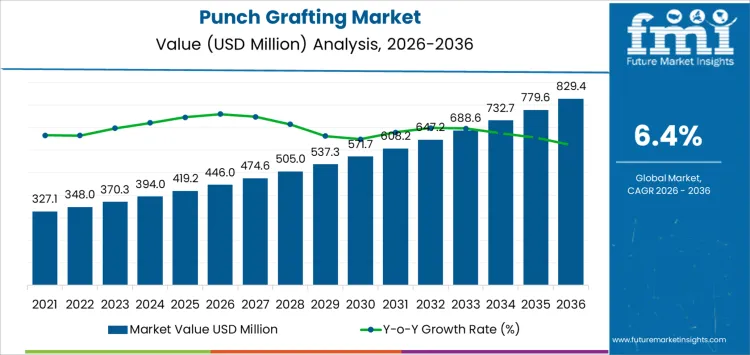
The punch grafting market is likely to be valued at USD 446 million in 2026 and is expected to reach USD 829.4 million by 2036, reflecting a CAGR of 6.4%. Market performance over the forecast period is closely shaped by supply chain structure and production control rather than rapid technology shifts. Manufacturing of punch grafting instruments remains moderately concentrated, with a limited number of specialized surgical instrument producers controlling precision machining, material finishing, and quality assurance. Dependence on high-grade stainless steel, tight dimensional tolerances, and consistent blade sharpness places emphasis on stable upstream sourcing and controlled production environments.
Regional manufacturing hubs in Europe and parts of Asia influence lead times, pricing stability, and availability for distributors serving high-volume clinic networks. Supply reliability is critical, as clinics depend on uninterrupted access to standardized tools and disposable components to maintain procedural throughput. Any disruption in sterilization compatibility, packaging consistency, or component sourcing can directly affect clinic operations. Supplier selection is strongly influenced by proven manufacturing discipline, inventory continuity, and the ability to deliver uniform product performance across batches rather than aggressive cost minimization.
Quick Stats for Punch Grafting Market
- Punch Grafting Market Value (2026): USD 446 Million
- Punch Grafting Market Forecast Value (2036): USD 829.4 Million
- Punch Grafting Market Forecast CAGR (2026-2036): 6.4%
- Leading Product Segment in Punch Grafting Market: Manual Punch Grafting Tools (51% share)
- Key Regions in Punch Grafting Market: Asia Pacific, Europe, North America, Latin America, Middle East & Africa
- Major Competitive Focus Areas in Punch Grafting Market: Instrument precision, ergonomic design, disposable versus reusable tool optimization, clinical training support, and procedural standardization
Punch Grafting Market Key Takeaways
| Metric | Value |
|---|---|
| Punch Grafting Market Value (2026) | USD 446 Million |
| Punch Grafting Market Forecast Value (2036) | USD 829.4 Million |
| Punch Grafting Market Forecast CAGR (2026-2036) | 6.4% |
How are Procedure Standardization and Clinic Economics Shaping the Punch Grafting Market?
The punch grafting market is expanding as dermatology and aesthetic clinics prioritize procedures that balance clinical outcomes with predictable chair-time and cost control. Punch grafting remains a preferred technique for vitiligo management, scar revision, and select hair restoration applications due to its simplicity, reproducibility, and minimal infrastructure requirements. For device and consumables suppliers, demand is increasingly driven by high-throughput clinics seeking standardized tools that reduce variability and support consistent results across practitioners.
Adoption is being influenced by workflow efficiency and training considerations. Clinics favor punch systems that offer precise sizing, ergonomic handling, and compatibility with common sterile workflows, enabling faster procedures and reduced complication rates. Disposable and single-use options are gaining traction for infection control and inventory management, while modular kits that bundle punches, forceps, and dressing accessories improve procurement efficiency. Suppliers that provide training materials, technique guides, and post-procedure care protocols are better positioned to accelerate clinic onboarding and repeat purchases.
Market growth is also supported by expanding access to dermatologic care in emerging regions and rising acceptance of minimally invasive treatments. As reimbursement remains limited in many indications, clinics evaluate tools based on total procedure economics consumable cost, procedure time, and patient throughput rather than device price alone. For manufacturers and distributors, competitive advantage increasingly depends on product reliability, portfolio breadth, and the ability to support clinics with education and service positioning punch grafting as a steady, practice-driven market with predictable demand over the forecast period.
How is The Punch Grafting Market Structured by Product and Application?
The punch grafting market is segmented by product and application, reflecting differences in procedural control, throughput, and clinical specialization. By product, manual punch grafting tools lead adoption, favored for precision and cost efficiency in routine grafting procedures. Other products include motorized punch grafting systems and disposable punch kits, which support higher throughput and standardized clinical workflows. By application, hair restoration represents the dominant use case, while dermatology grafting addresses scar revision, vitiligo treatment, and small-area skin reconstruction. The segmentation highlights how practitioner preference and procedure frequency shape purchasing decisions.
Why Do Manual Punch Grafting Tools Lead Product Adoption In The Punch Grafting Market?
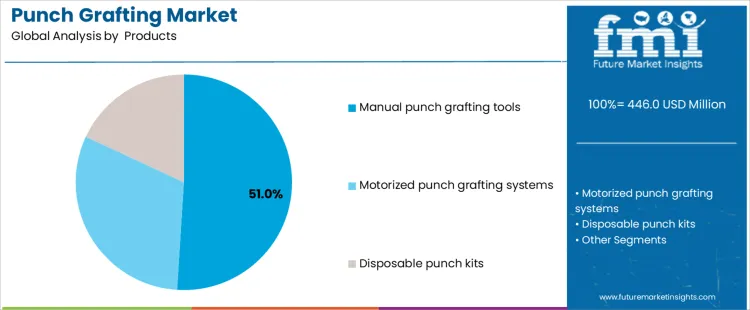
Manual punch grafting tools account for 51% share of the punch grafting market because they offer surgeons tactile control and precision during follicular extraction and implantation. Clinicians prefer manual tools for delicate areas where angle, depth, and graft integrity are critical. These tools are lightweight, easy to sterilize, and compatible with a wide range of punch sizes, enabling customization by hair type and skin characteristics. Lower acquisition and maintenance costs make manual systems accessible to small and mid-sized clinics. Training requirements are straightforward, accelerating adoption across emerging markets. These control, flexibility, and cost advantages explain why manual punch grafting tools remain the leading product category.
Why Does Hair Restoration Dominate Application Demand In The Punch Grafting Market?
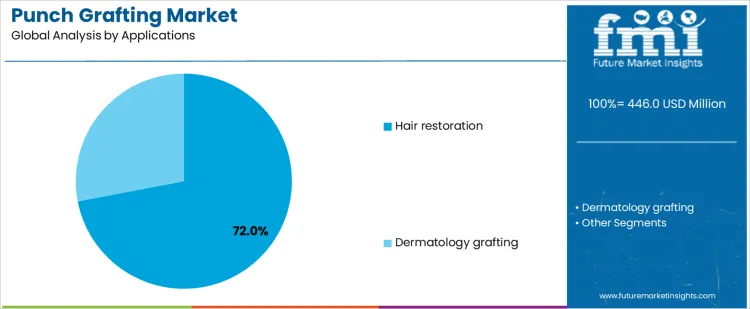
Hair restoration holds 72% share of the punch grafting market because hair loss treatments represent the most frequent and commercially established grafting procedures. High patient demand across male pattern baldness and thinning conditions drives consistent procedural volumes. Punch grafting enables precise follicular unit extraction with natural-looking results, supporting high patient satisfaction. Clinics focus on hair restoration services due to repeat referrals and predictable caseloads. Advances in technique and instrumentation improve graft survival and density outcomes. For device suppliers, hair restoration offers sustained demand and recurring consumables. These procedural frequency and clinic economics factors explain the dominance of hair restoration applications.
What Are The Key Dynamics Of The Punch Grafting Market?
The punch grafting market is driven by rising incidence of hair loss disorders (such as androgenetic alopecia), increasing patient awareness of surgical hair restoration options, and growing demand for minimally invasive aesthetic treatments. Punch grafting where small circular sections of scalp tissue containing hair follicles are transplanted remains a relevant option in specific clinical contexts despite competition from follicular unit extraction (FUE) and strip harvesting techniques. For device manufacturers and clinical service providers, precision instruments, ergonomic designs, and procedure-specific training programs influence adoption. Clinic reputation, patient outcomes, and cost considerations also shape treatment uptake and service delivery models.
How Are Clinical Trends And Technological Advancements Shaping This Market?
Clinical trends and technological advancements are influencing the punch grafting market by improving procedural accuracy, reducing operative time, and enhancing patient comfort. Modern punch tools manual and motorized with adjustable diameters and rotatory features support consistent graft harvesting and reduce transection rates. Integration of magnification systems and ergonomic handles improves precision for surgeons. Digital patient assessment tools and imaging platforms help set realistic expectations and guide graft placement. For suppliers, offering complete procedural kits, sterilization equipment, and training modules increases value, while clinics benefit from workflow standardization that enhances outcomes and repeat referral rates.
Why Do Competitive, Skill, And Outcome Variability Challenges Restrain Market Growth?
Competitive alternatives, skill requirements, and outcome variability restrain growth in the punch grafting market. Emerging hair restoration techniques such as FUE, follicular unit transplantation (FUT), and robotic harvesting systems offer less scarring, higher graft survival, and broader cosmetic appeal, which can reduce preference for traditional punch methods. Punch grafting demands high surgical skill to minimize trauma and maximize graft viability, creating barriers for providers without specialized training. Patient outcomes can vary based on surgeon experience, graft handling techniques, and post-operative care, affecting word-of-mouth and clinic reputation. These factors can slow broader adoption and lead clinics to invest in alternative technologies.
What is the Country-Level Growth Outlook for the Punch Grafting Market?
The punch grafting market is expanding steadily as dermatology and aesthetic clinics continue to adopt minimally invasive techniques for hair restoration, scar revision, and skin repair procedures. Punch grafting systems are valued for procedural precision, reduced recovery time, and compatibility with outpatient clinical settings. Growth varies by country based on aesthetic procedure volumes, availability of trained dermatologists, disposable income levels, and penetration of cosmetic clinics. Mature markets emphasize procedural standardization, safety, and incremental technology upgrades, while emerging markets are driven by expanding clinic networks, medical tourism, and rising patient awareness. Market value is shaped by device reliability, ergonomic design, and cost-effectiveness, particularly in high-volume clinical environments.
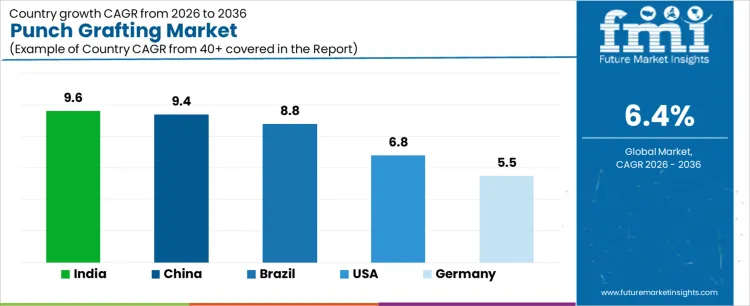
| Country | CAGR (%) |
|---|---|
| India | 9.6 |
| China | 9.4 |
| Brazil | 8.8 |
| United States | 6.8 |
| Germany | 5.5 |
How is The United States Maintaining Steady Demand for Punch Grafting Procedures?
The punch grafting market in the United States is expanding at a CAGR of 6.8% during 2026-2036, supported by consistent demand for hair restoration, scar correction, and dermatologic repair procedures. Adoption is concentrated in established dermatology and cosmetic surgery clinics that value procedural reliability and predictable outcomes. Clinics prioritize punch grafting instruments that offer precise graft extraction, ergonomic handling, and compatibility with outpatient workflows. Technological improvements are incremental, focusing on refinement rather than replacement of existing techniques. Procurement decisions are influenced by clinician familiarity, device reputation, and regulatory clearance. Training programs and technique standardization play an important role in maintaining procedural quality across clinics. Market value is driven by repeat procedural use, steady patient flow, and clinic efficiency rather than rapid expansion. The United States represents a mature market where growth is gradual and supplier success depends on reliability, clinician trust, and consistent instrument performance.
Why is Brazil a Rapidly Expanding Market for Punch Grafting Systems?
Brazil’s punch grafting market is growing at a CAGR of 8.8% during 2026-2036, driven by high demand for cosmetic and reconstructive dermatology procedures. The country’s large network of private aesthetic clinics supports widespread use of punch grafting for hair restoration and scar treatment. Clinics prioritize affordability, durability, and ease of instrument handling to manage high procedure volumes. Adoption is supported by strong practitioner interest and regular training workshops organized by professional bodies and distributors. Procurement decisions favor cost-effective systems that deliver reliable results with minimal downtime. Market growth is reinforced by rising patient awareness and the country’s role as a destination for aesthetic procedures. Brazil represents a growth-oriented market where success depends on competitive pricing, broad distribution coverage, and consistent clinical performance across varied practice settings.
Why is China Seeing Accelerated Adoption of Punch Grafting Procedures?
China’s punch grafting market is expanding at a CAGR of 9.4% during 2026-2036, supported by rapid growth in private dermatology and aesthetic medicine clinics. Demand is driven by increasing interest in hair restoration and skin repair procedures among younger urban populations. Clinics adopt punch grafting tools to improve procedural accuracy and reduce recovery time. Buyers emphasize availability, throughput efficiency, and consistency across multi-location clinic chains. Procurement decisions favor suppliers with local manufacturing capability, established regulatory pathways, and reliable logistics. Training programs and standardized clinical protocols are increasingly used to support high patient volumes. Market value is driven by scale, clinic network expansion, and procedural efficiency. China represents a volume-driven market where supplier competitiveness depends on dependable supply, operational consistency, and the ability to support fast-growing clinic networks.
Why is India Emerging as a High-Growth Market for Punch Grafting?
India’s punch grafting market is projected to grow at a CAGR of 9.6% during 2026-2036, driven by expanding private dermatology clinics and increasing demand for hair restoration procedures. Adoption is concentrated in urban centers and medical tourism hubs offering cost-effective treatments. Clinics prioritize affordability, versatility of instruments, and ease of maintenance. Punch grafting is widely used due to its suitability for outpatient settings and predictable results. Procurement cycles are short, enabling clinics to adopt or replace devices quickly. Training availability is improving, supporting broader adoption across tier-one and tier-two cities. Market value is driven by high patient throughput, competitive pricing, and service accessibility. India represents a fast-growing market where supplier success depends on cost control, local support, and scalability across diverse clinical environments.
How is Germany Retaining a Conservative Approach to Punch Grafting Adoption?
Demand for punch grafting in Germany is growing at a CAGR of 5.5% during the forecast period, characterized by cautious adoption and strong clinical oversight. Dermatology clinics emphasize procedural safety, physician training, and adherence to medical guidelines. Punch grafting is often used selectively, particularly for medically indicated treatments rather than elective cosmetic procedures. Buyers prioritize instrument precision, sterilization compatibility, and compliance with device regulations. Procurement decisions involve thorough evaluation processes, resulting in longer replacement cycles. Market value accrues to suppliers offering high-quality instruments with strong technical documentation. Germany represents a mature market where trust, regulation, and procedural rigor shape demand more than rapid clinic expansion.
What is Driving Competition in the Punch Grafting Market?
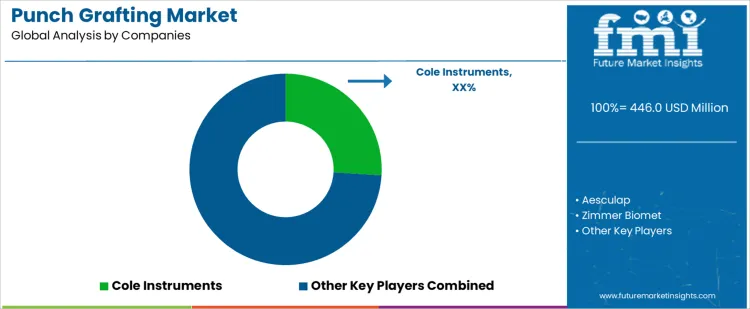
Competition in the punch grafting market is shaped by instrument precision, ergonomic design, and verified clinical performance that matter to surgeons, procurement teams, and healthcare facilities. Cole Instruments positions its punch grafting tools with official product literature emphasizing sharp, consistently beveled edges and material durability designed to minimize tissue trauma. Brochures highlight precision tolerances and repeatability in harvesting and implanting micro-grafts, appealing to clinicians focused on outcome reliability.
Aesculap competes through a legacy portfolio of surgical punches and grafting instruments documented for high-grade stainless steel construction and sterilization resilience. Product materials underscore ergonomic handles and balanced weight distribution that support prolonged procedures with reduced surgeon fatigue. Zimmer Biomet differentiates via integrated instrument systems where punch tools are part of broader grafting and orthopedic suites; official guides focus on compatibility with ancillary instruments and procedural workflows that enhance operating room efficiency.
Mid-tier surgical instrument specialists add further differentiation. Medicon positions its punch grafting range with brochures that highlight surface finish quality and precision manufacturing processes that ensure consistent cutting action. Integra LifeSciences competes by aligning punch grafting tools with regenerative medicine and wound care systems, supported by documentation of material biocompatibility and ease of use in both plastic and reconstructive procedures.
Others in the market provide niche designs, custom diameters, and surgeon-preferred handle ergonomics supported by specification sheets covering blade geometry and sterilization protocols. Across suppliers, competitive advantage is defined by brochure-verified instrument precision, clinical usability, and quality assurances rather than pricing alone.
Key Players in Punch Grafting Market
- Cole Instruments
- Aesculap
- Zimmer Biomet
- Medicon
- Integra LifeSciences
- Others
Scope of Report
| Attribute | Description |
|---|---|
| Quantitative Unit | USD Million |
| Products | Manual Punch Grafting Tools, Motorized Punch Grafting Systems, Disposable Punch Kits |
| Applications | Hair Restoration, Dermatology Grafting |
| Countries Covered | China, Japan, South Korea, India, Australia & New Zealand, ASEAN, Rest of Asia Pacific, Germany, United Kingdom, France, Italy, Spain, Nordic, BENELUX, Rest of Europe, United States, Canada, Mexico, Brazil, Chile, Rest of Latin America, Kingdom of Saudi Arabia, Other GCC Countries, Turkey, South Africa, Other African Union, Rest of Middle East & Africa |
| Regions Covered | Asia Pacific, Europe, North America, Latin America, Middle East & Africa |
| Key Companies Profiled | Cole Instruments, Aesculap, Zimmer Biomet, Medicon, Integra LifeSciences, Others |
| Additional Attributes | Dollar sales by product type and application are assessed across cosmetic surgery and dermatology procedure volumes. The report includes country-level demand assessment, growth projections for 2026-2036, analysis of clinic adoption and procedural efficiency, evaluation of disposable versus reusable instrument trends, competitive benchmarking of device suppliers, and assessment of outpatient aesthetic procedure expansion across global healthcare markets. |
Punch Grafting Market by Key Segments
Products
- Manual punch grafting tools
- Motorized punch grafting systems
- Disposable punch kits
Applications
- Hair restoration
- Dermatology grafting
Region:
- Asia Pacific
- China
- Japan
- South Korea
- India
- Australia & New Zealand
- ASEAN
- Rest of Asia Pacific
- Europe
- Germany
- United Kingdom
- France
- Italy
- Spain
- Nordic
- BENELUX
- Rest of Europe
- North America
- United States
- Canada
- Mexico
- Latin America
- Brazil
- Chile
- Rest of Latin America
- Middle East & Africa
- Kingdom of Saudi Arabia
- Other GCC Countries
- Turkey
- South Africa
- Other African Union
- Rest of Middle East & Africa
Bibliography
- U.S. National Library of Medicine. (2023). Microneedle‑mediated transdermal delivery of biopharmaceuticals. Pharmaceutics, 15(1), Article 277.
- Health Organization. (2024). Innovations in surgical and dermatologic delivery technologies and procedures. WHO.
- National Institutes of Health. (2024). Clinical overview of grafting techniques in dermatologic surgery. Journal of the American Academy of Dermatology.
Frequently Asked Questions
How big is the punch grafting market in 2026?
The global punch grafting market is estimated to be valued at USD 446.0 million in 2026.
What will be the size of punch grafting market in 2036?
The market size for the punch grafting market is projected to reach USD 829.4 million by 2036.
How much will be the punch grafting market growth between 2026 and 2036?
The punch grafting market is expected to grow at a 6.4% CAGR between 2026 and 2036.
What are the key product types in the punch grafting market?
The key product types in punch grafting market are manual punch grafting tools, motorized punch grafting systems and disposable punch kits.
Which applications segment to contribute significant share in the punch grafting market in 2026?
In terms of applications, hair restoration segment to command 72.0% share in the punch grafting market in 2026.
Preview the report firsthand - request a free sample
Get SampleGet the brochure for pricing and purchase details.
Get PDFTable of Content
- Executive Summary
- Global Market Outlook
- Demand-side Trends
- Supply-side Trends
- Technology Roadmap Analysis
- Analysis and Recommendations
- Market Overview
- Market Coverage / Taxonomy
- Market Definition / Scope / Limitations
- Market Background
- Market Dynamics
- Drivers
- Restraints
- Opportunity
- Trends
- Scenario Forecast
- Demand in Optimistic Scenario
- Demand in Likely Scenario
- Demand in Conservative Scenario
- Opportunity Map Analysis
- Product Life Cycle Analysis
- Supply Chain Analysis
- Investment Feasibility Matrix
- Value Chain Analysis
- PESTLE and Porter’s Analysis
- Regulatory Landscape
- Regional Parent Market Outlook
- Production and Consumption Statistics
- Import and Export Statistics
- Market Dynamics
- Global Market Analysis 2021 to 2025 and Forecast, 2026 to 2036
- Historical Market Size Value (USD Million) Analysis, 2021 to 2025
- Current and Future Market Size Value (USD Million) Projections, 2026 to 2036
- Y-o-Y Growth Trend Analysis
- Absolute $ Opportunity Analysis
- Global Market Pricing Analysis 2021 to 2025 and Forecast 2026 to 2036
- Global Market Analysis 2021 to 2025 and Forecast 2026 to 2036, By Products
- Introduction / Key Findings
- Historical Market Size Value (USD Million) Analysis By Products , 2021 to 2025
- Current and Future Market Size Value (USD Million) Analysis and Forecast By Products , 2026 to 2036
- Manual punch grafting tools
- Motorized punch grafting systems
- Disposable punch kits
- Manual punch grafting tools
- Y-o-Y Growth Trend Analysis By Products , 2021 to 2025
- Absolute $ Opportunity Analysis By Products , 2026 to 2036
- Global Market Analysis 2021 to 2025 and Forecast 2026 to 2036, By Applications
- Introduction / Key Findings
- Historical Market Size Value (USD Million) Analysis By Applications, 2021 to 2025
- Current and Future Market Size Value (USD Million) Analysis and Forecast By Applications, 2026 to 2036
- Hair restoration
- Dermatology grafting
- Hair restoration
- Y-o-Y Growth Trend Analysis By Applications, 2021 to 2025
- Absolute $ Opportunity Analysis By Applications, 2026 to 2036
- Global Market Analysis 2021 to 2025 and Forecast 2026 to 2036, By Region
- Introduction
- Historical Market Size Value (USD Million) Analysis By Region, 2021 to 2025
- Current Market Size Value (USD Million) Analysis and Forecast By Region, 2026 to 2036
- North America
- Latin America
- Western Europe
- Eastern Europe
- East Asia
- South Asia and Pacific
- Middle East & Africa
- Market Attractiveness Analysis By Region
- North America Market Analysis 2021 to 2025 and Forecast 2026 to 2036, By Country
- Historical Market Size Value (USD Million) Trend Analysis By Market Taxonomy, 2021 to 2025
- Market Size Value (USD Million) Forecast By Market Taxonomy, 2026 to 2036
- By Country
- USA
- Canada
- Mexico
- By Products
- By Applications
- By Country
- Market Attractiveness Analysis
- By Country
- By Products
- By Applications
- Key Takeaways
- Latin America Market Analysis 2021 to 2025 and Forecast 2026 to 2036, By Country
- Historical Market Size Value (USD Million) Trend Analysis By Market Taxonomy, 2021 to 2025
- Market Size Value (USD Million) Forecast By Market Taxonomy, 2026 to 2036
- By Country
- Brazil
- Chile
- Rest of Latin America
- By Products
- By Applications
- By Country
- Market Attractiveness Analysis
- By Country
- By Products
- By Applications
- Key Takeaways
- Western Europe Market Analysis 2021 to 2025 and Forecast 2026 to 2036, By Country
- Historical Market Size Value (USD Million) Trend Analysis By Market Taxonomy, 2021 to 2025
- Market Size Value (USD Million) Forecast By Market Taxonomy, 2026 to 2036
- By Country
- Germany
- UK
- Italy
- Spain
- France
- Nordic
- BENELUX
- Rest of Western Europe
- By Products
- By Applications
- By Country
- Market Attractiveness Analysis
- By Country
- By Products
- By Applications
- Key Takeaways
- Eastern Europe Market Analysis 2021 to 2025 and Forecast 2026 to 2036, By Country
- Historical Market Size Value (USD Million) Trend Analysis By Market Taxonomy, 2021 to 2025
- Market Size Value (USD Million) Forecast By Market Taxonomy, 2026 to 2036
- By Country
- Russia
- Poland
- Hungary
- Balkan & Baltic
- Rest of Eastern Europe
- By Products
- By Applications
- By Country
- Market Attractiveness Analysis
- By Country
- By Products
- By Applications
- Key Takeaways
- East Asia Market Analysis 2021 to 2025 and Forecast 2026 to 2036, By Country
- Historical Market Size Value (USD Million) Trend Analysis By Market Taxonomy, 2021 to 2025
- Market Size Value (USD Million) Forecast By Market Taxonomy, 2026 to 2036
- By Country
- China
- Japan
- South Korea
- By Products
- By Applications
- By Country
- Market Attractiveness Analysis
- By Country
- By Products
- By Applications
- Key Takeaways
- South Asia and Pacific Market Analysis 2021 to 2025 and Forecast 2026 to 2036, By Country
- Historical Market Size Value (USD Million) Trend Analysis By Market Taxonomy, 2021 to 2025
- Market Size Value (USD Million) Forecast By Market Taxonomy, 2026 to 2036
- By Country
- India
- ASEAN
- Australia & New Zealand
- Rest of South Asia and Pacific
- By Products
- By Applications
- By Country
- Market Attractiveness Analysis
- By Country
- By Products
- By Applications
- Key Takeaways
- Middle East & Africa Market Analysis 2021 to 2025 and Forecast 2026 to 2036, By Country
- Historical Market Size Value (USD Million) Trend Analysis By Market Taxonomy, 2021 to 2025
- Market Size Value (USD Million) Forecast By Market Taxonomy, 2026 to 2036
- By Country
- Kingdom of Saudi Arabia
- Other GCC Countries
- Turkiye
- South Africa
- Other African Union
- Rest of Middle East & Africa
- By Products
- By Applications
- By Country
- Market Attractiveness Analysis
- By Country
- By Products
- By Applications
- Key Takeaways
- Key Countries Market Analysis
- USA
- Pricing Analysis
- Market Share Analysis, 2025
- By Products
- By Applications
- Canada
- Pricing Analysis
- Market Share Analysis, 2025
- By Products
- By Applications
- Mexico
- Pricing Analysis
- Market Share Analysis, 2025
- By Products
- By Applications
- Brazil
- Pricing Analysis
- Market Share Analysis, 2025
- By Products
- By Applications
- Chile
- Pricing Analysis
- Market Share Analysis, 2025
- By Products
- By Applications
- Germany
- Pricing Analysis
- Market Share Analysis, 2025
- By Products
- By Applications
- UK
- Pricing Analysis
- Market Share Analysis, 2025
- By Products
- By Applications
- Italy
- Pricing Analysis
- Market Share Analysis, 2025
- By Products
- By Applications
- Spain
- Pricing Analysis
- Market Share Analysis, 2025
- By Products
- By Applications
- France
- Pricing Analysis
- Market Share Analysis, 2025
- By Products
- By Applications
- India
- Pricing Analysis
- Market Share Analysis, 2025
- By Products
- By Applications
- ASEAN
- Pricing Analysis
- Market Share Analysis, 2025
- By Products
- By Applications
- Australia & New Zealand
- Pricing Analysis
- Market Share Analysis, 2025
- By Products
- By Applications
- China
- Pricing Analysis
- Market Share Analysis, 2025
- By Products
- By Applications
- Japan
- Pricing Analysis
- Market Share Analysis, 2025
- By Products
- By Applications
- South Korea
- Pricing Analysis
- Market Share Analysis, 2025
- By Products
- By Applications
- Russia
- Pricing Analysis
- Market Share Analysis, 2025
- By Products
- By Applications
- Poland
- Pricing Analysis
- Market Share Analysis, 2025
- By Products
- By Applications
- Hungary
- Pricing Analysis
- Market Share Analysis, 2025
- By Products
- By Applications
- Kingdom of Saudi Arabia
- Pricing Analysis
- Market Share Analysis, 2025
- By Products
- By Applications
- Turkiye
- Pricing Analysis
- Market Share Analysis, 2025
- By Products
- By Applications
- South Africa
- Pricing Analysis
- Market Share Analysis, 2025
- By Products
- By Applications
- USA
- Market Structure Analysis
- Competition Dashboard
- Competition Benchmarking
- Market Share Analysis of Top Players
- By Regional
- By Products
- By Applications
- Competition Analysis
- Competition Deep Dive
- Cole Instruments
- Overview
- Product Portfolio
- Profitability by Market Segments (Product/Age /Sales Channel/Region)
- Sales Footprint
- Strategy Overview
- Marketing Strategy
- Product Strategy
- Channel Strategy
- Aesculap
- Zimmer Biomet
- Medicon
- Integra LifeSciences
- Others
- Cole Instruments
- Competition Deep Dive
- Assumptions & Acronyms Used
- Research Methodology


