

- Market Size (2026)
- USD 358.5 Mn
- Forecast (2036)
- USD 833.3 Mn
- CAGR (2026 to 2036)
- 8.8%
How big is Quinoa Flour Market in 2026?
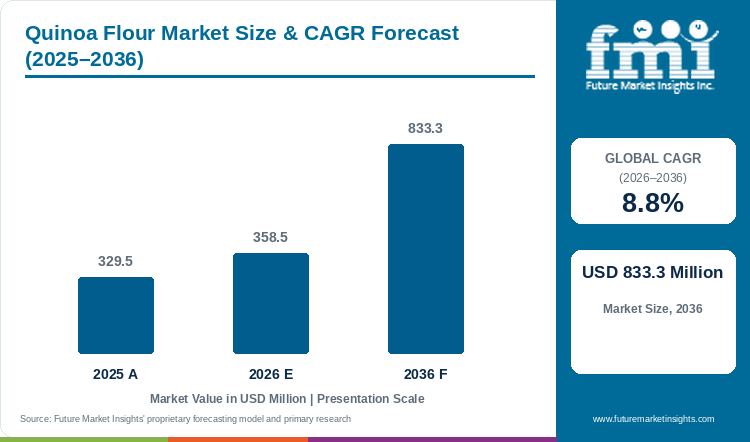
The quinoa flour market is estimated at USD 329.5 million in 2025 and is expected to reach USD 358.5 million in 2026. Sales of quinoa flour are forecast to grow at an 8.8% CAGR and reach USD 833.3 million by 2036.
From an estimated USD 329.5 million in 2025, the quinoa flour market is expected to reach USD 358.5 million in 2026, and gluten-free snack and bakery lines are likely to carry sales of quinoa flour to USD 833.3 million by 2036 at an 8.8% CAGR. Within that growth, snack and cracker makers are the first movers, with bread lines following once dough trials settle water absorption. For example, DakotaMB noted in April 2026 that amaranth and quinoa suit multigrain crackers, clusters and inclusions.[1] Such crisp formats need no gluten network, so early volume enters through crackers and bars.
Competition is sharpening on two fronts. On the blend side, Bob's Red Mill reformulated the Gluten Free 1-to-1 Baking Flour, a rice and sorghum based blend sold through Costco, Kroger and Whole Foods, in August 2026.[2] A better-tasting blend at mass retail sets a shelf price that single-grain flours find hard to match. On the ancient grain side, DakotaMB pitches quinoa beside teff, buckwheat and sorghum for whole grain positioning, giving snack brands several ancient grains to choose from.[1] As a result, single-grain quinoa millers selling into home baking face the hardest squeeze.
Food manufacturers carry the growth, with direct contracts expected to hold 50% of channel sales in 2026, and FMI expects standard milled flour to hold 39% of product type sales. Over the forecast period, millers pairing heat-treated or sprouted grades with gluten-free testing will keep those contracts, unlocking a second tier of protein-dense bakery lines.
Key Market Trends & Insights
- Cost per kilogram decides most first orders, and standard milled flour is predicted to hold 39% in 2026, with fine milled grades near 25% and heat-treated flour about 21%.
- Conventional quinoa flour is likely to hold 56% of nature sales in 2026. By comparison, organic flour, about 44%, draws on Bolivian highland crops, and Bolivia exported 32,647 tons of quinoa in 2025, up 10%.[3] Rising Bolivian shipments widen the certified grain pool, which keeps organic flour within reach of natural food brands.
- In application, bakery products are estimated to take 32% of application sales in 2026, led by bread, rolls and gluten-free loaves, with snacks and crackers at about 16%.
- Within sales channel, direct supply to food manufacturers is projected at 50% in 2026 and ingredient distributors near 17%. Food plants on direct contracts want more than one grain origin. Supply is broad as well, and Peru exported 54.7 thousand tonnes of quinoa to more than 50 markets in 2025.[4] A supply base of that reach lets millers offer multi-origin contracts, which supports the direct channel.
Regional Highlights
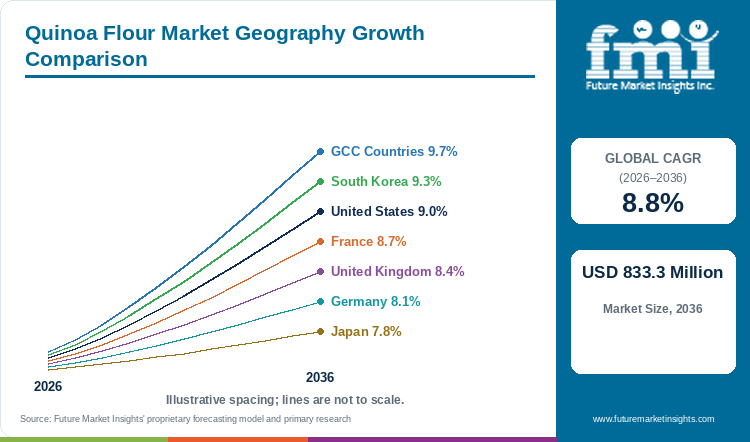
- Quinoa flour sales in GCC Countries are set for the quickest rise, 9.7% a year on FMI's forecast against the 8.8% market rate, as hotel bakeries and importers add gluten-free lines.
- South Korea (9.3%) and the United States (9%) are forecast to grow faster than the global pace, helped by bakery cafés and snack plants. Below that line, France reaches 8.7%, the United Kingdom 8.4% and Germany 8.1%, and Japan is likely to grow slowest at 7.8%.
- In Japan, quinoa flour competes with a state-backed alternative. Japanese rice flour demand reached 56,000 tonnes in fiscal 2024, and the government targets 130,000 tonnes by fiscal 2030, MAFF reported in February 2026.[5] A target of that size keeps rice flour cheap and widely stocked, which confines quinoa flour to a health food niche.
Market Size & Forecast
Table 1: Market Size and Forecast for the Quinoa Flour Market (USD million and percentage), 2025 to 2036
| Metric | Value |
|---|---|
| 2025 Market Size | USD 329.5 million |
| Estimated Market Size in 2026 | USD 358.5 million |
| Projected Market Size by 2036 | USD 833.3 million |
| CAGR, 2026 to 2036 | 8.8% |
| Added Revenue, 2026 to 2036 | USD 474.8 million |
| Market Expansion Multiple | 2.3x |
Andean grain exports are expanding, which gives quinoa flour mills more lots to choose from and steadier grain costs. Peru exported 54.7 thousand tonnes of quinoa valued at more than USD 152 million in 2025, up over 13%, El Peruano reported.[4] Higher Peruvian volume at a firm price shows importers absorbing more grain, which supports flour throughput in buyer countries. Likewise, Bolivia earned USD 93.5 million from quinoa exports in 2025, 11% more than in 2024, IBCE data show.[3] A second origin growing at a similar pace lowers the risk that one poor national crop leaves mills short. Alongside this, growth in the gluten free flours market is projected at 3.6% a year, below single-grain quinoa flour, which points millers with wider free-from ranges toward quinoa for new capacity. By 2036, FMI analysis indicates the quinoa flour market will be close to 2.3 times the 2026 size, with about USD 474.8 million in added sales. Grain flows in 2026 are supporting that path. Peruvian quinoa exports rose 21% in value to USD 94.1 million from January to July 2026, Agraria.pe reported, so grain is flowing freely for now.[6] Even so, a poor Andean crop or a freight spike remains the main cost risk for flour buyers.
Andean Grain Supply, Snack Innovation and Gluten-Free Baking
Andean supply is growing. For instance, quinoa made up about 80% of the 153,400 tonnes of Andean grains Peru produced in 2025, and the United States, Canada, Italy, the United Kingdom, Spain, the Netherlands and Germany were the main buyers, El Peruano reported on 30 June 2026.[4] With most of that grain going to North America and Europe, flour mills in those regions hold the best access to new lots. At the same time, Bolivia shipped 32,647 tons in 2025, against 29,807 tons in 2024.[3] Consequently, two origins with rising exports give flour millers a wider choice of grain lots and organic certificates.
New snack and bakery products are pulling ancient grains into recipes. One supplier, Healthy Food Ingredients, said the company offers flax, buckwheat, amaranth, quinoa, chia, sorghum and millet, Snack Food & Wholesale Bakery reported in May 2026.[7] A supplier bundling seven grains lets bakers trial quinoa without approving a new vendor. In a similar vein, DakotaMB pointed to quinoa, amaranth and lentils for texture in bars and clusters.[1] In turn, each new cracker or bar that lists quinoa near the top of the ingredient panel adds a steady flour contract.
Table 2: Grain Supply, Product and Competitor Indicators for the Quinoa Flour Market (volume, value and launches), 2025 to 2026
| Indicator | Data Point | Relevance | Source |
|---|---|---|---|
| Peru quinoa exports, 2025 | 54.7 thousand tonnes; above USD 152 million; up over 13% | Grain supply for flour mills | [4] |
| Bolivia quinoa exports, 2025 | 32,647 tons; USD 93.5 million; up 11% in value | Organic grain supply | [3] |
| Japan rice flour demand, FY2024 | 56,000 tonnes; 130,000 tonne target by FY2030 | Competing gluten-free flour in Japan | [5] |
| Bob's Red Mill Gluten Free 1-to-1 flour, August 2026 | Reformulated rice and sorghum blend at US mass retail | Shelf price benchmark for gluten-free flour | [2] |
| Healthy Food Ingredients ancient grain range, 2026 | Quinoa among seven ancient grains offered | Ingredient supply for bakery and snacks | [7] |
| DakotaMB ancient grains guidance, April 2026 | Quinoa for crackers, clusters and bars | Snack formulation demand | [1] |
Analyst Perspective
“The quinoa flour buyers I would watch are snack and pasta brands, since a gluten-free cracker or noodle needs a flour that adds protein and bite without gums. Millers who heat-treat or sprout the grain to take out bitterness and lower microbial counts will hold those contracts for several years. Plain milled flour sold into home baking will grow slower, as rice-based blends keep the price low.”
- Nandini Roy Choudhury, Principal Consultant, Future Market Insights.
How is the quinoa flour market segmented?
The market is segmented into product type, nature, application, sales channel, and region. Standard milled flour is expected to lead product type with 39% share in 2026, and direct supply to food manufacturers leads sales channel with 50%.
By product type: standard milled, fine milled, heat treated, and sprouted.
By nature: conventional and organic.
By application: bakery products, snacks and crackers, baking mixes and batters, pasta and noodles, breakfast cereals, and infant food.
By sales channel: direct to food manufacturers, ingredient distributors, retail stores, online retail, and foodservice.
By region: mills, food plants, bakeries and households in North America, Latin America, Western Europe, Eastern Europe, East Asia, South Asia and Pacific, and Middle East and Africa.
Why does standard milled quinoa flour lead sales by product type?
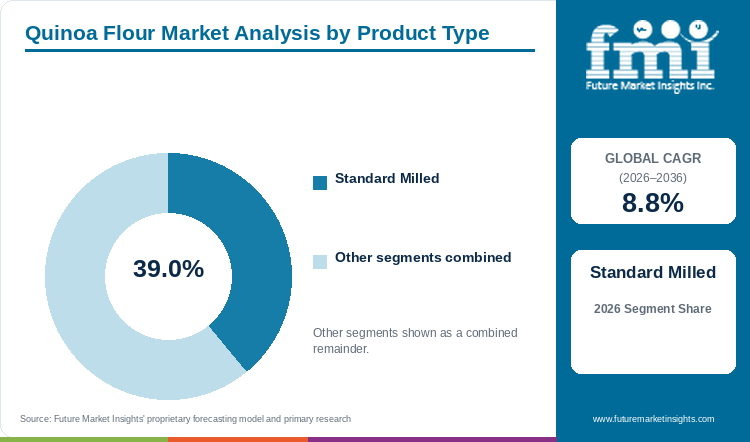
Standard milled flour is expected to lead product type sales with 39% share in 2026, ahead of fine milled grades at about 25% and heat-treated flour at an estimated 21%.
Table 3: Product Type Share for the Quinoa Flour Market (percentage share), 2026
| Product Type | Estimated Share (2026) |
|---|---|
| Standard Milled | 39% |
| Fine Milled | 25% |
| Heat Treated | 21% |
| Sprouted | 15% |
| Total | 100.0% |
Table 4: Product Type Leadership and Market Growth for the Quinoa Flour Market (segment and CAGR percentage), 2026 to 2036
| Metric | Value |
|---|---|
| Global CAGR (2026 to 2036) | 8.8% |
| Leading Segment | Standard Milled |
Standard milled quinoa flour is predicted to stay first, at 39% of 2026 sales, as a single pass through a stone or roller mill gives the lowest cost per kilogram. Fine milled grades are expected to hold about 25%, with cake and fresh pasta makers paying extra per tonne for the added sifting. Heat-treated flour, an estimated 21%, is toasted or steamed to cut bitterness and microbial load, which adds a processing step and a price premium. Further along the cost curve, sprouted flour, near 15%, needs germination and drying lines that few mills run. Protein-focused buyers also follow the high protein flour market, forecast at an 11.4% CAGR, as quinoa competes with pulse flours on protein per serving. Plain grades gain most from cheaper grain. On the supply side, Bolivia exported 32,647 tons of quinoa grain in 2025.[3] More grain at origin lowers the input cost of standard milled flour first, as the grade carries no extra processing. In practice, most buyers start with standard milled flour and move to treated grades only when a recipe fails on taste or shelf life.
- Whole grain flour for bread blends, crackers and bars forms most standard milled volume.
- Grain travels widely before milling, so standard flour can be ground close to the buyer. Peruvian quinoa reached more than 50 export markets in 2025.[4] Mills in Europe and North America can therefore grind locally from imported grain, which keeps standard flour prices low.
Why does conventional quinoa flour lead sales by nature?
Conventional quinoa flour is likely to lead nature sales with 56% share in 2026, and organic quinoa flour holds an estimated 44%.
Table 5: Nature Share for the Quinoa Flour Market (percentage share), 2026
| Nature | Estimated Share (2026) |
|---|---|
| Conventional | 56% |
| Organic | 44% |
| Total | 100.0% |
Conventional quinoa flour will hold the larger part, 56%, in 2026, as plants that print no organic claim buy the cheaper lot. Even so, organic flour holds a large 44%, as Bolivian highland growers supply certified grain to European and US natural food brands. Bolivian exports rose 11% in value in 2025, against a 10% rise in volume.[3] Value rising slightly faster than volume points to firm prices for certified grain, which keeps the organic premium in place. However, a certified chain from farm to mill adds audit cost, and buyers pay that premium only for retail packs with an organic seal.
- Conventional flour goes mainly into private label crackers, bread blends and food service mixes.
- Organic flour draws mainly on Bolivian highland grain. Bolivian quinoa exports were valued at USD 93.5 million in 2025.[3] Growth in that trade gives organic millers a deeper pool of certified lots for European and US brands.
Why do bakery products lead sales by application?
Bakery products are expected to lead application sales with 32% share in 2026, ahead of snacks and crackers at about 16% and baking mixes and batters at an estimated 14%.
Table 6: Application Share for the Quinoa Flour Market (percentage share), 2026
| Application | Estimated Share (2026) |
|---|---|
| Bakery Products | 32% |
| Snacks and Crackers | 16% |
| Baking Mixes and Batters | 14% |
| Pasta and Noodles | 14% |
| Breakfast Cereals | 12% |
| Infant Food | 12% |
| Total | 100.0% |
Bakery products are likely to remain the top use at 32% in 2026, as gluten-free bread, rolls and muffins use quinoa flour at 10% to 30% of the flour blend for protein and colour. Snacks and crackers, about 16%, accept higher inclusion rates since crisp textures need no gluten network. Mixes and batters account for 14%, and pasta and noodle makers hold another 14%, adding quinoa to rice and corn dough for protein. Then, at 12% each, breakfast cereals and infant food follow, and infant brands insist on heat-treated, low-microbial flour. Shopper preference is moving the same way. Snack Food & Wholesale Bakery reported in May 2026 that shoppers are now more likely to buy baked goods made with quinoa, farro and amaranth.[7] Wider shopper acceptance lets bakeries raise quinoa inclusion without losing sales, which adds flour volume per loaf. Above all, bakeries buy the most flour per product, which keeps bakery products ahead of every other use.
- Gluten-free loaves, multigrain rolls, muffins and flatbreads make up most bakery use.
- Snack makers use quinoa flour for flavour as much as nutrition. Multigrain crackers and clusters gain colour and a nutty note from quinoa and amaranth, DakotaMB wrote in April 2026.[1] Flavour gains of that kind support higher inclusion rates in crackers than in bread.
Why does direct supply to food manufacturers lead sales by sales channel?
Direct supply to food manufacturers is projected to lead sales channel with 50% share in 2026, ahead of ingredient distributors at about 17% and retail stores at an estimated 15%.
Table 7: Sales Channel Share for the Quinoa Flour Market (percentage share), 2026
| Sales Channel | Estimated Share (2026) |
|---|---|
| Direct to Food Manufacturers | 50% |
| Ingredient Distributors | 17% |
| Retail Stores | 15% |
| Online Retail | 9% |
| Foodservice | 9% |
| Total | 100.0% |
Direct supply to food manufacturers is forecast to carry 50% of 2026 channel volume, as snack, bakery and pasta plants buy quinoa flour in tote bags under annual specifications for moisture, particle size and gluten testing. By comparison, regional bakeries and importers in Europe, Asia and the Gulf buy through ingredient distributors, which hold about 17%. Meanwhile, shoppers buy one-kilogram bags in supermarkets and natural food stores, and retail stores are expected to hold 15%. Online retail, at 9%, sells through brand web stores and marketplaces, and foodservice matches that 9% through bakery and café kitchens. Retail shelves, however, are led by blends. The Gluten Free 1-to-1 flour from Bob's Red Mill sells through Costco, Kroger, Publix and Wegmans, which shows the scale of the retail rival.[2] Single-grain quinoa flour on those shelves therefore competes on protein and origin claims more than on price. Overall, direct contracts stay ahead since one snack line can use more flour in a month than a store sells over twelve months.
- Snack brands, gluten-free bakeries, pasta makers and infant food plants make up most direct volume.
- Ingredient suppliers are bundling grains to secure direct accounts. An ancient grain range from Healthy Food Ingredients puts quinoa beside flax, chia and millet for bakery buyers.[7] One supplier for several grains shortens approval for food plants, which favours multi-grain vendors in direct contracts.
What are the drivers, restraints, and opportunities in the quinoa flour market?
Gluten-free and high-protein product launches keep pulling quinoa flour into recipes. Bitter taste, dense crumb and price against rice blends slow adoption, and treated grades for snacks, pasta and infant food open the next contracts.
- Driver: Snack and bakery brands that drop wheat want a flour that adds protein and whole grain claims, and quinoa gives both on one ingredient line.
- Restraint: Quinoa flour is priced above rice and corn flour, carries a bitter note from saponin residue and gives a dense crumb, so many bakers cap inclusion at low levels.
- Opportunity: Heat-treated and sprouted grades with low bitterness and low microbial counts suit infant food, pasta and ready-to-eat snacks that plain flour cannot serve.
Gluten-Free and Protein Claims Pull Quinoa into Recipes
Consumer preference for whole grain, gluten-free snacks keeps quinoa flour on product development lists. Snack Food & Wholesale Bakery reported in May 2026 that shoppers are now more likely to buy baked goods and snacks containing quinoa, farro and amaranth.[7] Better shopper acceptance lowers the sales risk of a quinoa launch for brand owners. Along the same lines, DakotaMB advised brands in April 2026 to use quinoa and buckwheat for whole grain positioning.[1] As a result, each new launch turns into a recurring flour order once the line runs at full speed.
Price and Taste Gaps Slow Adoption
Producers of quinoa flour compete against cheap gluten-free blends. For instance, in August 2026 the Gluten Free 1-to-1 Baking Flour, a rice, sorghum and starch blend, was reformulated by Bob's Red Mill for better taste and texture.[2] A better-tasting blend at mass retail narrows the taste gap that once justified a higher price for quinoa. In Asia, Japan expects rice flour demand to grow toward 130,000 tonnes by fiscal 2030.[5] Such rice-based blends set a low price per kilogram, so bakers add quinoa only when the label or protein claim pays for the cost.
Treated Grades Open Snack, Pasta and Infant Food Contracts
Adoption of heat-treated and sprouted quinoa flour is set by buyers with strict taste and safety specifications. Peru and Bolivia both raised quinoa exports in 2025, giving millers more grain lots to select from.[4][3] More lots to choose from let millers pick low-saponin grain for treated grades. Alongside grain supply, the quinoa protein hydrolysate market is predicted to grow at a 9.9% CAGR, and the same nutrition brands buy treated flour for bars and infant cereals. Therefore, mills with toasting or sprouting lines will gain those accounts first.
Which country CAGRs are profiled in the quinoa flour market?
Table 8: Country CAGR Comparison for the Quinoa Flour Market (CAGR percentage), 2026 to 2036
| Country | CAGR (2026 to 2036) |
|---|---|
| GCC Countries | 9.7% |
| South Korea | 9.3% |
| United States | 9% |
| France | 8.7% |
| United Kingdom | 8.4% |
| Germany | 8.1% |
| Japan | 7.8% |
How do country-level CAGRs compare in the quinoa flour market?
On FMI's forecast, demand for quinoa flour in GCC Countries is set to rise fastest, at 9.7%, as Gulf hotel bakeries and supermarket chains import every kilogram of flour used. Next, South Korea follows at 9.3%, with bakery cafés adding gluten-free and high-protein loaves. The United States, at 9%, is the largest buyer of Peruvian quinoa and has the deepest snack and bakery base. Further down, French organic bakeries hold demand a shade under the 8.8% global rate, at 8.7%, and the United Kingdom (8.4%) and Germany (8.1%) come next. Finally, Japan has the slowest rate, 7.8%, as domestic rice flour serves most gluten-free baking.
- Gulf supermarkets are extending gluten-free shelves beyond hotel bakeries, which pulls in imported flour in small retail packs; exporters with Arabic labels and Gulf registration move first.
- Korean bakery cafés use quinoa to add protein to rice and multigrain loaves, so orders favour fine milled grades in bulk bags, and importers holding both Peruvian and Bolivian stock can serve chain menus all year.
- As the largest buyer of Peruvian grain, the United States mills most quinoa flour at home for snack and cracker plants, which hands the biggest contracts to domestic mills with gluten-free lines.
- French organic bakeries and free-from aisles pay for certified flour. Loire valley quinoa also gives local mills a short supply chain, an edge for certified millers.
- In the United Kingdom, supermarket free-from ranges take most quinoa crackers and breads, so flour goes mainly to own-label bakeries, and suppliers already audited by retailers get first call on new lines.
- Rye and spelt already meet much of the German demand for wholegrain bread. That leaves quinoa flour to organic stores and gluten-free bakers, a smaller pool that rewards niche millers.
- Government targets for rice flour keep a cheap domestic option on every Japanese shelf, pushing quinoa flour sellers toward health food stores and imported snacks.
Full report country CAGRs cover: every standard country in the seven regions, with three of seven key markets above 8.8% and Japan lowest on 7.8%.
Country-wise Analysis
GCC Countries Quinoa Flour Market Outlook (2026 to 2036)
Hotel pastry kitchens, gluten-free cafés and supermarket bakeries in the United Arab Emirates and Saudi Arabia import quinoa flour through regional distributors. However, imported flour needs Arabic labels and Gulf food registration before listing. FMI projects demand for quinoa flour in GCC Countries at a 9.7% CAGR, ahead of the global rate, as gluten-free menus spread from hotels to retail.
Key takeaway: Gluten-free ranges moving from hotels into Gulf supermarkets set the pace for quinoa flour.
South Korea Quinoa Flour Market Outlook (2026 to 2036)
Korean bakery cafés sell rice and multigrain breads, and quinoa flour adds protein to those loaves without wheat. For those loaves, ingredient importers bring in Peruvian and Bolivian flour, as Korea grows little quinoa. On that basis, demand for quinoa flour in South Korea is forecast by FMI to expand at 9.3%, as café menus keep adding protein loaves.
Key takeaway: Protein loaves on Korean café menus keep quinoa flour orders rising.
United States Quinoa Flour Market Outlook (2026 to 2036)
The United States is the largest destination for Peruvian quinoa, which anchors domestic flour milling. The United States received 41% of Peruvian quinoa shipments, valued at USD 21 million, from January to April 2026, Agraria.pe reported.[8] A buyer share that large gives US mills first pick of Peruvian lots. On the formulation side, DakotaMB, a specialty grain miller, recommends quinoa for crackers, clusters and bars.[1] Recommendations of that kind turn into cracker and bar trials at US snack brands. At the same time, Bob's Red Mill sells a reformulated gluten-free flour at national retail, which keeps price pressure on single-grain flours.[2] On balance, US quinoa flour sales are set to rise 9% a year on FMI's forecast.
Key takeaway: Cracker and bar lines turn Peruvian grain imports into steady flour orders.
France Quinoa Flour Market Outlook (2026 to 2036)
French mills rely on imported grain, with Peru among the main suppliers. Peru shipped USD 2.27 million of quinoa to France from January to April 2026, Agraria.pe reported.[8] French organic bakeries and free-from aisles turn that grain into quinoa breads, crêpe mixes and biscuits. In addition, organic stores buy certified Andean flour, and domestic quinoa from the Loire valley supplies some mills. As a result, French quinoa flour sales are expected to rise about 8.7% a year, just under the global pace.
Key takeaway: Organic shoppers and Loire quinoa give France a home-grown supply story.
United Kingdom Quinoa Flour Market Outlook (2026 to 2036)
Andean grain imports supply most British quinoa flour. The United Kingdom ranks among the main buyers of Peruvian quinoa, El Peruano reported.[4] Steady grain arrivals give British millers and importers a reliable supply for flour. Peruvian shipments to the United Kingdom reached USD 2.21 million in January to April 2026.[8] On the shelf, British free-from ranges in supermarkets carry quinoa crackers, breads and baking flour, which turns those grain shipments into retail sales. The United Kingdom is projected to grow at an 8.4% CAGR, held up by these free-from shelves.
Key takeaway: Most British quinoa flour ends up on free-from shelves.
Germany Quinoa Flour Market Outlook (2026 to 2036)
German demand for quinoa flour builds on steady grain imports. Germany is among the main destinations for Peruvian quinoa grain, El Peruano reported on 30 June 2026.[4] German organic stores and gluten-free bakers buy quinoa flour, but rye and spelt breads leave a smaller gap to fill. Germany is therefore expected to grow at an 8.1% CAGR, below the global rate.
Key takeaway: Organic shops give quinoa flour a steady but limited outlet in Germany.
Japan Quinoa Flour Market Outlook (2026 to 2036)
In Japan, quinoa flour faces a domestic rival backed by policy. Rice flour demand in Japan reached 56,000 tonnes in fiscal 2024, and the government aims for 130,000 tonnes by fiscal 2030, MAFF reported on 25 February 2026.[5] Domestic rice flour serves most gluten-free bread and confectionery, leaving quinoa flour a niche in health food and imported snacks. Consequently, Japanese quinoa flour sales are set for 7.8% annual growth, the lowest of the seven, with rice flour taking most gluten-free orders.
Key takeaway: Government rice flour targets crowd quinoa flour out of Japanese bakeries.
Who are the notable companies in the quinoa flour market?
Ardent Mills, ADM, Bay State Milling, Ingredion, Healthy Food Ingredients, Bob's Red Mill and Scoular are the profiled companies.
The quinoa flour supplier base combines North American millers, ingredient groups, branded flour sellers and grain merchants. Healthy Food Ingredients lists quinoa within an ancient grain portfolio for bakery and snack makers.[7] A broad grain list lets that supplier bundle quinoa into multi-grain bakery contracts. Among branded sellers, Bob's Red Mill reformulated the Gluten Free 1-to-1 Baking Flour in August 2026.[2] Reformulation keeps the brand's blend competitive on taste, which raises the bar for single-grain flours. The same brand also sells an organic quinoa flour in retail bags. FMI analysis places Ardent Mills, ADM, Bay State Milling, Ingredion and Scoular in the industrial supply tier.
- Flour millers and ingredient groups: Ardent Mills, ADM, Bay State Milling, Ingredion and Healthy Food Ingredients.
- Branded flour sellers and grain merchants: Bob's Red Mill and Scoular.
Competitive Benchmarking: Quinoa Flour Market
Table 9: Competitive Benchmarking for the Quinoa Flour Market (qualitative ratings), 2026
| Company | Quinoa Flour Range | Gluten-Free Controls | Bakery Application Support | Recent Activity |
|---|---|---|---|---|
| Ardent Mills | High | High | High | Medium |
| Bay State Milling | High | High | High | Medium |
| Bob's Red Mill | High | High | Medium | High |
| Ingredion | Medium | Medium | High | Medium |
| Healthy Food Ingredients | Medium | Medium | Medium | High |
Ratings compare the companies on quinoa flour range, gluten-free controls and bakery application support.
Key Developments in the Quinoa Flour Market
- A reformulated Gluten Free 1-to-1 Baking Flour from Bob's Red Mill, reported on 24 August 2026, raises the taste bar for single-grain flours on retail shelves.[2]
- Peruvian quinoa exports rose 21% in value to USD 94.1 million for January to July 2026, an Agraria.pe update of 13 August 2026 showed, so mills can count on ample grain at firm prices.[6]
- Peru's 2025 quinoa exports reached 54.7 thousand tonnes valued at more than USD 152 million, figures released on 30 June 2026 showed, confirming the country as the main grain source for flour mills.[4]
- The United States received 41% of Peruvian quinoa shipments in January to April 2026, as tallied on 3 June 2026, which keeps US mills first in line for Andean lots.[8]
- Healthy Food Ingredients described an ancient grain range that includes quinoa on 18 May 2026, a sign that ingredient suppliers are bundling grains for bakery accounts.[7]
- On 3 April 2026, DakotaMB recommended quinoa, teff and buckwheat for whole grain snacks, pointing snack brands toward multi-grain formulas.[1]
- MAFF's update of 25 February 2026 put Japanese rice flour demand at 56,000 tonnes for fiscal 2024, which shows how much gluten-free baking in Japan already runs on rice.[5]
- On 5 February 2026, IBCE reported Bolivian quinoa exports of USD 93.5 million for 2025, adding depth to the certified organic grain supply.[3]
Key Players in the Quinoa Flour Market
Flour Millers and Ingredient Groups
- Ardent Mills
- ADM
- Bay State Milling
- Ingredion
- Healthy Food Ingredients
Branded Flour Sellers and Grain Merchants
- Bob's Red Mill
- Scoular
Quinoa Flour Market - Report Scope
Table 10: Report Scope for the Quinoa Flour Market (coverage fields and definitions), 2026 to 2036
| Coverage field | Report scope |
|---|---|
| Market breakdown | Product type; nature; application; sales channel; region |
| Quantitative units | USD million |
| Market definition | Flour milled from whole or dehulled quinoa seed, including standard, fine, heat-treated and sprouted grades, sold to food manufacturers, foodservice and households. Whole quinoa grain, quinoa flakes, protein isolates and multi-grain blends are excluded, except the quinoa flour sold into those blends. |
| Regions covered | North America; Latin America; Western Europe; Eastern Europe; East Asia; South Asia and Pacific; Middle East and Africa |
| Countries covered | United States; Canada; Brazil; Mexico; Argentina; Chile; Germany; France; United Kingdom; Italy; Spain; Benelux; Nordics; Poland; Czech Republic; Romania; Hungary; China; Japan; South Korea; India; ASEAN; Australia and New Zealand; GCC Countries; South Africa; Türkiye; Israel |
| Key companies profiled | Ardent Mills, ADM, Bay State Milling, Ingredion, Healthy Food Ingredients, Bob's Red Mill, Scoular |
| Forecast period | 2026 to 2036 |
Quinoa Flour Market - Research Methodology
Table 11: Research Methodology for the Quinoa Flour Market (research methods and approach), 2026 edition
| Method | Approach |
|---|---|
| Data Sources | Company results, industry associations, government statistics and trade publications. |
| Desk Research | Desk research covers grain supply, milling grades, gluten-free baking, snack launches and competing rice flour. |
| Market Sizing and Forecasting | Sizing starts from the 2026 base of USD 358.5 million and the 8.8% CAGR for 2026 to 2036. |
| Data Validation | Figures are cross-checked across company, industry and government sources. |
Quinoa Flour Market by Segments
Quinoa Flour Market segmented by Product Type:
- Standard Milled
- Fine Milled
- Heat Treated
- Sprouted
Quinoa Flour Market segmented by Nature:
- Conventional
- Organic
Quinoa Flour Market segmented by Application:
- Bakery Products
- Snacks and Crackers
- Baking Mixes and Batters
- Pasta and Noodles
- Breakfast Cereals
- Infant Food
Quinoa Flour Market segmented by Sales Channel:
- Direct to Food Manufacturers
- Ingredient Distributors
- Retail Stores
- Online Retail
- Foodservice
Quinoa Flour Market by Region
- North America
- United States
- Canada
- Latin America
- Brazil
- Mexico
- Argentina
- Chile
- Western Europe
- Germany
- France
- United Kingdom
- Italy
- Spain
- Benelux
- Nordics
- Eastern Europe
- Poland
- Czech Republic
- Romania
- Hungary
- East Asia
- China
- Japan
- South Korea
- South Asia and Pacific
- India
- ASEAN
- Australia and New Zealand
- Middle East and Africa
- GCC Countries
- South Africa
- Türkiye
- Israel
Research Sources and Bibliography
- [1] Snack Food & Wholesale Bakery. (2026, April 3). Ancient grains fueling BFY innovation: DakotaMB. https://www.snackandbakery.com/articles/115528-ancient-grains-fueling-bfy-innovation-dakotamb
- [2] Baking Business. (2026, August 24). Bob's Red Mill reformulates signature gluten-free flour. https://www.bakingbusiness.com/articles/66781-bobs-red-mill-reformulates-signature-gluten-free-flour
- [3] Instituto Boliviano de Comercio Exterior. (2026, February 5). Bolivia: Exportaciones en 2025 (Cifras No. 1.392). https://www.ibce.org.bo//images/ibcecifras_documentos/Cifras_1.392_Exportaciones_en_2025_1770301479.pdf
- [4] El Peruano. (2026, June 30). Día Nacional de Granos Andinos: Perú lidera la producción y exportación mundial de quinua. https://elperuano.pe/noticia/299122-dia-nacional-de-granos-andinos-peru-lidera-la-produccion-y-exportacion-mundial-de-quinua
- [5] Ministry of Agriculture, Forestry and Fisheries of Japan. (2026, February 25). 米粉をめぐる状況について (Situation regarding rice flour). https://www.maff.go.jp/hokuriku/seisan/komeko/attach/pdf/salon_2026-3.pdf
- [6] Agraria.pe. (2026, August 13). Exportaciones de quinua peruana crecen 21% en valor hasta julio de 2026. https://agraria.pe/noticias/exportaciones-de-quinua-peruana-crecen-21-en-valor-hasta-jul-42863
- [7] Snack Food & Wholesale Bakery. (2026, May 18). Grain ingredients bring taste, health to baked goods and snacks. https://www.snackandbakery.com/articles/115752-grain-ingredients-bring-taste-health-to-baked-goods-and-snacks
- [8] Agraria.pe. (2026, June 3). Estados Unidos concentra el 41% de los despachos de quinua peruana. https://agraria.pe/noticias/estados-unidos-concentra-el-41-de-los-despachos-de-quinua-pe-42402
This bibliography is provided for reader reference. The full report contains the complete reference list and detailed citations.
This Report Answers
- How big is the quinoa flour market during 2026?
- What market size is projected by 2036?
- Which product type holds notable share?
- Which nature holds notable share?
- Which countries have notable growth?
- Which companies are notable in the market?
Frequently Asked Questions
How large is the quinoa flour market expected in 2026?
In 2026, the quinoa flour market is expected to reach USD 358.5 million, up from USD 329.5 million in 2025. FMI projects sales of quinoa flour at USD 833.3 million by 2036.
What CAGR is projected for the quinoa flour market through 2036?
Demand for quinoa flour is projected to grow at an 8.8% CAGR through 2036. Gluten-free snacks, bakery products and pasta that need protein without wheat carry that growth.
Which product type holds a notable market share in 2026?
Standard milled flour is expected to lead with 39% share in 2026. Fine milled grades follow at an estimated 25%.
Which nature holds a notable market share in 2026?
Conventional quinoa flour is likely to lead with 56% share in 2026. Organic flour holds an estimated 44%.
Which country has a notable expansion outlook through 2036?
FMI projects the fastest growth for GCC Countries, at a 9.7% CAGR. South Korea follows at 9.3%.
Who are the key companies in the quinoa flour market?
Ardent Mills, ADM, Bay State Milling, Ingredion and Healthy Food Ingredients lead the millers and ingredient groups. Bob's Red Mill and Scoular make up the branded seller and grain merchant group.
Preview the report firsthand - request a free sample
Get SampleGet the brochure for pricing and purchase details.
Get PDFTable of Content
- Key Takeaways
- Market Size and CAGR
- Top Growth Driver
- Fastest Growing Segment
- Leading Region
- Key Companies
- Emerging Opportunities
- Executive Summary
- Global Market Outlook
- Demand-side Trends
- Supply-side Trends
- Technology Roadmap Analysis
- Analysis and Recommendations
- Analyst Perspective (What is happening? Why now? What should investors know?)
- Key Questions Answered
- How large is the market?
- What is the CAGR?
- What are key trends?
- Which region dominates?
- Who are the leaders?
- Market Overview
- Market Coverage / Taxonomy
- Market Definition / Scope / Limitations
- Research Methodology
- Chapter Orientation
- Analytical Lens and Working Hypotheses
- Market Structure, Signals, and Trend Drivers
- Benchmarking and Cross-market Comparability
- Market Sizing, Forecasting, and Opportunity Mapping
- Research Design and Evidence Framework
- Desk Research Programme (Secondary Evidence)
- Expert Input and Fieldwork (Primary Evidence)
- Tooling, Models, and Reference Databases
- Data Engineering and Model Build
- Quality Assurance and Audit Trail
- Market Background
- Market Dynamics (Drivers, Restraints, Opportunity, Trends)
- Scenario Forecast (Optimistic, Likely, Conservative)
- Impact Analysis
- AI Impact
- Sustainability Impact
- Regulatory Impact
- Technology Impact
- Consumer / Buyer Analysis
- Purchase Drivers
- Adoption Barriers
- Buyer Journey
- Opportunity Map Analysis
- Product Life Cycle Analysis
- Supply Chain Analysis
- Investment Feasibility Matrix
- Value Chain Analysis
- PESTLE and Porter's Analysis
- Regulatory Landscape
- Regional Parent Market Outlook
- Production and Consumption Statistics
- Import and Export Statistics
- Global Market Analysis and Forecast, 2021 to 2036
- Historical Market Size Value (USD Million) Analysis, 2021 to 2025
- Current and Future Market Size Value (USD Million) Projections, 2026 to 2036
- Y-o-Y Growth Trend Analysis
- Absolute $ Opportunity Analysis
- Global Market Pricing Analysis, 2021 to 2036
- Global Market Analysis and Forecast, By Product Type, 2021 to 2036
- Introduction / Key Findings
- Historical Market Size Value (USD Million) Analysis By Product Type, 2021 to 2025
- Current and Future Market Size Value (USD Million) Analysis and Forecast By Product Type, 2026 to 2036
- Standard Milled
- Fine Milled
- Heat Treated
- Sprouted
- Y-o-Y Growth Trend Analysis By Product Type, 2021 to 2025
- Absolute $ Opportunity Analysis By Product Type, 2026 to 2036
- Global Market Analysis and Forecast, By Nature, 2021 to 2036
- Introduction / Key Findings
- Historical Market Size Value (USD Million) Analysis By Nature, 2021 to 2025
- Current and Future Market Size Value (USD Million) Analysis and Forecast By Nature, 2026 to 2036
- Conventional
- Organic
- Y-o-Y Growth Trend Analysis By Nature, 2021 to 2025
- Absolute $ Opportunity Analysis By Nature, 2026 to 2036
- Global Market Analysis and Forecast, By Application, 2021 to 2036
- Introduction / Key Findings
- Historical Market Size Value (USD Million) Analysis By Application, 2021 to 2025
- Current and Future Market Size Value (USD Million) Analysis and Forecast By Application, 2026 to 2036
- Bakery Products
- Snacks and Crackers
- Baking Mixes and Batters
- Pasta and Noodles
- Breakfast Cereals
- Infant Food
- Y-o-Y Growth Trend Analysis By Application, 2021 to 2025
- Absolute $ Opportunity Analysis By Application, 2026 to 2036
- Global Market Analysis and Forecast, By Sales Channel, 2021 to 2036
- Introduction / Key Findings
- Historical Market Size Value (USD Million) Analysis By Sales Channel, 2021 to 2025
- Current and Future Market Size Value (USD Million) Analysis and Forecast By Sales Channel, 2026 to 2036
- Direct to Food Manufacturers
- Ingredient Distributors
- Retail Stores
- Online Retail
- Foodservice
- Y-o-Y Growth Trend Analysis By Sales Channel, 2021 to 2025
- Absolute $ Opportunity Analysis By Sales Channel, 2026 to 2036
- Global Market Analysis and Forecast, By Region, 2021 to 2036
- Introduction
- Historical Market Size Value (USD Million) Analysis By Region, 2021 to 2025
- Current Market Size Value (USD Million) Analysis and Forecast By Region, 2026 to 2036
- North America
- Latin America
- Western Europe
- Eastern Europe
- East Asia
- South Asia and Pacific
- Middle East and Africa
- Market Attractiveness Analysis By Region
- North America Market Analysis and Forecast, By Country, 2021 to 2036
- Historical Market Size Value (USD Million) Trend Analysis By Market Taxonomy, 2021 to 2025
- Market Size Value (USD Million) Forecast By Market Taxonomy, 2026 to 2036
- By Country
- United States
- Canada
- By Product Type
- By Nature
- By Application
- By Sales Channel
- By Country
- Market Attractiveness Analysis
- By Country
- By Product Type
- By Nature
- By Application
- By Sales Channel
- Key Takeaways
- Latin America Market Analysis and Forecast, By Country
- Historical Market Size Value (USD Million) Trend Analysis By Market Taxonomy, 2021 to 2025
- Market Size Value (USD Million) Forecast By Market Taxonomy, 2026 to 2036
- By Country
- Brazil
- Mexico
- Argentina
- Chile
- By Product Type
- By Nature
- By Application
- By Sales Channel
- By Country
- Market Attractiveness Analysis
- By Country
- By Product Type
- By Nature
- By Application
- By Sales Channel
- Key Takeaways
- Western Europe Market Analysis and Forecast, By Country
- Historical Market Size Value (USD Million) Trend Analysis By Market Taxonomy, 2021 to 2025
- Market Size Value (USD Million) Forecast By Market Taxonomy, 2026 to 2036
- By Country
- Germany
- France
- United Kingdom
- Italy
- Spain
- Benelux
- Nordics
- By Product Type
- By Nature
- By Application
- By Sales Channel
- By Country
- Market Attractiveness Analysis
- By Country
- By Product Type
- By Nature
- By Application
- By Sales Channel
- Key Takeaways
- Eastern Europe Market Analysis and Forecast, By Country
- Historical Market Size Value (USD Million) Trend Analysis By Market Taxonomy, 2021 to 2025
- Market Size Value (USD Million) Forecast By Market Taxonomy, 2026 to 2036
- By Country
- Poland
- Czech Republic
- Romania
- Hungary
- By Product Type
- By Nature
- By Application
- By Sales Channel
- By Country
- Market Attractiveness Analysis
- By Country
- By Product Type
- By Nature
- By Application
- By Sales Channel
- Key Takeaways
- East Asia Market Analysis and Forecast, By Country
- Historical Market Size Value (USD Million) Trend Analysis By Market Taxonomy, 2021 to 2025
- Market Size Value (USD Million) Forecast By Market Taxonomy, 2026 to 2036
- By Country
- China
- Japan
- South Korea
- By Product Type
- By Nature
- By Application
- By Sales Channel
- By Country
- Market Attractiveness Analysis
- By Country
- By Product Type
- By Nature
- By Application
- By Sales Channel
- Key Takeaways
- South Asia and Pacific Market Analysis and Forecast, By Country
- Historical Market Size Value (USD Million) Trend Analysis By Market Taxonomy, 2021 to 2025
- Market Size Value (USD Million) Forecast By Market Taxonomy, 2026 to 2036
- By Country
- India
- ASEAN
- Australia and New Zealand
- By Product Type
- By Nature
- By Application
- By Sales Channel
- By Country
- Market Attractiveness Analysis
- By Country
- By Product Type
- By Nature
- By Application
- By Sales Channel
- Key Takeaways
- Middle East and Africa Market Analysis and Forecast, By Country
- Historical Market Size Value (USD Million) Trend Analysis By Market Taxonomy, 2021 to 2025
- Market Size Value (USD Million) Forecast By Market Taxonomy, 2026 to 2036
- By Country
- GCC Countries
- South Africa
- Türkiye
- Israel
- By Product Type
- By Nature
- By Application
- By Sales Channel
- By Country
- Market Attractiveness Analysis
- By Country
- By Product Type
- By Nature
- By Application
- By Sales Channel
- Key Takeaways
- Key Countries Market Analysis
- United States
- Pricing Analysis
- Market Share Analysis, 2025
- By Product Type
- By Nature
- By Application
- By Sales Channel
- Canada
- Pricing Analysis
- Market Share Analysis, 2025
- By Product Type
- By Nature
- By Application
- By Sales Channel
- Mexico
- Pricing Analysis
- Market Share Analysis, 2025
- By Product Type
- By Nature
- By Application
- By Sales Channel
- Brazil
- Pricing Analysis
- Market Share Analysis, 2025
- By Product Type
- By Nature
- By Application
- By Sales Channel
- Chile
- Pricing Analysis
- Market Share Analysis, 2025
- By Product Type
- By Nature
- By Application
- By Sales Channel
- Germany
- Pricing Analysis
- Market Share Analysis, 2025
- By Product Type
- By Nature
- By Application
- By Sales Channel
- United Kingdom
- Pricing Analysis
- Market Share Analysis, 2025
- By Product Type
- By Nature
- By Application
- By Sales Channel
- Italy
- Pricing Analysis
- Market Share Analysis, 2025
- By Product Type
- By Nature
- By Application
- By Sales Channel
- Spain
- Pricing Analysis
- Market Share Analysis, 2025
- By Product Type
- By Nature
- By Application
- By Sales Channel
- France
- Pricing Analysis
- Market Share Analysis, 2025
- By Product Type
- By Nature
- By Application
- By Sales Channel
- India
- Pricing Analysis
- Market Share Analysis, 2025
- By Product Type
- By Nature
- By Application
- By Sales Channel
- ASEAN
- Pricing Analysis
- Market Share Analysis, 2025
- By Product Type
- By Nature
- By Application
- By Sales Channel
- Australia and New Zealand
- Pricing Analysis
- Market Share Analysis, 2025
- By Product Type
- By Nature
- By Application
- By Sales Channel
- China
- Pricing Analysis
- Market Share Analysis, 2025
- By Product Type
- By Nature
- By Application
- By Sales Channel
- Japan
- Pricing Analysis
- Market Share Analysis, 2025
- By Product Type
- By Nature
- By Application
- By Sales Channel
- South Korea
- Pricing Analysis
- Market Share Analysis, 2025
- By Product Type
- By Nature
- By Application
- By Sales Channel
- Poland
- Pricing Analysis
- Market Share Analysis, 2025
- By Product Type
- By Nature
- By Application
- By Sales Channel
- Hungary
- Pricing Analysis
- Market Share Analysis, 2025
- By Product Type
- By Nature
- By Application
- By Sales Channel
- Türkiye
- Pricing Analysis
- Market Share Analysis, 2025
- By Product Type
- By Nature
- By Application
- By Sales Channel
- South Africa
- Pricing Analysis
- Market Share Analysis, 2025
- By Product Type
- By Nature
- By Application
- By Sales Channel
- GCC Countries
- Pricing Analysis
- Market Share Analysis, 2025
- By Product Type
- By Nature
- By Application
- By Sales Channel
- United States
- Market Structure Analysis
- Competition Dashboard
- Competition Benchmarking
- Market Share Analysis of Top Players
- By Regional
- By Product Type
- By Nature
- By Application
- By Sales Channel
- Emerging Startups
- Innovation Benchmarking
- Competition Analysis
- Competition Deep Dive
- Ardent Mills
- Overview
- Product Portfolio
- Profitability by Market Segments
- Sales Footprint
- Strategy Overview
- Marketing Strategy
- Product Strategy
- Channel Strategy
- Bay State Milling
- Bob's Red Mill
- Ingredion
- Healthy Food Ingredients
- ADM
- Scoular
- Ardent Mills
- Case Studies
- Success Stories
- Recent Developments
- Competition Deep Dive
- Assumptions & Acronyms Used


