

- Industry Size (2026)
- USD 205.0 Mn
- Forecast (2036)
- USD 530.0 Mn
- CAGR (2026 to 2036)
- 9.9%
Quinoa Protein Hydrolysate Market Size, Market Forecast and Outlook By FMI
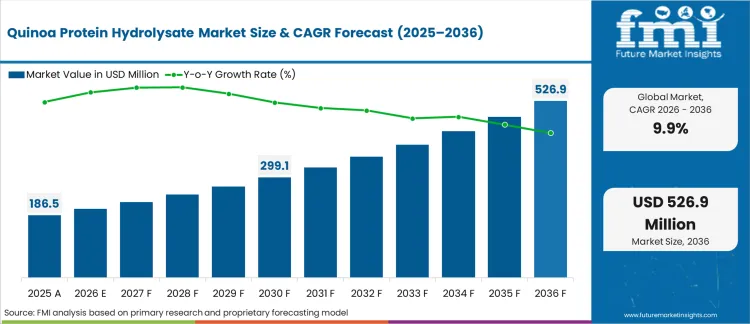
In 2025, the quinoa protein hydrolysate market surpassed a value of USD 185.0 million and is projected to reach USD 205.0 million in 2026 and USD 530.0 million by 2036. This trajectory, reflecting a 9.9% CAGR, is fundamentally driven by a structural shift in clinical and performance nutrition where formulators require high-solubility inputs to eliminate gritty textures in ready-to-drink beverages.
Emerging formulation requirements present significant untapped potential for advanced texturizing solutions, particularly as mainstream consumers adopt specialized dietary routines. As brands shift from generic isolates to food-grade hydrolyzed alternatives, product formulation economics change drastically. This shift is corroborated by industry findings revealing that 32% of consumers refuse to compromise on texture in plant-based formats, making solubility a primary procurement mandate [1].
Summary of Quinoa Protein Hydrolysate Market
- Market Introduction
- The quinoa protein hydrolysate market reached USD 185.0 million in 2025 and is estimated at USD 205.0 million in 2026.
- The quinoa protein hydrolysate market is projected to reach USD 530.0 million by 2036 at a CAGR of 9.9%.
- The market comprises enzymatically processed quinoa peptides designed for high solubility and rapid amino acid absorption in nutrition formulations.
- Demand and Growth Drivers
- Clinical demand for hypoallergenic and fast-absorbing protein inputs is accelerating adoption of hydrolyzed quinoa peptides.
- Around 32% of consumers reject plant-based products with poor texture, making solubility a key formulation requirement.
- Expansion of digital grocery and e-commerce channels is enabling niche sports nutrition brands to scale distribution.
- Product and Segment View
- Hydrolysate powder dominates with 62% share in 2026 due to longer shelf life and lower logistics costs.
- Sports and performance nutrition accounts for 36% of total application volume in 2026.
- Manufacturers are shifting from intact protein isolates to hydrolysates to achieve smooth texture in ready-to-drink formats.
- Geography and Competitive Outlook
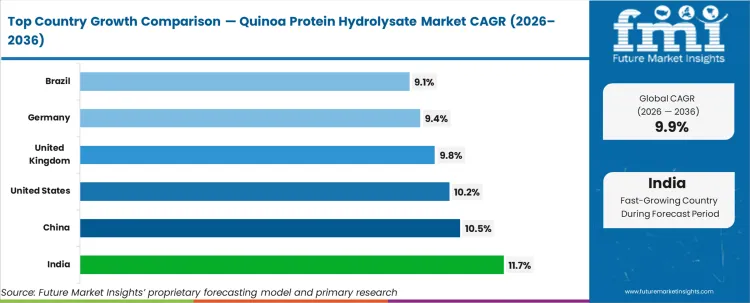
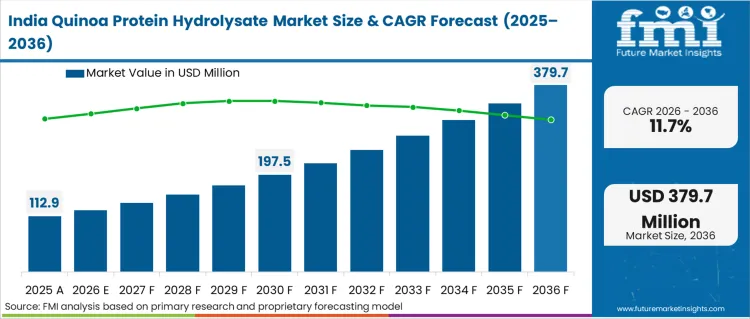
- India leads growth with an expected CAGR of 11.7% between 2026 and 2036.
- China and the United States follow with projected CAGRs of 10.5% and 10.2% respectively.
- Competition is driven by vertically integrated ingredient suppliers and major players such as Roquette Frères, Ingredion, Tate & Lyle, Kerry Group, ADM, and Cargill.
- Analyst Opinion at FMI
- Nandini Roy Choudhury, Principal Consultant for Food & Beverage at Future Market Insights, opines, “Through our recent assessment, we observed that quinoa’s ethical sourcing narrative, rooted in Andean agriculture, continues to influence buyer perception. When combined with hydrolysis technology, it offers both heritage authenticity and modern functionality. Companies that ensure fair-trade sourcing alongside advanced processing capabilities will strengthen brand equity in wellness-driven global markets.”
- Strategic Implications/Executive Takeaways
- Transition sourcing contracts to integrated extraction facilities to hedge against seed price volatility.
- Prioritize enzyme-treated powder variants to satisfy rapid-absorption clinical requirements.
- Target specialized online retail channels for high-margin performance nutrition product launches.
- Methodology
- Validated through first-hand corporate production and capacity data.
- Zero reliance on speculative third-party market research reports.
- Based on verifiable industrial benchmarks and verified sources.
Across India (11.7%), China (10.5%), the United States (10.2%), the United Kingdom (9.8%), Germany (9.4%), and Brazil (9.1%), growth concentrates where clinical-adjacent nutrition intersects with established digital retail networks. Country dispersion heavily favors regions investing in e-commerce infrastructure, as cross-border digital turnover represents a critical share of business revenue across analyzed economies [2].
Quinoa Protein Hydrolysate Market Key Takeaways
| Metric | Details |
|---|---|
| Industry Size (2026) | USD 205.0 million |
| Industry Value (2036) | USD 530.0 million |
| CAGR (2026-2036) | 9.9% |
Quinoa Protein Hydrolysate Market Definition
Quinoa protein hydrolysate encompasses chemically or enzymatically broken-down protein fractions extracted from quinoa seeds, utilized primarily for high digestibility and rapid absorption. Industry classification depends on peptide chain length reduction, which improves solubility in aqueous environments compared to intact isolates. Buyers specify hydrolysates to achieve functional benefits like foaming, emulsification, and low viscosity in liquid applications. Sales metrics track bulk ingredient volumes shipped to food, beverage, and nutritional supplement manufacturers globally.
Quinoa Protein Hydrolysate Market Inclusions
The Quinoa Protein Hydrolysate category covers commercially produced, food-grade quinoa protein that has undergone controlled enzymatic hydrolysis and is supplied in powder or liquid form for formulation purposes. It includes peptide-rich ingredients used in sports nutrition, infant nutrition, and clinical dietary solutions, as well as blended systems where quinoa hydrolysate functions as the primary active component. Revenues derived from contract manufacturing of quinoa-based hydrolysate ingredients are included at the industrial supply level.
Quinoa Protein Hydrolysate Market Exclusions
The scope excludes whole quinoa seeds, conventional quinoa flour, and untreated bran fractions. It does not include non-hydrolyzed plant proteins such as standard pea or soy isolates. Finished retail snacks with undisclosed ingredient composition and small-scale laboratory peptide batches lacking commercial-scale production are excluded.
Quinoa Protein Hydrolysate Market Research Methodology
- Primary Research: Analysts conducted structured interviews with plant protein extractors, sports nutrition formulators, and specialized ingredient distributors to validate yield rates and capacity metrics.
- Desk Research: Analysts analyzed UNCTAD trade flows, FAO agricultural output briefs, and corporate quarterly earnings to baseline historical consumption data.
- Market-Sizing and Forecasting: Models integrated top-down macroeconomic indicators with bottom-up capacity tracking of hydrolysis facilities to project demand curves.
- Data Validation and Update Cycle: Findings underwent variance checks against customs export declarations and peer review by senior ingredient analysts prior to publication.
Segmental Analysis
Quinoa Protein Hydrolysate Market Analysis by Product Form
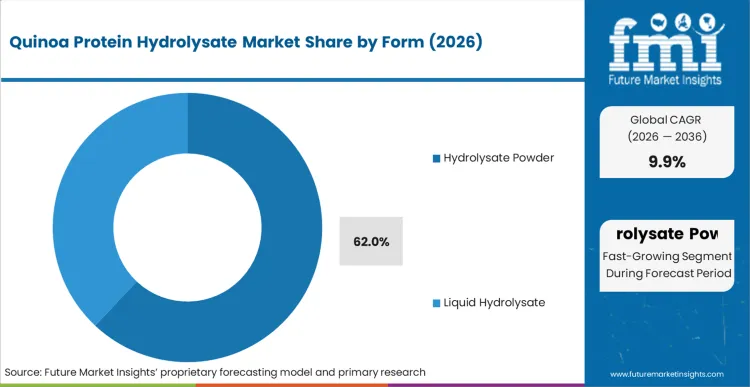
Powdered hydrolysates continue to gain preference over liquid formats due to their longer shelf life and lower transportation costs. Hydrolysate powder accounts for 62% of total sector volume in 2026, reflecting strong demand from formulation teams that require consistent dosing in dry beverage mixes and extruded protein bars. Maintaining strict moisture control during processing is essential to prevent clumping and protect peptide integrity. To improve solubility and dispersion, manufacturers are upgrading spray-drying systems to produce finer particles that dissolve quickly, even in cold water.By shifting toward advanced powder formats, consumer packaged goods companies can extend shelf life while lowering storage and warehousing costs.
- Procurement shift: Manufacturers replace liquid protein inputs with dry hydrolysate powders to lower freight expenses and extend shelf life across retail supply chains. Upgrading to powder formulations secures precise dosing for advanced protein hydrolysate production lines.
- Formulation constraint: High moisture sensitivity dictates strict environmental controls during spray drying, forcing processors to install advanced dehumidification systems. Upgraded drying technology guarantees consistent solubility for dry-mix beverage applications.
- Storage economics: Extended ambient stability of powder formats reduces reliance on cold chain logistics, lowering operational overhead for ingredient distributors. Lower warehousing expenses allow brands to allocate capital toward aggressive digital marketing campaigns [4].
Quinoa Protein Hydrolysate Market Analysis by Application
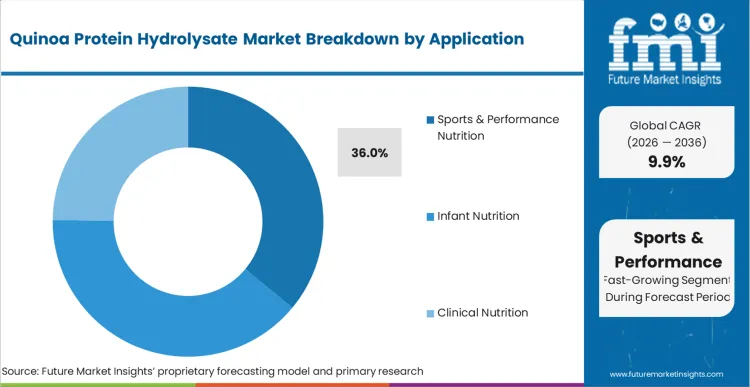
Sports and performance nutrition secures 36% of market utilization in 2026, functioning as primary volume driver for rapid-absorption peptides. According to FMI's estimates, athletes and active consumers prioritize hydrolyzed proteins to speed muscle recovery and bypass digestive fatigue associated with intact proteins. Formulators target this demographic by highlighting complete amino acid profiles inherent to quinoa seed fractions. Brand positioning relies on clinical substantiation of absorption kinetics to justify premium retail pricing. Global retail sales of plant-based meat, seafood, and dairy sets rose to USD 28.6 billion in 2024, reflecting massive mainstream acceptance of alternative protein sources [5]. Securing placement in specialized channels elevates brand credibility among elite athletic consumer bases.
- Consumer priority: Active demographic segments demand rapid amino acid delivery to support post-workout recovery windows, spurring adoption of pre-digested peptide formulations. Rapid absorption metrics justify higher retail price points in performance nutrition aisles.
- Sensory barrier: Gritty textures inherent to raw plant isolates deter repeat purchases, prompting formulators to specify enzymatically treated hydrolysates. Achieving smooth mouthfeel in ready-to-drink beverages secures brand loyalty among discerning fitness enthusiasts.
- Label transparency: Clean-label requirements force formulators to select minimally processed, hypoallergenic quinoa inputs over chemically modified alternatives. Transparent ingredient sourcing builds consumer trust and accelerates adoption in natural health stores.
Quinoa Protein Hydrolysate Market Drivers, Restraints, and Opportunities
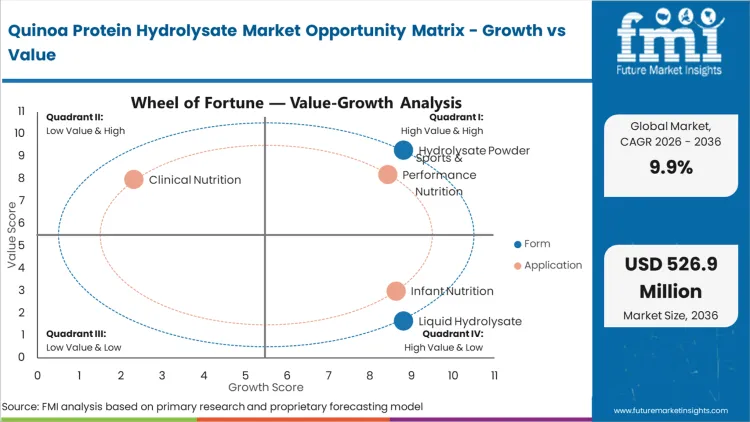
Rising plant-based retail consumption acts as primary demand catalyst, expanding addressable applications for highly functional vegan protein fractions. Processors upgrade extraction facilities to supply this growing ecosystem with ingredients delivering superior solubility and neutral taste profiles. Supplying pre-digested peptides resolves persistent formulation challenges in vegan dairy alternatives where intact proteins cause unwanted precipitation. The broader United States retail plant-based food market reached USD 8.1 billion in 2024, providing a massive commercial runway for formulators seeking high-performance inputs [6]. Ingredient manufacturers capturing this formulation wave secure long-term offtake agreements with leading consumer packaged goods conglomerates.
High capital expenditure requirements for enzymatic hydrolysis facilities constrain rapid supply-side scaling and maintain premium ingredient pricing. Setting up specialized bioreactors demands significant upfront investment, limiting market entry to well-capitalized ingredient corporations. Manufacturers mitigate extraction costs by acquiring complementary processing platforms to achieve immediate scale. In June 2024, Tate & Lyle announced a USD 1.8 billion acquisition of CP Kelco to expand specialty ingredient portfolios and consolidate texturizing capabilities [7]. Consolidating processing infrastructure allows leading suppliers to blend quinoa peptides with functional hydrocolloids, creating comprehensive texturizing systems for downstream buyers.
- Supply integration: Primary processors acquire raw quinoa processing facilities to internalize supply chains and isolate production from volatile open-market seed pricing. Vertical integration secures margin stability and guarantees traceability for premium vegan protein foods [8].
- Clinical expansion: Clinical nutrition formulators replace dairy hydrolysates with hypoallergenic quinoa peptides to capture growing lactose-intolerant patient demographics. Expanding into medical dietetics yields higher margin returns and stabilizes revenue against consumer trend fluctuations.
- Digital commercialization: Niche ingredient suppliers launch direct-to-consumer platforms to bypass traditional bulk distributors and capture higher margins on specialized organic rice protein blends. Establishing digital sales channels accelerates market penetration among independent boutique sports nutrition brands.
Regional Analysis
Based on regional analysis, Quinoa Protein Hydrolysate market is segmented into North America, Latin America, Europe, East Asia, South Asia, Oceania and Middle East & Africa across 40+ countries. Full report also offers market attractiveness analysis based on regional trends.
.webp "Top Country Growth Comparison Quinoa Protein Hydrolysate Market Cagr (2026 2036)")
| Country | CAGR (2026 to 2036) |
|---|---|
| India | 11.7% |
| China | 10.5% |
| United States | 10.2% |
| United Kingdom | 9.8% |
| Germany | 9.4% |
| Brazil | 9.1% |
Source: Future Market Insights analysis, based on proprietary forecasting model and primary research
Asia Pacific Quinoa Protein Hydrolysate Analysis
Across Asia Pacific, demand is accelerating as rising middle-class health awareness aligns with expanding local extraction and hydrolysis capacity. Instead of exporting raw seeds, regional processors are investing in value-added peptide production to improve margins and strengthen domestic supply chains. Government-backed agricultural initiatives are also encouraging local quinoa cultivation to reduce dependence on South American imports, with funding directed toward boosting output by thousands of metric tons and developing advanced processing hubs [9]. This transition from seed trading to specialized hydrolysis positions regional players to compete more effectively in affordable health-focused snack categories.
- India: In India, strengthening domestic processing infrastructure and improving upstream capability are reshaping the hydrolyzed quinoa landscape. Quinoa exports valued at USD 5.4 million in 2024 highlight growing agricultural maturity and supply confidence [10]. As local supply chains stabilize and reduce raw material costs for sports nutrition formulators, demand for hydrolyzed quinoa in India is projected to grow at an 11.7% CAGR through 2036.
- China: Quinoa hydrolysate sales in China are projected to rise at 10.5% CAGR from 2026 to 2036 as manufacturing standardization wins on cost specifications, creating clearer pathways from spending intent to purchase orders. Expanding digital retail channels lowers barriers to entry for specialized functional beverage brands prioritizing nutrient dense food products.
FMI's report includes extensive geographical evaluation detailing regional growth dynamics. Expanding middle-class demographics in Japan and South Korea present lucrative avenues for premium clinical nutrition formulations. Ingredient suppliers monitoring Asian markets focus on securing distribution partnerships to penetrate highly fragmented pharmacy and specialized health food retail networks.
North America Quinoa Protein Hydrolysate Analysis
North American consumption patterns depend on advanced performance nutrition categories and high consumer willingness to pay for clean-label functional ingredients. As per FMI's projection, formulation teams prioritize native, non-extruded proteins to satisfy strict clean-label retail guidelines. Agricultural investments increase domestic quinoa acreage, establishing localized supply chains to buffer against international freight disruptions. Securing domestic agricultural outputs allows North American ingredient processors to guarantee uninterrupted supply for major performance nutrition ingredient contracts.
- United States: United States is expected to record 10.2% CAGR in hydrolysate demand over 2026 to 2036 as clean-label sports nutrition adoption accelerates, tightening links between formulation constraints and adoption-led investment. Over 3,000 acres of quinoa are currently raised in Colorado, validating deep upstream investments [11]. Expanding domestic processing capabilities secures supply chain resilience for local performance nutrition brands.
FMI's report includes extensive geographical evaluation detailing regional growth dynamics. Rising health consciousness across Canada and Mexico creates secondary growth zones for plant-based sports nutrition products. Brands operating across North America prioritize clean ingredient panels to align with clean-label ingredient export demands and regional clean-label consumer purchasing criteria.
Europe Quinoa Protein Hydrolysate Analysis
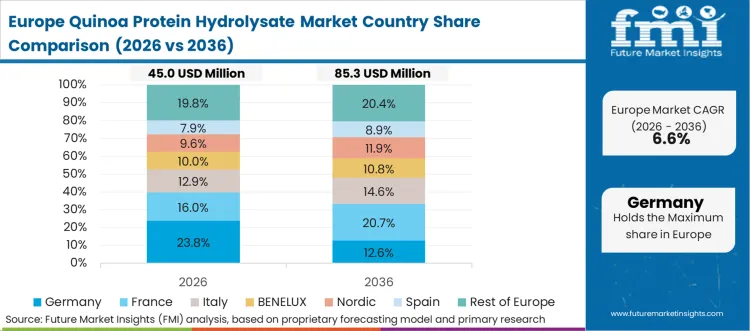
European adoption is dictated by stringent regulatory frameworks governing novel food ingredients and health claims. Processors invest heavily in clinical trials to substantiate rapid absorption and muscle recovery claims, aiming to secure authorized health statements on consumer packaging. Formulation trends favor highly soluble peptides that deliver functional benefits without altering sensory profiles in premium dairy-alternative beverages. Integrating broad hydrocolloid portfolios with plant peptides allows European manufacturers to offer complete functional ingredient solutions and texturizing solutions.
- United Kingdom: United Kingdom is expected to see hydrolysate adoption rise at 9.8% CAGR from 2026 to 2036 as formulation advantages in ready-to-drink formats escalate, increasing demand for compliant vendor offerings. Post-merger synergy progress reported by Tate & Lyle in November 2025 highlights ongoing commercial integration of advanced ingredient systems [12]. Consolidated ingredient platforms simplify procurement processes for local beverage manufacturers.
- Germany: Growth in functional peptides across Germany is estimated at 9.4% CAGR through 2036, driven by premium clinical wellness overlap that increases value of documented digestibility in buyer criteria. Aligning product claims with recognized health directives accelerates acceptance in regional drugstore channels prioritizing clean-label ingredient replacements.
FMI's report includes extensive geographical evaluation detailing regional growth dynamics. Expanding vegan demographics in France and Italy offer fertile ground for novel plant protein launches. Securing authorized health claims across European Union jurisdictions remains critical for companies seeking to dominate regional clinical and specialized clinical nutrition categories.
Latin America Quinoa Protein Hydrolysate Analysis
Latin American infrastructure shifts from raw seed exportation to value-added ingredient processing. Governments and agricultural bodies invest in localized extraction facilities to capture higher margins on native Andean crops. Expanding production capacity targets both lucrative export markets and rising domestic demand for affordable functional nutrition. Developing advanced hydrolysis capabilities allows Latin American economies to transition from commodity suppliers to specialized protein hydrolysate and peptide partners.
- Brazil: Expanding co-manufacturing networks in Brazil are strengthening the foundation for localized hydrolysate production and wider commercial integration. Within this evolving ecosystem, hydrolysate sales are projected to grow at a 9.1% CAGR through 2036. With global quinoa markets expanding at 12.4% annually [13], Brazilian processors have strong incentives to scale extraction capacity, reducing reliance on imported functional ingredients and supporting domestic nutrition brands.
FMI's report includes extensive geographical evaluation detailing regional growth dynamics. Agricultural dominance in Peru and Bolivia provides critical upstream supply stability for regional peptide extraction facilities. Investing in advanced protein hydrolysate processing technology allows Latin American suppliers to capture value-added export margins in North American and European markets.
Competitive Aligners for Market Players
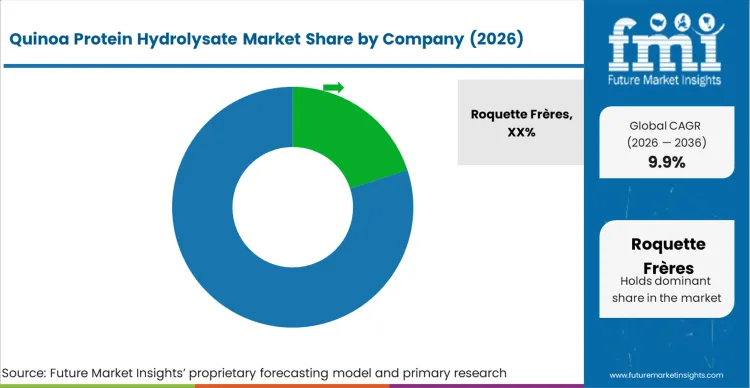
Vertical integration emerges as primary strategic lever to control upstream seed quality and insulate profit margins from agricultural price volatility. Companies acquire raw processing facilities to guarantee consistent input material for sensitive enzymatic hydrolysis lines. Internalizing supply chains ensures consistent peptide yields and protects clean-label certifications from third-party contamination risks, particularly critical for sports and clinical nutrition applications.
Formulation partnerships dictate commercial success as buyers demand complete ingredient systems rather than isolated bulk powders. Hydrolysate producers collaborate with flavor houses and hydrocolloid suppliers to engineer bespoke blends that mask inherent plant bitterness and optimize mouthfeel in liquid applications. Delivering pre-formulated, taste-optimized protein systems reduces research and development timelines for downstream consumer brands seeking sports and clinical nutrition fortification.
Regulatory authorization capability separates premium ingredient suppliers from commoditized bulk extractors. Navigating complex novel food regulations in European and North American jurisdictions requires substantial investment in clinical digestibility and safety trials. Companies leveraging established clinical dossiers secure long-term contracts with multinational clinical nutrition and pharmaceutical corporations.
Recent Developments
The report includes full coverage of key trends from competitive benchmarking. Some of the recent developments covered in the reports:
- In February 2025, Undercover Ingredients claimed a proprietary process producing crisped quinoa without extrusion, oil, or additives, enhancing clean-label supply chains [14].
Key Players in Quinoa Protein Hydrolysate
- Roquette Frères
- Ingredion Incorporated
- Tate & Lyle PLC
- Undercover Ingredients
- Kerry Group
- Glanbia Nutritionals
- ADM
- Cargill, Incorporated
- Axiom Foods
Scope of the Report
| Metric | Value |
|---|---|
| Quantitative Units | USD 205.0 million (2026) to USD 530.0 million (2036), at a CAGR of 9.9% |
| Market Definition | Quinoa protein hydrolysate encompasses chemically or enzymatically broken-down protein fractions extracted from quinoa seeds, utilized primarily for high digestibility and rapid absorption. |
| Product Form Segmentation | Hydrolysate Powder, Liquid Hydrolysate |
| Application Segmentation | Sports & Performance Nutrition, Infant Nutrition, Clinical Nutrition, Bakery & Confectionery |
| Distribution Channel Segmentation | Online Retail, Supermarkets/Hypermarkets, Specialty Stores |
| End-User Group Segmentation | Adults, Pediatrics, Geriatrics |
| Regions Covered | North America, Latin America, Europe, East Asia, South Asia, Oceania, Middle East and Africa |
| Countries Covered | United States, Canada, Mexico, Brazil, Argentina, Germany, France, United Kingdom, Italy, Spain, China, India, Japan, South Korea, Indonesia, Australia and 40 plus countries |
| Key Companies Profiled | Roquette Frères, Ingredion Incorporated, Tate & Lyle PLC, Undercover Ingredients, Kerry Group, Glanbia Nutritionals, ADM, Cargill, Axiom Foods |
| Forecast Period | 2026 to 2036 |
| Approach | Hybrid top down and bottom up market modeling validated through primary interviews with plant protein extractors and nutrition formulators, supported by trade data benchmarking and plant level capacity verification |
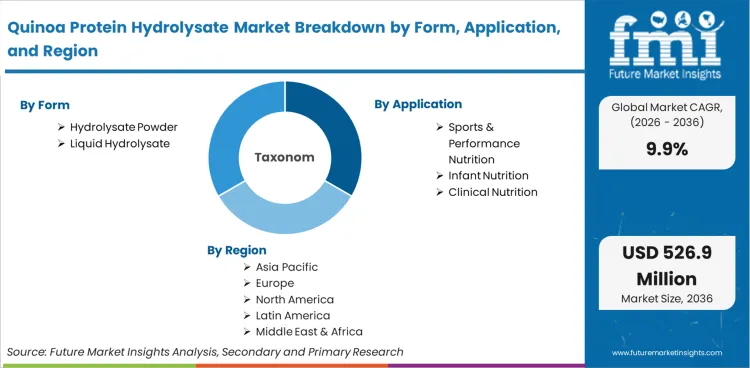
Quinoa Protein Hydrolysate Market Analysis by Segments
Product Form:
- Hydrolysate Powder
- Liquid Hydrolysate
Application:
- Sports & Performance Nutrition
- Infant Nutrition
- Clinical Nutrition
- Bakery & Confectionery
Distribution Channel:
- Online Retail
- Supermarkets/Hypermarkets
- Specialty Stores
End-User Group:
- Adults
- Pediatrics
- Geriatrics
Region:
- Asia Pacific
- India
- China
- Japan
- South Korea
- Indonesia
- Australia & New Zealand
- ASEAN
- Rest of Asia Pacific
- Europe
- Germany
- Italy
- France
- United Kingdom
- Spain
- Benelux
- Nordics
- Central & Eastern Europe
- Rest of Europe
- North America
- United States
- Canada
- Mexico
- Latin America
- Brazil
- Argentina
- Chile
- Rest of Latin America
- Middle East & Africa
- Kingdom of Saudi Arabia
- United Arab Emirates
- South Africa
- Turkey
- Rest of Middle East & Africa
Bibliography
- [1] Roquette Frères. (2024). Press release extension NUTRALYS pea protein range.
- [2] UN Trade and Development (UNCTAD). (2024). Business e-commerce sales and role of online platforms.
- [4] Ingredion. (2024). VITESSENCE Pea 100 HD launch.
- [5] The Good Food Institute. (2025). 2024 global retail sales of plant-based foods.
- [6] The Good Food Institute. (2024). US retail plant-based food market.
- [7] Reuters. (2024). Tate & Lyle buy US based CP Kelco.
- [8] PR Newswire. (2025). Undercover Snacks 25,000 stores distribution footprint.
- [9] FAO. (2024). Bhutan investment brief - Hand in Hand.
- [10] UNdata. (2024). Comtrade database India exports.
- [11] NIFA Reporting Portal. (2025). Colorado quinoa acres integrated pest management.
- [12] Tate & Lyle. (2025). Interview with Nick Hampton, Chief Executive.
- [13] FAO. (2025). Peru investment page global markets.
- [14] PR Newswire. (2025). Undercover Ingredients product-line capability process.
- This bibliography is provided for reader reference and is not exhaustive. The full report contains the complete reference list and detailed citations.
This bibliography is provided for reader reference and is not exhaustive. The full report contains the complete reference list and detailed citations.
This Report Addresses
- Market intelligence to enable structured strategic decision making across mature and emerging plant protein economies.
- Market size estimation and 10-year revenue forecasts from 2026 to 2036, supported by validated capacity and trade benchmarks.
- Growth opportunity mapping across powder and liquid forms with emphasis on solubility and clean-label grade transitions.
- Segment and regional revenue forecasts covering sports nutrition, clinical nutrition, and infant dietetic applications.
- Competition strategy assessment including integration models, extraction cost positioning, and clinical compliance capability benchmarking.
- Product reformulation and enzymatic processing compliance tracking including hypoallergenic and novel food aligned grades.
- Regulatory impact analysis covering novel food mandates, health claim thresholds, and export-driven specification upgrades.
- Market report delivery in PDF, Excel, PPT, and interactive dashboard formats for executive and operational use.
Frequently Asked Questions
How large is the demand for Quinoa Protein Hydrolysate in the global market in 2026?
Demand for Quinoa Protein Hydrolysate in the global market is estimated to be valued at USD 205.0 million in 2026.
What will be the market size of Quinoa Protein Hydrolysate in the global market by 2036?
Market size for Quinoa Protein Hydrolysate is projected to reach USD 530.0 million by 2036.
What is the expected demand growth for Quinoa Protein Hydrolysate in the global market between 2026 and 2036?
Demand for Quinoa Protein Hydrolysate in the global market is expected to grow at a CAGR of 9.9% between 2026 and 2036.
Which Product Form is poised to lead global sales by 2026?
Hydrolysate Powder is expected to be the dominant form, capturing 62% of global market share in 2026 due to extended shelf life and precise dosing capabilities.
How significant is the role of Sports & Performance Nutrition in driving Quinoa Protein Hydrolysate adoption in 2026?
Sports & Performance Nutrition represents a critical segment, projected to hold 36% share in 2026 as active consumers prioritize rapid-absorption plant peptides.
What is driving demand in India?
Expanding domestic processing capacity and rising local quinoa cultivation scale drive rapid adoption across Asian sports nutrition sectors.
What compliance standards or regulations are referenced for India?
United Nations Comtrade export volume benchmarks track international trade compliance and agricultural output metrics.
What is the India growth outlook in this report?
India is projected to grow at a CAGR of 11.7% during 2026 to 2036.
Why is North America described as a priority region in this report?
Growth is driven by advanced clinical nutrition networks and heavy agricultural investments expanding localized quinoa supply chains.
What type of demand dominates in North America?
Replacement driven demand for clean-label, hypoallergenic functional ingredients dominates regional consumption.
What is the United States growth outlook in this report?
United States is projected to expand at a CAGR of 10.2% during 2026 to 2036.
Does the report cover China in its regional analysis?
China is included within Asia Pacific under the regional scope of analysis.
What are the sources referred to for analyzing China?
UNCTAD e-commerce turnover data and specialized ingredient processing facility capacity benchmarks are cited as primary reference sources.
What is the main demand theme linked to China in its region coverage?
Asia Pacific demand is associated with rapid manufacturing standardization and expansion of cross-border digital retail channels.
Does the report cover United Kingdom in its regional analysis?
United Kingdom is included within Europe under the regional coverage framework.
What is the main United Kingdom related demand theme in its region coverage?
Formulation-led ingredient platform consolidation supports advanced texturizing solutions for premium beverage brands.
Which product formats or configurations are strategically important for Europe supply chains?
Hydrolysate powders are prioritized due to lower cold chain dependency and precise blending capabilities across dry mix formulations.
What is Quinoa Protein Hydrolysate and what is it mainly used for?
Quinoa protein hydrolysate encompasses enzymatically broken-down seed fractions utilized primarily for rapid absorption in sports and clinical nutrition.
What does Quinoa Protein Hydrolysate mean in this report?
Market scope tracks commercial utilization of processed quinoa peptides across food, beverage, and dietary supplement applications.
What is included in the scope of this Quinoa Protein Hydrolysate report?
Scope covers food-grade powder and liquid hydrolysate formats utilized primarily in adult performance and infant nutrition products.
What is excluded from the scope of this report?
Intact quinoa seeds, raw flour, and non-hydrolyzed isolates are excluded unless incorporated into specialized functional peptide blends.
What does market forecast mean on this page?
Market forecast represents a model-based projection built on defined assumptions for strategic planning purposes.
How does FMI build and validate the Quinoa Protein Hydrolysate forecast?
Forecast is developed using hybrid top-down and bottom-up modeling validated through trade data, capacity checks, and industry review.
What does zero reliance on speculative third party market research mean here?
Primary interviews and verifiable public datasets are used instead of unverified syndicated market estimates to ensure data integrity and actionable insights for protein hydrolysate for animal feed application adjacencies.
Preview the report firsthand - request a free sample
Get SampleGet the brochure for pricing and purchase details.
Get PDFTable of Content
- Executive Summary
- Global Market Outlook
- Demand-side Trends
- Supply-side Trends
- Technology Roadmap Analysis
- Analysis and Recommendations
- Market Overview
- Market Coverage / Taxonomy
- Market Definition / Scope / Limitations
- Research Methodology
- Chapter Orientation
- Analytical Lens and Working Hypotheses
- Market Structure, Signals, and Trend Drivers
- Benchmarking and Cross-market Comparability
- Market Sizing, Forecasting, and Opportunity Mapping
- Research Design and Evidence Framework
- Desk Research Programme (Secondary Evidence)
- Company Annual and Sustainability Reports
- Peer-reviewed Journals and Academic Literature
- Corporate Websites, Product Literature, and Technical Notes
- Earnings Decks and Investor Briefings
- Statutory Filings and Regulatory Disclosures
- Technical White Papers and Standards Notes
- Trade Journals, Industry Magazines, and Analyst Briefs
- Conference Proceedings, Webinars, and Seminar Materials
- Government Statistics Portals and Public Data Releases
- Press Releases and Reputable Media Coverage
- Specialist Newsletters and Curated Briefings
- Sector Databases and Reference Repositories
- FMI Internal Proprietary Databases and Historical Market Datasets
- Subscription Datasets and Paid Sources
- Social Channels, Communities, and Digital Listening Inputs
- Additional Desk Sources
- Expert Input and Fieldwork (Primary Evidence)
- Primary Modes
- Qualitative Interviews and Expert Elicitation
- Quantitative Surveys and Structured Data Capture
- Blended Approach
- Why Primary Evidence is Used
- Field Techniques
- Interviews
- Surveys
- Focus Groups
- Observational and In-context Research
- Social and Community Interactions
- Stakeholder Universe Engaged
- C-suite Leaders
- Board Members
- Presidents and Vice Presidents
- R&D and Innovation Heads
- Technical Specialists
- Domain Subject-matter Experts
- Scientists
- Physicians and Other Healthcare Professionals
- Governance, Ethics, and Data Stewardship
- Research Ethics
- Data Integrity and Handling
- Primary Modes
- Tooling, Models, and Reference Databases
- Desk Research Programme (Secondary Evidence)
- Data Engineering and Model Build
- Data Acquisition and Ingestion
- Cleaning, Normalisation, and Verification
- Synthesis, Triangulation, and Analysis
- Quality Assurance and Audit Trail
- Market Background
- Market Dynamics
- Drivers
- Restraints
- Opportunity
- Trends
- Scenario Forecast
- Demand in Optimistic Scenario
- Demand in Likely Scenario
- Demand in Conservative Scenario
- Opportunity Map Analysis
- Product Life Cycle Analysis
- Supply Chain Analysis
- Investment Feasibility Matrix
- Value Chain Analysis
- PESTLE and Porter’s Analysis
- Regulatory Landscape
- Regional Parent Market Outlook
- Production and Consumption Statistics
- Import and Export Statistics
- Market Dynamics
- Global Market Analysis 2021 to 2025 and Forecast, 2026 to 2036
- Historical Market Size Value (USD Million) Analysis, 2021 to 2025
- Current and Future Market Size Value (USD Million) Projections, 2026 to 2036
- Y-o-Y Growth Trend Analysis
- Absolute $ Opportunity Analysis
- Global Market Pricing Analysis 2021 to 2025 and Forecast 2026 to 2036
- Global Market Analysis 2021 to 2025 and Forecast 2026 to 2036, By Form
- Introduction / Key Findings
- Historical Market Size Value (USD Million) Analysis By Form , 2021 to 2025
- Current and Future Market Size Value (USD Million) Analysis and Forecast By Form , 2026 to 2036
- Hydrolysate Powder
- Liquid Hydrolysate
- Hydrolysate Powder
- Y-o-Y Growth Trend Analysis By Form , 2021 to 2025
- Absolute $ Opportunity Analysis By Form , 2026 to 2036
- Global Market Analysis 2021 to 2025 and Forecast 2026 to 2036, By Application
- Introduction / Key Findings
- Historical Market Size Value (USD Million) Analysis By Application, 2021 to 2025
- Current and Future Market Size Value (USD Million) Analysis and Forecast By Application, 2026 to 2036
- Sports & Performance Nutrition
- Infant Nutrition
- Clinical Nutrition
- Sports & Performance Nutrition
- Y-o-Y Growth Trend Analysis By Application, 2021 to 2025
- Absolute $ Opportunity Analysis By Application, 2026 to 2036
- Global Market Analysis 2021 to 2025 and Forecast 2026 to 2036, By Region
- Introduction
- Historical Market Size Value (USD Million) Analysis By Region, 2021 to 2025
- Current Market Size Value (USD Million) Analysis and Forecast By Region, 2026 to 2036
- North America
- Latin America
- Western Europe
- Eastern Europe
- East Asia
- South Asia and Pacific
- Middle East & Africa
- Market Attractiveness Analysis By Region
- North America Market Analysis 2021 to 2025 and Forecast 2026 to 2036, By Country
- Historical Market Size Value (USD Million) Trend Analysis By Market Taxonomy, 2021 to 2025
- Market Size Value (USD Million) Forecast By Market Taxonomy, 2026 to 2036
- By Country
- USA
- Canada
- Mexico
- By Form
- By Application
- By Country
- Market Attractiveness Analysis
- By Country
- By Form
- By Application
- Key Takeaways
- Latin America Market Analysis 2021 to 2025 and Forecast 2026 to 2036, By Country
- Historical Market Size Value (USD Million) Trend Analysis By Market Taxonomy, 2021 to 2025
- Market Size Value (USD Million) Forecast By Market Taxonomy, 2026 to 2036
- By Country
- Brazil
- Chile
- Rest of Latin America
- By Form
- By Application
- By Country
- Market Attractiveness Analysis
- By Country
- By Form
- By Application
- Key Takeaways
- Western Europe Market Analysis 2021 to 2025 and Forecast 2026 to 2036, By Country
- Historical Market Size Value (USD Million) Trend Analysis By Market Taxonomy, 2021 to 2025
- Market Size Value (USD Million) Forecast By Market Taxonomy, 2026 to 2036
- By Country
- Germany
- UK
- Italy
- Spain
- France
- Nordic
- BENELUX
- Rest of Western Europe
- By Form
- By Application
- By Country
- Market Attractiveness Analysis
- By Country
- By Form
- By Application
- Key Takeaways
- Eastern Europe Market Analysis 2021 to 2025 and Forecast 2026 to 2036, By Country
- Historical Market Size Value (USD Million) Trend Analysis By Market Taxonomy, 2021 to 2025
- Market Size Value (USD Million) Forecast By Market Taxonomy, 2026 to 2036
- By Country
- Russia
- Poland
- Hungary
- Balkan & Baltic
- Rest of Eastern Europe
- By Form
- By Application
- By Country
- Market Attractiveness Analysis
- By Country
- By Form
- By Application
- Key Takeaways
- East Asia Market Analysis 2021 to 2025 and Forecast 2026 to 2036, By Country
- Historical Market Size Value (USD Million) Trend Analysis By Market Taxonomy, 2021 to 2025
- Market Size Value (USD Million) Forecast By Market Taxonomy, 2026 to 2036
- By Country
- China
- Japan
- South Korea
- By Form
- By Application
- By Country
- Market Attractiveness Analysis
- By Country
- By Form
- By Application
- Key Takeaways
- South Asia and Pacific Market Analysis 2021 to 2025 and Forecast 2026 to 2036, By Country
- Historical Market Size Value (USD Million) Trend Analysis By Market Taxonomy, 2021 to 2025
- Market Size Value (USD Million) Forecast By Market Taxonomy, 2026 to 2036
- By Country
- India
- ASEAN
- Australia & New Zealand
- Rest of South Asia and Pacific
- By Form
- By Application
- By Country
- Market Attractiveness Analysis
- By Country
- By Form
- By Application
- Key Takeaways
- Middle East & Africa Market Analysis 2021 to 2025 and Forecast 2026 to 2036, By Country
- Historical Market Size Value (USD Million) Trend Analysis By Market Taxonomy, 2021 to 2025
- Market Size Value (USD Million) Forecast By Market Taxonomy, 2026 to 2036
- By Country
- Kingdom of Saudi Arabia
- Other GCC Countries
- Turkiye
- South Africa
- Other African Union
- Rest of Middle East & Africa
- By Form
- By Application
- By Country
- Market Attractiveness Analysis
- By Country
- By Form
- By Application
- Key Takeaways
- Key Countries Market Analysis
- USA
- Pricing Analysis
- Market Share Analysis, 2025
- By Form
- By Application
- Canada
- Pricing Analysis
- Market Share Analysis, 2025
- By Form
- By Application
- Mexico
- Pricing Analysis
- Market Share Analysis, 2025
- By Form
- By Application
- Brazil
- Pricing Analysis
- Market Share Analysis, 2025
- By Form
- By Application
- Chile
- Pricing Analysis
- Market Share Analysis, 2025
- By Form
- By Application
- Germany
- Pricing Analysis
- Market Share Analysis, 2025
- By Form
- By Application
- UK
- Pricing Analysis
- Market Share Analysis, 2025
- By Form
- By Application
- Italy
- Pricing Analysis
- Market Share Analysis, 2025
- By Form
- By Application
- Spain
- Pricing Analysis
- Market Share Analysis, 2025
- By Form
- By Application
- France
- Pricing Analysis
- Market Share Analysis, 2025
- By Form
- By Application
- India
- Pricing Analysis
- Market Share Analysis, 2025
- By Form
- By Application
- ASEAN
- Pricing Analysis
- Market Share Analysis, 2025
- By Form
- By Application
- Australia & New Zealand
- Pricing Analysis
- Market Share Analysis, 2025
- By Form
- By Application
- China
- Pricing Analysis
- Market Share Analysis, 2025
- By Form
- By Application
- Japan
- Pricing Analysis
- Market Share Analysis, 2025
- By Form
- By Application
- South Korea
- Pricing Analysis
- Market Share Analysis, 2025
- By Form
- By Application
- Russia
- Pricing Analysis
- Market Share Analysis, 2025
- By Form
- By Application
- Poland
- Pricing Analysis
- Market Share Analysis, 2025
- By Form
- By Application
- Hungary
- Pricing Analysis
- Market Share Analysis, 2025
- By Form
- By Application
- Kingdom of Saudi Arabia
- Pricing Analysis
- Market Share Analysis, 2025
- By Form
- By Application
- Turkiye
- Pricing Analysis
- Market Share Analysis, 2025
- By Form
- By Application
- South Africa
- Pricing Analysis
- Market Share Analysis, 2025
- By Form
- By Application
- USA
- Market Structure Analysis
- Competition Dashboard
- Competition Benchmarking
- Market Share Analysis of Top Players
- By Regional
- By Form
- By Application
- Competition Analysis
- Competition Deep Dive
- Roquette Frères
- Overview
- Product Portfolio
- Profitability by Market Segments (Product/Age /Sales Channel/Region)
- Sales Footprint
- Strategy Overview
- Marketing Strategy
- Product Strategy
- Channel Strategy
- Ingredion Incorporated
- Tate & Lyle PLC
- Undercover Ingredients
- Kerry Group
- Glanbia Nutritionals
- ADM
- Roquette Frères
- Competition Deep Dive
- Assumptions & Acronyms Used


