

- Industry Size (2026)
- USD 285.0 Mn
- Forecast (2036)
- USD 740.0 Mn
- CAGR (2026 to 2036)
- 10.0%
Salmon Protein Hydrolysate Market Size, Market Forecast and Outlook By FMI
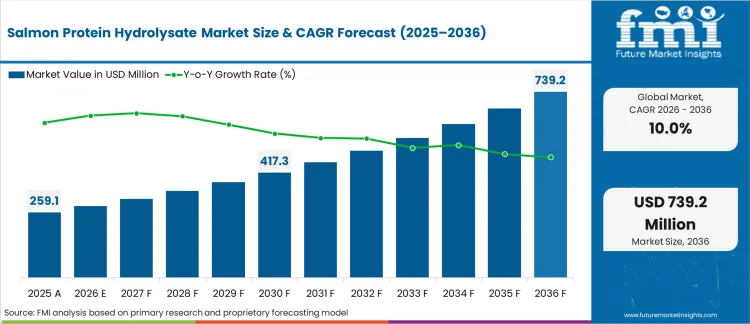
In 2025, the salmon protein hydrolysate market surpassed a value of USD 260.0 million. Based on Future Market Insights’ analysis, demand is estimated to grow to USD 285.0 million in 2026 and USD 740.0 million by 2036. FMI projects a CAGR of 10.0%. Adult demographics prioritizing rapid amino acid absorption over intact protein mass dictate this upward trajectory. Formulation teams respond by substituting standard concentrates with pre-digested options, converting pilot wellness programs into mass retail distribution networks.
Global fisheries and aquaculture production reached a record high 223.2 million tonnes total in 2022, fundamentally reshaping ingredient procurement away from waste disposal toward premium nutrition extraction [1]. As per FMI's projection, procurement teams specify marine protein hydrolysate to bypass volatile raw material costs and secure high-margin functional formulations. Processors converting this biomass insulate their operations against whole-fish price volatility while supplying formulators with a sustainable, isolated protein source.
Summary of Salmon Protein Hydrolysate Market
- Salmon Protein Hydrolysate Market Definition:
- Industry tracking encompasses specialized, enzymatically cleaved protein fractions derived from salmon processing waste streams for high-absorption nutrition.
- Demand Drivers in the Market:
- Clinical nutrition formulators demand rapid-absorption peptide structures for medical and sports applications.
- Processors seek revenue generation from secondary harvest biomass.
- Clean-label mandates push brands toward natural marine ingredient profiles.
- Key Segments Analyzed in the FMI Report:
- Form: Dominant powder formats (53%) relative to liquid variants.
- Application: Functional Foods & Beverages capture (32%) highest incorporation volumes.
- Geography: North America and Europe lead consumption, paired with rapid Asian industrialization.
- Analyst Opinion at FMI:
- Nandini Roy Choudhury, Principal Consultant for Food & Beverage at Future Market Insights, opines, “In our latest strategic assessment of the Salmon Protein Hydrolysate Market, my team and I have identified marine peptide standardization as the next competitive frontier. While demand is rising across sports, medical, and senior nutrition, variability in molecular weight distribution remains a critical differentiator. Companies investing in precise enzymatic control and batch-level peptide profiling will move beyond commodity marine protein positioning. In a performance-driven nutrition landscape, clinically validated absorption kinetics and traceable aquaculture sourcing will determine long-term brand credibility and procurement preference.”
- Strategic Implications/Executive Takeaways:
- Secure raw material access via long-term partnerships with primary salmon fish fisheries.
- Invest in clinical trials to substantiate specific health claims.
- Expand powder drying capacity to minimize transport expenditures.
- Methodology:
- Validated through first-hand corporate production and capacity data.
- Zero reliance on speculative third-party market research reports.
- Based on verifiable industrial benchmarks and verified sources.
Jon Olav Ødegård commented: "Symrise have been a key partner for us already and we are very excited to move ahead as they will help transform our scale and market access with their well-established market presence. The human health and premium pet markets continue to grow very strongly, and this partnership will allow us to sustain our growth trajectory and position us as the leading player in the science-led marine nutrition segment dedicated to human health." [2]
Across India (12.0%), China (11.2%), United States (10.4%), United Kingdom (9.8%), Germany (9.5%), and Brazil (9.1%), growth concentrates where domestic aquaculture processing scale intersects with premium clinical nutrition demand. Sourcing strategies dictate uptake; supply chain localization forces buyers to secure long-term capacity from integrated operators. Market participants align capacity expansion directly with domestic functional food regulatory approvals.
Salmon Protein Hydrolysate Market Key Takeaways
| Metric | Details |
|---|---|
| Industry Size (2026) | USD 285.0 million |
| Industry Value (2036) | USD 740.0 million |
| CAGR (2026 to 2036) | 10.0% |
Salmon Protein Hydrolysate Market Definition
Salmon protein hydrolysate covers enzymatically processed protein fractions derived specifically from salmon tissues, including meat, skin, and frames. Production yields low molecular weight peptides utilized for rapid human or animal absorption. Commercial extraction operations separate lipids and minerals to isolate high-purity protein streams. Buyers specify these active components for specialized dietary supplements, functional nutrition, and high-performance feed recipes.
Salmon Protein Hydrolysate Market Inclusions
Coverage accounts for revenue generated from bulk powder and liquid hydrolysate formats synthesized from Atlantic and Pacific salmon species. Applications quantified encompass functional beverages, active nutrition bars, dietary capsules, and specialized aquafeed additives. Value chains tracked involve B2B sales from ingredient manufacturers to formulators, alongside commercial trading volumes.
Salmon Protein Hydrolysate Market Exclusions
Calculations omit intact salmon fillets, cold-pressed salmon oils, and generic marine collagen blends lacking enzymatic breakdown. Crude fish meal designed for baseline agricultural fertilizer remains excluded. Non-commercial laboratory research quantities and secondary retail markups applied by consumer brands remain outside core ingredient valuation boundaries.
Salmon Protein Hydrolysate Market Research Methodology
- Primary Research: Direct consultations occurred with marine ingredient extractors, clinical nutrition formulators, and aquaculture feed directors to verify utilization rates.
- Desk Research: Analysts cross-referenced FAO fisheries output databases alongside corporate capacity expansion filings.
- Market-Sizing and Forecasting: Models deploy bottom-up demand aggregation from functional beverage production schedules, validated against top-down global salmon harvest totals.
- Data Validation and Update Cycle: Findings undergo variance checks against international trade codes and regional import records prior to final publication.
Segmental Analysis
Salmon Protein Hydrolysate Market Analysis by Product Form
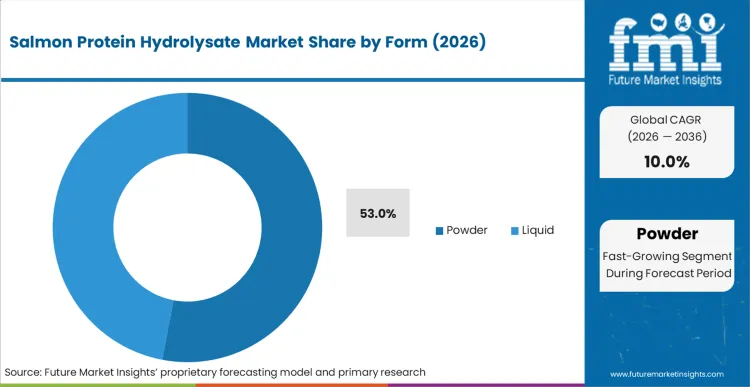
Powder formulations command 53% of total industry volume in 2026. Extraction facilities invest heavily in spray-drying technologies to stabilize amino acid profiles and extend commercial shelf life. Global salmon supply reported for January through September 2024 hit 2,019,600 tonnes, dictating the massive volume of liquid and powder outputs available for formulators [3]. FMI analysts opine that powder formats simplify integration into dry sports nutrition lines, making fish protein hydrolysate a standard specification for premium health brands globally. Liquid derivatives incur high transport costs and bacterial degradation risks, prompting procurement teams to mandate dry formats for long-distance shipping routes.
- Procurement strategies dictate dry format standardization to maintain clean labels and extend warehouse duration without cold chain logistics. Buyers reject liquid inputs that experience rapid bacterial growth unless heavily preserved, protecting brand integrity and shelf stability.
- Transport economics favor dehydrated components because shipping water weight destroys ingredient margin profiles across international routes. Powder processing removes excess mass, lowering freight charges and improving landed cost metrics for global formulation facilities.
- Manufacturing integration proceeds seamlessly because dry blending lines reject liquid inputs due to moisture control limits. Powders integrate into existing functional beverage mix infrastructure, reducing required factory modifications and accelerating production timelines.
Salmon Protein Hydrolysate Market Analysis by Application
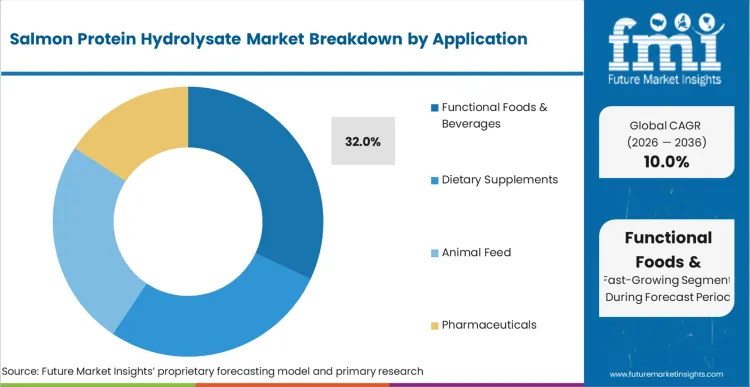
Health-conscious consumers increasingly expect measurable performance benefits from everyday foods instead of relying solely on standalone supplement pills. Functional Foods & Beverages account for 32% of total commercial demand in 2026, reflecting strong uptake of bioactive ingredients in mainstream formats. Formulators are incorporating marine peptides into ready-to-drink products to access premium price tiers and position offerings around targeted wellness claims. Hofseth BioCare’s NutraIngredients-USA Healthy Aging award in January 2026 highlights the growing commercial acceptance of upcycled marine ingredients in high-value nutrition segments [4]. FMI estimates that robust clinical validation helps brands secure retail shelf space by differentiating products through defined bio-efficacy metrics rather than competing directly with conventional soy or whey isolates.
- Dietary preferences shift away from pill fatigue, forcing brands to deliver active components through conventional eating habits. Peptide solubility permits integration into clear beverages without compromising visual appeal or mouthfeel, satisfying daily marine peptide consumption goals.
- Snack manufacturers restructure unit economics by adding marine components to target specialized dietary segments. Fortified protein bars command premium retail placement, allowing brands to escape commoditized snack pricing and capture higher operating margins.
- Procurement teams specify ingredients backed by independent efficacy data to satisfy regulatory committees. Evidence-backed claims determine retail placement success and prevent competitor substitution during annual physical retail resets.
Salmon Protein Hydrolysate Market Drivers, Restraints, and Opportunities
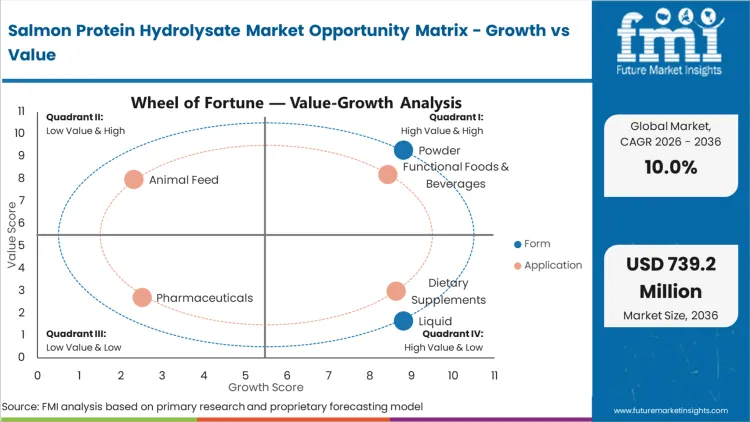
Upcycling physics fundamentally reshapes ingredient procurement, shifting business models from waste management to premium nutrition extraction. Fisheries historically allocated secondary processing biomass to low-value fertilizer, incurring disposal costs. Facility operators now install enzymatic hydrolysis reactors onsite to capture total harvest value. Global aquaculture production hitting a record 130.9 million tonnes provides robust upstream supply for these initiatives [7]. Converting these streams provides aquaculture firms with dual revenue channels and insulates operations against whole-fish price volatility. Formulators gain a consistent, sustainable fish meal alternative isolated from land-based agricultural disruptions. Demonstrating clinical efficacy justifies premium positioning, allowing ingredient manufacturers to target medical nutrition and elite sports categories.
Price disparity relative to conventional plant isolates limits immediate mass-market penetration. Extracting specific peptides via controlled enzymatic cleavage requires specialized bioreactors and high energy consumption, elevating baseline production costs. The structural reality that 51% of total aquatic animal production stems from aquaculture introduces intense competition for marine biomass, driving up initial feedstock pricing for independent processors [8]. Buyers seeking simple macronutrient fortification default to soy or pea derivatives to maintain strict product margins. Suppliers counter margin pressure by financing clinical trials to prove superior biological utilization rates. Operating sophisticated extraction plants requires massive initial capital expenditure, restricting market entry to well-capitalized aquaculture conglomerates.
- Cosmetic convergence: Formulators expand revenue potential beyond ingestion channels by transitioning active ingredients into topical applications, highlighted by Avant launching cultivated marine-peptide-based skincare actives in November 2024 [9].
- Aquafeed optimization: Intensive farming operations substitute generic feed components with specialized marine peptides, demonstrated by Symrise Aqua Feed positioning Actipal as a premium marine hydrolysate for enhanced feed intake and stress resistance [10].
- Export certification alignment: India reporting a marine exports change of +11.08% year-over-year reflects strong trade momentum, forcing processors to secure international food safety certifications to maintain export competitiveness [11].
Regional Analysis
Based on the regional analysis, the Salmon Protein Hydrolysate market is segmented into North America, Latin America, Europe, East Asia, South Asia, Oceania and Middle East & Africa across 40+ countries. The full report also offers market attractiveness analysis based on regional trends.
.webp "Top Country Growth Comparison Salmon Protein Hydrolysate Market Cagr (2026 2036)")
| Country | CAGR (2026 to 2036) |
|---|---|
| India | 12.0% |
| China | 11.2% |
| United States | 10.4% |
| United Kingdom | 9.8% |
| Germany | 9.5% |
| Brazil | 9.1% |
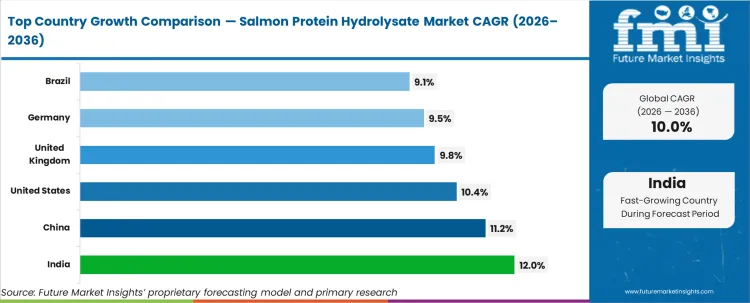
Source: Future Market Insights (FMI) analysis, based on proprietary forecasting model and primary research
Asia Pacific Salmon Protein Hydrolysate Market Analysis
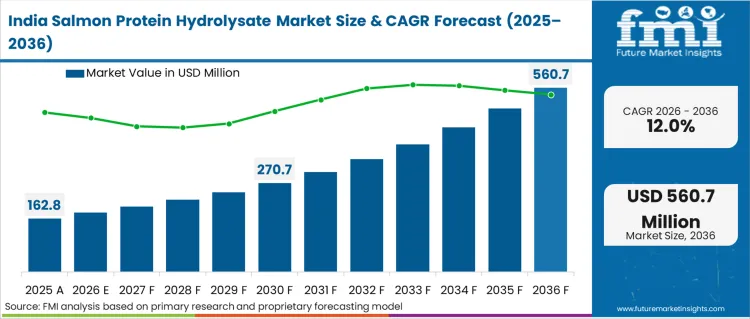
Across Asia Pacific, procurement strategies are increasingly balancing high-performance aquaculture feed requirements with rising demand for human functional nutrition. Aquaculture operators are replacing generic feed inputs with specialized marine peptides to improve yield and disease resistance. India’s total seafood exports reached 16.98 lakh tons in FY 2024 to 2025, highlighting the scale of processing activity that generates substantial by-products suitable for hydrolysate conversion [12]. At the same time, growing disposable incomes in urban centers are strengthening retail demand for traceable, clean-label health supplements.
- India: Expanding seafood processing ecosystems and centralized extraction capacity are reinforcing domestic supply chains for value-added marine ingredients. With total fisheries output volumes reaching 197.75 lakh tonnes in FY 2024 to 2025, feedstock availability for sports nutrition and functional applications continues to improve. As procurement systems mature and downstream deployment accelerates, demand for Salmon Protein Hydrolysate in India is projected to grow at a 12.0% CAGR through 2036.
- China: China is expected to record 11.2% CAGR in Salmon Protein Hydrolysate demand over 2026 to 2036, tightening linkages between operational aquaculture constraints and adoption-led feed investment. High disease pressure forces operators to adopt immune-boosting peptide formulas to secure harvest volumes.
FMI’s report includes comprehensive evaluation across multiple East and South Asian territories. Rising wellness trends across Japan and South Korea elevate cosmetic and dietary supplement standards. Regulatory bodies across Indonesia prioritize traceable, sustainable aquafeed additives, forcing processors to upgrade technological capabilities and secure international food safety certifications.
North America Salmon Protein Hydrolysate Market Analysis
North American operators prioritize clinical substantiation and clean-label declarations to capture value in saturated health retail environments. Consumers scrutinize ingredient origins, pushing formulators away from synthetic additives toward natural marine collagen and peptide derivatives. United States commercial landings reaching 8.4 billion pounds provide localized marine biomass, though specialized salmon inputs rely heavily on integrated Northern supply chains [13]. Brands utilize digital distribution to educate buyers on specific physiological advantages over standard whey proteins.
- United States: United States is projected to post 10.4% CAGR for Salmon Protein Hydrolysate between 2026 and 2036, improving conversion rates from dietary pilot programs to enterprise retail rollouts. Adult demographics requiring targeted muscle retention therapies absorb premium price points, integrating specialized formulations into daily regimens.
FMI’s report includes extensive breakdown of North American supply dynamics. Formulators in Canada actively exploit localized fisheries to build vertically integrated extraction plants. Procurement managers across Mexico monitor cross-border trade agreements, balancing import duties against domestic production costs when scaling functional food manufacturing output.
Europe Salmon Protein Hydrolysate Market Analysis
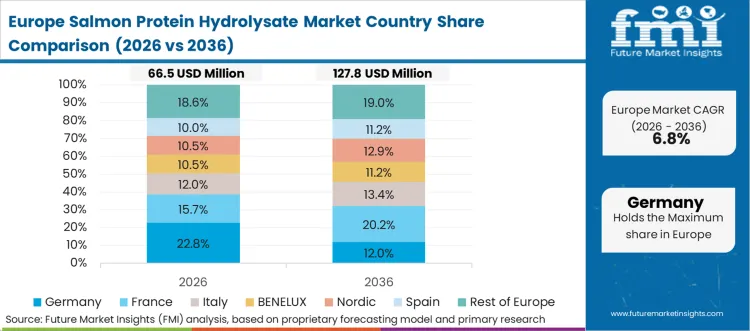
European markets operate under stringent circular economy directives and zero-waste mandates. Authorities penalize biological waste disposal, compelling major processors to install onsite hydrolysis infrastructure. The global food waste benchmark reaching 1.05 billion tonnes highlights legislative urgency surrounding total biomass utilization, forcing regional europe fish meal producers to modernize [14]. According to FMI's estimates, Nordic countries dominate primary supply, utilizing massive local salmon harvests to fuel global ingredient distribution pipelines.
- United Kingdom: The United Kingdom salmon protein hydrolysate segment is gaining momentum as premium healthy aging categories expand and formulators target consumers seeking highly purified active ingredients. Within this evolving landscape, the sector is projected to grow at a 9.8% CAGR between 2026 and 2036, as rising utilization rates support continued investment in upgraded processing technologies.
- Germany: In Germany, demand is strengthening as nutraceutical manufacturers increasingly specify marine peptides to serve aging populations in need of easily digestible protein fractions. This focus on purity, compliance, and supply reliability is expected to drive salmon protein hydrolysate growth at a 9.5% CAGR through 2036.
FMI’s report includes granular tracking of European circular economy mandates. Extraction firms across France target cosmetic peptide applications to diversify revenue streams. Norwegian and Spanish operators dominate upstream supply, investing heavily in automated bioreactors to maximize peptide yield from primary fillet processing lines.
Latin America Salmon Protein Hydrolysate Market Analysis
In Latin America, demand is closely tied to the region’s extensive agricultural and aquaculture networks, which require more advanced nutritional inputs to improve productivity. Feed manufacturers are incorporating marine hydrolysates to support faster growth cycles and reduce dependence on antibiotics. According to FMI projections, producers are also exploring alternatives to traditional fishmeal and fish oil, balancing performance benefits with strict cost controls. To strengthen competitiveness, suppliers are forming localized joint ventures that help bypass import tariffs and reduce exposure to currency volatility.
- Brazil: Brazil is forecast to register 9.1% CAGR in Salmon Protein Hydrolysate sales through 2036, raising addressable pipelines for vendors with local-ready integration. Expanding agricultural sectors utilize marine peptide profiles to optimize animal health and maximize export yields.
FMI’s report includes targeted analysis of Latin American production hubs. Chilean fisheries represent critical upstream nodes, processing massive domestic salmon harvests into stabilized powder exports. Manufacturers in Argentina monitor inflation metrics, adjusting procurement schedules to secure critical feed ingredients before currency fluctuations erode purchasing power.
Competitive Aligners for Market Players
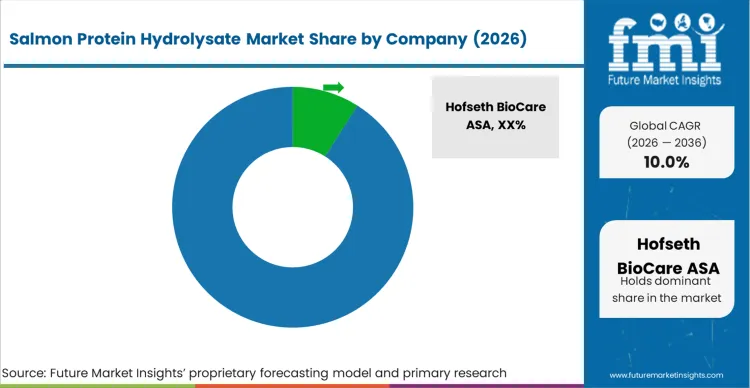
Strategic partnerships determine global market access, allowing independent hydrolysis operators to bypass lengthy qualification periods. Fish processing generates large by-product fractions ranging from 30% to 70% of whole fish, presenting massive margin expansion opportunities for vertically integrated aquaculture operators [15]. Technical innovators secure financial backing and immediate distribution channels by integrating with multinational food conglomerates. Integrated alliances lower customer acquisition costs and guarantee offtake volumes for newly constructed extraction facilities.
Clinical validation serves as primary competitive defense against low-cost commoditization from alternative protein isolates. Symrise receiving recognition in the F3 Challenge context for protein hydrolysate ingredients validates the sustainability-driven adoption pathway reshaping vendor shortlists globally [16]. Formulators lock into long-term contracts when switching suppliers endangers specialized label claims, transitioning ingredients from interchangeable commodities to proprietary assets.
Vertical integration insulates processors from raw material price shocks and secures continuous bioreactor utilization. Mowi reporting an immense harvest volume of 501,530 tonnes in its Integrated Annual Report highlights the massive upstream scale required to dictate stable hydrolysate feedstock economics globally [17]. Standalone extraction companies face severe margin compression when primary salmon harvests decline or fillet demand shifts unexpectedly.
Recent Developments:
The report includes full coverage of key trends from competitive benchmarking. Some of the recent developments covered in the reports:
- In February 2025, Hofseth BioCare signed an exclusive agreement to distribute targeted peptide ingredients into selected Symrise global key accounts [18].
Key Players in Salmon Protein Hydrolysate Market
- Hofseth BioCare ASA
- Symrise AG
- Scanbio Marine Group
- Mowi ASA
- Biomega Group
- Copalis Sea Solutions
- TripleNine Group
- Pelagia AS
Scope of the Report
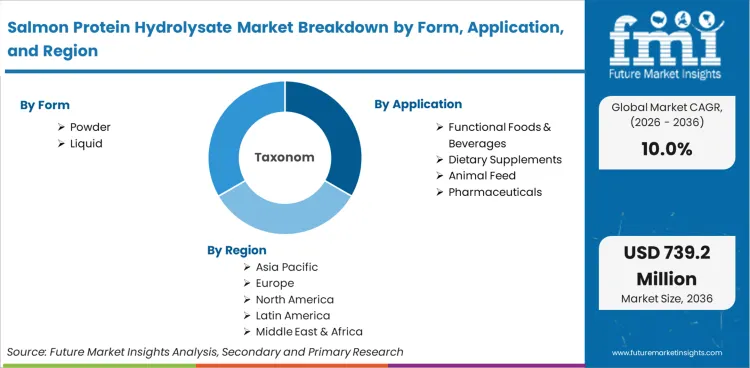
| Metric | Value |
|---|---|
| Quantitative Units | USD 285.0 million (2026) to USD 740.0 million (2036), at a CAGR of 10.0% |
| Market Definition | Salmon protein hydrolysate covers enzymatically processed protein fractions derived specifically from salmon tissues, including meat, skin, and frames, yielding low molecular weight peptides utilized for rapid human or animal absorption. |
| Product Form Segmentation | Powder Hydrolysate, Liquid Hydrolysate |
| Application Segmentation | Functional Foods & Beverages, Dietary Supplements, Animal Feed, Pharmaceuticals, Cosmetics |
| Distribution Channel Segmentation | Online Retail, Supermarkets/Hypermarkets, Specialty Stores, B2B |
| End-User Segmentation | Adults, Geriatric, Pediatric |
| Regions Covered | North America, Latin America, Europe, East Asia, South Asia, Oceania, Middle East and Africa |
| Countries Covered | United States, Canada, Mexico, Brazil, Argentina, Germany, France, United Kingdom, Italy, Spain, China, India, Japan, South Korea, Indonesia, Australia and 40 plus countries |
| Key Companies Profiled | Hofseth BioCare ASA, Symrise AG, Scanbio Marine Group, Mowi ASA, Biomega Group, Copalis Sea Solutions, TripleNine Group, Pelagia AS |
| Forecast Period | 2026 to 2036 |
| Approach | Hybrid top down and bottom up market modeling validated through primary interviews with marine ingredient extractors and clinical nutrition formulators, supported by FAO fisheries output databases |
Salmon Protein Hydrolysate Market Analysis by Segments
Product Form:
- Powder Hydrolysate
- Liquid Hydrolysate
Application:
- Functional Foods & Beverages
- Dietary Supplements
- Animal Feed
- Pharmaceuticals
- Cosmetics
Distribution Channel:
- Online Retail
- Supermarkets/Hypermarkets
- Specialty Stores
- B2B
End-User:
- Adults
- Geriatric
- Pediatric
Region:
- Asia Pacific
- India
- China
- Japan
- South Korea
- Indonesia
- Australia & New Zealand
- ASEAN
- Rest of Asia Pacific
- Europe
- Germany
- Italy
- France
- United Kingdom
- Spain
- Benelux
- Nordics
- Central & Eastern Europe
- Rest of Europe
- North America
- United States
- Canada
- Mexico
- Latin America
- Brazil
- Argentina
- Chile
- Rest of Latin America
- Middle East & Africa
- Kingdom of Saudi Arabia
- United Arab Emirates
- South Africa
- Turkey
- Rest of Middle East & Africa
Bibliography
- [1] FAO. (2024). Global fisheries and aquaculture production reached a record high 223.2M tonnes total.
- [2] Euronext. (2025). Hofseth BioCare ASA (HBC) accelerates human health and pet nutrition strategy.
- [3] FAO GLOBEFISH. (2025). Global salmon supply reported for Jan-Sep 2,019,600 tonnes.
- [4] Hofseth BioCare. (2026). ProGo won NutraIngredients-USA Healthy Aging category.
- [7] FAO. (2024). Global aquaculture production hit a record 130.9M tonnes.
- [8] FAO. (2024). 51% of total aquatic animal production from aquaculture.
- [9] Avant. (2024). Launch of cultivated marine-peptide-based skincare actives.
- [10] Symrise Aqua Feed. (2024). Actipal positioned as premium marine hydrolysate.
- [11] Press Information Bureau, Govt of India. (2025). India marine exports change +11.08%.
- [12] Press Information Bureau, Govt of India. (2026). Seafood export volume FY 2024-25 (16.98 lakh tons).
- [13] NOAA Fisheries. (2026). US commercial landings snapshot 8.4B pounds, $5.1B.
- [14] European Commission. (2025). Global food waste benchmark 1.05B tonnes.
- [15] FAO. (2024). Fish processing generates large by-product fractions (30% to 70%).
- [16] Symrise AG. (2025). F3 Challenge context for protein hydrolysate ingredients.
- [17] Mowi. (2025). Integrated Annual Report 2024 harvest volume (501,530 tonnes).
- [18] Euronext Live. (2025). Hofseth BioCare signs exclusive distribution agreement with Symrise.
This bibliography is provided for reader reference and is not exhaustive. The full report contains the complete reference list and detailed citations.
This Report Addresses
- Market intelligence to enable structured strategic decision making across mature and emerging marine ingredient economies
- Market size estimation and 10-year revenue forecasts from 2026 to 2036, supported by validated capacity and trade benchmarks
- Growth opportunity mapping across powder and liquid forms with emphasis on enzymatic extraction transitions
- Segment and regional revenue forecasts covering functional foods, dietary supplements, animal feed, cosmetics, and pharmaceutical applications
- Competition strategy assessment including integration models, extraction cost positioning, and compliance capability benchmarking
- Product formulation tracking including upcycled marine proteins, bioactive peptide profiles, and clean-label aligned grades
- Regulatory impact analysis covering zero-waste mandates, FDA/EFSA claims substantiation, and export-driven marine sourcing standards
- Market report delivery in PDF, Excel, PPT, and interactive dashboard formats for executive and operational use
Frequently Asked Questions
How large is the demand for Salmon Protein Hydrolysate in the global market in 2026?
Demand for Salmon Protein Hydrolysate in the global market is estimated to be valued at USD 285.0 million in 2026.
What will be the market size of Salmon Protein Hydrolysate in the global market by 2036?
Market size for Salmon Protein Hydrolysate is projected to reach USD 740.0 million by 2036.
What is the expected demand growth for Salmon Protein Hydrolysate in the global market between 2026 and 2036?
Demand for Salmon Protein Hydrolysate in the global market is expected to grow at a CAGR of 10.0% between 2026 and 2036.
Which Product Form is poised to lead global sales by 2026?
Powder Hydrolysate is expected to be the dominant form, capturing approximately 53% of global market share in 2026 due to logistics efficiency and extended shelf stability.
How significant is the role of Functional Foods & Beverages in driving Salmon Protein Hydrolysate adoption in 2026?
Functional Foods & Beverages represents a critical segment, projected to hold a substantial 32% share of the total market in 2026 as consumers prioritize active nutrition over traditional pill formats.
What is driving demand in India?
Expanding processing ecosystems and centralized extraction facility investments support rapid functional ingredient deployment across domestic channels.
What compliance standards or regulations are referenced for India?
India's Seafood Export certification programs are referenced as key compliance benchmarks ensuring origin quality.
What is the India growth outlook in this report?
India is projected to grow at a CAGR of 12.0% during 2026 to 2036.
Why is North America described as a priority region in this report?
Growth is propelled by elevated adult consumer purchasing power and strict requirements for clinically substantiated, clean-label marine ingredients.
What type of demand dominates in North America?
Demand for premium-grade, highly bioavailable peptides for adult muscle retention and healthy aging dominates regional consumption.
What is China growth outlook in this report?
China is projected to expand at a CAGR of 11.2% during 2026 to 2036.
Does the report cover United States in its regional analysis?
United States is included within North America under the regional scope of analysis.
What are the sources referred to for analyzing United States?
Official statistics published by NOAA Fisheries covering commercial landings and aquaculture values are cited as primary reference sources.
What is the main demand theme linked to United States in its region coverage?
North American demand is associated with conversion from dietary pilot programs to enterprise retail rollouts targeting muscle retention therapies.
Does the report cover United Kingdom in its regional analysis?
United Kingdom is included within Europe under the regional coverage framework.
What is the main United Kingdom related demand theme in its region coverage?
Expansion is tied to targeted online sales channels capturing dedicated wellness consumers seeking documented physiological benefits.
Which product formats or configurations are strategically important for Europe supply chains?
Powder formats are prioritized to minimize transport weights and satisfy strict warehouse shelf-life requirements across distribution channels.
What is Salmon Protein Hydrolysate and what is it mainly used for?
Salmon protein hydrolysate is an enzymatically processed protein fraction primarily used as a highly bioavailable ingredient in functional foods, supplements, and premium aquafeed.
What does Salmon Protein Hydrolysate mean in this report?
Salmon protein hydrolysate refers to global production, trade, and commercial consumption of enzymatically cleaved salmon tissues in bulk powder and liquid formats.
What is included in the scope of this Salmon Protein Hydrolysate report?
Scope covers hydrolysate variants, key applications including active nutrition and cosmetics, and distribution through online and commercial B2B channels.
What is excluded from the scope of this report?
Intact salmon fillets, generic marine collagen, and crude fish meal for basic agricultural use are excluded unless part of specialized peptide blends.
What does market forecast mean on this page?
Market forecast represents a model-based projection built on defined assumptions for strategic planning purposes.
How does FMI build and validate the Salmon Protein Hydrolysate forecast?
Forecast is developed using bottom-up demand modeling from beverage production schedules validated against top-down global FAO fisheries output.
What does zero reliance on speculative third party market research mean here?
Primary interviews and verifiable public datasets are used instead of unverified syndicated market estimates.
Preview the report firsthand - request a free sample
Get SampleGet the brochure for pricing and purchase details.
Get PDFTable of Content
- Executive Summary
- Global Market Outlook
- Demand-side Trends
- Supply-side Trends
- Technology Roadmap Analysis
- Analysis and Recommendations
- Market Overview
- Market Coverage / Taxonomy
- Market Definition / Scope / Limitations
- Research Methodology
- Chapter Orientation
- Analytical Lens and Working Hypotheses
- Market Structure, Signals, and Trend Drivers
- Benchmarking and Cross-market Comparability
- Market Sizing, Forecasting, and Opportunity Mapping
- Research Design and Evidence Framework
- Desk Research Programme (Secondary Evidence)
- Company Annual and Sustainability Reports
- Peer-reviewed Journals and Academic Literature
- Corporate Websites, Product Literature, and Technical Notes
- Earnings Decks and Investor Briefings
- Statutory Filings and Regulatory Disclosures
- Technical White Papers and Standards Notes
- Trade Journals, Industry Magazines, and Analyst Briefs
- Conference Proceedings, Webinars, and Seminar Materials
- Government Statistics Portals and Public Data Releases
- Press Releases and Reputable Media Coverage
- Specialist Newsletters and Curated Briefings
- Sector Databases and Reference Repositories
- FMI Internal Proprietary Databases and Historical Market Datasets
- Subscription Datasets and Paid Sources
- Social Channels, Communities, and Digital Listening Inputs
- Additional Desk Sources
- Expert Input and Fieldwork (Primary Evidence)
- Primary Modes
- Qualitative Interviews and Expert Elicitation
- Quantitative Surveys and Structured Data Capture
- Blended Approach
- Why Primary Evidence is Used
- Field Techniques
- Interviews
- Surveys
- Focus Groups
- Observational and In-context Research
- Social and Community Interactions
- Stakeholder Universe Engaged
- C-suite Leaders
- Board Members
- Presidents and Vice Presidents
- R&D and Innovation Heads
- Technical Specialists
- Domain Subject-matter Experts
- Scientists
- Physicians and Other Healthcare Professionals
- Governance, Ethics, and Data Stewardship
- Research Ethics
- Data Integrity and Handling
- Primary Modes
- Tooling, Models, and Reference Databases
- Desk Research Programme (Secondary Evidence)
- Data Engineering and Model Build
- Data Acquisition and Ingestion
- Cleaning, Normalisation, and Verification
- Synthesis, Triangulation, and Analysis
- Quality Assurance and Audit Trail
- Market Background
- Market Dynamics
- Drivers
- Restraints
- Opportunity
- Trends
- Scenario Forecast
- Demand in Optimistic Scenario
- Demand in Likely Scenario
- Demand in Conservative Scenario
- Opportunity Map Analysis
- Product Life Cycle Analysis
- Supply Chain Analysis
- Investment Feasibility Matrix
- Value Chain Analysis
- PESTLE and Porter’s Analysis
- Regulatory Landscape
- Regional Parent Market Outlook
- Production and Consumption Statistics
- Import and Export Statistics
- Market Dynamics
- Global Market Analysis 2021 to 2025 and Forecast, 2026 to 2036
- Historical Market Size Value (USD Million) Analysis, 2021 to 2025
- Current and Future Market Size Value (USD Million) Projections, 2026 to 2036
- Y-o-Y Growth Trend Analysis
- Absolute $ Opportunity Analysis
- Global Market Pricing Analysis 2021 to 2025 and Forecast 2026 to 2036
- Global Market Analysis 2021 to 2025 and Forecast 2026 to 2036, By Form
- Introduction / Key Findings
- Historical Market Size Value (USD Million) Analysis By Form , 2021 to 2025
- Current and Future Market Size Value (USD Million) Analysis and Forecast By Form , 2026 to 2036
- Powder
- Liquid
- Powder
- Y-o-Y Growth Trend Analysis By Form , 2021 to 2025
- Absolute $ Opportunity Analysis By Form , 2026 to 2036
- Global Market Analysis 2021 to 2025 and Forecast 2026 to 2036, By Application
- Introduction / Key Findings
- Historical Market Size Value (USD Million) Analysis By Application, 2021 to 2025
- Current and Future Market Size Value (USD Million) Analysis and Forecast By Application, 2026 to 2036
- Functional Foods & Beverages
- Dietary Supplements
- Animal Feed
- Pharmaceuticals
- Functional Foods & Beverages
- Y-o-Y Growth Trend Analysis By Application, 2021 to 2025
- Absolute $ Opportunity Analysis By Application, 2026 to 2036
- Global Market Analysis 2021 to 2025 and Forecast 2026 to 2036, By Region
- Introduction
- Historical Market Size Value (USD Million) Analysis By Region, 2021 to 2025
- Current Market Size Value (USD Million) Analysis and Forecast By Region, 2026 to 2036
- North America
- Latin America
- Western Europe
- Eastern Europe
- East Asia
- South Asia and Pacific
- Middle East & Africa
- Market Attractiveness Analysis By Region
- North America Market Analysis 2021 to 2025 and Forecast 2026 to 2036, By Country
- Historical Market Size Value (USD Million) Trend Analysis By Market Taxonomy, 2021 to 2025
- Market Size Value (USD Million) Forecast By Market Taxonomy, 2026 to 2036
- By Country
- USA
- Canada
- Mexico
- By Form
- By Application
- By Country
- Market Attractiveness Analysis
- By Country
- By Form
- By Application
- Key Takeaways
- Latin America Market Analysis 2021 to 2025 and Forecast 2026 to 2036, By Country
- Historical Market Size Value (USD Million) Trend Analysis By Market Taxonomy, 2021 to 2025
- Market Size Value (USD Million) Forecast By Market Taxonomy, 2026 to 2036
- By Country
- Brazil
- Chile
- Rest of Latin America
- By Form
- By Application
- By Country
- Market Attractiveness Analysis
- By Country
- By Form
- By Application
- Key Takeaways
- Western Europe Market Analysis 2021 to 2025 and Forecast 2026 to 2036, By Country
- Historical Market Size Value (USD Million) Trend Analysis By Market Taxonomy, 2021 to 2025
- Market Size Value (USD Million) Forecast By Market Taxonomy, 2026 to 2036
- By Country
- Germany
- UK
- Italy
- Spain
- France
- Nordic
- BENELUX
- Rest of Western Europe
- By Form
- By Application
- By Country
- Market Attractiveness Analysis
- By Country
- By Form
- By Application
- Key Takeaways
- Eastern Europe Market Analysis 2021 to 2025 and Forecast 2026 to 2036, By Country
- Historical Market Size Value (USD Million) Trend Analysis By Market Taxonomy, 2021 to 2025
- Market Size Value (USD Million) Forecast By Market Taxonomy, 2026 to 2036
- By Country
- Russia
- Poland
- Hungary
- Balkan & Baltic
- Rest of Eastern Europe
- By Form
- By Application
- By Country
- Market Attractiveness Analysis
- By Country
- By Form
- By Application
- Key Takeaways
- East Asia Market Analysis 2021 to 2025 and Forecast 2026 to 2036, By Country
- Historical Market Size Value (USD Million) Trend Analysis By Market Taxonomy, 2021 to 2025
- Market Size Value (USD Million) Forecast By Market Taxonomy, 2026 to 2036
- By Country
- China
- Japan
- South Korea
- By Form
- By Application
- By Country
- Market Attractiveness Analysis
- By Country
- By Form
- By Application
- Key Takeaways
- South Asia and Pacific Market Analysis 2021 to 2025 and Forecast 2026 to 2036, By Country
- Historical Market Size Value (USD Million) Trend Analysis By Market Taxonomy, 2021 to 2025
- Market Size Value (USD Million) Forecast By Market Taxonomy, 2026 to 2036
- By Country
- India
- ASEAN
- Australia & New Zealand
- Rest of South Asia and Pacific
- By Form
- By Application
- By Country
- Market Attractiveness Analysis
- By Country
- By Form
- By Application
- Key Takeaways
- Middle East & Africa Market Analysis 2021 to 2025 and Forecast 2026 to 2036, By Country
- Historical Market Size Value (USD Million) Trend Analysis By Market Taxonomy, 2021 to 2025
- Market Size Value (USD Million) Forecast By Market Taxonomy, 2026 to 2036
- By Country
- Kingdom of Saudi Arabia
- Other GCC Countries
- Turkiye
- South Africa
- Other African Union
- Rest of Middle East & Africa
- By Form
- By Application
- By Country
- Market Attractiveness Analysis
- By Country
- By Form
- By Application
- Key Takeaways
- Key Countries Market Analysis
- USA
- Pricing Analysis
- Market Share Analysis, 2025
- By Form
- By Application
- Canada
- Pricing Analysis
- Market Share Analysis, 2025
- By Form
- By Application
- Mexico
- Pricing Analysis
- Market Share Analysis, 2025
- By Form
- By Application
- Brazil
- Pricing Analysis
- Market Share Analysis, 2025
- By Form
- By Application
- Chile
- Pricing Analysis
- Market Share Analysis, 2025
- By Form
- By Application
- Germany
- Pricing Analysis
- Market Share Analysis, 2025
- By Form
- By Application
- UK
- Pricing Analysis
- Market Share Analysis, 2025
- By Form
- By Application
- Italy
- Pricing Analysis
- Market Share Analysis, 2025
- By Form
- By Application
- Spain
- Pricing Analysis
- Market Share Analysis, 2025
- By Form
- By Application
- France
- Pricing Analysis
- Market Share Analysis, 2025
- By Form
- By Application
- India
- Pricing Analysis
- Market Share Analysis, 2025
- By Form
- By Application
- ASEAN
- Pricing Analysis
- Market Share Analysis, 2025
- By Form
- By Application
- Australia & New Zealand
- Pricing Analysis
- Market Share Analysis, 2025
- By Form
- By Application
- China
- Pricing Analysis
- Market Share Analysis, 2025
- By Form
- By Application
- Japan
- Pricing Analysis
- Market Share Analysis, 2025
- By Form
- By Application
- South Korea
- Pricing Analysis
- Market Share Analysis, 2025
- By Form
- By Application
- Russia
- Pricing Analysis
- Market Share Analysis, 2025
- By Form
- By Application
- Poland
- Pricing Analysis
- Market Share Analysis, 2025
- By Form
- By Application
- Hungary
- Pricing Analysis
- Market Share Analysis, 2025
- By Form
- By Application
- Kingdom of Saudi Arabia
- Pricing Analysis
- Market Share Analysis, 2025
- By Form
- By Application
- Turkiye
- Pricing Analysis
- Market Share Analysis, 2025
- By Form
- By Application
- South Africa
- Pricing Analysis
- Market Share Analysis, 2025
- By Form
- By Application
- USA
- Market Structure Analysis
- Competition Dashboard
- Competition Benchmarking
- Market Share Analysis of Top Players
- By Regional
- By Form
- By Application
- Competition Analysis
- Competition Deep Dive
- Hofseth BioCare ASA
- Overview
- Product Portfolio
- Profitability by Market Segments (Product/Age /Sales Channel/Region)
- Sales Footprint
- Strategy Overview
- Marketing Strategy
- Product Strategy
- Channel Strategy
- Symrise AG
- Scanbio Marine Group
- Mowi ASA
- Biomega Group
- Copalis Sea Solutions
- TripleNine Group
- Hofseth BioCare ASA
- Competition Deep Dive
- Assumptions & Acronyms Used


