

- Market Size (2026)
- USD 920.7 Mn
- Forecast (2036)
- USD 1514.1 Mn
- CAGR (2026 to 2036)
- 5.1%
How big is Radius Rods Market in 2026?
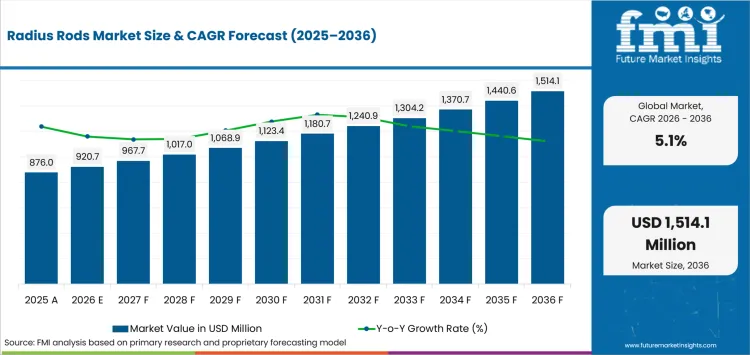
USD 920.7 million in 2026 and USD 1514.1 million by 2036 at a 5.1% CAGR.
Demand for radius rods is projected to expand at 5.1% CAGR between 2026 and 2036, increasing valuation from USD 920.7 million in 2026 to USD 1514.1 million by 2036. Revenue follows the need to hold an axle in its intended path under acceleration and braking loads across heavy vehicles and off-highway equipment.
Commercial-vehicle suspension suppliers continue to treat torque rods as an engineered part of the axle-control system. Hendrickson stated in February 2026 that its CONEXPO-CON/AGG display would pair TRAAX ROD torque rods with HAULMAAX EX and PRIMAAX EX vocational suspensions. The same announcement highlighted premium rubber torque-rod bushings as a way to reduce downtime and extend component life, showing why rod geometry and bushing behavior are purchased together in severe-duty fleets.
Key Takeaways of Radius Rods Market
- Radius rod demand follows commercial-vehicle production and service cycles because axle position must remain controlled through repeated braking and drive loads.
- Fixed radius rods are projected at 29.0% share of rod type demand in 2026 owing to repeatable geometry in established suspension packages.
- Heavy trucks are estimated at 34.0% of vehicle type demand in 2026 as axle loads and annual utilization increase fatigue exposure.
- Forged steel is forecast at 51.0% of material demand in 2026 because structural strength and fatigue resistance remain central qualification tests.
- OEM supply is projected at 39.0% of sales channel demand, while axle location accounts for 38.0% of application demand in 2026.
- Fitment accuracy and bushing specifications slow supplier switching when a replacement part cannot be matched to the intended suspension geometry.
- Hendrickson, ZF Friedrichshafen AG, Cummins Inc. through Meritor, Tenneco Inc., Sampa Automotive, Dayton Parts LLC and Ferdinand Bilstein GmbH + Co. KG participate through direct rod offerings or relevant heavy-vehicle suspension channels.
Analyst Perspective
"A radius rod creates value only when its geometry and bushing behavior match the axle it is controlling. Suppliers that document fitment clearly and keep service stock close to fleet workshops can compete on uptime instead of relying on unit price."
- Nikhil Kaitwade, Principal Consultant, Future Market Insights
How is the Radius Rods Market segmented?
The radius rods market is segmented by rod type, vehicle type, material, sales channel, application and region.
Rod Type distinguishes fixed geometry from adjustable and heavy-duty axle-control designs. Vehicle Type separates trucks from trailers, buses, off-highway equipment and passenger vehicles. Material captures load and mass trade-offs, while Sales Channel separates original fitment from replacement demand. Application covers axle location, torque control, suspension alignment and vibration control. These functions sit within the wider automotive suspension value chain, but radius-rod purchasing remains tied to exact center-to-center dimensions and joint specifications.
Why does axle location account for 38.0% of the application category?
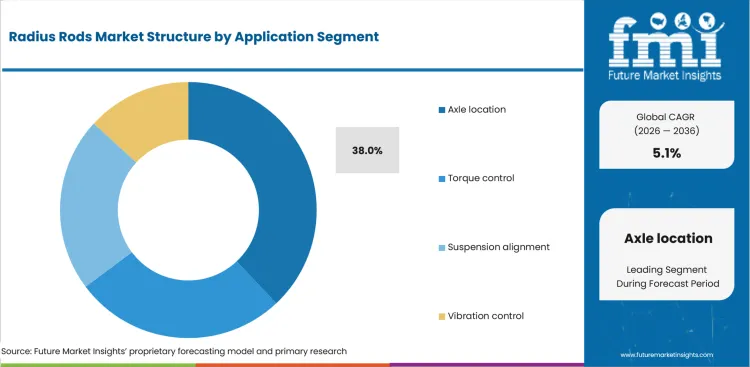
Axle location is the basic mechanical job that makes a radius rod necessary. The link controls longitudinal or angular movement so braking and drive forces do not move the axle outside its designed path. Torque control and alignment follow from the same geometry. This makes radius rods closely related to the automotive axle market, although the radius-rod revenue boundary excludes complete axle assemblies.
- Axle location is forecast to account for 38.0% of application demand in 2026 because maintaining the designed axle path is the first structural requirement of the link.
- ZF Aftermarket describes commercial-vehicle torque rods as connections between axles and the chassis, while LEMFÖRDER V-links are offered for truck and bus chassis applications.
Why do fixed radius rods account for 29.0% of the rod type category?
Fixed radius rods suit applications where axle geometry is predetermined during suspension design. A fixed center-to-center length removes an adjustment step during assembly and keeps the intended axle position repeatable across production vehicles. Adjustable rods remain useful when alignment correction is required, while V-rods and other heavy-duty forms solve related force-control requirements in severe service.
- Based on rod type, fixed radius rods are projected to account for 29.0% in 2026 because repeatable geometry supports validated OEM fitment and consistent replacement.
- Hendrickson continues to position TRAAX ROD torque rods alongside vocational suspension systems, reinforcing the role of matched axle-control links in heavy-duty packages.
Why do heavy trucks account for 34.0% of the vehicle type category?
Heavy trucks expose radius rods to sustained axle load and repeated torque reaction during acceleration or braking. High annual mileage creates further wear at bushings and mounting points, so first-fit demand is reinforced by service replacement. The broader heavy duty trucks market therefore provides a direct installed-base signal for radius-rod suppliers even when truck sales move through cyclical periods.
- In 2026, heavy trucks are expected to account for 34.0% of vehicle type demand as high axle loads and fleet utilization raise the consequence of worn suspension links.
- ANFAVEA reported 113,477 Brazilian truck registrations during 2025, illustrating the size of one national fleet-renewal channel even after registrations declined from the prior year
Why does forged steel account for 51.0% of the material category?
Forged steel fits radius-rod duty where the component must carry alternating tension and compression without losing dimensional stability. Buyers accept the mass penalty when fatigue life and impact tolerance carry more weight than lightweighting. Aluminum and composite designs can reduce mass, but each joint and bushing interface requires its own validation path before a fleet or OEM can treat the material change as equivalent.
- The material category is forecast to place forged steel at 51.0% share in 2026 because repeated structural loading makes fatigue resistance a primary purchase criterion.
- Dayton Parts lists steel construction for its 345-801 axle torque rod, while Sampa states that its V-rods and torque rods use controlled alloy specifications with material integrity testing.
Why does OEM supply account for 39.0% of the sales channel category?
OEM supply begins when suspension geometry is fixed during vehicle engineering. Vehicle and axle suppliers can validate mounting points before production, then control the same dimensional specification across the platform life. That early approval raises switching costs once a chassis enters serial production. Replacement channels remain important later, but their catalog logic still depends on the original geometry established upstream.
- OEM supply is likely to represent 39.0% of sales channel demand in 2026 because radius-rod interfaces are defined during chassis and suspension development.
- Tenneco lists torque rods and V-rods within its commercial vehicle and off-highway NVH portfolio, showing how suspension-link design can enter vehicle programs through engineered supplier relationships.
What are the drivers, restraints and opportunities in the Radius Rods Market?
Heavy-vehicle duty cycles sustain first-fit and replacement demand, while fitment requirements slow substitution and service-ready assemblies create a practical aftermarket opening.
- Driver: Commercial fleets create recurring axle-control demand as heavy loads and annual mileage increase wear exposure.
- Restraint: Exact rod length and joint specifications raise qualification costs when alternative parts lack proven application compatibility.
- Opportunity: Pre-assembled replacement rods can shorten workshop time when dimensional data and cross-references are clear.
Heavy-vehicle utilization keeps radius rods exposed to the same force path throughout the working life of a truck. FHWA data for 2024 show more than 16.0 million registered single-unit heavy trucks and combination trucks in the USA. A large active fleet supports repeat suspension inspection and replacement even when new-vehicle cycles soften. Similar replacement logic also supports demand for torque rod bush products when wear is concentrated at the elastomeric joint rather than the structural rod.
Fitment is the main restraint because a visually similar rod can still carry the wrong center-to-center length or bushing orientation. Hendrickson places torque rods within defined vocational suspension packages, while ZF treats V-links as safety-relevant chassis parts. This system context makes unverified substitution risky for OEM engineers and fleet workshops. Suppliers therefore need application data that can be checked before installation instead of relying on broad part-family similarity.
The aftermarket opportunity is strongest where suppliers remove labor or identification steps without changing the approved geometry. Dayton Parts offers axle torque rods with pre-installed bushings, while Sampa publishes dimensional control and bushing assembly details for its V-rods and torque rods. Clear cross-references also matter because worn links are often replaced alongside suspension bushings. Suppliers that place service stock near fleet corridors can convert that maintenance need into repeat orders.
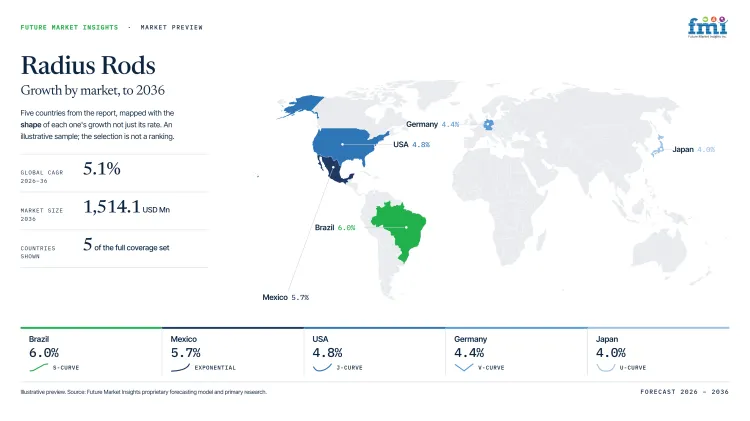
Which country CAGRs are included in the Radius Rods Market?
| Country | CAGR |
|---|---|
| Brazil | 6.0% |
| Mexico | 5.7% |
| South Africa | 5.4% |
| South Korea | 5.1% |
| USA | 4.8% |
| Germany | 4.4% |
| Japan | 4.0% |
How do country-level CAGRs compare in the Radius Rods Market?
The seven country CAGRs span 2.0 percentage points, from 4.0% to 6.0%. The spacing reflects different truck-production cycles and replacement-channel conditions rather than current market value within each country.
- Brazil is set to expand at 6.0% CAGR as road-freight demand and a sizeable truck base sustain both OEM and service requirements.
- Mexico is anticipated to grow at 5.7% as heavy-vehicle manufacturing and North American export exposure keep suspension sourcing tied to production programs.
- South Africa is expected to advance at 5.4%, with workshop availability and severe-duty durability carrying more weight across long-distance fleets.
- South Korea is likely to grow at 5.1% as domestic vehicle manufacturing keeps supplier qualification close to established chassis programs.
- USA is set to expand at 4.8%, supported by a broad installed truck base that creates recurring inspection and replacement demand.
- Germany is anticipated to grow at 4.4% as mature truck and bus fleets emphasize documented fitment and service life.
- Japan is expected to advance at 4.0%, with platform-specific quality requirements shaping a more selective replacement channel.
Comparable CAGRs can lead to different commercial entry conditions. The full report therefore reads growth rates alongside vehicle production and fleet activity, then tests whether suppliers can qualify the correct geometry and keep parts available through regional service networks.
Country-wise Analysis
- Brazilian radius-rod demand is tied to a road-freight system where truck utilization creates repeated suspension loads across line-haul and vocational duty. Brazil is set to grow at 6.0% CAGR through 2036. ANFAVEA reported 113,477 truck registrations in 2025, down 9.2% from 2024, so suppliers need inventory planning that can absorb vehicle-cycle swings while still serving an active installed fleet.
- USA fleets create a broad service base because heavy trucks operate across long-haul and vocational applications with different axle packages. USA is likely to expand at 4.8% CAGR through 2036.
- Japanese buyers place strong weight on exact fit and established quality performance when commercial-vehicle suspension parts are replaced. Japan is anticipated to grow at 4.0% CAGR through 2036. JADA reported 75,689 large and medium truck registrations during 2025, supporting a mature service base where inaccurate interchange information can quickly undermine supplier acceptance.
- Mexico combines domestic heavy-vehicle demand with a manufacturing base closely connected to the USA. Mexico is set to grow at 5.7% CAGR through 2036. INEGI reported 113,931 heavy-vehicle exports in 2025, down 28.6%, with the USA taking 94.2% of shipments, which leaves component suppliers exposed to North American production cycles and OEM call-off changes.
- German radius-rod demand comes from a mature truck and bus market where chassis documentation has a direct role in replacement approval. Germany is expected to expand at 4.4% CAGR through 2036. VDA reported 295,595 new truck registrations in 2025 and a 6.7% annual decline, so suppliers need a balance between OEM qualification and service coverage for an established vehicle base.
- South Korean demand is shaped by domestic vehicle manufacturing and concentrated supplier relationships. South Korea is likely to grow at 5.1% CAGR through 2036. The Ministry of Trade, Industry and Energy reported 388,000 domestic vehicle sales in the first quarter of 2025, up 2.7% year over year, while qualification requirements keep new suspension-component suppliers dependent on early engineering access.
- South African fleets place a premium on durable suspension parts and dependable replacement access across long-distance operating routes. South Africa is anticipated to grow at 5.4% CAGR through 2036. naamsa data for 2025 show 30,911 medium and heavy commercial vehicles plus buses sold, making severe-duty bushing life and distributed service stock practical purchase considerations.
Who are the notable companies in the Radius Rods Market?
Hendrickson, ZF Friedrichshafen AG, Cummins Inc. through Meritor, Tenneco Inc., Sampa Automotive, Dayton Parts LLC and Ferdinand Bilstein GmbH + Co. KG are notable companies serving radius-rod or closely related heavy-vehicle suspension channels.
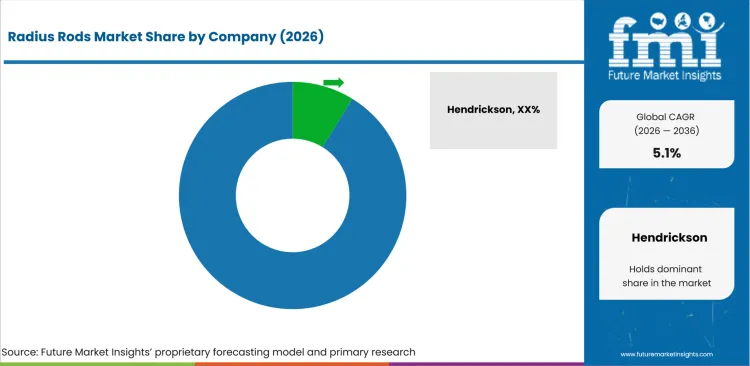
Competition separates suppliers with direct torque-rod or V-rod products from companies that participate through broader axle and commercial-vehicle service networks. Hendrickson, ZF, Tenneco, Sampa and Dayton Parts have direct public evidence around torque rods or V-links. Cummins participates through Meritor axle and aftermarket capabilities. febi adds broad commercial-vehicle replacement reach, but direct radius-rod breadth is left unscored where current public evidence is not specific enough.
- Direct suspension-link suppliers: Hendrickson, ZF Friedrichshafen AG, Tenneco Inc., Sampa Automotive and Dayton Parts LLC compete through documented torque-rod, V-rod or axle-link offerings.
- Integrated commercial-vehicle systems: Cummins Inc. through Meritor brings axle engineering and aftermarket access that can influence radius-rod sourcing around complete chassis programs.
- Independent aftermarket coverage: Ferdinand Bilstein GmbH + Co. KG supports truck steering and suspension replacement through febi, with direct radius-rod breadth scored only where product evidence is explicit.
Competitive Benchmarking: Radius Rods Market
| Company | Direct radius / torque-rod offering | Axle systems | Aftermarket replacement support | Geographic Reach |
|---|---|---|---|---|
| Hendrickson | High | High | High | North America and documented international commercial-vehicle markets |
| ZF Friedrichshafen AG | High | High | High | Global commercial-vehicle and aftermarket markets |
| Cummins Inc. / Meritor | Unscored | High | High | Global truck, trailer and off-highway customer base |
| Tenneco Inc. | High | Medium | Medium | Commercial-vehicle and off-highway markets |
| Sampa Automotive | High | Medium | High | International heavy-vehicle aftermarket |
| Dayton Parts LLC | High | Medium | High | North American heavy-duty replacement market |
| Ferdinand Bilstein GmbH + Co. KG | Unscored | Medium | High | International commercial-vehicle aftermarket |
Key Developments in the Radius Rods Market
- In February 2026, Hendrickson announced that TRAAX ROD torque rods would be displayed with HAULMAAX EX and PRIMAAX EX vocational suspensions at CONEXPO-CON/AGG. The company also highlighted premium torque-rod bushings as a maintenance-related feature for severe-duty fleets.
- In February 2026, ZF Friedrichshafen AG secured a multi-year order for several thousand AxTrax 2 LF electric portal axles for city buses in India. The axle integrates propulsion with braking and suspension functions, raising the importance of validated interfaces around axle location as vehicle architectures become more integrated.
- In April 2025, Tenneco's Clevite Elastomers business showcased its NVH and thermal isolation solutions for EVs and other automotive applications at Auto Shanghai. Highlighted products included advanced Hydroelastic hydraulic bushings, suspension top mounts and bushing systems, e-compressor isolators, exhaust isolators, and thermal isolators for light and commercial vehicles.
Key Players in the Radius Rods Market
Direct Suspension-Link Suppliers
- Hendrickson
- ZF Friedrichshafen AG
- Tenneco Inc.
- Sampa Automotive
- Dayton Parts LLC
Commercial-Vehicle Axle and Systems Supplier
- Cummins Inc. / Meritor
Independent Aftermarket Specialist
- Ferdinand Bilstein GmbH + Co. KG (febi)
Radius Rods Market - Report Scope
| Coverage field | Report scope |
|---|---|
| Market breakdown | By rod type, vehicle type, material, sales channel, application and region. |
| Quantitative Units | Revenue in USD million and CAGR in %. |
| Market Definition | Radius rods, torque rods, V-rods and related bushed axle-control links sold for axle location or torque control in covered vehicle applications. Complete axles, complete suspension systems, steering tie rods and standalone bushings sold outside covered rod assemblies are excluded. |
| Regions Covered | North America, Latin America, Europe, East Asia, South Asia and Pacific, and Middle East and Africa. |
| Countries Covered | Brazil, Mexico, South Africa, South Korea, USA, Germany, Japan, and 20+ additional countries included in the full report. |
| Key Companies | Hendrickson, ZF Friedrichshafen AG, Cummins Inc. / Meritor, Tenneco Inc., Sampa Automotive, Dayton Parts LLC, Ferdinand Bilstein GmbH + Co. KG. |
| Forecast Period | 2026 to 2036. |
| Approach | Primary and secondary research with market triangulation. |
Radius Rods Market - Research Methodology
| Method | Approach |
|---|---|
| Primary Research | FMI analysts gathered input from component manufacturers and distributors, vehicle-system suppliers, fleet maintenance participants, procurement teams and technical specialists. Interviews examined buying criteria, replacement triggers, fitment approval, pricing considerations and the evidence required before a trial supplier becomes a regular source. |
| Desk Research | Desk research covered government vehicle statistics, automotive associations, technical literature, company filings, official product pages and corporate announcements. Evidence was reviewed for date, geographic relevance and direct connection to radius rods or the heavy-vehicle suspension systems in which they operate. |
| Market Sizing and Forecasting | The market model combined the 2026 baseline with segment structure, vehicle activity, OEM and replacement demand, material mix, channel conditions and country-level growth assumptions. Adjacent axle and complete suspension revenue was kept outside the market boundary. |
| Data Validation | Estimates were checked against independent vehicle indicators and current company activity. Validation also tested whether each product sat inside the defined radius-rod boundary and whether company claims referred to production or replacement availability rather than adjacent steering components. |
Radius Rods Market by Segments
Radius Rods Market segmented by Rod Type:
- Fixed radius rods
- Adjustable radius rods
- Torque rods
- Heavy-duty suspension rods
- Bushed radius rod assemblies
Radius Rods Market segmented by Vehicle Type:
- Heavy trucks
- Trailers
- Buses
- Off-highway equipment
- Passenger vehicles
Radius Rods Market segmented by Material:
- Forged steel
- Cast steel
- Aluminum alloy
- Composite / hybrid
Radius Rods Market segmented by Sales Channel:
- OEM supply
- Aftermarket replacement
- Fleet maintenance
- MRO distributors
Radius Rods Market segmented by Application:
- Axle location
- Torque control
- Suspension alignment
- Vibration control
Radius Rods Market by Region:
- North America
- United States
- Canada
- Latin America
- Brazil
- Mexico
- Argentina
- Chile
- Rest of Latin America
- Western Europe
- Germany
- United Kingdom
- France
- Italy
- Spain
- Nordics
- Benelux
- Rest of Western Europe
- Eastern Europe
- Poland
- Czech Republic
- Romania
- Hungary
- Rest of Eastern Europe
- East Asia
- China
- Japan
- South Korea
- South Asia and Pacific
- India
- ASEAN
- Australia and New Zealand
- Rest of South Asia and Pacific
- Middle East and Africa
- Kingdom of Saudi Arabia
- Other GCC Countries
- Türkiye
- South Africa
- Other African Union Countries
- Rest of Middle East and Africa
Research Sources and Bibliography
- Federal Highway Administration. (2026, January). State Motor-Vehicle Registrations - 2024, Table MV-1, Highway Statistics 2024.
- ANFAVEA. (2026, January 15). Produção e venda de autoveículos crescem em 2025 e Anfavea projeta nova alta em 2026.
- Japan Automobile Dealers Association. (2026, January). 2025 large and medium truck registration statistics.
- INEGI. (2026, January 12). Registro Administrativo de la Industria Automotriz de Vehículos Pesados, diciembre de 2025.
- German Association of the Automotive Industry (VDA). (2026). New registrations, annual figures for 2025.
- Ministry of Trade, Industry and Energy, Republic of Korea. (2025, April 15). 2025 Q1 automotive industry trends.
- naamsa | The Automotive Business Council. (2026). Automotive Export Manual and 2025 commercial-vehicle statistics.
- Hendrickson. (2026, February 25). Hendrickson to Showcase Advanced Vocational Suspension Solutions at CONEXPO-CON/AGG 2026.
- ZF Friedrichshafen AG. (2026, February 16). AxTrax 2 LF: ZF Secures Major India City Bus Order.
- Cummins Inc. (2022, August 3). Cummins completes acquisition of Meritor.
- Ferdinand Bilstein GmbH + Co. KG. (2024, December 19). febi Launches Universal Parts Go2Market Kit & 3D Easy Search Tool.
- Tenneco Inc. (2025, April 23). Clevite Elastomers Showcasing NVH and Thermal Isolation Solutions for EVs During Auto Shanghai.
- Tenneco Inc. (Accessed 2026, August 18). Tenneco NVH Solutions, commercial vehicles and off-highway portfolio.
- Sampa Automotive. (Accessed 2026, August 18). V-Rod & Torque Rods.
- Dayton Parts LLC. (Accessed 2026, August 18). Suspension - Axle Torque Rod, 345-801.
- ZF Aftermarket. (Accessed 2026, August 18). Steering and Chassis Parts for Trucks, Trailers and Buses.
This bibliography is provided for reader reference and is not exhaustive. The full report contains the complete reference list and detailed citations.
This Report Answers
- How large is the Radius Rods Market in 2026 and 2036?
- Which operating conditions support recurring radius-rod demand in heavy vehicles?
- Which rod type accounts for 29.0% of demand in 2026?
- How does heavy-truck use shape radius-rod demand?
- Why does forged steel account for 51.0% of material demand?
- How do country growth rates affect supplier entry conditions?
- Which companies serve direct radius-rod and related heavy-vehicle suspension channels?
- Which fitment constraints limit substitution in OEM and replacement applications?
Frequently Asked Questions
How big is the Radius Rods Market in 2026?
USD 920.7 million represents the radius rods market value in 2026 across OEM and replacement applications. Demand is expected to reach USD 1514.1 million by 2036 as commercial-vehicle production and lifecycle service keep axle-control links in recurring procurement cycles.
What is the CAGR of the Radius Rods Market from 2026 to 2036?
A 5.1% CAGR is projected for the radius rods market between 2026 and 2036. Growth depends on heavy-vehicle utilization and replacement demand, while fitment qualification limits rapid supplier switching across established axle and suspension packages.
Which rod type is projected to account for 29.0% of the Radius Rods Market?
Fixed radius rods are projected to account for 29.0% of rod type demand in 2026. Their predetermined geometry suits repeat production fitments and service positions where the correct center-to-center length has already been validated for the suspension package.
How much will the Radius Rods Market add between 2026 and 2036?
USD 593.4 million is expected to be added to the radius rods market between 2026 and 2036. The increase is tied to commercial-vehicle activity and replacement cycles, with value capture depending on fitment accuracy and dependable service availability.
Which companies are active in the Radius Rods Market?
Companies active in direct radius-rod or closely related heavy-vehicle suspension channels include Hendrickson, ZF Friedrichshafen AG, Cummins Inc. through Meritor, Tenneco Inc., Sampa Automotive, Dayton Parts LLC and Ferdinand Bilstein GmbH + Co. KG. Their roles range from engineered suspension links to axle systems and replacement distribution.
Preview the report firsthand - request a free sample
Get SampleGet the brochure for pricing and purchase details.
Get PDFTable of Content
- Key Takeaways
- Market Size and CAGR
- Top Growth Driver
- Fastest Growing Segment
- Leading Region
- Key Companies
- Emerging Opportunities
- Executive Summary
- Global Market Outlook
- Demand-side Trends
- Supply-side Trends
- Technology Roadmap Analysis
- Analysis and Recommendations
- Analyst Perspective (What is happening? Why now? What should investors know?)
- Key Questions Answered
- How large is the market?
- What is the CAGR?
- What are key trends?
- Which region dominates?
- Who are the leaders?
- Market Overview
- Market Coverage / Taxonomy
- Market Definition / Scope / Limitations
- Research Methodology
- Chapter Orientation
- Analytical Lens and Working Hypotheses
- Market Structure, Signals, and Trend Drivers
- Benchmarking and Cross-market Comparability
- Market Sizing, Forecasting, and Opportunity Mapping
- Research Design and Evidence Framework
- Desk Research Programme (Secondary Evidence)
- Expert Input and Fieldwork (Primary Evidence)
- Tooling, Models, and Reference Databases
- Data Engineering and Model Build
- Quality Assurance and Audit Trail
- Market Background
- Market Dynamics (Drivers, Restraints, Opportunity, Trends)
- Scenario Forecast (Optimistic, Likely, Conservative)
- Impact Analysis
- AI Impact
- Sustainability Impact
- Regulatory Impact
- Technology Impact
- Consumer / Buyer Analysis
- Purchase Drivers
- Adoption Barriers
- Buyer Journey
- Opportunity Map Analysis
- Product Life Cycle Analysis
- Supply Chain Analysis
- Investment Feasibility Matrix
- Value Chain Analysis
- PESTLE and Porter's Analysis
- Regulatory Landscape
- Regional Parent Market Outlook
- Production and Consumption Statistics
- Import and Export Statistics
- Global Market Analysis and Forecast, 2021 to 2036
- Historical Market Size Value (USD Million) Analysis, 2021 to 2025
- Current and Future Market Size Value (USD Million) Projections, 2026 to 2036
- Y-o-Y Growth Trend Analysis
- Absolute $ Opportunity Analysis
- Global Market Pricing Analysis, 2021 to 2036
- Global Market Analysis and Forecast, By Rod Type, 2021 to 2036
- Introduction / Key Findings
- Historical Market Size Value (USD Million) Analysis By Rod Type, 2021 to 2025
- Current and Future Market Size Value (USD Million) Analysis and Forecast By Rod Type, 2026 to 2036
- Fixed radius rods
- Adjustable radius rods
- Torque rods
- Heavy-duty suspension rods
- Bushed radius rod assemblies
- Fixed radius rods
- Y-o-Y Growth Trend Analysis By Rod Type, 2021 to 2025
- Absolute $ Opportunity Analysis By Rod Type, 2026 to 2036
- Global Market Analysis and Forecast, By Vehicle Type, 2021 to 2036
- Introduction / Key Findings
- Historical Market Size Value (USD Million) Analysis By Vehicle Type, 2021 to 2025
- Current and Future Market Size Value (USD Million) Analysis and Forecast By Vehicle Type, 2026 to 2036
- Heavy trucks
- Trailers
- Buses
- Off-highway equipment
- Passenger vehicles
- Heavy trucks
- Y-o-Y Growth Trend Analysis By Vehicle Type, 2021 to 2025
- Absolute $ Opportunity Analysis By Vehicle Type, 2026 to 2036
- Global Market Analysis and Forecast, By Material, 2021 to 2036
- Introduction / Key Findings
- Historical Market Size Value (USD Million) Analysis By Material, 2021 to 2025
- Current and Future Market Size Value (USD Million) Analysis and Forecast By Material, 2026 to 2036
- Forged steel
- Cast steel
- Aluminum alloy
- Composite / hybrid
- Forged steel
- Y-o-Y Growth Trend Analysis By Material, 2021 to 2025
- Absolute $ Opportunity Analysis By Material, 2026 to 2036
- Global Market Analysis and Forecast, By Sales Channel, 2021 to 2036
- Introduction / Key Findings
- Historical Market Size Value (USD Million) Analysis By Sales Channel, 2021 to 2025
- Current and Future Market Size Value (USD Million) Analysis and Forecast By Sales Channel, 2026 to 2036
- OEM supply
- Aftermarket replacement
- Fleet maintenance
- MRO distributors
- OEM supply
- Y-o-Y Growth Trend Analysis By Sales Channel, 2021 to 2025
- Absolute $ Opportunity Analysis By Sales Channel, 2026 to 2036
- Global Market Analysis and Forecast, By Application, 2021 to 2036
- Introduction / Key Findings
- Historical Market Size Value (USD Million) Analysis By Application, 2021 to 2025
- Current and Future Market Size Value (USD Million) Analysis and Forecast By Application, 2026 to 2036
- Axle location
- Torque control
- Suspension alignment
- Vibration control
- Axle location
- Y-o-Y Growth Trend Analysis By Application, 2021 to 2025
- Absolute $ Opportunity Analysis By Application, 2026 to 2036
- Global Market Analysis and Forecast, By Region, 2021 to 2036
- Introduction
- Historical Market Size Value (USD Million) Analysis By Region, 2021 to 2025
- Current Market Size Value (USD Million) Analysis and Forecast By Region, 2026 to 2036
- North America
- Latin America
- Western Europe
- Eastern Europe
- East Asia
- South Asia and Pacific
- Middle East & Africa
- Market Attractiveness Analysis By Region
- North America Market Analysis and Forecast, By Country, 2021 to 2036
- Historical Market Size Value (USD Million) Trend Analysis By Market Taxonomy, 2021 to 2025
- Market Size Value (USD Million) Forecast By Market Taxonomy, 2026 to 2036
- By Country
- USA
- Canada
- By Rod Type
- By Vehicle Type
- By Material
- By Sales Channel
- By Application
- By Country
- Market Attractiveness Analysis
- By Country
- By Rod Type
- By Vehicle Type
- By Material
- By Sales Channel
- By Application
- Key Takeaways
- Latin America Market Analysis and Forecast, By Country
- Historical Market Size Value (USD Million) Trend Analysis By Market Taxonomy, 2021 to 2025
- Market Size Value (USD Million) Forecast By Market Taxonomy, 2026 to 2036
- By Country
- Brazil
- Mexico
- Chile
- Rest of Latin America
- By Rod Type
- By Vehicle Type
- By Material
- By Sales Channel
- By Application
- By Country
- Market Attractiveness Analysis
- By Country
- By Rod Type
- By Vehicle Type
- By Material
- By Sales Channel
- By Application
- Key Takeaways
- Western Europe Market Analysis and Forecast, By Country
- Historical Market Size Value (USD Million) Trend Analysis By Market Taxonomy, 2021 to 2025
- Market Size Value (USD Million) Forecast By Market Taxonomy, 2026 to 2036
- By Country
- Germany
- UK
- Italy
- Spain
- France
- Nordic
- BENELUX
- Rest of Western Europe
- By Rod Type
- By Vehicle Type
- By Material
- By Sales Channel
- By Application
- By Country
- Market Attractiveness Analysis
- By Country
- By Rod Type
- By Vehicle Type
- By Material
- By Sales Channel
- By Application
- Key Takeaways
- Eastern Europe Market Analysis and Forecast, By Country
- Historical Market Size Value (USD Million) Trend Analysis By Market Taxonomy, 2021 to 2025
- Market Size Value (USD Million) Forecast By Market Taxonomy, 2026 to 2036
- By Country
- Russia
- Poland
- Hungary
- Balkan & Baltic
- Rest of Eastern Europe
- By Rod Type
- By Vehicle Type
- By Material
- By Sales Channel
- By Application
- By Country
- Market Attractiveness Analysis
- By Country
- By Rod Type
- By Vehicle Type
- By Material
- By Sales Channel
- By Application
- Key Takeaways
- East Asia Market Analysis and Forecast, By Country
- Historical Market Size Value (USD Million) Trend Analysis By Market Taxonomy, 2021 to 2025
- Market Size Value (USD Million) Forecast By Market Taxonomy, 2026 to 2036
- By Country
- China
- Japan
- South Korea
- By Rod Type
- By Vehicle Type
- By Material
- By Sales Channel
- By Application
- By Country
- Market Attractiveness Analysis
- By Country
- By Rod Type
- By Vehicle Type
- By Material
- By Sales Channel
- By Application
- Key Takeaways
- South Asia and Pacific Market Analysis and Forecast, By Country
- Historical Market Size Value (USD Million) Trend Analysis By Market Taxonomy, 2021 to 2025
- Market Size Value (USD Million) Forecast By Market Taxonomy, 2026 to 2036
- By Country
- India
- ASEAN
- Australia & New Zealand
- Rest of South Asia and Pacific
- By Rod Type
- By Vehicle Type
- By Material
- By Sales Channel
- By Application
- By Country
- Market Attractiveness Analysis
- By Country
- By Rod Type
- By Vehicle Type
- By Material
- By Sales Channel
- By Application
- Key Takeaways
- Middle East & Africa Market Analysis and Forecast, By Country
- Historical Market Size Value (USD Million) Trend Analysis By Market Taxonomy, 2021 to 2025
- Market Size Value (USD Million) Forecast By Market Taxonomy, 2026 to 2036
- By Country
- Kingdom of Saudi Arabia
- Other GCC Countries
- Türkiye
- South Africa
- Other African Union
- Rest of Middle East & Africa
- By Rod Type
- By Vehicle Type
- By Material
- By Sales Channel
- By Application
- By Country
- Market Attractiveness Analysis
- By Country
- By Rod Type
- By Vehicle Type
- By Material
- By Sales Channel
- By Application
- Key Takeaways
- Key Countries Market Analysis
- USA
- Pricing Analysis
- Market Share Analysis, 2025
- By Rod Type
- By Vehicle Type
- By Material
- By Sales Channel
- By Application
- Canada
- Pricing Analysis
- Market Share Analysis, 2025
- By Rod Type
- By Vehicle Type
- By Material
- By Sales Channel
- By Application
- Mexico
- Pricing Analysis
- Market Share Analysis, 2025
- By Rod Type
- By Vehicle Type
- By Material
- By Sales Channel
- By Application
- Brazil
- Pricing Analysis
- Market Share Analysis, 2025
- By Rod Type
- By Vehicle Type
- By Material
- By Sales Channel
- By Application
- Chile
- Pricing Analysis
- Market Share Analysis, 2025
- By Rod Type
- By Vehicle Type
- By Material
- By Sales Channel
- By Application
- Germany
- Pricing Analysis
- Market Share Analysis, 2025
- By Rod Type
- By Vehicle Type
- By Material
- By Sales Channel
- By Application
- UK
- Pricing Analysis
- Market Share Analysis, 2025
- By Rod Type
- By Vehicle Type
- By Material
- By Sales Channel
- By Application
- Italy
- Pricing Analysis
- Market Share Analysis, 2025
- By Rod Type
- By Vehicle Type
- By Material
- By Sales Channel
- By Application
- Spain
- Pricing Analysis
- Market Share Analysis, 2025
- By Rod Type
- By Vehicle Type
- By Material
- By Sales Channel
- By Application
- France
- Pricing Analysis
- Market Share Analysis, 2025
- By Rod Type
- By Vehicle Type
- By Material
- By Sales Channel
- By Application
- India
- Pricing Analysis
- Market Share Analysis, 2025
- By Rod Type
- By Vehicle Type
- By Material
- By Sales Channel
- By Application
- ASEAN
- Pricing Analysis
- Market Share Analysis, 2025
- By Rod Type
- By Vehicle Type
- By Material
- By Sales Channel
- By Application
- Australia & New Zealand
- Pricing Analysis
- Market Share Analysis, 2025
- By Rod Type
- By Vehicle Type
- By Material
- By Sales Channel
- By Application
- China
- Pricing Analysis
- Market Share Analysis, 2025
- By Rod Type
- By Vehicle Type
- By Material
- By Sales Channel
- By Application
- Japan
- Pricing Analysis
- Market Share Analysis, 2025
- By Rod Type
- By Vehicle Type
- By Material
- By Sales Channel
- By Application
- South Korea
- Pricing Analysis
- Market Share Analysis, 2025
- By Rod Type
- By Vehicle Type
- By Material
- By Sales Channel
- By Application
- Russia
- Pricing Analysis
- Market Share Analysis, 2025
- By Rod Type
- By Vehicle Type
- By Material
- By Sales Channel
- By Application
- Poland
- Pricing Analysis
- Market Share Analysis, 2025
- By Rod Type
- By Vehicle Type
- By Material
- By Sales Channel
- By Application
- Hungary
- Pricing Analysis
- Market Share Analysis, 2025
- By Rod Type
- By Vehicle Type
- By Material
- By Sales Channel
- By Application
- Kingdom of Saudi Arabia
- Pricing Analysis
- Market Share Analysis, 2025
- By Rod Type
- By Vehicle Type
- By Material
- By Sales Channel
- By Application
- Türkiye
- Pricing Analysis
- Market Share Analysis, 2025
- By Rod Type
- By Vehicle Type
- By Material
- By Sales Channel
- By Application
- South Africa
- Pricing Analysis
- Market Share Analysis, 2025
- By Rod Type
- By Vehicle Type
- By Material
- By Sales Channel
- By Application
- USA
- Market Structure Analysis
- Competition Dashboard
- Competition Benchmarking
- Market Share Analysis of Top Players
- By Regional
- By Rod Type
- By Vehicle Type
- By Material
- By Sales Channel
- By Application
- Emerging Startups
- Innovation Benchmarking
- Competition Analysis
- Competition Deep Dive
- Hendrickson
- Overview
- Product Portfolio
- Profitability by Market Segments
- Sales Footprint
- Strategy Overview
- Marketing Strategy
- Product Strategy
- Channel Strategy
- ZF Friedrichshafen
- Meritor / Cummins
- Dana
- Tenneco
- Lemförder
- Febi Bilstein
- Sampa Automotive
- MEI Brakes
- Dayton Parts
- Hendrickson
- Case Studies
- Success Stories
- Recent Developments
- Competition Deep Dive
- Assumptions & Acronyms Used


