

- Market Size (2026)
- USD 78.7 Mn
- Forecast (2036)
- USD 244.5 Mn
- CAGR (2026 to 2036)
- 12.0%
How big is Recirculating Nutrient Blends Market in 2026?
USD 78.7 million in 2026 and USD 244.5 million by 2036 at a 12.0% CAGR.
Demand for recirculating nutrient blends is projected to expand at 12.0% CAGR between 2026 and 2036, increasing valuation from USD 78.7 million in 2026 to USD 244.5 million by 2036. Closed-loop facilities reorder concentrates as crop uptake changes nutrient ratios in reservoirs receiving recovered drainage. USDA NASS reported in February 2026 that protected food-crop sales reached USD 1.01 billion in 2024 and rose 44% from 2019. More protected production therefore increases the number of reservoirs that require stable soluble chemistry.
Country demand varies with protected-crop economics and the technical support available for local water conditions. DEFRA recorded 258 thousand tonnes of UK protected-vegetable output in 2025 through its June 2026 release. British greenhouses face energy and labor costs that make an unsupported feed-program change harder to justify. German glasshouses run longer vine-crop cycles, whereas Japanese and South Korean facilities are adding more digital control. Formulations therefore qualify under different water tests and injector settings despite identical base chemistry.
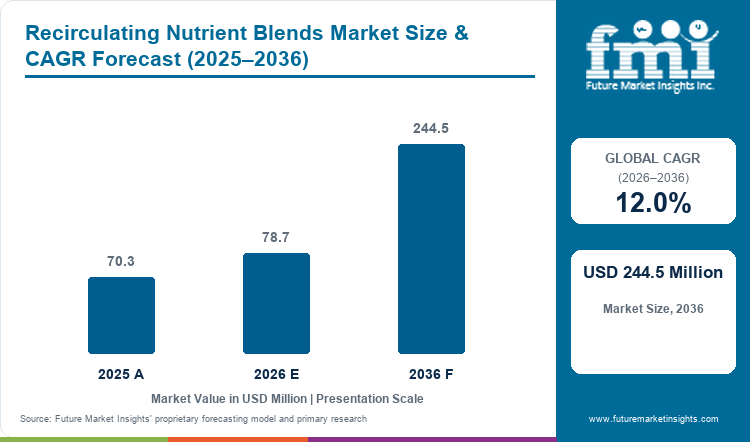
Key Takeaways of Recirculating Nutrient Blends Market
- Repeated reservoir use makes water chemistry and formulation consistency routine operating requirements, which sustains soluble nutrient reorder cycles for protected-crop operators.
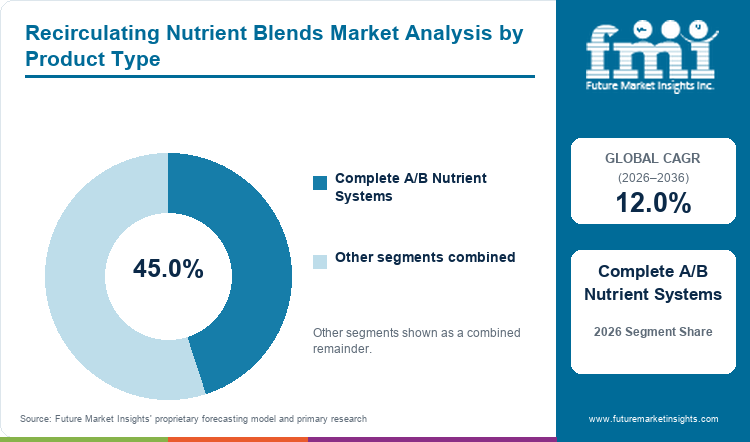
- Complete A/B nutrient systems are projected to account for 45.0% of product type demand in 2026, supported by separation of concentrated salts before dilution.
- Leafy greens & herbs are estimated to hold 42.4% by crop in 2026, driven by short production cycles that favor repeatable reservoir resets.
- Drip substrate (cocopeat - rockwool) is set to represent 49.0% share in 2026, attributable to frequent fertigation and controlled drainage recovery.
- Ion buildup and source-water variation can slow switching since a stable electrical-conductivity reading does not confirm individual nutrient balance.
- Some of the key players in this market include Advanced Nutrients, Athena Ag, Canna, JR Peters (Jack's), Masterblend, Netafim (Orbia), Compo Expert, and Haifa Group.
Analyst Perspective
"Commercial growers should test stock-tank behavior and water-source fit before judging nutrient programs on unit price. Stable chemistry protects margin by reducing corrective labor and avoidable reservoir discharge during repeated crop cycles."
- Nikhil Kaitwade, Principal Consultant, Future Market Insights
How is the Recirculating Nutrient Blends Market segmented?
The recirculating nutrient blends market is segmented by product type, crop, system, grower type, and sales channel.
Product types include complete A/B nutrient systems, single-element additives, biological additives, pH & compatibility aids and others. Crops include leafy greens & herbs, tomatoes & vine crops, berries and ornamentals, and systems cover drip substrate (cocopeat - rockwool), NFT - DWC recirculating, aeroponics and others. Grower types include commercial greenhouses, vertical farms, small commercial & hobby and others, and sales channels include greenhouse suppliers, hydro specialty retail, online - direct, distributors and others.
What makes complete A/B nutrient systems central to the product type category?
Commercial growers separate calcium-rich concentrate from phosphate or sulfate salts until both streams reach irrigation water. Advanced Nutrients made CS2 Prime & Push available in May 2026 as a two-part powdered base system for commercial cultivation and standardized stock preparation.
- By product type, complete A/B nutrient systems are estimated to hold 45.0% in 2026 owing to stock-tank separation that lowers precipitation risk during concentrate dilution.
- Facilities running commercial hydroponics can standardize two concentrated stocks more easily than repeated mixes assembled from separate nutrient salts in centralized dosing rooms.
Why do leafy greens & herbs lead the crop category?
Short harvest cycles make lettuce and herb facilities sensitive to recipe changes between reservoir resets. Destatis recorded 184.41 hectares of other salads under glass or high accessible cover in Germany for 2025. Its February 2026 release gives formulation teams a measurable protected-production base for testing repeatable leaf-crop recipes.
- Leafy greens & herbs are likely to capture 42.4% of crop demand in 2026, attributable to short planting cycles that favor repeatable nutrient recipes.
- Indoor farming operators can compare each cycle against a known EC target and adjust the next reservoir without carrying a long vine-crop feeding history.
How does drip substrate (cocopeat - rockwool) shape the system category?
Drip substrate confines the root zone to a defined media volume and supports short nutrient pulses from centralized dosing equipment. Japan’s Hokkaido Regional Agricultural Administration Office documented an Asahikawa eggplant facility in July 2025 that used drip-fed nutrient solution and computer-controlled delivery.
- Drip substrate (cocopeat - rockwool) is projected to hold 49.0% of system demand in 2026, owing to frequent irrigation that fits planned drainage capture.
- Water-soluble fertilizers fit this system when concentrates dissolve cleanly enough for repeated injector cycles and narrow emitter passages during commercial crop cycles.
What supports commercial greenhouses in the grower type category?
Commercial greenhouses expose more crop area to one nutrient error because shared stock tanks feed multiple bays. USDA NASS reported in February 2026 that corporate-owned horticulture operations accounted for 63% of sector sales during 2024, raising the commercial cost of formulation errors in centralized facilities.
- Commercial greenhouses are likely to capture 45.1% of grower type demand in 2026, supported by centralized fertigation and routine bulk replenishment.
- Commercial greenhouse systems also justify water testing and injector calibration that smaller growers may not perform during each recipe change.
What drives greenhouse suppliers in the sales channel category?
Greenhouse suppliers influence nutrient selection during commercial checks of injector settings and source-water chemistry at each facility. Haifa North West Europe introduced Haifa Soluble DUO at HortiContact in February 2025 and designed the water-soluble fertilizer specifically for fertigation.
- Greenhouse suppliers are projected to hold 47.8% of sales channel demand in 2026, aided by local pack availability and application guidance for commercial facilities.
- Specialty fertilizer formulations sell more readily through greenhouse suppliers as technical representatives resolve concentration and compatibility questions during commercial trials at greenhouse sites.
What are the drivers, restraints and opportunities in the Recirculating Nutrient Blends Market?
Protected cultivation increases repeat purchases while ion accumulation limits recipe transfer, and sensor-linked dosing gives formulators a route to higher-value monitoring and add-back guidance.
- Driver: Protected cultivation expands the installed reservoir base that consumes soluble nutrients through repeated crop cycles.
- Restraint: Sodium and other ions can accumulate during reuse even with overall electrical conductivity near its target range.
- Opportunity: Sensor-linked dosing can turn reservoir measurements into crop-specific replenishment rules that reduce corrective labor.
Every protected-crop facility operates reservoirs and dosing points that consume prepared nutrient solution during each production cycle. USDA NASS counted 23,060 U.S. horticulture operations in the 2024 census released during February 2026. More controlled-environment agriculture facilities increase the installed reservoir base receiving repeated nutrient replenishment as crop uptake changes solution ratios. Concentrate purchases therefore track active crop area and reservoir turnover instead of one-time equipment installation.
Recycled drainage returns sodium and other ions to the reservoir after plants remove nutrients at different rates. A September 2025 ISHS study used raw water containing 2.5 mM sodium and measured individual ions daily in closed-loop cucumber culture. The study kept nutrient concentrations near revised targets by changing the supplied solution instead of relying on EC alone. Commercial programs therefore need water testing and ion-specific correction rules for routine drainage reuse.
Reservoir sensors become commercially useful once measurements trigger a specific replenishment instruction instead of a generic alarm. Netafim partnered with Treetoscope in April 2025 to integrate plant sensing into GrowSphere and generate real-time water and fertilizer recommendations. Fertigation monitoring gives nutrient brands a service route for correcting feed rates early enough to prevent reservoir chemistry from drifting into manual troubleshooting.
Which country CAGRs are profiled in the Recirculating Nutrient Blends Market?
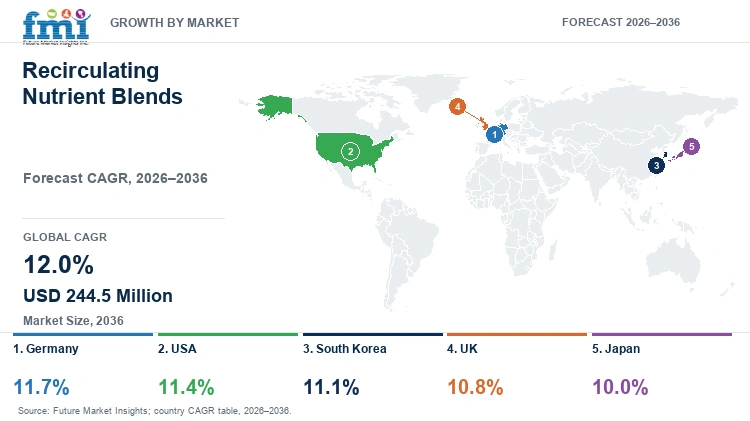
| Country | CAGR |
|---|---|
| Germany | 11.7% |
| USA | 11.4% |
| South Korea | 11.1% |
| UK | 10.8% |
| Japan | 10.0% |
How do country-level CAGRs compare in the recirculating nutrient blends market?
The forecasts span 1.7 percentage points from Germany at 11.7% to Japan at 10.0%. Germany and the USA form a narrow upper pair, with South Korea and the UK clustered just below them. Japan follows at 10.0%, so greenhouse scale and switching costs can shape revenue more than small CAGR differences.
- German greenhouse distributors give commercial growers established channels for concentrated nutrient programs and support.
- U.S. fertilizer brands must manage state registrations before extending commercial nutrient programs into jurisdictions.
- South Korean smart-farm investment raises demand for nutrient products that fit standardized control interfaces.
- UK specialist growing channels give greenhouse operators access to concentrated formulations and application advice.
- Japanese facility farms prefer clean-dissolving inputs that limit storage residue and dosing-system maintenance costs.
The full report provides country-level CAGR analysis across North America, Latin America, Western Europe, Eastern Europe, East Asia, South Asia and Pacific, and the Middle East and Africa.
Country-wise Analysis
- German glasshouse growers run long tomato and cucumber cycles that make midseason nutrient correction more expensive than early recipe adjustment. Germany is estimated to post 11.7% CAGR over the forecast period, shaped by intensive protected-vegetable acreage and long-cycle nutrient management. Destatis reported in February 2026 that vegetables under high accessible cover occupied about 1,250 hectares in 2025. Longer crop duration lets sodium or nutrient-ratio drift compound between full reservoir resets, which raises the cost of late correction. Formulators that fit automated fertigation skids need local water analysis and documented stock concentrations so greenhouse teams can change programs without disrupting existing injector settings.
- U.S. commercial horticulture spans production areas with sharply different source-water chemistry and operating scales. Recirculating nutrient blend demand in the USA is forecast to rise at 11.4% CAGR over the forecast period, driven by protected production and repeated fertigation. In its February 2026 census release, USDA NASS recorded ten states accounting for 67% of U.S. horticulture sales during 2024. Regional concentration makes bulk replenishment practical, although incoming-water composition can vary enough to change the correction required at each site. Commercial programs need water-testing support and compatible concentrated stocks to preserve the same feed logic between locations without assuming identical water at multi-site greenhouse operations.
- South Korean smart-farm operators are adding public training and data support as newer facilities learn standardized greenhouse routines during commercial rollout. MAFRA designated the Korea Agricultural Technology Promotion Agency as the smart-farming support center for controlled horticulture in June 2025. Recirculating nutrient blend demand in South Korea is predicted to advance at 11.1% CAGR through 2036, supported by wider technical capacity for sensor-based cultivation. Uneven operator experience raises switching risk whenever copied feed recipes skip local water checks. Local distributors can use nutrient monitoring devices with simple correction rules and registered products to reduce that training gap during commercial scale-up.
- British protected-vegetable growers evaluate nutrient changes inside a cost base shaped by energy use and seasonal labor. DEFRA reported in June 2026 that protected-vegetable area expanded 4.7% to 866 hectares during 2025. The UK recirculating nutrient blends outlook is anticipated to advance at 10.8% CAGR over the assessment period, supported by protected-area expansion and repeated nutrient management. Thin crop margins make corrective labor a material friction if a new concentrate forces frequent reservoir changes or injector cleaning. Local greenhouse distributors with reliable stock and clear water-compatibility guidance can reduce trial risk by limiting extra cleaning work and avoidable reservoir changes.
- Japanese facility horticulture increasingly treats nutrient recipes as part of a controlled production protocol covering irrigation timing and environmental data. Adoption of recirculating nutrient blends in Japan is estimated to expand at 10.0% CAGR through 2036, influenced by public support for data-based facility horticulture. MAFF opened its fiscal 2026 Smart Facility Horticulture Expansion Promotion program in March 2026 to spread operating methods and technical know-how. Documentation slows switching when a formula change must match local equipment settings and crop procedures. Vertical farming companies can use detailed recipes and local technical support to shorten site validation without changing established control routines.
Who are the notable companies in the Recirculating Nutrient Blends Market?
Advanced Nutrients, Athena Ag, Canna, JR Peters (Jack's), Masterblend, Netafim (Orbia), Compo Expert, and Haifa Group are the notable companies profiled in this market.
Competition depends on which part of the nutrient program each company controls during commercial use. Advanced Nutrients and Athena Ag sell complete feeding programs, whereas Canna and JR Peters (Jack's) focus on nutrient formulations. Masterblend and Compo Expert specialize in soluble formulations, and Haifa Group supplies fertigation inputs for commercial growers. Netafim (Orbia) controls dosing hardware, so nutrient blends must fit the injection equipment already installed.
- Advanced Nutrients with Athena Ag and Canna provide integrated hydroponic nutrition programs for controlled cultivation and repeated reservoir use.
- JR Peters (Jack's), Masterblend and Compo Expert supply professional soluble formulations for controlled cultivation programs and concentrated stock preparation.
- Haifa Group supplies fertigation inputs, and Netafim (Orbia) controls dosing systems used in commercial soilless production and automated nutrient delivery.
Competitive Benchmarking: Recirculating Nutrient Blends Market
| Company | Hydroponic Nutrition Program Coverage | Stock-Tank Compatibility Evidence | Fertigation / Automation Integration | Geographic Reach |
|---|---|---|---|---|
| Advanced Nutrients | High | High | Medium | North America, Europe, Asia-Pacific and Latin America |
| Athena Ag | High | High | High | North America with international distributors |
| Canna | High | High | Medium | Europe, North America and dealer-supported markets |
| JR Peters (Jack's) | Medium | High | Medium | North America with international commercial sales |
| Masterblend | Medium | High | Medium | North America with international distribution |
| Netafim (Orbia) | Low | High | High | Global precision-agriculture network |
| Compo Expert | Medium | High | Medium | Europe with sales offices in multiple regions |
| Haifa Group | High | High | Medium | Global specialty-fertilizer distribution |
Scoring basis: High hydroponic-program coverage requires several documented nutrient lines or structured procedures for soilless cultivation, whereas Medium reflects narrower professional nutrition coverage and Low marks limited direct evidence. High stock-tank compatibility requires documented concentration or solubility evidence from active commercial nutrition programs, with lower scores assigned as supporting evidence narrows. High fertigation integration requires direct dosing or automation support, whereas Medium reflects indirect compatibility and Low marks limited integration. Geographic reach describes documented active commercial regions without converting distribution breadth into a competitive score.
Key Developments in the Recirculating Nutrient Blends Market
- In April 2026, Advanced Nutrients announced the U.S. rollout of RSA within its 8th-Generation Elite Series and scheduled Rhino Skin for discontinuation. RSA gives commercial programs a single-element silica option without changing the existing base nutrient pair.
- In February 2026, Netafim introduced Dosing 5G with automated nutrient dosing and EC or pH stabilization for protected crops. Automated dosing therefore requires soluble concentrates that behave predictably inside the irrigation system itself.
- In March 2025, Compo Expert renewed RHP site certification for substrate-fertilizer production under an independent annual-audit process. The certification documents production controls relevant to substrate-linked nutrition used in controlled root zones.
Key Players in the Recirculating Nutrient Blends Market
Integrated Hydroponic Nutrition Programs
- Advanced Nutrients
- Athena Ag
- Canna
Professional Soluble Formulation Specialists
- JR Peters (Jack's)
- Masterblend
- Compo Expert
Fertigation Inputs and System Integration
- Netafim (Orbia)
- Haifa Group
Recirculating Nutrient Blends Market - Report Scope
| Coverage field | Report scope |
|---|---|
| Market breakdown | By product type, crop, system, grower type, sales channel and region. |
| Quantitative Units | Revenue in USD million and CAGR in %. |
| Market Definition | Commercial nutrient blends and correction products used in recirculating or drainage-recapture soilless cultivation systems. |
| Regions Covered | North America, Latin America, Western Europe, Eastern Europe, East Asia, South Asia and Pacific, and Middle East and Africa. |
| Countries Covered | Germany, USA, South Korea, UK, Japan, and 20+ countries included in the full report. |
| Key Companies Profiled | Advanced Nutrients, Athena Ag, Canna, JR Peters (Jack's), Masterblend, Netafim (Orbia), Compo Expert, Haifa Group. |
| Forecast Period | 2026 to 2036. |
| Approach | Primary and secondary research with market triangulation. |
Recirculating Nutrient Blends Market - Research Methodology
| Method | Approach |
|---|---|
| Primary Research | FMI analysts gathered input from manufacturers, service providers, technology developers, distributors, end users, procurement teams, and subject-matter experts. Interviews examined purchasing decisions, product or service evaluation, adoption barriers, approval requirements, pricing considerations, and expectations for technical or commercial support. Respondents were also asked what evidence is required before a trial, pilot, or initial order develops into regular purchasing. |
| Desk Research | Desk research covered government statistics, regulatory publications, trade data, industry associations, technical literature, standards, company filings, product information, and official corporate announcements. Sources were reviewed for relevance, publication date, geographic coverage, and consistency with the defined market scope. Claims relating to performance, applications, approvals, capacity, investment, and commercial activity were retained only when supported by credible public evidence. |
| Market Sizing and Forecasting | The market model combined the baseline value with historical performance, segment structure, pricing and volume indicators, adoption levels, company participation, and country-level demand conditions. Forecast assumptions considered economic activity, investment trends, regulatory developments, technology adoption, purchasing cycles, supply availability, and barriers to wider market use. Segment and regional estimates were reconciled before the final market total was calculated. |
| Data Validation | Estimates were checked against multiple independent indicators, including public data, company activity, trade patterns, industry developments, and findings from primary interviews. Validation also tested whether products, services, applications, and company revenues fell within the defined market boundaries. Adjacent categories, unsupported claims, overlapping revenues, and activities without direct market relevance were excluded to reduce double counting and maintain consistency across segments and countries. |
Recirculating Nutrient Blends Market by Segments
Recirculating Nutrient Blends Market segmented by Product Type:
- Complete A/B Nutrient Systems
- Single-Element Additives
- Biological Additives
- pH & Compatibility Aids
- Others
Recirculating Nutrient Blends Market segmented by Crop:
- Leafy Greens & Herbs
- Tomatoes & Vine Crops
- Berries
- Ornamentals
- Others
Recirculating Nutrient Blends Market segmented by System:
- Drip Substrate (Cocopeat - Rockwool)
- NFT - DWC Recirculating
- Aeroponics
- Others
Recirculating Nutrient Blends Market segmented by Grower Type:
- Commercial Greenhouses
- Vertical Farms
- Small Commercial & Hobby
- Others
Recirculating Nutrient Blends Market segmented by Sales Channel:
- Greenhouse Suppliers
- Hydro Specialty Retail
- Online - Direct
- Distributors
- Others
Recirculating Nutrient Blends Market by Region:
- North America
- United States
- Canada
- Latin America
- Brazil
- Mexico
- Chile
- Rest of Latin America
- Western Europe
- Germany
- United Kingdom
- Italy
- Spain
- France
- Nordics
- Benelux
- Rest of Western Europe
- Eastern Europe
- Russia
- Poland
- Hungary
- Balkan and Baltic States
- Rest of Eastern Europe
- East Asia
- China
- Japan
- South Korea
- South Asia and Pacific
- India
- ASEAN
- Australia and New Zealand
- Rest of South Asia and Pacific
- Middle East and Africa
- Kingdom of Saudi Arabia
- Other GCC Countries
- Türkiye
- South Africa
- Other African Union Countries
- Rest of Middle East and Africa
Research Sources and Bibliography
- U.S. Department of Agriculture, National Agricultural Statistics Service. (2026, February 26). U.S. Horticulture Operations Report $18.3 Billion in Sales.
- Department for Environment, Food & Rural Affairs. (2026, June 25). Horticulture statistics 2025.
- Advanced Nutrients. (2026, May 5). Meet Advanced Nutrients Elite Series CS2™ - 8th-Generation Base Nutrition for Commercial Cannabis.
- German Federal Statistical Office. (2026, February 26). Holdings, agricultural area, yield and harvest volume.
- Hokkaido Regional Agricultural Administration Office, Ministry of Agriculture, Forestry and Fisheries. (2025, July 23).
- Haifa Group. (2025, February 17). Haifa North West Europe launches innovative water-soluble fertilizer Haifa Soluble DUO.
- Giannothanasis, E., Tzouganakis, M., Ntanasi, T., Karavidas, I., Argyropoulou, K., Ntatsi, G., Thompson, R. B., & Savvas, D. (2025, September 30). Improving the control of sodium accumulation in closed-loop soilless culture systems using ion selective electrodes and the DSS NUTRISENSE.
- Orbia Netafim. (2025, April 15). Orbia Netafim Expands Digital Farming Capabilities with Treetoscope’s Plant Sensing Technology.
- Ministry of Agriculture, Food and Rural Affairs, Republic of Korea. (2025, June 17). S. Korea Accelerates Turning Agricultural Production into Smart Farming through Smart Farming Support Centres.
- Ministry of Agriculture, Forestry and Fisheries, Japan. (2026, March 27).
- Advanced Nutrients. (2026, March 6). Meet RSA - The New and Improved Advanced Nutrients Silica Formula.
- Orbia Netafim. (2026, February 17). Orbia Netafim Supercharges Precision Fertigation with AI-Powered Dosing 5G Product Range.
- COMPO EXPERT. (2025, March 30). Our substrate fertilizers and production sites are RHP certified.
- Advanced Nutrients. (2026, February 11). The Advanced Nutrients’ 8th-Generation Elite Series: Our Most Powerful Commercial Cultivation System Yet.
- Orbia Netafim. (2026, August 13). Orbia Netafim Launches GrowSphere™ FLEX to Scale Digital Farming for Smallholders and Mid-Sized Farmers.
- Advanced Nutrients. (2026, April 22). Advanced Nutrients Announces the Cultivator’s Vault: A Resource Hub for Commercial Cannabis.
- Advanced Nutrients. (2026, February 2). Advanced Nutrients Debuts Elite Commercial Package at CannMed 2026.
- Haifa Group. (2025, February 2). Haifa Group Expands in Brazil: New Multicote™ Blending Facility Opens in Uberlândia.
- New York State Department of Agriculture & Markets. (2025, May 7). Commercial Fertilizer Distributor License Master List.
- Orbia Netafim. (2026, June 4). Orbia Netafim Expands Americas Footprint with New Manufacturing Plant in Mexico.
- COMPO EXPERT. (2025, June 10). Next low-carbon raw material.
- Maryland Department of Agriculture. (2025, October 9). Registered Products - Fertilizer-2025-10-09-16-17-31.xlsx.
- Haifa Group. (2025, January 23). Haifa Group Launches its 18th International Subsidiary in India.
- Advanced Nutrients. (2026, June 23). Advanced Nutrients Earns ISO Certification for Cannabis-Specific Plant Nutrition.
This bibliography is provided for reader reference and is not exhaustive. The full report contains the complete reference list and detailed citations
This Report Answers
- What is the recirculating nutrient blends market size in 2026 and 2036?
- Which conditions turn protected cultivation into repeat nutrient-blend purchases?
- Why do complete A/B nutrient systems hold 45.0% of product type demand?
- Why do leafy greens & herbs hold 42.4% of crop demand?
- How does drip substrate shape nutrient dosing and drainage recovery?
- How do profiled country CAGRs compare through 2036?
- Which companies serve nutrition, soluble formulation and fertigation roles?
- How do sodium accumulation and sensor-linked dosing change formulation requirements?
Frequently Asked Questions
How big is the Recirculating Nutrient Blends Market in 2026?
The recirculating nutrient blends market is valued at USD 78.7 million in 2026 and is projected to reach USD 244.5 million by 2036. Protected cultivation increases the number of reservoirs that require repeated soluble nutrient replenishment programs.
What is the CAGR of the Recirculating Nutrient Blends Market from 2026 to 2036?
The recirculating nutrient blends market is projected to grow at a CAGR of 12.0% between 2026 and 2036. Expansion follows controlled-environment production and automated fertigation systems that make nutrient consistency more important during repeated reservoir use.
Which product type leads the Recirculating Nutrient Blends Market?
The complete A/B nutrient systems segment is expected to hold 45.0% of the recirculating nutrient blends market in 2026, attributable to separating concentrated salts before dilution. The paired-stock format also reduces recipe preparation work for greenhouse teams using centralized dosing rooms.
Which system leads the Recirculating Nutrient Blends Market?
The drip substrate (cocopeat - rockwool) segment is expected to hold 49.0% of the recirculating nutrient blends market in 2026, driven by frequent fertigation and planned drainage capture. Operators can meter solution into a defined root zone while recovering drainage for controlled reuse.
How much value will the Recirculating Nutrient Blends Market add between 2026 and 2036?
The recirculating nutrient blends market is expected to add USD 165.8 million in value between 2026 and 2036. Additional value comes from protected-crop capacity and more intensive formulation requirements in recirculating fertigation systems.
Which countries dominate the growth prospects through 2036?
Germany is projected to grow at 11.7% CAGR, followed by the USA at 11.4% and South Korea at 11.1% through 2036. Country growth differs because greenhouse scale, technical support and feed-program switching costs vary between national markets.
Which companies are active in the Recirculating Nutrient Blends Market?
Key companies operating in the recirculating nutrient blends market include Advanced Nutrients, Athena Ag, Canna, JR Peters (Jack's), Masterblend, Netafim (Orbia), Compo Expert, and Haifa Group. Their positions differ by complete feeding programs, soluble formulation expertise and documented integration with commercial fertigation systems.
Preview the report firsthand - request a free sample
Get SampleGet the brochure for pricing and purchase details.
Get PDFTable of Content
- Key Takeaways
- Market Size and CAGR
- Top Growth Driver
- Fastest Growing Segment
- Leading Region
- Key Companies
- Emerging Opportunities
- Executive Summary
- Global Market Outlook
- Demand-side Trends
- Supply-side Trends
- Technology Roadmap Analysis
- Analysis and Recommendations
- Analyst Perspective (What is happening? Why now? What should investors know?)
- Key Questions Answered
- How large is the market?
- What is the CAGR?
- What are key trends?
- Which region dominates?
- Who are the leaders?
- Market Overview
- Market Coverage / Taxonomy
- Market Definition / Scope / Limitations
- Research Methodology
- Chapter Orientation
- Analytical Lens and Working Hypotheses
- Market Structure, Signals, and Trend Drivers
- Benchmarking and Cross-market Comparability
- Market Sizing, Forecasting, and Opportunity Mapping
- Research Design and Evidence Framework
- Desk Research Programme (Secondary Evidence)
- Expert Input and Fieldwork (Primary Evidence)
- Tooling, Models, and Reference Databases
- Data Engineering and Model Build
- Quality Assurance and Audit Trail
- Market Background
- Market Dynamics (Drivers, Restraints, Opportunity, Trends)
- Scenario Forecast (Optimistic, Likely, Conservative)
- Impact Analysis
- AI Impact
- Sustainability Impact
- Regulatory Impact
- Technology Impact
- Consumer / Buyer Analysis
- Purchase Drivers
- Adoption Barriers
- Buyer Journey
- Opportunity Map Analysis
- Product Life Cycle Analysis
- Supply Chain Analysis
- Investment Feasibility Matrix
- Value Chain Analysis
- PESTLE and Porter's Analysis
- Regulatory Landscape
- Regional Parent Market Outlook
- Production and Consumption Statistics
- Import and Export Statistics
- Global Market Analysis and Forecast, 2021 to 2036
- Historical Market Size Value (USD Million) Analysis, 2021 to 2025
- Current and Future Market Size Value (USD Million) Projections, 2026 to 2036
- Y-o-Y Growth Trend Analysis
- Absolute $ Opportunity Analysis
- Global Market Pricing Analysis, 2021 to 2036
- Global Market Analysis and Forecast, By Product Type, 2021 to 2036
- Introduction / Key Findings
- Historical Market Size Value (USD Million) Analysis By Product Type, 2021 to 2025
- Current and Future Market Size Value (USD Million) Analysis and Forecast By Product Type, 2026 to 2036
- Complete A/B Nutrient Systems
- Single-Element Additives
- Biological Additives
- pH & Compatibility Aids
- Others
- Y-o-Y Growth Trend Analysis By Product Type, 2021 to 2025
- Absolute $ Opportunity Analysis By Product Type, 2026 to 2036
- Global Market Analysis and Forecast, By Crop, 2021 to 2036
- Introduction / Key Findings
- Historical Market Size Value (USD Million) Analysis By Crop, 2021 to 2025
- Current and Future Market Size Value (USD Million) Analysis and Forecast By Crop, 2026 to 2036
- Leafy Greens & Herbs
- Tomatoes & Vine Crops
- Berries
- Ornamentals
- Others
- Y-o-Y Growth Trend Analysis By Crop, 2021 to 2025
- Absolute $ Opportunity Analysis By Crop, 2026 to 2036
- Global Market Analysis and Forecast, By System, 2021 to 2036
- Introduction / Key Findings
- Historical Market Size Value (USD Million) Analysis By System, 2021 to 2025
- Current and Future Market Size Value (USD Million) Analysis and Forecast By System, 2026 to 2036
- Drip Substrate (Cocopeat - Rockwool)
- NFT - DWC Recirculating
- Aeroponics
- Others
- Y-o-Y Growth Trend Analysis By System, 2021 to 2025
- Absolute $ Opportunity Analysis By System, 2026 to 2036
- Global Market Analysis and Forecast, By Grower Type, 2021 to 2036
- Introduction / Key Findings
- Historical Market Size Value (USD Million) Analysis By Grower Type, 2021 to 2025
- Current and Future Market Size Value (USD Million) Analysis and Forecast By Grower Type, 2026 to 2036
- Commercial Greenhouses
- Vertical Farms
- Small Commercial & Hobby
- Others
- Y-o-Y Growth Trend Analysis By Grower Type, 2021 to 2025
- Absolute $ Opportunity Analysis By Grower Type, 2026 to 2036
- Global Market Analysis and Forecast, By Sales Channel, 2021 to 2036
- Introduction / Key Findings
- Historical Market Size Value (USD Million) Analysis By Sales Channel, 2021 to 2025
- Current and Future Market Size Value (USD Million) Analysis and Forecast By Sales Channel, 2026 to 2036
- Greenhouse Suppliers
- Hydro Specialty Retail
- Online - Direct
- Distributors
- Others
- Y-o-Y Growth Trend Analysis By Sales Channel, 2021 to 2025
- Absolute $ Opportunity Analysis By Sales Channel, 2026 to 2036
- Global Market Analysis and Forecast, By Region, 2021 to 2036
- Introduction
- Historical Market Size Value (USD Million) Analysis By Region, 2021 to 2025
- Current Market Size Value (USD Million) Analysis and Forecast By Region, 2026 to 2036
- North America
- Latin America
- Western Europe
- Eastern Europe
- East Asia
- South Asia and Pacific
- Middle East and Africa
- Market Attractiveness Analysis By Region
- North America Market Analysis and Forecast, By Country, 2021 to 2036
- Historical Market Size Value (USD Million) Trend Analysis By Market Taxonomy, 2021 to 2025
- Market Size Value (USD Million) Forecast By Market Taxonomy, 2026 to 2036
- By Country
- United States
- Canada
- By Product Type
- By Crop
- By System
- By Grower Type
- By Sales Channel
- By Country
- Market Attractiveness Analysis
- By Country
- By Product Type
- By Crop
- By System
- By Grower Type
- By Sales Channel
- Key Takeaways
- Latin America Market Analysis and Forecast, By Country
- Historical Market Size Value (USD Million) Trend Analysis By Market Taxonomy, 2021 to 2025
- Market Size Value (USD Million) Forecast By Market Taxonomy, 2026 to 2036
- By Country
- Brazil
- Mexico
- Chile
- Rest of Latin America
- By Product Type
- By Crop
- By System
- By Grower Type
- By Sales Channel
- By Country
- Market Attractiveness Analysis
- By Country
- By Product Type
- By Crop
- By System
- By Grower Type
- By Sales Channel
- Key Takeaways
- Western Europe Market Analysis and Forecast, By Country
- Historical Market Size Value (USD Million) Trend Analysis By Market Taxonomy, 2021 to 2025
- Market Size Value (USD Million) Forecast By Market Taxonomy, 2026 to 2036
- By Country
- Germany
- United Kingdom
- Italy
- Spain
- France
- Nordics
- Benelux
- Rest of Western Europe
- By Product Type
- By Crop
- By System
- By Grower Type
- By Sales Channel
- By Country
- Market Attractiveness Analysis
- By Country
- By Product Type
- By Crop
- By System
- By Grower Type
- By Sales Channel
- Key Takeaways
- Eastern Europe Market Analysis and Forecast, By Country
- Historical Market Size Value (USD Million) Trend Analysis By Market Taxonomy, 2021 to 2025
- Market Size Value (USD Million) Forecast By Market Taxonomy, 2026 to 2036
- By Country
- Russia
- Poland
- Hungary
- Balkan and Baltic States
- Rest of Eastern Europe
- By Product Type
- By Crop
- By System
- By Grower Type
- By Sales Channel
- By Country
- Market Attractiveness Analysis
- By Country
- By Product Type
- By Crop
- By System
- By Grower Type
- By Sales Channel
- Key Takeaways
- East Asia Market Analysis and Forecast, By Country
- Historical Market Size Value (USD Million) Trend Analysis By Market Taxonomy, 2021 to 2025
- Market Size Value (USD Million) Forecast By Market Taxonomy, 2026 to 2036
- By Country
- China
- Japan
- South Korea
- By Product Type
- By Crop
- By System
- By Grower Type
- By Sales Channel
- By Country
- Market Attractiveness Analysis
- By Country
- By Product Type
- By Crop
- By System
- By Grower Type
- By Sales Channel
- Key Takeaways
- South Asia and Pacific Market Analysis and Forecast, By Country
- Historical Market Size Value (USD Million) Trend Analysis By Market Taxonomy, 2021 to 2025
- Market Size Value (USD Million) Forecast By Market Taxonomy, 2026 to 2036
- By Country
- India
- ASEAN
- Australia and New Zealand
- Rest of South Asia and Pacific
- By Product Type
- By Crop
- By System
- By Grower Type
- By Sales Channel
- By Country
- Market Attractiveness Analysis
- By Country
- By Product Type
- By Crop
- By System
- By Grower Type
- By Sales Channel
- Key Takeaways
- Middle East and Africa Market Analysis and Forecast, By Country
- Historical Market Size Value (USD Million) Trend Analysis By Market Taxonomy, 2021 to 2025
- Market Size Value (USD Million) Forecast By Market Taxonomy, 2026 to 2036
- By Country
- Kingdom of Saudi Arabia
- Other GCC Countries
- Türkiye
- South Africa
- Other African Union Countries
- Rest of Middle East and Africa
- By Product Type
- By Crop
- By System
- By Grower Type
- By Sales Channel
- By Country
- Market Attractiveness Analysis
- By Country
- By Product Type
- By Crop
- By System
- By Grower Type
- By Sales Channel
- Key Takeaways
- Key Countries Market Analysis
- United States
- Pricing Analysis
- Market Share Analysis, 2025
- By Product Type
- By Crop
- By System
- By Grower Type
- By Sales Channel
- Canada
- Pricing Analysis
- Market Share Analysis, 2025
- By Product Type
- By Crop
- By System
- By Grower Type
- By Sales Channel
- Mexico
- Pricing Analysis
- Market Share Analysis, 2025
- By Product Type
- By Crop
- By System
- By Grower Type
- By Sales Channel
- Brazil
- Pricing Analysis
- Market Share Analysis, 2025
- By Product Type
- By Crop
- By System
- By Grower Type
- By Sales Channel
- Chile
- Pricing Analysis
- Market Share Analysis, 2025
- By Product Type
- By Crop
- By System
- By Grower Type
- By Sales Channel
- Germany
- Pricing Analysis
- Market Share Analysis, 2025
- By Product Type
- By Crop
- By System
- By Grower Type
- By Sales Channel
- United Kingdom
- Pricing Analysis
- Market Share Analysis, 2025
- By Product Type
- By Crop
- By System
- By Grower Type
- By Sales Channel
- Italy
- Pricing Analysis
- Market Share Analysis, 2025
- By Product Type
- By Crop
- By System
- By Grower Type
- By Sales Channel
- Spain
- Pricing Analysis
- Market Share Analysis, 2025
- By Product Type
- By Crop
- By System
- By Grower Type
- By Sales Channel
- France
- Pricing Analysis
- Market Share Analysis, 2025
- By Product Type
- By Crop
- By System
- By Grower Type
- By Sales Channel
- India
- Pricing Analysis
- Market Share Analysis, 2025
- By Product Type
- By Crop
- By System
- By Grower Type
- By Sales Channel
- ASEAN
- Pricing Analysis
- Market Share Analysis, 2025
- By Product Type
- By Crop
- By System
- By Grower Type
- By Sales Channel
- Australia and New Zealand
- Pricing Analysis
- Market Share Analysis, 2025
- By Product Type
- By Crop
- By System
- By Grower Type
- By Sales Channel
- China
- Pricing Analysis
- Market Share Analysis, 2025
- By Product Type
- By Crop
- By System
- By Grower Type
- By Sales Channel
- Japan
- Pricing Analysis
- Market Share Analysis, 2025
- By Product Type
- By Crop
- By System
- By Grower Type
- By Sales Channel
- South Korea
- Pricing Analysis
- Market Share Analysis, 2025
- By Product Type
- By Crop
- By System
- By Grower Type
- By Sales Channel
- Russia
- Pricing Analysis
- Market Share Analysis, 2025
- By Product Type
- By Crop
- By System
- By Grower Type
- By Sales Channel
- Poland
- Pricing Analysis
- Market Share Analysis, 2025
- By Product Type
- By Crop
- By System
- By Grower Type
- By Sales Channel
- Hungary
- Pricing Analysis
- Market Share Analysis, 2025
- By Product Type
- By Crop
- By System
- By Grower Type
- By Sales Channel
- Kingdom of Saudi Arabia
- Pricing Analysis
- Market Share Analysis, 2025
- By Product Type
- By Crop
- By System
- By Grower Type
- By Sales Channel
- Türkiye
- Pricing Analysis
- Market Share Analysis, 2025
- By Product Type
- By Crop
- By System
- By Grower Type
- By Sales Channel
- South Africa
- Pricing Analysis
- Market Share Analysis, 2025
- By Product Type
- By Crop
- By System
- By Grower Type
- By Sales Channel
- United States
- Market Structure Analysis
- Competition Dashboard
- Competition Benchmarking
- Market Share Analysis of Top Players
- By Regional
- By Product Type
- By Crop
- By System
- By Grower Type
- By Sales Channel
- Emerging Startups
- Innovation Benchmarking
- Competition Analysis
- Competition Deep Dive
- Advanced Nutrients
- Overview
- Product Portfolio
- Profitability by Market Segments
- Sales Footprint
- Strategy Overview
- Marketing Strategy
- Product Strategy
- Channel Strategy
- Athena Ag
- Canna
- JR Peters (Jack's)
- Masterblend
- Compo Expert
- Netafim (Orbia)
- Haifa Group
- Advanced Nutrients
- Case Studies
- Success Stories
- Recent Developments
- Competition Deep Dive
- Assumptions & Acronyms Used


